




Abstract
The present study examined whether bullying, defending, and outsider behaviors in preschool children were associated with two conscience aspects (empathic concern and internalization of rules) and with emotion understanding. We also investigated whether emotion understanding moderated the relationship between these dimensions and bullying roles. Participants were 105 children (51 males), aged 36 to 76 months. Bullying roles were assessed through peer nominations. Internalization of rules and empathic concern were observed in classroom and their scores derived from selected Q-Sort items. Emotion understanding was evaluated with the Puppet Interview administered to children. Results showed that empathic concern and internalization of rules were negatively associated with bullying and outsider behaviors, whereas emotion understanding correlated with defending behavior. The interaction between emotion understanding and internalization of rules was also significant: Low scores on rule-compatible conduct were associated with bullying or outsider behavior, in particular for those children with poor emotion understanding.
Keywords
Recently, the emergence of bullying among preschool children has received increasing attention. Literature indicates that specific patterns of bullying and victimization, such as repetitive and unjustified harassment, and imbalance of power are already present at a young age, and that the characteristics of children involved mirror those found at older ages (Alsaker & Valkanover, 2001; Vlachou, Andreou, Botsoglou, & Didaskalou, 2011). Moreover, it seems that the classroom dynamics observed in bullying among school-aged children and adolescents (Salmivalli, Lagerspetz, Björkqvist, Österman, & Kaukiainen, 1996) can be observed in preschool children as well. A few studies found that, besides the roles of the bully and the victim, other roles can be detected in kindergarten, such as the follower of the bully, the defender of the victim, and the outsider (Belacchi & Farina, 2000; Camodeca, Caravita, & Coppola, 2015; Monks, Smith, & Swettenham, 2003). In particular, some children can defend the victims by consoling them or by standing up against the bully; they are characterized by responsibility, social competence, and a higher tendency to experience moral emotions than other children. The outsider behavior includes not taking side and shying away from bullying episodes. Literature on school-aged children and adolescents yielded contrasting findings about the characteristics of outsider behavior, either claiming its similarity with defending behavior (e.g. on social cognition, empathy, low aggression), or underlining aspects typical of bullying (e.g. low guilt; Menesini & Camodeca, 2008).
Studies on late childhood and preadolescence identified morality as one of the possible correlates of bullying roles, because it is meant to guide behavior and to suggest what is right and what is wrong (e.g. Caravita, Gini, & Pozzoli, 2012; Menesini & Camodeca, 2008). However, to the best of our knowledge, no work is available supporting the association between moral aspects and involvement in bullying among preschool children, despite morality issues related to the development of conscience and of a moral self becoming more and more important in this period.
Indeed, according to Kochanska and colleagues, early conscience begins to emerge in the toddler and preschool years, it is defined as the system of internalized values and standards of behavior, and it is rooted in two key aspects of the parent–child relationship, that is, the child’s cumulative history of internalization of rules and of empathic concern within family (Aksan & Kochansha, 2005; Kochanska, Koenig, Barry, Kim, & Yoon, 2010). The authors showed that both of these dimensions promote future moral development and adaptive functioning, and inhibit antisocial behavior. In particular, empathic concern arises as an emotional response deriving from the comprehension of another’s state of distress, resembling, in this sense, sympathy. It is commonly considered as a foundation of moral sensibility and it is associated with guilt and others-oriented motivation (Eisenberg, 2000; Kochanska et al., 2010). As to internalization of rules, it is related with concern for wrongdoing and consequent regulation of conduct on the basis of socially accepted norms, values, and expectations, and thus it involves positive and cooperative behaviors. In contrast, noncompliance and opposition have been associated with low levels of remorse, deficits in regulating conduct in appropriate ways, and immoral motivations and desires (Kochanska et al., 2010; Turiel, 2006).
In sum, children who respond empathically to others’ distress and who internalize rules are more likely to meet a positive adaptation and stay away from behavioral problems (Kochanska et al., 2010). Therefore, we have reasons to think that these aspects may also be an interesting interpretative key to understand bullying dynamics at a young age. However, because these antecedents have been usually assessed within the relationship with the parents (Aksan & Kochanska, 2005; Kochanska et al., 2010), less is known about whether they play a salient role in the child’s socioemotional functioning outside of the family context, such as in the classroom, where children deal with peers’, instead of parents’, behaviors and emotions.
Our first aim was to shed light on the associations between bullying roles and the aspects of empathic concern and internalization of rules in preschool children. We expected bullying behavior to be associated with low levels of rule internalization and empathic concern, and defending behavior to be associated with high levels of these aspects. Given the contrasting findings in the literature, we did not formulate specific hypotheses for the outsider behavior, which has been considered on an exploratory basis.
The preschool period is also paramount for the development of emotion understanding. Specifically, starting from the second year of life, throughout preschool years, children become more and more capable of appropriately using and understanding labels referring to basic emotions, as well as coherently discussing their own and others’ emotional reactions (Denham, 1998; Pons & Harris, 2005; Pons, Lawson, Harris, & de Rosnay, 2003). Consistent findings show that emotion understanding promotes positive socioemotional development, such as effective emotion regulation, social competence, moral sensibility, and consideration of others’ needs, and prevents the emergence of internalizing and externalizing behavioral problems (Denham, 1998; Dunn, Brown, & Maguire, 1995; Eisenberg, 2000; Lane, Wellman, Olson, LaBounty, & Kerr, 2010; Trentacosta & Fine, 2010). Given the role of emotion understanding in influencing social behavior, it is plausible to hypothesize that it might also work as a protective factor against involvement in bullying. However, only one study has focused on this relationship in the preschool age. This suggests that a good comprehension of emotions is positively associated with defending behavior and negatively associated with outsider behavior (Belacchi & Farina, 2010). However, empirical evidence of the interplay between conscience, emotion understanding, and bullying roles is not available.
Our second aim was therefore to explore the role of emotion understanding in affecting bullying roles, both as main effect and in interaction with empathic concern and internalization of rules. We expected that a high competence in emotion understanding was associated with defending behavior, and that a low competence in emotion understanding could be a risk factor for engaging in bullying. We also hypothesized a negative association between outsider behavior and emotion understanding, as found in a previous study (Belacchi & Farina, 2010). Moreover, in the presence of low levels of empathic concern and internalization of rules, high emotion understanding could favor children’s propensity to consider the impact of their own negative behaviors on their peers’ feelings, preventing them from displaying bullying acts. Therefore, we also anticipated that a high level of emotion understanding could work as a protective factor in reducing the risk of deficits in conscience dimensions on negative behaviors. We also tested whether emotion understanding, in interaction with conscience aspects, favored defending behavior and reduced outsider behavior, although we did not formulate clear predictions about these relations.
Method
Sample
Participants were 105 children (51 males and 54 females), aged 36 to 76 months (M = 58.19; SD = 10.55) attending two kindergartens in central Italy. This age range reflects the body of children typically attending the public Italian preschool system, where children enter when they are three years old or if they will turn three before December of the same year. Independently from their date of birth, children remain in preschool till the end of the third school year.
The purpose and the methodology of the study were explained to schools principals, teachers, and parents, who gave their consent and were assured confidentiality and anonymity of the data collected. Graduates in Psychology, appropriately trained, administered the interviews individually to assess emotion understanding and bullying behaviors, and conducted the observations in classroom to obtain the Q-Sort scores.
Measures
Bullying behaviors
The Participant Roles Questionnaire for Preschool children (PRQ-P), based on peer nominations on eight items, assesses five roles of participation in bullying: bully, victim, follower of the bully, defender of the victim, and outsider (Camodeca et al., 2015). In order to control for classroom size, the nominations received by each child in all items are standardized by class into z-scores. Previous findings showed good psychometric properties of the PRQ-P with same-age children (Camodeca et al., 2015). Consistent with this, we replicated with our data the 5-factor solution by means of a Confirmatory Factor Analysis (χ2(15) = 17.82; p = .27; CFI = .98; RMSEA = .043).
However, for the purpose of the present study, we were only interested in the roles of bully (two items: “Makes fun of his/her classmates and makes them cry”; “Does nasty tricks and says bad things to other children”), defender of the victim (two items: “Defends the children who are being beaten or teased”; “Tries to console the children who cry because they have been beaten or isolated”), and outsider (one item: “Remains indifferent if a child is being teased or left alone”). The characteristics of imbalance of power and repeated perpetration are reflected in the items assessing bullying, as children are asked to nominate those peers who usually behave in that way and who, therefore, are considered to play a specific role. The dimensions of general aggression or conflict, in contrast, would have stressed, for instance, the involvement in fights or a mutual responsibility.
Items were read individually to children and great care was taken in order to allow all children to understand words and questions (e.g. children were familiarized with the procedure; if they showed a low comprehension, other, simpler, words were used; questions were formulated more than once; children were asked if they had understood). Children were presented with the photos of their classmates and were asked to indicate or nominate the peers whose behavior fitted with the one described in the items. When, in very few cases, photos were not available, caution was taken to obtain reliable responses (e.g. children were asked to think about all their classmates, even those not present that day). Descriptive statistics and reliabilities for the three scales are displayed in Table 1.
Conscience aspects
The California Child Q-Sort (CCQ), composed of 100 items, and the Preschool Q-Sort (PQ), consisting of 72 items (Block & Block, 1980; Waters, Noyes, Vaughn, & Ricks, 1985; Italian adaptation, Coppola & Camodeca, 2010) were employed. Two trained graduates (assigned to one kindergarten each) were involved in observing the sample: They were previously trained with pilot observations until a full understanding of the meaning of each item was achieved. Observations in each class were required to be at least 20 hours long in a week time (Vaughn, Santos, & Coppola, 2014). Afterwards, the items of the two Q-Sets were sorted on the basis of their similarity to each child’s behavior into nine categories (from 1 = completely different from target child’s behavior, to 9 = completely similar to target child’s behavior).
Consistent with one of the scoring option offered by the Q-Sort methodology (Vaughn et al., 2014), the authors separately selected those items concerning two aspects of conscience (i.e. empathic concern and internalization of rules), trying to focus on the most salient and less ambiguous ones. Then, they discussed the results to reach an agreement about which ones keeping. These items were subjected to a factor analysis (extraction: Principal Axis Factoring, rotation: promax). Two factors were extracted (64.24% and 14.28% of explained variance, loadings range .42-.99). The first factor was named empathic concern and included four items on understanding and caring about others’ feelings: “Is considerate of other children”; “Shows concern for moral issues (reciprocity, fairness, etc.)”; “Shows a recognition of others’ feelings, empathic”; and “Sympathetic towards peers’ distress.” The second factor included three items about understanding and respect for socially accepted rules, and was named internalization of rules: “Is obedient”; “Understands school procedures” [translated as rules in Italian]; and “Concerned about adult disapproval.”
The inter-observers’ agreement was assessed on 20% of the total sample (N = 21) using the observations provided by teachers preliminary trained to use the Q-sort methodology. The ICC (Intra-Class Correlation) on the scores for empathic concern and internalization of rules yielded values of .76 and .80, respectively. Psychometric properties are shown in Table 1.
Psychometric Properties of Study Variables and Correlations Among Them.

Note. N = 105. CI = confidence interval. Means with different superscripts (a and b) differ significantly (p < .05) between boys and girls. The outsider behavior scale was composed of a single item, so reliability is not available.
†p < .10. *p < .05. **p < .01. ***p < .001.
Emotion understanding
The Puppet Interview (Denham, 1998; Italian adaptation, Camodeca & Coppola, 2010) was used to assess children’s ability to recognize basic emotions. We employed four stylized faces expressing basic emotions (sadness, happiness, anger, and fear) and gender-matched drawings of children and mother (“puppets”). The procedure includes five tasks. The first two evaluate the child’s expressive and receptive identification, each by means of four questions corresponding to the four emotions. The third task assesses the child’s ability to identify the stereotypical emotion elicited by situational antecedents, using eight scenarios with puppets (e.g. “‘Hi! I’m Paolo. Here is my brother Gianni. Ah! He gave me some ice cream. Yum Yum!’ How does Paolo feel?”). The fourth task examines child’s perspective-taking abilities when the puppet’s emotional response is different from the one that the child would typically display in such a scenario (e.g. a child who is usually quite happy to go to school is asked to recognize that the puppet is sad about going to school). The child’s unlikely response is identified through questions to parents on 12 situations. In the third and fourth tasks, children are asked to both indicate and label the correct emotion. The last task assesses the child’s ability to articulate the causes of happiness, sadness, anger, and fear with reference to the self (four questions) and the puppet (four questions) (e.g. “What would make you feel this way?” and “Why does Paolo feels this way, according to you?”).
Scores are attributed on the basis of the correct identification: 0 if the child neither identifies the emotion nor the emotional tone (e.g. he/she says happy instead of scared), 1 if he/she does not identify the emotion, but identifies the emotional tone (e.g. he/she says angry instead of sad), and 2 if he/she identifies the emotion correctly. Scores were totaled throughout the five tasks in order to have a single measure of emotion understanding. Table 1 reports descriptive statistics and reliability.
Results
Preliminary analyses
In order to verify gender and age differences on all variables (bullying behaviors, empathic concern, internalization of rules, and emotion understanding), t-tests and correlations were conducted. Boys scored higher than girls on bullying and outsider behaviors (t(103) = 5.35, p < .001, and t(103) = 2.53, p < .05, respectively), whereas girls scored higher than boys on empathic concern and internalization of rules (t(103) = −2.22, p < .05, and t(103) = −2.38, p < .05; respectively). Descriptive statistics are displayed in Table 1. As to age, this correlated with defending behavior (r = .31, p < .01) and emotion understanding (r = .41, p < .001).
Correlations between bullying behaviors and emotion understanding and conscience aspects were first run separately for boys and girls, then separately for two age groups (lower and higher than the mean). The significance of the difference between correlation coefficients was tested using the Fisher r-to-z transformation. Given that no gender or age differences emerged in any of the correlations (except in the one between defending behavior and internalization of rules, boys: r = .29, p < .05, and girls: r = −.12, ns), following correlations were run again for the whole group (Table 1).
Main analyses
Three hierarchical regression analyses were run for the three bullying-related behaviors as dependent variables. Given that previous correlations only revealed gender differences in the association between defending behavior and internalization of rules, we first checked whether entering gender and the interaction between gender and internalization of rules (besides the other variables, as specified below) affected results about defending behavior. Since neither of these predictors was significant, both were dropped in further analyses. Emotion understanding was entered in the first step, conscience aspects in the second step, and the interaction terms between them in the third. Variables were entered in blocks. Results are displayed in Table 2. Internalization of rules was negatively associated with bullying and outsider behavior, whereas emotion understanding was associated with defending behavior. In order to interpret the interaction term between emotion understanding and internalization of rules and to analyze the slopes, emotion understanding was dichotomized into scores lower and higher than the mean and internalization of rules was standardized into z-scores. The interaction predicting bullying was significant for both high (β = −.55; p < .001) and low (β = −.51; p < .01) levels of emotion understanding, whereas the one predicting outsider behavior was significant for low levels of emotion understanding (β = −.48; p < .01). As displayed in Figures 1 and 2, bullying and outsider behaviors were associated with low levels of internalization of rules particularly in those children with a low emotion understanding.
Hierarchical Regression Analyses of Emotion Understanding, Empathic Concern, Internalization of Rules, and Interactions, on Bullying Roles.
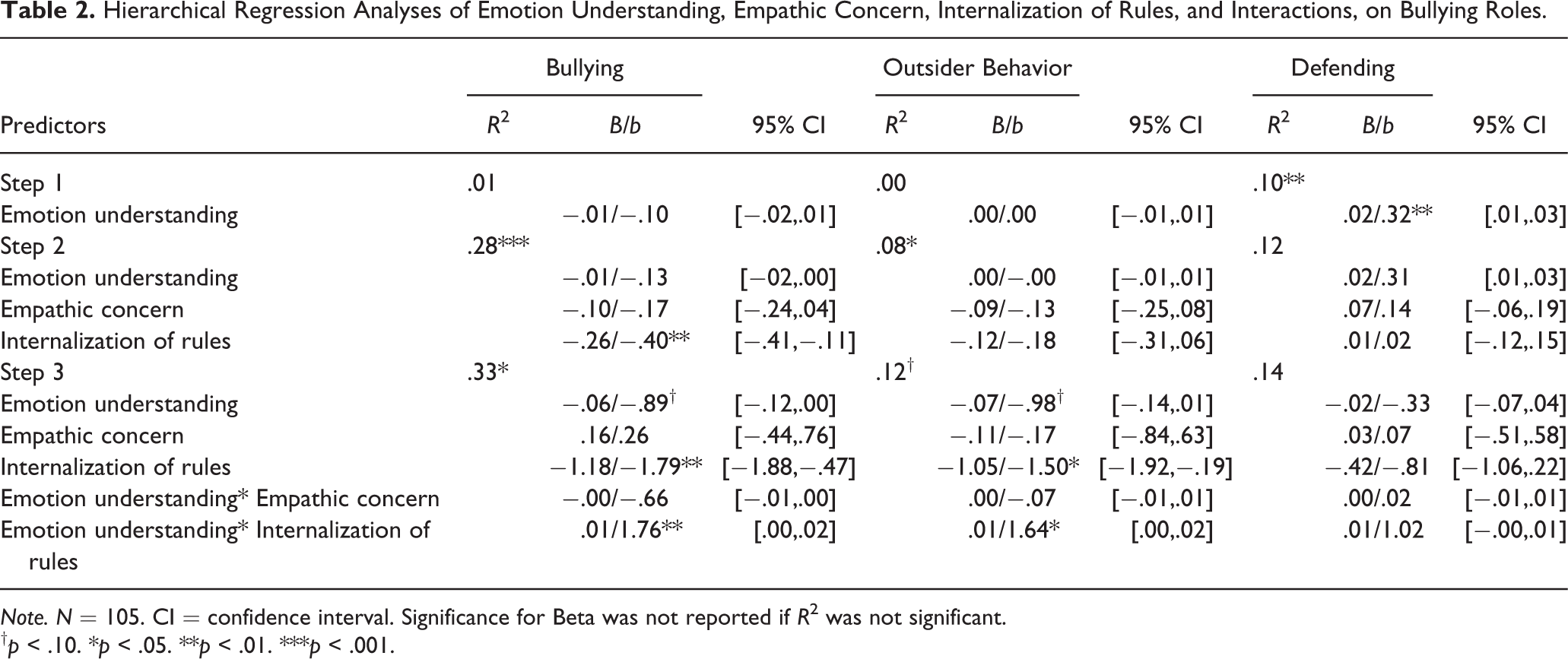
Note. N = 105. CI = confidence interval. Significance for Beta was not reported if R2 was not significant.
†p < .10. *p < .05. **p < .01. ***p < .001.
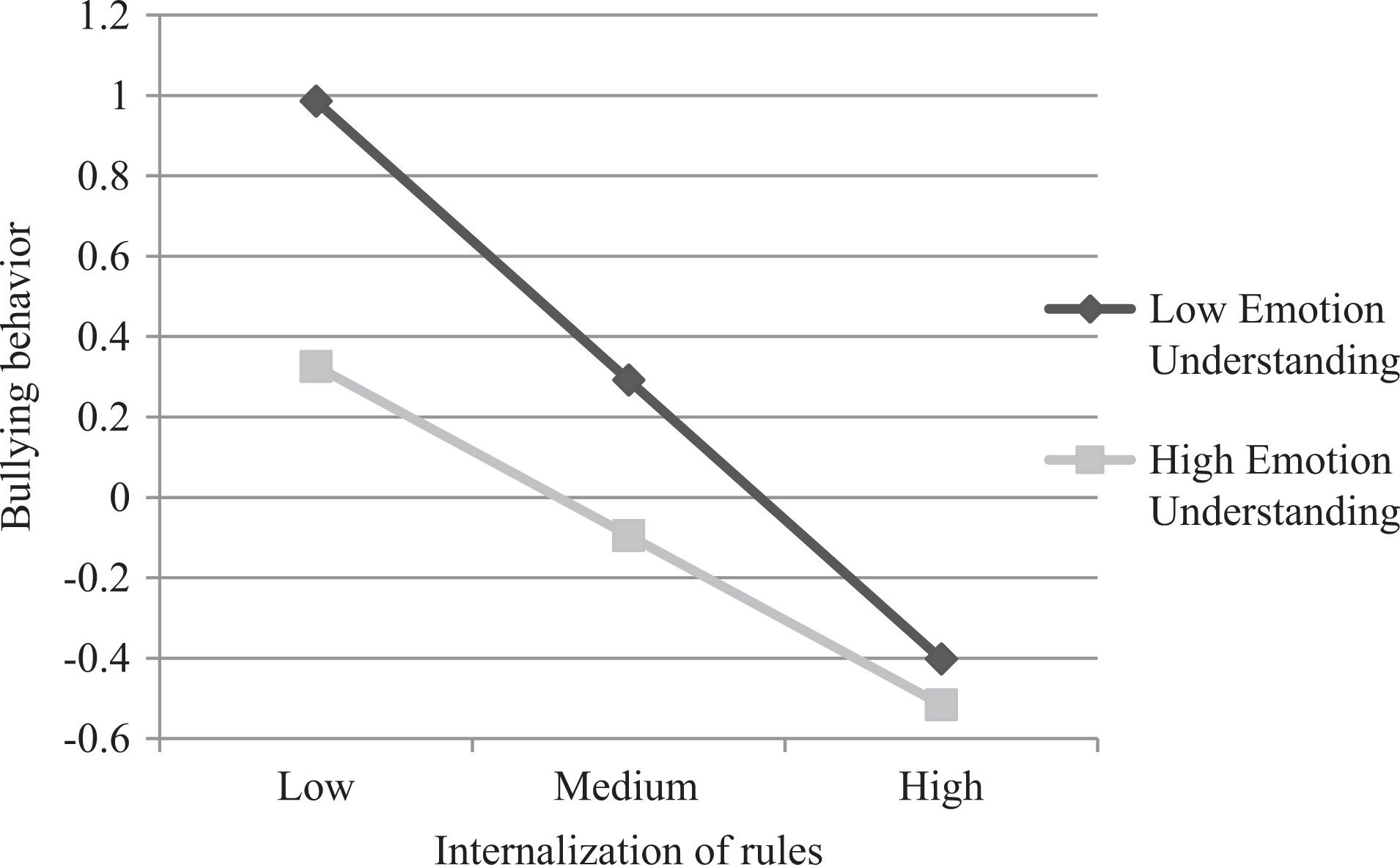
Interaction Between Emotion Understanding and Internalization of Rules on Bullying Behavior (N = 105).

Interaction Between Emotion Understanding and Internalization of Rules on Outsider Behavior (N = 105).
Discussion
Results partially confirmed the associations between bullying-related behaviors and empathic concern, internalization of rules, and emotion understanding, and the moderating role of emotion understanding. Deficits in conscience dimensions may explain bullying and outsider behaviors. A low level of empathic concern hinders children from feeling victims’ suffering, which may lead some children to harass and others to remain indifferent. Similarly, children who have not internalized rules may not care about and not respect social and moral norms, which emphasize not hurting and helping others. Alternatively, it could also be hypothesized that children with either bullying or outsider behavior deny any moral emotion or rules respect, in the attempt to protect their self-esteem, to justify, respectively, bad actions and not taking side, and thus to avoid cognitive dissonance.
The model proposed by Kochanska et al. (2010) in which empathic concern and internalization of rules play a pivotal role in the development of conscience was partially confirmed, because both variables were associated with social functioning and because they were inter-correlated, indicating that behaviors and emotions may be part of the same underlying organization (Aksan & Kochanska, 2005). Similar to what Kochanska et al. (2010) found, internalization of rules had a stronger effect than empathic concern. Children may be more aware of their rule-compatible conduct than of their emotional involvement in others’ distress, because internalized, compliant behaviors are more visible and more likely to be praised and noticed. Therefore, children could make internal attributions for their rule-compatible behavior, which becomes part of their own self and contributes to the development of a moral self. This, in turn, might affect social behavior (Kochanska et al., 2010).
As to emotion understanding, we found that it was directly associated with defending behavior, but not with bullying and outsider behaviors, partially confirming previous results (Belacchi & Farina, 2010; Trentacosta & Fine, 2010). In the regression, it affected defending behavior more strongly than did empathic concern and internalization of rules. We could surmise that, at least at this age, being able to correctly code facial expressions and to understand how others feel and why they feel that way is mostly important in order to motivate helping or consoling victimized peers.
The weak association between conscience aspects and defending behavior is unexpected. Internalization of rules seems independent from defending behavior, suggesting that being obedient to adults does not necessarily imply an attention to peers. As to empathic concern, we could surmise that, at least at this young age, it does not translate into helping behavior, but rather turns into an emotional arousal, inducing anxiety and personal distress, which increase children’s attention to the self and hinder them from helping others in need (Eisenberg, 2000; Hoffman, 1979). Evidence from cognitive neuroscience and developmental science suggest that cognitive abilities emerging over childhood, such as metacognition, perspective taking, and executive functions, support children in regulating personal distress and attending, consequently, to the thoughts and feelings of another without becoming overwhelmed by their own distress (Decety & Meyer, 2008). Thus, it is likely that empathic concern becomes more functional to prosocial behavior as children grow up and as these cognitive abilities become more sophisticated. In contrast, the direct relation between emotion understanding and defending behavior may be due to the fact that emotion understanding involves sociocognitive skills (e.g. coding emotions, analyzing causes) that do not imply personal distress but promote other-oriented behavior. Finally, the weak associations between empathic concern and defending behavior may also be due to a methodological problem: It is possible that an observational instrument is not sensitive enough to capture mild emotional reactions, leading to the risk of underestimating the assessment of empathic concern. In any case, these suggestions certainly need to be tested in further studies.
Interestingly, emotion understanding was found to be a protective factor in the relationship between early conscience and bullying roles, because the association between a weak internalization of rules and bullying or outsider behavior was especially strong for those children with a poor emotion understanding. Previous findings showed that emotion understanding, by allowing a better comprehension and consideration of others’ states of mind, may mitigate the role of rule disobedience and discourage aggressive behaviors (Lane et al., 2010; Trentacosta & Fine, 2010). Our findings allow extending these associations also in relation to bullying roles.
Limitations and suggestions for future research
Gender and age differences deserve more attention, because, due to the small sample size, we could not run different regressions for each gender and age group in order to investigate whether the association between interactions and bullying behaviors varies as a function of gender and age.
Different instruments could be used to confirm the outcomes. Despite our care and precautions, it is possible that some children, given their young age, still experienced difficulties in understanding PRQ-P questions, or in detecting behaviors, or in properly disentangling bullying from general aggression behaviors. However, questions were formulated on the basis of other instruments commonly used in the literature to assess bullying behaviors, which make us quite confident about the validity of the measure in assessing bullying (Belacchi & Farina, 2010; Salmivalli et al., 1996). We are aware that the alpha for defending the victim was low, albeit in line with other findings in the literature (Camodeca et al., 2015; Monks et al., 2003). The two defending items may reflect variability between those children who actively stand up for the victim and those who just comfort others. Although these two behavioral patterns may become integrated over time, they contribute to the same construct also in preschool age, as confirmed by the factor analysis.
Despite the interesting results about outsider behavior, we warn that they have to be considered preliminary and deepened in future studies. In particular at this age, outsider behavior seems not as well defined as the other bullying-related behaviors (Camodeca et al., 2015). For instance, our preliminary analyses showed, indeed, that bullying and outsider behaviors are significantly inter-correlated, suggesting that at such an early age, they are not well differentiated and presumably children behaving as bullies in some situations draw back in front of victimization in others. Longitudinal studies employing larger samples could highlight similarities and differences in bullying roles across time and clarify the stability of group dynamics, which may be more influenced by contexts or situations among young children than later on in life. Finally, future investigations are also encouraged to investigate the roles of other variables, besides emotion understanding, in affecting the association between conscience aspects and bullying roles, such as parental discipline or temperament.
We also think that the study has several strong points, such as the focus on a young age, in which the development of conscience, emotion understanding, and bullying behaviors become salient. In addition, we employed a sound theoretical model of early conscience, based on the aspects of empathic concern and internalization of rules (Aksan & Kochanska, 2005; Kochanska et al., 2010). A novelty of this study was that internalization of rules and empathic concern were assessed in the school context, and not within the relationship with parents, suggesting that both internalized conduct and empathic concern, although rooted in the history of parent–child exchanges, may be competencies generalized to other pivotal contexts in preschool age.
One of the strongest points was the use of different methods and informants (i.e. observers, peers, and children themselves): Thus, by avoiding a single source, we could reasonably increase the reliability of our results. Observations were used to detect empathic concern and internalization of rules, which is a novelty in the literature, given that previous works with preschool children employed interviews or dilemmas (Lane et al., 2010; Malti, Gummerum, Keller, & Buchmann, 2009), or lab paradigms (Kochanska et al., 2010). Besides, only a few studies on preschool children have considered bullying as a group process with different roles involved (Belacchi & Farina, 2010; Camodeca et al., 2015; Monks et al., 2003), and none of them investigated conscience and emotion understanding.
In conclusion, the present findings underline the importance of early conscience in shaping children’s behavior, showing that a weak internalization of rules characterizes both bullying and outsider behavior, and that emotion understanding could work as a protective factor. It is of great importance to implement intervention programs aimed at tackling bullying at an early age in order to prevent its escalation (Alsaker & Valkanover, 2001; Storey & Slaby, 2013). Our outcomes point to the need to involve children with outsider behavior, besides bullies and victims, and to include the promotion of emotion comprehension skills and of self-regulated conduct. Further, given that early socialization processes fostering both rule abiding and emotion understanding mainly occur within family contexts, a joined action involving parents and schools is particularly encouraged.
Footnotes
Funding
The authors received no financial support for the research, authorship, and/or publication of this article.