



Abstract
This study examines the effects of peer victimization by verbal, physical, and relational bullying on Korean adolescents’ self-worth, disconnect to peers, school engagement, and academic achievement. A two-year longitudinal survey on 3,266 sixth-graders attending school in Seoul, Korea was used. Multivariate regression results controlling for socio-demographic characteristics as well as initial levels of outcome indicated that youth bullied by their peers experienced greater difficulties than non-bullied peers in terms of self-worth, disconnect to peers, school engagement, and academic achievement. Results revealed that youth experiencing relational bullying suffered from large negative effects on all four adjustment outcomes and that the negative effects of bullying were generally limited to the period of victimization with little evidence for chronicity effects. Limitations as well as policy implications are further discussed.
Keywords
Bullying among youth is typically defined as unwanted aggressive behavior by other youth(s) that involves power imbalance and is repeated or highly likely to be repeated (Gladden, Vivolo-Kantor, Hamburger, & Lumpkin, 2014; Olweus, 1993; Ybarra, Espelage, & Mitchell, 2014). A growing body of studies has examined the association between peer victimization and early adolescent educational outcomes. One of the most frequently tested models posits that the relationship between peer victimization and academic achievement is mediated by psychological distress such as low self-worth, loneliness, and depression (Juvonen, Nishina, & Graham, 2000) as well as by inhibited student engagement (Buhs, Ladd, & Herald, 2006; Totura, Karver, & Gesten, 2014). These studies generally draw upon the general strain theory (GST) which suggests that students who experience a particular strain such as bullying or victimization tend to experience emotional distress and psychological difficulties later contributing to declines in student engagement and achievement (Lin, Cochran, & Mieczkowski, 2011). Although understanding the underlying mechanisms between peer bullying and educational outcomes is important, it is critical from both a theoretical and a policy perspective to test whether peer victimization has direct effects on youth’s academic performance as well as social-psychological and educational adjustment.
Relatedly, there have been attempts to understand how the stability (or chronicity) of victimization affects early adolescent outcomes especially in terms of the timing and duration of bullying (Juvonen et al., 2000; Rueger, Malecki, & Demaray, 2011). The importance of the timing of bullying on youth adjustment has been tested by examining the change in maladjustment as youth experience changes in their victimization status over time. For example, research on early adolescents has generally found that adjustment problems quickly dissipate as youth transition from victim to non-victim status (i.e., cessation hypothesis), while symptoms of maladjustment emerge as they move from non-victim to victim status (i.e., onset hypothesis) (Juvonen et al., 2000; Rueger et al., 2011; Scholte, Engels, Overbeek, de Kemp, & Haselager, 2007). On the other hand, the life-events model and chronic-stress model of stress and coping have been used to predict different effects of the duration of victimization (Rueger et al., 2011). The life-events model suggests that even brief exposure to victimization can trigger maladjustment regardless of duration, whereas the chronic-stress model posits that chronic victimization leads to worse youth outcomes as compared to transient victimization episodes. Evidence from extant longitudinal research generally supports the life-events models of stress and coping indicating that the duration of victimization is relatively unrelated to the magnitude of youth maladjustment and thus even temporary (non-chronic) victimization may compromise youths’ psychological and academic functioning (Juvonen et al., 2000; Juvonen, Wang, & Espinoza, 2011; Rueger et al., 2011; Scholte et al., 2007).
However, extant studies have focused primarily on examining these issues with Western datasets and thus little is known regarding the longitudinal effects of peer bullying, let alone the difference in consequences between stable versus temporary victimization, in unexplored cultures such as South Korea (hereinafter, Korea). The focus on primarily Western samples of extant studies is unfortunate given the importance of culture in predicting youth behavior (García Coll, Akerman, & Cicchetti, 2000). Previous findings indicate that there are significant cross-cultural differences in the meaning of bullying and how it relates to different forms of peer victimization (Kawabata, Crick, & Hamaguchi, 2010a). For example, compared to Western countries, researchers have found that in countries such as Japan and Korea, there is a general emphasis on the group processes of exclusion when youth conceptualize the meaning of bullying (S. Lee, Smith, & Monks, 2012). Such differences between East Asian and Western youth’s conceptualization of peer bullying have been posited to reflect differences in the orientation toward collectivism versus individualism (Koo, Kwak, & Smith, 2008). That is, tendencies to view the self as interdependent and to show strong conformity are traits found in collectivist cultures. Youths in such cultures are suggested to be more likely to approve of group decision making over individual action (Kinoshita, 2006). Yet, how these cultural differences in the understanding of bullying influence various forms of peer victimization are questions that should be answered by rigorous analyses of relevant empirical data taking culture into consideration. Empirical research using Korean data is scarce and therefore the current best available evidence on Korean youth bullying comes from cross-sectional analyses that have found peer victimization to be positively correlated with loneliness, low self-esteem, and academic maladjustment (Schwartz, Farver, Chang, & Lee-Shin, 2002; Yang, Kim, Kim, Shin, & Yoon, 2006). From a policy perspective, however, it should be important to consider questions regarding the timing and duration effects of bullying since intervention efforts in schools could vary significantly. For example, all victims of bullying should be the target for intervention regardless of chronicity of experiences in cases where support for the onset hypothesis and life-events model exists; however, more intensive intervention should be provided for sustained and stable victims if the chronic-stress model is supported.
Another area that has been relatively unexplored in the Korean context is the differential consequences associated with various forms of bullying. This is because most studies that examine peer victimization and youth adjustment outcomes using Korean datasets have based their analyses on composite victimization scores encompassing verbal, physical, and relational bullying, preventing them from investigating the differences in effects by bullying form (Kim, Koh, & Leventhal, 2005; Kim, Leventhal, Koh, Hubbard, & Boyce, 2006; Schwartz et al., 2002; Yang et al., 2006). However, research on Western adolescents has demonstrated that bullying takes many forms and it is important to distinguish among the different forms of victimization when studying its consequences (Card, Stucky, Sawalani, & Little, 2008; Vieno, Gini, & Santinello, 2011; Wang, Nansel, & Iannotti, 2011). In general, these studies have found that direct aggression including physical or verbal bullying is strongly associated with externalizing problems, whereas indirect aggression such as relational bullying has been related to internalizing problems (Card et al., 2008).
Peer bullying and victimization in the Korean context
In recent years, peer bullying has become quite prevalent in Korea placing youth at risk of both physical and psychopathologic problems (Kim et al., 2005; Yoo, 2013). National surveys of adolescents have revealed that a large number of students perceive peer victimization to be a severe problem in school (in 2011, 41.7%; in 2012, 40.8%) which can potentially lead to various mental and physical sickness as well as, in the extreme case, even to suicide (Kim et al., 2005; K. Lee et al., 2014). Peer victimization in Korea is usually described by the term, wang-tta, which means severe exclusion but refers more broadly to physical and verbal forms of bullying as well as social exclusion (Koo et al., 2008; S. Lee et al., 2012). A recent study revealed that Korean upper elementary and middle school pupils described wang-tta as active and intentional isolation such that wang-tta victims were perceived as isolated abnormal persons who are exposed to aggressive acts by a group of people (S. Lee et al., 2012, p. 344). Youth’s understanding of wang-tta seemed to develop and become more concrete as they enter early adolescence given the relatively simplistic and less detailed responses of children in preschool and lower elementary school who described it in terms such as “a loner” or “not getting along” (S. Lee et al., 2012, p. 344).
Researchers studying school bullying in East Asian cultures (e.g., China/Taiwan, Japan, and Korea) have posited that differences in parental beliefs and values about child-rearing as well as differences in peer relationships or friendships from Western (or US) cultures may lead to divergence in the social processes underlying peer victimization (Ando, Asakura, & Simons-Morton, 2005; Chen & Wei, 2011; Kawabata, Crick, & Hamaguchi, 2010a; 2010b; Kawabata, Tseng, Murray-Close, & Crick, 2012; Kim et al., 2006; Kim, Boyce, Koh, & Leventhal, 2009). Specifically, in contrast to the more individualistic Western cultures, these societies tend to emphasize harmony, conformity, cooperation, and empathy in their relationships which in turn could lead to greater stress in intragroup relations (French, Bae, Pidada, & Lee, 2006; Kawabata et al., 2010b). The traditional Confucian values as well as collectivistic orientations and interdependent cultures have also been linked to greater vulnerability in interpersonal conflicts (Kawabata et al., 2010b).
Given these cross-cultural differences in the value and meaning of relationships, a growing number of studies documenting differences in the frequency and forms of bullying in the Korean cultural context have recently emerged (Koo et al., 2008; Yang et al., 2006). In comparison with studies using Western datasets, Korean youth were found to be bullied in a more collectivist manner similar to bullying in Japan where verbal and relational bullying are more common than physical bullying (Koo et al., 2008). Also, in contrast to Western studies which find girls more likely than boys to experience or engage in relational bullying (Yoon, Barton, & Taiariol, 2004), gender differences in the prevalence rate of relational bullying are far less noticeable in these cultural settings (Ando et al., 2005; Koo et al., 2008). This could be related to the fact that Korean friendships, regardless of gender, are characterized as more intimate and exclusive with less extensive interactions as compared to US friendships which in turn facilitate the usage of relational aggression by both genders (French et al., 2006).
The degree to which the stability of victimization will influence Korean youth adjustment is difficult to predict given the lack of existing research in the East Asian cultural context. Although extant studies on Western early adolescents have generally supported the life-events model, the intimate and exclusive characteristics of friendships in the Korean collectivist culture may amplify the detrimental effects of stable exposure to peer victimization. Specifically, the combined effects of a culture that emphasizes conformity and interdependence with the collectivist characteristics of bullying which involves exclusionary and aggressive practices by groups of peers may entail magnified cumulative effects for victims of chronic harassment. On the other hand, the relationship-oriented culture may instill in youth the expectation that they should interact harmoniously with others diminishing the negative effects of chronic victimization since aggressive peers tend to be viewed as aversive and less desired (Kawabata et al., 2010a, 2012). In a similar vein, cultural values encouraging youth to follow general social requirements and to conform to traditional expectations which emphasize harmony and stability in relationships may serve as a protective factor to victims of chronic bullying since such values may incentivize youth bystanders to reject peer bullying and support chronic victims.
Researchers have argued that relational aggression may be particularly prevalent among East Asian youths because of the contextual emphasis on interpersonal relationships (Tom, Schwartz, Chang, Farver, & Xu, 2010). However, it has also been suggested that such focus on close friendships and harmonious relationships may strengthen the correlation between relational aggression and internalizing symptoms since youth who violate these cultural values will be especially prone to peer rejection themselves (Kawabata et al., 2010a, 2012; Tom et al., 2010). Recent cross-cultural studies focusing on East Asian countries have revealed that, in both the Japanese and Chinese cultural contexts, relational aggression tends to be more common and more strongly associated with internalizing problems such as depressive symptoms than physical aggression (Hokoda, Lu, & Angeles, 2006; Kawabata et al., 2010a, 2012). Yet, these cross-cultural studies are limited in that they have exclusively focused on the correlates and consequences of youth aggression without considering potential differences in the consequences of peer victimization by different forms of aggression. Based upon prior research, one can speculate that the Korean culture, which also emphasizes group awareness and cooperative behavior, may lead to more severe psychological and social consequences for relational victims given its potential to damage social relationships as compared to victims of overt forms of physical or verbal bullying (Schwartz et al., 2002).
In addition, it is not clear if different forms of peer victimization will result in compromised academic performances as well as social-psychological maladjustment among youth in these cultures. This is problematic since, as has been suggested by Nakamoto and Schwartz (2010, pp. 236–237), the negative effects of peer victimization on academic achievement may be larger among youth from Asian countries (as compared to youth from Western countries) where the academic atmosphere of intense competition may influence peer relations in ways different from the Western context. Due to collectivistic values which emphasize interdependent social relationships, conflict with peers may prove especially stressful for Korean youth’s educational adjustment (Schwartz et al., 2002).
Current study
The primary goal of the present study was to examine the associations between peer victimization and adolescent social-psychological (i.e., self-worth, disconnect to peers) as well as educational adjustment (i.e., school engagement, academic test scores) using recent longitudinal data from Seoul, Korea. The present study had three specific aims. The first aim was to examine the victimization trajectories of Korean youth during sixth and seventh grade when they transition from elementary to middle school. The second aim was to determine whether divergent victimization pathways are related to differences in the development of social-psychological and educational outcomes by explicitly testing for the effects of stability (i.e., timing and duration) of victimization. The third aim was to investigate whether the consequences of peer victimization on youth adjustment varies across forms of bullying.
The hypotheses guiding this investigation were as follows. First, with regard to the first research aim, based on the earlier review of research documenting the collectivistic characteristic of bullying involving groups rather than individuals as well as the gender-neutral use of relational bullying among Korean peers, it was predicted that the experience of peer victimization should be quite prevalent among our sample youth and that the fraction of adolescents involved in bullying as victims, bullies, or both should be relatively high. In terms of the second research aim, based on findings from research using Western datasets, we expected support for both the onset and cessation hypotheses in predicting the timing effects of victimization on youth’s self-worth, disconnect to peers, school engagement, and test scores. That is, it was predicted that early adolescent’s tendency to be present-oriented would also apply to Korean youth such that new victims would display concurrent symptoms of peer victimization, while past victims would recover quickly from the incident and display little carryover effects the following year. To test the duration effects of victimization, we tested whether the life-events versus chronic-stress models of stress and coping would better explain differences in outcomes between youth who were chronically bullied for 2 years in both sixth and seventh grade versus those who were bullied for 1 year in seventh grade. Finally, with respect to the third research aim, we hypothesized that the consequences of victimization should vary across different forms of bullying drawing from extant literature on peer bullying in East Asian countries (Kawabata et al., 2010a). Specifically, it was predicted that victims of indirect relational aggression would experience more severe detrimental effects on social-psychological outcomes such as self-worth and disconnect to peers than victims of direct verbal or physical bullying. Also, given the educational context of Korea which entails intense competition and academic stress, we expected that exposure to relational victimization would lead to greater distress in youth’s academic performance than verbal or physical victimization. That is, it was predicted that relationally victimized youth would display lower school engagement and test scores as compared to verbally or physically victimized youth, controlling for observed differences across youth.
Method
Participants
The Seoul Education Longitudinal Study of 2010 (SELS: 2010) is an ongoing longitudinal study sponsored by the Seoul Metropolitan Office of Education of the city of Seoul, Korea. The children in SELS comprise a representative sample of 5,059 fourth-graders in 2010, selected randomly from a total of 108 schools out of a total population of 540 public elementary schools in Seoul, with a response rate of 98.2%. Students were randomly chosen from two classrooms within each of the 108 sample schools using a stratified random sampling strategy. Annual follow-up surveys of children’s cognitive, social, emotional, and physical development were collected in years 2011, 2012, and 2013 with a response rate of 92%, 85.6%, and 73.6%, respectively. Because information on bullying only began to get collected in the third wave survey (in 2012), our analyses are based on sixth- and seventh-grade youth from the third and fourth waves of SELS (N = 3,725). Given the decrease in response rates across survey waves, analyses were conducted to see if the retained sample of students is comparable to those students who dropped out of the survey before seventh grade. Independent sample t tests on the outcome measures, including self-worth, disconnect to peers, school engagement, and academic test scores, as well as the socio-demographic control variables during fourth grade (at baseline) were conducted. Results revealed that none of the differences in outcome measures were significant at the 5% level. Differences in family structure, maternal employment, and household income were also statistically insignificant, yet there were significant differences in parental education between the retained youth and drop-outs which indicated that attrition was positively correlated with parental education levels (results available upon request). However, given that the main focus of the present study is to investigate the effect of peer bullying on youth’s developmental outcomes, any potential bias from non-random attrition should be indirect. To account for the potential bias associated with unbalanced attrition, socio-demographic characteristics were controlled for in all of the following analyses. The sample is further restricted to youth who have non-missing information on peer victimization, social-psychological adjustment, school engagement, and academic achievement during the 2 survey years. As a result, the final sample consists of a total of 3,266 children.
Descriptive statistics on baseline (i.e., sixth grade) socio-demographic characteristics for our sample youth are presented in Table 1. More than half of the sample youth have at least one parent with a 4-year college degree or higher (57%), whereas a little more than a quarter reported high-school degree or less as their parent’s highest level of education (27%). Most of them lived in a household with both parents present that have an average monthly income that is equivalent to roughly US$4,200. Maternal employment rates are generally lower in East Asian countries, such as Korea and Japan, compared to Western countries (OECD, 2013), and this trait is reflected in our sample youth reporting maternal employment rate of 54%.
Descriptive statistics.

Note. aMonthly income is reported in 10,000 South Korean Won units. This is equivalent to roughly US$8.7 (as of July 2, 2012).
bNon-standardized values for self-worth and connection to peers are presented for ease of interpretation.
cYouth who reported being bullied two to three times a month, about once a week, and all the time were coded as bullied (= 1), while those who reported being victimized once or twice ever or never were coded as non-bullied (= 0).
Measures
Self-reports of being bullied
To ensure that students understand the meaning of bullying, the SELS states in the beginning of the school violence questionnaire that “Bullying refers to repeated aggression that is committed in a relationship among people with unequal power. It does not include pranks and fights among equal peers.” Students were then asked to provide self-reported information on how often they experienced four incidents of peer bullying (we include the statement students responded to followed by the variable name we use). As is stated in the User Manual of SELS, these questionnaires were created based on The revised Olweus bullying/victim questionnaire (Olweus 1996):
I was teased, called names, or made fun of (VERBAL) I was hit, kicked, choked, or locked in (PHYSICAL) I was intentionally left out or excluded from things and/or Bad rumors were spread about me with the intention to make others reject me (RELATIONAL)
Responses on the social exclusion and rejection questionnaires were combined to create our measure of relational victimization since both types of victimization involve interpersonally manipulative behaviors which define relational aggression (Yoon et al., 2004, p. 304). This meant that students were regarded as relationally bullied if they experienced either social exclusion or peer rejection (α = 0.72). Students reported frequencies of being bullied on a 5-point Likert scale: (1) Never; (2) Once or twice ever; (3) two to three times a month; (4) About once a week; (5) All the time. Students filled out the survey in July of each year near the end of the first semester since each school year starts in March and ends in February in Korea.
Following the method used by Juvonen and colleagues (2011), a continuous measure of peer victimization was created by averaging the responses of the three items (verbal, physical, and relational bullying) with higher scores indicating higher levels of bullying (α = 0.70). The mean-centered continuous measure of bullying was used in the analyses examining the effects of stability of peer victimization on youth adjustment. Next, to investigate the effects of peer victimization by distinct forms of bullying, each form of bullying was recoded into a binary variable in which being a victim constituted of experiencing bullying at least two to three times a month (Likert scales 3–5) following the suggestion of Solberg and Olweus (2003). That is, based on empirical analyses as well as conceptual theory, Solberg and Olweus (2003) found that the use of “two to three times a month” should be regarded a useful and reasonable lower-bound cutoff point for classifying early adolescents as victims/bullies for purposes of prevalence estimation. Students were further classified into four groups based on their change in victimization status across sixth and seventh grade: 1) not bullied in either year (i.e., never victim); 2) bullied only in sixth grade (i.e., victim to non-victim); 3) bullied only in seventh grade (i.e., non-victim to victim); and 4) bullied in both grade levels (i.e., chronic victim).
Social-psychological adjustment, school engagement, and academic achievement
Annual self-reported measures of self-worth and disconnect to peers as well as school engagement were collected by students indicating on a five-point scale how true each statement is for him or her (1 = Not at all true and 5 = Always true). The five items referring to self-worth included “I am a good person,” “I am a competent person,” “I am a valuable person,” “I think of myself positively,” and “I am generally satisfied with myself.” Disconnect to peers at school was measured through two items, “I have a friend to trust and talk to,” and “I hang out with friends during break or lunch time rather than being alone.” These two items were selected from a range of questions addressing student’s peer relations. We reverse-coded the responses for each item assigning higher values to greater feelings of disconnect. Both measures were internally consistent: self-worth (α = 0.94) and disconnect to peers (α = 0.72).
Student engagement has been studied as a multifaceted construct including behavioral, cognitive, and emotional components, responsive to contextual features such as one’s peer relationship in the classroom setting (Fredricks, Blumenfeld, & Paris, 2004; Wang & Eccles, 2011). Yet, as pointed out by Totura et al. (2014), indicators of these engagement components tend to be highly correlated and thus examining their collective rather than individual predictability may be more appropriate. Therefore, we constructed a composite measure of school engagement by averaging responses to each of the three components. Behavioral engagement which refers to participation in academic activities was measured by student responses on five items including “I concentrate in class,” “I actively participate in class,” “I always do homework,” “I always review class material before class,” and “I always review class material after class.” Cognitive engagement which draws on the idea of investment and self-regulated approach to learning was measured using three items such as “I try my best to completely understand the content learned in school,” “I try to abide by my plans for studying as best as I can,” “I search the internet or find books that will help me understand things I don’t know when doing homework or studying.” Emotional engagement which refers to positive and negative reactions and attitudes toward learning was measured with student responses on two items, “I look forward to class and find it interesting,” and “Class helps my studies.” A composite measure of student engagement was created by averaging each of these items within construct, transforming the average values into z scores, and averaging the standardized values. The measure of student engagement was internally consistent (α = 0.75).
Academic performance was measured using standardized test scores on an annual exam of Korean, English, and mathematics which were developed to test students on materials learned during the first semester (March–July) and administered during the end of July. The scores were scaled to describe a student’s location on an achievement continuum allowing researchers to compare student achievement across grade levels. To obtain a composite measure of achievement, we standardized each test score by grade level and subject matter, transformed it into z scores, and obtained the average value (α = 0.85). Unfortunately, the SELS: 2010 did not contain information on student GPA or teacher’s evaluation of students.
Socio-demographic control variables
Our model includes several socio-demographic factors that are likely to be associated with youth’s chances of being bullied. Research has successfully pointed out that household characteristics such as income, parental education, and two-parent family structure are correlated with Korean youth’s chances of becoming victimized (Kim et al., 2009). Specifically, disadvantaged family background characteristics including low socio-economic status, low parental education, and non-intact family were identified as peer victimization risk factors among Korean seventh- and eighth-graders (Kim et al., 2009). In addition, gender was controlled for since extant research found that both the socio-demographic profiles of victims and the prevalence of victimization vary across Korean boys and girls (Kim et al., 2009; Yang et al., 2006). Lastly, we control for maternal employment status as youth whose mothers work long hours have been shown to engage in more problematic behaviors than youth with non-employed mothers (Parcel & Dufur, 2001).
Data analysis
To test the stability effects of peer bullying, the present study estimated several multivariate regressions predicting youth’s seventh grade outcome controlling for a lagged dependent variable (i.e., sixth-grade outcome), socio-demographic variables, a continuous mean-centered measure of peer bullying in sixth grade, a continuous mean-centered measure of peer bullying in seventh grade, and an interaction term between the continuous mean-centered bullying measures in sixth and seventh grade. The effects of the timing and duration of bullying were examined as follows: the onset hypothesis is supported if the coefficient of the continuous measure of peer bullying in seventh grade is negative and statistically significant (i.e., students with high levels of bullying only in seventh grade display worse seventh grade outcomes than students who were never bullied); the cessation hypothesis is supported if the coefficient of the continuous measure of peer bullying in sixth grade is statistically insignificant (i.e., students with high levels of bullying only in sixth grade display no difference in seventh grade outcomes from students who were never bullied); the chronic-stress model is supported over the life-events model if the sum of coefficients of the continuous measure of peer bullying in sixth grade, in seventh grade, and the interaction term is significantly greater than the coefficient of the continuous measure of peer bullying in seventh grade (i.e., students with high levels of bullying in both grade levels display larger negative effects than students with high levels of bullying in seventh grade only) and vice versa. Next, to investigate whether different forms of bullying are associated with differential effects, victimization status indicator variables (i.e., not bullied in either year [reference group]; bullied only in sixth grade; bullied only in seventh grade; and bullied in both grade levels) were created separately across each form of bullying and entered into a multivariate regression predicting seventh grade outcomes controlling for a lagged dependent variable and socio-demographic variables.
A small number of observations (about 3%–4% of observations) for variables such as parent’s highest level of education, household level of income, family structure, and maternal employment status had missing values. We imputed values under missing-at-random (MAR) assumptions using the “ice” command in Stata version 13 (Royston, 2005). However, imputation of missing values was not conducted for the dependent variables because imputing the dependent variable can lead to biased estimates (Von Hippel, 2007). The results were substantively the same across analyses with and without the imputation.
Results
Descriptive statistics on the measures of victimization and outcomes were presented in Table 1. Estimates revealed that the average sample youth had somewhat high self-worth and low disconnect to peers. At baseline in sixth grade, we found that more than a third of the sample (36%–39%) reported being verbally bullied at least two to three times a month, while the prevalence of physical and relational bullying was around 4%–9% and 9%–13%, respectively. When comparing the prevalence of bullying from baseline in sixth grade to the follow-up year in seventh grade, it is apparent that the incidence of victimization drastically dropped (sometimes up to 50%) across both genders and all forms of bullying which may be associated with a couple of factors. First, extant research indicates that the prevalence of bullying declines with age (Smith, Madsen, & Moody, 1999). Second, and more importantly, the issue of school violence became a Korean nationwide controversy following the tragic suicide of several bullied students in 2011 resulting in the creation of a number of nationwide anti-bullying polices in 2012 (K. Lee et al., 2014). Overall, we found that a little more than half the sample had not been victimized in either grade (52%), whereas 15% of the sample had been chronically bullied in both grade levels.
Table 2 presents preliminary analyses in which we computed the Pearson product-moment correlations among our main variables including each form of bullying as well as the social-psychological and educational outcomes. These correlations demonstrated that social-psychological outcomes were correlated with educational outcomes and that although each form of bullying was correlated with each other, none of the correlation coefficients exceeded 0.5. These findings warranted subsequent analyses on the effects of victimization by forms of bullying.
Zero-order correlation matrix of key variables in seventh grade (N = 3,266).
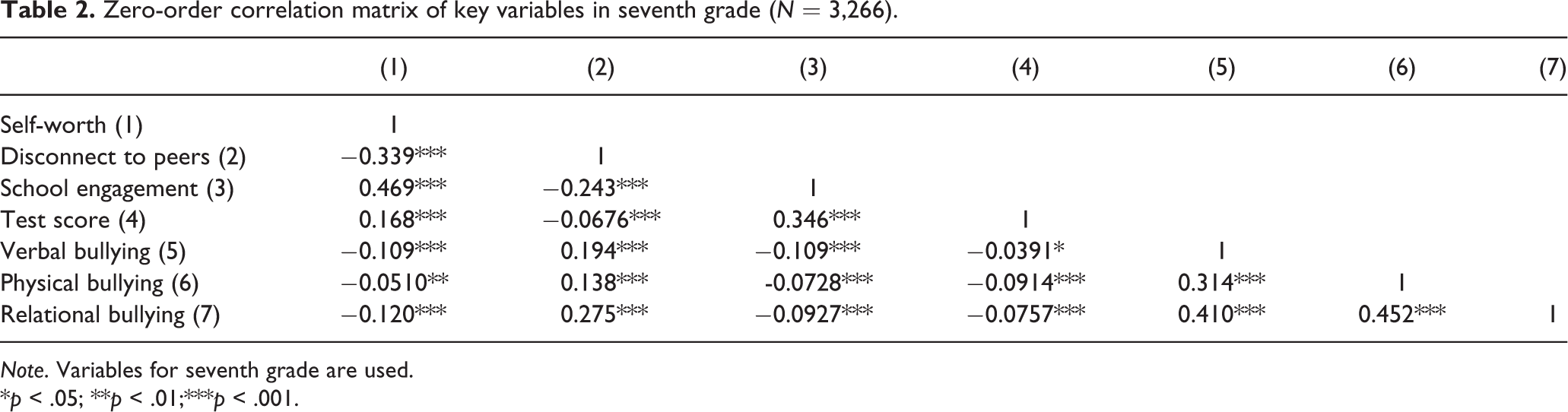
Note. Variables for seventh grade are used. *p < .05; **p < .01;***p < .001.
Effects of peer victimization by stability of bullying
Results on the effects of peer victimization on youth’s social-psychological and educational outcomes using a continuous mean-centered measure of bullying were presented in Table 3. It should be noted that the reference group using a continuous mean-centered measure of bullying refers to the average student who experienced 1.39–1.61 Likert points of bullying in sixth and seventh grade when the value of 1 refers to “Never” and the value of 2 refers to “Once or twice ever” (see Table 1). Thus, consistent with extant literature and conceptual theory (Solberg & Olweus, 2003), we regard the reference group as youth who did not experience victimization. First, in terms of social-psychological outcomes, results indicated that high victimization scores in seventh grade were associated with a decline in self-worth and an increase in disconnect to peers during seventh grade controlling for observed socio-demographic characteristics and sixth-grade outcomes. This finding supported the onset hypothesis by indicating that youth who experienced high levels of victimization displayed concurrent social-psychological maladjustment as compared to youth who did not experience victimization (self-worth:
Effects of peer bullying on youth’s psychological adjustment and educational outcomes (N = 3,266).

Note. Dependent variables were measured at seventh grade. Measures of victimization are continuous and mean-centered. 95% CIs reported in brackets. Parameter estimates are unstandardized. *p < .05; **p < .001.
Next, in terms of educational outcomes, results confirmed that high victimization scores in seventh grade were also associated with a decline in standardized measures of school engagement and academic test scores in seventh grade controlling for observed socio-demographic characteristics and sixth grade outcomes. This finding supported the onset hypothesis by indicating that youth who experienced high levels of victimization in seventh grade only experienced concurrent educational maladjustment as compared to youth who did not experience victimization (school engagement:
Effects of peer victimization by forms of bullying
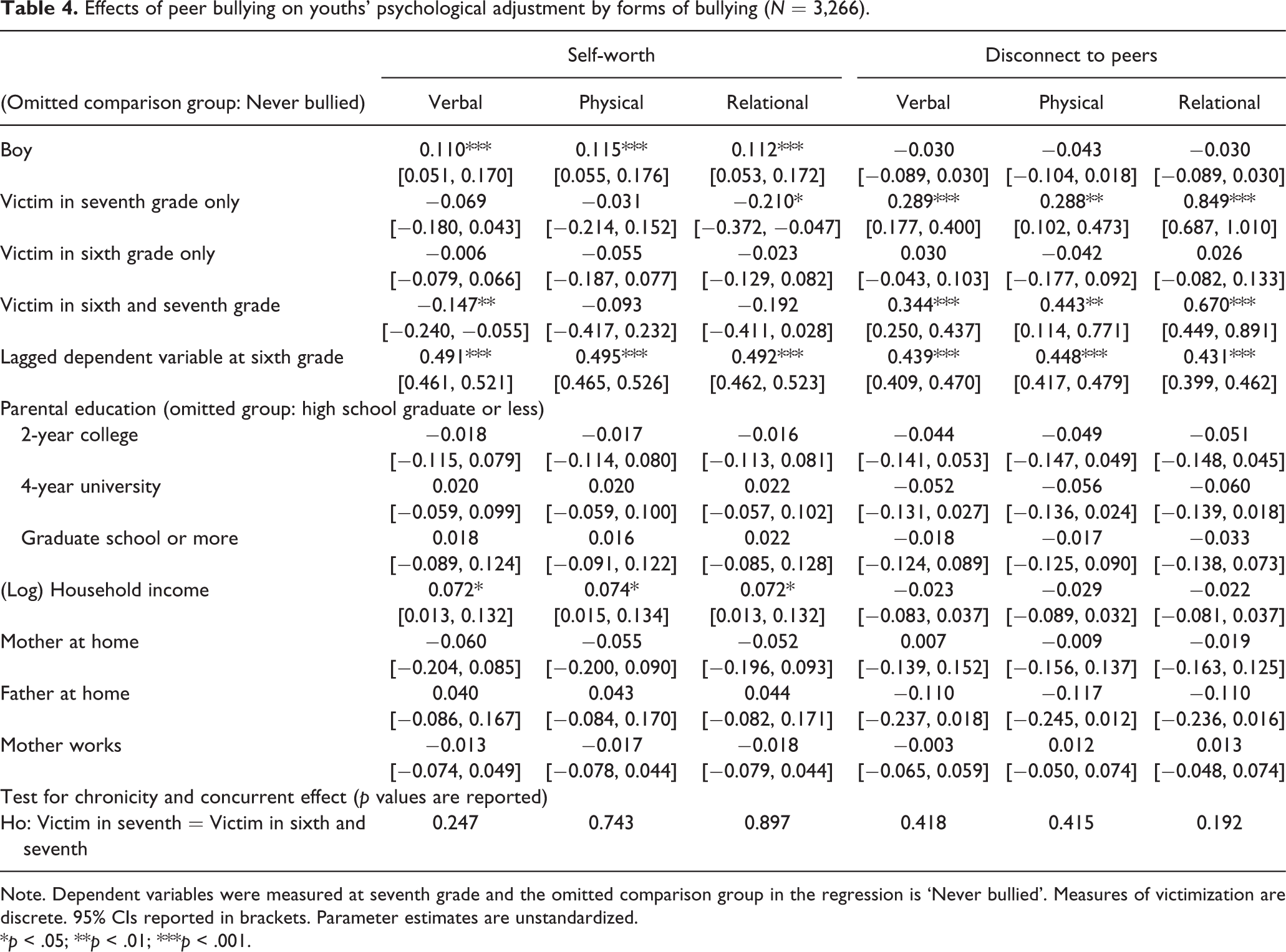
To test the effects of peer victimization by forms of bullying, three indicator variables of victimization status (i.e., bullied only in sixth grade; bullied only in seventh grade; and bullied in both grade levels) were included in the multivariate regression instead of the continuous measures of peer bullying. The students in the omitted category were not bullied in either year. Results on the effects of peer victimization by forms of bullying on self-worth and disconnect to peers were presented in Table 4. Regression estimates indicated that youth who were verbally bullied in both sixth and seventh grade were found to have lower levels of self-worth as compared to youth who were not verbally bullied in either grade (i.e., the omitted reference group). Findings on physical victimization suggested that youth who were physically bullied only in sixth grade, only in seventh grade, or in both grade levels did not experience diminished self-worth than youth who were not physically bullied in either grade. Youth who were relationally bullied only in seventh grade reported greater declines in self-worth than youth who were not relationally bullied in either grade. It appears that both verbal and relational bullying are associated with declines in youth’s self-worth, whereas physical bullying has little effect.
Effects of peer bullying on youths’ psychological adjustment by forms of bullying (N = 3,266).
Note. Dependent variables were measured at seventh grade and the omitted comparison group in the regression is ‘Never bullied’. Measures of victimization are discrete. 95% CIs reported in brackets. Parameter estimates are unstandardized.
*p < .05; **p < .01; ***p < .001.
Next, for all forms of bullying, regression estimates indicated that youth who were bullied only in seventh grade as well as those who were bullied in both grade levels consistently reported to feel greater disconnect to peers in seventh grade as compared to youth who were not bullied in either grade level. The magnitude of the coefficient indicating forms of bullying, however, was larger for relational bullying than verbal or physical bullying indicating that indirectly victimized youth tended to report larger increases in their perception of disconnect to peers than directly victimized youth.
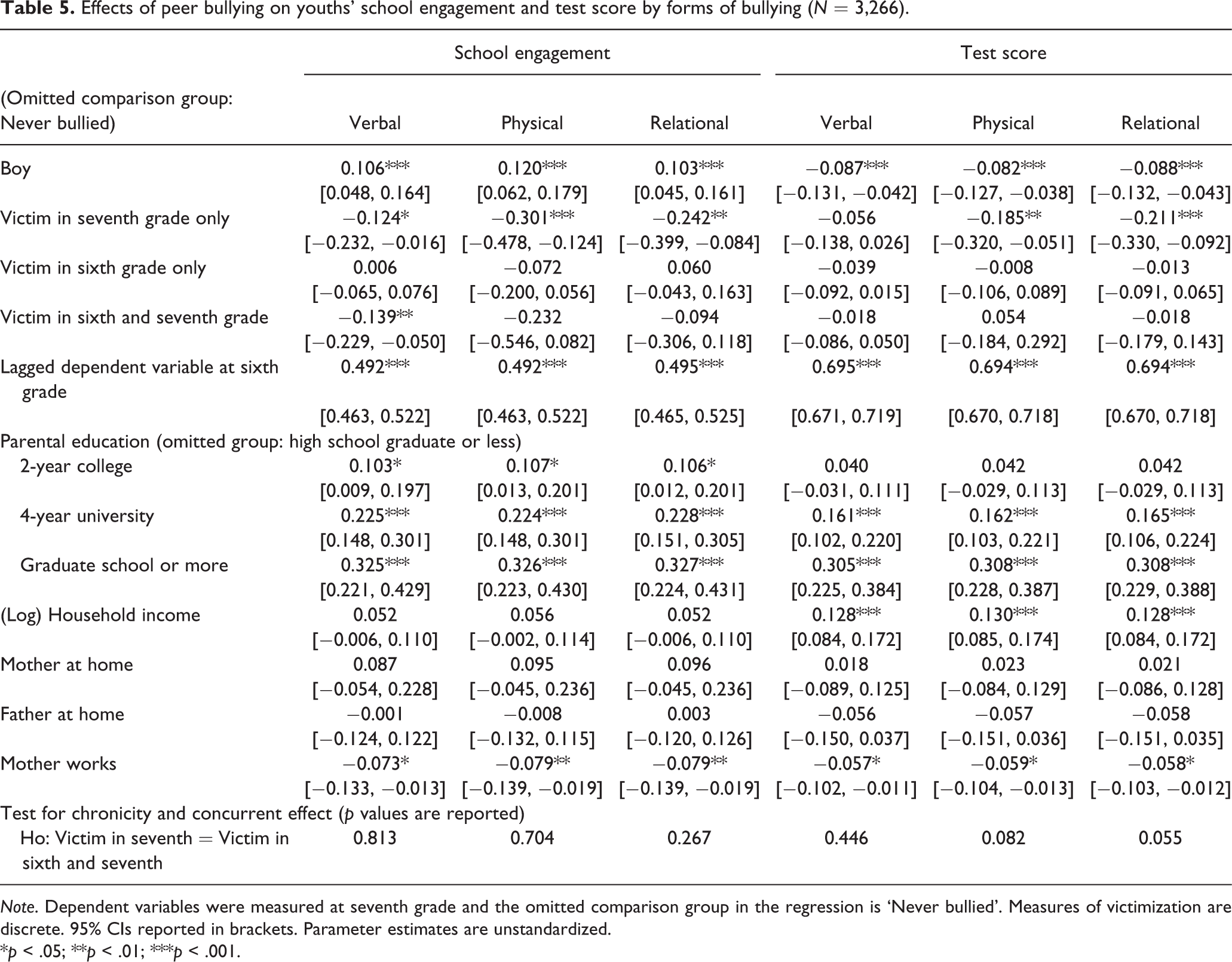
Results on the effects of peer victimization by forms of bullying on school engagement and test scores were presented in Table 5. First, a decline in school engagement was observed for youth who were verbally bullied only in seventh grade (
Effects of peer bullying on youths’ school engagement and test score by forms of bullying (N = 3,266).
Note. Dependent variables were measured at seventh grade and the omitted comparison group in the regression is ‘Never bullied’. Measures of victimization are discrete. 95% CIs reported in brackets. Parameter estimates are unstandardized.
*p < .05; **p < .01; ***p < .001.
Next, the impact of bullying on test scores indicated that verbal bullying in either sixth or seventh grade or both was not associated with a significant drop in seventh grade test scores as compared to youth who were not bullied in either grade. However, both physical (
Discussion
The present study investigated the effects of peer victimization on the social-psychological as well as educational outcomes among early adolescents in Seoul, Korea using longitudinal data. A critical objective of the current study was to document Korean youth’s victimization trajectories and to further examine whether such divergent pathways were associated with significant differences in their developmental outcomes by explicitly testing for differences in effects by stability of victimization. We also attempted to examine whether the consequences of peer victimization on youth adjustment varied across forms of bullying for Korean youth. The dataset utilized in this study was ideal to explore adjustment difficulties of Korean early adolescents since the study period covered the years during youth’s transitions into middle schools from sixth to seventh grade. As has been pointed out by developmental researchers studying adolescents and peer harassment, youth transitioning into middle school may become particularly vulnerable to adjustment problems related to peer bullying because of their heightened concerns about peer approval (Juvonen et al., 2000), but also because of the additional burden of having to reestablish social relationships and status in a new school setting (Pellegrini & Bartini, 2000).
Results from the current investigation suggested that for many Korean early adolescents the experience of being victimized by one’s peer is common, and for some (about 15%) it is quite a stable experience even after they transition into middle school. Consistent with extant literature on Korean peer victimization, findings from this longitudinal study offer further evidence that youth who were bullied by their peers experienced greater adjustment difficulties than their non-bullied peers in terms of self-worth, disconnect to peers, school engagement, and test scores (Schwartz et al., 2002; Yang et al., 2006).
As stated in the outset of this article, we investigated whether stability (i.e., timing and duration) of bullying among Korean early adolescents related to changes in their social-psychological as well as educational outcomes. Findings from the analyses on the timing effects of bullying revealed that both the onset and cessation hypotheses were supported for Korean youth. That is, the negative effects of bullying generally increased when victimization emerged and declined once victimization receded with little lasting effects. These results were consistent with findings from studies using Western datasets which have shown that for middle school students, the negative effects of bullying are mostly concurrent (Juvonen et al., 2000). However, given that the present study was based on a 2-year longitudinal dataset, future investigation should be conducted on a longer time frame to better identify such mechanisms.
Results on the duration effects of bullying on youth outcomes was also found to support the life-events model of stress and coping, that is, students who were persistently victimized in the past 2 years did not suffer from magnified effects of chronic victimization as compared to their peers who were victimized for only 1 year in terms of self-worth, disconnect to peers, school engagement, and standardized test scores. These findings are generally consistent with findings from extant research on early adolescents in Western settings (Juvonen et al., 2000; Scholte et al., 2007). However, as a recent study on a sample of US seventh- and eighth-graders indicated, findings on the effects of chronicity of victimization may vary by the specific type of youth outcome examined. Specifically, Rueger et al. (2011) found that although chronic experiences of victimization did not lead to worse self-esteem or school attitude over time, it was associated with continued decreases in academic grades and school attendance. Such variation in effects was not observed for our sample of Korean youth which indicates that in the Korean case, given its relationship-oriented culture, there may be little negative effects associated with chronic victimization on educational outcomes since expectations of youths for harmonious relationships are higher thereby creating an atmosphere in which victims of bullying receive more empathy, especially as the incidence of victimization persists. When such cultural attributes interact with a highly competitive educational environment, it is possible for chronic victims of bullying to turn to studying as a means to indicate their general competence to peers and thus escape their problems. It should be important to further investigate the underlying mechanisms behind the absence of duration effects of bullying on Korean youth outcomes using different longitudinal datasets.
The study also revealed that the detrimental effects of Korean adolescent bullying varied by forms of bullying. Across all four outcome measures, relational victimization was the only form of bullying that was consistently associated with significant negative effects. Specifically, relationally bullied youth reported lower levels of self-worth, increased feelings of disconnect to peers, and lower levels of school engagement as well as standardized test scores as compared to youth were not relationally bullied. On the other hand, verbal victimization was not associated with a decline in test scores, whereas physical victimization was not associated with a decline in self-worth. In addition, the magnitude of the coefficients of relational victimization versus verbal or physical victimization was largest among three out of the four outcomes examined. These results supported our original hypothesis which predicted victims of relational aggression to experience greater detrimental effects than victims of verbal or physical aggression. Our finding of large negative psycho-social effects associated with relational bullying is consistent with studies from other Asian countries examining bullying among Chinese and Japanese youth and contributes to our understanding on Asian adolescents’ vulnerability to relational aggression in collectivistic cultures (Kawabata et al., 2010b, 2012).
In addition, in our investigation of the influence of peer bullying on school engagement, we found that relational bullying was associated with lowered school engagement consistent with extant studies using Western datasets (Buhs et al., 2006). However, we also found large declines in engagement among physically bullied youth which has not been well documented in extant literature. Such finding builds upon previous research by revealing that youth may not only reduce school engagement because peer exclusionary practices directly restrict their opportunities to engage in classroom activities, as was suggested by Buhs et al. (2006), but also because getting physically harassed distracts victims from concentrating on school work which may result in lowered effort as well as less affective emotions toward class. It should be important to further explore the relationship between student engagement and distinct forms of bullying within and across different cultural settings.
Limitations and policy implications
There are a few key limitations to this study. First, although we found strong evidence relating peer bullying to lowered self-worth, increased disconnect to peers, diminished school engagement, and lowered achievement, we do not go so far as to make strong casual inferences. This is due to the limited number of time-variant covariates available in our dataset we could control for. However, as we show, the availability of longitudinal data and the use of multivariate regression that controls for baseline outcome measures should attenuate some of the bias due to unobserved differences between youth who are bullied and those who are not. This is a substantial improvement over prior cross-sectional studies examining the effects of Korean peer victimization. Second, all measures of peer bullying in the study came from student self-reports on specific experiences of victimization preceded by a statement providing a definition of bullying. Although self-report measures of victimization are commonly used in research, we acknowledge its limitations in terms of correctly assessing the prevalence and magnitude of peer bullying given that SELS did not directly gather information on differential power or repetition (Ybarra et al., 2014). However, SELS combined a definition-based self-report strategy with a behavior-based self-report strategy in collecting information on bullying (T. Lee & Cornell, 2010) which should have reduced measurement error as compared to studies using only one approach (Felix, Sharkey, Green, Furlong, & Tanigawa, 2011). Relatedly, the analyses examining differential effects of peer victimization by forms of bullying used single-item scales to measure both verbal and physical bullying—relational bullying was measured using two items. As has been pointed out by extant research, the use of single-item measures may compromise content and construct validity leading to erroneous estimates of causal and functional relationships (Haynes, Richard, & Kubany, 1995). It should be important in future research to investigate the validity of the present results by examining such empirical relationships produced by multiple-item measures of different forms of bullying. Third, the SELS survey did not provide an explicit reference period (e.g., in the past year or in the past 6 months, etc.) when asking students about the frequency to which they experienced bullying. This introduces uncertainty in the prevalence measure of victimization. And lastly, given the longitudinal nature of the SELS survey, attrition occurred in each wave of data collection potentially limiting the representativeness of our sample. Therefore, caution should be given when generalizing the findings of the present study to the entire South Korean population of youth.
We conclude by discussing the policy implications of this study. Considering the detrimental effects associated with relational victimization in countries with collectivistic cultures, it may be useful to create intervention programs that specifically address relational aggression. Research has indicated that educating teachers and school administrators on identifying the signs of relational aggression as well as creating a school climate that does not condone relational bullying are important intervention strategies (Yoon et al., 2004). However, as Hong, Lee, Lee, Lee, & Garbarino (2014) document, many Korean anti-bullying interventions tend to focus only on the perpetrator and victim and seldom involve multiple stakeholders such as teachers, administrators, parents, and bystanders. There appears to be crucial need to develop programs that are directed at the entire school rather than just at individual bullies or victims which enable cooperation across various stakeholders (Cho & Park, 2015). Next, our findings on the stability of victimization experienced by Korean youths indicated that a considerable number of adolescents were moving in and out of victim status every year. This implies that the actual risk of experiencing bullying may be much higher than is reported in annual prevalence measures. Such results are even more troublesome when one considers findings from the present study which supported the life-events model of stress and copying, that is, even temporary incidents of bullying could lead to detrimental effects on youth adjustment. Together the results from this investigation suggest that intervention efforts be targeted toward victims immediately once bullying has been identified regardless of the chronicity of victimization. Given the uniqueness of Korea’s educational and cultural context, multiple factors in the broader ecological context should be considered when devising intervention strategies (Hong et al, 2014).
Footnotes
Funding
The authors disclosed receipt of the following financial support for the research, authorship, and/or publication of this article: The work by Rosa Minhyo Cho was supported by the National Research Foundation of Korea Grant funded by the Korean Government (NRF-2013S1A3A2055042).