



Abstract
From birth on, infants show long-term recognition memory for persons. Furthermore, infants from six months onwards are able to store and retrieve demonstrated actions over long-term intervals in deferred imitation tasks. Thus, information about the model demonstrating the object-related actions is stored and recognition memory for the objects as well as memory for the actions is retrieved. To study the development of long-term retention for different memory contents systematically, the present study investigated the recognition of person- and object-related information as well as the retention of actions in two samples of three-year-olds who had participated in a deferred imitation task at either nine or 18 months of age. Results showed that three-year-olds who had participated at nine months of age retained actions in a re-enactment task; however, they neither indicated person- nor object-recognition in a picture-choice task (recognition task). Children who had participated at 18 months of age demonstrated person- and object-recognition but no re-enactment at three years of age. Findings are discussed against the background of memory development from a preverbal to a verbal age and in regard to the characteristics of the recognition vs re-enactment tasks and the stimuli used.
Keywords
Long-term memory – the storage and retention of information over long periods of time – is an essential ability which enables us to store past experiences. Considering the significance of this capacity in the framework of children gaining world knowledge, it is not surprising that a vast number of studies seek to explore the characteristics and development of long-term memory in infancy and early childhood. Quantitative findings across different methodological approaches (e.g., recognition tasks) revealed that, with increasing age, infants encode information faster and remember it over longer intervals (Rovee-Collier & Hayne, 2000). In addition, with increasing age, infants use a broader range of retrieval cues and retrieve forgotten memories through the presentation of a retrieval cue (e.g., in deferred imitation tasks; Hayne, 2004). Up till now, studies on long-term memory in infancy and early childhood have relied on various methodological approaches. In such studies, long-term memory for person- (e.g., faces in recognition tasks) and object- (e.g., objects in recognition tasks and actions in re-enactment tasks) related information were investigated. Although there is a vast amount of findings with varying age-groups and applied retention intervals, research lacks a systematic investigation in which performances in recognition and re-enactment tasks between different age-groups are compared.
Early experimental findings concerning long-term recognition memory in infancy deal with faces in terms of person-related information. Findings with preferential looking time tasks, which indicate very early memory capacities, showed that the human face is a particularly interesting stimulus for young infants (e.g., Pascalis, de Haan, Nelson, & de Schonen, 1998). Bushnell (2001) demonstrated that infants who were younger than three days of age preferred to look at their own mother’s face over the face of a stranger after a delay of 15 minutes of maternal visual contact. With increasing age, infants’ long-term memory improves as the retention interval for the recognition of faces is extended. Pascalis et al. (1998), for example, used a habituation paradigm to demonstrate that four-month-olds are able to recognize a face 24 hours after habituation.
For three-year-olds, memory for person-related information was demonstrated over several years. Kingo, Staugaard, and Krøjgaard (2014) showed evidence that three-year-olds retained long-term memory for a person that they had met only once in the context of a laboratory study on object manipulations two years earlier. The authors conducted a visual paired comparison (VPC) task using eye-tracking methodology, in which two videos of persons demonstrating actions (one of them displaying the former experimenter) were simultaneously presented to the child. In this study, the authors discussed that the novelty preference found could indicate recognition memory.
Additionally, Kingo et al. (2014) tested recognition of the former experimenter in a picture-choice task. The results of this task showed that participants failed to choose the correct photograph. On the contrary, Cain, Baker-Ward, and Eaton (2005) reported successful picture-choice recognition for older children in a study in which 34-, 43-, or 57-month-olds were asked to recognize young adults who had been voluntary caregivers in their class for seven weeks. The children were instructed to choose their former caregiver from a lineup of five photographs. This recognition test was conducted one week after the caregivers left as well as three months later. The results showed that recognition increased with age, whereas the length of delay had no effect on children’s recognition performances.
To sum up, person-related information is in the scope of interest regarding newborn infants’ (Bushnell, 2001) as well as toddlers’ (Kingo et al., 2014) long-term recognition memory. In both infancy and early childhood the long-term retention intervals for such person-related information are noteworthy.
In contrast to person-related information, evidence of long-term recognition memory concerning objects is often reported in combination with associated actions that can be performed with the respective objects. Examples of tasks in which actions are performed with objects are deferred imitation (DI), pretend play, and object manipulation tasks.
In a DI task, Bauer and Lukowski (2010) assessed 16- and 20-month-olds’ object-recognition memory by measuring choice preference between target objects (objects used in the DI task) and functional equivalent objects. In this study, recognition memory for objects presented in two action sequences was measured immediately after the demonstration (session 1) as well as one month later (session 2). The results showed that during both sessions, children’s behavior to the objects and equivalent objects used was nonrandom. Thus, the children systematically choose the target or equivalent objects within the object-choice tasks. The authors discuss that this pattern is consistent with the suggestion that infants encode object-related information during the first session and remember it over a delay of one month.
Similarly, Bauer et al. (2004) assessed three-year-olds’ verbal recognition of objects that had been used in a DI task which was demonstrated when the participants were 13-, 16-, or 20-months old. Verbal recognition memory was measured by presenting the objects either physically or as photographs and by asking the children what the object is called and what was done with it. Results showed that three-year-olds who were 20 months at the initial demonstration session showed evidence of verbal memory when presented with physical objects but not when presented with photographs of the objects. Children who were younger than 20 months during the initial demonstration session failed to show this verbal recognition memory for the objects. These findings suggest that, with increasing age, verbal recognition memory can be elicited by providing target objects.
Boyer, Barron, and Farrar (1994) investigated three-year-olds’ object-recognition memory for objects used in a nine-step action sequence (“making Play-Doh spaghetti”) which was presented in a pretend play task when the children were 20 months of age. At three years of age the children were shown photographs of objects used in this former pretend play task and they were asked if they remembered the objects or if they had used them before. In this study the children failed to understand the instructions of a picture-choice task and therefore it was decided to use an object-selection task instead. The findings indicated no successful recognition or selection of objects and no re-enactment. However, those participants who were older at the time of testing (range from 32 to 42 months) had a tendency to re-enact the former pretend play task more accurately than same-aged controls, indicating that the provided objects served as cues for re-enactment. This finding suggests that older children have long-term memory for object-related information and that this information is necessary for re-enactment.
A crucial point concerning these studies using picture-choice as well as object-selection tasks is considering differences in retrieval between 2D images and 3D physical objects. It is generally assumed that 3D objects provide a broader range of available features that facilitate retrieval. Furthermore, due to age-related improvements in representational flexibility, older children outperform younger ones in tasks that require a cross-modal transfer in terms of retrieving information that was initially encoded on 3D objects from a 2D source (for an overview see Barr, 2010; Zack, Barr, Gerhardstein, Dickerson, & Meltzoff, 2009).
Simcock and Hayne (2002) investigated recognition memory for objects that were used in a “magic shrinking machine” task which had been introduced to participants at 27, 33, or 39 months of age. Long-term memory for the objects and actions was measured after a delay of either six or 12 months. First of all, verbal recall for the objects and actions was assessed by asking questions about the machine. Then, recognition memory for the objects and actions was measured by presenting photographs in a four-alternative picture-choice task. Finally, the authors measured re-enactment in terms of how the children operated the machine. Altogether, this study’s findings demonstrated an increase in memory performance as a function of age in verbal recall, object-recognition measured in the four-alternative picture-choice task, and re-enactment. Moreover, it was found that older children evidenced memory over longer retention intervals. In this study it was also demonstrated that memory performance depended on the type of test. The children performed the best in the re-enactment task, followed by the four-alternative picture-choice task, whereas children’s performance was the worst in the verbal recall task. This study’s results indicate that recognition memory for objects improves over age and that children’s performances depend on how this memory is measured.
To sum up, these studies showed that young children already have long-term memory for object-related information in terms of recognition memory for the objects. It was shown that retention intervals were prolonged with increasing age. Furthermore, the findings suggest that objects provide a strong cue which enables re-enactment over long-term intervals, even if the participants fail in a verbal recall task.
Infants’ and toddlers’ long-term memory for actions is often measured using DI tasks. A number of studies demonstrated quantitative improvements as age increases in the number of action steps that children were able to re-enact. Kolling and Knopf (2015) provide an overview over multiple-used multistep-DI tasks of increasing difficulty for 12-, 18-, 24-, and 36-month-olds. For example, six- and nine-month-olds reproduce on average one to two out of three demonstrated target actions after a retention interval of 10 or 15 minutes respectively (Goertz, Knopf, Kolling, Frahsek, & Kressley-Mba, 2006; Graf et al., 2013; Kressley-Mba, Lurg, & Knopf, 2005), whereas 12-month-olds are able to retrieve about four out of seven target actions over a delay of 30 minutes. Thus, with increasing age the child is able to handle a more complex array of items and the necessity to present more items to be remembered increases. Furthermore, 18-month-olds retain approximately seven out of 12 target actions over a delay of 30 minutes (Goertz, Kolling, Frahsek, & Knopf, 2008). Two-year-olds were shown to reproduce more than 17 out of 25 target actions and three-year-olds are able to imitate about 25 out of 40 target actions after a 30-minute interval (Goertz, Kolling, Frahsek, & Knopf, 2009; for an overview see Kolling and Knopf, 2015). Furthermore, with increasing age, improvements concerning the length of possible intervals imposed between encoding and retrieval have been shown by a substantial number of studies using an elicited imitation task. For example, nine-month-olds have been shown to recall target actions after one month (Bauer, Wiebe, Waters, & Bangston, 2001; Carver & Bauer, 2001), whereas 20-month-olds evidenced recall of target actions after a retention interval of 12 months (Bauer, Wenner, Dropik, & Wewerka, 2000). Moreover, Bauer, Kroupina, Schwade, Dropik, and Wewerka (1998) found that children between 22 and 32 months of age recalled target actions after delays of six and 12 months. Those studies using an elicited imitation task demonstrate that immediate practice results in significantly extended retention intervals compared to deferred imitation tasks, indicating that long-term memory performance benefits from immediate practice during the encoding of target actions.
In summary, long-term memory for actions indicated via re-enactment has been demonstrated by numerous DI studies. Therefore, it is an important circumstance that the DI task can be decomposed into several memory-related facets which have an impact on target action performance. Given the DI setting in which a model demonstrates object-related actions, the aforementioned task-related aspects, namely the human model and the objects with their associated actions, have been shown to be relevant. Learmonth, Lamberth, and Rovee-Collier (2005) found that if the model during recall was different from the model who had demonstrated the target actions during encoding, participants between six and 18 months of age did not exhibit deferred imitation after a delay of 24 hours. These findings show that person-related information influences imitative performance. Concerning object-related information, it is generally assumed that objects trigger the performance of target actions after a delay phase. This presupposes that object-related information is represented in memory, thereby constituting one aspect of the DI task as a whole.
Taylor and Herbert (2013, 2014) decomposed an immediate imitation task into these components, namely person and object, and furthermore included infants’ attention to the background into their research. The authors studied visual attention during six- to 12-month-olds’ encoding of the task using eye-tracking technology. The results of these studies showed that during the demonstration, participants’ attention was primarily focused on the person and on the object. However, an immediate VPC task indicated no evidence of recognition memory for the separate components of the task (Taylor & Herbert, 2013). In the following study, Taylor and Herbert (2014) additionally assessed immediate imitation following the same procedure described above and found that those participants who successfully imitated the previously presented target actions focused more on the person and on the object during the demonstration than those children who showed no immediate imitation. Taken together, these results indicate that person- and object-related information is of central relevance regarding the processes underlying an imitation task. Since imitative performance was assessed without a delay, the impact of the participants’ attention to person- and object-related information on long-term memory has not yet been studied.
In our study, we systematically investigated long-term memory for these three aspects, namely persons, objects, and actions being components of a DI task. We assessed recognition memory for the person who acted as a model in the DI task as well as recognition for the objects involved. At the same time, we assessed memory for the target actions. Thus, long-term memory for single components of the DI task which have been proven to be relevant for long-term memory performance was assessed by recognition in addition to re-enactment.
The main goals of the present study were to systematically investigate long-term memory of person- and object-related information in addition to memory of target actions. Memory of these components was assessed over an extended retention interval. Furthermore, the present study aimed to compare the performances of participants who participated in the DI task during the first year of life with others who participated in the DI task during the second year of life. Therefore, our study involves participants of particularly young age-groups comparable to those reported by Kingo et al. (2014). Furthermore, our study covers extended retention intervals exceeding one year.
According to our assumption that objects trigger actions and therefore contribute to increased accessibility in memory, we hypothesize that behavioral recall of target actions can be found for both encoding age-groups. Therefore, recall is indicated by an increased rate of target action performance compared to a control sample.
Due to improved memory abilities with increasing age, we hypothesize that three-year-olds’ memory for a DI task encoded at nine months of age is weaker than for a DI task encoded at 18 months of age. Better recognition abilities for person- and object-related information encoded during the second compared to the first year of life are expected.
Method
Design
In the present study, we investigated three-year-olds’ recognition of the model and the target objects of the DI task in which they had participated either 27 (this nine-months-at-encoding-sample is referred to as 9-M-E) or 18 months ago (this 18-months-at-encoding-sample is referred to as 18-M-E). Recognition was measured using a four-alternative picture-choice task. Additionally, the re-enactment of target action performance was assessed by providing the original materials used in the former study (Table 1).
Design.
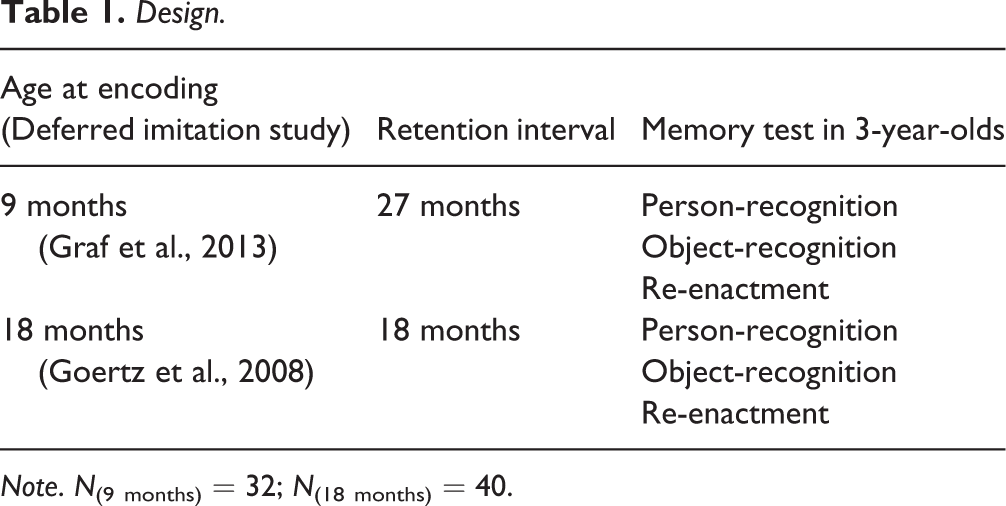
Note. N(9 months) = 32; N(18 months) = 40.
Encoding Phase (DI Studies) 1
9-M-E
Thirty-two (18 female) children had participated in a DI task (Graf et al., 2013) at our lab when they were nine months old (M = 279.86 days, SD = 4.79). After a four-minute long baseline phase in which spontaneous playing behavior had been assessed, one of the two female models had demonstrated a total of seven target action steps on a face-like puppet (Figure 1). Due to reasons of interest of the previous DI study involving nine-month-olds, the objects either displayed a typical Caucasian or non-Caucasian female face or a pink non-facial stimulus called “Greeble” (Gauthier & Tarr, 1997). When nine-month-olds had visited the lab they were randomly assigned to a test condition with one of these three objects. After a delay of 15 minutes, target action performance had been assessed.

Target objects as well as two distractor objects for nine-month-olds.
18-M-E
Forty (20 female) of the three-year-olds had participated in a DI task (Frankfurt Imitation Test – FIT 18; Goertz et al., 2008) at our lab when they were 18 months old (M = 562.66 days, SD = 6.77). After a baseline in which children’s spontaneous playing behavior was assessed for 30 seconds for each of the six items (Figure 2), one of the two female models demonstrated a total of 12 target actions on the target objects. After a 30-minute-retention interval, children’s target action performance had been assessed.

Target objects for 18-month-olds (FIT 18; Goertz et al., 2008).
Participants
In the present study, in total, N = 70 (37 female) participants were contacted, of whom N = 53 were derived from the original DI task and their parents were willing to take part in a further long-term retention study. Children were from urban middle-class families, living in the metropolitan area of a large city and had a mean age of M = 3;1 years (SD =13 days) ranging from min = 3;0 to max = 3;2 years. Nineteen children had participated in both former studies, 13 children had solely participated at nine months of age, and 21 children had solely participated at 18 months of age. Seventeen children had not participated in any former study (control group). One additional child was tested but not included in the final sample because of a lack of cooperation. Table 2 gives an overview of the sample-size of all involved experimental and control groups. Gender was controlled for in all analyses. Participants in the original DI tasks had been recruited through advertisements at mother–child centers, notices to local pediatricians, and by word of mouth. In the present study, they were contacted and asked to visit our lab again. During the original lab visit children had interacted with a female model for approximately 60 minutes. Thus, we had good control over what they had experienced during their first visit and the original DI task was carefully planned and kept constant between infants. The current study took place in the same lab in which the original experiment had been conducted, thus we provided strong contextual cuing related to the original study. The study has been conducted in full accordance with the ethical guidelines of the German Psychological Society and is also in line with the Ethical Principles of Psychologists and Code of Conduct of the American Psychological Association.
Overview of sample-size of all involved subsamples in experimental and control conditions.
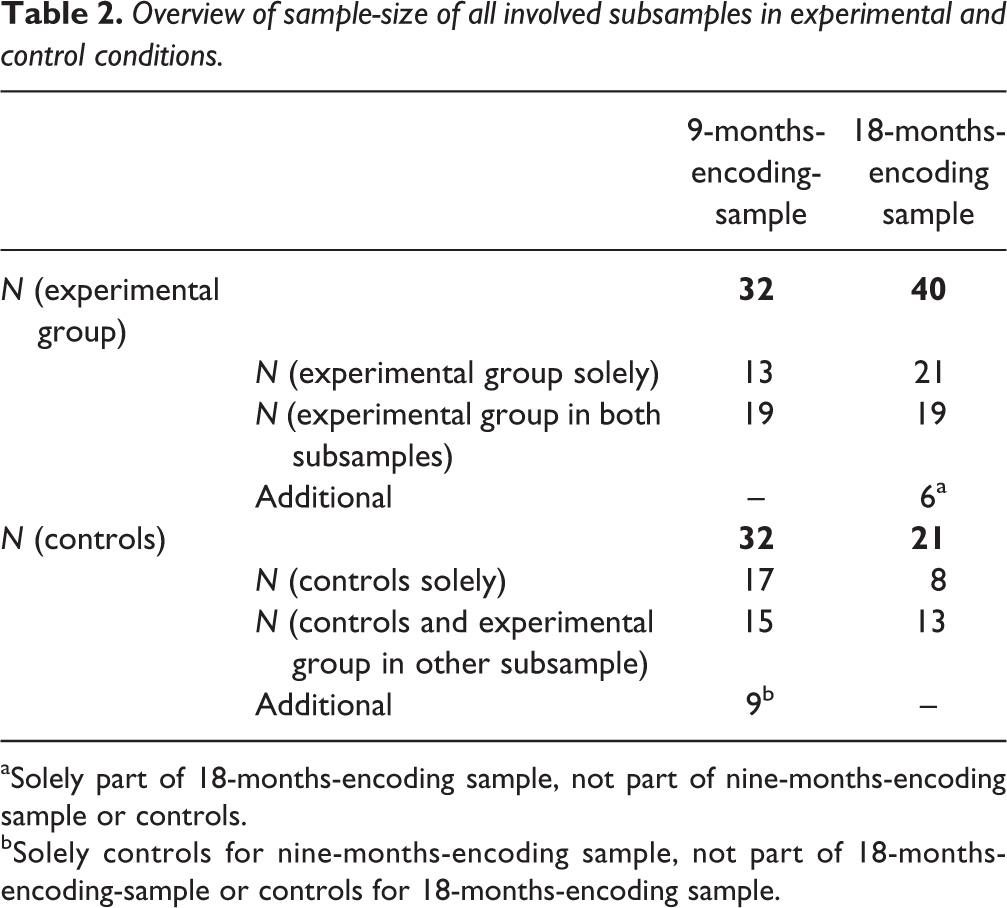
aSolely part of 18-months-encoding sample, not part of nine-months-encoding sample or controls.
bSolely controls for nine-months-encoding sample, not part of 18-months-encoding-sample or controls for 18-months-encoding sample.
Stimuli
Person-recognition test
A four-alternative picture-choice task was developed using photographs of the former models (10 × 7.5 cm) representing the target between three distractor photographs, which displayed persons unknown to the participants in the current study. All target and distractor photographs showed young, smiling, female adults (see Figure 3 for an example). For a within-control of equivalent salience and attractiveness of each photograph, target photographs were distractors for other participants, who had been tested by the other experimenter in the original DI task.
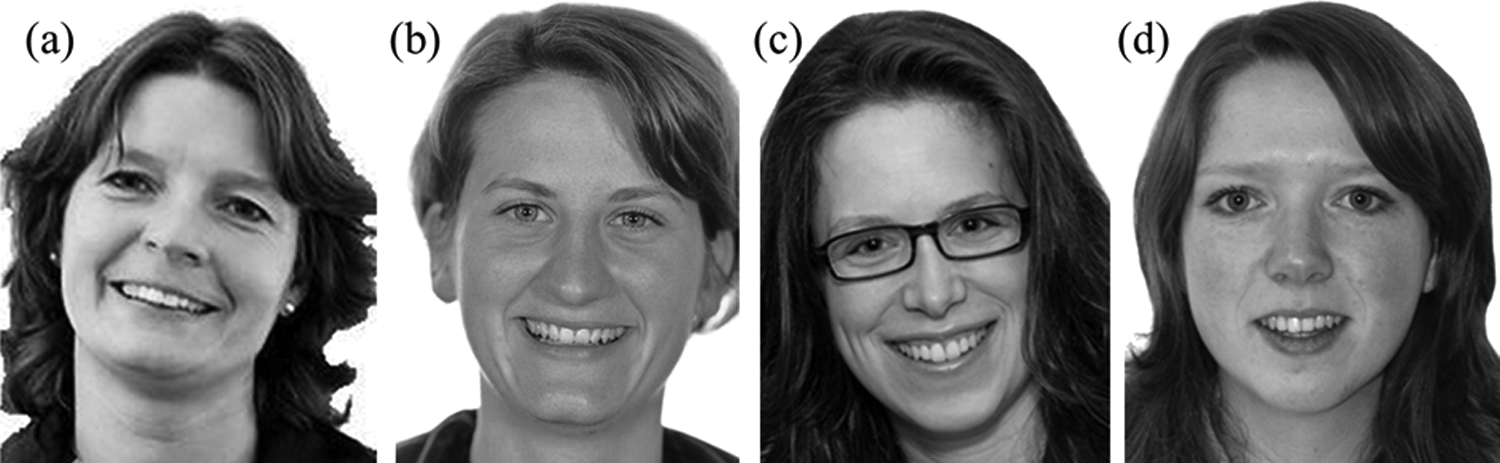
Target photograph of the former model (a) and distractors (b–d; unknown to the child) of the person-recognition test.
Object-recognition test
In the original DI task for the 9-M-E sample, one target object out of three alternatives had been used. Thus, depending on the experimental condition at nine months, one of the three photographs (10 × 7.5 cm) was the target whereas the other ones served as controls in the current study, resulting in a three-alternative picture-choice task for the assessment of object-recognition in the 9-M-E sample. The case of being target or distractor was therefore counterbalanced between participants. For the 18-M-E sample, the object-recognition test was realized through six trials, each consisting of a four-alternative picture-choice task. In each trial, one target object was shown between three distractors. These distractors were toys which were comparable to the target objects regarding their size, color, shape, and material.
Action retention
The memory test for target actions assessed the performance of target actions on the test stimuli derived from the studies in which children had participated at nine or 18 months of age (Goertz et al., 2008; Graf et al., 2013).
Procedure
Appointments were made for the time of the day when parents reported that their child was most likely to be well rested and playful. Before the testing began, the experimenter explained the study’s general set-up and obtained informed consent for the recording of the testing. Furthermore, the experimenter established contact with the child by starting to engage the child in an interactive game. When the child seemed to be comfortable and ready to participate in the testing, the experimenter directed the child and parent(s) to a sparsely furnished laboratory, the same one used during the previous DI study. Children were tested individually by the first author of this paper. Parents remained in the laboratory during the session and were requested not to help their child by either choosing photographs or reminding them of object manipulations. The child was seated at a table opposite the experimenter on a high chair. The test material was stored next to the table but was not apparent to the child and was subsequently presented by the experimenter. All sessions were video-recorded for later analyses. A warm-up game was given to the child. It consisted of a kind of picture-sorting game in which six cards had to be placed onto matching fields with the same images. The game was chosen to introduce handling pictures on cards and contemplating illustrations during the experimental session. Following this, the memory tests were conducted.
When the child felt comfortable with the experimenter and was willing to participate, the person-recognition test was conducted. The experimenter said: “Look, [Name], I will show you something!” The four photographs were simultaneously put in a line on the table and the child was asked “Who do you know?” The spatial arrangement of the photographs was counterbalanced between participants. If the child did not answer, she/he was asked: “Do you know one of these women?” If the child did not choose one of the photographs after 60 seconds, the experimenter removed them.
Following this, the object-recognition test was conducted. The three-alternative (for 9-M-E) or four-alternative (for 18-M-E) picture-choice tasks were administered by saying to the child: “Look, [Name], now I will show you a couple of photographs of toys. Can you show me the one that you played with?” The arrangement of the photographs was counterbalanced between participants. The three (for 9-M-E) or four (for 18-M-E) photographs were simultaneously presented to the child. If the child did not choose any photograph, the experimenter asked: “Have you ever played with one of them?” If the child did not choose one of the photographs after 60 seconds, the experimenter removed them. Note that this procedure was repeated in six trials for the 18-M-E sample.
Finally, the test of target actions was conducted. It was introduced by the following: “Look, [Name], now I will give you some toys and you can play with them.” Each child in the 9-M-E sample was given the target object (i.e., the one he or she had seen during the former study). There was no time limit for play duration with the target object for the 9-M-E sample. Participants of the 18-M-E sample were given the six target objects for 18-month-olds subsequently. There was no time limit for play duration with the targets of the 18-M-E sample. However, when children no longer showed interest in playing with an object they were asked to give it back to the experimenter and received the next one.
Control Sample
To ensure that the photographs of the target objects were not more likely to be chosen over the distractors for reasons of attractiveness or salience, a preference test with a control sample of inexperienced children for the respective target objects for 18-month-olds was conducted. Inexperienced three-year-olds were shown the photographs of target objects and distractors in the same manner as described for the object-recognition test. Note that this control procedure was not conducted for the person-recognition test for two reasons. First, as described in the section above, photographs displayed targets for half of the participants whereas for the other half they were used as distractors. Second, the question “Which one do you know?” would probably have been too confusing for a control sample of inexperienced three-year-olds who in fact knew none of the displayed persons. All objects were controlled concerning familiarity from other contexts than the previous DI task. Those objects that were known from diverse other contexts (e.g., at home) were excluded from the analysis. We considered participants’ reply to our question “Where do you know it from?” as well as parental report for the decision to exclude singular objects for individual participants.
In order to assess spontaneous performance of target actions without prior experience, three-years-olds who had not participated in the DI task for nine-month-olds were handed out one of the three target objects which had been used for the study with nine-month-olds, and the target action behavior was assessed. Similarly, three-year-olds who had not participated in the DI task at 18 months of age were handed out the six target objects for 18-month-olds which they were inexperienced with and the target action behavior was assessed.
Data Scoring
All video-recorded experimental sessions were scored by two independent raters blind to the experimental condition (9-M-E sample, 18-M-E sample, controls) that each child belonged to. For the recognition tests a correct response was scored when the photograph of the target model (i.e., former model in DI task) or a target object (i.e., prop of actions in the DI task) was chosen, whereas a response was referred to as wrong/false when the child chose a photograph of a distractor (i.e., an unknown person/object not used in the former study). Pointing behavior was considered as answer as long as the parents did not influence their child’s choice. Inter-rater reliability was κ = .84 (p < .001). Discrepancies between raters were resolved by mutual agreement.
Results
9-M-E Sample 2
Person-recognition test
For the 9-M-E sample, the photograph of the target model was chosen by seven out of the 29 3 participants (24.1%). A binomial test was conducted to compare this distribution to the probability of 25% choosing the correct photograph of the target model by chance. It showed that the choice-behavior does not differ significantly from chance level (p(B29, .25) = .56). In addition, there was no difference in the choice-behavior for the two models (N = 29, χ2 = 1.20, df = 1, p = .27).
Object-recognition test
For the 9-M-E sample, the photograph of the target object was chosen by 11 out of the 32 participants (34.4%) of the sample. A binomial test showed that the choice-behavior does not differ significantly from chance level (p(B32,.33) > .99). We controlled for stimulus-class (Caucasian, non-Caucasian, Greeble) which had no influence on target object-recognition (N = 32, χ2 = 1.22, df = 2, p = .54).
Action retention
The 9-M-E sample showed M = 2.23 (SD = 1.86) out of seven correct target actions on average, whereas the control sample (N = 32) showed M = 1.00 (SD = 1.11) target actions, indicating a significant difference between both samples (t(61) = 3.19, p = .002, r = .94). Of the 32 participants, 24 showed at least one target action. In the control sample, 19 of 32 children showed at least one target action. We controlled for stimulus-class (Caucasian face, non-Caucasian face, Greeble), which was not related to the performance of actions (F(2,60) = .30, p = .74).
For more detailed results regarding the performed target actions, play duration was analyzed in a post-hoc analysis. The 9-M-E sample played M = 98.74 seconds (SD = 70.88) on average with the corresponding target objects compared to M = 43.84 seconds (SD = 20.39) in the control sample, indicating that play duration in the 9-M-E sample was significantly higher compared to the control sample (t(61) = 4.21, p < .01, r = .76).
We controlled for those children who had participated in both previous studies for their additional chance to get acquainted with the lab. In the 9-M-E sample there was no effect on their performance of target actions depending on whether they had additionally participated at 18 months or not (F(1, 29) = 1.00, p =.32).
To compare the performance rates of target actions between the time points nine months and three years of age, we conducted a paired t-test (t(29) = 2.34, p <.05, r = .16). Due to missing values, performance rates for nine as well as 36 months could only be assessed for the 30 participants for whom we could access both time points (M(9 months) = 3.20, SD = 1.58; M(3 years) = 2.17, SD = 1.86). In our study, participants forgot, on average, M = 1.62 (SD = 1.94) target action steps between nine months and three years of age.
18-M-E Sample 4
Person-recognition test
In the 18-M-E sample, for four of the 40 participants the former model was a male person. They were excluded from the person-recognition test as we did not construct a picture-choice task for male faces. Fifteen of the 36 remaining participants (41.7%) chose the photograph of the target model. For one target model, seven out of 16 participants chose the correct photograph. For the other target model, six out of 16 children choose the correct photograph. Two of four children chose the correct target model of a further person who acted as a substitute in four DI test sessions. A binomial test (p(B36, .25) = .02, φ = .17) showed that this choice-behavior is significantly different from chance level. There was no difference in the choice-behavior for the two models (N = 32, χ2 = 0.13, df = 1, p = .71).
Object-recognition test
The number of chosen photographs of the six target objects was compared between the 18-M-E sample and the control sample of inexperienced three-year-olds (N = 20 5 ). More photographs of target objects were correctly chosen by the 18-M-E sample (M = 1.95, SD = 1.54) compared to the control sample (M = .70, SD = .92). The number of correctly identified photographs of target objects, therefore, between the 18-M-E sample and control sample (t(58) = 3.34, p = .001, r = .97) favors the 18-M-E sample. A binomial test showed a significant difference of choice-behavior from chance level for two out of the six photographs of target objects (or the duck with octopus: N = 15 of 33 6 ; 45% correct choice, p(B33, .25) < .05; for the drum: N = 25 of 40, 63% correct choice, p(B(40, .25) < .01).
Action retention
The 18-M-E sample performed, on average, M = 2.10 (SD = 1.54) out of 12 correct target actions compared to M = 2.24 (SD = 1.61) target actions in the control sample, representing no significant difference (t(60) = .33, p = .74). There was no difference regarding the performance of target actions depending on whether they had additionally participated at nine months of age (F(1, 39) = .31, p =.58). Of the 40 participants, 36 showed at least one target action. In the control sample, 16 of 21 children showed at least one target action. To compare the number of performed target actions between the time points 18 months and three years of age, we conducted a paired t-test (t(33) = 5.27, p < .01, r = .45). Due to seven cases of missing values, performance rates for 18 as well as 36 months could only be assessed for 33 participants for whom we could access both time points (M(18 months) = 3.88, SD = 1.53; M(3 years) = 1.91, SD = 1.52). Our results show that participants forgot, on average, M = 1.97 target actions (SD = 2.18).
Discussion
The present research studied three-year-olds’ long-term memory for persons, objects, and actions encoded at nine or 18 months of age within a DI task. In addition to memory for actions, as it is traditionally researched in DI studies, recognition of features concomitantly present during the encoding, namely person- and object-related information, was assessed.
For the 9-M-E sample we found no recognition, either for the person or for the object involved in the original DI task children had participated in 27 months earlier. Thus, it seems that no person-related as well as object-related information is available in these children after long-term retention intervals. There are several reasons which might contribute to this result. Maybe recognition in our study failed due to the character of our picture-choice task, which was verbally instructed. However, it remains an open question if recognition memory in terms of a preference in looking behavior would have revealed different results as is reported by Kingo et al. (2014). Future research should address this question by investigating nine-month-olds’ visual preference in a recognition task after a long-term retention interval.
Furthermore, although we provided a very similar context compared to the original task as three-year-olds were welcomed and investigated in the same laboratory and with the same target object as used in the original DI task, the experimenter in the present study was a different person than during the DI task conducted at nine months of age. Future research might explore if performance in the object-recognition test is increased if the person who acts as experimenter in both studies remains the same (for similar arguments see Learmonth et al., 2005).
Additional explanations for our results might be derived from findings by Bahrick, Gogate, and Ruiz (2002). The authors investigated 5.5-month-olds’ visual preference for persons demonstrating actions after delays of one minute and seven weeks. Results indicate discrimination and memory for actions, but not for persons, after both retention intervals. The authors conclude that these findings demonstrate the attentional salience of actions over faces in dynamic events. We suggest that similar reasons might have contributed to our findings in the 9-M-E sample. For nine-month-olds, an outlasting memory input might be established with priority given to the action component rather than for the person- and object-related information. Although Taylor and Herbert (2014) found that nine-month-olds’ attention is focused on the model and on the object during encoding, it is still an open question if both bits of information are stored and can be retrieved after a long-term interval.
However, in the present study we found an increased performance rate of target actions from the original DI task which the three-year-olds had encoded at nine months of age compared to a control sample. Thereby, previous research on nine-month-olds’ long-term retention of target actions must be considered. Findings by Bauer et al. (2001) revealed no evidence for successful memory performance over intervals exceeding one month. It remains an open question (for a discussion see Want & Harris, 2002) if imitation or rather stimulus enhancement contributed to our results. Given the fact that play duration was about twice as high as in the control sample, the 9-M-E sample had an increased opportunity to discover target actions by chance. However, we argue that stimulus enhancement constitutes a kind of memory. Our results are in line with the findings of Perris, Myers, and Clifton (1990), who demonstrated memory for a single laboratory task (a task for auditory space localization) in 2.5-year-olds who encoded the task two years earlier when they were as young as 6.5 months of age. Participants who had unique experience in the laboratory context were more willing to remain in the same situation during the long-term memory test and showed increased reaching and grasping behavior compared to an inexperienced control sample, which was a crucial behavior regarding the original task. Likewise, in our study participants who had prior experience with the object for nine-month-olds showed increased exploratory behavior.
To sum up the findings for the 9-M-E sample, person- and object-related information was not retrievable by our picture-choice task, whereas the original object during the action retention test constituted a strong cue enabling memory retrieval for target actions.
For the 18-M-E sample we found that, in the present study, three-year-olds showed recognition of persons as well as of objects from the DI task they participated in 18 months earlier. To our knowledge, no previous research provides evidence of three-year-olds’ recognition memory for person- and object-related information encoded at 18 months of age. Possibly, in line with the assumptions made by Csibra and Gergely (2006) as well as Gergely and Csibra (2005), person-related information concerning the model in a DI task constituted an especially important aspect of the DI task for 18-month-olds, resulting in well encoded information which was retrievable at three years of age.
In line with findings by Bauer et al. (2004), the present study demonstrated that three-year-olds were able to recall an original laboratory task which they were initially exposed to at 1.5 years of age. Therefore, our results add to the growing body of research on long-term memory encoded during the second year of life. Furthermore, the present study is the first one providing evidence of photographs being effective retrieval cues associated with to-be-remembered actions covering intervals exceeding one year.
To speculate, picture-choice probably demands another level of memory accessibility than verbal utterances associated with the initial experiences that were assessed in previous research by Bauer et al. (2004). We did not assess verbal accessibility of long-term memory as it has been previously studied by Bauer et al. (2004) as well as by Simcock and Hayne (2002). Instead, we assessed a behavioral (picture-choice) response to a verbal instruction. Bauer et al. (2004) report that only participants who were at least 20 months of age, but no younger, showed evidence of later verbal recall at three years of age. However, the present study demonstrates that recognition memory exceeds this age-barrier. In future research, it might be better to first ask the children if they knew anyone in the photographs and, if they did, to then ask them who they knew. In this way, it would be possible to use the same task with a control sample. Further, this procedure could avoid the possibility that the wording might have biased the children in that they would know that they were supposed to know one of the people. Similarly, in future research all participants should first be asked if they knew any of the objects and, if they did, then ask them which one they knew.
Contradictory to our results of successful person- and object-recognition, no increased performance rate of target actions was observed compared to the control sample. However, it remains an open question if this finding occurred due to forgetting. Previous research by Bauer et al. (2000) indicated that in a sample of 20-month-olds, 70% of the children demonstrated recall of target actions after a delay of 12 months. Given these findings, it seems unlikely that the lack of a difference between the experimental and control sample in our study occurred due to forgetting target actions. We acknowledge that in our study there was forgetting of approximately two target actions, which might reflect differences in the length of the retention interval between our study and the results reported by Bauer et al. (2000) and in the nature of the tasks. Participants in our study, contrary to the elicited imitation task reported by Bauer et al. (2000), did not receive multiple demonstration sessions of the target actions with narrative support.
However, we instead suggest that our results are affected by stimulus characteristics of the DI task for 18-month-olds. A memory effect may have been obscured by children’s familiarity with the everyday actions that could be completed with the sequence materials (for a discussion see Boyer et al., 1994; McDonough & Mandler, 1994). In fact, the three-year-olds in our study did not show target actions, but a broad compilation of actions typically associated with the objects used as targets. For example, whereas target actions for 18-month-olds involved putting a hand into a car and waving, and removing a blue drumstick to press a red button on a drum, three-year-olds pretended to drive the car and used the stick of the drum as a telephone receiver. For future research, target actions might be designed with respect to their novelty for every age-group involved.
In our study, retrieval was assessed at three years of age. A 2D retrieval task provides a poorer range of features of the object. We suggest that younger age at encoding in our 9-M-E sample led to weaker elaboration of memory traces, less representational flexibility in retrieval, and thus poorer ability to successfully transfer from a 3D encoding to a 2D retrieval using photographs. As suggested by Barr (2010) and Zack et al. (2009), older age at encoding leads to richer encoding of specific perceptual features of the objects, context, and model used during the demonstration (Bandura, 1986; Meltzoff, 1988; Tulving, 1983). In line with these assumptions, older age at encoding in our 18-M-E sample led to successful recognition of 2D features encoded in the framework of a DI task.
Within participants, there was no consistency, in that those children who correctly identified the model were not the same who also recognized target objects and performed target actions. We suggest that emerging memory abilities were not yet completely accessible concerning every aspect in each participant. Future research on co-occurring variables is needed to further examine why some participants were able to recognize former models, whereas others recognized target objects.
To conclude, the present study shows emerging memory abilities in three-year-olds over extended retention intervals; however, these are not thoroughly consistent and not complete. For example, recognition of former models and target objects can be found in some (but not all) participants of the 18-M-E group. Thus, it is not the case that all, or even most, children show evidence of recall of the previous tasks encoded at nine or 18 months of age. However, our results show that different measures, for example recognition- and re-enactment-tasks, provide the opportunity to have a closer look at evidence of emerging long-term memory abilities, thereby covering a detailed analysis of contextual and content information in infants’ and toddlers’ environmental learning situations.
Footnotes
Acknowledgment
We extend a special note of appreciation to the children and parents who participated in this research.
Funding
The authors disclosed receipt of the following financial support for the research, authorship, and/or publication of this article: Support for this research was provided by a scholarship from the Anna Ruths-foundation awarded to the first author.