




Abstract
This article examines the political socialization of young children who live under conditions of intractable conflict. We present four premises: First, we argue that, within the context of intractable conflict, political socialization begins earlier and faster than previously suspected, and is evident among young children. Second, we propose that the agents of political socialization impart narratives of the ethos of conflict and of collective memory in young children that support continuation of the conflict. Third, we maintain that the great majority of the young children form systematic and coherent systems of beliefs, attitudes, and emotions that support the conflict as a result of political socialization and direct exposure to conflict. Finally, we suggest that the conflict-related contents absorbed by children have lasting effects on the solidification of children’s later socio-psychological repertoire. Our arguments highlight the serious consequences of political socialization processes on very young children in societies involved in intractable conflict.
Examining the political socialization of young children in the context of intractable conflict is crucial for understanding their social and political behavior in adulthood. Political socialization is a process of learning political contents which begins at an early age and is affected by the context in which the children live (Dawson, Prewitt, & Dawson, 1977; Greenberg, 2009). Intractable conflicts are fought over goals viewed as existential and violent, perceived as being of zero sum nature and unsolvable, preoccupy a central position in the lives of the involved societies, require immense investments of material and psychological resources, and last for at least 25 years (Bar-Tal, 2013; Kriesberg, 1998). In these conflicts, it has been well observed that despite great losses, destruction, and personal suffering, most society members remain entrenched in societal beliefs of narratives that propagate the continuation of the conflict, de-legitimization of the rival, glorification of the ingroup, and collective self-perception as victims of the conflict. We suggest that these narratives are acquired at an early age and influence the beliefs, attitudes, and emotions of society members when they become adults.
This article presents four premises that are derived from the effects of the nature of intractable conflict on political socialization. These premises form an argument suggesting that early political socialization plays a major role in the acquisition of the socio-psychological repertoire that supports the continuation of intractable conflicts. While this article does not aim to be a systematic review of the literature regarding the political socialization of young children in intractable conflict, the reviewed material does shed valuable light on possible directions for research in a relatively unexplored field of study. But first, we begin with several points of established knowledge about political socialization at an early age, or, as it is referred in the psychological field, socio-cognitive development in early childhood.
Socio-cognitive development in early childhood
Socio-cognitive development is usually considered a concept with a wider scope than political socialization because it combines reference to forces of maturation and to external forces of the context (such as agents of socialization) responsible for the acquisition of the political repertoire of the child (Bjorklund, 2013; Serafica, 2015).
In this article, we focus mostly on the external forces of the powerful context of intractable conflict that greatly affect acquisition of the children’s belief system related to the conflict. These are contextual forces that mediate the maturational processes. Obviously, they not only shape the content of the children’s acquired repertoire, but also determine the speed, the scope, and the trajectory of development. Therefore, in exploring the effects of intractable conflict on young children, consideration must also be given to knowledge accumulated in developmental psychology about social-cognitive development related to the development of intergroup attitudes and biases. In this framework, we briefly describe three integrative social-cognitive developmental theories on intergroup attitudes that are mostly relevant to our conception.
The first theory, social identity development theory (SIDT) (Nesdale, 2004) is comprised of a four-phased model for intergroup attitude development. In the first or “undifferentiated” stage, children under the age of 2–3 years are incapable of responding to racial cues regarding others. In the second phase, “ethnic awareness,” children around the age of 3 begin to become aware of ethnicity, and most crucially, build a sense of self-identification and belonging to a particular group. In the third phase, “ethnic preferences,” children aged 4 and upwards not only recognize and identify with their ingroup, but also express preference for their ingroup over outgroups. In the final stage, “ethnic prejudice,” which is usually only identifiable in children aged 7 and upwards, the ingroup preference begins to emerge as negative prejudice against outgroups. This theory highlights that while almost all children will pass from the undifferentiated stage to ethnic awareness and ethnic preference, a significant number of children will not express ethnic prejudice. The move from ethnic preference to ethnic prejudice depends on several factors, including the extent to which negative attitudes of outgroup are shared by the members of the ingroup. As we argue later in this article, we thus believe that the social context of intractable conflict catalyzes the move towards ethnic prejudice.
The social-cognitive domain model (Smetana, 2006; Turiel, 1983) posits that children aged 3–4 years and upwards evaluate social events using three main domains: the self, the group, and morality as gained during earlier stages of development. According to this social-cognitive domain model, young children can exercise multiple forms of reasoning at once; moral considerations, social-conventional norms, and personal goals all provide input into social reasoning. Studies have demonstrated that, from a young age (from 4.5 years), children in straightforward situations give priority to moral reasoning instead of group membership by emphasizing moral reasoning (e.g., fairness) when judging exclusion based on group membership, such as gender or race (e.g., Killen, Pisacane, Lee-Kim, & Ardila-Rey, 2001). Yet, by investigating whether complexity or ambiguity reveals prejudice or bias, studies using this approach have found that young children often resorted to stereotypic judgments or conventions to justify exclusion (Killen, Pisacane, Lee-Kim, & Ardila-Rey, 2001).
The social reasoning developmental (SRD) theory (Rutland, Killen, & Abrams, 2010) integrates social identity development theory (Nesdale, 2004) and social domain theory (Turiel, 1983) in order to make predictions about developmental changes in children’s intergroup attitude orientations. This theory contends that children’s decision making is influenced simultaneously by both morality (principles, as distinct from cultural norms) and group processes (norms and identity), as these two processes are intertwined in development. Children simultaneously develop the ability to think about the social world using different types of judgments, while considering notions of group identity, social-conventional norms, and morality. This ability then forms the basis for their evaluations of groups and peers within groups. Whether (and when) children begin to show prejudice depends on the close interplay between their emerging morality, their ability to understand group life, and their motivation to act in accordance with certain group identities. This process is dependent on the development of social-cognitive abilities (e.g., advanced mental state understanding, moral judgment, autonomy, and group reasoning) and on specific features of the intergroup context (e.g., the strength and nature of the group identity propagated by the system, social norms, intergroup contact, and presented outgroup threat). According to this perspective, children actively construct their attitudes using their social-cognitive understanding to navigate between moral principles and group identity concerns.
The reviewed approaches that are supported by empirical studies indicate that, as they grow up, children develop socio-cognitive skills that on the one hand give priority to their ingroup and extend the reliance on social identity in evaluating events and people, but on the other hand, their social reasoning, moral judgment and understanding of the social world becomes more complex, differentiated, open-minded, and moral. Other dimensions of socio-cognitive development such as development of perspective taking (Selman, 1980), empathy (Hoffman, 2008), understanding of conflict and friendship relations (Hartup, 1992), social conventions (Turiel, 1983), and moral reasoning and judgement (Kohlberg, 1969) show the same trend: Age is an important factor in the normal development of socio-cognitive skills and abilities to see, evaluate, and judge the social world. Nevertheless, in line with the dominant view of developmental psychology, we suggest that the context may have a powerful influence on the trajectories of the socio-cognitive development. The stronger the experiences it provides, the longer it lasts, the more consistent the messages it supplies, the more sources, mediums and agents offer the same messages and the more continuously they are presented—the greater influence that context exerts on the acquisition of a socio-cognitive repertoire. Thus, we can assume that, in the case of a powerful context that presents particular messages, they tend to be maintained by the individuals who live in this context (see Teichman & Bar-Tal, 2008). We now describe the powerful context of intractable conflict and its influences on the development of very young children who live in this context.
Intractable conflict
A recent 10-year report by UNICEF (2009) indicates that conflicts in more than 30 countries and territories affect the lives of over one billion children, including approximately 300 million who are under 5 years old. Some of these conflicts are intractable, such as the conflicts in the Middle East, Kashmir, Sri Lanka, Chechnya, and Cyprus. It is generally assumed that the study of a social context is essential for understanding the functioning of society members (e.g., Giddens, 1984; Parsons, 1951). Considering this assumption, we go one step further and posit that the powerful context of an intractable conflict has great influence on society members living in this situation, including children (Bar-Tal, 2013). Furthermore, we suggest that the influence of this potent context begins from a very early period of life and has a formative and lasting effect on children. We recognize though that although we refer to the main trend, not all children are affected in the same way. We will never find one unitary pattern of political socialization. There are multiple factors and processes that play a role in children’s socialization in a conflict, depending on their own psychological characteristics, the groups to which they belong, and the particular societal contexts in which they live (Barrett & Oppenheimer, 2011; Sagi-Schwartz, 2012).
Intractable conflicts can take place between states (for example, India and Pakistan), or between a state and another group, or indeed between two groups (for example, between Tamils and Singhalese or between Turks and Kurds). Violence in intergroup conflicts may include isolated military encounters and small-scale military engagements, through use of military forces against civil population, terror attacks and long-lasting wars. Over an extended period of time, not only are soldiers wounded or killed in conflicts, but also civilians, including women and children, and civil property is often destroyed. Additionally, these types of conflicts frequently create refugees and sometimes involve atrocities, including mass rape, mass killing, ethnic cleansing, and even genocide (Brubaker & Laitin, 1998; Staub & Bar-Tal, 2003).
From a psychological perspective, all societies engaged in intractable conflicts experience harsh conditions of threat, stress, despair, insecurity, uncertainty, and pain, though with differences (e.g., Lindert & Levav, 2015). These experiences constitute chronic psychological conditions that force society members to adapt both in their personal and in their collective lives. In order to cope with the pressures and challenges that the conflict poses, the involved societies develop a socio-psychological infrastructure that consists of three components: the ethos of conflict, a collective memory of conflict, and collective emotional orientations (Bar-Tal, 2013).
The first of these three components—the ethos of conflict—is the configuration of shared central societal beliefs that provide central orientation to the society and thus contribute to the dominant discourse that propagates and maintains the conditions of an intractable conflict (Bar-Tal, 2013). The ethos of conflict includes eight themes of societal beliefs that provide a clear, simplistic, and one-sided narrative: societal beliefs about the justness of own goals outline the goals in the conflict, indicate their crucial importance and provide their justifications and rationales; societal beliefs about security refer to the importance of personal safety and national survival, and outline the conditions for their achievement; societal beliefs of positive collective self-image concentrate on the ethnocentric tendency to attribute positive traits, values, and behavior to one’s own society; societal beliefs of own victimization concern self-presentation as a victim; societal beliefs of delegitimizing the opponent consist of beliefs which deny the adversary’s humanity and provide psychological permit to harm them; societal beliefs of patriotism generate attachment to the society by propagating loyalty, love, care, and sacrifice; societal beliefs of unity refer to the importance of ignoring internal disagreements in order to unite forces in the face of the external threat; and finally, societal beliefs of peace present peace as the ultimate desire of the society.
The second component of this infrastructure—collective memory—consists of societal beliefs that represent and construct the history of the conflict to society members (Cairns & Roe, 2003). This memory develops over time and describes the conflict’s outbreak and its course, providing a coherent and meaningful narrative of what has happened from the societal perspective (Devine-Wright, 2003). In addition to the collective memory, members of the affected society also have collective emotional orientations, such as fear, anger, and hatred, that develop during and as a result of the conflict (e.g., Halperin, 2016). These three elements of the socio-psychological infrastructure of the conflict fulfill a functional role in satisfying individual and collective needs, such as the need for living in a meaningful and predicable world, the need for security, a positive collective self-view, mastery, etc. The socio-psychological infrastructure of the conflict also enables mobilization of society members to support the conflict and their active participation in violence (Bar-Tal, 2013).
The combination of the ethos of conflict, collective memory, and collective emotional orientations together serve as the foundation for the development of the culture of conflict, which becomes a central feature of the societal-cultural context in which society members, including children, live during intractable conflict (Bar-Tal, 2013). This foundation plays a powerful role in the society as a whole as well as on individuals, especially when no possibility of peace appears. In these times, there is often a consensual and genuine view that the described socio-psychological repertoire not only reflects reality, but is also needed for the struggle with the rival over important goals. Therefore, societies make major efforts to maintain this repertoire and impart it to the new generations via formal and informal societal institutions and channels of communication. In fact, this repertoire becomes a prism through which individuals evaluate incoming information, their experiences and their reality in general. Yet when possibilities of peace appear, the same repertoire that facilitated the continuation of violence becomes a very serious barrier to the developing peace process (Bar-Tal & Halperin, 2011).
Effects of the context of intractable conflict on young children
In an analysis of the effects of intractable conflict context on political socialization in early childhood, we present and discuss four premises. First, drawing on research conducted in the field, we believe that there is strong evidence to suggest that under the conditions of intractable conflict, political socialization begins at a very young age with intensive experiences and continuous exposures to information about the conflict (e.g., Bar-Tal & Teichman, 2005; Connolly, Smith, & Kelly, 2002). The second premise concerns the contents (i.e., societal beliefs and narratives) propagated by the societal agents of political socialization participating in the socialization of young children. We argue that in instances of intractable conflict, these agents often propagate conflict-supporting narratives of the ethos of conflict and collective memory of society. Third, we suggest that young children, on the basis of their experiences and exposure to violence and learning, usually form systematic and coherent systems of beliefs, attitudes, and emotions supporting the conflict. In our final premise, we suggest that the contents absorbed by children have lasting effects on the solidification of children’s later socio-psychological repertoire. The four premises constitute a holistic framework that points to the serious consequences of the political socialization process at an early age in societies which have a dominant culture of conflict. In presenting these premises, we refer to a variety of studies conducted on children in intractable conflicts. The studies presented include children as young as 3 and as old as 12, in order to account for the differences that come with age that can be explained by the aforementioned theories of intergroup attitude development. It is worth noting that the vast majority of studies reviewed used interview techniques, since interviews are usually the most effective method for elucidating children’s experiences. We will now discuss each of these premises.
Early beginnings of political socialization
In areas where the conflict is active, political socialization begins very early in children as a result of conflict-related events that are inseparable parts of their daily lives (e.g., Cairns, 1996; Robben & Suárez-Orozco, 2000). Even in periods of relative calm when violence is less apparent, the conflict continues to be part of the daily discourse and is reflected in various ways in the culture of conflict (Muldoon & Trew, 2000). In this environment, almost every child is affected by conflict-related events (Cummings, Goeke-Morey, Merrilees, Taylor, & Shirlow, 2014; Sagi-Schwartz, 2012). We suggest that the context of intractable conflict affects the life of an individual from the day he or she is born. Infants may hear sirens, shootings, bombardment, and/or detect emotional distress of their family members (Meijer, 1985) and thus are active absorbers of experiences and information. As an infant or toddler grows, these experiences become more concrete, identifiable, and meaningful.
In focusing solely on the exposure to conflict, we suggest that political socialization is taking place in three different ways: in the first and least direct manner, children absorb information by being continuously exposed to information about the conflict in their environment. Children indirectly hear language that is laced with a vocabulary of conflict, using words to describe its nature, the rival group, and the ingroup. From an early age, when they begin to collect information from their surroundings, children also observe visual violent representations of conflict. The conflict is also reflected in various images and symbols of everyday life that children are exposed to, such as the presence of military forces with weapons in public spaces, statues and sculptures related to the conflict, checkpoints, bomb shelters, memorial sites, military cemeteries, and advertisements whose contents are related to the conflict (Bar-Tal, Abutbul-Selinger, & Raviv, 2014). Furthermore, children, like all society members, engage on a daily basis in practices that are related to the context of the conflict and are established either formally or informally. Formally established practices are imposed by the authorities and may even be required by law (e.g., security searches in public places, train stations, and airports). Informally established practices may emerge as norms observed by society members (e.g., paying attention to suspicious objects in public places). It is therefore unsurprising that children of all ages who live in conflict-zones absorb conflict-related information continuously from birth and they form concepts, categories, impressions, and preferences. We recognize that these cues differ in the context of every society but they are always visible and salient.
The second way in which political socialization takes place refers to direct instruction. Agents of socialization such as family members, teachers, and media describe and explain the conflict to the children. For example, parents may respond to questions and also initiate talk about the conflict, trying to explicate its various features (e.g., Myers-Walls, Myers-Bowman, & Pelo, 1993; Priest et al., 2014). Kindergarten teachers, who have great influence on children at a very early age, refer to different facets of the conflict such as the bravery of the fighters, the cruel rival, commemorative events of the conflict and stories about the collective memory of the conflict (see Nasie, Diamond, & Bar-Tal, 2015). In addition, children themselves as observers may ask questions, conduct verbal interaction and take an active part in societal, communal, and familial memorial ceremonies. Finally, television programs for children refer to the ongoing conflict. In this way, children are directly exposed to new information and expand their knowledge about the conflict.
The third (and perhaps most pervasive) way in which children undergo political socialization is directly through various personal experiences of conflict. Children may experience a loss, or observe the injury of family members or acquaintances, destruction of their homes or harm to their environment, or may experience violence in cases of shooting, bombardment, terror attack, or leaving home as a refugee. In addition, children may undergo arbitrary humiliation, detention, or imprisonment and some may even experience injury, torture, or recruitment by armed forces and active participation in the violence (e.g., Derluyn, Broekaert, Schuyten, & De Temmerman, 2004; Elbert et al., 2009).
The three aforementioned methods of political socialization provide evidence to suggest that the political socialization of children in the context of intractable conflict is accelerated because of the unique experiences the children go through from their birth (e.g., Feldman & Vengrober, 2011). Experiences of children who live in areas of conflict are very different from the experiences of children who do not live in such areas; in particular, children living in intractable conflict acquire a distinctive set of societal beliefs, attitudes, and emotions that provide cognitive tools for understanding their conflictual reality (e.g., Bar-Tal & Teichman, 2005; Miljević-Ridjički & Lugomer-Armano, 1994; Myers-Bowman, Walker, & Myers-Walls, 2005).
Effects of the agents of political socialization
In our second premise, we argue that in instances of intractable conflict, agents of political socialization inevitably impart a socio-psychological repertoire consistent with an ethos of conflict, the collective memory, and shared emotions of the society to young children. We suggest that the socio-psychological repertoire children acquire in this context emphasizes the justness of the conflict, describe the heroism and sacrifices of the ingroup members and their importance for the group’s survival, the suffering of the group members as victims of the conflict, and the evilness of the rival-group that performs violent acts against the ingroup (Nasie et al., 2015).
It is important to note that although personal experiences can be similar across different conflicts, the use of major formal agents of socialization such as the educational system and mass media differs considerably in societies engaged in intractable conflict, depending on different factors, especially on whether the ingroup has a state. Thus, in many cases, societies that have a state or some kind of formal political autonomous infrastructure (e.g., Jews in Israel, Turks in Turkey, Tutsi in Rwanda, or Palestinians in the Palestinian Authority) widely use the educational system and mass media to propagate narratives to young children that are in line with the policy of the authorities. In contrast, societies that do not have a formal infrastructure (e.g., Tamils, Hutu, or Kurds) have to rely on informal societal institutions and channels of communication, such as families or ceremonies, in order to socialize their young generation. Moreover, in some instances, when the rebellious minority lives within a state with the majority which is a rival in the conflict, the authorities actively prevent dissemination of materials that negate the official narrative in formal educational, societal, and cultural systems as, for instance, in the Basque region during the Franco era or in Sri Lanka’s treatment of the Tamil minority. We must take these major differences into account because the latter groups often conduct the political socialization of the young children not only informally, but also under conditions of threat from the dominant group which tries to prevent this process. Furthermore, when the ingroup is supported by a state, families will most often transfer the role of socialization to the formal institutions (i.e., kindergartens and schools); but when the ingroup is not supported by a state, families take the responsibility for constructing the collective identity and imparting the group’s narratives related to the conflict. In such cases, the families believe that if they do not actively pass on their beliefs to their children, the youngest generation will not form an identification with the ingroup and will not acquire the ingroup’s ethos and collective memory. Therefore, parents tend to participate more actively in the socialization of their children (see for example, Nahhas, 2012).
Parents
Parents play an important role in the political socialization of young children. Children are exposed to parents’ political views and accept them uncritically at this age. Through telling stories, explaining events, and other methods of direct instruction, parents in this sense are the main epistemic authority for most children and thereby have the power to control the opportunities, scope, modes, and contents of children’s exposure to the political world (Priest et al., 2014). Studies from a wide variety of national contexts investigating the interactions between children and parents during a conflict reveal the extent to which parents can direct their children’s socio-psychological repertoire. Indeed, parents employ cognitive and emotional strategies to ease their children’s fear. Parents’ strategies include conversations about the events of the war, discussions about the child’s feelings about the war, parents’ expression of their own values or positions on the war to their child, and justifying the war by explaining how it may benefit the country or the world over time (e.g., Myers-Walls et al., 1993). In cases of intractable conflict, there is evidence that children as young as 3 years of age were capable of discussing conflict with parents, with references being made to war activities, negative consequences of war, weapons, soldiers, and even qualitative evaluations of war (e.g., for Ireland, see O’Malley, Blankemeyer, Walker, & Dellmann-Jenkins, 2007; for Israel, see Bar-Tal & Teichman, 2005). The possible effects of the epistemic authority of parents in intractable conflicts are reflected in the results of meta-analyses revealing strong correlations between parents’ and children’s views regarding intergroup attitudes (e.g., Degner & Dalege, 2013). The strong influence of parents in this sense was also recorded in Northern Ireland (see Stringer et al., 2010). It was found that parental attitudes, group membership, and cross-group contacts explain the majority of variance in children’s political attitudes.
Media
Studies have also focused on television and other media as a key source of information for young children about wars and other political conflicts (Blankemeyer, Walker, & Svitak, 2009; Lemish & Götz, 2007). Daily coverage of global attacks through media formats has greatly increased the likelihood of children being exposed to these images. Cohen and Adoni (1980) suggested that a conflict’s daily coverage contributes to the increased salience and vividness of conflict-related events. To illustrate that, we highlight that at least in the context of the Arab-Israeli conflict, there has been ample research suggesting that one of the main sources of information on the conflict for children aged 3–10 years is television (e.g., Warshel, 2007). However, given the technological advancements over the last few years and the increasing rate of access that children have to smartphones, the internet, and social media, it is important to consider that the salience of the effects of television and printed media has probably changed. For instance, social media have recently mobilized youth to spark protest and revolutions (for example, in Egypt; Tufekci & Wilson, 2012). As such, while the effect of advancing technologies (and access to social media in particular) on the political socialization of children has yet to be thoroughly explored, it should be considered as a potentially very powerful agent of socialization.
Educational system
In addition to family and the media, educational institutions constitute a central socialization agent in conflict (Barrett, 2007; Covell, 1999). In schools located in societies engulfed by intractable conflict, political socialization takes place in two major ways: first, by providing access to the contents of national conflict-supporting narratives through various channels (e.g., school textbooks, lectures, discussions, ceremonies, trips); and second, by preventing access to alternative information about the conflict and thereby limiting critical discussion of topics related to conflict (Papadakis, 2008; Torsti, 2007). In the context of the Israeli-Palestinian conflict, for instance, Bar-Tal, Spivak, and Castel-Bazelet (2003) found that 64% of 5–6.5-year-old children in their study reported that they had acquired information about the conflict from their kindergarten teachers. Similar responses were found in a study with 6–7-year-old children. Of the interviewed children, 50% reported that they had acquired information about the conflict from their school (Ben Shabat, 2010).
It is reasonable that children acquire knowledge about the conflict in kindergartens and schools, since the educational institutions note at least holidays and memorial days as part of their roles in transmitting national culture. National cultures in societies engaged in intractable conflicts saliently include themes of the ethos of conflict and collective memory. This claim has been exemplified by studies including interviews with Jewish-Israeli kindergarten teachers about national holidays and observations in kindergartens during ceremonies; during ceremonies on Memorial Day for Israel’s fallen, Independence Day, Holocaust Memorial Day, and Jewish festivals, teachers knowingly or unknowingly emphasized themes related to the ethos of conflict and collective memory (such as a collective sense of victimhood, heroism and sacrifice). The teachers also associated commemorated events in the past with the present conflict (Nasie et al., 2015).
In addition to ceremonies and holidays, school textbooks act as tools of socialization, serving as a channel through which conflict-related contents are transmitted in times of conflict (e.g., Adwan, Bar-Tal, & Wexler, 2016; Papadakis, 2008). This element of institutionalization is of special importance for two reasons. First, given that education is compulsory in almost every society, educational textbooks reach almost all children in any given society. Second, with young children in particular, educational textbooks are widely perceived as authoritative sources of knowledge, providing truthful accounts of the past and present (Hofer, 2001), and hence are powerful sources of information. Extensive research on conflict-related content in curricula in Israel has shown that in many instances, the reality of conflict and conflict-related societal beliefs appear in school textbooks as early as the first and second grades (e.g., Bar-Tal, 1998; Bar-Tal & Zoltak, 1989)
Formation of a coherent conflict-related repertoire by children
Third, we suggest that young children, on the basis of their experiences, exposure to violence, and learning from various agents of socialization, form systematic and coherent systems of beliefs, attitudes, and emotions pertaining to the conflict. At a very early age, children form a clear social identity and identification with the ingroup as well as clear differentiation between their own group and the rival group (Oppenheimer, 2006). Moreover, children form a basic conflict-supporting narrative that contains its major themes: justness of the group’s conflict goals, threats that the group encounters, positive collective self-image, self-collective view as the victim, extremely negative stereotypes and a delegitimizing view of the rival, importance of mobilization for the nation, and peace as the desired objective that the group aspires to achieve (e.g., MacMullin & Odeh, 1999; Nasie & Bar-Tal, 2012). These contents indicate adherence to an ethos of conflict, and the group’s collective memory. In addition, the children acquire emotions related to the conflict, especially fear and hatred of the enemy (Myers-Walls, 2004; Punamäki, 1982).
The threatening and violent environment affects the child’s broad and realistic understanding of violent conflict, and especially of war, in concrete terms. For example, pre-school children as young as 3 years of age from Croatia who lived through the conflict in 1992 were able to clearly define the characteristics of war (Miljević-Ridjički & Lugomer-Armano, 1994). They provided detailed understanding of war: shooting; using of heavy arms and air-force activities; human suffering; physical destruction-consequences; and alarms warning of attacks and danger. The children also associated war with negative attributes, describing war emotionally as “ugly,” “nasty,” “wicked,” and “damned.” In addition, the factual knowledge of children aged 3 to 6 about the war was far greater than had been expected. The children talked about the enemy’s aggression, identified the enemies, mentioned the actual names of the politicians, and provided causes for the fighting.
The study of the Croatian children is not the only instance where very young individuals demonstrate socio-political understanding. In Israel, a series of studies showed that Israeli-Jewish children could already use the word “Arab” comprehensively by the age of 30 months. Furthermore, the great majority of interviewed children, aged 3–6 years, described Arabs mostly negatively and had a tendency to characterize them with violent behavior (war, terror attack) (Bar-Tal, 1996). More recently, a report on seven studies carried out with Israeli preschool children showed that very young children, 18–30 months old, expressed stereotypic attributions and negative attitudes before they manifested acquisition of the relevant concept or image of an Arab, reacting negatively to the word “Arab.” Later, the word representing the rival group, “Arab,” appeared fully in the children’s vocabulary at the age of 3–4, and at the age of 5–6, most children were able to use the word in context. In addition, most of the children resorted to aggressive content describing Arabs with acts such as killing, stealing, fighting, throwing bombs, and terrorism (Bar-Tal & Teichman, 2005).
In many societies undergoing conflict, studies indicate that children exhibit a preference for the ingroup from a young age. For instance, results from a survey investigating the ethnic attitudes and identities of 3–6-year-old children in Northern Ireland showed that young children identified with national symbols such as a flag, a name, or marches even before understanding what these symbols represent (Connolly, Kelly, & Smith, 2009). Northern Irish children also established early prejudice towards the rival group (see also Trew, 2004). In a somewhat different study related to the Northern Irish conflict, children of the two rival parties in three age groups, 6, 9, and 12 years old, were interviewed about their people and country. By the age of 6, children already had a wide scope of knowledge about the conflict. They knew that there was a conflict between Protestants and Catholics and were able to explain its causes. With age, they moved from individualistic explanations to collective ones (Sani, Bennett, Agostini, Malucchi, & Ferguson, 2000).
In comparing contexts of conflict to relative peace, conflict may be seen to accelerate identification with the ingroup and rejection of the out-group. In one study analyzing the data collected among children 7–11 years of age in different societies about identification with and views of the ingroup, the most important differentiating variable characterizing the national groups that participated in the studies was the presence or absence of actual or recent armed conflict (Oppenheimer, 2011). Children from Bosnia, Northern Ireland, Cyprus, and the Basque Country tended to develop relatively early knowledge about their own group and the enemy in comparison to children from countries not directly engaged in a conflict. Similarly, a study comparing children’s descriptions of war from Belgrade and the US shortly after the NATO-Yugoslavian conflict (where the Belgradian children directly experienced war, and the children from the USA did not) showed how conflict can affect the socio-psychological repertoire of children. The Belgradian children, who directly experienced war, described war by using personal pronouns and by supplying information about their experiences during the recent bombing of their city. They described things they did, saw, and heard; they defined war as the opposite of normal and peace as when life is normal. The children from the US, however, provided descriptions that reflected their more distant experiences with war. They talked about war in general terms as observers from a distance, and were more able to generalize and remain idealistic about peace and war (Myers-Bowman et al., 2005).
The findings of these studies suggest that the context of violence has a meaningful effect on the knowledge that children form regarding conflict. We suggest that children form a coherent and systematic set of beliefs that correspond to the themes of socio-psychological infrastructure of the intractable conflict.
Long lasting effects of the early conflict-related socialization
In our final premise, we propose that in general, the early acquired beliefs and attitudes remain in the socio-psychological repertoire of the adults. Indeed, there is already significant evidence for the existence of continuity between childhood experiences and early formed attitudes and the adult’s system of beliefs and actions of the same individuals (e.g., Bandura, 1986; Kagan & Moss, 1962). But an intriguing line of research in social psychology shows that even when individuals change their views in the later phase of their lives, contradicting earlier-acquired intergroup attitudes or stereotypes, this early acquired repertoire is not erased from the brain but may come to light in automatic way in certain situations. This takes place because the newly acquired beliefs have a shorter history of activation and their expression requires intentional inhibition of automatic responses. Specifically, conscious attention, cognitive resources, and high motivation are all required to internalize new beliefs and suppress long-held patterns (Devine, Plant, Amodio, Harmon-Jones, & Vance, 2002). When these cognitive resources are unavailable, the automatic activation of the intergroup attitudes learned in the early childhood are usually revealed. A recent study found that ingroup preference is a very early emerging tendency that appears as soon as intergroup categories are acquired in 3–4-year-old children (Dunham, Chen, & Banaji, 2013). This ingroup preference is subsequently apparent among adolescents and adults. Therefore, we suggest that if effects of intergroup attitudes acquired in early childhood are observed in adult reactions in a relatively normal context, they definitely can also be found in the powerful and influential context of intractable conflict (Ajdukovic, Corkalo, & Biruski, 2008). Moreover, we may assume that the process of long-term socialization not only works for negative stereotypes of the rival, but also for other themes of the conflict-supporting narrative, such as justness of ingroup goals, self-victimization or moral superiority.
In addition to the abovementioned research on intergroup attitudes and stereotypes, we note three characteristics of the early political socialization of children in the context of intractable conflict. First, based on the literature reviewed in this article, children in societies engaged in intractable conflict are widely and continuously exposed to conflict-supporting narratives in their political socialization through the years while attending school. Second, the exposure to agents delivering and supporting messages consistent with the conflict continues through adulthood in their respective societies by different agents such as mass media and leaders, as long as the conflict is not resolved peacefully. Third, we note that as long as the conflict continues, there is a continuous flow of cues and signals triggering socio-psychological responses to the conflict in the form of violence, rhetoric, and discourse of the society (for an example of this characteristic in Israel, see Sharvit, 2014). Thus, in view of these arguments, we suggest that a conflict supporting narrative acquired at an early age is often also maintained during adulthood.
Implications and conclusions
We must understand that the context of intractable conflict is a struggle over goals which are very often seen as existentially important for the collective identity of the group. The groups thus form shared narratives and take all psychological measures to assure that society members adhere to the conflict-supporting narratives in order to increase mobilization for the achievement of their goals. We have focused on the socio-developmental psychological perspective that illuminates the early processes by which members of societies engaged in intractable conflict acquire a repertoire that fuels the continuation of conflict and erects barriers to peaceful resolution. Children are exposed to conflict from birth and begin to form their impressions and knowledge early on. In addition, societies which try to maintain the conflict-supporting narratives frame the knowledge presented to children in line with the contents of these narratives via the educational system and mass media. In the context of conflict, these narratives are easily absorbed because there are many cues that support the conflict, thus directing children to a conflict-oriented socio-psychological repertoire that is very accessible, used, and reused.
Our conceptual model describing how young children are socialized into forming views of conflict reality in the context of intractable conflict is presented graphically in Figure 1.
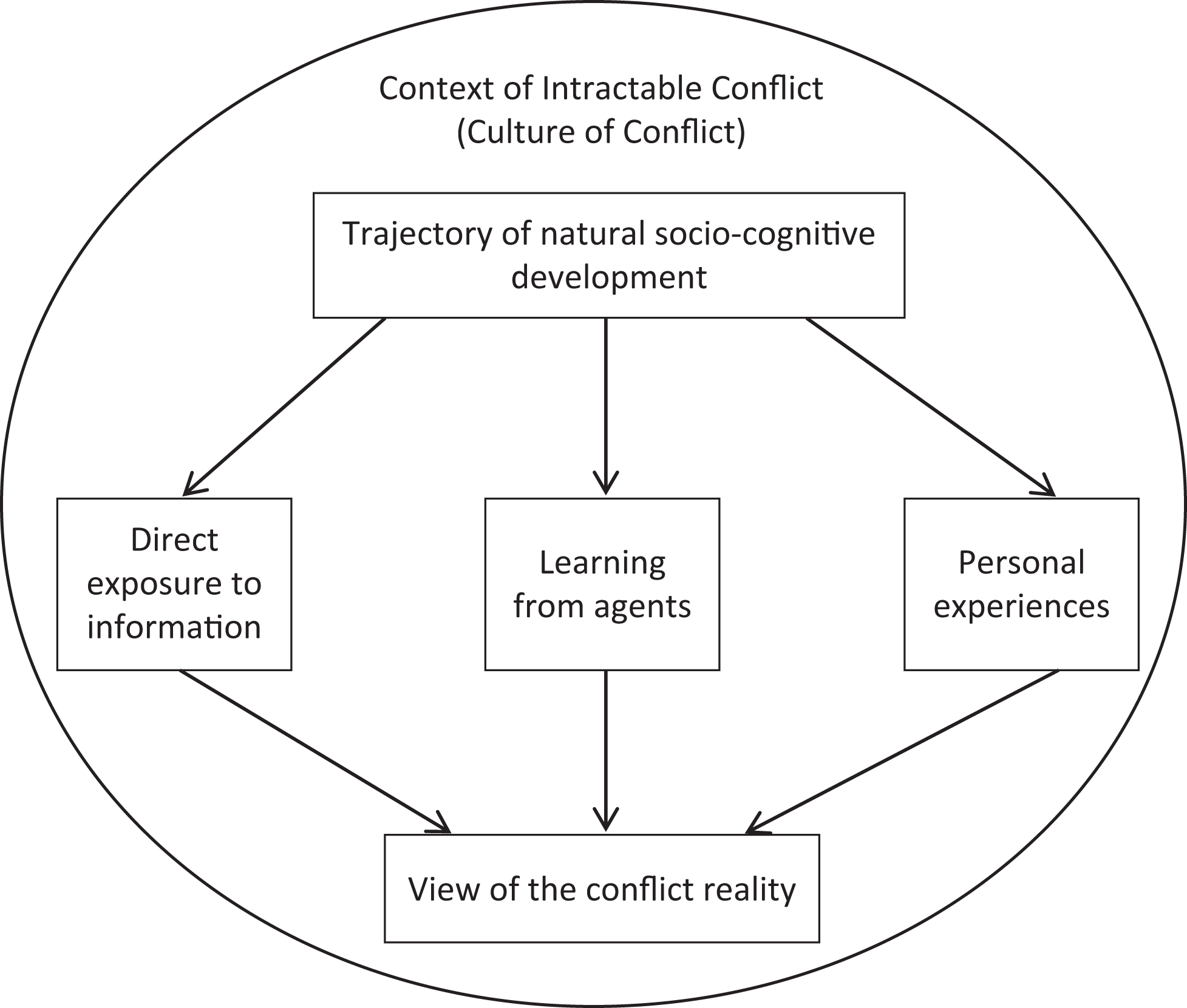
Formation of young children’s view of the conflict reality
We argue that natural socio-cognitive development mediates the acquisition of the social understanding of conflict that is mainly learned through socialization processes. Moreover, we provide evidence to suggest that in the context of intractable conflict, socialization occurs in three main ways as previously described. The first is through direct passive exposure to the signs of conflict. The second way children are socialized refers to the processes that agents of political socialization such as family members, teachers, and the media shape children’s perspective of the conflict. The third (and perhaps most pervasive) way in which children undergo political socialization is directly through various personal experiences of conflict as participants. These processes contribute to the formation of children’s views of the conflict reality, which includes acquiring a conflict-oriented socio-psychological repertoire of societal beliefs, perceptions, and emotions.
We propose that this repertoire may be stored in the minds of the individuals, becoming an inseparable part of the belief system, and eventually function as a socio-psychological barrier when possibilities of solving the conflict peacefully appear. It provides a meaningful picture of the conflict situation, justifies the behavior of the society, facilitates mobilization for participation in the conflict, differentiates between the ingroup and the rival, and enables maintenance of a positive social self-collective image. The conflict-oriented repertoire with its narratives serve as the pillar of the culture of conflict, providing a particular illumination of the conflict that is widely used in the society. Moreover, taking recent studies into account (Bar-Tal & Halperin, 2011; Kelman, 2007), we suggest that a conflict-oriented repertoire leads to a selective, biased, and distorted collection of information, as society members involved in intractable conflict tend to search for and absorb information that validates the societal beliefs of their repertoire, while ignoring and omitting contradictory information.
The described socio-psychological repertoire, which underlies the disagreements themselves, is powerful force that inhibits and impedes progress towards peaceful settlement of the conflict. This repertoire poses a major obstacle to begin negotiations, to continue negotiations, to achieve an agreement and later to engage in a process of reconciliation (Bar-Tal, 2009). This socio-psychological repertoire closes the society members to new viewpoints and prevents information processing that could provide alternative knowledge to potentially advance peace-making efforts. Thus, resolving intractable conflicts not only requires addressing the issues that stand at the center of the disagreements, but also necessitates overcoming the socio-psychological barriers that underlie these disagreements. Construction of a new socio-psychological repertoire is a necessary condition for the establishment of lasting peaceful relations between former rival groups, in order to form stable foundations that are rooted in the psychological repertoire of the people. Thus, societies that decide eventually to leave the path of violence and embark on the road to peace have to change the repertoire that has been hegemonic for many years (Bar-Tal, 2013).
The need for peace education
The implications of the above arguments lead to the need for peace education already at an early age in preschoolers. The goal of peace education in times of conflict is to construct children’s worldviews (values, beliefs, attitudes), simultaneously with the acquisition of political knowledge, through fostering an alternative socio-psychological repertoire, which consists of new images of the out-group and alternative peaceful attitudes with regard to the relationship with the adversary. Peace education in the context of intractable conflicts should provide children with attitudes, knowledge, and skills that are consistent with the principles of accepting the other, avoiding prejudice, and promoting peace and reconciliation (e.g., Bar-Tal, Rosen, & Nets-Zehngut, 2011). These contents correspond greatly to the principles of the intercultural competence program developed as guidance for the educational systems of states that are members of the European Council (Barrett, Byram, Lazar, Mompoint-Gaillard, & Philippou, 2013). The program aims to provide children with intercultural skills that facilitate functioning within cultural diversity with mutual respect and tolerance, to understand the other’s culture and to communicate with the other. Multicultural understanding can also be used in the context of intractable conflict, providing the badly needed foundations for new lines of education that prepare children to accept peace building. This line of education is especially needed and relevant in societies in which there is a partner for peace negotiation on the rival side and peace process is a real possibility.
Indeed, in recent decades, peace education has become prevalent and accepted throughout the world as an educational element necessary for modern-democratic societies. In general, it aims to reject violence and conflict and to promote a culture of peace instead of a culture of war (United Nations, 1998) by fostering tolerance toward the other, eliminating prejudices and stereotypes, encouraging justice and equality, imparting skills and dispositions of conflict resolution and developing understanding and reconciliation between rival groups. Peace education is a part of a social change process, since it must overcome a deeply-rooted socio-psychological infrastructure of certain beliefs, ideas, collective narratives, and emotions that support the conflict and contradict elements of peace-building. In this respect, the educational system may serve as a societal institution genuinely wishing to promote peacebuilding by imparting contents and messages that support ending the conflict and promote reconciliation between the parties. Indeed, there are societies and nations which have started implementing peace education programs as a mechanism for social change even while being involved in violent protracted conflict, indicating their desire to promote peace-building. This has occurred, for example, both in Northern Ireland (e.g., Smith, 1995) and in Cyprus (Zembylas, 2011).
Interventions based on intergroup contact, where individuals from one group meet and interact with others from a different group, have already shown promising results with children samples (Tropp & Prenovost, 2008; Vezzali, Stathi, Crisp, & Capozza, 2015). Specifically, these interventions have demonstrated that contact between groups reduces intergroup biases. Inter-group contact may also be effective when it is indirect or when it occurs through media. For instance, in Israel and the Palestinian Authority, studies were conducted on a special version of the Sesame Street television series where characters from Rehov Sumsum (the Hebrew name for “Sesame Street”) would visit friends on Shara’a Simsim (the Arabic name for “Sesame Street”). Large-scale studies investigating the effects of this program revealed that watching this version of Sesame Street increased the likelihood of a child attributing positive characteristics to members of the outgroup, and increased children’s use of social justifications to resolve conflicts (Brenick et al., 2007; Cole et al., 2003). The Sesame Street studies are consistent with further research that has demonstrated the effects of positive media portrayals (Schiappa, Gregg, & Hewes, 2005), particularly in cases where intergroup encounters are rare. An extended contact can also address negative intergroup attitudes among young children. For example, children as young as 5 were exposed to intergroup friendships through reading illustrated stories that portrayed friendships between ingroup and out-group members (Cameron & Rutland, 2008). The extended contact improved intergroup attitudes making children think that others like them think that intergroup friendships are legitimate and normal (Cameron & Rutland, 2008). Having positive extended contact changes, the group norms for cross-group friendships, thereby making intergroup attitudes more positive.
While the consequences of these arguments may be far-reaching, it is important to bear in mind that, although we provide evidence to back our claims, further research is required to substantiate them fully. To that end, the arguments presented here would be a good theoretical basis for a meta-analysis of the political socialization of young children in intractable conflicts, or indeed further empirical studies in the field. Empirical studies would be essential to determine the effects of each of the agents discussed in a much wider range of contexts.
In any case, in endeavoring to shift the orientation of early childhood political socialization towards peace, societies have to understand that one important change has to begin with the young generation: a new political socialization that cherishes peace, supports compromises, and humanizes the rival for making peace. This is not a simple mission when the signs of the conflict and violence are still going on, rather, the parties involved must begin to simultaneously engage in peace negotiations when the window of this opportunity opens, and, at the same time, begin preparing the society itself for the desired peace. Within this framework, peace education has to begin from a very early age as part of a societal change. This line of peace education changes the attitudes of the next generation, preparing individuals to live in peace, and indicating to the rival society the seriousness of the intention to make peace. The earlier it begins on both sides of a conflict, the faster the process of peace-building will be.
Footnotes
Acknowledgments
We express our gratitude to Martyn Barrett, Karen Trew, and Michal Raifen Tagar for their helpful comments on the first draft of the article, and express great thanks to the editor and the reviewers for their insightful comments that helped to improve the manuscript. Finally, Meytal Nasie is grateful to the Azrieli Foundation for the award of an Azrieli Fellowship.
Funding
This study was funded by a grant from the Israeli Science Foundation [1231/11] awarded to the first author.