




Abstract
The concurrent and longitudinal associations between popularity, likeability, and prosocial behavior were evaluated in this three-year study of middle school and high school Chinese adolescents. The initial sample included 766 middle school (mean age = 13.3 years) and 668 high school participants (mean age = 16.6 years); there were 880 (399 girls) middle school and 841 (450 girls) adolescents who participated in at least one year of data collection. Significant positive associations between popularity, prosociality, and academic achievement were found. Both popularity and likeability concurrently predicted significant unique variance in prosocial behavior after controlling for academic achievement; longitudinal cross-lagged analyses revealed bi-directional associations between popularity and prosocial behavior such that popularity positively predicted subsequent prosocial behavior and prosocial behavior predicted subsequent popularity. Cross-cultural research on popularity may profitably focus on variation in prosocial behavior as the relative salience of coercive and prosocial control strategies may vary across cultures.
Introduction
There appears to be agreement that many popular youth utilize a combination of aggressive and prosocial strategies to attain and preserve their status and to gain access to resources (Findley & Ojanen, 2013; Wolters, Knoors, Cillessen, & Verhoeven, 2014). Adler and Adler (2001), in their ethnographic study, discussed how popular youth alternate between showing favors to others and then mobilizing attacks against them. This strategic use of aggressive and prosocial strategies was described by Hawley (2003) as: “Machiavellian” and “bi-strategic control”.
The vast majority of research exploring the characteristics of popular youth has focused on aggression with results coming from North America and Europe that popular youth are more aggressive than those who are socially preferred (i.e., those who are liked by many classmates and disliked by few) (e.g., Cillessen & Mayeux, 2004). There is mixed evidence, however, regarding the extent to which Chinese popular youth are more aggressive than those high in acceptability (i.e., social preference or likeability). Results from three studies suggest that they are (Cheng, 2010; Niu, Jin, Li, & French, 2016; Schwartz et al., 2010), whereas findings from three other studies suggest that they are not (Li, Xie, & Shi, 2012; Owens, Feng, & Xi, 2014; Tseng, Banny, Kawabata, Crick & Gau, 2013).
The prosocial behavior of popular youth has received much less research attention than aggression, although there are consistent findings that prosocial behavior is positively associated with popularity (e.g., de Bruyn & Cillessen, 2006; Dijkstra, Lindenberg, Verhulst, Ormel, & Veenstra, 2009; Findley & Ojanen; 2013); based on evidence available from both the US and Europe, it appears that the correlations between social preference and prosocial behavior are typically larger than those between popularity and prosocial behavior (Aikins & Litwack, 2011). For example, Sandstrom and Cillessen (2006), in a study of US fifth grade children, found that the correlation between prosocial behavior and social acceptance was stronger than that between prosocial behavior and popularity (r = 0.63 vs. 0.45) and that the correlation between prosocial behavior and popularity became non-significant once peer acceptance was introduced as a control. Similarly, Wolters et al. (2014) found that prosocial behavior was more strongly correlated with social preference than with popularity (r = 0.56 vs. 0.21) in a study of sixth grade children in the Netherlands.
The relation between popularity and prosocial behavior in Chinese youths, however, appears to differ from the patterns described above. Niu et al. (2016), using the same operational definition for popularity used in the present study, found that the correlation between prosocial behavior and popularity was significantly larger than that between prosocial behavior and social preference in a sample of eighth grade Chinese adolescents. They interpreted this finding by noting that among Chinese adolescents, prestige is often acquired by being able to offer help in school work and classroom duties (Chen, Kaspar, Zhang, Wang, & Zheng, 2004), and that these results are consistent with Confucian principles that status is accrued through behaving in a morally responsible manner and treating others with respect (Gabrenya & Hwang, 1996). In addition, those of high status are expected to exhibit benevolence toward those of lower status.
Direct cross-cultural comparisons of the relation between prosocial behavior and the conceptions of popularity were provided by two studies. Owens et al. (2014) found that being helpful to others was associated with conceptions of popularity in high school girls from both Adelaide and Shanghai, but these associations were stronger for Chinese than for Australian adolescents. Similarly, Li et al. (2012) found that both US and Chinese children rated prosocial behaviors highly, but Chinese children viewed these as more favorable than US participants in a study of fifth grade children’s assessments of determinants of popularity. As in the present study, popularity was translated in both of these studies as shou huan ying (受欢迎).
Both popularity and prosocial behavior appear to be strongly associated with academic success in China. There are a variety of studies suggesting that a major aspect of prosocial behavior involves providing academic assistance to classmates (Chen, Li, Li, Li, & Liu, 2000). Academically successful students are often elevated by teachers to classroom roles such as study session supervisors and tutors, positions that require them to help others. These students are often admired by peers and sought after as friends even if they otherwise exhibit characteristics that are not typically associated with popularity (Li, 2012). Thus, the relation between popularity and prosocial behavior may be partially explained by academic ability.
Although the findings from prior research pertaining to the relation between popularity and prosociality in China are intriguing, there are several limitations that necessitate further research. First, two of these studies (Li et al., 2012; Owens, et al., 2014) focused on the characteristics of hypothetical popular individuals. The single study (Niu et al., 2016) that assessed the relation between popularity and prosocial behavior in a population of youths included only eighth grade participants and consequently questions remain regarding the extent that these associations are present across a larger age span. Second, these three studies were cross-sectional and consequently it is important to assess the longitudinal associations between popularity and prosocial behavior. Finally, given that help- giving is often associated with providing academic assistance, it is important to control for the effects of academic ability.
The relation between prosocial behavior and popularity in China might reflect the existence of two causal pathways that require study using longitudinal analyses. First it is possible that that prosocial behavior is a means to enhance status. If so, we could hypothesize high levels of prosocial behavior to lead to increased popularity whereas low levels of prosocial behavior might be associated with decreased popularity. In addition, however, being of high status may entail obligations to help others, thus leading to the prediction that popularity will be associated with increased prosocial behavior. These hypotheses lead us to suggest the existence of bidirectional longitudinal associations between popularity and prosocial behavior.
The present study was designed to address the questions raised above using data from a three-year longitudinal study that included a middle school (7th, 8th and 9th grades) and a high-school cohort (10th, 11th and 12th grades). Both samples came from urban schools in Lanzhou, Gansu, China, which is a provincial capital located in northwest China with a population of approximately 3.6 million.
Yearly peer nominations of likeability, popularity, and prosociality were obtained. We determined the relative contributions of popularity and likeability predicting prosocial behavior using separate hierarchical regression analyses for each grade while controlling for academic achievement. Separate longitudinal cross-lagged models for middle school and high school that included yearly assessment of prosocial behavior, popularity, and likeability were constructed. Only the affirmative assessment of popularity was used in this study and consequently this was compared with likeability which likewise indexed only the positive dimension of acceptability (Cillessen & Marks, 2011).
Method
Participants
This study began when participants were in the seventh or tenth grades and the sample was followed for two years. Participants were recruited from typical academic schools (i.e., neither vocational nor highly prestigious academic schools). There was a wide distribution of parent education levels; 42.9% of mothers and 41.5% of fathers had a junior high school education; 28.1% of mothers and 32.6% of fathers had a senior high school education; and 8.3% of mothers and 11.9% of fathers had a post high school education.
The middle school adolescents came from two schools with a total of 880 adolescents (399 girls) who participated in at least one year of data collection; 614 participated in all years of the study. The initial seventh grade sample included 766 adolescents (mean age = 13.33, standard deviation (SD) = 0.64). At grades eight and nine, 114 students who did not participate in the first year of the study were added. The high school sample came from three high schools and included 841 adolescents (450 girls) who participated in at least one year of data collection. The initial tenth grade sample included 668 participants (mean age = 16.64, SD = 0.71); of these, 515 participated throughout the study. An additional 173 students who did not participate in the first year of the study were added at grades eleven and twelve. This resulted in the following number of participates at each year of the study; 766 (7th), 764 (8th), 748 (9th), 668 (10th), 783 (11th) and 623 (12th). Only those adolescents who were in classrooms within which there was a minimum of 70% participation were included in this study. Thus the above numbers were obtained following the removal of 61 adolescents in two high school classrooms in Year 1 and 39 adolescents in one high school classroom at Year 3. After removing these participants, the percentage of participating students in each classroom across the three years of the study ranged between 71% and 100%.
Attrition analyses revealed that participants who remained in the study across the three years had higher levels of likeability and academic achievement at baseline (d = 0.14 and 0.67, respectively) than those who left. The two groups did not differ in popularity, prosocial behavior, or parent education.
Measures
Peer nominations of popularity, likeability, and prosocial behavior
Students were presented with a list of students in their classroom (n’s range from 28 to 67) and asked to circle the names of up to five classmates described by each item. The nominations received were divided by the number of classmates providing nominations and these proportions were used to compute the popularity, likeability, and prosocial behavior scores.
Popularity in year one was measured by shou huan ying (受欢迎), a translation that has been used in past studies of popularity in China (Li et al., 2012; Niu et al., 2016; Tseng et al., 2013). In Years 2 and 3, we added another popularity item (人气高; ren qi gao) that was recommended by two prominent native Chinese researchers of peer relationships (H. Xie, personal communication, August 9, 2014). Consistent with the procedures used in Niu et al. (2016) we computed the mean of the two popularity items; these were correlated: 0.94 at eighth grade; 0.95 at ninth grade; 0.90 at eleventh grade; and 0.93 at twelfth grade. Because the distributions of the popularity items were skewed, we applied the square root transformation to each item and standardized the scores within classrooms from the single item at seventh and tenth grades and the composite scores at other grades. It was previously shown that the correlates of this composite score were similar to those that have emerged from US and European studies of popularity and differed from those associated with likeability and social preference (Niu et al., 2016 ).
One nomination item assessed adolescents’ likeability: “who do you most like to be with?” The proportion of number of nominations received was computed and standardized within classrooms. Prosocial behavior was measured by three items: “shows care and concern for others”; “helps others”; and “is kind to others”. This score was averaged across the three items and then standardized within classrooms. Internal consistencies ranged from 0.86 to 0.90 across the three years.
Academic achievement
Final grades in Chinese, mathematics and English were obtained from school records. The means across the three subject areas yielded a composite score (α ranged from 0.90 to 0.93 from seventh to ninth grades and 0.75 to 0.84 from tenth to twelfth grades) that was standardized within grade at each school.
Analyses
Regression analyses were conducted at each year to compare the unique contributions of popularity and likeability with prosocial behavior after controlling for academic achievement. Cross-lagged analyses were used to examine the longitudinal effects. Both regression and cross-lagged analyses were conducted using AMOS (Arbuckle, 2012). Full information maximum likelihood estimation was used to deal with missing data (Acock, 2005). The number of participants with missing popularity, likeability and prosocial data ranged from zero at grades nine and twelve to seventeen at grade eight. Missing data for academic achievement ranged from four at twelfth grade to a maximum of forty at seventh grade.
Procedure
This study was approved by the Purdue University institutional review board and written consent and assent were respectively provided by parents and adolescents. Participants were assessed in classroom groups by psychology graduate and undergraduate students.
Results
At all six grades, girls were rated higher than boys in likeability with effect sizes (d) that ranged between 0.16 and 0.28, prosocial behavior (d ranged between 0.41 and 0.60), and academic achievement (d ranged between 0.42 and 0.48). In contrast, boys were rated as being more popular than girls at all grades (d ranged from 0.07 to 0.29), but these effects were statistically significant only for grades nine through twelve.
The correlations of prosociality with popularity and likeability are presented in Table 1. Prosocial behavior was significantly associated with popularity and likeability at all grades. The z test transformation to compare correlated correlation coefficients, commonly referred to as the Steiger comparison (Meng, Rosenthal, & Rubin, 1992), was used to compare the magnitude of the associations. As seen in Table 1, the correlations between popularity and prosocial behavior were significantly higher than those between likeability and prosocial behavior at grade eleven in the combined sex analyses, grades eight and eleven for boys, and for all grades with the exception of grade ten for girls. To estimate the size of these effects, differences between the squared correlations between popularity and prosocial behavior and between likeability and prosocial behavior were computed. These values are presented in Table 1 and reveal that the differences in the shared variance of prosocial behavior with popularity and with likeability for the combined gender sample were small, ranging from 1% to 7%; these differences ranged from 1% to 11% for boys and from 0% to 15% for girls. As expected, academic achievement was significantly correlated with popularity at all grades with values that ranged between 0.21 and 0.33 at middle school and 0.12 to 0.18 at high school. Academic achievement was also significantly associated with prosocial behavior with values that ranged between 0.30 and 0.38 at middle school and 0.22 and 0.27 at high school. The correlations between popularity and likeability ranged between 0.51 to 0.61 in middle school and between 0.39 and 0.48 in high school.
Correlations of Prosocial Behavior with Popularity and Likeability at Each Grade.
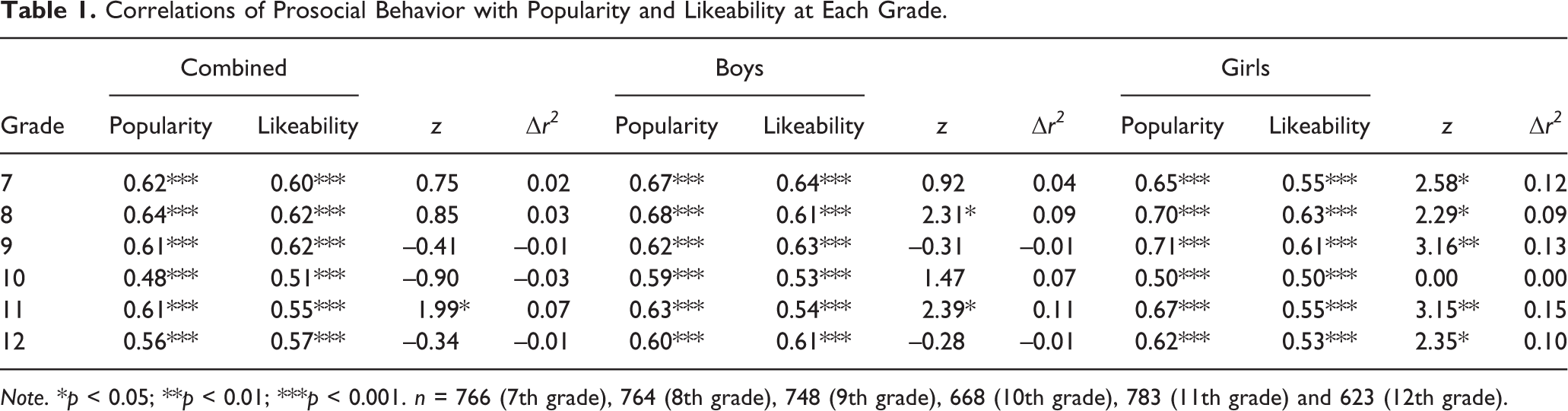
Note. *p < 0.05; **p < 0.01; ***p < 0.001. n = 766 (7th grade), 764 (8th grade), 748 (9th grade), 668 (10th grade), 783 (11th grade) and 623 (12th grade).
Regression analyses were conducted to compare the unique contributions of popularity and likeability to prosocial behavior at each grade after controlling for gender and academic achievement. Both popularity and likeability significantly and uniquely predicted prosociality at each grade of the study; parameter comparisons of the regression coefficients (Table 2) revealed that the contribution of popularity was stronger than that of likeability at grades seven, eight, and eleven. We also evaluated the popularity by gender interaction as an additional analysis and found that although popularity significantly predicted prosocial behavior at all six grades for boys and girls; the significant interaction revealed that the association was stronger for girls than for boys during middle school but not high school.
Regression Analyses Predicting Prosocial Behaviors from Gender, Academic Achievement, Popularity, and Likeability.
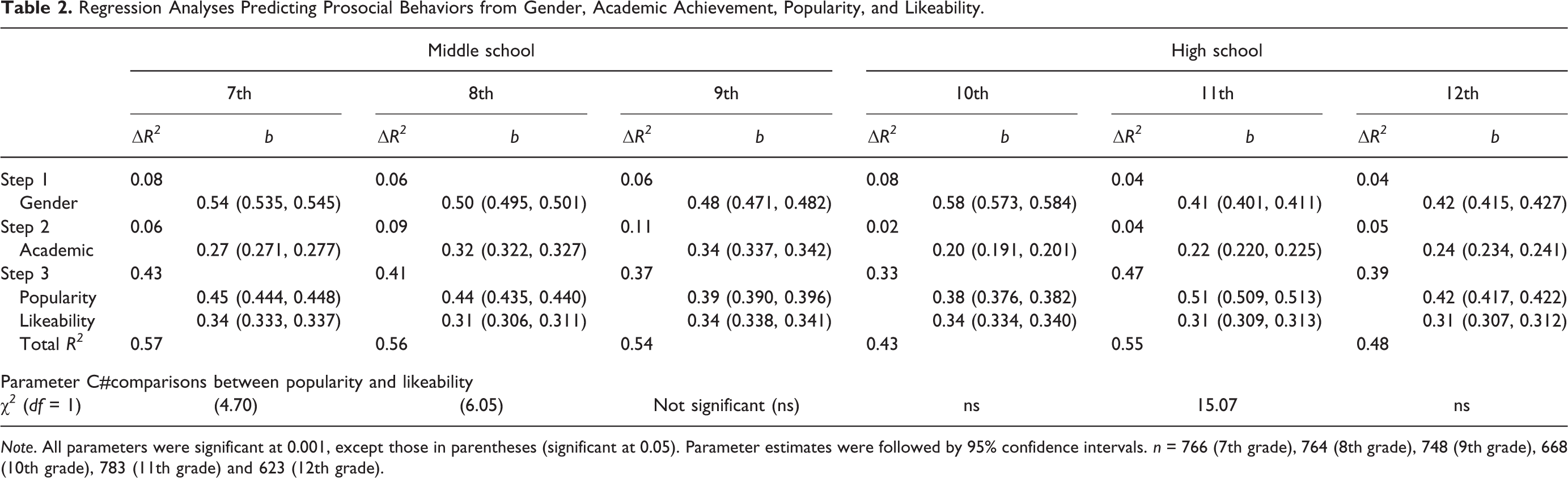
Note. All parameters were significant at 0.001, except those in parentheses (significant at 0.05). Parameter estimates were followed by 95% confidence intervals. n = 766 (7th grade), 764 (8th grade), 748 (9th grade), 668 (10th grade), 783 (11th grade) and 623 (12th grade).
A cross-lagged model was constructed to evaluate the longitudinal associations between popularity, likeability, and prosocial behavior over the three years of middle school and high school. After the multiple group analyses revealed differences between the middle school and high school models, a series of model comparison tests were conducted and pathways that did not differ between middle school and high school or between boys and girls were held to be the same. The final model is presented in Figure 1. Path coefficients that were common across the four subgroups are provided in Figure 3 whereas those paths that differed for one or more of the genders or school level subgroups are presented in Table 3. The final model had good fit, χ2 (71) = 103.24, p = 0.007, comparative fit index = 0.99, root mean square error of approximation = 0.02, 95% confidence interval [0.01, 0.03]. Popularity, likeability, and prosociality were stable over time; all pathways presented in Figure 3 were significant with some variability in the magnitude of the coefficients.
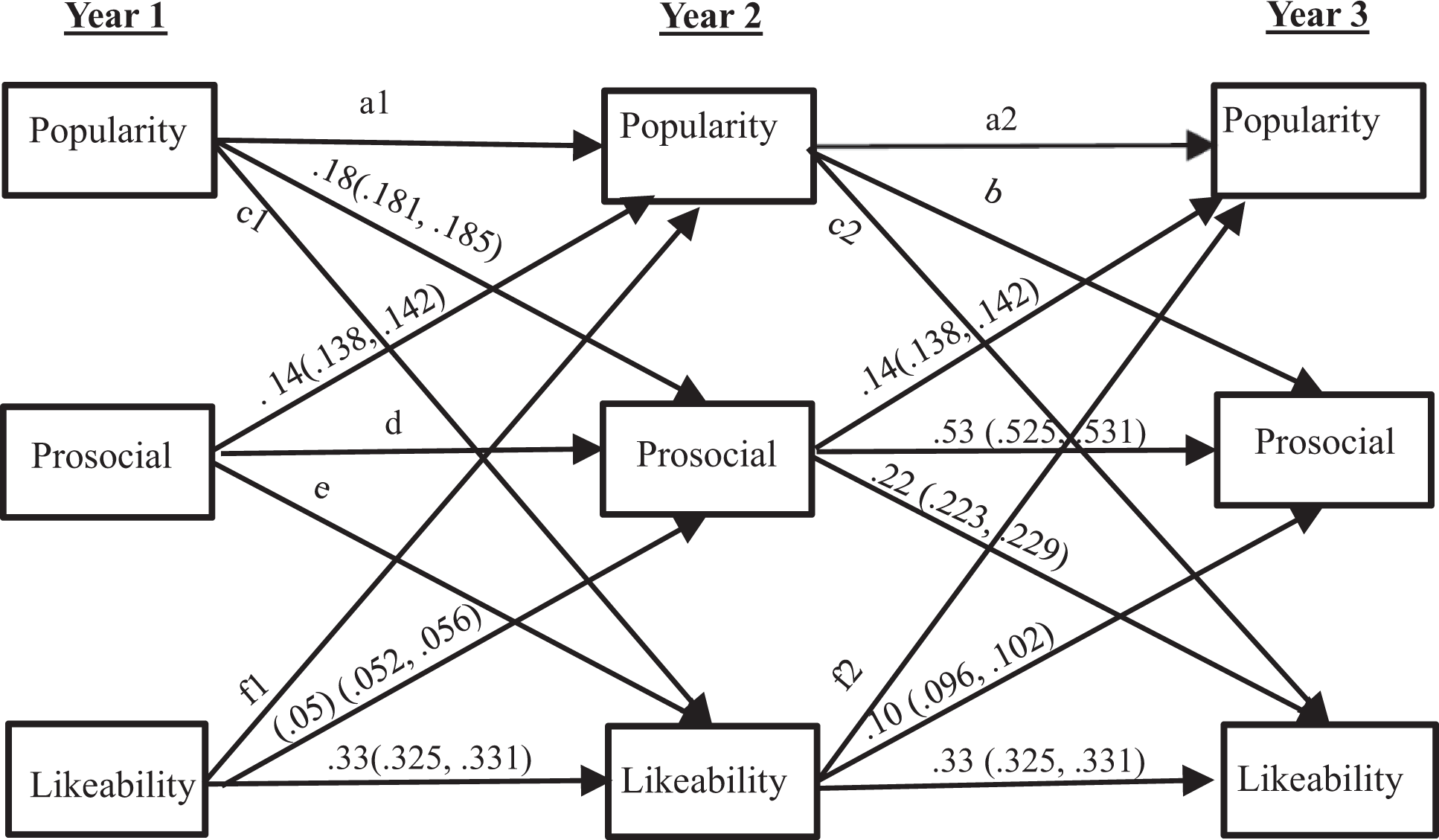
Cross-lagged model for adolescent prosocial behavior, popularity, and likeability in middle and high school.
Parameter Estimates of Significantly Different Paths (and 95% Confidence Intervals) for Middle and High School Boys and Girls.
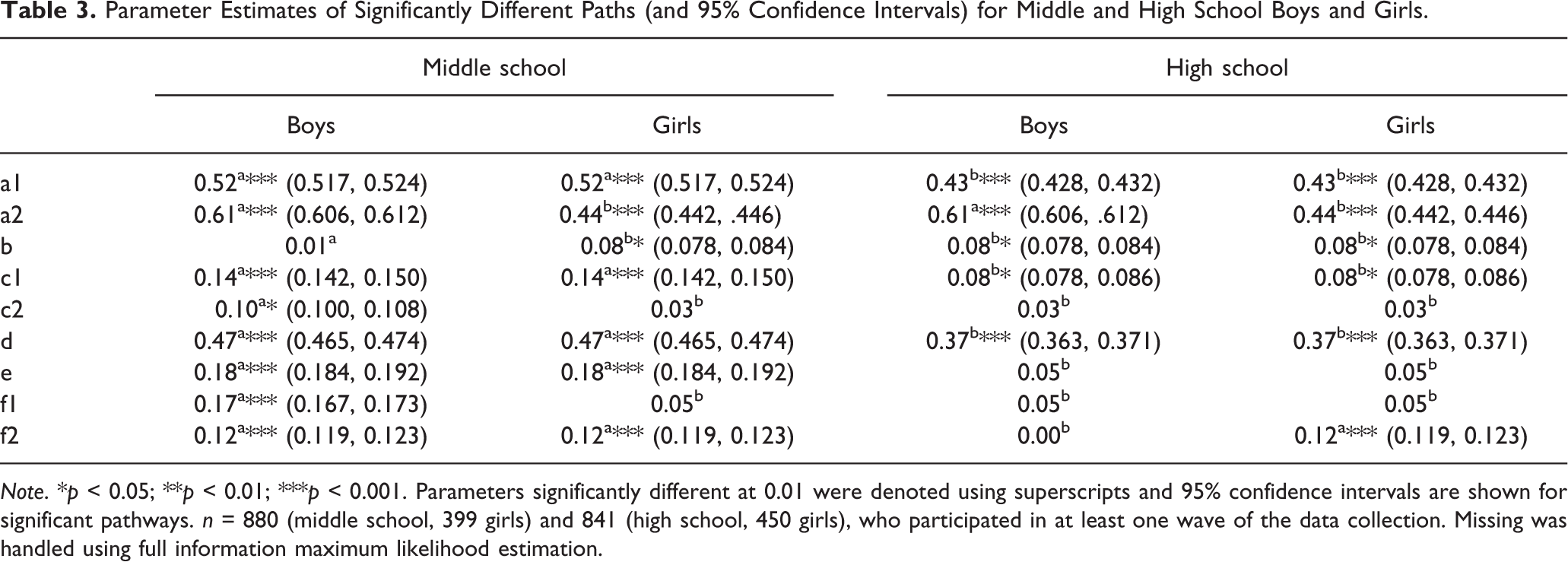
Note. *p < 0.05; **p < 0.01; ***p < 0.001. Parameters significantly different at 0.01 were denoted using superscripts and 95% confidence intervals are shown for significant pathways. n = 880 (middle school, 399 girls) and 841 (high school, 450 girls), who participated in at least one wave of the data collection. Missing was handled using full information maximum likelihood estimation.
Consistent with our expectations of the existence of bidirectional associations between popularity and prosocial behavior, prosocial behavior predicted popularity one year later; these effects were common across grades and gender. There were also significant pathways from popularity to prosocial behavior at all grades with the exception that the popularity to prosocial behavior pathway for boys from eighth to ninth grades was not significant.
Evidence of bidirectional associations between likeability and prosocial behavior also emerged. Positive pathways from likeability to prosocial behavior were found for the seventh to eighth and tenth to eleventh grades transitions and the eighth to ninth grades and the eleventh to twelfth grades transitions. The pathways from prosocial behavior to likeability were significant during all transitions for both boys and girls.
Mixed findings emerged regarding the longitudinal associations between popularity and likeability. The pathways from likeability to popularity were significant only for boys during the seventh to eighth grades transition, for both boys and girls for the eighth to ninth grades transition, and for girls as they moved from the eleventh to twelfth grade. Significant pathways from popularity to likeability emerged for both boys and girls for the seventh to eighth grades and tenth to eleventh grades transitions and only for boys from the eighth to ninth grades transition.
Finally, we compared the magnitude of the longitudinal pathways from prosocial behavior to both popularity and likeability in the cross-lagged model. The pathways from prosocial behavior to popularity were not statistically different from the pathways from prosocial behavior to likeability during any of the transitions in middle school or high school.
There were differences in the relative strength of pathways from popularity to prosocial behavior when compared to the pathways from likeability to prosocial behavior in middle school. For girls, seventh grade popularity was a stronger predictor of eighth grade prosocial behavior than was the prediction of eighth grade prosocial behavior from seventh grade likeability; for boys, eighth grade likeability was a stronger predictor of ninth grade prosocial behavior than was eighth grade popularity. The longitudinal pathways from popularity to prosociality and from likeability to prosociality were not statistically different for high school students.
Discussion
The present study examined the associations between popularity and prosocial behavior in Chinese middle school and high school adolescents. Consistent with expectations, prosocial behavior was concurrently associated with both popularity and likeability at all grades for both boys and girls. Also consistent with our hypothesis, academic achievement was associated with prosociality at all grades.
Our concurrent regression analyses, which assessed the contribution of popularity and likability to prosocial behavior while controlling for both gender and academic achievement, revealed popularity to be a stronger predictor than likeability in three of the six grades whereas likeability did not emerge as a stronger predictor than popularity in any grade. These findings can be compared with those from both the US and Europe in which stronger relations between prosocial behavior and social preference than between prosocial behavior and popularity have been found (Sandstrom & Cillessen, 2006; Wolters et al., 2014).
Consistent with our hypothesis, we found bidirectional associations between prosociality and popularity in the cross-lagged longitudinal models. Across both middle school and high school, significant pathways from prosocial behavior to popularity emerged. Additionally, pathways from popularity to prosocial behavior in the following year were consistently found with the exception that the pathway from eighth grade popularity to ninth grade prosocial behavior was significant only for girls. This gender difference was neither expected nor do we have an explanation for this given that this was not replicated in the high school cohort or for middle school adolescents in the seventh to eighth grades transition.
The exhibition of prosocial behavior may be a way for Chinese youth to attain popularity as well as increase their acceptance and leadership status. Traditional Chinese values emphasize group well-being and restraining individual desires to promote collective interests (Gabrenya & Hwang, 1996; Ho, 1986). Although not directly assessing popularity, the findings of French et al. (2011) are relevant to this discussion. They found that seven year old Chinese children more often shared toys and acquiesced to the requests of others in a limited resource situation than did Canadian children, and that such cooperative behavior was associated with acceptance to a greater extent by Chinese than by Canadian children. These results suggest that prosocial behavior is well regarded by Chinese youth. In another study, prosocial behavior was found to be positively associated with a composite measure of teacher rating of leadership and attainment of honors in sixth grade children (Chen et al., 2000). The results of the present study extend these findings by showing that prosociality is associated with popular status as bestowed by peers as well as status as bestowed by teachers. Our findings regarding the strong associations between popularity and prosocial behavior in China are consistent with the results from two cross-cultural studies of conceptions of popularity (Li et al., 2012; Owens et al., 2014). Thus, there appears consistent evidence that prosocial behavior is a particularly salient aspect of the popularity of Chinese youth.
Our findings of pathways from popularity to prosocial behavior suggest the possibility that being of high status enhances prosocial behavior. Traditional views of Chinese leadership, stemming in part from Confucianism, incorporate elements of paternalism, benevolence, treating others kindly, and being a moral example (Chen & Fahr, 2010; Liu, Li, & Yu, 2010). It is likely that these ideas are translated by youth into expectations that high status persons should help others. The saying “being the powerful person entails more duty to fulfill (能者多劳)” reflects the view that those high in status are expected to do more of the work and will attain more rewards; it also reflects the expectation that such individuals are expected to do more. In China, as in other cultures that value interdependence, prosocial behavior may be viewed as obligatory in contrast to this being viewed as voluntary in more individualistic cultures (Miller, 1994).
Limitations and future directions
In interpreting these results, it is important to note that there does not appear to be a single Chinese word for popularity that fully captures the nuanced meaning of the English word. As we discussed earlier, there is evidence of the appropriateness of our operational definition evidenced by past findings that the popularity as measured by either the composite measure or the single item, 受欢迎; shou huan ying, is correlated with a number of characteristics of adolescent adjustment in China in a manner similar to the associations between popularity and adolescent adjustment that have emerged in the US and Europe (Lu, Jin, Li, Niu, & French, in press; Niu et al., 2016). Note that our results were unchanged when this single popularity item term rather than the composite score was used. Most important, we showed in both concurrent and longitudinal analyses that our operational definition of Chinese popularity is positively associated with aggression whereas social preference and likeability were negatively associated with aggression (Lu et al., in press; Niu et al., 2016), thus providing evidence of construct validity. Nevertheless, it cannot necessarily be assumed that the Chinese words for popularity fully capture the meaning of the US term and consequently it is important for researchers to be cautious when making direct cross-cultural comparisons. In future research it would be useful to explore how the possible translations of popularity are related to each other and how each is correlated with characteristics including prosocial behavior. Furthermore, it is important to assess the discriminant validity of popularity by comparing this with related constructs such as leadership, dominance, and acceptance.
In considering these findings, it is important to note that standardized measures that were derived from peer nominations were used in these analyses. Consequently it is impossible to determine whether longitudinal effects are associated with increases or decreases in behavior and instead reflect relative positioning of adolescents compared to their classmates on these dimensions. It would be useful to determine the changes in the level of absolute level of prosocial behavior over time, perhaps using observation or laboratory performance measures, as this would make it possible to determine whether popularity was associated with increases in such behavior.
We found that gender moderates the relation between popularity and prosocial behavior, specifically finding that this relation is stronger for girls than for boys in middle school but not high school. This finding is noteworthy given Li et al. (2012) finding that fifth grade Chinese girls viewed prosocial behavior as being more strongly associated with popularity status than did boys. Other researchers of Chinese popularity, however, have either not assessed gender moderation (i.e., Niu et al., 2016; Xi, Owens, & Feng, 2016) or did not find sex moderation effects (Cheng, 2010; Schwartz, 2010; Tseng, 2013). These mixed findings from China add to the inconsistent findings coming from the broader popularity literature regarding gender moderation of the relation between popularity and child characteristics (Rose, Glick, & Smith, 2011).
Culture and popularity
This study illustrates the importance of considering popularity within a cultural framework. Although many of the features associated with popularity in China are similar to those that have emerged in the US and Europe (Niu et al., 2016), popularity may be particularly strongly associated with prosocial behavior in China. This pattern may reflect cultural values pertaining to helping others and the obligations of high status persons. As we consider bi-strategic control strategies, it is important to consider that although such strategies may be widespread, the specific ways that coercive and prosocial elements are blended likely vary across cultures. This is not surprising given the considerable cultural variability in the use of coercion across cultures (Bond, 2004). The present results suggest that we should also consider cultural variation in the exhibition of prosocial behavior, and future cross-cultural research should focus on both dimensions.
Footnotes
Funding
The authors disclosed receipt of the following financial support for the research, authorship, and/or publication of this article: This research was supported by a Major Project of National Social Science Foundation of China (grant number 13&ZD073).