




Abstract
A wealth of research suggests that youth whose parents use corporal punishment are more likely to engage in antisocial behavior during childhood and adolescence. Questions remain, however, about: (a) whether this relationship extends reliably to samples outside the US and Canada; (b) whether corporal punishment is associated with antisocial behavior in adulthood rather than just childhood and adolescence; (c) whether the association depends on which parents use corporal punishment; and (d) what theoretical mechanisms account for the link between corporal punishment and antisocial behavior. The present study uses data collected from young adults in Asia, Europe, and North America to address each of these issues. Net of statistical controls, including retrospective measures of childhood misbehavior and abusive parenting, findings reveal that antisocial behavior in all three regions is higher among young adults who report experiencing corporal punishment in childhood. Overall, this relationship is least likely to emerge when corporal punishment comes only from fathers and most likely to emerge when it comes from both parents. Further, results suggest that self-control and social concern, but not conventional attitudes, mediate a portion of the association between retrospective reports of childhood corporal punishment and antisocial behavior in early adulthood.
Introduction
Corporal punishment (CP) is extremely common throughout the world and often begins when children are very young. In the US, a nationally-representative survey conducted in 1995 found that nearly 70% of parents with children between 1–2 years of age admitted using CP in the prior year (Straus & Stewart, 2014). The same survey found that, among parents with children between the ages of 4–5, the prevalence of CP exceeded 90%, and remained as high as 30% among parents with teenaged children (see also Giles-Sims, Straus, & Sugarman, 1995; Holden, Coleman, & Schmidt, 1995; Martin, 2006; Stattin, Janson, Klackenberg-Larsson, Magnusson, & McCord, 1995). Outside of the US, CP likewise appears to be very common. Among 17,404 students who participated in the International Dating Violence Study (Straus, 2014), more than 50% reported experiencing CP as children. Across the study’s 32 regional settings, the retrospectively-reported prevalence of CP in childhood ranged from less than a fifth of respondents in Sweden and the Netherlands to almost three-quarters of respondents in Taiwan and Tanzania. On the one hand, these data were collected between 2001–2006 from college students reporting on childhood experiences that took place a decade or more before. On the other hand, UNICEF’s most recent data continue to suggest that a majority of individuals throughout the world have at least some experience with CP (UNICEF, 2014).
In addition to demonstrating that CP is prevalent both inside and outside the US, research consistently finds that children whose parents use CP are disproportionately prone to a range of negative outcomes, including antisocial behavior. Straus, Sugarman, and Giles-Sims (1997), for example, found that children between the ages of six and nine who experienced CP tended to engage in more antisocial behavior two years later than those who did not experience CP (see also, Taylor, Lee, Guterman, & Rice 2010; Taylor, Manganello, Lee, & Rice 2010). Millar (2009) followed a nationally representative sample of 9,789 Canadian children between the ages of four and 11, and found that CP was associated with aggression and delinquency even after adjusting statistically for five well-established risk factors including: parent depression; inadequate supervision; lack of love and support; low income; and family structure. Brezina (1999) studied a nationally-representative sample of 10th grade boys in the US and found that CP was associated with an increase in child-to-parent assault a year later. Using data from a sample of 7th grade boys, Simons, Lin, and Gordon (1998) found that more CP was associated with more dating violence and more antisocial behavior two years later.
Whereas the above-cited studies examined the link between CP and negative outcomes in general samples, other studies have focused on high-risk samples or compared results across subsamples. Berlin et al. (2009), for example, studied a sample of low-income two-year-olds in Early Head Start programs and found that more CP at age one was associated with an increase in aggression a year later. Using a sample of children between the ages of four and 14, Grogan-Kaylor (2004) found that more CP was associated with an increase in antisocial behavior two years later for Blacks, Whites, and Hispanics. Similarly, in a sample of 1st, 4th, and 7th grade children, Pardini, Fite, & Burke (2008) found that CP was associated with a subsequent increase in both teacher- and parent-reported conduct problems, particularly among African Americans. A number of further studies corroborate the above findings by using samples of various ages to demonstrate associations between CP and a range of negative outcomes, including antisocial behavior, across youth from a variety of racial and ethnic backgrounds (e.g., Gunnoe & Mariner, 1997; McLoyd & Smith, 2002; Mulvaney & Mebert, 2007).
Despite clear evidence of a reliable association between CP and antisocial behavior (for more detailed reviews, see: Farrington & Welsh, 2006; Gershoff, 2002, Haapasalo & Pokela, 1999), most existing studies are based on cross-sectional data. Such studies therefore cannot discern between the hypothesis that CP influences child behavior and the hypothesis that child behavior influences CP. Longitudinal research, however, provides evidence consistent with the notion that CP promotes negative outcomes, including antisocial behavior. Berlin et al. (2009), for example, examined the reciprocal relationship between spanking and aggression among children between the ages of one and three from low-income families. Results revealed that spanking was associated with increases in child aggression over time, but not vice versa. Similarly, Gershoff, Lansford, Sexton, Davis-Kean, and Sameroff (2012) used data collected from children between the ages of five and eight to demonstrate a reciprocal relationship between spanking and externalizing behavior. In a recent meta-analysis, Ferguson (2013) used 45 longitudinal studies to examine the relationship between early CP and later externalizing behavior. Results revealed that early CP tended to be associated with a small, but statistically significant, increase in later antisocial behavior even after adjusting for early levels of childhood misbehavior. Most longitudinal studies have reached similar conclusions (but see Morris & Gibson, 2011). Further, Gershoff and Grogan-Kaylor’s (2016) recent meta-analysis found evidence that, with few exceptions, CP alone is associated with negative outcomes even in the absence of more severe, abusive parenting.
Notwithstanding results of the above-cited studies, there exist several shortcomings in the literature concerning CP and antisocial behavior. First, relatively few studies have taken place outside the US or Canada. Among the exceptions, Burlaka (2016) studied a sample of 320 Ukrainian respondents, Ma, Han, Grogan-Kaylor, Delva, and Castillo (2012) studied a sample of 919 respondents in Chile, and Lansford et al. (2005) studied a sample 336 Chinese, Indian, Kenyan, Filipino, and Thai respondents. All three studies found an association between CP and antisocial behavior, with the latter study finding the strongest associations in nations whose norms were least accepting of CP. None of these studies, however, was longitudinal and none included even a retrospective measure of early childhood behavior problems.
Second, most existing studies have examined the relationship between CP and negative outcomes in childhood or adolescence. Most have not examined whether CP in childhood is associated with negative outcomes in adulthood. Among the rare exceptions, Fergusson, Boden, and Horwood (2008) found that CP in childhood was associated with anti-social personality disorder and other mental health problems in early adulthood. These associations, however, did not remain statistically significant upon adjustment for a range of statistical controls. McCord (1991) followed a sample of boys into adulthood, and found that those who experienced physical punishment were more likely to be convicted of a serious crime as adults. However, although this was a longitudinal study, it did not include a control for childhood misbehavior.
Third, most studies in the existing literature have not distinguished between CP by mothers versus fathers, and none has yet examined whether concordance in the discipline style of two parents affects the association between CP and antisocial behavior. Dyadic concordance types (DCTs), however, reflect a potentially important new development in research on family violence and have recently been applied to a range of abusive behaviors (Rodriquez & Straus, in press; Straus, 2015). The underlying premise informing the study of DCTs is “the assumption of systems theory, including family systems theory, that the whole is greater than the sum of the parts” (Straus, 2015, p. 89). At the same time, DCTs need not be “tied to any specific theoretical focus” and are “applicable to research or interventions undertaken from almost any theoretical perspective” (Straus, 2015, p. 85). The most frequent use of DCT’s to date has been in research on partner physical violence (Langhinrichsen-Rohling, Selwyn, & Rohling, 2012). In particular, research on partner violence has found that the adverse effects of partner violence, such as injury and depression, are greatest when both partners engage in assault (Winstok & Straus, 2014). Given the attachment theory (Bowlby, 1969/1982) assertion that “children develop emotional and behavior problems when their parents fail to provide a safe and supportive environment” (Evans, Simons, & Simons, 2012, p. 1097), as well as the social learning (Akers, 1998; Bandura, 1977) and social control (Hirschi, 1969) arguments described below, the existing literature could benefit from an application of DCTs to CP. In particular, individuals who experience CP from both parents may be more prone to internalize the belief that antisocial behavior is a legitimate means of achieving personal ends and may experience less family attachment (and hence less social control) than those who experience it from one parent.
Fourth, surprisingly little empirical research has attempted to evaluate what mechanisms may account for the association between CP and antisocial behavior (for an exception, see Evans et al., 2012). A number of theories in the criminological literature, however, imply potential mechanisms that could plausibly account for the association. According to social learning theory (SLT), for example, individuals engage in deviant behavior when they are exposed to deviant role-models in their social environments and, as a result, adopt attitudes favorable to deviant behavior (Akers, 1998; Bandura, 1977). From the perspective of SLT, experiencing CP at an early age may teach individuals to believe that violence (and antisocial behavior in general) is an acceptable or even desirable way to achieve one’s ends. Such beliefs, in turn, might then be associated with greater antisocial behavior insofar as they provide life-long behavioral scripts concerning how one can or should deal with interpersonal conflict. From the perspective of social control theory (e.g., Hirschi, 1969), individuals refrain from antisocial behavior as a function of their social bonds to conventional associates and activities. Building on this notion, Gottfredson and Hirschi’s (1990) self-control theory argues that parents who consistently set clear rules and sanction inappropriate behavior in the first decade of a child’s life promote that child’s ability to delay gratification. On the one hand, self-control theory might predict that CP promotes higher levels of self-control insofar as it reflects a punishment for inappropriate or undesirable childhood behavior. On the other hand, certain versions of strain theory suggest that CP might actually weaken social bonds and lower self-control (e.g., Agnew, Rebellon, & Thaxton, 2000; Elliott, Ageton, & Canter, 1979). In particular, CP may represent a powerful stressor that weakens a child’s attachment to parents and, by extension, impedes the child’s ability or willingness to exercise self-control in the face of adversity.
Yet another explanation for the link between CP and antisocial behavior comes from Agnew’s (2014) recent theory of social concern. In contrast to the prevailing criminological view that people are primarily self-interested by nature, Agnew argues that people are motivated by a mix of both self-interest and social concern. Further, he argues that individuals differ in their relative levels of social concern, which he conceives as a construct incorporating four major dimensions. These dimensions include “care about the welfare of others,” the “desire for close ties with others,” the “inclination to follow certain moral intuitions”, and a tendency “to conform to the views and behaviors of others” (Agnew, 2014). Of note, Agnew explicitly discusses the ways in which he believes social concern is related to concepts derived from both social learning theory and self-control theory. With respect to learning theory, he acknowledges that one element of social concern, the tendency “to conform to the views of others,” may simply be the inverse of attitudes favorable to deviance. At the same time, he argues that social concern’s other three dimensions are much broader than learning theory’s conception of attitudes and, therefore, that social concern reflects a construct that encompasses more than merely one’s attitudes toward deviant behavior. With respect to self-control theory, Agnew argues that self-control and social concern are separate constructs, but that the two are likely to be positively correlated. Finally, Agnew argues that social concern “partly mediates the effect of biological and social-psychological causes” of antisocial behavior. Of particular relevance for the present purposes, he argues that social concern can be fostered by reducing strain and promoting emotional bonds. CP may therefore be associated with lower social concern to the degree that it promotes strain and weakens the emotional bonds between children and parents. Evans, Simons, and Simons (2012) provide indirect support for this assertion by finding evidence that a “hostile view of relationships” may partly mediate the association between CP and antisocial behavior, but further research is needed to explore potential mediators in more depth.
The present study contributes to the existing literature by addressing the above four limitations of the existing research concerning the relationship between CP and antisocial behavior. In particular, it examines the relationship between retrospective reports of childhood CP and adult antisocial behavior in Asia, Europe, and North America. Further, it examines the degree to which the relationship between CP and adult antisocial behavior varies by DCT in each world region, as well as the degree to which the relationship is mediated by self-control, conventional attitudes, and social concern.
Method
Data for this study were obtained as part of the International Parenting Study (IPS). They were gathered by a consortium of researchers in 15 nations between October 2007 and March 2010. Each IPS consortium member used the same core questionnaire, except for the final section, which was reserved for each member to add questions about issues of specific local or theoretical interest. (A description of the study, including the questionnaire and all other key documents can be downloaded from http://pubpages.unh.edu/∼mas2). The procedures for the IPS were reviewed and approved by the University of New Hampshire institutional review board and by the equivalent board or administrator at each of the participating universities. Participation was restricted to students age 18 or older. Potential participants read a consent form which stressed that participation was entirely voluntary and that they were free to not answer any question they chose to omit. Steps were taken to ensure the privacy and anonymity of the data. The recruitment strategy and questionnaire format varied by site, but the majority of students were recruited in class and completed a paper version of the questionnaire. After completing the questionnaire, participants received a debriefing form explaining the purpose of the study and a list of mental health referrals.
Sample
The full sample in the IPS consists of 11,408 students in 15 nations. Data from Norway were systematically missing certain variables in the present analyses, so Norway’s 378 participants have been dropped from the present analyses. We also omitted data from Israel’s 366 respondents because Israel did not fit into the three geographic regions reflected in the remaining 13 settings. After omitting respondents with missing data for the variables and scales described below, 8,901 respondents remained in our working sample, reflecting 78% of the original sample. Seventy percent of these 8,901 respondents were women, reflecting the gender composition of the psychology, sociology, nursing, education, family studies and social work courses from which most of the participants were recruited. Their mean age was 21 (standard deviation = 3.9) with a range of 18 to 40. Despite the skewed distribution of age, 89% of the sample was under the age of 25, which corresponds with the college student population. The overwhelming majority were undergraduate students as only three universities also surveyed graduate students.
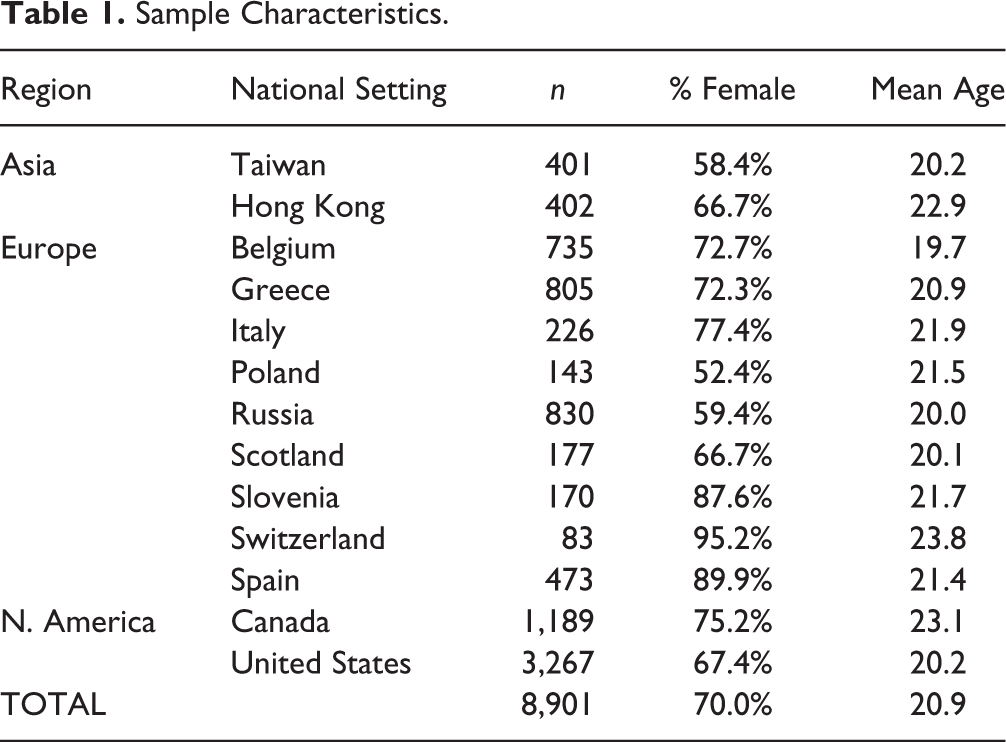
Ninety percent of the sample reported being born in the country of data collection and 80% self-identified as belonging to the majority racial or ethnic group. Ninety-six percent of the students provided data concerning both biological parents. Their parents’ educational attainment level tended to be high: 43% of fathers and 41% of mothers completed a college degree. With respect to employment status, 93% of fathers worked full time, but only 55% of mothers worked full time outside the home. The nations included in each of our three world regions, the sample size for each nation, and the age and gender breakdown of respondents within each nation are described in Table 1. Analyses presented include participants from all family structures, but results were substantively similar when limited to only those participants who reported growing up in households with both parents present.
Sample Characteristics.
Measure of Corporal Punishment
The students were interviewed at only one point in time, but were asked to provide retrospective data about the discipline methods used by their parents when they were ten years old. The peak CP ages in the US are two through five (Straus & Stewart, 2014), but adults cannot be expected to remember much about CP incidents at those ages. Age ten was chosen for two reasons. First, this is an age at which children are able to remember and describe CP incidents. Second, research cited at the outset finds CP to remain prevalent at this age in the US. Given that representative samples, disaggregated by age, are not available in the remaining national settings from which our respondents come, we could not find a better option than to extrapolate US results about the utility of using age ten for our retrospective measure of childhood CP.
Corporal punishment was measured via the Dimensions of Discipline Inventory (DDI). This inventory probes how many times each parent used the following methods to discipline their child: spanking; slapping; smacking or swatted; grabbing to get a child’s attention; shaking a child; using a paddle/belt/other object for disciplinary purposes; washing children’s mouths out with soap; or putting hot sauce or something similar on children’s tongues. The nine response categories range from “Never” to “Daily.” The details of this scale are available elsewhere (Fauchier & Straus, 2010; Gámez-Guadix et al., 2010; Straus & Fauchier, 2011; Van Leeweun, Fauchier, & Straus, 2012) and, given that one of our primary purposes is to explore the issue of DCTs, we have dichotomized our CP measure to allow for a manageable means of operationalizing DCT. In particular, we create one dummy variable reflecting whether a respondent reported any amount of CP at age 10 from his or her father and another dummy variable reflecting whether a respondent reported any amount of CP at age 10 from his or her mother. We then cross-classified responses concerning fathers with responses concerning mothers to create a measure of CP DCTs, reflecting whether a respondent reported CP at age 10 from Father-Only, Mother-Only, Both, or Neither. Figure 1 presents the prevalence of each DCT, disaggregated by gender and world region. Across all three world regions, Figure 1 reveals that a majority of respondents report experiencing CP, that CP was more likely to be administered by both parents than by one parent only, and that males were more likely to report experience with CP than females.

The prevalence of corporal punishment dyadic concordance types.
Measures of Conventional Attitudes, Self-Control, and Social Concern
Conventional attitudes
Our data include seven measures of conventional attitudes concerning the degree to which respondents believed such things as “cheating on taxes” and “throwing litter in public places” to be justified. Response options ranged from “1” (Never Justified) to “5” (Always Justified). We created a conventional attitudes scale by reverse-coding each of these items and computing their mean for each respondent. Alpha was 0.77 for the working sample and all items are listed in Table 2.
Varimax-Rotated Factor Loadings of Conventional Attitudes and Self-control Items (n = 8,901).
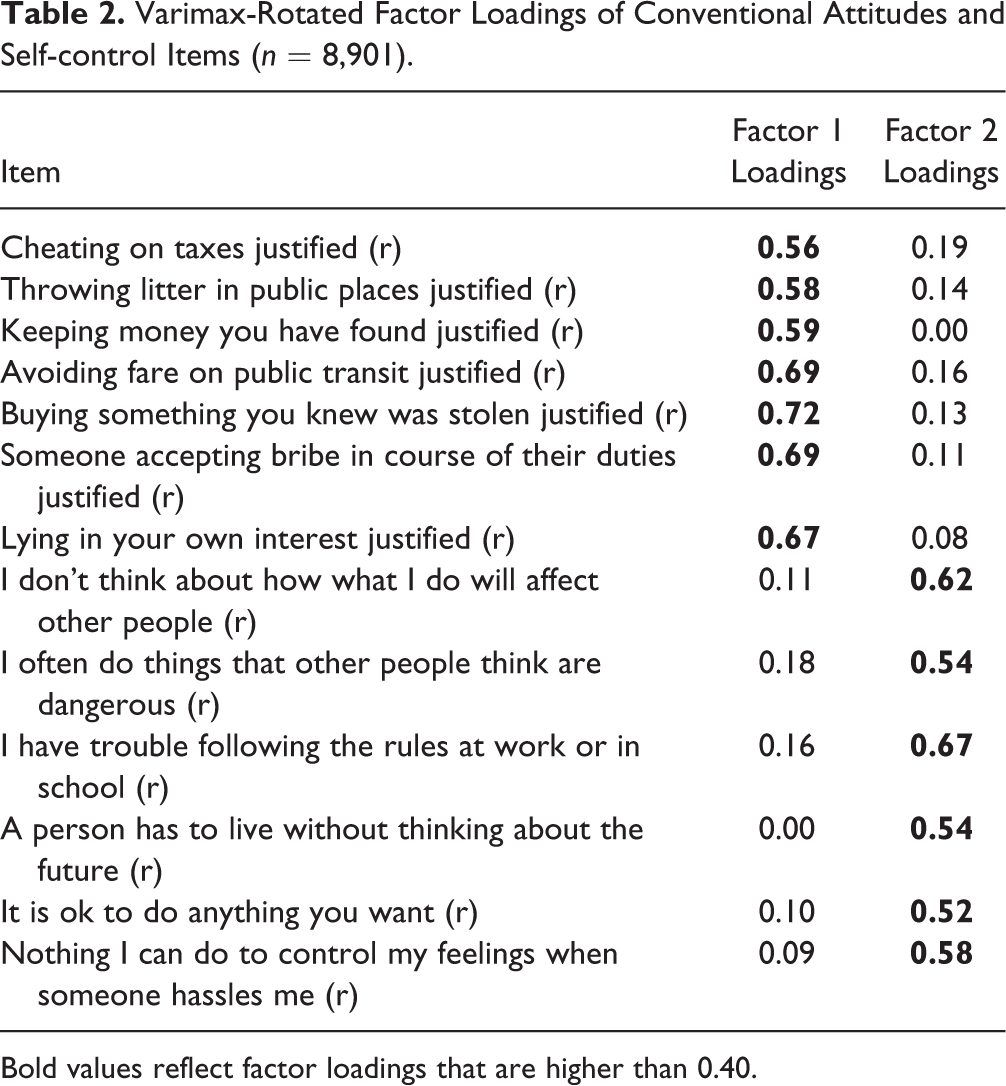
Bold values reflect factor loadings that are higher than 0.40.
Self-control
We created a six-item self-control scale similar to the scale used by Rebellon, Straus, and Medeiros (2008) in their multi-nation test of Gottfredson and Hirschi’s (1990) self-control theory. Example items include “I have trouble following rules at work” and “A person has to live without thinking about the future.” Response options ranged from “1” (Strongly disagree) to “4” (Strongly agree). We constructed the self-control scale by reverse-coding each of the six items and computing their mean for each respondent. Alpha was 0.62 for the working sample and all items are listed in Table 2. While this alpha is relatively low by traditional standards, it is in line with that of other self-control scales that are reviewed in Rebellon et al.’s (2008) study and that have all been demonstrated to predict antisocial behavior to a similar degree in the expected direction. Of note, Table 2 demonstrates that a varimax-rotated factor analysis including all seven conventional attitudes items and all six self-control items yielded a two-factor solution with all items loading well-above 0.40 on the expected factor. Notwithstanding a modest alpha for the six-item self-control scale, items from both the above scales are clustering together as intended in the analyses that follow.
Social concern
After constructing measures of conventional attitudes and self-control, we next searched the data for items that might plausibly reflect Agnew’s broad conception of social concern. We attempted to measure the three dimensions of social concern other than a “tendency to conform to the views and behavior of others” because Agnew acknowledges that this latter dimension is traditionally associated in the criminological literature with a core component of the social learning process (e.g., Akers, 1998). As described above, the remaining dimensions of social concern including caring “about the welfare of others”, a desire for “close ties to others”, and a broad “inclination to follow certain moral intuitions” apart from the specific values of any one particular group. We identified four items in the IPS that seemed to fit. These items asked about respondent agreement with the statements that: “the death penalty is not appropriate under any circumstances;” “I feel sorry when I hurt someone;” “if a coworker got a prize I would feel proud;” and “relationships with others are more important than personal accomplishments.” Response ranges for each of these four items ranged from “1” (strongly disagree) to “4” (strongly agree). When these four items were put into a factor analysis with all self-control items and conventional attitudes items described above, the social concern items all clustered together with factor loadings higher than 0.40 on one factor that was clearly distinct from the self-control and conventional attitudes factors. Alpha for the social concern items, however, was below 0.60. As a result, we selected one of the four items, “I feel sorry when I hurt someone,” to reflect social concern. We feel that this item, construed as physical or emotional hurt, comes closest to reflecting the spirit of Agnew’s social concern construct. We note, however, that we replicated all of the analyses that follow using a social concern scale comprised of all four original items and results were substantively identical to those presented below using only the one-item measure of social concern.
Measure of Adult Antisocial Behavior
Adult antisocial behavior was measured by a three-item scale, with the three items probing how much respondents agreed that, since the age of 15, they have: “hit or threatened to hit someone” outside their family; “physically attacked someone with the idea of seriously hurting them;” and “stolen money (from anyone, including family).” Response categories ranged from “1” (strongly disagree) to “4” (strongly agree). We interpret strong agreement as meaning that an individual was certain he or she had engaged in a severe degree of the behavior a given question probed. We interpret agreement as meaning that an individual engaged in a moderate form of the behavior probed and disagreement as meaning that an individual engaged in only very mild versions of the behavior a given question probed. We interpret strong disagreement as meaning that an individual did not engage in anything remotely reflecting the behavior a given question probed. Alpha for the three items was 0.64 for the working sample, and we calculated the three-item adult antisocial behavior scale so as to reflect the mean of its three constituent items.
Control Variables
Physical abuse
To ensure that CP in our study was not confounded with physical abuse, we controlled for a retrospective measure of childhood physical abuse. In particular, this measure was coded “1” if individuals reported experience with any of the following during childhood and “0” if they reported no experience with any of the following during childhood: being hit with fists or kicked hard by their mother or father; being grabbed and choked by their mother or father; being beaten up by their mother or father; being hit with an object like a belt other than on their bottom by their mother or father; or being thrown or knocked down by their mother or father. We note that these measures can be distinguished in two ways from our measures of corporal punishment. First, they are measured to reflect incidents that took place outside the context of parental discipline. Second, they were devised intentionally to reflect more severe treatment than the items used in the corporal punishment measure. We note further that our corporal punishment and physical abuse measures yield independently significant effects across most of the multivariate analyses that follow below, thus empirically substantiating the distinction that they were created to reflect.
Positive parenting
In order to ensure that our corporal punishment measure was not simply tapping into a lack of positive parenting, we included a retrospective measure of positive parenting consisting of the six items from the DDI (Calvete, Gámez Guadix, & Orue, 2010; Straus, 2011; Van Leeweun, 2012). Each item asked how often during the year a respondent was ten years old his or her mother and, separately, father: “Did or said things to show that they loved and supported you,” “Explained why they did what they did to correct you,” and “Encouraged and supported when they corrected misbehavior.” Items ranged from “0” to “4” (never, almost never, sometimes, usually, always or almost always). Alpha for all six items was 0.86 for the working sample and the scale reflects the mean of all six items.
Socially desirable responding
To guard against the possibility of socially desirable reporting, we controlled for the six-item Limited Disclosure Scale of the Personal and Relationships Profile (Chan & Straus, 2008; Straus & Fauchier, 2011; Straus, Hamby, Boney-McCoy, & Sugarman, 2010; Straus & Mouradian, 2011). Examples of the items are: “I sometimes try to get even rather than forgive and forget” and “No matter who I am talking to I am always a good listener.” Items ranged from “1” to “4” (strongly disagree to strongly agree) and the scale reflects the mean of its six items. Alpha is 0.56 for the working sample. Higher scores on this scale reflect a low willingness to disclose negative, but arguably universal, human tendencies.
Socioeconomic status
This variable was measured by the mean of the number of years of education completed by the student’s father and mother after first standardizing each one to control for differences between nations and national differences in educational systems, especially differences in cultural constraints of women. It is intended to indicate the rank of the student’s family within their own society.
Childhood misbehavior
We control for a retrospective measure of childhood misbehavior to address the possibility that our measure of adult antisocial behavior reflects a long-standing pattern of lifetime misbehavior beginning before (and potentially contributing to) parental CP. The questionnaire asked: “How often, at age 10, did you”: (a) “Repeat a
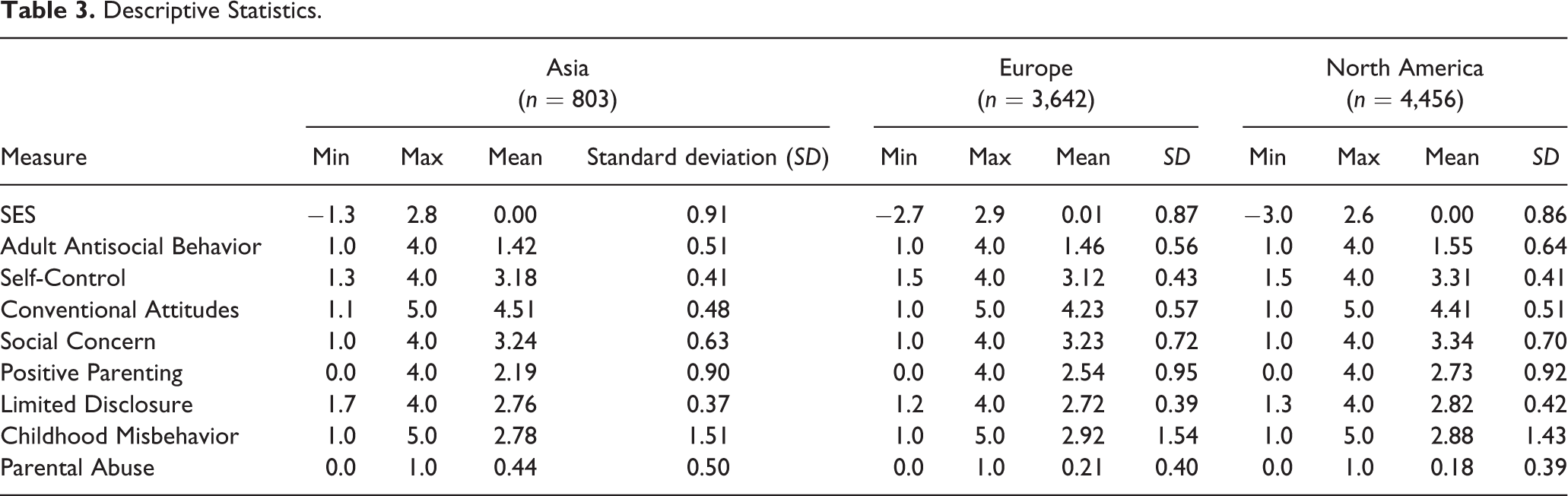
Descriptive Statistics.
Analytic Strategy
We used analysis of covariance (ANCOVA) to compare the association of CP and antisocial behavior across DCTs in each of the three world regions. In particular, these analyses examined whether antisocial behavior scores are higher (after adjusting for controls) among respondents who reported experiencing CP, whether the relationship between CP and antisocial behavior varies by DCT, and whether results are comparable across gender and world region. We then used path analysis, estimated via ordinary least squares estimation, to examine how much each of our three proposed mediators is independently able to explain a portion of the relationship between CP and antisocial behavior. In particular, we examined the direct association between DCT during childhood and antisocial behavior in early adulthood, as well as the indirect relationship via each of our proposed meditators: conventional attitudes; self-control; and social concern. We disaggregated results of our path analysis by world region and used the natural log of our antisocial behavior measure as our dependent variable, so as to limit its skew. For each path analysis, we included controls for abuse, gender, socioeconomic status, positive parenting, limited disclosure, and childhood misbehavior, as well as a series of dummy variables to control for nation within each region.
Results
Figure 2 summarizes results of an ANCOVA examining the relationship between CP and adult antisocial behavior, disaggregated by gender, and net of controls for: abuse; positive parenting; social desirability; socioeconomic status; and childhood misbehavior. Beginning with results pooled across all three world regions, adult antisocial behavior is significantly related to CP (SS = 8.43, df = 3, F = 10.06, p < 0.001) and gender (SS = 148.71, df = 1, F = 532.24, p < 0.001). Across all DCTs, male antisocial behavior scores are substantially higher than those of females. Comparisons of antisocial behavior scores across DCTs are slightly more complicated. In particular, overall antisocial behavior scores are highest among respondents who reported CP from both parents. Pairwise comparisons find antisocial behavior in this category to be significantly higher (p < 0.01) than in all three other categories but fail to find the antisocial behavior differences within these other three categories to be statistically significant. At the same time, results reveal a significant interaction between gender and DCT (SS = 4.62, df = 3, F = 5.51, p < 0.01) such that antisocial behavior is significantly higher among males, but not females, who reported CP at the hands of both parents.
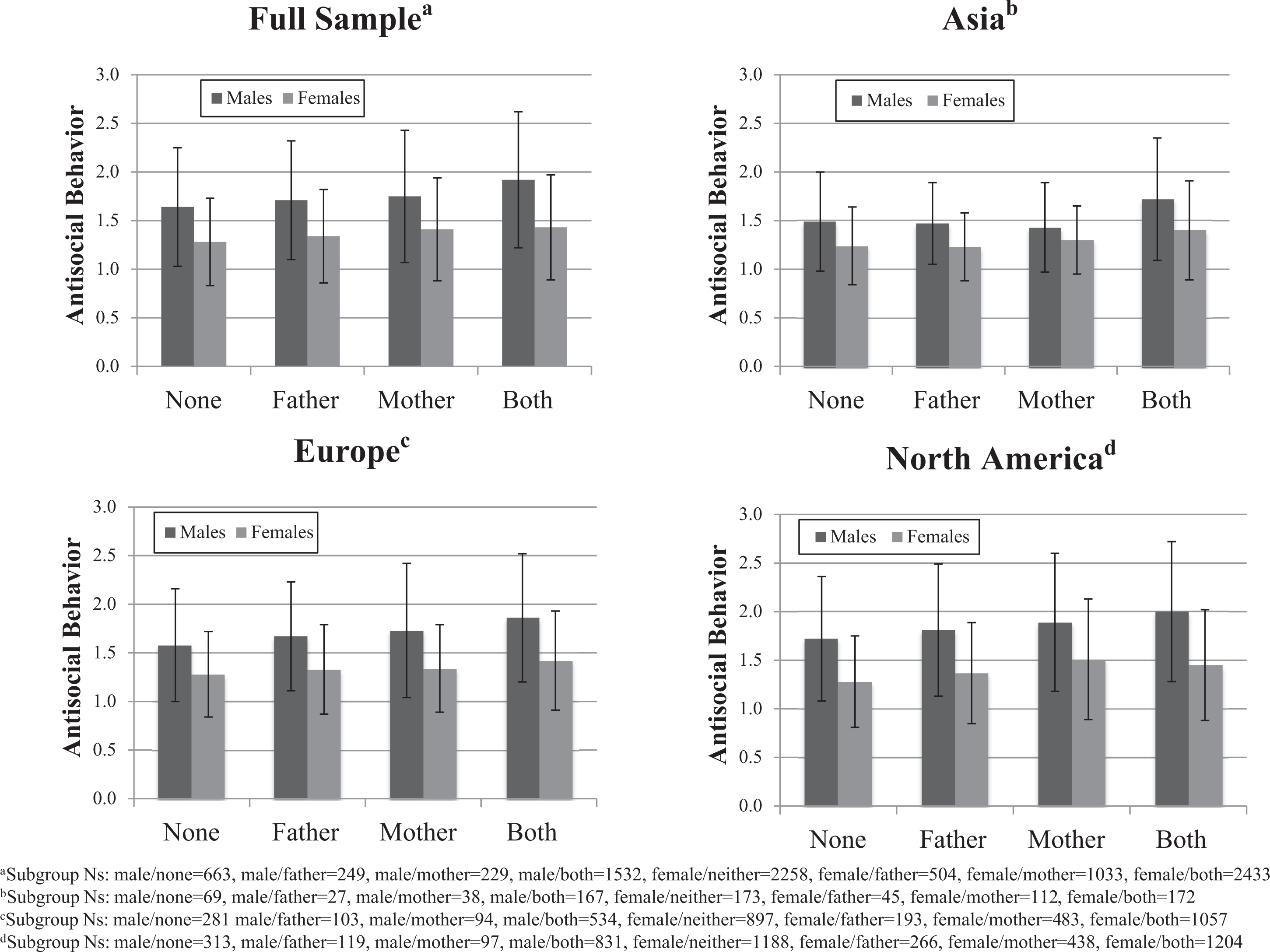
Mean adult antisocial behavior by corporal punishment dyadic concordance type.
Our ANCOVA likewise reveals a significant interaction between DCT and world region (SS = 6.05, df = 6, F = 3.61, p < 0.01). Results in Figure 2 are disaggregated by world region to assist with the interpretation of this interaction. Visual inspection of disaggregated results suggests that results from North America seem disproportionately to drive results from the pooled sample. Specifically, all substantive results reported for the pooled sample are replicated for analyses of only the North American sample. European results mirror those of the pooled sample with only one slight exception. Specifically, among females in the European sample, antisocial behavior scores are highest for those reporting CP from both parents rather than for those reporting CP from mothers only, but pairwise comparisons suggest this difference from North American results to be non-significant. Results for the Asian sample demonstrate somewhat more substantial differences from results in the other two regions, likely driving the interaction between region and DCT. In particular, although antisocial behavior in the Asian sample remains highest among those who reported CP at the hands of both parents, the association between this type of CP and antisocial behavior is substantively smaller in the Asian sample than in the European or North American samples, particularly among males.
Figure 3 summarizes the results of path analyses for each region to estimate the direct and indirect relationship of CP with antisocial behavior, net of controls. Interaction terms (not shown) failed to find significant interactions by gender upon inclusion of self-control, social concern, and conventional attitudes in multivariate models. Eight of nine coefficients in the three path analyses suggest that self-control, social concern, and conventional attitudes bear direct associations with adult antisocial behavior in the manner expected by prior theory and research cited above. Even after adjusting statistically for all control variables, including retrospective measures of childhood misbehavior and physical parental abuse, CP at the hands of both parents is significantly associated with antisocial behavior across all three world regions. In contrast to results from Figure 2, which did not adjust statistically for our three proposed mediator variables, path analyses reveal that the coefficient for CP at the hands of both parents is stronger in Asia than in North America and in Europe. With respect to the other two DCTs, the analyses fail to find a direct association of father-only CP with antisocial behavior in any of the three world regions, but a direct association between mother-only CP and antisocial behavior emerges in the North American sample. Overall, results from Figure 3 suggest that CP experienced in childhood is associated with adult antisocial behavior in all three world regions, but that this is consistently true only for the DCT involving CP from both parents.
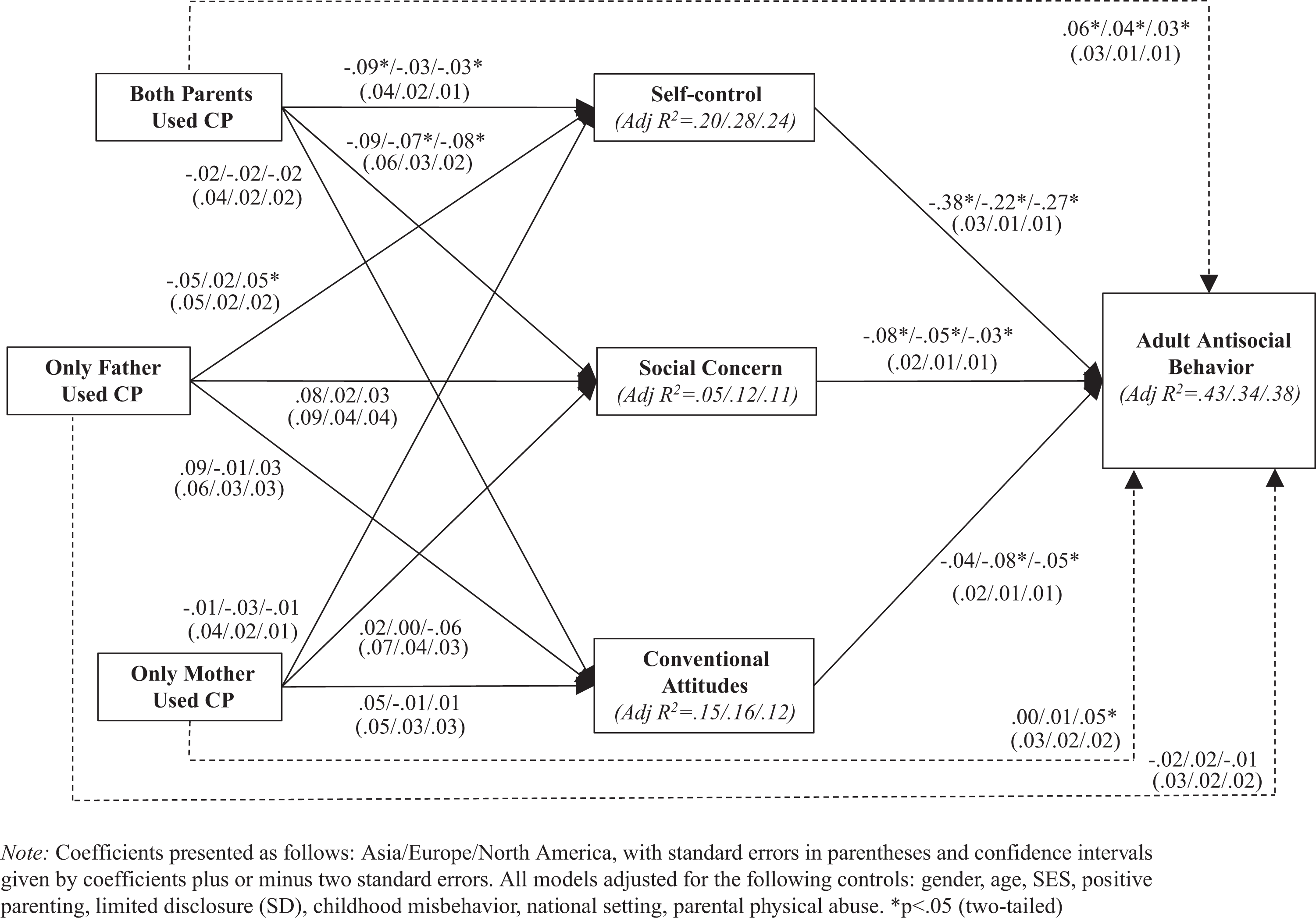
Direct and indirect relation between corporal punishment and adult antisocial behavior.
In addition to suggesting a direct association between childhood CP from both parents and antisocial behavior later in life, Figure 3 suggests indirect associations of this DCT with adult antisocial behavior via two of our three proposed mediators. On the one hand, results do not provide evidence that conventional attitudes mediate the relationship between CP from both parents and later antisocial behavior. Although conventional attitudes are significantly associated with antisocial behavior in multivariate models for the European and North American samples, no form of CP is significantly associated with conventional attitudes in multivariate models for any of the three world regions. On the other hand, results do provide evidence that CP from both parents is related to adult antisocial behavior via self-control and social concern. In Asia and Europe, CP from both parents is associated with lower self-control which, across all three world regions, is associated with more antisocial behavior. In Europe and North America, CP from both parents is associated with lower social concern which, across all three regions, is associated with more antisocial behavior. Aside from suggesting a pathway through which CP is associated with antisocial behavior, the latter result is noteworthy because it provides preliminary evidence bearing on Agnew’s (2014) theory of social concern. In particular, even after controlling for self-control and conventional attitudes, which reflect critical constructs in the mainstream criminological literature, as well as for a host of further control variables, Figure 3 finds social concern to be independently associated with lower antisocial behavior across all three world regions.
Whereas results suggest that CP from both parents is directly and indirectly associated with adult antisocial behavior, they suggest that CP from one parent bears little direct or indirect association with antisocial behavior. Father-only CP, for example, bears no direct relationship to antisocial behavior in any of our three regions and mother-only CP bears a direct association with antisocial behavior only in our North American sample. With respect to indirect relationships, mother-only CP is not associated with self-control, social concern, or conventional attitudes in any of our three world regions. While father-only CP is significantly associated with self-control in North America, this effect is substantively small and, of note, is positive, such that North Americans who experienced this form of CP tend to have higher self-control. On the one hand, this finding might be counter-intuitive to those who might predict that CP should be associated with uniformly negative outcomes. On the other hand, this relationship may be consistent with self-control theory’s assertion that discipline promotes self-control, particularly since the present analyses separate measures of CP from measures of more severe physical abuse. No matter how this relationship in North America is interpreted, it does not emerge in our Asian or European samples and the indirect association between father-only CP and adult antisocial behavior via self-control in North America is substantively very small.
Discussion
A wealth of cross-sectional research and an increasingly substantial body of longitudinal research find childhood CP to be associated with a host of negative behavioral outcomes. To date, however, most research has used US and Canadian samples, most has not attempted to examine whether childhood CP bears a long-term association with negative outcomes in adulthood, little research has examined whether the association between CP and negative outcomes depends on which parent or parents use CP, and surprisingly little research has attempted to discern what potential mechanisms might account empirically for the association between CP and antisocial behavior. The present study addresses each of these issues using retrospective data collected from individuals in three world regions.
Results reveal a number of important findings. First, results provide needed insight concerning the relationship between CP and adult antisocial behavior outside the US and Canada. Net of controls, including retrospective measures of childhood misbehavior and physical abuse, CP is associated with a higher level of antisocial behavior across three world regions. Second, results suggest that CP experienced in childhood is associated not only with externalizing behavior or other such outcomes in childhood and adolescence, but also with long-term antisocial behavior in early adulthood. Third, results provide evidence that CP’s association with adult antisocial behavior depends on which parent or parents engaged in CP. In particular, experiencing CP at the hands of both parents seems to be more strongly and more consistently associated with adult antisocial behavior across each of our three world regions than are other DCTs. Fourth, results provide evidence about why it is that CP may be associated with adult antisocial behavior, suggesting that CP at the hands of both parents is associated with lower self-control in all three world regions and with lower social concern in Europe and North America. Of note, results suggest that, upon adjusting for controls, CP’s association with adult antisocial behavior would not appear to reflect a systematic difference in the conventional attitudes of those who experienced CP versus those who did not.
Notwithstanding the above contributions, results must be understood within the context of several data limitations. First, we grouped national settings according to geography as an intuitive, but largely atheoretical, means of examining whether the association between CP and antisocial behavior might be said to generalize across different contexts. Adding to this issue, we note that our sample within any given national setting is not representative and, instead, reflects our logistic ability to gather data from university settings in which we had colleagues who were willing to help gather data for our study. On the one hand, certain results in our analyses clearly seem to differ by region, suggesting that our regional categorizations may be capturing cultural differences across region. On the other hand, we do not claim to have captured a representative sample of individuals within any given geographic, let alone cultural, context and it would be beyond the scope of the present paper to address fully what might account for regional and/or cultural differences. We do, however, encourage future theory and research to focus specifically on this issue.
Second, while we have provided what we believe to be a relatively rigorous set of analyses including a greater array of control variables than many studies of CP and antisocial behavior, there remain reasonable questions about the reliability and validity of certain measures included in our analyses. Our self-control and social desirability scales, for example, yield relatively low alphas and would ideally include items that are more strongly correlated with one another. Likewise, our retrospective data collection strategy is reason for concern with respect to the validity of measures like CP, positive parenting, and physical abuse, all of which were measured at least eight years after they presumably took place, and using data collected exclusively from respondents themselves. On the one hand: we believe that our factor analysis provides evidence that our self-control measure is in line with many other measures that have been commonly used in the criminological literature (see Rebellon, Straus, & Medeiros, 2008); our social desirability measure is simply intended as a control variable; and our retrospective measures yield results in line with those that prior theory and research suggest they should. On the other hand, however, we encourage further research to replicate our general analytic strategy with better measures to further validate the results presented herein.
Beyond the limitations of our data, results of our analyses raise further questions that our data do not allow us to address fully. Further research will be needed, for example, to explore whether the small but significantly-positive association between father-only CP and self-control in North America reflects type-I error. Likewise, the direct association between CP at the hands of both parents and adult antisocial behavior across all three world regions remains unexplained, as does the direct association between mother-only CP and adult antisocial behavior in North America. While our path analyses suggest that self-control and social concern mediate a portion of the relationship between CP and adult antisocial behavior, the remaining direct effects of CP imply that some unmeasured variable (or variables) must also mediate a portion of the association between CP and adult antisocial behavior.
Finally, our data do not allow us to explore for certain why it might be that CP at the hands of both parents seems to be associated with adult antisocial behavior while CP at the hands of only parent is not. We offer the following speculation, however, for future research to consider: in keeping with the insights of attachment theory (Bowlby, 1969/1982), it may be that positive youth development requires the presence of at least one authority figure around which a child feels fully secure and fully safe from violence. In other words, while we do not advocate CP from any parent, it may be the case that it is the absence of any fully safe haven that could be associated with long-term antisocial behavior. We encourage future research to replicate our findings concerning DCTs and to elaborate its examination of exactly why DCTs may be associated with differential developmental outcomes.
Footnotes
Funding
The authors declared receipt of the following financial support for the research, authorship, and/or publication of this article: This research was funded by the National Institute of Mental Health, Grant number T32MH15161.