



Abstract
In a typical delay-of-gratification task, children have the choice between eating a small amount of treats immediately and waiting in order to receive a larger number of treats. To date, it has not been investigated whether children’s time comprehension is related to the ability to wait for the larger number of treats. Time comprehension can be tested by presenting children with three hourglasses containing different amounts of sand and asking them about the running time of the hourglasses (e.g., “Which hourglass will finish first?”). In this study, 75 four-year-old children were tested with a delay-of-gratification task, a time comprehension task, and a receptive language task. Children who ate the treat immediately in the delay-of-gratification task did not perform above chance level in the time comprehension task. In contrast, children who waited in the delay-of-gratification task, either for some time or until the end of the task, did perform above chance level. Correlation analyses revealed that performance in the time comprehension task and in the delay-of-gratification task correlated even after controlling for receptive language ability. Thus, children’s time comprehension is related to their ability to delay a prepotent response. The nature of this correlation is discussed.
Introduction
Controlling impulsive behavior is a developmental milestone in a person’s life, which not all adults have passed equally, with some adults being more self-controlled than others. A difference in time perception (Wittmann & Paulus, 2008) might contribute to this variance in self-control which probably has multiple reasons (e.g., an individual’s temperament such as conscientiousness; McCrae & Costa, 1987): it is suggested that less self-controlled individuals overestimate the duration of time intervals, whereas more self-controlled individuals do not show this systematic misconception. As a consequence, the delay of receiving a reward appears to be longer – and therefore more-costly – to less self-controlled individuals than to more self-controlled individuals. Time perception, however, is not present from day 1 after birth but is rather subject to cognitive maturation in the first years of life (Friedman, 2005). Following the idea that controlling impulsive behavior is associated with time perception, this study investigated whether delay of gratification is related to 4-year-old children’s ability to reason about time. Considering time as a relevant factor in action planning might help individuals to refrain from acting on impulses.
Developmental psychologists have investigated children’s ability to refrain from eating a small number of treats in order to receive a larger number of treats in the future (Mischel & Ebbesen, 1970), with findings showing a marked increase in the ability to wait between age 3 and 4 years (Atance & Jackson, 2009). A standard procedure entails an experimenter promising the child that he/she will receive an additional marshmallow if the child does not eat the single marshmallow which is in front of him/her while waiting alone for the experimenter to return (Mischel & Ebbesen, 1970). Younger children tend to eat the marshmallow immediately or after a short while of waiting. The standard interpretation is that this developmental progression in a delay-of-gratification task is attributable to children’s increasing self-control (Mischel, Shoda, & Rodriguez, 1989).
Delay of gratification is related to time perception. It has been proposed that the ability to refrain from acting on impulses depends on time perception (Wittmann & Paulus, 2008). That is, while humans wait, an internal pacemaker counts the temporal units that accumulate over a time period. The number of temporal units is then compared to a stored representation of temporal units and individuals can explicitly state how much time has passed. According to this model, some individuals overestimate durations because the internal pacemaker has a higher frequency of counting temporal units. This distorted time perception leads to an overestimation of time, which makes waiting more costly for these individuals than for individuals who correctly estimate durations. There is some evidence for this cognitive model of time perception. For example, 8–12-year-old children who waited until the end in a delay-of-gratification task showed better duration discrimination than children who did not wait until the end (Reinelt, Wirth, Rauch, & Gawrilow, 2014). Another study (Barkley, Edwards, Laneri, Fletcher, & Metevia, 2001) showed that adolescents’ ability to wait was negatively correlated with the correctness in reproducing a certain duration: in a time-reproduction task, a shorter waiting time was not correlated with larger durations, but rather with larger errors, including both shorter and longer durations. Although these results are not perfectly in line with Wittman and Paulus’ (2008) account, this study showed that the ability to wait correlates with the overall precision in correctly estimating durations. In younger children, it has also been shown that children’s ability to wait in the delay-of-gratification task correlates with their understanding of temporal terms (e.g., “tomorrow” or “before”; Kumst & Scarf, 2015). The latter finding suggests that children’s development of a concept of time develops in synchrony with their ability to refrain from acting on impulses. However, the relationship between time comprehension in terms of estimating durations and delay of gratification has not been investigated in younger children. Time comprehension involves the ability to align past, present and future on a timeline, to understand that events have durations (Bischof-Köhler, 2000) and to allocate events on this timeline (Friedman, 2005). Research on children’s time comprehension has revealed that at the age of 4 years, children show a significant improvement in time comprehension. Four-year-old children are better than 3-year-old children at comprehending and producing temporal terms such as “yesterday” or “tomorrow” (Busby Grant & Suddendorf, 2011) and at comparing the duration of different events (Levin, 1977). They are also better than 3-year-old children at predicting and remembering which of three hourglasses (3, 4, and 5 minutes duration) finished first and last (Zmyj & Bischof-Köhler, 2015). The latter task requires children to consider time as a dimension on which the outcome of an event can be measured. Children’s performances in this task were found to correlate with other tasks involving time comprehension (Bischof-Köhler, 2000). For example, in one task, a child could look for a gift in one of two locations, a near one and a far one. The child could not see where the experimenter had hidden the gift because the child was sitting behind a curtain. However, if the curtain was closed only for a short period of time, the experimenter must have hidden the gift at the near location, while if the curtain was closed for a longer period of time, the experimenter had probably hidden the gift at the far location. Children who looked at the correct location also performed better in the hourglass task. The performance in comparing the durations of hourglasses was also found to correlate with children’s behavior while they were waiting for a gift. For instance, in one experiment, children were able to open a wrapped gift when a 5-minutes hourglass had run out. In the meantime, they could play with several toys. One type of behavior stood out through its elaborated time management: children who showed this type of behavior played with the toys and checked from time to time how much sand had already run out. All other types of behavior were more or less focused on the hourglass or the gift. Children with time management performed better in the task in which the three hourglasses had to be compared than children without time management (Bischof-Köhler, 2000). However, this correlation was not controlled for general cognitive development, such as receptive language or intelligence quotient (IQ), which might have served as a moderator. Receptive language might play a prominent role in the investigation of time comprehension and delay of gratification because the different paradigms use verbal instruction. For example, a previous study showed that self-control and language abilities are correlated (Beaver, Delisi, Vaughn, Wright, & Boutwell, 2008).
There is a concurrent significant improvement in time comprehension and delay-of-gratification ability between 3 and 4 years of age. There is also some evidence of a correlation between the ability to estimate durations and the ability to wait in older children. This study therefore hypothesized a correlation between time comprehension and performance in a delay-of-gratification task when children start to reflect on the concept of time. Time comprehension was tested with three hourglasses, which differed only in the amount of sand and accordingly in the running time (Zmyj & Bischof-Köhler, 2015). Children had to predict and remember the duration of the hourglasses. Delay of gratification was tested using the original procedure (e.g., Mischel & Ebbesen, 1970): children were presented with one chocolate bar. If they waited until the experimenter came back of her own accord, they received another one; if they made the experimenter come back by ringing a bell or if they ate the chocolate bar, they received only the chocolate bar in front of them. Children’s receptive language was tested with a standardized test (Grimm, 2001). A correlation between performance in the time comprehension task and in the delay-of-gratification task should remain after controlling for receptive language ability.
Method
Participants
The final sample consisted of 75 four-year-old children (42 girls) who participated in this study (mean (M) = 4 years; 18 days; standard deviation (SD) = 16 days; range = 48–50 months). An additional 23 children were tested but excluded due to unwillingness to cooperate in at least one task (n = 10), equipment failure (n = 5), experimenter error (n = 3), no knowledge about the German language (n = 3), parental interference (n = 1), or falling asleep during the delay-of-gratification task (n = 1). Children were recruited from a database of families who had previously agreed to participate in studies on child development. All parents of children at this age who lived in the city of Bochum had been contacted via mail and were invited to participate in these studies and to register in this database. Fifty-five percent of mothers and 51% of fathers had a university degree and a further 28% of mothers and 16% of fathers had a university entrance level diploma indicating that most children were from a middle- to high-socioeconomic status background.
Materials and Room
In the delay-of-gratification task, the treat was a chocolate bar (the name of the popular German chocolate bar is “Kinderriegel”). The chocolate bar was placed on a plate next to a bell. Children could ring the bell by pushing the top knob. In the time comprehension task, children were presented with three hourglasses which differed only in the amount of sand (height: 36 cm; diameter of the tube: 4 cm). When turned upside down, the hourglasses ran for 3, 4, and 5 minutes, respectively. In the receptive language task (SETK 3–5, Grimm, 2001), the items from the original task were used (a bag, a red and a blue pencil, a box, two red buttons, a blue button, a yellow button, a teddy bear, a pink golf ball, a yellow golf ball, and a picture book).
The testing room (3.6 × 1.7 m) was empty except for one child-sized table, two child-sized chairs for the child and the experimenter, and one chair for the parent. A one-way window that appeared as a mirror in the testing room allowed the room to be observed from an adjacent room while not being visible to the child during the delay-of-gratification task. A video camera with a panoramic lens videotaped the test session from the ceiling in a corner of the room.
Design and Procedure
All children participated in all three tasks (delay of gratification, time comprehension, and receptive language), which were conducted in a randomized order.
After arrival at the university, the experimenter escorted the parent and the child to the test room. Before the study started, the parent gave informed consent to participate in the study and the experimenter and the child drew a picture or read a picture book together. Once the child appeared to be comfortable with the situation and the experimenter, the test session started.
In the delay-of-gratification task, the experimenter first introduced the bell. She showed that if she was outside the room and the child rang the bell, then she would immediately return to the room. The child then performed three practice trials in which she or he rang the bell and the experimenter returned to the room. Then, the experimenter showed two chocolate bars and told the child that she had to leave the room. One chocolate bar would remain in the room, and she would take the other chocolate bar with her. She further told the child that the child would only get the second chocolate bar if the child waited until she came back on her own. If the child rang the bell, then she would come back, but the child would only get one chocolate bar. After this explanation, the experimenter asked three control questions (“How many chocolate bars do you get if you wait until I come back?”, “If you want me to come back, what do you do?”, and “How many chocolate bars do you get if you ring the bell?”). If the child failed to answer a question correctly, the experimenter repeated the explanations until the child answered the control questions correctly. Then, the parent and the experimenter left the room and watched the child from the adjacent room through the one-way mirror. The maximum duration was 15 minutes.
In the time comprehension task, the experimenter presented the child with the 5-minutes hourglass and turned it upside down in order to demonstrate the mechanism of the hourglass. This task has been established by Bischof-Köhler (2000) and was used in a previous study on time comprehension (Zmyj & Bischof-Köhler, 2015). Subsequently, the experimenter presented the three hourglasses in ascending order and turned them upside down. Then, the experimenter asked the following pairs of questions (literal translation of the phrasing which turned out to be most appropriate in colloquial German): Item 1. Which hourglass will finish most quickly? Item 2. Why? Item 3. Which hourglass will take the longest? Item 4. Why?
After the sand of the 3-minutes hourglass had run through, it was put aside. Then, the child was asked to compare the remaining two hourglasses. The experimenter asked the following questions: Item 5. Which hourglass will finish last? Item 6. Why? Item 7. Which hourglass will finish first? Item 8. Why?
After the hourglasses had run through, they were presented again in the same position, and the questions were asked in reverse order: Item 9. Which hourglass finished first? Item 10. Which hourglass finished last?
Finally, the positions of the hourglasses were switched (with the 5-minutes hourglass in the center), and the child was again asked the two types of questions: Item 11. Which hourglass finished most quickly? Item 12. Which hourglass took the longest? Item 13. Which hourglass finished first? Item 14. Which glass finished last?
To answer items 1–6 correctly, the child had to predict the running time of the three hourglasses. In contrast, to answer items 7–14 correctly, the child had to remember the running time that they had already experienced.
In the receptive language task (SETK-3–5, Grimm, 2001), the experimenter asked the child 15 questions that consisted of 15 prompts with ascending grammatical complexity. All questions required the child to comprehend and to follow the experimenter’s oral instructions (e.g., “Put the bag between the pencils”). Cronbach’s alpha for the SETK-3–5 was .77.
Coding
In the delay-of-gratification task, the duration for which children waited until they rang the bell or ate the chocolate was categorized into groups, because the waiting times for this task were highly skewed, with approximately half of the children either eating the chocolate/ringing the bell immediately or waiting until the end of the task. Three groups were identified: the first group rang the bell or ate the chocolate bar within 10 seconds after the experimenter had left the room; the second group waited for more than 10 seconds but not the whole 15 minutes before ringing the bell or eating the chocolate bar; and the third group waited until the 15 minutes had elapsed and the experimenter had returned. The rationale for using 3 categories (no waiting, some waiting, and waiting until the end) in the present study was that approximately half of the children showed a distinct pattern: either they ate the chocolate/rang the bell immediately or they waited until the end. The other children waited, but not until the end. The 10 seconds cut-off criterion appeared to be appropriate for the no-waiting group because children did not really wait for some seconds. Instead, they looked at the door after the experimenter had left for some seconds and then ate the chocolate.
In the time comprehension task, each correct answer was scored with “1”. For questions regarding the running time of the hourglasses (“Which hourglass…?”), a correct answer was indicated by pointing to the corresponding hourglass. For questions regarding the reason for the child’s previous answer (“Why?”), a correct answer referred to the amount of sand in the upper part of the hourglass. Incorrect answers referred to the amount of sand in the lower part of the hourglass or to the speed of the sand running from the upper part to the lower part. Eleven out of the 1050 questions (75 children × 14 questions) could not be analyzed due to experimenter errors. Thus, percentage scores instead of sum scores were calculated. Two percentage scores were calculated for further analyses. The first percentage score excluded the “Why” questions. This exclusion was necessary in order to test whether children’s performance was above baseline. Children could randomly point to one of the three hourglasses when they were asked “Which hourglass […]?”, which results in a chance level for a correct answer of .33. However, for an open “Why” question, there was no comparable chance level for a correct answer by guessing. A sum score was calculated and divided by the number of valid questions. The second percentage score included all questions. Cohen’s kappa calculated for interrater reliability for the time comprehension task was high (κ = .917). In the receptive language task, a correct action was scored with “1”; all other actions were scored with “0” and the sum score was transformed into a T-score. The intraclass correlation calculated for interrater reliability for the receptive language task was high (r = .99).
Results
In the delay-of-gratification task, 24 children (32%) waited for 15 minutes until the experimenter came back of her own accord (waiting-until-end group). Eleven children (15%) ate the chocolate bar or rang the bell immediately (i.e., they waited for less than 10 seconds after the experimenter had left; no-waiting group). Forty children (53%) waited for more than 10 seconds but less than 15 minutes before ringing the bell or eating the chocolate bar (some-waiting group). The median waiting time was 5 minutes 36 seconds. In the time comprehension task, the consistency of the items was good (Cronbach’s alpha = .85 for all questions and .73 when excluding the “Why” questions). The mean percentage of correct answers was 54% (SD = 26) for all questions and 62% (SD = 26) when excluding the “Why” questions. In the receptive language test, the mean T-score was 53.88 (SD = 11.75). The position of the single tasks (1st, 2nd, and 3rd) in the experimental procedure did not affect the individual performance (all Fs < 2.490, all ps > .090).
In order to analyze the relationship between time comprehension and delay of gratification and in order to control for receptive language, Spearman rank correlations were calculated. Time comprehension correlated with delay of gratification (r = .319, p = .005). Even after controlling for receptive language (r = .241, p = .039) this correlation remained statistically significant although receptive language correlated with time comprehension (r = .374, p = .001) and delay of gratification (r = .278, p = .016). A further analysis was conducted on the percentage of correct answers in the time comprehension task without the “Why” questions in order to analyze whether children answered above chance level according to their allocation to the three waiting groups in the delay-of-gratification task (no-waiting, some-waiting, and waiting-until-end; see Figure 1). First, an ANOVA revealed that the percentage of correct answers in the time comprehension task differed across the three waiting groups in the delay-of-gratification task, F(2, 72) = 4.843, p = .011. Separate independent t-tests revealed a statistically significant difference between the no-waiting group and the some-waiting group, t(49) = 2.076, p = .043, and between the no-waiting group and the waiting-until-end group, t(33) = 3.616, p = .001. There was no statistically significant difference between the some-waiting group and the waiting-until-end group, t(62) = 1.446, p = .153. Further one-sample t-tests revealed that only children in the some-waiting and the waiting-until-end group gave more correct answers than expected by chance, t(39) = 6.016, p < .001, and t(23) = 8.330, p < .001, respectively. In contrast, children in the no-waiting condition did not give more correct answers than expected by chance, t(10) = 1.089, p = .302.
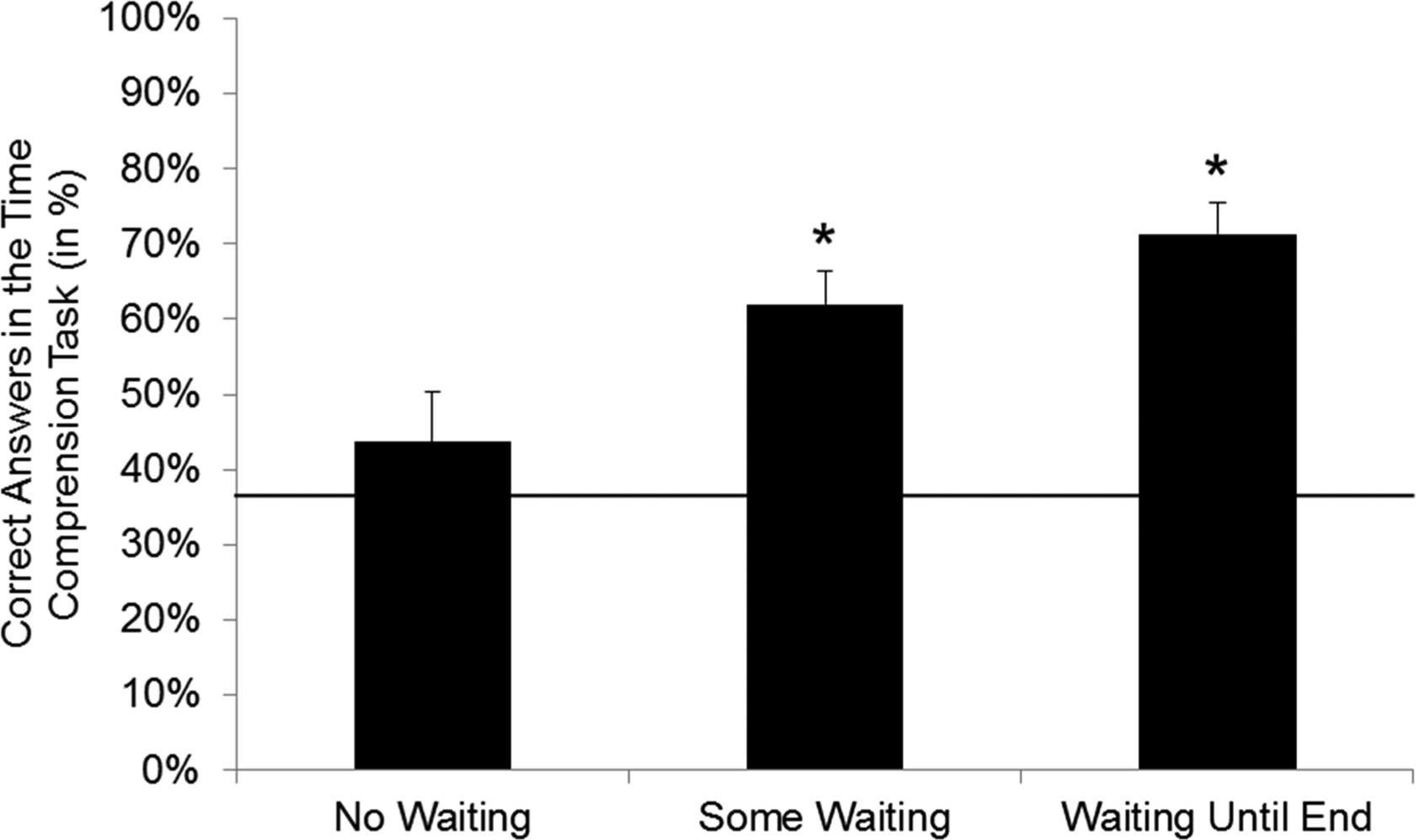
Percentage of correct answers (without “why”-questions) compared to chance level of 36.4% (8 questions with a chance level of 33% and 2 questions – Items 5 and 7 – with a chance level of 50%). Asterisks indicate a performance that is statistically significant above chance level.
Discussion
This study investigated the relationship between the performance in a time comprehension task and a delay-of-gratification task in 4-year-old children. Waiting in the delay-of-gratification task correlated with correctly estimating and remembering the duration of hourglasses. This correlation remained statistically significant even after controlling for receptive language ability. Only children who waited until the experimenter returned or waited for some time after the experimenter had left the room in the delay-of-gratification task performed above chance level in the time comprehension task. In contrast, children who did not wait in the delay-of-gratification task performed at chance level in the time comprehension task.
Correlation studies are always difficult to interpret and the current one is no exception. It is tempting to causally interpret the data: it has been suggested that time comprehension is involved in delay of gratification (Wittman & Paulus, 2008). A shorter waiting time in a delay-of-gratification task might be the result of an overestimation of the duration of time intervals. While there is evidence for this relationship in older children (Reinelt et al., 2014), another study showed that the ability to wait in a delay-of-gratification task correlates with the magnitude (i.e., both over- and underestimation) of error when estimating time intervals (Barkley et al., 2001). In combination with the present study, which tested young children, these results suggest that the relationship between time comprehension and delay of gratification is not as specific in early years as was proposed by Wittmann and Paulus (2008). Time comprehension might help children to refrain from acting on impulses, because the ability to predict and remember durations correctly helps them to understand what it means to wait for some time. This interpretation could be applied to the finding that children who did not wait in the delay-of-gratification task also did not perform above chance level in the time comprehension task. It could also be applied to the finding that children in the no-waiting group showed poorer performance in the time comprehension task than children in the some-waiting and the waiting-until-end group. One could test this causal interpretation by examining whether training children’s time comprehension improves their ability to wait for a reward.
This study contains several limitations. First, it is not clear why children who waited until the end of the task and children who only waited for some time and then ate the chocolate/rang the bell did not differ in their performance in the time comprehension task. Both groups performed at about chance level but not differently from each other. Future studies should assess children’s temperament, as this might be associated with their performance in a task in which they have to inhibit a prepotent response (Mittal, Russell, Britner, & Peake, 2013).
Second, the correlation between time comprehension and delay of gratification might be moderated by the ability to think about the future. The age of 4 years marks a transitional period in which children’s future-oriented thinking improves significantly (Suddendorf & Redshaw, 2013). Time comprehension – for example the ability to understand that events have different durations as measured in the time comprehension task – is a prerequisite for thinking about the future. In turn, thinking about the future helps children to refrain from acting on impulses (e.g., Daniel, Stanton, & Epstein, 2013) because it might enable them to imagine a future episode in which the current need is fulfilled (Suddendorf & Redshaw, 2013). The correlation between time comprehension and delay of gratification found in the present study might also depend on a third variable. For instance, first, children had to understand the experimenter’s instructions in both tasks. However, the correlation between time comprehension and delay of gratification remained after controlling for receptive language. Accordingly, although language abilities are involved in this task, they do not fully explain the correlation. Second, children who ate the treat immediately might be more impulsive than children who waited for some time or until the end in the delay-of-gratification task. This impulsivity might have led to them taking less time to think about the answer in the time comprehension task and thus to performing poorly in this task. Future studies could implement a “stop-and-think” instruction in which children are encouraged to think about the answer before responding to a question (as in Wimmer & Perner, 1983). Third, a variety of other factors might be involved in this correlation. Future studies could test the predictive power of time comprehension for delay-of-gratification abilities when other factors such as children’s executive functions, IQ, temperament, and future-oriented thinking are controlled for.
This study investigated the relationship between time comprehension and delay of gratification at the developmental onset of time comprehension. The results demonstrated that time comprehension is related to the ability to wait for a reward. This ability to refrain from acting on impulses is a developmental milestone in childhood and is important for engaging in adult-like social interactions, in which it is considered a matter of course.
Footnotes
Acknowledgments
I thank Marie-Christin Frerich, Tessa Heinrich, Milena Meyers, Paula Siegmann, and Sarah Witt for their help with data collection and data analyses, and the parents and children for participating in this study.
Funding
The author received no financial support for the research, authorship, and/or publication of this article.