



Abstract
Three decades of research have examined children’s challenge and threat appraisals, yet unresolved issues remain. This study provides new insight about three central, open questions in this field: How do challenge and threat appraisals relate to events eliciting discrete negative emotions? How do challenge appraisals develop across childhood, and are there gender differences across development? In this cross-sectional study, 172 children (three age groups: 3–5 years, 6–8 years, and 9–11 years) and 89 young adults (ages 17–26) described sad, scary, and anger-provoking autobiographical experiences and were asked whether the event was something they could handle (a challenge appraisal) or whether it was just too much (a threat appraisal). Challenge appraisals were associated with anger-eliciting events more often than with sad or scary events. In line with predictions, challenge appraisals steadily increased across age groups. In early childhood, girls made more challenge appraisals than boys, but young adult men made more challenge appraisals than young adult women. Findings highlight the importance of understanding the developmental progression of appraising difficult events and experiences as a challenge rather than a threat, and provide new information about the etiology of adaptive appraisal processes in early life.
Children frequently face minor hassles and major stressors that can elicit a wide range of negative emotions. The intensity and duration of these emotional experiences depends in part on how the initiating event is evaluated (e.g., does it matter to me? Can I do anything to fix it? Can I do anything to make myself feel better?). These cognitive appraisals of what an experience means and whether one has the resources to handle it have important implications for diverse outcomes, including social competence, academic achievement, effective coping, and mental health (Mak, Blewitt, & Heaven, 2004; Thompson, Zalewski, & Lengua, 2014).
Appraisals assign meaning to an experience (Lazarus, 1991; Moors, Ellsworth, Scherer, & Frijda, 2013) via unconscious or conscious evaluation of various criteria. One dimension of the appraisal process concerns whether people appraise a stressful or negative event as a challenge (i.e., assessing that one has adequate resources to deal with the situation) or as a threat (i.e., assessing that one does not have adequate resources; Blascovich, Mendes, Tomaka, Salomon, & Seery, 2003). Examining challenge and threat appraisals provides a framework for understanding how children and adults perceive their own abilities to handle problems (Hood, Power, & Hill, 2009; Lazarus, 1991), which is a key component of effective self-regulation (Bandura, 2006). This study investigated patterns of challenge and threat appraisals in response to sad, frightening, and angering events, as well as age-related changes and gender differences in these appraisals across childhood and in young adulthood.
Discrete Emotion Differences in Appraisals
Both positive and negative emotions can be useful, providing valuable information that helps people make sense of their experiences. However, emotions may also interfere with achieving one’s goals or maintaining relationships, if not well regulated. One theoretical question that has not been adequately addressed is the extent to which events eliciting discrete emotions may be more frequently appraised as a threat or as a challenge (e.g., Zimmer-Gembeck, Lees, Bradley, & Skinner, 2009).
Theoretical accounts of emotion hold that sadness, fear, and anger are negative or difficult emotions because each is associated with an interpretation that the situation is inconsistent with one’s goals (e.g., Lazarus, 1991; Moors et al., 2013). These discrete emotions are also associated with specific response or action tendencies (Lazarus, 1991). For example, sadness is associated with low control potential and often leads to a withdrawal response, whereas anger is associated with more control potential and often leads to activation and approach, such as confronting the agent thought to be responsible (Carver & Harmon-Jones, 2009; Lazarus, 1991; Roseman, Antoniou, & Jose, 1996). The ambiguity of fear is associated with low control potential but may lead to either activation or withdrawal, such as a fight, flight, or freeze response (Lazarus, 1991; Moors et al., 2013; Roseman et al., 1996). The approach motivation associated with anger would potentially be accompanied by a challenge appraisal. In contrast, situations eliciting fear and sadness would likely be accompanied by threat appraisals, as these emotions are associated with the assessment that little can be done to change the situation. The current cross-sectional study tested whether challenge appraisals were more frequently associated with angering events compared with sad or scary events.
Descriptions of autobiographical events show that there are similarities in the evaluations, goals, and consequences in emotional events experienced by children and adults (Stein, Liwag, & Wade, 1996). For example, when children (ages 2.5–6) discussed situations when they felt sad, scared, angry, and happy, the events they described were aligned with adult understanding of these emotion contexts (Stein et al., 1996). Similarly, children as young as three can discriminate between situations that are likely to elicit each emotion (Levine, 1996). Of course, developmental change also occurs. Children develop regulatory skills and a more sophisticated understanding of personal and social resources, which facilitate navigating a wider range of social contexts (Eisenberg, Hofer, Sulik, & Spinrad, 2014). However, little is known about how these changes might influence challenge appraisals made during events that elicit specific emotions. Thus, this study investigated whether sad, fearful, or angering events may be more often associated with challenge or threat appraisals, and whether this pattern would be the same or different across age groups.
Age and Gender Differences in Appraisals
Many researchers have highlighted the importance of taking a developmental perspective to better understand appraisal processes (e.g., Hood et al., 2009; Moors et al., 2013; Zimmer-Gembeck et al., 2009). Challenge and threat appraisals are likely influenced by many systems over the course of development, including changes in physiology and cognition (e.g., attention, language, and memory; Eisenberg et al., 2014; Skinner & Zimmer-Gembeck, 2007). These systems are embedded within contexts of socialization, and thus develop in transaction with significant social partners, such as parents, teachers, and peers (Eisenberg et al., 2014). As challenge and threat appraisals are linked to competency and psychopathology, understanding the developmental progression of these appraisals is important for coping, regulation, and resiliency research more broadly (Skinner & Zimmer-Gembeck, 2007). One study that examined challenge appraisals across age groups examined the adjustment of children of battered women, and found that the 10- to 12-year-olds had lower threat appraisal scores than the 8- to 9-year-olds (Jouriles, Spiller, Stephens, McDonald, & Swank, 2000). In a 4-wave longitudinal investigation of interparental conflict, Richmond and Stocker (2007) found that threat appraisals decreased from late childhood to adolescence but decreased less steeply across adolescence. Other researchers have not found age differences, but this may be because study samples have had inadequate age ranges to examine this hypothesis.
In addition to changes associated with age, gender may be an important factor in the development of challenge appraisals. Gender differences have been found in coping strategies and adjustment problems, which result, in part, from appraisal processes (e.g., Hunter, Boyle, & Warden, 2004; Kliewer & Sullivan, 2008; Ptacek, Smith, & Zanas, 1992; Thompson et al., 2014). Gender socialization likely plays a key role in such differences, whether by shaping individuals’ cognitions and behaviors to be gender-specific (e.g., through modeling, coaching, or responding) or by guiding males and females to engage in different activities and roles, which may lead to different coping styles (Tamres, Janicki, & Helgeson, 2002). Adolescence is a time of hormonal change, as well as gains in meta-cognitive ability (Skinner & Zimmer-Gembeck, 2007). For girls, adolescence is also associated with greater risk of depression and anxiety. One study reported that threat appraisals accounted for the gender differences in depressive symptoms in adolescents; thus, a prevalence of threat appraisals may be a marker for risk (Mak et al., 2004). Examining gender differences across age groups is an important step to integrating the understanding of coping processes, competence, and psychopathology (Mak et al., 2004; Thompson et al., 2014). Boys and girls may weight distinct dimensions of situations differently in appraisal processes. In one study examining children’s appraisals of injury risk, girls appraised the threat of injury based on potential vulnerability (i.e., whether there was a chance of getting hurt), whereas boys appraised threat based on the severity of injury (i.e., the degree of hurt that might be experienced; Morrongiello, Midgett, & Stanton, 2000). Another study utilizing a 21-day, daily-survey method with college students found that young women made fewer challenge appraisals than young men, but found no gender difference in the types of events reported (Ptacek et al., 1992). Thus, we sought to explore potential gender differences across age groups in this investigation.
Current Study
Children and adults described appraisals in the context of an autobiographical interview. Participants recounted situations in which they felt sad, scared, and angry, and whether they “could handle” each event when it occurred. We investigated age-related changes by examining appraisals made in early childhood (ages 3–5), middle childhood (ages 6–8), late childhood (ages 9–11), and by young adults (ages 17–26). Based on appraisal theory and the association of anger with approach motivation, we expected angering events to be associated with challenge appraisals more often than sad or frightening events (Carver & Harmon-Jones, 2009). Given that our data are cross-sectional, we cannot determine the direction of this effect (i.e., whether the appraisal preceded the emotion or the emotion preceded the appraisal) but the association we predict is supported by appraisal and functional emotion theory (e.g., Roseman et al., 1996). Given prior evidence that challenge appraisals increase across childhood and adolescence, we hypothesized that challenge appraisals would increase across childhood age groups, and that young adults would make more challenge appraisals than (all ages of) children (Richmond & Stocker, 2007). Previous studies have found gender differences in appraisals, and we hypothesized that female participants would make fewer challenge appraisals than male participants. Given the expanded age range included in the current study, we explored whether gender differences may vary by age group, but did not have a specific expectation for this pattern.
Method
Participants
Children
In this study, 184 children, grouped into early childhood (n = 54, ages 3–5; only two children were younger than four, M = 4.83 years, SD = .62 years; 33 girls), middle childhood (n = 71, ages 6–8, M = 7.62, years, SD = .90 years; 37 girls) and late childhood (n = 59, ages 9–11, M = 10.33 years, SD = .81 years; 25 girls) participated with one of their parents. Families were recruited from community events and childcare centers in the Inland Empire region of Southern California. Twelve children (early childhood group, n = 7; middle childhood group, n = 3; late childhood group, n = 2) were not included in analyses due to experimenter error or child noncompliance with the task. Parents reported children’s race/ethnicity (35.9% Mixed Race/Ethnicity, 29.9% Hispanic, 18.5% White, 10.9% African American, 2.2% Asian American, and 2.2% Other) and household income (53.7% reported income below $51,000; the median household income in the United States in 2015 was $56,516; Proctor, Semega, & Kollar, 2016).
Young Adults
A total of 110 undergraduate students (ages 18–26, M = 19.89 years, SD = 1.54 years) participated. Some 18% of participants did not provide demographic information (including gender). In this report, only the participants who self-reported gender were included in analyses (n = 89; 69% women). Of note, primary results replicated when analyses were conducted with the complete young adult sample using experimenter-observed gender as a proxy for these missing data. However, as observed gender assumes all participants are cisgendered (having gender identity which corresponds to cultural expectations and roles), such data have inherent limitations (APA, 2015).
Demographic information was reported, including race (40.9% Asian, 17.3% Latino/Latina, 12.7% White, 7.3% Mixed Race, 2.7% Other, 1.8% Black or African American, 1.8% Native Hawaiian or Other Pacific Islander, .9% American Indian/Alaskan Native, 14.5% did not report) and ethnicity (33.6% Hispanic or Latino, 48.2% Not Hispanic or Latino, 18.2% did not report). 35.5% of participants reported that they would be the first in their family to receive a college degree, and 37.2% reported an annual household income of their immediate family (i.e., their family of origin) below $51,000.
Procedure
Both the child and young adult studies included an autobiographical emotion interview as part of larger studies investigating the biobehavioral correlates of regulatory processes. Upon arrival to the lab, parents provided consent for their children to participate, children provided assent, and adult participants consented. At the end of the study, families received a small honorarium for their participation, and children selected a small toy to take home. Course credit was given to young adults for their participation. The institutional review board approved all research procedures.
Autobiographical Emotion Interview
Both studies used an identical, semi-structured interview protocol to assess challenge and threat appraisals made in past situations that had elicited specific emotions. Participants were asked to recall and describe recent experiences in which they had felt very sad, very scared, and very angry. The total length of the interview, including all three emotions, usually took about 20 minutes.
The experimenter first explained, “We are interested in how people think and feel about different things. So now I am going to ask you about times that you felt certain ways.” Participants were then prompted to think about each discrete emotion (sadness, anger, and fear) in separate, consecutive phases of the interview. The experimenter left the room, and participants were given one minute to think and draw. The experimenter returned and continued, “Ok, [name], now I’d like you to tell me everything you can about the time you felt really [sad/scared/angry], starting at the beginning.” Two follow-up prompts were given to each participant to provide the opportunity for further elaboration (e.g., What else do you remember? What else happened?).
Finally, the experimenter asked about participants’ appraisals of the event by saying, “So, you told me about a time when [paraphrases sad/angry/scared event]. When that happened to you, did you feel like it was something you
Results
The binary coding of challenge versus threat appraisals across the three emotion-eliciting events was examined using general estimating equations (GEE; Ghisletta & Spini, 2004). GEE is similar to logistic regression, but is appropriate for repeated measures, allowing us to test whether challenge and threat appraisals varied by discrete emotion, age group, or gender. We conducted a 3 (emotion-eliciting event: sad, scary, angry; within-person) × 4 (age group: early childhood, middle childhood, late childhood, young adult; between-person) × 2 (gender: male, female; between-person) analysis using GEE.
As predicted, we found a main effect of emotional event, Wald χ2 (2) = 14.32, p = .004 (see Figure 1). Overall, there were decreased odds of making a challenge appraisal for both scary events, Wald χ2 (1) = 12.85, p = .0003, and sad events, Wald χ2 (1) = 11.29, p = .0008, compared with angering events; but the odds did not differ between sad and scary events, Wald χ2 (1) = .02, p = .89. The emotion × age interaction was not significant, Wald χ2 (6) = 8.26, p = .22. Thus, angering events were more often appraised as a challenge compared with sad or scary events across all age groups. Table 1 shows the percentage of participants who made challenge appraisals by emotion, age, and gender.
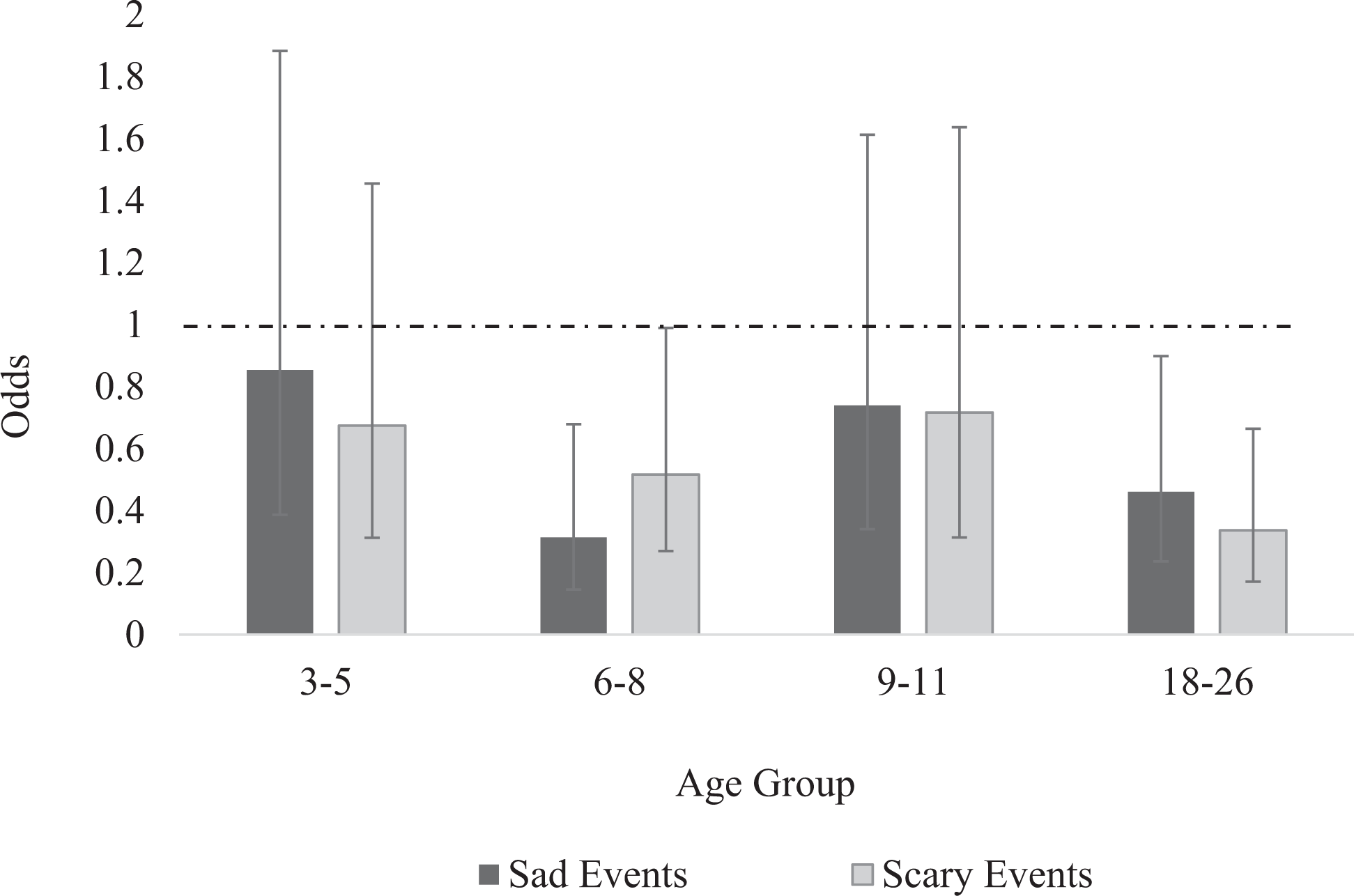
The odds of making a challenge appraisal by emotional event within each age group, with angering events as the reference group. Note. Appraisals were measured with a one-item, binary question (coded challenge = 1, threat = 0). Participants were grouped by age: ages 3–5 (n = 47, 28 girls), ages 6–8 (n = 68, 35 girls), ages 9–11 (n = 57, 24 girls), and ages 18–26 (n = 89, 62 women). Error bars are 95% Wald CI. The dashed line indicates odds of 1 (the reference group).
Percentage of Participants Who Made Challenge Appraisals by Emotional Event, Age Group, and Gender.
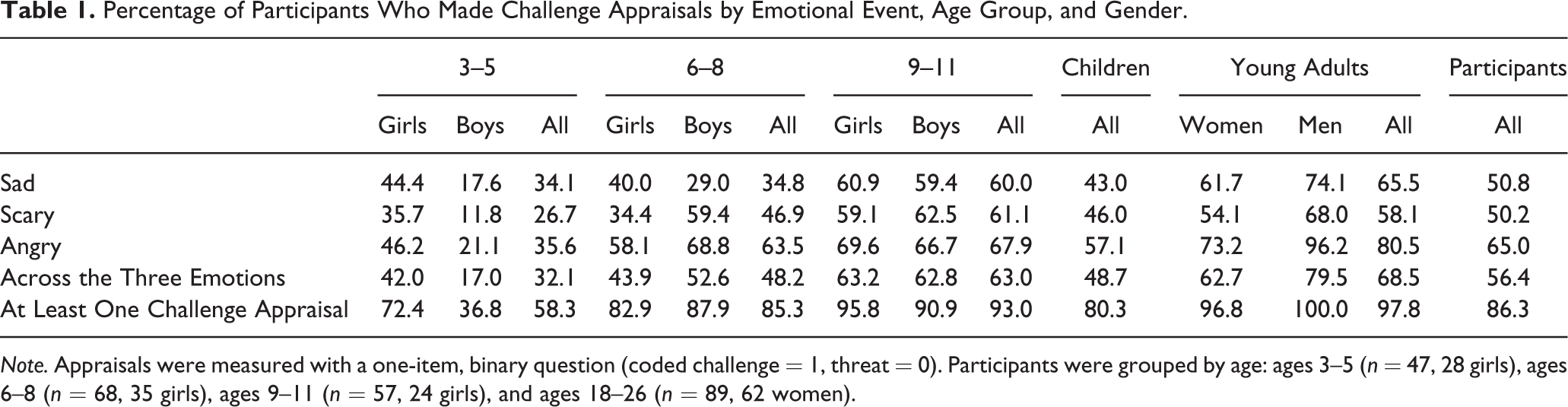
Note. Appraisals were measured with a one-item, binary question (coded challenge = 1, threat = 0). Participants were grouped by age: ages 3–5 (n = 47, 28 girls), ages 6–8 (n = 68, 35 girls), ages 9–11 (n = 57, 24 girls), and ages 18–26 (n = 89, 62 women).
As predicted, the odds of making a challenge appraisal increased across age groups (odds were .21 for early childhood, .42 for middle childhood, and .77 for late childhood with young adults as the reference group with odds of 1), and there was a main effect of age, Wald χ2 (3) = 45.05, p < .0001. We also conducted a priori planned comparisons to test whether the odds of making challenge appraisals increased across each of the four age groups. The odds of making a challenge appraisal increased between the youngest and middle childhood groups, Wald χ2 (1) = 6.84, p = .009, as well as the middle and late childhood groups, Wald χ2 (1) = 8.28, p = .004, but did not increase between the late childhood and young adult groups, Wald χ2 (1) = 1.52, p = .22. Thus, as hypothesized, the odds of making a challenge appraisal were greater across childhood, but contrary to our prediction, the odds of making a challenge appraisal remained stable from late childhood to young adulthood.
While there was no main effect of gender, Wald χ2 (1) = .03, p = .87, there was an age × gender interaction, Wald χ2 (3) = 13.20, p = .004 (see Figure 2). In the early childhood group, girls had greater odds of making challenge appraisals than boys, Wald χ2 (1) = 6.26, p = .012. However, in the young adult group, young women showed lower odds of making challenge appraisals than young men, Wald χ2 (1) = 7.27, p = .007. There were no gender differences within the middle childhood, Wald χ2 (1) = 1.60, p = .21, or late childhood groups, Wald χ2 (1) = .004, p = .95. The gender × emotion interaction was nonsignificant, Wald χ2 (2) = 2.04, p = .36, as was the three-way age × gender × emotion interaction, Wald χ2 (6) = 5.39, p = .50. Thus, there were gender differences in the frequency of challenge appraisals only within the early childhood and young adult groups; challenge appraisals increased across groups overall, and both genders had greater odds of appraising angering events as a challenge compared with sad and scary events.
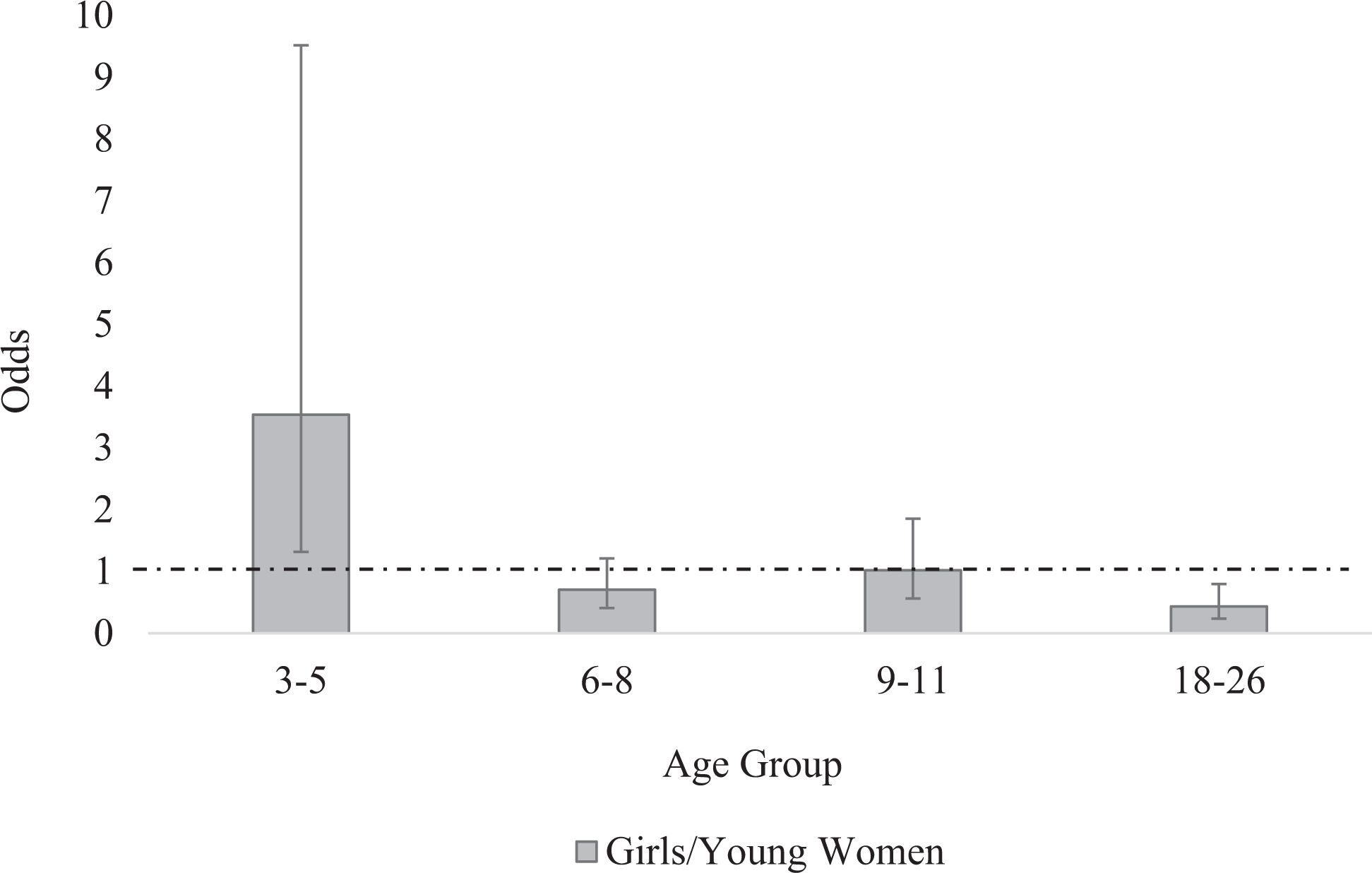
The odds of making a challenge appraisal by gender within each age group with boys/men as the reference group. Note. Appraisals were measured with a one-item, binary question (coded challenge = 1, threat = 0). Participants were grouped by age: ages 3–5 (n = 47, 28 girls), ages 6–8 (n = 68, 35 girls), ages 9–11 (n = 57, 24 girls), and ages 18–26 (n = 89, 62 women). Error bars are 95% Wald CI. The dashed line indicates odds of 1 (the reference group).
Discussion
We investigated challenge and threat appraisals across discrete emotion, age, and gender in a cross-sectional sample of four age groups: early childhood (ages 3–5), middle childhood (ages 6–8), late childhood (ages 9–11) and young adulthood (ages 18–26). As predicted, more challenge appraisals were made in response to anger-evoking events than sad or scary events. Also as expected, challenge appraisals increased across age groups in childhood, but remained stable from late childhood to adulthood. Our exploration of gender differences revealed an interesting pattern, as the youngest girls made more challenge appraisals than same-age boys, but young adult women made fewer challenge appraisals than young adult men.
Across age groups, anger-eliciting events were appraised as a challenge more often than sad and scary events. Anger is often elicited in situations assessed as being difficult but with high control potential (Roseman et al., 1996). The potential to change the situation leads to an activation and approach response, which can help to embolden one to address the problem (Carver & Harmon-Jones, 2009). Appraising these situations as a challenge would be particularly adaptive, as this would facilitate action to achieve one’s goal. For example, if a friend has done something upsetting, anger might help the aggrieved individual address the issue with the friend and resolve the problem.
Our finding that challenge appraisals were positively associated with age aligns with previous research that has found gains in challenge appraisals across development. Jouriles and colleagues (2000) noted that the negative consequences of making threat appraisals may become more pronounced with age, and that an increase in challenge appraisals with age would be adaptive. Even the youngest children in our study reported making challenge appraisals about a third of the time, and most of the youngest group made a challenge appraisal in at least one of the three emotion contexts. Throughout childhood, increasing social demands (e.g., at school, at home, and with peers) along with higher levels of self-efficacy and the use of more adaptive coping strategies set the stage for the growing ability to appraise difficult events as a challenge (Bandura, 2006; Eisenberg et al., 2014).
The current study provides further evidence that there is continuity in the appraisals made by older children and young adults (e.g., Hood et al., 2009; Richmond & Stocker, 2007). We found that older children and young adults made challenge appraisals to a similar extent, and even young adults made threat appraisals about 30% of the time, suggesting that people do not reach ceiling levels of challenge appraisals (assessing challenge 100% of the time). Assessing a difficult event to be a challenge may depend, in part, on lower-level executive functioning skills which are not well developed until late childhood (De Luca et al., 2003). In one of the few studies examining the association of cognitive flexibility and challenge and threat appraisals, effortful control predicted relative decreases in threat appraisal from Time 1 to Time 2 in a group of 7- to 12-year-olds (Thompson et al., 2014). In a cross-sectional and comprehensive study of executive functioning, attentional set shifting was found to be stable from 8 or 10 years of age (De Luca et al., 2003). Thus, by late childhood, the necessary executive functioning skills may be in place to enable adult levels of challenge appraisals.
Threat appraisals are associated with poor adjustment, including internalizing behaviors and avoidant coping (Kliewer & Sullivan, 2008; Thompson et al., 2014). Previous work has shown that gender socialization may lead to differences in appraisals for boys and girls. In the youngest group girls made more challenge appraisals than boys; this may be due to girls having higher levels of effortful control and executive functioning in early childhood (Matthews, Ponitz, & Morrison, 2009). However, no gender differences were found in the middle and older childhood groups, and young adult women were less likely to make challenge appraisals than their male counterparts. Threat appraisals are associated with depression and anxiety, problems that are more common for females than males in adolescence and young adulthood (Kliewer & Sullivan, 2008). Our study aligns with others that found adolescent girls made more frequent threat appraisals than adolescent boys (Mak et al., 2004) and that female undergraduates made fewer challenge appraisals than males (Ptacek et al., 1992). By examining a greater range of ages across childhood and including a young adult comparison group, this study expands on prior work, showing that although appraisals increase across age groups, there may be important gender differences that contribute to risk, particularly for young women.
This study had some limitations that should be acknowledged. First, the direction of effects cannot be conclusively determined with the interview paradigm used here—we cannot say whether the appraisal preceded the emotion or the emotion preceded the appraisal. As many theorists have noted, appraisals and emotions are transactional processes, with bidirectional effects unfolding in real time (Moors et al., 2013). Future work would benefit from measuring appraisals and emotional responses multiple times throughout emotion-eliciting tasks to better understand these processes. Longitudinal work is also needed to determine what individual differences and socialization factors contribute to gender differences that may emerge over the course of development. In this study, we utilized a one-item measure of challenge and threat (similar to one- and two-item measures used in prior work; Ptacek et al., 1992; Schneider, 2008), to ensure that even young children would be able to answer the question. This measure cannot rule out the possibility that participants reported being able to handle an event because it was minor or because others helped them manage the situation, rather than because they appraised it as a challenge. However, as our hypotheses were supported, this one-item measure of challenge and threat appraisals is an important step in being able to assess challenge and threat appraisals across a wide age range. Future work should utilize more nuanced assessments to better understand the development of challenge and threat appraisals (Schneider, 2008). Finally, this study used a retrospective, autobiographical interview design, which limited the control we had over the types of events participants would describe. Advantages to this paradigm include ensuring that the events recalled were emotionally salient to each participant, which is difficult to ensure when using paradigms that present controlled but non-autobiographical events (e.g., in a story or a film; Stein et al., 1996).
Conclusion
Challenge appraisals are linked to many adaptive outcomes, including academic achievement, effective coping, and fewer adjustment problems (e.g., internalizing), and have been proposed as an important mechanism by which people are better able to handle difficult situations. This study contributes important insight about differences in appraisals across discrete negative emotion contexts, the development of challenge appraisals across childhood, and gender differences that may help characterize risk for maladaptation, such as difficulties regulating emotion or psychopathology.
Footnotes
Funding
The authors received no financial support for the research, authorship, and/or publication of this article.