




Abstract
Drawing on data from the German Socio-Economic Panel (SOEP), this study examines change and stability in personal goal appraisals among German young adults aged 18–29 from 2008, the depth of the Great Recession, to 2012, into the recovery period (N = 3,292). Young adults in Germany, particularly young male workers, were greatly affected by the recession. We examine adaptation in personal appraisals of family, work, leisure, and self-fulfillment goals. Latent transition analysis revealed two profiles of goal adaptation, which differed mainly on the significance of family formation goals (low vs. high). Transitions between the latent profiles over time were less common. Females, older participants, partnered, and employed respondents were more likely to be classified into the high family formation profile. The high family formation profile was also associated with higher levels of life satisfaction and satisfaction with family life, yet simultaneously with lower levels of satisfaction with work and more concerns about the general economy at the onset of the recession. Furthermore, results do not reveal that family formation goals were relinquished over the recession years in favor of self-fulfillment or work-related goals. The high degree of stability in goal appraisals suggests that holding on to family formation goals was important for the well-being of young adults, and that maintaining high aspirations for multiple goals may have protected young people from the effects of economic strain. These findings are discussed in light of the unique aspects of German context.
Keywords
Young adulthood, which is roughly conceptualized to span the years 18 to the mid-30s, represents a dense developmental period in which social transitions occur simultaneously in multiple life domains, such as education, work, and family (Furstenberg, Rumbaut, & Settersten, 2005; Schoon & Silbereisen, 2017). Decisions made and pathways chosen during this time period may have far-reaching effects on individuals’ futures, and therefore represent a source of cumulative advantage or disadvantage over the life course (Dannefer, 2003). Thus, strategic planning and the acquisition of key personal resources, such as education and social capital, are crucial for launching into adulthood in the contemporary competitive economies (Hellevik & Settersten, 2013; Vuolo, Staff, & Mortimer, 2012).
How young adults plan and set goals, and how they allocate resources to achieve these goals, depends on how they appraise various goals. These processes are subject to change as young people adapt to macrostructural conditions, such as economic downturns (Heckhausen & Chang, 2009). But few studies incorporate larger social factors—factors that are beyond individuals’ control—in the study of goals (Salmela-Aro, 2009). The present study integrates macrostructural influences into the analyses of young adults’ personal goals by examining change and stability in goal appraisals across multiple life domains in the context of the Great Recession. We use latent transition analysis (LTA) to reveal young adults’ profiles of personal goals appraisals over the recession years, and to examine correlates of profile membership (Nylund-Gibson, Grimm, Quirk, & Furlong, 2014).
Theoretical Considerations of Goal Selection and Adaptation
Understanding goals is an essential part of human motivation because goal content and appraisal have direct implications for individuals’ behaviors and actions, which allow individuals to express ownership over their future pathways, negotiate transitions, and optimize personal potential (e.g. Bolkan & Hooker, 2012; Heckhausen, Wrosch, & Schulz, 2010). Rooted in life-span theory (Baltes, Lindenberger, & Staudinger, 2006), the “4C” life-span model of motivation proposes the four key mechanisms—channeling, choice, co-agency, and compensation—to explain the construction and adaptation of personal goals (Salmela-Aro, 2009). Channeling refers to the impact of environments, such as sociocultural beliefs, institutional structures, or historical markers, on the range of possible developmental trajectories. However, despite environmental influences, and especially constraints imposed by the social worlds in which individuals are embedded, individuals also make proactive choices about the environments they enter and trajectories they take (Brandtstädter, 2006; Settersten & Gannon, 2005; Silbereisen, 2005). Choices and behavioral strategies to attain selected goals are further negotiated with key individuals within social contexts, such as family members; this reflects the process of co-agency. Lastly, the process of compensation describes the adjustment of goals as a response to success, failure, or other challenges in goal pursuit. Individuals’ ability to disengage from, alter, and reappraise personal goals in light of external stressors and shifting opportunities has also been linked to increased levels of well-being compared (e.g. Brandtstädter, 2006). Thus, maintaining a diverse pool of possible personal goals to choose from may facilitate adaptation in the face of new circumstances or of hurdles and challenges that an individual may not or cannot overcome (Heckhausen et al., 2010; Tomasik, 2016).
Goal Adaptation in Young Adulthood
Young adulthood is a particularly important time period for careful planning and goal adaption, not only because young people are navigating the process toward new roles in many life domains, but also because the timing and sequencing of these transitions has long-lasting implications for the subsequent decades of adult life (e.g. Schoon & Silbereisen, 2017). Goal content is closely tied to age-graded developmental tasks, and previous studies (e.g. Nurmi & Salmela-Aro, 2002) have shown that young adults most commonly identify salient personal goals that map onto the five role transitions traditionally associated with adulthood—leaving the parental home, finishing education, entering the workforce, getting married, and becoming a parent (Furstenberg et al., 2005)—and which remain salient markers of adulthood in most European countries (Spéder, Murinkó, & Settersten, 2014). Salmela-Aro (2009) documented an increase in work, family, and health goals, and declines in friendship and educational goals, during the transition to adulthood. The salience of particular personal goals also influences the timing of subsequent behavioral transitions. For example, holding more family-related goals in young adulthood is associated with earlier marriage or cohabitation, and holding higher educational goals is associated with on-time educational attainment and higher occupational outcomes (Nurmi & Salmela-Aro, 2002).
Additionally, young men and women may differ in how they appraise personal goals in different life domains. For example, work goals, such as finding a job that matches one’s educational attainment, may be more important for men than women (e.g. Hooker, Fiese, Jenkins, Morfei, & Schwagler, 1996), which could reflect men’s traditionally more rigid and work-based life structure. And yet it is also clear that transitions to adulthood have in recent decades converged for women and men in many national contexts, particularly due to gains in women’s access to and achievements in education and professional life (Spéder et al., 2014). Because life domains are intertwined, personal goals from competing domains must also be resolved or integrated, and investments in some domains may come at the cost of others (Knecht, Wiese, & Freund, 2016; Tomasik, 2016). For example, investing heavily in work-related goals, may mean that individuals must hold back family or leisure goals, and vice versa (Knecht et al., 2016). These dynamics, however, have often not been in sight because many previous studies have focused on single life domains.
Young Adults’ Personal Goals and the Great Recession
Becoming an adult is now more prolonged, diverse, and even disordered due to the confluence of many factors, including changes in higher education, labor markets, and welfare states; the erosion of normative life scripts; and growing social and economic inequalities (e.g. Billari & Liefbroer, 2010; Schoon & Silbereisen, 2017; Settersten, 2007). Historic events like the Great Recession, which gained momentum in 2008, may have further complicated young adults’ decision-making because they were disproportionally affected by unemployment and economic hardship in many Western nations (Aassve, Cottini, & Vitali, 2013; Jenkins, Brandolini, Micklewright, & Nolan, 2013). For example, between 2007 and 2012, youth unemployment increased 7.3% across Europe (ages 20–24) and 5.1% in the US (ages 16–24), compared to a 3.3% increase in the overall unemployment across Europe and 3.5% in the US. In Germany, however, the opposite effect was observed: youth unemployment decreased 3.3%, compared to the 2.5% drop in the overall unemployment between 2007 and 2012 (Aassve et al., 2013; Destatis, 2017; US Bureau of Labor Statistics, 2016). The German economy responded to the recession with an enormous increase in “short-time work” (or “Kurzarbeit”), meaning a reduction of working hours for people with fixed-term or permanent contracts, and which affected up to 1.5 million workers at its peak (Brenke, Rinne, & Zimmermann, 2013). This prevented unemployment rates from skyrocketing.
From an individual perspective, though, short-time work could translate into income loss (Brenke et al., 2013) for young workers who are generally at-risk for spells of un- or under-employment and frequent job shifts (Buchholz & Kurz, 2008). Furthermore, among young adults, the impact of the recession was felt most strongly by those from more disadvantaged social backgrounds and by men with lower levels of educational attainment (Grabka & Frick, 2013; Groh-Samberg & Voges, 2014). The recession may also have left a psychological mark on all young adults, even more affluent ones, and even in Germany, by increasing perceived work demands, economic uncertainties, and global vulnerabilities (Ranta, Dietrich, & Salmela-Aro, 2014; Tomasik & Silbereisen, 2016). Economic uncertainties have also been linked to the delayed residential independence (Aassve et al., 2013) and the commitment to family roles, such as marriage and childbirth, across many developed nations (Sobotka, Skirbekk, & Philipov, 2011). Yet, despite delayed family transition rates, young adults in Europe and the US seemed to show a growing need and desire to build meaningful and supportive relationships with others over the recession years (Schoon & Mortimer, 2017).
Young adults’ ability to plan and set goals for the future serves a key strategy to cope with the economic uncertainty of the recession (e.g. Hellevik & Settersten, 2013; Ranta et al., 2014). For example, Vuolo, Staff, and Mortimer (2012) found that maintaining high career aspirations shielded young adults from unemployment in the beginning of the recession years. Another coping strategy is one’s ability to disengage from unattainable goals and to pursuit alternative goals, which has been linked to higher levels of well-being (Heckhausen et al., 2010; Salmela-Aro, 2009). Disengaging from goals, however, may only be adaptive for goals that are not core to one’s goal hierarchy or if opportunities to succeed are truly marginal (whether due to personal characteristics or larger circumstances, such as a recession). One could speculate that young adults who maintained high career aspirations amid the recession might have disengaged at least temporarily or partially from goals in other life domains, and research has pointed to the need to examine these kinds of cross-domain dynamics (Tomasik, 2016). Additionally, the ability of young adults to set and modify goals is to some extent shaped by the presence of personal resources (Hellevik & Settersten, 2013), such that youth with greater resources will suffer less disruption in goal-striving in hard times, thereby exacerbating inequalities in the outcomes of young people.
The Present Study
How young adults plan and set goals across life domains, and how they allocate resources in an attempt to achieve them, depends on how they appraise their goals. These processes, however, are subject to change as young people confront macrostructural conditions, such as economic change. The present study examines the Great Recession-influenced change and stability in goal appraisals of German young adults. Because goals within and between domains are intertwined, we look holistically at profiles of goal appraisals across multiple domains at the depth of the recession and at a point into the recovery period.
The study has three primary research aims: First, we examine stability and change in the importance that individuals assign to personal goals across the domains of family, work, and self-fulfillment. We expect that young adults who were coming of age over the recession years would adjust their personal goals in response to greater economic uncertainty. For example, some might relinquish family goals in favor of self-fulfillment or work-related goals, especially to establish a stronger economic foundation or gain more life experience before forming partnerships and having children. Others, in light of more limited economic opportunities or resources, might lower work-related goals and instead raise their family goals or place more significance on self-fulfillment goals only.
Second, we anticipate that some changes in goal appraisals may differ by gender. Because young men were disproportionally affected by the Great Recession in Germany, yet existing gender expectations reinforce their continuous investment into the work domains, preexisting gender differences in the endorsement of family formation goals may be further accentuated. In contrast, women may be inclined to invest more in family or self-fulfillment goals in response to the recession. Young women may also invest in family goals at younger ages than men, if they do not see economic opportunity.
Third, we examine the relationship between goal profiles and satisfaction as well as concerns about the economy as proxy of the individual-level impact of the recession. We expected that profiles characterized by higher endorsement of goals in multiple domains, and goal adjustment of unattainable personal goals (e.g. reappraising career goals during the recession), would be related to higher levels of satisfaction and lower levels of concerns because young adults are able to invest and redirect their energy into alternative goals.
Method
Data
Data were drawn from the German Socio-Economic Panel (SOEP; v29i), which is the longest-running nationally representative longitudinal study of private German households since 1984 (Wagner, Frick, & Schupp, 2007). Every year the panel survey repeats a core set of questions and includes rotating topic modules, such as the assessments of personal goals used here, that are repeated every five to ten years. Because the present study focuses on young adults’ goal appraisals over the Great Recession years, we selected respondents aged 18 to 29 years in 2008, who were coming of age at the depth of the recession. We chose this age bracket because it is associated with the transition to adulthood and represents a period of widespread normative expectations and significant life changes related to social roles, as young people leave home, finish school, find work, form partnerships, and become parents (e.g. Spéder et al., 2014). For the final analytic sample of young adults (N = 3,292; 52.1% women), the goal items are surveyed in 2008 and then re-surveyed 2012, which respectively represent the depth of the economic recession and a point into the recovery period in Germany. The longitudinal sample characteristics are displayed in Table 1.
Descriptive Statistics of Key Variables over the Study Years (N = 3,292).
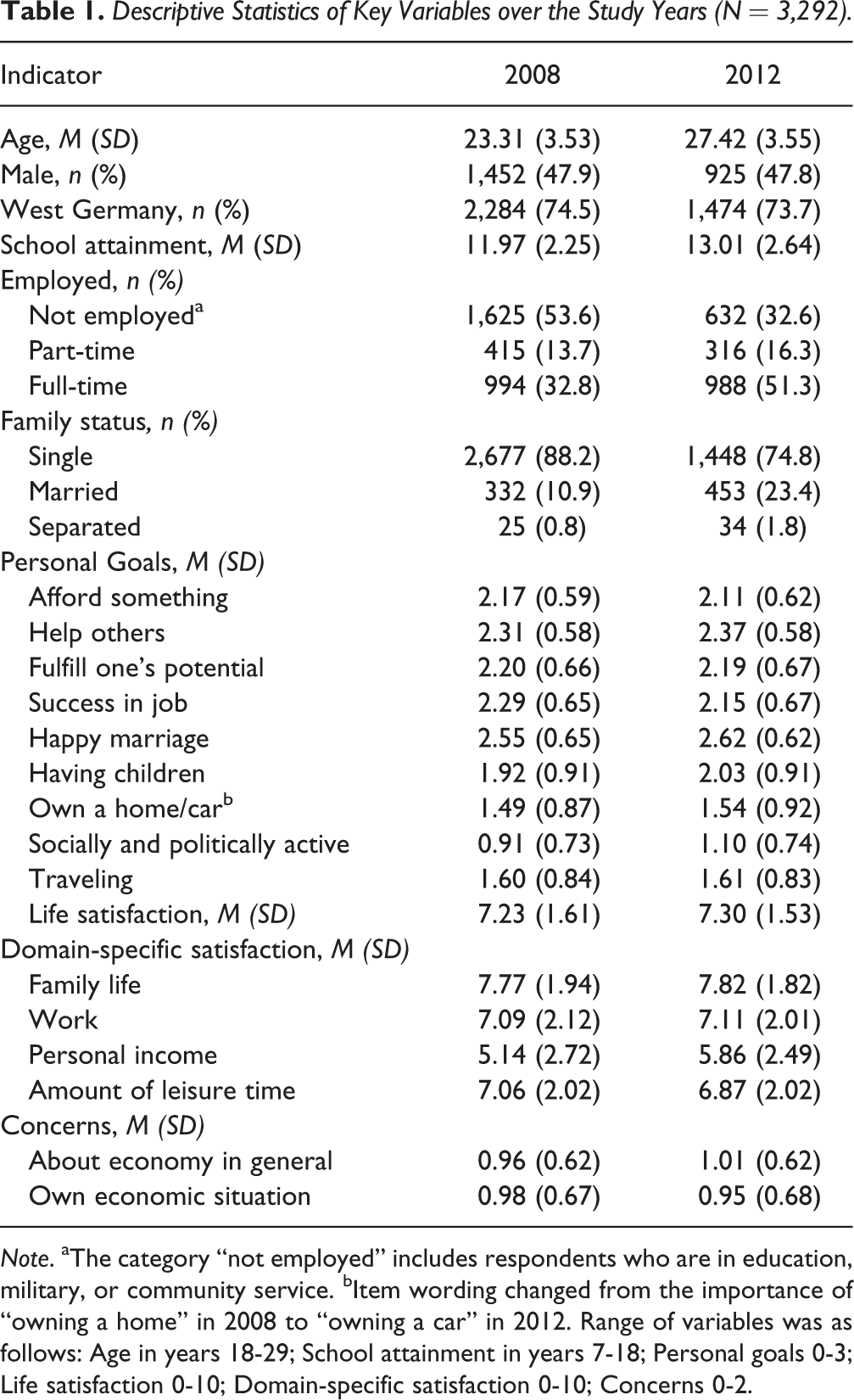
Note. aThe category “not employed” includes respondents who are in education, military, or community service. bItem wording changed from the importance of “owning a home” in 2008 to “owning a car” in 2012. Range of variables was as follows: Age in years 18-29; School attainment in years 7-18; Personal goals 0-3; Life satisfaction 0-10; Domain-specific satisfaction 0-10; Concerns 0-2.
Study variables
Personal goals
Participants were asked to rate the importance of nine personal goals in different life domains ranging from career and economics (e.g. successful in career; being able to afford things), family formation (e.g. happy marriage; having children), and personal fulfillment (e.g. traveling; being socially and politically engaged). The questions were introduced in the following way: “Different things are important to different people. How important are the following things to you?” Answers were given on a scale from 0 (not important at all) to 3 (very important).
Satisfaction
Respondents were asked to rate a single item on how satisfied they were with their life in general. Additionally, they rated their satisfaction in the domains of family life, work, personal income, and leisure time. Responses ranged from 0 (completely dissatisfied) to 10 (completely satisfied).
Concerns about the economy
In both study years, participants were asked how concerned they were about “the economy in general” as well as “their own economic situation.” Responses were rated on a scale from 0 (not concerned at all) to 2 (very concerned).
Demographic information
Information about participants age (in full years), gender (0 = female; 1 = male), educational attainment (in full years enrolled in primary and secondary schooling), partnership status (0 = single; 1 = partnered), employment status (0 = not employed; 1 = part- or full-time employed) was available for each survey year.
Analytic Strategy
A series of LTA models assessed change and stability in the importance of young adults’ personal goals across multiple life domains simultaneously. LTA belongs to the group of mixture models and represents a longitudinal application of latent class and latent profile analysis (LCA/LPA; Collins & Lanza, 2010), where the grouping variable of interest (i.e. the latent profiles) is not directly observable. Instead, it is indicated by a set of observed variables. Because LTA models also estimate probabilities to transition between the latent classes over time, they are particularly suited to model developmental trajectories (Masyn, 2013).
We entered ratings of the importance of nine personal goals assessed at two time points into the LTA model (i.e. from 2008 to 2012) and estimated the prevalence of latent class membership at both times points, as well as the incidence of transitioning from one latent group to another over time. Analyses were conducted in Mplus (7.11) in the following steps. First, cross-sectional LPA were fitted for 2008 and 2012 to explore the underlying measurement models. Relative fit indices such as AIC and BIC, entropy, likelihood ratio tests, and the interpretability of results were employed to determine the appropriate number of classes for these nested models.
Second, we fitted a LTA model estimating the transition probabilities over time by regressing the categorical latent class variable in 2012 on the categorical latent class variable in 2008. Third, we added distal variables to the models using the three-step approach (Nylund-Gibson et al., 2014), where distal variables are not part of the estimation process for deriving the latent profiles. Instead, they are used to describe and compare individuals classified into different latent profiles. We regressed the categorical latent class variable on age, gender, educational attainment, partnership and employment status, life and domain-specific satisfaction, and concerns about the economy.
Lastly, in order to discern recession from maturation effects, we also replicated the above outlined analytical steps in the same-age SOEP sample of 18 to 29-year-olds in 2004, which is the next-nearest module to 2008, and well before the recession, that contains the same items. The goal items were then re-surveyed for this sample (N = 3,659; 51.8% women) in 2008. The sociodemographic composition of the 2004 replication and the 2008 focal sample were quite similar. Some findings from the 2004 replication will be described below, but a more complete overview of respective tables and figures can be found in the online appendix.
Missing Data
In order to detect systematic bias due to missing data, missing data were identified and then used to predict attrition against key descriptive variables gender, educational attainment, study region (East vs. West Germany), as well as employment and partnership status using logistic regression. Of the 3,292 participants who met the age criteria in 2008, 1,355 respondents did not complete the assessment in 2012. Being lower educated and from West Germany were significantly associated with nonresponse in 2012 (OR = 0.93, p < .01, and OR = 1.44, p < .001, respectively). Age, partnership, and employment status were not significantly associated with nonresponse in 2012. We used a full information maximum likelihood (FIML) approach to account for missingness, which does not impute missing values, but uses all available information in its maximum likelihood estimation (Acock, 2012).
Results
Cross-Sectional Latent Profile Analysis Results
Model selection
Table 2 summarizes the model fit indices that were compared for all nested models by increasing the number of latent profiles starting with one and extending up to seven. It can be seen that AIC and sample-size adjusted BIC continued to decrease across all models. Nonsignificant values for the likelihood ratio tests examining the three- and seven-profile solutions for both time points suggested that the solutions with one profile fewer fits the data significantly better than the estimated model. Considering the interpretability of the target models with two and six profiles and the distribution of class counts across solutions, we rejected the six-profile solution in favor of the more parsimonious two-profile solution at both waves.
Goodness of Fit Statistics for Latent Profile Analysis Models in 2008 and 2012 (N = 3,292).

Note. LL = log likelihood; npar = number of free parameters; AIC/BIC = Akaike/Bayesian information criterion; SABIC = sample-size adjusted BIC; (V)LM-Rubin = (Vuong-)Lo-Mendell-Rubin likelihood ratio test. Dash indicates criterion not applicable. Bold type indicates selected models.
For the replication sample, fit statistics were less conclusive in 2004. The likelihood ratio tests remained highly significant across all models but approached nonsignificance for the three-profile solution with p < .05. Entropy was very high for both solutions (.93 for the two-profile solution vs. .99 for the three-profile solution), and decreases in the information criteria leveled off starkly after the three-profile solution. Nevertheless, the third profile comprised only about 9% of the sample, so we chose the two-profile solution as final model in 2004. In 2008, the two-profile solution seemed to fit best because likelihood ratio tests indicated that the three-profile solution did not fit the data significantly better than the two-profile solution (see online appendix, Table 2).
Description of the LPA profiles
Table 3 shows means and standard deviations of the indicator items for the latent profiles in 2008 and 2012, which are also visualized in Figure 1. For each time point, we observed one profile that captured a smaller proportion of the sample (about 31–37%), which we labeled the low family formation endorser profile (LFF). The second profile consisted of the majority of the sample (about 63–69%) and was labeled the high family formation endorser profile (HFF). These two latent profiles were fairly similar with respect to the means of most indicators—with the important exception that those in LFF profile had consistently lower family formation goals. The means of the indicator items helping others and owning a home or car were also higher among the HFF profile. Lastly, both profiles looked remarkably similar across the study years as well as in the replication sample, even though means and standard deviations of the indicator items differ slightly.
Means and Standard Errors of Personal Goals for the Two-Class Latent Profile Solutions.
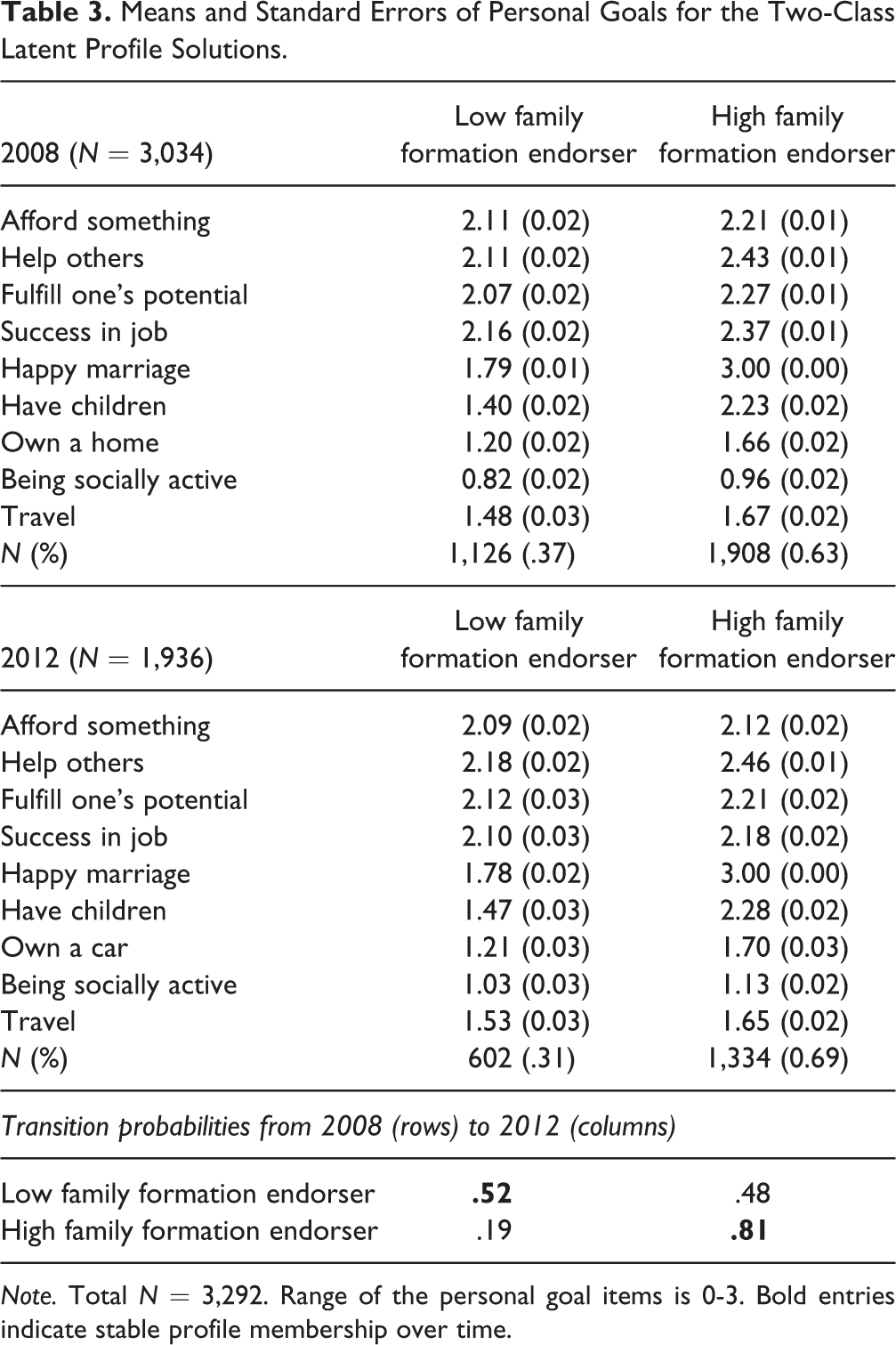
Note. Total N = 3,292. Range of the personal goal items is 0-3. Bold entries indicate stable profile membership over time.

Latent profiles of personal goals for the two-class solution in 2008 (left) and 2012 (right). Total N = 3,292. FF = family formation endorser profile.
Longitudinal Latent Transition Analysis Results
Latent transition probabilities
The bottom of Table 3 shows the derived transition probabilities indicating the patterns of changing profile membership between the LFF and HFF profiles over time. The majority of respondents did not transition from one profile to another. The proportion of the sample that either belonged to the LFF or HFF profile at both time points comprised about 85% (vs. 80% for the replication): the majority of participants were in the HFF profile at both time points (58% vs. 54% for the replication) compared to stable LFF profile members (27% vs. 26% for the replication).
Results indicated that participants in the HFF group had a .19 probability of transitioning into the LFF profile over time, which were about 7% of the sample. In contrast, participants in the 2008 HFF profile had a .81 probability of remaining in that profile in 2012. Participants in the 2008 LFF profile had a .48 probability to transitioning into the HFF profile in 2012. Transition probabilities in the replication sample were almost identical with those from the initial sample.
Regression results of the final LTA model
Table 4 displays the regression results of the distal variables that were used to predict profile membership. Each variable was entered into the model separately and the LFF profile was used as reference group. We found that females, partnered, and employed individuals were more likely to be in the HFF profile in 2008 and 2012. Individuals with lower levels of education were more likely to be in the HFF profile, but only in 2008. Respondents grouped into the HFF profile reported significantly higher levels of life satisfaction and satisfaction with family life at both time points and higher levels of satisfaction with their personal income, but only in 2012. Compared to respondents grouped into the LFF profile, however, HFF endorsers reported lower levels of satisfaction with work in 2008. Lastly, respondents in the HFF profile reported more concerns about the economy in 2008, but no significant differences emerged for concerns about one’s own economic situation. Patterns in the associations between profile membership and distal variables did not differ substantially for the replication sample, except that HFF endorser reported higher satisfaction with personal income (OR = 1.04, p < .05) and more concerns about the overall economy in 2004 (OR = 1.31, p < .001).
Regression Results for Distal Variables in the Latent Transition Analysis Model.
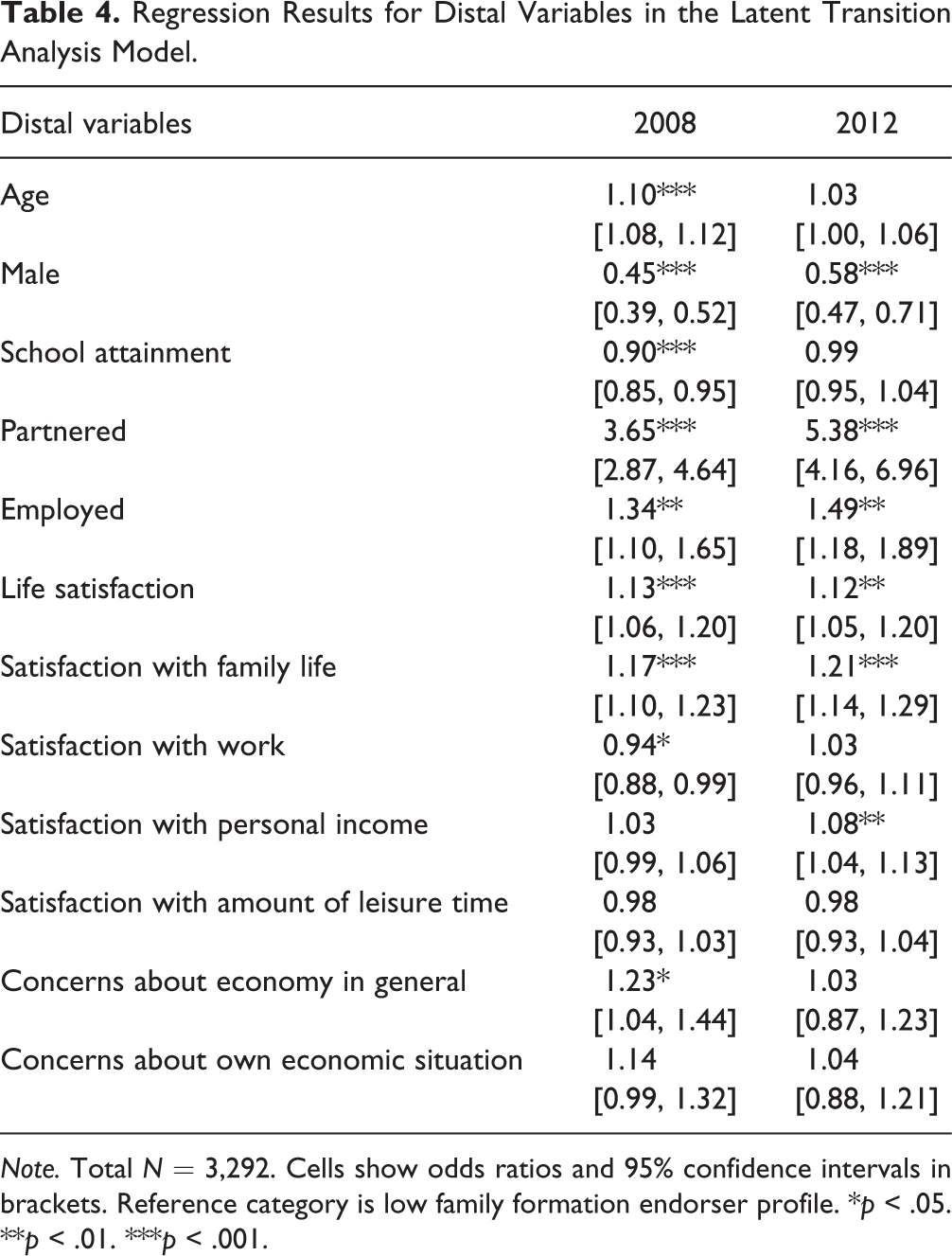
Note. Total N = 3,292. Cells show odds ratios and 95% confidence intervals in brackets. Reference category is low family formation endorser profile. *p < .05. **p < .01. ***p < .001.
Sensitivity tests
We conducted several sensitivity tests to check the robustness of our findings (available upon request). First, we alternated the underlying variance/covariance structure during model selection starting with the most parsimonious configuration (variances constrained to be equal across profiles; covariances fixed to 0) and increased the complexity up to the most restrictive configuration (variances/covariances varied freely), to check whether consistent profiles were produced. Because the profile solutions across different parameterizations were very similar, we chose the most parsimonious parameterization (Masyn, 2013).
Furthermore, we estimated multi-group latent profile analyses by introducing two observed grouping variables in separate models: age groups (18 to 23 years vs. 24 to 29 years) and gender. Again, the derived latent profiles for these subgroups did not differ substantially from the solutions using the whole sample. Lastly, we replicated our 2008–2012 LCA models with a subgroup of respondents who present at both measurement points (i.e. a “listwise deletion subsample”; N =1,682). Again, the two-class solution yielded an excellent fit, and the patterns and means of the profiles for the two-class solutions were quite similar to our findings on the full analytic sample.
Discussion
The Great Recession affected young adults in Germany and other nations by exposing them to unemployment and bringing uncertainty to other life domains (Jenkins et al., 2013; Schoon & Mortimer, 2017). Because launching a career is an essential step in the transition to adulthood, careful planning in the acquisition and allocation of resources through goal setting and adaptation has become a key strategy for dealing with economic pressure (Hellevik & Settersten, 2013; Vuolo et al., 2012). This study examined change and stability in German young adults’ personal goal appraisals over the Great Recession. We formed profiles of goal appraisals across multiple— potentially competing—life domains that individuals must orchestrate simultaneously (Tomasik, 2016). Our profiles differed mainly in the endorsement of family formation goals (high vs. low) and were remarkably stable over time, which may be partly explained by Germany’s unique experience during the recession (Brenke et al., 2013).
Normative Trends in Personal Goal Appraisals and the Recession
Over the young adult years, the importance of work, family, and health goals has been shown to increase, while the importance of friendship and education goals has been shown to decrease (Salmela-Aro, 2009). Our results are consistent with these findings because the profiles of goal appraisals highlight the salience of family formation, a capstone of reaching adulthood today, as point of divergence between the profiles. Because work and self-fulfillment goals were appraised at similar levels in both profiles, the salience of these goals may have been heightened for all participants due to economic pressure (Ranta et al., 2014). German young adults entering the labor market are already disproportionately at risk for spells of unemployment or unstable work because labor market regulations in Germany protect experienced workers (Buchholz & Kurz, 2008), and new hires were put on hold during the Great Recession (Grabka & Frick, 2013). Thus, it is possible that goal appraisals for work and self-fulfillment did not uniquely differentiate the profiles because strategic investments in these domains may have been required for all young adults.
It has been suggested that economic pressure and future uncertainty associated with the recession may have left individuals hesitant to commit to family roles (Sobotka et al., 2011), particularly in regions that were strongly affected by the recession (Morgan, Cumberworth, & Wimer, 2011). Postponed family commitments, especially fertility choices, can be seen as a coping strategy that frees resources from the domain of family life to invest those into work goals when facing external stressors. Ranta, Dietrich, and Salmela-Aro (2014) showed that Finnish young adults (aged 19–23 years) appraised professional rather than family goals more highly during recession. In contrast, the majority of our sample was classified into the High Family Formation (HFF) profile at both time points, and was likely to either remain in this profile or to transition into it from the Low Family Formation (LFF) profile. The durability and salience of family goals may also reflect the fact that family formation is highly valued in Germany, reinforced in cultural expectations, and in the priorities of the welfare state. In light of this normative context, the recession alone may not have posed a major threat to such aspirations.
Stability Despite Economic Strain
According to frameworks of motivation over the life span (Baltes et al., 2006; Heckhausen et al., 2010; Salmela-Aro, 2009), having flexibility in goals is a beneficial and effective strategy in light of shifting opportunity structures and external constraints, such as an economic recession. Our findings, however, demonstrated a remarkable amount of stability in individuals’ profile membership over the study period, as well as the shape and composition of profiles for a same-aged cohort of young adults before the onset of the recession and during its depth. The relative durability of goal appraisals in Germany may reflect the less severe effects of the recession on German youth relative to some other nations (Aassve et al., 2013; Jenkins et al., 2013). Thus, fears related to job loss and economic disparity may not have been strong enough to prompt a substantial reappraisal of core goals related to career and family life for young adults in Germany.
It is interesting, however, that those in the HFF profile reported higher levels of concern about the general economy and less satisfaction with work at the onset of the recession, but there were no differences between the profiles in concern about personal finances (cf. Grabka & Frick, 2013). Because the HFF profile tended to consist of respondents who were older, partnered, and employed, it may be the case that these young adults were more deeply rooted in work and family commitments than those in the LFF profile, which made them more aware of and responsive to economic uncertainty. Simply put, there may have been more at stake for this group because of their responsibilities for a partner—or a family—while also navigating the labor market, which may have heightened the individual-level impact of the recession.
Remaining in the HFF profile—characterized by high appraisals of all other personal goals in addition to the family goals—could still be seen as a manifestation of maintaining high aspirations in multiple domains, which has been shown to be a protective factor against unemployment in the school-to-work transition during the recession (Heckhausen et al., 2010; Vuolo et al., 2012). Relatedly, we found a positive link between HFF profile membership and life satisfaction and satisfaction with family life at both time points. One could therefore speculate that the fulfillment of emotional and social needs represents a positive strategy for maintaining well-being in the face of economic pressure (Schoon & Mortimer, 2017). Having high appraisals of family goals over the recession, however, does not necessarily mean that young adults will have put these goals into action until the (perceived) economic strain is lifted (Morgan et al., 2011).
Gendered Goal Appraisals and the Welfare State
Personal goal appraisals differ by gender because young women tend to more strongly endorse goals related to close relationships and family (Hooker et al., 1996), while men more strongly endorse work and career goals (Cinamon & Rich, 2002; Nurmi & Salmela-Aro, 2002). We found that women were indeed more likely to be classified into the HFF profile. This trend is not surprising, given that women still tend to be more heavily involved in family life, which is often associated with significant scaling back or disruption in their professional lives (Bianchi & Milkie, 2010). Although men have become more involved in parenting, they are less likely to take parental leave and, when they do, they take shorter spells of leave (e.g. Ray, Gornick, & Schmitt, 2010).
There is some evidence that family formation is perceived to organize the life courses of men and women alike (Spéder et al., 2014), which suggests that gendered pathways have converged to a considerable degree in many European countries. Variability in young men’s and women’s transition patterns, and underlying goal appraisals, also depends on the supporting institutions in which individuals are embedded (Elder & Shanahan, 2006). As noted earlier, the German welfare state seems to have served as a stabilizing force in young adults’ personal goal appraisals over the recession years. Because German young adults are firmly channeled through the tracked educational system and into the labor market—guided by the male-breadwinner ideology (Bosch & Jansen, 2010)—the appraisals of most goals appeared to be relatively unaffected by the recession. In welfare states with fewer regulations concerning education, labor market entry, and family policies, such as the liberal welfare state, individuals shoulder more risk on their own, but may also be able to react to external stressors, such as the recession, in a more flexible manner. In turn, personal goals of all three life domains may fluctuate more strongly.
Limitations
This study has several limitations. First, our results are based on a sample of German young adults and may not be generalizable to young adults in other nations in Europe or the US, where the recession was felt more strongly and over a longer time period (Jenkins et al., 2013). Thus, profiles of goal appraisals from other national samples could differ vastly from ours depending on the severity of the recession, and on supporting institutions such as the welfare state, in the respective countries.
Second, we attempted to discern recession from maturation effects by replicating our analyses in a same-aged comparison group that first assessed the goal appraisal items in 2004. But this comparison may be problematic. On the one hand, in 2004 Germany’s labor market was relatively strained after the high (youth) unemployment rates of the 1990s and starting to recover after the “Agenda 2010” reforms (Rinne & Zimmermann, 2012). For example, youth unemployment rate was at 13.7% in 2004 compared to 10.4% in 2008 (Eurostat, 2018). On the other hand, both samples overlap at the onset of the recession in 2008 (one going from 2004 to 2008, and the other going from 2008 to 2012), which does not allow us to track how profiles and profile membership may have evolved for the 2004 sample without exposure to the recession. These two time periods—even though they were marked by unique conditions and challenges—may therefore share some of notions of economic pressure and uncertainties that may weigh on young adults.
Third, the assessment of goals in SOEP differed from measures in previous studies where participants are asked to generate a list of personal goals and rate them subsequently (e.g. Little, 1983; Ranta et al., 2014). SOEP respondents were asked to rate the importance of a fixed list of nine goals from multiple life domains, which were in line with major milestones and developmental tasks of young adulthood (Furstenberg et al., 2005). Nevertheless, it could be the case that the items may not have reflected highly salient goals for some of the respondents. For example, the survey did not assess some of the “softer” transitions to family formation (e.g. moving in with a partner) and work (e.g. finishing or improving a degree or qualification). It stands to reason, then, that our robust results on the significance of family formation have been underestimated, and that if items like these would have been included, endorsements would have been even higher.
Fourth, mixture models assume that each latent subgroup forms a distinct component of the observed such that overall data distribution reflects a composite of a finite number of components (Masyn, 2013). Due to skewed data, it may be the case that our two profiles describe distinct parts of one common distribution rather than two distinct components. Future studies using mixture modeling will need to confirm or revise these profiles.
Lastly, systematic bias due to missing data is a key concern in any longitudinal study. Using multiple strategies, we tried to detect and limit potential selectivity effects due to nonresponse of certain subgroups that tend to be harder to reach for survey research (e.g. by predicting attrition against demographic indicators and using FIML estimation in our models). However, it is nonetheless possible that our results do not fully reflect the reality of subgroups that could be particularly affected by economic strain and therefore may have shown diverging patterns of goal appraisals over time.
Conclusion and Future Directions
Our study contributes to the literature on goal adaptation across multiple life domains and considered the role of a historic event on individuals’ agentic goal adaptation by comparing data collected at the depth of the Great Recession and into its recovery. We proposed two distinct profiles of young adults’ goal appraisals that differed predominantly in the endorsement of family formation. That the recession did not seem to leave a major mark on young adults’ goal appraisals, particularly those pertaining to work and self-fulfillment, speaks in part to the persistence of individuals’ core values and beliefs. Milder responses of the German labor market to the recession are also likely provided a relatively sheltered context, thereby facilitating the stability of appraisals. The durability and salience of family goals, in particular, may also reflect the high value placed on family formation in Germany. Because holding on to highly salient family formation goals was related to higher life satisfaction and satisfaction in other life domains, we conclude that maintaining high aspirations on a diverse set of goals and goals that bring comfort, is a protective factor in times of economic strain.
Future studies should enrich the understanding of cross-national differences in profiles of goal appraisals and their adaptation to economic pressure. It would be particularly interesting to compare countries based on severity and length of the impact of the economic downturn. Structural components, such as the setup of welfare states, should hereby be taken into considerations because they may buffer or expose young adults to the impact of the recession. Furthermore, on a more fine-grained within-country level, incorporating regional indicators of economic prosperity could help to examine whether the shape and distribution goal appraisal profiles may also vary considerable depending on local opportunity structures in terms of available resources and infrastructure (e.g. the coverage of childcare facilities). Taken together, our study highlighted the salience and durability of family formation goals in times of economic upheaval. The high appraisals of family goals, however, do not necessarily mean that they will be realized. In light of stagnating birth rates in Germany and elsewhere, these findings might stimulate political discourse about supportive family policies that might foster family formation.
Supplemental Material
Supplemental Material, JBD798494_online_appendix - Stable goals despite economic strain: Young adults’ goal appraisals across the Great Recession
Supplemental Material, JBD798494_online_appendix for Stable goals despite economic strain: Young adults’ goal appraisals across the Great Recession by Claudia Recksiedler, Richard A. Settersten, G. John Geldhof, and Karen Hooker in International Journal of Behavioral Development
Footnotes
Acknowledgments
We would like to thank Dr. Alan C. Acock for his thoughtful comments on an earlier version of this manuscript.
Funding
The author(s) received no financial support for the research, authorship, and/or publication of this article.
Supplemental material
Supplemental material for this article is available online.
References
Supplementary Material
Please find the following supplemental material available below.
For Open Access articles published under a Creative Commons License, all supplemental material carries the same license as the article it is associated with.
For non-Open Access articles published, all supplemental material carries a non-exclusive license, and permission requests for re-use of supplemental material or any part of supplemental material shall be sent directly to the copyright owner as specified in the copyright notice associated with the article.
