




Abstract
Various developmental studies have demonstrated that implied object weight is a key variable in children’s interpretations of motion, such as predicting the objects’ speeds. An additional bias in predictions of object motion is representational momentum (RM), where objects are anticipated to be found in a location farther along in the direction of motion from where they actually are. The present study aimed to evaluate when children begin to be sensitive to relative weight in a RM-related search task. Toddlers (N = 60) aged 2, 2½ and 3 years first visually and manually experienced a heavy ball, a light ball, or both balls at the same time. They then watched one of the balls roll down a ramp and behind a screen with four doors, with a visible barrier placed along the ramp in various positions that would stop the ball’s motion, after which the toddlers were allowed to search for the ball by opening one of the doors. Search accuracy generally increased with age but the accuracy also depended on condition. Relative heaviness in particular led to reduced search accuracy. Further analyses revealed relative heaviness to lead to more searches farther beyond the barrier, adding to the expected RM effect.
Introduction
Studies with school-age children have demonstrated that while they are able to consider a wide range of object variables to construct predictive beliefs about how an object moves, weight appears to be a particularly important one (e.g., Hast & Howe, 2012). Crucially, it seems to be the implied relative weight that informs these beliefs. For example, when children experience, through handling, two balls that differ only in weight and are asked to predict which of the two they believe would fall faster or roll faster down a slope, then they make their predictions under explicit consideration of the balls’ weights by stating that one would be faster because it is heavier or lighter than the other—even if there was no preceding discussion of weight (Hast & Howe, 2015, 2017). By 5 years of age children hold consistent beliefs about how such dynamic events should occur. Subsequently, the question arises as to what age the incorporation of relative object weight into predictive behavior in relation to object motion emerges in children’s reasoning.
A first such evaluation comes from an adaptation of Hood’s (1995) gravity bias task. In this task, toddlers typically watch a ball being dropped down into a curved tube, and they are then allowed to search for the ball by choosing one of three locations—either the correct location, the location immediately beneath the entry of the tube, or a third location. It is the second location that corresponds to the so-called gravity bias; an expectation that, without considering the curvature of the tube, an object will fall straight down. Young toddlers frequently select this location. However, while this behavior typically decreases with increasing age, recent research evaluating the particular role of relative object weight in this task revealed two main observations about 2- to 3½-year-olds (Hast, 2018). Relative heaviness of a test ball, prompted through having experienced the test ball and a lighter non-test ball, generally led toddlers to make the most gravity errors, and those toddlers who had been prompted with relative lightness made the most correct searches. The divergence emerged somewhere around 3 years of age.
Amongst the main interpretations of the above patterns was the suggestion that the relative heaviness or lightness of an object in toddler’s reasoning in hidden displacement tasks where motion is involved is associated with momentum that is attributed to objects. The increased salience of relative heaviness may lead to a representation that gives heavy objects a categorical intuitive capacity to fall fast and straight down. Relative lightness, on the other hand, might have been seen as intuitively slowing a ball down, making it more amenable to guidance by the tube’s shape and thus leading to greater search success. Related work with slightly older children, from around 5 years onwards, has shown that while they understand the general function of speed change, including whether an object should accelerate or decelerate, this understanding is typically constrained to the very beginning of a motion path rather than being conceived as a more continuous process (Hast & Howe, 2013a; Nachtigall, 1982; Piaget, 1970). In doing so, they reduce their conceptions of speed change to short intensive efforts. The finding of weight-directed search behaviors in toddlers can therefore be considered a potential precursor to this.
Specifically, Hast (2018) pointed out that a further bias in motion predictions, representational momentum (RM), might help in the interpretation of the findings. RM results in a tendency to believe that objects, based on their initial motion patterns, have traveled farther in the direction of motion than they actually have, and therefore there is a tendency to judge their final location as being farther along that trajectory (Freyd & Finke, 1984; for reviews see e.g., Hubbard, 2005, 2010, 2014). RM is dependent on experience, which results in expectations of future events (Hubbard, 2005, 2010). A range of variables has been noted to matter in the context of RM, including implied acceleration and velocity, implied friction experienced by objects, but also implied object weight (Hubbard, 2005, 2014; Nagai, Kazai, & Yagi, 2002). Importantly, weight acts as an additive factor rather than affecting RM as such, since RM occurs in the direction of anticipated motion but weight is interpreted in the direction of implied gravitational attraction.
From a developmental perspective, some work contends that the RM effect increases across childhood, with the effect being greater in 9-year-olds than in 5-year-olds (Taylor & Jakobson, 2010), though these authors note the differences in dynamic events by using more complex non-linear motion. Other research suggests instead that while the effect does not disappear its magnitude decreases with age, both when comparing children with adults (Hubbard, Matzenbacher, & Davis, 1999) and young toddlers with slightly older toddlers (Perry, Smith, & Hockema, 2008). To explore the potential origins of relative object weight in young children’s reasoning about object motion, Perry et al.’s (2008) study seems most pertinent. Here, they employed an apparatus with a slope and barrier, and found that toddlers frequently searched for objects released down the slope in a location beyond the barrier; a finding also noted by various other studies employing the same apparatus or simplified versions of it (Berthier, DeBlois, Poirier, Novak, & Clifton, 2000; Butler, Berthier, & Clifton, 2002; Gresham, 2012; Hood, Carey, & Prasada, 2000; Keen et al., 2008; Kloos, Haddad, & Keen, 2006; Mash, Keen, & Berthier, 2003; Mash, Novak, Berthier, & Keen, 2006; Perry, Samuelson, & Spencer, 2009).
However, most of the above identified slope-and-barrier studies addressed apparatus modifications, such as changing slope heights, or using transparent screens. At the same time, there is a significant lack of work that examines the potential role that awareness of specified object variables might play in RM-related displacement tasks involving children. Of the mentioned studies, Gresham’s (2012) research with 3- and 4-year-olds serves as starting point. Here, object size was incorporated as a variable, and Gresham found no significant differences in search behavior between using a large or a small ball. However, toddlers had only been given opportunity to explore and see one of the two balls. This seems to be in accordance with Hast’s (2018) observation that object variables might only have an impact on search behavior when children are provided with opportunities for direct experience of contrasting examples of a variable, such as heaviness and lightness.
The present study therefore sought to examine the role of relative weight in the context of RM in toddlers’ search behavior in hidden displacement tasks. Two main research questions were asked. First, if toddlers are given opportunity to manually experience weight of different objects, what role does knowledge of that relative weight play in their search behavior in RM-related search tasks? Based on Hast’s (2018) findings, it was hypothesized that relative heaviness would be more likely to lead to RM-related search errors and relative lightness to fewer errors. Second, what is the extent of impact—as measured by the disparity between actual and search location—that relative weight has on RM-related search behavior? Similar to the first question, it was hypothesized that relative heaviness would lead to a greater difference between actual and search location than other conditions. In both contexts, a further factor of interest was the development of any effects of age, in order to more accurately pinpoint the onset of relative weight incorporation in toddler’s motion predictions.
Method
Participants
A total of 60 toddlers (33 girls) took part in the study. This comprised 20 2-year-olds (mean (M) = 24.8 months, standard deviation (SD) = 0.82), 20 2½ -year-olds (M = 30.7 months, SD = 1.35) and 20 3-year-olds (M = 36.1 months, SD = 0.83). The toddlers were recruited from nurseries and pre-schools in the Greater London area. Each of the four conditions outlined below had the same number of children from each age group. An additional 4 children did not complete the task due to lack of interest and their data could not be included in the analyses.
Design and Materials
Following Perry, Smith, and Hockema (2008), a plywood apparatus (see Figure 1) was constructed, using the particular dimensions laid out in the original study by Berthier, DeBlois, Poirier, Novak, and Clifton (2000). The apparatus consisted of a front and back panel (28 cm high, 58 cm wide). A channel (75 cm long, 18.5 cm wide) ran between the two panels, with 15 cm of the channel length visible outside of the panel and the channel starting height at 14 cm. The visible section made it possible to observe the initial speed and direction of the ball before being occluded by the front panel. The panels and channel were painted white. The front panel, which could be folded down, contained four openings (13.5 cm high, 9.5 cm wide), each spaced 4 cm from the other and at an angle that corresponded to the channel. Attached to each opening was a door of the same dimension. Each door could be opened downward by pulling a small wooden knob. Four plywood barriers could be slotted into the apparatus, at the far side of each door. Each barrier was 15 cm wide and, when inserted, 8.5 cm remained visible above the panel. The barriers were padded to minimize sounds of the balls rolling against it, thereby removing additional auditory cues that might have facilitated the search behavior. The doors and barriers were left unpainted, to contrast with the panels and channel.
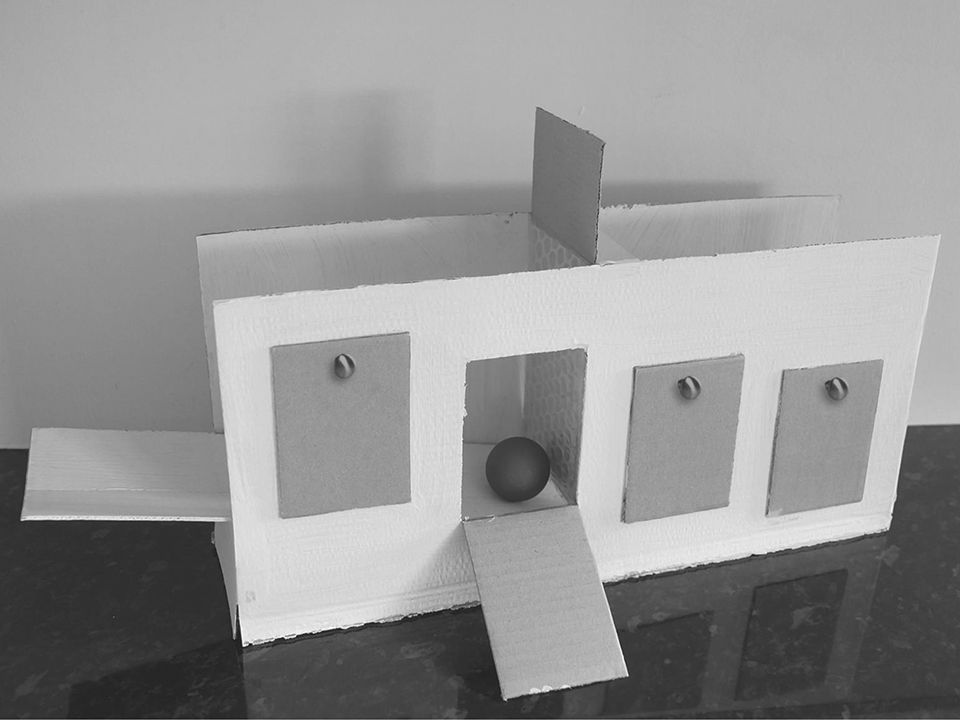
Apparatus used in the study, with the barrier placed after Door 2 (opened) and one of the test balls resting against the barrier.
Two test balls were used. One was a dark brown marble of 5 cm diameter, weighing 85 g (subsequently referred to as the heavy ball). The other was a bright blue table tennis ball of the same diameter but weighing 5 g (subsequently referred to as the light ball). Each toddler was allocated to one of two main test groups. In the relational (R) group, toddlers were familiarized with both the heavy and the light ball through visual presentation and manual exploration. In the non-relational (NR) group, toddlers were familiarized with one ball only, with no exposure at all to the other ball. Groups were then further divided according to whether the toddlers were tested with the heavy ball (H) or the light ball (L). This resulted in a total of four conditions: NR-H; NR-L; R-H; and R-L. A black rubber ball also of 5 cm diameter was used to familiarize the toddlers to the apparatus; they did not have opportunity to manually explore this ball.
Procedure
The apparatus was set up in a quiet area in the participating schools. Each toddler was invited to the area together with a teaching assistant, and the toddler was told by the researcher that they would all be playing a game. The teaching assistant was asked to remain present in the testing area, typically behind the toddler. This was done in order to make the child feel more at ease, and the teaching assistant was asked beforehand to encourage the toddler to search, if necessary, but not to guide him or her towards any specific location through pointing, looking or verbal expression. In an initial acclimatization phase each child was given a few minutes to freely examine the apparatus. The researcher then took the toddler through the apparatus by opening the front of the box, highlighting the ramp, and inserting the barrier into each of the four slots. The researcher then closed the front and pointed out each of the doors. If during the acclimatization period the toddler had not opened all four doors, the researcher demonstrated this for them and encouraged them to open the doors too. With the front reopened and the barrier put aside, the researcher produced the practice ball, held it at the top of the ramp, said to the toddler “Watch the ball!” and released the ball. The researcher removed the ball from the box, closed the front, opened all four doors and held the ball at the top of the ramp. Again, the researcher said to the toddler “Watch the ball!” and released the ball. In both cases the practice ball was not released or retrieved by the toddler, to avoid providing any additional relational weight information, especially in the NR conditions.
The practice ball was then removed. According to a randomly selected schedule that defined the order of barrier placement on each trial, the barrier was inserted into place. Since no RM effect can be measured in the task if there is no awareness of the barrier and its location, the placement was done in view of the toddler. Depending on the condition, the researcher produced either the table tennis ball or the marble (NR conditions), or both (R conditions). The ball or balls were handed to the toddler, who was given time to freely explore them manually for as long as they wanted. In the R conditions the non-test ball was then placed to the side but remained in view of the toddler. The researcher then took the remaining test ball. The toddler’s attention was drawn to the ball and the toddler watched it being released down the ramp. The toddler was then encouraged to find the ball by opening the doors, being allowed to search until the ball had been retrieved. However, only the first search where a door was opened was recorded by the researcher. The researcher then removed the barrier and the process was repeated. Four trial order combinations were used, where no two forward consecutive doors (e.g., from Door 2 to Door 3) were correct, and only one backward consecutive order (from Door 3 to Door 2) was correct. The trial order was repeated in each case to result in a sequence of eight trials.
Scoring and Analysis
Manual searches were coded and analyzed in two ways. First, they were simply coded as either correct (a score of 1) or incorrect (a score of 0) on each trial, with a maximum mean score of 1 per participant against a chance level of 0.25 on each trial. To evaluate any effects of RM, inaccuracies in searches were evaluated in terms of whether they were more likely to be in the direction of gravitational force, that is, behind a door farther down the path of motion, or whether searches were more likely to occur before the actual location. On each trial, the searches were coded across all four doors as the door opened (a score of 1) or not opened (a score of 0).
Results
Two sets of analyses are presented in this section. The first set addresses search behavior against chance performance to determine accuracy of those searches. The second set evaluates possible effects of RM, focusing on search behaviors by door to see where toddlers searched in relation to where the ball actually was. Because RM cannot be measured when the ball is behind Door 4, since there is no search location farther along the path, only the first three doors are considered in the second analysis. Initial evaluations of all data sets revealed that the data were not normally distributed. As a result, non-parametric tests were selected to conduct the two sets of analyses. To evaluate search accuracy, Wilcoxon tests were applied to compare mean scores against chance performance. To evaluate RM effects, Wilcoxon tests were applied to compare frequency of opening the correct door against frequency of choosing a door farther along the path or earlier on. In both cases, possible variations with age and across conditions were analyzed using Kruskal–Wallis tests. Gender and trial order were also analyzed but showed no significant effects, so are not discussed further. All data were analyzed using SPSS 24.
Search Accuracy
Figure 2 summarizes the main results of search accuracy against chance performance.

Mean number of correct first search outcomes for each condition and age group (N = 60).
Regardless of age, condition or door, toddlers searched significantly more often behind the correct door on each trial (M = 0.46, SD = 0.21) than would have been expected by a chance performance score of 0.25, z = -5.66, p < 0.001, r = 0.73. There was significant variation in mean scores across the three age groups, H(2) = 32.35, p < 0.001, ε2 = 0.55. Post-hoc pairwise comparisons further revealed that all groups’ scores were significantly different from another. Post-hoc pairwise comparisons showed that the 2-year-olds’ mean search score of 0.28 was significantly lower than the mean search score of 0.46 for the 2½-year-olds, z = -3.67, p < 0.001, r = 0.47, which in turn was significantly lower than the mean search score of 0.66 for the 3-year-olds, z = -3.67, p < 0.001, r = 0.47. Only the 2½- and the 3-year-olds’ performances significantly exceeded chance level.
In addition to age being a significant factor, there was also significant variation in mean scores across the four different conditions, H(3) = 15.89, p < 0.05, ε 2 = 0.27. The lowest mean score was attributed to toddlers in the R-H condition (M = 0.30, SD = 0.09), and post-hoc pairwise comparisons showed that this was significantly different only from the highest score achieved by toddlers in the R-L condition (M = 0.62, SD = 0.25). However, mean scores did not vary across the conditions for the 2-year-olds. On the other hand, there was significant variation in scores across the conditions for the 2½-year-olds, H(2) = 14.23, p < 0.05, ε 2 = 0.75. Post-hoc pairwise comparisons showed a significant difference in scores between conditions R-H and R-L. Similarly, the 3-year-olds’ scores varied across the conditions, H(3) = 15.17, p < 0.05, ε 2 = 0.80, with a significant difference between conditions R-H and R-L, but also between conditions NR-H and R-H.
Effects of RM
Table 1 summarizes the main results of where toddlers searched in relation to where the ball actually was.
Percentage of searches behind each door for each condition (N = 60).

When the barrier had been placed such that the ball was actually to be found behind Door 1, significantly more searches (69%) were made at a door farther along the path, z = 4.20, p < 0.001, r = 0.38. There was significant variation across age groups when searching beyond Door 1, H(2) = 14.96, p < 0.05, ε2 = 0.11, with searches by the 2-year-olds being directed more beyond Door 1 than those by the 3-year-olds. There was also significant variation across conditions, H(3) = 15.00, p < 0.05, ε 2 = 0.10, with searches in the R-H condition being directed more beyond Door 1 than those in the R-L condition. The age–condition interaction also showed significant variation, H(11) = 36.70, p < 0.001, ε 2 = 0.24, with the notable post-hoc observations that all age group searches in the R-H condition as well as the searches by the 2-year-olds in the R-L condition were farther along than searches by the 3-year-olds in the R-L condition.
When the ball was behind Door 2, most searches (58%) were at a door farther along the path, which was significantly more than the 29% of searches at Door 2, z = 3.42, p < 0.05, r = 0.31. There was significant variation across age groups when searching beyond Door 2, H(2) = 8.43, p < 0.05, ε 2 = 0.05, with searches by the 2-year-olds being directed more beyond Door 2 than those by the 3-year-olds. There was also significant variation across conditions, H(3) = 20.81, p < 0.001, ε 2 = 0.09, with searches in the R-H condition being directed more beyond Door 2 than those in the R-L condition. The age–condition interaction also showed significant variation, H(11) = 34.14, p < 0.001, ε 2 = 0.21, with the notable post-hoc observations that all age group searches in the R-H condition were farther along than searches by the 3-year-olds in the R-L condition.
When the ball was behind Door 3, most searches (49%) were at Door 3, which was significantly more than searches made farther along, z = 2.02, p < 0.05, r = 0.13. However, 33% of searches were still directed towards Door 4, which was significantly more than the 18% of searches directed towards Doors 1 or 2, z = 2.18, p < 0.05, r = 0.20. There was no significant variation across age groups when searching beyond Door 3. However, there was significant variation across conditions, H(3) = 20.00, p < 0.001, ε2 = 0.15, with searches in the R-H condition being directed more beyond Door 2 than those in the R-L condition and the NR-H condition. The age–condition interaction also showed significant variation, H(11) = 23.62, p < 0.05, ε 2 = 0.12, but none of the post-hoc comparisons were significant.
Discussion
In line with other studies in the field examining relevant hidden displacement tasks using the same apparatus (cf. Berthier et al., 2000; Butler et al., 2002; Gresham, 2012; Keen et al., 2008; Kloos et al., 2006; Mash et al., 2003, 2006; Perry et al., 2008, 2009), toddlers’ search successes generally increased with age. Disregarding any differences between conditions, the youngest children in the present study merely performed at chance level as a whole, but by the age of 3 years they were already correct in around two-thirds of their searches. However, the current research was interested in going beyond this, by considering the particular role of relative object weight in toddler’s search behavior in such a task. In summary, it can be noted that object weight alone is not sufficient to impact their search behavior. As in other studies that relied on non-relational object variable comparisons in hidden displacement tasks, such as size (Gresham, 2012) and weight (Hast, 2018), the present study revealed no differences in performance between the two non-relational conditions.
In the context of relative weight, on the other hand, a developmental trend was evident. For the 2-year-olds, relative weight did not seem to play any significant role and their level of success at the task was merely the equivalent of guessing, regardless of which condition they were in. For the 3-year-olds, on the other hand, experience with relative heaviness increased search errors and experience with relative lightness increased search success. This transition is again in line with Hast’s (2018) findings. Not only were the 3-year-olds more likely than the younger toddlers to search correctly, they also typically searched closer to the true location even when errors were made. However, a closer look revealed that this was not always true. Notably, in the R-H condition the 3-year-olds actually searched farther down the track than the 2-year-olds when the ball was behind Door 1, so in this situation they were evidently more susceptible to the relative heaviness. This could to some extent reflect the fact that the magnitude of RM-related errors can be seen to increase with age during childhood (Taylor & Jakobson, 2010), but since in the R-L condition the reverse pattern was observed, it would seem more likely that the older toddlers are simply incorporating relative weight information more than the 2-year-olds are.
In the group of 2½-year-olds, indications for this developmental trend begin to emerge. However, while in the older toddlers both relative and non-relative heaviness seems to be taken into account, only the connection between relative heaviness and decreased search success seems apparent at this slightly younger age. As a result, the present study has been able to pinpoint the beginning impact of relative object weight in toddlers’ reasoning to 2½ years, which is slightly younger than previously assumed by Hast (2018) or implied by others (e.g., Povinelli, Vonk, & Castille, 2012). In part, this may have resulted from a more specific age grouping in the current study. It is important to keep in mind, however, that the present study also used a different task, making a direct comparison more challenging. Nonetheless, the incorporation of relative object weight in hidden displacement tasks can be seen as a gradual developmental process between 2 and 3 years of age.
The fact that implied heaviness leads to increased search errors, and more importantly that this pattern seems to emerge first over sensitivity to implied lightness in development, is of further interest. For instance, when 5-year-old children explain different behaviors between objects of different weight, they typically make reference to the heaviness of one, rather than the lightness of the other (Hast & Howe, 2012), suggesting that at least in language heaviness seems the more salient end of the weight continuum. This would be supported by the present observations. This could further be explained through consideration of so-called marked and unmarked ends of dimensions. Marschark (1977), for instance, notes that words such as “big” are learnt before their counterparts, in this case “small.” “Small” is considered marked because it is typically used in a comparative fashion (e.g., by asking which is smaller), whereas “big” is considered unmarked because it is used both to compare (e.g., by asking which is bigger) and in a nominal sense (e.g., by asking how big something is). This difference seems to lead to unmarked concepts being learnt first and children, even at ages 3 and 4 (Marschark, 1977), performing better in tasks underpinned by them.
At the same time, 5-year-olds are more likely to predict a light ball to be faster in rolling down a slope than a heavy ball, but older children are more likely to predict the reverse (e.g., Hast & Howe, 2013b, 2017). How can what at first sight looks like a U-shaped development over time, where heaviness is initially implied to be faster which changes in favor of light-as-faster and then returns to associating heaviness with faster motion down inclines, be explained? There are some key differences between the tasks that need to be taken into account here. First, the present study was about predicting the end point of a ball rather than how fast the ball would move or change its speed along the slope. This may interfere with how children incorporate object weight into their reasoning as it may simplify the thought process. In addition, the toddlers were also able to experience some motion at the very beginning of the slope, providing them with some implied speed along the remaining hidden trajectory, whereas the children in the past research did not have this. Again, this may have simplified the process for the toddlers. Finally, perhaps 3-year-olds have not yet developed a distinct conception of motion along supported surfaces, meaning the downward element is still more significant to them—but in a manner that is not as integrated as it is in older children who anticipate heavy-faster outcomes. However, further research will be needed to clarify this issue.
There are some limitations that need to be taken into account in the present study and that leave scope for future research possibilities. First, a classic symptom of manual search tasks with toddlers is that they do not necessarily reflect the participants’ actual understanding, since there are often discrepancies between their incorrect search behavior and their looking at the correct location (for reviews see e.g., Keen, 2003; Krist & Krüger, 2012). An incorporation of looking behavior might reveal a more detailed picture of the role of relative object weight since research using hidden displacement tasks has shown there can be discrepancies between incorrect searching and correct looking in toddlers (e.g., Lee & Kuhlmeier, 2013). Another limitation is the lack of consideration given to the size–weight illusion that might play a role here; an illusory effect that frequently leads to assuming that smaller objects feel heavier than larger objects that happen to weigh the same. This effect is even evident in children as young as 2 years of age and typically decreases throughout childhood (Buckingham, 2014). In an inverse interpretation, the lack of difference in size in the present study might have led the youngest toddlers in the present study to assume that the two balls were somewhat similar in weight, and therefore relative object weight did not impact their search behaviors. However, this is difficult to extrapolate from the study as it stands, since there were no manipulations of size alongside those of weight, and further research will need to evaluate this more carefully, to examine whether the susceptibility to the illusion interacts with relative versus non-relative experiences.
Footnotes
Funding
The author received no financial support for the research, authorship, and/or publication of this article.