




Abstract
In a longitudinal study (N = 54), we investigated the developmental relation between children’s implicit and explicit theory of mind and executive functions. We found that implicit false belief understanding at 18 months was correlated with explicit false belief understanding at 4 to 5 years of age, with the latter being closely related to second-order false belief understanding at 5 years of age. Also, replicating a number of studies, explicit first- and second-order false belief understanding, in contrast to implicit false belief understanding, were related to executive functioning. This indicates that executive functions play a role in standard explicit false belief tasks, but not in implicit false belief understanding. We argue that spontaneous, implicit false belief understanding does not require conscious control, whereas explicit false belief understanding is based on conscious, reflective processing. In sum, we suggest a developmental enrichment account of theory of mind development, with belief processing becoming increasingly reflective and controlled with advancing age.
Social interactions form a fundamental part of our everyday life. Most of these interactions require some understanding of one’s own and other people’s minds or mental states (e.g., thoughts, beliefs, and desires), referred to as “theory of mind.” A radical change in children’s theory of mind is thought to occur at around 4 years when children understand that other people may hold a false belief (Wellman, Cross, & Watson, 2001).
In contrast to this explicit false belief understanding, non-verbal false belief tests based on infants’ anticipatory looking or using violation-of-expectation paradigms indicate that an implicit “understanding” may be present much earlier. This has been shown in various studies, starting with an endeavor undertaken by Wendy Clements and Josef Perner (1994). In a standard false belief paradigm, they investigated children’s anticipatory looking, before the protagonist returns. Correct anticipations (i.e., looking to location A) occurred very abruptly at about 2 years 11 months. More recently, Southgate, Senju, and Csibra (2007) showed that even 25-month-olds showed correct anticipatory looking behavior in a non-verbal false belief test. And Onishi and Baillargeon (2005) found that 15-month-old infants looked longer when the protagonist acted in contrast to her (false) belief than when the protagonist acted in line with her (false) belief in a violation-of-expectation paradigm. Despite a growing body of evidence indicating that infants can attribute false beliefs in their second year of life (for reviews, see Baillargeon, Scott, & He, 2010; Sodian, 2011), these findings should be treated with caution, because there are also a number of non-replications of implicit theory of mind tasks (see, e.g., Baillargeon, Buttelmann, & Southgate, 2018; Dörrenberg, Rakoczy, & Liszkowski, 2018; Kulke, Reiß, Krist, & Rakoczy, 2018).
There is an ongoing theoretical debate whether such an implicit false belief understanding reflects genuine access to mental state reasoning: (1) some authors argue that false belief understanding is already present in infants, while (2) others argue that infants’ success in implicit false belief tasks does not reflect genuine access to mental states.
Baillargeon, Scott, and He (2010; see also Setoh, Scott, & Baillargeon, 2016) favor a rich interpretation. They claim that the traditional explicit false belief tests (“elicited-prediction tasks”) are more difficult, because they are more demanding with respect to executive control processes (response generation and response inhibition). In contrast, implicit false belief measures (spontaneous-response tasks) require only a correct false belief representation. According to Baillargeon et al., false belief understanding is already present by the second year of life, but is masked in traditional explicit tasks due to executive task demands.
Other theories (minimalist accounts, developmental enrichment views, and two-systems accounts) argue that a fundamental change occurs around 4 years of age:
According to minimalist accounts, implicit false belief tasks may be passed by reliance on behavior rules (Perner & Ruffman, 2005) or other low-level processes (perceptual novelty; Heyes, 2014; statistical learning; Ruffman, 2014). According to the submentalizing view (see Heyes, in press), children’s performance on implicit false belief tasks is based on domain-general mechanisms and related low-level features of the stimuli (e.g., color, shape, and movement).
Except for perceptual novelty, the minimalist views are compatible and can be complemented with developmental enrichment views. For example, Ruffman, Garnham, and Rideout (2001) argued that eye gaze as a measure of social understanding may tap unconscious core insights into social behavior. Such an early implicit understanding of action may develop into an explicit understanding of belief through conversations with parents and siblings as well as developing language abilities (Ruffman, 2014; Ruffman, Perkins, & Taumoepeau, 2012). In a similar vein, Astington and Hughes (2013) have put forth the idea of a developmental view of mind, beginning with an early intuitive awareness appearing in infancy, which later becomes increasingly reflective and explicit during the preschool years. Also, Peter Carruthers (2016) proposed continuous conceptual enrichment, change, and gradual transformation in one mind-reading system. And, recently, Tomasello (2018) argued that only cooperative mental and social coordination with others (and their sometimes conflicting perspectives) leads to the acquisition of a mature concept of false belief.
According to two-systems accounts, implicit and explicit false belief understanding may reflect distinct and largely independent processes, with implicit processes being fast, relatively inflexible, and largely automatic versus explicit processes being slower, flexible, effortful and depending on language (e.g., Apperly & Butterfill, 2009; Frith & Frith, 2008).
Except for strong minimalist views, these different accounts are supported by a longitudinal study from Thoermer, Sodian, Vuori, Perst, and Kristen (2012) who found that implicit false belief understanding (as indicated by anticipatory looking) at 18 months significantly predicted explicit false belief understanding at 48 months (independent from children’s verbal abilities). A relation between implicit (eye gaze) false belief knowledge and explicit false belief understanding has also been found in cross-sectional studies in 3- to 4-year-old children (Low, 2010). Extending the scope of their longitudinal study, Sodian, Kristen-Antonow, Licata, and Kloo (2015) found that implicit false belief understanding predicted the age (50, 60, or 72 months) at which children first mastered an explicit false belief task, independently of verbal IQ, content false belief, and false belief about emotions (cf. Wellman & Liu, 2004). These findings indicate a unique source of variance connecting implicit and explicit false belief reasoning. Since significant correlations were obtained for different types of explicit false belief tasks, and since implicit false belief understanding at 18 months also predicted false-belief-based intention understanding in a moral reasoning task at the age of 5 years (Sodian et al., 2016), a domain-specific enrichment account or a rich interpretation is supported by these findings (see Sodian, 2016).
However, other researchers found a dissociation between implicit and explicit false belief tests. For example, in a cross-sectional study, Grosse Wiesmann, Friederici, Singer, and Steinbeis (2017) found no correlation between explicit and implicit anticipatory looking false belief tasks in 3- and 4-year-old children. Furthermore, explicit false belief understanding is correlated with age-related white matter maturation in regions classically involved in false belief reasoning in adults (i.e., temporoparietal regions, the precuneus, and medial prefrontal cortex) independently of implicit anticipation of belief-based actions as well as linguistic and executive abilities (Grosse Wiesmann, Schreiber, Singer, Steinbeis, & Friederici, 2017). Also, though adults with Asperger syndrome are able to solve explicit false belief tasks, they do not attribute mental states spontaneously in an implicit false belief test using eye movements (Senju, Southgate, White, & Frith, 2009). But it is still possible that there is a more long-term longitudinal relation. Also, it is unclear whether the same processes underlie implicit false belief reasoning in infants, children, and adults.
Various researchers (e.g., Baillargeon et al., 2010; Carruthers, 2016) have outlined the importance of executive functions for passing explicit false belief tests. Indeed, a long tradition of developmental research has established that explicit false belief understanding is related to executive functioning (for reviews, see Devine & Hughes, 2014; Perner & Lang, 1999). “Executive functions” is an umbrella term referring to cognitive self-regulatory control processes like inhibitory control, working memory, or attention shifting, which enable the conscious control of thought, action, and emotion. Marked improvements in executive control occur between 3 and 5 years of age, when children also begin to master the standard false belief test. Research consistently showed that false belief understanding and executive functions are associated in preschool children with correlations persisting even when age or verbal intelligence are controlled.
Different theoretical accounts (for an elaborate description of these accounts, see Moses & Tahiroglu, 2010; Perner & Lang, 1999) of the empirical association between explicit false belief understanding and executive control can be distinguished, with expression and emergence accounts being particularly prominent. Similar to the rich interpretation of implicit false belief understanding (e.g., Baillargeon et al., 2010), expression accounts argue that executive demands inherent in the standard false belief test hinder the expression of children’s false belief understanding (e.g., Russell, Mauthner, Sharpe, & Tidswell, 1991). More specifically, the claim is that the false belief task poses executive demands because children need to inhibit the prepotent tendency to answer the test question based on their own knowledge of the true state of affairs in order to predict the protagonist’s false-belief-based action.
In contrast, similar to fundamental change accounts of implicit false belief understanding, emergence accounts posit that at around 4 years a fundamental change occurs, and executive control is necessary for mental state reasoning to emerge. For example, Russell (1996) argues that self-control is a prerequisite for building a theory of mind, because theory of mind understanding must be grounded upon a first-person experience of agency. Existing longitudinal research supports such an executive emergence account, because early executive control predicts later false belief understanding more strongly than vice versa (for a review, see Devine & Hughes, 2014).
Recently, some authors have proposed that not only explicit, but also implicit theory of mind understanding draws (at least partially) on executive control processes. The evidence is mixed. Grosse Wiesmann et al. (2017) found no correlation between implicit and explicit false belief understanding in 3- and 4-year-old children. However, explicit, but not implicit, false belief understanding was correlated with executive functioning and syntactic abilities. Low (2010) also found no correlation between implicit false belief understanding and the executive function of cognitive flexibility in 3- to 4-year-old children; though explicit false belief understanding was related to cognitive flexibility as well as to implicit false belief understanding and language (complement mastery). Two other studies found a relation between implicit false belief understanding and executive functioning. Yott and Poulin-Dubois (2012) reported a correlation between implicit false belief understanding and performance on a detour-reaching task requiring inhibitory control in 18-month-old infants. And Schneider, Lam, Bayliss, and Dux (2012) found that cognitive load disrupted implicit belief processing in a dual task paradigm in adults.
The Present Study
The main goal of the present study was to investigate the role of executive functioning in theory of mind development. We assessed implicit, first-order, and second-order false belief understanding in a longitudinal study from 18 up to 70 months of age (parts of the present data set are also described by Kloo & Sodian, 2017; Sodian et al., 2016; Thoermer, Sodian, Vuori, Perst, & Kristen, 2012). In addition, children’s executive functions were assessed at five measurement points during this time span, and we added a measure of verbal ability, because explicit false belief comprehension is closely related to children’s language ability (for a meta-analysis, see Milligan, Astington, & Dack, 2007). This allows us to shed some light on unsolved issues of theory of mind development.
First, according to the expression account (Russell et al., 1991), two-systems accounts (Apperly & Butterfill, 2009) and the rich interpretation (Baillargeon et al., 2010), only explicit (but not implicit) false belief understanding should be related to executive functioning. Also, according to the expression account, the correlation between explicit false belief understanding and executive functioning should remain significant when implicit false belief understanding is partialled out, because executive demands are thought to be inherent in explicit false belief tasks and these demands are thought to mask children’s true competence.
Second, according to the executive emergence account, development of later explicit false belief understanding is thought to be dependent on earlier executive control development. Therefore, the relation between implicit and explicit false belief understanding should be reduced, in particular, when early executive functioning is partialled out.
Third, according to developmental enrichment accounts of theory of mind, explicit false belief understanding should be related to language and executive control development. Nevertheless, the relation between implicit and explicit false belief understanding should remain significant even if we control for executive functioning or language, because there is supposed to be a conceptual relation between earlier implicit and later explicit belief reasoning, independent of other cognitive abilities. Though Thoermer et al. (2012) presented evidence that the longitudinal relation between implicit and explicit false belief processing is independent of verbal IQ, the role of executive functioning remains to be clarified.
Fourth, according to strong low-level accounts (Heyes, 2014), implicit and explicit false belief reasoning should not be significantly related.
Method
Participants
The sample consisted of 54 children (21 girls), who completed the implicit false belief task at 18 months. Children came from predominantly white middle-class families in an urban area of Germany. This sub-sample is part of a larger longitudinal study on the development of social-cognitive abilities. Ages at the measurement points were as follows: 1;6 (years;months; M = 18 months, SD = 7 days), 2;0 (M = 24 months, SD = 7 days), 2;6 (M = 30 months, SD = 14 days), 3;0 (M = 36 months, SD = 8 days), 4;2 (M = 50 months, SD = 19 days), 5;0 (M = 60 months, SD = 21 days), and 5;9 (M = 70 months, SD = 10 days).
Procedure
Children were assessed individually in a child-friendly university laboratory by a trained experimenter. Participation was voluntary. Addresses were obtained through local birth records. Parents received full information about the study. Informed parental consent was obtained for all children who participated in the experiment. Families received a travel reimbursement and a small age-appropriate gift at each measurement point. The study was approved by the ethics committee of the university.
Measures
Theory of mind
Theory of mind development was investigated with an implicit anticipatory looking task, two different first-order and two different second-order false belief tasks.
Implicit false belief understanding (18 months)
False belief understanding in infants was investigated with an anticipatory looking task (see Thoermer et al., 2012, for a detailed description). Infants watched animated colored movies featuring a female protagonist. The female agent watched a car moving from one box to another. Gaze fixations were recorded using an integrated eye-tracking system. During two familiarization trials (each lasting 32 s), the protagonist watched the car arriving at the second box, and then she disappeared behind a screen. Subsequently, two doors located above each of the two boxes were illuminated (accompanied by a chime). A freeze frame (lasting 3 s) followed during which anticipatory fixations at the two doors (areas of interest; AOI) were assessed. Then, the agent’s face appeared at the door above the box where the car had disappeared, and she reached through the door in order to retrieve the car. Ten infants did not show correct anticipatory fixations in at least one of the two familiarization trials. These children have been excluded from analyses.
Subsequently, infants received one test trial (lasting 41 s). In contrast to the familiarization phase, a phone ring distracted the agent from observing the car’s movement. After reaching the second garage, the car went back to the first garage, drove through this garage and then disappeared from the screen. After this, the doors were illuminated with an accompanying chime. Infants’ fixations were recorded over a 3-s anticipatory period. The timeline for the familiarization and test trials is depicted in Figure 1. Participants were classified as “passers” if they looked longer (> 50%) at the belief-based (correct) door than at the incorrect door. For analysis, a differential looking score (DLS) was calculated to provide a comparative measure of looking times at the two doors (possible scores ranged from -1 to 1).
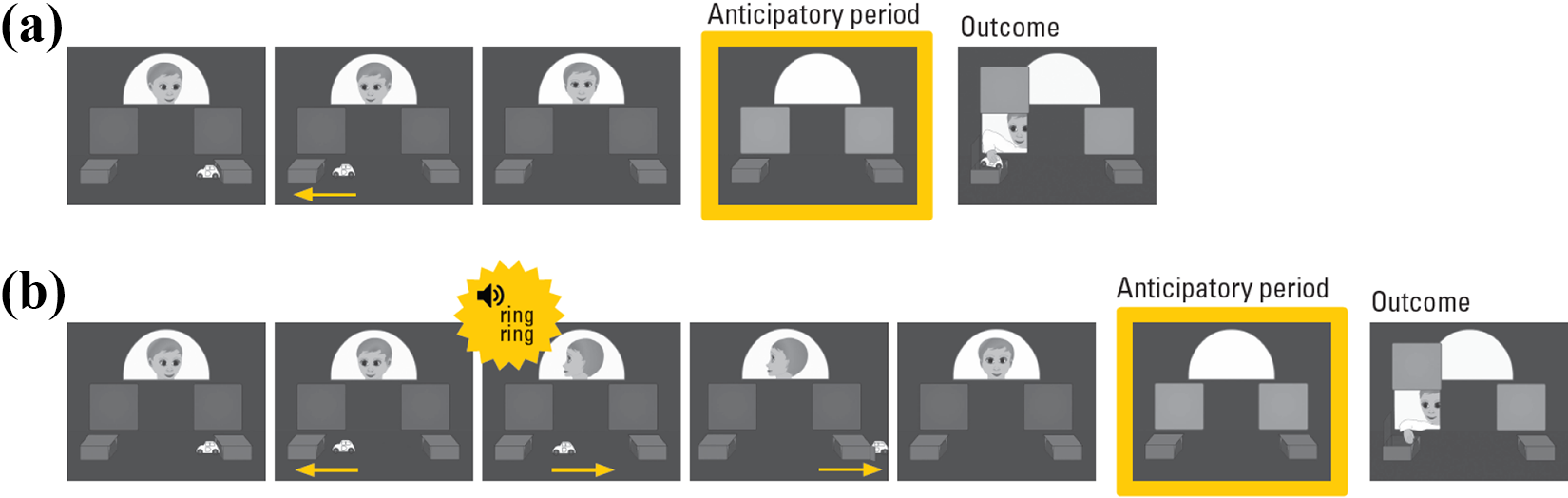
Familiarization and test trials of the implicit false belief task. From Schuwerk, T, Jarvers, I, Vuori, M and Sodian, B, 2016, ‘Implicit Mentalizing Persists beyond Early Childhood and Is Profoundly Impaired in Children with Autism Spectrum Condition,’ Front. Psychol, 7: p. 4. doi: 10.3389/fpsyg.2016.01696.
Explicit false belief understanding (50, 60, and 70 months)
Explicit false belief understanding was assessed using two tasks from the German version of the ToM Scale (Kristen, Thoermer, Hofer, Aschersleben, & Sodian, 2006; Wellman & Liu, 2004; see Hofer & Aschersleben, 2007, for the full German version). In the contents false belief task, children were shown a Smarties box and were asked what they thought would be inside the box. After the expected answer (“Smarties”), the experimenter revealed that the box contained a toy pig. Then, a Playmobil figure (“Lukas”) was introduced, and children were asked, “So, what does Lukas think is in the box?” In the location false belief task, children were presented with a story about Paul, who wants to find his mittens. They were asked the following test question, “Really, Paul’s mittens are in his backpack. But Paul thinks that his mittens are in the closet. So, where will Paul look for his mittens?” At each time point children were given both tasks. One point was given for each correct answer yielding a total score between 0 and 6 across the three time points.
Second-order false belief (60 and 70 months)
Second-order false belief understanding was investigated using two different scenarios. At 60 months, children received a simplified second-order false belief story about “Paula’s Birthday” based on Coull, Leekam, and Bennett (2006) and the “Birthday Puppy” story based on Sullivan, Zaitchik, and Tager-Flusberg (1994). At 70 months, they were only given the “Birthday Puppy” story. For each task, children received 1 point if they answered all questions correctly. This resulted in a total Second Order False Belief score between 0 and 3.
For “Paula’s Birthday” (Coull, Leekam, & Bennett, 2006), children were told a story about Paula and Anna. Paula is showing Anna her favorite birthday present – a teddy bear. Paula puts the teddy bear in the cupboard. Then, in Paula’s absence, Anna takes the teddy and hides it under the blanket. While Anna is hiding the teddy, Paula passes by the window and sees Anna hiding the teddy. But Anna does not see Paula. Then, Paula returns. Now, children were asked a non-linguistic control question (“Does Paula know that Anna hid the teddy under the blanket?”) and a second-order ignorance question (“Does Anna know that Paula knows where the teddy is?”). Children were then reminded, “Remember, Anna doesn’t know that Paula saw her hide the teddy.” Finally, children were asked a second-order false belief question (“Where does Anna think Paula will look for the teddy?”) and a second-order justification question (“Why does Anna think Paula will look for the teddy in the ___________?”).
For “Birthday Puppy” (Sullivan, Zaitchik, & Tager-Flusberg, 1994), children were presented with a story about Peter whose mom wants to surprise him with a puppy on his birthday. Peter’s mom has hidden the puppy in the basement. Peter says, “Mom, I really hope to get a puppy for my birthday.” Children were reminded, “Remember, Peter’s mom wants to surprise him. So she tells him that he will get a great toy instead of a puppy.” By accident, Peter finds the birthday puppy in the basement. He says to himself, “Wow, Mom didn’t get me a toy, I will really get a puppy for my birthday.” The experimenter emphasized that Peter’s mom did not see him go down to the basement and find the puppy. Now, children were asked a non-linguistic control question (“Does Peter know that he will get a puppy for his birthday?”) and a linguistic control question (“Does his mom know that Peter found the puppy in the basement?”). Then, the story was continued, “The telephone rings. Peter’s grandmother calls to find out what time the birthday party starts. Grandma asks Peter’s mom, ‘Does Peter know what you really got him for his birthday?’” Now, children were asked a second-order ignorance question (“What does Peter’s mom say to Grandma?”). Then, they were told, that Grandma says to Peter’s mom, “What does Peter think you got him for his birthday?” followed by the second-order false belief test question (“What does Peter’s mom say to Grandma?”).
Executive functions
At five measurement points, executive functions were assessed with eight different tasks measuring predominantly inhibitory abilities. For a more detailed description of the executive function measures, see also Kloo and Sodian (2017).
Gift Delay (24 months)
Following Kochanska, Murray, and Harlan (2000), children were given a large present bag containing a shiny wrapped gift. The experimenter left the room in order to fetch a bow. Children were instructed not to touch the present until the experimenter returns (after 180 s). Based on Kochanska et al. (2000), children received a touch score ranging from 0 to 5, based on the degree of restraint they exhibited (0 = present unpacked; 1 = pulled the gift from the bag; 2 = put his/her hand into the bag; 3 = peeked in the bag; 4 = touched the bag without peeking; 5 = no touch to bag or gift).
Reverse Categorization (30 months)
Based on Carlson, Mandell, and Williams (2004), children were instructed to play a sorting game with one big and one little bucket as well as big and little blocks. In the pre-switch phase, children were asked to sort the big blocks in the big bucket and the little blocks in the little bucket. If children failed in this phase, they were excluded from analysis. In the following test phase, children were instructed to play a “reverse” game and to sort the little blocks in the big bucket and the big blocks in the little bucket. Children were given a score ranging from 0 to 5, based on the number of correct test trials.
Fruit Stroop (30 months)
Following Kochanska et al. (2000), children were required to point to a little fruit nested in a different large fruit. First, they were shown six colored drawings of little and big oranges, bananas, and apples. If children were able to correctly identify the three different fruits, they were presented with three test cards showing a little fruit nested in a different large fruit and were asked to point to the little fruit (e.g., “Show me the little banana!”). Based on the number of correct test trials, a score from 0 to 3 was given.
Snack Delay (30 months)
This task was adapted from Carlson, Mandell, and Williams (2004). Children were presented with a goldfish cracker under an inverted transparent cup. Then, they were asked to wait for varying lengths of time (5, 10, 15, and 20 seconds) before retrieving the cracker (“Wait until I ring the bell to pick up the cracker!”). The number of correct test trials was recorded (0–4).
Whisper Task (36 months)
This task, derived from Kochanska, Murray, Jacques, Koenig, and Vandegeest (1996), required lowering one’s voice. Children were asked to whisper the names of ten consecutively presented cartoon characters (e.g., “Winnie the Pooh”). The experimenter also whispered during the task. Halfway through, children received a rule reminder. On each trial, children were given a score of 1 for whispering and a score of 0 for using a normal voice or shouting. A score between 0 and 1 was given based on the percentage of trials on which children whispered.
Dog/Bear (36 months)
In this simplified version of the “Simon Says” task, based on the Bear/Dragon task (Carlson, Mandell, & Williams, 2004), children had to alternate between executing and inhibiting commanded actions (e.g., “Touch your face!”). The experimenter introduced a “nice dog” puppet (using a friendly voice) and a “naughty bear” puppet (using a gruff voice). Children were instructed to follow the dog’s commands, but not to follow the bear’s commands. Up to six practice trials and a control question (with corrective feedback) followed. There were 10 test trials in a fixed random order (dog, bear, bear, dog, bear, dog, dog, bear, dog, bear). After five trials, there was a rule reminder. On each trial, children received a score from 0 to 2 (2 = full commanded movement on a dog trial/no movement on a bear trial; 1 = partial or incorrect movement; 0 = full commanded movement on a bear trial/no movement on a dog trial). For analysis, we used the bear (inhibition) trials only.
Truck Loading (50 months)
This task was based on Carlson, Moses, and Claxton (2004). Children were instructed to pretend that they were a mail carrier and to deliver party invitations (2, 3, 4, or 5) using a toy mail truck. The experimenter demonstrated the game with one house and one invitation, “Look, we put the invitation onto the truck and deliver it to the house. But, this is a one-way street, so there is only one direction.” Then, a warm-up trial with two houses followed. Children were told, “Now there are two houses that we want to invite to the party. The blue invitation goes to the blue house, and the pink invitation goes to the pink house. And we need to deliver these invitations fast so that everyone will be able to come to the party. The fastest way is to drive around only one time. You always have to take the letter off the top of the truck so that the top invitation goes to the first house and the next invitation goes to the next house.” That is, children had to inhibit the tendency to put the letter for the first house first on the mail truck.
In the following test phase, two differently colored houses (red and green) were used. For each subsequent level, the experimenter added a new house (up to four difficulty levels or five houses). Each level involved two trials. If they passed one of the two trials, children continued to the next level. On incorrect trials, children received corrective feedback. Children were given a score reflecting the highest level achieved (0 to 4).
Simon (Peter) Says (60 months)
In this task, based on Strommen (1973), children had to alternate between executing and inhibiting commanded actions. They were told, “Now, we are playing a game. I’ll do all the exercises. Sometimes you are to do them with me and sometimes you are not. Only if I say ‘Peter says’ you do them. If I don’t, you don’t do them.” After two practice trials with corrective feedback, 20 test trials (10 of each trial type) without feedback were given. Regardless of trial type, the experimenter performed all actions (e.g., “Stamp your feet!”). Trials were coded as in the Dog/Bear task yielding a possible range of 0 to 20 for each trial type (Simon vs. non-Simon). Only non-Simon (non-Peter) trials were used for analysis.
Executive function composite scores (EF scores)
Children also received three EF composite scores. To this end, scores on the eight executive function tasks were z-transformed. Then, missing data were replaced by the expectation-maximization (EM) algorithm, because missing data were randomly distributed across the various tasks according to Little’s MCAR test (p > .05). Finally, z-scores were averaged to create a composite score for all executive functioning measures as well as an early EF score (based on Gift Delay, Reverse Categorization, Fruit Stroop, and Snack Delay) and a late EF score (including Whisper, Dog/Bear, Truck Loading, and Simon Says). It should be mentioned, though, that the raw correlations between the different EF measures did not reach significance (apart from the relation between Gift Delay and Simon Says, r = .39, p = .019). This is mainly due to the small sample size (based on children who participated in the implicit false belief task) and the moderate size of the correlations. When analyzing the whole sample (N = 96), there is evidence for robust across-age correlations among EF measures (see Kloo & Sodian, 2017).
Verbal ability
At 50 months, verbal ability was assessed using a German test battery of language development (“Sprachentwicklungstest für Kinder”; SETK 3–5; Grimm, 2001).
This battery measures receptive and productive language skills as well as phonological memory ability. For analysis, T-values were used.
Results
First, we present an overview of the individual tasks, and then interrelations between tasks are investigated. Descriptive statistics of children’s task performance at the seven measurement points are shown in Table 1. Children’s verbal ability at 50 months was slightly above average (SETK T-value: M = 55.90, SD = 12.09). With a DLS score of .14 (SD = .86) to the correct compared to the incorrect door, children performed at chance level on the implicit false belief task at 18 months, t(53) = 1.17, p = .25. This is in accordance with recent data from Grosse Wiesmann, Friederici, Disla, Steinbeis, and Singer (2018) showing that children did not perform above chance on an anticipatory looking false belief task until 4 years of age. However, a closer inspection of children’s looking behavior indicates that their performance at chance level is not due to random variation, because 37 of the 54 participants (68.5%) received a DLS score of either -1 or 1. Children’s performance on first- and second-order false belief tasks at the different measurement points revealed a clear developmental trend. First-order false belief understanding improved significantly according to a Friedman test, χ 2 (2, n = 35) = 33.91, p < .001. At 50 months, children answered .72 (SD = .71) out of two questions correctly. At 60 months, children gave 1.38 out of two (SD = .73) correct answers. And at 70 months, they were almost perfect, reaching 1.76 (SD = .54) out of two. Children also improved significantly on the second-order task (“Birthday Puppy”), they received at 60 (M = 9% correct, SD = .29) and 70 months (M = 29% correct, SD = .46) according to a McNemar test, χ 2 (1, n = 40) = 5.82, p = .012.
Descriptive statistics of performance on all measures.
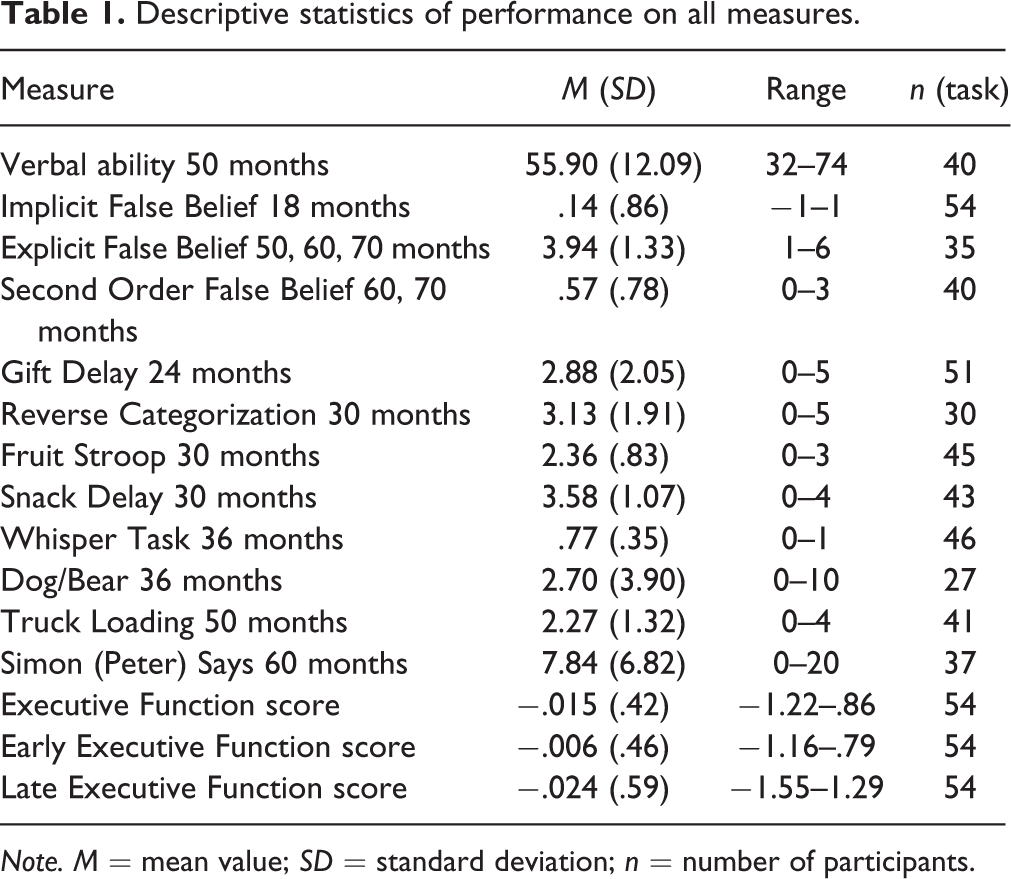
Note. M = mean value; SD = standard deviation; n = number of participants.
Performance on the executive measures was age-appropriate: On the Gift Delay task at 24 months, children received an estimated mean restraint score of 2.88 (SD = 2.04) of 5. On the Reverse Categorization task at 30 months, they mastered 3.13 (SD = 1.91) of 5 reverse sorting trials. On the Fruit Stroop task (30 months), they pointed correctly to the little fruit on 2.36 (SD = .83) of 3 trials. On the Snack Delay task (30 months), children showed good inhibitory control (M = 3.58 of 4 trials correct, SD = 1.07). At 36 months, children whispered on 77 percent (SD = .35) of the test trials. On the Dog/Bear task at 36 months, children reached a mean inhibition score of 2.70 (SD = 3.90) out of 10. On the Truck Loading task at 50 months, the highest level of difficulty achieved (with a maximum score of 4) was M = 2.27 (SD = 1.32). On the Simon Says task (60 months), children reached an inhibition score of M = 7.84 (SD = 6.82) out of 20.
First, we analyzed zero-order correlations (two-tailed) between all tasks (see Table 2). Second, if there was a significant zero-order correlation for two variables, we also computed partial correlations (one-tailed) controlling for different variables. At a zero-order level, implicit false belief understanding at 18 months was only significantly related to explicit first-order false belief understanding at 50, 60, and 70 months (r = .36, p = .035). Second-order false belief understanding at 60 and 70 months was correlated with explicit first-order false belief understanding (r = .63, p < .001), the EF sum score (r = .38, p = .015), and early EF (r = .35, p = .028); the relation between second-order false belief and late EF failed to reach significance (r = .27, p = .088). Replicating previous research, explicit first-order false belief reasoning was related to several EF measures (Whisper: r = .39, p = .022; Dog/Bear: r = .48, p = .034; Truck Loading: r = .45, p = .007; Simon Says: r = .45, p = .01) as well as to the aggregate EF score (r = .59, p < .001) and late EF (r = .66, p < .001), but not to early EF (r = .22, p = .21). Furthermore, performance on explicit first- and second-order false belief tasks was strongly related to children’s verbal ability as assessed with the SETK (first order: r = .77, p < .001; second order: r = .61, p < .001), but the correlation between implicit false belief understanding and verbal ability was not significant (r = .21, p = .19). This indicates that implicit false belief understanding is less reliant on verbal ability than explicit false belief understanding (see also Grosse Wiesmann et al., 2017; Low, 2010).
Zero-order correlations among all tasks.
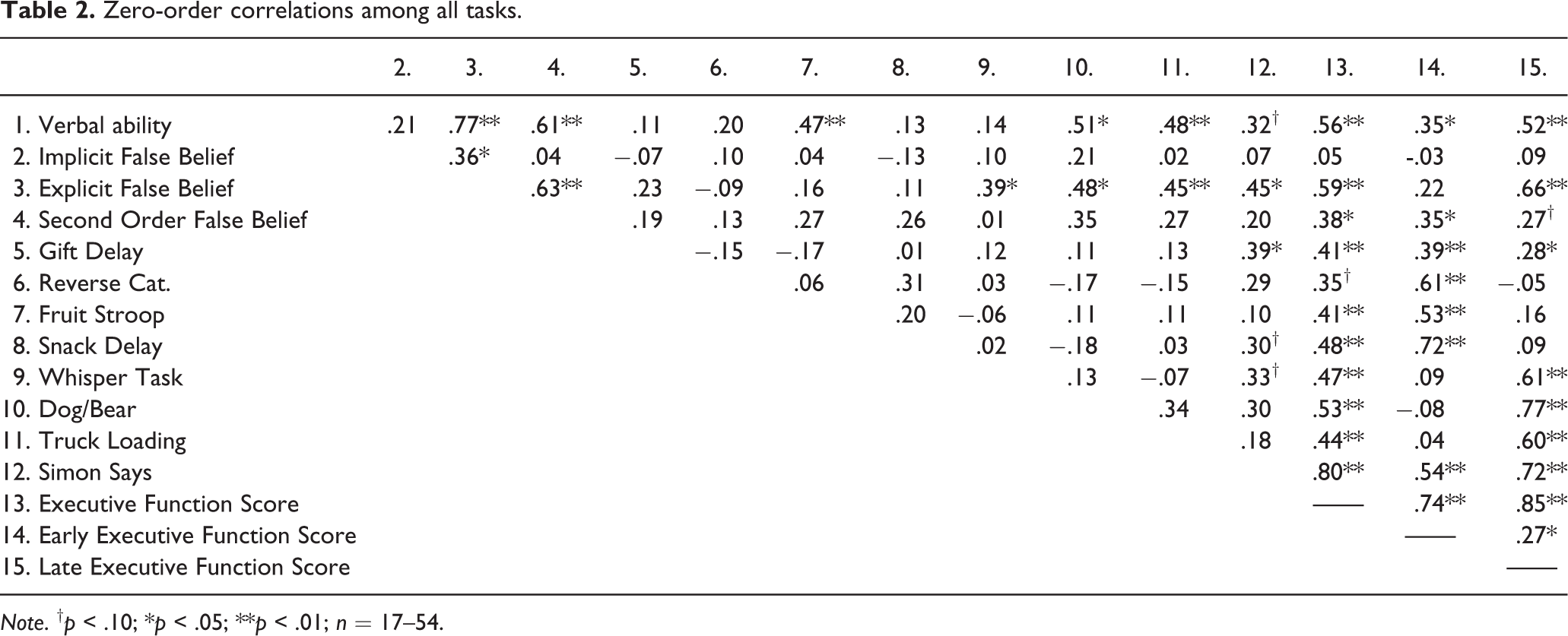
Note. † p < .10; *p < .05; **p < .01; n = 17–54.
When verbal ability was partialled out, implicit false belief understanding was still significantly related to explicit false belief understanding (r = .31, p = .038). Also, explicit false belief reasoning remained significantly related to Whisper (r = .45, p = .004), Simon Says (r = .33, p = .035), late EF (r = .47, p = .003), and the EF composite score (r = .30, p = .043). The relation between first- and second-order false belief understanding was reduced but remained significant (r = .31, p = .04). Also, Gift Delay remained significantly related to Simon Says (r = .37, p = .031). In a further step, performance on early and late EF scores was partialled out in order to shed some light on predictions from executive emergence and expression accounts. The relation between implicit and explicit false belief understanding remained significant when performance on early EF (r = .37, p = .015) or late EF (r = .40, p = .010) were partialled out – as well as when controlling for any other executive task and the EF sum score, apart from Dog/Bear (r = .30, p = .10) and Fruit Stroop (r = .36, p = .058). In addition, second-order false belief understanding remained significantly related to first-order false belief understanding after controlling for early EF (r = .61, p < .001), late EF (r = .62, p < .001) or the EF score (r = .54, p < .001), and after partialling out any of the other executive measures. Then, we controlled for performance on the implicit false belief task at 18 months. The relations between first-order and second-order false belief reasoning (r = .66, p < .001) as well as between first-order false belief understanding and the five executive function measures (Whisper; Dog/Bear; Truck Loading; Simon Says; EF sum score, late EF) were unaffected by partialling out implicit false belief understanding. Also, second-order false belief remained significantly correlated with early EF (r = .35, p = .015).
In a last step, we conducted a stepwise linear regression analysis with first-order false belief as dependent variable and implicit false belief as well as early and late EF as predictor variables; unfortunately, the sample size is too small for structural equation modeling. This yielded two statistically significant predictors. In a first step, where late EF was entered as a single predictor, 44% of variance was explained, F(1, 33) = 25.53, p < .001. In a second step, with the addition of implicit false belief, 50% of variance was explained, F(2, 32) = 16.08, p < .001.
Discussion
This is the first longitudinal study investigating the developmental of implicit and explicit theory of mind reasoning and its relation to the development of executive functioning.
First, one finding was that first- and second-order false belief understanding were significantly related to executive functioning, but implicit false belief understanding was not. This corroborates other findings (Grosse Wiesmann et al., 2017; Low, 2010; Schuwerk, Jarvers, Vuori, & Sodian, 2016) and is also in line with meta-analytic findings reported by Devine and Hughes (2014). The relations between explicit first-order false belief understanding and executive functioning remained significant when implicit false belief understanding was partialled out. That is, there is robust evidence suggesting that explicit but not implicit false belief understanding is related to executive control. This could be explained by an expression account of theory of mind development proposing that explicit false belief understanding requires the inhibition of the prepotent tendency to answer the test question based on the (more salient) true state of affairs in order to explicitly take the protagonist’s perspective (e.g., Baillargeon et al., 2010; Russell et al., 1991).
However, it should be noted that there are two studies (Schneider, Lam, Bayliss, & Dux, 2012; Yott & Poulin-Dubois, 2012) indicating that there is some relation between implicit false belief understanding and executive functioning. As Grosse Wiesmann et al. (2017) pointed out, one critical feature of these two studies is that the relevant object was not removed from the scene, which may have induced the need for inhibitory control processing. Evidence for the importance of processing demands in the traditional false belief task also comes from an inventive study by Setoh, Scott, and Baillargeon (2016) who found that even 2.5-year-old children perform reliably above chance (78%) in the standard false belief test when processing demands are reduced. To this end, the relevant object was taken away to an undisclosed location (which reduces inhibitory demands), and children received two practice trials (which reduces response-generation demands). Nevertheless, such superficial characteristics of the false belief test may not fully explain the relation between theory of mind and executive functioning, because recently, Carlson, Claxton, and Moses (2015) showed that executive functioning, particularly conflict inhibition, is related to theory of mind measures imposing either low (e.g., understanding sources of knowledge) or high (e.g., location false belief) executive demands.
Second, we found a developmental relation between implicit and first-order false belief understanding as well as between first- and second-order false belief reasoning. These relations remained significant when verbal ability or executive functioning were partialled out. This suggests that there is an intrinsic relation between various measures of false belief understanding assessing theory of mind development from 18 months up to 70 months of age. Furthermore, if we take into account that implicit false belief understanding, in contrast to explicit false belief reasoning, was not significantly correlated with verbal IQ or executive functioning and that the relation between implicit and explicit false belief understanding remained significant when controlling for language and executive control, then this supports developmental enrichment positions assuming that implicit false belief understanding develops into an explicit understanding through developing language and executive control abilities (e.g., Moses & Tahiroglu, 2010; Ruffman, 2014).
Nevertheless, findings about the implicit-explicit distinction in theory of mind development are mixed, because some studies (e.g., Grosse Wiesmann et al., 2017) suggest a distinction between implicit and explicit false belief understanding, while the present study and Low (2010) found significant correlations between implicit and explicit false belief tasks. With regard to the finding that implicit false belief understanding was related to first-order but not to second-order false belief reasoning, there are two possible explanations. On the one hand, this may simply be due to the fact that the time span lying between implicit and second-order belief understanding is longer than the time span between implicit and first-order belief understanding. On the other hand, implicit false belief understanding may build a conceptual foundation for explicit first-order false belief understanding. In turn, second-order false belief understanding may rely on a third developmental stage of theory of mind development requiring a higher level of reflection (e.g., Kloo, Rohwer, & Perner, 2017).
Third, in contrast to a number of other longitudinal studies (see Devine & Hughes, 2014), we found no clear support for an executive emergence account: the correlation between implicit and explicit false belief understanding remained significant when early or late EF were partialled out. Also, only implicit false belief understanding and late EF, but not early EF, significantly predicted children’s explicit first-order false belief understanding. That is, explicit false belief seems to be more strongly related to late than early EF. However, it should be mentioned that the early EF score included two measures of delay inhibition (Snack and Gift Delay), which have been shown to be less strongly related to theory of mind than measures of conflict inhibition (Carlson & Moses, 2001).
In sum, given these results, we argue in favor of a developmental enrichment account with belief understanding becoming increasingly reflective with age (see also Astington & Hughes, 2013). Our longitudinal data suggest that explicit false belief reasoning develops out of an earlier, implicit and effortless form of belief processing. Later in development, these two kinds of belief processing may relate to different levels of reflection resulting in a dissociation in older children as found by Grosse Wiesmann et al. 2017 (but see, for example, Low, 2010). Implicit false belief understanding may provide a basis, and possibly even a “conceptual foundation” (Baillargeon et al., 2010), for later explicit false belief understanding. This is also supported by recent data from Yott and Poulin-Dubois (2016), who used different violation-of-expectation paradigms in 14- and 18-month-old infants. While implicit theory of mind seems to be less well integrated than explicit theory of mind, they found evidence for a developmental progression in implicit theory of mind measures similar to the developmental pattern of explicit theory of mind abilities starting with intention, being followed by desire and then false belief understanding. Therefore, Yott and Poulin-Dubois argue that implicit theory of mind abilities are “preconceptual abilities that provide the foundations for later explicit ToM understanding.” (2016, p. 695).
Our study suggests that implicit belief processing does not merely reflect the application of low-level processes (Heyes, 2014); instead, because implicit belief processing is longitudinally linked to the acquisition or application of an explicit concept of belief, we propose that infant false belief measures tap into implicit false belief attribution processes, which then evolve into an explicit understanding (e.g., Astington & Hughes, 2013; Perner & Roessler, 2012; Ruffman et al., 2012).
The finding that explicit but not implicit false belief processing is associated with executive control is also in line with two-systems accounts (Apperly & Butterfill, 2009), which distinguish between largely automatic, inflexible, and implicit versus more demanding, flexible, and explicit processes; though the relation between implicit and explicit false belief reasoning speaks against developmental independence of these two systems.
Nevertheless, apart from strict low-level accounts, all in all, the present results are compatible with the various theoretical accounts proposed to explain the developmental relation between implicit and explicit false belief understanding. Clearly, more carefully controlled longitudinal research is needed to fully understand the complex nature of children’s growing theory of mind understanding, both from implicit to explicit and from first-order to second-order reasoning.
Footnotes
Author note
Thanks go to Josef Perner for his insightful comments on a previous version of this paper.
Funding
The authors disclosed receipt of the following financial support for the research, authorship, and/or publication of this article: This work was supported by the German Research Council (DFG) [grant number SO213/27 -1,2].
