




Abstract
Socialization among aggressive friends is believed to play a critical role in the development of aggressive behavior. This study examined the moderating effect of norm salience in the classroom on the association between reciprocal friends’ and children’s own physical, relational, and general aggression. A total of 713 children (M = 10.32 years, SD = 0.99) in grades 4 to 6 completed a peer nomination inventory in the fall and spring of the same academic year. Norm salience was operationalized as the class- and sex-specific correlation between each form of aggression and social preference. Norm salience moderated relational aggression socialization among friends only for highly relationally aggressive girls. Specifically, socialization was exacerbated when norm salience was favorable and attenuated when norm salience was unfavorable, suggesting that highly relationally aggressive girls may possess skills allowing them to adapt to the social context in which they and their friends interact. In contrast, boys’ general aggression socialization was exacerbated when norm salience was neutral or unfavorable, suggesting that boys who affiliate with aggressive friends may be more susceptible to aggressive friends’ influence in general and especially in the context of potential peer rejection. No moderating effect of norm salience was found in regards to physical aggression socialization. Results suggest that interventions aimed at changing acceptability of aggression in the classroom may only be effective in specific subgroups of aggressive youth.
In addition to genetic influences, environmental experiences have been shown to play a significant role in the development of both physical aggression and relational aggression (Brendgen et al., 2005). Among potential sources of environmental influence, affiliation with aggressive friends plays a critical role (Sijtsema & Lindenberg, 2018). Through socialization processes, friends influence each other’s attitudes and behaviors, becoming more similar over time (Brechwald & Prinstein, 2011). Since friendships exist in a larger social context, this study examined whether social norms in the classroom with respect to aggression moderate aggression socialization among friends.
Aggression manifests itself in different forms, with one important distinction being that between physical and relational aggression (Vaillancourt, Brendgen, Boivin, & Tremblay, 2003). It is common to find moderate to high correlations between these forms (Vaillancourt et al., 2003). Physical aggression is overt and direct; by the preschool years it is seen more often among boys than girls (Hay et al., 2011). In contrast, both sexes engage in relational aggression (Card, Stucky, & Sawalani, 2008), which can be direct or indirect (Bjorklund & Hawley, 2014) and involves manipulation of an individual’s social reputation (Archer & Coyne, 2005). Compared to physical aggression, relational aggression is a more complex social phenomenon, requiring the involvement of peers to be effective (Bjorklund & Hawley, 2014). The classroom is an ideal setting for the study of relational aggression, as it is for many children an opportunity outside of the family context to learn about expectations regarding social behavior (Bjorklund & Hawley, 2014).
Strong socialization effects have been found with regard to aggression in general (e.g., Laninga-Wijnen et al., 2017), with relatively weaker associations reported in studies that distinguish between different forms (e.g., Brendgen et al., 2008; Werner & Crick, 2004). When controlling for the large overlap between physical and relational aggression, socialization effects have only been found in regard to the same form (Brendgen et al., 2008; Werner & Crick, 2004) and are more pronounced in relational aggression relative to physical aggression (Sijtsema et al., 2010). Given this variability, it is important that investigations of friends’ influence on aggression not only distinguish between these forms, but also consider other potential moderators in physical and relational aggression socialization. Because socialization among friends occurs within a peer context (Veenstra & Dijkstra, 2011), a potentially important moderator may be the social norms in the classroom.
Social Norms and Aggression
Norms are social rules that reflect a consensus on what is preferred or acceptable behavior for group members and shaping behavior at the individual level (Cialdini, Kallgren, & Reno, 1991). Norm salience captures the degree to which a given behavior is associated with sociometric status indices such as likability or popularity (Brendgen, Girard, Vitaro, Dionne, & Boivin, 2013, 2015; Henry et al., 2000; Laninga-Wijnen et al., 2017; Veenstra, Dijkstra, & Kreager, 2018). The person–group similarity model assumes that individuals tend to accept and like others who are similar to themselves and reject and dislike others who are dissimilar (Wright, Giammarino, & Parad, 1986). It is theorized that norm compliance is motivated by a desire to respond aptly to social situations and to have meaningful social relationships (Cialdini & Goldstein, 2004). Thus, norm salience may be particularly relevant to the understanding of children’s aggression socialization, given their fundamental motivation to be accepted as part of a group (Baumeister & Leary, 1995).
Studies have tested the association between different markers of norms and different aggressive behaviors, particularly bullying. For instance, positive attitudes toward bullying at the classroom level have been associated with higher rates of bullying behavior (Scholte, Sentse, & Granic, 2010), whereas norms reflecting anti-bullying attitudes predicted defending of bullying victims (Salmivalli & Voeten, 2004). In a key study of the role of classroom normative influences on aggression in first, second, and fourth graders (Henry et al., 2000), norm salience was examined as a predictor of change in aggressive behavior. Results showed that aggression diminished over time when norm salience was unfavorable (i.e., when aggression was positively correlated with peer-nominated rejection). These findings support the notion that norm salience may influence the development of aggressive behavior among children.
Norm Salience and Socialization of Aggression Among Friends
Norm salience may impact aggression socialization among friends in several ways. Social impact theory (Latané, 1981) would suggest that aggression socialization depends on the degree to which individuals experience pressure from the social environment. When their friends engage in behaviors tied to markers of high peer status (e.g., high social preference), children may imitate these behaviors to maximize their own social standing. In contrast, when their friends engage in behaviors tied to markers of rejection (i.e., low social preference), children may be less inclined to adopt their friends’ behavior and more inclined to fit in with the larger peer group to avoid rejection.
Norm salience has been found to moderate socialization of adolescent risk attitudes (Rambaran, Dijkstra, & Stark, 2013) and academic achievement (Laninga-Wijnen, Ryan, Harakeh, Shin, & Vollebergh, 2018). However, to our knowledge, only one study has examined norm salience in the peer group as a moderator of aggression socialization by friends (Laninga-Wijnen et al., 2017). Results showed that young adolescents adopted friends’ aggressive behavior only in classes where norm salience (i.e., the class-specific correlation between aggression and perceived popularity) was favorable, not neutral or unfavorable. It is unknown, however, whether this moderating effect equally applies to physical and relational aggression. Compared to physical aggression, relational aggression is a “social” phenomenon requiring several participants to be effective (Bjorklund & Hawley, 2014). Enticing peers to participate in rumor spreading or social exclusion requires insight into what is acceptable or not within the peer group. Relational aggression emerges when children learn to manipulate and hurt others in a way that avoids sanctions (Björkqvist, Lagerspetz, & Kaukiainen, 1992). Indeed, relational – but not physical aggression – is positively associated with social intelligence and theory of mind (Kaukiainen et al., 1999; Renouf et al., 2010). These social skills may be associated with the ability to accurately perceive social norms, potentially making highly relationally aggressive children most sensitive to learn from their friends when relational aggression can be advantageous. Thus, the moderating role of norm salience may be more pronounced for relational than physical aggression.
Operationalization of Norm Salience
Research suggests that clusters of children identified as high-status, highly liked, or popular each occupy central positions in the peer group and have a great deal of social control (Lease, Musgrove, & Axelrod, 2002). There is evidence that popularity-based norm salience (i.e., “who is most popular?” and “who is least popular?”) moderates general aggression socialization (Laninga-Wijnen et al., 2017). In line with a dual-component model of social competence, children’s social behavior may be driven by social demonstration goals such as achieving high social status, or by social development goals such as being liked, avoiding being disliked, and developing close friendships (Rodkin, Ryan, Jamison, & Wilson, 2013). Examining the moderating effect of norm salience based on social preference (i.e., based on liked and disliked peer nominations) on aggression socialization may thus further contribute to our understanding of potential social goals involved in the development of aggressive behavior.
In addition, it may be important to consider sex-specific norm salience within a class (i.e., a given behavior may be associated with higher social preference for boys than for girls in a class), rather than a single index of norm salience in the classroom at large. Not only do pre-adolescents tend to socialize more with same-sex groups (Bukowski, Gauze, Hoza, & Newcomb, 1993), but also a qualitative investigation of explanations for girls’ relational aggression suggests that they may be particularly motivated to achieve a sense of belonging and develop relationships through manipulative and indirect means, as it minimizes the risks of being perceived as overtly aggressive (Owens, Shute, & Slee, 2000). Moreover, affiliation with relationally aggressive friends has been found to predict increases in relational aggression over time for girls, but not for boys, whereas affiliation with physically aggressive friends predicts increases in physical aggression in both sexes (Werner & Crick, 2004). Sex differences may thus be most pronounced in regards to relational aggression socialization.
Other Potential Moderators of Aggression Socialization
In addition to sex-specific norm salience based on social preference, it may be important to consider other potential moderators of aggression socialization, such as age and children’s initial levels of aggressive behavior. For instance, Henry and colleagues (2000) found a main effect of classroom norms regarding aggression on peer-nominated aggressive behavior in 12 year olds, but not in 9 year olds, suggesting that socialization effects may be most pronounced in older children, who may be more attuned to potential social rewards and sanctions tied to aggression. Results of a meta-analysis (Müller & Minger, 2013) also suggest that pre-existing behavior problems and positive attitudes toward antisocial and aggressive behaviors are associated with greater susceptibility to peer influence. Friends’ aggression may thus predict increases in children’s own aggression most strongly when norm salience is favorable and when children already have aggressive tendencies.
The Present Study
The main objective of the present study was to examine whether norm salience moderates the longitudinal association between reciprocal friends’ physical and relational aggression in the fall and children’s physical and relational aggression in the following spring, while controlling for the overlap between the two forms of aggression and children’s initial levels of aggression. We also examined the same question for general aggression (conceptualized as what is common between physical and relational aggression), in order to obtain a more complete understanding of aggression socialization. The present study focused on reciprocal friendships, as socialization effects are significantly more pronounced among reciprocal friends than among nominated friends (Brechwald & Prinstein, 2011). We hypothesized that higher levels of friends’ aggression would predict increases in children’s respective levels of aggression. Favorable norm salience should predict increases in children’s aggression, whereas unfavorable norm salience should predict decreases in children’s aggression. However, we also expected interactive effects, such that aggression socialization among friends should be exacerbated when classroom norm salience is favorable. When norm salience is unfavorable, socialization may be attenuated, as children attempt to fit in with the larger peer group. As previously mentioned, the moderating effect of norm salience was expected to be especially strong for relational aggression. An additional objective was to examine whether the putative moderating effect of norm salience varies across children’s sex, age, or initial levels of aggression. We expected that the moderating effect of norm salience would be more pronounced in relationally aggressive girls, older children, and children with higher initial levels of aggression.
Method
Participants
Study participants were part of a sample of 1205 fourth to sixth graders (613 girls) from 23 public schools (67 classrooms) in low to average socio-economic status neighborhoods in a large Canadian city. School board records indicate that, for 54% of the student population from which the sample was obtained, both parents were born in Canada, whereas 27% of students had at least one immigrant parent and 19% of students were born outside of Canada. Students of immigrant descent originated mainly from the Caribbean (18.0%), North Africa (4.7%), Central America (4.4%), South America (3.3%), Middle East (2.9%), Southern Europe (2.8%), and Southeast Asia (2.2%). A third (33%) of students’ mother tongue was neither French nor English (the two official languages in Canada) and 24% of students spoke neither French nor English at home. Data were collected in the fall (i.e., T1) and spring (i.e., T2) of the same academic year. Active parental consent and children’s active verbal assent were obtained for all participants. Only classrooms where at least 75% of students received parental consent at both T1 and T2 were considered for participation (Cillessen & Marks, 2011). The classroom participation rate was 97% (67 out of 69 classrooms asked to participate). The average student participation rate within the remaining classrooms was 98% (range = 91 to 100%).
A group of 1023 individuals with valid friend nominations was retained (see friendship nomination procedure described below). The remaining 182 individuals were excluded because they did not nominate any friends or nominated friends for whom consent was not received. Of those with valid friend nominations, 713 (69.7%; 381 girls) had at least one reciprocal friend. Those with no reciprocal friend (310 individuals; 30.3%) were also excluded. Excluded participants were younger (M = 10.18, SD = 1.07) than those included (M = 10.32, SD = .99; t(712) = 2.28, p = .023). Those with no reciprocal friend were also more physically aggressive than those included (t(712) = 2.34, p = .020). Since data were obtained through peer nominations (see description of measures below), and participants could still nominate participating classmates who were absent at T2, there were no missing data points. The number of participants per class ranged from 12 to 26 (M = 18.13, SD = 2.78).
Procedure
Data collection took place during regular school hours. A research assistant read the instructions aloud and clarification was provided if needed, ensuring that all participants understood what was asked of them. Participants were reminded that their responses would remain confidential. Instruments were approved by the University Ethics Committee and the school board administrators.
Measures
Physical and relational aggression
Children’s physical and relational aggression at T1 and T2 were measured via peer-nominations, following the procedure used in other studies (e.g., Crick & Grotpeter, 1995). A list was given to each participant containing the names of all participants in the class. From this list, each participant was asked to nominate three classmates of either sex who best fit a behavioral descriptor. Physical aggression was estimated using two items from the Pupil Evaluation Inventory (Pekarik, Prinz, Liebert, Weintraub, & Neale, 1976): “Those who start a physical fight over nothing” and “Those who say they can beat everybody up.” Scores on these two items were highly correlated at T1 (r = .86, p < .001) and at T2 (r = .88, p < .001). Separately for T1 and T2, individual physical aggression scores were computed by averaging the number of received nominations for the two items and then z-standardizing within the classroom. Relational aggression at T1 and T2 was measured with two items from the Indirect Aggression Scale (Björkqvist et al., 1992), “Those who encourage others to be mean against those they don’t like,” “Those who say mean things behind others’ back,” and a third item from the PEI, “Those who make fun of others in a mean way” (Pekarik et al., 1976). Separately for T1 and T2, individual relational aggression scores were computed by counting the number of received nominations for the three items and then z-standardizing within the classroom (Cronbach’s α = .86 at T1 and α = .86 at T2). Physical and relational aggression were highly positively correlated at T1 (r = .81, p < .001) and at T2 (r = .84, p < .001). To account for this substantial overlap, one form was regressed on the other and residual variables were computed. These residual variables were used in the computation of the respective norms and in the multilevel regression analyses (see description below) to capture effects unique to either form, such that physical aggression refers to a residual variable where the overlap with relational aggression is controlled and vice versa. Previous studies have also examined residuals in order to capture unique effects of highly correlated albeit distinct subtypes of aggression, such as physical and relational aggression (e.g., Burt, Donnellan, & Tackett, 2012) and reactive and proactive aggression (e.g., Cima, & Raine, 2009).
Common aggression
A general aggression variable was computed from the five peer-nominated items. Residual physical and residual relational aggression scores were then subtracted from the general aggression score to exclude variance specific to either form and include only what is common to both.
Friendship nominations
Participants were asked to nominate up to four friends of either sex from a list of all participants in their classroom at T1. Friendship nominations were restricted to peers within the same classroom because most grade-school children name classmates as best friends, even when they are free to nominate friends from other contexts outside the classroom (Parker & Asher, 1993). Following the friendship nomination procedure used in other studies (e.g., Hawley, Little, & Card, 2007), a friendship was considered to be reciprocal when the nominated peer had also rated the participant as one of his or her four best friends at the same time point.
Reciprocal friends’ aggression
For each participant, friends’ residual physical, relational, and common aggression was available based on the same peer-nominated items described above. Residual scores for each respective form of aggression were averaged across all of a participant’s reciprocal friends to maximize variability (Berndt & Keefe, 1995).
Social preference
Peer-perceived social preference was assessed by peer nominations at T1. A list of the names of all participants in the class was given to each participant. From this list, each participant was asked to nominate three children that they most like to play or hang out with (positive nominations) and three children that they least like to play or hang out with (negative nominations). Participants could nominate children of either sex. A social preference score was calculated for each participant (following the procedure developed by Coie, Dodge, & Coppotelli, 1982). The number of positive peer nominations received was calculated for each individual and z-standardized within the classroom to account for differences in class size, creating a Liked-Most score. A Liked-Least score was calculated for each individual by calculating the number of negative nominations received, which was also z-standardized within the classroom. The Liked-Least score was subtracted from the Liked-Most score to obtain a Social Preference score for each individual, which was again z-standardized within the classroom. This score was thus a continuous measure of peer-rated social preference, with high scores indicating acceptance and low scores indicating rejection among classmates.
Norm salience
As in other studies (Brendgen et al., 2013, 2015), norm salience was operationalized using the classroom-specific correlation between social preference and each behavioral variable (i.e., residual physical aggression, residual relational aggression, and common aggression) at T1. Norm salience values can theoretically range from -1 (indicating that the given behavior is entirely rejected or disliked), to +1 (indicating that the given behavior is entirely accepted or liked), with values approaching zero indicating a neutral norm (i.e., a behavior is neither particularly liked nor disliked). Sex-specific norm salience was calculated for each classroom in the fall. Classrooms had a minimum proportion of 36% same-sex peers, with the proportion of same-sex peers distributed equally for boys and girls (M boys = 49% same-sex peers, M girls = 51% same-sex peers, with the exception of one classroom that only had of five boys, corresponding to 20% same-sex peers for the boys in that class). Among boys, norm salience ranged from highly favorable to highly unfavorable for residual physical aggression (range = -.65 to 70, M = -.17, SD = .30), residual relational aggression (range = -.91 to .78, M = -.01, SD = .34) and common aggression (range = -.96 to .53, M = -.25, SD = .39). Among girls, norm salience also ranged from highly favorable to highly unfavorable for residual physical aggression (range = -.76 to .71, M = .13, SD = .34), residual relational aggression (range = -.73 to .63, M = -.16, SD = .35) and common aggression (range = -.75 to .60, M = -.18, SD = .34). Physical and common aggression norm salience were more unfavorable in boys (t(712) = -12.38, p < .001 and t(715) = -2.69, p = .007). Relational aggression norm salience was more unfavorable in girls (t(712) = 6.09, p < .001).
Analytic Rationale
Multilevel regressions using Generalized Linear Mixed Models were performed with SPSS version 21 software (IBM Corp. 2012). Multilevel regressions allow for analysis of both child effects (i.e., age, individual aggression scores, friends’ aggression) and group level effects (i.e., within-classroom sex group norm salience, sex group). In principal, our design suggested a four-level structure of the data (i.e., children nested in same-sex groups, same-sex groups nested in classrooms, classrooms nested in schools). However, because the peer-nomination-based dependent aggression variables were z-standardized within classrooms to account for classroom differences in the number of nominating children, mean levels of aggression could not vary across classes or across schools. The multilevel models were thus estimated for two levels, that is, the child (level 1) and his or her within-classroom sex group (level 2). Robust estimation methods were selected in order to generate unbiased standard error estimates and significance values (Maas & Hox, 2004) and to control for non-independence of the sample (Skrondal & Rabe-Hesketh, 2004).
To examine the additive and interactive associations of classroom norm salience and reciprocal friends’ aggression with changes in children’s aggression from fall to spring of one academic year, three series of models were conducted: separately for physical aggression, relational aggression, and common aggression at T2. This allowed us to examine whether associations varied according to the specific form of aggressive behavior. A result was considered to be statistically significant at an alpha level of p = .05 or smaller to ensure comparability of findings with those from previous studies. In model 1, main effects of sex, age, child’s T1 aggression, friends’ T1 aggression and the corresponding norm salience were tested. Model 2 introduced all possible 2-way interactions between the predictor variables and model 3 introduced five 3-way interactions. Model 4 introduced a 4-way interaction between sex, aggression at T1, friends’ T1 aggression, and norm salience. Interactions were decomposed using simple slopes at high (i.e., +1 SD) and low (i.e., -1 SD) levels of the moderator(s). All variables except child sex were z-standardized prior to analyses to facilitate interpretation of the results. Preliminary analyses were performed to investigate main or moderating effects of the within-class sex ratio and none were found. Parsimonious model results without that variable are presented.
Results
Preliminary Analyses
Bivariate correlations between individual-level raw (i.e., not residual) variables are presented in Table 1. In boys, but not girls, age was positively correlated with both physical and relational aggression, as well as with friends’ physical and relational aggression, at both time points. Physical aggression at T1 was highly positively correlated with physical aggression at T2, although this correlation was stronger in boys (Z = 7.28, p < .001). Similarly, relational aggression at T1 was highly positively correlated with relational aggression at T2, and this correlation was also stronger in boys (Z = 5.13, p < .001). Physical and relational aggression were highly positively correlated at both times, supporting the use of residual scores in the subsequent analyses. At both times, correlations between the two forms of aggression were stronger in boys (ZT1 = 8.06, p < .001; ZT2 = 13.53, p < .001). Physical and relational aggression were positively correlated with friends’ physical and relational aggression at T1 and the strength of these correlations was not different between boys and girls (ZPA = 0.42, p = .674; ZRA = 1.73, p = .084).
Bivariate correlations between individual-level variables for boys and girls.

Note. N = 713. ** p < .01. Physical and relational aggression in this table refers to the “original” variables (i.e., not residuals). Results for boys are presented above the diagonal and results for girls in the lower diagonal.
Physical Aggression
Table 2 presents the multilevel regressions predicting children’s physical aggression at T2. In the unconditional model, individual (within-group) differences accounted for 88.1% of the variance in T2 physical aggression, whereas between-group differences accounted for 11.7% (ICC = .12), indicating that variance in T2 physical aggression was mainly due to individual differences. In model 1, the child’s sex was associated with T2 physical aggression (b = .41, SE = .08, p < .001), such that boys showed a greater increase in residual physical aggression over the school year than girls. Physical aggression was highly stable over time, with child’s T1 physical aggression being positively associated with T2 physical aggression (b = .39, SE = .04, p < .001). No other main effects emerged. Model 2 introduced all possible two-way interactions between the predictor variables. An interaction between sex and friends’ T1 physical aggression (b = .15, SE = .06, p = .014) revealed socialization effects in boys specifically (b = .08, SE = .04, p = .030). A second interaction between age and child’s T1 physical aggression (b = .09, SE = .03, p = .004) showed that older children (+1 SD) presented more stability in physical aggression over time (b = .49, SE = .08, p < .001) relative to younger children (-1 SD; b = .30, SE = .07, p < .001). A third interaction between friends’ T1 physical aggression and child’s T1 physical aggression (b = -.11, SE = .04, p = .012) indicated that physical aggression was more stable over time among children whose reciprocal friends showed low (-1 SD) physical aggression at T1 (b = .49, SE = .08, p < .001), relative to those whose friends showed high (+1 SD) physical aggression at T1 (b = .29, SE = .09, p = .002). The five triple interaction terms added in model 3, as well as the quadruple interaction term assed in model 4, were not statistically significant. Thus, we found no evidence that norm salience moderates physical aggression socialization.
Multilevel regression analyses predicting the child’s T2 physical aggression.
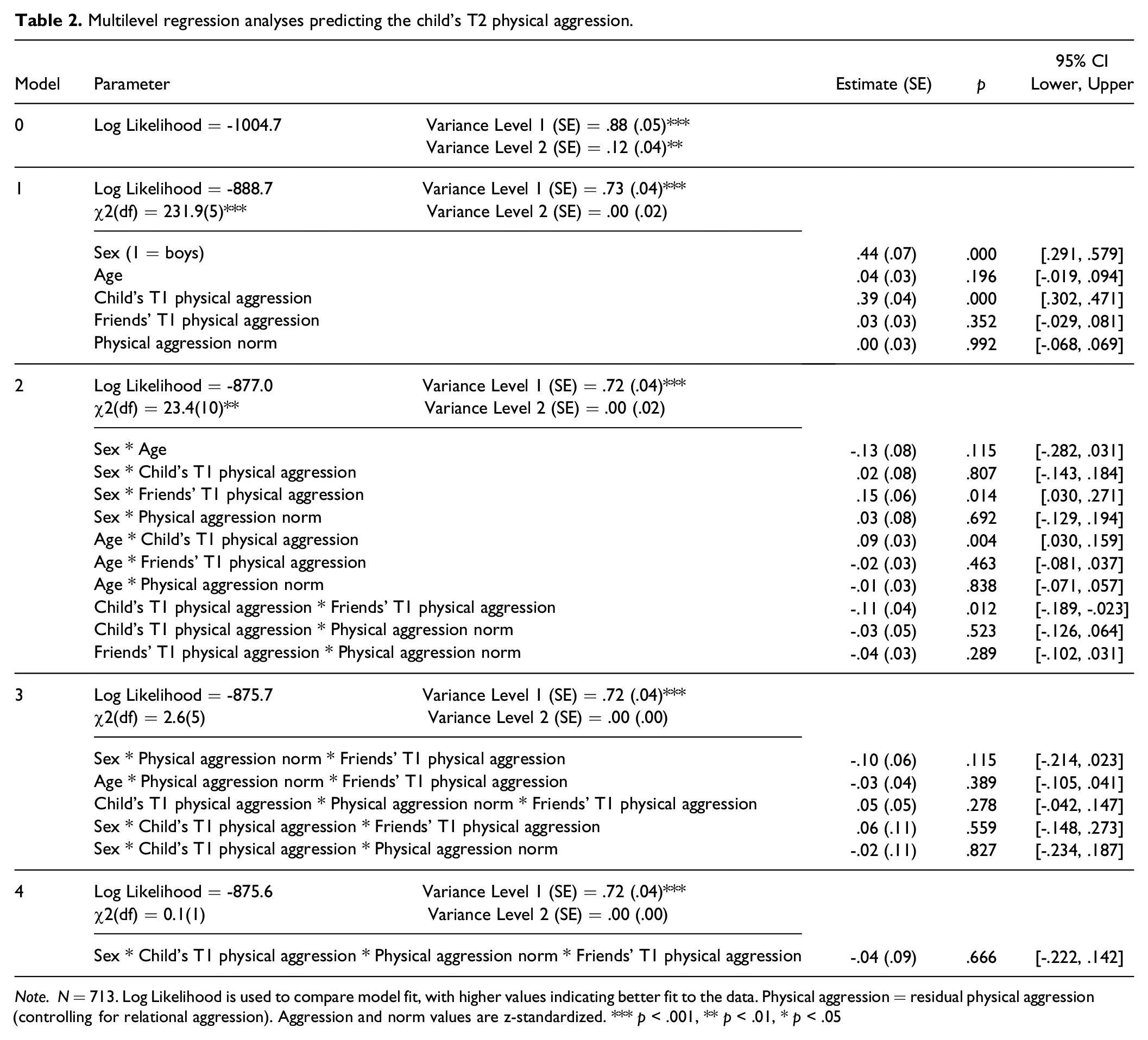
Note. N = 713. Log Likelihood is used to compare model fit, with higher values indicating better fit to the data. Physical aggression = residual physical aggression (controlling for relational aggression). Aggression and norm values are z-standardized. *** p < .001, ** p < .01, * p < .05
Relational Aggression
Table 3 presents the multilevel regressions predicting children’s relational aggression at T2. In the unconditional model, individual (i.e., within-group) differences accounted for over 99.8% of the variance in T2 relational aggression, whereas between-group differences accounted for less than 0.1% (ICC = .001), indicating that virtually all of the variance in T2 relational aggression was due to individual differences. Added in model 1, child’s relational aggression at T1 was a strong predictor of relational aggression at T2 (b = .40, SE = .05, p < .001), but no other main effects emerged. Model 2 introduced all possible double interactions. An interaction between sex and T1 relational aggression (b = -.19, SE = .08, p = .016) revealed greater stability in relational aggression in girls (b = .49, SE = .07, p < .001) than in boys (b = .30, SE = .05, p < .001). A second interaction between sex and age (b = .16, SE = .06, p = .010) indicated that age predicted increased relational aggression in boys specifically (b = .10, SE = .05, p = .020). A third interaction between age and relational aggression at T1 (b = .08, SE = .04, p = .029) showed greater stability of relational aggression in older children (+1 SD; b = .46, SE = .09, p < .001) relative to younger children (-1 SD; b = .14, SE = .08, p = .068). An interaction between age and friends’ T1 relational aggression also emerged (b = -.06, SE = .03, p = .044), but when decomposed at +/- 1 SDs of age, the effects of friends’ T1 relational aggression were not statistically significant and therefore cannot be interpreted. Similarly, an interaction emerged between friends’ T1 relational aggression and norm salience (b = .09, SE = .03, p = .009), but the effects of friends’ T1 relational aggression were not statistically significant when examined at +/- 1 SDs of norm salience. Model 3 introduced five triple interactions, none of which were statistically significant. However, Model 4 showed a significant quadruple interaction between sex, relational aggression at T1, friends’ T1 relational aggression and relational aggression norm salience (b = -.17, SE = .07, p = .019). Probing revealed that the triple interaction between relational aggression at T1, friends’ T1 relational aggression, and the relational aggression norm was statistically significant for girls (b = .15, SE = .05, p = .003), but not for boys (b = -.02, SE = .05, p = .756). The decomposition of this interaction is illustrated in Figure 1. Norm salience emerged as a significant moderator of relational aggression socialization among highly relationally aggressive (+1 SD) girls only, relative to girls presenting average or low (-1 SD) levels of relational aggression at T1. When norm salience was favorable (+1 SD), friends’ relational aggression at T1 was associated with increased relational aggression among highly relationally aggressive girls (b = .21, SE = .09, p = .021). In contrast, when norm salience was unfavorable (-1 SD), reciprocal friend’s relational aggression at T1 was associated with decreased relational aggression in this subgroup (b = -.29, SE = .12, p = .019).
Multilevel regression analyses predicting the child’s T2 relational aggression.
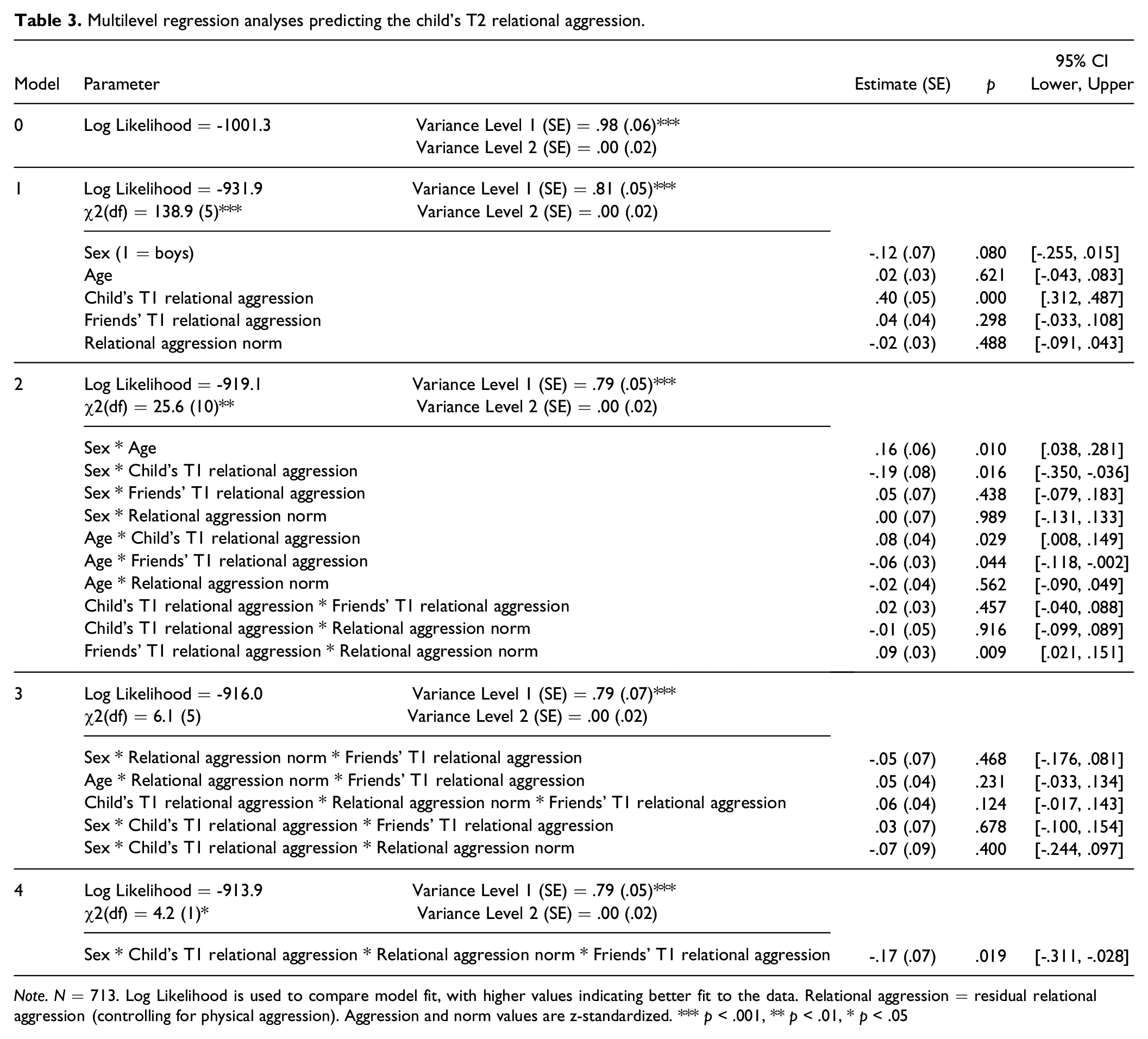
Note. N = 713. Log Likelihood is used to compare model fit, with higher values indicating better fit to the data. Relational aggression = residual relational aggression (controlling for physical aggression). Aggression and norm values are z-standardized. *** p < .001, ** p < .01, * p < .05
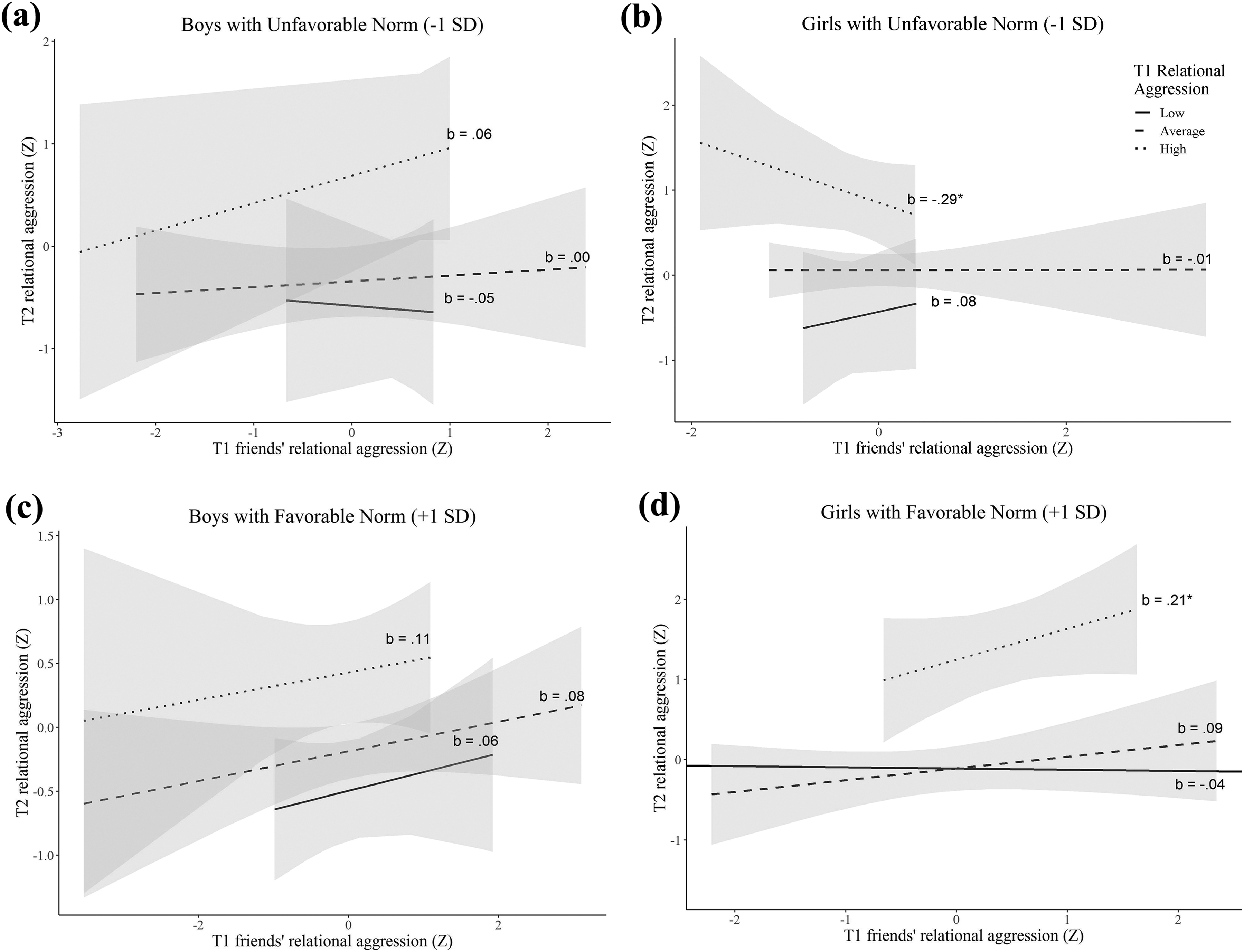
Axes show the range of observed data values separately for boys (a, c) and girls (b, d) when norms are unfavorable (a, b) and favorable (c, d). Regression lines include 95% confidence intervals (grey-shaded areas). In Figure 1b, the dotted slope illustrates that – in girls showing high (+1 SD) levels of relational aggression at T1 – friends’ relational aggression at T1 is negatively associated with relational aggression at T2 when norm salience is unfavorable (-1 SD). In Figure 1d. the dotted slope illustrated that – in girls showing high (+1 SD) levels of relational aggression at T1 – friends’ relational aggression at T1 is positively associated with relational aggression at T2 when norm salience is favorable (+1 SD). These same associations were not statistically significant among boys or among girls with average or low (-1 SD) levels of relational aggression at T1.
Common aggression
Whereas the previous analyses were based on residual scores that controlled for the overlap between physical and relational aggression, the analyses presented in Table 4 examined the pattern of results for aggressive behavior common to both forms of aggression. In the unconditional model, individual (i.e., within-group) differences accounted for 86.35% of the variance in T2 common aggression, whereas between-group differences accounted for 14.16% (ICC = .14), indicating that variance in T2 common aggression was mainly due to individual differences. Added in model 1, common aggression at T1 emerged as a strong predictor of common aggression at T2 (b = .75, SE = .04, p < .001). Sex was significantly associated with T2 physical aggression (b = .16, SE = .06, p = .004), such that boys showed a greater increase in common aggression over the school year than girls. Reciprocal friends’ common aggression was also positively associated with T2 common aggression (b = .06, SE = .02, p = .006). No other main effects emerged. Model 2 introduced all possible two-way interactions. A significant interaction between reciprocal friends’ T1 common aggression and norm salience (b = -.05, SE = .02, p = .036) revealed a socialization effect specifically when norm salience was unfavorable (-1 SD; b = .17, SE = .06, p = .006) and neutral (b = .07, SE = .03, p = .042), but not when norm salience was favorable (+1 SD; b = -.03, SE = .05, p = .609). Model 3 showed a significant triple interaction between sex, friends’ T1 common aggression and norm salience (b = -.12, SE = .06, p = .039), indicating that the moderating effect of norm salience in common aggression socialization was present only in boys (b = -.10, SE = .03, p < .001). The quadruple interaction in model 4 was not statistically significant.
Multilevel regression analyses predicting the child’s T2 common aggression.
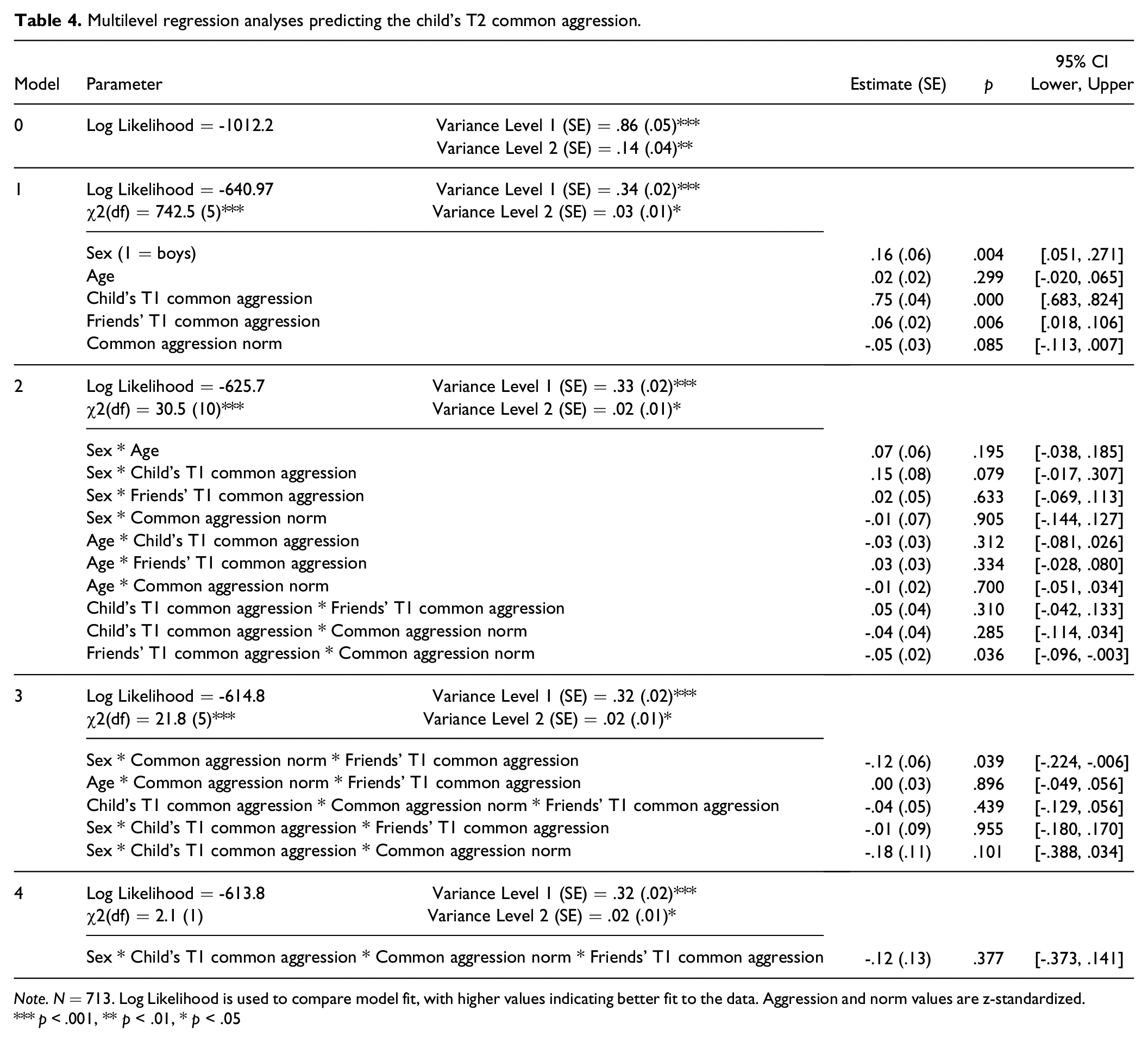
Note. N = 713. Log Likelihood is used to compare model fit, with higher values indicating better fit to the data. Aggression and norm values are z-standardized. *** p < .001, ** p < .01, * p < .05
Discussion
The first objective of the present study was to examine the longitudinal association between reciprocal friends’ physical and relational aggression at time 1 and children’s physical and relational aggression at time 2, and the moderating effect of time 1 norm salience in this context, while controlling for children’s time 1 levels of aggression. To capture effects unique to either form of aggressive behavior, one type of aggression was regressed on the other to compute new residual physical aggression and relational aggression variables that were used in all analyses. The second objective was to examine whether these putative moderating effects of norm salience are similar across sex or age and whether they vary according to children’s time 1 levels of each form of aggression. These associations were also examined in regard to “common” aggression, which includes what is common between physical and relational forms of aggression.
The results showed that norm salience moderated relational aggression socialization among friends, albeit only among highly relationally aggressive girls. In line with hypotheses, friends’ relational aggression predicted increases in these girls’ own relational aggression when norm salience was favorable. In contrast, when norm salience was unfavorable, friends’ relational aggression predicted decreases in these girls’ own relational aggression. A review of studies examining sex differences in peer relationship processes describes the predominance of connection-oriented goals in girls, such as forming and maintaining friendships and social approval (Rose & Rudolph, 2006). Research also suggests that girls are more likely than boys to worry about peer perception and loss of friendships (Rose & Rudolph, 2006). When norm salience favors relational aggression, highly relationally aggressive girls may not need to worry about negative peer perception and thus use relational aggression even more to achieve their connection goals (i.e., maintain existing or form new friendships and gain social approval through social manipulation). In contrast, relational aggression socialization may be attenuated in highly relationally aggressive girls when norm salience is unfavorable, because this type of behavior would impede connection goals in this context.
Contrary to the findings observed for relational aggression, no evidence of norm salience moderation was found for physical aggression socialization. As has been suggested in regard to other antisocial behaviors such as delinquency (Veenstra, Dijkstra, Steglich, & VanZalk, 2013), norm salience within other social contexts such as sports teams or broader cultural groups may have a greater influence on physical aggression socialization than norm salience in the classroom, as we measured it. The findings also showed that physical aggression was most stable over time among children who, at the start of the school year, had friends low on physical aggression. Thus, when children and their friends already showed little physical aggression at the beginning of the school year, little change in their behavior will occur. Physically aggressive youths, however, may have difficulty maintaining friendships with peers who are low on aggression. These children’s physically aggressive behavior may persist as they find themselves without non-aggressive friends and become more socially isolated. As a result, they may affiliate with other aggressive youths by default (Sijtsema, Lindenberg, & Veenstra, 2010), which may make them even more prone to act aggressively toward others. Our findings suggest that this socialization of physical aggression among friends is especially pronounced in boys. Studies of gender differences in peer influence suggest that boys and girls are most susceptible to peer influence in regards to the behaviors they encounter most frequently within their respective peer groups (Müller & Minger, 2013). Thus, boys may be more susceptible to aggressive friends’ influence in general and especially in the context of potential rejection by the larger peer group. This potential explanation is also in line with our finding showing socialization effects of common aggression among boys when norm salience was neutral or unfavorable. In contrast to relational aggression, common aggression socialization may be more predominantly influenced or motivated by social demonstration goals or status goals (i.e., a desire to demonstrate one’s power and superiority in a social group) over social development or connection goals such as being liked and developing relationships. Boys have been found to endorse more status-oriented goals such as dominance in the peer group than girls, who endorse more development or connection goals (Rose & Rudolph, 2006). Further research distinguishing both the forms and the functions of aggression is needed to shed light on the processes underlying these interactive associations.
Strengths and Limitations and Conclusions
This study has a number of strengths. The longitudinal design allowed for the examination of changes in children’s aggressive behaviors within the same school year, while controlling for initial levels of aggression. This study is also the first to examine relational and physical aggression specifically by controlling for the substantial overlap between the two, in addition to examining that which is common to both forms. The use of peer nominations throughout is an important strength, because aggregated scores from multiple informants minimize individual rater bias.
Our study also has several limitations. The generalizability of results may be limited beyond the examined age-range. The high stability of aggressive behaviors over the six-month time frame of the present study left little residual variance to be explained by other variables. Limiting peer nominations may have limited ecological validity (Gommans, & Cillessen, 2015). Moreover, including only children with at least one reciprocal friend resulted in the exclusion of 30% of the sample. Future studies may use longitudinal social network analysis, which allows for the examination of both directed and reciprocated relations (Veenstra, Dijkstra, Steglich, & Van Zalk, 2013). Importantly, although we controlled for children’s initial levels of aggression, we could not control for preexisting behavioral similarities that may have motivated friendship formation (i.e., selection effects), because we examined average aggression across a child’s reciprocal friends rather than focusing on a single friendship. Lastly, given the z-standardized peer nominations within classrooms to account for differences in classroom size, there was no variation across classrooms. We thus could not assess change in aggression or potential socialization effects of others in the classroom (e.g., non-friends, popular peers).
Despite these limitations, results of the present study offer new insights into the role of norm salience especially for the socialization of relational aggression among friends. Specifically, favorable norm salience facilitated relational aggression socialization within friendships in girls with an increased tendency for relational aggression in the present study. Relational aggression socialization was attenuated among highly relationally aggressive girls when the peer group clearly disapproved of such behavior. These results may have some theoretical and practical implications. Relational aggression is a social behaviour quite unlike physical aggression and future research should carefully differentiate between these two forms. Norm salience also emerged as a moderating factor in common aggression socialization, such that socialization was exacerbated in contexts in which this behavior was strongly associated with being disliked. Thus, future studies may also seek to distinguish between reactive and proactive aggression, as more reactive forms of aggression may be exacerbated when norm salience is unfavorable. In addition, while the sex distribution in the majority of the classrooms in the present study was approximately equal and unrelated to any of the study variables, future studies may examine whether a smaller or larger proportion of same-sex peers in the classroom influence opportunities for friendship formation and aggression socialization, as well as norms. Future studies may also examine acceptance-based versus rejection-based norm salience to investigate whether these two components of social preference play a distinct moderating role in aggression socialization. In conclusion, our results suggest that interventions aimed at challenging acceptability of aggression at the classroom level may only be effective in specific subgroups of aggressive youth, namely relationally aggressive girls.
Footnotes
Funding
The authors disclosed receipt of the following financial support for the research, authorship, and/or publication of this article: Funding for this study was provided by the Social Sciences and Humanities Research Council of Canada (Grant # 410-2004-1719).
