



Abstract
Objects can be grasped in different ways to ensure a movement plan is aligned with the intended action. The current study assessed grasp posture in joint action object manipulation in children (ages 6–11, n = 68), young adults (n = 21), and older adults (n = 23). Participants performed two actions (pickup and pass; pickup and pass for use) within two movement contexts (using a dowel as if it were the actual object; actual object use), using two objects (glass and hammer) that differed in use-dependent experience. Beginning-state comfort (prioritizing a comfortable initial hand posture for an object recipient) was assessed. Taken together, findings support the notion that the ability to anticipate the intended action, and thus consider an action partner in one’s action plan, increases with age. With age and use-dependent experience, it can be argued that there is a shift from stimulus-driven, familiar responses, to considering affordances and task demands. Together, findings add to our understanding of changes in motor planning capabilities across the life span.
Grasp posture can be used to infer how far in advance a movement was planned (Rosenbaum, Chapman, Weigelt, Weiss, & van der Wel, 2012). For example, second-order planning considers immediate and secondary demands. Grasping an overturned object with an uncomfortable grasp facilitates a comfort end-state where the object is reoriented for use. This behavior has been coined end-state comfort (e.g., Rosenbaum et al., 1990).
Planning in joint action has become a topic of interest in recent years (e.g., Dötsch & Schubö, 2015; Gonzalez, Studenka, Glazebrook, & Lyons, 2011; Lamb et al., 2017; Meyer, van der Wel, & Hunnius, 2013, 2016; Paulus, 2016; Ray & Welsh, 2011; Scharoun & Bryden, 2014; Scharoun, Mintz, Glazebrook, Roy, & Gonzalez, 2017; Scharoun, Scanlan, & Bryden, 2016). Although there exist a myriad of uses of the term joint action (Scharoun Benson & Bryden, 2018), here we consider the definition of Sebanz, Bekkering, and Knoblich (2006): “joint action can be regarded as any form of social interaction whereby two or more individuals coordinate their actions in space and time to bring about change in the environment” (p. 70).
To our knowledge, Gonzalez, Studenka, Glazebrook, and Lyons (2011) and Ray and Welsh (2011) were the first to assess planning in joint action object manipulation. Whereas Gonzalez et al. (2011) had participants pass three tools to a confederate, Ray and Welsh (2011) had participants pass a jug of water. In both studies, the confederate placed the object on the table or used the object. Gonzalez et al. (2011) coined the observed pattern of behavior beginning-state comfort (BSC), as participants passed the object to facilitate a comfortable and functional grasp posture for the confederate. This effect was only observed when the confederate intended to use the object (Gonzalez et al., 2011). In a related example, Meyer, van der Wel, and Hunnius (2013) had participants pickup an object with one hand and pass it to their own hand or a partner’s hand before transporting it to a shelf. Third-order planning was revealed in both tasks, attributed to similar neurocognitive planning mechanisms (e.g., Bekkering et al., 2009; Rizzolatti & Sinigaglia, 2010). It was argued that findings reflected participants incorporating their action partner into their action plan (Meyer et al., 2013).
Together, research has demonstrated that adults modify actions in consideration of an action partner (e.g., Gonzalez et al., 2011; Herbort, Koning, van Uem, & Meulenbroek, 2012; Meyer et al., 2013; Ray, de Grosbois, & Welsh, 2017; Ray & Welsh, 2011, 2018; Scharoun, Mintz, Glazebrook, Roy, & Gonzalez, 2017). Work with children (Gerson, Bekkering, & Hunnius, 2016; Meyer et al., 2016; Paulus, 2016; Sacheli, Meyer, Hartstra, Bekkering, & Hunnius, 2017; Satta, Ferrari-Toniolo, Visco-Comandini, Caminiti, & Battaglia-Mayer, 2017; Scharoun & Bryden, 2014) has questioned whether and at what age children display such behavior. Although limited, evidence suggests children begin to include a partner into their action plan by Age 3 (Gerson et al., 2016; Meyer et al., 2016; Sacheli et al., 2017; Scharoun & Bryden, 2014), and “adult-like” strategies have been observed in 7- (Scharoun & Bryden, 2014) and 8-year-olds (Satta et al., 2017). Age-related differences have been attributed to egocentrism. Young children do not possess the necessary skills to interpret another’s perspective (Payne & Issacs, 2011; Piaget, 1953), and thus include them in a joint-action plan. Likewise, differences are attributed to the development of online control (Hay, 1979; Satta et al., 2017; Smits-Engelsman, Westenberg, & Duysens, 2003; Van Braeckel, Butcher, Geuze, Stemmelaar, & Bouma, 2007).
The current study aimed to increase knowledge of joint action object manipulation through the assessment of children, young adults (YAs), and older adults (OAs). Building upon Scharoun Benson, Roy, and Bryden’s (2018) work assessing independent manipulation, participants performed two joint action tasks (pickup and pass; pickup and pass for use) with two objects that differ in use-dependent experience (glass and hammer). Two movement contexts (demonstration with a dowel; actual object use) were assessed. Tasks were similar to actions performed in daily life. For example, manipulating the glass can be compared to a parent grasping an overturned glass from the cupboard and passing it to a child at the breakfast table. Likewise, the hammer task was comparable to a construction worker passing a hammer to a colleague on a worksite or a child passing a toy hammer to a peer. It was hypothesized that BSC would be displayed more frequently when the action involved use (Gonzalez et al., 2011) and with actual objects (Scharoun, Gonzalez, Roy, & Bryden, 2018; Scharoun Benson, Roy, & Bryden, 2018). It was also hypothesized that age would be a significant predictor of BSC, based on previous work which has noted age-related differences (Scharoun & Bryden, 2014; Scharoun, Bryden, et al., 2016; Scharoun, Gonzalez, et al., 2018; Scharoun Benson, Roy, et al., 2018; Wunsch, Weigelt, & Stöckel, 2017).
Method
Participants
One hundred and twelve 6- to 11-year-olds (n = 68), YA (n = 21; Mage = 22.86, SD = 1.49), and OA (n = 23; Mage = 68.52, SD = 6.43) participated (Table 1). The University Research Ethics Board approved all procedures. Informed consent was obtained from all adult participants and parents/guardians of children. Verbal assent was obtained from children.
Participant Demographics.
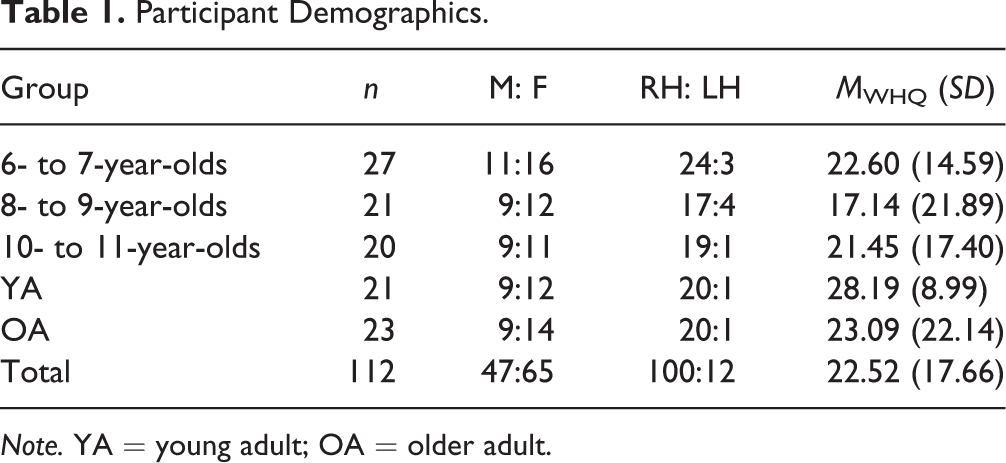
Note. YA = young adult; OA = older adult.
Apparatus and Procedures
Participants were seated across from the researcher. The Waterloo Handedness Questionnaire was used to confirm hand preference (Cavill & Bryden, 2003). Both left and right handers were included. Participants performed two tasks (pickup and pass; pickup and pass for use) within two movement contexts (using a dowel as if it were the actual object; actual object use), using two objects (glass and hammer) that differed in use-dependent experience (Figure 1). Dowels were painted half black for ease of administration (i.e., black represented bottom of the glass and handle). Critical and noncritical (i.e., upright/overturned glass, handle facing away/toward the participant) conditions were performed three times with both hands. Objects were presented using a blocked design (i.e., all trials were performed with the dowel, prior to the actual object) to prevent the actual objects providing cues as to correct performance (e.g., Heath, Westwood, Roy, & Young, 2002); therefore, critical trials allowed us to create variability within each block of trails, via altered object orientation. This helped to ensure participants did not repeat one grasp throughout the duration of the study simply because object-orientation did not change; instead, participants first had to identify the orientation of the object, before selecting their response. A video camera was used to record each session. Videos were coded off-line to note BSC—when participants prioritized a comfortable initial hand posture for the confederate, thus facilitating object use without further object manipulation. This was observed in the handle of the hammer (or end of dowel that represented the handle) being offered to the confederate, and the glass (or dowel that represented the glass) being reoriented to an upright position for the confederate.

Study Setup. Participants Were Seated Across From the Researcher. Participants Performed Two Tasks (Pickup and Pass, and Pickup and Pass for Use) Within Two Movement Contexts ((a): Demonstrate With a Dowel and (b): Actual Object Use), Using Two Objects (1: glass and 2: hammer). The Researcher Had a Pitcher or Nail in a Block of Wood Available to Them.
Data Analysis
Data were collapsed as a function of hand used and only critical conditions were included in analyses using IBM SPSS© Statistics Version 25. Generalized Estimating Equations (GEEs; Liang & Zeger, 1986; Zeger & Liang, 1986) were used (unstructured model) to examine the effect of object (two: glass and hammer), movement context (two: using a dowel as if it were the actual object; actual use), and task (two: pickup and pass; pickup and pass for use) on the proportion of grasps which facilitated BSC. Age was entered as a continuous covariate. Interactions between moderators and covariates examined whether these variables affected the outcome or the slope of change in the outcome. The Bonferroni correction was used for multiple comparisons. The first model included the whole sample, and the second model included only child participants.
Results
Test of model effects from the GEE with the whole sample revealed main effects of object, Wald χ2(1) = 39.93, p < .001; context, Wald χ2(1) = 4.27, p = .039; and task, Wald χ2(1) = 56.50, p < .001. The covariate age was a significant predictor of overall BSC, Wald χ2(1) = 17.37, p < .001 (see Figure 2), and on the effect of object, Wald χ2(1) = 9.44, p = .002. Interactions between object and task, Wald χ2(1) = 26.47, p < .001 (see Figure 3), and object and movement context, Wald χ2(1) = 5.29, p = .021 (Figure 4), were also revealed. Pairwise comparisons revealed BSC was facilitated more often with the glass (or dowel as if it were the glass) in pass for use compared to pass (p < .001) and compared to the hammer (or dowel as if it were the hammer) in both pass (p < .001) and pass for use (p < .001). Comparisons also revealed no difference in BSC when manipulating the dowel as if it were the hammer or the actual hammer (p = 1.00), or with the actual glass compared to when manipulating the dowel as if it were the glass (p = .114). Nevertheless, BSC was facilitated more often with the glass compared to the hammer, regardless of the movement context (p < .001). The subsequent model with only child participants revealed a significant main effect of object, Wald χ2(1) = 9.17, p = .002, such that BSC was facilitated significantly more often with the glass compared to the hammer (p < .001). A significant interaction between task and age, Wald χ2(1) = 9.57, p = .002, revealed BSC was facilitated significantly more often in pass for use compared to pass (p < .001), and this effect was predicted by age.
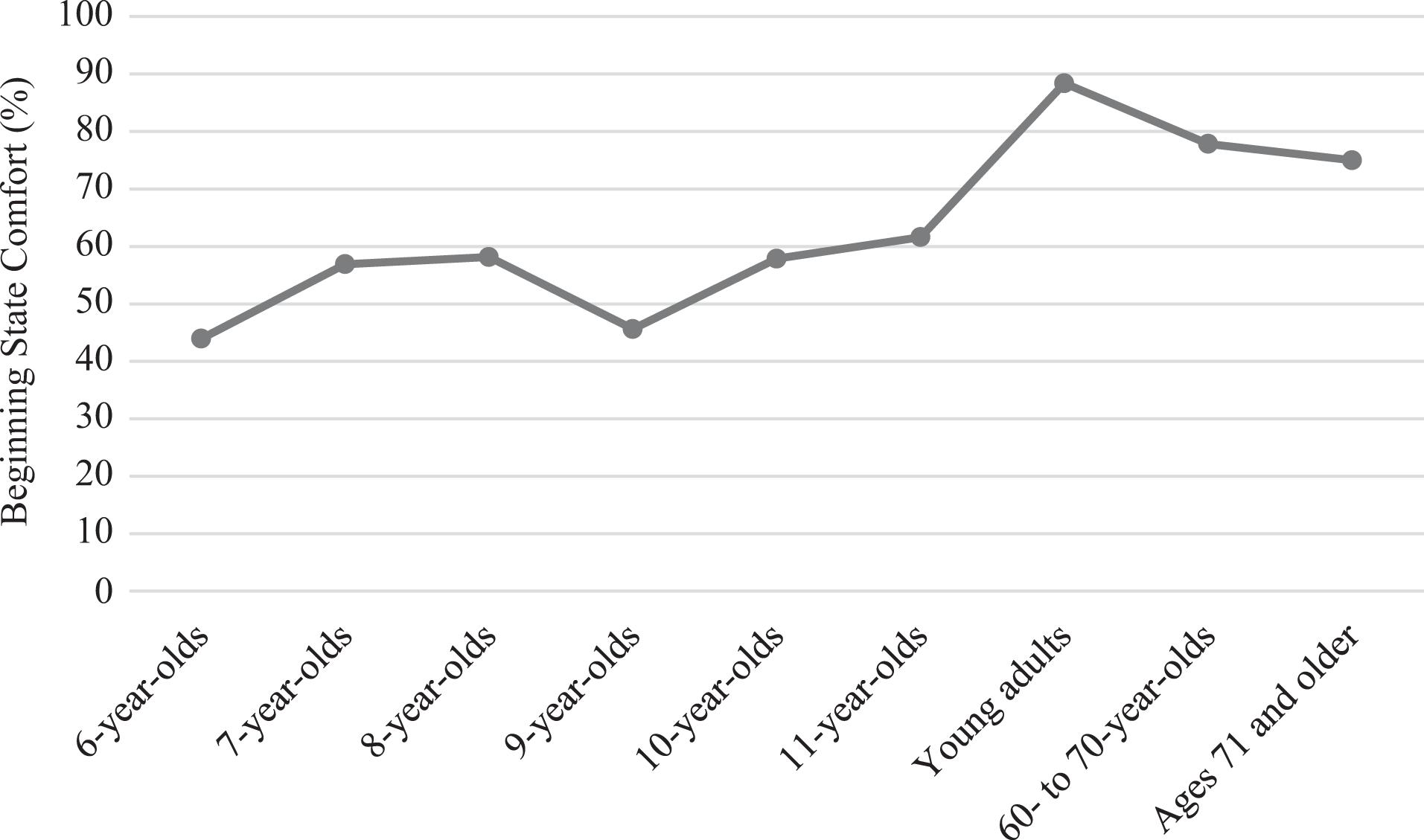
The Continuous Covariate Age Was a Significant Predictor of Beginning-State Comfort Overall, and When Considering the Effect of Object. For Clarity Sake, Age Groups Are Displayed (N = 112).

Beginning-State Comfort Was Facilitated Most Often With the Glass (or Dowel As If It Were the Glass) in Pass for Use Compared to All Other Object/Task Combinations (p < .001). Standard Error Bars Are Displayed. Horizontal Lines Represent Significant Differences (N = 112).

Beginning-State Comfort Was Facilitated Most Often With the Glass (Dowel and Actual Object; p < .001). Standard Error Bars Are Displayed. Horizontal Lines Represent Significant Differences (N = 112).
Discussion
The propensity for children, YA, and OA to facilitate BSC was assessed in the current study. Considering the entire sample, when entered as a continuous covariate, age was a significant predictor of BSC. Furthermore, age was a significant predictor when considering the effect of object. Scharoun and Bryden (2014) observed age-related differences in BSC. Within their study, which was limited to manipulations of an actual class, children as young as 7 facilitated BSC. Therefore, the inclusion of the hammer and dowels (i.e., using the dowel as if it were the hammer and glass), objects with less use-dependent experience, adds to our understanding of joint action object manipulation and developmental processes.
Differences in spatial and temporal features of movement based on the context have been noted elsewhere. According to Goodale, Jakobson, and Keillor (1994), movements should vary toward remembered and actual objects, due to the dependence on working memory. With an increase in contextual information, affordances are more easily perceived (Goodale, Jakobson, & Keillor, 1994; Scharoun, Gonzalez, Bryden, & Roy, 2016). Related work (Scharoun, Bryden, et al., 2016) has noted that the ability for children to perceive affordances tasked longer to refine.
Children learn by exploring (Gibson, 2000); therefore, with use-dependent experience, children are better able to understand tool use behavior. It is generally understood that young children are more proficient in self-directed compared to other-directed tasks, as it is easier to interpret action consequences (e.g., Claxton, McCarty, & Keen, 2009; McCarty, Clifton, & Collard, 1999). According to Piaget’s (1953) notion of egocentrism, young children are limited in their ability to visualize the perspective of others. It can thus be argued that children must first become more proficient manipulating objects they are less familiar with independently, before they are able to successfully engage in joint action tasks.
The age of 7 has been identified as an important age in sensorimotor development. Recent accounts discuss increased proprioceptive acuity between the ages of 7 and 8 that fuels a shift to feed-forward control as sensory processing delays are overcome (King, Kagerer, Contreras-Vidal, & Clark, 2009; King, Oliveira, Contreras-Vidal, & Clark, 2012; King, Pengelinan, Kagerer, & Clark, 2010). Stöckel and Hughes (2015) proposed that young children’s object manipulation reflects more of a stimulus-driven response, as opposed to an action which reflects higher order planning. Glenberg and Soliman (2014) have similarly discussed the parallel between motor learning and changes that occur due to physical growth and maturation. More specifically, experience and acquisition of multisensory feedback update the hand-tool body schema, thus benefitting the forward model and ability to anticipate forthcoming movements (Glenberg & Soliman, 2014; van Elk, van Schie, & Bekkering, 2014). Variability between ages 7 and 10 has been attributed to a transition period (Mason, Bruyn, & Lazarus, 2013).
Other factors were also revealed to influence dependent measures. Regardless of the movement context, BSC was facilitated more often in the glass task compared to the hammer task. Gonzalez et al. (2011) suggested that BSC is facilitated as a function of learned social norms. It has also been suggested that one will increase effort based on the belief that such action will decrease the overall effort (Santamaria & Rosenbaum, 2011). Nevertheless, others (e.g., Scharoun, Scanlan, et al., 2016) have reported that grasp selection reflects consideration of efficiency; therefore, people are more willing to reciprocate helpfulness, if they have been helped before (Bartlett & DeSteno, 2006). It can be argued that BSC was facilitated more often in the glass task as participants had greater use-dependent experience. In contrast, when manipulating the hammer, attention was focused on the detection of affordances (Scharoun Benson, Roy, et al., 2018).
Scharoun Benson, Roy, et al. (2018) argued that differences in behavior emerged when object affordances were more easily detected. The interaction between object and movement context revealed that, within the glass task, BSC was more frequently observed in actual object use compared to when acting with a dowel. Such findings can be attributed to ease of affordance detection (e.g., Ellis & Tucker, 2000; Scharoun, Bryden, et al., 2016; Tucker & Ellis, 1998). The hammer offers the actor a more apparent affordance of “graspability,” considering the clear distinction between the handle and head. Anecdotal evidence revealed that, when manipulating the dowel as a hammer, the distinction between head and handle was easily interpreted by participants. However, differentiating between the top and bottom of the glass was more frequently confused (and had to be clarified by the experimenter), despite the dowels both being painted half black. Future work would benefit from use of eye tracking technology to identify the location and sequence of fixations, and thus, the allocation of visual-spatial attention (Karatekin, 2007) for children, YA, and OA. Belardinelli, Steper, and Butz (2016) revealed that eye fixation data demonstrate a clear anticipatory preference for index finger placement and are dependent on the order of planning; however, this work was limited to YA.
It is important to note that previous work has identified differences in OAs. Such differences have been attributed to cognitive decline, as OAs were separated into younger (60–70) and older (71+) groups (Scharoun, Gonzalez, et al., 2018; Wunsch et al., 2017). This was not feasible, as age was entered into the model as a continuous covariate; however, future work would benefit from purposefully recruiting YA (60–70 years old) and OA (71–80 years old; Scharoun, Gonzalez, Roy, & Bryden, 2016; Scharoun, Gonzalez, et al., 2018; Wunsch et al., 2017) to increase knowledge of aging.
In summary, findings from the current study revealed that with age and use-dependent experience with different objects, individuals are better able to integrate multisensory information in anticipation of an intended action, and thus consider an action partner in their action plan. As such, there is a shift from stimulus-driven, familiar responses, to considering affordances and task demands.
Footnotes
Authors’ note
This article was prepared as part of a PhD thesis. A portion of the data were presented at the North American Society for the Psychology of Sport and Physical Activity (NASPSPA) and the Canadian Society for Psychomotor Learning and Sport Psychology (SCAPPS) conferences.
Funding
The author(s) declared receipt of the following financial support for the research, authorship, and/or publication of this article: This research was funded by the Natural Sciences and Engineering Research Council of Canada.
