



Abstract
Despite abundant research on the benefits of dispositional mindfulness and mindfulness-based interventions, little is known about the naturally occurring developmental course of mindful awareness. Given dramatic strides during adolescence in competencies that may support mindfulness (e.g., emotion regulation), the high school years are a suitable window to study developmental changes in mindfulness. Using an accelerated cohort design to examine the longitudinal trajectory of mindfulness from 9th grade through 12th grade, we employed data from a 5-year study of 3,453 U.S. adolescents (55% female; 40% Latinx, 38% White, 13% Black, and 7% Asian) from high schools in three geographical regions in the U.S. Adolescents annually completed self-report surveys measuring mindful awareness and several internal and external factors. Latent growth curve analyses found that, after controlling for cohort, there was no average linear change in mindful awareness from grades 9 through 12, although there was significant interindividual variability in slopes. Within-person analyses found that in grades when needs-supportive climate was higher and discrimination was lower, adolescents reported greater mindful awareness. Unexpectedly, in grades when perspective taking and prosocial behaviors were higher, mindfulness was lower. These findings inform developmental understanding of mindful awareness and the ways that it naturally occurs and is supported during adolescence.
Keywords
Burgeoning research on the benefits of dispositional mindfulness and mindfulness-based interventions has piqued the interest of scholars focused on adolescence (Felver, Celis-de Hoyos, Tezanos, & Singh, 2016), yet little is known about the normative development of dispositional mindfulness and the everyday internal and external ecologies in which mindfulness develops. Scholars have called for mindfulness to be studied through a developmental lens (Roeser & Eccles, 2015). Our study answers this call by testing age-related changes in dispositional mindfulness during high school and examining within-person links between mindfulness and everyday internal and external factors that may foster or impede its development.
Dispositional Mindfulness
Definitions of mindfulness involve attention to and awareness of present experience, coupled with receptivity to the contents of experience without judgment or elaboration. Whereas some scholars conceptualize mindfulness as having additional dimensions (e.g., Baer et al., 2008); our study focuses on acting with awareness, aligning with Brown, Ryan, and Creswell’s (2007) definition of mindfulness as “receptive attention to and awareness of present events and experiences” (p. 212). Scholars also distinguish between momentary mindful states and dispositional mindful traits, with the latter referring to habitual and chronically enacted mindful states over long periods of time. Our focus is on the mindful awareness dimension of dispositional mindfulness.
Mindful individuals sometimes behave mindlessly, and even the most mindless individuals occasionally exhibit high levels of mindfulness. Such within-person variability highlights the importance of a dynamic account as to why mindful states differ across situations. For example, a mindful state might draw from internal capacities (e.g., self-regulation) and be instantiated through transactions with contexts that prompt mindful awareness (e.g., a friend asks how you feel). Over longer periods of time, developmental change in mindfulness would occur in response to repeated exposure to external conditions that call for mindful awareness and maturation of internal capacities that support mindful awareness. Thus, we conceptualize dispositional mindfulness as inherently developmental, and we apply the relational developmental systems (RDS) framework (e.g., Lerner, Lerner, Bowers, & Geldhof, 2015), which posits development as a dynamic process in which individuals influence, and are influenced by, multiple levels of their ecology.
Age-Related Change in Mindfulness
Examining naturally occurring (i.e., without formal training) intraindividual change in mindfulness is valuable for several reasons. First, understanding normative change can identify periods during which mindfulness interventions may be particularly useful, for example, by supporting growth in mindfulness at times in adolescence when it typically remains stagnant or declines. Second, identifying developmental periods that display growth in mindfulness may suggest periods of heightened plasticity for behavioral change, via an increased capacity to disrupt automatic modes of responding, and redirect attention toward goal-supportive behaviors. Third, studying average patterns of development helps define what is normative, offering a reference point to compare alternative (e.g., poor, excellent) trajectories. Finally, examining age-related changes in mindfulness—and documenting internal and external correlates of such changes—may identify novel, malleable targets for intervention that extend beyond formal mindfulness training.
During adolescence, several cognitive capacities that may support mindfulness normatively develop, including metacognition (e.g., Schneider, 2008), self-regulation (e.g., Harden & Tucker-Drob, 2011), and perspective taking (Van der Graaff et al., 2014). Normative growth in these capacities is noteworthy, given that formal practices to cultivate mindfulness require meta-awareness to notice when attention is off-task (Jankowski & Holas, 2014), self-regulation to return attention to present experience (Bishop et al., 2004), and, for dispositional mindfulness, the capacity to observe one’s thoughts and emotions as from an outsider’s perspective (a form of perspective taking; Selman, 1980). Prior research found that mindfulness is positively associated with perspective taking (e.g., Berry et al., 2018) and certain forms of self-regulation (e.g., Melen, Pepping, & O’Donovan, 2017), and mindfulness practice increases meta-awareness in adults (Hargus, Crane, Barnhofer, & Williams, 2010).
Research on developmental changes in mindfulness during adolescence is limited to a single longitudinal study and several cross-sectional studies. Longitudinally, nonreactivity to inner experience displayed an average linear increase from 8th grade to 9th grade (Galla, Tsukayama, Park, Yu, & Duckworth, 2018). We extend this work by examining a different facet of mindfulness (act with awareness) across high school. Among 10 cross-sectional studies of adolescents using measures in which act with awareness was a partial or exclusive focus, results on age differences have been mixed: Two studies showed negative associations (de Bruin, Zijlstra, van de Weijer-Bergsma, & Bögels, 2011; Robinson, Ladd, & Anderson, 2014), six reported null associations (Brown, West, Loverich, & Biegel, 2011; Ciesla, Reilly, Dickson, Emanuel, & Updegraff, 2012; Greco, Baer, & Smith, 2011; Marks, Sobanski, & Hine, 2010; Petter, Chambers, McGrath, & Dick, 2013; Warren & Wray-Lake, 2017), and two had positive associations between age and dispositional mindfulness (de Bruin, Zijlstra, & Bögels, 2014; 1 Warren, Wray-Lake, & Syvertsen, 2018). Notably, samples came from different countries and had different age ranges and sample sizes; analysis of these factors does not reveal discernable patterns of associations between age and mindfulness. Also, measurement differences did not seem to account for discrepant age–mindfulness associations. Notably, Warren, Wray-Lake, and Syvertsen (2018) examined this question with a large cross-sectional sample of adolescents from seven diverse countries and found small, positive associations between age and mindfulness in all seven countries. Given the cross-national consistency of Warren et al.’s (2018) findings, Galla, Tsukayama, Park, Yu, and Duckworth (2018) findings of longitudinal growth in a different aspect of mindfulness during adolescence, and the conceptual rationale of normative age-related increases in cognitive skills related to mindfulness, we hypothesized that mindfulness increases throughout adolescence.
Internal and External Developmental Ecologies of Mindfulness
In addition to describing normative intraindividual change, RDS stresses examining the internal and external dynamics that explain interindividual differences, intraindividual change, and interindividual differences in intraindividual change. Below, we discuss four internal factors (emotion regulation, perspective taking, empathy, and prosocial behavior) and three external factors (supportive climate, discrimination, and breadth of extracurricular activities) that may play roles in the development of dispositional mindfulness.
Internal Factors
Self-regulation skills including emotion regulation may support mindfulness by providing youth with capacities to shift attention to present experience. Emotion regulation may be essential for managing feelings such as excitation and anxiety that characterize reactivity to present experience and may impede awareness of present experience. Cross-sectional data from college students document a positive link between emotion regulation and dispositional mindfulness (e.g., Pepping, Davis, & O’Donovan, 2013).
Perspective taking involves the capacity to step back from one’s own experiences to understand others’ thoughts and emotions. Critically, it also involves capacities to observe one’s thoughts and emotions as a third party (Selman, 1980), which should support awareness of present experience. Research with college students indicated that perspective taking was positively linked to dispositional mindfulness and mindfulness in interpersonal interactions (Berry et al., 2018). Similarly, empathy involves stepping back from one’s own experience to feel what others are feeling, and empathic concern was positively linked to dispositional mindfulness among college students (e.g., Beitel, Ferrer, & Cecero, 2005).
Finally, prosocial behavior may also support the development of mindfulness, as prosocial acts allow adolescents to practice compassion and gain a sense of identity or mattering, key ingredients to becoming mindful (Roeser & Pinela, 2014). Indeed, prosocial behavior was positively associated with mindfulness in college samples (Berry et al., 2018), and acting on one’s values of care and concern for others was associated with greater mindfulness among adolescents (Warren & Wray-Lake, 2017). Although we acknowledge that mindfulness may also play a role in developing perspective taking, empathy, and prosocial behavior (e.g., Berry et al., 2018), we highlight the capacity to decenter from one’s own experience as common across these constructs, creating a context for the development of dispositional mindfulness.
External Factors
Several external factors are also noteworthy. In particular, external factors that regulate emotion, such as parental, teacher, and peer support, may conduce to mindfulness. Mindful parenting (compassion for and listening to one’s child with full attention) has been positively linked to adolescents’ mindfulness via attachment security (Moreira, Gouveia, & Canavarro, 2018). Additionally, satisfaction of basic psychological needs (autonomy, relatedness, and competence) was positively linked to mindfulness in college students (Pratscher, Rose, Markovitz, & Bettencourt, 2017). Relationships that support basic psychological needs are characterized by high levels of trust and safety, which may free adolescents from anxiety and emphasize that their feelings, experiences, and needs matter (Roeser & Pinela, 2014). At the same time, parents, teachers, and peers who support these needs are likely to show interest in the experiences of the adolescent, serving as an invitation to attend to one’s own emerging experience.
Conversely, contexts in which adolescents are discriminated against may impede the development of mindfulness by undermining basic psychological needs and exacerbating anxiety. For example, racial discrimination was negatively associated with mindfulness in African American college students (Zapolski, Faidley, & Beutlich, 2018). Individuals can experience discrimination for a range of reasons such as race, gender, religion, social class, or weight (Major, Quinton, & McCoy, 2002), and any type of discrimination may detract from the development of mindfulness.
Finally, breadth of extracurricular participation may impede mindfulness. Although participation in extracurricular activities is positively associated with academic achievement (Darling, Caldwell, & Smith, 2005), at the highest levels of participation, some studies show deleterious effects on academic outcomes and belongingness (e.g., Knifsend & Graham, 2012), indicating a curvilinear relationship. Rushing from one activity to the next, “overscheduled” adolescents may feel busy and a sense of hurry—both of which show negative links to mindfulness in adults (Suelmann, Brouwers, & Snippe, 2018).
Current Study
In this novel longitudinal study, we utilize data from a diverse sample of 3,453 adolescents spanning from 9th grade to 12th grade to examine developmental change in—and internal and external factors that predict—adolescents’ dispositional mindfulness over time. Using latent growth models, we test the hypothesis that mindfulness increases linearly across high school. Internal factors (i.e., emotion regulation, perspective taking, empathy, and prosocial behavior) and external factors (i.e., needs-supportive climate, discrimination, extracurricular activity involvement) are estimated as time-varying predictors of dispositional mindfulness. We hypothesized that when youth report higher emotion regulation, perspective taking, empathy, prosocial behavior, and needs-supportive climate, they would also report higher dispositional mindfulness. We further expected that when adolescents reported higher discrimination, they would report lower mindfulness. Aligned with the overscheduling hypothesis, we anticipated a curvilinear relationship between breadth of activity involvement and mindfulness, such that when adolescents engaged in the highest numbers of extracurricular activities, they would report lower mindfulness. Analyses included gender, race/ethnicity, parent education, and financial security as controls. Results can inform developmental understanding of mindful awareness and the ways that it is supported during adolescence.
Method
Participants
Data come from the Roots of Engaged Citizenship Study, a longitudinal study examining the development of civic engagement. Youth in grades 4–12 were surveyed over five waves annually from 2013 to 2018 in 25 schools across three U.S. regions: metropolitan southern California, urban Minnesota, and rural West Virginia. Data for our analyses drew from the high school subsample from 11 schools, as mindfulness was only measured in this age group (N = 3,453; M ageW1 = 14.46, range 14–18; M ageW5 = 17.91, range 13–23; 55.1% female at Wave 1). Students still in schools were recruited for each follow-up and new students were recruited for all grades in Waves 2–3. The self-reported racial–ethnic breakdown was 38.1% White, 40.3% Latinx, 12.7% Black or African American, 6.6% Asian, and 2.3% Other. Youth-reported parental education for at least one parent showed 47.6% had a college degree or higher; 20.6% attended some college; 26.8% had a high school degree or less; and 5% did not know parents’ education. Retention rates overall were 33.8% from Wave 1–2, 45.8% from Wave 2–3, 61.7% from Wave 3–4, and 55.7% from Wave 4–5. Due to the accelerated cohort design and attrition, 2 1,187 students participated in one wave, 752 participated in two, 933 in three, 467 in four, and 114 participated in all five waves. Attrition analyses using χ2 tests showed Asian youth at Wave 2, White youth at Waves 3–5, Latinx youth at Wave 5, and males at Waves 4 and 5 were more likely to attrit. Youth were more likely to attrit who endorsed less empathy (Waves 2 and 4 only), less needs-supportive climate (Wave 4 only), greater discrimination (Wave 2 only), or greater breadth of extracurricular activities (Wave 3 only).
Planned Missing Data
A three-form planned missing data design was used, allowing inclusion of more items without overburdening participants (Little, 2013). Items were divided into a core set (X) and three additional item sets (A, B, C). At each wave, participants received the X set and two of three item sets, which were randomly distributed across participants. Principal components analysis (PCA) is recommended for estimating missing data with a planned missing design (Little, McConnel, Howard, & Stump, 2008). PCA was conducted using the PcAux package for R version 3.4.4 (Howard, Rhemtulla, & Little, 2015). Linear principal components were calculated, which account for missing data due to design and attrition. After running sensitivity analyses, 10 principal components were retained and used as auxiliary variables in full information maximum likelihood estimations in Mplus version 8.
Measures
Tables 1 and 2 provide descriptive statistics and Wave 1 correlations for study variables. To examine developmental change, we restructured variables from wave to grade.
Descriptive Statistics on Mindfulness and Time-Varying Predictors.

Note. N = 3,453. Mindfulness, emotion regulation, empathy, perspective-taking, needs supportive climate, and prosocial behavior were scaled from 1 to 5; discrimination was scaled at Wave 1 from 1 to 6, at Wave 2 from 1 to 7, and at Waves 3–5 from 1 to 5—due to scale differences, discrimination items were standardized at each wave; and breadth of activities was scaled from 0 to 6. For all constructs, greater values indicated higher levels of each construct. M = mean; SD = standard deviation.
Correlations at Wave 1.
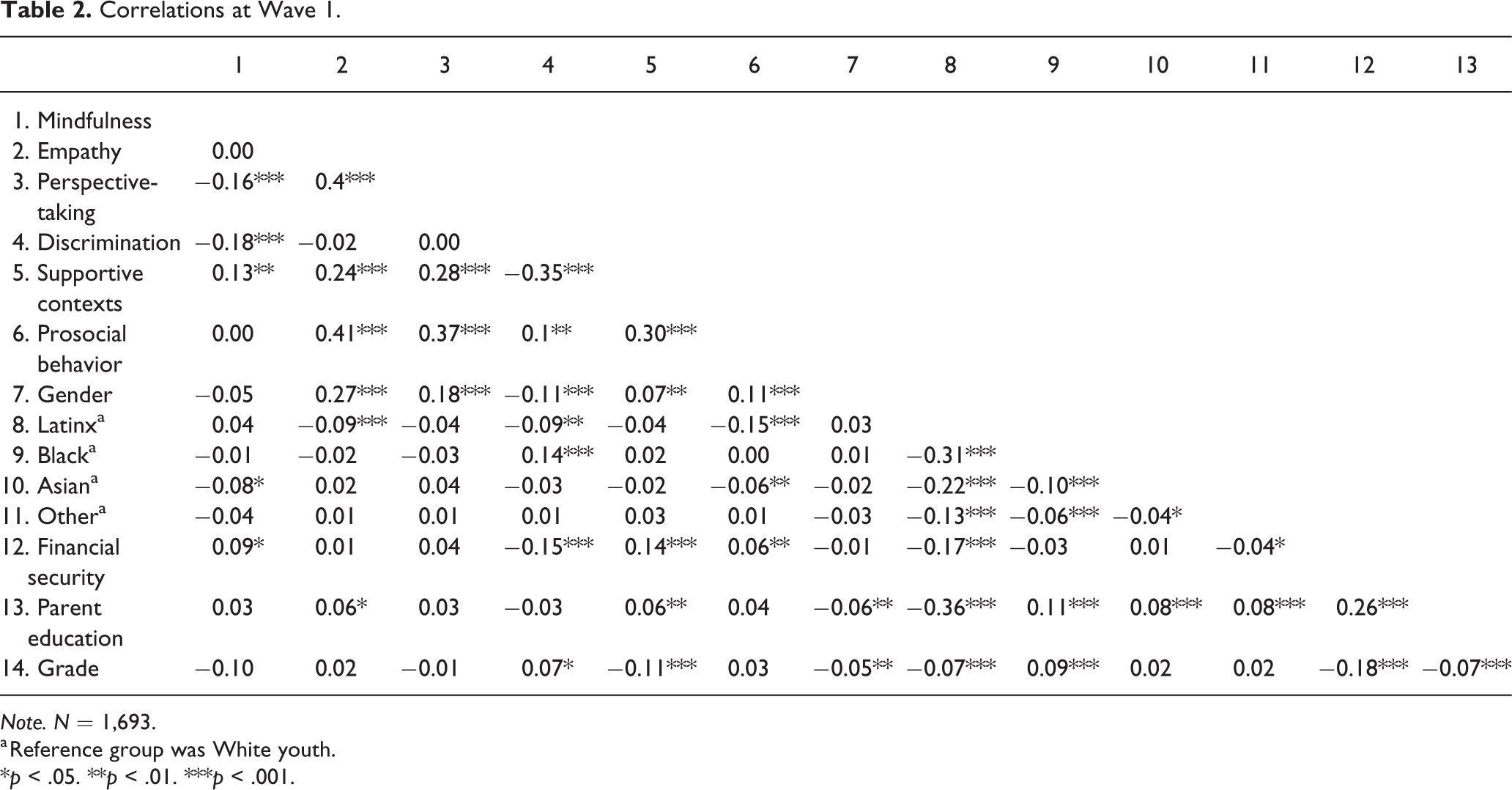
Note. N = 1,693.
a Reference group was White youth.
*p < .05. **p < .01. ***p < .001.
Mindfulness
Mindfulness was assessed using 3 items from the Mindful Attention Awareness Scale–Adolescent (MAAS-A; Brown et al., 2011): “It seems I am running on automatic without much awareness of what I’m doing,” “I rush through activities without being really attentive to them,” and “I find myself doing things without paying attention.” The MAAS-A is widely used and correlates positively with conscientiousness and self-regulation and negatively with neuroticism and negative affect (Brown et al., 2011). The 3 items used are among those identified as holding the greatest amount of scale information (Van Dam, Earleywine, & Borders, 2010). Responses ranged from 1 = not at all like me to 5 = very much like me. Items were reversed such that higher scores signified greater mindfulness. 3 Internal reliability using omega ranged from .58 to .79 across waves and .66 to .71 across grades.
Emotion regulation
At Waves 2–5, emotion regulation was assessed using four items: “When I get upset, I am usually able to calm myself down” (Search Institute, 2011); “When I’m upset, I can still get things done” (Goals subscale of the Difficulties in Emotion Regulation Scale; Gratz & Roemer, 2004); “I have control over my feelings;” and “I am always in charge of my emotions” were written for the current study. Responses ranged from 1 = strongly disagree to 5 = strongly agree. Omegas ranged from .74 to .75 across waves and .71 to .76 across grades. Although not ideal that emotion regulation items were unavailable at Wave 1, this missingness was distributed evenly across grades, resulting in 17.2% additional missing data in emotion regulation at each grade.
Perspective taking
Three perspective taking items were adapted from the Perspective Taking subscale of the Interpersonal Reactivity Index (Davis, 1996): “I try to understand people by thinking about how things look from their point of view,” “When I talk to others, I try to imagine how I would feel if I were in their place,” and “When I’m upset at someone, I try to think about how they feel.” Responses ranged from 1 = not at all like me to 5 = very much like me. Omegas ranged from .68 to .79 across waves and .77 to .78 across grades.
Empathy
Three empathy items were adapted from Davis (1996): “I feel sad when I see someone being treated unfairly,” “It bothers me when bad things happen to other kids,” and “When I see another person who is hurt or upset, I feel upset too.” Responses ranged from 1 = strongly disagree to 5 = strongly agree. Omegas ranged from .73 to .77 across waves and .74 to .76 across grades.
Prosocial behavior
Four items assessed prosocial behavior (Syvertsen, Wray-Lake, & Metzger, 2015): “I have stood up for a classmate who was being picked on,” “I have helped a classmate with homework,” “I have shared school supplies with a fellow student who needed them,” and “I have helped my neighbors with projects for no pay.” Responses ranged from 1 = never to 5 = very often. Omegas ranged from .61 to .67 across waves and .66 to .69 across grades.
Needs-supportive climate
Items for psychological needs-supportive contexts were based on self-determination theory (Ryan & Deci, 2000) to assess support of the three basic psychological needs (autonomy, relatedness, and competence) in parents, teachers, and friend relationships. Three items assessed each relationship, starting with “My parents/teachers/friends”: “accept me as I am,” which came from Armsden and Greenberg (1987) and “respect my opinions,” and “always tell me I can succeed at my goals” were written using theory as a guide. Responses ranged from 1 = strongly disagree to 5 = strongly agree. Omegas ranged from .76 to .80 across waves and .75 to .77 across grades.
Discrimination
Discrimination was assessed with four items adapted from the Everyday Racism Scale (Williams, Yu, Jackson, & Anderson, 1997). Youth were asked how often in daily life the following happens because of something about them (e.g., skin color, appearance, or beliefs): “You are treated with less respect than other people,” “People assume you’re not smart or intelligent,” “You are threatened or harassed,” and “You are watched closely by security guards or store clerks at the store or the mall.” At Wave 1, youth responded on a 6-point scale from 1 = never to 6 = almost every day. At Wave 2, the scale ranged from 1 = never to 7 = daily and at Waves 3–5, the scale was 1 = never to 5 = very often. Due to scale differences, discrimination items were standardized at each wave. Omegas ranged from .75 to .83 across waves and .91 to .92 across grades. Although not used in the current study, participants indicated discrimination experiences were due to one or more of the following: race or ethnicity (range across waves = 28–44%); sex or gender (15–31%); age (27–46%); sexual orientation (4–7%); religious beliefs (11–16%); weight (19–24%); physical disability (4–8%); language or accent (10–15%); or other (17–35%).
Breadth of extracurricular activities
To assess breadth of activity involvement, we summed the number of activities reported across six categories (Eccles & Barber, 1999): volunteering; participating in school clubs or organizations (other than sports); participating in community clubs or organizations; performing or practicing art, music, or drama; attending programs, groups, or services at a church, synagogue, mosque, or other religious/spiritual place; and playing individual or team sports in school or community. All youth received all items, ensuring the sum of activities was consistent across youth.
Sociodemographic control variables
Gender, race/ethnicity, financial security, and parent education were included as control variables. Gender was assessed via binary self-report, 0 = male; 1 = female. Race/ethnicity was dummy coded as Black, Latinx, Asian, White, and Other (White as reference). Financial security was assessed on a scale of 1 = We have a hard time buying the things we need, 2 = We have just enough money for the things we need, 3 = We have no problem buying the things we need, and we can also sometimes buy special things, or 4 = We have enough money to buy almost anything we want (Roehlkepartain, Scales, Roehlkepartain, & Rude, 2002). Parental education was used as a three-point continuous scale of 1 = high school degree or less, 2 = some college, to 3 = college degree or higher (don’t knows were coded as missing).
Analytic plan
First, longitudinal measurement invariance of mindfulness was examined (see Table 3) to ensure measures were equivalent across waves (compatible with the study design) and grade (compatible with the analysis model). In establishing longitudinal measurement invariance, change in comparative fit index (CFI) values greater than .01 was used to indicate worse fitting models (Cheung & Rensvold, 2002), as χ2 tests are sensitive to sample size (Little, 2013). Invariance models by wave achieved metric (factor loading) invariance, based on nonsignificant differences in factor loadings. Scalar (intercept) invariance was achieved after freeing 1 item, “I find myself doing things without paying attention.” Invariance by grade achieved metric invariance and scalar invariance.
Invariance Tests of Mindfulness by Wave and Grade.
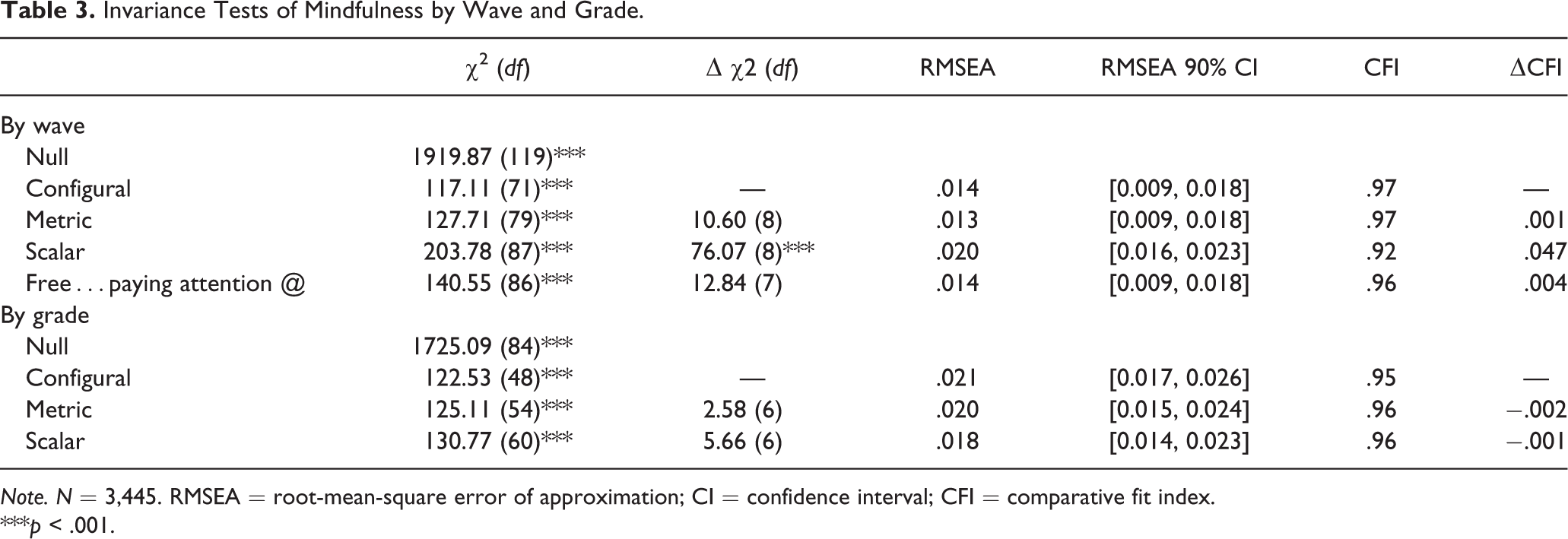
Note. N = 3,445. RMSEA = root-mean-square error of approximation; CI = confidence interval; CFI = comparative fit index.
***p < .001.
Latent growth curve modeling was used to estimate trajectories of mindfulness. Accelerated cohort designs use adjacent segments of data across cohorts to approximate a single, continuous developmental trajectory spanning grades 9–12. To identify the best-fitting trajectory, unconditional growth curve models were estimated using restructured variables that represent grade-as-time. Grade and wave at study entry were included as predictors to test the appropriateness of combining data across cohorts into a single developmental trajectory. In estimating the growth model, linear and quadratic growth factors were compared to a latent basis model where the first and last time factor loadings were fixed at 0 and 1, respectively, and others were freely estimated. The best fitting trajectory was determined via model comparisons examining significance of growth parameters, ΔCFI of less than .01, and χ2 difference tests. After establishing unconditional growth models, conditional growth models were estimated with all predictors entered simultaneously as time-varying covariates (TVCs). Each TVC was group-mean centered. Gender, race/ethnicity, financial security, and parental education were included as time-invariant controls. Grade and wave at study entry and number of waves completed were also included as covariates to account for the accelerated cohort design and attrition.
Results
Unconditional Latent Growth Models
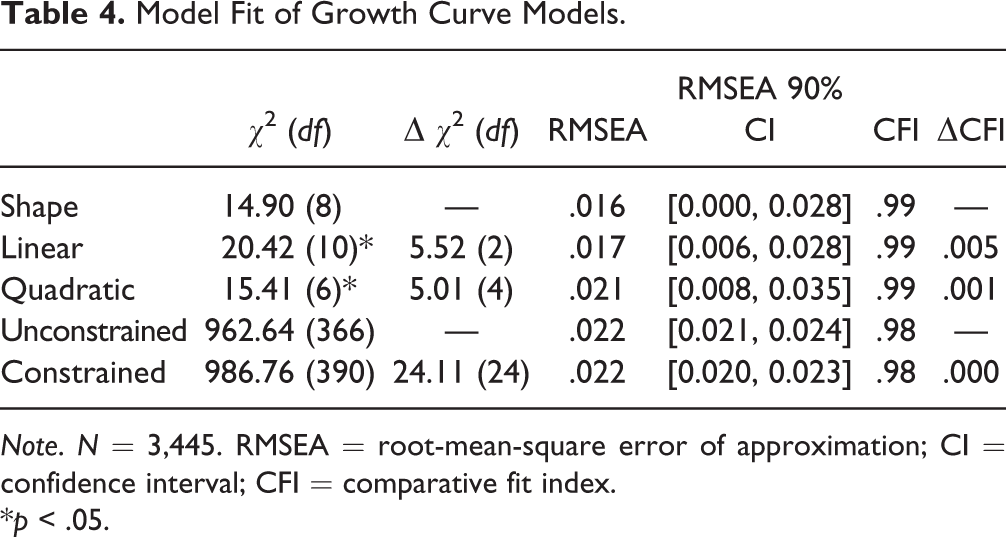
First, in estimating the unconditional growth models, the intercept was set at grade 10 (a central point) and slope factor loadings were set to increments of 0.1, as a small metric can ease estimation. To test for cohort effects, growth factors were regressed on grade and wave at study entry. A linear model provided the best fit, as this model showed no difference from the less parsimonious shape model (see Table 4), and the quadratic model showed no significant quadratic growth and no significant improvement in fit over the more parsimonious linear model.
Model Fit of Growth Curve Models.
Note. N = 3,445. RMSEA = root-mean-square error of approximation; CI = confidence interval; CFI = comparative fit index.
*p < .05.
In the linear model, the intercept was significant, but the slope was not (see Figure 1). The variances for the intercept and slope were significant, indicating individual differences in grade 10 mindfulness and in linear change in mindfulness. Grade at study entry (centered at grade 10) did not predict the intercept, but predicted the slope: for youth starting the study in 11th and 12th grades, the slope decreased by −.023 (α × factor loading of .01) each year, respectively, indicating that youth recruited at older grades showed greater decline in mindfulness relative to youth recruited at younger grades. Wave at study entry predicted the intercept but not the slope, suggesting youth recruited in later waves had lower mindfulness at grade 10. Overall, mindfulness remained relatively stable across 9th–12th grades, though youth recruited at older grades showed slight declines across time and youth entering the study later were lower in 10th grade mindfulness.

Unconditional Growth Models for Mindfulness.
Full Predictor Model
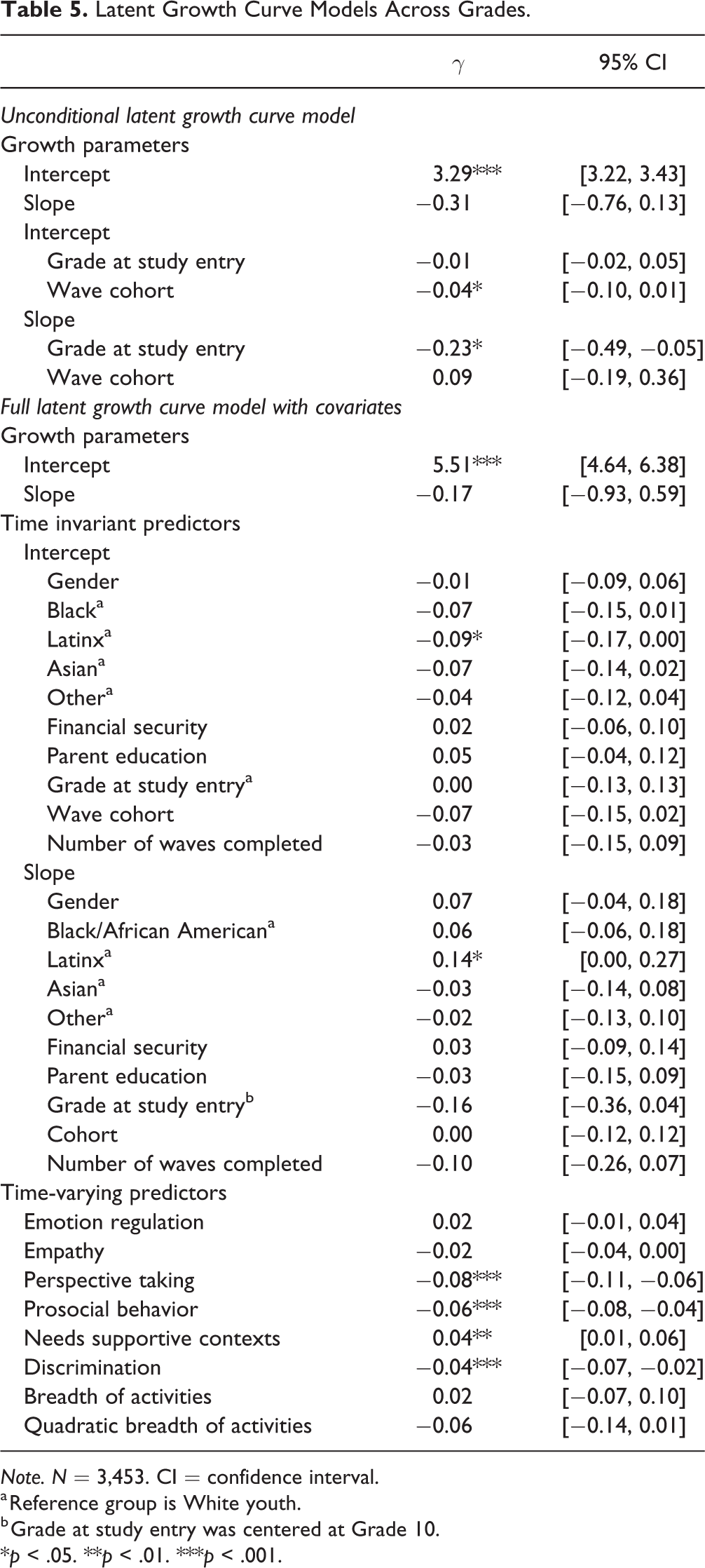
Next, full models including predictors were estimated. Models with TVCs constrained to be equal across time were compared to fully unconstrained models to test whether predictors were similarly associated with mindfulness at each grade. Compared to an unconstrained model, constraining time-varying effects did not significantly worsen model fit (see Table 4). Thus, the results presented below refer to a single time-varying effect constrained to equality across grades, indicating that predictors related to mindfulness are similar across grades (see Table 5).
Latent Growth Curve Models Across Grades.
Note. N = 3,453. CI = confidence interval.
a Reference group is White youth.
b Grade at study entry was centered at Grade 10.
*p < .05. **p < .01. ***p < .001.
Regarding internal factors, perspective taking and prosocial behavior were unexpectedly negatively related to mindfulness over time. In other words, at occasions when youth reported more perspective taking or more prosocial behavior, they tended to report lower mindfulness. Empathy and emotion regulation had nonsignificant associations with mindfulness.
Regarding external factors, psychological needs-supportive contexts were positively related to mindfulness, meaning that at grades when youth’s relationships supported their basic psychological needs, they reported higher mindfulness. Discrimination was negatively related to mindfulness; at grades when youth reported higher than their own average levels of discrimination, they reported lower mindfulness. In contrast to the overscheduling hypothesis, neither breadth of extracurricular activities nor the quadratic effect of breadth of extracurricular activities were significantly related to mindfulness.
Regarding sociodemographics, only race/ethnicity had significant effects. Compared to White youth, Latinx youth had on average higher levels of mindfulness at grade 10 and exhibited less steep declines in mindfulness across grades, meaning that the mindfulness slope for Latinx youth was very close to zero. Grade and wave at study entry became nonsignificant, suggesting that including predictor variables accounted for potential differences among youth who started the study at later grades.
Discussion
Answering the call for developmental research on mindfulness, we found no evidence of normative age-related changes in dispositional mindfulness across high school. However, several internal and external factors displayed consistent over-time associations with mindfulness. These findings contribute to understanding the development of mindfulness by suggesting that the act with awareness facet of mindfulness is unlikely to be tightly tied to an age-graded, maturational timetable, but instead likely develops in more ideographic ways through dynamic individual ←→ context relations.
Age-Related Change in Mindfulness
The finding of no average age-related change in mindful awareness across high school contrasts with Galla et al. (2018), who found a longitudinal increase in nonreactivity from 8th grade to 9th grade. This discrepancy likely rests on different focal aspects of mindfulness (awareness vs. nonreactivity) and their differential relations to age-graded competencies. For example, nonreactivity is tightly connected to emotion regulation, which normatively increases in adolescence (McRae et al., 2012), whereas acting with awareness may have looser ties to emotion regulation (indeed, our data showed no within-person link with emotion regulation) and did not follow a pattern of linear growth, on average.
Perhaps mindful awareness, rather than showing normative change with age, develops more ideographically, responding to various internal and external influences. Indeed, we found significant variance in slopes, indicating that mindfulness changes more for some youth than for others—potentially in different directions—across high school. Thus, dispositional mindfulness may be person-specific, determined by context and ability, and ebb and flow depending on the complex dynamics of each person’s unique and constantly evolving developmental system. Therefore, it is important to identify malleable factors in adolescents’ lives that are linked to changes in mindfulness.
Internal and External Developmental Ecologies of Mindfulness
As hypothesized, needs-supportive contexts displayed positive within-person links to mindful awareness. These findings converged with research showing that contexts that satisfy basic psychological needs are positively linked to mindfulness (Moreira et al., 2018; Pratscher et al., 2017), suggesting that mindfulness may develop in the same kinds of supportive relational contexts that drive positive development more generally (Osher, Cantor, Berg, Steyer, & Rose, 2018). Although previous research suggests mindfulness may help individuals fulfill basic psychological needs (Pratscher et al.), our data, while correlational, suggests needs-supportive contexts are conducive to mindful awareness. Social partners who support autonomy and relatedness are sensitively attuned to the other’s goals, feelings, and experiences, and adolescents with such relationships are likely to join in this by attending to their own experiences. More broadly, when youth believe that adults and peers in their lives accept them, respect them, and have faith in their abilities, they likely have a greater sense of security and less reason to be anxious, freeing attention for present-moment experience.
Aligning with this observation, discrimination due to race, age, gender, and other factors was negatively linked to mindful awareness, suggesting that marginalizing experiences may work against awareness of present experience. Whereas dispositional mindfulness may help adolescents flexibly process discrimination (Brown-Iannuzzi, Adair, Payne, Richman, & Fredrickson, 2014), daily experiences of discrimination and other adverse childhood experiences nevertheless impair prefrontal cortex development (Felitti & Anda, 2010), which could thwart the development of mindfulness. Considering how under-supportive schools, strained parents, and discrimination often coincide in the lives of marginalized youth, a key study implication is that youth may have systematically different opportunities to develop mindfulness or enjoy its benefits depending on societal treatment.
Importantly, needs-supportive contexts and discrimination—but generally speaking not sociodemographics (e.g., race, gender, socioeconomic status)—predicted mindfulness, suggesting that social position per se does not relate to mindfulness, but rather experiences of security and anxiety may foster or thwart mindfulness. Other external contexts similarly fall along the security–anxiety continuum and may be viable contenders for understanding mindfulness. For example, appropriate levels of challenge and mastery in classrooms, safe homes, schools, and neighborhoods may foster mindful attention, whereas stereotype threat, cyber bullying, family discord, and other adversities may impede developing mindful attention.
Our extracurricular activity hypothesis was not supported, and thus we cannot add clarity to the mixed body of research on high levels of extracurricular involvement and positive youth development (e.g., Knifsend & Graham, 2012; Mahoney & Vest, 2012). Perhaps extracurricular participation engenders heterogeneous experiences obscuring an overall effect, as some experiences may support mindful attention, whereas others may hinder it. Future research should investigate whether specific experiences arising from extracurricular activities explain interindividual differences in mindful awareness.
We also tested internal factors theoretically relevant to mindfulness. Finding no over-time associations between mindful awareness and emotion regulation or empathy contrasts with previous studies finding positive links in college samples (Beitel et al., 2005; Berry et al., 2018, Study 1; Melen et al., 2017; Pepping et al., 2013). Emotion regulation may have more direct connections to nonreactivity than to acting with awareness. Additionally, more nuance may be needed in studying distinct emotion-regulation strategies in relation to mindfulness. Similarly for empathy, the other-focus required of empathy may be less compatible with a focus on one’s own immediate experience and more robust, interpersonal forms of mindfulness may show stronger links to empathy (Pratscher et al., 2017).
This logic may also account for our hypothesis-refuting findings that on occasions with higher perspective taking and prosocial behavior, mindfulness was lower. The other-focus entailed in listening to outside perspectives and helping others may detract from receptive attention to one’s own present experience.
Limitations and Future Directions
Our model included all predictors entered simultaneously in addition to numerous controls, thus offering a robust test of hypotheses. Nonetheless, the small and intermittent effects we observed—including the nonsignificant slope for mindful awareness—is a limitation. Rather than testing normative patterns of mindful awareness for an entire sample, future research should investigate ideographic developmental processes that unfold on individualized time scales (e.g., over a time period when one experiences marginalization or anxiety). This approach aligns with the idea that changes in mindful dispositions reflect adaptations to repeatedly experienced contextual stimuli within one’s developmental system. Indeed, the variability in slopes implies that growth mixture modeling may be fruitful in identifying common patterns of developmental change for subgroups of adolescents whose trajectories deviate from the overall group average (Warren, Wray-Lake, Rote, & Shubert, 2016). A more complete understanding of how mindfulness develops—including understanding counterintuitive links between mindfulness and perspective taking and prosocial behavior—could result from “burst designs” (Sliwinski, Hoffman, & Hofer, 2010) involving dozens of densely spaced, intensive longitudinal measurements that “zoom in on” and clarify the nature of the developmental process.
The small and intermittent effects observed in our study may also reflect sampling and measurement limitations. Although the sample was large and adequately powered, it lacks generalizability and thus replication of these findings is needed. Although our measures achieved acceptable reliability and were generally drawn from valid scales, our use of short scales could have limited the scope of the constructs and thus narrowed the tests of hypotheses. Additionally, although the MAAS-A purports to measure the acting with awareness facet of mindfulness, items may instead tap into perceived inattentiveness (Grossman, 2011; Van Dam et al., 2010). Future research should examine developmental questions related to mindfulness not only using other self-report scales (see Abujaradeh, Colaianne, Roeser, & Galla, 2020), but also utilizing behavioral and other-report measures (see Rickert & Roeser, 2020).
Conclusion
Longitudinal inquiry into naturally occurring mindfulness has only just begun. Stagnant trajectories in mindful attention during high school call for identifying, understanding, and exploiting factors that play a role in within-person change. Our data offer tentative evidence that mindful awareness naturally develops in the context of low levels of discrimination, and when parents, teachers, and peers support adolescents’ autonomy, competence, and relatedness, yet even these effects were small and need to be replicated. Clearly, more work remains to build an adequate account of the development of mindful awareness during adolescence.
Footnotes
Funding
The author(s) received no financial support for the research, authorship, and/or publication of this article: This research was made possible through the support of a grant from the John Templeton Foundation and the National Science Foundation under Grant 1551520. Any opinions, findings, and conclusions or recommendations expressed in this material are those of the authors and do not necessarily reflect the views of the National Science Foundation or the John Templeton Foundation.
