



Abstract
Rooted in commitment theory, this study examines dedication, perceived investments, and felt constraint, three unique aspects of commitment, in midlife using data gathered from a sample of 224 adults surveyed at ages 43 and 50 years. Positive and negative dimensions of couple relations (partner supportiveness and the extent to which one’s partner is demanding and critical, referred to as strain) assessed longitudinally and midlife-specific circumstances, including being in a first marriage or remarriage and parental and empty nest status, were examined as predictors of commitment at age 50. Latent change score modeling revealed partner support and strain as robust predictors of commitment. Higher levels of partner support at age 43 and a more gradual intraindividual decrease in support between ages 43 and 50 predicted higher dedication and perceived investments and less felt constraint at age 50. Higher age 43 levels of partner strain predicted more perceived investments and felt constraint at age 50, while a more rapid increase in strain predicted less dedication and more felt constraint. Being in a first or remarriage, being a parent, or having an empty nest did not predict commitment. These results highlight the importance of initial levels and changes in couple relations for shaping midlife commitment.
Divorce in middle and later life, dubbed “gray divorce,” doubled in the U.S. between 1990 and 2010 (Brown & Lin, 2012), a startling trend, given its potential costly consequences for the health and well-being of the individuals, their families, and to societies (Canham, Mahmood, Stott, Sixsmith, & O’Rourke, 2014). Relationship science has focused extensively on understanding the stability of newlywed and younger adult partnerships, but the increasing prevalence of gray divorce invites further research on the relationship dynamics undergirding partnership stability in midlife.
Commitment, or the intention to remain in a partnership (Rusbult, 1980; Stanley & Markman, 1992), is one of the most extensively scrutinized constructs in relationship science, for good reason. Committing to a future with one’s partner is the mechanism through which one initiates and secures long-term romantic attachments (Stanley, Rhoades, & Whitton, 2010) and sustained commitment is a critical contributor to relationship stability (Rhoades, Stanley, & Markman, 2010). The present research draws on data from 225 continually partnered individuals at ages 43 and 50 years to examine midlife predictors of three aspects of commitment to a partner (married or not) in midlife: dedication (“I would like our partnership to last for a long time”), perceived investments (“I have invested a lot in this relationship”), and felt constraint (“I would end this relationship if it wasn’t so hard to do”).
Background
Relationship science has produced a rich theoretical literature explicating the components of commitment (e.g., Johnson, 1973; Rusbult, 1980; Stanley & Markman, 1992). While different authors emphasize different components of commitment, such as quality of alternatives (Johnson, 1973) and investments (Rusbult, 1980), these perspectives share a conceptualization of commitment as both the desire to maintain and improve a partnership, referred to as dedication, and the forces that make it more difficult to end a union, referred to as constraint (Stanley & Markman, 1992). Dedication is most influenced by partnership quality, while constraints arise from a variety of internal or external forces, including social pressure to remain partnered and the tangible resources and obligations that accumulate over time (e.g., joint possessions, having children; Stanley et al., 2010). When a relationship is going well, dedication and constraint contribute to stability, but when a partnership sours and one feels trapped, referred to as felt constraint, the risk of dissolution increases. Thus, we focus on dedication, perceived investments, and felt constraint, three aspects of commitment that prior research found were associated with young adult relationship dissolution (Rhoades et al., 2010) and may well continue to play an important role in the stability of partnerships later in life.
We examine commitment in midlife, an important and understudied segment of the life span (Lachman, 2015). As many of the age-graded circumstances from the young adult period of life (e.g., finishing school, transitioning to parenthood) have been negotiated by midlife (Krahn, Chai, Fang, Galambos, & Johnson, 2018), the middle years are a particularly interesting time to investigate commitment. Theoretical perspectives on the determinants of commitment have emphasized the central role of couple dynamics (Rusbult, 1980; Stanley & Markman, 1992) in giving rise to commitment, so we examine perceived partner support and strain (extent to which a partner is demanding and critical) as positive and negative dimensions of couple relations that might influence commitment. By midlife, those in continuing partnerships have been together many years, on average, and their relationship dynamics may have stabilized years before (Proulx, Ermer, & Kanter, 2017), suggesting initial levels of support and strain will predict future commitment. Nevertheless, relationships can erode or improve over time, raising questions about how changes in perceptions of support and strain contribute to commitment. Thus, we explore how between-person differences at age 43 and changes in perceived support and strain between age 43 and 50 predict commitment at age 50, controlling for relationship duration.
Those who are married have legally formalized their commitment to a partner, but many individuals have already experienced a divorce and re-partnered by midlife (Brown, Lin, Hammersmith, & Wright, 2018). Remarried couples compared to those in first marriages tend to hold more positive attitudes toward divorce (Whitton, Stanley, Markman, & Johnson, 2013) and have a higher likelihood of experiencing further relationship instability (Sweeney, 2010). Thus, a past divorce may lead individuals to be less committed in future partnerships, investing less in the success of these unions. As such, we consider being in a first or higher order marriage compared to being in a nonmarital union as potential predictors of commitment.
Parenthood also influences commitment. Prior work found dedication decreased following the birth of a child (and continued to decrease for fathers) and felt constraint increased, particularly among unmarried fathers (Doss, Rhoades, Stanley, & Markman, 2009; Kamp Dush, Rhoades, Sandberg-Thoma, & Schoppe-Sullivan, 2014). By midlife, the transition to parenthood is likely a distant memory and parents are more likely to experience the transition to an “empty-nest” as children leave the family home (Mitchell & Lovegreen, 2009). The association between the empty nest and commitment is an open question, although prior work found an empty nest did not predict the likelihood of gray divorce (Lin, Brown, Wright, & Hammersmith, 2018). Nevertheless, children leaving the home may reduce one’s sense of feeling trapped in a partnership even though it may not directly predict relationship dissolution, so we include parental status and whether all children have left home as predictors of commitment. Based on the diverging patterns in men and women’s commitment across the transition to parenthood, we include gender as an additional predictor.
Present Study
Drawing from prior theory and research on the development of commitment, this study examines predictors of dedication, perceived investments, and felt constraint in midlife. We consider initial levels at age 43 and changes between ages 43 and 50 years in partner support and strain, along with relationship duration, being in a first or remarriage, parental and empty nest status, and gender as predictors of commitment.
Method
Procedures
Data were drawn from the Edmonton Transitions Study (ETS), a 32-year longitudinal study that surveyed adults 8 times from age 18 until age 50. At baseline in 1985, 983 grade 12 students from 6 high schools in a Canadian city completed survey questionnaires. Of the baseline participants, 47% were women and 80% were born in Canada. Most participants (85%) reported their race as White, 11% were Asian, 1% were Black, 1% identified as Aboriginal, and the remaining 2% were of mixed ethnicity or another race. Follow-up surveys at ages 19, 20, 22, and 25 years were sent to only continuing participants, but all baseline participants were targeted for data collection at ages 32, 43, and 50 years. Couple relationships were first assessed in the ETS in 2010, so this study uses data gathered in 2010 and 2017 when participants were 43 and 50 years old, respectively. In 2017, data were obtained from 404 original participants, a 41% response rate after 32 years. All participants received a CAD$50 Amazon gift card. More information about the study design can be found in past publications (Galambos, Barker, & Krahn, 2006; Johnson, Galambos, & Krahn, 2014). Ethics approval has been obtained for all phases of this study.
Given our focus on understanding midlife predictors of commitment within intimate partnerships, we filtered our sample to include those in continuing relationships at ages 43 and 50 (n = 224). Just over half of this sample was female (52%) and average relationship length at age 43 was 16 years (SD = 5.98 years). At age 50, most were in their first marriage (81%), 9% were remarried, and 10% were living together without being married. The majority were parents (91%) and 14% reported having empty nests. In terms of education, 13% completed high school, 14% started university or a technical program, 32% earned a technical school diploma, 26% completed their bachelor’s degree, and 15% earned a graduate degree.
Measures
Commitment
Dedication, perceived investments, and felt constraint were each measured for the first time at age 50 with single items similar to shortened commitment measures in prior research (e.g., Johnson & Horne, 2016). The items for dedication commitment (“I would like our partnership to last for a long time”) and perceived investments (“I have invested a lot in this relationship”) were adapted from The Investment Model Scale (Rusbult, Martz, & Agnew, 1998). The felt constraint item (“I would end this relationship if it wasn’t so hard to do”) was adapted from the felt constraint scale reported by Rhoades, Stanley, and Markman (2010). Responses ranged from 1 = strongly disagree to 5 = strongly agree.
Partner support and strain
Two scales assessing positive and negative dimensions of couple relations were administered at ages 43 and 50. The measure of partner support was derived from a prior scale of affective support (Turner, Frankel, & Levin, 1983) and consists of the mean of 6 items (e.g., “Does your spouse or partner really care about you?” and “Does he or she understand the way you feel about things?”). Cronbach’s α was .85 at age 43 and .86 at age 50. Partner strain was the mean of 2 items adapted from a measure of negative interactions with a partner (Schuster, Kessler, & Aseltine, 1990): “Does he or she (spouse/partner) criticize you?” and “Does he or she make too many demands on you?” The items correlated at .57 at age 43 and .51 at age 50. Responses ranged from 1 = never to 5 = almost always.
First marriage and remarriage
Participants reported their marital status and those who had ever been married reported their total number of marriages. Those married with one marriage were coded as being in a first marriage (0 = not in a first marriage and 1 = in a first marriage) and those married with more than one marriage were coded as being remarried (0 = not remarried and 1 = remarried). Those not in a first or remarriage were all in a nonmarital cohabiting partnership (10%), which served as the reference category in the analysis. Marital status changed for only six participants between ages 43 and 50 (they all got married), so the age 50 reports of marital status were used.
Parental status and empty nest
Participants’ total number of children was recoded into a binary parenthood variable (0 = no, 1 = yes). Empty nest was assessed by asking whether all the respondents’ children were living on their own (0 = no and 1 = yes). Reports from age 50 were used; empty nest was not previously measured.
Gender and relationship length
Participants reported their gender (0 = female, 1= male) and length of their relationship in years at age 43.
Analytic Plan
We answered our research questions by computing a latent change score (LCS) model (McArdle, 2009) in Mplus 8 (Muthén&Muthén, 1998–2017). This approach partitions variance in constructs assessed longitudinally into initial levels and changes between subsequent time points. LCS modeling allows us to examine the influence of age 43 levels of partner support and strain, as well as changes in support and strain between ages 43 and 50, on the three commitment constructs at age 50. The other covariates were entered as traditional predictors since they were each assessed once. The amount of missing data was low, given that we selected continuously partnered participants (from 0% to 4.5%) and full-information maximum likelihood estimation was used to handle missing values (Enders, 2010). Overall model fit was evaluated with the following global fit indices: the χ2 test, the root mean square error of approximation, the comparative fit index, the Tucker–Lewis Index, and standardized root mean square residual following conventional cut-off criteria (Little, 2013).
Results
Correlations
Bivariate correlations among the study variables appear in Table 1. Dedication was weakly associated with higher perceived investments and strongly associated with less felt constraint, underscoring the importance of accounting for this shared variance in the multivariate analyses. Felt constraint and perceived investments were not associated. Partner support was associated with higher dedication and perceived investments and less felt constraint, while partner strain was associated with less dedication and higher felt constraint, but not perceived investments. Being in a first marriage was correlated with more perceived investments and those in remarriages perceived fewer investments. Men also reported less felt constraint but more strain at ages 43 and 50. Being a parent, having an empty nest, and relationship duration were not associated with commitment.
Correlations and Descriptive Statistics for Study Variables (N = 224).
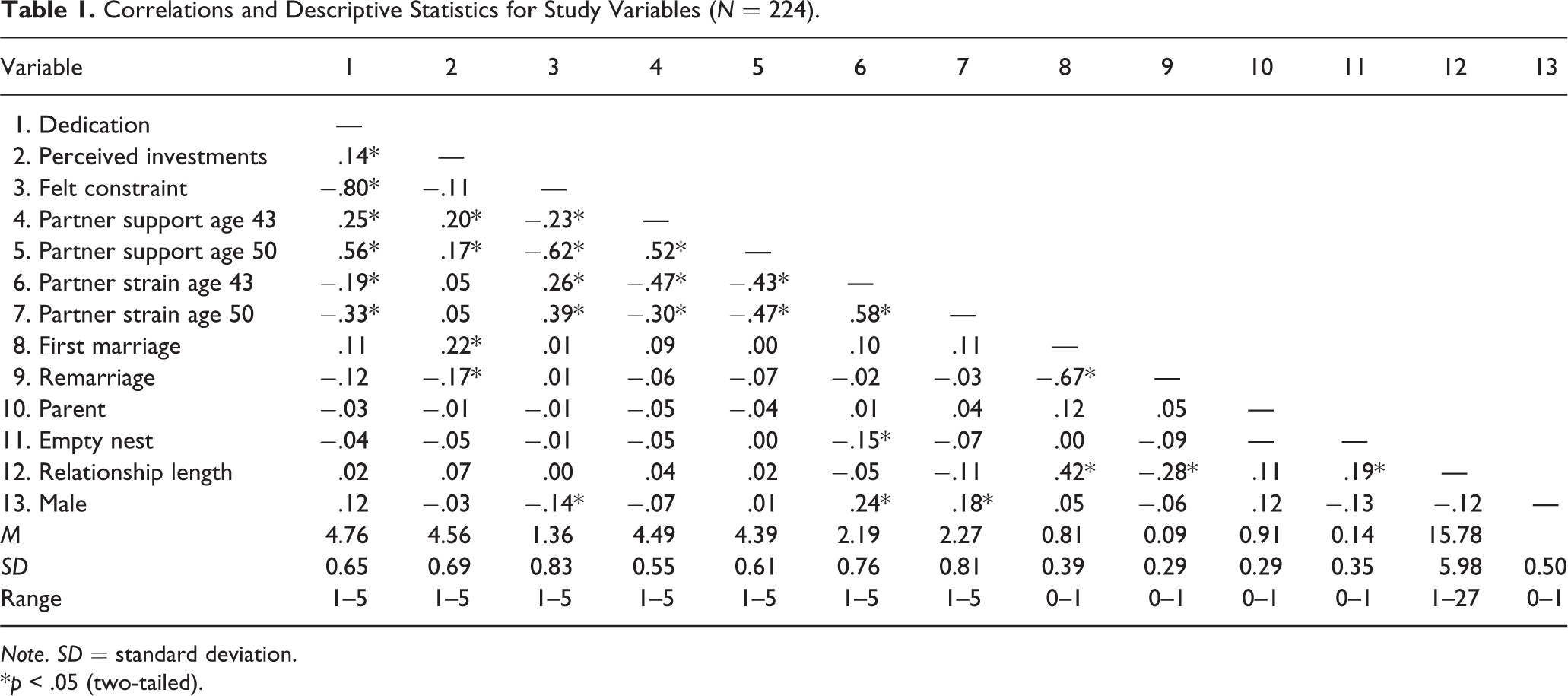
Note. SD = standard deviation.
*p < .05 (two-tailed).
LCS Model
We next computed the LCS model with the covariates simultaneously predicting dedication, perceived investments, and felt constraint. The commitment variables were allowed to covary, as were the predictors as appropriate. Model estimates are presented in Table 2, and full output is available as Online Supplementary Material. This model was a good fit to the data and accounted for a substantial amount of variance in each component of commitment: 35% of the variance in dedication, 11% in perceived investments, and 44% of felt constraint.
LCS Model Predicting Dedication, Perceived Investments, and Felt Constraint at Age 50 (N = 224).
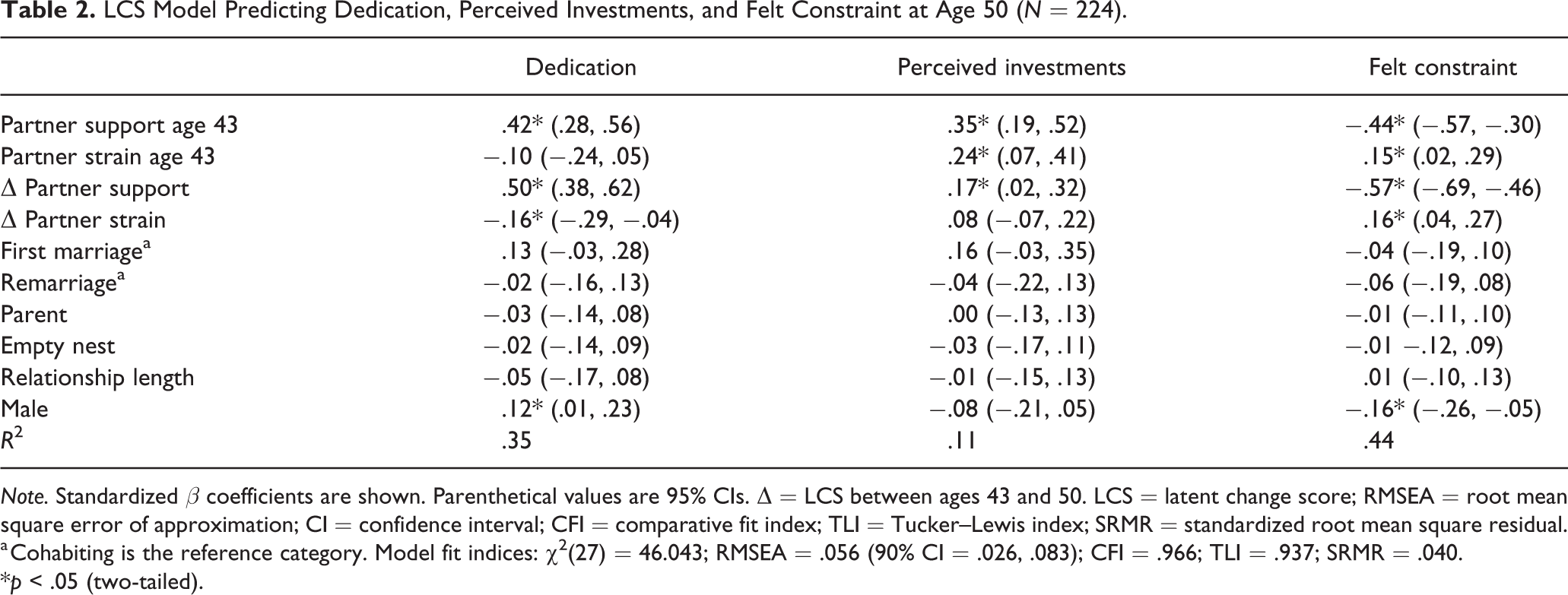
Note. Standardized β coefficients are shown. Parenthetical values are 95% CIs. Δ = LCS between ages 43 and 50. LCS = latent change score; RMSEA = root mean square error of approximation; CI = confidence interval; CFI = comparative fit index; TLI = Tucker–Lewis index; SRMR = standardized root mean square residual.
a Cohabiting is the reference category. Model fit indices: χ2(27) = 46.043; RMSEA = .056 (90% CI = .026, .083); CFI = .966; TLI = .937; SRMR = .040.
*p < .05 (two-tailed).
Those with higher levels of partner support at age 43 also reported higher dedication and perceived investments and less felt constraint at age 50. Those with higher partner strain at age 43 reported higher perceived investments and felt constraint. Change between ages 43 and 50 in support (mean decrease of .10 units) and strain (increased .08 units) also predicted commitment 7 years later: a more gradual decrease in support predicted higher dedication and perceived investments and less felt constraint, while a more rapid increase in straining interactions with a partner predicted less dedication and more felt constraint at age 50. Finally, men reported more dedication and less felt constraint.
Given these mean-level differences in dedication and felt constraint for men and women in the current study, and also prior findings documenting diverging commitment trajectories by gender (Doss et al., 2009; Kamp Dush et al., 2014), we computed a multiple group LCS model to determine whether gender moderated associations among the predictors and the commitment variables (full results are shown in Supplementary Table 1). Equality constraints were placed on corresponding paths for men and women one at a time and χ2 difference tests were computed to test for moderation. Six differences emerged out of 27 comparisons, primarily showing partner support at age 43 and its rate of change and changes in partner strain were more strongly associated with women’s dedication and felt constraint than men’s. Specifically, higher partner support at age 43 and a more gradual decrease in partner support between ages 43 and 50 were more strongly linked to women’s higher dedication (βs = .48 and .54 compared to .27 and .32 for men) and lower felt constraint (βs = −.48 and −.67 compared to −.32 and −.29 for men). A more rapid increase in partner strain between ages 43 and 50 years predicted lower dedication commitment for women (β = −.18), but not men (β = −.04). This analysis also revealed being in a first marriage predicted higher dedication commitment, especially for men (βs = .41 and .17 for women).
Discussion
Drawing from commitment theory, this study explored a number of predictors of dedication, perceived investments, and felt constraint in midlife, an important and understudied segment of the life span. The findings revealed that each aspect of commitment is predicted primarily by initial levels and changes in relationship characteristics. Partner support was the most consistent predictor of commitment, particularly for women: those who perceived their partner as more supportive at age 43 also tended to be more dedicated to the future of their partnership, reported they had invested more in their union, and were less likely to feel trapped in the relationship at age 50. Furthermore, the maintenance of higher support across seven middle adult years also predicted higher dedication and perceived investment and less felt constraint. This provides additional evidence highlighting the important role of couple support as a cornerstone of satisfying intimate ties (Falconier, Jackson, Hilpert, & Bodenmann, 2015). We are particularly confident in the robustness of this finding because it aligns with a prior study of couples nearing midlife that found supportiveness consistently predicted higher commitment in the future and no evidence that commitment predicted future support (Johnson & Horne, 2016). Given the availability of intervention protocols that improve a couple’s ability to support one another (Bodenmann & Shantinath, 2004), our findings suggest partner support is a promising mechanism for clinical interventions aimed at increasing commitment among couples in midlife, an important contribution in the light of the gray divorce trend (Brown & Lin, 2012). Indeed, given the documented links between couple support leading to improvements in future mental health (Johnson, Galambos, Finn, Neyer, & Horne, 2017), such interventions may yield benefits within and outside the relationship.
Perceiving a partner as critical and demanding also consistently predicted commitment, especially for women again: those who reported more partner strain at age 43 reported more perceived investments and felt constraint at age 50, while more rapid increases in strain predicted less dedication and higher felt constraint. The links of partner strain with dedication and felt constraint could be expected, but the finding that strain predicted higher perceived investments was surprising, given it was not correlated at the bivariate level with perceived investments and it seems counterintuitive. Thus, caution is warranted when interpreting this result. This finding, however, may hint at a downside of perceived investments. Investment may be associated with stability but that could include keeping individuals in unions with critical and demanding partners. At the same time, such unions may be marked by feeling trapped and questioning one’s dedication to the relationship. Thus, intervention efforts to improve support may also benefit midlife commitment if they also reduce demanding and critical interactions.
Our multiple group analyses revealed that women’s commitment is more strongly associated with positive and negative partnership dynamics than men’s. Feminist theories contend that women are more relationally oriented than men due, in part, to societal expectations that women bear more responsibility for the maintenance of social ties (e.g., Gilligan, 1995). As a result, women develop more cognitively complex representations of their intimate partnerships than men (Holmberg, Orbuch, &Veroff, 2004). This provides one explanation as to why women’s commitment would be more strongly informed by the supportive and straining interactions with their partner, which are intrinsically interpersonal processes.
Being married, remarried, a parent, or having an empty nest were not associated with commitment in our multivariate LCS analysis, although being in a first marriage was a robust predictor of men’s commitment in the multiple group analysis. Prior work has argued that marriage is particularly transformational for men, partly because men reap greater benefits in personal and social well-being than women (Nock, 1998). It would follow that marriage might be particularly impactful on men’s commitment. Perhaps the deleterious influence of parenthood on commitment, as reported in prior research (Doss et al., 2009; Kamp Dush et al., 2014) wanes by midlife when children are independent or nearly so. And the lack of association between having an empty nest and commitment aligns with studies on gray divorce (Lin et al., 2018). A more nuanced investigation into the link between commitment and the empty nest is warranted before firm conclusions are drawn. In particular, studies examining commitment across the transition to the empty nest that follows couples before, during, and after their children leave home are needed to provide a clearer picture of how the empty nest is implicated in later life intimate ties. Nevertheless, our study suggests that, despite the developmental salience of these life events for adults in their middle years, commitment to a partnership remains most closely intertwined with the unfolding relations between partners.
This study also provided insight on the interrelation among these three aspects of commitment in midlife. Namely, dedication and felt constraint were strongly correlated with each other (r = −.80), while perceived investments were less closely tied to the other components of commitment (rs = .14 and −.11). Prior research with young adults also reported strong associations between dedication and felt constraint (r = −.63; Rhoades et al., 2010), suggesting that these variables essentially function as the opposite of each other at the between-person level. This is evident in the results from this study; the predictors were almost identical for dedication and felt constraint, the coefficients were just in opposite directions. We reanalyzed our data in two models, one with only dedication and perceived investment and the other with felt constraint and perceived investment, to ensure the reported results were not biased by the inclusion of these two highly correlated variables in the same model. Results in these simpler models were consistent with those reported in our main analysis. Future research could usefully explore the empirical distinguishability of these constructs. It seems that they may function synonymously at the between-person level (those who report high dedication also report low felt constraint compared to those who report low dedication), but it is possible that they may be more distinct at the within-person level.
Limitations
Results must be considered in the light of study limitations. First, the three aspects of commitment were each assessed with single items. The ETS is an omnibus study of human development gathering information about personal well-being, career and education, and family life. Such a broad focus necessitates the use of abbreviated measures to limit participant fatigue. Although our items were adapted from existing measures, more robust measurement with multi-item scales would be preferable. Second, we only had access to longitudinal data on partner support and strain. Commitment was first measured at age 50. Considering the intraindividual development of commitment in middle adulthood may yield additional insight, particularly across the transition to the empty nest. Third, couple relations became a more central focus of the study at age 43, so the analysis in this article is based on information from two waves of data (ages 43 and 50). A longitudinal examination of midlife commitment with more measurement occasions would allow for a more nuanced understanding of the changes that unfold during this period. A longer term follow-up would also allow for investigation of commitment as a predictor of relationship dissolution in midlife.
Conclusion
This study found that dedication, perceived investments, and felt constraint were consistently predicted by constructs reflecting initial levels and changes in partnership dynamics, a striking finding, given the long-term nature of the partnerships under investigation, on average, and the tendency for couple dynamics to stabilize over time (Proulx et al., 2017). These results point to the dynamic nature of couple relations in middle adulthood that plays an important role in determining commitment levels. Given the robust link between support and commitment, interventions aimed at improving couple supportiveness may prove a potent means of boosting dedication commitment and perceived investments, while reducing the sense of being “stuck in the middle with you.”
Supplemental Material
Supplemental Material, JBD885025_supplemental_material - Stuck in the middle with you: Predictors of commitment in midlife
Supplemental Material, JBD885025_supplemental_material for Stuck in the middle with you: Predictors of commitment in midlife by Matthew D. Johnson, Sarah D. Somerville, Nancy L. Galambos and Harvey J. Krahn in International Journal of Behavioral Development
Supplemental Material
Supplemental Material, JBD885025_supplemental_table - Stuck in the middle with you: Predictors of commitment in midlife
Supplemental Material, JBD885025_supplemental_table for Stuck in the middle with you: Predictors of commitment in midlife by Matthew D. Johnson, Sarah D. Somerville, Nancy L. Galambos and Harvey J. Krahn in International Journal of Behavioral Development
Footnotes
Funding
The authors disclosed receipt of the following financial support for the research, authorship, and/or publication of this article: This research was funded by grants from the Social Sciences and Humanities Research Council of Canada (SSHRC), Alberta Advanced Education, and the University of Alberta. Data were collected by the Population Research Laboratory, University of Alberta.

Supplemental Material
Supplemental material for this article is available online.
References
Supplementary Material
Please find the following supplemental material available below.
For Open Access articles published under a Creative Commons License, all supplemental material carries the same license as the article it is associated with.
For non-Open Access articles published, all supplemental material carries a non-exclusive license, and permission requests for re-use of supplemental material or any part of supplemental material shall be sent directly to the copyright owner as specified in the copyright notice associated with the article.
