



Abstract
Previous research has offered mixed evidence on whether obligation in relationships benefits or harms individuals and their relationships. Given that few studies are prospective and consider multiple close relationships, we used 18-year longitudinal data to model whether obligation is associated with differences in relational and individual well-being over time. Because prior mixed findings may be attributed to differential influences of obligation across development, we also considered age. Light obligation predicted higher levels of relational and individual well-being; substantive obligation sometimes predicted lower levels of well-being. Both types of obligation mostly did not predict changes in relationships and well-being over time except substantive obligation predicted slower increases in friend support. The associations between light and substantive obligation were largely uniform across age. The only exception was for substantive obligation and friend support; substantive obligation was associated with a slower increase in friend support only for younger adults (<39 years old). This study extends previous research by examining obligation among middle-aged adults, addressing a critical developmental gap in this literature. Findings suggest that understanding people’s obligations toward close others is important not only for their own well-being but also their relationships in adulthood.
Obligation is one of the many things that distinguishes close relationships from other relationships. Is obligation ultimately associated with higher intrapersonal and interpersonal well-being? Previous research has offered limited evidence on whether a sense of obligation improves or hinders relationships over time and has focused on youth/emerging adults or older caregivers. The current study of approximately 7,000 middle-aged adults examined the effects of obligation on people’s close relationships and well-being across 18 years.
Researchers sometimes describe obligation as the glue that connects individuals through duties and a sense of responsibility in their relationships (Stein, 1992). In many relationships, obligation is viewed as a sense of duty to reciprocate—to equally give and take from a relationship (Neufeld & Harrison, 1995; Stuifbergen & Van Delden, 2011). In a qualitative study on reciprocity and caregiving, one entry highlighted the importance of reciprocity in close relationships, even ostensibly voluntary ones, like friendships: “If someone is doing all the giving and somebody is doing all the taking, there is no relationship. That’s like a parasite” (Neufeld & Harrison, 1995, p. 354). Other respondents likewise agreed that they pursued and maintained relationships with friends only when there was a sense of reciprocity.
Although obligation reflects reciprocity norms in voluntary relationships, filial obligation may arise from the sense of belonging and connectedness of two related individuals (see Stuifbergen & Van Delden, 2011 for a review on theories of filial obligation). In fact, family relationships are largely involuntary—people do not get to choose who their parents and siblings are—and seem to have different expectations for reciprocity. For instance, although parents often provide a great deal of support to their children, the extent to which children need to reciprocate as adults may be unclear (Stuifbergen & Van Delden, 2011). Even among people who strongly endorsed reciprocity norms, there is often a tolerance for family members who do not reciprocate over time (e.g., caregiving situations; Neufeld & Harrison, 1995).
Researchers have long studied the degree to which close relationships reflect reciprocal rules (i.e., exchange; Trivers, 1971) or unfettered giving and receiving (i.e., communal; Clark & Mills, 1979). With or without reciprocity, individuals’ sense of obligation frequently seems to be the glue that holds some of their relationships together. Yet, it also seems that too much obligation can have adverse effects on individuals and their close relationships (e.g., Tedgård et al., 2018). A survey of the existing literature provides a mixed portrait of the role of obligation on both individuals’ well-being and the quality of their relationships. In the following sections, we review evidence for whether a sense of obligation is beneficial or harmful for individuals and their relationships.
Benefits of Obligation
Some studies suggest that family obligation benefits relationships and the individuals within them. Most of the studies to date focus on youth and their family relationships in different contexts and cultures (e.g., Macfie et al., 2015; Nuttall & Valentino, 2017). In these contexts, family obligation can be operationalized in many ways, including views on how much they currently assist (e.g., helping and spending time), respect, and expect to provide support to their families in adulthood. A study of diverse adolescents found that obligation was associated with greater relationship quality with one’s family (Fuligni et al., 1999). Adolescents with stronger familial obligation also had more positive peer relationships—seeking more advice and spending more time with their peers. Having a strong sense of obligation seemed to help adolescents connect with friends who shared similar values and beliefs regarding their families.
Family obligation is also associated with many other benefits for adolescents, including better school adjustment and motivation (Fuligni et al., 1999), fewer behavioral problems (van Geel & Vedder, 2011), and higher life satisfaction (Hooper et al., 2015; King & Ganotice, 2015). The sense of duty and responsibility likely motivates adolescents to obey their parents, leading to fewer behavioral problems and better school adjustment (van Geel & Vedder, 2011). Furthermore, Chinese-American adolescents with higher feelings of obligation reported fewer depressive symptoms 2 years later (Juang & Cookston, 2009). Thus, obligation was shown to have multiple benefits for adolescents.
In adulthood, obligation continues to exert a positive influence on relational commitment. In spousal relationships, obligation is intertwined with commitment, such that feeling that one’s partner is highly obligated is associated with feelings of enhanced commitment for individuals (Nock, 1995). Greater investment and commitment predict better relationship functioning and foster relationship maintenance behaviors, ultimately helping relationships last (Arriaga & Agnew, 2001). There is even some evidence that a sense of obligation to one’s organization explains why workers perform well at work—they feel a sense of obligation when they feel supported by their employer (Eisenberger et al., 2001). Altogether, there are many examples of obligation enhancing relationships.
Drawbacks of Obligation
Although obligation benefits individuals and their relationships in multiple ways, it can also be a burden, creating strain for individuals and their relationships. This burden can appear as early as in childhood in the form of parentification. Parentification is a relational dynamic in which children assume more responsibility in a family than their developmental capacity and carry out roles traditionally meant for adults (Byng-Hall, 2002; Hooper et al., 2015; Nuttall & Valentino, 2017). Holding developmentally inappropriate emotional and/or instrumental responsibilities may lead children to assume their roles in relationships are about giving rather than receiving care and ultimately form insecure attachment relationships with caregivers (Byng-Hall, 2002). Such responsibilities violate the ethical reciprocation of caregiving expected in families (Jurkovic, 1997).
Even studies that show positive outcomes of obligation also find that obligation can be simultaneously associated with negative outcomes. For instance, although Fuligni et al. (1999) found multiple positive effects of obligation on relationships and academic motivation, they also found that these same high-obligation students received some of the lowest grades at school compared to the other groups, even with higher levels of academic motivation. They speculate that too much obligation may be inappropriate and harmful in the case of academic achievement, possibly because efforts to fulfill other family responsibilities limit adolescents from focusing on schoolwork. Other studies also found that childhood parentification experiences were associated with greater psychopathology and lower well-being in adulthood—again showing that too much obligation can be harmful (Hooper et al., 2011).
The same may be true for adults adopting stressful interpersonal roles. For example, a sense of obligation can be particularly stressful for adults serving as caregivers to their parents, partners, or children. Around the world, informal care—as opposed to institutional care—is carried out by spouses and adult children, frequently out of obligation (Australian Bureau of Statistics, 2008 as cited in Cash et al., 2013; Butler et al., 2005; Cicirelli, 1993). Informal caregiving is quite common in some regions, and the prolonged responsibilities can be psychologically strenuous for caregivers. Some estimates suggest that up to half of adult caregivers report significant levels of burden and depression, whether it be caring for their spouses or parents (Butler et al., 2005). Because caregiver obligation is associated with a greater sense of burden and depression (Cicirelli, 1993; Stein, 1992) in men, and depression is a risk factor for lower relationship satisfaction (Whisman et al., 2004), it is possible that obligation could also negatively affect relationships through increasing stress and depression. Equity theory also suggests that people become distressed in inequitable relationships (Walster et al., 1973). However, stress contexts like caregiving and parentification may be particularly burdensome; less clear is how feelings of obligation are related to important outcomes for individuals in less stressful situations.
The Present Study
Taken together, previous research suggests that while obligation is associated with many benefits, it is also associated with negative outcomes for individuals, particularly in caregiving situations. However, most studies to date focus on the effect of obligation on individual functioning in adolescents rather than its effects on relationships beyond adolescence (see Fuligni et al., 1999 for a rare exception). The present study extends previous research to examine whether obligation is beneficial or harmful for a variety of relationships in middle-aged adults’ lives to address a critical developmental gap in this literature.
Among the few prospective tests of the role of obligation on relationship outcomes across the life span, there has been little attention paid to how obligation influences multiple relationships after adolescence. Beyond adolescence, people are more autonomous in how they spend their time and invest in their relationships and are developmentally able to perform a broader range of responsibilities. Further, little attention has been paid to obligation in other close relationships beyond parent–child relationships (e.g., friends and partners). This study addresses these gaps employing a panel study of midlife adults in the U.S. (Brim et al., 2004) to examine the effects of obligation on individual adjustment (life satisfaction and depressive symptoms) and the quality (i.e., support and strain) of diverse relationships. It is possible that these associations differ across age. Given the large age range of our sample, we tested the potential role that age plays in modulating the links between obligation and each outcome. Lastly, we explored the possibilities of a curvilinear effect of obligation and other covariates on the aforementioned associations (e.g., that particularly high/low levels of obligation might be differentially associated with the intercepts and slopes of each outcome).
Method
Participants
Participants were from the National Survey of Midlife Development in the U.S. (MIDUS; Brim et al., 2004). The first wave of the MIDUS study (MIDUS I, 1995–1996) consisted of 7,108 English-speaking adults in the U.S. (M age = 46.38, SD = 13.00, range: 20–75; 51.1% female; 90.7% White, 5.2% Black/African American, 4.1% other race/ethnicities, Mdn Education = 1–2 years of college). Wave 2 (MIDUS II, 2004–2005) retained 69.82% (n = 4,963) of MIDUS I, and Wave 3 (MIDUS III, 2013–2014) retained 46.34% of MIDUS I (66.37% of MIDUS II; n = 3,294). Compared to participants with only one wave of data, those with more waves were more educated (d = .35), received more support from their partners (d = .17) and other family members (d = .14), and received less strain from partners (d = .14), family (d = .07), and friends (d = .08). Those who had longitudinal data and those who did not were otherwise comparable on other variables (e.g., obligation; p = .10).
Measures
Obligation
Obligation was assessed once at the first wave. Participants responded to eight statements or hypothetical situations to which they indicated how obligated they would feel (e.g., “To call, write, or visit your adult children on a regular basis”). Among the 8 items, 3 were about children, 3 about friends, 1 about parents, and 1 about spouses. Participants rated how much obligation they would feel in each situation on a scale of 0 (no obligation) to 10 (very great obligation).
Previously, ratings for eight situations have been summed or averaged to yield a normative obligation score (α = .82) or a simplified 4-item version (Grzywacz & Marks, 1999; α = .79). Upon investigating the factor structure of the measure, we found that the measure was separable on some features (e.g., obligations that reflect different levels of investment and costs and toward different people). After excluding 1 item that moderately cross-loaded on both factors, a two-factor solution was selected, such that the measure operationalizes substantive (α = .98) and light obligation (α = .99). Substantive obligation involved high-cost activities that would make long-lasting changes to the individual’s life (e.g., taking in a child of a friend); light obligation involved easier, low-cost activities (e.g., calling parents regularly). See Supplementary Tables for a full list of items, descriptive statistics of variables related to the factor analyses, factor loadings, and model fit indices.
Life satisfaction
Satisfaction with life was assessed at all three time points using 5 items (α > .63; Prenda & Lachman, 2001). Each item asked participants to rate their overall satisfaction with respect to their life, work, health, relationship with spouse/partner (if applicable), and relationship with children (if applicable). Satisfaction with spouse/partner and children was averaged to create a satisfaction score for the relationship domain by the MIDUS study team. Ratings from four domains were averaged to calculate an overall score, which ranged from 0 (the worst possible) to 10 (the best possible).
Depression
Depressive symptoms were assessed at all three time points using a checklist (Wang et al., 2000). Participants answered yes or no to the presence of seven symptoms in the past year from two subscales: Depressed Affect (e.g., loss of appetite) and Anhedonia (e.g., feeling tired out or low on energy). After adding the number of “yes” responses to the items, the two 7-item subscales were averaged to calculate a final measure of depressive symptoms that ranged from 0 to 7.
Support and strain from close relationships (i.e., relationship quality)
Support and strain from partners, family members, and friends were assessed at all three waves (Schuster et al., 1990; Walen & Lachman, 2000).
Six questions assessed the amount of support participants perceived from their partner (e.g., “How much does he or she appreciate you?”); six questions assessed the amount of strain participants perceived from partner (e.g., “How often does he or she make you feel tense?”).
Four questions assessed how much support participants perceived from family members and four questions assessed how much support participants perceived from friends (e.g., “How much can you rely on them for help if you have a serious problem?”).
Four questions assessed how much strain participants perceived from family members and four questions assessed how much strain participants perceived from friends (e.g., “How often do they criticize you?”).
Participants skipped irrelevant questions (e.g., single individuals did not answer questions about spouses/partners). Participants responded to each question on a scale ranging from 1 (a lot) to 4 (not at all). All responses were reverse-scored and then averaged to yield composites for partner support (α > .86), partner strain (α > .81), family support (α > .82), family strain (α > .79), friend support (α > .86), and friend strain (α > .79). Support and strain were examined as distinct scales because previous factor analyses suggested that they were distinct constructs (Chopik, 2017).
Data Analytic Strategy
Analyses were conducted in Mplus 8.1 (Muthén & Muthén, 2017) using full information maximum likelihood estimation to account for missing data. We used latent growth curve modeling techniques to investigate changes in individual and relational well-being over time. This approach allows modeling of both intrapersonal and interindividual changes in the variables of interest (Baltes & Nesselroade, 1979; Grimm & Ram, 2012). First, we tested a series of competing unconditional models to identify overall patterns of change over time in our eight outcome variables—life satisfaction, depression, and support and strain from family members, partners, and friends (see Nuttall et al., 2015, for a similar approach). The first model was an intercept-only model with three parameters (intercept mean, intercept variance, and residual variance). The second model was a linear model with six parameters (intercept and slope means, intercept and slope variances and their covariance, and a residual variance). We performed χ2 difference tests to test these nested models and retained the model that better described the data (Grimm et al., 2016). Eight outcome variables were centered at the first wave of data collection and scaled so that estimated intercepts/levels could be interpreted as an average score at Wave 1 and estimated slopes interpreted as an average unit change per wave (i.e., MIDUS I = 0, MIDUS II = 1, MIDUS III = 2). Model fit was assessed using multiple goodness-of-fit indices: (1) nonsignificant χ2 (this metric is often overly sensitive when examined in large samples like ours; Bentler & Bonett, 1980), (2) comparative fit index (>.95; Hu & Bentler, 1999), (3) root mean square error of approximation (confidence interval <.08; MacCallum et al., 1996), (4) Tucker–Lewis index (>.95), and (5) standardized root mean squared residual (<.08; Hu & Bentler, 1999).
Next, we tested conditional models, in which the intercepts and slopes of each outcome were modeled as conditional on obligation (i.e., Does obligation predict levels and changes in a construct over time?), age, and their interactions. Because obligation was measured only once, it was treated as a time-invariant predictor. We included two interaction terms in each model—Age × Light Obligation and Age × Substantive Obligation. We then explored other models (e.g., curvilinear effects of obligation and amount of social support without including age). Due to the large number of tests, we only discussed those effects that were significant at p ≤ .01.
Results
Means, SDs, and correlations among variables are presented in Supplementary Materials. Table 1 presents model fit indices for 16 unconditional latent growth curve models (trajectories of individual adjustment and relationship quality over time), χ2 difference tests between intercept-only and linear models, and pseudo R 2. The linear models fit significantly better than intercept-only models for all outcomes and hence were selected as the final models. On average, family support, partner support, and friend support increased over time. On average, depressive symptoms, family strain, partner strain, and friend strain decreased over time. Although the average slope for life satisfaction was not significantly different from zero, the slope significantly varied across individuals. In each model, there was significant variability in the intercepts and slopes, suggesting individual differences in each outcome. Model parameters are presented in Table 2.
Model Fit Indices for Unconditional Intercept-Only and Linear Models by Outcome.
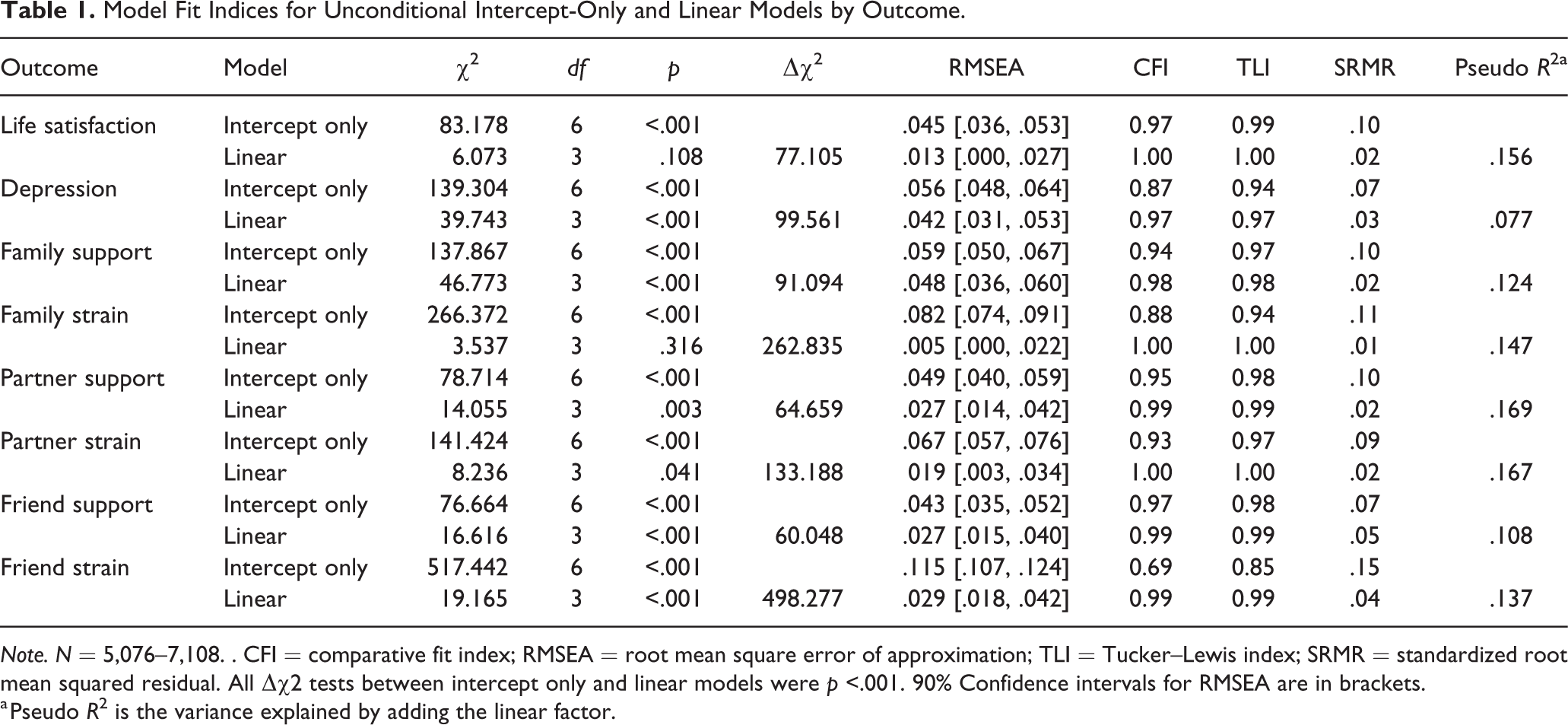
Note. N = 5,076–7,108. . CFI = comparative fit index; RMSEA = root mean square error of approximation; TLI = Tucker–Lewis index; SRMR = standardized root mean squared residual. All Δχ2 tests between intercept only and linear models were p <.001. 90% Confidence intervals for RMSEA are in brackets.
a Pseudo R 2 is the variance explained by adding the linear factor.
Unstandardized Parameter Estimates for Unconditional Latent Growth Curve Models.

Note. N = 5,076–7,108. 95% confidence intervals are in brackets. Covariance is between the level and slope factors.
*p < .01.
After selecting linear models for all outcomes, light and substantive obligations were added as predictors (i.e., change is interpreted as conditional upon obligation) along with age, Age × Light, and Age × Substantive Obligation in eight conditional models. For all but the friend support model, age did not moderate the link between obligation and outcomes. In other words, the effects of light and substantive obligation were largely uniform across age. However, there were main effects of age (e.g., associated with more positive outcomes and less negative outcomes at MIDUS I). Table 3 presents all parameter estimates.
Path Coefficient Estimates from Conditional Models in which Light and Substantive Obligation, Age, and Their Interactions Predict Levels and Changes in Outcomes.
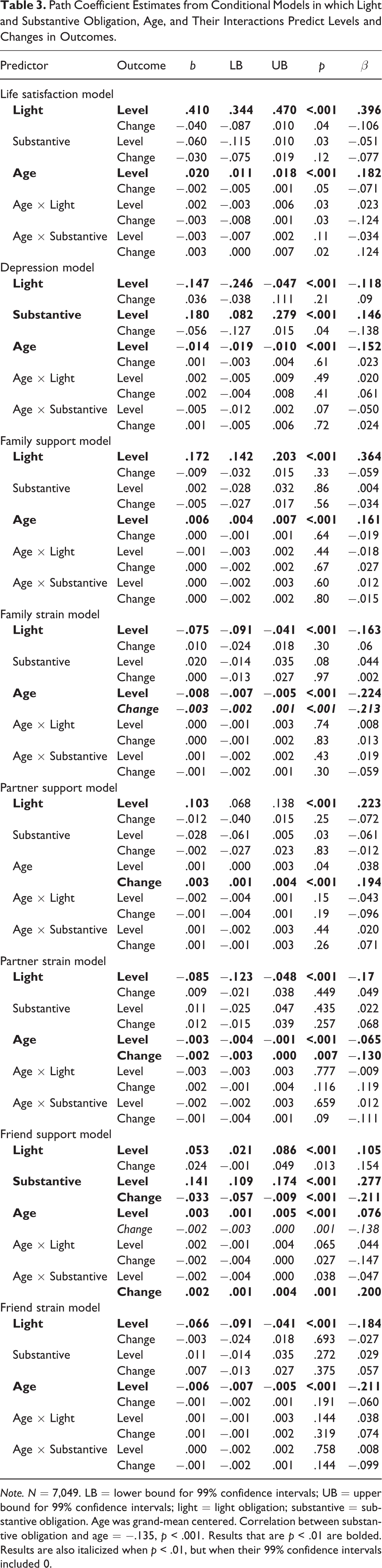
Note. N = 7,049. LB = lower bound for 99% confidence intervals; UB = upper bound for 99% confidence intervals; light = light obligation; substantive = substantive obligation. Age was grand-mean centered. Correlation between substantive obligation and age = −.135, p < .001. Results that are p < .01 are bolded. Results are also italicized when p < .01, but when their 99% confidence intervals included 0.
Life Satisfaction
Light obligation was significantly associated with greater life satisfaction at MIDUS I (i.e., the intercept) and with smaller increases in life satisfaction over time. Substantive obligation was not significantly related to the intercept or changes (i.e., the slope) in life satisfaction.
Depression
Light obligation was associated with fewer depressive symptoms at MIDUS I. Substantive obligation was associated with more depressive symptoms at MIDUS I. Both factors of obligation were not significantly related to changes in depressive symptoms.
Family Relationships
Light obligation was only associated with the intercepts; light obligation was associated with more support and less strain in family relationships at MIDUS I. Substantive obligation was not associated with family support or strain.
Partner Relationships
Light obligation was only associated with the intercepts; light obligation was associated with more support and less strain from partners at MIDUS I. Substantive obligation was not associated with partner support or strain.
Friendship
Light obligation was associated with more support and less strain from friends at MIDUS I. Substantive obligation predicted more friend support at MIDUS I, but also slower increases in friend support over time. However, this main effect of substantive obligation was qualified by a significant interaction with age. Age significantly moderated the association between substantive obligation and slope factor of friend support (β = .20, p = .001). To follow up this significant interaction, we conducted a multigroup analysis to examine whether the effects of obligation differed across age groups (young < 39, middle = 40–59, older = 60+ years) while holding all else constant. Substantive obligation was significantly associated with a slower increase in friend support for young adults (β = −.29, p = .002), but was not significantly associated with the slope factor in other age groups.
Exploratory Analyses
Curvilinear effects of obligation
Given the possibility of a curvilinear effect of obligation, we also included light2 and substantive2 obligation as predictors (i.e., Light Obligation × Light Obligation) of the levels and slopes of each outcome. Generally, light2, but not substantive2, obligation significantly predicted the levels in the outcomes. The linear effects of light and substantive obligations remained significant. To follow up significant curvilinear effects of light obligation, we estimated two separate lines using the inflection as the breakpoint (Simonsohn, 2018). Interestingly, results showed that light obligation only had a significant association for participants who scored higher than the inflection point. For example, light obligation was significantly associated with higher family support at MIDUS I (b = .132, SE = .006, p < .001) for participants who scored higher than 4.14 but was unrelated to family support below this point.
Substantative2, but not light2, obligation emerged as a significant predictor of the levels of friend strain (b = −.03, SE = .008, p < .001). The linear effect of substantive obligation was no longer significant with the inclusion of the quadratic term (p = .05). Substantive obligation was significantly associated with strain from friends at MIDUS I. However, this association was stronger for participants who scored higher than the inflection point than below the inflection point (i.e., if substantive obligation < 5.30, then b = .04, SE = .01, p < .001; if substantive obligation > 5.30, then b = .07, SE = .007, p < .001).
Giving and receiving social support
It is possible that the effect of obligation is confounded with how many resources people receive from and give to people in their network. In other words, receiving a lot of support might be associated with greater well-being among those with many sources of support. Likewise, people who give to several others out of obligation might be spreading themselves too thin. Also, people with very small social networks might not receive as many benefits but have a relatively easy time providing support to others. To address this, we controlled for the number of hours participants have (1) received and (2) given emotional and instrumental support in the past month. This did not change the effects of light and substantive obligation. However, the number of hours of support given and received emerged as significant predictors of the levels of outcomes in expected directions. First, hours of support received in the past month were positively associated with relationship support and life satisfaction and negatively associated with strain from their relationships (.01 < |standardized estimates| < .28, ps < .004). Second, hours of support given in the past month were negatively associated with relationship support and life satisfaction and positively associated with relationship strain and depression. Further, giving support was associated with slower decreases in family strain over time (b = −.002, SE =. 001, p = .004).
Covariates
Controlling for sex and self-reported health did not change most associations between obligation and outcomes (11 of 14 associations were still significant).
Discussion
The current study examined the associations between obligation and well-being across 18 years of adulthood. Our results revealed that two types of obligation—light and substantive—were reliably associated with outcomes in different ways. Light obligation involved arguably easier day-to-day activities (e.g., calling parents regularly). Substantive obligation involved strong commitments that would create long-lasting changes to the individual’s life (e.g., taking in a child of a friend). Light obligation was associated with better intrapersonal and interpersonal well-being across all outcomes; substantive obligation was sometimes associated with more negative outcomes for people and their relationships (i.e., more depressive symptoms, slower increases in friend support, and more friendship strain in the exploratory analyses). The current study constitutes an important step in examining the effects of obligation on individual and relational outcomes among middle-aged adults and formally distinguished between different types of obligation. This study extends previous research in the obligation literature by examining the role of age in the association between obligation and individual and relational well-being, particularly the strength of this association among middle-aged and older adults.
Both intrapersonal and interpersonal well-being increased over the 18-year time period. Similar to previous work on changes in life satisfaction (Baird et al., 2010; Gana et al., 2012) and depression over time (Chopik & Edelstein, 2018), the current study also found that life satisfaction increased and depression decreased. Relative to individual well-being, life span changes in support and strain from relationships have not received as much attention, particularly among middle-aged adults. This study found that across 18 years of adulthood, support increased and strain decreased across all relationships (friends, family, and partner). These results are consistent with other research on older adults experiencing more positive emotions and relationships because they optimize positive interpersonal exchanges by avoiding conflicts, improving in social expertise and experience, and affiliating with people who treat them more positively (Carstensen et al., 1999; Luong et al., 2011). Although people’s lives generally improved over time, people also differed in their levels and changes of well-being, and obligation predicted differences in levels at the first wave.
Effects of Obligation
Previous research on obligation earlier in life demonstrates many benefits of obligation, including adolescent school adjustment, life satisfaction, and family relationships (Fuligni et al., 1999; Hooper et al., 2015; van Geel & Vedder, 2011). However, obligation is not uniformly positive for individuals. Research often finds a “sweet spot” of obligation, meaning that either too much or too little obligation render negative outcomes (McMahon, & Luthar, 2007; Nuttall et al., 2019). When people feel too obligated to carry out responsibilities beyond their capabilities, obligation is associated with lower well-being across developmental periods (Cicirelli, 1993; Jurkovic, 1997). The present study suggests a more nuanced view of how obligation affects adults’ well-being. Light obligation was associated with higher individual and relational well-being across relationships, although substantive obligation was associated with depressive symptoms and more friend support. Results suggest that it is important to consider different types or contents of obligation.
Why is light obligation associated with positive outcomes?
Why might light obligation render positive outcomes even at higher levels? Light obligation might enrich relationships and promote well-being by inducing positive emotions within and between individuals. Regulatory focus theory suggests that people feel certain positive emotions—such as calmness—when they expect to meet their obligations (Higgins, 1997). Looking more broadly, people generally find prosociality and giving to be emotionally rewarding. Prosociality increases happiness and self-esteem, and providing family assistance likewise promotes positive emotions (Crocker et al., 2017; Telzer & Fuligni, 2009). Because prosociality and generous behavior are linked to better health and well-being (Brown & Brown, 2015; Penner et al., 2005), it is not surprising to find people who feel light obligation report better well-being, assuming that people who feel more obligated to help are indeed more likely to help.
In addition, when people respond to others’ needs, recipients generally show gratitude. Receiving/seeing gratitude is associated with (1) greater life and relationship satisfaction for the individual and (2) mutually responsive behavior between individuals (Algoe, 2012; Chopik et al., 2018). A norm of reciprocity builds a sense of satisfaction in individuals, and relational partners become a source of support as a consequence (Neufeld & Harrison, 1995; Reinhardt, 1996). Further, when people perceive personal benefits from caregiving for family members, caregiving roles were positively associated with intention to provide care (Nuttall et al., 2018). This intention and desire to help may reflect autonomous motivations, which are suggested to foster growth and optimal functioning (Ryan & Deci, 2000). Therefore, as our study suggests, light obligation is associated with individual well-being and positive relationships.
Why is substantive obligation associated with mostly negative outcomes?
It makes sense that many of the same mechanisms that lead to enhanced well-being for light obligation should also hold for substantive obligation. Substantive obligations may make recipients feel more thankful and thus create more supportive relationships (e.g., feeling more thankful to a friend who is willing to take care of my child vs. a friend who calls every week). However, our results found that feeling obligated to fulfill responsibilities that involve more permanent, life-changing sacrifices was associated not only with more depressive symptoms but also slower increases in friend support and more friend strain (in the exploratory analyses). Holding light obligations (e.g., regularly calling parents) is likely not too costly for people. But substantive obligations require larger investments of various resources (e.g., time, money, patience), which may compromise an individual’s well-being and the effort they can devote to other relationships (e.g., giving money to a friend in need may put a financial strain on an individual and their family). Because substantive obligations require greater investments, it may not always be feasible for people to fulfill these obligations. When people cannot meet their obligations, they may experience agitation, anxiety, and nervousness (Higgins, 1997). Even when people can meet their obligations, the large costs may outweigh the benefits over time despite initial positive feelings that come from fulfilling an obligation.
Previous research supports the idea that obligations with high costs are harmful for individuals. For instance, providing more intense care is associated with worse health for caregivers (Schulz & Sherwood, 2008), and when people feel like they are giving too much support, they report feeling exhausted and less satisfied with life (Maier et al., 2015). Further, children’s caregiving obligations toward parents, which is expected to be particularly burdensome because it tips the balance of caregiving reciprocity away from meeting the child’s needs, was associated with perceiving less personal benefit from caregiving roles (Nuttall et al., 2018). It could also be that substantive obligation reflects feeling pressured to help and feeling controlled (vs. autonomous), both of which likely impair growth and optimal functioning (Ryan & Deci, 2000).
In this way, our findings with respect to substantive obligation are supported by previous research. However, it is interesting that for friendships, substantive obligation predicts higher levels of both strain (in the curvilinear and social support models) and support, and slower increases in support. One possible explanation for this may be how the voluntary nature of friendships affects our tendency to invest in them. Substantive obligation may create strain in a friendship as people try to encourage others to reciprocate equally even when they might not be able to do so (Trivers, 1971). Thus, substantive obligation might lead people to feel like they are investing too much and impeding well-being. In addition, when people perceive that a benefactor is acting out of selfishness or expecting a return, gratitude decreases while feelings of indebtedness remain constant (Tsang, 2006; Watkins et al., 2006). Substantive obligation may predict higher levels of support because their friends do reciprocate in some possible way—ultimately resulting in a more supportive friendship. However, even despite the higher initial levels or the general increase in friend support over time, participants feeling substantive obligation or indebtedness would not be reaping the benefits from their friends expressing gratitude and hence show slower increases in support.
Of course, many relationships in people’s lives involve mixed emotions—the closest relationships that provide support and love are also often the most difficult and frustrating (Fingerman et al., 2004). Friendships hold a particularly interesting place in relationships research. Despite lacking filial investments and typical obligations (e.g., exclusivity in romantic relationships), they persist as long as they provide emotional benefits for the individuals involved (Baker et al., in press; Chopik, 2017). In other words, friendships last because people enjoy them, more so than other types of relationships. The extent to which relationships of choice persist even in the context of substantive obligation and investments (which may undermine our enjoyment of these relationships) is an important future direction.
Overall, our findings provide evidence that, in addition to the overall amount of obligation, considering the type of obligation is important in predicting well-being among middle-aged adults. While light obligation might be the glue that keeps us together (Stein, 1992), substantive obligation might be the handcuffs that keep us together, causing pain and unhappiness.
The Influence of Age in the Link Between Obligation and Well-Being Over Time
We controlled for age and examined the interaction between age and both types of obligation to see whether obligation had a different effect on outcomes across different age groups. Most of the time, age did not moderate obligation. In other words, it seems that at least for the types of obligations examined in this study and for middle-aged adults, obligation has a similar effect on well-being across the life span. Perhaps obligations that involve intense physical and/or cognitive functioning might influence older adults differently. If we had examined adolescents, certain obligations that likely exceed their developmental capacity (e.g., taking a friend into your home who could not afford to live alone) might have influenced them differently than the adults in this study. This is also consistent with the lone significant interaction in which substantive obligation was associated with a slower increase in friend support for adults younger than 39 years old. Examining broader types of obligations that tax different types of resources among both younger individuals who have not reached the independence of adulthood and significantly older participants (e.g., those over the age of 75) who may be declining in health is interesting future directions.
There are many ways one can incorporate age into the models we conducted. We also attempted to examine linear age-based growth models using the definition variable approach (i.e., changes are tracked against age at each wave; Grimm et al., 2016), centering age at the youngest age at Wave 1 (age 20). These models showed slightly different results, but due to issues with convergence in 25% of the models, it was difficult to get a comprehensive understanding of the effects of obligation. Therefore, we did not present these results. However, in sum, most slope variances across unconditional models were no longer significant, and only one type of obligation significantly predicted the intercept for each outcome.
Limitations and Future Directions
Although this study had many strengths—the focus on middle adulthood, the prospective design, and the focus on multiple relationships—there were limitations. First, it is possible that obligation may have been changing in concert, or simultaneously, with relationship quality and adjustment over the duration of the study. Although the current data did not allow us to examine whether changes in obligation predicted changes in each outcome, it would be interesting to test this possibility in future studies that measure obligation repeatedly over time.
Second, while the current study revealed a more nuanced factor structure of the MIDUS obligation measure (which prior work has conceptualized as unidimensional), it also revealed limitations that can affect the interpretation and generalization of the results. Importantly, the measure conflates relationship source with the degree of investment (e.g., the substantive obligation items referenced only friends, not family). Thus, we cannot completely ascertain whether the results mean that there is (1) an effect of relationship type (family or friends), (2) an effect of obligation type (light or substantive), or (3) an interaction between relationship type and obligation type in predicting well-being. An extreme (and superficial) interpretation of this study is that family obligations benefit intrapersonal and interpersonal well-being, and friend obligations are sometimes maladaptive for intrapersonal and interpersonal well-being. However, it could be that feeling strongly obligated to friends implies that one has fewer resources (defined broadly) to dedicate to family relationships. Further, there may be important differences across family relationships (e.g., parents vs. siblings) that would be interesting to examine in future research.
Third, the measure asked about hypothetical situations to which anyone could respond. Although people have ideas about how they would behave under certain situations, because some situations have low base rates (e.g., taking in your friend’s child), their responses may not reflect how they would actually act. Participants could also have evaluated their general obligations and not the relative investment across different relationships. Yet it is likely that light obligation reflects a person’s general tendencies to feel obligation and therefore affects all relationships similarly, while substantive obligation is more relationship-specific. To date, there have been no studies directly comparing the levels of obligation toward different relationships in adulthood, how these relationships might conflict with one another, and how obligation in one relationship might translate to poor outcomes in another relationship. Future research can more directly compare light and substantive obligation from different sources (e.g., spouses, family, friends) using more carefully constructed measures than the one available to researchers in MIDUS.
Last, although we provided some reasons for why certain forms of obligation might be better or worse for people and their relationships, we did not specifically examine mechanisms. Affect could possibly explain why light or substantive obligation is related to well-being. Substantive obligation may be associated with worse relationship quality because it leads to increases in negative affect (Hooper et al., 2015; Juang & Cookston, 2009; Whisman et al., 2004). Light obligation and reciprocity may enrich relationships by promoting positive emotions between individuals, which would be consistent with theoretical models hypothesizing links between close relationships and well-being (e.g., Algoe, 2012; Eisenberger et al., 2001). There are likely additional variables that might enhance or diminish the effects of obligation on well-being. For example, the concept of the relational self has been suggested to moderate the effects of obligation: a relational-interdependent self-construal was associated with higher well-being in Filipino students who felt higher levels of obligation (King & Ganotice, 2015). Future research can more formally model moderating and mediating processes of the link between adults’ obligation and important outcomes.
Conclusion
In this 18-year longitudinal study of middle-aged adults, intrapersonal and interpersonal well-being increased over time. Light obligation was associated with benefits—higher well-being and higher quality of close relationships. Substantive obligation was sometimes associated with lower individual and relational well-being. Because many people feel a sense of obligation to people in their lives, it is important to understand when obligations may be beneficial or harmful for individuals and their relationships. Future research can reveal the processes through which obligation affects close relationships, particularly how varying degrees of obligation toward different relational partners intersect and affect the quality of our close relationships.
Supplemental Material
JBD911089_supplemental_file - The effects of obligation on relationships and well-being over time in middle adulthood
JBD911089_supplemental_file for The effects of obligation on relationships and well-being over time in middle adulthood by Jeewon Oh, William J. Chopik and Amy K. Nuttall in International Journal of Behavioral Development
Footnotes

References
Supplementary Material
Please find the following supplemental material available below.
For Open Access articles published under a Creative Commons License, all supplemental material carries the same license as the article it is associated with.
For non-Open Access articles published, all supplemental material carries a non-exclusive license, and permission requests for re-use of supplemental material or any part of supplemental material shall be sent directly to the copyright owner as specified in the copyright notice associated with the article.
