




Abstract
This study aimed to develop and evaluate a new parent-report measure to assess primary schoolchildren’s academic behaviors in the home context. We developed the Academic Behavior Scale (ABS) and administered it to Chinese parents of primary schoolers along with other measures. Six hundred and forty-five parents and 170 primary schoolchildren in Grades 4–6 were recruited from a public primary school and completed a set of questionnaires. After that, the psychometric properties of the ABS including factorial validity, convergent and concurrent validity, as well as internal consistency were evaluated using confirmatory factor analysis and correlation analysis in Mplus v.8.3. The results confirmed a two-factor structure for the scale, with satisfactory convergent and concurrent validity and internal consistency. This study provides preliminary evidence for the satisfactory psychometric properties of the ABS among Chinese parents.
Introduction
Student academic behaviors are related to their academic achievement, cognitive abilities, behavior problems, and social adjustment (McDermott, 1999; McDermott et al., 2002; Reynolds, 1979). Compared with intelligence, academic behaviors are relatively more modifiable and improvements in these areas tend to generalize to other developmental outcomes such as academic achievement, social adjustment, and cognitive abilities (see Canivez et al., 2006; McDermott et al., 2002). The assessment of academic behaviors in children can provide an evaluation of children’s behaviors pertaining to their academic learning and give parents, teachers, and relevant professionals meaningful information to help improve children’s difficult academic behaviors and promote their academic adjustment and well-being. Therefore, it is important to have quality measures to assess children’s academic behaviors.
In-Home and School-Based Academic Behaviors
According to a cultural historical approach, child development and learning take place in the dialectic interaction between person and environment (Hedegaard, 2012; Vygotsky, 1998). Hence, children’s academic behaviors should be understood within the specific environments where they occur. Home and school are two primary environments in which children undertake their academic learning activities, and they create different learning settings for children because of their different practice traditions, aims, and objectives (Hedegaard, 2014). In school, the leading objective is children’s learning of subject matter, whereas at home the leading objective is care of the child (Hedegaard, 2014). Learning activities are also different in these two settings: in the classroom, learning activities primarily consist of listening to teacher instructions, answering teacher’s questions, participating in class activities and doing schoolwork, whereas the main learning activities in the home setting are comprised of doing homework or other learning tasks (e.g., preparing for the next day’s study or reading textbooks) and asking parents for help or working with parents on homework and other relevant tasks. Moreover, children practice, master, and apply the lessons learned in the classroom at home (Power et al., 2007), which requires more self-regulation than in the classroom context (Xu et al., 2015).
Children’s academic behaviors also differ between home and school. It is possible that a child who is motivated at school may refuse to do homework at home. In fact, Hedegaard (2014) has clearly observed that children’s focus changes from learning in school to play at home. Therefore, in light of the settings where academic learning activities occur and the difference in academic behaviors between the two settings, we believe that academic behaviors can be classified into two types: in-home academic behaviors and school-based academic behaviors. In line with this classification, current measures that assess student academic behaviors consist of measures assessing student academic behaviors in school (e.g., McDermott et al., 2011) and those occurring in the home context (e.g., Anesko et al., 1987).
Measurement of Academic Behaviors
Teacher-report questionnaires measuring student learning behaviors in the classroom context predominate the measurement of student academic behaviors. These measures can be used across age ranges (McDermott et al., 2011; Reynolds & Bernstein, 1982; Worrell et al., 2001) and assess both problematic (e.g., Anesko et al., 1987) and positive (McDermott et al., 2011) academic behaviors. However, teachers cannot observe the academic behaviors occurring in the home context, thus these measures do not provide a way to assess in-home academic behaviors. This is important considering the difference in academic behaviors between home and classroom settings. Some measures have also been developed to assess relevant academic behaviors while students are doing homework. Xu (2008) developed a student-report questionnaire to assess homework management strategies in middle and high school students and some validation studies have revealed good psychometric properties of this measure among Chinese students (e.g., Yang & Xu, 2015). There are also parent-report questionnaires assessing homework performance (Power et al., 2014) as well as homework problems (Anesko et al., 1987) in elementary and middle school students. Nevertheless, the parent-report measures of homework behaviors were developed in western contexts and have not been validated in a Chinese context. It is unknown whether they can be used for Chinese parents.
Chinese Parents’ Emphasis on Children’s Academic Achievement
Chinese parents attach much importance to their children’s education (Chao, 1996; Li, 2004), seeing education as their children’s primary means of social upward mobility (Sue & Okazaki, 1990). In contrast with European American parents, Chinese parents have higher expectations for their children’s academic achievement (e.g., Leung & Shek, 2011; Li, 2004). Furthermore, due to Chinese beliefs in human malleability and self-improvement (Chen & Uttal, 1988), Chinese parents place a strong emphasis on effort in academic activities and believe that parents play a significant role in children’s school success. Therefore, Chinese parents are more directly involved in children’s education than European American parents (Chao, 1996), especially in terms of home-based involvement (Huntsinger & Jose, 2009; Wu et al., 2013), providing opportunities for Chinese parents to impact their children’s academic behaviors. In this case, a measure of children’s academic behaviors from parents’ perspective can help to understand Chinese parents’ views of their children’s academic behaviors and to identify children’s desirable and difficult academic behaviors. This information can be used to improve the quality of Chinese parents’ involvement in their children’s academic learning through parenting interventions.
Development of the Academic Behavior Scale (ABS)
To provide a measure of children’s in-home academic behaviors for Chinese parents, this study aimed to develop a parent-report questionnaire—ABS—for Chinese parents to assess their children’s academic behaviors in the home context. We adopted Dweck’s (2000) two-factor model of motivation as the theoretical foundation for developing the ABS. Dweck identified two patterns of children’s reaction to challenges and difficulties in learning situations: patterns of mastery-oriented pattern (MO) and helpless-oriented pattern (HO). According to Dweck, children with MO have interest in learning, are not afraid of failure and willing to engage in challenging tasks, and persist and enhance strategic effort in coping with difficulties. In contrast, HO means that children are not willing to engage in challenging tasks, experience negative emotions in the face of difficulties, tend to attribute their failures to their incompetency, and do not persist in challenging situations. Some research has shown that HO is related to student’s low level of self-efficacy, whereas MO is associated with student’s high level of self-efficacy and quality of life (Kovacs, 2019; Sorrenti et al., 2015). Moreover, mastery-oriented children outperform helpless-oriented children in the face of difficult learning tasks (Licht & Dweck, 1984), and mastery- and helpless-oriented behaviors in the third year of school could predict fifth year academic achievement in primary school (Fincham et al., 1989).
Although some researchers have developed teacher-report (Fincham et al., 1989; Yates, 2009) and student-report (Sorrenti et al., 2015) questionnaires to measure student’s mastery-oriented and helpless-oriented behaviors in school settings, there is a lack of measures assessing home-based academic behaviors for parents. Since Chinese parents have a high level of involvement in children’s learning in the home context (Huntsinger & Jose, 2009; Wu et al., 2013), they can also provide valuable information on children’s academic behaviors from observations in their interaction with children. Moreover, it is difficult for young children to respond to items describing their own behaviors because of their inadequate literacy skills and teachers cannot observe children’s academic behaviors in the home settings. Therefore, a parent-report measure of in-home academic behaviors of primary schoolchildren is needed particularly for Chinese parents.
The ABS was developed and administered to parents of children along with other measures in a primary school in Fuzhou to evaluate the construct validity, criterion-related validity, and internal consistency of the ABS. According to the conceptualization of MO and HO, and the relationship found between children’s learning motivation and parenting practices (e.g., Cheung & McBride-Chang, 2008), parental involvement (e.g., Jeynes, 2005), as well as academic achievement (e.g., Huang, 2012) in the existing literature, we hypothesized that (1) MO would be correlated with intrinsic motivation positively, whereas HO would be correlated with extrinsic motivation positively; (2) MO would be negatively correlated with dysfunctional parenting, whereas HO would be positively associated with dysfunctional parenting; (3) MO would be positively associated with parental involvement and HO would be negatively associated with parental involvement; and (4) MO would be associated with higher academic achievement and HO would be associated with lower academic achievement.
Method
Participants
Seven hundred and sixty-eight parents of students in a primary school 1 in Fuzhou, China, completed a set of questionnaires online. Among them, 123 were excluded from data analysis because (1) participants only filled the demographic information (n = 48); (2) parents selected the “unclear” choice for more than 25% of items in the ABS measure, which implied that parents might not know enough about their children’s academic behaviors (n = 55); and (3) the mean difference across repeated items was greater than 1.5 scale points (n = 20). Finally, we obtained a valid sample of N = 645 parent participants. Meanwhile, 170 of these parents’ children who were in Grades 4–6 in primary school completed hardcopy questionnaires. As the demographic information of the child participants was provided by their parents, we reported the demographic results of these two samples together in the same table. t-Tests and Chi-square tests showed that there were no significant differences between the samples in most demographic characteristics, except parents’ and children’s ages and parents’ level of education. Detailed demographic information is presented in Table 1.
Demographic Characteristics of the Sample.

Note. Percentages may not add up to 100 due to missing data. SD = standardized deviation.
Measures
The Family Background Questionnaire
It is used to collect demographic information from parents, including parent and child gender and age, parent marital status, family composition, parent education, and work and financial status (Sanders & Morawska, 2010).
The ABS
It is a new parent-report measure developed to assess home-based academic behaviors in primary school students who are typically between 6 and 13 years of age. This measure originally had 26 items and was developed to have two dimensions including mastery orientation (MO) and helpless orientation (HO). Parents were asked to rate how true the statements are of their child on a 4-point scale ranging from 0 (not true at all) to 3 (true very much/most of the time). Items were summed for each dimension to indicate levels of mastery-oriented behaviors and helpless-oriented behaviors in academic learning in the home context. It should be noted that a fifth choice (unclear) was added to identify parents who might not know enough about their children’s academic behaviors due to their lack of involvement or awareness about children’s academic behaviors. The questionnaire is presented in the Appendixes.
The Parenting and Family Adjustment Scales (PAFAS)
It assesses dysfunctional parenting and family adjustment in parents of 2- to 12-year-old children (Sanders et al., 2014). The measure consists of two subscales, including the Parenting and Family Adjustment subscales. The Parenting subscale (15 items) has four dimensions, including parental consistency, coercive parenting, positive encouragement, and parent–child relationship, whereas the Family Adjustment subscale (11 items) has three dimensions, including parental adjustment, family relationships, and parental teamwork. All items are rated on a 4-point Likert-type scale, ranging from 0 (not true of me at all) to 4 (true of me very much). The items are summed to provide overall scores, with higher scores indicating higher levels of parenting or family dysfunction. It has been validated among Chinese parents and obtained satisfactory psychometric properties (Guo, Morawska, & Filus, 2017). Only the Parenting subscale was used in this study.
The Parental Involvement Questionnaire
It is a brief measure designed for this study, consisting of 4 items, including “How often do your check your child’s homework,” “How often do you help with your child’s homework,” “How often do you talk with your child about his/her learning,” and “How often do you do things with your child relating to his/her learning.” Parents were asked to answer the items on a 4-point scale, ranging from 0 (never) to 3 (always). The scores of the items were averaged to indicate level of parental involvement.
The Academic Self-Regulation Questionnaire (SRQ-A)
It is a 32-item questionnaire for students in late elementary and middle school, which assesses student academic self-regulation (Ryan & Connell, 1989). The scale consists of four dimensions, including external regulation, introjected regulation, identified regulation, and intrinsic motivation. External regulation and introjected regulation represent academic motivation with low levels of internalization, whereas identified regulation and intrinsic motivation represent academic motivation with relatively high levels of internalization. The higher the level of internalization student academic motivation has, the more their academic behaviors are self-determined or autonomous. The items are rated on a 4-point scale, ranging from 1 (not true at all) to 4 (very true). Item scores are averaged for each dimension, and the Relative Autonomy Index (RAI) can be computed using the formula:
Child academic achievement
It is measured by an item asking parents to report their children’s academic performance. The item is stated as “Overall speaking, what level is your child’s academic achievement compared with other students in the same grade.” Parents were asked to choose an answer from five choices: 1 (poor), 2 (lower than average), 3 (average), 4 (above average), and 5 (excellent), which were seen as an ordered scale in this study.
In addition, 3 items in the whole questionnaire were repeated to identify parents who did not carefully complete questionnaires, and a mean difference between the repeated and original items greater than 1.5 was used as a criterion to determine that a parent should not be included in data analysis (Tracey, 2002). It should also be noted that participating children completed the SRQ-A, whereas parents completed all other questionnaires. The Cronbach’s αs or H coefficients are presented in Table 3 to indicate the internal consistency of the measures.
Procedure
All procedures were approved by the Academic Ethics Committee of Fujian Normal University. In this study, all parent participants read an information sheet about the study and signed a consent form if they agreed that they themselves and/or their children participate in the study. Participation in the study was voluntary and parents and their children could withdraw from this study at any time.
Scale development
The items of the ABS were generated in two ways. Firstly, we conducted individual interviews with nine Chinese parents of primary school students, asking about their children’s strengths and difficulties of academic behaviors. Thematic analysis of parents’ responses identified some major themes including children’s interest in learning, self-discipline in learning, and whether the child was relying on parents’ help, which are largely consistent with Dweck’s (2000) conceptualization of MO and HO. Then, we carefully reviewed parents’ responses and selected parental reports which could reflect MO or HO and converted them into items, giving the 10 items of the ABS. Secondly, we took 6 items from the teacher-report and student-report questionnaires which also assess mastery- and helpless-oriented behaviors based on Dweck’s (2000) model (Fincham et al., 1989; Sorrenti et al., 2015), which were then modified to suit Chinese language and culture. For example, the item “Expresses enthusiasm about his/her work” was changed to “My child appears to be interested in learning.” Thirdly, we developed 10 items based on the concepts of MO and HO and an observation study describing how primary schoolchildren manifest MO and HO specifically (Pino-Pasternak et al., 2010).
After preliminary items were developed, 10 Chinese parents of primary school students were invited to read and complete the questionnaire and to provide comments and suggestions on the wording and content of the items. Nine parents commented that the items were understandable and they could answer them. One parent who only received junior middle school education reported that she could not understand a few items. Therefore, we made minor changes to these items to make them easier to understand. Moreover, we added a choice of “unclear” for parents to select in case they could not understand the items or did not know how to respond to them.
Data collection
The study was conducted in a primary school in Fuzhou, which is the capital of Fujian Province in the southeast of China. The measures for parents were entered into an online platform to form an online questionnaire, which was used regularly by all parents of children in the school, as a way for everyday parent–school communication. After that, head teachers in every classes helped to invite parents of children to complete the online survey within 2 weeks. In the meantime, hardcopy questionnaires were administered to children by trained research assistants in Grades 4–6 when they were in self-study classes, in which students had 40 min to complete the questionnaires.
Data Analysis
Factorial validity
Confirmatory factory analysis (CFA) is used to test a measurement theory which specifies how measured items logically and systematically represent constructs involved in a theoretical model (Hair et al., 2014). As the items of the ABS were developed based on the Dweck’s (2000) model, we conducted CFA to test the factor structure of the ABS. A number of indices were used to evaluate model fit in CFA, including the Chi-square goodness-of-fit index, the comparative fit index (CFI), the Tucker–Lewis index (TLI), the root mean square error of approximation (RMSEA), and the standardized root mean square residual (SRMR). Correspondingly, the following criteria were used to determine the acceptability of the model fit: CFI and TLI > .90 (Hu & Bentler, 1999) and RMSEA and SRMR < .08 (Browne & Cudeck, 1989; Hu & Bentler, 1999). Regarding the significance of factor loadings, the standardized value of .50 was used as a cutoff criterion to determine whether an item should be retained or deleted (Hair et al., 2014). In CFA, models were respecified based on the magnitude of factor loadings, standardized residuals, modification indices, and theoretical considerations (Kline, 2011). However, standardized residuals and modification indices are not available when the mean- and variance-adjusted weighted least square (WLSMV) estimator and multiple imputations approach to deal with missing data are used; therefore, residual correlation was used to indicate model modification.
To assess the extent to which a newly specified model exhibits an improvement over its predecessor, we used two different approaches for two types of models. For non-nested models, we used fit indices (CFI, TLI, SRMR, and RMSEA) to compare the models, with higher values of CFI and TLI and lower values of SRMR and RMSEA indicating better model fit. For nested models, we employed the Chi-square difference test in Mplus developed particularly for WLSMV and maximum likelihood with missing values (MLMV) estimators to examine Chi-square difference (Muthén & Muthén, 1998–2017). A significant difference in Chi-square values indicates the model with fewer degrees of freedom fits the data significantly better than the model with more degrees of freedom.
Convergent and concurrent validity
To evaluate the convergent validity of the ABS Scale, correlations between the ABS and SRQ-A were computed. Moreover, correlations between the ABS and PAFAS, parental involvement, and children’s academic achievement were also computed to evaluate the concurrent validity of the scale. These analyses were all conducted in Mplus using latent constructs. The latent approach is superior to using composite scores as it allows decomposition of the true score variance from error variance and allows for estimating effect sizes that are not attenuated by measurement error (Kline, 2011).
Internal consistency
H coefficients were computed to assess the internal consistency of the ABS Scale using factor loadings obtained from CFA (Hancock & Mueller, 2001). The H coefficient is advantageous over the traditional Cronbach’s α when the assumptions of τ-equivalence or uncorrelated error terms are violated (Cheng et al., 2012). The range and interpretation of H coefficient values are exactly the same as for Cronbach’s α (Hancock & Mueller, 2001).
All the above analyses were conducted in Mplus v.8.3 (Muthén & Muthén, 1998–2017). Given the categorical nature of the ABS indicators (4-point Likert-type scale), we used the WLSMV estimator to estimate its factor structure and evaluate the validity of the ABS (Muthén & Muthén, 1998–2017). In addition, Cronbach’s αs for the SRQ-A, PAFAS, and Parental Involvement Questionnaire were computed using SPSS v.22.
Results
Data Screening
There were 645 cases in the parent data set and 170 cases in the child data set. Correspondingly, there were 1.91% and 0.70% missing values, respectively, in these two data sets. For the ABS Scale in the parent data set, 21 items had significant univariate skewness and 20 items had significant kurtosis. Moreover, the normalized estimates of Mardia’s coefficient of multivariate kurtosis were high (927.35 with critical ratio of 58.70, p < .001). Since the full information maximum likelihood (FIML) approach is not available when the WLSMV estimator is used in Mplus, multiple imputations with 50 imputations were employed to handle missing data (Asparouhov & Muthén, 2010; Muthén & Muthén, 1998–2017). It should be noted that pairwise deletion approach was used to deal with missing data in SPSS v.22 when computing Cronbach’s αs.
Factorial Validity
Factor structure of the ABS
CFA was conducted to examine the factor structure of the scale using the full data. The results showed that the two-factor model showed much improvement of fit to the data compared with the one-factor model according to all model fit indices. Although the two-factor model did not fit the data satisfactorily according to the criteria (see Model B in Table 2), inspection of factor loadings indicated that 4 items (Items 7, 15, 25, 26) had standardized values lower than 0.5. Hence, we decided to delete these items from further analysis. The revised model (see Table 2, Model B1) obtained better fit to the data. The examination of residual correlations indicated that the model fit could be further improved by allowing correlations between error terms of Items 10 and 11 as well as Items 11 and 17. The Item 10 “My child studies or does homework only when they are monitored” and Item 11 “My child does not take initiative in learning or doing homework until I tell him/her what to do” both referred to children’s lack of self-motivation in academic learning, thus the correlation was added to the model and the new model obtained better fit indices than Model B1 (see Model B2 in Table 2). Moreover, Item 17 “My child takes initiative in his/her study” indicated child’s self-motivation in their study, whose meaning is opposite to Item 11, thus the error correlation was also added. The revised model showed satisfactory fit to the data according to CFI, TLI, and SRMR (see Model B3 in Table 2) with standardized factor loadings ranging from .515 to .883. Although the RSMEA was slightly larger than .80, it is negligible considering other good model fit indices. Moreover, there was a moderate level of negative correlation (r = −.45) between MO and HO according to Cohen (1988). The final model is illustrated in Figure 1.
Model Fit Indices of ABS.

Note. Models A–B3 are based on N = 645. All the fit indices were computed in Mplus v 8.3 based on 100 imputations; WLSMV Chi-square statistics were combined across 100 imputations and the procedure by Li et al. (1991) was used to estimate a p value for the Chi-square test of exact fit. The fit indices CFI, TLI, SRMR, and RMSEA were averaged across 100 imputations. Confidence intervals for Chi-square and other fit indices are not provided in Mplus when multiple imputation approach is used; pairwise present approach was used to handle missing data when Chi-square difference test was conducted because the test is not available in Mplus when multiple imputation approach is employed. WLSMV χ2 = statistic from the robust weighted least squares estimator; df = degrees of freedom; CFI = comparative fit index; TLI = Tucker–Lewis index; SRMR = standardized root mean square residual; RMSEA = root mean square error of approximation; SD = standardized deviation.
***p < .001.

Two-Factor Confirmatory Factor Analysis of the 22-Item ABS With Standardized Estimates Based on N = 645. ABS = Academic Behavior Scale.
Convergent and Concurrent Validity
As presented in Table 3, MO significantly correlated with identified regulation, intrinsic motivation, and RAI in a positive direction, and it also significantly negatively correlated with external regulation. Comparatively, HO was significantly positively correlated with introjected regulation. HO was negatively correlated with RAI, although this was not significant. Overall, these correlation results were in the expected pattern. Moreover, MO and HO significantly correlated with the four factors of the Parenting Scale and Parental involvement as expected, except that the correlation between HO and positive encouragement was not significant. Lastly, MO correlated significantly and positively with children’s academic achievement, whereas HO negatively correlated with children’s academic achievement, which was also consistent with expectations.
Internal Consistency, Mean, SD, and Correlations Between Variables.
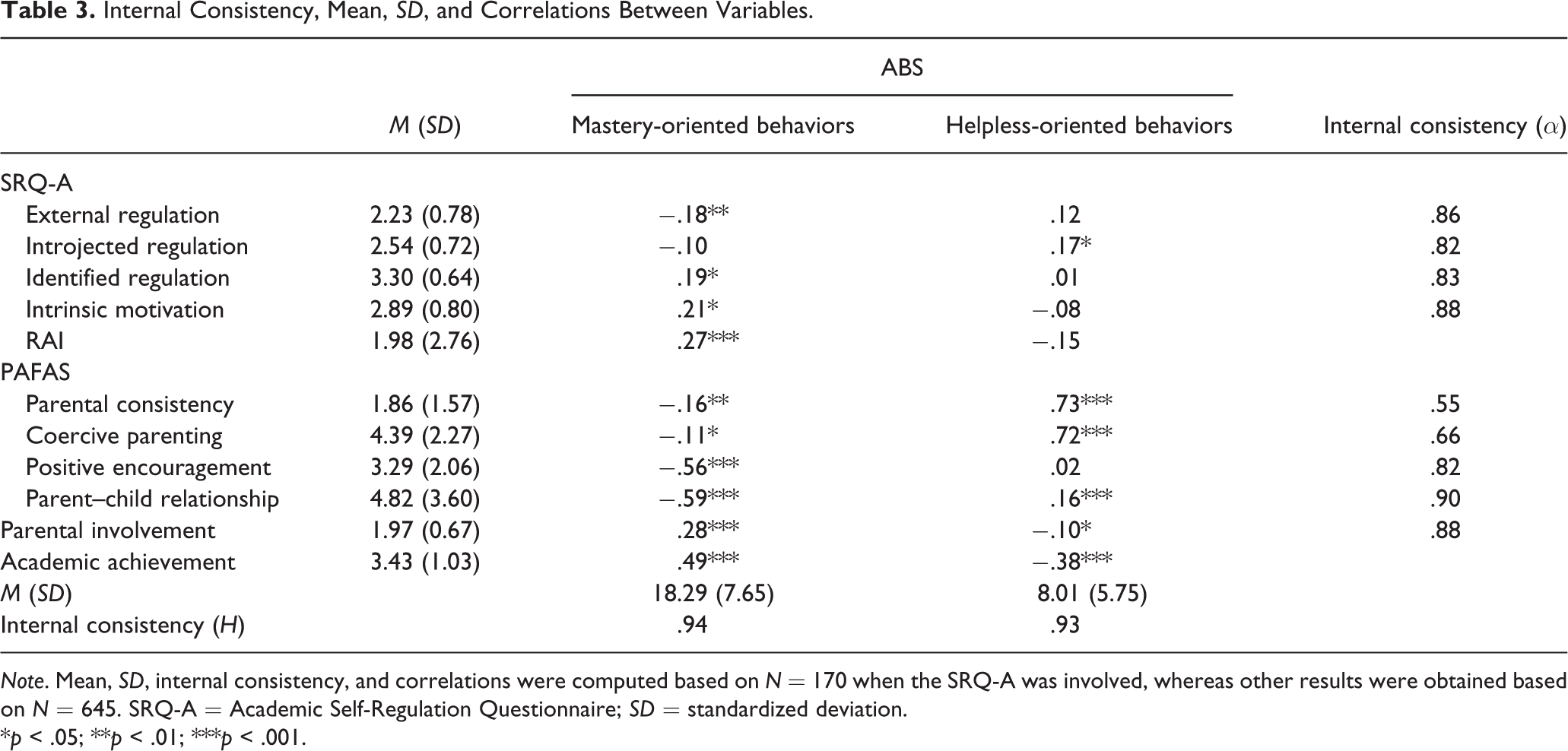
Note. Mean, SD, internal consistency, and correlations were computed based on N = 170 when the SRQ-A was involved, whereas other results were obtained based on N = 645. SRQ-A = Academic Self-Regulation Questionnaire; SD = standardized deviation.
*p < .05; **p < .01; ***p < .001.
Internal Reliability
The H coefficients were .94 for MO and .93 for HO, respectively, in the ABS Scale, indicating excellent internal consistency (see Table 3).
Discussion
In this study, we developed a new parent-report measure to assess primary schoolchildren’s academic behaviors that occur in the home setting and conducted an initial validation of this measure among Chinese parents. We evaluated the psychometric properties of this measure among 645 Chinese parents living in Fuzhou including factorial validity, convergent and concurrent validity, as well as internal consistency. Overall, the results indicated that the scale had good psychometric properties.
With respect to the factorial validity of the ABS, the CFA results supported the two-factor structure of this measure, which is consistent with Dweck’s (2000) model which we drew on for the development of the scale. In past research, Fincham et al. (1989) found that there was a high correlation between MO and HO (r = −0.81) in a teacher-report questionnaire, whereas Sorrenti et al.’s (2015) study indicated that the correlation between the two constructs was relatively low (r = −0.22) in a student-report questionnaire. Inconsistent with these results, MO had a moderate level of correlation with HO in this study. Theoretically, MO and HO are seen as two relatively correlated but distinct constructs rather than two opposite constructs (Sorrenti et al., 2015), and one child may manifest different levels of MO and HO in different academic subjects or settings. The difference in the results of the studies might be caused by different informants of the constructs, who had different observations or experiences of MO and HO, resulting in different insights into children’s academic behaviors. Specifically, teachers observe children’s academic behaviors among a group of students, so that their observations might only reflect an explicit pattern of academic behaviors, leading to relatively high levels of correlation between MO and HO. Comparatively, parents might know about their children’s academic behaviors more deeply and completely since they have more direct and deep interactions with children, particularly considering Chinese parents’ high level of involvement in children’s academic learning in the home setting (Huntsinger & Jose, 2009; Wu et al., 2013). Compared with teachers and parents, children have experiences of their own behavior and performance in all different subjects and settings, so that they may experience more interest and competence in one subject or setting while have less interest and persistence in another subject or setting. In such case, children might experience more distinction between MO and HO from parents’ and teachers’ more global observations, making the correlation relatively low. Therefore, the different observations or experiences of children’s manifestations of the two constructs might have led to different levels of correlations between MO and HO in the earlier studies.
It should be noted that 4 items were removed from the original 26-item scale including Item 7 “When my child does a poor job, he/she thinks it is because they are not intelligent or competent enough,” Item 15 “My child is afraid that he/she cannot do a good job in the face of learning tasks,” Item 25 “My child prefers simple learning tasks,” and Item 26 “My child cares about his/her failure very much in the process of academic learning.” These items seem to reflect children’s cognitive and emotional reactions in academic situations than other items. Although these reactions can also be manifested behaviorally, they are relatively internal and not as observable as explicit academic behaviors described by other items. As a result, it might be difficult for parents to observe these reactions and thus respond in an objective manner, which then impacted on the factor loadings of these items. To make the model fit acceptable, two error correlations were allowed in the two-factor model. However, considering the similarity in meaning of Items 10, 11, and 17, it was reasonable to allow correlations between error terms of Items 10 and 11, as well as Items 11 and 17.
Regarding the convergent validity of the ABS, the two factors of the ABS correlated with the four factors of SRQ-A and RAI in the expected pattern overall, which provided support for the convergent validity of the ABS. It should be noted that HO was significantly correlated with introjected regulation but not with external regulation. External regulation refers to motivation driven by reference to external authority, fear of punishment, and rule compliance, whereas introjected regulation is based in student internal and self-esteem-based affects and related to their avoidance of guilt and shame and concerns about self-approval and other approval (Ryan & Connell, 1989). In their empirical research, Ryan and Connell (1989) found that introjected regulation had stronger correlation with student amplified anxiety and self-denigration in response to failure than external regulation. Since amplified anxiety and self-denigration are part of helpless-oriented pattern of response to difficulties and challenges (Dweck, 2000), it is reasonable that introjected regulation had higher correlation with HO than external regulation in the present study.
Furthermore, the results showed that the ABS correlated significantly with the PAFAS, parental involvement, and children’s academic achievement in the expected directions, providing evidence for the concurrent validity of the ABS. It is interesting that PAFAS—Positive encouragement was not significantly correlated with HO. Moreover, some research has shown that Chinese parental warmth was positively correlated with their children’s academic self-regulation (Guo, 2011), implying that positive encouragement might be different from parental warmth in a Chinese context. Nevertheless, further research is needed to examine whether and why positive encouragement is consistently not correlated with HO to inform parenting and clinical practices. In addition, the high level of H coefficient indicated excellent internal consistency of the ABS.
To conclude, the results of the present study provided strong support for the two-factor structure of the ABS and demonstrated its convergent and concurrent validity as well as internal consistency among Chinese parents of primary schoolers. This parent-report measure of children’s academic behaviors can be used as a tool to help parents to self-evaluate their children’s academic competencies and deficits and provide professionals information regarding children’s academic behaviors. It makes great sense particularly considering Chinese parents’ high expectations of children’s academic achievement and high level of involvement in children’s academic activities at home (Huntsinger & Jose, 2009; Wu et al., 2013). However, there are some limitations of the study calling for further research to continue the evaluation of the psychometric properties of the ABS for parents. Firstly, the participating parents were only recruited from one primary school in Fuzhou, which limits the generalizability of the findings to other areas of China. Secondly, as the school is located in suburban area, the findings should also be considered with caution due to the differences from urban areas of cities in the number of children in a family. Thirdly, the present study did not recruit children with clinically diagnosed learning disability or intellectual disability, hence it is unknown if the ABS can differentiate between typically developing children and children with clinical problems. Lastly, it can be seen that Cronbach’s αs were relatively low for some PAFAS subscales, including parental consistency and coercive parenting. It might influence the reliability of the findings relating to the two subscales; hence, the results should be considered with caution. Future research can aim to remedy these limitations.
Footnotes
Declaration of Conflicting Interest
The author(s) declared the following potential conflicts of interest with respect to the research, authorship, and/or publication of this article: The Parenting and Family Support Centre is partly funded by royalties stemming from published resources of the Triple P—Positive Parenting Program, which is developed and owned by The University of Queensland (UQ). Royalties are also distributed to the Faculty of Health and Behavioural Sciences at UQ and contributory authors of published Triple P resources. Triple P International (TPI) Pty Ltd is a private company licensed by Uniquest Pty Ltd on behalf of UQ, to publish and disseminate Triple P worldwide. The authors of this report have no share or ownership of TPI. Dr. Morawska receives royalties from TPI. TPI had no involvement in the study design, collection, analysis or interpretation of data, or writing of this report. Dr. Morawska is an employee at UQ.
Funding
The author(s) disclosed receipt of the following financial support for the research, authorship, and/or publication of this article: This study was supported by the Chinese National Education Sciences Planning Fund for Young Scholars (NO: CBA170255).
