




Abstract
This study examines the idea that youth’s perceptions of their political interactions with important others are influenced by their own political interest to a greater extent than the perceived political interactions that influence youth’s political interest. Hence, it was proposed that youth’s perceptions of important others’ (parents’, teachers’, friends’) political views, political interest, political influence, and support, as well as of being susceptible to others’ political communication, are all affected by their own political interest. Community samples of 908 13-year-olds and 869 16-year-olds were followed over 1 year. Latent change models supported the idea that youth’s political interest significantly affected their perceptions of important others’ political views, influence, and support over time in both cohorts. In 11 out of 12 longitudinal analyses, youth’s political interest strongly affected perceptions of their political interactions with others, but none of the 12 analyses showed that the perceptions of political interactions with others strongly predicted a change in youth’s political interest. These results suggest that the political interest of young people is an input in their political development, making politically interested youth active agents in their political interactions with their important others.
There is no doubt that young people’s political development is shaped by the interpersonal conditions around them, and particularly by the people they meet regularly—parents, friends, and teachers (Barrett & Brunton-Smith, 2014). However, political development is also an interactive process in which the young person plays an active role (McDevitt & Chaffee, 2002; Ojeda & Hatemi, 2015). In this study, we examine this agency perspective. Rather than assuming that young people’s political interest is exclusively determined by the influences of important others, we propose that politically interested youth open themselves up to the political views of other people. The perception of important others as politically influential stems from youth’s political interest more than it affects youth’s political interest. Politically interested young people are eager to know more, want to see other perspectives, and welcome others’ political ideas, values and opinions as inputs and points of comparisons. So, when they report that important others are politically interested and provide political support, that these people try to influence them, and that they are susceptible to these people’s influences, this is more an indication of the young people’s own political interest than it is an effect of important others’ attempts to exert influence.
Political socialization theory has moved from emphasizing a unilateral influence of important others on youth’s political development according to the transmission model (e.g., Sapiro, 2004) to accepting and highlighting youth’s own input into their political development. Political interest, defined as being attentive to political issues (Levy & Akiva, 2019) or having an ongoing evaluation of politics (Prior, 2010), is one of the most robust predictors of a wide variety of political phenomena. Prior (2019) described the development of political interest as essentially a self-driven process. McDevitt, Chaffee and colleagues, in a series of seminal studies, challenged the conventional parent-to-youth analysis of family discussions and proposed that, in one case, a newly expressed political interest by youth at school, stimulated by a civics curriculum, changed their political interactions with parents and spurred the parents to acquire further information (McDevitt, 2006; McDevitt & Chaffee, 2000, 2002; Saphir & Chaffee, 2002). The common denominator in Prior and McDevitt et al.’s work is that youth’s own political interest motivates their political interactions with others. But the opposite view, that youth’s political interest is a result of political interactions with their socialization agents, has been far more common in the political socialization literature.
Several studies in the literature show that the more frequently parents and youth discuss politics at home, the more politically interested the youth are (Dostie-Goulet, 2009; Jennings et al., 2009; Oswald & Schmid, 1998; Schmid, 2012; Shehata & Amnå, 2019; Warner & Warner Colander, 2016). There are fewer studies of discussions with friends, but the ones available show a substantial association between the frequency of political discussions with friends and youth’s political interest (e.g., Koskimaa & Rapeli, 2015; Oswald & Schmid, 1998; Shani, 2009). All these studies interpret this association as indicating that parents and friends socialize youth’s political interest through joint discussions. Some longitudinal studies attest to the conclusion that discussions—with parents primarily, but also with friends—predict youth’s future political interest (Dostie-Goulet, 2009; Shehata & Amnå, 2019). The study by Dostie-Goulet (2009) also includes teachers’ contributions. In this study, having teachers who often talked about politics in class was found to be predictive of youth’s political interest after 1 year but not at 2-year follow-up.
The longitudinal studies by Dostie-Goulet (2009) and Shehata and Amnå (2019) built the assumed direction of causality into their study designs by preselecting youth’s political interest as outcome variable, but other studies have interpreted the matter differently. Levinsen and Yndigegn (2015), for example, predicted the frequency of political discussions in the family from youth’s political interest. They found that youth’s political interest was the strongest predictor, over and above age and gender of the youth, parents’ education, occupation and religion, and youth’s information about whether they followed politics in the media and had political views close to or distant from their parents. One recent study examined the fuller picture of how political interest and political discussions influence each other over time. With an accelerated longitudinal design that allowed for examination of the bidirectional effects of youth’s political interest and their political discussions with parents over 2 years for five age cohorts (ages 13, 16, 20, 22, and 26), political discussions with parents and youth’s political interest were found to predict each other bidirectionally from early adolescence into young adulthood (Kim & Stattin, 2019). This study challenges the common interpretation in the literature that parents socialize youth’s political development through joint discussions. However, it also makes the additional point that youth who are politically interested are keen to communicate with their parents on political issues.
That youth’s political interest can be the originator of their political discussions with parents and peers rather than a consequence raises the critical question of how the influence should be interpreted. In the studies we have cited, the frequency of having political discussions with parents and peers was based on youth reports. Hence, it is the link between youth’s political interest and their perceptions of having political discussions with parents and peers that needs to be explained. To date, only one study has attempted to explain how youth’s political interest may affect their political interactions with others. It was based on the idea of projection, namely that people tend to believe that other people have similar attitudes, values, beliefs, and perceptions of their own (Krueger, 1998), and that people’s own motivations color their interpersonal perceptions (Lemay et al., 2010; Maner et al., 2005). Stattin et al. (2021) proposed that youth’s political interest colors their perceptions of political discussions with their parents and their parents’ political support in such a way that politically interested youth tend to overstate the frequency of political conversations with their parents and their parents’ political support. They also proposed that this might be true of parents’ perceptions. In support of the idea of projection, they found, in this study, that youth’s perceptions of the frequency of political discussions with parents and their parents’ support were strongly associated with the youth’s own political interest. Similarly, parents’ perceptions of the frequency of political discussions with their children and their own political support were strongly associated with parents’ own political interest. By contrast, youth and parents’ perceptions of their political interactions showed low correspondence. In effect, this explanation for the link between youth’s political interest and their perception of political discussions with parents is based on the idea of biased perception on the part of both youth and their parents.
The study by Stattin et al. (2021) was based on cross-sectional data, which precludes interpretations of directions of influence. In the present study, we propose a more general explanation. There would be a strong argument for youth being active agents in their political interactions with others, and for such agency to be driven largely by their political interest, if it could be shown that youth’s awareness of others’ political views, perceptions of others’ political interest, knowledge that others provide them with concrete political information, recognition that others try to politically influence them, and perceptions of being susceptible to others’ political influence all stem from youth’s own political interest. In short, this study proposes the idea that an understanding of adolescents’ political development needs to consider youth’s political agency, and that much of what happens concurrently and over time is consistent with the idea that youth’s own political interest affects their perceptions of political interactions with others.
In the current context, it is argued that high political interest on the part of some youth makes them sensitive to others’ political communication. They perceive important others’ political views, interest, support, and attempts to exert influence, and it is their own political interest that determines their perceptions. Indeed, it can be argued that it is unlikely that youth who are politically uninterested would be motivated to engage in political discussions instigated by politically interested others about issues that they have little insight or interest in, or that they would be receptive to these others’ political communication. The same argument has been used by Brady et al. (1999) to understand the recruitment of citizens into politics.
In sum, we propose that youth must have some degree of political interest to perceive the political views and interest of important others, and that they must have some degree of political interest to identify and recognize important others’ attempts to exert political influence, and to be susceptible to others’ attempts to do so. In the study, we make use of longitudinal data on community samples of adolescents to examine the idea that the political interest of youth affects their perceptions of important others’ political influence—that is, that of parents, peers, and teachers—more than that important others’ perceived attempts to exert influence affect their political interest.
A developmental perspective needs to be adopted. Potentially, the role that youth’s political interactions with others play in their political interest may be stronger at earlier than at later ages. The stability of political interest increases rapidly from early adolescence to young adulthood, only to level off later on (Russo & Stattin, 2017b). The higher stability over later years may make youth’s political interest more and more resistant to others’ political influence over time. Therefore, in this study, we used two samples of adolescents, early and mid-adolescents, and a multigroup design, and tested whether there were differences between these two age cohorts not only regarding the effect of their perceived political interactions with others on political interest, but also, vice versa, regarding the effect of political interest on youth’s perceived political interactions with others.
Method
Sample
Two age cohorts of 13- and 16-year-old adolescents were followed-up in a longitudinal project on the political socialization of young people (Amnå et al., 2009). The study was conducted in a mid-sized city in Sweden of 130,000 inhabitants. The target sample at Time 1 (T1) consisted of 960 and 1,052 persons in the two age cohorts, respectively. The sample with data on the measures used in the study at T1 comprised 908 (95%) persons, 463 boys, and 445 girls in the younger cohort and 869 (83%) persons, 443 girls, and 426 boys in the older cohort. Of this sample, Time 2 (T2) data 1 year later were available for 793 persons (87%) in the younger cohort and 682 (78%) persons in the older.
The proportion of participants with both parents born outside the country was slightly higher in the city (22%) than it was nationally (19%), and the participants’ parents were slightly better educated than their national counterparts. The city is close to the national average on factors such as population density, income, unemployment, and percentage voting in parliamentary elections (Statistics Sweden, 2010).
Procedure
The cohort was recruited from three schools in the city, strategically chosen to represent the social and demographic characteristics of youth in the city. The parents of the young people were informed about the study prior to the first assessment and had the possibility of opting their children out of participation (less than 2% did). The school assessments took place in the participants’ classrooms during regular school hours. Trained test administrators distributed a self-report questionnaire to the participants without the presence of their teachers. A contribution of about US$120 was made to the class fund for initial participation, and, on the second test occasion, the participants were compensated with movie tickets. A local ethical review board under the auspices of the National Ethics Review Board in Sweden approved all the procedures (DNR 2010/115, 2010/04/14).
Measures
Political Interest
In line with the notion that political interest has both cognitive and affective components (Prior, 2019; Silvia, 2008), we used two questions. First, the participants were asked: “How interested are you in politics?” with response options ranging from 1 (totally uninterested) to 5 (very interested). Second, they were asked: “People differ in how they feel about politics. What are your feelings?” Here, the participants answered on a six-item response scale ranging from (1) loath to (6) great fun (cf. Russo & Stattin, 2017a). The “interest” question was rescaled into a six-point scale and the two item scores were aggregated. The political interest measure had a Spearman–Brown reliability estimate of .78 in the younger cohort and .87 in the older cohort at T1, and of .85 in the younger and .89 in the older at T2.
Perceptions of Parents, Friends, and Teachers
The following questions were asked: (1) if the participants were knowledgeable about their parents and best friends’ political views, (2) if parents and friends were interested in what happened in society, (3) if parents, friends, and teachers provided political information, (4) if parents and friends tried to influence the youth politically, and (5) if the youth were susceptible to parents, friends, and teachers’ political communication. Table 1 summarizes the specific questions and measures. With some exceptions, the reliabilities were .70 or higher. We also checked whether the measures used in the study were invariant across age cohorts and over time by examining the means in confirmatory factor analyses (CFA) comparisons. The results of the comparisons of the models in which the factor loadings were constrained to be equal across cohorts and time with models in which the loadings were set free indicated that our measures were invariant across age and time. The results of these analyses are further presented in the Supplementary Online Material (Tables S1 and S2).
Scales Measuring Youth Perceptions of Parents’, Friends’, and Teachers’ Political Influence and Youth’s Susceptibility to These Influences.
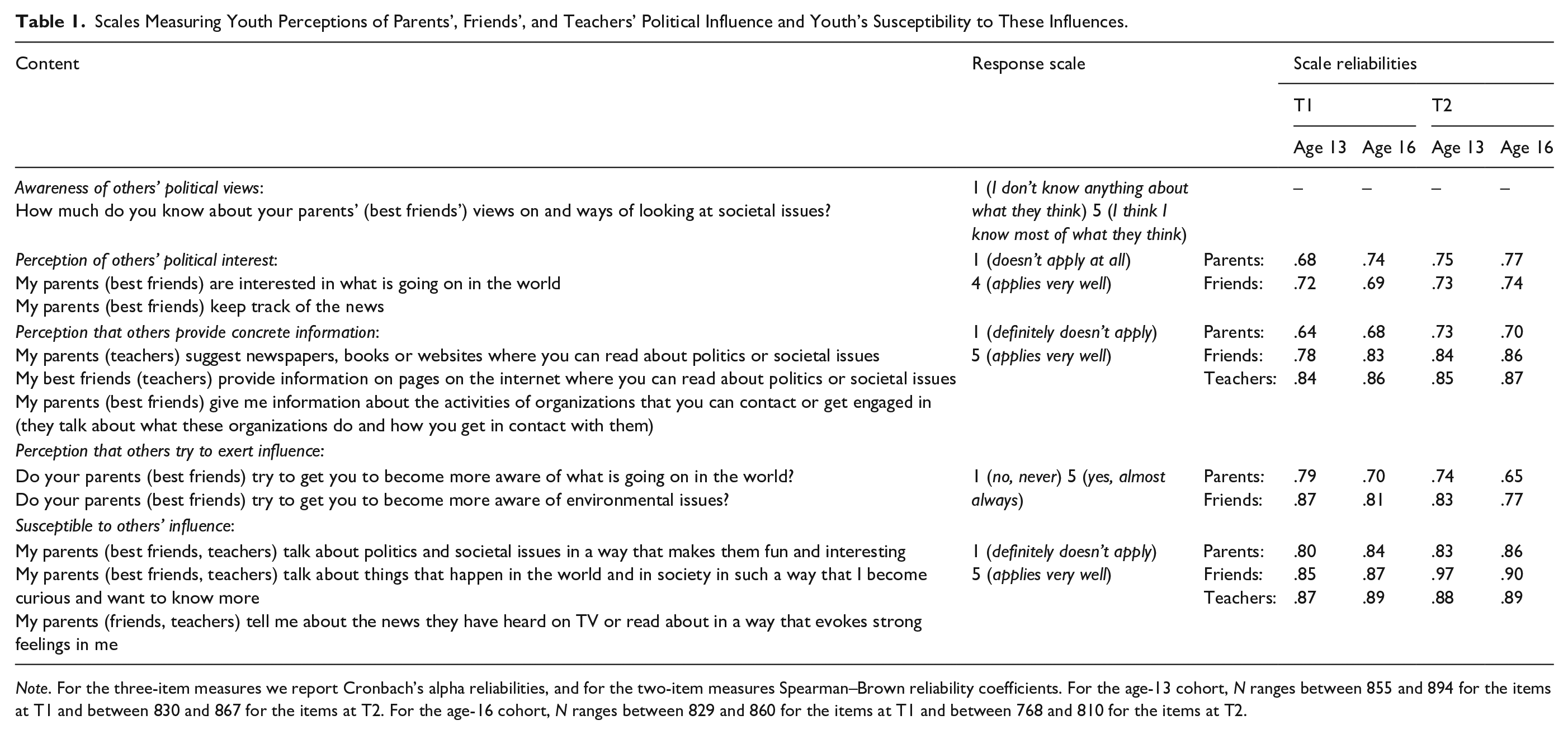
Note. For the three-item measures we report Cronbach’s alpha reliabilities, and for the two-item measures Spearman–Brown reliability coefficients. For the age-13 cohort, N ranges between 855 and 894 for the items at T1 and between 830 and 867 for the items at T2. For the age-16 cohort, N ranges between 829 and 860 for the items at T1 and between 768 and 810 for the items at T2.
Given the lack of information about whether the main study hypothesis applies more to males or to females, sex (1 = male) was controlled for in the study. We also controlled for immigrant background using a measure that differentiates between students with both parents born outside the Nordic countries (coded 1) and other students (coded 0). Table 2 reports descriptive statistics for all the variables in the study at T1 and T2.
Descriptive Statistics for the Variables at T1 and T2.
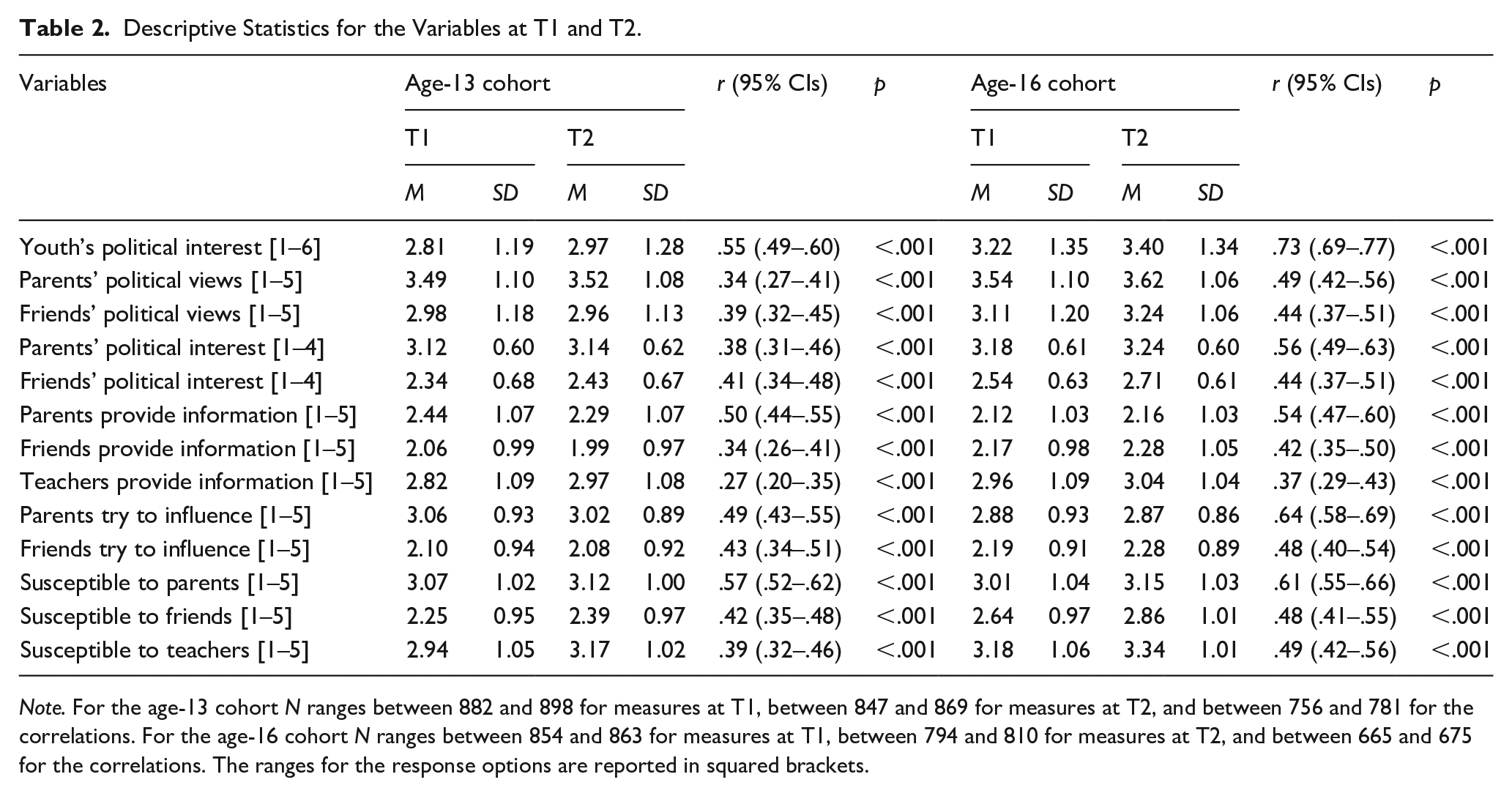
Note. For the age-13 cohort N ranges between 882 and 898 for measures at T1, between 847 and 869 for measures at T2, and between 756 and 781 for the correlations. For the age-16 cohort N ranges between 854 and 863 for measures at T1, between 794 and 810 for measures at T2, and between 665 and 675 for the correlations. The ranges for the response options are reported in squared brackets.
Attrition Analyses
Logistic regression analyses compared the T1 participants who took part with those who did not take part in the data collection at T2 on all the study variables at T1. In the age-13 cohort, significant results were obtained for awareness of best friends’ political interest (odds ratio [OR] = 1.80, p = .003, Cohen’s d = .32) and the perception that friends provide political information (OR = 0.72, p = .023, Cohen’s d = .18). The youth who participated on both test occasions were more aware of their best friends’ political views but regarded their best friends as providing less political information. In the age-16 cohort, a significant result was obtained for perceived attempts by parents to influence their youth (OR = 1.28, p = .037, Cohen’s d = .14). The youth who participated on both test occasions perceived more attempts by parents to exert influence than the youth who responded only at T1. In light of the low Nagelkerke R2 coefficients, .05 in the younger cohort and .03 in the older, and given that the differences in terms of significance when converted to Cohen’s d can be regarded as small, we consider that the bias between the longitudinal cohorts is low.
Analytic Strategies
We made use of latent change models (LCMs; McArdle & Nesselroade, 1994) to test the idea that youth’s political interest impacts on youth’s perceptions of their parents, peers, and teachers, rather than the opposite. We tested one LCM for each family of variables, that is, for knowledge of others’ view, others’ political interest, others providing political information, others trying to exert influence, and susceptibility to others’ political communication. Figure 1 depicts the structure of the model tested, using the perception of parents’ political interest as an example. In each model, the observed measures were included as manifest variables and served as indicators of two latent factors. When all loadings are set at 1, the latent intercept reflects the mean level of the variable at the first assessment, whereas the latent slope reflects the amount of linear change that occurs between the two time points. The main advantage of these models is that, by partitioning the variance of a measure into these components, they are suitable tools for distinguishing between-person differences (i.e., stable differences between persons) and within-person change (i.e., change relative to an individual person’s own average).
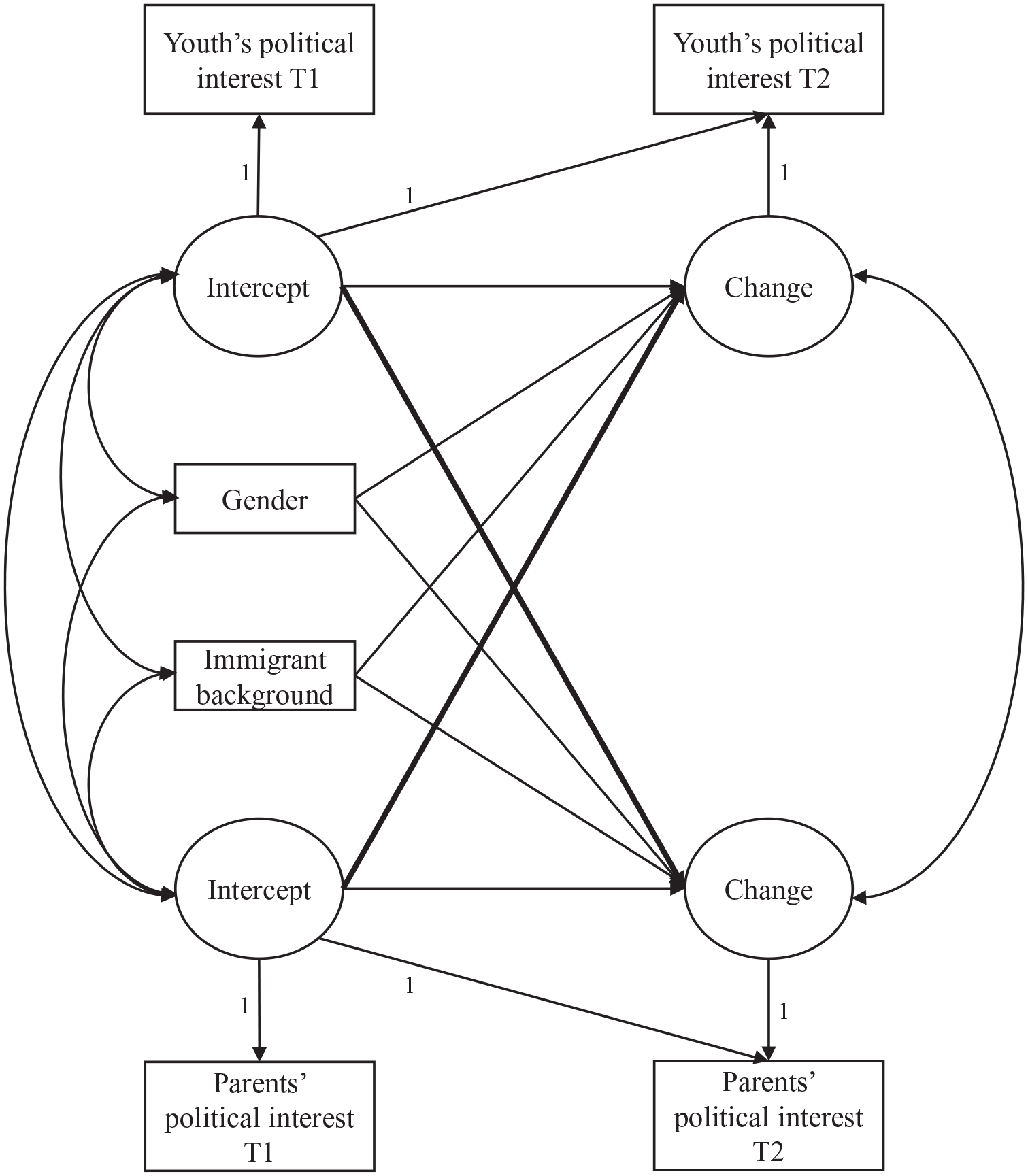
The Structure of the Models Tested.
The model was first tested on the young and old cohorts simultaneously, with all structural parameters allowed to vary across groups. We then conducted a multiple group analysis using a sequential method for testing the imposition of structural invariance constraints across groups. Across-group equality constraints were successively imposed on the coefficients of interest until further constraints significantly worsened the model’s fit (Chou & Bentler, 2002). The parameter with the smallest group difference was equated across the groups first, and the revised model was then estimated. We used chi-square difference tests to compare the less constrained model with the more constrained model (Kline, 2016). A significant χ2 difference value suggests that constraining the path to be equal across groups worsens the model fit and the less constrained model should be retained, whereas a nonsignificant difference indicates that the two models provide equal fit to the data and the more constrained/parsimonious model should therefore be retained. All models were run in Mplus 8 (Muthén & Muthén, 1998–2017) and were specified with the MLR estimator, that is, maximum likelihood estimation with robust standard errors (Yuan & Bentler, 2000) so that fit statistics are corrected for nonnormality. This estimator, by default, computes parameter estimates using all available information, taking missingness into account under the assumption of Missing At Random (MAR). Also, in all models, we controlled for youth’s gender and immigration status.
Results
Table 3 shows the estimates of the effects from the latent intercepts (initial levels) on the latent slopes (changes between T1 and T2). The table reports on the models with all paths constrained to be equal across groups, except for the paths that—with the multiple group comparisons—turn out to be significantly different from one group to the other. In this case, we report both coefficients, the first for the younger cohort and the second for the older cohort. All models had good fit indices. Youth’s initial levels of political interest positively and significantly predicted changes in the perception of significant others’ political views, the perception of others’ political interest, the perception that others provide political information, the perception that others try to exert influence, and susceptibility to others’ political communication in both cohorts. In short, significant effects, most often at the .001 level were found when youth’s political interest predicted a change over time in their perceptions of political interactions with others. Here, we found no significant differences between age cohorts. Regarding the other direction of effects, that is, from the initial levels of the perceptions of significant others to changes in youth’s political interest, the perception of teachers did not affect changes in youth’s interest, but the perception of friends did so in two instances. In particular, awareness of friends’ political views predicted an increase in youth’s political interest in the older but not in the younger cohort. Finally, perceptions related to parents predicted changes in youth’s political interest in all the models considered. Again, we found no significant differences between the age cohorts. Note that in 11 out of the 12 analyses, youth’s political interest predicted a strong change in their perceptions of their political interactions with others at the .001 level but in no case did youth’s perceptions of others predict a strong change in their political interest at the .001 level. Also, R2s indicate that our models better predicted changes in the perception of political interactions with others (mean R2 for the perception of interaction with parents across all models was .30; mean R2 for the perception of interaction with friends was .34, and the mean R2 for the perception of interaction with teachers was .37) than changes in youths’ political interest over time (mean R2 was .16). Overall, although our model revealed reciprocal effects, much of what we see over time in these analyses is consistent with the idea that adolescents’ political interest affects their perceptions of others’ political interest, views, support, and influence, and their own susceptibility to their important others’ political communication more than the other way around.
Unstandardized Coefficients for the Multiple Group Latent Change Models.
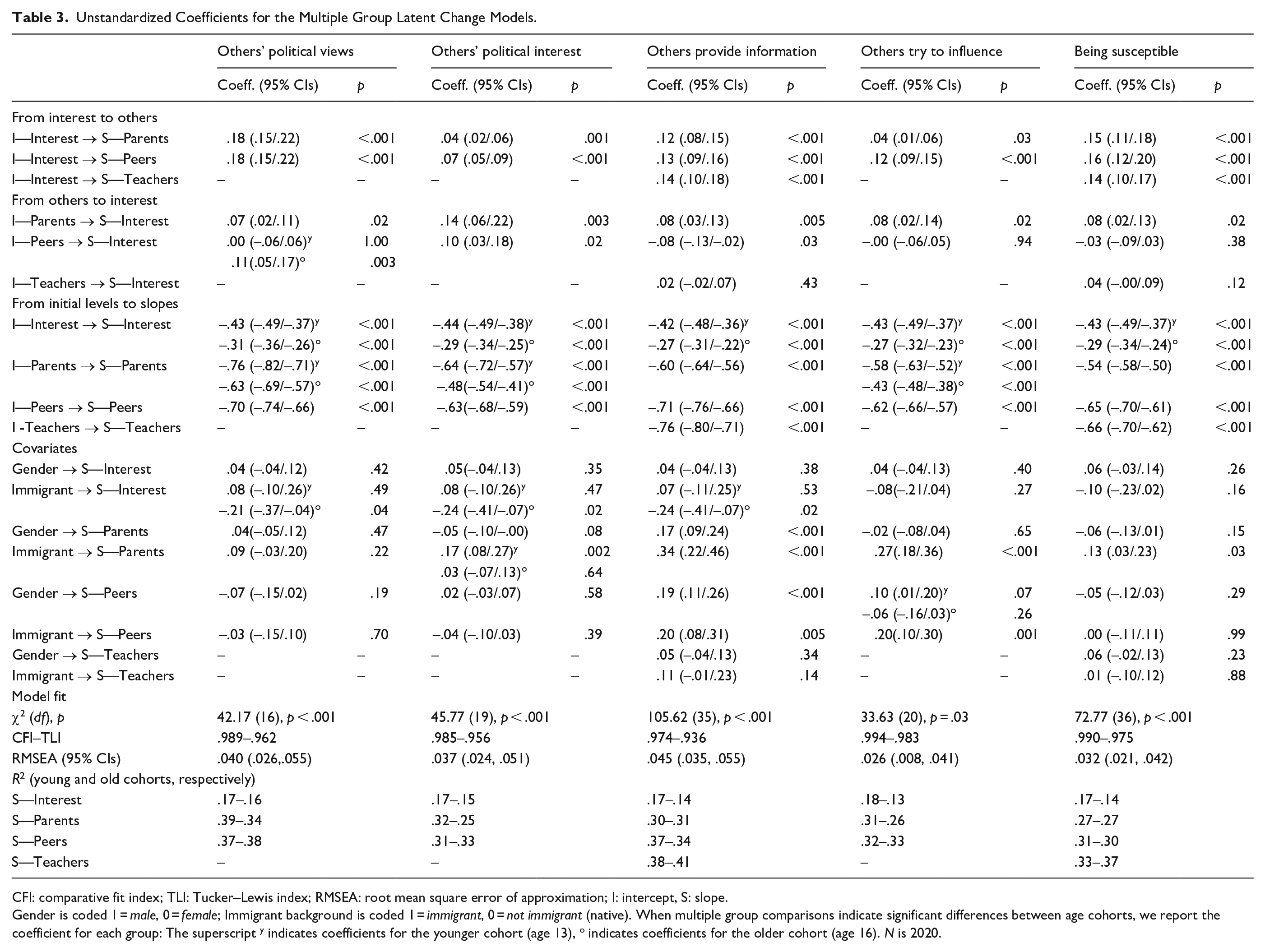
CFI: comparative fit index; TLI: Tucker–Lewis index; RMSEA: root mean square error of approximation; I: intercept, S: slope.
Gender is coded 1 = male, 0 = female; Immigrant background is coded 1 = immigrant, 0 = not immigrant (native). When multiple group comparisons indicate significant differences between age cohorts, we report the coefficient for each group: The superscript y indicates coefficients for the younger cohort (age 13), o indicates coefficients for the older cohort (age 16). N is 2020.
Concerning the control variables, the results show few gender differences regarding the latent slopes, other than boys perceive that parents and peers provide political information more often than girls do. Further differences emerged in relation to youth’s immigrant background. Youth with parents from countries outside Scandinavia tend to perceive that parents and peers provide political information and try to influence them more over time. Also, these youth perceive their parents’ to be more influential over time and, only at age 13, do they perceive their parents’ interest to be increasing over time. The full results of the LCMs are reported in Table S3 in the Supplementary Online Material.
Discussion
We proposed that youth’s political interest affects perceptions of their political interactions with important others—parents, peers, and teachers. In this study, political interactions with important others were broadly defined in terms of youth’s awareness of others’ views on and ways of looking at societal issues, the interest others were perceived to have in politics and society, whether youth perceived that other people provided them with political support, whether they perceived that these other people were influencing them, and whether they were susceptible to these others’ political communication. For the most part, in the results from 13- to 16-year-olds, each followed over 1 year, support the proposition that youth’s political interest affects their perceptions of important others’ political views, influence and support. In 11 out of 12 longitudinal analyses, youth’s political interest strongly affected their perceptions of their political interactions with others. By contrast, none of the 12 analyses showed that the perceptions of political interactions with others predicted a strong change in youth’s political interest. Overall, there was ample support for the study hypothesis that high political interest sensitizes youth to others’ political communication and makes them recognize others’ political interest and influence, and others as a source of political inspiration.
Concerning developmental trends, we had expected that the increased stability over time in youth’s political interest from adolescence to young adulthood (Russo & Stattin, 2017b) would dampen the effects of youth’s perceptions of their political interactions with others on their political interest more for the mid-adolescents than for the early adolescents. But we found little empirical evidence of this. In both the early and mid-adolescent samples, youth’s perceptions of others’ political interest, views, support, and influence, and their own susceptibility to their important others’ political communication, seemed to affect their political interest to about the same limited extent.
In classic studies of political socialization, agreement in political attitudes and behaviors between parents and youth was seen as evidence of parents’ socializing influence (Jennings & Niemi, 1968, 1974). Studies using regular correlation coefficients were taken as empirical evidence that parents socialize their children through political discussions at home (McIntosh et al., 2007). The longitudinal studies that permitted the identification of bidirectional influences showed either that political discussions with parents and youth’s political interest predict each other bidirectionally over time, or that political interest alone predicts political discussions over time (Kim & Stattin, 2019; Russo & Stattin, 2017a). The current study focuses on youth’s perceptions of their political interactions with parents, friends, and teachers. The main message is that youth’s perceptions of political interactions with their important others can partly be explained by the youth’s own political interest. Politically interested youth are aware of their political interactions with important others, are sensitive to their political communication, are aware of their influences, and are susceptible to their messages, to a greater extent than politically uninterested youth.
Perhaps the most obvious conclusion to draw from this study is that politically interested youth seem to be open to others’ political influences independently of the environmental context, that is, whether in the peer group, at school, or at home. Indeed, young people need to be open to their parents’ and others’ socialization efforts if “normal socialization” is to operate as it should. Essentially, this idea reflects the assumptions about socialization posed in value socialization theory (Grusec & Goodnow, 1994; Grusec & Kuczynski, 1997; Knafo & Schwartz, 2003, 2009). In this theory, in the family context, key features are youth’s acceptance and accurate perceptions of their parents’ views (Grusec & Goodnow, 1994). When youth correctly perceive their parents’ values and attitudes, they can decide whether or not to adopt these values and attitudes as their own. If they do so, they are said to have internalized their parents’ values and attitudes. For accurate perceptions of parents’ values, youth need to be open to these values. Apparently, as shown in this study, youth who are politically interested are open to, and liable to be influenced by, other people’s political information in their main everyday-life settings. This is important information for further theoretical development of research into political socialization.
Overall, we have proposed that high political interest makes youth sensitive to other people’s political communication, to their attempts to exert influence, and to these people as sources of political inspiration. This is a more general explanation than the one entailed by the hypothesis proposed by Stattin et al. (2021) that projection can explain the link between youth’s political interest and their perceptions of the frequency of political discussions with parents. The more general explanation proposed here is not limited to youth’s perceptions of their political discussions with parents but generalizes to youth’s broader perceptions of their political interactions with their own important people, that is, parents, peers, and teachers. This explanatory proposal can be subjected to direct tests, rather than being inferred from designs that examine differences in the magnitudes of projection and accuracy effects. Indeed, the explanation can be tested with longitudinal designs, rather than being limited to cross-sectional analyses. However, that said, we cannot fully rule out the possibility that projection plays a substantive role.
More broadly, developmental theories in psychology tend to converge around the idea that the way people appraise the situations and interactions with others that they meet in everyday life will determine their reactions and later actions. The psychological meanings of these situations and interactions are the determining factors in their behaviors (Magnusson & Stattin, 2006). This insight is valuable for studies that have attempted to examine how young people perceive their political interactions with others. Stattin and Kim (2018) found strong support for their claim that, when 16-year-old adolescents are asked to report on their parents’ humanistic, environmental, and achievement values, they report their parents’ values as being close to their own. Youth reports of these values do not match those of their parents, though. Stattin et al. (2021) found that youth’s political interest was strongly related to their perceptions of the frequency of family political discussions, whereas the correspondence between parents’ and youth’s reports of these discussions was low. In these studies, there seems to be a general tendency of youth to view others’ values and political interactions as similar to their own. As Anaïs Nin (1903–1977) is known to have said: “We don’t see things as they are, we see them as we are.” That adolescents are not left in their perceptual worlds, apart from others’ perceptions, is suggested in this study. Their political interest seems to make them open for other peoples’ political input.
Explanations for the Development of Political Interest
If the development of political interest can partly be described as a self-driven process, the question immediately becomes one of what makes some people politically interested and others not. There are several plausible answers. An obvious one is that a political interest that once was situational may develop into one that is dispositional (Hidi & Renninger, 2006). An unplanned encounter with a political event may, over repeated exposures, lead to a sustained interest in politics (Prior, 2019). Other answers reflect mutually reinforcing processes. Politically interested youth, with their higher responsiveness to political cues, are more likely to encounter events in their daily life that further spur their political interest (Stattin et al., 2017). Also, youth’s political interest may make them more convinced that they can affect political issues or have high internal political efficacy or social responsibility (Ardèvol-Abreu et al., 2019; Schmid, 2012), and high internal political efficacy may, in turn, sustain or increase their political interest over time (Arens & Watermann, 2017).
Another possible answer is that genetic factors lie, in part, behind the development of political interest. At least a decade of research attests to the conclusion that genetic factors affect people’s political behaviors, values, and attitudes (Hatemi, 2012; Hatemi et al., 2012; Hatemi & McDermott, 2012a, 2012b). A study using the Swedish Twin Registry considered genetic variability in political interest (Dawes et al., 2014). Genetic factors were found to account for 50% of the variation in political interest, while the unique environment accounted for 44%. The common-environment effect, which includes, but is not limited to, being raised in the same family, accounted for only 4%. Very similar genetic and environmental estimates have been reported from U.S. samples (Arceneaux et al., 2012). Likewise, in a study of two independent samples of twins, York (2019) found that the frequency of discussing political issues with others was explained by latent genetic traits and unique environmental effects to the same extent as in studies of political interest, and the common environmental effect was almost zero. These studies examined people of middle age, and it is unclear whether their findings can be generalized to youth. Nevertheless, that genetic factors account for the main part of individual differences in political interest and political discussions, and that the common environmental factor accounts for only a small proportion, may explain why politically interested individuals tend to be sensitive to their political interactions with others and why there is a lack of correspondence between parents’ and youth’s political interest. Of course, other explanations for the reported findings cannot be ruled out.
Strengths and Limitations
The current study has important strengths. It is the first study, to our knowledge, to propose that youth’s political interest triggers their perceptions of important others’ attempts to politically influence them as well as their susceptibility to others’ political communication. Apparently, this is the case even for youth as young as 13 years of age. This agentic perspective is different from that expressed in the decades of research asserting that youth’s political interest is mainly attributable to parents, peers, and teachers’ efforts to convey information.
The study was conducted at specific points in time and in a specific geographical milieu. Although the sample can be said to be representative of youth of the targeted ages in Sweden at the time of the study, the possibility that different results may have emerged if the study had been conducted in other countries cannot be ruled out. This is an important limitation of the study, the results of which need to be cross-validated using other samples in different countries.
Also, it has to be acknowledged that response bias may affect the self-reports in this study. Perhaps of most concern is social desirability. However, we do not consider the questions in our inventory about political and societal issues in the everyday life of Swedish youth as sensitive enough to prompt them to shift their private views toward what is publicly expected of them. We do have to acknowledge, though, that some young persons might try to present themselves in an overall favorable and mature light by reporting that they are generally politically interested, often have conversations with others about politics, and are interested in other people’s views about politics. Still, we believe that this potential social desirability bias should not systematically undermine the results reported.
Political interest stabilizes in late adolescence (Prior, 2019; Russo & Stattin, 2017b). At this time in life, the high stability of political interest should leave little room for changes in political interest due to interactions with important others. This study focuses on samples of 13- and 16-year-olds, which represents a time when youth’s political interactions with important others still should have a substantial effect on them. The findings in this study suggest that, even at this phase of life, youth’s political interest seems to affect their perceptions of their political interactions with others, rather than the opposite. Studies of political development in childhood are rare (Patterson et al., 2019), but need to extend to younger age groups before firmer knowledge about the causal connections between political interest and perceptions of political interactions with important others can be established.
Conclusion
The findings of this study suggest that politically interested youth are more likely than other youth to recognize the political knowledge of others, to acknowledge their political support and influence, and to be inspired by their political communication. The conclusion in the literature, taken much for granted, that the development of the political interest of youth is under the influence of parents, peers, and teachers through learning is not self-evident. Youth’s political interest seems to operate as a filter for their perceptions of political communication with others, which makes them far from being passive recipients of others’ political influence.
Supplemental Material
sj-docx-1-jbd-10.1177_01650254221095843 – Supplemental material for Youth’s own political interest can explain their political interactions with important others
Supplemental material, sj-docx-1-jbd-10.1177_01650254221095843 for Youth’s own political interest can explain their political interactions with important others by Håkan Stattin and Silvia Russo in International Journal of Behavioral Development
Footnotes
Acknowledgements
This study was made possible by access to data from the Political Socialization Program, a longitudinal research program at Youth & Society (YeS) in Örebro University, Sweden.
Funding
The author(s) disclosed receipt of the following financial support for the research, authorship, and/or publication of this article: The program was supported by Riksbankens Jubileumsfond, the Swedish Foundation for Humanities and Social Sciences [M2008-0073:1-PK].
Ethical Approval
The study was approved by the regional Ethical Committee at Uppsala, Sweden.

Supplemental Material
Supplemental material for this article is available online.
References
Supplementary Material
Please find the following supplemental material available below.
For Open Access articles published under a Creative Commons License, all supplemental material carries the same license as the article it is associated with.
For non-Open Access articles published, all supplemental material carries a non-exclusive license, and permission requests for re-use of supplemental material or any part of supplemental material shall be sent directly to the copyright owner as specified in the copyright notice associated with the article.
