




Abstract
Research has documented both stable and nonstable trajectories of depressive symptoms across young adulthood, but has not explored the mechanisms that might explain change in level of depressive affect over time. To explore this question, the current study draws on data from an Israeli longitudinal study of 205 young adults who reported their depressed symptoms four times from ages 23 to 35 years. Employing a latent profile analysis (LPA), three distinct trajectories of depressive symptoms were identified: stable low, moderate and decreasing, and stable high. To understand how stability and change in the course of depressive symptoms across time aligns with career development, 60 participants (20 from each profile), who had completed in-depth career development history interviews at age 29, were randomly selected. Subjecting the interviews to qualitative analysis showed that participants belonging to the stable low depressive symptoms trajectory were more likely to be intrinsically motivated, having the capacity to learn from their experiences, which resulted in a more successful career pursuit. In contrast, participants who consistently exhibited a high level of depressive affect were more likely to lack motivation, tended to feel at a loss, and were less likely to know what they want to do with their lives. Participants who were identified as belonging to the moderate and decreasing trajectory were more likely to describe the lack of a clear view of their future career plans. However, due to encouragement from significant others, they eventually found their niche. Conceptually, findings underscore the importance of understanding career factors that could covary with stability or change in the level of depressive symptoms during young adulthood.
Longitudinal studies tracking the fluctuations of depressive symptoms from adolescence into young adulthood have consistently demonstrated substantial variation among individuals in both the degree and development of depressive symptoms over time. Overall, the identified trajectories have represented either stable levels (high or low), or an increase or decrease in the magnitude of depressive symptoms over time (Schubert et al., 2017). Although this body of research is informative of the heterogeneity in developmental courses of depressive symptoms, these studies covered the age range of 15–25 years. Less is known of the possible developmental course of depressive symptoms after the age of 25, and when young people enter their thirties. Previous research also demonstrated the contribution of different environmental or biological risk factors to explain membership in the different depressive trajectories (see review by Schubert et al., 2017). However, to the best of our knowledge these studies have not explained the possible mechanisms that might associate with increase or decrease in depressive symptoms over time. Based on longitudinal data combined with in-depth interviews, the current study explored depressive symptom trajectory profiles between the ages of 23 and 35. In addition, through qualitative analysis of in-depth interviews assessing participants’ history of career pursuit, career patterns within each profile were explored and compared to identify possible interrelations between depression symptoms and patterns of career progress over time.
Research on mental health during young adulthood has produced contradictory results. On one hand, studies document a high prevalence of psychiatric problems among people in their twenties (Kessler et al., 2005). Yet, there is also mounting evidence that mental health improves for the average young adult (Galambos et al., 2006). Schulenberg and Zarrett (2006) suggest that the contradictory trends, both in general mental health and depression, mask the increasing heterogeneity in life courses deriving from individual capacity or difficulty in coping with developmental challenges.
Trajectories of Depressive Symptoms
Accumulating research that followed adolescents through young adulthood supports the existence of distinct depressive trajectories. For example, assessing trajectories of self-reported depressed mood from ages 12–25 years, Costello and colleagues (2008) found four trajectories: no depressed mood, stable low depressed mood, early high declining depressed mood, and late escalating depressed mood. The majority of participants belonged to one of two profiles—the low and stable, or the decreasing depressive symptom profiles. Essau and colleagues (2020), following adolescents from age 15 to 26, identified three trajectories of depressive symptoms: a trajectory of consistently low symptom level, a trajectory of decreasing symptom level, and a trajectory of increasing symptom level. Reviewing 54 studies that assessed trajectories of depression across adolescence and early adulthood, Schubert and colleagues (2017) found that the majority of studies report either three or four distinct depressive symptom trajectories. Inspection of the different trajectories shows that the majority of individuals experience only minimal depression throughout adolescence and early adulthood. A small number of individuals reported a persistent high level of depression across time. In addition, there is evidence for distinctive upward and downward trajectories over time (Chaiton et al., 2013; Sabiston et al., 2013). In sum, the majority of studies concluded that there is at least one “intermediate” trajectory of young people, characterized by less severe depressive symptoms over time. These intermediate trajectories tended to be less stable than the high and low trajectory groups, and often showed considerable positive or negative change over time (Schubert et al., 2017).
The majority of the existing studies examined the developmental course across adolescence into early adulthood (Schubert et al., 2017). However, less is known about what course depressive trajectories might take in the following years. Young adulthood is a major life transition, accompanied by more extensive individual and contextual change than any other phase of life. Young people are expected to pursue a career, and establish a stable romantic relationship (Shulman & Connolly, 2013). Previous research shows that despite the mounting tasks, the majority of young people settle down romantically, and become committed to a career, toward the end of the third decade of life (Cohen et al., 2003). However, in his seminal work, Levinson (1978) describes that the Age Thirty Transition might spread over a longer period of time. During the earlier thirties, the young person is expected to consolidate a “life structure” that encompasses career, establishing a family, and becoming a parent. While for some individuals this transition might be smooth, Levinson describes that for most persons this transition can be stressful, as it is a commitment for the years to come. In a recent conceptual paper, Mehta and colleagues (2020) similarly describe the complexity of tasks with which young people have to cope when establishing their adulthood and settling down once they reach the age of 30. Similar to Levinson (1978), Mehta and colleagues (2020) suggest that the need and urge to settle down can become a source of stress well into the thirties. As such, well into the thirties young adulthood might still present both great challenge and great opportunity in addressing personal and family aspirations, and environmental constraints. Accordingly, increase in depressive symptoms might reflect coping difficulties exacerbating psychosocial vulnerabilities, whereas decrease in depressive affect may reflect more successful negotiation of age-related goals (Edgerton et al., 2019). Taken together, the first aim of the study was to explore depressive symptom trajectories among young adults, following them into their early thirties. Considering both the stressors and opportunities that characterize this period of development (Cohen et al., 2003; Mehta et al., 2020; Shulman et al., 2018), it is likely that both decreasing and increasing depressive trajectories, in addition to the stable low and high trajectories, are likely to be found following young people into their thirties.
What Can Explain Increase or Decrease in Depressive Symptoms Over Time?
Previous research identified a number of biological, psychological, and social factors that increase the likelihood of belonging to different depressive increasing trajectories (Schubert et al., 2017). Several studies have explored the role of gender on depressive symptom trajectories (Hankin, 2009). Another body of research explored and demonstrated the association between genetic variation on factors such as dopamine receptors, and depressive symptom trajectories (Adkins et al., 2012). In contrast, belonging to an intact family, and higher parental support, served as a protective factor against association with a high depressive trajectory (Costello et al., 2008; Edgerton et al., 2019). This earlier research demonstrated the associations between a variety of social, psychological, and biological factors and membership in stable high or low depressive trajectories, but did not explain membership in increasing or decreasing depressive trajectories.
An earlier study assessing the association between exposure to stressful events and depressive symptoms could shed light on the possible conditions and mechanisms that can explain change in depressive symptoms. Pettit and colleagues (2010) found a significant association between stressful events and the maintenance or development of depressive symptoms among adolescents and young adults. Exposure to hassles such as strained interpersonal relationships, or difficulties adjusting to changes in academic or occupational settings, often encountered by young adults, were found to be salient predictors of 1-year increases in depressive symptoms. Earlier studies emphasized the role of difficulties in occupational attainment in predicting greater mental health difficulties such as depression (Burgard et al., 2007). Furthermore, this association between occupational difficulties and depression tends to become more pronounced among young adults (Ueno & Krause, 2019). Success or failure in career pursuit during the transition to adulthood is crucial, as this can affect future occupational trajectories, determine one’s course of life, and become an important part of self-identity (MacDonald, 2009). Indeed, failure in occupational attainment, or employment in jobs not related to one’s goals or aspirations, was found to associate with higher levels of depressive symptoms (Hardie, 2014; Ueno & Krause, 2019).
This association between occupational difficulties and depression among young adults can be further understood from a developmental perspective. Pursuing and developing a career is one of the major developmental tasks during young adulthood (Shulman & Nurmi, 2010). Career pursuit is an ongoing process of adaptation between the self and the situation, with the eventual aim of achieving synergy between individuals’ aspirations and identity, and an occupational environment. Within the career domain, coping strategies have been increasingly characterized as career adaptability (Creed et al., 2009), capturing the capacity to cope with predictable and unpredictable challenges while pursuing one’s career, and remaining committed to career choice. Considering the recent economic and societal changes (Furlong & Cartmel, 2006), the ability to be open and flexible, and maintain one’s motivation in the search for one’s niche, is thus an important asset (Heckhausen et al., 2010). Considered together, difficulties or failure in career pursuit is likely to affect mental health during the transition to adulthood. In contrast, the capacity to employ adaptive coping strategies when addressing developmental tasks and challenges, such as career pursuit, could serve as a protective factor against depression, or might lead to a decrease in depressive symptoms over time. Of note, in addition to one’s set of personal coping resources, social support and willingness to accept advice can serve as an additional resource for addressing adversity in general, and for buffering effect on career stress (Mishra & McDonald, 2017). Career stories of young people could thus be helpful in recognizing their capacities, their inner motivations, their capacity to enact their aspirations, to adapt to changes and to overcome failures, and associate with better wellbeing. In contrast, stories of unsuccessful efforts to progress in the vocational domain might associate with higher depressive affect (Del Corso & Rehfuss, 2011).
Purpose and Aims of the Current Study
In summary, this study aims to identify the different career pursuit stories among young adults. By analyzing young people’s stories of their career pursuit in recent years, and in line with recent conceptualizations of career adaptability (Creed et al., 2009), it can be assumed that stories portraying different coping experiences are likely to include career histories of more or less adaptive modes of coping, and stories that resulted in successful or failed career pursuit. Adaptive coping was described as a buffer against stress (Mishra & McDonald, 2017); thus, it is likely that the extent to which a career pursuit story is associated with a confident pursuit of personal interests, aspirations, and dreams or rather with a sense of difficulties in pursuing one’s goals, failure, or giving up (Savickas, 2005), will associate with the level of depressive symptoms across the years of young adulthood. Furthermore, the richness of stories of career histories might shed light on the development and changes across the process of career pursuit, which might explain changes in depressive symptoms, accordingly.
The current study focuses on career pursuit stories, beginning with the assumption that success or failure to cope with career demands and expectations will associate with individuals’ mental health patterns over time. Research studies on life course transitions suggest that mental health is also associated with the manner in which family related goals and roles are addressed (Schoon et al., 2009). As outlined below, interviews were conducted when participants were 29 years old, when many of them were not yet married. Therefore, the current study focuses only on the coping strategies related to career pursuit.
Data were collected four times from young adults between the ages of 23 and 35. These data were drawn upon to examine two major aims. First, to identify participants who differed in their depressive affect trajectories over the 12 years. Considering both the challenges and opportunities that characterize this period of development, four profiles were expected: both decreasing and increasing depressive trajectories, and stable low and high trajectories. The second aim of the study was to understand the reasons for changes in the level of depressive symptoms across the years, and employed a mixed-methods approach to address this question. Career development stories described by individuals belonging to different depressive trajectories were collected. A closer inspection of the stories and their strategies could then be helpful in explaining which strategies associate with high, low, or change in depressive symptoms over time. We expected that career pursuit patterns that result in greater success are more likely to associate with better mental health outcomes, and be told by individuals belonging to low depressive symptoms trajectories. In contrast, less successful career pursuit patterns are more likely to associate with belonging to a high depressive symptoms trajectory. Finally, closer inspection of the unique career pursuit coping features could be helpful in exploring processes or mechanisms. We assumed that achieving, or learning to cope efficiently with career goals following a failure could explain a decrease in the level of depressive symptoms over time, whereas unexpected failure or repeated failure to pursue career goals might associate with an increase in the level of depressive symptoms.
Method
Participants and Procedure
The participants consisted of 205 Israeli young adults (111 men and 94 women; Mage = 23.01, SD = 1.71) enrolled in two preparatory academic programs in two different colleges, one in the center and one in the south of Israel. The preparatory academic programs were government sponsored, and aimed at promoting academic studies among young people who aspired to higher education, but had not successfully completed their high-school education, or had not attained a high-school diploma. Mean level of parental education was 11.92 years of schooling (SD = 2.55) for fathers, and 11.52 years of schooling (SD = 2.50) for mothers. Thus, the sample represents mainly a lower middle-class background. After obtaining approval for the academic programs, consent of the participants was requested. At the first assessment, we were able to secure participation of 96% of the eligible students of preparatory academic programs.
Overall, this sample completed surveys four times. The first assessment was at age 23, and participants were reassessed at ages 26.5, 29, and 35. At each wave, the level of depressive symptoms was assessed. Mean participation rate for the three latter assessments was 64%. No significant differences were found on the demographic variables (gender, level of parental education) and level of depressive symptoms between individuals who did or did not participate in the later assessments. Participants were compensated with an amount of about US$30 to encourage participation in the latter three assessments. At the third wave, at age 29, a random subsample of 100 of the 132 participants at the third assessment was given in-depth interviews. This random subsample of 100 of the 132 participants was selected due to budget limitations. In the interviews, participants were asked to talk about their work and career history in recent years, as described in detail in the following section. In line with the purpose of the current study, and to understand the mechanisms that could explain how stability and change in the course of depressive symptoms across time aligns with career development, 60 of the 100 participants who had completed the career development history interviews at age 29 (20 from each profile) were randomly selected. The study was approved by Bar Ilan University’s institutional review board (IRB); date of approval, 13 May 2003.
Measures
Depressive Symptoms
Using the Brief Symptom Inventory (BSI; Derogatis & Melisaratos, 1983), participants rated six items assessing the frequency of their depressive symptoms (i.e., “To what extent have you felt worthless in the last month”) on a five-point scale, ranging from 0 to 4 (0 = not at all and 4 = very often). The mean score for the six items was calculated. A mean score of 2.5 or higher is considered to represent an elevated level of stress (Gilbar & Ben-Zur, 2002).
Cronbach alphas for the four assessments were .92, .89, .91, and .88, respectively.
Career Adaptability Interview
The interview was designed to gather descriptive current and retrospective accounts of the participants’ careers, including both their objective and subjective experiences (Shulman et al., 2015). This followed Rosenthal’s (1993) reconstruction of the life-stories method, where first a spontaneous story is told, after which the questions are presented. In the current study, participants were encouraged first to tell the “story” of their work experience. Following this, they were asked to talk in detail about their current work status, work/study experiences, difficulties they might have had in the past and how they coped with these, feelings and expectations about work/study and their meaning for them. In particular, they were asked to elaborate on their personal, social, and professional dreams. In addition, they were asked to reflect on changes and turning points in the recent histories of their work and career, and on adaptations they made or did not make. In particular, they were encouraged to describe successful and unsuccessful experiences. To capture and address inner processes, participants were further encouraged to relate and elaborate on the extent to which they felt they had advanced on their aspired track, or were still not sure what they really wanted to do in life, and on the extent to which their job fits their interests and is meaningful to them. This extensive interview aimed to capture the possible variability in individuals’ decision-making behaviors, and actions they took or did not take while pursuing their career (Mortimer et al., 2002). The interviews were recorded, transcribed, and analyzed, as will be explained in the following sections.
Data Analysis
To explore possible different patterns of change in the depressive affect among young adults through the years, we ran a latent profile analysis (LPA) in Mplus (Muthén & Muthén, 2017), which allowed us to identify trajectories of change in depressive symptoms over time. Previous studies exploring depressive trajectories ran latent class grow analyses (LCGA) or LPA. In her conceptual discussion of these two types of finite mixture modeling, Masyn (2013) suggests that despite the equivocal label, essentially both are the same (p. 552), as both demonstrate the overall distribution of one or more variables as a mixture of or composite of a finite number of component distributions. Owing to limitations in sample size, we only estimated two-, three- and four-class solution outcomes. While models estimating higher numbers of classes tend to be better fitting when compared with those models estimating a fewer number of classes, instead we selected the most parsimonious models for further analysis.
Qualitative Analysis
Both the literature on the association between career development stressors and depression (i.e., Pettit et al., 2010), and the raw material that emerged from reading participants’ career stories, guided the analysis of the interviews (Spector-Mersel, 2011). We aimed to identify patterns of career pursuit coping modes among individuals affiliated with different depressive symptom trajectories. Reading their career stories, we considered various components such as events, difficulties, obstacles, turning points, decisions made, and coping abilities, as highlighted by the different theoretical approaches cited above. For example, the extent to which they relied on their own capabilities, motivations and interests, and the ways they acted when facing an obstacle or a failure. We considered whether participants described earlier deliberations before actions were taken, whether they offered explanations for decisions they made, or whether they tended to repeat earlier modes of behavior even when those did not necessarily promise success. We also examined participants’ tendency to reach out to others for support in aspects such as information or advice, and to what extent others had, in fact, played a role their choices and outcomes. Subsequently, themes that emerged from the interviews refined our further readings of the material.
As a result, analysis was conducted in the following manner: we first randomly chose 20 interviews from each trajectory group (a total of 60 interviews). We then began with initial coding (Charmaz, 2006), which involved labeling each line of the interview data by asking what the data suggest and exemplify. The constant comparative method (Charmaz, 2006) was used to compare data within each interview, and across interviews (e.g., interviews of individuals affiliated with the same trajectory, as well as cross-trajectories), and to identify commonalities and differences. By this evolving process, proposed patterns and dynamics of coping behavior, and of approaching challenges, were adapted and reformulated to ensure that all career stories were well represented (Morrow & Smith, 2000). To increase the adequacy of interpretations, two raters (developmental clinical psychologists) coded transcripts independently, and disagreements were subsequently resolved through negotiations until coders agreed on all themes (described below).
Identification of Career Pursuit Dynamics Rating, and Inter-Rater Agreement
Looking for the dynamics of the career pursuit, two main dynamics were identified, namely, internal versus external motivation (or amotivation), and the capacity to learn from past experience. The first dynamic assessed the type of motivation that facilitated individuals’ pursuit of a career, and consisted of three categories. The first category included individuals who were internally motivated, active, and self-determined in their pursuit process. Their readiness to invest time and efforts in pursuit of their aspired career goals was high. The second category included individuals who were guided less by personal aspirations. They were more likely to describe that they were influenced or encouraged by others to pursue the specific goal. Finally, the third category included individuals who lacked the inner drive and capability to make changes or to be invested in the pursuit of a career, and seemed to prefer continuing their life as it was, although this did not lead anywhere. Conceptually, the three categories recall the constructs conceptualized by the Self Determination theory (Ryan & Deci, 2000), and will be referred to as Intrinsic motivation, Extrinsic /Identified motivation, and Lack of motivation.
The second dynamic that was identified focused on the participants’ capacity to learn and draw lessons from past experiences, and make adaptations that further facilitated progress in the pursuit of their career (Knight, 2011). Participants also fell into one of three categories for this dynamic. The first category included resourceful individuals who demonstrated a high capacity to learn from earlier experiences that, in turn, led to insight and progress and contributed to a sense of success in attainment of the aspired goals. The second category included individuals whose progress resulted from repeated trial and error behaviors until they realized, or were told by others, that some changes were necessary to find their way. As a result, their career pursuit story included both difficult and more successful periods. Finally, the third category consisted of individuals whose stories reflected repeated incapacity to learn from past experiences, and their interviews contained stories of repeated failures and disappointments, accompanied by a sense of despair.
After the establishment and definition of the two dynamics, two additional raters independently coded the transcripts to assign each interviewee to the dynamic categories 1, 2, or 3 for motivation and the capacity for learning. The transcripts were given to the two raters in a random order. The raters were not given any information with regard to the participant’s level of depressive symptoms. In the first step, raters classified career stories into whether the respondents described a highly internally motivated pursuit, were less guided by personal aspirations and more directed by others, or whether their career story represented a lack of inner capacity and motivation. Participants were thus assigned 1, 2, or 3 for the motivation dynamic. Inter-rater reliability for this dynamic was at the level of kappa = .87. In the second step, raters were again given the transcripts in a random order, and were asked to rate the career stories with regard to described insightfulness and capacity to learn from past experience. Again, participants were assigned 1, 2, or 3 for the learning dynamic. Inter-rater reliability for this dynamic was at the level of kappa = .85.
Results
Trajectory Analysis
An LPA was conducted to explore depressive trajectories. We relied on the Vuong–Lo–Mendell–Rubin (VLMR-LRT) and the Lo–Mendell–Rubin adjusted likelihood ratio test (LMR-LRT) to determine which solution was optimal. A significant p-value suggests that a model with k class fits the data better than the model with k-1 classes. A comparison of LPAs for level of depressive symptoms revealed that only two- and three-class solutions could fit with the data. We selected the three-class solution, as this provided the best fit to the data when compared with a two-class solution. In addition, its Bayesian information criterion (BIC) and aBIC values were lower. Thus, the three-class solution was selected as the optimal solution. A summary of the model fit results of different class solutions are presented in Table 1. The three distinctive trajectories of depressive symptoms reflected theoretically meaningful patterns of levels of depressive symptoms. The first trajectory was stable low depressive symptoms across all the years of young adulthood, and accounted for 38.8% of the sample. The second trajectory was moderate and decreasing depressive symptoms, and accounted for 43.2% of the sample. The third trajectory was stable high depressive symptoms, which accounted for 17% of the sample. The three trajectories are presented in Figure 1. Means and standard deviations of depressive level for each trajectory across the four assessments are presented in Table 2. In sum, assessing the level and change in depressive symptoms among young adults over a span of 12 years, till the age of 35, yielded three depressive symptoms trajectories: stable low, moderate decreasing, and stable high.
Summary of Model Fit Results of Different Class Solutions for Depressive Trajectories.

Note. LL: log-likelihood; AIC: Akaike information criteria; BIC: Bayesian information criterion; aBIC: sample size-adjusted BIC; VLM-LRT: Vuong-Lo-Mendell-Rubin likelihood ratio test; LMR-LRT: Lo–Mendell–Rubin adjusted likelihood ratio test.
n = 205.
Best models are bolded.
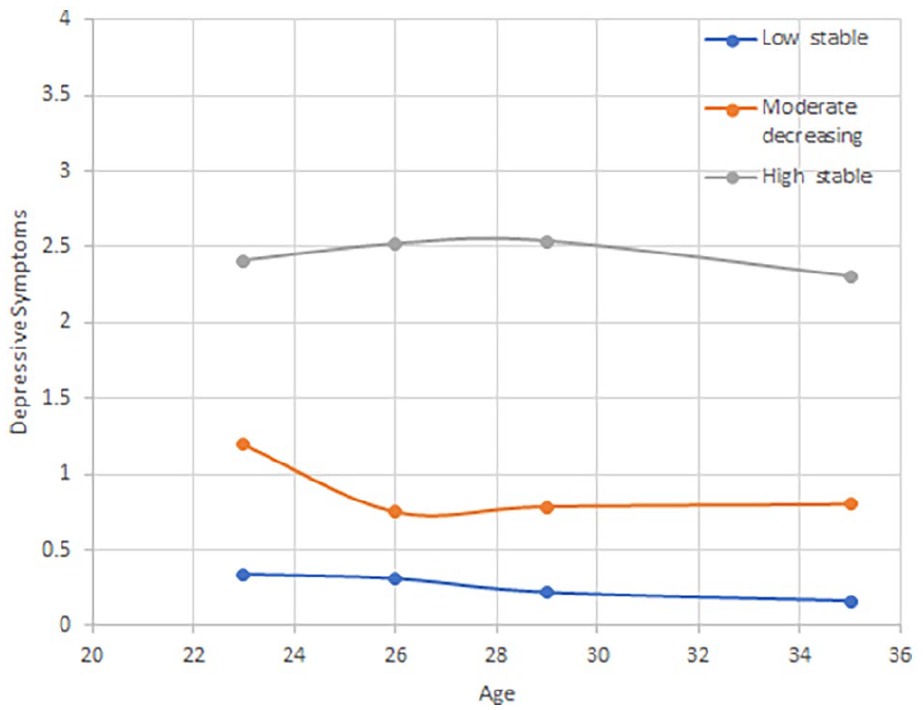
Trajectories of Depressive Symptoms.
Level of Depressive Symptoms by Trajectory and Age: Ms and SDs.
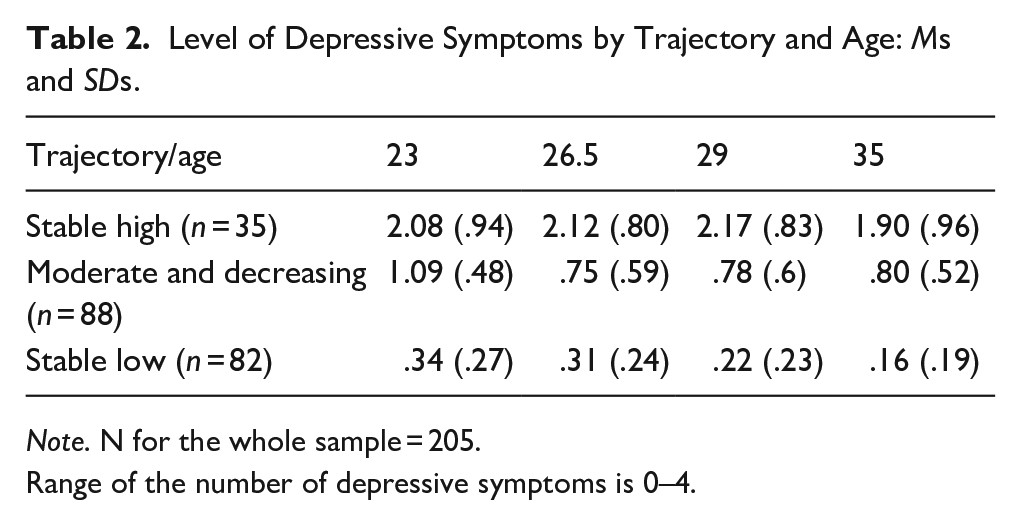
Note. N for the whole sample = 205.
Range of the number of depressive symptoms is 0–4.
Career Pursuit Dynamics and Depressive Symptom Trajectory Membership
Motivation and Depressive Symptoms Trajectory
The three categories of the motivation feature captured the extent to which individuals described that they were guided by internal career aspirations (intrinsic motivation), influenced by others (extrinsic/identified motivation), or lacked motivation (amotivation). Individuals who were coded as presenting intrinsic motivation described concern about their future career progress; they thought about their future, and put effort into advancing their career development. These individuals’ actions and choices were self-initiated or fully self-endorsed. Their decisions were autonomous and connected to their sense of self. This could be seen in the following story of a young adult describing his decision to study engineering:
After I spent two years working in temporary jobs, it was time to think about the future, I told myself. . . you can really do something and not just go study because everyone else goes, but really do something you believe in . . . that in the end will fulfill what you truly want. (p. 200)
The second category of extrinsic/identified motivation included those who described their career pursuit as geared toward goals influenced or valued by others. Although they might have seemed to pursue a career, they needed external encouragement to become involved in a vocational pursuit. The external forces might have been cues, such as internalized social expectations, that drove these individuals to make decisions and become active, or external figures such as parents, friends, a partner, or a mentor who convinced, or even pushed, the individual to make a decision and start acting toward vocational progress. The following story of a young man showed how his father persuaded him to start studying to attain a profession. Interestingly, driven by his father, he started studying without deciding which subject to study:
I started studying at a relatively old age, when I was 26. (How did it come up?) I had a fight with my dad, he told me I need to start studying and I told him I don’t want to. But then I realized I work too much, and it doesn’t lead me anywhere. . . I once thought that if I should start studying then it should be something really good. But then it was no longer so important to me what to study, the main thing was to start with something. (p. 44)
As could be seen this young man was guided by his father, followed his father’s advice, and started studying.
Individuals identified as belonging to the third category of amotivation diverged from the other two categories, as they were indifferent to their future and did not describe clear interest in career pursuits. For example, a young woman described: “I think about it (getting a job) but then a month passes, a week, a year, I forget and then it comes up again” (169). Others might have described having a dream; however, the dream might not have been realistic, and no steps were taken toward pursuing this path.
Tabulation of the three motivation categories across the three depressive symptoms trajectories are presented in Table 3. As can be seen, these three motivation dynamics differ significantly across depressive trajectories: χ2 (df = 4, n = 60) = 20.44, p < .001. A total of 18 of 20 participants who belonged to the low stable depressive trajectory described themselves as intrinsically motivated in their career pursuit. In contrast, members of the high stable depressive trajectory were significantly more likely to describe career stories characterized by amotivation. Members of the moderate and decreasing depressive trajectory were significantly more likely to report that they were stuck in their career pursuit process, and were not sure of what they really wanted to do. However, at some point in time they were influenced by a significant other, which led them to change direction and start pursuing a career more actively.
Frequencies and Residuals of the Three Motivation Categories Across Depressive Symptoms Trajectories.

The Capacity to Learn from Past Experiences and Depressive Symptoms Trajectory
The first category of this dynamic included individuals who described competently navigating their careers. In addition, their description revealed how they learned from past experiences, and were highly reflective of their experiences and aspirations. This associates with strong commitments and having an inner plan of how they saw themselves in the future. In particular, some described an insightful learning process:
Looking back I understand that I have always tried to understand what works and what does not work. In addition, I looked how others do it. And because I was able to learn and be open to ideas, I gained a lot of knowledge that helped me progressing. (p. 217)
Individuals belonging to the second learning dynamic described a lower capacity to draw lessons from past experiences. They described career pursuit as a process of “lots of trials and errors” (p. 35) until they became more aware of their true preferences, values, and needs. A young man described: “I tried to find what’s right for me. I moved from one position to another, switching departments within the company . . . After I was promoted to be a team leader, I realized I prefer jobs with more technological nature . . .” (p. 25). To their merit, members of this category, despite earlier doubts, described a process of becoming more capable of finding their way and starting to settle down.
While the previous two categories represented learning dynamics through insight or through repeated and sometimes painful experiences, members of the third category described little learning over time. Career stories of these individuals lacked descriptions of progress, and were characterized by repeated failures that did not lead to change in course. As a result, they relinquished control and tended to harbor attitudes and beliefs that held them back and prevented them from developing toward a satisfactory career. This condition was summarized by the words of one young man:
(What do you think about the future?) . . . I just don’t think about it. I live day by day, I don’t plan . . . the issue about work is that you can never know what will happen . . . one day the manager will come and decide, ten people go home. So, I can’t plan too many things. (p. 221)
Tabulation of the three learning dynamic categories across the three depressive symptom.ms trajectories are presented in Table 4. As can be seen, distribution of the categories of the capacity to learn from past experiences significantly differed across depressive trajectories: χ2 (df = 4, n = 60) = 12.52, p < .001. As can be seen in Table 4, participants belonging to the stable low depressive trajectory were more likely to have the capacity to learn from past experiences. In contrast, the vast majority of individuals belonging to the stable high depressive trajectory were identified as lacking the capacity to learn from past experiences. Individuals belonging to the moderate decreasing depressive trajectory were mainly those for whom the career pursuit journey took longer. They described repeated experiences, including repeated failures, until they were able to realize that change was necessary, and then they found their way. In sum, in line with our second hypothesis, an in-depth inspection of the unique career pursuit histories among participants belonging to different depressive symptom trajectories suggest that modes of career pursuit and development of depressive symptoms are significantly associated.
Frequencies and Residuals of Learning Capacity Categories Across Depressive Symptoms Trajectories.

Discussion
Employing an LPA, this study identified three distinct trajectories of depressive symptoms spanning ages 23–35 years. Participants were assigned to one of the three distinctive trajectories of depressive symptoms: a stable low level of depressive symptoms across all the years of young adulthood, a moderate and decreasing level of depressive symptoms, and a stable high level of depressive symptoms trajectory. This trajectory model aligns with earlier research that examined depressive trajectories between adolescence and early adulthood. Overall, earlier studies found three or four depressive trajectories consisting of stable low, stable high, and one or two trajectories of intermediate level of depressive symptoms that tended to be less stable and to decrease or increase over time (see Schubert et al., 2017).
Depressive Symptoms Trajectories Across Emerging and Early Adulthood
Although the number of trajectories align with past research, findings the current study extend on the existing research in two ways. First, the majority of earlier research followed young adults till the age of 25, and only a few studies followed their participants into their thirties. The current study followed young people into their early thirties, covering most of the young adulthood years and beyond. Second, earlier studies showed that the majority, more than 70% of subjects, belonged to a stable or low depressive symptoms trajectory, and only a small percentage belonged to the high stable (Costello et al., 2008; Schubert et al., 2017). Only about 10% aligned with nonstable trajectories. In contrast, in the current study only 38.8% of the sample belonged to the stable low trajectory, whereas the majority of participants, more than 40%, belonged to a trajectory characterized by change in depressive symptoms—moderate and decreasing level of depressive symptoms over time. Thus, focusing on a longer span of years across emerging and early adulthood shed more light on the possible changes in depressive symptoms across young adulthood.
Furthermore, understanding the trajectories within their reference to BSI norms can shed further light on their meaning and distribution. The mean level of depressive affect for the stable high trajectory was consistently above 2.0 but below 2.5, which is considered as the cut-off point for elevated stress. Although members of this trajectory do not fall above the clinical cut-off, they consistently reported an elevated depressive affect (Gilbar & Ben-Zur, 2002). In contrast, members of the low stable trajectory consistently reported a very low level of depressive affect. Members of the moderate and decreasing trajectory reported a moderate level at the first assessment at age 23, which decreased to a lower level of depressive affect at the later assessments at age 26. In sum, at age 26 the majority of our participants could be considered as low on depressive affect. The higher prevalence of moderate level of depressive affect in individuals at the age 23 assessment, and its subsequent decrease to a low level of depressive affect, can be understood considering the developmental challenges typical at this stage of development.
Many young adults have difficulties taking their first steps into the adult world (Arnett, 2015). These difficulties are manifested in postponement of developmental transitions, and an increased likelihood of oscillation between transitory and inconsistent states (Cohen et al., 2003). Furthermore, young adults undergo major changes with respect to their views of themselves, their career aspirations and future tasks, and their relationships with others (Hutteman et al., 2015). Considering the multiplicity of tasks to be handled simultaneously in young adulthood (Shulman & Connolly, 2013), and the increased social and economic uncertainties evident in recent years (Furlong & Cartmel, 2006), the early twenties have become an increasingly stressful period. An accumulation of stress can have important consequences for the mental health and wellbeing of young people (Schulenberg & Maggs, 2002), and could explain why fewer participants in the stable low trajectory of depressive symptoms emerged at the first assessment at age 23 in the current study, relative to research on younger age groups.
Despite the inevitable challenges, young adulthood can also become a period of many new possibilities and growth (Arnett, 2015). Through exposure to different experiences, individuals can become more introspective with age, reflecting their efforts to establish their own identities, to understand how others perceive them, and to discover what roles or jobs they want and are capable of obtaining in adulthood (Arnett, 2015). In another study examining the career pursuit pathways of the participants examined in the current study, Shulman and colleagues (2015) found that more than a substantial number of young adults described disappointments or failures in their career or romantic lives. However, despite earlier setbacks, over the years they were able to change course. They described that they found a new fields of study or new workplaces which they described as interesting, fulfilling and on a par with, and closer to fulfilling their personal inner aspirations. Relatedly, Blustein (2011) showed that even those who did not find their niche and made compromises, learned over time to find meaning in their current occupation and became more satisfied with their life.
Thus, in their early twenties, young adults might experience greater stress relative to earlier in life, which is evidenced in a moderate high level of depressive symptoms. However, it is probable that after young adults become more established in careers and relationships (and other life pursuits), depressive symptoms would decrease, which could explain the higher prevalence of the moderate and decreasing trajectory in the current study. The higher prevalence of individuals with a moderate level of depressive symptoms in the current study, compared with their prevalence in earlier studies, can also be attributed to the nature of the current sample. At the first assessment, participants were enrolled in a college preparatory program. Success or failure in the program could determine their chances of acceptance into a college. This could be a very stressful period, and could explain elevated stress and depressive affect. Indeed, following completion of the program, those reporting a moderate level depressive affect reported a decreased level of depressive affect at the second assessment.
Dynamics of Coping with Career Pursuit and Depressive Trajectories
The second aim of the study was to understand what could explain belonging to high or low depressive trajectories and, in particular, to understand the mechanisms that could explain stability or change in level of depressive symptoms across the years. Reading the career histories of individuals identified as belonging to the low stable depressive trajectory showed that these young adults were intrinsically driven, their decisions were autonomous, and connected to their sense of self. They had articulated future plans, and were active in advancing their career development. They were open to advice, aware of environmental conditions, and demonstrated an impressive capacity to learn from past experiences. In contrast, individuals identified as belonging to the high stable depressive trajectory were most likely to describe career stories characterized by lack of motivation. They lacked clear future aspirations or plans, which was accompanied by lesser inclination to be active in handling their lives or cope with challenges that appeared from time to time. In addition, they had difficulties learning from past experiences and tended to repeat failures, which further intensified their low mood.
This association between the dynamic of career pursuit and depressive symptoms aligns with earlier research. Hortop and colleagues (2013) showed that young adults with higher levels of autonomous motivation and greater control of their lives reported accelerated goal progress after 6 months which, in turn, explained increases in emotional wellbeing. Following emerging adults for 10 years, Salmela-Aro and colleagues (2008) also found that individuals belonging to a high depressive trajectory reported more pessimistic attitudes, and employed more avoidant strategies than those belonging to a low depressive trajectory. The fewer success expectations and the more self-handicapping behaviors probably undermined these young adults’ confidence, led to withdrawal behavior when facing challenges, and explained future higher likelihood of belonging to a high-depression trajectory. In contrast, achievement-oriented behavior characterized those individuals who were low on depressive symptoms across the years.
Incorporation of qualitative data, collected in the current study, sheds light on the processes and mechanisms associated with change in the level of depressive symptoms across time. Analysis of the interviews identified that individuals belonging to the moderate and decreasing trajectory were unikely to describe inner motivation, and reported that they made slow progress in their career pursuit. However, at some point during the study, some were convinced or encouraged by significant others to become more active and more focused in their career pursuit. Others described that through trial and error they finally found what they wanted to do, and were happy with their choice. This developmental path, characterized by earlier failure and later success finding one’s way, parallels the trajectory of earlier moderate high level and later decrease in level of depressive symptoms These findings can be understood within two different conceptual frameworks.
Earlier research consistently showed that autonomous motivation predicted higher goal progress, whereas lack of motivation related to higher goal stress (see Dietrich et al., 2013). However, a closer inspection of the Self Determination theory (Ryan & Deci, 2000) suggests that the autonomous continuum of motivation consists of both intrinsic and identified self-regulations, and both are associated with positive outcomes.
Indeed, individuals driven by intrinsic motivation set their goals and pursue them actively (Dietrich et al., 2013). Other individuals are more affected by external factors and once they perceive a goal as valued important for them and attainable, they will pursue this goal (Burton et al., 2006). It is probable that identified motivation needs to be externally activated and, in the case presented above, this was facilitated by the father of the young man. This assumption aligns with earlier research showing that among youth who delay or postpone career decisions, career progress and achievement of career identity can be facilitated by significant others such as family, friends, or even other adults (Mortimer et al., 2002). Intrinsic motivation implies actively handling and pursuing one’s life goals. However, accomplishment of goals is not always necessarily satisfying or stable. Across time, individuals have to learn to cope with and overcome inevitable emerging obstacles, which requires a process of readjustment (Burton et al., 2006). Drawing lessons from past experiences can be helpful for furthering progress. However, there are individuals for whom the learning process is more difficult and requires more time for processing, reflection, and (possibly) implementing change. Conceptually, these processes recall Baltes’ (2003) seminal Selection, Optimization, and Compensation theory, which suggests that adaptive development encompasses selection of one’s resources to optimize gains, and the capacity to compensate for earlier failures.
Taken together, the qualitative analysis of the career stories of young adults belonging to the moderate and decreasing depressive trajectory suggests they were less intrinsically motivated, and their capacity to learn from earlier experiences was lower. This probably can explain why pursuing their career was difficult for them, and they reported a moderate level of depressive symptoms. However, over time they were open enough to listen to advice from significant others, or learned through trial and error to search for, and find their niche. This can explain the decrease in the level of depressive symptoms over time.
Study Implications and Limitations
Findings of the current study suggest that a significant number of young adults need to undergo a more guided and longer process of learning until they become more able to pursue their career successfully. They need a longer time for experimentation and for trying different options until they are able to reorganize and reach a new integrated form of adult organization (Knight, 2011). In sum, there are young adults whose development is “linear,” for better or worse, and they either progress or do not progress toward their career goals. It can be assumed that their emotional affect also stays stable high or low, accordingly (Salmela-Aro et al., 2008). For others, however, development is not necessarily linear and there are ups and downs till they settle down (Shulman et al., 2015). Among these young adults, changes in their depressive affect are likely to parallel the ups and downs in their career pursuit.
Although the results provide a new understanding of the mechanisms that can explain stability or change in depressive symptoms across young adulthood, the study has certain limitations. First, it is important to emphasize that the current findings do not point to causative process. Based on the nature of the current data, it is more accurate to assume that higher intrinsic motivation (or being motivated by others), and capacity to learn to cope with failures or obstacles, associate with a lower or decreasing level of depressive affect. It is possible that the level of depression affects the strength of personal motivation or capacity to learn, and not vice versa. A future longitudinal study is needed to further examine this association. Second, findings of the current study are based on the analyses of personal career stories. Pursuit of family goals, and establishing a family, is also a central developmental marker that can affect personal wellbeing (Schoon et al., 2009). We cannot rule out that information on the ways young people cope with the goal of establishing a family would provide a somewhat different, or broader understanding of the mechanisms associated with change in depressive affect, and should be assessed in a future study. Third, we employed an LPA to identify trajectories, whereas some previous studies employed latent class analyses (LCA). Although statistically both methods are essentially the same (Masyn, 2013), employing an LCA might have yielded a lightly different solution. Relatedly, analyzing 20 interviews per profile resulted in some small cell sizes, which could also question how strong the profile differences in career dynamics that were found are. Fourth, the sample represents a particular group that aspired to obtain a college education and consisted mainly of young people from lower middle-class families. Their motivation for progress, exemplified by their joining the college preparation program, can explain the decrease in depressive symptoms that was found among 40% of them. Young people from more privileged backgrounds have more resources available, and their patterns of career development might differ from those who are less privileged. Relatedly, sample characteristics might affect the pattern of depressive trajectories that might emerge (Costello et al., 2008), and a different pattern of trajectories might have emerged had these factors been considered. Finally, this study was conducted on young Israeli adults. Israel has a Western culture and when making the transition to adulthood, young Israelis face dilemmas and uncertainties similar to those faced by their counterparts in other Western countries (Mayseless & Scharf, 2003). However, due to compulsory military service, young Israelis join the workforce a couple of years later than their Western counterparts. It might be that following military service, it takes longer for young people to decide about their career, which can explain the higher prevalence of individuals belonging to the moderate and decreasing depressing trajectory. Future studies could indicate whether the pattern of our findings would be replicated in a different culture and a different social class background.
Conclusion
In sum, following young people for 12 years, between the ages of 23 and 35, allowed us to learn about the pattern of depressive symptom trajectories across the years of young adulthood. These findings replicated and extended earlier findings on depressive trajectories, but also showed that among a significant number of young adults, depressive symptoms decline during this period, which might be attributed to overcoming developmental challenges faced during these years. Moreover, conducting in-depth interviews with a subset of participants within each of the three different depressive symptom trajectories, and subjecting the interviews to qualitative analysis, allowed us to learn about the possible interface between depressive affect and career dynamics during young adulthood. Dynamics of career motivation and the capacity to learn from earlier experiences both seemed to align with depressive symptoms over time, with a higher depression level aligned with more amotivation, and less learning and changes in depressive symptoms converging with positive improvements in career dynamics. Thus, it can be suggested that findings of the current study underscore the importance of understanding the interplay between success or failure in pursuing career goals and experiencing depressive symptoms during the young adulthood years.
Footnotes
Declaration of Conflicting Interests
The author(s) declared no potential conflicts of interest with respect to the research, authorship, and/or publication of this article.
Funding
The author(s) disclosed receipt of the following financial support for the research, authorship, and/or publication of this article: This study was supported by the Israeli Science Foundation, ISF Grant # 1016/05 and by the Ben Dov Foundation.
