




Abstract
This study examined variations in the development of classroom aggression popularity norms, as well as the role of homeroom teachers’ aggression beliefs and students’ perceptions of teachers’ support as predictors of such variations. To achieve this goal, a sample of 63 classrooms were assessed at four time points during a school year, in nine Colombian schools. Results indicated that, overall, classroom aggression popularity norms have a nonlinear trajectory with an increase that peaks at the end of the school year. Also, we found that teachers’ aggression beliefs were concurrently associated with aggression popularity norms across time, and that teachers’ support prevented the increase in these norms. These findings are discussed considering their practical implications for preventing aggression in the school context.
Research has shown that individual behavior is affected by group norms. For instance, in classroom contexts where aggression is normative, children become more aggressive (Henry et al., 2000; Laninga-Wijnen et al., 2018). These findings call for a need to understand how classroom peer ecologies emerge and develop. Researchers increasingly conceptualize classrooms as dynamic social systems whose social structures change over time (e.g., Laninga-Wijnen et al., 2018). Hence, this study set out to explain variations in the development of classroom peer norms, particularly those related to aggression. Teachers, as classroom leaders, may play an important role in shaping the classroom social structure. While teachers are not a direct part of student’s peer ecologies, they are nevertheless important socializing agents that provide interaction opportunities for students to build their peer relations (Hamm & Hoffman, 2016; Veenstra & Lodder, 2022). This socializing influence may occur via the emotional support that teachers provide to their students (Luckner & Pianta, 2011) and through the transmission of the teachers’ beliefs and values (Gest & Rodkin, 2011). Based on this, the current study examined whether teachers’ support and aggression beliefs predict the development of aggression peer norms in their classrooms. Documenting these issues is critical for informing research-based teacher training programs aimed at building classroom environments conducive to children’s positive social development.
Classroom Popularity Norms
The peer relations literature shows that group norms affect children’s behavior (Rubin et al., 2006). Classroom norms have been measured in three distinct ways: injunctive peer norms (i.e., individuals’ perceptions of approved behaviors in a group); descriptive norms (i.e., the prevalence of social behavior in the group); and norm salience (i.e., the process through with the norms are made salient in the group) (Henry et al., 2000). Norms can be made salient in classrooms through the behavior of popular peers. Given the centrality of popular students, they may become social referents that others emulate and who enact the normative behaviors that lead to higher social status in the group (Prinstein & Cillessen, 2003). The behavior of social referents has been regarded as a form of norm salience that has been called popularity norm (Dijkstra et al., 2008; Laninga-Wijnen et al., 2020). Given that an important goal for adolescents is to be accepted by their peers and to gain a sense of belonging within the peer group (Rubin et al., 2006), popularity norms can be particularly important during this developmental period (Veenstra & Lodder, 2022). In fact, previous research has shown that the priority given by children to peer status across different developmental stages peaks during early adolescence (LaFontana & Cillessen, 2010).
Although popularity norms can refer to different types of social behavior, particular attention has been given to aggression due to its detrimental effects on child development. Studies have operationalized these norms in different ways. For example, in a previous study we examined the differential effects of different types of norms compared two measurement methods of classroom popularity norms: (a) the within-classroom correlation between popularity and aggression (correlation-based norm); and (b) the average level of aggression of the most popular children in each classroom (prevalence-based norm; Velásquez et al., 2021). Findings revealed that prevalence-based norms produced stronger effects compared with correlation-based norms. Another study examining prevalence-based popularity norms (Dijkstra et al., 2008) found that bullying behavior of popular students moderated the relationship between bullying and social preference. Accordingly, in this study, we used a prevalence-based measure of classroom aggression popularity norms.
Peer norms have usually been treated as static predictors of child development; therefore, changes in peer norms have been overlooked. One exception is a study that examined changes and stability of descriptive and popularity norms across the first year of secondary school (Laninga-Wijnen et al., 2018). Results showed that, while descriptive norms tend to be stable, popularity norms show more dynamic changes. Arrow et al.’s (2004) social-psychological theory on small groups posits that change in social groups is mainly produced by the permanent accommodations of the group as a result of internal and external forces. Given that each classroom is subjected to different types or forces, we expected variations between classrooms in norm development.
Teachers’ Influence on Classroom Norms
Teachers can be regarded as an external force to the peer group that promotes changes in students’ norms through their practices and interactions (Hamm & Hoffman, 2016). One way that teachers may influence peer ecologies is through teacher–student interactions, which include emotional, instructional, and classroom management practices that indirectly affect classroom social dynamics (Gest & Rodkin, 2011). We propose that teacher–student interactions may indirectly influence aggression peer norms in the classroom through supportive behaviors and the implicit transmission of teachers’ aggression normative beliefs.
Teacher support includes expressions of warmth and teachers’ sensitivity and responsiveness to students’ needs (Luckner & Pianta, 2011). Supportive teacher behaviors may affect peer norms by modeling the type of relationships expected in the classroom and by providing opportunities for the students to practice positive relationship skills (Gest & Rodkin, 2011; Luckner & Pianta, 2011). In addition, teachers may indirectly influence peer norms through their beliefs, as these may be reflected in their practices such as discipline management strategies. For example, teachers’ approval of aggression is related to higher aggression descriptive norms (Gest & Rodkin, 2011) and with higher popularity of aggressive children (Chang, 2003). Accordingly, we expected aggression popularity norms to be positively related to teachers’ support and negatively related to teachers’ aggression beliefs.
The Present Study
To date, the literature suggests that teachers may have a significant role in shaping classroom peer ecologies. In this study, we examined the role of teachers in the dynamics of classroom popularity norms across the school year. Given the importance of peer status in early adolescence, we conducted this study in a sample of preadolescents. First, we sought to explore between-classroom variations in the development of aggression popularity norms over time. Given that classrooms are affected by different internal and external forces, we hypothesized that classrooms would show significant variations in the ways that aggression popularity norms develop across time. Second, we examined the role of teacher support on changes in aggression popularity norms. We hypothesized that in classrooms where teachers model warm and supportive relationships, aggression popularity norms would decrease over the course of the school year. Third, we examined how teachers’ aggression beliefs predict the development of classroom aggression popularity norms. Based on previous research documenting positive concurrent associations between teachers’ aggression beliefs and aggression peer norms, we hypothesized that aggression popularity norms would increase in classrooms where teachers approve this type of behaviors.
Method
Participants
This study was conducted in 63 fourth-, fifth-, and sixth-grade classrooms in nine urban schools in Bogotá, Colombia. Classroom size ranged from 20 to 60 students. Schools varied in the socioeconomic composition of their students (see description of Colombian socioeconomic status [SES] codification in Supplemental Material).
A total of 1,595 boys and girls (mean age = 10.2 years; 53% male; 47% female) and their homeroom teachers took part in the study. In Colombia, students in these grades spend their day with the same peers throughout the day. In addition, homeroom teachers play a significant role in students’ school life. They get in contact with their students daily, and they are responsible for managing students’ conflict and any other behavioral, emotional, or academic problems. Of the participating teachers, 14 were male and 49 were female with a mean age of 34.4 years.
Principals of schools were contacted and invited to participate. Once their approval was obtained, students were informed of the objectives and procedures of the study, and active parental consent was requested. This study was approved by the Human Research Ethics Committee from Concordia University in October 2007, certificate number 30002779.
Overall, the participation rate of students per classroom was 79% which ranged across classrooms from 67% to 97%. Students completed a multi-section questionnaire during a 1-hr in-class session. Data from students were collected at four time points over the school year (which runs from February to November), separated by approximately eleven-week intervals (Time 1 = March; Time 2 = May; Time 3 = August; Time 4 = October) (see Supplemental Material for a description of the procedure to handle missing data). At Time 1, homeroom teachers also filled out a self-report questionnaire.
Instruments
Homeroom Teachers’ Normative Beliefs
The homeroom teachers’ approval of aggression was assessed at Time 1. Because self-reports are the most reliable instruments to assess beliefs, we measured teachers’ aggression beliefs with a questionnaire taken from the Colombian national test of citizenship competencies (Daza & Mejía, 2005). A set of four hypothetical vignettes that involve aggression were presented. The respondents rated their level of agreement with the protagonist’s behavior on a 5-point scale from 1 (total disagreement) to 5 (total agreement). An example of one of the four vignettes used is: “Someone insulted Maria and for that reason Maria insulted that person back. To what extent do you agree with Maria’s behavior?.” The average of the four items was used as the homeroom teacher’s aggression-related belief score (Cronbach’s alpha = .82).
Students’ Perceptions of Teacher Support
The participating children rated the teachers’ supportive behaviors at Time 1 with a subscale of the School Climate Questionnaire (Brand et al., 2003). In Colombian upper-elementary grades, students are taught different subjects by different teachers and may receive support from all of their teachers. Therefore, students were asked to rate how many of their teachers were supportive with them. They rated three items on a 5-point Likert-type scale from 1 (none of my teachers) to 5 (all of my teachers). An example of the items used in this scale is “How many of your teachers will find time to talk with the students who want to talk with them?” The individual scores of the perceptions of students were averaged across the three items (Cronbach’s alpha = .77) and then aggregated for each class to obtain the classroom index of students’ perceived teacher support.
Classroom Aggression Popularity Norm
Consistent with previous studies (Dijkstra et al., 2008; Velásquez et al., 2021), classroom popularity norms were measured by calculating the level of aggression of the most popular children in each classroom. Aggression and popularity were measured with an unlimited choice peer assessment procedure (see Bukowski et al., 2011). Four items assessed direct aggression (e.g., someone who hits or pushes other people; Cronbach’s alpha at Time 1 = .94), two items assessed indirect aggression (e.g., someone who talks bad about others behind their backs to hurt them; Cronbach’s alpha at Time 1 = .87) and one item measured perceived popularity (i.e., someone who is popular). Each child was given a score on each item indicating how often they had been nominated. The average of the six aggression items was calculated to obtain an overall aggression score. The popularity score was the number of times the child was chosen in the perceived popularity item. Within each classroom, children with a popularity score ⩾ one standard deviation above the mean were identified, and their aggression scores were averaged to obtain the classroom index of popularity norms.
To maintain the original scale of this measure (i.e., number of nominations received), these scores were adjusted for classroom size with a regression-based procedure. Specifically, multiple regression was used to calculate the predicted values of the nomination scores, after controlling for the linear and nonlinear effects of the number of nominators in each classroom (see Velásquez et al., 2013).
Plan of Analysis
Given that repeated measures were nested within classrooms, multilevel analysis was used. Using HLM 7 (Bryk & Raudenbush, 1992–2009) we modeled variations in final status and in development of classroom aggression popularity norms across the school year, to test the predictive value of teachers’ characteristics on both parameters. We ran a series of nested models, starting with Model 1, which included only classroom aggression popularity norms across the four waves as the outcome variable. This model allowed us to identify the proportion of within- and between-classroom variance to be explained. In Model 2, we added time as a linear and nonlinear predictor of the outcome. For this, we coded time to identify the classrooms’ mean intercept (i.e., level of popularity norms at Time 4), the mean linear slope (Time 1 = −3, Time 2 = −2, Time 3 = −1, and Time 4 = 0) the mean quadratic slope (Time 1 = −9, Time 2 = −4, Time 3 = −1, and Time 4 = 0). To consider possible contextual and developmental variations in aggression norms, Model 3 included SES and grade of the classroom as level-two control covariates. Finally, Model 4 added homeroom teachers’ normative beliefs and students’ perception of their teachers’ support as level-two predictors. Decreases in the residual variances were used to assess the effect size of the predictors.
Results
Descriptives
Means and standard deviations of the teacher variables and classroom aggression popularity norms across the four time points, along with the correlations among these variables are presented in Table 1. Means of classroom aggression popularity norms were relatively stable from T1 to T3 and then showed a slight increase at T4. In terms of teachers’ variables, results showed a positive association between teachers’ beliefs and popularity norms. In contrast, teacher support was negatively associated with T1 and T4 popularity norms. Finally, aggression beliefs from homeroom teachers were uncorrelated with students’ perceptions of teachers’ support. In relation to variability in teachers’ variables, on a scale from 1 to 5, aggression beliefs ranged from 1 to 3 (SD = .53), while teacher support ranged from 3.02 and 4.46 (SD = .28). These results indicate that the variability of these two predictors was somewhat restricted, which may attenuate associations with these variables.
Means, Range, Standard Deviations and Correlations among the Variables.

Note. N = 63 classrooms. For all variables, higher scores indicate higher levels of the variable. SD: standard deviation.
p < .05; **p < .01.
Changes in Classroom Aggression Popularity Norms
Model 1 indicated that 31.9% of the variance of popularity norms was within-classrooms, whereas 68.1% of the variance was between-classrooms. Model 2, with the linear and nonlinear effect of time as a level-one predictor of the popularity norms, indicated that time explained 35.7% of the within-classroom variance. The linear coefficient was positive and significant (B = .67, SE = .22, p < .01), as well as the nonlinear coefficient (B = .17, SE = .07, p < .05). This result suggests an increase in aggression popularity norms over time in these classrooms, with a peak at the end of the year. Random effects estimations of Model 2 revealed that the intercept, the linear slope and the nonlinear slope varied significantly across classrooms (intercept residual variance = 5.16, Χ2(62) = 426.89, p < .01; linear slope residual variance = .85, Χ2(62) = 85.22, p < .05; nonlinear slope residual variance = .08, Χ2(62) = 84.39, p < .05). Figure 1 shows the mean change of aggression popularity norms across the school year, as well as variations around the mean. This pattern confirmed our hypothesis that classrooms would show significant variations in the way popularity norms develop across the school year.
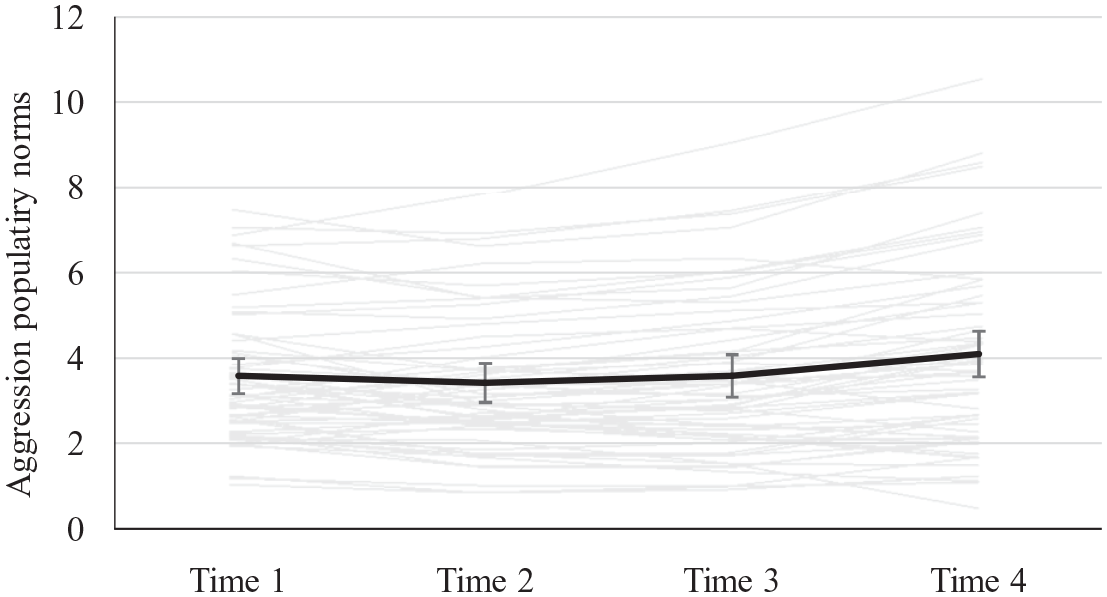
Average and Variations of Development of Aggression Popularity Norms across the School Year. N = 63 Classrooms.
Teachers’ Variables as Predictors of Changes in Aggression Popularity Norms
Teachers’ self-reported aggression beliefs and students’ perceptions of teachers’ support were included as level-two predictors of the level-one parameters (Model 4), after including SES and grade as control covariates (Model 3). Results from Table 2 (Model 4) indicate that homeroom teachers’ aggression beliefs and students’ perceptions of teacher’s support were both significantly associated with the intercept, while only teacher support was associated with both the linear and nonlinear slope. As seen in Figure 2, classrooms where homeroom teachers held beliefs that approved aggression had significantly higher levels of aggression popularity norms across all time points, compared to classrooms with average and low levels of teachers’ aggression beliefs. On the other hand, Figure 3 shows that in classrooms where most teachers were perceived as supportive by their students, low and stable levels of aggression popularity norms were found across the school year, while classrooms with low and average levels of teacher support showed an increase in aggression popularity norms, particularly at the end of the school year (Time 3 to Time 4).
Coefficients of the Level-One Intercept and Time Slope of Classroom Aggression Popularity Norms on Level-Two Predictors.
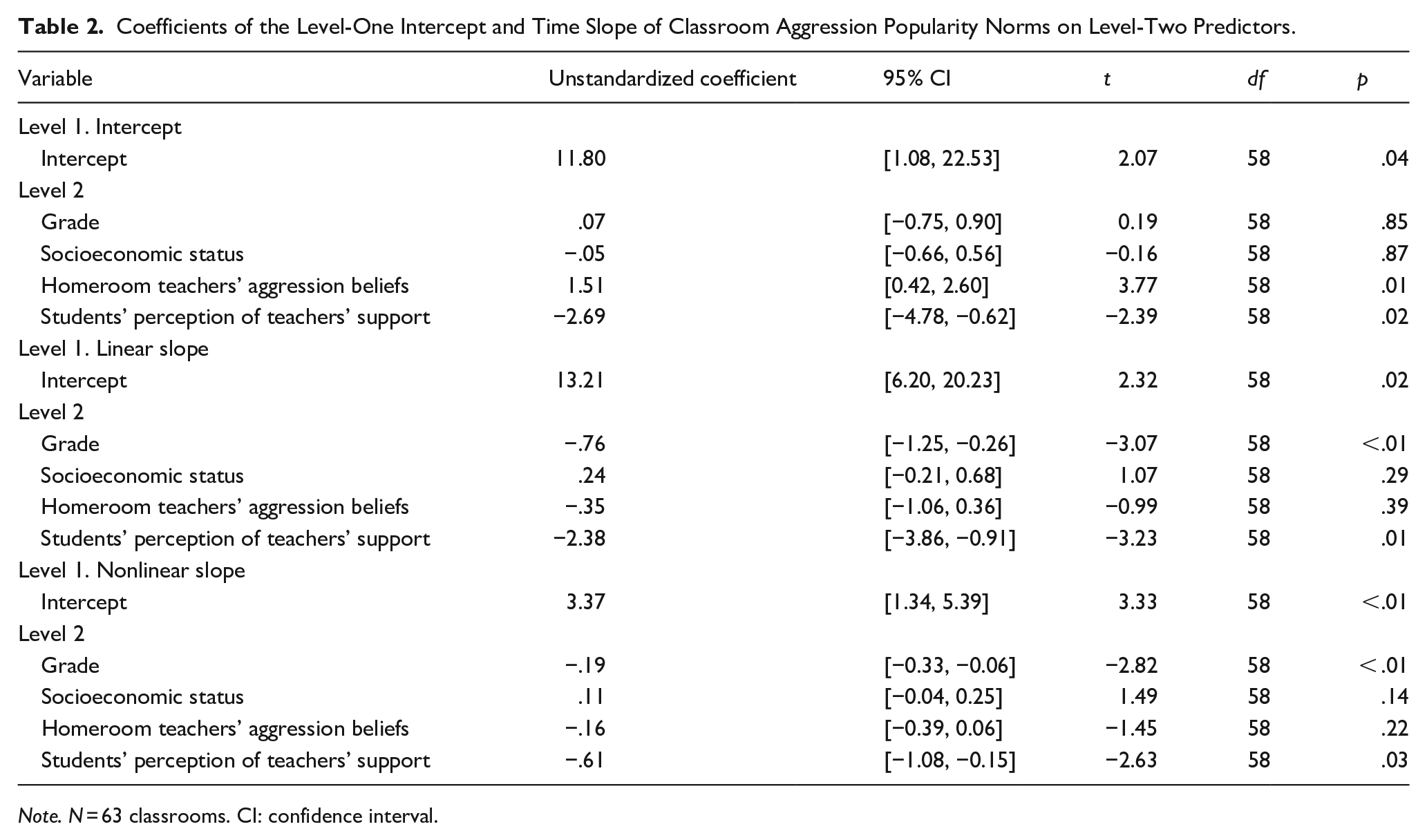
Note. N = 63 classrooms. CI: confidence interval.

Variations of Aggression Popularity Norms Development as a Function of Teachers’ Aggression Beliefs. N = 63 classrooms.
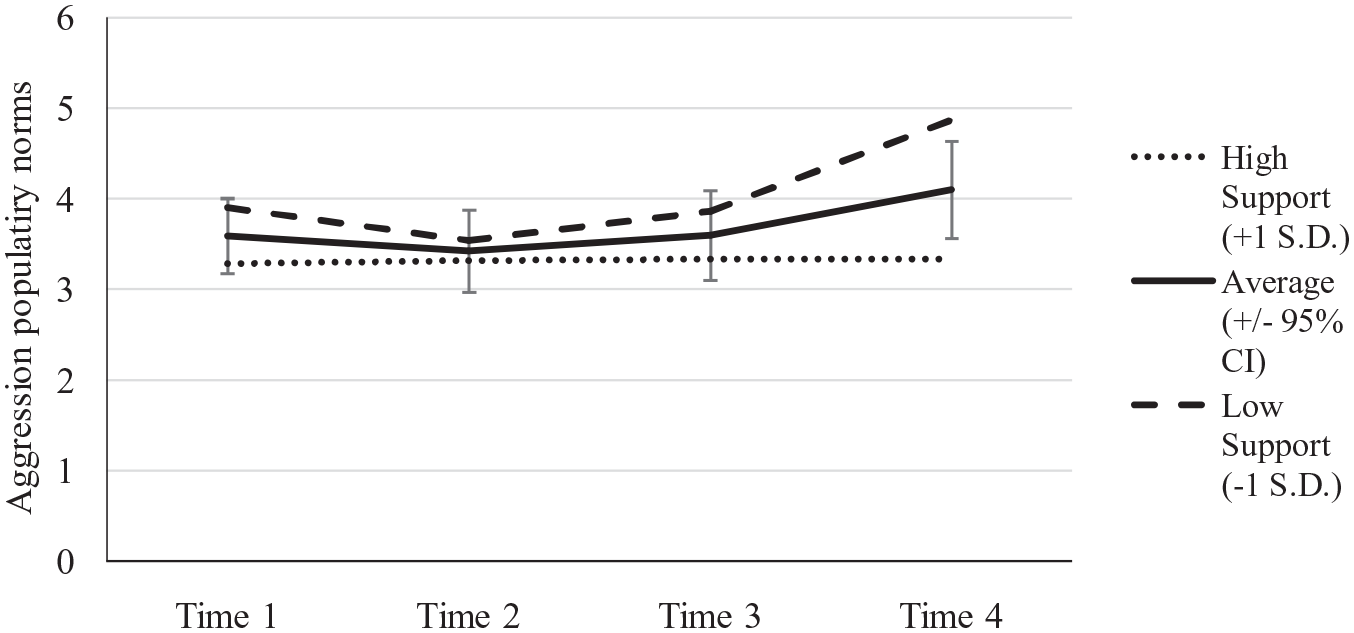
Variations of Aggression Popularity Norms Development as a Function of Students’ Perceptions of Teacher Support. N = 63 classrooms.
Changes in the residual variances revealed that the inclusion of these level-two predictors accounted for 18% of the variance in the intercept, 39.1% of the variance in the linear slope and 26.3% of the variance in the linear slope. Chi-square difference test showed that these proportions of explained variance were significant (ΔΧ2(4) = 88.09, p < .01, for the intercept; ΔΧ2(4) = 13.91, p < .01, for the linear slope; ΔΧ2(4) = 11.40, p < .01, for the nonlinear slope). These results confirmed our second hypothesis that in classrooms where students report receiving support from their teachers, aggression popularity norms would decrease over the course of the school year. However, we did not find support for our hypothesis that aggression popularity norms would increase in classrooms where homeroom teachers held beliefs that approve of this type of behavior.
Discussion
Our first goal was to assess variations in the way that the peer ecology of school classrooms develops over the course of a school year, particularly regarding aggression popularity norms. A second goal was to examine the role of homeroom teachers’ aggression beliefs and students’ perceptions of their teachers’ support in explaining such variations. To accomplish these purposes, we took a dynamic perspective on the social context of the classroom, regarding teachers’ characteristics as external forces that may drive the classroom social structure toward change (Arrow et al., 2004).
Results showed that, on average, aggression popularity norms tend to increase across the school year, with peak during the last 2 months. Moreover, we found support for our hypothesis that there is significant variation in the way that classrooms’ aggression popularity norms change over the course of a school year. This finding is consistent with previous research suggesting that classroom popularity norms, in comparison to descriptive norms, tend to change dynamically across the school year (Laninga-Wijnen et al., 2018). These results support the idea that normative processes need to be examined from a social dynamics perspective (Arrow et al., 2004), where classrooms are regarded not as static contexts, but as dynamic systems that are subject to internal and external forces that may differentially lead to changes in their social structure.
To explain variations in the development of classrooms, we proposed that teachers may directly or indirectly affect peer ecologies through their interactions and practices. Our findings suggest that when students perceive their teachers to be highly supportive at the beginning of the school year, aggression popularity norms in the classroom tend to remain low over time. In contrast, these norms tend to increase in classrooms with low levels of teacher support, particularly by the end of the year. This finding adds to previous research underlining the positive influence of teacher support on the classroom social environment (Gest & Rodkin, 2011; Luckner & Pianta, 2011). These results show that as teachers model positive interactions with their students, they set standards of what is expected in the classroom in terms of social interactions, discouraging a peer norm that tolerates harm-doing among the students.
Our hypothesis that homeroom teachers’ aggression normative beliefs could influence changes in popularity norms was only partially supported. Although we did not find a significant effect on aggression popularity norms slopes, we found a positive correlation between teachers’ aggression beliefs and popularity norms across the four times of measurement. Particularly, we found that these norms were significantly higher for classrooms with high levels of teachers’ aggression beliefs. This result is consistent with other studies that have examined concurrent associations between teachers’ aggression normative beliefs and classroom aggression norms (Chang, 2003). This result suggests that teachers’ aggression beliefs might influence classroom high levels of popularity norms from the beginning of the school year, which remain high and stable over time.
Based on these results, two important contributions of the present study can be highlighted. First, these results add to the few studies (e.g., Laninga-Wijnen et al., 2018) that have examined changes in the normative structure of classrooms. Most studies have regarded this context as a static predictor of individual outcomes. This study acknowledges a dynamic perspective that highlights the need to further explore and explain changes in classroom contexts. Given that intervention efforts are designed to produce change, results from studies such as this one can inform which variables are the most promising targets of interventions aimed at generating transformations in the classroom social structure.
The second contribution of this study is in discerning how teachers’ cognitions and behaviors may influence classroom normative processes. According to our findings, normative dynamics in the classroom appear to be more sensitive to students’ experiences of positive interactions with several of their teachers, as compared to the normative beliefs of their homeroom teachers. It is possible that if we measured students’ perceptions of teachers’ aggressive behaviors toward them, an effect on the classroom social norms dynamics may have been detected. Considering the role that popularity norms have in predicting students’ social behavior (Laninga-Wijnen et al., 2018; Velásquez et al., 2021), these findings provide preliminary recommendations regarding the foci of teacher training that may help to prevent aggression in the classroom.
Some limitations of this study should be noted. First, our sample size was relatively small (63 classrooms), reducing the statistical power and variability needed to detect significant effects between classrooms. A second limitation is that teachers’ beliefs were assessed only for homeroom teachers and the peer ecology might be influenced by the interaction of students with different teachers. A final limitation is that this study assessed only interactions external to the peer ecology. The dynamic perspective on which our study is based (Arrow et al., 2004) emphasizes the importance of both internal and external forces as influences on social systems. That is, this study did not account for internal forces that may affect the emergence or maintenance of aggression popularity norms (e.g., other peer norms related with competing social behaviors such as helping).
In summary, this study contributed to our understanding of the dynamics of the classroom social structure. Our longitudinal findings provide evidence that these contexts change over time and vary in the way that they change. Our results bear on how teachers, as main leaders in the classroom, might promote positive changes in peer ecologies. These insights about the dynamics of the classroom may help to enhance the effectiveness of research-based aggression prevention programs.
Supplemental Material
sj-docx-1-jbd-10.1177_01650254231152423 – Supplemental material for Predicting changes in classroom aggression status norms: The role of teachers’ normative beliefs and students’ perceived support
Supplemental material, sj-docx-1-jbd-10.1177_01650254231152423 for Predicting changes in classroom aggression status norms: The role of teachers’ normative beliefs and students’ perceived support by Ana M. Velásquez, Lina M. Saldarriaga and William M. Bukowski in International Journal of Behavioral Development
Footnotes
Funding
The author(s) disclosed receipt of the following financial support for the research, authorship, and/or publication of this article: This work was supported by (a) grants from the Social Sciences and Humanities Research Council of Canada and the Fonds Québécois de la Recherche sur la Société et la Culture, (b) fellowships awarded to the first author from the Social Sciences and Humanities Research Council of Canada and to the third author from Colciencias and Universidad de los Andes, Bogotá, Colombia, and (c) a Concordia University Research Fellowship awarded to the second author.

Supplemental material
Supplemental material for this article is available online.
References
Supplementary Material
Please find the following supplemental material available below.
For Open Access articles published under a Creative Commons License, all supplemental material carries the same license as the article it is associated with.
For non-Open Access articles published, all supplemental material carries a non-exclusive license, and permission requests for re-use of supplemental material or any part of supplemental material shall be sent directly to the copyright owner as specified in the copyright notice associated with the article.
