



Abstract
This study identified patterns of bullying roles in offline and cyber contexts among Korean adolescents and investigated their relationships with normative beliefs about offline bullying and cyberbullying. Four distinct latent classes of participant roles in offline bullying and cyberbullying emerged through a person-centered latent profile analysis: (a) low involvement (54%), (b) bully/victim-nondefenders (9.9%), (c) defenders (17%), and (d) offline bully-cyber outsiders (19.1%). Adolescents in the defenders class reported the highest levels of defending behavior both online and offline compared with adolescents in the other classes, while adolescents in the bully/victim-nondefenders class reported the highest levels in all roles except for the defending role (i.e., bully, follower, outsider, and victim roles). The overall pattern of the results was similar for the bully/victim-nondefenders and the offline bully-cyber outsiders class, though these two classes have marked differences in cyberbullying scores. The results indicated unique differences regarding antecedents (normative beliefs about offline bullying and cyberbullying) tied to patterns of roles in offline bullying and cyberbullying. The findings suggest that preventive interventions against bullying are possible by changing personal beliefs about offline bullying and cyberbullying.
Keywords
Introduction
Bullying is a distinct problem among teenagers (Doty et al., 2017). Offline bullying happens in various ways, including physical (hitting and kicking), verbal (calling names, teasing, and threatening), and relational forms of aggression (spreading rumors and social exclusion), which can occur among students in school classrooms, playgrounds, and hallways (Liu & Graves, 2011; Smith, 2014). The rapid development and implementation of new communication technologies (e.g., the Internet, mobile devices) have facilitated new forms of bullying that allow contact beyond direct, face-to-face encounters. As rates of bullying are commonly found to peak during the middle school years (Li, 2007; Price & Dalgleish, 2010; Williams & Guerra, 2007), this study focused on middle school adolescents.
Definitions and Roles of Offline Bullying and Cyberbullying
Bullying is defined as intentional, repeated harmful acts that are perpetrated by a more powerful person or group against a less powerful person (Olweus, 1994). Cyberbullying can be defined as a means of bullying in which electronic media is used to insult, harass, or intimidate a peer (Kowalski et al., 2014; Willard, 2007). Both offline bullying and cyberbullying have been defined based on the criteria for intentionality, imbalance of power, and repetition (Olweus, 1994). However, the criteria for repetition in relation to offline bullying and cyberbullying are controversial. Some researchers (e.g., Ko, 2016) believe that cyberbullying can be considered bullying even if it does not meet the criteria of repetition, as it can occur in a single instance of bullying online. Besides this difference, cyberbullying allows a degree of anonymity for the participant roles that is absent in offline bullying (Tokunaga, 2010) and can also potentially involve a wide audience of Internet users. While there are common features between offline bullying and cyberbullying, both phenomena designate specific types of aggressive behavior that are prevalent in many different cultures (Smith et al., 2016; Wang et al., 2019).
Understanding of both offline bullying and cyberbullying has evolved from a dyadic interaction between the bully and the victim, to viewing bullying as a whole-group process including a third party, that is, bystanders, who witness the bullying situation. In this regard, Salmivalli et al. (1996) in Finland created the Participant Role Questionnaire (PRQ) to assess participants’ reactions to offline bullying. Studies using the PRQ distinguish four bystander roles: assistants of the bully, reinforcers of the bully, outsiders, and defenders of the victim (Gini, 2006; Salmivalli et al., 1998; Sutton & Smith, 1999). As assistants and reinforcers play an active role in reinforcing bullying, these two roles have been assigned as one factor based on factor analysis, such that bystanders’ responses can be categorized into follower, outsider, and defender, with the roles of assistants and reinforcers combined to form the follower category (Baek, 2014; Goossens et al., 2006; Heo, 2019; Seo, 2015).
Researchers have also identified specific bullying roles in the cyber context and found that most adolescents engage in at least one of these roles (Ko, 2016; Seo, 2020; Ybarra & Mitchell, 2004). However, due to the differences between offline and cyber contexts, assessment of roles in cyberbullying differs from assessment of offline bullying (Baker, 2014; Heo, 2019; Ko, 2016; Quirk & Campbell, 2015). While an offline bully harasses a victim in a physical act or by saying something nasty, a cyber bully sends nasty messages (Twemlow et al., 2004). This leads to a difference in bystanders’ behavior between offline bullying and cyberbullying. For example, one of the outsider behaviors exhibited in cyberbullying episodes is where outsiders do nothing in a chat room, such as reading and not commenting on the messages of the bully harassing the victim (Seo, 2020), but such a response cannot occur when there is offline bullying. Despite the difference of bullying behaviors in offline and cyber contexts, cyberbullying roles, like those in offline bullying, have been broadly classified into the roles of bully, bystander (involving follower, outsider, and defender roles), and victim (Baker, 2014; Heo, 2019).
Co-occurrence and Role Patterns of Offline Bullying and Cyberbullying
Offline bullying and cyberbullying have strong co-occurrence (Ruth et al., 2019; Shi et al., 2021). Studies indicate that offline bullying is associated with cyberbullying both concurrently and longitudinally (Campbell, 2005; Hinduja & Patchin, 2007; Raskauskas & Stoltz, 2007; Seo, 2021; Wang et al., 2019; Wright & Li, 2013). These studies have shown that experiences with offline bullying and cyberbullying are linked among bullies and victims. Furthermore, studies have reported correlation between the roles of bystanders in offline and cyber contexts (Heo, 2019); for example, adolescents who supported the victim in an offline context tended to do so in a cyber context as well (Machackova & Pfetsch, 2016). Co-construction theory posits that individuals construct their cyber world in similar ways to their non-cyber environment (Subrahmanyam et al., 2006). This theory also postulates that aggressive adolescents tend to generalize their non-cyber aggressive disposition to their cyber environments through their engagement in cyberbullying (Williams & Guerra, 2007). Thus, co-construction theory is useful to explain how offline bullying overlaps with cyberbullying.
Due to the interrelationship between offline bullying and cyberbullying, overlapping of roles (e.g., individuals who are victims offline but bullies online) can be identified in bullying situations, rather than singular roles (e.g., offline followers and cyber outsiders, respectively). Thus, it is necessary to explore profiles of participant roles that integrate offline bullying and cyberbullying. However, previous classifications of bullying roles have taken conventional variable-based approaches, such as mean-based cut-off values (e.g., bully, victim, and bystander scales) to determine which types of involvement were present in the sample, and to later assign bullying roles (Francisco et al., 2022; Goossens et al., 2006; Heo, 2019; Salmivalli et al., 1996; Seo, 2008). This classification method using arbitrary cutoffs reveals that even in the same sample, assignment proportions differ according to the various criteria. In addition, participants were considered to have no role if they scored below the mean (e.g., bullies, followers, outsiders, defenders, and victims) on all scales (Salmivalli et al., 1996; Seo, 2008). Thus, a person-centered approach, which has the advantage of providing categorical profiles of respondents that are based on a multivariate pattern of observed data, would be useful for exploring the profiles of roles in offline bullying and cyberbullying. Latent profile analysis (LPA; rather than the manual categorization used in past studies) offers model-fit and better encompasses the complexity of the bullying phenomenon. Latent profiles of bullying involvement have been constructed in a limited number of studies when considering bullying and victimization items simultaneously (Lovegrove & Cornell, 2014; Williford et al., 2011), but person-centered mixture methods including bystander roles (e.g., follower, outsider, and defender) have not yet been applied.
Normative Beliefs About Bullying as a Predictor of Bullying Roles
Social cognitive theory emphasizes the importance of self-regulatory beliefs in motivating and regulating behavior (Bandura, 1986). Since normative beliefs stipulate appropriate behavior, they can affect social behavior. Normative beliefs, which are individualistic cognitive standards that guide assessment for what is acceptable or desirable behavior, have been studied in relation to aggression (Henry et al., 2000; Huesmann & Guerra, 1997). In the literature on bullying, several studies on adolescents’ attitudes toward bullying have been conducted (Boulton et al., 1999; Salmivalli & Voeten, 2004). Although attitude is a more general construct, as it is not only based on beliefs, but also contains emotional and behavioral components (Petty & Cacioppo, 1986), bullying-related attitudes are often operationalized in a similar manner to normative beliefs, that is, as adolescents’ moral judgments regarding the acceptability or unacceptability of bullying (Boulton et al., 1999). The present study used the “bullying-related normative beliefs” concept to understand bullying.
Previous studies have consistently reported a link between normative beliefs and aggressive behavior or offline bullying (Burton et al., 2013; Werner & Nixon, 2005), as well as a link between normative beliefs and cyberbullying for both adolescents and young adults (Allison & Bussey, 2017; Ang et al., 2017; Wright & Li, 2013). However, studies have also revealed that the beliefs-behavior association was specific to the type of bullying or aggression; for example, beliefs about relational aggression were distinctively associated with involvement in relationally aggressive acts, whereas beliefs about physical aggression contributed to distinctive engagement in physical aggression (Werner & Nixon, 2005). Williams and Guerra’s (2007) study examined beliefs in the appropriateness of face-to-face aggression in relation to aggression in both the cyber and face-to-face contexts. Their results indicated that the acceptability of face-to-face aggression was positively related to cyberbullying, but to a lesser extent when compared to its association with face-to-face contexts. Seo (2021) found a link between different types of normative beliefs and the corresponding types of offline bullying and cyberbullying among adolescents. Considering that individuals may have distinctive normative beliefs about offline bullying versus cyberbullying, even if there is an association between such normative beliefs in offline bullying and cyberbullying (Seo, 2021), there is a need to differentiate between beliefs about offline bullying and those about cyberbullying.
Bullying-related normative beliefs have been found to be associated with bystander behaviors (Howard et al., 2014). For example, Machackova and Pfetsch (2016) showed that both normative beliefs about verbal aggression and cyberaggression predicted reinforcement in the bully in both offline bullying and cyberbullying. Francisco et al. (2022) reported that bystanders and participants with no involvement perceived cyberbullying behavior as more unfair than adolescents with all types of involvement. However, compared to the numerous studies on the link between normative beliefs about bullying and bullying behavior, few studies have focused on how personal normative beliefs connect bystanders’ behavior to offline bullying and cyberbullying (Goh & Lee, 2021).
The Current Study
The primary goal of the current study was to identify profiles of adolescents based on their behaviors in offline bullying and cyberbullying situations. Following co-construction theory, this study assumed that classes with similar patterns would be found due to the high overlap between offline bullying and cyberbullying roles. In addition, I predicted that the outsider role would be seen more often in cyber contexts, where anonymity exists, compared to offline contexts.
This study investigated distinctive normative beliefs about offline and cyber bullying and examined the relationships between latent profiles of offline bullying and cyberbullying roles and normative beliefs about offline and cyber bullying. This investigation was grounded in social cognitive theory, so I predicted that profiles from bullying roles in offline and cyber contexts would be influenced by normative beliefs. Figuring out the relationship between moral acceptability of different types of bullying and bullying behavior is important in that it provides a social cognitive basis from which interventions against bullying can be developed.
Studies have reported gender differences in participants’ behaviors concerning offline bullying and cyberbullying among adolescents. For example, boys are more likely to be involved than girls in bullying, victimizing, or following the bully offline and online (Li, 2006; Oh, 2011; Salmivalli & Voeten, 2004; Seo, 2008), and girls are more likely to be outsiders and defenders than boys (Salmivalli et al., 1996). Thus, in this study, participants’ gender was considered as a control variable when analyzing factors determining bullying role patterns.
Method
Participants
This study used data obtained from four middle schools in Jeju-do, South Korea. This study was conducted before Institutional Review Board (IRB) approval was required by the university which I belong to. Although the IRB approval process was not conducted, this study followed established ethical procedures, and participants’ consent was obtained prior to conducting the survey at the schools. Of the 850 questionnaires that were distributed, 797 were retrieved. Of these 797 adolescents, 21 who had never used the Internet or mobile messengers were excluded from the analyses (i.e., adolescents who had never witnessed cyberbullying in chat rooms). Thus, the final sample comprised 776 adolescents (391 girls and 385 boys) aged 13–15 years, of whom 394 were seventh graders and 382 were eighth graders.
Measures
Offline Bullying Roles
Offline bullying roles were measured using a modified version (Seo, 2008) of the PRQ (Salmivalli et al., 1996). Before completing the PRQ, the participants were presented with the following definition of offline bullying:
It is intentional and repeated harassment and attacks by one or several other students toward one student; harassment and attacks may be, for example, shoving or hitting the other student, taking their things, calling the student names or making jokes about them, leaving them outside the group, or any other behavior meant to hurt the other student.
Both self- and peer estimates were derived in the original PRQ. However, in the present study, the participants evaluated only their own behavior across 32 items divided into 5 subscales that described tendencies to act as a bully, follower, outsider, defender, or victim (Seo, 2008).
The seven items of the Bully subscale (α = .82) described active, initiative-taking bullying behavior (e.g., “I have hit or kicked a friend”). The seven items of the Victim subscale (α = .86) described experiencing physical, verbal, and relational types of bullying (e.g., “Some of my friends called me by nicknames I do not want to hear or cursed at me”). The six items of the Follower subscale (α = .84) also described active bullying behavior, but more follower- than leader-like bullying behavior, reflecting tendencies to reinforce bullying by laughing or joining in (e.g., “Once someone else started harassing the victim, I joined in”). On the Outsider subscale (α = .93), the six items described “doing nothing” or essentially staying out of the bullying situation (e.g., “I pretended not to notice what was happening”). On the Defender subscale (α = .94), six items described supportive, consoling side-taking with the victim as well as active efforts to make others stop bullying (e.g., “I tried to help the person being bullied,” or “I told the bully to stop”). Participants rated each item using a 5-point scale, ranging from 1 = never to 5 = very often. The higher the score, the more the person behaved in a manner that was consistent with each offline bullying role.
Cyberbullying Roles
This study focused on cyberbullying that occurs in group chat rooms, because chat rooms allow group interaction (e.g., bullies vs victims vs bystanders) and bullying occurs more frequently compared to in one-on-one communication such as email and text messages (Li, 2007; Oh, 2011). Similar to the classification of offline bullying roles, participant roles in cyberbullying were classified into bully, follower, outsider, defender, and victim roles. To measure cyber bully and victim behavior, a scale reconstructed by Moon (2016) using Shim et al.’s (2014) questionnaire was adopted. Before completing the questionnaire, the students were presented with the following definition of cyberbullying:
It refers to harassing behavior with the intention of harming others, such as calling out nicknames, making fun of them, swearing at them, or inviting them to the chat room even after they have left the chat room through the Internet or mobile messenger.
Bullying behavior was assessed using 12 items (α = .90) that included actions such as sending messages, texts, and photos that harassed the victim in the group chat room (e.g., “To make fun of a friend I have sent a message”). The 12 items of the Victim Scale (α = .92) assessed subjection to a form of aggression (e.g., “A friend has sent a message to other friends to make fun of me”).
To measure follower, outsider, and defender behavior, these scales were modified and supplemented by the researcher based on both Ko’s (2016) scale and the scale constructed by Baker (2014). The Follower Scale (α = .91) described the behavior of encouraging the bully or delivering a message or photo if the bully took the initiative first. It consisted of six items (e.g., “I have written a message or comment that the victim would hate when someone bullied another friend in a chat room”). The five items of the Outsider Scale (α = .91) included actions such as pretending to be unaware of cyberbullying situations or not taking sides (e.g., “I have seen cyberbullying situations and pretended not to know”). On the Defender Scale (α = .97), six items described comforting the victim or telling the bully to stop (e.g., “I once comforted a friend who was cyberbullied”). A total of 41 items were rated on a 5-point scale, ranging from 1 = never to 5 = very often. The higher the score, the more the person behaved in a manner that was consistent with each cyberbullying role.
Normative Beliefs About Offline Bullying
Following the literature regarding the nature of normative beliefs about offline bullying (Park, 2000; Salmivalli & Voeten, 2004), this study assessed participants’ normative beliefs about offline bullying by asking them to evaluate the extent to which they believed offline bullying, including physical, verbal, and relational types, was not acceptable or appropriate (e.g., “It is bad to spread the bad news of one friend to other friends”). The participants rated five items on a 5-point Likert-type scale, ranging from 1 = strongly no to 5 = strongly yes. The higher the total score, the more the person held negative beliefs about offline bullying. Cronbach’s alpha was .91 for this scale.
Normative Beliefs About Cyberbullying
To measure normative beliefs about cyberbullying, a scale reconstructed by Moon (2016) from Shim et al.’s (2014) questionnaire was used. Similar to the measure used for normative beliefs about offline bullying, the participants reported the extent to which they believed cyberbullying was not acceptable or appropriate (e.g., “It is bad to spread other people’s rumors through social networking sites and chat programs”). The participants rated six items on a 5-point Likert-type scale, ranging from 1 = strongly no to 5 = strongly yes. The higher the total score, the more the person held negative beliefs about cyberbullying. Cronbach’s alpha was .97 for this scale.
Covariates
Gender was recorded as 0 for girls and 1 for boys.
Data Analyses
Although 797 completed questionnaires were collected, after excluding 21 adolescents who did not respond to the all questions regarding the different cyberbullying roles, 776 adolescents were included in the analyses. Little’s (1988) test was conducted for data missing completely at random (MCAR), χ2(df = 132) = 149.095, p = .147. The results of which indicated that the missing data pattern was not systematic (i.e., is not associated with measured or unmeasured variables).
LPA was used to classify the participants into distinct profiles based on the bullying roles in both offline and cyber contexts. The LPA model is a person-centered approach used to identify classes of individuals who share similar characteristics. It uses full-information maximum likelihood (FIML) estimation. In this study, FIML was useful because it could include a portion of individuals with data missing at any of the bullying roles.
Fit indices are used to determine the optimal number of latent profiles and include the Akaike information criterion (AIC), the Bayesian information criterion (BIC), and the Lo–Mendel–Rubin likelihood ratio test (LMR). The optimal class solution comprises a smaller AIC and BIC, and significant LMR statistics (Nylund et al., 2007). Entropy was used to examine how accurately each model predicted each subgroup. An entropy value that is larger compared with other solutions and greater than .70 indicates higher accuracy in the classification of individuals into classes with similar characteristics (Jung & Wickrama, 2008).
The latent profiles identified concerning bullying roles in offline and cyber contexts were also evaluated in association with normative beliefs about offline bullying and cyberbullying, respectively. The analyses followed a three-step procedure for LPA (Asparouhov & Muthén, 2014). In the first step, profile enumeration is undertaken to identify the best-fitting set of profiles based on the criteria previously determined. A most likely class variable is created using the latent class posterior distribution in the second step. Finally, antecedents (auxiliary variables) are assessed in relation to the final profiles. Most likely group classification and the classification error rate are considered to reduce bias by incorporating the degree of uncertainty of group classification for the participant included in the LPA. Thus, this method differs from traditional cluster analyses (Wang & Hanges, 2011). To test antecedents, R3STEP analysis was conducted (Asparouhov & Muthén, 2014; Vermunt, 2010). R3STEP uses multinomial logistic regression to test whether an increase in an antecedent makes it more or less likely that a person belongs to one profile or another.
Paired t-tests were used to test the intra-individual differences between the study variables (i.e., bullying roles and normative beliefs) across offline and cyber contexts. Multivariate analysis of variance (MANOVA) was used to compare the mean scores for roles in offline and cyber bullying for each profile. Analyses for descriptive statistics, paired t-tests, and MANOVA were conducted using IBM SPSS 22.0 (IBM, Armonk, NY, USA), while Mplus 8.4 (Muthén & Muthén, Los Angeles, CA, USA) was used to conduct the LPA.
Results
Preliminary Analyses
Mean and standard deviations for the study variables are provided in Table 1. The bullying roles included in the LPA and normative beliefs about offline bullying and cyberbullying were evaluated. According to the paired t-tests, there were significant intra-individual mean differences in participant roles and normative beliefs between offline and cyber contexts. All offline bullying roles except for the outsider role had a higher mean score than that for the cyberbullying roles. Concerning normative beliefs, the participants held more negative beliefs about cyberbullying than offline bullying.
Mean Differences Between Paired Measurements.

Note. M: mean; SD: standard deviation. N = 773.
p < .001.
Estimation of Latent Profiles in Offline Bullying and Cyberbullying Roles
LPA was used to test 1- to 5-class models of latent profiles based on the participants’ roles in offline bullying and cyberbullying. A series of unconditional models were examined based on the AIC, BIC, and LMR. The entropy for each unconditional model tested was also evaluated. The LPA fit indices for the latent class solutions are presented in Table 2. Both the AIC and BIC for the unconditional model decreased from the 1- to the 5-class model. The 2- and 4-class models had significant LMR p-values.
Model Fit Indices for the Latent Profile Analysis.

Note. AIC: Akaike information criterion; BIC: Bayesian information criterion; LMR: Lo–Mendel–Rubin likelihood ratio test.
p < .01.
Based on the criteria of goodness of fit, interpretability, and the proportion of the sample belonging to each class, the 4-class solution provided the best-fit model, varying in both the level and pattern of offline bullying and cyberbullying roles. Moreover, the 4-class model had good entropy (0.88), and the posterior probabilities of group classification were all above 0.80 for the classes. Each class was labeled according to the overall patterns of roles describing offline bullying and cyberbullying as well as whether these patterns were similar or discrepant between classes.
As shown in Figure 1, there were differences in the levels and patterns of offline bullying and cyberbullying roles between the four profiles. Table 3 summarizes the features of bullying roles of the four profiles. For the continuous variables, a MANOVA was conducted using class as the grouping factor, revealing significant differences among the classes according to all the variables.
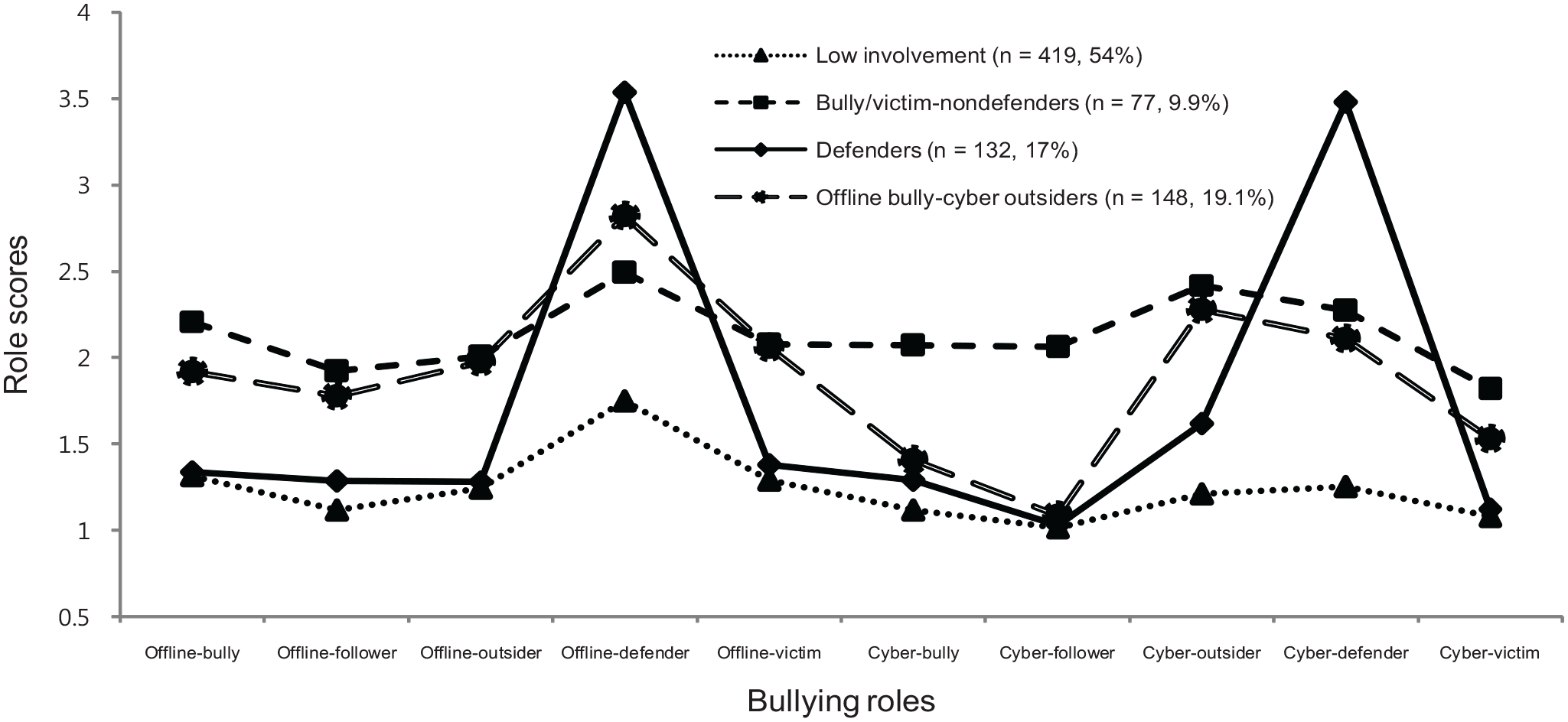
Latent Classes of Participant Roles in Offline Bullying and Cyberbullying.
Scores for the Participant Roles for Offline Bullying and Cyberbullying by Latent Classes.

Note. M: mean; SD: standard deviation.
Differing superscripts (a, b, c, d) within rows indicate significantly different means at p < .05.
p < .001.
The first class was termed low involvement (54%, n = 419) and was the largest among the four classes. As shown in Table 3, adolescents in the low involvement class had the lowest average score for all offline bullying and cyberbullying roles relative to the other three classes.
The second and smallest class (9.9%, n = 77) was termed bully/victim-nondefenders. This class had the highest level of bully, follower, outsider, and victim roles in both the offline and cyber contexts among the four classes, and it had a low probability of endorsing defender behavior. Despite the offline defender average within this class being the highest of all the roles, it was moderately low relative to the other classes.
The adolescents in the third class (17%, n = 132), which was termed defenders, had the highest defending behavior both in offline and cyber contexts. Moreover, they had a low probability of endorsing the bully, outsider/follower, and victim roles in offline and cyber contexts. This class showed very similar patterns between offline bullying and cyberbullying.
The fourth class (19.1%, n = 148) was termed offline bully-cyber outsiders. This class did not differ from the bully/victim-nondefenders class on both the offline and cyber outsider scales. Comparing within the class, while the outsider score was the highest role score in the cyber context, it was not the highest in the offline context (both the defender and victim are higher). In addition, this class had relatively high levels in relation to the bully and follower scores in the offline context, but the lowest bully and follower scores for cyberbullying.
Participant roles were generally similar for offline and cyber contexts for low involvement, bully/victim-nondefenders, and defenders classes, but differed for the offline bully-cyber outsiders class. The adolescents in the low involvement and bully/victim-nondefenders classes had the largest difference between role scores: adolescents in the bully/victim-nondefenders class had the highest scores across all roles except for the defender role, and adolescents in the low involvement class had the lowest scores across all roles. The adolescents in the defenders class were distinctive in that they had the highest scores for the defender role but the lowest or relatively low scores for the other roles in both the offline and cyber contexts. Overall, while there were small differences between bully/victim-nondefenders and the offline bully-cyber outsiders class on many of the subscales, the overall pattern was similar for these two classes, with the most marked difference being in the bully and follower roles in the cyber context.
Antecedent Tests
To further understand the profiles of the adolescents in this study, the three-step method was applied. R3STEP was used to determine whether certain antecedents (normative beliefs about offline bullying and cyberbullying) increased the likelihood of being included in a particular profile. First, all classes were compared with the bully/victim-nondefenders class, as it represented the most elevated risk pattern for the bullying roles. Subsequently, additional pairwise comparisons were made among the other three classes. The results are presented in Table 4. Gender, as a control variable, did little to differentiate between the four classes. Normative beliefs about offline bullying increased the likelihood of adolescents belonging to the low involvement or defenders class compared with the bully/victim-nondefenders class, with individuals being 1.5 times (odds ratio [OR] = 1.46) and nearly 3 times (OR = 2.86) more likely to be in the low involvement or defenders class than the bully/victim-nondefenders class. In addition, inclusion in the defenders class compared with the offline bully-cyber outsiders and low involvement classes was significantly positively associated with normative beliefs about offline bullying. Based on the results of the scale assessing beliefs about offline bullying, a one unit increase in negative beliefs increased the odds of being included in the defenders class by approximately 2 times compared with the offline bully-cyber outsiders (OR = 2.13) and low involvement (OR = 1.97) classes. Regarding normative beliefs about cyberbullying, the ORs comparing the bully/victim-nondefenders class with the defenders and offline bully-cyber outsiders classes were 8.07 and 1.69, respectively, and statistically significant. As such, having more negative beliefs about cyberbullying made individuals approximately 8 times and over 1.5 times more likely to be included in the defenders and offline bully-cyber outsiders classes, respectively, than the bully/victim-nondefenders class.
Three-Step Results for Antecedents (R3STEP).
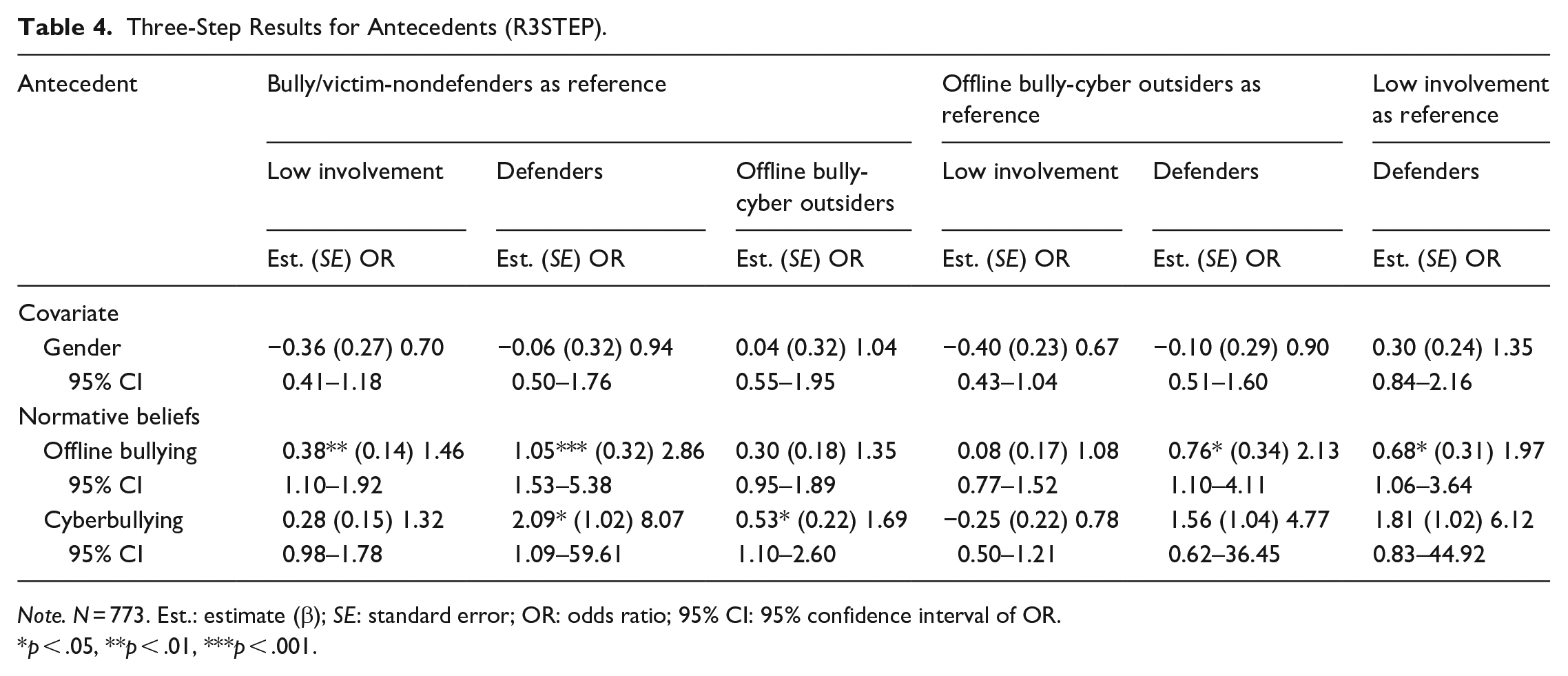
Note. N = 773. Est.: estimate (β); SE: standard error; OR: odds ratio; 95% CI: 95% confidence interval of OR.
p < .05, **p < .01, ***p < .001.
Discussion
A major aim of the present study was to identify patterns of participant roles in offline bullying and cyberbullying among middle school students. This study provides new information about bullying roles through integrating findings from both offline and cyber contexts, using a person-centered approach. The constructed LPA models comprised classes in which 54% of the adolescents in this study had a low level of involvement in all the roles in relation to both offline bullying and cyberbullying, while, of the remaining 46%, 19.1% were in the offline bully-cyber outsiders class, 17% were in the defenders class, and 9.9% were in the bully/victim-nondefenders class.
Regarding the profiles of participants’ roles when comparing offline and cyber contexts, apart from the offline bully-cyber outsiders class, three classes (i.e., low involvement, bully/victim-nondefenders, and defenders) showed a high degree of similarity between offline bullying and cyberbullying role patterns. In particular, adolescents in the defenders class showed the highest level of defending behavior in both offline and cyber contexts, whereas they reported a lower level of alternative behavior in other roles. These findings are consistent with previous studies showing that offline bullying is associated with cyberbullying not only in those who bully and the victim but also in bystander behavior (Campbell, 2005; Heo, 2019; Hinduja & Patchin, 2007; Quirk & Campbell, 2015; Raskauskas, 2010; Wang et al., 2019; Wright & Li, 2013). In the context of co-construction theory, these results indicate an overlap between offline bullying and cyberbullying (Rivers & Noret, 2010; Seo, 2021). However, the offline bully-cyber outsiders class, which captured differences in offline bullying and cyber bullying roles, is unique among the four classes. Adolescents in the offline bully-cyber outsiders class showed the highest outsider score among cyberbullying roles within the class, but bully and follower roles in cyberbullying had the lowest scores. This result supported a prediction in this study that there may be many outsiders due to more anonymity in cyber contexts.
Another goal of this study was to explore the association between normative beliefs about offline bullying and cyberbullying and profiles of bullying roles. The results revealed that normative beliefs about bullying were related to patterns of bullying roles. These findings are consistent with previous studies that found that believing offline bullying (or aggression) and cyberbullying are appropriate was associated with engaging in offline bullying or cyberbullying (Guerra et al., 2011; Seo, 2021; Werner & Nixon, 2005; Wright & Li, 2013). Those adolescents with negative beliefs about offline bullying were more likely to belong to the low involvement and defenders classes than the bully/victim-nondefenders class. Moreover, the adolescents in the defenders class had more negative beliefs about offline bullying than those in the offline bully-cyber outsiders and the low involvement classes. Stronger negative beliefs about cyberbullying increased the likelihood of belonging to the defenders and the offline bully-cyber outsiders classes rather than the bully/victim-nondefenders class. In addition, the adolescents in the offline bully-cyber outsiders class marked lower scores in bully and follower roles in both offline and cyber contexts than those in the bully/victim-nondefenders class, and those in the offline bully-cyber outsiders class had the lowest bully and follower scores in cyberbullying within the class. This finding aligns with comparisons for normative beliefs, as the two classes differ in their normative beliefs about cyberbullying but not in their beliefs about offline bullying. This study accords with the findings of prior research in concluding that it is important to distinguish between specific types of normative beliefs, because they may differ in their effect on specific types of bullying (Machackova & Pfetsch, 2016; Seo, 2021; Werner & Nixon, 2005).
Beliefs concerning offline bullying were more consistent differentiators between the classes than beliefs concerning cyberbullying, possibly because offline bullying roles were better differentiated between the classes than cyberbullying roles (Table 3). Normative beliefs about offline bullying and cyberbullying were found to differ between the bully/victim-nondefenders and defenders classes. The adolescents in the defenders class, which had the highest level of defender behavior among all the roles for both offline and cyber contexts, were more likely to believe that both offline bullying and cyberbullying were inappropriate than the adolescents in the bully/victim-nondefenders class, which showed higher levels of relevant behavior in all the other roles except for the defender role. This result is partially consistent with previous findings that showed positive beliefs about offline bullying were positively associated with reinforcing the bully (Guerra et al., 2011; Machackova & Pfetsch, 2016; Werner & Nixon, 2005). In addition, the defenders class differed from all the other classes in having more negative beliefs about offline bullying, which was possibly because the defenders class had a more distinctive profile in bullying roles compared to the other classes.
Strengths, Limitations, and Future Directions
The present study has some strengths. This study considered both offline bullying and cyberbullying to provide more information on how adolescents respond to bullying. The findings contribute to elucidating the patterns of roles in offline bullying and cyberbullying, unlike previous studies that examined such patterns for each bullying type separately (Goh & Lee, 2021; Ko, 2016; Salmivalli et al., 1996; Seo, 2008). This identification of profiles among adolescents also considers that behavior in bullying situations can vary, with adolescents potentially engaging in a variety of behaviors (e.g., offline bully-cyber defender) through offline and cyber contexts rather than engaging in a single role, such as the bully, victim, or defender. In addition, the patterns in the roles of offline bullying and cyberbullying were analyzed using LPA, a sophisticated statistical approach classifying clusters based on membership probabilities estimated directly from the model. The findings from this study expand on past studies that have explored the link between normative beliefs about face-to-face aggression and cyberbullying (Ang et al., 2017; Goh & Lee, 2021; Shi et al., 2021) by measuring normative beliefs in relation to both offline bullying and cyberbullying. Specifically, examining the direct relationship between normative beliefs about bullying and bullying roles can contribute to an improved understanding of bullying based on social cognitive theory and thereby aid prevention efforts to reduce the occurrence of bullying.
Despite these strengths, some limitations of this study should be noted. First, this study was limited to cyberbullying occurring in chat rooms, and thus, it did not cover a wider range of locations on the Internet, such as blogs, listservs, and text messages on social media websites. However, because this study followed an approach that conceptualized bullying as a group process, attention was paid to cyberspace where bystanders can witness bullying situations. Nevertheless, future studies are recommended to consider various cyberbullying methods (e.g., the Internet, bulletin boards, websites) to help understand and prevent bullying. Second, all measures were based on self-reports. The use of self-reports has certain advantages (Crick & Bigbee, 1998); for example, self-reports can reveal bullying episodes that others have not witnessed. Nevertheless, some adolescents are more likely to depict themselves in a favorable light and may refrain from disclosing their active role as a bully or follower (Juvonen et al., 2000; Perry et al., 1988). This study also found that means in relation to the defender role and negative beliefs about bullying were very high, while means in relation to the bully and follower roles were very low (Table 1). Thus, considering that there may be issues pertaining to social desirability bias, other methods, such as the use of peer reports, observation, and diaries, need to be applied in future studies. Finally, because this study was cross-sectional in nature, there are limitations to inferring any cause-and-effect relationships between the adolescents’ beliefs and their behavior. Therefore, the results need to be interpreted with caution considering these inherent limitations.
Conclusions and Implications
This is the first study to my knowledge to investigate adolescents’ profiles in relation to offline bullying and cyberbullying roles. The results suggest that there are four profiles, indicating that adolescents have different experiences of offline bullying and cyberbullying. However, for many adolescents, profiles were very similar between offline bullying and cyberbullying. These results seem to be in line with the co-construction theory, in that bullying behaviors overlap in offline and cyber contexts, and there are similarities across some roles, particularly in pro-bully (i.e., bully and follower) and defender roles. Furthermore, these profiles were associated with normative beliefs about offline bullying and cyberbullying, which provide additional support for the relevance of these profile distinctions. In the context of social cognitive theory, these findings indicate that normative beliefs are influential in determining whether to engage in offline bullying and cyberbullying.
The current study also has some practical implications. For example, it suggests that adolescents who fit the bully/victim-nondefenders or the offline bully-cyber outsiders classes, which accounted for 29% of the sample and are considered risk profiles, should be the main targets for bullying intervention. In addition, findings that adolescents in the defenders class have high levels of defending behavior in both offline and cyber contexts are very encouraging for the concurrent reduction of offline bullying and cyberbullying (Seo, 2021). However, only 17% of the sample was included in this class, whereas 54% of the sample was in the low involvement class, that is, they neither bullied nor defended. Thus, it is necessary to devise strategies to encourage adolescents in the low involvement class to engage in positive behaviors in relation to bullying, such as defending. As indicated in the study by Seo (2021), adolescents are aware that involvement by bystanders is one solution to cyberbullying (e.g., engaging in defender behavior such as informing the police or school teachers). Therefore, there is a need for a bullying intervention plan that allows these perceptions to lead to actual engagement. The findings of the present study imply that negative beliefs about offline bullying and cyberbullying not only are likely to decrease pro-bullying behavior, but could encourage defending behavior in both offline and cyber contexts. Therefore, the findings suggest that preventive interventions can influence engagement in the diverse roles of bullying, including that of bystander, by changing beliefs about the appropriateness of bullying. However, the current attitudes of adolescents are typically more anti-bullying than pro-bullying (Boulton et al., 1999; Menesini et al., 1997; Rigby & Slee, 1991). Moreover, although attitudes may help drive social behaviors, evidence in support of the attitude-behavior link is rather modest (Augoustinos et al., 2014; Boulton et al., 1999). Thus, an empirical investigation of the associations among normative beliefs, other social cognitive mechanisms (e.g., attributional processes), and bullying behavior merits attention in future studies. Furthermore, it is likely to be helpful to examine factors (e.g., deviant social information processing) mediating the relationship between beliefs and behavior (Zelli et al., 1999) to aid understanding of the mechanisms involved in these associations.
Footnotes
Acknowledgements
I would like to thank all the adolescents and middle school staff including teachers who generously gave their time to participate in this study.
Declaration of Conflicting Interests
The author(s) declared no potential conflicts of interest with respect to the research, authorship, and/or publication of this article.
Funding
The author(s) disclosed receipt of the following financial support for the research, authorship, and/or publication of this article: This research was supported by the 2022 scientific promotion program funded by Jeju National University.
Institutional Review Board Statement
Not applicable.
Informed Consent
Informed consent was obtained from all participants.
