




Abstract
This study examines how culture and development jointly shape moral values in northern Thailand. Eighty participants (40 adolescents [Mage = 17.30] and 40 parents, evenly divided across a rural community and a globalized urban city) completed the Ethical Values Assessment (EVA), a questionnaire that examines the extent to which individuals prioritize Ethics of Autonomy, Community, and Divinity. Statistical analyses reveal that these three moral values are customized by extent of exposure to globalization: adolescents in the globalized urban context were most likely to prioritize Autonomy, and least likely to prioritize Community. Urban parents prioritized Community values more so than their children and rural-dwelling parents. These and other findings speak to the effects of globalization and localization in the face of cultural change. The more granular focus on particular EVA items endorsed further reveals both the maintenance of long-standing cultural values (i.e., filial piety), even among those with most significant exposure to globalization, and ways in which certain autonomous values may be tailored to function alongside long-standing local values. In total, this study suggests that local value systems are maintained, reasserted, and dynamically reshaped with globalization.
Developmental science is in the midst of a context revolution, evidenced in part by recent special issues centering how culture, ethnicity, and race shape young people’s lives and developmental trajectories (Cooper et al., 2022; McKenzie, 2019b; Spanierman et al., 2022). Perhaps the most widely recognized theory guiding the context revolution is Bronfenbrenner’s (1979) ecological systems theory, which explicitly investigates various contexts or “systems” that influence child development, from the most proximal “microsystem,” which includes elements of the immediate environment, to the most distal “chronosystem,” which includes historical changes over time. While developmental science has long attended to microsystemic influences on youth development (e.g., family, peers), considerably less attention has been paid to the chronosystem, even amid the context revolution. Globalization is a collective chronosystem that is fundamentally altering landscapes of youth development.
Psychological research has tended to focus on how globalization reshapes young people’s values (Arnett, 2002; Ferguson & Bornstein, 2012; Rao et al., 2013). Such psychological research generally examines youth in urban contexts, where global values are relatively entrenched via substantial exposure to the “four Ts” of globalization: trade, technology, tourism, and transnationalism (Eales et al., 2020). Yet with the expansion of technology in recent decades to far-flung regions of the world, even young people in rural settings and adults in urban contexts (who historically hold more traditional values [Abu Aleon et al., 2019; McKenzie & Xiong, 2021]) are likely to endorse some global values.
This study examines the moral values of adolescents and their parents living in both a rural community and an urban city in northern Thailand. Moral values are assessed via the Ethical Values Assessment (EVA; Padilla-Walker & Jensen, 2016), a questionnaire that encompasses an array of cross-culturally relevant moral values, and is ripe for application to the study of the developmental implications of globalization.
Globalization: A New Developmental Context
In today’s majority world, adolescents seldom reach adulthood knowing of only one culture. Rather, they increasingly have interactions with people from diverse cultures, either firsthand or indirectly through media. Although the flow of products, people, and ideas across cultures is not new, the global scope and complexity of this flow is unprecedented historically (Jensen et al., 2011). In the 1990s, the entry into the global economy of Asia and eastern European countries and the growth of transnational TV networks were important catalysts of globalization (Chalaby, 2016). In the intervening decades, globalization has accelerated at breakneck speed, with dramatic increases in trade (e.g., infiltration of fast-food chains, exposure to global clothing and fashion trends), technology (especially via the expansion of digital and social media), tourism (e.g., exposure to incoming tourists), and transnationalism (e.g., study abroad; Eales et al., 2020). Each of these four Ts has enhanced engagement with global cultures in a way that did not exist for previous generations (Arnett, 2002; Eales et al., 2020).
Despite the ubiquitous nature of this collective chronosystem, psychological research on globalization remains relatively sparse (McKenzie, 2018). That which we do know about the psychological impact of globalization tends to focus on adolescents, who may be particularly impacted by globalization given that: (a) this is a developmental period with pronounced openness to new cultural ideas, values, and behaviors (Jensen et al., 2011), and (b) this age group is generally more interested in popular and global media—primary vehicles of cultural change—than are children or adults (Abu Aleon et al., 2019; Jensen et al., 2011; Onitsuka et al., 2018).
Research with adolescents in very different parts of the world suggests that globalization promotes values pertaining to individual autonomy (Hansen et al., 2012; Huntsinger et al., 2019; Manago, 2015; Rao et al., 2013). For example, field experiments in Ethiopia have examined how the introduction of laptops and Western media influences adolescents’ values (Hansen et al., 2012). One year after laptops were introduced, those adolescents who had used laptops scored significantly higher on values emphasizing autonomous decision-making and achievement, compared to adolescents who did not have laptops and whose laptops had broken. Another example of adolescents adopting autonomous values in the context of globalization comes from southern Mexico, where adolescents who started attending school and had exposure to Western ideas emphasized individual choice and feelings in dating relationships, family roles, and careers significantly more than adolescents, parents, and grandparents who did not attend high school (Manago, 2015). These studies highlight how forces of globalization (i.e., exposure to technology, formal schooling [Greenfield, 2009; Jensen et al., 2011]) alter moral values in a more autonomous direction in low- and middle-income countries (LMICs).
Considerably less is known about the development of other moral values in LMICs. Less is known, too, about the values of adolescents residing in rural regions of LMICs, and of how their parents’ moral values may also be affected by globalization. These knowledge gaps are significant because other traditional values—such as those pertaining to religion, which is central in most LMICs (Odukoya et al., 2022), and to family and community (Huntsinger et al., 2019)—also likely shift with globalization. These knowledge gaps are also problematic because nearly half of the world’s population—particularly in LMICs—continues to be rural (World Bank, 2023), and because parents are key socializers for the next generation. A cultural-developmental approach is well suited for the task of investigating how globalization intersects with moral values in LMICs, a point to which we now turn.
Moral Values: The Cultural-Developmental Approach
The cultural-developmental approach assesses diversity in peoples’ moral psychology by differentiating three kinds of ethics that are prioritized—albeit to differing degrees—by individuals in diverse world regions and across developmental periods: Autonomy, Community, and Divinity (Jensen, 1995, 2015b; Shweder, 1990; Shweder et al., 1997). The reason for the adoption of this theoretical framework is twofold. First, whereas developmental science regularly centers the development of autonomous values that have long been anchors in the West (e.g., equality, justice, fairness), the cultural-developmental approach’s incorporation of community and divinity allows for examination of moral values that may be both culturally salient, and subject to change with modern globalization, in LMICs (Sunar, 2009). Second, empirical research has supported the presence of Ethics of Autonomy, Community, and Divinity in northern Thailand (Hickman & DiBianca Fasoli, 2015; McKenzie, 2018).
Briefly, the Ethic of Autonomy involves a focus on persons as individuals. Moral considerations within this ethic address the interests, well-being, and rights of individuals (self or other), and fairness between individuals. The Ethic of Community focuses on persons as members of social groups, such as family and society. Here moral considerations include duty to others, and concern with the welfare, interests, and customs of groups. The Ethic of Divinity focuses on persons as spiritual or religious beings, and moral considerations encompass divine and natural law, sacred lessons, and spiritual purity. Studies have shown the presence and reliable differentiation of the three ethics among highly diverse cultural groups (e.g., from Brazil, Finland, India, the Philippines, and the United States).
The Ethics of Autonomy and Community overlap to some extent with other important psychological theories, such as Triandis’ (1995) differentiation between individualism and collectivism and the values of self-direction and tradition within Schwartz’s (1994) 10-value system. Also, Haidt’s (2012) differentiation of five (now six) moral foundations was originally based on the three ethics differentiation. In contrast to these theories, however, research with the three ethics differentiates a sizable number of moral concepts within each ethic (described below). This provides not only for big picture knowledge of people’s use of each of the three ethics but also much more fine-grained knowledge of people’s ways of conceptualizing Autonomy, Community, and Divinity. In our view, having both kinds of knowledge is imperative for obtaining valid understanding of how people across cultures are similar and different in their moral development.
Research has supported the cultural-developmental proposal that life course development of the three ethics co-modulates with culture (Guerra & Giner-Sorolla, 2015; Jensen, 2008; Jensen & McKenzie, 2016; Rozin et al., 1999; Vasquez et al., 2001). For example, findings from studies in India show that adults invoke the Ethic of Community more than adolescents, whereas adolescents invoke the Ethic of Autonomy more than adults. According to the researchers, these results reflect development in the Indian context where family and community typically are placed ahead of the individual (Kapadia & Bhangaokar, 2015; Pandya et al., 2023). Studies in India have further shown that the Ethic of Divinity emerges particularly early among low- and high-SES children, which likely reflects the suffusion of religion in everyday life (Pandya & Bhangaokar, 2015; Pandya et al., 2023). Another example of the co-modulation of development and culture comes from findings that show that the Ethic of Autonomy is particularly high among people in their late teens and twenties who live in cultural and economic contexts that afford a period of emerging adulthood—a developmental time characterized by a quest for self-determination and individual exploration (Arnett, 2004; Guerra & Giner-Sorolla, 2015; Hickman, 2014). In short, ontogenetic trajectories for the development of Autonomy, Community, and Divinity are in part culturally shaped.
So far, cultural-developmental studies have primarily involved the coding of oral discourse, such as from interviews with individual research participants (Arnett et al., 2001; Hickman, 2014; Pandya et al., 2023) or conversations between participants (DiBianca Fasoli, 2018; Hickman & DiBianca Fasoli, 2015). Participants describe their reasons for regarding particular behaviors as morally right, wrong, or somewhere in between. Discourse is then analyzed with the standard coding manual for the three ethics (Jensen, 2015a), which originally was developed on the basis of a wide-ranging review of developmental and cultural research to cull a full scope of moral concepts.
Although the majority of this work is qualitative to date, EVA is a questionnaire that enables research with the three ethics to go beyond oral discourse. EVA enables quantitative examination of moral value prioritization within and across cultural communities by assessing the importance participants attribute to Autonomy, Community, and Divinity, and which ethics they deem core in guiding their lives. Thus, EVA measures endorsement of and preference for each of the three ethics as values that guide their lives—for themselves and potentially for socializing or influencing others. Research with EVA has shown its reliable and valid use in diverse countries, including the Czech Republic, Slovakia, Turkey, and the United States, and among age groups ranging from adolescence to older adults (Dost-Gözkan, 2023; Padilla-Walker & Jensen, 2016; Považanová, 2023).
In sum, cultural-developmental research has revealed that culture informs the development of moral values in diverse world regions. EVA is well suited for this study because it encompasses both a broad range of values that exist across diverse cultures and is culturally customizable (e.g., by tailoring Divinity items such that they align with the locally dominant religion). Although research has not yet used it to specifically address globalization, the opportunity is ripe to quantitatively investigate patterns of moral values across geographic contexts and age groups with differential embeddedness in globalization. This study uses EVA for this purpose in rapidly globalizing Thailand.
Youth Moral Reasoning in Globalizing Thailand
Thailand is a middle income southeast Asian nation that has experienced dramatic changes in the four Ts over the last three decades. With regard to trade, American convenience stores and fast-food restaurants (e.g., 7-Eleven, McDonalds) arrived in the late 1980s, and now over 13,000 7-Eleven stores are spread across the country (CP All, n.d.; McDonald’s, n.d.). Moreover, Thailand has also experienced dramatic technological transformation. Just two decades after commercial internet was introduced, Thailand is among the top four countries in the world for time spent on social media (Leesa-Nguansuk, 2018). Thailand is also among the top 10 most popular tourist destinations for international tourists (World Population Review, 2023). Transnationalism has increased in recent decades, as well—particularly with international migration as a result of transnational marriages (McKenzie & Xiong, 2021) and integration of study abroad opportunities in urban high schools (McKenzie, 2020b).
With regard to values, Thailand has long been regarded as a highly collectivistic nation with strong Community-oriented values of filial piety, age-based hierarchy, and group harmony (Eberhardt, 2014; McKenzie, 2020b; McKenzie & Xiong, 2021; Ukosakul, 1999). Divinity-oriented values have also been central in this overwhelmingly Buddhist nation, with religion playing a key role in the everyday lives, psychological processes, and moral frameworks of Thais—particularly in rural areas, where temples have long been central in organizing village life (Cassaniti, 2015; Swearer, 1995).
Recent research has also highlighted, however, that Thai values are changing due to globalization. One interview study with adolescent–parent dyads in diverse Thai communities, for instance, revealed differences in moral values across age groups and contexts of globalization (McKenzie, 2018). When reasoning about personal moral experiences, rural adolescents and parents prioritized Community values, urban parents prioritized Autonomy and Community values to roughly equal degrees, and urban adolescents stood alone in their uniquely Autonomous reasoning. Interview-based research focused on Divinity values has also highlighted the tendency for Thai adolescents growing up in a globalized urban environment to pair Divinity values alongside Autonomous values, whereas a comparative sample of Thai adolescents growing up in a rural village typically pair Divinity values alongside Community values (McKenzie, 2019a). These studies suggest that globalization affects constellations of moral values by altering the moral socializers and the moral values to which young people are exposed (McKenzie, 2020a).
Importantly, however, qualitative interview research also points to the maintenance of local Community-based values (e.g., filial piety, generosity) even among urban-dwelling youth (McKenzie, 2020b) whose moral reasoning is uniquely dominated by Autonomy. These findings align with theoretical work, which suggests that localization (the counterforce of globalization) promotes the maintenance, defense, and even expansion of local values and practices (Hermans & Dimaggio, 2007). Yet to date the lack of engagement with quantitative data collection methodologies restrict a more broad and complete assessment of the heterogeneity and homogeneity of moral values across age groups and contexts of globalization.
This Study
While research suggests that urban adolescents in LMICs become more autonomy-oriented with exposure to globalization, less is known about young people’s identification with other values that are often central in LMICs, including divinity- and community-oriented values. Less is also known about the values of young people in rural contexts, where globalization is present, albeit less prevalent. Less is known, too, about parents—a critical sample from both a cultural perspective (as their lifetimes straddle the dramatic rise in the four Ts in many settings) and a developmental perspective (as they remain key socializers for the next generation).
This study takes a cultural-developmental approach to studying moral values in rapidly globalizing northern Thailand. To capture differences and overlaps in value systems among individuals at different points in the life course and with differential exposure to globalization, we focus on adolescents and their parents residing in a globalized urban city and a nearby rural community. Moral values were assessed with EVA (Padilla-Walker & Jensen, 2016). Informed by the literature reviewed in the preceding paragraphs, this study was guided by three hypotheses:
H1: Autonomy reasoning will be higher among urban than rural participants, and higher among adolescents than parents. Urban adolescents will endorse the Ethic of Autonomy more strongly than any other participant group.
H2: Community reasoning will be higher among rural than urban participants, and higher among parents than adolescents. Urban adolescents will endorse the Ethic of Community less strongly than any other participant group.
H3: Divinity reasoning will be higher among rural than urban participants. There will be no Ethic of Divinity age differences and no interaction effect.
In addition to focusing on the three overarching values, we aim to offer a more fine-grained understanding by investigating the particular EVA items that were most endorsed both across the entire sample and among participant groups. Although this portion of data analysis was not explicitly hypothesis-driven, we expected based on previous research that the EVA item which implies filial piety would emerge as a core guiding value for all participant groups—including those with the most exposure to globalization: urban adolescents.
Methods
Field Sites
Data collection for this study took place over the course of 1 year, after obtaining approval from Clark University’s Institutional Review Board (Protocol #103) and the Office of the National Research Council of Thailand. Prior to data collection, the first author lived in Thailand on a long-term basis, learned Thai and Kam Muang languages, made preliminary site visits, and established relationships with community members and local culture brokers (e.g., research assistants, teachers, and administrators from local high schools).
Mae Kiaw and Chiang Mai districts are both in Chiang Mai Province, and hence, share a common local history, dialect (Kam Muang), and cuisine. Despite these similarities and their geographic proximity (separated by a mere 25 miles), they constitute distinct sociocultural contexts. With a population of roughly 21,000 spread across six subdistricts, Mae Kiaw is sparsely populated. Rice fields and low-lying mountains pervade the district. At the time of this fieldwork, there were no malls, supermarkets, or global chains (e.g., 7-Eleven) in the district. Census data indicate that the predominant profession in the district is farming, and that over 67% of the population has completed primary education or less.
Chiang Mai city is the capital of Chiang Mai Province and Thailand’s second largest city. Including the metropolitan area, its population is 1.2 million. The city’s cultural and historical significance, paired with its modern conveniences (e.g., shopping malls, and global chains such as 7-Eleven and McDonalds), renders it a popular tourist destination for Thais and international travelers alike. The professions of Chiang Mai inhabitants are diverse, and levels of education are quite high. Census data show that the most common profession is wage labor (typically service industry work). More than 61% of the population has completed at least some high school, and 23% of the population has a bachelor’s degree or higher.
Participants
Adolescents were recruited through a secondary government school in each location. After building rapport with administrators and teachers, the first author visited classrooms and held focus group discussions to build rapport with students and to finalize data collection materials. Adolescents interested in participating in the study provided contact information for themselves and their parents.
Eighty participants, evenly divided between the rural (Mae Kiaw) and urban (Chiang Mai) community took part in this study. In each community, participants included 20 adolescents (Mage = 17.30 years, SD = 0.56) and 20 parents (one parent of each adolescent, Mage = 45.93, SD = 5.43). Across communities, participants included more girls (67.5%) than boys and more mothers (67.5%) than fathers. The overwhelming majority (91.3%) of participants reported their ethnicity as Thai; in the urban community, two adolescent–parent dyads reported their ethnicity as Thai–Chinese, and in the rural community, one adolescent–parent dyad reported “multiple” ethnicities. Also, the overwhelming majority (90%) of participants reported their religion as Buddhist. In the rural community, one adolescent–parent dyad self-identified as Muslim, and another adolescent–parent dyad self-identified as Christian. In the urban community, the three non-Buddhist participants all self-identified as Christian.
Socioeconomic status was assessed via parent self-reported education level, work status, and family income. In the rural community, 95% of parents had primary or secondary level education, 75% reported working part-time or freelance, and the average annual family income (SD) was US$2,250 (US$1,270). In the urban community, there was more of a spread of education levels, though the most common (65%) highest education level was a bachelor’s degree. Most urban parents (65%) worked full-time, and the average annual family income (SD) was US$16,480 (US$8,980). These socioeconomic differences speak to participants’ differential embeddedness in the global economy.
Materials
Data analyzed for this study were participants’ moral values. Participants completed the 18-item long form of EVA (Padilla-Walker & Jensen, 2016), with six items pertaining to each of the three ethics of Autonomy, Community, Divinity. 1 EVA items are based directly on the most commonly used subcodes from the standard coding manual for the three ethics (Jensen, 2015a). In consultation with local research assistants and informants, the six Divinity items were modified to reflect the Thai context, where 95% of inhabitants self-identify as Buddhist (CIA, 2022). The aim when adapting the Divinity subscale was to maintain the validity of the original Divinity items. When original EVA language was deemed general enough to tap into a Buddhist worldview (e.g., “I should have a spiritual compass”), Divinity items were left untouched. On other occasions, Divinity items were modified as slightly as possible such that they aligned with locally salient conceptions of the divine (e.g., “I should follow God’s law” was modified to “I should follow the law of karma”). The same research assistants worked closely with the first author to translate the EVA into standard Thai language, in order that participants could choose whether to complete the survey in Thai or English.
The Autonomy subscale included items such as “I should try to achieve my personal goals” and “I should respect other individuals’ rights”; the community subscale included items such as “I should take care of my family” and “I should know my place or role in a group”; and the divinity subscale included items such as “I should have a spiritual compass” and “I should aim to live like the Buddha.” Participants responded to three prompts:
Importance of Moral Values: “What moral values do you think are important to how you should live at this time in your life?” Participants indicated how important each of the 18 EVA items are on a five-point Likert-type scale, ranging from 1 (not at all important) to 5 (completely important). This prompt broadly taps into the extent to which each of the 18 values listed resonate with participants.
Core Moral Values: “Indicate the three moral values from the above list [of 18 values statements] that you consider the
Additional Core Moral Values: “In your own words, indicate if there are moral values that you consider
One item (“I should take care of my body”) was removed from the Autonomy subscale because its inclusion resulted in reduced reliability, and one item (“I should strive for social harmony”) was removed from the Community subscale because its inclusion resulted in reduced construct validity. McDonalds Omega was then calculated, resulting in evidence of adequate internal reliability for subscales of Autonomy (five items, ω = 0.77), Community (five items, ω = 0.72), and Divinity (six items, ω = 0.81). The Autonomy subscale was correlated with the Community subscale (r = .54) and the Divinity subscale (r = .40), and the Community subscale was correlated with the Divinity subscale (r = .58).
In line with previous research using the EVA (Padilla-Walker & Jensen, 2016), confirmatory factor analysis (CFA) was conducted to examine construct validity. Goodness-of-fit of the models was evaluated using the Tucker–Lewis Index (TLI), Comparative Fit Index (CFI), and root-mean-square error of approximation (RMSEA). Typical cutoff scores indicative of adequate fit to the data were considered: CFI > 0.90, TLI > 0.90, and RMSEA < 0.08. (Little, 2013). Because the EVA is theory-driven (Jensen, 2008), pre-existing empirical support across several countries exists for this measure (Dost-Gözkan, 2023; Padilla-Walker & Jensen, 2016; Považanová, 2023), and this study tests hypotheses pertaining to the three factors, we examined a three-factor model. This solution yielded acceptable construct validity, χ2(101) = 134.67, p = .014, CFI = 0.91, TLI = 0.90, RMSEA = 0.07.
Statistical Analyses
To assess the importance of the Ethics of Autonomy, Community, and Divinity across age groups and cultural groups, a repeated measures analysis of variance (ANOVA) was performed for each of the three ethics. Age (adolescent, parent) constituted the within-subjects variable, culture (rural, urban) constituted the between-subjects variable, and the rated importance of each of the three ethics constituted the dependent variables. 2
To assess core moral values (i.e., the moral values that participants across age groups and cultural groups deem most important to how they should live at this time in their lives), a repeated measures ANOVA was performed for each of the three ethics. Age (adolescent, parent) constituted the within-subjects variable, culture (rural, urban) constituted the between-subjects variable, and mean number of Autonomy, Community, and Divinity values listed as most important constituted the dependent variables. Because an a priori analysis of variance indicated that participant groups differed significantly in the total number of values listed, “total number of values listed” was entered as a covariate in order to ensure that any differences in use of each ethic could not be accounted for by some groups listing more values than others. 3
Finally, the authors examined individual items that were considered “core moral values” across participant groups. This examination aimed to offer an even more granular understanding of the specific kinds of Autonomy, Community, and Divinity values that were deemed most core to participants’ lives.
Results
Autonomy
Statistical analysis assessing the importance of Autonomy values revealed a trend for age, F(1, 38) = 3.01, p = .091, ηp2 = .073, with adolescents rating the Ethic of Autonomy as somewhat more important than parents (M = 4.53, SD = 0.38 and M = 4.36, SD = 0.56, respectively). As expected, there was a significant main effect for culture, F(1, 38) = 7.89, p = .008, ηp2 = .172, with urban participants rating the Ethic of Autonomy as more important (M = 4.59, SE = 0.08) than rural participants (M = 4.29, SD = 0.08). There was no significant age × culture interaction effect, F(1, 38) = 0.84, p = .364, ηp2 = .022.
Statistical analysis assessing core Autonomy values revealed no significant main effect for age, F(1, 35) = 0.43, p = .516, ηp2 = .012, and no significant main effect for culture, F(1, 35) = 0.29, p = .593, ηp2 = .008. There was, however, a trend for age × culture interaction, F(1, 35) = 3.31, p = .078, ηp2 = .086 (see Figure 1). Urban adolescents listed more Autonomy values than did any other participant group (M = 1.68, SD = 0.58) and rural parents listed fewer Autonomy values than did any other participant group (M = 0.95, SD = 0.76).

Core Moral Values: Ethic of Autonomy. N = 78 (n = 19 for urban parents and rural adolescents; n = 20 for rural parents and rural adolescents). Range: 0–3.
With regard to individual items listed as core values, urban adolescents prioritized “I should take responsibility for myself”; for this participant group, this was the top core value across all three ethics. This value was also the top core Autonomy value listed for parents in both communities. Among rural adolescents, “I should try to achieve my personal goals” was the top core Autonomy value.
Community
Statistical analysis assessing the importance of Community values revealed no significant main effect for age, F(1, 38) = 0.25, p = .620, ηp2 = .007. There was a trend for culture, F(1, 38) = 3.32, p = .076, ηp2 = .080, with urban participants rating the Ethic of Community somewhat higher than rural participants. An unexpected age × culture interaction effect, F(1, 38) = 6.82, p = .013, ηp2 = .152, clarified that the trend for culture was driven by parents in each community (see Figure 2). Urban parents rated the Ethic of Community as significantly more important (M = 4.50, SD = 0.46) than did rural parents (M = 4.06, SD = 0.56). Urban and rural adolescents, meanwhile, were nearly identical in their rating of Community’s importance (M = 4.31, SD = 0.47 and M = 4.34, SD = 0.31, respectively).
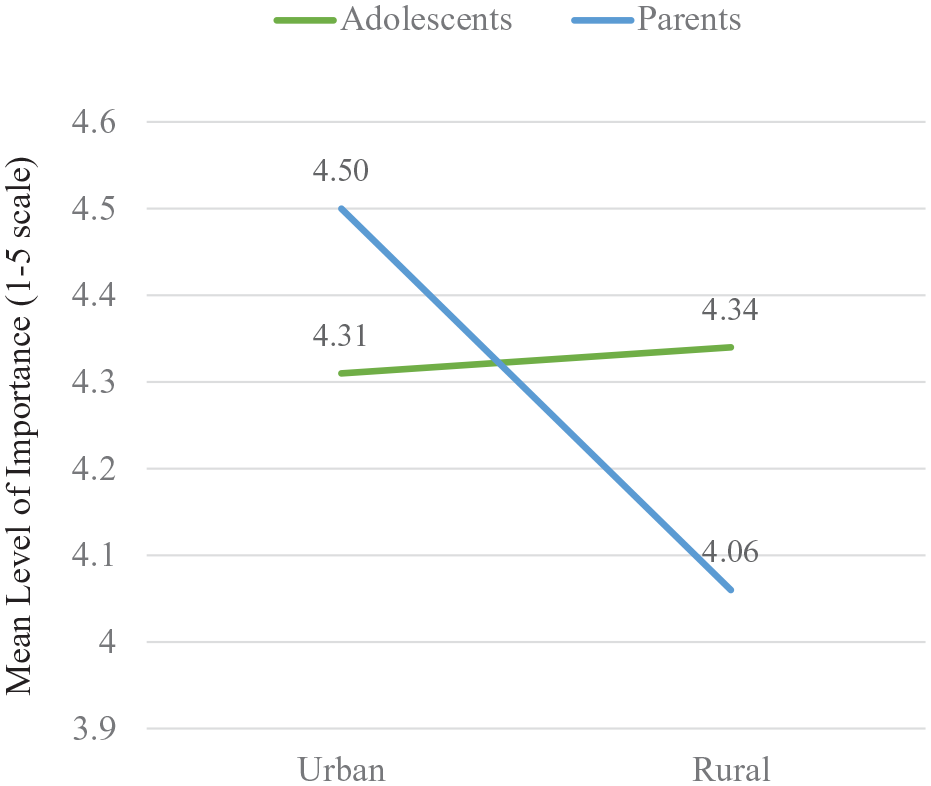
Importance of Moral Values: Ethic of Community. N = 80 (n = 20 for all participant groups). Range: 3.2–5.0.
Statistical analysis assessing core Community values showed no significant main effect for age, F(1, 35) = 1.30, p = .262, ηp2 = .036. Counter to the hypothesis that rural participants would list more Community values as “most important” than would urban participants, there was no significant main effect for culture, F(1, 35) = 0.07, p = .787, ηp2 = .002. There was an unexpected age × culture interaction effect, F(1, 35) = 4.70, p = .037, ηp2 = .118 (see Figure 3), indicating that urban parents listed more Community values than did any other participant group (M = 1.37, SD = 0.76). As expected, however, urban adolescents listed fewer Ethic of Community values than all other participant groups (M = 0.89, SD = 0.46). Rural adolescents, meanwhile, were somewhat more likely to list Community values as most important (M = 1.20, SD = 0.52) than were their parents (M = 0.95, SD = 0.60).

Core Moral Values: Ethic of Community. N = 78 (n = 19 for urban parents and rural adolescents; n = 20 for rural parents and rural adolescents). Range: 0–3.
With regard to individual items listed as core Community values, “I should take care of my family” rose to the top for all four participant groups. Among urban parents, rural parents, and rural adolescents, this item was furthermore their top core value overall. Notably, urban adolescents were the only participant group for whom it was not the top core value overall.
Divinity
Statistical analysis assessing the importance of Divinity values revealed a significant main effect for age, F(1, 38) = 7.41, p = .010, ηp2 = .163, indicating that parents rated the Ethic of Divinity as more important (M = 3.85, SD = 0.80) than did adolescents (M = 3.56, SD = 0.66). There was no significant main effect for culture, F(1, 38) = 0.18, p = .678, ηp2 = .005, and no significant age × culture interaction effect, F(1, 38) = 1.51, p = .227, ηp2 = .038.
Statistical analysis assessing core Divinity values revealed no significant main effect for age, F(1, 35) = 0.02, p = .878, ηp2 = .001, no significant main effect for culture, F(1, 35) = 0.21, p = .653, ηp2 = .006, and no significant age × culture interaction effect, F(1, 35) = 0.07, p = .794, ηp2 = .002.
Across all participant groups, Divinity items rarely made it to the top three core values. When they did, “I should make merit for my next life” was the top Divinity item for rural parents, rural adolescents, and urban adolescents. For rural parents and rural adolescents, this item was tied with “I should strive for spiritual purity.” Among urban parents, “I should strive for spiritual purity” was the top Divinity item.
Discussion
This study demonstrates how the collective chronosystem of globalization is reshaping moral values in northern Thailand. Next, we discuss key findings for each ethic, and consider what the findings indicate about how globalization exposure and developmental age jointly shape moral values.
Autonomy: The Globalization Ethic
Stark differences in Autonomy values exist across urban and rural contexts, with urban participants prioritizing the Ethic of Autonomy more than rural participants. This speaks to the effects of embeddedness in a globalized urban context with substantial exposure to the four Ts (Eales et al., 2020)—which renders autonomy and independence adaptive values (Greenfield, 2009; Jensen et al., 2011). This aligns with previous empirical research, which has shown that globalization shapes the development of moral values in African and Central American LMICs by enhancing the importance of autonomy (Hansen et al., 2012; Manago, 2015), and extends those findings to Southeast Asia.
Analyses further revealed that adolescents were somewhat more likely to prioritize the Ethic of Autonomy than were their parents, and that adolescents in both communities conceptualized Autonomy as more “core” in guiding their lives than did their parents. These findings align with research coming out of India, which has found that children and adolescents prioritize Autonomous values more so than adults (Kapadia & Bhangaokar, 2015).
Importantly, however, Autonomous values were not uniformly high among adolescents growing up in rural and urban contexts. Urban adolescents, who were most exposed to the four Ts by virtue of growing up in a globalized context and who have only known life with internet, prioritized Autonomy values more than any other participant group. This finding broadens previous interview-based work (McKenzie, 2018) by demonstrating that urban Thai adolescents’ unique prioritization of the Ethic of Autonomy stands not only when reasoning about personal, participant-generated moral experiences, but also when expressing one’s values more generally. Rural parents, who were least embedded in globalization via context, age group, and cohort, prioritized Autonomy values less than any other participant group. That those with the most significant exposure to globalization valued Autonomy the most, and those with the least exposure to globalization valued Autonomy the least, suggests that Autonomy is “the Globalization Ethic” in the Thai context, as in other world regions (Hansen et al., 2012; Huntsinger et al., 2019; Manago, 2015; Rao et al., 2013).
The specific type of Autonomous value that rose to the top speaks to the particular form that Autonomy takes in the Thai context—that is, how Autonomy is tailored to fit with local cultural values. “I should take responsibility for myself,” which assesses the extent to which individuals value personal responsibility, was the most commonly prioritized item overall for urban adolescents. It is not altogether surprising that globally oriented urban adolescents perceived this classic independence-oriented value as core in guiding their lives. Although this item was not at the very top of the “core values” list for other participant groups, it was the top Autonomy item among parents in both settings.
The prioritization of this item across participant groups may speak to how globalization is manifesting in Thailand. That is, the emphasis on taking responsibility for oneself (an Autonomous value) may align with, and indeed amplify the importance of, the local (Community value) of not being a burden to others (McKenzie, 2020). Taking responsibility for oneself may be ripe for adoption in the Thai context precisely because it enables one to not burden others (such as one’s children or parents). This finding suggests that, with globalization, certain Autonomy values may be more psychologically integrated because they can be adapted to work in tandem with, or indeed facilitate, local Community values.
The Curious Case of Community
Urban parents deemed the Ethic of Community more important than any other participant group. This unanticipated finding may be explained by the effects of localization (Hermans & Dimaggio, 2007; McKenzie, 2020b), or by their reaction to globalization-based value shifts, which urban parents see reflected in their own children (McKenzie, 2018). Indeed, witnessing dramatic changes in their community within their lifetime, and the corresponding values transformation both broadly and in their children may have inspired a reassertion of historically Community-centered Thai values (Ukosakul, 1999). Among urban parents, Community values may be exaggerated in hopes of counteracting the “infringement” of Autonomous values.
When pushed to choose three core values, urban adolescents were the least likely participant group to prioritize Community items. This aligns with previous research, which found that urban-dwelling Thai adolescents were less likely than both rural adolescents and their own parents to draw from Community values when reasoning about private moral experiences (McKenzie, 2018). It substantiates previous research by showing that Community is also less central for urban Thai adolescents when values are assessed more broadly via quantitative measures. As previously previewed, this finding may also help explain why urban adolescents’ parents emphasized Community values—for themselves and perhaps especially as part of socializing their adolescents who they witness heading off in this Autonomous direction.
That rural parents deemed the Ethic of Community less important than any other participant group is an unanticipated finding that future research should address. One potential explanation is that the relatively abstract nature of the Community items (e.g., “I should know my place or role in a group,” “I should be a good member of society”) may have been deemed less obviously applicable for this participant group, for whom salient groups were generally restricted to one’s family and villagers (McKenzie, 2018). Similarly, being a good member of (Thai) society may be less salient than being a good member of the village—a more tangible form of community in the rural context. That is, rural parents’ remote location, the hyper-local nature of their lives and work, and lack of embeddedness in a global economy may have rendered some Community items less salient for this participant group.
The fact that “I should take care of my family” was the most common Community item, and among the top two most commonly listed overall items for all participant groups, speaks to the continued prioritization of kinship ties and to the endurance of the cultural value of filial piety (Eberhardt, 2014; McKenzie, 2020b; Ukosakul, 1999), even among those with significant exposure to globalization. The fact that urban adolescents were the only participant group for whom this was not the most commonly listed “core moral value,” however, may speak to the effects of globalization and the process of cultural value change. That is, the cultural value of filial piety remains among young Thais growing up in globalized urban contexts, but it is deemed less essential than it was among older Thais and those in less globalized contexts. As the next generation grows up in an environment with even more exposure to global cultures via the four Ts (Eales et al., 2020), perhaps “I should take care of my family” will no longer make it into the top three. Only time will tell.
Absentee Divinity—At Least for Adolescents
Divinity values differed across age, but not cultural, groups. In rural and urban contexts, parents valued the Ethic of Divinity more so than their adolescent children. This finding diverges from research coming out of India, where the Ethic of Divinity emerges already in childhood (Pandya & Bhangaokar, 2015; Pandya et al., 2023). The present findings suggest either developmental effects (in which case a stronger Divinity focus would be expected as these Thai adolescents move into adulthood) or cohort effects (in which case stable, low Divinity focus would be expected among this cohort of Thai adolescents). The latter explanation aligns with scholarship, which suggests that religious values are generally perceived as less important among younger generations (Jensen, 2021). To tease apart the unique effects of life stage development and cultural change, cross-sequential research is needed (Jensen, 2021).
Interestingly, however, these findings did not show up again in the analysis pertaining to core values. This may be because, when forced to choose, not a single group ranked a Divinity item as among their top three most important values. This may suggest that, while Divinity is more salient for adult Thais than adolescent Thais, it does not rise to the top as a guiding moral value, even among adults. Alternatively, Divinity may indeed be a salient moral ethic—at least for some participant groups—but it may be less obvious, as it has potentially been “folded in” with other ethics. Particularly in an overwhelmingly Buddhist society like Thailand, in which Buddhism suffuses so much of daily life and mental processes (Cassaniti, 2015; Swearer, 1995), Divinity may be less identified and extracted as a distinct value system than folded into other ethics (McKenzie, 2019a).
Indeed, write-in responses on the back of the EVA survey (in which participants indicated other important moral values that were not mentioned in the list) suggest the perceived interconnectedness of multiple ethics. In response to this prompt, for instance, one rural adolescent wrote, “Having compassion/metta for people who are poor” and “I should live with consciousness (samadhi)—knowing what I’m doing and being agentic.” The former statement speaks to the interconnectedness of Community and Divinity, in which metta (lovingkindness, a central Buddhist teaching) is conceived as a means to helping the impoverished (a community-driven end). The latter statement speaks to a conceptualization of Autonomous self-awareness as a Buddhist quality. Both values therefore speak to the mutual imbrication of ethics (Hickman & DiBianca Fasoli, 2015), an area which warrants further research.
Limitations and Future Directions
The results must be understood alongside several limitations. With regard to design and sample, the study included participants from nearby locations with differential exposure to globalization as a proxy for globalization. Also, developmental age and cohort are entangled in this study. However, a cross-sectional design is reasonable for a first study that examines moral values among rarely studied adolescents and parents in rural and urban Thailand. A cross-sequential design that examines the value systems of multiple groups of adolescents and parents over time will be necessary to draw concrete conclusions about how moral values change over time and across the life course. In addition, the relatively small sample size poses some limitations with regard to power for statistical analyses and underscores the need for replication and extension. Yet the presence of many significant findings with large effect sizes is compelling—especially in light of sample size limitations.
With regard to the measure, the two items that were removed for the sake of reliability should be investigated further. “I should take care of my body,” for instance, is an EVA value that may hold distinct meanings based on people’s circumstances. In the rural context, considerations of one’s body may not exclusively trigger Autonomous values but rather considerations about the meaning of work in an agricultural community where one’s body is a means for achieving financial stability for one’s family. The low levels of Community endorsement among rural parents should be further explored, aiming to understand how meanings of Community may vary across settings. Such research may, in turn, contribute to our burgeoning understanding of globalization and the reshaping of moral values.
Because this is, to our knowledge, the first study to use the EVA with a primarily Buddhist sample, future attention to the Divinity subscale also warranted—particularly to ensure that it works equally well for those who do and do not identify with the dominant religion of the country. For the current sample, however, Importance of Divinity scores were nearly identical for Buddhist and non-Buddhist participants (M = 3.70 and 3.75, respectively). This suggests an adequate Divinity subscale for those of diverse faiths in the Thai context.
Conclusion
This study demonstrates that cultural context and developmental age jointly shape moral values in northern Thailand. By revealing that adolescents growing up in a globalized urban Thai context are most likely to prioritize Autonomy, and least likely to prioritize Community, this study echoes and extends previous empirical research addressing the developmental implications of globalization. By revealing that urban parents prioritize Community values more so than rural parents, this study points to the effects of localization in the face of rapid cultural and cultural value change. The more granular focus on particular items endorsed across the sample further speaks to both the maintenance of shared cultural values (i.e., filial piety), even with exposure to globalization, and to the ways in which autonomous values may be folded into local value systems (e.g., personal responsibility enabling one to not burden others). In total, this study speaks to how value systems are maintained, reasserted, and dynamically reshaped with increasing embeddedness in the collective chronosystem of globalization.
Analytically, this study points to the utility of EVA in assessing how culture and development jointly shape both broad and specific moral values, and to the utility of multiple forms of quantitative analyses (i.e., Likert-type scale values assessment and choosing those which are most central) to capture nuance—and address discord—that may be hidden via exclusive focus on only the former, as is often the case in psychological research.
