




Abstract
Parenting style plays an important role in children’s externalizing behaviors. Differences in physiological regulation among children may lead to variations in whether or to what extent parenting style influences them. The present study aimed to investigate the effect of parenting styles on young children’s development of externalizing behaviors and to consider the moderating role of children’s physiological regulation (resting respiratory sinus arrhythmia [resting RSA]). Participants included 119 Chinese parent–child dyads (55 girls, T1 Mage = 4.62 years, SDage = 0.27 years; T2 Mage = 5.73 years, SDage = 0.29 years). At T1, parents reported their parenting styles and children’s externalizing behaviors; at T2, children’s externalizing behaviors were measured again by parental reports, and children’s resting RSA was measured. Authoritarian parenting predicted children’s development of externalizing behaviors from T1 to T2, and this effect was moderated by children’s resting RSA. For children with low resting RSA, authoritarian parenting positively predicted their development of externalizing behaviors, but no significant relation was found among children with high resting RSA. Permissive parenting was associated with children’s externalizing behaviors T1 but not with the development of externalizing behaviors from T1 to T2. The present study demonstrates the crucial role of resting RSA in early childhood and supports the diathesis-stress model by revealing that children with poor physiological regulation are vulnerable to authoritarian parenting and thus develop high externalizing behaviors.
Externalizing behaviors, which include disobedience, hyperactivity, aggression, and other negative reactions to others and the external environment, are among the most common social maladjustment outcomes in children (Campbell et al., 2000). Externalizing behaviors emerge as early as the first year and have a profound influence on children’s later social development (Van Zeijl et al., 2006). Children with externalizing behaviors are more likely to experience peer rejection and interpersonal conflict (Fanti & Henrich, 2010; Jia & Mikami, 2015), have poorer academic performance (Van der Ende et al., 2016), and engage in antisocial behaviors in adulthood such as crime and violence (Farrington, 2005). Given the detrimental effects of early externalizing behaviors on an individual’s lifespan development and social harmony, it is important to explore the risk of externalizing behaviors development in early childhood.
As ecological system theory states, parenting is a proximal process that directly influences children’s social development (Bronfenbrenner & Morris, 2006). The role of parenting styles in externalizing behaviors from childhood to adolescence has been widely demonstrated (e.g., Pinquart, 2017; Zhou et al., 2008). It is worth noting that children differ in the extent to which parenting styles relate to the development of their behavioral problems. The diathesis-stress model (Zuckerman & Riskind, 2000) postulates that children with vulnerability factors are sensitive to poor environmental experiences (e.g., low-quality parenting), whereas children without these factors rarely suffer. Physiological self-regulation is among the most frequently identified vulnerability factors. Once children have advanced physiological self-regulation, they may be able to resist the effects of negative parenting style. However, little is known about the role of young children’s physiological regulation in the relation between parenting style and behavioral problems. Early childhood is a fundamental stage in self-regulation development and social adjustment; thus, understanding the interplay of environmental and internal factors in the development of externalizing behaviors during early childhood will provide insights for prevention and intervention. The present study sought to extend the previous literature to investigate the effect of parenting styles on young children’s development of externalizing behaviors and the potential moderating role of children’s physiological self-regulation (resting respiratory sinus arrhythmia [RSA] as a marker).
Parenting Styles and Child Externalizing Behaviors
Parenting style refers to the way parents guide and direct their children. Baumrind (1989) differentiates three parenting styles—authoritative, authoritarian, and permissive—with respect to two main dimensions: demandingness and responsiveness. Authoritative parenting is characterized by high demandingness and responsiveness. Authoritative parents convey warmth and support and execute behavioral control with consistent discipline and effective communication. This style has been found to promote children’s social development and, in particular, is associated with low externalizing behaviors (Sorkhabi & Mandara, 2013). Authoritarian parenting is characterized by high demandingness and low responsiveness. Authoritarian parents use hostile control or harsh punishment to gain children’s compliance, following a set of absolute standards with little consideration for their children’s perspective. Research has indicated that such arbitrary control can cause a child to be a “rebel” (Van Petegem et al., 2015). Children do not show committed compliance or internalization of parents’ demands; instead, they exhibit increasingly negative affect and resistant behaviors (Grolnick & Pomerantz, 2009; Obradovic et al., 2021). Their defiance toward parents can extend to peer interactions, where, for example, they break rules (McDowell & Parke, 2005) and bully (Georgiou et al., 2013). In addition, with less warmth and support, children are more likely to develop hostile attributions toward others and have difficulty regulating their behaviors, which can result in an increased risk of externalizing behaviors over time (Kochanska et al., 2015; Nelson & Coyne, 2009; Pinquart, 2017; Zhou et al., 2008). Permissive parenting is characterized by low levels of demandingness. Although permissive parents may be diverse in responsiveness (with either permissive-neglectful or permissive-indulgent styles), they are tolerant and accept children’s misbehavior with little punishment or restriction. The lack of parental control may also cause children’s externalizing behaviors (Alizadeh et al., 2011; Baumrind et al., 2010).
In addition to parenting styles, children’s characteristics have a substantial effect on their externalizing behaviors. Multiple studies have shown that children with susceptibility characteristics are more likely to exhibit externalizing behaviors as a consequence of a negative environment (e.g., Pascual-Sagastizabal et al., 2021; Serbin et al., 2015). These findings support the diathesis-stress model and emphasize the necessity of examining children’s intrinsic physiological self-regulation while investigating their rapid development of externalizing behaviors.
Role of Resting RSA
Vagal tone is responsible for the parasympathetic nervous system’s response to environmental stressors as it maintains a homeostatic balance between the internal and external environments (Porges, 2007). Vagal tone in young children can be measured noninvasively by capturing resting RSA—heart rate variations that occur naturally during a breathing cycle (Grossman & Taylor, 2007). Resting RSA is fairly stable from preschool to early adolescence (Bornstein & Suess, 2000; Dollar et al., 2020; El-Sheikh, 2005) and is linked to children’s socioemotional outcomes; children with high levels of resting RSA have the ability to regulate their emotions, behaviors, and bodies in accordance with contextual demands and thereby rarely exhibit externalizing behaviors (Sulik et al., 2013). In contrast, children with low resting RSA levels are at increased risk for maladjustment (e.g., attention-deficit, disruptive behavior disorders, and delinquency; Beauchaine et al., 2007; Crowell et al., 2006; De Wied et al., 2009; Pine et al., 1998). Nonetheless, the direct effect of resting RSA is predominantly observed in clinical or high-risk samples (Van der Graaff et al., 2016). In community samples, as a typical vulnerability factor, resting RSA played a prominent role in the association between parenting and developmental outcomes. It has been postulated that children with high resting RSA levels can self-regulate and, consequently, have greater resilience to external stressors (Beauchaine, 2001).
Studies have demonstrated that high levels of resting RSA can protect children from adversity, such as child maltreatment (Gordis et al., 2010; McLaughlin et al., 2014), family conflict (El-Sheikh & Erath, 2011; El-Sheikh & Whitson, 2006), and parental psychopathology (Diamond et al., 2012). Regarding parenting, previous research has examined different types of parental behaviors, showing that negative parental behaviors such as harsh parenting and psychological control are linked to increased externalizing behaviors (e.g., delinquency, substance use, aggression) among adolescents with low levels of resting RSA (Cai & Tu, 2020; Hinnant et al., 2015; Kassing et al., 2018). In particular, a relevant study focused on parenting styles and found that high levels of resting RSA served as a protective factor against low levels of authoritative parenting on adolescents’ externalizing behaviors (Dyer et al., 2016). However, the consistent moderating role of resting RSA between parenting and child externalizing behaviors has mainly been studied in adolescence, with only few studies focusing on early childhood (Rudd et al., 2017; Zhang et al., 2020). The limited research on early childhood theoretically agreed that resting RSA can moderate parenting effects on children’s behavior, though they failed to detect such effect, with the possible explanation that they adopted a sample with constrained variability (high-risk children; Zhang et al., 2020) or influenced by measurement context (presence of other individuals and vocal stimuli; Rudd et al., 2017). As a neurophysiological mechanism, individual differences in resting RSA become embedded early in life, with children reaching adult levels of resting RSA by the age of 5 years (Bornstein & Suess, 2000). Thus, focusing on preschool years, we present one of the first systematic analyses of the moderating influence of resting RSA on the relation between parenting styles and externalizing behaviors in early childhood.
Using a longitudinal design, we investigated the effects of parenting styles on young children’s development of externalizing behaviors and the potential moderating role of child RSA (from age 4 to 5 years). It would be beneficial to comprehend how the interaction of internal and external factors influences children’s externalizing behavioral development. We measured parenting styles at age 4 years (T1), RSA at age 5 years (T2), and externalizing behaviors at both ages. We hypothesized that (1) authoritarian and permissive parenting would increase children’s externalizing behaviors, whereas authoritative parenting would decrease them, and (2) children’s RSA would moderate the negative effects of authoritarian and permissive parenting on children’s externalizing behaviors. Specifically, children with low RSA are especially susceptible to the negative effects of authoritarian and permissive parenting.
Method
Participants
The participants in the present study were from an ongoing longitudinal study on temperament, parenting, and children’s social development. From April 2016 to January 2018, 163 families with children aged 2 years old in Hangzhou, a large modern city in mainland China, were recruited via mail and social media messages. The present study collected data when the children were 4 (T1) and 5 (T2) years old. At T1, 119 of these families participated (55 girls, T1 Mage = 4.62 years, SDage = 0.27 years; T2 Mage = 5.73 years, SDage = 0.29 years), with parents reporting parenting styles and children’s externalizing behaviors. At T2, 15 families were unable to participate in the follow-up study, and the other 12 families did not yield valid data (nine children were unable to sit still to complete the vagal tone [resting RSA] measurement, and four parents did not report children’s externalizing behaviors). The questionnaire was completed by the children’s primary caregivers (T1: 103 mothers and 16 fathers; T2: 87 mothers and 13 fathers). To make full use of the data, all the 119 families were included in our study.
T1 visits were completed between April 2018 and January 2020, and T2 visits were completed between May 2019 and January 2021. Most participants in the final sample were of Han Chinese ethnicity (95%), and 5% were from Chinese ethnic minorities. Approximately 64% of the children were only children, and the others had one sibling. Parents were well educated as 83% of mothers and 86% of fathers had received at least a college education, whereas the others had received at least a junior high school education. Families mainly belonged to the middle class in the main urban area. This socioeconomic classification was based on self-reported monthly family income (4% with less than ¥10,000, 30% with ¥10,000–20,000, 35% with ¥20,000–30,000, 23% with ¥30,000–50,000, and 8% with more than ¥50,000). At the time of data collection (2018), the average monthly family income of urban family in Hangzhou was approximately ¥15293 (the calculation of these data include urban family in subordinate counties that were not included in the current study). No significant differences were found between the final sample and excluded families for any demographic or key variables (ps > .11).
This study was conducted in accordance with the guidelines established in the Declaration of Helsinki, and written informed consent was obtained from a parent or guardian of each child before any assessment or data collection. All procedures involving human subjects were approved by the Institutional Review Board of the Department of Psychology and Behavioral Sciences, Zhejiang University (1 March 2018).
Procedure
At T1, parents completed online questionnaires about parenting styles and children’s T1 externalizing behaviors, whereas the children participated in a battery of tasks that assessed social and cognitive development (not presented in this article). At T2, parents completed online questionnaires about their children’s T2 externalizing behaviors. Then, parents accompanied them to sit quietly around a table for 3 min, during which time the children were measured for RSA.
Measures
Parenting Style (T1)
Parenting styles were measured using the Parenting Styles and Dimensions Questionnaire (PSDQ; Robinson et al., 1995) when the children were 4 years old (T1). Based on parents’ self-report on a 5-point Likert-type scale (1 = never, 5 = always), the PSDQ assesses parents’ tendencies toward authoritative, authoritarian, and permissive parenting. Authoritative parenting was measured in four dimensions: warmth and involvement (11 items), reasoning/induction (seven items), democratic participation (five items), and good-natured/easygoing (four items). Authoritarian parenting was measured in four dimensions: verbal hostility (four items), corporal punishment (six items), non-reasoning, punitive strategies (six items), and directiveness (four items, e.g., “Uses threats as punishment with little or no justification.”). Permissive parenting was measured in three dimensions: lack of follow-through (six items), ignoring misbehavior (four items), and self-confidence (five items). Example items include “Allows child to give input into family rules” (authoritative parenting), “Uses physical punishment as a way of disciplining our child” (authoritarian parenting), and “Ignores child’s misbehavior” (permissive parenting). The average scores of each parenting styles were used. The internal consistencies of authoritative, authoritarian, and permissive parenting in this study were .92, .76, and .69, respectively. No significant differences were found between the parenting styles reported by fathers and mothers in this study, authoritative parenting: t(90) = −0.25, p = .81; authoritarian parenting: t(90) = −1.01, p = .32; permissive parenting: t(90) = −1.19, p = .24.
Children’s Externalizing Behaviors
Children’s externalizing behaviors were measured at both the T1 and T2 visits. At T1, when children were 4 years old, externalizing behaviors were measured using the Strengths and Difficulties Questionnaire (SDQ; Goodman, 1997). At T2, when children were 5 years old, externalizing behaviors were measured using the Child Behavior Checklist (CBCL; Achenbach & Rescorla, 2000) and the Early School Behavior Scale (ESBS; Caldwell & Pianta, 1991). We selected the questionnaires according to the children’s age, expecting to capture the greatest variability of individual differences at a given age.
Externalizing Behaviors (T1)
Parents completed the Chinese version of the Strengths and Difficulties Questionnaire for 2- to 4-year-olds (SDQ; Goodman, 1997) on a 3-point scale (0 = not true, 2 = certainly true). For the present study, the conduct problems subscale (five items, e.g., “Often has temper tantrums or hot tempers,” α = .73) was used to measure children’s externalizing behaviors. The SDQ showed high internal consistency and validity in a Chinese sample (Liu, 2006).
Externalizing Behaviors (T2)
Parents completed the Chinese version of the Child Behavior Checklist/1.5–5 on a 3-point scale (0 = not true, 2 = very true or often true) and the Early School Behavior Scale on a 4-point scale (1 = almost not, 4 = almost always). For the present study, the aggressive behavior subscale (19 items, e.g., “Destroys things belonging to his or her family or other children,” α = .86) of the CBCL and the conduct problems subscale (nine items, e.g., “Fights with other children,” α = .72) of the ESBS were used. The CBCL and ESBS showed high internal consistency and validity in Chinese samples (Liu et al., 2011; Zhang et al., 2009). The three scales (SDQ, CBCL, and ESBS) we used to measure externalizing behaviors screened for similar attributes and were highly correlated (e.g., Dang et al., 2017; Stevens et al., 2021; Warnick et al., 2008). The scores of these two subscales were standardized and averaged to create an externalizing behaviors composite score (α = .80).
Physiological Data Collection (T2)
Children’s resting RSA was measured at T2. Children were asked to sit quietly with their parents for 3 min. During this time, two disposable Ag/AgCl electrodes with a 2-cm diameter were placed on the child’s chest beneath both collarbones, approximately 6–7 in. apart, and a ground electrode was placed on the right ankle. The respiratory cord was wrapped horizontally around the child’s fifth thoracic vertebra. Heart rate and respiration were collected using Bio-Radio (Great Lakes Neuro Technologies, Cleveland, OH, USA) and the software BioCapture (Biopac-Systems Goleta, CA, USA). The sampling frequency was 1 kHz for both the heart rate and respiration signals. We imported data to AcqKnowledge 4.2 (BIOPAC Systems, Goleta, CA, USA) to calculate resting RSA values, and the discarded unreliable signals when respiration frequency was out of the high-frequency 0.12–0.40 Hz range (Berntson et al., 2008). The RSA was calculated using the root mean square of successive differences (RMSSD) and expressed in units of ln (ms2). High resting RSA is theorized to reflect a better ability to engage with the environment and high flexibility in responding (Grossman & Taylor, 2007).
Data Analyses Strategy
First, we performed preliminary analyses to examine the effects of demographic variables such as age (a continuous variable accurate to the day), sex, informant, and parents’ education on key variables (parenting styles, resting RSA, and externalizing behaviors). Second, we examined the relations among the key variables. In particular, we were interested in the effects of parenting styles on the development of externalizing behaviors, and externalizing behaviors concurrently collected with parenting styles at T1 were controlled for in these analyses. Third, to explore the role of resting RSA in relation between parenting style and externalizing behaviors, a linear regression model was used. The outcome variable was externalizing behaviors, and the predictive variables were entered into the model in the following order: age, gender, informant, externalizing behaviors at T1, authoritative parenting, authoritarian parenting, permissive parenting, and resting RSA. To examine the interaction effects of parenting style and resting RSA, three interaction terms (resting RSA by authoritative parenting, resting RSA by authoritarian parenting, and resting RSA by permissive parenting) were entered into the model. Little’s Missing Completely at Random did not support the hypothesis that data were not missing completely at random (χ2 = 3.046, p = .385). To take maximum use of the data, linear regression analyses were all conducted with maximum likelihood estimation (MLE) for all 119 families using Mplus 8.3. All predictive variables were standardized to reduce multicollinearity and aid in interpretation.
Results
We observed no significant effects of parents’ education, monthly family income, being the only child on parenting styles, resting RSA, externalizing behaviors at T1, and externalizing behaviors at T2 (ps > .05); therefore, these variables were excluded from further analyses. There was no significant effect of informant on parenting styles, externalizing behaviors at T1, and externalizing behaviors at T2 (ps > .15). A gender difference was found in externalizing behaviors at both T1 and T2, with boys showing more externalizing behaviors than girls, T1: t(117) = 2.64, p = .01, Cohen’s d = .49; T2: t(98) = 3.51, p < .001, Cohen’s d = .71. Children’s age was positively associated with resting RSA (r = .20, p = .048). We found no significant effect of age and gender on the other variables (ps > .06), and to avoid the potential interference of age, gender, and informant, we conducted further analyses controlling for them.
The correlations between the primary variables are presented in Table 1. Highly authoritarian parenting was associated with children’s high externalizing behaviors at both T1 and T2. In addition, after controlling for age, gender, and externalizing behaviors at T1, authoritarian parenting still significantly predicted externalizing behaviors at T2 (r = .30, p = .003), indicating its negative effect on children’s development of externalizing behaviors. Highly permissive parenting was associated with high externalizing behaviors (T1) and did not show a significant effect on externalizing behaviors at T2. Authoritative parenting did not have any significant effect on externalizing behaviors, and children’s RSA was not significantly associated with parenting style or externalizing behaviors.
Description and Correlations between Parenting Styles, Children’s RSA, and Externalizing Behaviors.
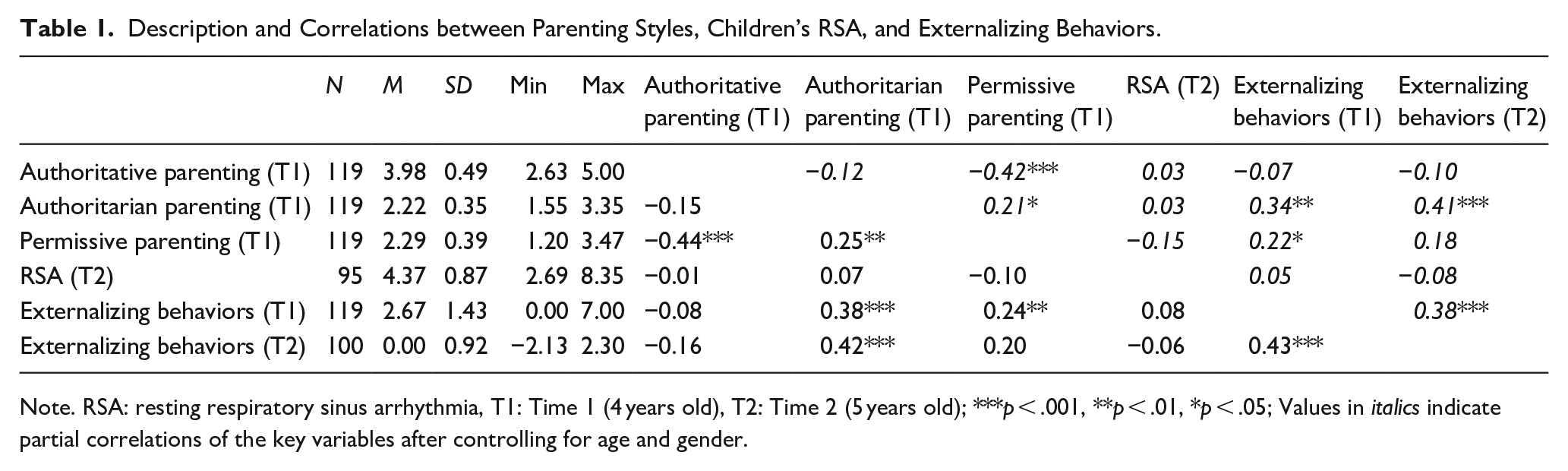
Note. RSA: resting respiratory sinus arrhythmia, T1: Time 1 (4 years old), T2: Time 2 (5 years old); ***p < .001, **p < .01, *p < .05; Values in italics indicate partial correlations of the key variables after controlling for age and gender.
To examine whether the effect of parenting styles on the development of externalizing behaviors varied in children with different RSA, we performed hierarchical multiple regression analyses with externalizing behaviors T2 as the outcome. In the first step, we entered gender, age, informant, and externalizing behaviors T1 as control variables (Model 1 in Table 2). Second, we entered parenting styles and children’s RSA (Model 2 in Table 2). Third, we added the interactions between parenting style and children’s RSA (Model 3 in Table 2). The results revealed that authoritarian parenting had a significant negative effect on the development of externalizing behaviors. In addition, a significant interaction was observed between authoritarian parenting and children’s RSA in the development of externalizing behaviors. To interpret this interaction, the relation between authoritarian parenting and externalizing behaviors (T2) was examined separately for children with high (+1 SD), mean, and low (−1 SD) levels of RSA. For children with low and mean RSA, high authoritarian parenting was significantly associated with high externalizing behaviors at T2 (low: b = .51, t = 3.92, p < .001, 95% CI = [0.25, 0.76]; M: b = .26, t = 3.25, p = .001, 95% CI = [0.10, 0.41]). However, for children with high RSA, authoritarian parenting was not significantly associated with externalizing behaviors T2 (b = .09, t = .07, p = .94, 95% CI = [−0.23, 0.25]). To estimate the moderation effect precisely, we computed and graphically represented the “regions of significance” (Figure 1). The upper and lower bounds of the regions of significance were 4.73 and 0.36, respectively. When RSA was lower than 0.36, authoritarian parenting significantly predicted externalizing behaviors. Note, however, that the observed range of RSA in this sample was between −1.92 and 4.55, and the value of the upper bound of the region of significance (4.73) was beyond this range. Consequently, although calculable, it was not practically interpretable and not depicted. These results demonstrate that high RSA can protect children from the detrimental effects of authoritarian parenting.
Results of Regression Analysis Examining Parenting Styles and Children’s RSA on Externalizing Behaviors T2.
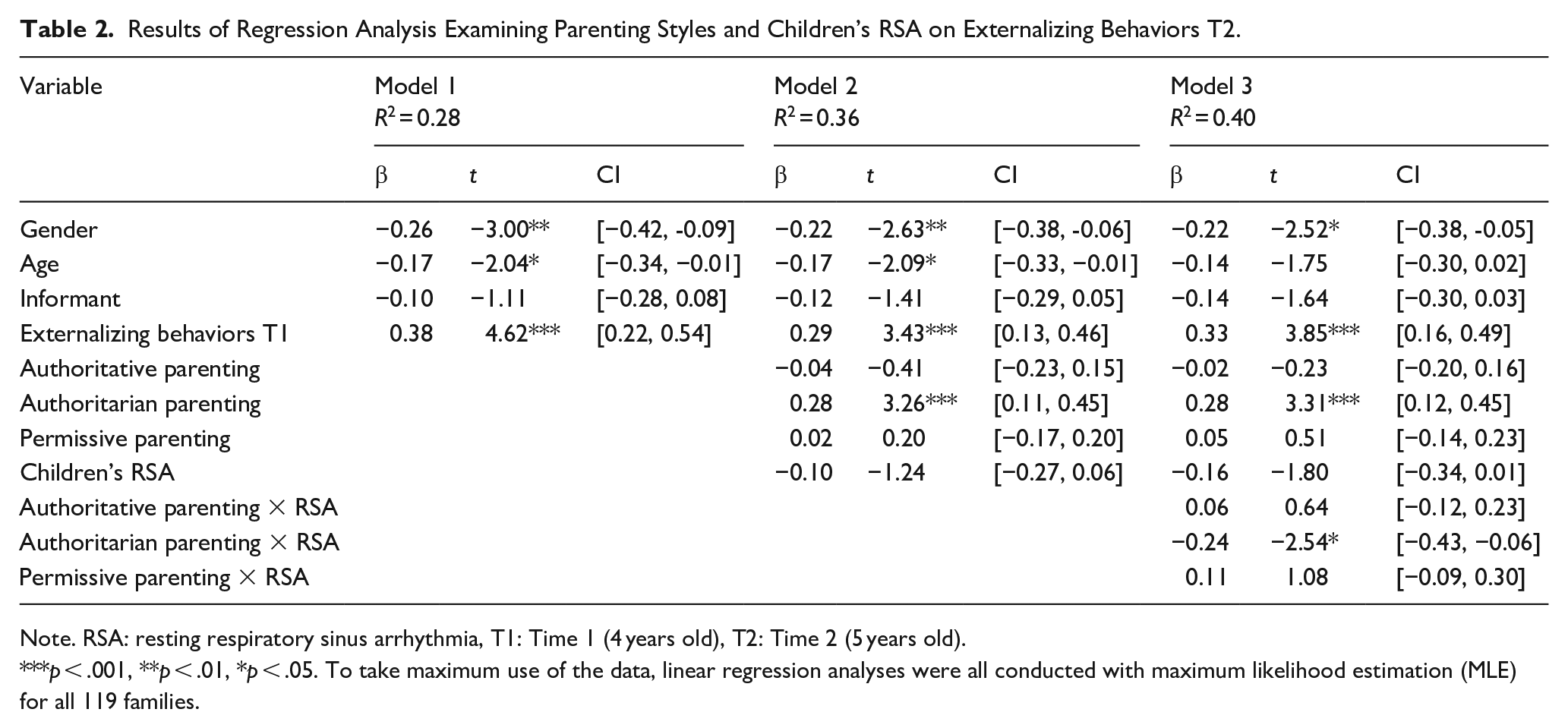
Note. RSA: resting respiratory sinus arrhythmia, T1: Time 1 (4 years old), T2: Time 2 (5 years old).
p < .001, **p < .01, *p < .05. To take maximum use of the data, linear regression analyses were all conducted with maximum likelihood estimation (MLE) for all 119 families.

RSA Moderates the Effect of Authoritarian Parenting on Externalizing Behaviors (Regions of Significance Analysis).
Discussion
Framed from the ecological system theory and the diathesis-stress model, the present study investigated the effect of parenting styles on young children’s development of externalizing behaviors and the potential contribution of children’s vulnerability, focusing on resting RSA. We found that authoritarian parenting positively predicted children’s externalizing behaviors, and this effect was moderated by resting RSA. Specifically, children with low levels of resting RSA exhibited higher externalizing behaviors at high levels of authoritarian parenting than those with low levels of resting RSA. In contrast, children with high RSA showed no significant difference across levels of authoritarian parenting. These findings support the diathesis-stress model, indicating that high levels of resting RSA had already served as a protective factor against the environmental stress of authoritative parenting as early as childhood. In addition, permissive parenting was only associated with contemporaneous children’s externalizing behaviors, whereas authoritative parenting had no significant effect.
Effect of Authoritarian Parenting
Among the three parenting styles studied, our results highlight the detrimental effect of authoritarian parenting, which has both concurrent and antecedent associations with children’s externalizing behaviors. These findings are consistent with previous research as links between externalizing difficulties with authoritarian parenting are stronger in meta-analyses (Pinquart, 2017) and more pervasive in empirical studies (e.g., Braza et al., 2015; Calzada et al., 2012; Cheevers et al., 2010) than with authoritative or permissive parenting. With arbitrary parental control, children can be forced to the other side of their parents, resulting in increased defiance (Kochanska et al., 2003). Parents’ authoritarian behaviors (e.g., angry expressions and corporal punishment) can be imitated by children through the process of social learning, which can directly cause irritability and aggression in children when they are confronted with interpersonal problems (Georgiou et al., 2013; Jaekel et al., 2021). Furthermore, the low warmth of authoritarian parents may have a negative effect. Parental warmth may calm emotionally dysregulated children, whereas authoritarian parenting, which ignores children’s emotional needs, deprives them of the opportunity to acquire emotional regulation skills (Morris et al., 2007; Qiu & Shum, 2022) and thus consolidates their externalizing behaviors.
The present study extends the influence of authoritarian parenting on the development of externalizing behaviors in Chinese culture, where parents utilize more authoritarian parenting than Western parents (Su & Hynie, 2011; Xu et al., 2005) because of the traditional Chinese value of filial piety and hierarchical structure (Ng & Wang, 2019). Chinese parents responsibly teach, discipline, and govern, believing that firm discipline is beneficial to their children (Chao, 1994). However, recent research has revealed that even in China, firm control without warm support can result in poor self-regulation, low social competence, and increased psychological difficulties among children and adolescents (Liu & Chang, 2016; Tan et al., 2012; Zhou et al., 2008), albeit to a lesser extent than in Western countries in some studies (Chao, 2001; Pomerantz & Wang, 2009). Our study is consistent with these studies and further indicates the negative effects of authoritarian parenting in early childhood—a pivotal stage when Chinese parents begin to discipline their children to learn and obey social conventions; even during this period, parents should be cautious about using authoritarian parenting.
The results from our study showed that authoritative parenting is not significantly associated with children’s externalizing behaviors. This may be because it is more likely to promote positive social adjustment outcomes in young children (Coplan et al., 2008; Luo et al., 2021), whereas the present study focused on a maladaptive variable, namely, externalizing behaviors. Permissive parenting showed a positive association with children’s externalizing behaviors concurrently rather than the development of externalizing behaviors. Although research has found that permissive parenting can lead to children’s externalizing behaviors, it has also indicated that the negative effects of permissive parenting are small and unstable (Pinquart, 2017; Pinquart & Kauser, 2018).
Moderate Effect of Resting RSA
Our study demonstrated the interaction effects of parenting and children’s intrinsic characteristics, suggesting that resting RSA moderates the influence of authoritarian parenting on young children’s development of externalizing behaviors. We did not find any significant interaction effect of authoritative or permissive parenting. In line with the diathesis-stress model (Zuckerman & Riskind, 2000), children with a vulnerability factor (low resting RSA) are more likely to be overwhelmed by authoritarian parenting. Previous studies on adolescents have found that high levels of resting RSA can protect adolescents from adversity (e.g., child maltreatment, negative parenting), whereas children with low levels of resting RSA suffer significantly (e.g., Dyer et al., 2016; McLaughlin et al., 2014). This study extends the moderating role of resting RSA in parenting and child social adjustment in early childhood which has been theoretically proposed but failed to be found in previous studies (Rudd et al., 2017; Zhang et al., 2020), contributing new knowledge to the mechanism of young children’s socialization.
Our findings indicate that resting RSA plays a crucial role in early childhood. On one hand, preschool children—unlike infants, who are well protected—begin to be exposed to a variety of environmental stressors, such as parental discipline, peer conflicts, and social rule constraints (Chen et al., 2001; Luo et al., 2013). The ability to self-regulate is essential for managing emotions and behaviors to achieve social goals. As shown in Model 3, resting RSA was negatively associated with externalizing behaviors, although this trend was only marginally significant. On the other hand, unlike adolescents, preschool children are not yet equipped with mature emotion regulation strategies (DeCicco et al., 2012; Sala et al., 2014) or constructive conflict resolution (Laursen et al., 2001). The lack of these abilities makes it challenging for young children to make proactive cognitive adjustments in response to the onset of stress. Thus, the early emerging resting RSA is a specific intrinsic regulation capacity (Dollar et al., 2020; El-Sheikh, 2005) that helps young children access a calm state conducive to social interaction (Porges, 2007). This study focused on the family system, which is often the first context where children socialize, and illustrated how high levels of resting RSA protect children against stress from authoritarian parents. In contrast, children with low levels of resting RSA are easily provoked into anger and aversion and are more likely to defy parents’ demands, thus exhibiting more externalizing behaviors. It is also possible that children’s externalizing behaviors lead to harsh parenting (Serbin et al., 2015). Taken together, the superposition of authoritarian parenting and children’s low levels of resting RSA results in an increase in externalizing behaviors. In view of the direct adverse effect and the interaction effect of authoritarian parenting, this study pointed out the significance of intervening in authoritarian parenting, especially for children with weak physiological regulation.
Conclusion and Limitations
This study investigated the interactive effect of parenting style and physiological self-regulation on the development of young children’s externalizing behaviors. These findings corroborate the diathesis-stress theory, indicating that children with low levels of resting RSA are especially vulnerable to the negative effects of authoritarian parenting. However, this study has several limitations. First, we used parental reports to measure children’s externalizing behaviors. Although parents are familiar with their children’s behaviors from daily observations, subjective reporting bias may have compromised the validity of our findings. Thus, to comprehensively explore the development of externalizing behaviors, future research could combine teachers’ reports or behavioral observations. Second, this study controlled for children’s externalizing behaviors at T1, but it could not completely exclude the effect of children’s behaviors or physiological self-regulation on parenting styles; indeed, the effect of children or the bidirectional relationship between children’s characteristics and parental behaviors has been discussed in recent developmental and family studies (Sokolovic et al., 2021). In our future research, we would like to examine the transactional processes and reciprocal change to further elucidate the developmental mechanisms underlying children’s behavioral problems from the family system perspective. Finally, the participants in this study were mainly from middle-class urban families in China, and most parents are highly educated; therefore, the present findings should be cautiously generalized to low economic level areas or rural China. Given the deeply entrenched traditional standards (e.g., emphasis on self-restraint and respect for parental authority) in rural China, authoritarian parenting may be prevalent in these areas (Chen et al., 2011). Thus, future research that includes a more diverse sample is needed to further explore how Chinese culture influences the interactions of parenting styles and children’s characteristics with children’s socioemotional development.
Supplemental Material
sj-docx-1-jbd-10.1177_01650254231222434 – Supplemental material for Influence of parenting styles on children’s development of externalizing behaviors: The role of resting respiratory sinus arrhythmia
Supplemental material, sj-docx-1-jbd-10.1177_01650254231222434 for Influence of parenting styles on children’s development of externalizing behaviors: The role of resting respiratory sinus arrhythmia by Shuyi Zhai, Ying Liang, Chenxin Lu and Jie He in International Journal of Behavioral Development
Footnotes
Acknowledgements
The authors thank Jinjing Han, Laike Pan, and Yuting Luo for assistance with data collection. They also thank Editage for English language editing. They are grateful to the families that participated in this project.
Authors’ Note
This manuscript has not been published or presented elsewhere in part or in entirety, and is not under consideration by another journal.
Declaration of Conflicting Interests
The author(s) declared no potential conflicts of interest with respect to the research, authorship, and/or publication of this article.
Funding
The author(s) disclosed receipt of the following financial support for the research, authorship, and/or publication of this article: This work was supported by the National Natural Science Foundation of China (32371108, 32200869, 31871119 ) and the National Natural Science Foundation of Zhejiang Province (LY24C09001).
Ethical Approval
All study participants provided informed consent, and the study design was approved by the appropriate ethics review boards. All the authors have approved the manuscript and agree with submission to this esteemed journal.

Supplemental Material
Supplemental material for this article is available online.
References
Supplementary Material
Please find the following supplemental material available below.
For Open Access articles published under a Creative Commons License, all supplemental material carries the same license as the article it is associated with.
For non-Open Access articles published, all supplemental material carries a non-exclusive license, and permission requests for re-use of supplemental material or any part of supplemental material shall be sent directly to the copyright owner as specified in the copyright notice associated with the article.
