




Abstract
Import–export studies use citation data to describe the exchange of knowledge and ideas between different disciplines. This paper reports the use of journal impact factors (IF) to quantify the extent to which an individual discipline, specifically librarianship and information science (LIS), is able to export knowledge to other disciplines. Web of Science searches were used to identify citations to 232 high quality LIS publications extracted from submissions to the UK’s 2008 Research Assessment Exercise. These publications resulted in 1061 knowledge exports to 444 unique, non-LIS citing journals, for which IFs were taken from the Journal Citation Reports database and normalised in order to minimise inter-disciplinary differences in citation behaviour. Non-LIS citing journals are shown to have IFs that are above the average for their subject categories, with this pattern of behaviour being considerably more pronounced for citations to LIS research published in non-LIS, rather than LIS, journals.
Keywords
1. Introduction
Citations occur within publications when an author acknowledges another’s work, creating a network of connections that effectively maps the spread of knowledge from one publication to another. The spread of ideas is most evident within an individual discipline, yielding a highly inter-connected network spanning journals that share a common focus of interest. However, the boundaries between different disciplines are highly permeable, providing a route for inter-disciplinary knowledge exchange that can be mapped using methods of citation analysis. Cronin and Pearson suggested an economic analogy for knowledge exchange, in which a given discipline, A, is said to export knowledge when a citation is made from an article in another discipline, B, to an article in A; conversely, A imports knowledge from B when a citation is made in the opposite direction [1]. The effect of an export is to increase the academic visibility of A, while the effect of an import is to take up ideas and methods etc. that have been developed outside of A.
The import–export model of inter-disciplinary knowledge transfer has been used in many studies, as discussed in the following section. These studies have commonly adopted the view that the influence of a discipline A is strongest on those other disciplines that import the most, i.e. that make the largest number of citations to A journals. However a direct link cannot necessarily be made between exports and the actual degree of influence as different journals vary in their significance (actual or perceived), in just the same way as different types of export vary considerably in value; for example, technologically sophisticated manufacturing, e.g. aerospace or pharmaceuticals, generally results in more valuable exports than do, e.g., textiles or kitchen white-goods.
This paper considers the extent to which the import–export model of knowledge transfer can be enhanced by incorporating information as to the relative value of different types of export. Specifically, we seek to quantify the nature of knowledge exports from the discipline of librarianship and information science (LIS) to other disciplines in the sciences and social sciences. The paper is structured as follows. The next section discusses previous citation-based, import–export studies, and this is followed by a description of the methodology that was developed. The fourth section presents the results that were obtained using the citations to a set of 232 high quality LIS articles with data extracted from the Thomson-Reuters Web of Science (WoS) and Journal Citation Reports (JCR) databases. The paper closes by summarising our main conclusions.
2. The import–export model of knowledge transfer
Import–export models have been applied to a broad range of disciplines. For example, Urata investigated information flows across the arts, humanities and social sciences and found that the flows between individual disciplines were not simply reciprocal in character but were determined by an academic structural hierarchy [2]. Levitt et al. studied changes in the level of inter-disciplinarity for 14 social science disciplines since 1980 [3]. All of the disciplines were found to have experienced a net increase in inter-disciplinarity during this period, with the authors highlighting the requirements of those setting research policy as one of the principal factors contributing to this growth. The largest increase noted was for LIS (as denoted by the WoS subject category Information Science & Library Science) between 1990 and 2000. Liu and Wang analysed citation exports and imports in journals for demography, an inter-disciplinary subject drawing heavily on fields such as sociology, anthropology and geography [4]. Analysis of the citations in a set of journals showed that demography had increased its independence as a discipline, as its journals were now predominantly communicating within the discipline, as opposed to outside it. Liu and Wang hence considered low import and export levels as denoting the cohesiveness and individuality of a discipline, rather than as a symptom of academic weakness [5]. Lockett and McWilliams identified a balance-of-trade deficit between management and related social science disciplines, with management importing noticeably more knowledge than it exported [6]. Johnson and van Hoek studied information imports in three management sub-disciplines: operations, strategy and marketing. The first of these was found to be the main importer, leading the authors to suggest that it might form a suitable ‘home’ for the developing sub-discipline of supply chain management [7]. The import–export model is normally used to describe the transfer of discipline-specific knowledge across subject boundaries, but can also be carried out at the level of individual journals or databases. Thus, Goldstone and Leydesdorff assessed exports from and imports to the journal Cognitive Science, finding that it provided an effective mechanism for transfer between psychology, computer science, neuroscience and education [8], and Wong et al. demonstrated that articles about the Cambridge Structural Database were of interest far beyond the chemical crystallographic community [9].
There is a long-standing, and continuing, interest in the inherently inter-disciplinary nature of LIS [10–16], and it is hardly surprising therefore that LIS has formed the basis of many import–export studies (even if not always described as such). The seminal work here is that of Cronin and Pearson [1], who discussed the journals citing the work of six leading LIS researchers (or ‘grandees’) and found that the discipline, at least as represented by the work of these six grandees, exported little to other disciplines. Other, subsequent approaches to studying the import and export of ideas in LIS include the following. Tang studied citations to 150 LIS publications drawn randomly in six years between 1975 and 2000 and showed that LIS attracts a wide spectrum of interests across the sciences, social sciences, and arts and humanities [17]; Peritz and Bar-Ilan studied imports to bibliometrics as evidenced by citations in the journal Scientometrics [18]; Tsay studied imports to the journals Journal of the American Society for Information Science and Technology, Information Processing and Management, and Journal of Documentation, and noted the much stronger library focus of Journal of Documentation [19]; and Wormell’s study of the international nature of leading LIS journals included a discussion of the export performance of Libri and Journal of the American Society for Information Science (as it was then called), with the latter being far more widely cited outside of LIS [20]. Rather than using specific journals, both Levitt and Thelwall [14] and Tabatabaei and Beheshti [21] used highly cited papers from a range of journals to highlight the fact that high quality LIS work often results in a strong export performance and that a considerable period may pass before this external impact becomes evident.
Odell and Gabbard investigated the inter-disciplinary influence of 67 journals categorised by JCR as Information Science & Library Science for the years 1996–2004 [22], this study replicating an earlier one by Meyer and Spencer for the years 1972–1994 [23]. Odell and Gabbard highlighted the large increases in the share of citations to LIS literature by the disciplines of computer science, business and management, and also noted that the journals with the strongest export performance were newer ones that had not been included in the earlier survey by Meyer and Spencer. An even more comprehensive study was conducted by Cronin and Meho [5]. These authors identified three limitations characterising earlier import–export studies in LIS: restricting analyses to a set time-period; focusing on a sub-field of LIS; or investigating only a small portion of literature. Their study was carried out on a very large scale, covering exports from 275 LIS journals and imports to 80 LIS journals for the years 1977–2006. During this period, Cronin and Meho found that LIS had become a significant contributor to disciplines such as computer science and engineering, business and management, while at the same time itself drawing on these literatures, a situation that is very different from that of 1980 when the initial study of Cronin and Pearson was conducted.
3. Methodology
In this study, we focus on the export of knowledge from LIS to other disciplines, but go further than previous studies by considering not just the extent of the exports, as represented by the number of non-LIS journals citing LIS literature, but also the value of the exports, as represented by the quality of those citing journals. Adopting Cronin and Pearson’s trade analogy, we can view citations to LIS research in an international, high impact journal as representing high-value exports into a more competitive market place than is represented by citations to LIS research in a national, low impact journal.
Any study of inter-disciplinarity requires a working definition of what is meant by a discipline. Like many previous workers, we have adopted a pragmatic approach based on the JCR subject categories. Here, journals are allocated to one or more subject categories: for example both the Journal of Information Science and the Journal of Computer-Mediated Communication belong to the Information Science & Library Science category in the JCR Social Sciences Edition, but the latter additionally belongs to the Communication category. An export is said to have occurred when a piece of LIS research is cited in a journal that has been allocated a category other than Information Science & Library Science. In fact, we consider two types of export here: we define a full-export as occurring when a citation to LIS research occurs in a journal that has not been allocated to the Information Science & Library Science category; and we define a part-export as occurring when a citation to LIS research occurs in a journal that has been allocated to the Information Science & Library Science category and also to one or more further categories. Thus a citation to LIS research in the Journal of Computer-Mediated Communication would be considered as a part export, whereas a citation in the ACM Transactions on Information Systems, which is only in the Computer Science, Information Systems category, would be considered as a full export. We should note at this point that, while JCR subject categories are widely used, they may shape, at least in part, the results obtained since the precise allocation of journals to categories will determine whether a citation to an article is considered to be an export (either part or full). All classification schemes have some element of arbitrariness and this is certainly the case here: for example, both Journal of Informetrics and Scientometrics are in Information Science & Library Science, but only the latter is also in Computer Science, Interdisciplinary Applications. That said, there is no obvious alternative data source that so successfully integrates publications, citations, impact data and a subject classification.
If we are to consider the value of citations from some specific journal to a piece of LIS research, whether in a part or a full export, then there needs to be a definition of the value of a journal. There are many ways in which this can be quantified [24, 25]; however by far the most widely used – despite its known limitations – is the journal’s Impact Factor (IF) [26–28], and it is the IF that is used in the present study, specifically the 2-year IF values listed in the JCR database.
Most previous import–export studies have taken LIS research to be material that has been published in LIS journals, where an LIS journal is assumed to be one that has been allocated to the Information Science & Library Science category. However, the inherently inter-disciplinary of LIS means that researchers come from an increasingly wide range of backgrounds [5] and that they may thus be expected to publish in a correspondingly wide range of journals. An alternative, and arguably more precise, definition of LIS research is hence what is published by LIS researchers; this definition was used by Cronin and Pearson in their original work on import–export models in LIS [1] and is also used here. The differences between the two definitions (i.e. publication in an LIS journal or appearance in an LIS researcher’s list of publications) are discussed further in Section 4.4.
An obvious source of publication lists comes from the submissions by LIS departments to the UK Research Assessment Exercise in 2008 (RAE2008). The purpose of RAE2008, as of all the previous such exercises, was to rate the quality of academic research so as to provide a quantitative basis for the allocation of research funding to universities by central government [29]. The full details of each department’s submission to the exercise are available on the RAE2008 website at http://www.rae.ac.uk/Submissions/, with each such departmental submission containing, inter alia, details of up to four publications produced by each member of staff in the period 2001–2007. These publications have been carefully selected by departments to show their research in the best possible light, and they hence provide a body of high quality publications that are ideal for the current study. A total of 21 institutions submitted to RAE2008 in the LIS category, which was formally called Unit of Assessment (UoA) 37, Library and Information Management. However, the submissions to UoA 37 included not only LIS departments but also departments whose main focus was information systems or humanities computing. We have hence selected 10 of the submitting departments to represent UK LIS research, the selection being based on our knowledge of the departments and on a careful reading of the ‘Research environment and esteem’ sections of their submissions. These departments came from the following institutions: Aberystwyth University, the University of Brighton, City University, Leeds Metropolitan University (LMU), Loughborough University, Manchester Metropolitan University (MMU), Robert Gordon University (RGU), the University of Sheffield, University College London (UCL), and the University of Wolverhampton.
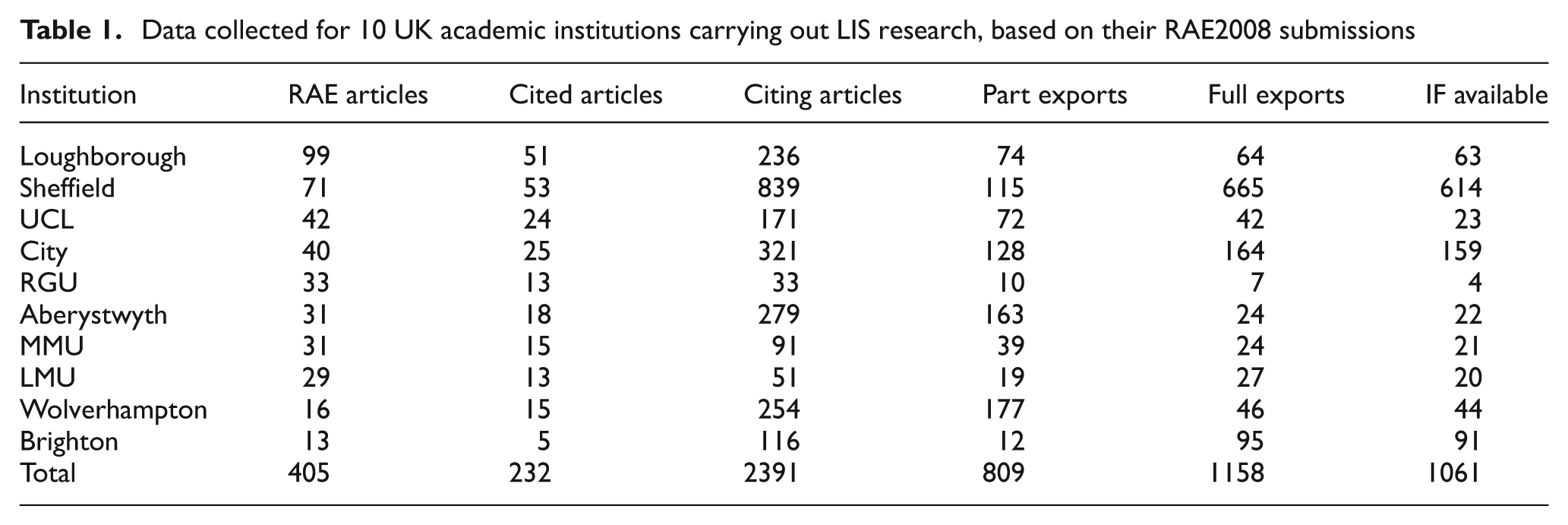
The processing of the RAE publication data is exemplified by the data for Aberystwyth. In all, the RAE2008 submission listed 48 publications (‘outputs’ in the RAE parlance) for 12 members of staff. Of these 31 were journal articles (column ‘RAE articles’ in Table 1), of which 23 appeared in WoS. Five of these had not been cited in WoS, leaving a final sample of 18 articles (column ‘Cited articles’) for this institution for which citation data could be collected, this comprising the subject category, the IF and the total numbers of citations for each of the citing journals. The 18 articles attracted a total of 312 citations in WoS. Of these 281 citations were from articles, with 279 (i.e. all but two) in journals for which the subject category was available. Out of 279 citations (column ‘Citing articles’), 163 were part-exports, i.e. the citing journal had a subject category (or categories) in addition to Information Science & Library Science, and 24 were full exports, i.e. had not been allocated to the Information Science & Library Science category (columns ‘Part exports’ and ‘Full exports’). Of the latter, two further articles had to be omitted because the corresponding IFs were not available, giving the value of 22 in the column ‘IF available’; this is because JCR covers only the sciences and social sciences, hence excluding citing journals (and the corresponding IFs) in the arts and humanities. All of the 10 RAE submissions were processed in the same way, yielding the results listed in Table 1.
Data collected for 10 UK academic institutions carrying out LIS research, based on their RAE2008 submissions
4. Results
4.1. Part exports and full exports
When considering the data in Table 1, it was noted that a large number of mainstream LIS journals, and categorised as such, were also allocated to the Computer Science, Information Systems category. Examples of such journals are Aslib Proceedings, Information Processing and Management, Journal of Information Science, Journal of the American Society for Information Science and Technology, Online Information Review and Program. In fact, if we consider the 16,587 WoS LIS articles for 2001–2007 (the period covered by RAE2008) then 5728 (over one-third) of these had also been allocated to Computer Science, Information Systems and 1590 (almost one-tenth) to Computer Science, Interdisciplinary Applications (with other high-ranked categories including Multidisciplinary Sciences, Management, and Communication inter alia). Articles in such dual-category citing journals (i.e. part exports) cannot be regarded as unequivocal evidence of significant inter-disciplinary knowledge transfer. The Computer Science, Information Systems category is in the JCR Science Edition, which does not have a specific LIS category; instead, this category, Information Science & Library Science, is in the JCR Social Sciences Edition. The Information Science & Library Science category contains 77 journals, 17 of which belong to an additional category in the JCR Social Sciences Edition, with the most common additional category being Management. When the 77 journals are ranked in decreasing order of IF, five of the dual-category journals occur in the top 10 positions, with two of them – MIS Quarterly and Information Systems Research – right at the top of the ranking.
Overall, 31 of the 77 journals in the Information Science & Library Science category have one or more additional categories in the science or social science parts of JCR. Ignoring the existence of such dual categorisations in an import–export study could clearly provide a highly over-optimistic view of the extent to which LIS knowledge is being exported to the wider academic community, especially as the data of Levitt and Thelwall [14] and of Tabatabaei and Beheshti [21] show that part exports are associated with high citation levels. The analyses in the remainder of this paper hence focus on the 1061 full exports in the final column of Table 1.
4.2. Analysis of citing journals and subject categories
The 1061 full exports were cited in 444 unique journal titles. Of these, 277 (almost two-thirds) made only a single citation to an LIS export; thereafter, hardly surprisingly, the distribution dropped away steeply with 77 titles making two citations, 30 journals making three citations etc. in the expected long-tailed distribution. LIS exports are hence thinly spread across a large number of different journals, with a few isolated titles drawing extensively on LIS research.
The wide range covered by the citing journals is exemplified by the variety of titles making just one or two citations. For example, Journal of Air Transport Management cites an LIS article on the use of the critical incident technique in studies of information behaviour [30]; Surgical Clinics of North America cites two LIS articles on clinical librarianship in the UK [31, 32]; and the Australian Journal of Agricultural Research cites an LIS article on practice-based research in networked learning [33]. Further titles demonstrating the varied destinations of LIS exports include Annals of Tourism Research, Journal of Plant Nutrition and Soil Science and Palaeontology.
The journals citing LIS research most frequently are listed in Table 2, which shows those in the top 10 ranked positions (there are multiple journals with 8, 9 or 11 citations).
Journals most frequently citing LIS research

The table shows a very clear outlier, in the form of the Journal of Chemical Information and Modeling which made 111 citations to articles in the LIS sample (i.e. about one-tenth of all the full exports). It is, however, but one of a large number (13 of the 20 in the table) of journals in the general area of drug discovery and medicinal chemistry. Apart from these 13, there are two other medical journals with five that are perhaps more typical of the journals that one might expect to cite LIS research, viz Computers and Education, Expert Systems With Applications, New Media & Society, Computers in Human Behavior and Information Retrieval. Citation counts alone can be a misleading indication of export performance. Thus, all of the citations from the 13 drug-discovery journals were to a single research group in a single institution (the Sheffield chemoinformatics group) and comprise citations to just 11 distinct articles, i.e. the apparent strong export performance results from citations to a small number of core articles, rather than to a broad range of LIS research. Other, less dramatic, examples of institution-specific exports include all of the citations from Information Retrieval being to articles from City, and the eight citations from Sociology of Health & Illness not only being to the same institution (Brighton), but also to the same article [34]. In view of this degree of specificity, it could be argued that the best export performance for the discipline as a whole is exemplified by journals that draw more widely on LIS research. For example, the 11 citations from Computers and Education in Table 2 are to nine different articles from seven different institutions; less marked examples of this behaviour are Expert Systems with Applications, which made nine citations to four institutions and six articles, and New Media and Society, which made nine citations to three institutions and seven articles.
LIS exports were cited across 146 unique subject categories. Thirty-three of these categories yielded only a single citation and 101 of them yielded fewer than 10 citations. The 10 categories whose constituent journals cite LIS research most frequently are listed in Table 3. At first appearance this would suggest a rather different picture from that presented in the previous paragraph, since there are relatively more computer science, and fewer medicinal chemistry, entries than in Table 2. However, the difference is more apparent than real, as many of the high-ranked chemistry journals in Table 2, such as Journal of Chemical Information and Modeling and Journal of Computer-Aided Molecular Design, belong to the Computer Science, Interdisciplinary Applications category (and Journal of Chemical Information and Modeling also belongs to the Computer Science, Information Systems category).
WoS subject categories most frequently citing LIS research

4.3. Use of journal impact factors
The discussion in the previous section of citing journals and disciplines (as denoted by subject categories) is typical of previous export studies; here, we describe how journal IFs can be used to provide a more nuanced view of the extent to which LIS research is viewed in other disciplines. Although widely used, journal IFs have several limitations [26, 27, 35], most obviously in the current context the fact that their magnitudes vary significantly from one discipline to another. We have hence normalised the IF values by using the median IF, i.e. the middle IF value when the individual IFs for the journals in a subject category are ordered. Normalisation was carried out by dividing a journal’s raw IF by the median IF for its subject category, so that the resulting, normalised IFs (NIFs) provide an indication of a journal’s standing within its subject category: the journal is then assumed to be of above-average quality for the category if NIF > 1, and of below-average quality if NIF < 1. For example the Turkish Online Journal of Educational Technology has a raw IF of 1.016. It is attributed to the subject category Education & Educational Research, which has a median IF of 0.653. Therefore the NIF for this journal is 1.016/0.653; that is, 1.556, indicating that it has an above-average impact for the journals in its subject category. In addition to the median IF for each subject category, the JCR also provides the aggregate IF (the sum of all the citations to the journals in the category divided by the sum of all the articles in the journals in the category): normalisation experiments with the aggregate IF showed that it yielded broadly comparable results to those obtained with the median IF and the subsequent discussion hence uses the latter approach to normalisation. Approximately half of the citing journals in our sample of full exports were assigned to two or more subject categories, in which case the mean of the normalised figures for each individual category was calculated. For example, Flavour and Fragrance Journal has a raw IF of 1.849. It is assigned to two subject categories: Chemistry, Applied (median IF = 1.028) and Food Science & Technology (median IF = 0.930). Its normalised IF was hence calculated as ((1.849/1.028) + (1.849/0.930))/2; that is, 1.893. Five humanities subject categories in our sample did not feature in JCR: Film, Radio and Television; Humanities, Multidisciplinary; Language and Linguistics; Acoustics; and Music. However, all the citing journals assigned to these categories in our sample also had at least one other categorisation, and the latter was used as the basis for the normalisation.
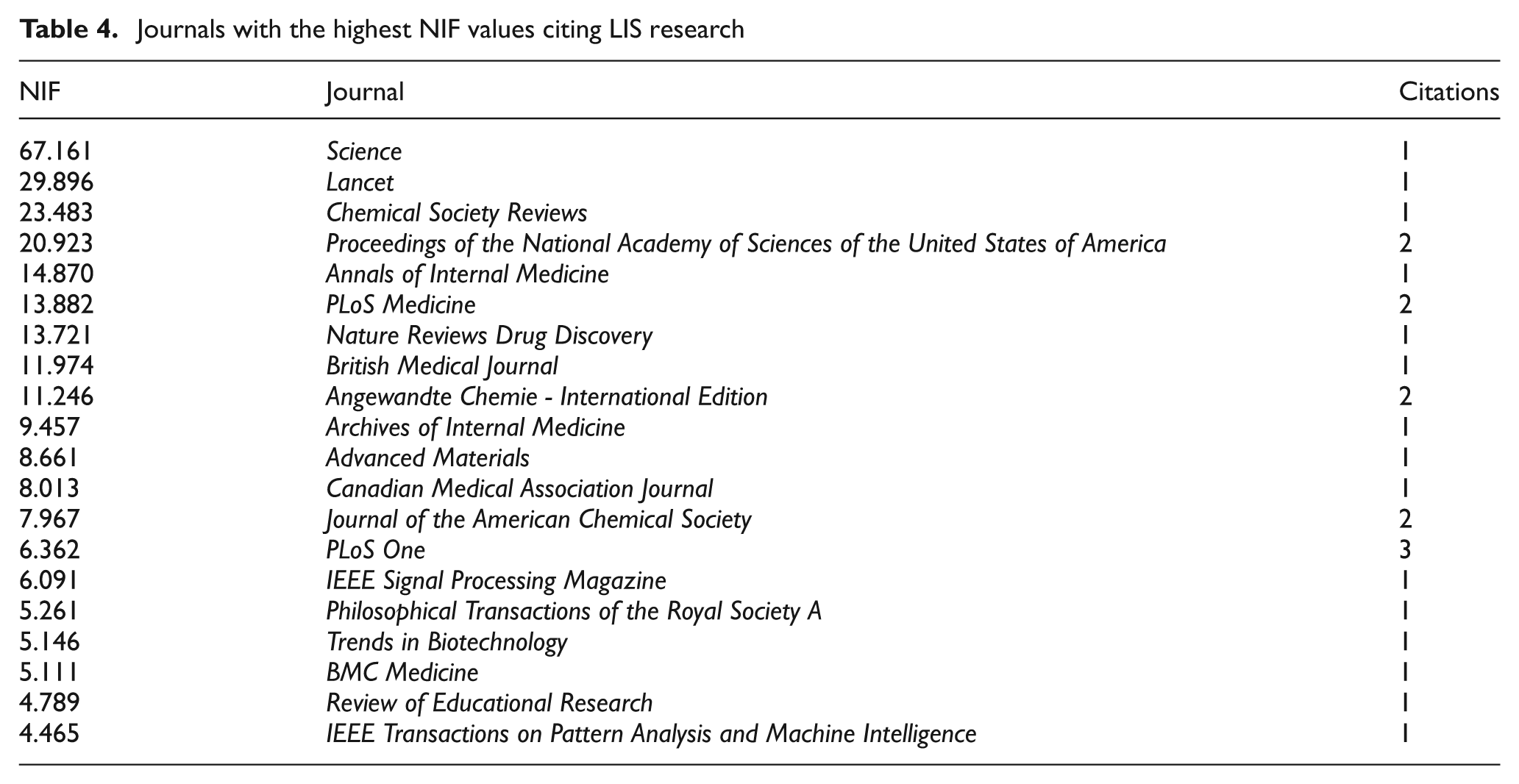
The NIF values for the full export publications range from 0.059 (Neural Regeneration Research) to 67.161 (Science), with a median value of 1.609, and the 20 citing journals with the highest NIF values are listed in Table 4. The table also contains the number of citations for each journal, and it will be seen that all of these high-ranked journals made three or fewer citations, i.e. LIS research is not highly cited in the most prestigious journals.
Journals with the highest NIF values citing LIS research
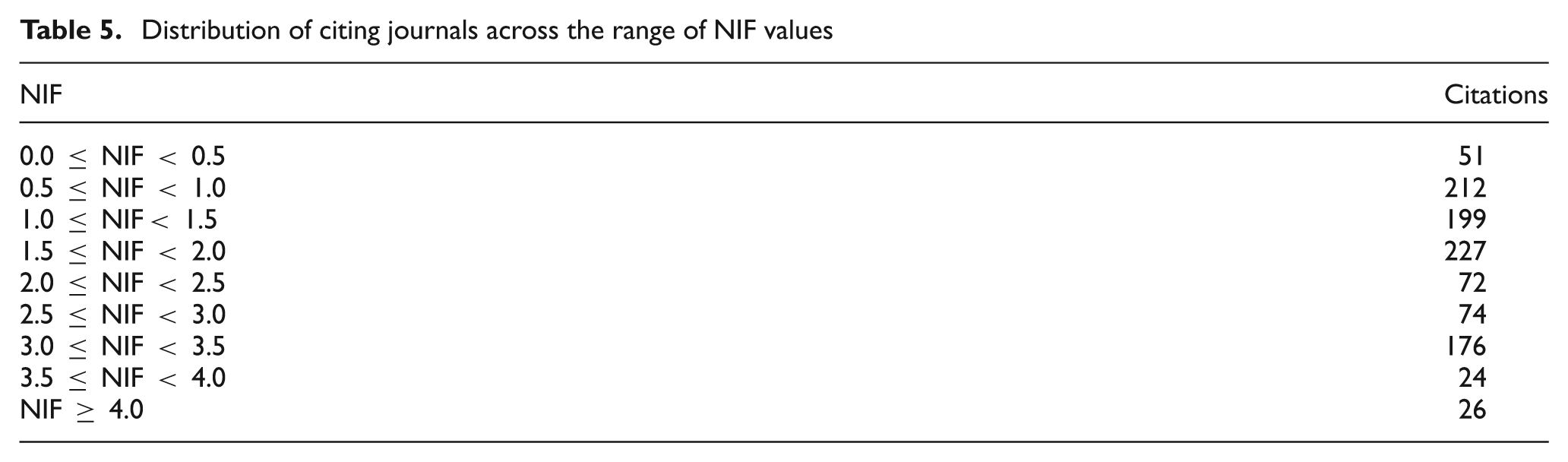
However, the median NIF value of 1.609 for the set of 444 citing journals makes it clear that, taken as a whole, the full exports are being made to above-average journals. This is made explicit in Table 5, which shows the distribution of citing journals over the range of NIF values. It will be seen that no less than 798 (almost exactly three-quarters) of the 1061 citations are from journals for which NIF ≥ 1: thus, LIS research influences not just work beyond the discipline (as suggested by previous studies), but additionally influences high quality work (as denoted by the appearance of the work in high quality journals) beyond the discipline. An inspection of Table 5 shows that the citation frequencies rise markedly for NIFs greater than 0.5 and peak over the interval 1.5 ≤ NIF< 2.0, with 227 citing articles falling into this category. After this point the distribution drops steeply and tails off with the exception of a second peak corresponding to the interval 3.0 ≤ NIF < 3.5. Much of this second peak comprises the 111 citations from the Journal of Chemical Information and Modeling (the single most frequent citer of LIS research), which has an NIF of 3.310, with the next largest contributions to this peak coming from the Journal of Medicinal Chemistry (26 citations), Computers and Education (11 citations, and Current Opinion in Chemical Biology (8 citations). However the remaining 20 citations in this NIF interval are from 13 separate titles, indicating a relatively large number of citing journals with this level of impact.
Distribution of citing journals across the range of NIF values
4.4. Citations to LIS and non-LIS journals
An operational definition of LIS research can be obtained from consideration of either the publications of LIS researchers [1] or of publications in journals that have been categorised as being about LIS (using either an existing subject classification [15, 16] or researcher selection [5]). As discussed previously, the former approach has been used here, with the publications being those submitted for RAE2008 by academic staff in UK LIS departments. However, only a small subset of the resulting 1061 full export articles were published in journals that belong to the WoS Information Science & Library Science subject category: specifically, 269 of them (just over one-quarter), with the remaining 792 exports appearing in journals that were not included in that category. The marked difference in numbers suggests that academics wishing to attract the interest of non-LIS researchers should, if at all possible, seek to publish in non-LIS, rather than LIS, journals. This is probably to be expected, but the great disparity in the numbers of exports from the two types of publication is certainly worthy of note.
The top-ranked subject categories for citations to LIS research published in LIS journals are shown in Table 6. The categories here are very different from those for citations to LIS research published in non-LIS journals, which closely mirror Table 3 with a preponderance of subject categories related to medicinal chemistry.
WoS subject categories most frequently citing LIS research published in LIS journals
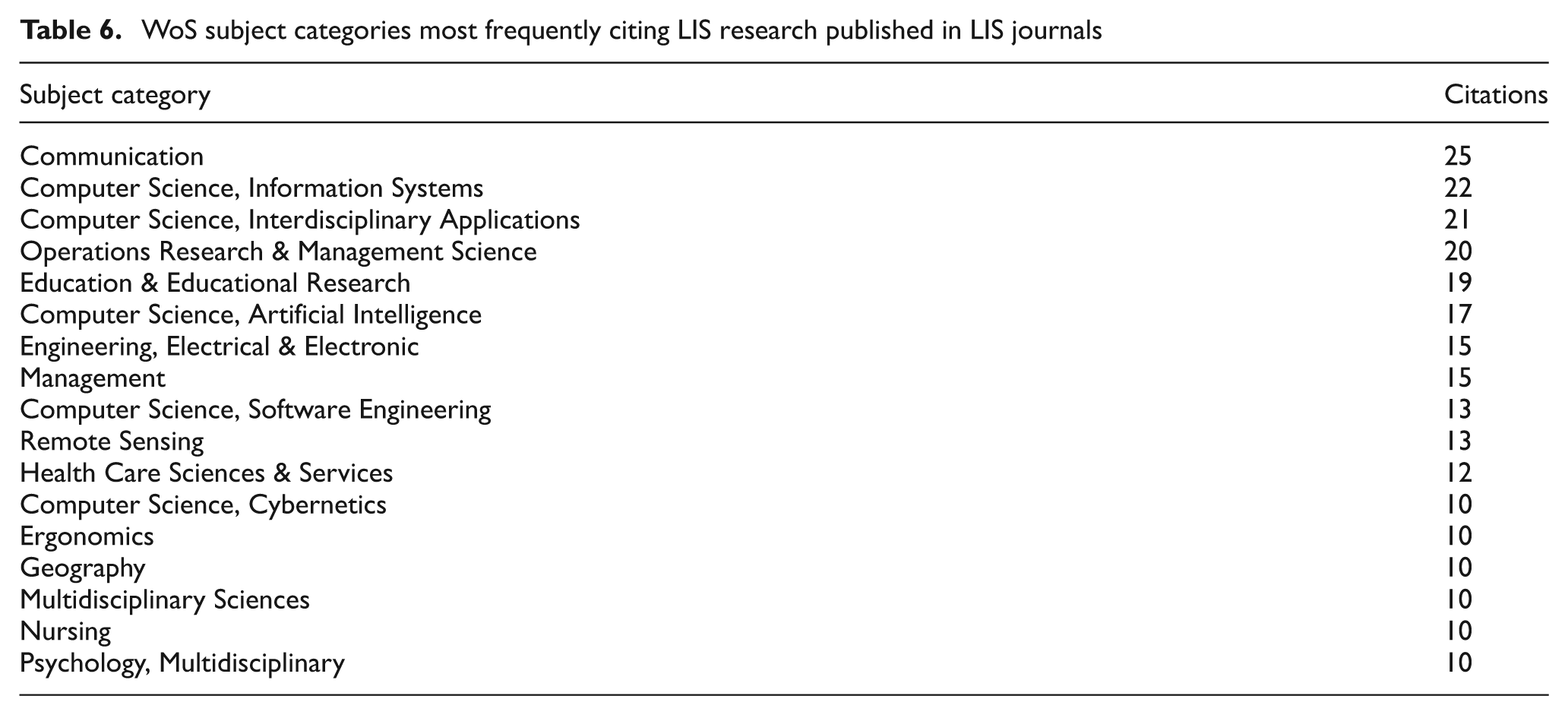
Figure 1 shows the distribution of NIF values for full exports from LIS and from non-LIS journals. It will be seen that both distributions have the majority of citations coming from journals with NIF ≥ 1.0, i.e. from above-average journals. The figure also demonstrates the markedly better export performance of the exports from non-LIS journals: 61.7% of the citations to LIS journals have NIF ≥ 1.0 but this figure increases to 79.8% for citations to non-LIS journals. Thus, not only does publication of LIS research in a non-LIS journal result in more exports, but it also results in exports to higher quality journals, i.e. in exporting successfully in highly competitive markets to use the economics analogy. A chi-squared test using the Yates correction for continuity shows that the difference between the two types of full export is statistically significant (p ≤ 0.001, χ2 = 68.26 with 7 degrees of freedom).
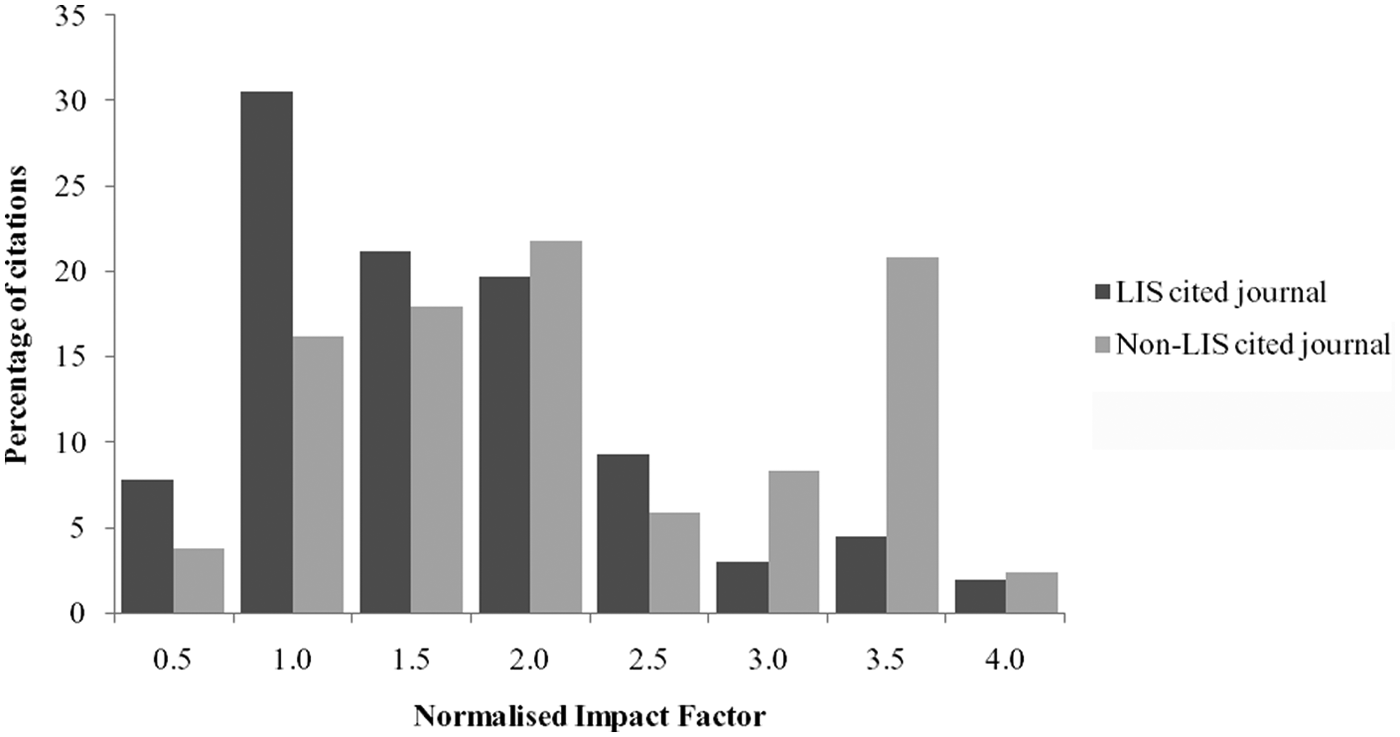
Distributions of NIF values for full-exports from publications in LIS and non-LIS cited journals. The distributions ignore a total of 26 citations from journals with NIF ≥ 4.0.
In concluding our discussion of the results obtained, we note several limitations of the work. First is the highly skewed nature of the full export data, with 614 of the 1061 citations being to publications from a single LIS department, and with the majority of this sub-set being citations to a single, highly specialised research group. That said, highly skewed distributions are the norm, rather than the exception, in bibliometric studies and, as noted in Section 4.1, there are other groups, or individual articles, that have attracted above-average citation interest from beyond LIS. Second, we have considered only high quality LIS research, defined here as articles included in a department’s submission to RAE2008, and the export performance of other types of research might differ from that reported here; in this context, it has been noted previously that highly cited articles (an alternative, appropriate definition of high quality) often exhibit a strong export performance [14, 15]. Third, the JCR database currently only considers journals in the sciences and social sciences, thus precluding a quantification of LIS exports to the arts and humanities.
5. Conclusion
Previous import–export studies, whether in LIS or in other disciplines, have generally analysed the extent of knowledge transfer by consideration of the journals in which articles are published. In this paper, which has considered specifically exports from LIS, we suggest two methodological improvements to this general approach. First, when an export is defined on the basis of an existing subject classification in which journals may be allocated to more than one category, such as with the popular JCR subject categories, it is important to differentiate between what we refer to as part-exports and full exports. Omission of this step is likely to result in an over-estimate of the extent of knowledge transfer from a discipline such as LIS to the wider academic community. Second, the use of normalised journal impact factors provides a way of quantifying not just the range of exports, as denoted by the numbers of citing journals, but also the nature of those exports, as denoted by the quality of those citing journals.