



Abstract
This paper addresses the problem in Web page ranking of effectively combining link and content information with efficiency high enough to be applicable to real-world search engines. Unlike previous surfer models, our approach is based on the viewpoint of a Web page author. Based on this viewpoint, we formulate the concept of contribution score, which indicates the amount to which a term in each page is utilized by other pages. To improve efficiency without loss of effectiveness, we exploit the expectations of both a Web page author and a Web search engine user on retrieval results, and restrict candidate terms that can contribute to other pages to a set of keywords of each page. In this paper, we propose three contribution-based models: C-Rank, PC-Rank and HC-Rank. Experimental results show that C-Rank provides the best precision among the models and is very effective for topic distillation tasks on the .GOV collection in TREC. Most importantly, the proposed models are efficient enough to be applicable to real-world search engines.
Keywords
1. Introduction
Link structure is the most characteristic feature in Web information retrieval compared with traditional information retrieval. However, the most direct evidence that a page is relevant to a given query is the contents of the page [1]. To effectively combine content and link information, a number of approaches have been suggested [2–28].
Page et al. suggested PageRank based on the novel concept that a page has a high rank if the sum of the ranks of its backlinks is high [13]. However, the original concept cannot be implemented because of the problem of rank sinks, which occur when there exists a cycle or a page with no outgoing links. To overcome this problem, they adopted the concept of a random surfer [3–8, 13, 26] making a random jump. If the random surfer is on a page with no outgoing links or getting into a small cycle of pages, he/she jumps to a randomly chosen page, thereby solving the problem. PageRank indicates a global authority score of every page that is independent of a query. However, Page et al. did not mention how to combine PageRank with the relevance score of a page to a query.
Most of the following works that tried to combine content evidence with PageRank can be classified into two categories. The first one focuses on the probability of a link to be chosen by a surfer, depending on the contents of a page such as a topic [3, 5, 8, 11, 12, 14, 18, 19]. The second one independently computes both the relevance score of a page to a query and the global authority score of the page, and regards the weighted sum of the relevance and global authority scores as the final rank of the page [24, 29–31].
Probabilistic approaches based on the random surfer model measure the authority score of a page by summing the authority scores currently flowing into the page when the flow through every page is in equilibrium, that is, the amount of incoming flow is equal to the amount of outgoing flow. A real Web graph consists of an enormous number of pages and links. Nevertheless, the insertion/deletion of a page into/from a real Web graph breaks the equilibrium state and, consequently, affects the authority score of every page. Even though the variance may be small, the insertion/deletion affects the authority score of a page regardless of how far it is from the inserted/deleted page. That is, even if the path from one page to another is long, for example, 20 links away, the pages still have an effect on one another. We do not think this effect properly reflects the real Web environment.
Compared with PageRank, which works on all pages, Shakery and Zhai suggested the relevance propagation model [20] that works on a subset of pages. This model is similar to PageRank, but it is query dependent. The relevance propagation model and its variants have been known to be very effective [6, 17, 20–22]. However, they can rarely be applied to real-world search engines since, at querying time, the models need to construct a subset of pages and propagate relevance scores among pages in the subset until the scores reach convergence.
In this paper, we introduce a new approach for ranking Web pages that effectively combines content and link information: C-Rank, PC-Rank and HC-Rank, standing for contribution-based rank, probabilistic C-Rank and hybrid C-Rank, respectively. Our proposed approach aims to discover a bunch of Web pages that have not only a high authority score, but also good content relevant to the topic in a given query. This task can be classified as the topic distillation task [32, 33].
Unlike previous surfer models, our approach is based on the viewpoint of a Web page author rather than a Web surfer. Based on this viewpoint, we formulate the concept of a contribution score that indicates the amount to which a page is utilized by other pages on a given topic. A term in a page is regarded as a topic of that page, and the contribution score of a page on a term is considered the contribution score of the term in the page to other pages. Then we can compute the contribution score of every term in every page in preprocessing time. This computation might look infeasible. However, there exists an additional worthwhile feature based on the expectations of a Web page author and a Web search engine user. We propose an efficient method that utilizes this feature. This idea is briefly described below and detailed in Section 3.1.
Usually, a Web page author creates a page with one or a few topics, and the page can be summarized by a small number of terms. In this paper, we define these terms as keywords of the page. To improve efficiency without loss of effectiveness, we note the expectations of a Web page author and a Web search engine user on retrieval results, and thus consider only those keywords as the candidate terms that can contribute to other pages. As a result, the contribution score of a term that is not a keyword is set to zero.
During preprocessing time, for each term in a page, we combine a contribution score of the term in the page to other pages and a relevance score of the page to the term. The combined score is assigned as the final score of the term. Given a query of multiple terms, the contribution score of a page under the query is determined by the sum of the final scores of query terms for the page. Consequently, at querying time, our approach requires the same retrieval time as other models using only a relevance score.
To clarify the difference between our approach and previous probabilistic approaches, we compare their ranking measures. The ranking measure of probabilistic approaches based on the surfer model is the amount of authority scores currently flowing into a page at the time that all pages reach an equilibrium state. If we analyse our approach from the aspect of the flow of authority scores, our ranking measure corresponds to the amount of authority scores absorbed by a page until there is no flow of an authority score through the page.
In our experiments, we evaluate the effectiveness and efficiency of our approach according to the number of keywords of a page and the maximum length of a path through which a page contributes to others. To evaluate our approach, we conduct extensive experiments on the .GOV collection with two sets of topic distillation task topics [34, 35]. Experimental results show that C-Rank provides the best precisions among our three models and it is very effective on the .GOV collection for topic distillation tasks. It is remarkable that the results of C-rank with 10 keywords and the maximum length 3 are comparable to other results of C-Rank using the larger number of keywords and the longer maximum length. Also, compared with previous relevance propagation models on the topic distillation tasks in both P@10 and MAP, our results show that C-Rank is the best or very close to the best in effectiveness. Our models are also notable in terms of efficiency. In contrast with previous relevance propagation models, which can rarely be applied to real-world search engines owing to a lack of efficiency, our models are efficient enough to be applicable to real-world search engines.
The rest of this paper is organized as follows: in Section 2, we review related works. Section 3 explains our approach in detail. In Section 4, our experimental results are shown. We conclude in Section 5.
2. Related work
The original concept of PageRank is the following: a page has a high rank if the sum of the ranks of its backlinks is high [13]. This concept can be formularized by equation (1):

where p and q are Web pages, P(p) is the ranking of page p, inlink(p) is the set of pages that point to page p and Nq is the number of outlinks from page q. Equation (1) has the problem of rank sinks occurring by a cycle or a page without outlinks. To overcome this problem, Page et al. introduced a random jump component. PageRank can be described as below:

where N is the total number of pages and 1 − λ is the probability of jumping to a random page. P(p) is computed iteratively until it reaches convergence.
Richardson and Domingos proposed the query-dependent PageRank depending on content of pages and query terms that a surfer is looking for [19]. The resulting probability distribution over pages under query term t is computed as below:

where

where Rt(p) is the relevance score of page p to term t and W is the set of all pages. The relevance score of a page to a query is computed by summing relevance scores of the page to the query terms.
As a method of combining link and content information, Shakery and Zhai proposed a relevance propagation model [20, 21]. Given a query, this model constructs a working set that consists of the topmost relevant pages to the query and other relevant pages to the query that have links to/from the topmost relevant pages. For every page in the working set, the relevance score of a page is initially assigned by its content-based relevance score to a query. Then, each page propagates its relevance score into its neighbour pages in the working set according to the weight of a link that is proportional to the initial relevance score of a page pointed to by the link. Once all the pages receive relevance scores from their neighbours, each page resets its relevance score to the sum of the currently received relevance scores and again propagates the new relevance score to its neighbour pages. This process is repeated until the relevance score of every page reaches convergence. The converged relevance score of each page is regarded as the final rank of the page. Formally, the rank of page p is defined as follows [21]:

where D is the working set, k is the number of neighbour sets,
Qin et al. [17] proposed a hyperlink-based term propagation model (or HT model), merging the concepts of the relevance propagation model [20] and the sitemap-based term propagation model [22]. The HT model also constructs a working set of pages and propagates the frequency of a query term in a page in the working set. Then, a relevance weighting algorithm such as BM25 [36] is used to rank the pages. The HT model is formularized as below:

where
The previous relevance propagation model and its variants provide a certain improvement in effectiveness. However, they can rarely be applied to real-world search engines since the models require much computational overhead at querying time for constructing a working set and propagating scores.
3. Proposed approach
3.1. Overview
Our approach starts from investigating the viewpoint of a Web page author rather than a Web surfer. A typical Web page author does not place random links in his/her pages (with the possible exception of banner advertising), but instead tends to create links to pages on related topics [37]. We note that the main purpose of creating links is to supplement the contents of a page. Therefore, a page can be considered to contribute to other pages pointing to the page by a link or through a chain of links.
Consider two pages connected as
As page q gets more valuable on the topic, the possibility that page p has good information on the topic becomes higher, thereby contributing to page q more on the topic. Conversely, if page q is not related to the topic, the amount of contribution of page p is small. This intuitive description is similar to the original concept of PageRank formularized as equation (1).
As page p gets more valuable on the topic, page p contributes to page q more on the topic. It is natural that a better page contributes more. A similar concept is used in the intelligent surfer as equations (3) and (4).
If page q is more valuable than page p on the topic, it means that the Web page author of page q created a link to page p to supplement insufficient information partially on the topic. Therefore, even though page p is valuable on the topic, the amount of contribution is not that much. To the best of our knowledge, our approach is the first to adopt this concept.
As page q points to more pages related to the topic, the amount of contribution of page p to page q on the topic becomes smaller. This makes sense since, if page p gives complete information on the topic, the Web page author might not create links to other pages. Equations (1) and (4) show that this concept has been similarly used in previous surfer models.
In this paper, to construct a formula representing the amount of contribution, we use the above four types of intuition as the contribution constraints of the formula.
The contribution score of a page under a term can be considered as the contribution score of the term in the page. Based on the above contribution constraints, we carefully evaluate the amount of contribution of every term in every page in preprocessing time. It might look infeasible. However, there exists an additional worthwhile feature based on the expectations of a Web page author and a Web search engine user on retrieval results. We propose a novel technique that utilizes those expectations.
Usually, a Web page author creates a page with one or a few topics, and the page can be summarized by its keywords. Meanwhile, a Web search engine user makes query terms to describe a page the user wants to retrieve. Many pages containing the query terms might exist. However, the pages relevant to the query are highly likely to have the query terms as keywords.
Now, we focus on the expectations of both a Web page author and a Web search engine user simultaneously. We believe that there exist two kinds of expectations: first, a Web page author expects that his/her page is ranked high for query terms matched to the keywords of the page, but the author might not mind the ranking of the page for query terms not matched to the keywords of the page; second, a Web search engine user rarely expects a page that does not contain the query terms as its keywords to be ranked high. There is no special reason for considering a page, the author of which disregards the page under a given topic, to be valuable on the topic.
Regarding a keyword of a page as the topic of the page, our approach computes the contribution score of every topic of every page to other pages. The contribution score of a term that is not a keyword is considered to be zero. Then, the final score of a term in a page is determined by combining the relevance score of the page to the term and the contribution score of the term to other pages. This computation is conducted offline in preprocessing time. Given a query of multiple terms, the final score of the page to the query is determined online by summing the final scores of all the query terms for the page.
3.2. C-Rank and its variations
A C-Rank of a term in a page is determined by the relevance score of the page to the term and a contribution score of the term to other pages. In a Web graph constructed with a large number of pages and links, the insertion of a new link into the Web graph affects the amount of contribution of a term in a page connected by the link or through a path containing the link. In this section, we describe C-Rank, PC-Rank and HC-Rank, which differ in the strategy of how a link affects a contribution score.
The first model considers only the effect of inlinks. The larger the number of inlinks of a page is, the higher the contribution score of a term in the page becomes. In the second model, the contribution score of a term in a page is represented by probability, thereby keeping the sum of contribution scores over all pages invariant. The third model is a hybrid of the first and the second models. In the hybrid model, the contribution score of a term in a page is not reduced to less than the relevance score of the page to the term even though an addition of an outlink causes its contribution score to decrease.
3.2.1. Basic model: C-Rank
In the basic model, a C-Rank of a term in a page is defined by the sum of both the relevance score of the page to the term and a portion of the contribution score of the term to other pages. Let D(p, d) be the set of pages, each of which is a starting page of a path of length d that ends at page p. Here, a path means a sequence of distinct pages such that each of pages in the path has a link to the next page in the sequence [38]. Therefore, the path in our case does not allow a cycle. For example, consider a graph consisting of three pages connected as

where Rt(p) corresponds to the relevance score of page p to term t, Ct(p, q) is the contribution score of term t in page p to page q, and

To determine a contribution score Ct(p, q), we utilize the contribution constraints described in Section 3.1. Various kinds of contribution score formula satisfying the constraints can be constructed. In this paper, to satisfy the first constraint, we adopt a simple formula, as below:

where

If d ≥ 2, then

Finally, the basic model, CRt(p), is defined by equation (12):

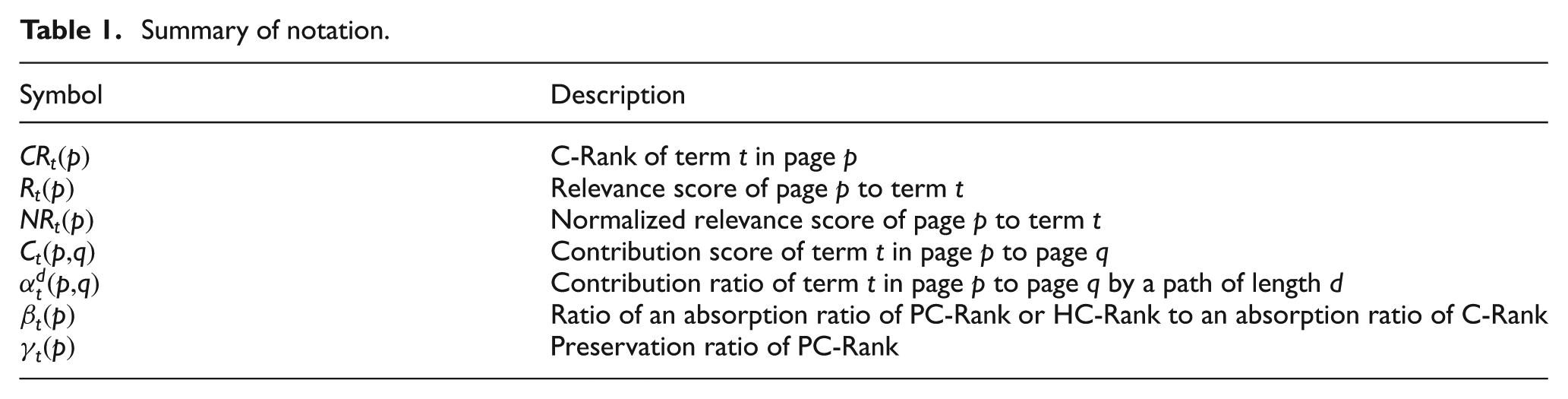
For the reader’s convenience, we summarize symbols mainly used in this paper in Table 1.
Summary of notation.
3.2.2. Probabilistic model: PC-Rank
The sum of all C-Ranks over all terms in all pages increases whenever a link is newly inserted. Accordingly, C-Rank cannot be explained by probability. To construct a probabilistic model satisfying the contribution constraints, we modify the basic model (C-Rank) into the probabilistic model (PC-Rank), adopting two strategies that keep the sum of all C-Ranks invariant.
Consider a page p, another page q that has a path to page p, and a set of the third pages to which page p has paths. The first strategy considers the sum of contribution scores to page q of both page p and the third pages. The goal of the first strategy is to keep the sum of contributions scores invariant for inserting/deleting a link to/from page p and the third pages. Equation (7) can be expressed as follows:

where

In the aspect of a score propagation method, equations (13) and (14) mean that page p absorbs the portion of
To show that equation (13) reflects the first strategy, let us consider a simple Web graph of
Compared with the first strategy that treats the contribution score of a page to other pages, the second strategy focuses on the contribution scores of the third pages to the page. According to the first strategy and equation (10), given a page p, the sum of contribution scores of the third pages to page p,

Based on the two strategies, C-Rank can be modified as below:

Keeping consistency with CRt(p) = Rt(p) for

where
3.2.3. Hybrid model: HC-Rank
The probabilistic model causes some loss of a relevance score so that the importance of a term in a page might be underestimated. To prevent such underestimation, we can think of the hybrid model (HC-Rank) which combines the basic and the probabilistic models as below:

where
The sum of all HC-Ranks increases whenever a link is added to a Web graph. However, according to the first strategy used in the probabilistic model, the sum of all contribution scores is bounded above by

where 0 ≤
3.3. Contributing terms
Consider two pages, p and q, connected as
The goal of a Web search engine is to provide a user with the most relevant pages to a query. Usually, both a Web page author and a Web search engine user expect a page that has the query terms as its keywords summarizing the page to be ranked high. They might not care about those pages that do not contain the query terms as their keywords. Therefore, we consider only the keywords of each page as candidate terms that can contribute to other pages and also safely ignore other non-keyword terms when computing contribution scores. According to this restriction and the contribution constraints, keyword t in page p contributes to page q only if (1) there is a path from page q to page p and (2) every page on the path contains keyword t as one of its keywords. In this paper, we call this path the contribution path of term t in page p.
3.4. C-Rank computation
Computations of C-Rank, PC-Rank and HC-Rank follow the same procedure. In this paper, we explain the procedure on C-Rank. The C-Rank of every term in every page is computed offline. Then, given a query Q possibly consisting of multiple terms, the C-Rank for page p under query Q is determined online by summing the pre-computed C-Ranks of all the query terms for page p as follows:
A C-Rank can be computed by score propagation. Consider three pages connected by links as
The C-Rank computation algorithm consists of three stages: initialization, iteration and finishing. In the initialization stage, first, the relevance scores of all the pages to each term are computed and C-Ranks of all terms in each page are initialized to zero. Second, a set of keywords of each page is determined according to the relevance scores. Finally, for each pair of page q and page p connected as
In the iteration stage, first, for each page q, the contribution score of every page p pointed to by page q, which is computed in the initialization stage, is transferred to page p. Consequently, every page receives its contribution score. Let the absorption ratio be the ratio of a contribution score accumulated into the final score to a received contribution score. The absorption ratios of keyword t of page p of C-Rank, PC-Rank and HC-Rank are 1 −
Now, we explain the finishing stage. Let the preservation ratio be the ratio of the portion of a relevance score added into the final score to a relevance score. For keyword t, the preservation ratios of C-Rank, PC-Rank and HC-Rank are
The above procedure does not show how to construct a path that consists of distinct pages. To construct the path, we attach a tag on each propagation score. The tag contains the path information through which the contribution score is propagated. Before a contribution score is propagated to another page, we check whether the insertion of the page to the path stored in the tag induces a cycle. If a cycle occurs, we shall not propagate the contribution score to the page.
3.5. Comparison of ranking measure
To clarify the difference between our approach and previous probabilistic models described in Section 2, we compare the ranking measures of our probabilistic model (PC-Rank) with the previous probabilistic models. As described in Section 3.4, a PC-Rank can be computed by score propagation. Let


where
To compare PC-Rank with PageRank, let us consider the special case that, in all the pages, all relevance scores are completely disregarded and all the received contribution scores are propagated to other pages without absorption. Then, in equation (20),

Equation (22) corresponds to the original concept of PageRank of equation (1). As described in Section 2, to overcome the problem of rank sinks, Page et al. [13] suggested the random surfer model of equation (2) containing the random jump component. However, the ranking measure of PC-Rank does not require the random jump.
To compute PageRank, equation (2) is repeated until the variances of scores of all the pages at each iteration step are under a given threshold. This means that the scores reach convergence. Meanwhile, the PC-Rank computation stops when newly received contribution scores are under a given threshold. In conclusion, the ranking measure of PageRank is the amount of current probability flow through each page when the probability flow through every page is in equilibrium, that is, the amount of probability flow is not changed further. However, the PC-Rank measure is the amount of absorption of each page from the probability flow until no probability flow occurs. C-Rank and HC-Rank are not probabilistic models, but these models use ranking measures similar to that of PC-Rank, except using different absorption ratios and preservation ratios.
Similar to probabilistic approaches based on the surfer model, relevance propagation models [17, 20, 21] use the amount of flow as the ranking measure even though these models propagate relevance scores of pages to a given query instead of an authority score and utilize both inlinks and outlinks. Unlike the previous surfer models, our approach does not have a random jump component and the amount of score flow is attenuated by the ratio of
3.6. Discussions
C-Rank and its variants have two practical advantages. First, our approach is robust against a cycle or a spam farm created by a spammer. The spammer tries to manipulate ranks of some Web pages by boosting their authority scores intentionally, using a weakness of previous approaches. The weakness is that most previous approaches allow the authority score of a Web page to be propagated to itself at least once when it is directly or indirectly connected to itself. However, our approach could avoid such boosting of the authority scores because it does not allow a Web page to contribute to itself. Also, when Web pages in a cycle or a spam farm are not related or less related to one another, our approach rarely propagates a relevance score of a Web page to the other Web pages in a cycle or a spam farm. Additionally, both a PC-Rank and an HC-Rank of a Web page become smaller as the Web page has more outlinks. That is, no matter how many outlinks a Web page has in a cycle or a spam farm, the Web page does not heighten its authority score. These properties of our approach can counteract the gains from a cycle or a spam farm.
Second, our approach can dynamically update ranks of Web pages. When some Web pages are newly added or removed, most previous approaches re-compute the ranks of all the pages in a Web graph. On the other hand, our approach needs to re-compute the ranks of only some Web pages associated to the updated (added or removed) Web pages rather than all ones. This is owing to the two properties of our approach: the cutoff path length and no random jump. The cutoff path length allows a Web page to contribute to other Web pages that are directly or indirectly connected by a path of length less than or equal to cutoff path length. In addition, since our approach does not perform the random jump, it requires the re-computations of ranks only for those Web pages whose path lengths to the updated one are less than or equal to the cutoff path length. Using those properties, we expect to develop a dynamic update mechanism to keep up-to-date ranks of all the Web pages effectively. We think that this dynamic update issue could be quite an interesting topic as the future work.
4. Experimental results
4.1. Experimental environment
For our experiments, we used the .GOV collection that is constructed with 1.25 million pages and 11.2 million links. As our query sets, we used two sets of topic distillation task topics in Web Track of TREC-2003 and TREC-2004 whose numbers of topics are 50 and 75, respectively.
Our experiments were conducted on the public search engine-Lucene. 1 The baseline accuracy was evaluated by pure relevance scores, provided in Lucene, of terms to a page containing all query terms. As performance measures, precision at 10 (P@10) and mean average precision (MAP) were used. The set of N keywords of a page is constructed with N terms that have the topmost relevance scores in the page.
4.2. Effectiveness evaluation
Precisions of C-Rank and its variants are affected by three factors: the weight value of
4.2.1. Precision depending on three factors
To describe the influence of the three factors on precision, we first show the experimental results conducted with C-Rank. Figure 1 shows C-Rank precisions with 10 keywords according to the cutoff path length 3, 5, 7 and 9. In almost all cases, the cutoff path length 3 gave the best results. As two pages are further apart, it is less likely that the two pages have a common topic. Therefore, it is reasonable to set the cutoff path length to a value between 3 and 5.

C-Rank precisions according to the cutoff path length with 10 keywords. L3, L5, L7 and L9 mean the cutoff path lengths 3, 5, 7 and 9, respectively.
Figure 2 shows C-Rank precisions of in P@10 and MAP with the cutoff path length 3 according to 10, 20, 30, 40, 50 and 60 keywords. Overall, P@10 with 10 keywords was better than the others. Meanwhile, for MAP, using 20 or 40 keywords generated better accuracies. From these results, we can infer two things: first, as more keywords are used, more relevant pages move upward in ranking; second, concurrently, non-relevant pages move upward and, consequently, P@10 decreases. The keywords of a page were chosen with those terms of the topmost relevance scores in the page. We do not think that the keywords currently used are the best terms summarizing the page. Therefore, we expect that the accuracies can be more improved if those keywords are carefully constructed by employing more sophisticated methods [35].

C-Rank precisions according to the number of keywords with the cutoff path length 3. K10, K20, K30, K40, K50 and K60 mean 10, 20, 30, 40, 50 and 60 keywords, respectively.
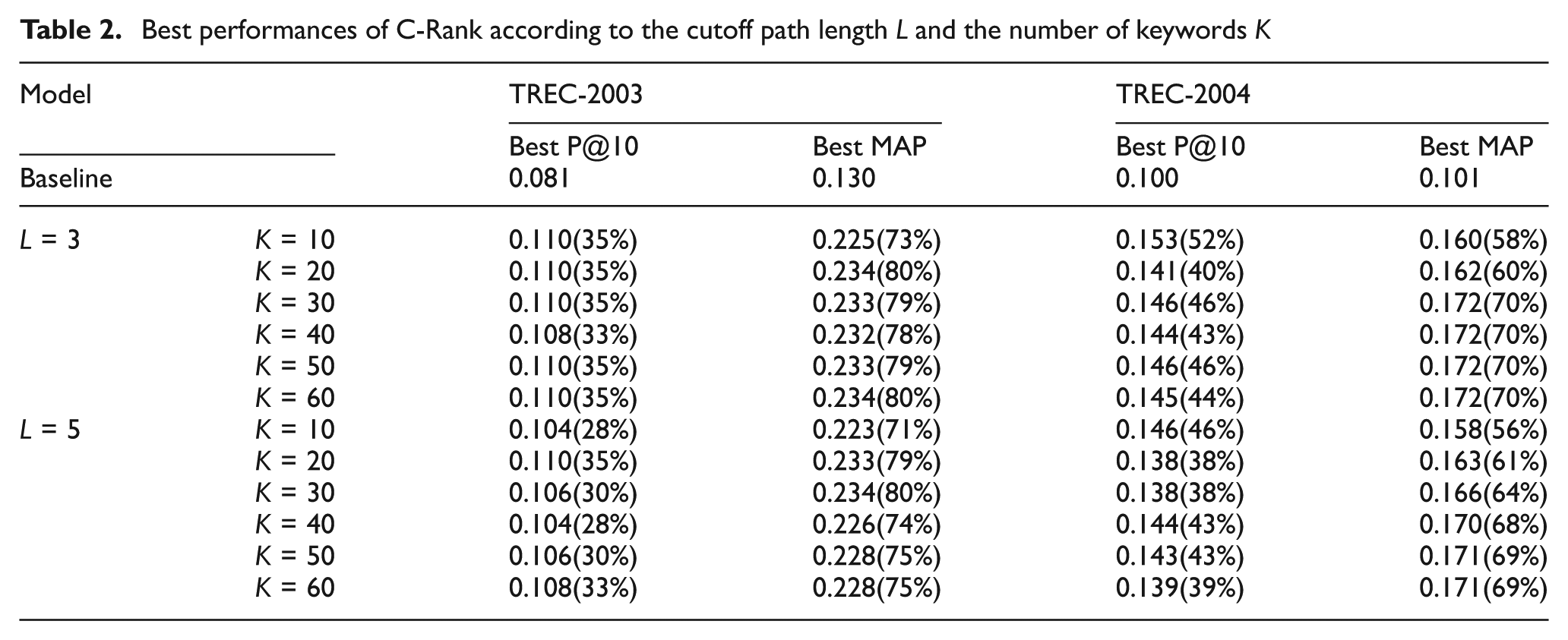
Behaviours of precisions for combinations of the number of keywords and the cutoff path length are analogous. We list in Table 2 the best MAP and P@10 in each combination. For example, P@10 = 0.110 in Table 2, which is for the case of 10 keywords and cutoff path length 3 in TREC-2003 dataset, indicates the maximum value of P@10 for L3 in Figure 1(a) where the value of λ is set as 0.8. The number in parentheses shows the percentage improvement over the baseline. We observe that C-Rank greatly improves the effectiveness compared with the baseline. As the cutoff path length or the number of keywords becomes larger, more computation time is required. Therefore, we recommend the combinations of the cutoff path length set to 3–5 and the number of keywords set to 10–30 to apply C-Rank to real-world search engines.
Best performances of C-Rank according to the cutoff path length L and the number of keywords K
4.2.2. Comparison of C-Rank, PC-Rank and HC-Rank
To compare C-Rank and its variants, we conducted experiments on .GOV with 10 keywords and the cutoff path length 3. Figure 3 shows that C-Rank gave the best results both on TREC-2003 and TREC-2004. Meanwhile, PC-Rank was the worst. This result coincides with those in other studies discovering that un-normalized scores often work better than normalized ones [39–41]. We conjecture that this is caused by the preservation ratio

Precision comparison among C-Rank and its variants with 10 keywords and the cutoff path length 3.
4.2.3. Precision decrease by cycles
A contribution score might be overestimated if we admit a term in a page to contribute to the page multiple times through a cycle. Figure 4 shows the dependency of precisions on cycles. Even though a cycle is admitted, the C-Rank precision does not go down below the baseline precision. However, the decrease in precision is significant.

Precision comparison of cycle-break and cycle-admission with 10 keywords and the cutoff path length 3 or 5 on C-Rank. NC and C mean cycle-break and cycle-admission, respectively.
The computational cost for cycle-break is highly dependent on the cutoff path length. However, we should note that, according to our experimental results, using the cutoff path length 3–5 provides good precisions. Therefore, a cycle-break operation is applicable to real-world search engines with this small cutoff path length.
4.2.4. Precision comparison with previous models
Relevance propagation models have been most effective among previous models exploiting link and content information [6, 17, 21]. However, the models require too much computation time, at querying time, to be applied to real-world search engines [6]. To show that C-Rank is effective, we compare C-Rank with relevance propagation models in terms of effectiveness.
Figure 5 shows that the results of C-Rank with 10 keywords are the best or close to the best on each set of topics in both P@10 and MAP. In particular, the results of C-Rank are very dominant in MAP on TREC-2003. Meanwhile, the results of WIO were the best on both TREC-2003 in P@10 and TREC-2004 in MAP and close to the best on TREC-2004 in P@10. The results of HT-WI were not bad, but it did not generate the best results. HT-WO gave results that were worse than others. From those results, we can observe that C-Rank and WIO are comparable to each other in effectiveness.
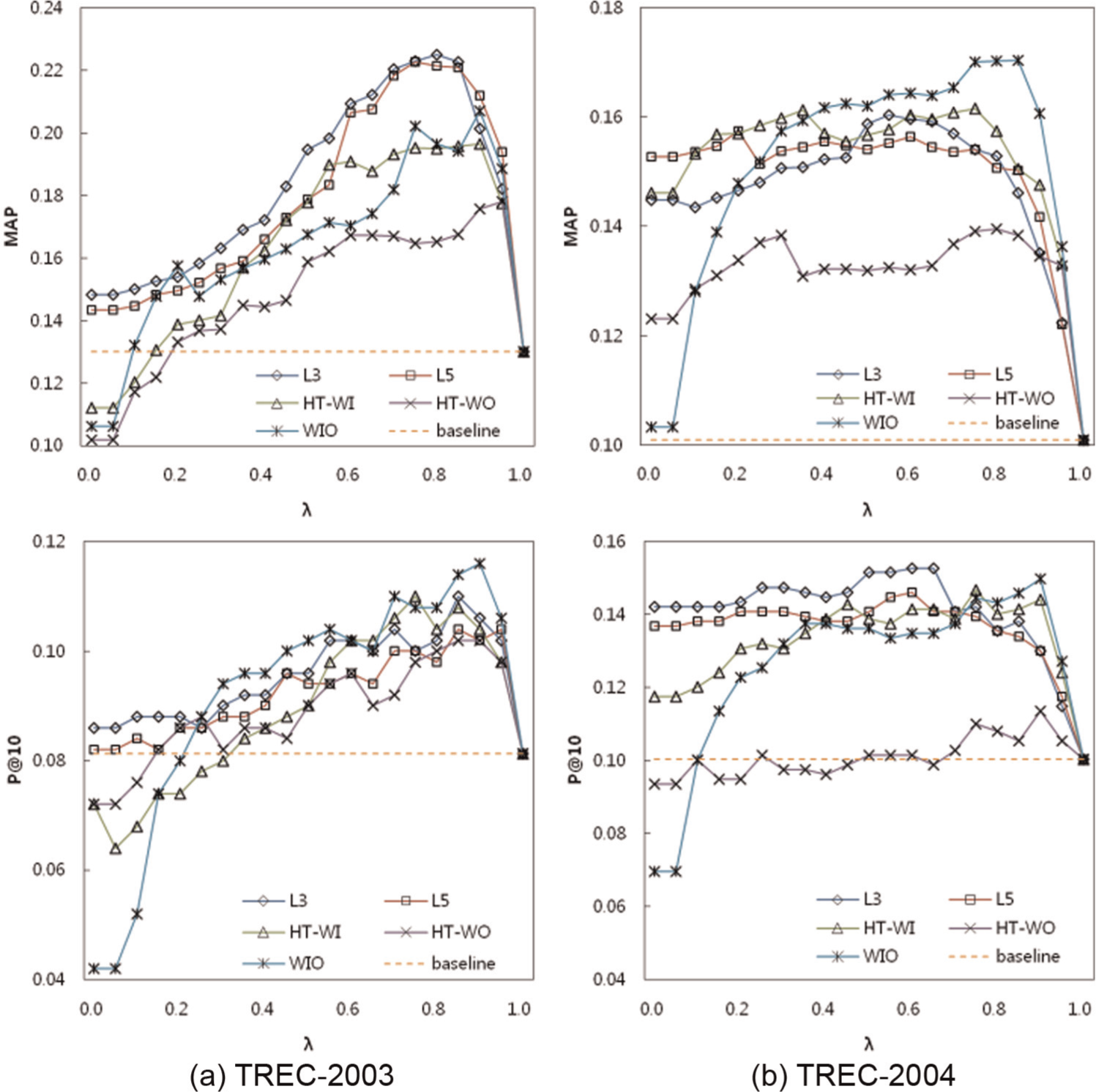
Performance comparison of C-Rank and relevance propagation models.
Finally, we compare C-Rank results with official runs submitted to TREC [34, 35]. Table 3 shows the three best precisions among both official runs and C-Rank results obtained from Table 2. In MAP on TREC-2003, C-Rank results greatly overwhelm the three best official runs. Both in MAP on TREC-2004 and P@10 on TREC-2003, C-Rank results are close to the three best official runs. Meanwhile, in MAP on TREC-2004, C-Rank results are worse than the three best official runs. Official TREC runs utilized a variety of extra features such as url types, anchor texts, a page structure and so on. However, in this paper, we did not employ those features to focus on combining links and content. Therefore, we expect the effectiveness of C-Rank to be much improved if the above features are exploited in C-Rank.
Best performances comparison

4.3. Efficiency evaluation
To be used in real-world search engines, efficiency is another important factor besides effectiveness. In this section, we investigate efficiencies of C-Rank, HT-WI, and WIO in two aspects of computation: online and offline.
The C-Rank of every term in each page is computed offline. Therefore, given a query, C-Rank spends the same time as the baseline method using only a relevance score. Consequently, C-Rank requires no additional online time consumption for exploiting link and content information. Meanwhile, relevance propagation models require a lot of extra time online for constructing a working set of pages relevant to a given query and propagating a relevance score or a term frequency to the relevant pages. To measure efficiency, we logged a time usage on 1.6 GHz CPU and 8 GB memory.
Table 4 shows average time usages of C-Rank, HT-WI and WIO for computing one term score, excluding I/O access time and score sorting time, which are identical over all models. As an advantage to the relevance propagation models, the number of iterations for propagating a relevance score or a term frequency is restricted below 10. That is, if the number of iterations becomes 10, the models stop even though relevance scores do not reach convergence. Additionally, we assume all pages in a working set are located in the same server to ignore the data transfer time among servers for propagating relevance scores or term frequencies. As a set of test queries, 50 terms in TREC-2003 and TREC-2004, were chosen at random. The zero average time usage for C-Rank in Table 4 indicates that C-Rank does nothing besides I/O access and score sorting. HT-WI and WIO spent 5.92 and 18.16 s per term on average, respectively. It is obvious that C-Rank is more efficient than HT-WI and WIO in online computation. Also, the results show that the relevance propagation models are rarely feasible for application in real-world search engines.
Online average computation time per a term

The offline computation time of C-Rank depends on the number of keywords and the cutoff path length, assuming that all the relevance scores of pages to each term are pre-computed. As shown in Figure 1, the cutoff path length 3 gave best results. Therefore, we measured offline time usage in computing C-Rank according to the number of keywords with the cutoff path length 3 on the .GOV collection. From Table 5, we conclude that C-Rank is efficient enough to be applied to real-world search engines.
Offline computation time of C-Rank with the cutoff path length 3

Compared with the baseline method, the relevance propagation models require heavy online computation, but they do no additional offline computation. One might think about the way of pre-executing such online computation. However, a query can consist of multiple terms so that the number of candidate queries becomes almost infinite. Therefore, it is impossible for the relevance propagation models to build rankings of pages offline under all candidate queries.
5. Conclusions
In this paper, we proposed the contribution-based ranking approach exploiting link and content information with efficiency high enough to be applicable to real-world search engines: C-Rank, PC-Rank and HC-Rank. Based on the viewpoint of a Web page author, we suggested the contribution constraints, and then formulated the contribution score of a term in a page satisfying them.
Our approach, to the best of our knowledge, is the first to adopt the viewpoint of a Web page author. As a result of moving a viewpoint from a Web surfer to a Web page author, a contrived modification such as a random jump used in random surfer models is not required. A Web page author creates his/her Web page without considering all the Web pages in the Internet. Thus, newly created Web pages affect the scores of only these pages associated with their links rather than all the pages in the Internet. Therefore, we claim that our approach reflects the real-world Web environment better than random surfer models.
To clarify the difference between our approach and previous probabilistic models such as random surfer models, we compared the ranking measures of PC-Rank with PageRank. The ranking measure of probabilistic approaches based on the surfer model is the amount of authority scores currently flowing into a page at the time all the pages reach an equilibrium state. Our ranking measure corresponds to the amount of authority scores absorbed by a page until there is no flow of an authority score through the page. If insertion/deletion of a page into/from a real-world Web graph occurs, probabilistic models should update the scores of all the pages while our approach updates the scores of only the pages near the page inserted/deleted.
To improve efficiency without loss of effectiveness, we utilize the expectations of both a Web page author and a Web search engine user on retrieval results simultaneously, and restrict candidate terms that can contribute to other pages to a small number of keywords of each page. C-Rank, PC-Rank and HC-Rank are computed by combining the contribution score of a term in a page and the relevance score of the page to the term. The computations for every term in every page are done offline so that the computational cost at querying time is the same as the cost of the models using only relevance scores.
Compared with relevance propagation models that construct a working set at querying time in order to simultaneously exploit link and content information, our approach utilizes the expectations of both a Web page author and a Web search engine user. As a result, no additional cost is required at querying time. This means that our approach clearly solves the performance problem of relevance propagation models while maintaining the merits of exploiting link and content information simultaneously.
To show the effectiveness and efficiency of our approach, we conducted extensive experiments on the .GOV collection with two sets of topic distillation task topics. Experimental results show that C-Rank gives the best precisions among the proposed models. For effectiveness, C-Rank with 10 keywords and the cutoff path length 3 performed the best or was very close to the best compared with the relevance propagation models in both P@10 and MAP. From these results, we understand that our basic concepts of focusing on keywords and adopting the scores of only the pages associated by links are effective. For efficiency, the experimental results show that our approach is very efficient, but the relevance propagation models comparable to C-Rank in terms of effectiveness can rarely be applied to real-world search engines owing to their lack of efficiency. From our results, we conclude that the proposed contribution-based ranking approach is quite effective and also efficient enough to be applicable to real-world search engines.
There are several interesting directions for future works. First, our approach does not differentiate Intranet from Internet. Meanwhile, the previous works [17, 22] show that a site-map based model is effective in a topic distillation task for finding homepages. We think it is worthwhile to employ site-map information in our approach. Second, in this paper, we extracted the keywords of a page in a naive way of selecting those terms having the topmost relevance scores to the page. However, we do not think that these keywords are the best terms summarizing the page. We expect that the effectiveness of C-Rank can be much more improved if keywords are chosen with more sophisticated techniques [42]. Third, treating the relation between synonyms such as ‘car’ and ‘automobile’ for a contribution score might be helpful in improving the effectiveness. Fourth, our experimental results show that it is enough to consider relations among pages that are close to one another. It means that it is possible to insert/delete a page into/from a Web graph without re-calculating scores of all pages. In a real Web environment, many pages are daily generated and deleted. Therefore, it is very worthwhile to develop a method that dynamically updates the scores of only the pages associated with inserted/deleted pages.
Footnotes
Acknowledgements
This research was supported by the Information Technology Research Center support program (NIPA-2014-H0301-14-1022) supervised by the National IT Industry Promotion Agency, a National Research Foundation of Korea grant funded by the Korea government (MEST; no. 2011-0029181), and Semiconductor Industry Collaborative Project between Hanyang University and Samsung Electronics.