



Abstract
An increasing number of companies use social media such as micro blogs to promote celebrities in Internet communities. Companies may run their official micro blogs differently, which in turn leads to different public engagements on micro blogging sites. This study takes a perspective on the adoption behaviours of micro blogs in enterprises by looking at the relationship between media frame and audience frame based on the China Fortune 500 firms in 2014. The results show that the updates, active days and followings are associated with public engagement with the corporate official micro blogs. In particular, we found information overload from information updates. The marginal utility of the public engagement decreases as number of updates increases. The results also show that the daily variance of updates has a significant influence on the audience frame.
Keywords
1. Introduction and background
Nowadays, social media has become an important factor in our lives, influencing the manner with which we communicate with each other [1] and the speed of news reporting in a trendier and more digital manner [2]. The emergence of social media such as Facebook, Twitter and micro blogs provides easier social interaction and information dissemination to individuals [3]. In addition to individuals, an increasing number of enterprises have followed this trend, participating in marketing campaigns that use social media in an attempt to engage consumers in online communication [4]. In China, micro blogging is more popular than any other kind of social media, such as Facebook and Twitter, because of the media control regulations in the country. By the end of 2013, 20.9% of the listed Chinese firms were conducting marketing activities on the Web, and the micro blog utilization rate reached 20.7% [5]. Micro blogs have positive effects on a firm’s value, such as attracting more potential consumers, improving brand awareness and enhancing marketing promotions and brand loyalty when the public engage with the firm [6–10].
It is vital to understand the effects of the different corporate social media adoption behaviours on public engagement, which is the question we raise in this article. To address this question, we consider that differences in corporate micro blog adoption in terms of active days, followings and updates will affect public engagement, which in turn will influence corporate business value.
The rest of the paper is organized as follows. Section 2 reviews some theories and proposes four hypotheses. The methodology and data are presented in Section 3. Section 4 describes the data analysis and determinants of corporate decisions in improving the public engagement of companies through the construction and operation of their official micro blogs. Finally, the conclusions and implications are listed.
2. Theory and hypotheses development
2.1. Related work on public engagement on official social media pages of organizations
The works most closely related to ours [4, 11–13] investigate the public engagement on official social media home pages of organizations. Dijkmans et al. [4] provided empirical evidence of positive effects of public engagement through social media on perceived corporate authenticity, organizational transparency, organization-public relationships, and public advocacy. Ashley and Tuten [11] measured consumers’ engagement in an airline’s social media activities and suggested that the intensity of social media activities was positively related to consumers’ engagement in the airline’s social media activities and engagement, which in turn contributed to corporate reputation. In addition, Bonsón et al. [12] also determined the importance of frequent updates and incentives for public participation on branded social content and that creative strategies, including experiential, image and exclusivity messages, are associated with customer engagement in the social media activities. Some concrete comments or implications advocated by practitioners and academics could benefit citizen engagement on the Facebook pages of government institutions [13].
Most prior studies have investigated the use of social media by the government [12, 14–16] or other non-profit organizations [17–21] for political engagement or engagement of public events. In recent years, scholars have begun to pay attention to engagement with business entities’ social media pages, especially in specific industries such as the tourism industry [4] and the pizza industry [22]. However, most of the present studies focused on the effect of the content types of updates on public engagement with social media pages or specific activities proposed by these entities. A very limited number of studies have been conducted on the effect of social media adoption behaviours on public engagement with social media pages that use a large number of firms from different industry sectors as samples.
2.2. Conceptual framework based on information framing effect
The conceptual framework for the determinants of public engagement is based on the information-framing effect. Frames have to be considered schemes for both presenting and comprehending news. Two concepts of framing can be specified: the media frame and the individual frame [23]. ‘Media frame’ refers to a central organizing idea or storyline that provides meaning to an unfolding strip of events [24], which also can be used as a working routine of news publishers to enable packaging of news that can be efficiently relayed to the audiences [25]. ‘Individual frame’ refers to ‘mentally stored clusters of ideas that guide individuals’ processing of information’ [26]. The individual frame has been defined conceptually as a cognitive device that ‘operate as non-hierarchical categories that serve as forms of major headings into which any future news content can be filed’ [27]. The process performed from media frame to audience frame can be referred to as frame setting [23]. Pan and Kosicki [28] and Entman [26] conceptually predicted a link between media and audience frames. However, no empirical analyses have been performed on this topic. When the audience frame was used as dependent variable, it was usually evaluated as a direct result of a given specific media frame [29, 30].
Most studies on the effect of information framing have focused on the frames in the news, including issue-specific and generic frames [31]. Previous studies have investigated the relationship between framed information in terms of loss or gain and participation in various activities [32–36]. Framed information in a risky situation has also attracted the interest of a number of scholars [37–42]. However, few studies have focused on the effects of information packaging way on the framing effect. Few papers have pointed out the importance of the method of information dissemination over content. Bertele et al. [43] examined the different levels of effectiveness of analytical framing, narrative framing and tropes on public attitude and behavioural intent for the various new services and the findings indicate that alternative framing strategies had an impact on consumer responses. The limited availability of studies on the subject demonstrates that the effect of corporate social media adoption behaviours on public engagement is an interesting research topic. Therefore, we decided to extend these studies to China Fortune 500 firms in 2014 and their public engagement in social media.
With the development of social media, an increasing number of firms have begun to adopt the micro blogs to release promotional information because of the low cost and unparalleled convenience. The extent of micro blog adoption in enterprises can be measured in different ways. Using several information dissemination theories, we elicited that corporate social media adoption behaviours could contain the number of updates, daily variance of updates, number of followings, active days and establishment of corporate matrix. Considering the existence of information overload, we tested the relationship between the number of updates and public engagement to determine the threshold of audiences’s information capacity for corporate social media information and guide firms in releasing the information effectively while avoiding unnecessary waste. Given the constant emphasis on the importance of interactivity in corporate communication strategies, we examined the effect of followings (users that the company links with to construct two-way communication channels) on public engagement. In addition, considering the information memory manipulation model, we argued that active days and daily variance of updates, which represent the frequency and stability of corporate social media communication strategies respectively, would affect the degree of public engagement on official corporate social media pages. Differences in the preferences and perspectives of individuals would result in differences in public engagement because of the various communication strategies targeting specific audiences. The audience frame can also be represented by the records of likes, shares and comments, which represent the three different engagement tools for the public to engage with organizational messages offered by social media; these tools appear at the bottom of the content and show the frame effect directly [17]. The relationship between information propagation and user-supplied comments has been tested sufficiently [44, 45], and a set of public engagement measures [46] can be subjective or objective. In this paper, principal component analysis (PCA) is performed on the likes, shares and comments, and the final score of PCA is used to represent the degree of public engagement in corporate official micro blogs. The PCA is used because it can reassemble the numerous indicators that have certain relevance to a new set of comprehensive index but have nothing to do each other, through which the variables could be simplified. Additionally, we also control for the number of followers, location of the firm, assets, profit and shareholders.
2.3. Information overload and public engagement
The notion of information overload was first proposed by Miller [47]. He concluded that human information processing performance increased linearly with increasing information input up to a threshold point, which was also pointed out by later scholars, such as Streufert and Driver [48] and Schroder et al. [49] in 1967. Information overload means that the volume of information released has exceeded the limitations of human information-processing capacity [50, 51], which is usually taken to represent a state of affairs where an individual’s efficiency in using information in their work is limited by the large amount of relevant, and potentially usefully, information available to them [52]. Managerial information overload is characterized by the features including high information load and decision situation, pressure to receive information and limited processing capacity, which leads to the resulting stress and suboptimal or dysfunctional decision behaviour [53].
With the exponential expansion of news publication, particularly computer-mediated communication systems, were constructed, information overload was generally accepted as a problem [52]. A study of consumer information overload concluded that customers make poorer decisions when given too much information [50, 51]. For managers, although a reduction in efficiency may occur as the level of information increases, the satisfaction attained with the decision made actually decreases [54]. Even worse, information overload will cause information anxiety [55]. A rather similar condition is library anxiety, which results in a sense of powerlessness and the feeling of being lost [56].
In recent years, a number of scholars have begun to pay close attention to the phenomenon of social media information overload. The common theme of the studies that are most similar to ours is to test the existence of the limitation of social ties and communication capacity [57–59]. Psychologists have also connected text messaging and instant messaging with social anxiety [60]. As their own news publishers on the enterprise micro blog platform, they possess sufficient randomness to release the information, and their followers will unconsciously become information receivers. The openness, convenience and virtual nature of social media will also result in information flooding [61]. Public engagement reflects information efficiency and audience satisfaction. Therefore, we hypothesize that the following:
2.4. Two-way symmetrical communication and public engagement
Many previous studies have examined the influence of social media on public relations [62, 63]. The development of social media has given organizations vigour to communicate effectively with a variety of internal and external stakeholders [63]. Micro blogs provide the function of following for the users. When the firms release messages, they can receive messages issued by those following at the same time. Hence, firms are not only the news providers but also news recipients, which forms the important process of two-way communication where the publishers and recipients can exchange positions. Two-way symmetry communication has the advantage of building quality relationships between an organization and its public [64]. According to the study by Cho et al. [17], the public is more likely to comment on organizational two-way symmetry-based messaging strategies. A number of studies have confirmed the value of two-way symmetry communication for building quality relationships between an organization and its public [64, 65]. Claeys and Cauberghe [42] analysed 355 brand posts from 11 international brands and found that higher degrees of interactivity generated more likes and comments. As the news publishers of their own official micro blog platform, they have their autonomous promotional and marketing activities. If the news concerns others, then they may agree to disseminate the information on the micro blogging platform, which is a special feature of micro blogging platforms in other information channels. Micro blogging platforms emphasize equality and symmetry relationships among the users. When two-way communication is achieved, the public as the equally symmetrical body may receive the feedback, which can result in a sense of equality and participation. It also can increase self-confidence and a sense of responsibility. These developments can facilitate firms and the public in building interaction and trust.
2.5. Recency of updating and public engagement
Social media appears to have been designed to satisfy the need for immediate information [66], which is consistent with the opinion of Levinson [67] that a social media characteristic is providing information in real time. Therefore, an important issue that needs to be addressed is the effect of recency of updating on public engagement in corporate social media pages. According to present studies, individuals are significantly influenced by the end effect because the end is more highly accessible than the start, and this phenomenon can be called the recency effect [68]. Many later studies have confirmed that the end is given more weight than the start in the frame of sequences [69 –71] and that people represent items according to their position in a multidimensional space [72]. Fogg and Tseng [73] examined the relationship between recency of updating and information credibility and found that updating more frequently was associated with higher credibility. If companies update their information constantly on social media, the followers can receive relevant information on the enterprises more frequently because they can maintain their top position in social media, which shifts older updates further down. Advertising research also emphasizes the position of information advertising on a website had a positive effect on audience attention [74, 75]. Recent studies have also shown that information ads at the top of a social media page can attract more clicks [76] because prior exposure facilitates noticing of information ads [77]. When companies create new updates frequently, these become more noticeable and can receive more attention than old ones shifted by fresh updates. Therefore, we propose that actively releasing information daily is beneficial for public engagement with corporate social media accounts.
2.6. Targeting of information advertising and public engagement
Previously, the purpose of corporate advertising strategy has been to decrease the extent to which advertising information reaches consumers beyond the use scope of products [78]. Hence, an increasing number of companies implement targeted advertising to specific consumer segments within a product category [79]. The need for a better target is relevant in modern markets, particularly when considering the fragmentation of existing media and various new social medias [79]. When at least one person receives the right information at the right time and in the right context, companies have achieved effective advertising [80]. Advertising presents the same offerings for everyone but is unable to meet the current requirements of businesses because of the increasing differences in individual preferences. Before the concept of targeted advertising, a significant number of studies focused on differences in marketing. Shaffer and Zhang [81] examined targeted coupon promotions. Thisse and Vives [82] studied the effects of directed product changes, and Iyer and Soberman [83] tested the effects of these changes. Later theoretical literature on marketing began to emphasize the targeting of informative advertising [79], and several scholars have begun to add empirical evidence on the targeting of information ads, which can increase audience and customer welfare [84, 85]. A considerable number of patents appear to have accomplished the targeting of information advertising [86–88].
In particular, Kotler [89] announced a new trend in marketing communications in his world tour lecture forum, that of precision marketing, which included precision communication as the most important part. In his opinion, companies need more precise and measurable marketing communications that can gain a higher return on investment. They need more result- and action-oriented marketing communication plans and should focus increasingly on direct sales communication investments. In the theory of precise marketing, the changing technology will provide companies with the courage to shift from the traditional college media to more targeted interaction communication model in the target market to improve the effectiveness and efficiency of communication. Jansen et al. [90] suggested that organizations should use multiple social media accounts for different purposes. The corporate matrix is a systemic marketing approach based on the micro blogging platform and refers to a plan for establishing related companies and brands into a micro blog account group and building a community of the presence of the brand from different perspectives to achieve cross-coverage of the target audience. On the surface, the various sub-micro blogs were built according to the products, brands, and features such as different positioning needs. In essence, their greater goal is to cover accurately and effectively various user groups for the merchant through different accounts and through the distribution points and wiring, being the surface, detonating and monitoring to achieve the maximum effect of marketing.
3. Data and methodology
3.1. Sample
According to the iResearch’s report on 30 March 2011, the SINA micro blog, which was launched by the largest portal of the SINA network in August 2009, had taken a commanding lead over its competitors, with 56.5% of China’s micro blog market based on active users and 86.8% based on browsing time [91]. Similar to Twitter’s verified accounts that allow verification of the identity of a famous person, organization and other entities, an identification policy is implemented by SINA. Once a user is verified on the Internet, a colourful V is added behind his user name. An orange V is provided for people, whereas a blue one is given for organizations. In addition, a graph and declaration on the user page show the verification. Several kinds of verification exist: personal verification, college verification, organization verification, verification for official accounts (accounts of government departments, social media platforms and famous companies) and micro blog masters (people behind the accounts with their phone numbers and their followers).
The SINA micro blog enterprise edition is a tailor-made service platform for enterprises and institutions. This edition has more personalized settings of page display, more accurate analysis of data services and more efficient communication management mechanism, which can help enterprises communicate with their target users, improve the conversion of marketing effect and seek more business opportunities. All certified enterprises can be found in the micro blog brand (http://verified.e.weibo.com/brand/). When enterprises set up their own official micro blog, they can also create a corporate matrix on their own home page, which is composed of multiple, related micro blog links, such as their subsidiaries, functional departments or brands.
We drew our sample from 354 firms of the top 500 listed companies in China (where size is measured in terms of revenue in 2014). Not all data for all involved Chinese companies are available because most companies do not release their financial data to the public, with the exception of listed companies in China. Therefore, we based our sample on the listed companies in the Shanghai Stock Exchange (http://www.sse.com.cn) and the Shenzhen Stock Exchange (http://www.szse.cn) of China. Both stock exchanges operate independently in China, funded by People’s Bank of China. The management and trading system of the Shanghai Stock Exchange is almost identical to that of the Shenzhen Stock Exchange. The critical difference between them is that the Shanghai Stock Exchange focus on medium- or large-scale enterprises, whereas the Shenzhen Stock Exchange emphasizes small and medium-sized companies. A total of 354 of the top 500 listed companies could be found in the two stock exchanges in 2014.
Among the 500 listed companies, 167 have their official micro blogs in the SINA brand pavilion. Among the 167 companies, 112 are listed on the Shanghai and Shenzhen Stock Markets. Annual financial data for 2013 were collected from the RESSET database (http://www.resset.cn). The RESSET database published by RESSET Ltd is the only standard database integrated with the world’s leading professionals that provide support for empirical research and model testing.
To acquire micro blog data, we first studied the SINA brand pavilion to obtain the addresses of the official micro blogs and then searched through the micro blog pages to determine the multiple account addresses included in the corporate matrix. Second, we used self-programming to fetch the micro blog’s home page on the number of active days, the number of followers, the number of followings, the number of updates and the number of likes, shares and comments of every message from 1 January 2013 to 10 October 2014. The software was programmed using VB language. We initially confirmed the indicators needed on the SINA micro blog and then imported the addresses of the official corporate micro blogs into the system. When the software operated, it could flip the pages automatically and place the target data into a final Excel worksheet. Precision is ensured because the process is operated by a machine, and we could obtain data simultaneously because of its fast speed. We obtained 279,880 observations on the SINA micro blog. With the collection of corporate financial data, industry information and regional information, this paper has a total of 289,552 observations.
3.2. Variables
3.2.1. Dependent variable-engagement score
Two broad types of public engagement measures exist: subjective measures and objective measures [92]. Likes, shares and comments are made on behalf of the different levels of public engagement to the official micro blogs of firms, from low to high [17]. Cho et al. [17] proved that the highest level of public engagement was significantly different from the four public relations model proposed by Grunig and Hunt [93], which implied that public engagement would be represented by an aggregate variable. Considering the advantages of PCA in the treatment of multiple variables, we used positive and negative scores returned by the PCA to compute the degree of public engagement. With the technical support of SPSS 16.0, PCA was adopted to analyse three factors, namely likes, shares and comments, which appear at the bottom of the content. We perform standardized treatment because of the relatively large difference in the indicators. We performed the logarithmic treatment and correlation coefficient matrix as shown in Table 1. After the indicators were standardized, the correlation coefficient matrix showed that the correlation coefficient between the likes and shares was 0.336; the correlation coefficient between shares and the comments was 0.397; and the correlation coefficient between the shares and comments was 0.972. All coefficients obtained were strongly and positively significant.
Correlation coefficient matrix of engagement indicators.

p < 0.01.
We then computed the eigenvalues of likes, shares and comments and the principal component contribution rates (as shown in Table 2). The first, second and third characteristic values for the main component were 2.197, 0.778 and 0.026, respectively. Only the characteristic value of the first main component was larger than 1.000. Simultaneously, its contribution rate was up to 73.228%, indicating that the first principal component already contained all the information of the above three indicators. Hence, the component can be used to describe the degree of public engagement with official enterprise micro blogs.
Principal component eigenvalues and the contribution rate.

We then performed the load value calculation for the first principal components, and obtained the first principal component loads on x 1, x 2 and x 3 as 0.589, 0.953 and 0.970, respectively. For the first principal component, the feature vectors on x 1, x 2 and x 3 were 0.397, 0.643 and 0.654, respectively, for the first principal component.
Based on the main components of the load size, the indicators were closely related to the first principal component. According to the principal component feature vectors derived from the linear relationship between indicators and the principal component y 1, the following can be obtained:

We then followed the principal component
3.2.2. Independent and control variables
An active user is considered as retained for the given week if he or she reposts at least once in the following X weeks. The calculation rules and rewards of the active days of SINA micro blog users are shown in Table 3. Followings refer to the number of users following other users. Updates refer to the number of micro blog articles from 1 January 2013 to 10 October 2014. Corporate matrix refers to whether a company establishes a corporate matrix on their official micro blog. If a company establishes a corporate matrix on its home page, then common border is 1; otherwise, it is 0. The variance of updates refers to the discrete degree of the mean value of the updates on each official enterprise micro blog. Daily variance of the updates refers to the fluctuation extent of daily updates of each firm.
Calculation rules and rewards of SINA micro blog active days.

We controlled for public connection, which is the key factor in determining marketing strategies. If a company belongs to the service industry, then it will connect with the public directly and will require tools to communicate with consumers effectively. If a company belongs to the service industry, then the common border is 1; otherwise, it is 0. Given the different degrees of economic development, we also controlled for the potential effects of having a significant location in the region. If a company belongs to the Eastern city, then the common border is 1; otherwise, it is 0. Nationally, compared with the level of development in Western cities, Eastern cities have a higher level of development and more opportunities to access new technologies and utilize new technological tools. In accordance with literature on marketing strategies, we also controlled for the variables of profit, state-owned, assets and stakeholders. The relevant data on these variables in 2013 were collected from the RESSET database.
4. Results and discussion
4.1. Information overload and public engagement
Descriptive statistics and bivariate correlations between all measures are reported in Table 4. Table 5 reports the linear regression results of the frame-setting process. Models 1 and 2 in Table 5 show that the updates were positive and strongly and significantly correlated with public engagement. The variance of the updates is significant but negatively correlated with public engagement, indicating that the degree of dispersion between the number of updates and the mean value has a negative relationship with public engagement. A greater variance in the updates shows a lower degree of involvement by the public. When the number of updates is smaller than the mean value, the firm will have fewer people to engage in its official micro blog because the firm provides fewer opportunities for the public to communicate with it. However, when a firm releases too many updates, the degree of public engagement will also decrease because efficiency will fall rapidly when it reaches a maximum point [94]. This finding is contrary to the results in Table 4. The number of updates is simply positively related to public engagement.
Descriptive statistics and bivariate correlations.

n = 112.
p < 0.05 and **p < 0.01.
Linear regressions of public engagement.

N = 112.
p < 0.10, **p < 0.05 and ***p < 0.01.
Given the very small coefficients of the updates in the linear regressions, we ran curve estimation on SPSS to explore further the relationship between the number of updates and public engagement. Comparing the linear model (R 2 = 0.465, F = 181.688), logarithmic model (R 2 = 0.621, F = 179.953), inverse model (R 2 = 0.207, F = 28.723), quadratic term model (R 2 = 0.642,F= 97.845), cubic model (R 2= 0.660,F= 69.746), compound model (R 2 = 0.420, F = 79.747), S curve model (R 2 = 0.238, F = 34.446), exponential distribution model (R 2 = 0.420, F = 79.747), growth model (R 2 = 0.420, F = 79.747) and logistic model (R 2 = 0.420, F = 79.747), we found that the power model (R 2 = 0.623, F = 181.688) fit the curve best. The effect of curve fitting is shown in Figure 1, and is modelled as the following:


Curve fitting of updates and public engagement.
where y is equal to the degree of the public engaging into enterprise official micro blogs, and x is the number of the updates from 1 January 2013 to 10 October 2014 for a focal firm.
The F-test statistic is 181.688 (R 2 = 0.623). After calculating the slope of this function, we obtained the equation expression of y = 0.294x (−0.795). However, the mean value of the number of updates was 1797. When the number of updates was larger than 1797, the slope moved infinitely closer to 0, that is, when the number of updates was significantly larger than the mean value, the marginal benefit of public engagement diminished, illustrating the limitations of the individual information capability resulting in knowledge redundancy [95] and additional information causing dysfunctional effects. Hence, Hypothesis 1 is verified.
4.2. Two-way communication and public engagement
Using the results of Table 4, we find that relationship between public engagement and followings is weakly positive, which is contrary to the results in Table 5, which indicate no significant correlation between them in three linear regression models. Java et al. [96] found that the number of followings has a direct relationship with followers. Combining this finding with the results in our study that the number of followers has a significant relationship with public engagement, we presume that the number of followers plays an intermediary role between the relationship of the number of followings and public engagement. Afterwards, we follow the SPSS method to test this hypothetical mediating effect. First, we test the role of the number of followings in public engagement, which can be referred by:

where Y is the dependent variable for public engagement and X is the number of followings, which is a cumulative value on the home page of the official enterprise micro blogs.
We performed a regression test for coefficient c and obtained c = 0.001 (SE = 0.000l, significance = 0.028). Hence, coefficient c is clearly significant. Second, we performed a regression test between the number of followings and followers, which can be represented by the following equation:

where M is the number of followers and X is the independent variable of followings. The result showed that coefficient a = −4.679 (SE = 308.653,significance = 0.988). The coefficient a is not significant, and thus, the Sobel test may be required. In the checking whether the Sobel test is appropriate, we should determine the relationship between followers and public engagement, that is, test whether the coefficient of the following equation is significant:

The result shows that coefficient b = 0.461×〖10〗−7 (SE = 0.000, significance = 0.000). The result meets the condition of the Sobel test because at least one coefficient between a and b is significant. Using the Sobel calculator, we calculated the Sobel value, which is equal to −0.015 (<0.05). Therefore, the Sobel value is significant. This significance confirms that the number of followers has an intermediary effect between the relationship of followings and public engagement. Thus, enterprises also need to follow others to improve the number of followers and indirectly enhance public engagement in official micro blogs.
According to previous research, consumers require information on discounts and reviews, but firms provide only information on new products and brands, which results in information asymmetry between the two parties [59]. Therefore, constructing a communication channel between firms and consumers is important. When combined with previous results, if firms can take the initiative to become others’ followers, then they can gain more followers for themselves. In addition, if they become followers of one another, a communication channel will be constructed, thereby improving information symmetry.
4.3. Recency of updating and public engagement
Models 1–3 in Table 5 show that the relationship between active days and public engagement is positive and strongly significant. The results indicate that the degree of public engagement in an official micro blog will increase when the number of active days also increases, thereby supporting Hypothesis 4. The rules of calculating the number of active days in the SINA micro blogging platform is shown in Table 3. A variety of methods can be used to increase active days, such as extending online time, being consistently logged on and releasing a certain number of updates every day. We also performed an in-depth study of the relationship between active days and public engagement. The curve estimation of SPSS shows that the power model (R 2)= 0.633, F = 190.050) can better fit the curve than other models (Figure 2). The equation is expressed as the following:

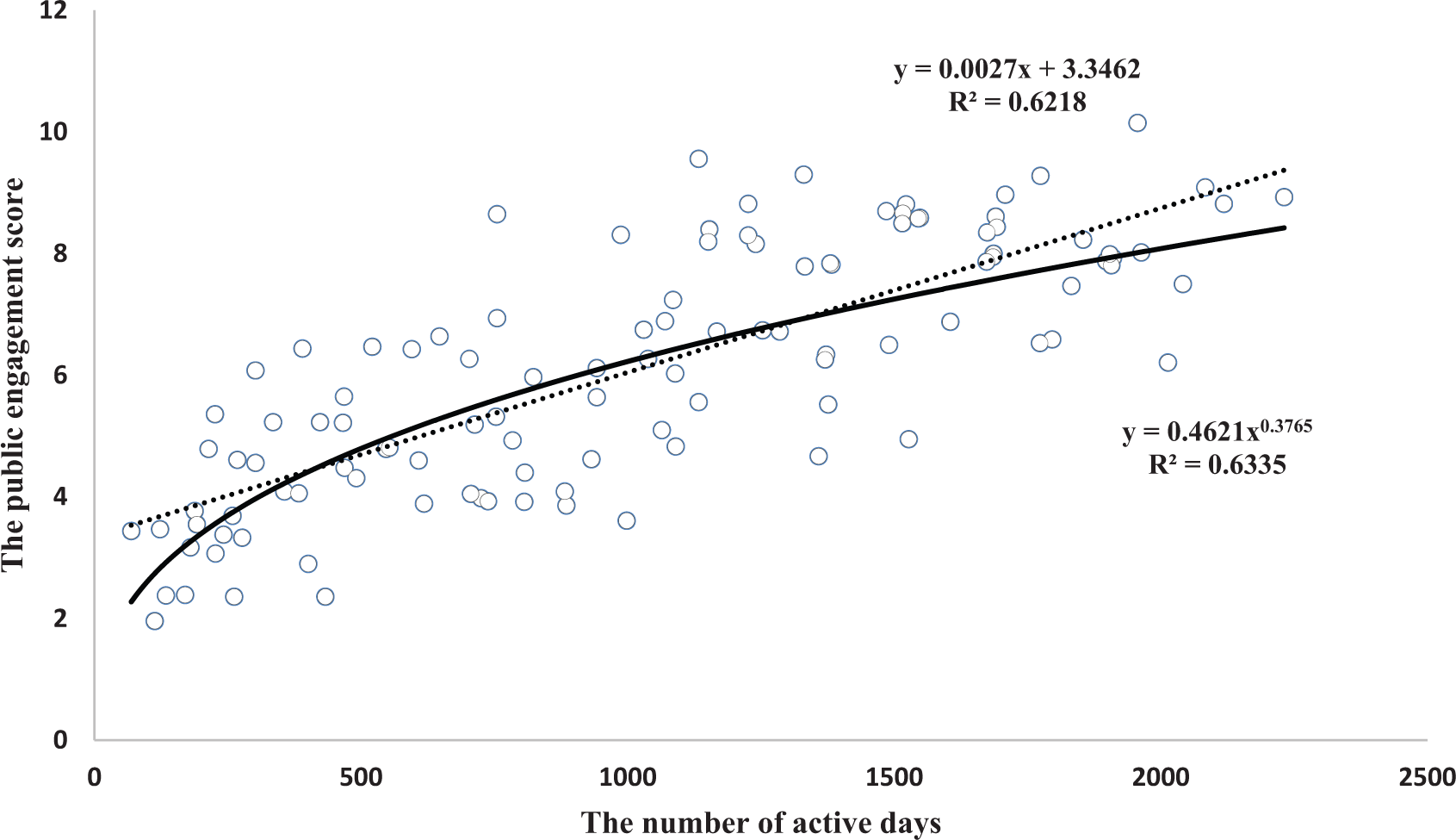
Curve fitting of active days and public engagement.
where y is the dependent variable equal to the degree of public engagement and x is an independent variable representing the number of active days. After calculating the slope of the function, we obtain the following formula:

We collected a total of 112 enterprises’ observations. By 10 October 2014 the largest cumulative number of active days was 2231, whereas 95.6% of the active days were <2000.When the number of the active days reached 2000, the slope of the curve became 0.001516, and when the number of active days was 1000, the slope of the curve became 0.002336, indicating that, when the number of the active days increased, the degree of the public engagement improved accordingly. To a certain extent, such a memory concerning the corporate image can be acceptable to all kinds of audience [97]. The rate of increase was significantly large, particularly during the beginning period.
The daily variance of the updates was included in the third model in Table 5. Statistics showed that adding this indicator significantly improved the model fit. The results in model 3 show that the daily variance of the updates has a significantly negative relationship with public engagement, illustrating that firms achieve less public engagement when the release of updates fluctuates widely. To further validate the relationship between them, we also performed curve estimation similar to the test of the relationship between the updates and public engagement. A comparison of various models indicated that the logarithmic model (R 2 = 0.604, F = 167.435) can fit the curve better (Figure 3). The equation is generated as follows:


Curve fitting of the daily variance of the updates and public engagement.
where y represents the dependent variable of public engagement and x is the independent variable of the daily variance of updates on each firm’s official micro blog for the study period.
The curve fitting is shown in Figure 2. After the derivative is obtained, the derivative equation of the curve can be expressed as follows:

The slope is the absolute value of the derivative. When the daily variance reaches 37, the change in the degree slope is <0.001, whereas the daily variance becomes 52, the change is <0.0005. Therefore, with the gradual increase in daily variance of updates, the change in the degree of the slope would tend to move closer to 0, indicating that public engagement will decrease when the daily variance of the updates becomes sufficiently large. The benefit is a very sensitive and a diminishing marginal one. The instability of the frequency with which companies release their updates will undermine the degree of public engagement, which supports Hypothesis 2.
When managers aim to enhance the degree of public engagement, they should strive for more active days and frequently update their positions on other social media pages. The policies for calculating the number of active days are shown in Table 3. Firms can lengthen online time by releasing updates every day and being constantly logged in. However, with regard to the results of information overload, the information capacity of the public for corporate information for a period of 648 days was nearly 1797, and the change in daily variance of updates should be smooth and steady. Therefore, we propose that the appropriate number of daily updates is three. Compared with earlier information, the end is easier to retrieve because of the presence of less interference in the memory when recalling this end information [68]. For managers, this result is an important finding because it indicates the appropriate number of daily updates when considering information overload and recency effect, which both can be found in the classic theory in the field of information and has been proven by numerous empirical studies.
4.4. Targeting of information advertising and public engagement
According to the results in Tables 4 and 5, no significant relationship was observed between the matrix established and public engagement. Considering the relationship between the followings and public engagement, we presume that the number of followers plays an intermediary effect between them. We tested this presumption using the method described in Section 4.2. However, we did not obtain significant results. Whether the matrix is established would not affect public engagement in official micro blogs. The results of the corporate matrix operation would affect engagement in the official micro blog because the corporate matrix contains many micro blogs. Firms that establish a corporate matrix will not influence public engagement in official micro blogs. They may achieve public engagement in their subsidiaries' micro blogs because they established a corporate matrix that caters precisely to specific groups. Hence, engagement in official micro blogs would be cut because of the dispersion of consumer groups.
5. Conclusions and implications
In an era when many organizations are experimenting with their use of social media, but limited evidence is available on the best practice to guide corporate use [98], this paper used frame theory to construct a framework from the media frame to the audience frame by sampling 112 listed companies and analysing this process to determine the corporate methods to frame their audience and improve public engagement. The findings of the study are as follows: (a) firms may gain public engagement though information release, but the extent of public engagement will not increase infinitely with the number of updates because of information overload; (b) the daily variance of updates has a negative effect on public engagement – the stability of information release will help increase public engagement; (c) the number of followers plays an intermediary effect between the followings and public engagement; (d) the number of active days has a positive relationship with public engagement – persistent activities on micro blogs will draw attention from the audience and enhance their memory of the firms; and (e) the establishment of a corporate matrix will not influence public engagement on official social media home pages.
This study makes theoretical and empirical contributions to the literature on the information framing effect. With respect to theory, this paper combines several classical theories in the field of information dissemination with the information framing effect and confirms that both the content and practices of information packaging influence the information frame effect, which adds to the literature on information framing effect. We extended the study on information overload on social media by conducting a theoretical investigation of the large number of updates released by each firm. We also proved the inefficiency of information overload on social media. By focusing on the daily variance of each firm’s updates and active days, we extend the application of the recency effect on the information updating of firms on social media. In addition, we add explanatory mechanisms to the two-way communication between firms and the public on social media by testing the intermediate effect of followers on the relationship between followings and public engagement.
The empirical contribution of this study is that it conducts an almost 2 year analysis of 112 enterprise official micro blogs of China Fortune 500 firms in 2014 and an in-depth qualitative analysis of over 270,000 observations on micro blog adoptions in enterprises. Previous studies on micro blogs have been concerned mostly with the contents of updates and case studies [e.g. 99, 100], and have not explicitly monitored the daily change in updates. To our knowledge, this study is the first large-scale empirical investigation that tests the influence of micro blog adoptions by enterprises on public engagement with official enterprise micro blogs from the perspective of the information frame effect. Empirical results show that the way information is packaged can also influence the effect of information framing, and appropriate social media adoption behaviours generate positive effects on public engagement with corporate social media pages. These findings imply that an appropriate number (not more than the mean value of updates among all companies) of updates, more frequent updating, more followings and more active days result in increased opportunities for public engagement. Hence, corporate communication strategies should focus on the practices of social media information framing.
The determinants of public engagement with official micro blogs of firms were examined based on a sample of 112 listed companies in China. The main limitation of this research is the reliability of the estimated results, which was not assessed by longitudinal studies. Active days, followers and followings are aggregate values and monitoring real-time changes of these numbers and the different micro blog adoptions in enterprises would make the study on the relationship between them more meaningful. The content of updates that corporations release may also have an effect on public engagement. Some companies may focus on product promotion while others may be keen to forward hot social issues that resonate with the public. These differences in message content in micro blog adoptions will influence public engagement in corporate social media adoption, which in turn affects corporate brand image and corporate reputation. These problems may be addressed in future studies.
Footnotes
Acknowledgements
The authors are grateful to the editor and three anonymous referees for their helpful and constructive comments and suggestions that improved the quality of this paper.
Funding
The authors wish to thank the National Natural Science Foundation of China under grants 71373250, 61004108 and 71121061.