



Abstract
The aim of this study is to understand and explain different dimensions of absorptive capacity and the strategies used in practice to realise it. The theoretical and conceptual contribution of the study lies in the adoption of a dual process and structure approach, aiming at identifying, respectively, how learning takes place and what learning takes place. The study is based upon a case study research design to explore the manifestation of absorptive capacity processes and its relationship to knowledge structures in four company case studies. The findings of the research indicate that knowledge acquisition, transformation and integration involve successive iterations of codification, abstraction and diffusion of knowledge in relation to product concepts, process requirements and problem-solving approaches. This relates to the capability to adopt, simultaneously, different trajectories in terms of knowledge exploration and knowledge exploitation strategies. The combined adoption of these different strategies enables both strategic and operational flexibility and underlies the successful realisation of absorptive capacity.
1. Introduction: absorptive capacity
The notion of absorptive capacity was first coined by Kedia and Bhagat [1] in the context of the study of technology transfer across nations. However, it was its conceptualisation in Cohen and Levinthal’s seminal studies [2,3] as an organisational capability that has led to its most influential construct. Cohen and Levinthal [2] first looked at absorptive capacity as a by-product of internal research and development (R&D) efforts and explored its relationship with technological innovation from an economics perspective. In a reconceptualisation of this notion [3], they defined it as ‘[…] an ability to recognize the value of new information, assimilate it, and apply it to commercial ends (p. 128)’. In their second study, they do not consider it merely as a by-product of the R&D efforts of an organisation but also as a by-product of its manufacturing capability. They define it as dependent upon its pre-existing knowledge basis, as cumulative, path and history dependent and therefore inherently dynamic by nature. They posit that it is also dependent on trade-offs between the following:
Knowledge similarity and dissimilarity, that is, it requires prior knowledge bases to be sufficiently similar to new information to enable its assimilation and sufficiently diverse to enable creation and innovation
Outward looking and inward looking capacities, that is, between the capacity to assimilate and exploit external information and internal communication efficiency.
Much research on absorptive capacity has tended to focus on effects on firms and/or organisational dyads, has adopted a quantitative approach and used proxy measures [4] – for example, at the firm level, R&D intensity measures [3], and at the organisational dyad level, measuring technology and patent overlap [5,6]. At both the firm and organisational dyad levels, a small number of studies have used more widely devised scales [7,8]. However, the quantitative approach and the use of classic indicators, such as R&D expenses and investment decisions as proxy measures for absorptive capacity, do not seem to capture its multifaceted nature, nor help to explain what is happening in practice in sufficient depth, in terms of the social processes and practices involved. In addition, they do not capture its dynamic nature nor how it leads to organisational change and adaptation. This has led to an interest in qualitative approaches to the study of absorptive capacity.
Qualitative studies of absorptive capacity have tended to adopt process [7,9–12], agency [12] or practice perspectives [13]. Studies have also focused on the change and evolution of absorptive capacity and its relationship with developmental milestones of firms [14,15]. These studies provide a richer exemplification of the processes and practices adopted in absorptive capacity in specific empirical contexts, but less so of what learning takes place and how the organisational knowledge bases are transformed through these processes; hence, the dual approach to study absorptive capacity was suggested in our study.
In effect, previous studies point towards the need to adopt an approach to exploring absorptive capacity in a more holistic and integrative manner and taking into account its multifaceted and dynamic nature [11,13] and highlight the need for empirical research exploring these dimensions [16]. This study is motivated by the need to understand the different dimensions of absorptive capacity through a multifaceted theoretical lens that captures what learning takes place and how it takes place. In order to understand and explain the different dimensions of absorptive capacity, the study is driven by a two inter-related questions, which are given as follows:
How is absorptive capacity operationalised, in terms of what and how learning occurs in dynamic contexts?
What strategies are used in practice to realise absorptive capacity?
The next section introduces the theoretical framework for this research, based on a process and structure perspective for the operationalisation of absorptive capacity. Section 3 presents the research design followed in the study. Then, this article explains how absorptive capacity takes place in practice, in terms of context, processes and capabilities, in four case studies in the Portuguese manufacturing industry (specifically, in textiles and clothing and footwear), which exhibited significant capacity for change in a context of economic downturn. Finally, a revised framework for absorptive capacity and its relationship to the intersection of strategies of exploration and exploitation of knowledge is presented and discussed.
2. A process and structure perspective on absorptive capacity
This study is unique in combining a process and structure perspective on absorptive capacity and exploring it in an empirical context. This approach is based on deploying structure and process perspectives on organisational learning and knowledge sharing [17]. While structural models explain what learning takes place, process models tell us how it takes place. By combining the two, it is possible to conceptualise what and how learning occurs in dynamic contexts. This dual perspective integrates two central propositions and foci in the literature and practice of knowledge management: knowledge as an asset and knowing as a process [17,18]. It is rooted in two different epistemological traditions, an epistemology of possession (of knowledge) and an epistemology of practice (of knowing), which have seldom been combined (with few exceptions, such as Mentzas et al. [19]), as pointed out in the recent review and reconceptualisation of absorptive capacity by Marabelli and Newell [20].
This article therefore adopts a combined process and structure perspective for studying absorptive capacity, using the absorptive capacity model of Zahra and George [9] as the process model and Boisot’s I-Space [21,22] as the structural model. Its contention is that while structural models explain what learning place, process models tell us how learning takes place. By combining the two, it is possible to conceptualise what and how learning occurs in dynamic contexts. This has previously been explored in relation to knowledge creation and organisational learning [17], using the socialization, externalization, combination and internalization (SECI) model [23] and Boisot’s I-Space [21,22]. Structure and process models are not mutually exclusive and can be mutually inclusive. Combining the two approaches and dimensions can provide us with a richer theoretical framework which provides a more complete picture of the interaction of process and structure and how it relates to organisational change.
2.1. Process perspective: Zahra and George’s absorptive capacity model
Zahra and George [9] reconceptualised the framework developed by Cohen and Levinthal [2,3], broadening the theoretical basis of the concept, to express its nature as ‘a dynamic capability that influences the creation of other organisational competences and provides the firm with multiple sources of competitive advantage (p. 186)’ [9]. To Cohen and Levinthal’s original proposition of a capacity to value, assimilate and apply new information for commercial purposes, they add (1) Mowery and Oxley’s [24] view that absorptive capacity involves the capability to deal with the tacit nature of some of the assimilated knowledge and (2) Kim’s [25,26] proposition that it involves a focus on problem-solving and on learning capabilities. Therefore, they redefine absorptive capacity as ‘as set of organisational routines and processes by which firms acquire, assimilate, transform, and exploit knowledge to produce a dynamic organisational capability (p. 187)’ [9].
They emphasise both the dynamic and multidimensional nature of absorptive capacity. In relationship to its dynamic nature, they stress the key difference between capabilities and dynamic capabilities when reconceptualising knowledge, that is between ‘high-level routines’ that produce outputs that are significant for organisational survival and those embedded processes that are strategic in nature and geared towards organisational change and renewal. In relation to its multidimensional nature, they propose four inter-related dimensions: acquisition, assimilation, transformation and exploitation.
Acquisition refers to the capability to identify and acquire key external knowledge for its operation and direction, depends upon prior knowledge and investments and can be characterised by its intensity, speed and direction. Assimilation involves the capacity to analyse, process and interpret this information and represents its understanding and contextualisation. Transformation involves its combination with prior and existing knowledge, in order to generate different approaches to how the organisation operates in terms of product and service offerings. Exploitation refers to the capacity to apply transformed knowledge, integrating it in organisational operations.
To these processes, Zahra and George [9] add the notions of activation triggers, such as internal crises or market changes; social integration mechanisms, such as informal employee interaction and formal mechanisms for integrating knowledge and enabling the achievement of efficiencies and regimes of appropriability of knowledge over new processes and products, which moderate the relationship between absorptive capacity and the ability to sustain competitive advantage.
Zahra and George [9] distinguish between the organisational capability to value, identify and acquire critical external knowledge (potential absorptive capacity) and its capacity to integrate it and exploit it to generate value (realised absorptive capacity). While acquisition and assimilation remain in the domain of potential absorptive capacity, it is the transformation, integration and exploitation of knowledge that transforms it into realised absorptive capacity. While Todorova and Durisin [27] question whether knowledge assimilation and knowledge transformation are sequential and propose them as alternative and possibly concurrent processes, Camisón and Forés [7] argue they involve processes that are different by nature. The former is related to potential absorptive capacity and the latter is related to realised absorptive capacity.
2.2. Structure perspective: Boisot’s I-Space
Boisot’s I-Space [21,22,28] is a three-dimensional framework in which the creation and diffusion of knowledge within selected organisational groups and the dynamics of knowledge diffusion and of social learning can be understood. The dimensions of the I-Space model are the degree of codification, abstraction and diffusion of knowledge.
Codification refers to categorising and classifying knowledge entities. Boisot considers a continuum between codified and uncodified knowledge and places at the codified end of the scale simple tasks that can be easily articulated and described (e.g. transactions into bank accounts) and, at the uncodified end, tasks that cannot be articulated or clearly described (e.g. defining long term economic trends). As Boisot [22] states, ‘the larger the number of distinctive attributes associated with a phenomenon, the more problematic is the act of codification (p. 42)’.
Abstraction involves the development of a structure into which the categories resulting from codification are organised. It is, in the I-Space model, a second axis representing a continuum between the degree of concreteness of knowledge and the degree of abstraction of knowledge. At the concrete end of the scale, it refers to knowledge that is applied to specific situations (e.g. individual transactions that involve a particular bank account); at the abstract end of the scale, it refers to ‘conceptual and non-local knowledge (p. 51)’ [22] that is of general application (e.g. standard rules and procedures that involve assessing credit risks across a number of situations).
Diffusion refers to the proportion of a given population of agents that can be reached with information operating at different degrees of codification and abstraction. Boisot distinguishes between the diffusion of information and its use or adoption stressing that it is possible for information to be diffused to a large number of agents without being assimilated or used. It is interesting to note that while referring to codification and abstraction, Boisot uses the term ‘knowledge’, but when referring to diffusion, he reverts to the term ‘information’.
Boisot [22] brings these dimensions together in the Information Space or I-Space framework as a three-dimensional perspective for representing the dynamics of knowledge flows in organisations, by means of what he labels as the ‘Diffusion Curve’ and the ‘Social Learning Cycle’: the more information is codified and abstracted, the more amenable to diffusion it becomes (p. 55). The I-Space [29] ‘[…] relates the degree of structure of knowledge (i.e. its level of codification and abstraction) to its diffusibility, as that knowledge develops’. Its key premise is that ‘structured knowledge flows more readily and extensively than unstructured knowledge (p. 180)’ [28]. The I-Space provides a structural framework based on the processes of codification, abstraction and diffusion of knowledge. It offers therefore a three-dimensional framework that relates the structure of knowledge and its diffusion.
Boisot [22] proposes that we can use the I-Space to identify and represent core competences [30] that underpin differentiated and successful strategies. Boisot [21] proposes that organisations can be categorised into three different regimes depending upon how they deal with complexity: (1) the ordered regime, (2) the chaotic regime and (3) the complex regime. The last is characterised by the organisational ability to develop information processing capabilities to deal with complexity required to develop core competences. We can, by extension, use the I-Space to represent dynamic capabilities that are developed through absorptive capacity.
2.3. Knowledge exploration and exploitation
The dynamic capabilities referred to in the previous section can be related to the management of the tension between the exploration of knowledge and the exploitation of knowledge. Levinthal and March [31] asserted that most organisations face the dilemma of deciding whether to focus their strategies on the exploration of knowledge or on the exploitation of knowledge, as exploitation is enhanced through redeployment and exploration through experimentation and emergence. Levinthal and March [31] consider, though, that over a period of time, there is a bias, especially in mature organisations, for exploitation to dominate over exploration as it generates faster and closer returns than exploration. Nevertheless, McNamara and Baden-Fuller [32] consider that organisational ambidexterity [33], the balance between exploration, essential to renew and adapt capabilities, and exploitation, required to reinforce, refine and leverage developed competences, is necessary for longer term organisational success. Previous research results indicate that the exploration of a tension between the two conflicting, but not exclusive forces, can lead to successful strategies [32–35].
We can relate this back to the notions of potential absorptive capacity and realised absorptive capacity. These two dimensions of exploration and exploitation can potentially be related to, respectively, the exploratory efforts of the organisation involved in developing potential absorptive capacity and the exploitative efforts leading to realised absorptive capacity. If so, there may also be a tension between the efforts placed into developing potential absorptive capacity and those placed in delivering realised absorptive capacity [36,37].
3. Research design
The aim of this study is to understand and explain different dimensions of absorptive capacity and the strategies used in practice to realise it in an empirical context. Case studies in the Portuguese manufacturing industry were used to explore knowledge structures and processes in absorptive capacity. A multiple case study research design [38,39] was employed, involving textiles and clothing and footwear manufacturing companies. The Portuguese context is interesting, as its manufacturing sector, particularly textiles, clothing and leather products, exhibited significant capacity for adaptation in a context of economic downturn, and this export sector is playing a key role in the current economic adjustment process [40,41].
The selection of the case companies was based upon four criteria – (1) companies with a strong growth orientation, measured by annual turnover; (2) companies with origin in Portugal but operating globally and offering their products at international level; (3) cases where the CEO was the founder of the firm, or a family successor, driving the strategic orientation of the company [42], as the Portuguese entrepreneurial fabric has traditionally exhibited a strong influence of family owned firms, particularly in traditional sectors [43]; (4) companies that enjoyed high reputation ascribed by wide and favourable media coverage [44,45]. This led to a final selection of four cases in the textiles and footwear sectors, as shown in Table 1.
Description of companies.
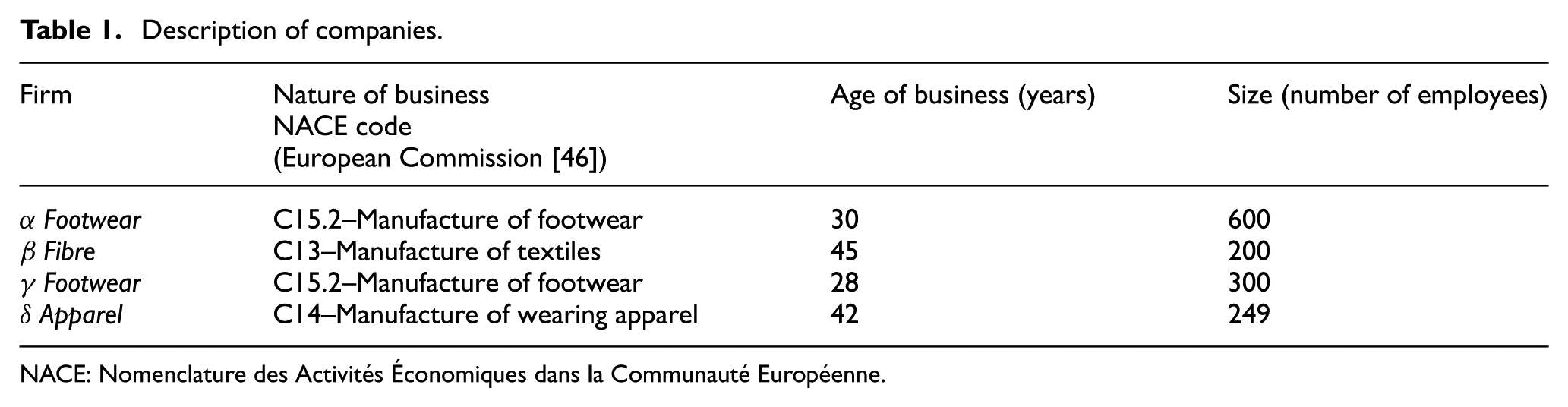
NACE: Nomenclature des Activités Économiques dans la Communauté Européenne.
These are well-established companies in traditional manufacturing sectors. In all firms, exports account for the majority of total sales, as will be detailed in the following section.
α Footwear manufactures 700,000 pairs of shoes per year and has an annual turnover of €60 million. For the first 10 years of its existence, α Footwear manufacturing was devoted entirely to subcontracting for other labels. Currently, it has a global presence, exporting its own footwear brands to 58 countries. Recent investment in production technologies and processes resulted in the opening of additional plants in the Northern region of Portugal and the development of a system that is able to respond to online orders for customised shoes in 24 h.
β Fibre is a leading manufacturer and supplier of felt hat bases, producing 400,000 felt hats per year. This represents 20% of the world market. Since its establishment in 1969, it is the only company in the country that has survived in the hat manufacturing business, through continued investment in technology, new product development techniques to guarantee authenticity and production processes that are streamlined to respond to the requirements of both large and small series. Currently, only 3% of its production is sold in Portugal, with the rest being exported mainly to France, Spain, Italy and the United States.
γ Footwear has its origins in the mid-1980s, when it started as a small subcontractor that expanded into mass production in the 1990s following intensive investment in technology and later adjusting to high-end smaller series produced both for its own brand and a range of international fashion brands. It has an annual turnover of €16 million. It manufactures 2500 pairs of shoes per day and is a subcontractor for international high fashion brands.
δ Apparel is a wearing apparel manufacturer, combining production for its three bands with international subcontracting, it has an annual turnover of €10 million. Nearly 90% of the clothing produced by the firm is exported to 30 countries, including China.
A series of semi-structured interviews were conducted with the CEOs of all four companies, reflecting on their personal experience, on the company history and key strategic turnaround milestones, on the context of the evolution of the sector and on the impact of current economic context in their market. The use of CEOs as key sources of information provides a high-level strategic view of the companies’ trajectories and operations in their external environment and, thus, is the most useful perspective for the purposes of this study. In addition to the interviews with the CEOs of all four companies, we conducted interviews with similar high-level executives, more specifically the creative director and the managing director of δ Apparel and the quality controller at β Fibre. All four companies are family businesses, which impacts on the structure of executive decision-making and the profile of interviewees. The CEOs are either founders or direct descendants of the founders. In either case, they share a history of family links to the business sector, which granted them an extended network of contacts from which they extract useful learning. Another common feature is that the high-level executives are either close relatives or employees who have a transgenerational, long-standing affiliation with the company, which becomes their de facto extended family. The seven interviews were complemented with data obtained from visits to all the factories, following interviews with the CEOs, and from desk research. Interviews were conducted between June and July 2013, a period during which Portugal was under financial assistance and an adjustment programme designed, implemented and funded by the International Monetary Fund (IMF), in cooperation with the European Central Bank and the European Commission. The country’s economic situation at the time was characterised by a large negative internal balance, high unemployment, reduced external imbalance and both public and private high debt levels [41].
Interviews lasted on average 90 min with one interview lasting more than 2 h. Interview topics addressed a variety of issues: milestones in the history and development of each firm, position of each firm within the business sector, strategic orientation and motivation for that strategic orientation, ability to change and respond to environmental shocks, drivers and barriers to innovation, examples of defining products from concept to launch and challenges and opportunities for development in the next 2 years. Interviews were taped and subsequently fully transcribed. In line with the thematic analysis procedures proposed by Braun and Clarke [47], interview transcripts were initially read and re-read in order to highlight relevant material, make annotations and proceed with the identification of preliminary codes. Subsequently, preliminary codes were clustered into sub-themes before categorising them into broader themes. The analysis of data in this study was originally informed by the initial key theoretical constructs synthesised in section 2 above: the processes in the absorptive capacity model by Zahra and George [9], the dimensions of the I-Space [21,22,28] and the tension between knowledge exploration and knowledge exploitation [31]. However, empirical findings have, in turn, also shaped the final conceptual categories derived from the study.
4. Case studies in the Portuguese manufacturing industry
4.1. The context
The case companies crossed different phases of the macroeconomic cycle of the Portuguese economy defined by Blanchard and Portugal [41]: boom (1995–2001), slum (2002–2007), two crises (2008–2013, including the global financial crisis starting in 2008 and the euro crisis starting 2011) and recovery (from 2014 onward). Table 2 provides information on the macroeconomic context until the two crises period, which coincides with the timeframe for the interviews for this study.
Macroeconomic context in Portugal.

A significant point to note about the case companies is that, in general, they exhibit throughout these cycles, including during the period of global downturn (2008–2013) a positive performance. Table 3 illustrates the dynamics for these companies during these different economic phases, in terms of turnover, number of employees, labour costs and productivity and R&D expenditure, as detailed in Table 3.
Short characterisation of the case companies.

Source: Based on calculations using Informa/Dun & Bradstreet databases.
NA: data not available or not comparable across time.
The annual turnover growth within the first period (1995–2001) in the case of this firm is computed with the data for 1997–2001.
The mean of annual inflation rate measured by the Consumer Price Index (CPI) was in each period (2010–2013; 2014–2016) 1.3% and 0.3%, respectively (Source: Statistics Portugal).
The companies in general show a positive performance compared with the macroeconomic context, namely, in turnover growth and productivity, and some create jobs in periods of large increase in unemployment.
In Figure 1, the evolution of the structure of the market (internal and external) is represented. The structure of the markets changed in recent years with an increase in the exports to non-European Union (EU) countries in the cases of footwear companies. The case of β Fibre, where the non-EU market dominates, reveals a small decrease in the last year. δ Apparel has among the four cases the largest share of the domestic market, but always lower or equal to 20% in total. The growth of the turnover is strongly affected by exports.

Market structure and evolution of case companies.
The context of the industry and the changing market landscape is a key driver for the activities carried out in the case companies, which require an understanding of what is changing the market, what shape these changes are taking and therefore what the market is seeking. Despite their different historical roots, all four companies in this study had, early in their history, a focus of internationalisation at the core of their strategic orientation, with the aim of reducing dependency from a national market of small dimensions within an economy marked by significant fluctuations. This orientation was part of a differentiated vision of the different founders from an early stage. This associated a desire to differentiate the product offering with an ambition to thrive in wider contexts, as there was an awareness that the quality of their products could compete at a wider and more demanding market. This was especially the case as many of these companies were already manufacturing for established quality brands in the international market, which outsourced part of their production to factories in Portugal, where labour costs were lower than in other European countries: We were always a company geared towards exporting […]. Practically the internal market was not very important to us. (CEO, α Footwear) I had another vision, I wanted to create my own brand and wanted to have effectively autonomy in relationship to that environment which I knew, of the shoes that everybody produced for importers. Everybody worked for the importers and I wanted to have my own brand. (CEO, α Footwear)
This international orientation was largely driven by the entrepreneurial vision and pre-existing knowledge of the market that founders had, in line with previous research reviewed by Costa et al. [48]. In turn, it allowed simultaneously the development of networks of suppliers, clients and agents and associated knowledge bases. While not at the origins of the international orientation of the four firms, the current climate of economic downturn, has, nevertheless, brought the need to refocus businesses and to seek for new target markets. This strategic refocusing is also driven by a close relationship with clients and an understanding of their economic and business context, which often requires the capacity to deliver quality, at smaller scales, and adopt a ‘just-in-time’ production philosophy: […] at this moment, the advantage we have in relationship to the new production markets is the proximity to the markets, the capacity for response, and the capacity to produce to small sized orders. […] I mean today those that need small orders and operate around small orders, made and supplied for at last minute, are those that have the capacity for expenditure. (CEO, α Footwear)
The pre-existing knowledge of the international market, of suppliers, agents and sales networks, is seen as a fundamental basis for re-shifting focus in terms of target markets and product offerings in a relatively easy manner. It needs, however, to be integrated with an understanding of new demands that often require innovation in terms of the design and quality of the product and in terms of production and supply processes: From the export market to the markets that are outside the so call traditional export markets in Europe it was also very easy. Our product has very high quality. This is what enables us to weather the storms. We have always quality at the basis for our product. And then we go on innovating. (Creative Director, δ Apparel)
This collective and integrated knowledge plays a key role in the successful internationalisation of small and medium enterprises (SMEs) [48].
4.2. Absorptive capacity processes and knowledge structure
We identified three main processes involved in the absorptive capacity activities across all four companies, which are similar to the categorisations of Zahra and George [9] and of Camisón and Forés [7]: (1) knowledge acquisition, (2) knowledge transformation and (3) knowledge integration. In the context of this research, knowledge acquisition refers to potential absorptive capacity and knowledge transformation and integration refers to realised absorptive capacity, as defined by Zahra and George [9].
4.2.1. Knowledge acquisition
As stated by Cohen and Levinthal [3], absorptive capacity depends, to a large extent, upon the pre-existing knowledge bases of individuals who undertake it. In terms of knowledge acquisition and internalisation, a pre-existing knowledge basis is important to identify what is of value and of usefulness and to make sense of how it can fit the context of the business and of its existing operations. However, serendipity in the discovery of new trends and ideas also plays an important role in this process. This entails the ability to combine new knowledge with what is known from previous experience, through processes that frequently resemble problem-solving activities [49]. Capturing market trends, for example, acts a barometer for assessing change and identifying areas for required innovation. Chasing trends is a main objective and is seen as a much more proactive and instinctive activity that allows to capture trends as they are being generated, contrary to formal market research which identifies them a posteriori: So we work very much around trying to understand how design will develop for the next season […]. This is like the trend hunter. How do they know what the trend will be? And it’s the same. […]. (Creative Director, δ Apparel)
Trade fairs were perceived to operate as valuable relational platforms for their capacity to explore new trends. γ Footwear emphasised how regular visits to trade fairs impacted the ability to find out about market trends and update its technological knowledge basis: We have never stopped. I go and visit all the trade fairs related to machinery because I know they can add value and quality to our production. […] and every year we keep on investing in new machinery. (CEO, γ Footwear)
The information acquired in that way is then interpreted in light of a pre-existing understanding of what may work and what may not work in fashion trends. Interviewees stressed that there is a strong element of tacitness in the competences involved in identifying this information. The process in itself is difficult to explain and remains largely uncodified and unarticulated at first. This implied that in practical terms, it was difficult to operationalise the difference between knowledge acquisition and assimilation [9]: No, this is almost inexplicable. Why is it that a painter has the same brush, paint and canvas, one is fantastic, and the other will never get there? You cannot explain, it is our capacity […] to transform into something that others will also like. (Creative Director, δ Apparel)
At this stage, knowledge remains largely uncodified and concrete, therefore unstructured and undiffused. As a consequence, this process represents potential, but not realised absorptive capacity. The following processes, knowledge transformation and integration, are necessary to the realisation of absorptive capacity.
4.2.2. Knowledge transformation
Knowledge transformation, however, was often presented as a collective process and a team-based activity, involving the codification and generation of common knowledge and of a common understanding of new concepts and processes. This implies the need to articulate and codify new ideas about products and processes (codified knowledge) and the capacity to see their application on a wider basis (abstract knowledge). The proactivity of the firm plays a key role here, namely, the ability to understand customer needs and the search for new ways to satisfy them [49]. The fact that this process is shared across a team implies its wider diffusion, following, therefore, the trend implied in Boisot’s [22] diffusion curve: We all work together. My father and my husband went to an exhibition in Milan to look at the trends. The designer also went […]. That is, to try to transmit that, we have to capture [it] on the street. (Creative Director, δ Apparel)
Knowledge transformation involves successive processes of combination and recombination of old and new codified knowledge over product concepts, process requirements and problem-solving approaches, involving different members of a team with different competences. This leads to the introduction of greater structure in the knowledge that is being developed and co-created: [Product managers] interpret […] what the client wants […] in terms of weight, quality, size of crown, size of flap, colour, finishing […] they write [the requirements] in an internal document and upload in our platform a set of specifications which are a set of instructions for production. […] Each section follows specific instructions and at the end we have a product put together in a specific way. (CEO, β Fibre)
Sometimes, this involves adapting technologies and correlated know-how developed in other contexts and therefore the capacity to abstract knowledge into new contexts. At α Footwear, a shift to more crafted methods of production was associated with higher quality products and involved partnerships with a university research centre and a marble manufacturer to adapt technology originally used in cutting marble to shoe manufacturing: When we started our own brand, we realised the time had come for a qualitative leap. We had to make a move and partner up with a university […], and with a marble manufacturer. This would enable us to have our own specialised equipment to produce smaller collections, drawing on existent waterjet cutting equipment that the marble manufacturer used to cut stone. Knowing about this machinery, we invited the research institute to translate and apply this technology to shoe manufacturing. (CEO, α Footwear)
Knowledge transformation can also involve re-thinking business operations with a new logic, re-inverting the logic of production and rediscovering traditional craft knowledge, as will be further detailed in the following section.
4.2.3. Knowledge integration
The process of transforming knowledge about business operations ties in very closely with the third process, knowledge integration, which involves embedding in work routines these new understandings of how the logic of the production must be rethought in order to develop differentiated products required by an evolving market. This requires the integration of cross-functional capabilities and competences, so the product concept is embedded across different functional areas and diffused across the company offerings: We didn’t have quantity, because we didn’t have equipment for large productions and, so, all the logistic, all the logic was, a bit, the move from the artisanal industry […] to a process of industrialization. Now, it was the other way around. It was moving from an accelerated industrialization process which I had in place to a semi-artisanal process because the orders were very small and our equipment wasn’t adequate. I moved from a very rudimentary industry, say shop based, to an industry of high production machinery and equipment. Then I had to do it the other way around. […]. Except there were no machines for that […] there were many processes in the middle that we had to reindustrialize, but within a different logic […]. (CEO, α Footwear)
The adopted technology itself has embodiments of collective know-how, enabling reproduction of a certain style much more closely than other type of machinery. At all the companies, various interviewees explained the decision to replace machinery and technology on this basis – for example, at δ Apparel, the need to achieve an Italian ‘finish’ has led to replace existing machines with Italian machinery.
The effort placed into integrating knowledge across functional boundaries and product offerings implies further development of structured knowledge that is shared across these boundaries. This effort also translates into notions of quality and of innovation that are of a holistic and integrative nature: Quality is a total thing! It can’t just be … the quality of the fabric. No! It’s the quality of the fabric, of the manufacturing, of the finishing, of invoicing, of communication […]. Quality must be a whole. […] But you must have innovation. If you do not innovate, that will be difficult. (CEO, δ Apparel)
Innovations introduced through absorptive capacity require therefore synergistic efforts across different areas of the firm in order to be realised. These require socialisation and integration capabilities, as proposed by Zahra and George [9]. Internally, the general long-standing relationship between employees fosters the generation of common knowledge, which simultaneously shapes these relationships. Instantiations of this phenomenon in the SME context were identified and analysed in previous studies [50,51].
A related dimension of conversational intimacy that seemed to foster the generation of common knowledge was found, for instance, in the ability of these firms to establish a group of employees who have grown together with the company, share affinities and have the competences and the flexibility to cooperate in pursuit of a common goal: There’s an engineer in this firm who is now 50 years old and who started working with me when he was 15. He is in charge of sales. The manager of the industrial production sector, which used to be controlled by myself, is a woman and she also joined the firm when she was only 14 or 15 years old. (CEO, α Footwear) No, this is the entrepreneurial culture we have inside. That the boss supports, and the boss teaches, and someone says ‘Look at that because it isn’t right’. This is a human chain that cannot be made by law. It’s the internal principles that the company has always held. (CEO, δ Apparel)
This was associated with a combination of flatness in structure, allowing proximity with all functions of the business, with a strong direction and, at points, elements of power distance. Despite the family environment and a workplace culture that claims to espouse camaraderie, vertically centralised decision processes are de facto dominant. The CEOs in all case companies undertake the responsibility for scanning and exploring customer needs, combining them with an appraisal of broader market and technology trends. They act as gatekeepers between external developments and internal operations. This gatekeeping role is reinforced by the emphasis placed on the prevalence of lateral communication and the daily interaction with employees in the production lines, emphasising a concurrent roaming role [52], establishing cross-functional connections.
4.2.4. Absorptive capacity and knowledge diffusion
The processes of knowledge acquisition, knowledge transformation and knowledge integration involve successive iterations of codification, abstraction and diffusion of knowledge.
At the acquisition stage, knowledge is largely uncodified, unarticulated and concrete; therefore, it remains unstructured and less amenable to diffusion. It often involves chasing and discovering market trends. Knowledge transformation involves interpreting and translating trends into specifications, generating a common understanding for new concepts, products and processes, as part of a collective based activity. This involves combining newly acquired knowledge with pre-existing knowledge, making it amenable to wider diffusion across the firm. Knowledge integration involves embedding these new understandings in new routines and operations and integrating them across different areas of the firm. Throughout these processes, knowledge becomes increasingly structured and amenable to wider diffusion in the firm. Absorptive capacity seems therefore to follow the I-Space premises on structuring knowledge and diffusing it.
There are elements of overlap in terms of how companies deploy absorptive capacity processes. Zahra and George [9] propose that although absorptive capacity capabilities ‘[…] have some commonalities across different firms and attain equifinality, they are idiosyncratic in the specific ways firms pursue, develop, and employ them (p. 189)’. Our findings suggest that absorptive capacity processes are not necessarily sequential or linear and companies can go through them concurrently and in successive cycles. Marabelli and Newell [20] have previously proposed, in their review and theoretical model, that absorptive capacity processes are interactive; the findings in this study support this proposition. Different manufacturing logics can require that the same company adopts different trajectories in terms of how it goes through these processes in terms of developing new competences and leveraging existing ones, as will be explained in the following section.
5. Knowledge exploration and exploitation as intersecting strategies
In previous work, McNamara and Baden-Fuller [32] proposed that the balance between exploration and exploitation is necessary for longer term organisational success and demonstrated that successful companies alternated between periods driven by each of these strategies in order to establish a balance between them. In this study, companies exhibited slightly different trajectories in developing resilient strategies in a context of economic downturn. A common feature across the four companies was the capability to, as mentioned above, engage at different points in their history with diverse manufacturing logics which require the simultaneous adoption of different trajectories in terms of how they develop new competences, engaging in knowledge exploration strategies, and simultaneously leverage existing ones, engaging in knowledge exploitation strategies. Based on the findings, this section presents and discusses a revised framework for absorptive capacity and its relationship to the intersection of strategies of exploration and exploitation of knowledge, which bridge between potential and realised absorptive capacity.
A common pattern across the interviews was that, over time, the firms acquired, used and accumulated different types of knowledge for product or service development. This is combined with significant efforts placed into consolidating the knowledge bases developed in the past. This entails the combination of efforts focused on exploring new ideas and processes, with the exploitation of mature technology capabilities, extracting benefit from familiar, proximate knowledge.
A salient dimension across the approaches displayed by the case firms is the ability to combine pro-activeness with operational efficiency. In other words, these firms share trajectories that integrate, in a non-linear fashion, the ability to move quickly towards new opportunities and the ability to exploit the value inherent to existing business models and proprietary assets, codifying and integrating different sets of old and new knowledge. For instance, as presented above and in section 4.2.3, at α Footwear, there was a realisation that changes in the market determined a growing demand for the production of higher quality footwear but in significantly smaller scale than before. For the company, this approach represented a departure from the previous skills in planning and executing production at a larger industrial scale. This was solved via a partnership with a local research centre, bridging the knowledge gap between the technology it had and the technology it needed, allowing it to alternate between small and large scales of production. In doing so, it reduced the risks incurred in the exploration of novel solutions: We were facing production falls and again the research centre solved it. Initially for shoes sewing, which was the most delicate stage, but also for the assembly of shoes. […] in using technology and software that ease the alternation between large and small series; we did not change the structure of production, and we gained time and the ability to produce cheaper and in larger quantities. (CEO, α Footwear)
Another way of combining exploration and exploitation trajectories was pursued by γ Footwear. It consisted in searching and exploring the knowledge from the upstream functions of the value chain, while capturing that knowledge locally and embedding it within its own value chain functions. γ Footwear enriches existing production capabilities with external knowledge obtained from clients who subcontract production, creating ideal opportunities for the internal selection, retention, replication and creative reuse of this knowledge whenever reactivation is required: Some time ago an Italian brand approached me. Italians are extremely good at finishing the product; they can make a relatively average leather look amazing just by delivering excellent product finishing. I learned a lot with them whilst working for them. They were here at the factory; they sent their technical staff that spent 3 or 4 months over here […]. It is obvious that my staff developed immensely by learning from their high quality standards. Now even when manufacturing shoes that are not for that specific brand, no one will be able to take that wisdom from my staff. (CEO, γ Footwear)
At β Fibre, the integration of exploration and exploitation strategies is associated with incremental innovation and improvements to its product offering. The following example demonstrates how the integration of novel technology and associated knowledge with its pre-existing production competences led to differentiate its existing products from those of counterfeiters: We innovate here very frequently, in a continuous way but that is still innovation, based mostly on continuous improvement. We manage to make products that are slightly different from each other, with features that are often times different, you see. Let me give you an example. We faced an issue with contrafaction in a country where another company was producing felts but claiming they were our felts. They would sell them as if they were our own when that was not the case. And we addressed that problem through depositing microcapsules on to the felt that delivered a particular scent. They [the counterfeiters] couldn’t simply copy the scent. Initially we stamped the felt, but they imitated the stamp. We changed the stamp and they also imitated it. At some point we didn’t know what to do anymore, right? They would produce a lower quality felt and stick out stamp on it. Many clients could not tell the difference. The solution [of depositing scented microcapsules on to the felt] was a suggestion from our distributor in that country. He told us: ‘why don’t we get some scent on to this. Maybe that they aren’t able to copy’. And from that moment on, with the nanotechnology available … Because if you simply apply perfume on a hat, it will go away in a couple of days. To do it permanently we needed nanotechnology, micro-particles of scent that are encapsulated and deposited on to the hat. When the hat is manipulated it releases scent and the scent remains for a long time. So that is an innovation, but it is an innovation within the same product line. It is not a disruptive innovation. (CEO, β Fibre)
Other researches [53,54] have identified the exploration of complementarity of knowledge across value chains as a salient feature of innovation networks. Marra et al. [55] also highlight the intertwined nature of the relationship between knowledge management practices and supply chain management processes. In the case firms that participated in this study, this often involves intersecting and integrating different value chains, negotiating and managing different sensibilities and potentially conflicting interests. β Fibre reported different configurations of its production line as its history unfolded, often as a result of difficulties in the business environment. At the beginning of its existence, following the decline in demand for its traditional offering in the 1960s, it was created as a conglomeration of six companies that united in order to concentrate the manufacture of its Fibretype. Despite this cooperative arrangement, each manufacturer maintained its own identity and its separate product development and design processes: I want to develop with β Fibre a new collection, but I don’t want that information to transfer to the other shareholders, who are my competitors. So β Fibre developed a system of production […] with one process for one of the shareholders, another process for another and [yet] another for another. (CEO, β Fibre)
Operating in such conditions involves managing the balance between promoting the know-how and skills that are of common advantage and limiting the level of diffusion of knowledge that is of individual benefit. This modus operandi implies that the cooperating companies operated simultaneously in different areas of Boisot’s [22] I-Space configuration and is indicative of the complex regime that can foster the development of core competences.
This study set out to understand and explain the different dimensions of absorptive capacity. It did so by exploring two inter-related objectives: (1) to understand the operationalisation of absorptive capacity in terms of what and how learning takes place and (2) to explain the strategies used in practice to operationalise absorptive capacity. Figure 2 illustrates the integration of processes and trajectories in the absorptive capacity practices exhibited by the case companies and presents a revised model for absorptive capacity, integrating the key theoretical constructs that underpinned this study. The framework combines (1) processes for absorptive capacity, referring to how learning takes place, with (2) the dimensions that provide structure to knowledge (codification and abstraction), enabling its diffusibility, referring to what learning takes place, and relates them with (3) the tension between knowledge exploration strategies and knowledge exploitation strategies that leads to the realisation of absorptive capacity and enables companies to adapt to required changes.
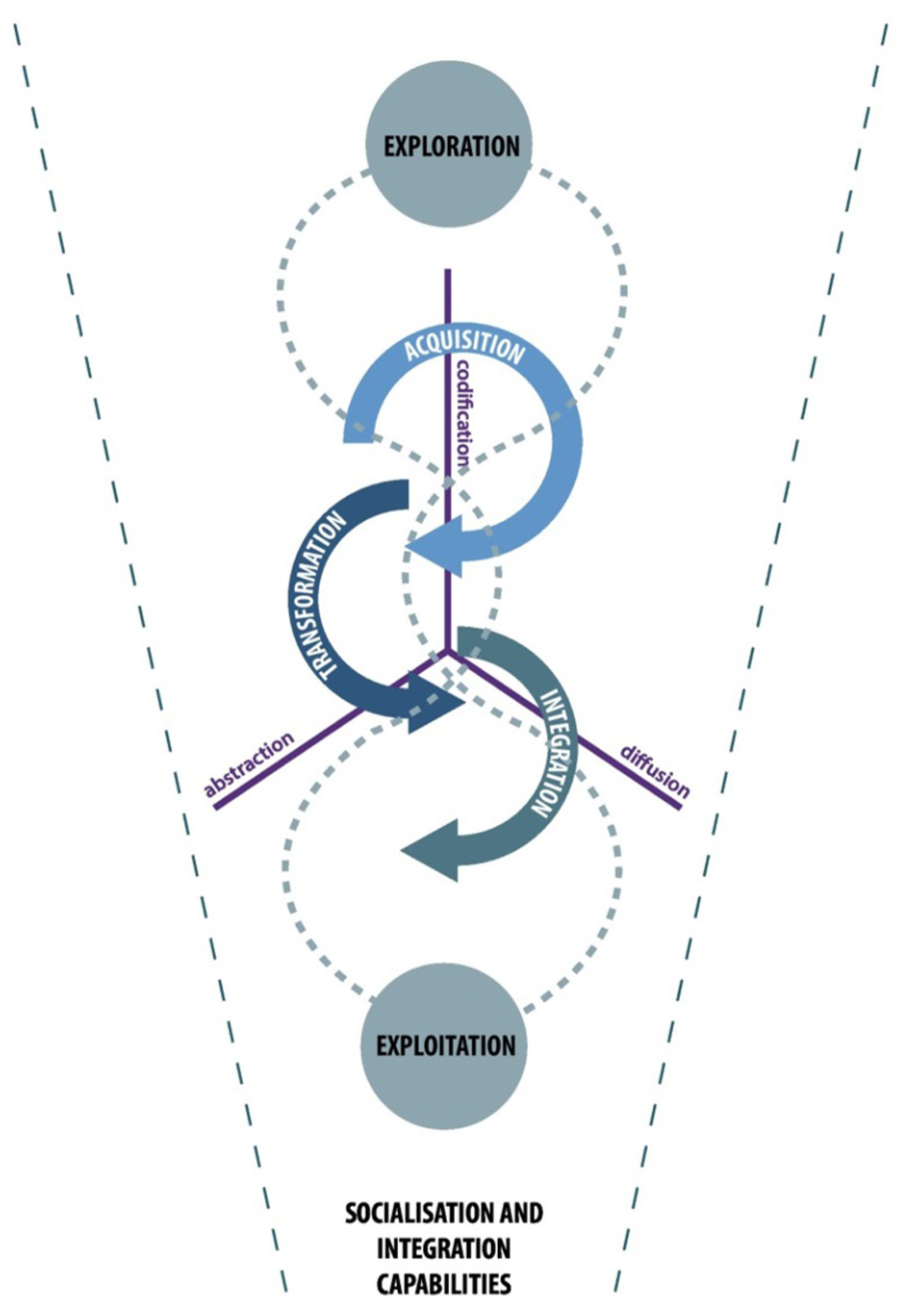
A revised framework for absorptive capacity.
The processes of knowledge acquisition, transformation and integration are interlinked and involve successive iterations of codification, abstraction and diffusion of different sets of knowledge, leading to the operationalisation of absorptive capacity. As explained in section 4.2, throughout these processes, knowledge becomes increasingly structured and amenable to wider diffusion in the firm in a way that follows the I-Space diffusion curve. These processes take place in a non-linear fashion, which may involve discontinuities and reconnections in time, as well as the intersection of exploratory and exploitative efforts. Absorptive capacity is facilitated by socialisation, coordination and integration capabilities that are embedded in the routines of the company.
The capability for engaging simultaneously in knowledge exploration and exploitation strategies leads to the realisation of absorptive capacity and underpins the development of both strategic and operational flexibility, bridging successfully between market-oriented decision-making and the operational control over production. Strategic and operational flexibility has been found, in previous studies, to be a key enabler of business resilience (see in the context of Swedish textile and clothing SMEs during the current economic crisis the study by Pal et al. [56]). Studies by McNamara and Baden-Fuller [32], He and Wong [34] and Holmqvist [35] have highlighted the key role of managing ambidexterity between knowledge exploration and knowledge exploitation in developing successful strategies. These findings are also consistent with the recent study of knowledge creation and absorptive capacity in firms embedded in industrial districts by Camisón and Forés [57], where it has been found that absorptive capacity depends both on inter-organisational flows of learning that rely on shared competences (e.g. sector webs, business-to-business-webs and cooperation with technological institutes) and on the ability of firms to develop internal, continuous learning systems.
The approaches undertaken by the case companies display therefore the capabilities to process complexity characteristic of organisations that operate within Boisot’s [22] complex regime. These characteristics enable them to re-organise their internal processes to adapt to required changes, and this forms the basis for the successful realisation of absorptive capacity.
6. Conclusion
This study uses a process and structure framework to explain the different dimensions of absorptive capacity and to understand how is realised through processes of exploration and exploitation of knowledge.
The findings of this research indicate that the processes of knowledge acquisition, knowledge transformation and knowledge integration involve successive iterations of codification, abstraction and diffusion of knowledge, consistent with Boisot’s [21,22] diffusion curve, moving from uncodified and concrete, hence unstructured and undiffused knowledge, to increasingly structured (codified and abstract) and diffused knowledge. However, these are not necessarily sequential or linear processes – there are elements of overlap in terms of how companies deploy these processes and companies can go through them concurrently and in successive cycles.
Absorptive capacity is facilitated by socialisation, coordination and integration capabilities that are embedded in the routines of the company, both internally and externally, in how it engages in wider external value networks combined with the ability of firms to develop internal, continuous learning systems. The mechanisms supporting the latter consist essentially of a simultaneously diverse and deep internal knowledge base – supported by standards, codes and frames of reference – that enables the integration of new external knowledge into pre-existing knowledge [3].
The study sought to understand the operationalisation and realisation of absorptive capacity in companies operating in Portuguese traditional industries (in this case, textiles and clothing and footwear). This a context affected by significant economic crisis, but which also exhibits high turnover and a large share of exports, and is currently playing a key role in the national economic adjustment process. The companies in this study exhibit the capacity to adopt simultaneously different strategies in developing new competences (knowledge exploration) and leveraging existing ones (knowledge exploitation). In this context, the interactions between exploitation and exploration strategies generate opportunities for bridging potential and realised absorptive capacity. This enables the companies to adapt quickly to new circumstances and opportunities and to exploit the value inherent to existing business and production processes and proprietary assets. This strategic and operational flexibility, which is indicative of the complexity processing capabilities characteristic of Boisot’s [22] complex regime, underlies the formation of strategies for organisational change.
Footnotes
Acknowledgements

Declaration of conflicting interests
The author(s) declared no potential conflicts of interest with respect to the research, authorship and/or publication of this article.
Funding
This study was partly funded by Santander Research Mobility Awards.