




Abstract
Research topics vary in their citation potential. In a metric-wise scientific milieu, it would be probable that authors tend to select citation-attractive topics especially when choosing open access (OA) outlets that are more likely to attract citations. Applying a matched-pairs study design, this research aims to examine the role of research topics in the citation advantage of OA papers. Using a comparative citation analysis method, it investigates a sample of papers published in 47 Elsevier article processing charges (APC)-funded journals in different access models including non-open access (NOA), APC, Green and mixed Green-APC. The contents of the papers are analysed using natural language processing techniques at the title and abstract level and served as a basis to match the NOA papers to their peers in the OA models. The publication years and journals are controlled for in order to avoid their impacts on the citation numbers. According to the results, the OA citation advantage that is observed in the whole sample still holds even for the highly similar OA and NOA papers. This implies that the OA citation surplus is not an artefact of the OA and NOA papers’ differences in their topics and, therefore, in their citation potential. This leads to the conclusion that OA authors’ self-selectivity, if it exists at all, is not responsible for the OA citation advantage, at least as far as selection of topics with probably higher citation potentials is concerned.
1. Introduction
Open access (OA) to scientific papers has widely been believed to have advantages for community, as readers, practitioners, researchers or the public. Facilitating knowledge transfer and, hence, knowledge progress is the key benefit of OA for all. It is, however, supposed to bring about an added value to scientists as writers, that is, a higher level of recognition by the scientific community, called open access citation advantage (OACA). The OACA, defined as the citation gap between OA and non-open access (NOA) paper groups, is widely confirmed for various OA models, that is, the Gold, Green, article processing charges (APC) and hybrid OA models [1–18]. The research results are not consistent in that they sometimes reject the OACA, for example, at journal level [19], for the Gold model [15,20] and for low-impact journals [21]. However, a recent large-scale research conducted by Piwowar et al. [22] corroborates the existence of OACA for a big sample of papers intended to roughly proxy the whole population of scholarly literature.
The OACA is perceived to have roots in different factors. On one hand, some OA researchers attribute the OACA to the higher visibility brought about by their exposure to a broader readership [2] or to their early accessibility [9,19], while others challenge that it is the author’s self-selectivity of his or her high-quality papers that results in a higher recognition level. In other words, according to the latter, the citation advantage has roots in the intrinsic merits of the OA papers, and not necessarily in their open accessibility [23]. Some authors believe that more citable articles have a higher probability of being freely accessible [6,11,23–26]. Hajjem and Harnad [27] showed that not only self-archived articles are more likely to be cited (‘Quality Advantage’), but also those articles which are more likely to be cited are more likely to be self-archived (‘Quality Bias’). Gargouri et al. [28] confirmed that the OA advantage is due to a ‘quality advantage’ judged by users who self-select what to use and cite, rather than a ‘quality bias’ from authors self-selecting what to make OA. Some other factors include journals’ prestige [29–31], paper length and the number of collaborating authors [11], though not confirmed in all studies [32]. In spite of the widespread studies on the OACA, there is not yet any certainty about the causation of the phenomenon. As instance, ‘the early view postulate’ is challenged by some studies confirming the OACA persistence over time [33,34]. The impact of ‘self-selection’ bias is also rejected by Ottaviani [18]. The debates are, hence, ongoing and researchers call for further studies to clarify the causation of the OACA effect [22].
Given the high and increasing number of national and international OA mandates [35–37], one might think that all authors have to apply for open accessibility of their outputs with no freedom of choices between OA and NOA models. However, it is not the case, because the mandates have faced important barriers, for example, lack of strong incentives [37], inflexibility of embargo duration, low participation of authors [37,38] and limitation of the OA models included [36,39], hindering their wide acceptance and effectiveness. The OA articles are, hence, ‘almost all unmandated’ around the world, although effective in some countries like the United Kingdom [40].
Aside from the above-mentioned factors, the subject area of papers is determining in their citation potential [41–43]. Citation potential differs not only between but also within disciplines and fields. More specifically, citations are related to the topic the paper deals with. As Falagas and Alexiou [44] put it, even within a certain discipline there are some citation-intensive areas attracting more – though rather perfunctory – citations. ‘Hot’ topics [45], exciting and popular topics [46,47] and positive outcomes [48] are among the content-related factors that play a role in citation performance of papers. Research topic is believed to be determining in predicting its recognition to such extent that it is a matter of importance of writing highly cited papers [42,43].
As a result, authors and journals may adopt the approach – either tactically or strategically – to increase their visibility and hence their impact. High research interest and popularity may serve as a drive for authors, given the increasing role and influence of citation as a research performance measure in milestones of their scientific lives, especially promotion, tenure and grant allocation [49]. In Rousseau and Rousseau’s [50] words, in a ‘metric-wise’ milieu, research topics and publication avenues may be selected to maximise a researcher’s bibliometric indicator levels rather than out of a desire to advance science or to reach the most interested audience. It is, therefore, likely that choosing a topic for research or a venue for publicising research results may be a function of its citation potential. This may be especially true for OA venue, which is confirmed to be more citation attractive, so that multiple OA availability of articles has a positive impact on their citation count [4]. The wide discussions on the factors leading to the OACA may be good evidence of the perceived interaction between attention-provoking topics and outlets in catching more citations. On this basis, it is likely that the ‘selection bias’ implies the selection of not only high-quality papers but also citation-attractive topics.
This gives rise to the question of whether the citation gap between OA and NOA papers results from authors’ self-selectivity in choosing citation-attractive topics when adopting the APC model or self-archiving their accepted papers. If so, it would be expected that OA and NOA papers experience no citation inequality when dealing with similar topics and hence enjoying the same level of citation potential. To answer the question, this study tries to pair OA and NOA papers in terms of their subject similarity and then examine the association between their OACA and similarity degrees. As far as the OACA-oriented literature goes, it seems that subject coverage is taken into consideration by focusing on the papers published either in the same journal [14,25,51–53] or in the same discipline [6,21,30,54–57]. Piwowar et al. [22] categorised papers based on their publishing journal fields, except for those published in multidisciplinary journals that they classified at the article level to their mostly cited subject area. Unlike journal fields and disciplines that are broad, papers’ topics are more specific and therefore more prone to reflect authors’ interests and preferences. No research was, however, found to have controlled for the effect of specific topics dealt with in OA and NOA papers. As an exception, one may refer to Piwowar and Vision [8] who controlled for many citation predictors, including authors and topics. However, they concentrated on the impact of openly available data in a narrow field, that is, gene expression microarray. Moreover, Gargouri et al. [28], Niyazov et al. [58] and Snijder [59] controlled for the field effect at general level. Besides, in almost the entire literature, the OA and NOA papers were collectively analysed, while a matched-pairs design would take any probable individual differences between papers into consideration. As Piwowar et al. [22] suggest, concentrating on articles paired based on their topics, journal issues and publication dates may help eliminate confounding factors and hence judge the OACA more accurately.
2. Research aims
Applying a matched-pairs study design, this study aims to examine the role of research topics in the citation gap between OA and NOA papers. To do this, it endeavours to determine the following:
The citation gap between NOA papers and their subject peers in the OA models;
The significance of the citation gap across OA models;
The significance of the citation gap across OA models in different subject similarity groups.
3. Research method
This research uses a comparative citation analysis method to investigate a test collection sampled from 47 Elsevier APC-funded journals previously identified by Sotudeh et al. [13]. The rationale to select the journals lies in the fact that they had been previously found to have a growing body of APC and self-archived papers with considerable OACA [13,60]. Moreover, according to the SHERPA/RoMEO database, all of them were revealed to have adopted the Green (GR) model also. The model allows authors to self-archive their papers (in its pre-print, reviewed or post-print versions) on their personal or organisational websites. This allowed to concentrate on both APC and Green models and their interaction, that is, a mixed model of APC and Green OA. Not only OA models are different in their OACA potential [15,61], but also the citation count of an article is positively influenced by its multiple availability by, for example, multiple search engines [4], repositories [23] and databases [62].
3.1. Sampling
The time span of 2013–2015 was selected. The collection was limited to research articles, reviews and proceeding papers. Out of the 50,080 papers identified by Sotudeh et al. [13], 42,226 papers were available with full bibliometric information (including abstracts). After downloading the bibliometric and bibliographic information of the papers from Scopus, the access model of each paper was investigated as described below.
3.1.1. Identification of APC papers
The data collection process was started in January 2016. Off-campus searches were conducted using the papers’ titles and authors. The searches were conducted off campus in order to avoid subscription-based papers entering the collection. The papers were classified as APC if they contained the terms ‘Open Access Article’ and ‘Creative Commons’ tags and were freely available for downloading to public. Furthermore, the URLs of the papers were checked in terms of including ‘Open Archive’ in order to prohibit the delayed OA papers from entering the collection.
3.1.2. Identification of GR OA papers
In the next step, the papers were manually searched in Google and Google Scholar by their titles and authors in order to find if they were self-archived. The rationale for selecting the search engines lies in their advantages including offering a reasonably comprehensive coverage of scholarly papers [63], ranking OA at the top of their results retrieved and exhibiting similar or even higher performance in retrieving OA results compared with Directory of Open Access Journals (DOAJ), Science-Metrix and Unpaywall [35,64,65].
As the search engines rank OA items at the top of the results, only the first and second result pages were verified. Each of the links retrieved was tried in order to check the online availability of the papers’ full texts.
The results of the verification of the papers’ access models are summarised in Table 1. As observed, the NOA model expectedly comprises most of the papers published by the journals (58.13%), followed by the Green model (34.83%). The lowest share belongs to the APC model, in its pure format (2.23%) or mixed with the Green model (APC-Green or APCGR; 4.81%). The latter refers to those papers that are not only openly accessible through the publisher’s or the journal’s website in exchange for the publication charges paid by their authors, but also archived on websites and social networks. The adherence of a single paper to more than one OA model can be explained by the fact that all of the studied hybrid journals allow self-archiving model, though with different policies regarding the archived versions and the length of the embargoes [66]. The payment of the APC, despite the allowance of the Green model, could be due to OA mandates or authors’ unawareness of the other OA models allowed [67,68]. Moreover, the Green versions may be posted by co-authors or third parties, for example, librarians, enthusiastic readers and so on, who are not necessarily responsible for paying the publication charges.
Characteristics of the initial data set.
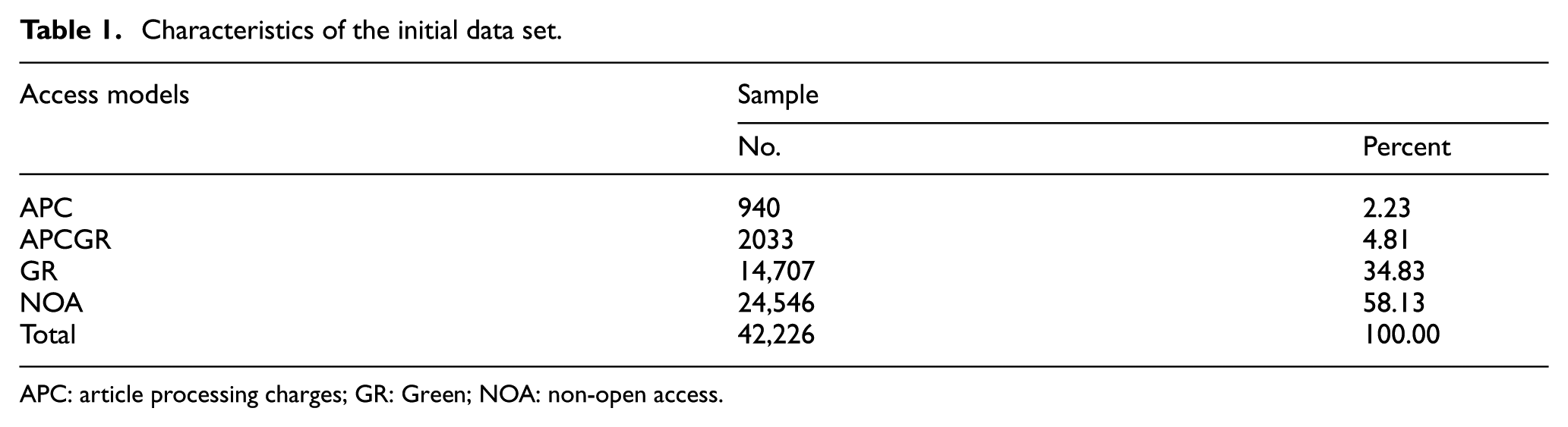
APC: article processing charges; GR: Green; NOA: non-open access.
It is worth mentioning that the total portion of the OA papers (41.87%) is lower than what was previously reported by Archambault et al. [15] who reported over half of the papers to be freely available. This could have resulted from the fact that the present sample is limited to APC and Green papers published in hybrid journals and does not include other OA models, for example, those articles published in Gold journals or the Green papers published in toll-access ones. As mentioned, Bronze and delayed OA models are also excluded from the sample. Another noteworthy point is that the share of the Green papers seems to be higher in comparison with that revealed by Piwowar et al. [22]. The discrepancy may be attributed to the differences between operational definitions. Unlike their study, Green papers in this research are not limited to just those self-archived in OA repositories, but also in personal or institutional websites as well as social networks. They also gave priority to Gold over self-archived content, if an article adhered to both the models. Moreover, in their study, the ‘hybrid papers’, that is, the APC-funded papers published in hybrid journals, account for 3.6%, 4.3% and 8.3% of their three samples selected from CrossRef, WoS and Unpaywall, respectively. As observed, the share of the APC papers identified in this study (7.04%) approximates that of those identified in their latter sample.
The initial data set was then deeply analysed in order to build a test collection consisting of NOA documents, which served as queries, paired with documents in the OA models in terms of their subject similarity. To do so, 2134 NOA papers were selected based on containing salient keywords in the collection based on their term frequency–inverse document frequency (TF-IDF). They served as seed documents and were then paired to their OA peers as described below.
3.1.3. Test collection building
In order to study the association between the subject similarity and the citation gap between the OA and NOA papers, it was necessary to first pair the papers in terms of their similarities in their contents. To do so, the documents’ titles and abstracts were chosen as highly important representations of paper contents [69,70] because they are ‘lexically dense and focus on the core issues presented in articles’ (p. 4) [71].
KNIME (Kostas Information Mining) was used to measure the similarity between the OA and NOA papers and to couple them. The software uses different steps to process texts including reading and parsing documents, named entity recognition, filtering and manipulation, word counting and keyword extraction, and measuring the similarities between the seed documents and the collection.
A workflow consisting of the following nodes (modules) was built and executed, respectively:
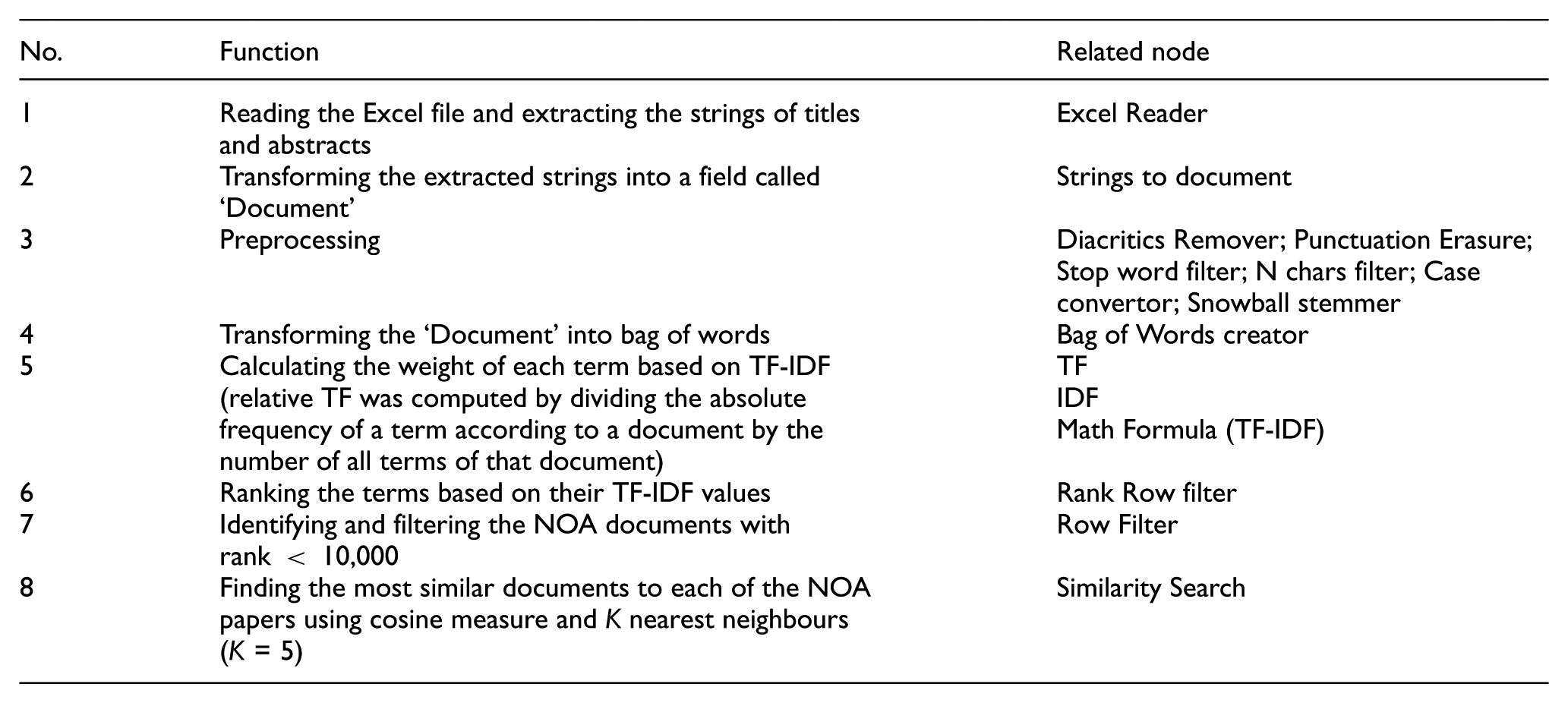
The obtained data were checked manually in order to control for any false-positive matching or duplicated records. This resulted in identifying 4171 unique documents in the four access models including NOA (2134), APC (75), GR (1305) and APCGR (122) (Table 2).
Test collection characteristics.

NOA: non-open access; APC: article processing charges; GR: Green.
It is noteworthy that some NOA papers matched more than one document in the OA models and vice versa. As the models were analyzed separately, it caused no problem when this happened between groups. However, within the NOA–NOA group, the seed and neighbour documents were necessarily mutually exclusive in order to observe the independence of the variables.
3.2. Data analysis procedures
As the citation and similarity values were found to be non-normally distributed across the papers, even after natural log transformation, non-parametric statistics (i.e. Wilcoxon test) was used for comparing the citations of OA and NOA papers.
Using the two-step clustering technique, the papers were categorised into three groups of subject similarity including slightly similar (min = 0.218, max = 0.586, cluster centre = 0.46), moderately similar (min = 0.587, max = 0.849, cluster centre = 0.71) and highly similar (min = 0.854, max = 1, cluster centre = 0.99).
Before conducting the analyses, the citation data were normalised based on the total number of the citations each journal has received in each year following Priem et al. [72]. However, as Waltman and van Eck [73] put it, there are several normalisation approaches and the best approach is still an open question. Consequently, to allay any probable hesitations regarding the normalisation, the highly similar OA–NOA pairs were further studied in a strict categorisation based on the similarity of the confounding factors affecting the citation potential of papers. Publication dates, publishing journals and document types (e.g. reviews, research articles, proceeding papers) are among the confounding factors causing a higher number of citations in favour of, for example, older versus younger papers [74,75], reviews versus original research papers [26] and top- versus low-ranked journals [76,77]. The highly similar OA–NOA pairs were further compared after categorising them into ‘Evens’ and ‘Odds’ if their document types, publication years or publishing journals were similar or dissimilar, respectively.
4. Results
Table 3 illustrates the citation performance of the OA and NOA papers in different access models before and after being normalised by their publication years and journals’ total citations. As observed, the OA papers are superior in their mean citation values in all matched-pairs groups, compared with their peers in the NOA model.
Citation performance of OA and NOA papers across the access models.
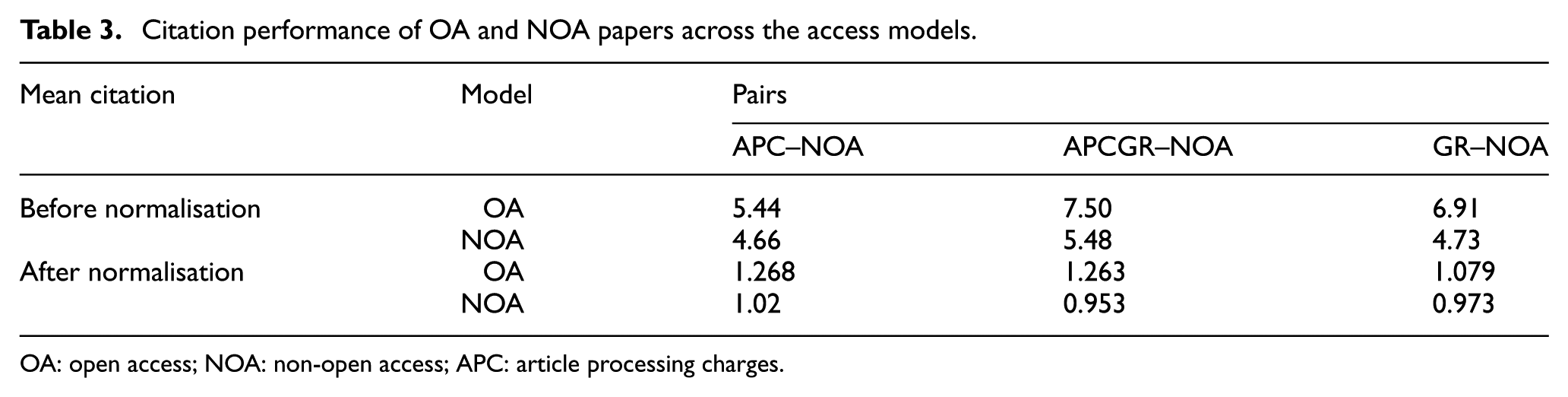
OA: open access; NOA: non-open access; APC: article processing charges.
4.1. Significance of the citation gap across the access models
Table 4 summarises the results of Wilcoxon test conducted to compare the OA and NOA pairs in terms of their citation mean ranks. As observed, the mean ranks of the OA papers are significantly higher than those of their NOA peers in the OA models, including APC (‘OA > NOA’ = 70.06), APCGR (‘OA > NOA’ = 112.36) and GR (‘OA > NOA’ = 1348.64). Besides, the NOA–NOA pairs do not significantly differ in their citation gaps.
Wilcoxon results for comparing citation mean ranks of OA and NOA papers.

OA: open access; NOA: non-open access; APC: article processing charges; GR: Green.
4.2. Significance of the citation gap across the access models in the subject similarity groups
Table 5 illustrates the results of the Wilcoxon tests carried out to compare the citation advantage values among the paper pairs in different access models in different similarity groups. As observed, the OA–NOA pairs with ‘slightly similar’ contents are equal in their citation performances, so that there are no statistically differences between the APC, APCGR and GR papers on one hand and their NOA papers in the same pairs on the other. However, when the similarity increases, in the ‘moderately similar category’ the citation gap becomes significant between GR and NOA papers (OA > NOA = 134,480.5 vs OA < NOA = 100,474.5). Moreover, in the ‘highly similar’ groups, all OA models outperform the NOA model, so that significant OACA values can be observed for the APC (OA > NOA = 2505 vs OA < NOA = 1150), APCGR (OA > NOA = 7198.5 vs OA < NOA = 4736.5) and GR (OA > NOA = 587,793 vs OA < NOA = 787,519). In this similarity group, NOA–NOA pairs showed no significant gap between their citation mean ranks. It is worth mentioning that the size of the sample is small for the APC and APCGR papers, especially in the slightly and moderately similar groups and the results should be interpreted with caution.
Comparing normalised citation mean ranks of OA and NOA papers in similarity groups.
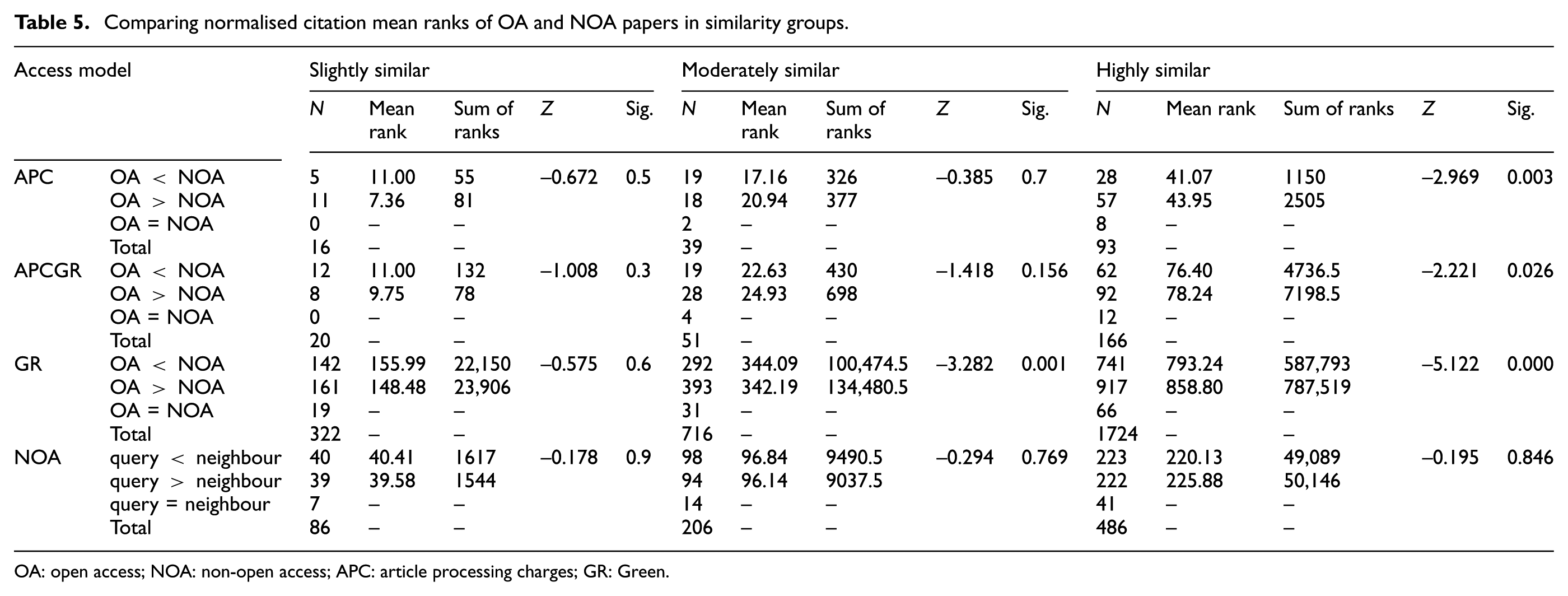
OA: open access; NOA: non-open access; APC: article processing charges; GR: Green.
4.3. Significance of the citation gap between highly similar OA and NOA papers in terms of year, document type and journal groups
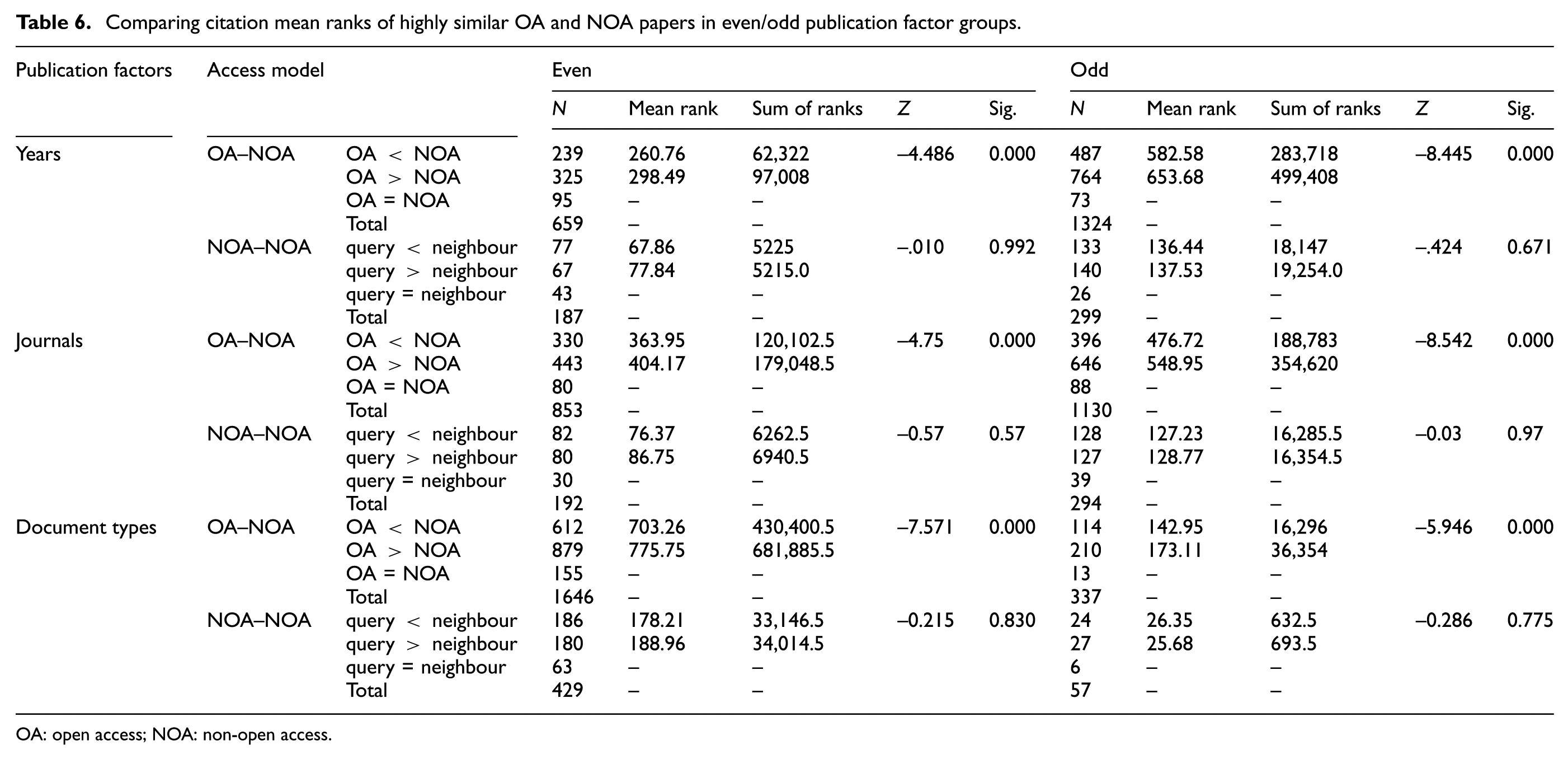
Aside from topics, there are other publication factors such as publication years, publishing journals and document types that have been found effective in accumulating citations. This gives rise to the question of whether the significant OACA in the highly similar group is due to their differences in these regards. To answer this question, the OA–NOA pairs were categorised into two groups including ‘Evens’ if the OA–NOA pairs are published in the same document types, years or journals and ‘Odds’ if not so. The results of the tests carried out on the pairs with ‘highly similar topics’ are reported in Table 6. The analyses of the pairs with ‘slightly and moderately similar subjects’ are presented in Appendix 1. It is noteworthy that, in order to vet the role of publication years and journals, it was necessary to carry out the tests on raw citations (i.e. before normalisation by journals’ total citations and publication years).
Comparing citation mean ranks of highly similar OA and NOA papers in even/odd publication factor groups.
OA: open access; NOA: non-open access.
As shown in Table 6, the OA papers significantly outperform their highly similar NOA peers no matter if they are published in the same or different years, journals or document types. The same holds for the OA–NOA pairs with ‘slightly and moderately similar subjects’ (Appendix 1).
5. Discussion
Researchers seem to follow a double standard in supporting OA movement. As readers, they enthusiastically campaign for open accessibility of scientific papers to read and use, while as authors they do are not willing to do their best in providing OA to their own papers [78,79]. The paradox calls, hence, for motivations other than altruism and commitment to knowledge progress, which are not per se adequate to guarantee writers’ support for the movement. In the present metric-wise atmosphere, requiring authors to increase the quantity of their papers and citations, the citation superiority of OA papers may serve as a leverage to stimulate their survival motivations.
Although the citation advantage was confirmed since the early works on OA [80], there is no consensus on its underlying factors including higher visibility, higher quality, journals’ prestige and publication characteristics [2,6,11,23,25,26,28–31,81]. Since papers’ subjects are a key factor in attracting citations, one may wonder if the OACA is nothing but a misunderstanding caused by OA and NOA papers’ differences in their topics and hence in their citation potentials.
The present communication concentrated on a sample of OA and NOA papers paired in terms of their similarity degrees. According to the results of the Wilcoxon tests, NOA papers exhibited significant disadvantage compared with their OA peers in each of the Green, APC and APC–Green models. However, the result does not hold for the NOA–NOA couples which served as the evidence group (Table 4).
The comparison of OA and NOA papers at different similarity levels provides an opportunity to verify the OACA phenomenon at a finer granularity. While OA–NOA couples dealing with almost different topics showed statistically equal performances, those with highly similar topics revealed a citation advantage for OA papers (Table 5). In fact, it seems that in the groups with lower levels of subject similarity the citation potential brought about by open accessibility is counterbalanced by the subjects’ differences in their citation potentials. This empirically re-confirms the already-known fact that subjects and topics are determining in attracting citations to papers [41–44,48,82,83].
On the contrary, there exist significant gaps among the OA–NOA pairs dealing with highly similar subjects in all the OA models. However, the NOA–NOA pairs with highly similar contents do not adhere to the finding. This means that the OACA is not an artefact caused by different topics with various citation potentials for the OA and NOA papers. Nor it is associated with (dis)similarity in their publication factors, because the highly similar OA–NOA pairs were also detected to be significantly different, no matter if they are published in the same or different years, journals or document types. These factors are believed to be crucially determining when evaluating and comparing papers [72,84]. The higher citation performance of the OA in comparison with their subject-similar NOA pairs with different publication characteristics signifies that subject similarity is so powerful to counterbalance the effect of publication in different journals, publication time and document types.
Paper quality is of a multi-dimensional and highly complicated nature. Although all quality dimensions are not explained by the topic or subject a paper deals with, topic characteristics such as topic importance [85] and topic coverage and detailedness [86] crucially affect the judgement of a paper quality. Characteristics of research topics are believed to be determining in predicting their citation potentials. A good example may be observed in ‘hot’ topics, which are believed to easily acquire more citations and more papers than those dealt with in cold fields, as there are more papers focusing on similar topics [45]. Among other instances, to name, there are exciting and popular topics [46,47], controversial topics versus those contributing to scientific progress [83], fundamental versus super-specialised subjects with narrower audience [82] and finally positive and statistically significant versus negative outcomes [48]. Accordingly, it seems that important subject matters may acquire fewer citations, while popular, hot or trivial topics are more likely to gain more citations. Given the ‘self-selectivity postulate’, it would be probable that the OACA is a resultant of authors’ selectivity of topics with a high citation potential. However, the results of this study indicated that OACA is still observable among OA and NOA papers dealing with highly similar topics and hence enjoying the same level of citation potential. As a result, this article may contribute to the ongoing challenge of OA ‘quality bias’ versus ‘quality advantage’ by clarifying that the OACA is not brought about by topic differences among OA and NOA papers. Accordingly, even if authors intentionally select these kinds of citation-attracting topics for their OA papers, they would experience a higher citation performance compared with NOA papers dealing with the same topics.
6. Conclusion
OACA not only is a motive to drive authors to support the OA movement, but can also be interpreted as a herald of acceleration and expansion of knowledge dissemination and usage. It may, therefore, be important to all parties being involved in science. OA researchers have been continually endeavouring to provide rigorous evidence to ensure whether the OACA is an artefact of ‘publication strategies’ (e.g. longer paper, multiple authorship and self-selectivity of high-quality papers) expediently adopted by authors to increase their recognition or a natural consequence of open accessibility leading to higher visibility and wider readership. Concentrating on a collection of OA papers having citation superiority to their NOA couples, the present communication adds to the existing knowledge that although topics differ in their citation potentials, the OACA does not result from OA papers’ differences in topics. It also re-confirms the effect of publication years, journal prestige and document types on the recognition of papers. However, they are not found to be influential in the OACA.
Although this research sampled the OA papers in terms of the degrees of their content similarity to the NOA papers, the topics themselves were not studied. The scope of the topics might be diverse, widespread and divergent. Consequently, the results imply just the existence of OACA among OA and NOA papers with the same subjects. However, from the results, one cannot infer how various topics with different degrees of importance, popularity and influence are scattered among the OA and NOA papers and how these characteristics associate with the OACA. Further studies are required to dig deep into topics’ distributions among OA and NOA models to answer these questions. Moreover, the research communication focused on a relatively small sample of 47 hybrid OA journals published by Elsevier, one of the largest commercial publishers of highly prestigious journals, especially APC-funded ones. To generalise the results, it is required to replicate the research on journals and publishers with different prestige levels, sizes and histories. The study had another limitation regarding sample size, especially for the slightly and moderately similar papers, which requires cautious interpretation, as well as replication of the study on a larger sample to generalise the results.
Footnotes
Appendix
The Wilcoxon results for comparing citation mean ranks of slightly and moderately similar subject OA and NOA papers in even/odd publication factor groups.

| Publication factor | Access model | Slightly similar | Similar | ||||||||||
|---|---|---|---|---|---|---|---|---|---|---|---|---|---|
| N | Mean rank | Sum of ranks | Z | Sig. | N | Mean rank | Sum of ranks | Z | Sig. | ||||
| Publication year | Even | NOA–NOA | query < neighbour | 11 | 12.59 | 138.5 | −0.33 | 0.74 | 29 | 25.47 | 738.5 | −0.98 | 0.33 |
| query > neighbour | 13 | 12.42 | 161.5 | – | – | 21 | 25.55 | 536.5 | – | – | |||
| query = neighbour | 8 | – | – | – | – | 18 | – | – | – | – | |||
| Total | 32 | – | – | – | – | 68 | – | – | – | – | |||
| Odd | query < neighbour | 25 | 21.5 | 537.5 | −0.28 | 0.78 | 52 | 65.83 | 3423 | −1.81 | 0.07 | ||
| query > neighbour | 22 | 26.84 | 590.5 | – | – | 77 | 64.44 | 4962 | – | – | |||
| query = neighbour | 7 | – | – | – | – | 9 | – | – | – | – | |||
| Total | 54 | – | – | – | – | 138 | – | – | – | – | |||
| Even | OA–NOA | OA < NOA | 43 | 48.19 | 2072 | −0.93 | 0.35 | 92 | 95.42 | 8779 | −3.20 | 0.00 | |
| OA > NOA | 53 | 48.75 | 2584 | – | – | 124 | 118.2 | 14,657 | – | – | |||
| OA = NOA | 17 | – | – | – | – | 40 | – | – | – | – | |||
| Total | 113 | – | – | – | – | 256 | – | – | – | – | |||
| Odd | OA < NOA | 71 | 111.42 | 7910.5 | −4.66 | 0 | 185 | 242.25 | 44,817 | −5.75 | 0 | ||
| OA > NOA | 151 | 111.54 | 16,842.5 | – | – | 319 | 258.44 | 82,443 | – | – | |||
| OA = NOA | 23 | – | – | – | – | 46 | – | – | – | – | |||
| Total | 245 | – | – | – | – | 550 | – | – | – | – | |||
| Journal | Even | NOA–NOA | OA < NOA | 14 | 15.11 | 211.5 | −0.44 | 0.66 | 24 | 27.29 | 655 | −1.17 | 0.24 |
| OA > NOA | 16 | 15.84 | 253.5 | – | – | 32 | 29.41 | 941 | – | – | |||
| OA = NOA | 5 | – | – | – | – | 7 | – | – | – | – | |||
| Total | 35 | – | – | – | – | 63 | – | – | – | – | |||
| Odd | query < neighbour | 22 | 19.2 | 422.5 | −0.10 | 0.92 | 57 | 62.6 | 3568 | −0.62 | 0.54 | ||
| query > neighbour | 19 | 23.08 | 438.5 | – | – | 66 | 61.48 | 4058 | – | – | |||
| query = neighbour | 10 | – | – | – | – | 20 | – | – | – | – | |||
| Total | 51 | – | – | – | – | 143 | – | – | – | – | |||
| Even | OA–NOA | OA < NOA | 37 | 47.85 | 1770.5 | −2.19 | 0.03 | 94 | 115.41 | 10,848.5 | −5.28 | 0 | |
| OA > NOA | 60 | 49.71 | 2982.5 | – | – | 169 | 141.23 | 23,867.5 | – | – | |||
| OA = NOA | 9 | – | – | – | – | 26 | – | – | – | – | |||
| Total | 106 | – | – | – | – | 289 | – | – | – | – | |||
| Odd | OA < NOA | 77 | 109.45 | 8427.5 | −4.04 | 0 | 183 | 219.96 | 40,253.5 | −4.28 | 0 | ||
| OA > NOA | 144 | 111.83 | 16,103.5 | – | – | 274 | 235.03 | 64,399.5 | – | – | |||
| OA = NOA | 31 | – | – | – | – | 60 | – | – | – | – | |||
| Total | 252 | – | – | – | – | 517 | – | – | – | – | |||
| Document type | Even | NOA–NOA | query < neighbour | 34 | 32.57 | 1107.5 | −0.01 | 0.99 | 73 | 82.1 | 5993 | −1.14 | 0.25 |
| query > neighbour | 32 | 34.48 | 1103.5 | – | – | 90 | 81.92 | 7373 | – | – | |||
| query = neighbour | 15 | – | – | – | – | 23 | – | – | – | – | |||
| Total | 81 | – | – | – | – | 186 | – | – | – | – | |||
| Odd | query < neighbour | 2 | 1.5 | 3 | −1.21 | 0.23 | 8 | 7.62 | 61 | −0.36 | 0.72 | ||
| query > neighbour | 3 | 4 | 12 | – | – | 8 | 9.38 | 75 | – | – | |||
| query = neighbour | 0 | – | – | – | – | 4 | – | – | – | – | |||
| Total | 5 | – | – | – | – | 20 | – | – | – | – | |||
| Even | OA–NOA | OA < NOA | 103 | 140.68 | 14,490.5 | −4.15 | 0 | 250 | 307.85 | 76,963 | −6.29 | 0 | |
| OA > NOA | 181 | 143.53 | 25,979.5 | – | – | 405 | 340.44 | 137,877 | – | – | |||
| OA = NOA | 38 | – | – | – | – | 82 | – | – | – | – | |||
| Total | 322 | – | – | – | – | 737 | – | – | – | – | |||
| Odd | OA < NOA | 11 | 16.86 | 185.5 | −1.91 | 0.05 | 27 | 25.98 | 701.5 | −2.42 | 0.02 | ||
| OA > NOA | 23 | 17.8 | 409.5 | – | – | 38 | 37.99 | 1443.5 | – | – | |||
| OA = NOA | 2 | – | – | – | – | 4 | – | – | – | – | |||
| Total | 36 | – | – | – | – | 69 | – | – | – | – | |||
OA: open access; NOA: non-open access.
Declaration of conflicting interests
The author(s) declared no potential conflicts of interest with respect to the research, authorship and/or publication of this article.
Funding
The author(s) received no financial support for the research, authorship and/or publication of this article.
