



Abstract
A mind map is an approach to the organisation of the human mind that prepares the ground for thinking. Inspired by the function of the mind in handling a situation, this article reports on an empirical study that evaluated the efficiency of mind map techniques and tools in formulating and refining information needs. The study examined graduate students’ Internet information searching. Two simulated search tasks were completed by participants in two search sessions. The results revealed no statistically significant difference between searching with a mind map and without a mind map, and therefore, no advantage could be found for using a mind map in the search process. Participants were happier with their search session when not using mind maps; mind map might help information need clarification, but it is a barrier to interaction and serendipity retrieval. However, this could be due to the search setting where the mind map had to be used as a separate tool and not an integrated component of the search system. The article also discusses some potential benefits of mind mapping for searching.
Keywords
1. Introduction
Taylor [1] divided information needs into four steps or levels, including the actual level of an unexpressed need for information, called the visceral level, in which inconvenience, doubt and uncertainty prevail. The second level, the conscious need, exists in the mind in the form of a mental description. The third level is the formalised need, which is expressed formally and the last level is the compromised need, which refers to those requests presented to the information system. From the viewpoint of some scholars, such as Hiemstra [2], the information retrieval process begins when an individual enters the compromised information need, that is, the need at level four, into the information system in the form of a search query and continues until a conclusion is reached. The result might include a change in the cognitive status of the user or the use of information retrieved. When interacting with the system, users might revise or change their search query. They might even attempt to revise or change the query formulation during the information retrieval process to fulfil the visceral information need. This could lead to a better understanding of the user’s information needs [2]. The user might even deviate from their actual information needs, face information overload, and thus be dissatisfied with the results. Harter [3] discusses how talking about an individual’s information needs is analogous to the description of their current psychological status since the needs might change when encountering each piece of relevant information. Like Harter [3], others such as Wilson [4], Pool [5] and Bosman and Renckstorf [6] also believe that information needs have certain characteristics, although they are not fixed and stable.
Countless efforts have been made in the field of information retrieval to identify the cause of users’ dissatisfaction with the results and also to further investigate the challenges they face. However, experts, like Wilson [7], Menzel [8–10] and Paisley [11] (among others), believe that less attention has been devoted to the challenges of information needs.
There are two fundamental challenges relating to information needs: the difference between the conscious information need and the user’s request to the system; and discrepancies between what the system deems relevant and what the user considers relevant. Each of these challenges is explored further below.
According to the first challenge, the compromised need, or what Roberts [12] called ‘demand’ and Lundh [13] called ‘question’, refers to whatever the user enters into the system. That need is not necessarily the same as the conscious need or the user’s request.
In terms of Taylor’s [1] levels, the visceral ambiguous need is a vague feeling of dissatisfaction and is not clear to the users themselves. In the second level of need, the user attempts to build a level of conscious need. In the next levels, the user attempts to find some search terms with which s/he can retrieve relevant information from the system. The following challenges exist for converting the visceral information need to the compromised information need:
The unconscious (unexpressed) information need: the user is not able to express the need because of uncertainty and incomplete understanding. In other words, they do not exactly know what they want. Case [14] named it unconscious since it will not lead to retrieval due to the uncertainty that lies within it.
The conscious (unexpressed) information need: the users know what they want but are not willing to express the need for some reason [15]. The reason for this reluctance could be confidentiality of the need; fear or uncertainty about the system’s ability to retrieve the information, or being unaware or having little knowledge about information sources.
Immature (unexpressed) information need: the users know what they want but are not able to identify appropriate terms in order to convey the need.
Actual hidden (unexpressed) information needs: for example, Wilson [4] and Pool [5] believed that the idea of information needs is an unrealistic concept since most of it can be expressed through the more general needs and not all information needs are observable.
The second challenge arises when users’ evaluation of the relevance of the information retrieved is different from that of the system. The system identifies relevant documents based on the search terms used, that is, compromised need, and the user evaluates the retrieved documents according to the internal information need or his or her want.
In order to overcome these challenges, it is essential to seek strategies that can balance needs, requests and demands. This is obtainable through improving the visceral/conscious information needs. Identifying a strategy to achieve this is in fact a research gap that some experts (e.g. Ingwersen [16]) noted.
A significant group of researchers including Taylor [17], Anon [18], Belkin et al. [19], Byström [20], Derr [21], Dervin [22], Behrens [23], Ingwersen [24], Borlund and Dreier [25], Borlund [26], Shenton [27], Cole [28], Coonin and Levine [29], Ford [30] and Savolainen [31] addressed issues related to information needs, types of needs and conceptual analysis of needs. A substantial body of research referred to the difficulties that users face when clarifying information needs. Most of the studies were related to relevance evaluation and search results satisfaction, but researchers rarely present a strategy to overcome this challenge, that is, improving the expression of information needs.
Although the provision of full texts in information systems has had an impact on the user’s clarification of his or her information needs, this impact occurs mainly after the fourth level of information need, that is, when the user is involved in the process of relevance judgement. There has been extensive discussion in the user-oriented research literature [7,14], especially studies on reference interview or mediators, about developing and translating users’ thoughts into demands.
2. Research framework
The present research focuses on the structure of mind and mind mapping strategies to present an approach to improve the expression of an information need. Users will have the chance to contemplate their actual needs as long as their path (in which clarification of information needs occurs) is not exposed to change. That is more likely if they are not confronted by a host of information.
Reviewing the experts’ viewpoint, Ruthven [32] pointed out that users do not think in terms of formal statements of needs, but rather on problematic situations that have to be turned into expressions of information need in order to obtain information. This fact reveals a need for a brainstorming technique that helps users clarify their problematic situation concerning the human mind and thinking habits.
The mind mapping technique helps the user specify the complexities of an issue, draw connections between them and goes beyond a situation in which the user’s idea is packaged in a linear form that does not express the nodes in the network of the user’s mind.
The mind mapping helps the user to create a network of information needs by identifying the nodes with which they understand the need, identify the main nodes and map the relationship between them. This network can play a role in the general understanding of the needs, recalling it at search time, eliminating uncertainty, preventing the deviation in the search, highlighting the need to modify the search and evaluating the relevancy.
According to Ruthven [32], conscious information needs (often consisting of those kinds of information needs that are given to the system to retrieve information) involve more uncertainty. However, in problematic situations, uncertainty is not restricted to one aspect of a situation. Thus, an approach that helps users to draw connections between the words in the brain is necessary. It could define the user’s thinking process more clearly. Tony Buzan noted ‘without connections, thinking would not even exist’ [33]. Mind mapping helps the user categorise, prioritise, combine and organise thoughts or wants to convert to the query formulation.
Buzan [34] outlines the following seven steps in building a mind map:
Begin within the centre of a clear page turned sideways.
Utilise a picture for your central idea.
Utilise colours all through.
Interface your primary branches to the central picture and interface your moment- and third-level branches to the primary and moment levels and so on.
Make your branches Bended instead of straight-lined.
Utilise one keyword per line.
Utilise pictures all through.
All the mentioned steps have been embedded in most of mind mapping software available including adding images, taking notes and using lines and shapes.
To sum up, mind mapping using mind map tools can help clarify and refine information needs, converting them to compromised information needs or demands. Benefits include as follows:
Strengthening the individual brainstorming.
Offering the user an opportunity to understand the information need.
Assisting the expression of the information need from the linguistic and psychological aspects.
Linking information seeking behaviour with behaviour before seeking information.
Adapting information desires, requests and needs.
Evolving the immature, unstated, unconscious and censored information needs, and converting them into the mature, stated and conscious information needs.
Taking the positive role of being a mediator which has been left empty in the current online systems.
Reducing the negative role of the mediator, that is, deviating the information need due to the user’s perceived information needs.
Having the possibility to draw a situation that information need has raised.
Resolving uncertainties by providing the possibility of communication through the mind map tool. Brashers [35] pointed to communication to resolve uncertainty.
Ruthven [32], in line with Taylor [1] and Belkin et al. [19], believes that users can discuss the situation or the issue which raises the needs better than search queries. The question is now whether mind maps with these features can help to develop the user’s visceral information need. In this regard, the research seeks to answer the following question: are there any significant differences between the overall satisfaction with the search results for users who use mind mapping and those who do not?
By mind mapping, information is collected, integrated and then branched, easily retrieved and used [36]. Using a mind map, users can draw their information needs graphically, and articulate their information needs before starting the search. In addition, while searching for information, users can complete a mind map based on the retrieved results by drawing the relationship between the results and their information needs. Despite the potential capabilities and functions of the mind map in clarifying information needs, a review of the literature indicates that these capabilities have not received attention in information retrieval research. To fill this gap, this study addresses this question that to what extent does the use of mind mapping techniques affect users satisfaction in information retrieval if users are trained, get familiar and use mind mapping techniques?
Focusing on the central problem of information need from Wilson’s viewpoint, which indicates ‘why the user decides to seek information’, this study proposes a solution and evaluates it through the importance of combining the mediator and technology to help the user [7, p. 662]. The approach strengthens the mediator function in situations where the human mediator has been eliminated due to information technology. It assists in addressing the real information need before it becomes a search strategy, the need to address the pre-search stage [16], and most importantly the challenges in converting wants into needs, from understanding to expressing the need in the form of search terms (individual brainstorming).
3. Literature review
The assumption of this study is that because the user’s information needs do not always fully correspond to his or her demand or questions for the information system, a mediator is necessary to link needs with demands. The mediator can be either human or semi-automated system. By eliminating the mediator due to the spread of information technology, we should look for solutions that reinforce mediators and, as a result, contribute to this adaptation. In this article, the researchers believe that the mind map can play this role, because this strategy can help the structure of the mind to aid the user to understand the information need. Based on this assumption, there are two supportive groups of literature, both theoretical and empirical. The first group addresses the lack of complete adaptation between visceral information need (wants) and compromised information need (questions/demand), as well as dissatisfaction with the search results due to this lack of adaptation. The second group emphasises the role and importance of mediators and have identified strategies to adapt and strengthen the mediator role and in particular to address the effectiveness of mind mapping in retrieval.
3.1. Difference between actual/visceral information need and compromised information need
Many scholars – including Pao [37], Ingwersen [16], Wilson [7], Ayed et al. [38] and others – have argued that the stated information need does not often represent one’s real need. A study by Lancaster [39] is among eminent studies that examined the difference between requests and needs. It represents the possible conceptual distance between requests or users’ information needs and the actual formulation or their demand and refers to the role of the mediator as well. Ingwersen [16] considered the lack of interaction between the user and the system as the complicated formulation of initial requests in the current contexts. Lancaster suggested two main reasons for the conceptual gap, which still exists in the current contexts: (1) request explanations made by users and (2) the user’s main request deviated by the intervention of search specialists or librarians who interviewed the user only through the help of MeSH thesaurus and then wrote the final request in plain language. Lancaster’s discussion of the conceptual gaps between user’s actual information needs and expression of that need lends some support for a strategy that enables users to understand their needs before interacting with the system or evaluating the search results.
3.2. The function of mind mapping in information retrieval
In the field of information retrieval, mind maps are relatively scarce and a few studies have been done on the effectiveness of mind maps in this area. Although there has been some criticism of the effectiveness and satisfaction of the search results, no research has been found to investigate the function of the mind map in the information retrieval process and before the formal start of the information retrieval process.
One of the first studies on using mind mapping in information retrieval was a study by Beel and Gipp [40]. They examined the efficiency of mind maps for determining document relatedness. They asked five participants to rate the relatedness of documents linked in the mind maps and found that documents that were linked in the mind maps were more often rated as relevant in comparison to documents randomly shown from a large database to the participants. Beel et al. [41] made recommendation for the use of mind map in various applications related to looking for information; however, their recommendations did not include the use of mind map by searchers to articulate their information needs; instead, it was more about establishing links between documents.
D’Antoni et al. [42] tried to find out if the mind map learning strategy facilitates information retrieval and critical learning in medical students. They compared a mind map group with a standard note-taking group based on Graduate Record Examination and the Analytical-Critical General Test. The results showed that students belonging to the mind map group had a more successful data recovery in the short term using mind maps. The mind map, as a strategy, helped students to organise, integrate and maintain information.
Beel et al. [43] evaluated the feasibility of eight ideas based on estimates of the number of available mind maps, an analysis of the content of mind maps and an evaluation of users’ acceptance of ideas. They concluded that user modelling was the most promising application of mind maps.
More relevant to the current research, Ayed et al. [38] refer to the ‘bag of words’ indicating that users in information retrieval are formulating their queries in a bag of words that should be understandable by the system. This ‘bag of words’ format caused the deformation of the user’s information needs. They suggested the use of a mind map based on the relative importance of terms. Their preliminary experimentation on a medical corpus confirmed the accuracy of their approach [38].
Overall, the review shows that although only a few studies have focused on mind maps in information retrieval, no research has evaluated the effectiveness of this tool in terms of information needs articulation or user satisfaction with the search process. This study contributes to this area.
4. Methodology
4.1. Approach
This study had two parts including a survey and an experiment. Kelly [44] believed that although the information seeking behaviour is affected by the environment and context (users’ feelings and conditions, etc.), it is possible to prepare a suitable test environment to reasonably control intervening factors and thus collect useful data. In the survey part, a questionnaire about mind map was provided to a larger sample of students (N = 371) to assess their level of familiarity, use, preparation and application of mind map. In the experimental stage, a simulated work task was provided to a smaller group of participants (N = 30), and they were asked to search for information. At the end of the search, they were given another questionnaire to determine their satisfaction with the search. After completing the questionnaire, a training session for using the mind map software (MindMeister) was held and participants were trained. Then, another simulated search task (search task two – different from the previous scenario) was provided to the participants. They were asked to search using the mind map software and to draw their mind map. They completed another satisfaction questionnaire (questionnaire three) on use of mind map in the information retrieval process. In order to design this questionnaire, the factors that have been mentioned in information retrieval articles as factors that might impact on user satisfaction were extracted and included in the questionnaire. These factors included time spent [45,46], amount of effort spent [39], relevance, barriers, output [47], user expectations and usefulness [44]. In addition, some other factors based on Library and Information Science experts’ opinions that could affect the information retrieval process were identified and included in the questionnaire. The focus of this article is on the experimental part of the study and not the initial survey of students.
4.2. Participants
The sample size for the survey was 371, which was calculated using the Cochran’s formula [48]. The population was students from the four fields of humanities, engineering, agriculture and pure sciences at Ferdowsi University of Mashhad, Iran. In this questionnaire, while examining the level of familiarity with the concepts of mind map, its application and mind mapping tools, the respondents were asked to express their willingness to participate in the second stage of research, that is, the mind map workshop and the experiment. It should be noted that the survey was anonymous and the responses from the survey were not linked to the results of experiment for those who participated in both stages of the study. The second stage which was the experiment had a sample size of 30 people. This sample size was calculated using G-POWER software, which is a sample size calculation software, based on the study variables.
4.3. Data collection method and tool
Information behaviour studies are commonly conducted by assigning participants simulated work tasks situations. Giving the same task and environment for all the test participants provides experimental control and the search interactions are comparable across the group of test participants for the same simulated work task situation. As such, the use of simulated work task situations ensures the interactive information retrieval study has both realism and control [26]. Therefore, we conducted the study by applying simulated search tasks. Steinmetz et al.’s [49] findings showed that like actual visceral experiences, mental simulation can substitute for experiences and affects behaviours, albeit to a weaker extent.
We do not yet know whether Taylor’s [1] four levels of information need to go through the simulated search task as an actual information need or not. But according to Cole [50], the visceral information need is ‘a feeling she has rather than an expressible thought’, so in simulated situations where the user is trying to understand the need and connect it to previous knowledge, one can expect that a kind of visceral information need is in progress.
Taylor [1] provided a plausible reason for dissatisfaction of user’s visceral information need level: ‘… the searcher approaches an information system with an idea about how the system functions …’ (as cited in [50]). Therefore, it could be concluded that the visceral information need is affected by the user’s mindset of the information system, the way the system works, previous experience and knowledge, and not necessarily the search task in itself.
In this article, we want to look at mind maps as a tool that helps the user pay more attention to the search task than to the system functionality. Thus, applying a simulated search task is appropriate. The experiment was also designed as closely as possible to the real situation by applying Borlund’s frameworks [26,51].
Two simulated search tasks (search scenarios) were designed for the experiment. Past researchers such as Borlund and Bogers [52] suggested the use of real-world examples (e.g. log files) in order to make search tasks more realistic and more similar to the real-life searches. This technique has been used by researchers such as Koolen et al. [53] and Bogers et al. [54] who used saved requests made by academic users in their analysis. Therefore, in this study, the log file of actual searches conducted by university students in the three months prior to the study was used to come up with some real-world search tasks. The two simulated search tasks (search scenarios) used in this study were derived from the log files and were developed based on Borlund’s [51] framework.
From the point of view of complexity, the tasks were designed in two forms: modest and complex. The difficulty or complexity of a task often depends on the level of previous uncertainty about inputs (information need), processes and outcomes of the task. These complex search tasks are the same as the domain information in Byström’s [20] model and the known-genuine decision task of Anon’s [18] model. Anon [18] divided tasks into five categories: genuine decision task; known-genuine decision task; normal decision task; normal information processing task; automatic information processing task.
Based on Anon’s categorisation, as we move from automatic information processing tasks towards genuine decision tasks, the detection of a real need for information decreases in individuals and will be accompanied with more uncertainty. As a result, the process of information retrieval will be longer and the output or result will be more flawed and will suffer more uncertainty.
Byström [20] also believed that information in a functional point of view can be divided into three categories: (1) problematic information, (2) domain information and (3) problem-solving information. Domain and problem-solving information types can be categorised as interpretative information, because they are influenced by the quality of observation and the users’ understanding.
In order to address the theoretical issues noted above, the scenarios were structured based on Borlund’s [51] model, and in terms of the level of simplicity and complexity, they were designed based on the two models of Anon [18] and Byström.
It seems that these difficult tasks are the same as the muddled topical information need in the categorisation of information needs identified by Ingwersen [16]. The muddled topical information need is about the exploration of a topic that is unknown but of interest to the participants. Verificative information need and the conscious topical information need are two other types of information needs identified by him.
Through an experimental study, Borlund [26] tried to frame these different types of information needs within simulated work task situations. Borlund concluded that in a muddled topical information need type incorporated in simulated search tasks, users use more search terms than in a conscious information need.
Since the purpose of this study was to investigate the effectiveness of mind mapping on information needs and search satisfaction, the tasks needed to have a higher level of difficulty resulting from ambiguity, be more time-consuming and require more search words [26]. This was in addition to the need for more skilful and cognitive levels [55], and more mental effort to pick better words. For this purpose, two modest and complex scenarios from six identified search tasks were used to map the network of need concepts and search analysis. The scenarios of search tasks are depicted in Figure 1.
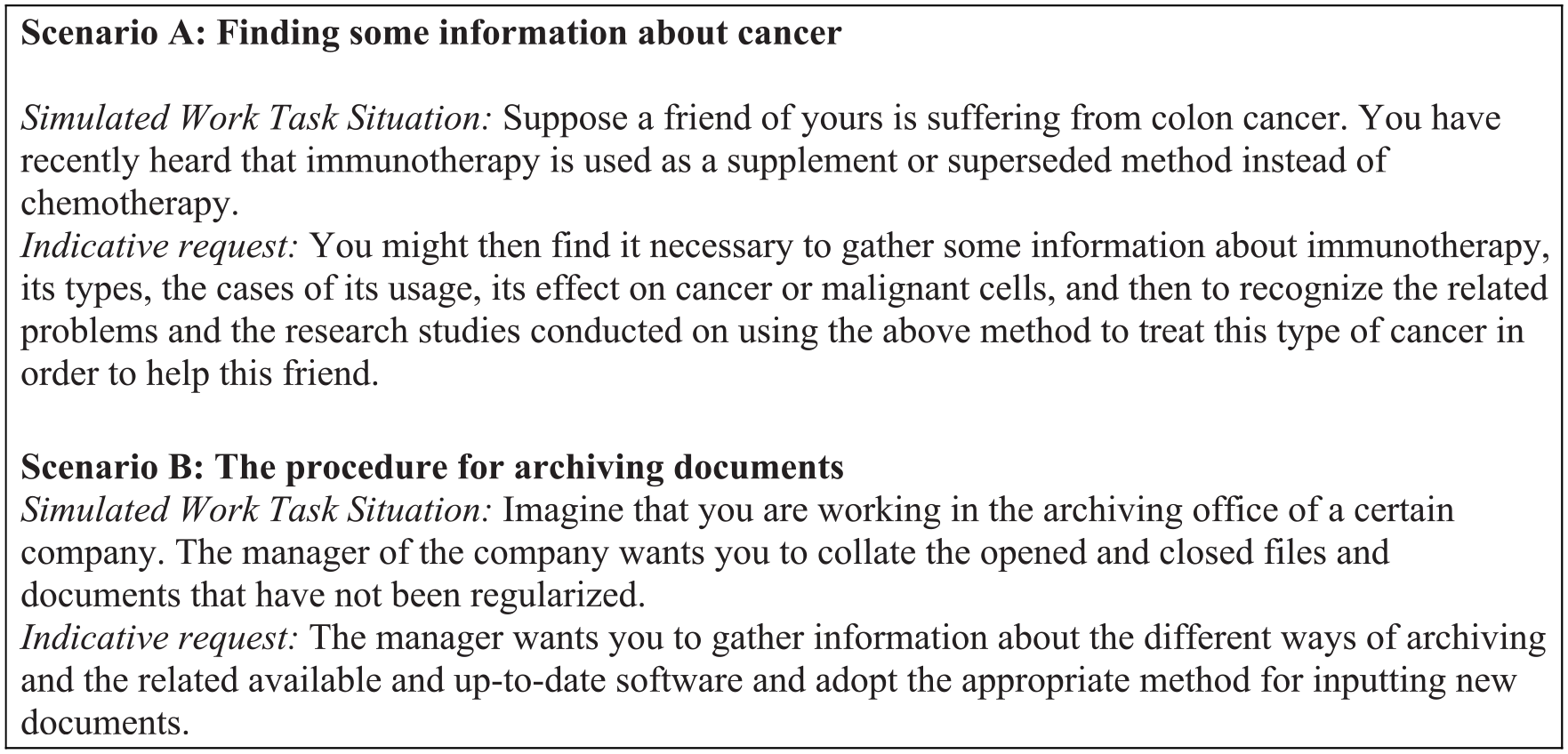
Simulated work task situations.
The scenarios were chosen generally so that participants from different subject groups could search for information. The first task was performed without using mind mapping and the second task was performed in a second session using mind mapping. Before the second task, participants were taught how to use mind mapping in a short workshop.
After completing both search sessions, participants completed a satisfaction questionnaire about the searching processes. The questionnaire was designed to measure participants’ general level of satisfaction with their searches. Factors identified in the information retrieval literature on user satisfaction informed the design of the survey. The content and face validity of the questionnaire was confirmed by information science experts. Cronbach’s alpha of 0.882 confirmed the reliability of the questionnaire.
At the end of the second search session (using mind map) and after the completion of a questionnaire about satisfaction with the search process, short semi-structured interviews were carried out with the participants. These short interviews were conducted only to capture participants’ views about the usefulness of the mind map for developing their information needs. The team members analysed each interview, and the consistency of interpretation was regularly checked through team discussion and cross comparison. The interview data were analysed by thematic content analysis in order to identify common themes and views on mind map in information retrieval process. The thematic analysis included these steps: familiarisation, in which audio files of the interviews were transcribed and read carefully, coding, generating and reviewing the themes of the main points of the data. The themes were applied to interpret and provide context for the quantitative data.
5. Findings
Participants were asked how satisfied they were with different aspects of the search process using a 5-point Likert-type scale of ‘not satisfied at all’ (1) to ‘very satisfied’ (5). Table 1 shows the mean value of their satisfaction with different aspects. Given the 5-point scale, number 3 was considered the expected average for the answers. SD is the standard deviation, and t is the value of one sample t-test. For the items where the t-test was significant, indicates that the mean of the variable is meaningfully higher or lower than 3 (expected average).
Satisfaction with searching with and without mind map (d.f. = 29).
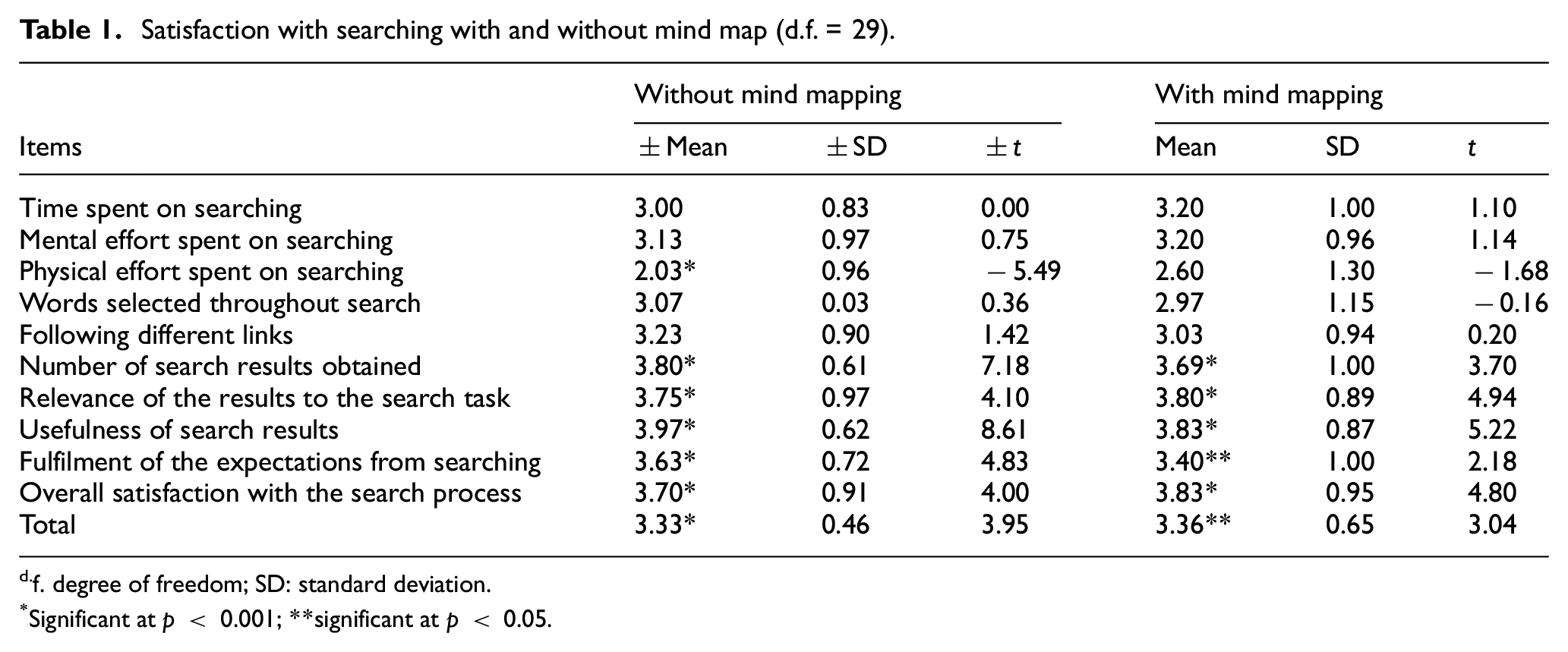
d.f. degree of freedom; SD: standard deviation.
Significant at p < 0.001; **significant at p < 0.05.
As Table 1 indicates, satisfaction with different aspects of the search process both without and with mind mapping was above the expected average, except in the case of physical effort spent on searching which was below the average in both cases (2.03 without and 2.60 with mind mapping). Surprisingly, the satisfaction with the words selected throughout the search was below the average (2.97) with mind mapping and below the satisfaction without mind mapping (3.07).
To find out if there were any statistically significant differences between satisfaction scores for the two tasks, paired samples t-tests were conducted after checking for the normality of the data. As the data indicate, despite the fact that the mean values show more users’ satisfaction with most of the search aspects in the session with mind mapping in comparison to the session without mind mapping, these differences were not statistically significant. The exception was the physical effort spent on searching where satisfaction was higher in the session with mind mapping (2.60) compared with the session without mind mapping (2.03). However, both values were below the expected average, which shows the users were not happy with the amount of physical effort they had to spend on searching.
In contrast, the absence of mind maps increased their satisfaction with ‘choosing search words and phrases’ as well as ‘following links through’ interaction with information systems. The above finding revealed that mental involvement occurred for the identification and comprehension of the information need in the search phase and during interacting with the system and with the brainstorming resulting from that the system, while, on the other hand, using a mental map, identification and understanding the need occurred before the search began and during the stage when the user felt the information need (Further research needs to be conducted on this using a larger population sample.). In fact, users were more satisfied with their interaction with the search system when they did not use the mind map. This could be due to the discovery more search terms and following more links. Also it might be because mind map hinders serendipity or because the user will enjoy the benefits of interaction with the information system. A dependent t-test was used in order to compare the amounts of satisfaction in the first and second stages, the results of which are displayed in Table 2.
Comparison of satisfaction with searching with and without mind map (paired samples t-test) (d.f. = 29).

SD: standard deviation.
In the short interviews carried out after the completion of the search tasks, participants described using mind maps as both desirable and useful. But they felt that the lack of experience in using mind mapping had an impact on how easily and effectively they could use mind mapping for the search tasks.
6. Discussion and conclusion
Searching for information is more effective when the individual has an organised mind about the information problem. Lack of an organised mind might result in dissatisfaction with search results and confusion and users might give up before achieving the desired outcome.
A mind map is an approach to the organisation of the human mind that prepares the ground for thinking about the problem and the information need before searching. It can lead to more efficient decision-making. Drawing a mind map means using the tools with which the individual outlines major and minor ideas, establishes relationships among them and prioritises them. Outlining the main ideas in the centre, followed by setting up branches, adding notes, using various lines and finally, developing a link between the mind and the world outside the mind, in the same manner, observed in texts, creates a depth and breadth that is not provided by a simple list. As Buzan and Buzan [56] stated, a mind map increases the potential of the brain in establishing relationships between concepts and enhances learning and creativity.
This study examined the potential of the mind map in helping users to explore and identify intrinsic information needs. To this aim, the research addressed the effectiveness of this approach in needs analysis and how it influences search satisfaction. The interviews revealed that users identified mind map as a useful assisting tool in information retrieval. Past studies [38,40,42,43] have found mind maps to be a useful practical tool. Research by Fidel [57,58] and Sanatjoo [59] has also confirmed the usefulness of assisting tools for searching. A study by Ayed et al. [38] confirmed the usefulness of mind maps in information retrieval.
However, the result did not show any meaningful advantage for using mind map in the search process. Potentially, with the use of mind mapping, some of the mental involvement and cognitive load might shift to the pre-search stage. This can protect users against deviations that may occur while they interact with the system, whereby information needs may change. Moreover, a mind map could help users think about and recognise their information needs before starting the search, and therefore, avoid immature or poor searching that can happen as a result of ill-conversion of information needs to demands or compromised needs. In fact, the use of mind mapping at the beginning of the search process can expand what Ingwersen [16,24] called pre-search stage (i.e. the definition of concepts and keywords in the mind). Taylor [17] called this stage the explanation of visceral information needs and Roberts [12] called it the explanation of desire. As a result of the expansion of this stage, search terms change less in the search process. Both Ingwersen [16,24] and Case [14] emphasised the importance of this stage and the need for more research on it.
However, using a mind map can also have drawbacks for information retrieval. For instance, it might decrease the interaction with the search system and increase the overall cognitive load. More research is needed to better understand the negative aspects of the use of mind maps. Most of past research on the interaction in information retrieval has focused on its positive aspects. According to Harter [3], interaction sometimes distorts the user from the main search path. This is where using a mind map might be helpful as it helps keep the user on the main search path.
The research had some limitations. The small sample size might have had an impact on the statistical tests of significance. Also the fact that mind mapping was a separate tool and not integrated in the search system and required some learning might have affected the result as the use of mind mapping in this way would not be as smooth and effective as it is expected to be for a desirable search experience.
The researchers propose integrating mind mapping tools in information systems to help users to recognise and address their real information needs. This will make information systems more user-oriented, which is needed nowadays given that the advances in information technologies have resulted in disintermediation.
This article evaluated the effectiveness of mind mapping in the process of evolving visceral information into compromised information needs. The presupposition of this study was that as intermediaries are eliminated, then a strategy is needed to help users get an accurate understanding of their information needs, choosing the correct search terms, and linking the concepts to their information needs. Therefore, in the current research, the mind mapping technique was used and its effectiveness was assessed. Although the statistics showed no significant difference between using mind map and not using it for search tasks except for physical effort spent on searching, users thought that mind maps can be a helpful technique. It can help users overcome the challenges that they face due to the inadequate understanding of their information needs.
Further research is needed in order to gain a better understanding of the impact of mind mapping on the process of information retrieval and the evolution of information needs. Since this was one of the first studies on the benefits of mind mapping for the refinement of information needs, we considered information needs in general. Thus, there is an obvious need to examine the application of mind mapping technique for different types of information needs.
Footnotes
Declaration of conflicting interests
The author(s) declared no potential conflicts of interest with respect to the research, authorship and/or publication of this article.
Funding
The author(s) received no financial support for the research, authorship and/or publication of this article.
