




Abstract
Traditional online communities suffer from false, repetitive or low-level content, with blockchain technology able to solve these problems. Specifically, the incentive mechanism is the blockchain’s core value, including positive and negative incentive mechanisms. The former strengthens people’s behaviour positively, while the latter, on the contrary, adopts mandatory methods such as punishment to eliminate the occurrence of certain types of behaviour. The negative incentive mechanism is the key factor to solve the problems presented above that traditional online communities face. Specifically, this article develops a solution that utilises the negative incentive mechanism, based on the classic infectious disease model (SIR model), introduces smart nodes, puts forward the SSIR model of information dissemination in the blockchain network community, and establishes a set of differential equations reflecting the information dissemination rules. Based on the parameter assumption and solving the equations with MATLAB, this article compares and reveals the changes of different user types on the SIR and SSIR models. Furthermore, we utilise the data collected from the Steemit blockchain community and Sina Weibo platform and apply the Social Network Analysis method to compare and analyse the information dissemination between the blockchain and the traditional network community. The research results highlight that the negative incentive mechanism in the blockchain network community affords a more rational behaviour of user information dissemination, a simpler interaction between users, and reducing to a certain extent the dissemination of ‘distorted’ or ‘uncertain’ information.
1. Introduction
With the rapid development of network information technology, the network community has become an important platform for organisations and individuals to share knowledge. However, due to lacking an effective incentive mechanism, the traditional online community suffers from several problems such as the low willingness of users to share knowledge, the platform being overwhelmed by fragmented and low-level repeated content, and the inability to guarantee the quality of the platform’s content. Blockchain is regarded as an important technology to reshape Internet Ecology, and its unique advantages provide an effective method to solve the above problems in the online community. An incentive mechanism includes positive and negative incentives, the core value of blockchain, and the key element to solve the above problems [1,2]. However, the incentive mechanism still poses some open research questions such as how the blockchain’s incentive mechanism drives users to participate in community activities, how the positive and negative incentive mechanism affects the blockchain network community’s information dissemination, and how the blockchain network community differs from the traditional network community in information dissemination due to the role of the incentive mechanism.
Hence, spurred by the advantages of the negative incentive mechanism, this article constructs the theoretical information dissemination model for the blockchain network community and then analyses and verifies the related information dissemination features based on the Steemit and traditional network community data.
The remainder of this work is as follows: Chapter 2 presents the literature review, focusing on the online community’s information dissemination and the blockchain’s incentive mechanism. Chapter 3 expounds the content and function of blockchain’s incentive mechanism, adds smart nodes to the SIR model, and constructs the SSIR model for the blockchain network community information dissemination. By solving the SIR and SSIR differential equations, this article theoretically analyses the information dissemination differences between the blockchain and traditional network communities. Chapter 4 utilises the Social Network Analysis method to analyse the information dissemination characteristics of the blockchain network community, based on the Steemit community and Microblog platform data and challenges the conclusions of Chapter 3. Finally, Chapter 5 summarises this work, presents our methods’ shortcomings and suggests future research directions.
2. Relevant theories and research
2.1. Information dissemination model of online community
Information dissemination refers to transferring information from a sending source to a receiving source with the help of certain media. Lasswell first developed an information communication process and suggested its five basic elements: disseminator, communication content, communication media, communication audience and communication effect [3]. Lasswell’s work is one of the classic achievements of early communication research. To solve the problem of the no feedback mechanism, Riley suggested a new communication model appropriate for mass communication and social systems that focussed on the information feedback during the information exchange process [4]. Maletzke combined the five elements of the communication process and added media constraints, making the research on information communication more systematic and reasonable [5]. Overall, the above models laid the theoretical foundation for network information dissemination research.
To study the transmission law of infectious diseases, Kermack and McKendrick employed a differential dynamics method and created the classic infectious disease models of SIS and SIR [6]. Given that the network structure of the infectious disease model is very similar to the community network, researchers transplanted the infectious disease model into the community network. They developed the SEIR model [7], the SIRS Internet users’ emotional infection model [8], the SCIR public opinion communication model [9] and the improved SEIR model [10]. However, some scholars argue on these improved models. For example, Zhou [11] claimed that there is no latent node in the communication environment of a Microblog network, and thus applying the SEIR model to public opinion communication is not valid. Consequently, not all improved models are considered to be effective and applicable. Nevertheless, there is no doubt that SIR is the most basic model for community information communication research, and therefore, improvements based on the SIR model still pose the current research direction for community information communication.
2.2. Blockchain incentive mechanism
The incentive mechanism is one of the core blockchain processes, which is currently a hot research topic. For instance, He et al. summarised the research status of the incentive mechanism based on a blockchain that included a transaction form utilising the classification and evaluation standards of the incentive mechanism [2] and comprehensively combed the blockchain’s incentive mechanism. The blockchain’s incentive mechanism design and application are divided into the bottom and application incentive mechanisms. The former refers to the issue of virtual currency motivating the user’s behaviour when designing the blockchain consensus protocol, such as the incentive mechanism based on the POW consensus protocol in Bitcoin [12–14] and the POS consensus protocol in Ethereum [15–19]. The incentive mechanism of the application layer refers to using the blockchain’s characteristics to design an incentive mechanism for its application after the blockchain is constructed to mobilise the users’ enthusiasm. For example, Wu designed a blockchain-based incentive scheme for differential scoring appropriate for recommendation system and verified the scheme’s effectiveness through simulation experiments [20]. Wang et al. [21] designed an incentive scheme for user privacy protection in blockchain-based group intelligence sensing applications, aiming to protect privacy by issuing cryptocurrency to reward high contribution users. Li [22] proposed a group intelligence perception incentive framework based on blockchain to solve the problem of third-party authority centres abusing user information, system failure or being attacked by attackers, and verified the security, effectiveness and feasibility of the developed incentive scheme. From the existing literature, it is evident that a blockchain incentive mechanism is applicable in several fields.
Regarding the relationship between the traditional online community rewards and the users’ sharing behaviour in the community, existing research mainly provides three views on the community rewards: promoting users’ sharing behaviour [23–25], having a negative effect on users’ sharing behaviour [26,27] and having no significant effect on users’ sharing behaviour [28–30]. Considering the traditional community, there is no unified conclusion on the relationship between community reward and sharing behaviour. Current research mainly focuses on the positive incentive’s role on knowledge sharing, while there is a lack of relevant research on the negative incentive.
To sum up, the incentive mechanism is blockchain’s core feature. Currently, there is a lack of relevant theoretical and empirical research on the impact of the negative incentive mechanism on the information dissemination of the blockchain network community. Nevertheless, utilising the SIR model to study information dissemination in the online community has a good theoretical basis, while the existing literature suggesting improved SIR models provides a good reference value for the research conducted in this article. Given the above situation, this article conducts an in-depth study on the information dissemination of the blockchain network community under the influence of the negative incentive mechanism based on the improved SIR model.
3. Information dissemination model of the blockchain network community under the action of incentive mechanism
3.1. Contents of the blockchain community incentive mechanism
The blockchain network community gives certain token or reputation value encouragement according to the user’s contribution. Specifically, if users publish authentic information, it is considered that the information enriches the community’s resources, and depending on the information quality, the publisher obtains some reward and support. On the contrary, if the information created or disseminated is not authentic or the disseminator is distorted, the creator and the disseminator will be punished [31].
Although some traditional online communities have their incentives, these still have the following differences compared with blockchain online communities:
(1) Considering rewards, traditional online communities are mainly rewarded with points, membership level and reputation value improvement. These rewards can only be used within the community without generating a direct economic value. In addition to the above incentives, blockchain communities are also stimulated by tokens, which be exchanged for cash directly or indirectly in the secondary market (exchange). In addition, in the blockchain community, the amount of reward received by users is uncertain. Moreover, the community’s behaviour is calculated through the pre-agreed reward distribution scheme that determines the user’s specific reward amount and is primarily based on the user’s contribution.
(2) The blockchain community has a relatively perfect punishment mechanism in terms of punishment. Due to blockchain’s distributed characteristics, users’ violations are easier to find. Once the violations are confirmed, users will suffer token and reputation losses, and their violations may be recorded in the blockchain forever. Opposing, the traditional network community is a centralised platform, where the users’ information audit is operated by the management department, governed by inefficiency, and thus a large number of violations cannot be found.
3.2. Blockchain network community information dissemination model
3.2.1. Traditional infectious disease model
As mentioned above, information dissemination in online communities is similar to the spread of infectious diseases among people, with the SIR model being the most classic and basic model. In the SIR model, the study population is divided into three groups: Susceptible (S), Infected (I) and Recovered (R), with the related transmission model illustrated in Figure 1.

SIR propagation model.
In the network community, the susceptible group S, the infected group I and the Recovered group R in the infectious disease model correspond to the uninformed node, the forwarding node and the immune node, respectively. An uninformed node is a state where users do not know the network information and may potentially spread information. The forwarding node means that it will spread the known information in the community in the current state, while the immune node is not interested in network messages and does not spread information temporarily [32–35].
Combined with Figure 1, it is assumed that the information dissemination rules of the online community are as follows:
(1) The uninformed node changes into an informed node with probability
(2) The forwarding node becomes an immune node with probability
It is assumed that the total population in this model remains unchanged, that is, the number of community users remains unchanged for a short period. Suppose at time t, the S, I and R node proportions be S(t), I(t) and R(t), respectively, with
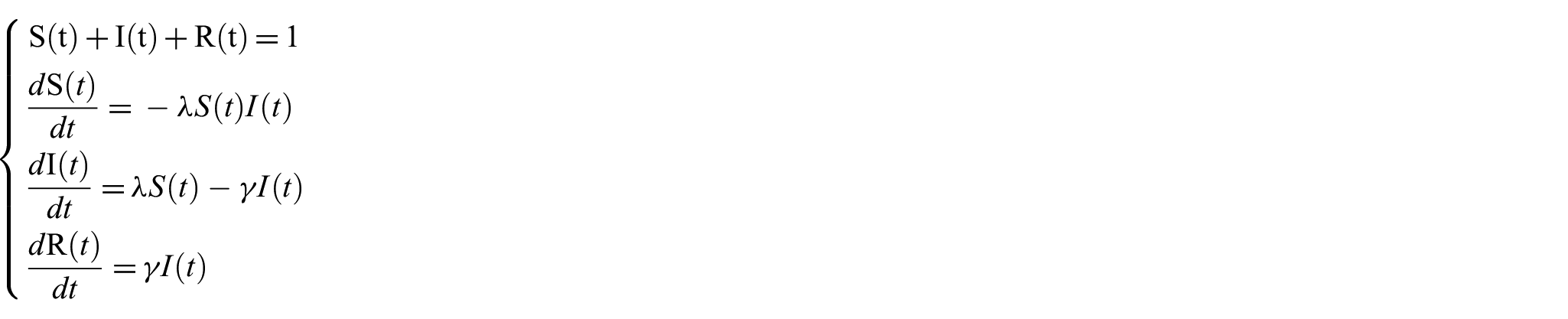
where
3.2.2. Model proposed in this article
Due to the incentive mechanism in the blockchain network community, spreading false information imposes reputation and economic losses. Therefore, compared with the traditional community, the blockchain network community users treat the obtained information more carefully and fully consider the advantages and disadvantages before making their communication strategies. According to the actual information dissemination process and to better represent the above users’ behaviour, this article adds a Smart node to the traditional SIR model and suggests the SSIR model. The state changes of the four-node types in SSIR are illustrated in Figure 2.

Information dissemination process of SSIR model.
Compared with the SIR model, the information dissemination of the SSIR model is different in the following two points:
(1) The uninformed node changes into a smart node with probability
(2) After obtaining the information, the smart node makes its communication strategy considering a
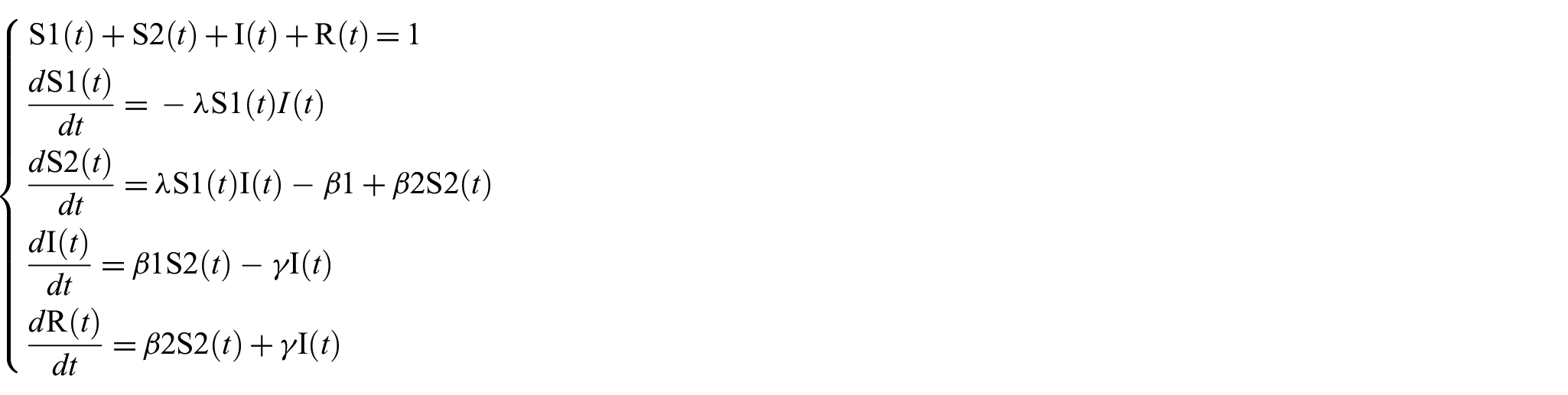
In the above equations, the meaning of the first two equations is the same as in section “Traditional infectious disease model”. In the third equation,
3.3. Comparing the SSIR and SIR models
To analyse the impact of the SSIR and SIR models on the node users, we utilise for both methods the same parameters when solving the differential equations. Part of smart node S2 is converted to a forwarding node I (with a
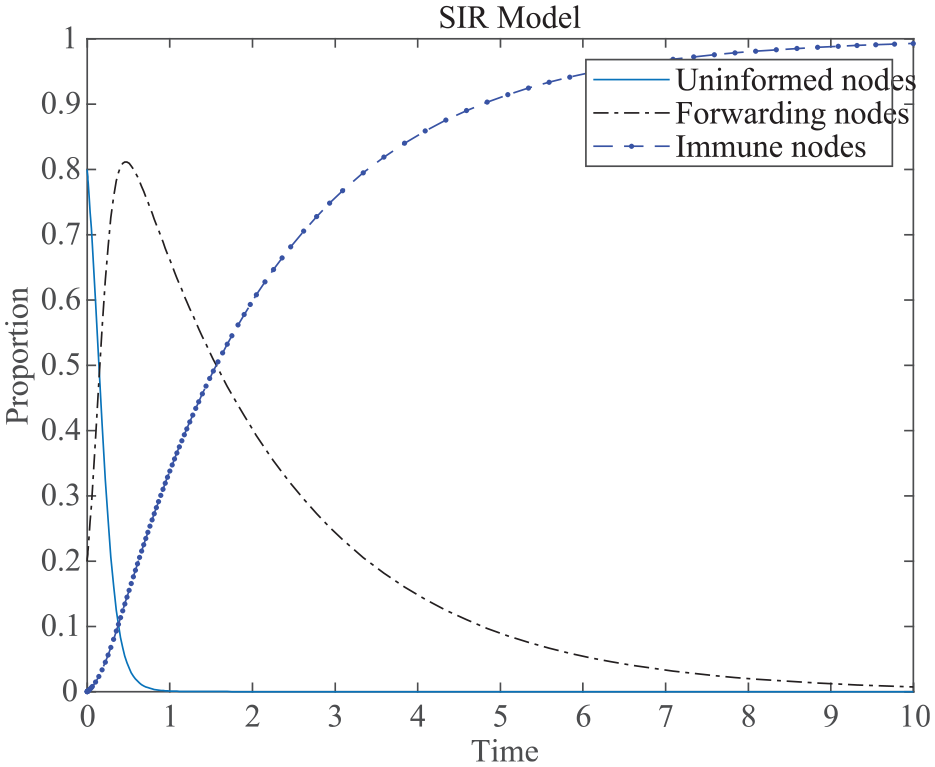
User change trend under the SIR model.
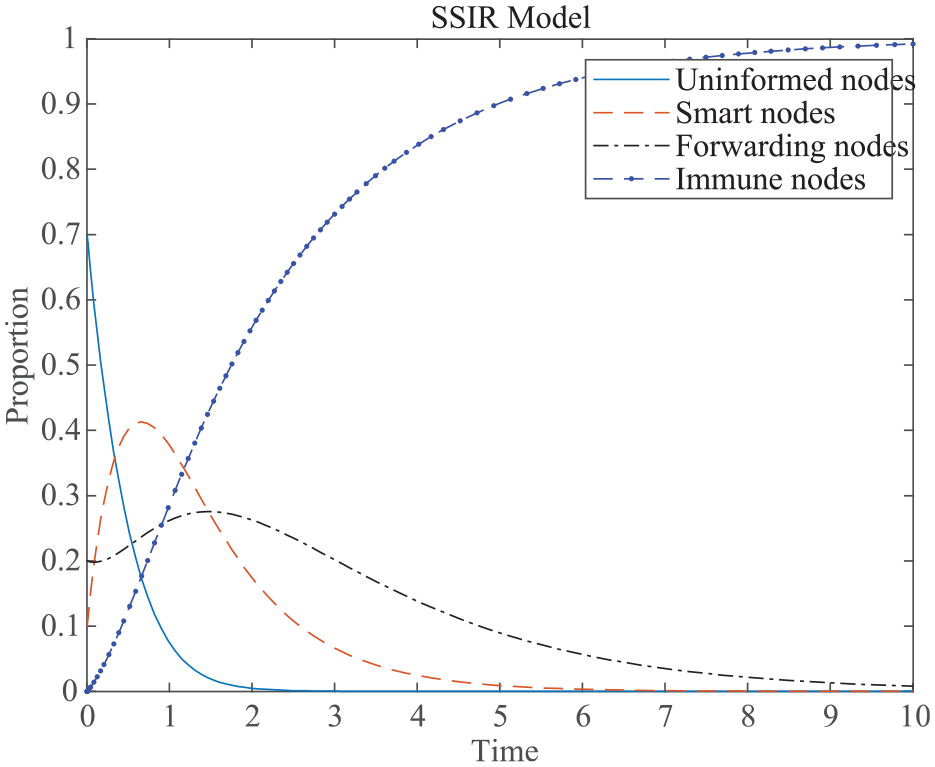
User change trend under the SSIR model.
Figures 3 and 4 highlight that adding smart nodes reduces the maximum number of forwarding users in the blockchain network community compared with the traditional network community and that the overall curve is more stable. This reveals that the information forwarding behaviour of the blockchain network community is more rational, and the interaction between users is simpler than that in traditional communities [36]. In fact, in the blockchain community, users can obtain certain benefits by forwarding ‘true’ information, but even with such ‘temptation’, users still rarely choose to forward information, as users are not sure about the authenticity of the information. If they do not forward the information, they can avoid the loss of credibility and token value. Therefore, the trend chart in Figure 4 shows that blockchain’s negative incentive mechanism can better curb the dissemination of ‘uncertain’ information in the community.
Next, we alter the
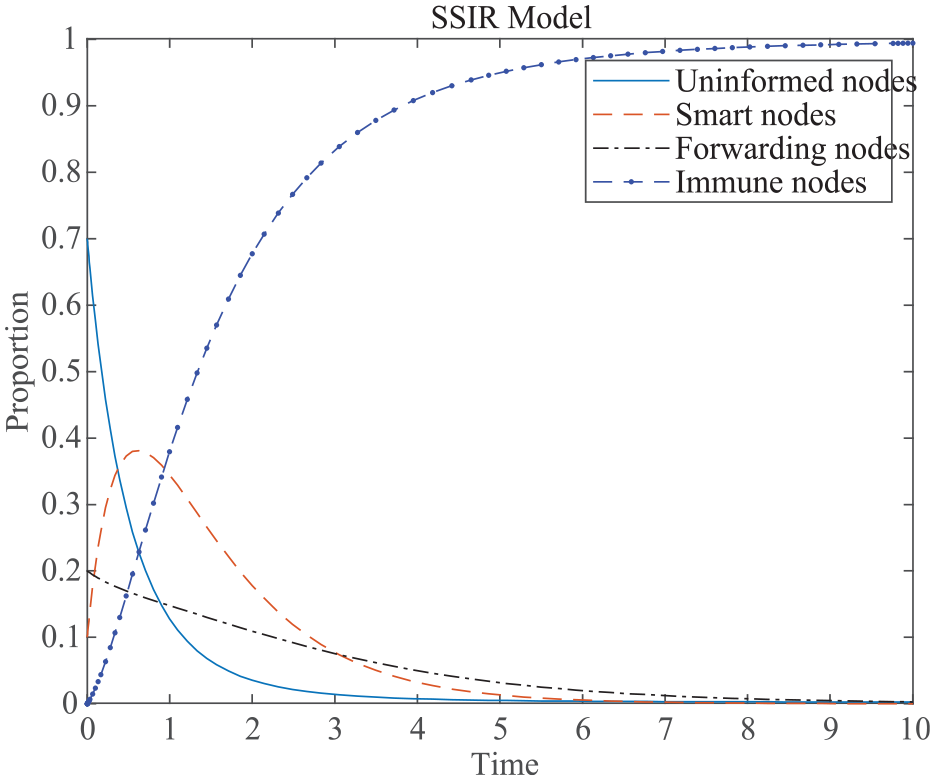
Node changes for
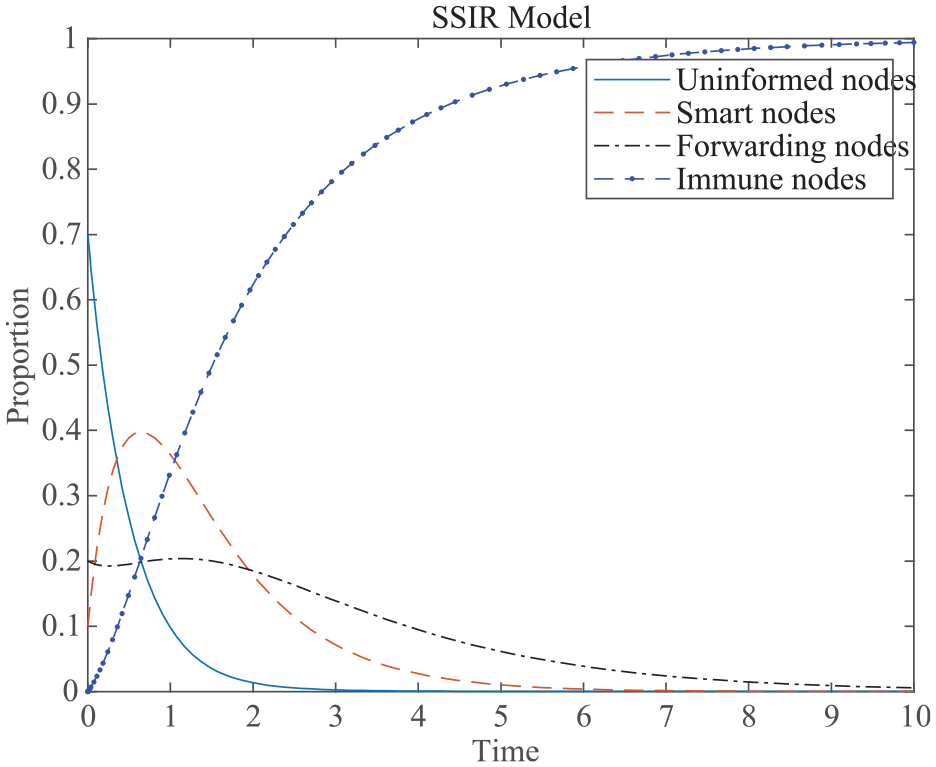
Node changes for
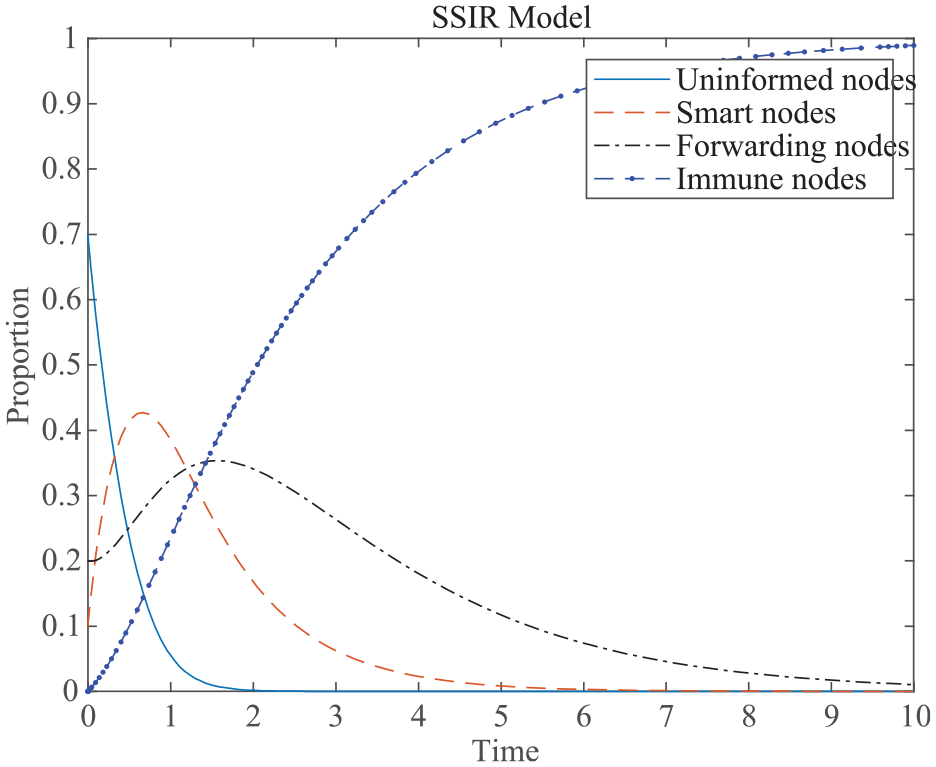
Node changes for
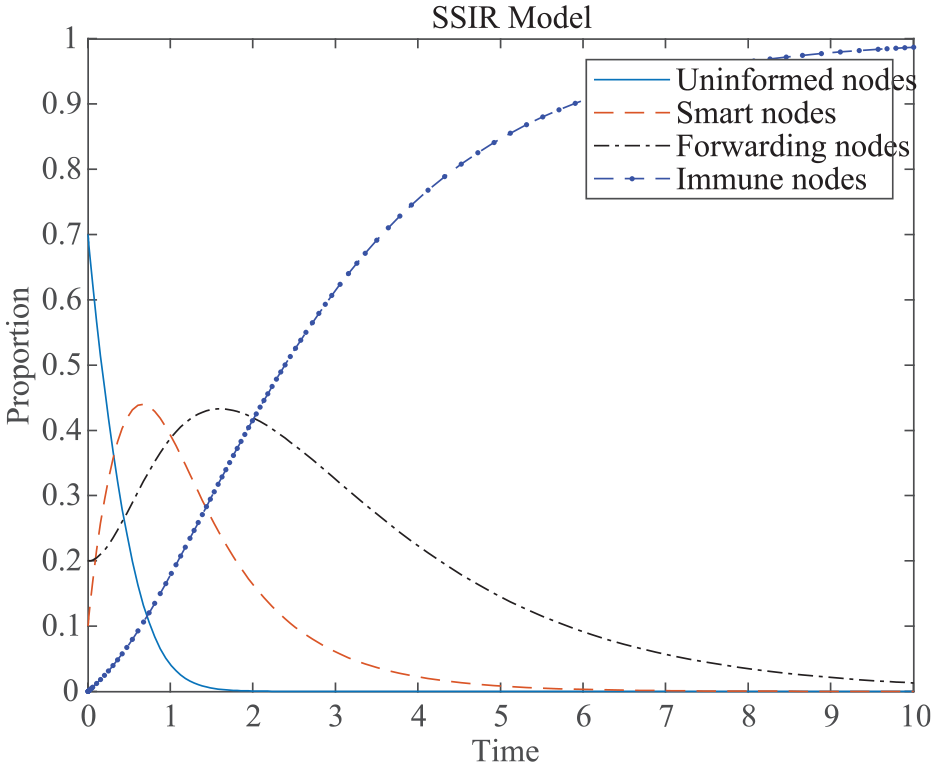
Node changes for
Figures 5–8 highlight that when
4. Empirical research
4.1. Data sources
To further illustrate the differences in information dissemination between the blockchain and traditional online communities and verify the conclusions of the previous chapter, we utilise the Steemit social platform and the Sina Weibo platform, that is, Microblog for short, for comparison. Steemit is a high-quality content creation and sharing community based on blockchain technology. It rewards social network participants through Steem tokens. On the Steemit platform, the network information published and shared by users is stored in the blockchain and involves a set of incentive mechanisms (including positive and negative incentive schemes) to act on the production and dissemination of information [37,38]. The Steemit community generates a block every 3 s, and each block produces a certain number of tokens priced by Stemm. Seventy-five percent of these tokens are sent to the content incentive pool in the form of SP (Stemm power) or SBD (steemit blockchain dollar), which are then distributed by the system to content producers and reviewers (75% to the producers and 25% to users). In order to obtain higher token rewards, users will try to choose high-quality resources when publishing and forwarding relevant information. Each user has a reputation value, which can only be gradually increased by posting, commenting and liking. Suppose the information content forwarded or supported by a user is a bad resource. In that case, the publisher will be deducted from the corresponding token, and the reputation value of the users’ forwarding and liking will be deducted from the corresponding reputation value. Therefore, users in the Steemit social network will be more cautious on releasing and forwarding information, and thus less random forwarding of unverified information occurs. Although the Microblog platform has its member point system, users can accumulate points through posting. However, these points lack practical value, and hence, their punishment mechanism is not obvious. In a word, compared with the social network of Steemit blockchain, Microblog lacks a reward and punishment mechanism.
4.2. Overall situation of information dissemination
We utilise ‘bitcoin’ as the keyword to search on the Steemit and Microblog platforms and collect data according to fields such as title, publisher, time, forwarder, likes and responders. We ultimately obtain 5387 original sample data from the Steemit platform and 5349 from the Microblog platform.
To meet the empirical research data requirements, this article cleans the data, deletes missing values, duplicate fields and garbled data, and retains 5218 data from the Steemit platform and 5185 data from the Microblog platform as the official data set.
This article considers users as the nodes and their forwarding relationships, commenting and liking as the edges, and employs the Gephi software to draw the information dissemination cloud picture between the Steemit and Microblog platforms [39], as illustrated in Figures 9 and 10, respectively.
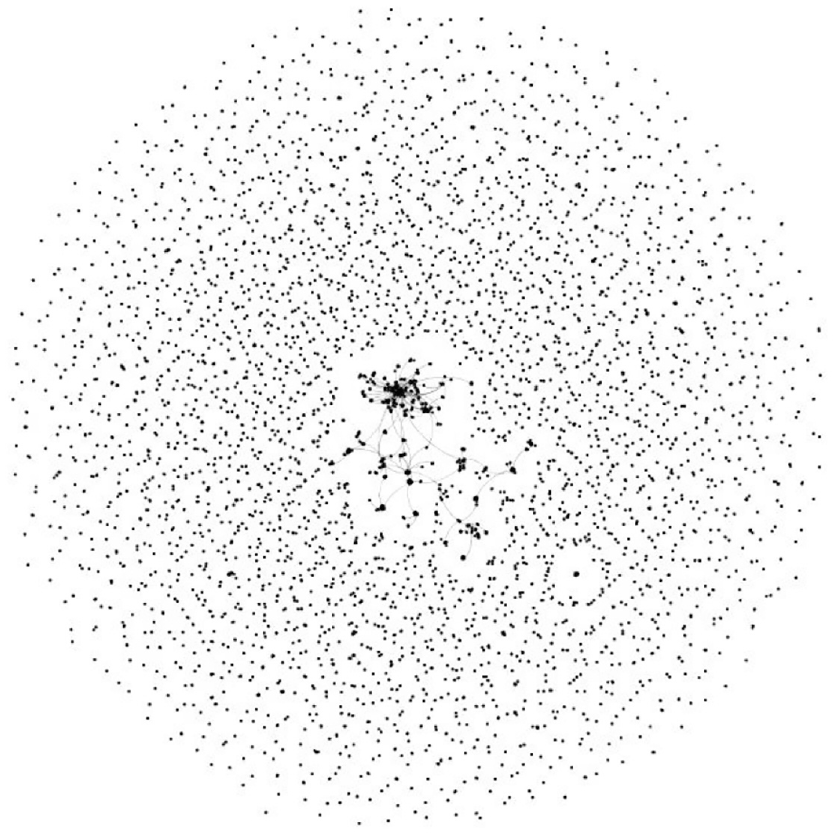
Cloud picture of the information dissemination in a blockchain community.

Cloud picture of the information dissemination in a traditional community.
In both figures presented above, the dots represent the user nodes, the connections between the nodes are the information interaction relationships between users, and the thicker the connection, the more frequent the interaction. Figure 9 reveals a large number of nodes in the blockchain community. However, their connections do not differ much, and the node distribution is relatively scattered, indicating that although the number of users disseminating information in the blockchain community is large, the number of core users is small, the connection between nodes is small, the information interaction between nodes is not close enough, and the amount forwarded information is relatively small. It again shows that the relationship between users in the blockchain community is more rational than that in a traditional community due to controlling the spread of ‘uncertain’ information, helping reduce false or junk information, and highlighting the platform’s high-quality content.
4.3. Social network analysis of blockchain information dissemination structure
Social network analysis is a quantitative analysis method developed by sociologists utilising mathematical methods and graph theory to study the relationship between social actors. In the network community, the social network analysis method explores the topological structure characteristics of user networks and analyzes the impact of knowledge sharing and information dissemination [40–42]. Its core indicators include degree centrality, betweenness centrality and average clustering coefficient.
4.3.1. Degree centrality
Degree centrality refers to the number of nodes directly connected to a node, including in-degree and out-degree. In-degree refers to the number of other nodes pointing to a node, and out-degree is the number of nodes pointing to other nodes. The greater a node’s in-degree, the larger its influence. Accordingly, the greater a node’s out-degree, the more active is the node in the network [43,44].
We import the sample data obtained from the Steemit community and the Microblog platform into Gephi software to obtain the in-degree and out-degree data of the top-10 users, presented in Tables 1 and 2, respectively.
Blockchain community users’ out/in degree (TOP10).

Microblog platform users’ out/in degree (TOP10).

Tables 1 and 2 reveal that the user cardinality in the blockchain community sample data is far less than the traditional network community. Moreover, in the blockchain online community, the users’ communication behaviour is more rational due to the negative incentive mechanism. Compared with the random forwarding behaviour of users in traditional network communities, users in blockchain network communities often respond based on determining the authenticity and information value. To further verify the above conclusions, we calculate the average out-degree to in-degree ratio of the sample data, as shown in Table 3. The results highlight that the average ratio on the Steemit platform is less than the corresponding ratio on the Microblog platform, revealing that users are more cautious in disseminating information on the Steemit platform than on the Microblog platform.
Average number of out/in degrees of sample data.

4.3.2. Betweenness centrality
Betweenness centrality is an index to describe the importance of nodes by the number of shortest paths passing through a node [45]. For the above sample data, the proportion of users, whose centrality is 0, is 78.4% in the Steemit community and 25.7% in the Microblog platform. It can be seen that under the action of the negative incentive mechanism, compared with the Microblog platform, there are fewer connections between users and more rational information dissemination behaviour in the Steemit community.
4.3.3. Average clustering coefficient
The clustering coefficient reflects the degree of clustering between nodes in a network, representing the interconnection between a node’s adjacent nodes. Assuming a node has k edges, the maximum number of possible edges between the nodes (k) connected by these K edges is K × (K − 1)/2. The aggregation coefficient of this node is defined as the score obtained by dividing the actual number of edges by the maximum number of possible edges. By calculating the average clustering coefficient of the above sample data, the value on the Steemit community is 0.0263, and on the Microblog platform it is 0.0609. Since the number of nodes of the two platforms is roughly the same in the sample data, we conclude there are fewer connections and simpler relationships between the Steemit community users than those in the Microblog platform.
5. Conclusion
Incentive mechanisms, including positive and negative incentives, play an important role in the blockchain system and have been successfully applied in many fields. For online communities, the incentive mechanism is an important means to solve the problems of the low willingness of users to share knowledge and the low quality of published information. To solve this concern, this article adds smart nodes to the traditional SIR model, develops the SSIR model appropriate for blockchain network community information dissemination and compares the information dissemination characteristics between the SSIR and SIR models. At the same time, our method crawls data from the Steemit community and Microblog platform and performs empirical research utilising social network analysis methods. From our analysis, the following conclusions are made:
(1) The users’ forwarding behaviour in the blockchain network community is more rational, as due to the punishment mechanism, the interaction between users becomes simpler. Moreover, the blockchain network community has fewer forwarding users than the traditional network community.
(2) Blockchain’s negative incentive mechanism can control the dissemination of ‘distorted’ or ‘uncertain’ information to a certain extent. This is because forwarding false information imposes token or reputation loss, and thus users prefer to directly choose immunity for uncertain information, that is, in the SSIR model the smart node changes to an immune node.
It should be noted that the conclusions are based on some assumptions, such as that all users are rational people, users care about their interests, and a user’s behaviour is irrelevant to the platform within a certain amount of data between the Steemit and Microblog communities. Besides, the proposed method has some limitations. For example, the amount of data collected in the empirical analysis is limited, and the object is only limited to Steemit and Sina Microblog. Hence, future work shall consider more data from more communities, ensuring our conclusions’ accuracy and objectivity.
Footnotes
Declaration of conflicting interests
The author(s) declared no potential conflicts of interest with respect to the research, authorship and/or publication of this article.
Funding
The author(s) disclosed receipt of the following financial support for the research, authorship and/or publication of this article: The new generation information technology innovation project of China University Industry Research Innovation Fund (Project Name: Research on MOOC personalised recommendation service innovation based on deep learning. Project No.: 2019ITA01013).
