



Abstract
In the digital age, the reading habits are gradually declining and poor reading skills are causing various informational and social challenges include lack of critical thinking and intellectual irresponsibility. The main objective of this study is to consolidate the published works to comprehend the influencing factors of reading culture. We examine the reading skills, reading habits and reading behaviour literature from 1991 to 2020 to measure the scope and depth of reading culture (RC) through bibliometric analysis and visualisation by utilising a VOSviewer software based on Web of Science database. These selected 1139 articles are classified according to year of publication, author, the country of publications and author affiliation. The analysis provided insights about the RC publication trends as the most productive years are 2017 and 2019. The United States, Spain and China are the leading countries contributing to reading culture-related publications. Jyväskylä University and Florida State University serve as the most productive institutions. Furthermore, we also conduct a thematic analysis based on the keywords to identify the components and influencing factors contributing to the reading culture. The four main components of the reading culture are identified as reading skills, behaviour, habits and factors. At the end, we provided propositions to support the reading culture and future research directions for the interest of Library and Information Science (LIS) professionals, academicians and researchers.
1. Introduction
Reading culture (RC) is a comprehensive term that depicts the environment, skills and habits that supports the reading. It has been an area of interest for information professional since the start of libraries and librarianship. The librarians continue seeking insights on reading habits [1–3], information-seeking behaviour [4], information resources and services usage patterns [5–8] of their users’ communities to improve library services.
A literature review highlighted that various studies published on reading, reading skills and reading habits, but there is no bibliometric study on RC; therefore, this study is novel in its scope. There is a need to provide a holistic view of the published research on the RC to understand the RC components and identify the research trends and gaps. This study used bibliometric research methods to analyse 30 years of research (1991–2020) on the RC. This study aims to provide insights into the RC research valuable domain for the researcher and practitioners. Further valuable contributions of this work are discussed here. First, it can help information professionals to identify the prominent authors, publication outlets, institutions and funding bodies working on the field of the RC. Second, the information professionals will gain a holistic overview of the RC literature to increase their understanding of the components contributing to RC. This can assist them in the progression of their research career in the reading domain. Finally, this research will guide information professionals with practical implications to shape the services for engaging and sustainable RC in the digital age.
The remainder of this article is arranged in sections. In section 2, a brief overview of the RC literature and its relationship with skills, habits, behaviour and influencing factors was explained. The research objectives and research questions are also presented here. Section 3 introduces the structured methodology, including information about the specific tools and techniques that are employed for this study. Section 4 provides a detailed analysis and an evaluation of the results under two main themes – productivity and thematic analysis. Section 6 summarises the results, provides proposition and discusses opportunities for future research.
2. Reading and RC
The historical evidence shows that prosperous human civilisations have developed learning habits. In the fourth millennium BC, the reading history relates to the beginning of the script [9]. In olden times, scholars, royals and religious bodies promoted the reading, impacting its importance [5] and reading means the act of a person who reads. In contrast, habit is another thing that an individual often does, and it is difficult to stop doing because not thinking rationally [10]. In the traditional understanding of reading, it means the ability to read any written text. However, advanced studies discussed multidimensional cognitive processes, including decrypting signs and symbols to develop meanings [9], leading to critical thinking. Reading thrives our minds, expands our vision towards progress [11] and help individuals to grow and to contribute to society. It is helpful to change our vision consistently and creates a new picture and understanding about things. It provides new abilities, makes humans acquainted with new realities, and affirms truth in a complex world [12]. Hence, it is vital to advancing and growing our brains’ activities to improve our lives [10]. Reading habits improve the reader’s personality, support personal and social adjustment, and serve as a form of reformation [13]. It is not only crucial for the development of any individual but also crucial for the progress of any community, society and nation. Farik et al. [10] discussed that reading is probably limited to classrooms in educational institutes, which is not the case. Instead, reading is a lifelong learning process that plays a significant role in each sphere of life like education, work and career, socio-cultural, health and wellbeing and so on.
Reading is often started at an early age with the help of parents or teachers. ‘Reading for pleasure’ is a term that can perform a significant role in a child’s mental expansion [14]. Teachers take pride in teaching reading skills to the student. They apply various strategies to achieve this goal. Reading strategies are thoughtful and goal-oriented endeavours to modify and control the reader’s struggles to decode text, construction of the meanings and words’ understandings [15]. Teachers also categorise the children according to the weaknesses in reading, and it can be helpful to the teachers in classroom planning for the learning of the specific students [11]. Similarly, parents invest in children’s reading habits by developing a family culture representing a distinctive combination of thinking pattern, behaviour, language, values and habits that having a great contribution to accomplishing a higher social prestige [16]. Parents can influence their children’s experience through sounds association, reading resources like books, letters and can increase their vocabulary and reading, writing habit [11]. The interaction is necessary between the teachers and parents for the development of reading habits of students [11,17].
Although reading is a personal routine, communal practices and culture impact the shaping of reading habits; hence, a study of RC is essential. There is no unified definition of RC, but it consists of components. Kamalova and Koletvinova [18] explained RC as an individual accomplishment, quantitative and qualitative indicators of consciousness, communication and activity both considered a product and a major factor for the development of a personality. They suggested that RC includes five aspects. (1) an organisation for context and sources for reading, (2) a clear, deep and accurate understanding of the text content, critical examination, accompanied by emotive empathy and original interpretation of the read work, (3) capabilities of readers to search and analysis text in multiple forms, that is, electronic documents,e-books, databases and search engines from the Internet and so on, (4) an understanding of a variety of reading methodologies ways and (5) RC of the reader is carried out in the activities of the reader as a manifestation of his compassion, co-creation, co-thinking with others in the public arena, subject to the laws of society and nature. The RC develops over time but requires persistent determination and a range of skills, behaviour and habits and affected by external factors, that is, access to reading resources, social and religious implications and so on. To effectively promote reading habits, behaviour and skills, RC must be made pleasurable and voluntary [12].
As one of the prominent stakeholders, libraries can play a vital role in developing and employing strategies to encourage RC. Other stakeholders such as communities, government bodies, teachers, organizations, parents, and individuals can also benefits from the libraries to support reading culture [19]. However, in the competitive age digital, libraries are facing challenges of declining reading habits and RC [9,20]. Palani [13] concerned that technology will take control of our lives and affect reading habits because people show little interest in any type of reading due to the influence of mass media. Therefore, it is important to understand the reading cultural domain. A literature search indicated that there is no comprehensive study that encompasses the RC. Therefore, a bibliometric study seems suitable to conduct analysis of existing literature and to identify directions for future research. Hence, this study is an original effort to map the domain of RC. Two main research objectives of this study are to measure the research productivity of research on RC and identify emerging research themes to establish the current research trends and identify the gaps for the future research. Thus, the following research questions (RQs) are explored in this study:
RQ1. What is the publication trend (number of articles by year) of RC?
RQ2. Where are the most influential publications (outlets, articles) of RC?
RQ3. Who are the most prolific contributors (authors, countries and institutions) of RC?
RQ4. What does existing research (themes, topics) inform about RC?
RQ5. Where can future research (avenues) explore to enrich our understanding of RC?
Bibliometric research methods are established now as a scientific field in various disciplines, and it has become an indispensable part of exploration assessment strategy [21]. Bibliometric strategies permit analysts to put together their discoveries concerning collected bibliographic information created by different researchers in the field [22,23]. These studies are helpful to encompass the range and scope of publication in a given field and increase understanding of research trends and gaps [23,24]. Through bibliometric methods, various aspects are quantitatively analysed for the ranking and measuring impact, that is, distinguished authors, studies, publication sources, regions and institutions.
3. Materials and methods
The search for articles was conducted in early 2021 and was guided by a systematic search strategy that included selecting a database, developing search query, filtration and screening (Figure 1). Data for the bibliometric analysis were assembled from the Science Citation Index database, Web of Science (Core Collection), on 18 February 2021. The searched query for this study is TI = (‘Reading habit*’) OR TI = (‘Reading factor*’) OR TI = (‘Reading Behaviour*’) OR TI = (‘Reading Skill*’) OR TI = (‘Reading Trend*’). A total of 1420 documents were found that covered all type of publications, that is, articles, proceeding papers, meeting abstract, book review, editorial material, review, letter, correction, news item, book chapters, note, poetry and fiction creator prose related to the subject. The searched documents were published in 18 different languages including three top languages as English (976 = 86%), Spanish (76 = 6.67%) and German (23 = 2.01%). Since it is a bibliometric review and the analysis is run on the title, abstract and author keywords available in English, all sources were included for the final analysis. Next, different filters were applied to exclude irrelevant resources at this stage, that is, the publication years 1991–2020 and duplication check. Later, a title, abstract and full-text screening were applied to ensure further data relevancy to RC. Through this careful analysis, 281 documents were excluded, and a total of 1139 results were selected for bibliometric analysis.
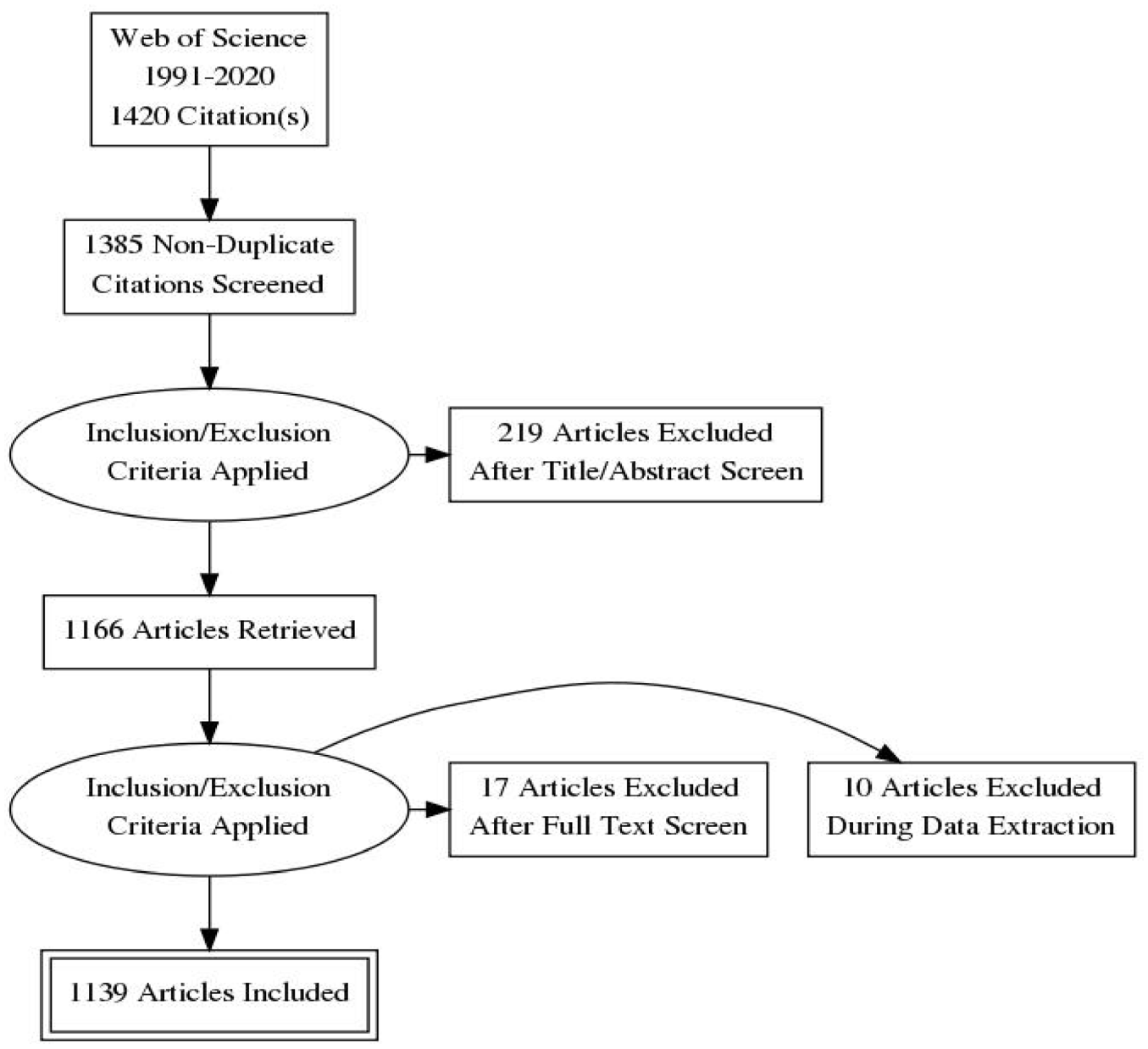
Data extraction and filtration process.
The data were downloaded and prepared for analysis through various bibliometric software (Figure 2), that is, Biblioshiny, VOSviewer, ScientoPy and MS Excel. VOSviewer was used to conduct a keyword co-occurrence analysis and a thematic analysis. The results of this analysis were refined in Excel for the word standardisation, that is, British and American spellings, singular and plural terms, abbreviated and whole terms. ‘ScientoPy’ was used for co-authorship analysis and organisational productivity reporting. ‘Biblioshiny’ was used to analyse authorship patron, a network of country collaboration and publication sources ranking by most published works on RC. Through the data analysis process, Excel was frequently used to clean data and to create final graphs.

Usage of bibliometric tools for analysis.
4. Results and discussion
This section analyses the research output over the past 30 years (1991–2020) on the RC and its components – reading skills, reading habits, reading behaviour and reading factors (Figure 4). The analysis is divided into two sections that address two research objectives (research productivity trends and research thematic trends) and five research questions.
4.1. Influential publications trends
This section provides insights into the publication trend by the distributions – yearly publications, top sources publishing research on RC, authorship trends and top article on the RC.
4.1.1. Yearly output
The yearly distribution of articles indicates that RC research has gained increasing scholarly interest over the last 30 years (Figure 3). The results showed that 2017 and 2019 are the years considered the highest 90 (7.902) publication years. The year 2018 is also remarkable with 75 (6.585) published document, and the minimum publications year is 1995 with low publications 8 (0.702). This growth in publication output on the RC shows a consistent scholarly interest and scope for further research in this area.

Yearly publications on digital culture 1991–2020.
4.1.2. Publication sources
The distribution of the articles in different publication sources showed (Table 1) that Reading and Writing are the most influential journal to publish on the RC. It started publishing working in 1991 and has published 32 works during the past 30 years, cited 894 times. The second important source of publication in the International Journal of Psychology is on the second number by a number of published works on RC. However, the second source to gain more citations for its publications is the Journal of Learning Disabilities.
Distribution of sources by rank of total publications (1991–2020).

TP: total publication; TC: total citation; PY: publication year; WoS(IF): web of science impact factor.
4.1.3. Top cited articles
An analysis of the top cited articles can guide researchers to position their research on the previous quality works. Table 2 provide a list of 10 top cited articles on the RC. The first two articles emphasise developing reading skills among preschool children [25,26].
Top cited articles on the reading culture (skills, behaviour and habits).

TC: total citation.
An analysis of the proportion of author was conducted to review the publication trends by different authors. Data show (Table 3) that 2926 authors published on the topics related to RC. The data analysis revealed that the one-time authorship trend is the highest 2588 (88.45). People who worked as co-authors 242 (8.27) are the second highest, and the least choice of authorship is 1 (0.03) who worked with 9 and 11 authors as combined authors. The following information shows the people having the interest to write as an individual author. Information about author productivity in Table 3 has been collected through Lotka’s law.
Distribution of publications by number of authors (1991–2020).

4.2. Influential contributors (authors, countries and institutions)
This section provides results from top authors, countries, institutions and funding agencies researching the RC and related topics.
4.2.1. Authors
An analysis of articles contributed by different authors on the RC indicated that Lyytinen H (total publication (TP) = 1993) and Nurmi JE (TP = 2002) are the top two productive authors with 12 publications each. Lerkkanen MK (TP = 2012) is a second productive author with 11 publications (Table 4).
Top 10 productive authors on the reading culture (1991–2020).

TC: total citation; TP: total publication; PY: publication year.
4.2.2. Institutions
An analysis of the research productivity by the institutions showed that an author from 1118 organisations published on RC (Table 5). The University of Jyvaskyla is on the top with the highest [25] TPs, followed by Florida State University is the second uppermost [10] contributor. Stanford University is also a notable organisation with [11] TP. With time, organisations became more productive in publications. Most institutions that contributed nine or fewer articles on RC are Georgia State University, Hacettepe University, the University of Gothenburg, the University of Minnesota, Tallinn University and University of Washington.
Distribution of published documents by top 10 organisations (1991–2020).

TP: total publication; AGR: average growth rate; ADY: average documents per year; PDLY: percentage of documents in last years.
4.2.3. Countries
The country-wise analysis revealed top research contributing countries on RC and related areas. The United States (318, 31.39%) have led in published documents, while the rest of the contributions are from various countries. The second highest productive country is Spain, 70 (6.91%), and the third is China, 55 (5.43%) (Table 6).
Distribution of published documents by top 10 counties (1991–2020).

TP: total publication; SCP: single country publication; MCP: multiple country publication.
4.2.4. Funding agencies
Funding is one of the main factors in academic research and an indicator to identify the policy focus. The data revealed that the National Institutes of Health (NIH, USA) and the United States Department of Health Human Services are the top two funding agencies with support in 57 (5.004) TPs out of 1139. NIH Eunice Kennedy Shriver National Institute of Child Health Human Development (NICHD) is an outstanding funding agency with 34 (2.985) TPs. Another significant agency is the Academy of Finland with 14 (1.229) TPs. These agencies are interested in the development of RC (Table 7).
Top 10 funding agencies of the RC research (1991–2020).

RC: reading culture; TP: total publication.
Percentage of 1139.
Collectively, this study provided a precise picture of the research on the RC. We outlined the top countries, source, authors, institutions, and funding agencies working on the RC and related research domain. The next section provides a thematic analysis of the co-word occurrences.
4.3. Thematic analysis
Thematic analysis of the author’s keywords provided great insights into understanding an RC, its components and it’s underpinning intellectual structure. The data of 1139 documents were analysed with VOSviewer that resulted in 820 co-word occurrences. The integrated author keywords collaborative network showed 5 clusters, 122 items and 562 total link strengths (Table 8). In the following section, we synthesis the emerging themes from each cluster.
Thematic analysis of author keywords on the reading culture.

O: occurrence; TLS: total link strength.
4.3.1. Cluster 1: reading skills
Cluster 1 (n = 387 articles), which epitomises reading skills, is the most significant cluster (Table 8). The sub-themes of this cluster are reading ability, background knowledge, learning and teaching methodologies to enhance the reading skills. Reading skill training often starts at a very early age and continue to grow. Skills include essentially reading of signs and symbols that represent any language. In this cluster, the emerging themes were related to reading skills as a reader develops his reading capabilities, he is expected to gain considerable cognitive skills to search, analyse and synthesise the literature. It is evident from practice that a person can develop reading habits only if he possesses certain skills. However, this analysis showed that these skills are beyond basic reading, writing and literacy skills, but these include cognitive skills like learning, remembering, logical reasoning and critical thinking.
4.3.2. Cluster 2: reading habits
The reading skills gradually transform into habits that sustain as the reader grew old. Reading habit and reading attitude varied and change with the passage of time [27]. One of the effective ways of building an RC in the knowledge society is developing reading habits [10,28]. Reading habits are how an individual organises his reading [29]. The thematic analysis of Cluster 2 – reading habits includes keywords as adults, reading attitudes, reading interest, differences and reading strategy. The readers develop some common and some unique habits and attitude of reading. Reading habits that developed at an early age progress throughout their life affect their academic, professional and social lives.
4.3.3. Cluster 3: reading factors
The factors affecting the RC can be internal and external. An analysis of the Cluster 3 – reading factor revealed reading difficulties and disabilities, family literacy, reading motivations, electronic media and so on. The external factors are socio-economic [30]; demographic, that is, gender [2]; time management [29]; accessibility, cost, complexity and importance of the reading to the course [31]; intellectual and physical disabilities, that is, elderly reading [30] or kindergarten reading [26]. There are also various studies on different user groups to understand influencing reading and learning factors [32,33].
Hence, to promote the RC, both the internal and external factors should be considered and addressed.
4.3.4. Cluster 4: reading behaviour
Information-seeking behaviour is one of the most researched areas in the LIS field. Various studies explore the reading behaviour of children, adults, professionals [34] and students. These studies have two main elements – the skills and motivations to read. Keywords in the Cluster 4 – reading behaviour includes struggling readers, promotion of reading, individual behaviour, critical reading, metacognition, academic performance, online-reading, behavioural genetics, working memory, pleasure reading, reading instructions, vocabulary and critical pedagogy. These keywords indicate the behaviour and skills of the reader, in most cases the students [3].
4.3.5. Cluster 5: RC
The themes in Cluster 5 – RC provide insights about the learnings age, libraries, reading strategies and skills. Some main keywords are libraries, language development, elementary school, primary school, teacher education, academic achievement, reading programmes, higher education, cross-cultural, precision teaching, simple view of reading, curriculum-based measurements, word reading development, reading comprehension development and so on. The RC remains interest of learned and elite societies since the Roman civilisation [35]. The formal education institutions like schools, colleges, universities and supporting organisations like libraries tried build RC through various services and resources [36–38]. An analysis of emerging themes of RC and its components guided to suggest some propositions for LIS professionals and future research directions to LIS researchers.
5. Discussion
The concept of reading has received increasing attention and consideration from government agencies, non-governmental organisations (NGOs), academics, practitioners, families, individuals, communities and international organisations. This bibliometric analysis provides precise data about the relevant topic and uncovered various aspects. The important discoveries of the bibliometric study are summarised here which meets the research questions of the study:
Numerous terms related to reading were discovered during the search, but the term, for the most part, was ‘reading skills’ and 13 types of publications found in the analysis such as conference papers, abstracts, letters, articles and so on, but the extreme used type of document was article writing. The results obviously show that research works have keen interest to write articles on RC in this time spam, and the researchers frequently analyse the key term RC in their research works.
The yearly distribution of articles highlights the increasing trend of article writing over the last 30 years. The results showed that 2017 and 2019 are the years considered the highest 90 (7.902) publication years. The highest number of publications was in the English language, and 2017 and 2019 were the most productive year.
Author’s contributions were analysed in this research and the top 20 authors with highest contribution were found on the RC, but the most productive author was Lyytinen H (TP = 1993). He has found the top productive author with 12 publications each. Another analysis of the research productivity by the institutions showed that an author from 1118 organisations published on RC. Various countries and organisations were involved in writing productions on the given above area, but the prominent country who lead was the United Sates, and the organisation with the highest TP was University Jyvaskyla. The top 20 countries and organisations’ contribution in publications were highly appraised.
Keywords regarding RC were evaluated in this bibliometric analysis, and the top 20 keywords were found, which were primarily used. ‘Reading skills’ mainly was a repeated keyword. Different sources were used for publications, and the most prominent was ‘Reading and Writing’ with the highest TP.
Overall, this study unfolds some interesting insights about the RC and the components that contribute to a health RC.
The previous studies analysed in bibliometric analysis were under multiple concepts, for example, information-seeking behaviour, primary education, reading habits, reading behaviour, usages of reading resources, usage of online resources and reading skills. This study presents a thematic analysis of the 1139 studies on RC and present thought-provoking insights. We propose that the RC consists of four distinct components (Figure 4) – reading skills, reading habits, reading behaviour and several effecting factors. Together these components contribute to the strengthening of the RC. It is also essential to recognise that the RC faces a consistent decline, raising concerns for educationists, policy-makers, teachers, parents and librarians. Reading is essential for individuals to synthesise digital contents for logical decision-making. Poor reading habits also influence the learning and critical thinking of communities and overall societies. As digital contents are growing, the control over the quality of contents is declining. The lack of RC is also contributing to the creation and spread of misinformation and disinformation.

Components of reading culture.
6. Conclusion, propositions and future research directions
RC is an overarching area that consists of multiple components. Various stakeholders can contribute in RC, such as libraries, parents, society, institutions and so on. The research concludes the writing trends on RC and the mostly practised trend found writing articles. In the analysis of the 30 years, it is highlighted that research trend increased gradually, and the year 2017 and 2019 are the most prominent in publications. Contributions of authors towards this issue like RC were analysed and highlighted the 20 most productive authors who became the best part of the RC. The study also concludes the contribution of top 20 countries and organisations who have taken interest in this sensitive issue. Research connected with RC appears to will quite often increased gradually; for the most part, the exploration subject is overwhelmed by the RC. This study attempts to identify, discuss and show a relationship among these components through bibliometric analysis. Considering RC as an area of interest for LIS researchers, academician and practitioners, we develop a few proposition and suggest some directions for future research.
6.1. Proposition 1: encourage a variety of formats of reading resources to different age groups
Reading is not limited to text or paper. Humans live under the predominance of electronic media in the current era, and technology shapes reading habits [9,20,39]. The reading resources are available in print, electronic, graphic, audio and video formats. ‘Listening’ to book summaries or ‘watching’ to the graphic videos on the reading materials is ‘new reading’. An area of research interest can be an exploration of the role of technology in developing an RC. There are many studies in the LIS field that explore the access, usability and information-seeking behaviour of different age groups. However, there is a gap to synthesise the explicit instruction of developing and sustaining RC in the digital age. The technology is no more a rival of libraries but a robust tool for co-existing in a competitive virtual world. The use of such methodologies for developing RC requires more investigations.
6.2. Proposition 2: identify and engage with other stakeholders of RC
There is a need of recognising that libraries are one of the stakeholders of the RC. The competitive digital and entertainment industry is challenging the roles of libraries and opening new opportunities for librarians. LIS community needs to identify other stakeholders and potential partners to strengthen the RC. These stakeholders can be teachers, families, NGOs, government agencies and the business industry to develop an RC. For future research, there is a need to explore the role of these stakeholders in developing an RC.
6.3. Proposition 3: focus on the factors that potentially influence RC
LIS community also needs to focus on the internal and external factors that affect the formation and sustainability of the reading factors. These factors may include a range of sub-elements, including reading resources, access, gender, affordability, cultural, political, social or religious censorship, reading disabilities and format of reading resources. Libraries need to identify these contextual issues and address them for the progression of RC. The third area of interest can be an exploration of reading patterns on digital platforms as the reader’s attention spans are shortening, and various online distractions are causing the poor critical reading. However, at the same time, the options for digital reading and listening to the summaries promote knowledge consumption. Further research is needed to explore the impact of multiple technologies and emerging information consumption methods, and if they can be part of RC?
6.4. Proposition 4: use RC as a potential adjuster for the information disorder
The world is facing a pandemic of information disorder [40] and reading culture can help digital civilisation mitigate its effects. Libraries and librarians as stakeholders of information literacy can use reading culture to create awareness and train individuals to understand information disorder: misinformation, mal-information and disinformation. There is a scope of future research on the role of libraries in adjusting and preventing information disorder.
It is expected that the study will help increase understanding of the reading culture and will leave readers with insightful thoughts about the scope of reading culture domain.
Footnotes
Declaration of conflicting interests
The author(s) declared no potential conflicts of interest with respect to the research, authorship and/or publication of this article.
Funding
The author(s) received no financial support for the research, authorship and/or publication of this article.
