



Abstract
The aim of this study was to investigate the hotspots of WeChat official accounts and the impact of their pushes on user information behaviour including reading rate, sharing rate, number of comments or collections and fan growth rate. Using nine official accounts provided by the Sootoo Network, this study collected data on more than 10,000 pushes released from January to December 2017. In this study, a second-order user information behaviour model using the collected data was constructed. Based on empirical research, a prediction model of user information behaviour was built using a backpropagation neural network and random forest algorithm, and two variable sets were used for training. Then, the effect of different prediction models was analysed to determine the main factors affecting user information behaviour. This study addresses gaps in the field of WeChat research, and the results are of great practical significance for the operators of WeChat official accounts: they can help them optimise operation effects and enhance the influence of official accounts.
1. Introduction
With the rapid development of mobile Internet, new online social media – such as Facebook, Twitter, Microblog and WeChat – have attracted considerable attention from academic researchers [1,2]. In contrast with the unidirectional content consumption through traditional sources, such as television or print media, the social media landscape includes increasing levels of user generated content in the form of shares, likes and comments, which promotes content creation in both directions [3]. In the past years, studies on user behaviour and information dissemination based on various social media have been conducted. These studies have found several major decisive factors including emotional drive, content quality, current event hotspots and interpersonal value [4]. Moreover, researchers found that different message features generate different types of behaviours: sensory and visual features lead to likes; rational and interactive features lead to comments and sensory, visual and rational features lead to sharing. This suggests that clicking ‘like’ is driven by emotions, commenting is a cognitively triggered behaviour, and sharing is affective, cognitive or a combination of the two [5]. Furthermore, social information serves as an input for cognitive and emotional processes in moral judgement and decision-making; this emphasises the importance of emotion in social information transmission [6]. Existing studies on social media primarily focus on the determinants of users’ sharing behaviours [3,7], prediction of user behaviour and social influence [8–11], factors influencing information dissemination [6,12–14] and fan transformation [15,16]. Few studies exist on user information behaviour on social media, and there is a lack of complete relevant models. Based on psychological stimulus–response theory and existing studies on user information behaviour, this study aims to build a user information behaviour model in this study.
Currently, the prediction of user behaviour and emotion analysis on social networks is primarily based on neural networks and machine learning [17]. Focusing on different aspects of the predicted content, different prediction models are constructed [18,19]. Although considerable progress has been made in this research field, some challenges remain. The emergence of social media promotes the application of content analysis in organisational communication research and provides a wealth of well-documented information; however, the analysis of the content is arduous. Capturing the interactions among multiple messages under the same hot topic is vital for improving the prediction results. Multi-message interaction mechanisms and non-linear relationships can be handled by a backpropagation neural network (BPNN) model. It can learn and store a large number of input–output mode mapping relationships, without the need to derive mathematical equations for the relationships in advance. However, multiple messages exert an iterative guiding effect on user behaviour, which leads to overfitting of the neural network [9].
Through a review of the previous research, this study established a prediction model based on a BPNN and random forest (RF) for different prediction dimensions. RF is an ensemble method that grows multiple unpruned decision trees, each of which is grown on a sample of the training data where only a random subset of the features is used to split each node in the decision tree [20].
WeChat is a free application launched by Tencent in January 2011 to provide an instant messaging service for intelligent terminals based on mobile Internet. WeChat official account is an application account applied by developers or businesses on WeChat platform. It realises interactive marketing with users by pushing articles. Different from Weibo, Twitter and other social media, WeChat social network is a strong relationship network based on WeChat friends, which makes the push of WeChat official account more targeted. Meanwhile, users’ attention and forwarding of push content are also restricted by the friend system.
Although an increasing number of studies on social media have been conducted, there is insufficient analysis of the factors and hotspots that positively affect user information behaviour from the perspective of official account operation to provide effective guidance. To explore its’ unique characteristics of hotspots and user behaviour and fill in the gap in previous studies, this study chose WeChat official accounts as the research object. In this study, term ‘push’ was used to refer the act of WeChat official accounts sending subscribed articles to users. Hotspot refers to the articles pushed by WeChat official accounts that get more clicks and readings. Then, hotspot characteristics was divided into reading rate, sharing rate, comments/collections, number of fans and other dimensions, which correspond to the user information behaviour studied.
This study fills this gap by answering the following three key research questions:
RQ1. What are the different influencing factors of each user behaviour stage and how to define them as relevant independent and dependent variables?
RQ2. What are the influences of different account types, different push dates and push index on user information behaviour?
RQ3. How to establish a prediction model based on BPNN and RF for different hotspot prediction dimensions?
The remainder of this article is organised to address these questions as follows. First, section 2 briefly introduces the theoretical background and innovations of this study, including user information behaviour theory and stimulus–response theory. Section 3 summarises the research methods, data collection and processing, and the analysis of influencing factors. Based on primary data, statistical and correlation analyses of the factors that may affect user information behaviour are conducted, and a negative binomial regression model to explore the influencing factors of user information behaviour is built. Section 4 introduces the experimental evaluation index and results. Section 5 discusses the influencing factors of user information behaviour of WeChat official accounts under the stimulus–response paradigm. Section 6 discusses the theoretical and practical significance and limitations of this study, presents the implications for future research and concludes this article.
2. Theoretical background
2.1. User information behaviour
The concept of information behaviour was first proposed by Davenport. He believed that information behaviour is the behaviour of an individual acquiring and processing information and includes information retrieval, error correction, utilisation, sharing, storage and neglect [21]. Wilson [22] supplemented this concept by proposing that information behaviour includes not only active information seeking and using but also passive information receiving. Koh and Kim [23] concluded that information-sharing behaviour of virtual community users can promote the information sharing of other users achieving a virtuous circle. Moreover, Guo et al. [16] found that personal factors – such as participation motivation of followers – are important predictors of fan engagement behaviour. Thompson et al. [3] determined that status seeking gratification has a stronger effect on information sharing when information quality is more emphasised.
Recently, many empirical studies regarding user information behaviour have been conducted. Researchers are very concerned about the factors affecting user information behaviour. Pu et al. [24] studied the effect of disclosing identity on users’ willingness to post online through their social presence. Waqas et al. [25] studied the effect of customer attribution of meanings on defining their experiences and its prediction function to user information behaviour. Bojd and Yoganarasimhan [26] focus on how user information behaviour was influenced in online dating. Some scholars also pay attention to the influence of comments on the Internet on users’ information behaviours such as comments and purchases [27,28].
Online social media, as an important interactive platform for people, contains rich values for researchers of user information behaviour. Venkatesan et al. [29] chose to study the drivers of Twitter users’ social influence during the 2011 Egyptian social movement. Zhang and Moe [30] used Facebook data, including brand and customer interaction confidence, to study the factors influencing brand goodwill in social media. Momot et al. [31] examined the use and value of social media information in selectively selling goods and services. Huang et al. [32] conducted a randomised field experiment on social networks to measure the effectiveness of social advertising across different product categories and features. Castillo et al. [33] have studied the impact of user participation driven by social media on improving film performance and commercial value.
The research of user information behaviour is interdisciplinary and multi-domain. Referring to previous studies, this study will focus on the influencing factors of user information behaviour in social media represented by WeChat official accounts. According to the definition of user information behaviour, this study divides user information behaviour of WeChat official accounts into the following user behaviour: reading, sharing, collecting and commenting.
2.2. Stimulation–reaction theory
The stimulation–reaction (S–R) theory was first proposed by Watson, and it indicated that complex human behaviour could be divided into stimulation and reaction, with behaviour being a response to stimulation. Based on Watson’s S–R theory, Howard and Sheth [34] proposed the stimulus–body–reaction consumer model. Eroglu et al. [35] completed the model through empirical research and obtained a new conceptual model. Skinner believed that science must be studied within the scope of natural science, and its task is to determine the functional relationship between the stimulus controlled by the experimenter and the subsequent organic response. Clearly, he considered not only the relationship between a stimulus and a response but also the conditions that change the relationship between the stimulus and response [36]. Many empirical studies have been conducted recently using S–R theory [37–39].
To analyse the push process of a WeChat official account, this study defined the official account and the push as the stimulus. Before the users accept the information, the stimulation comes primarily from the attributes of the official account, push time and push title. After users receive the information, the stimulation primarily comes from the content pushed.
2.3. Content sharing and communication on WeChat official accounts
The general process of user behaviour on WeChat official accounts is as follows: first, the user receives the push message directly or indirectly. Direct reception means that the user has followed the official account, and thus voluntarily received the push message from the message list. Indirect reception means that the push message was received through other channels, such as sharing by other users and the Internet. Second, when the user receives the push stimulus, they can choose whether to read it. When the user chooses to read it or not, they receive the stimuli from the push content. After reading, the user may perform the following actions: like, comment, add to collection or share. Finally, after the overall push stimulus, the user chooses whether to follow the account or continue following the account.
Currently, the focus of WeChat official account operators and academic researchers is how to enhance the influence of a WeChat official account. This is related to how to promote reading, sharing and commenting behaviour. Tian and Xu [40] examined the sources of user satisfaction with WeChat official accounts. Chen et al. [41] studied the impact of familiarity and anonymity on information-sharing behaviour and the mediating role of intrinsic motivations on WeChat moments. Yang and Counts [42] found that the information content and the reference rate of related users are the key factors affecting information dissemination. Moreover, some researchers used the infectious disease model to simulate information dissemination on social networking services [43–45].
There are some limitations in previous studies on WeChat official accounts. First, the data related to WeChat official accounts are not open to the public, resulting in limited data sources. Second, there is insufficient analysis of the factors and hotspots that positively affect user information behaviour from the perspective of official account operation to provide effective guidance. This study will use the background data of WeChat official account to study the factors and hot spots that affect users’ information behaviour in a quantitative way to fill the gaps in previous studies.
3. Data collection and analysis
3.1. Data collection and preprocessing
The data used in this study came from the background database of a WeChat official account operated by Beijing Sootoo Network company. Beijing Sootoo Network company has more than 160 WeChat official accounts, related to entertainment, emotion, finance, fashion and other fields, with account sizes ranging from tens of thousands to millions of users. To obtain comprehensive and real experimental data, three official accounts with better operation from the areas of entertainment, emotion and information were selected. This study obtained all the push data of these nine accounts from 1 January to 31 December 2017, and the number of overall data points of each official account is listed in Table 1.
Summary of WeChat official account data.

Data come from Beijing Sootoo Network company.
According to the needs, this study has a clear definition of the variables involved in the research process. The definitions of independent and dependent variables are detailed in Tables 2 and 3, respectively.
Definitions of independent variables.

Definitions of dependent variables.

According to the definition and analysis of each variable, the first-order stimulation selected in this study included the attributes of the account, the attributes of the title, date of push and top push. The second-order stimulation included the attributes of the content, and relevant data dimensions from the original data were extracted. These included the name of the WeChat account, position of the push, and the numbers of successful pushes, fans, likes, readings, shares, pictures and words. Moreover, Excel and other tools were used for processing of each field to prepare for the subsequent data analysis.
To find comprehensive relationships, outliers were removed in this research. The following rules were used to identify and remove the outliers from the original data:
R1. Null value. The data of a few push articles were empty. To avoid their influence on subsequent calculation or keyword extraction, this part of the data was removed.
R2. Extreme data. This refers to ‘bursting text’, which had an extremely high rate of reading, sharing or clicking. Although the official account operators expect such data, they will interfere with the results of the analysis; thus, variables that deviated significantly from the normal value were removed.
To make the observation more intuitive, this study used SPSS software to draw a scatter diagram with the number of readings on the y-axis and the push time on the x-axis. The scatter plots of numbers of readings from the three types of official accounts before removing outliers are shown in Figure 1.

Scatter plot of numbers of readings with outliers.
After removing the outliers, the scatter plots of numbers of readings from the three types of official accounts are shown in Figure 2.

Scatter plot of numbers of readings without outliers.
3.2. Statistical analysis of data
First, one-way analysis of variance (ANOVA) and correlation analysis were used to analyse the impact of each variable on user information behaviour. Many similar variables were collected, and this study chose to analyse the impact of the push index on the reading rate. As a result of many and similar variables, the effect of the push index on the reading rate was taken as an example. The horizontal axis of the scatter plot is time, the longitudinal axis is the reading rate, the green point is the top push, and the blue is not the top push. The differences between the reading rates of articles in the top and non-top pushes can be seen in Figure 3.

Reading rate scatter plots for the three types of official accounts.
Then, to further study whether the push index has a significant impact on the reading rate, we randomly selected 500 samples in the top and non-top pushes from each type of official account to conduct one-way ANOVA. The F-values of the three groups were 2470, 716 and 172, respectively, and the p-values were less than 0.05, reaching a significant level. These results indicate that whether the article is in the top push has a significant impact on the reading rate in all three types of official accounts.
The sharing rate is similar to the reading rate. The first-order stimulation used the push index, and it had no significant effect on sharing in the second-order reaction. Using a non-parametric test, we found that the p-values were less than 0.05; thus, it is significant. The scatter diagram of the influence of the push index on the sharing rate is shown in Figure 4.

Scatter plot of sharing rate for the three types of official accounts.
The results of the variable analyses are shown in Table 4.
Results of analysis of stimuli and responses.

To build the prediction model of push hotspots, we defined hot push as a prediction variable. Hot push refers to the push with the top 10% reading rate and sharing rate of each official account. In this study, two sets of characteristic variables were used: total variables (all variables set) and the standardised variables related to the reading and sharing rates (related variables set). After data processing, neural network and RF algorithms were used to construct the model. The push situation for prediction model construction is shown in Table 5.
Push instances for prediction model construction.

4. Experiment
4.1. Experimental design
The data from section 3 and machine learning models were used to predict the push hotspot. To build the prediction model, it was defined that the hotspot as the push whose reading rate and sharing rate are in the top 10% of each account, and then established the binary classification variable. This study used all variables and standardised variables associated with reading and sharing rates as two sets of characteristic variables, respectively. To build the model, this study used a BPNN and RF algorithm.
The experiment used threefold cross validation; thus, the original data set was split into three equal folds. Two were used as the training set, and one as the test set; this was repeated with each fold as the test set, and finally, the average of the three evaluation results was used as the prediction result.
The prediction model was based on BPNN and RF algorithms, and each algorithm adopted the combination of all variables set E1 and related variables set E2. The two sets of characteristic variables were selected as Table 6.
All variables set E1 and related variables set E2.

4.2. Modelling process
BPNN is a type of multi-layer feedforward neural network whose structure is similar to that of a multi-layer perceptron. BPNN has three or more layers of neurons, including input layer, hidden layer and output layer. The training process of BPNN is divided into positive and negative transmissions. With full connection between different layers, the activation value obtained by a neuron activation function is propagated from the input layer through the hidden layer to the output layer. Simultaneously, with the aim of error reduction, the transmission from the output layer back through the hidden layer to the input layer is performed to modify the weights of each connection layer by layer. BPNN has been widely used in machine learning owing to its simple structure, many adjustable parameters and good manoeuvrability. Moreover, this study chose BPNN because it can handle multi-message interaction mechanisms and non-linear relationships.
First, the BPNN was used for modelling. After a number of experiments, all variables and related variables sets were selected to construct the parameters of the model. The results are shown in Table 7.
Comparison of network structure.

After obtaining the results of the BPNN model, RF was used to build the model. This study randomly sampled n times from a set of N original training samples to form a new training decision tree sample set. Then, according to the above steps, m decision trees were constructed to form an RF, which is a set of decision trees. Finally, the output of the entire RF was obtained by judgement result voting of the subdecision trees, and it was used as the classification result of the new data.
4.3. Results
The evaluation metrics of the analysis algorithms used four statistics from the confusion matrix shown in Table 8.
Confusion matrix for evaluation metrics.

Using the values from Table 8, the calculation formulas of the evaluation metrics are as follows
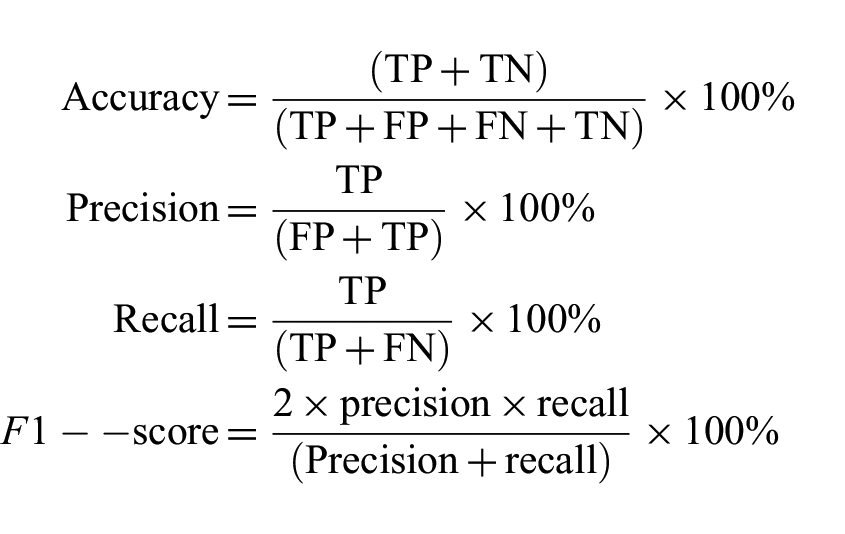
Area under the curve (AUC) is also used for evaluation, which is the graphic area enclosed by the receiver operating characteristic (ROC) curve and the abscissa; the larger its value, the better the performance of the model.
The experiment was conducted by comparing the characteristic variables E1 and E2 using the BPNN and RF algorithms. The results of the experimental evaluations are shown in Table 9. The better performing values between E1 and E2 are shown in bold in Table 9.
Comparison of experimental evaluation results.

AUC: area under the curve; BPNN: backpropagation neural network; RF: random forest.
By comparing the evaluation results of the two sets of feature variables, it can be seen that the performance of the BPNN model is better with the E2 feature set than with the E1 feature set on accuracy, recall, F1-score and AUC. The RF model performs better with the E2 feature set than with the E1 feature set on accuracy, precision and AUC. Overall, the prediction performance of both models is better with the E2 feature set than with the E1 feature set. Comparing the evaluation metrics of the two models with E2 as the feature set, we can see that BPNN achieved better accuracy, precision and AUC value than RF, whereas RF achieved better recall and F1-score than BPNN. Although neither of the models is overwhelmingly superior across all evaluation metrics, we concluded that BPNN is a better prediction model than RF on this set. There were two reasons for choosing BPNN: with E2 as the feature set, the recall and F1-score of BPNN are lower than those of RF, but the difference is very small. Second, BPNN has an obvious advantage in precision, which indicates that it is able to identify more potential hotspots than RF; this is of practical significance when the number of hot pushes is relatively small.
According to the prediction results of the two models on the two data sets, it can be concluded to some extent that the feature variables selected after statistical analysis are more effective as the prediction data sets. The performance of the BPNN model with the E2 feature set is better than with the E1 feature set on accuracy, recall, F1-score and AUC. This result supports our conclusions regarding the correlations in the data. By building and training such machine learning models, we can further enhance the reliability of our conclusions.
5. Summary analysis
According to the definition and analysis of each variable, the first-order stimulation selected in this study included the attributes of the account, the attributes of the title, date of the push and top push. For the second-order stimulation, the attributes of the content were selected, and relevant data dimensions from the original data – including the name of the WeChat account, the number of successful pushes, total number of fans, number of likes, number of readings, number of shares, number of pictures, position of push and number of words – were extracted. Through a comprehensive analysis, the first-order and second-order reactions after the first-order and second-order stimuli were obtained, respectively.
5.1. Influence of the first-order stimulus
Impact of a weekend push across different types of public accounts. Using statistical analysis, this study found that a weekend push date had a positive effect on the reading rate of official accounts of entertainment and emotion but negatively affected that of information. This may be determined by the nature of the official account: for the professional push from the information-type accounts, users will reduce reading during non-working days. Moreover, the overall data showed that the most read articles in every type of official account primarily appeared on non-weekend days: 84% of the articles with a reading rate in the top 1% were pushed on non-weekend days. This ratio is greater than the ratio of weekdays to weekends. Finally, the weekend had a positive impact on the sharing rate of the three types of official accounts.
Impact of using a question or exclamation in the title. For official accounts of emotion and entertainment, use of interrogative and exclamatory sentences had a positive effect on reading and aroused readers’ curiosity and interest. Moreover, exclamatory sentences promoted user information behaviour more positively than interrogative sentences. This supports the effectiveness of the ‘clickbait title’ to a certain extent. However, for official accounts of information, the use of the ‘clickbait title’ had a negative impact on reading, sharing and acquiring new fans. For this type of professional push, users prefer rational and objective descriptions. Based on our statistical results, it was believed that ‘clickbait titles’ should be used with caution depending on the type of official account.
Impact of double title on reading rate, sharing rate and acquiring new fans. According to the descriptive statistical results of ANOVA, whether the title is double has a significant impact on reading and sharing rates. The push with double title had a weak negative impact on reading and sharing, which may because the push with double title is usually part of a series. It is usually distributed in the non-headline position, so it is less attractive to ordinary users. However, the push with double title has a weak positive impact on acquiring new fans, probably because users will choose to subscribe to the official account as they are interested in the content of the entire series.
Top push has positive impact on reading rate. Each official account pushed an average of three to five articles every day: the first is the main push, and the rest are secondary push. Many official accounts choose to set the content of the most sophisticated article as the top push, and articles with advertising content as secondary push. According to the statistical results, there is a large difference in average reading rate between top push articles and other articles. Based on the results of a one-way ANOVA, this study concluded that the headline had a significant effect on reading rates. There is a strong positive correlation between top push and reading rate, and a moderate positive correlation with second-order reaction (e.g. sharing, collection and likes). This conclusion is obvious because top push can give articles a powerful advantage, allowing more people to see them in prominent places.
5.2. Influence of second-order stimulus
Copyright has a positive correlation with user reaction. The copyright label is determined by WeChat to encourage original content, which to some extent reflects the content quality and novelty of the article. There is a moderate positive correlation between original push and second-order reaction (e.g. sharing, collection and likes) and a weak positive correlation with first-order reaction. Although the second-order stimulus does not affect the first-order reaction in theory, this situation can still be explained because of the correlation between the original push and the top push. This study conducted a multi-variate analysis of variance for original push and top push, and the results showed that the interaction between the two also had a significant impact on attracting new fans.
Number of pictures has a positive impact on sharing rate. The number of illustrations in an article can have an impact on the user’s reading process. However, the number of images is unlikely to have an impact on first-order reactions such as reading rates, because users do not know about it before clicking. Therefore, reading rates was not included in our correlation analysis, and there is a moderate positive correlation between the number of pictures and the sharing rate, which is not related to the first-order reaction. Meanwhile, the number of images had no significant effect on attracting new fans.
Number of words has a positive impact on sharing and collection rates along with a negative impact on acquiring new fans. As mentioned in statistical analysis of data, the number of words in an article usually has no effect on the reading rate of users. Therefore, this study only measured the impact of article word count on share rates and new followers. The results show that the number of words pushed is positively correlated with sharing and collection rates and negatively correlated with acquiring new fans, which is not correlated with any first-order reactions. A lengthy article may bore the reader. Because the articles pushed by public accounts tend to be regarded as concise and interesting information carriers, users are usually reluctant to read excessive text in such articles.
6. Discussion
6.1. Theoretical implications
First, this study combined the S–R model and the environmental characteristics of WeChat official accounts, defined the two-level research concept of push stimuli-user information behaviour and conducted an investigation on the specific dimensionality of user information behaviour in this environment. Furthermore, this study determined the main factors affecting user information behaviour. This study established a prediction model based on a BPNN and RF for different prediction dimensions, expanding our theoretical contribution to this field. Meanwhile, the experimental methods used are innovative in this field.
Second, most of the previous studies on user information behaviour based on WeChat focused only on one type of behaviour. Owing to limited data, previous studies on WeChat official accounts were focused on WeChat marketing strategies, consumer purchase intentions and customer relationship management. Moreover, the few studies on information dissemination and user information behaviour often used qualitative methods, such as questionnaires. By contrast, this study used quantitative empirical analysis to study the influencing factors of user information behaviour, including reading and sharing, and acquiring new fans. This study obtained the second-hand data of WeChat official accounts through cooperation with enterprises, which addressed the difficulty of obtaining data in previous studies.
In the field of user information behaviour, this study enriched the research theory of users’ reaction to the specific situation of accepting and sharing pushed articles. Through the empirical research on the influencing factors of users’ two-stage stimulus, this study determines the influencing factors of different stimulus stages, which provides a reference basis and research direction for further research in this field.
6.2. Practical implications
This study explored the hotspots and factors that affected user information behaviour of WeChat official accounts using a quantitative research method, and thus can provide some suggestions to support WeChat official account operators’ decision-making based on the analysis of the experimental results. In the WeChat we-media platform, everyone can use the official account to be a content creator and communicator; however, operation capacity is crucial to the development of the official account. It is helpful for operators to understand how user behaviour is affected by variables associated with pushed articles. Thus, our research results are of great significance with respect to WeChat official account operators’ positive influence on user information behaviour.
First, the title of the push should be set reasonably. The titles pushed by official accounts with strong professionalism should be as objective and rational as possible, whereas leisure accounts can use emotional titles. Second, by making full use of the exposure advantage of top push and the interaction between top push and original push, higher sharing and fan growth rates can be achieved. Third, content quality remains the most important factor in communication. Although the ‘clickbait title’ can improve the reading rate to a certain extent, its influence on the second-order reaction is usually very small. Therefore, only enhancements of the text content can effectively improve the user’s second-order information behaviour.
Given that social media such as Weibo and Twitter also have the function of promoting news to followers, these suggestions are also valuable for other social media operators. However, because social media such as Weibo and Twitter usually release a short message rather than articles that need to be clicked into, the influencing factors of their users’ information behaviour are different from that of this study in terms of stage division. Therefore, other social media operators also need to refer to the suggestions put forward in this study according to the actual situation.
6.3. Limitations and future work
First, the dimensions of the data used in this study were limited. Although the backstage data of hundreds of official accounts were used in this study, account types and quality were uneven so that nine official accounts of three types were selected for analysis. Therefore, the differences between different official account types could not be compared horizontally. Moreover, the push time of the same official account is fixed; hence, it is difficult to study its impact.
The S–R model contains the concept of organism arousal; however, because this study could not analyse the organism arousal qualitatively or quantitatively, it was not considered. In a follow-up study, we will consider the introduction of questionnaires and interviews for analysis.
7. Conclusion
This study investigated the factors and hotspots with positive impact on user information behaviour by building a prediction model of user information behaviour; this fills some gaps in the existing research field of WeChat. Moreover, a prediction model based on a BPNN and RF was constructed using a quantitative method. Through systematic analysis of the data of different types of WeChat official accounts, this study summarised the influence of the first-order stimulus before clicking to read the article and the second-order stimulus after reading the article on users’ information behaviour. In addition, based on the analysis results, this study put forward decision-making suggestions for the operators of WeChat official accounts to help improve users’ reading, sharing, following and other positive behaviours.
Footnotes
Author contributions
All authors contributed equally to this study.
Declaration of conflicting interests
The author(s) declared no potential conflicts of interest with respect to the research, authorship and/or publication of this article.
Funding
The author(s) disclosed receipt of the following financial support for the research, authorship and/or publication of this article: The authors thank the National Natural Science Foundation of China (grant no. 72061147005), the School of Interdisciplinary Studies, Renmin University of China, and the Fundamental Research Funds for the Central Universities, and the Research Funds of Renmin University of China (grant no. 21XNO002).
