



Abstract
In the rapidly evolving field of information systems, the role of mobile-based social media as a platform for knowledge sharing among vocational schoolteachers presents both opportunities and challenges. This study addresses a critical gap in the understanding of how psychological factors (such as self-efficacy) and contextual factors (such as trust environments) influence knowledge-sharing behaviours in information systems. This study includes 332 vocational schoolteachers and employs structural equation modelling to examine how psychological and contextual factors enhance or inhibit sharing intentions. The results revealed that psychological factors significantly impact sharing intentions, whereas contextual factors bolster self-efficacy and behaviours. The findings offer valuable insights into the optimisation of information systems environments to facilitate effective knowledge sharing, thereby contributing to enhanced collaborative practices and technology adoption in educational settings. This research underscores the need to integrate social cognitive career theory into information systems to better understand the complex dynamics of knowledge sharing on mobile platforms.
Keywords
1. Introduction
With the development of a knowledge society, teachers’ professional development and knowledge updating have become important issues in the field of education. As disseminators of vocational skills and knowledge, vocational schoolteachers need to constantly improve their subject knowledge, teaching knowledge and innovation ability to adapt to the needs of society and students [1,2]. Knowledge sharing is an effective method for teaching professional development and knowledge updating that can promote communication, cooperation and learning among teachers [3,4]. However, teachers’ knowledge sharing also faces many challenges, such as time, space, resource and culture constraints [5,6].
As a new knowledge sharing platform, mobile social media (MSM) provides teachers with convenient, flexible and diverse ways to communicate and create knowledge [7]. During the COVID-19 pandemic, MSM became an important tool for teachers to acquire and disseminate knowledge and has become a mainstream method of social teachers’ knowledge sharing [8,9]. However, the knowledge sharing environment of MSM is not perfect, and there are many factors that affect teachers’ knowledge sharing behaviour (KSB) intentions and effects, such as social, psychological, cultural and technical factors [10]. Therefore, this paper aims to explore how to optimise the knowledge sharing environment provided by MSM and stimulate vocational schoolteachers to share knowledge on mobile social media platforms, which is a widely discussed topic in the field of vocational education and knowledge sharing research and is the focus of this paper.
Although MSM provide teachers with a new knowledge sharing platform, there is still a lack of research on the impact of MSM on vocational school teachers’ knowledge sharing intentions (KSIs). This study is based on the belief that there are two main problems in this area of research:
(1) The particularities and needs of vocational schoolteachers are ignored. Vocational education has many differences from other forms of education, such as teaching objectives, student characteristics, and curriculum settings. The goals of this education are to facilitate students’ transition from school to work, cultivate their active participation, self-directed learning and critical skills, and provide the talents needed for social and economic development [11,12]. Therefore, vocational education teachers need to constantly update and expand their subject, teaching and experience knowledge that is consistent with social requirements [13]. However, previous studies have focused mainly on the KSB of higher education or all teacher groups and lack attention and empirical research on vocational education teachers.
(2) The diversity and complexity of mobile social media environmental factors are ignored. MSM provide teachers with more time, space and channels to communicate and share knowledge [14]. However, not all MSM are conducive to knowledge sharing but are influenced by multiple dimensions of environmental factors, such as social, psychological, cultural and technical factors [15]. These environmental factors not only directly affect KSB but also indirectly affect this behaviour by affecting teachers’ subjective efficacy and intentions [16,17]. Therefore, it is necessary to use a more comprehensive and integrated model structure to consider the interaction between the external environment and internal factors and reveal the specific mechanism involved.
Building on previous research gaps, this study aims to delve deeper into the KSBs of teachers in vocational colleges and universities in the context of mobile social media, focusing on how external environmental factors and intrinsic motivation work together to shape teachers’ KSBs. This article constructs a structural equation model based on social cognitive career theory (SCCT), which provides a framework for understanding how individuals form attitudes and behavioural intentions towards knowledge sharing through social cognitive processes under the influence of a specific environmental factor (mobile social media platform application), using the external environmental factors of the mobile social media environment and the intrinsic motivation of the individual’s psychological factors as the key variables in the study [18].
Numerous studies based on SCCT provide rich references for our path design. For example, Huang and Hsieh’s [19] study on career exploration intention used self-efficacy and outcome expectations to directly point to the path setting of behavioural intention, revealing the mediating effect of psychological factors on entrepreneurial intention in the context of socioeconomic status. Aure et al. [20] regarded self-efficacy and outcome expectations as individual cognitive factors and personality traits and perceived social support as contextual factors, analysing the complex role of individual and contextual influences on career exploration intentions. Furthermore, this study draws on the meta-analytical work of Brown and colleagues [21,22] to synthesise the three basic models of SCCT, uses the performance model to analyse KSBs as a potential driver of educational outcomes, and draws on the choice model to explore how individuals make career-related decisions based on internal beliefs and external conditions. Using Lent et al.’s [23] perspective on how situational factors such as support and barriers indirectly influence individuals’ goal setting and behavioural choices during career development through their self-efficacy, this study aims to elucidate how knowledge sharing environments can influence teachers’ willingness and behaviours to share knowledge by shaping their self-efficacy and, consequently, their KSIs.
In view of the specific challenges faced by the teacher community in using mobile social media for knowledge sharing stemming from their educational needs and the unique role of vocational college teachers in vocational skills education and knowledge dissemination, teachers in Chinese vocational colleges and universities were specifically selected for this study. By using Mplus 8.3 software to analyse the data, this study aimed to explore the factors influencing KSIs and behaviours in the mobile social media environment.
2. Theoretical basis and related research
2.1. Theoretical basis
In this study, SCCT is used as the theoretical framework to explore the KSI of vocational schoolteachers in the MSM environment. SCCT is a comprehensive vocational psychology theory that emphasises the mutual influence of individual cognition, behaviour and the environment [24]. SCCT originates from Bandura’s social cognitive theory and inherits its research on core concepts such as individual self-efficacy, outcome expectations and goal setting [25].
According to SCCT, individual self-efficacy and outcome expectations are divided into different dimensions and sources, which can better explain the behavioural differences of individuals in different situations [26]. SCCT can also be used to overcome the limitations of traditional theories that separate psychological and social factors and link individual KSB intentions with the external environment [27]. Therefore, SCCT is suitable for analysing the direct and indirect effects of environmental factors of MSM on KSI and behaviour, as well as their interaction with individual cognitive processes and personal characteristics. Previous studies have often used SCCT to explore the factors that affect knowledge sharing, such as self-efficacy, outcome expectations, and community atmosphere [28], but systematic research on the KSI of vocational schoolteachers in MSM environments is lacking, and the influence mechanism of environmental factors and psychological factors has not been examined in depth.
2.2. Vocational school teachers and knowledge sharing
Knowledge sharing refers to the process of the communication and dissemination of knowledge between individuals or groups, including the process of knowledge provision and reception [29]. For teacher groups, knowledge sharing is a beneficial learning activity that can promote teachers’ personal and collective professional development, thereby improving teaching effectiveness, student learning outcomes and school reputation [30]. Compared with teachers in higher education institutions and other schools, vocational schoolteachers are more willing and motivated to share knowledge, which is influenced by two main dimensions: individual knowledge pursuit and organisational incentive pursuit.
2.2.1. Individual knowledge pursuit
Individual knowledge pursuit refers to the outcome expectation of vocational education teachers for knowledge acquisition before they engage in KSB. This expectation is influenced by vocational education teachers’ own professional development needs and education quality improvement goals.
First, vocational education teachers’ own professional development needs motivate them to constantly update their teaching and professional skills. Antera [31] noted that vocational education teachers have the characteristics of dual professionalism, which requires them to master professional knowledge in teaching, industry and experience, as well as to cope with the challenges of knowledge updating and innovation. Through interviews with Swedish vocational schoolteachers, Andersson and Köpsén [32] found that they need to learn new knowledge and skills constantly to improve their teaching quality and adapt to market demand, which motivates them to participate in knowledge sharing activities more actively. Therefore, vocational education teachers expect to gain more professional knowledge and skills through knowledge sharing, thus enhancing their professional competitiveness and satisfaction.
Second, vocational education teachers’ education quality improvement goals inspire them to constantly enrich both their practical and innovation knowledge. Runhaar and Sanders [33] argued that knowledge sharing is a key factor for improving the quality of vocational education because it can promote mutual learning and reflection among teachers and enhance their adaptability to student needs and industry changes. Cornelius and Stevenson [34] evaluated the data of vocational school teacher trainees in the International Online Collaboration Project (COLIGE) and found that knowledge sharing contributes to vocational education innovation, enabling learners and educators to cross boundaries between different practices, cultures and backgrounds and promote their professional identity and ability reflection and transformation. Therefore, vocational education teachers expect to gain more practical experience and innovative ideas through knowledge sharing, which will improve their teaching effectiveness and student satisfaction.
2.2.2. Organisational incentive pursuits
Organisational incentive pursuit refers to the expectation of vocational education teachers for the support and rewards provided by the organisation before they engage in KSB. This expectation is influenced by two factors: one is the technical change speed of the industry in which vocational education teachers are located, and the other is the degree of education reform and innovation in the field of vocational education.
First, technical change in the industry in which vocational education teachers are located motivates them to acquire new knowledge through knowledge sharing to keep up with the development of their professional fields [35]. Livingstone and Guile [36] argued that vocational education teachers are in the knowledge economy and need to constantly learn new knowledge and skills to adapt to work requirements and student needs. Therefore, vocational education teachers expect to obtain professional development opportunities, technical update training, learning resources and other support provided by the organisation through knowledge sharing.
Second, the degree of education reform and innovation in the field of vocational education affects the necessity and urgency of knowledge sharing for vocational education teachers. Wijnia et al. [37] noted that with changes in social development and student needs, there are often reforms and innovations in teaching modes, curriculum settings, evaluation methods and other aspects in the field of vocational education. These reforms or innovations require vocational education teachers to acquire the latest knowledge achievements, improve their teaching and research abilities, promote the transformation of personal knowledge into team public knowledge, and enrich the practical knowledge base of teacher groups in a timely manner [38]. Therefore, vocational education teachers will expect to obtain research projects, experience sharing, academic exchange and other rewards provided by the organisation through knowledge sharing.
2.3. Knowledge sharing environment of mobile Social Media
Knowledge sharing among MSM has the characteristics of convenience, timeliness, richness and personalisation, which provide users with an environment that is conducive to knowledge communication and sharing [39]. Environmental factors refer to external conditions that affect individual KSB. They can promote or inhibit individuals’ self-efficacy and outcome expectations [23]. Different studies divide the dimensions of the knowledge sharing environment from different perspectives, such as the physical environment, social environment, cultural environment, psychological environment, and technical environment [40]. In this paper, ‘trust atmosphere’ and ‘technical adaptation’ are selected as the environmental factors of MSM, and the analysis is conducted from multiple perspectives: the atmosphere of trust represents the influence of the environment on individual KSIs from the perspectives of individuals and teams, and technical adaptation represents the influence of the environment on individual KSIs from the perspective of technology.
2.3.1. Social trust atmosphere
The social trust atmosphere (STM) refers to the atmosphere of mutual trust and reliance that is established among MSM users. It can reduce the risk and cost of knowledge sharing and enhance knowledge sharers’ confidence and sense of belonging [15]. Lee et al. [41] concluded that the recognition of knowledge recipients in virtual academic social networks will have a positive impact on STM, which will motivate users to share knowledge. Based on the theory of planned behaviour, Feng et al. [42] constructed a model of user KSB in question-and-answer communities and argued that an STM would affect individuals’ knowledge sharing efficacy and value judgement. Chow and Chan [43] constructed a structural model of Hong Kong managers’ KSI and concluded that this social trust had no significant direct impact on sharing intention, which also confirmed the conjecture proposed in this study that the environment affects KSB through internal factors.
2.3.2. Social technology adaptation
Social technology adaptation (STA) refers to users’ cognition and evaluation of the technology functions and characteristics of MSM. This adaptation can affect users’ attitudes and willingness to use technology and subsequently affect their KSB [39]. Based on the grounded theory method, Ming et al. [44] conducted interviews, questionnaires and structural equation modelling and concluded that individual differences are the internal driving factors for user behaviour intention, while system characteristics and interface characteristics are the external driving factors for user behaviour intention. Chai and Kim [45] adopted a method that included social technology system theory, and by using a structural model, they concluded that social network website service providers and technical security measures have a positive impact on KSB. Ahmad et al. [46] used a partial least squares structural equation model to conclude that technical availability has a positive impact on knowledge sharing with students. These studies support adding the technical adaptability of MSM as a technical link to the present model.
3. Research hypotheses and model construction
3.1. Research hypotheses
Based on the core concepts of SCCT, a theoretical model with three levels – psychological, environmental and behavioural – is constructed in this study. The psychological level includes self-efficacy (SE, a person’s belief in his or her ability to succeed in specific situations), knowledge acquisition expectations (KAE, the expectation of vocational education teachers to gain professional knowledge and skills through knowledge sharing), and organisational reward expectations (ORE, the anticipation of support and rewards provided by the organisation), which reflect the individual’s cognitive evaluation of his or her own ability and outcomes. The environmental level includes the STM and STA, which reflect the characteristics and influence of MSM. The behavioural level includes KSI and KSB, which reflect the individual’s actual participation in knowledge sharing attitudes and behaviours towards MSM.
3.1.1. Psychological factors
SE is a concept proposed by Bandura in 1977 that refers to an individual’s confidence and ability to complete a certain behaviour or task [47]. SCCT builds upon this concept and argues that SE is an important factor affecting individual career development and choice [24].
KAE refers to an individual’s belief or expectation that he or she can acquire new knowledge or improve his or her knowledge level in the learning process [48]. KAE is a manifestation of learning motivation and is related to an individual’s interest, goals, SE and other factors [49]. Previous studies have shown that KAE is an important motivational factor affecting KSB and has a significant positive correlation with the attitudes, intentions and behaviours of knowledge sharers [17]. Moreover, KAE is influenced by various personal and environmental factors, such as knowledge sharers’ SE, trust, risk, and reward, as well as the scene, culture, atmosphere of knowledge sharing, etc [50,51].
ORE is defined as the expectation or belief that organisational members can obtain various rewards and support provided by the organisation for their KSB. That is, from the perspective of expectancy theory, incentives from the organisation can affect organisational members’ outcome expectations and value perceptions of knowledge sharing, thus affecting their intention and behaviour of knowledge sharing [52]. For example, if the organisation provides rewards or recognition related to knowledge sharing, employees will think that sharing will bring positive results and thus will be more willing to share knowledge.
Individual factors have an important impact on teachers’ KSI for MSM, which is reflected in the following relationships: (1) Teachers with high SE are more likely to think that they can effectively use MSM for knowledge sharing, thus increasing their sharing intention [53]. (2) Teachers’ KAE in MSM, such as increasing professional knowledge or skills through communication with other teachers, obtaining and feedback information, participating in and creating content, etc., will also affect their sharing intention [54]. For teachers, the greater their KAE is, the more likely they are to believe that sharing can promote personal growth and development, thus increasing their sharing intention [55]. (3) Teachers’ expectations of organisational rewards will also affect their sharing intentions. ORE means that teachers can expect or believe that they can obtain organisational-level incentives or praise through cooperation and collaboration with other teachers, contribution and sharing of resources, support and promotion of learning, etc. This expectation can enhance an individual’s sense of belonging, loyalty and sharing intention [56]. When teachers believe that their sharing activities are consistent with the organisation’s goals and values, they are more likely to think that sharing can facilitate the achievement of these goals and values, thus increasing their sharing intention.
3.1.2. Environmental factors
The STM of MSM refers to the degree and quality of trust among members, reflecting the interpersonal relationships and interactions among members. This study is based on the belief that STM affects the process and outcome of members’ knowledge sharing by affecting their motivation, attitude, behaviour and so on. From the perspective of social cognitive theory, STM can affect online learners’ cognition and evaluation of themselves, others and the environment, thus affecting online learners’ attitudes and behaviours towards knowledge sharing [57,58].
STA refers to the effectiveness and efficiency of technology for completing specific tasks. In terms of online social knowledge sharing, from the perspective of the technology acceptance model (TAM), technology adaptation can affect people’s perceived usefulness and perceived ease of use of social technology, thus affecting their attitude, intention, behaviour and outcome of using technology. For example, if technology can help sharers and receivers complete knowledge sharing tasks more effectively and is easy to use, they will be more willing to use technology for knowledge sharing and be able to achieve knowledge sharing goals better [56,59].
Based on the existing research results, STM and STA can enhance teachers’ SE in MSM by improving their social SE and professional development; STM can enhance teachers’ social SE, that is, their confidence and ability to achieve goals in social situations;[60] and STA can promote teachers’ professional development and information sharing [61]. The STM and STA can directly affect teachers’ attitudes and emotions related to knowledge sharing to affect teachers’ KSI and behaviour in MSM [62,63].
In summary, focusing on the relationships among environmental and psychological factors and the internal mechanism of action, the following hypotheses are proposed:
H1: STM has a positive impact on teachers’ SE in mobile social media;
H2: STA has a positive impact on teachers’ SE in mobile social media;
H3: SE has a positive impact on teachers’ KSI on mobile social media;
H4: KAE has a positive impact on teachers’ KSI on mobile social media;
H5: ORE has a positive impact on teachers’ KSI on mobile social media.
3.1.3. Behaviour factors
KSI refers to the psychological tendency of individuals to share their knowledge with others in specific ways or methods [64]. In previous studies, KSI was shown to be influenced by various personal, organisational and environmental factors, such as an individual’s motivation, attitude, trust, subjective norms, SE, environmental atmosphere, organisational reward, and social identity [65].
KSB involves actively transferring knowledge to others to bridge knowledge gaps or foster innovation and can be influenced by external incentives or constraints. This study examines both KSI and KSB to provide a comprehensive view of knowledge-sharing dynamics within the MSM environment. The model is informed by the theory of planned behaviour [66], which posits that intentions directly lead to behaviours [67]. By examining both intended and actual knowledge-sharing practices, we offer a holistic perspective on these processes, thus reflecting the interplay between individual intentions and their real-world actions in MSM settings.
In summary, focusing on the relationship between environmental factors and behavioural factors, the following hypotheses are proposed:
H6: The social trust environment has a positive impact on teachers’ KSI on mobile social media.
H7: STA has a positive impact on teachers’ KSI on mobile social media;
H8: The social trust environment has a positive impact on teachers’ KSB on mobile social media.
H9: STA has a positive impact on teachers’ KSB on mobile social media.
3.1.4. Mediation hypotheses
According to the social cognitive career model and its internal influence mechanism, in addition to the direct path to benefits, SE indirectly affects an individual’s goal selection behaviour through outcome expectations as a substantive path in each subject model [18]. In light of this, it can be inferred that there is a mediating effect of outcome expectations between SE and KSI.
H10: SE affects teachers’ KSI on mobile social media through KAE and ORE; that is, there is a dual-factor mediation effect, which can be decomposed into the following two hypotheses:
H10: SE affects teachers’ KSI on mobile social media through KAE and ORE; that is, there is a dual-factor mediation effect, which can be decomposed into the following two hypotheses:
H10-1: KAE plays a mediating role in the effect of SE on KSI.
H10-2: ORE plays a mediating role in the effect of SE on KSI.
3.2. Model construction
Based on the relationship between each construct and the hypotheses proposed above, a research model is drawn, as shown in Figure 1.

Research model.
4. Research design
4.1. Questionnaire design
A 27-question questionnaire was used in this study, including six basic information questions and specialised items based on a five-point Likert-type scale ranging from 1 (strongly disagree) to 5 (strongly agree). According to the SCCT model, questions on the three dimensions of psychological factors, SE, KAEs, and OREs, were based on the literature on individual psychology in the field of knowledge sharing [56,68,69]; questions on the two dimensions of environmental factors, STM and STA, were based on the literature on community environments in the field of knowledge sharing [68,70,71] and the literature on community environments in the field of knowledge sharing. In the field of knowledge sharing [56,71,72], the questions on the 2 constructs of knowledge sharing willingness and KSB in the action factor refer to the literature in the field of knowledge sharing on the mechanism of knowledge sharing willingness [56,70]. Most of the questions used in this study were based on the established scales of previous researchers, and the content of the questionnaire was modified to some extent according to the differences between the region and the target group. The specific scales are shown in Exhibit 1.
Before the official distribution of the questionnaire, a pilot test was conducted with 50 vocational school teachers in Zhejiang Province, China. This pretest used paper questionnaires to gather initial feedback. The respondents provided insights that led to modifications ensuring the clarity and precision of the questionnaire items. An introduction to the concept of ‘knowledge sharing’ was also added to enhance respondents’ understanding and contextualise the questions.
4.2. Data collection
To achieve comprehensive and accurate data collection, this study utilised the Questionnaire Star platform to design and release an online survey, which was distributed through mainstream social media platforms commonly used for educational purposes, such as WeChat and Nail. The target demographic comprised teachers from vocational colleges and universities in Zhejiang Province. A hierarchical distribution strategy was employed by collaborating with the heads of teaching and research groups at each institution to maximise survey participation and ensure data authenticity. In addition, detailed participant information was collected to analyse the factors influencing KSBs among teachers in these institutions and to develop a precise, empirically based research framework.
Building on the insights of Oldendick and Lambries [73], who highlighted the effectiveness of incentives in boosting survey participation, this study leveraged the host institution’s established network with vocational colleges to increase response rates. Close collaboration with the heads of teaching and research teams facilitated the distribution of the questionnaire while maintaining the voluntary nature and anonymity of the participants. A monetary incentive of RMB ten yuan was offered to respondents who completed the questionnaire via the Questionnaire Star platform. The collected data underwent ethical review by the corresponding author’s institution, thus ensuring adherence to ethical research standards.
Over three weeks, 387 responses were collected via online questionnaires. To ensure data quality, responses were screened via SPSS 27.0. Questionnaires that were completed in under 90 seconds or over 10 minutes were excluded to ensure the reliability of the data [74]. Therefore, 332 valid questionnaires were ultimately included, yielding a validity rate of 85.79%. Among the valid samples, 146 were male teachers and 186 were female teachers; 236 had bachelor’s degrees, 96 had master’s degrees, and there were no teachers with doctoral degrees; the age distribution was 47 under 25 years old, 157 between 26 and 35 years old, 105 between 36 and 45 years old, and 23 more than 46 years old; the distribution of the teaching experience was 87 less than 5 years old, 132 between 6 and 10 years old, and 113 more than 10 years old; and the type of teacher distribution was 85 teachers of cultural courses, 157 teachers of professional courses, 32 teachers of internship guidance, and 58 part-time teachers of professional courses and internship guidance. The normal distribution of the data suggests that the sample is suitable for studying teachers’ motivation for knowledge-sharing behaviours in the social media environment.
5. Data analysis
5.1. Reliability and validity tests
5.1.1. Reliability test
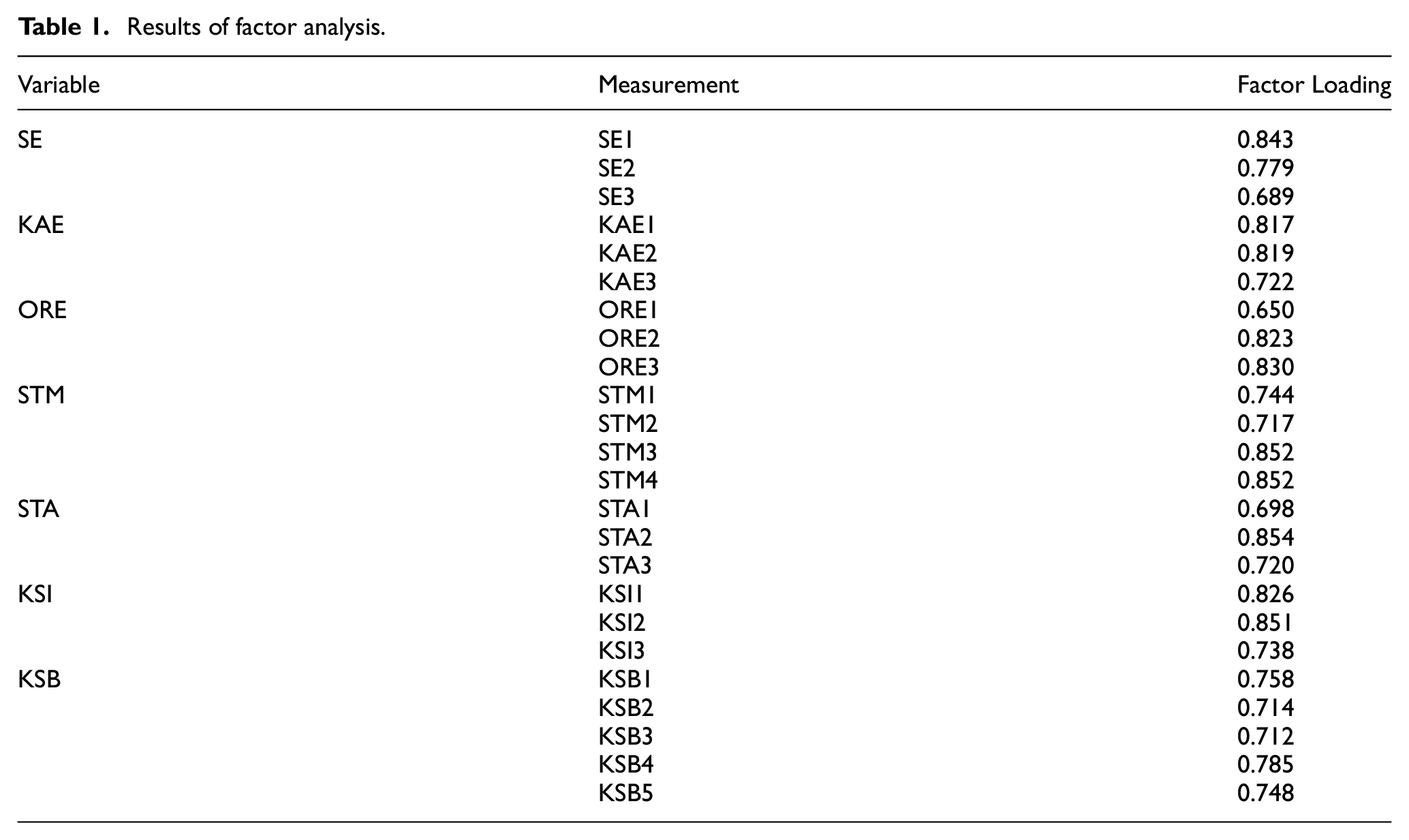
Reliability reflects the consistency or stability of the questionnaire measurement results. In this study, the path factor loadings obtained by Mplus 8.3 measurements were extracted. There is no unified standard for its acceptable range, but the guiding opinions from related studies suggest that a value higher than 0.5 is an acceptable standard and that a value higher than 0.7 is considered a clear structural target, indicating that there is a very strong correlation between the observed variables and the latent variables [75,76,77]. As shown in Table 1, most of the factor loadings are greater than 0.7, and all are greater than 0.5, which indicates that the setting of latent variables in each dimension of this study can explain each observation item under this dimension well.
Results of factor analysis.
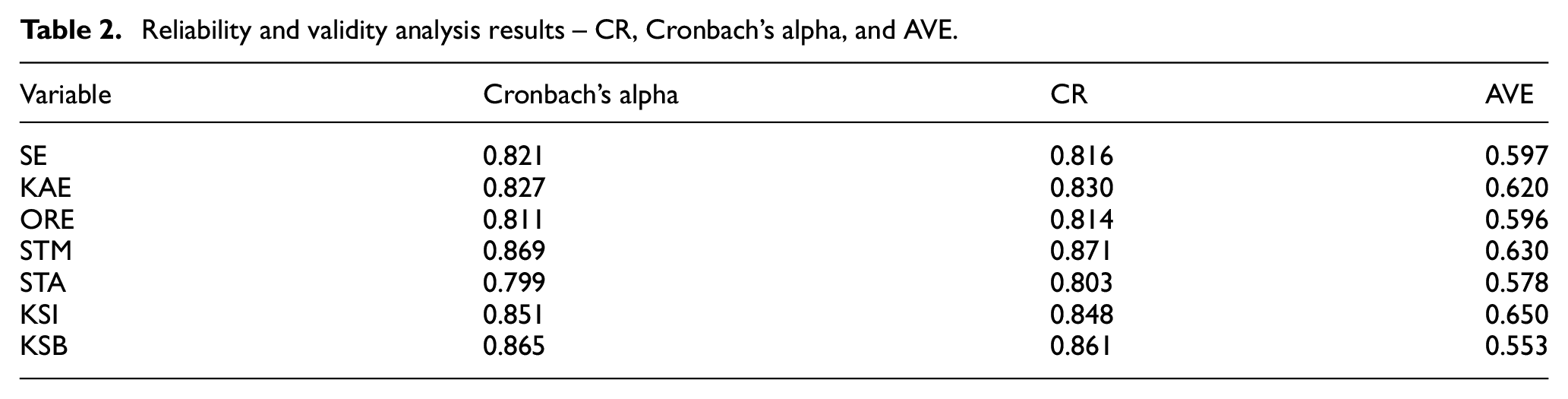
SPSS 27.0 was used to calculate the composite reliability (CR) and average variance extracted (AVE) values. According to Fornell and Larckerd’s study [78], the CR should be greater than 0.7, and the AVE should be greater than 0.5. As shown in Table 2, all the AVE values and CR values in this study meet the requirements, which indicates that the internal consistency of the measurement items is good and that the reliability is acceptable.
Reliability and validity analysis results – CR, Cronbach’s alpha, and AVE.
5.1.2. Discriminant validity test
The criteria for the validity judgement were as follows: if a variable’s correlation coefficient with other variables is smaller than the square root of the average variance extracted of that variable, it indicates that the variable has good discriminant validity [78]. As shown in Table 3, the diagonal line is the square root of the AVE, and the square root of the AVE value is greater than the correlation coefficient between structures, indicating that each variable has discriminant validity.
Discriminant validity.

5.1.3. HTMT test
In addition, the heterogeneous-homogeneous ratio, which is the ratio of between-trait and within-trait correlations [79] and may affect the estimation of path coefficients and model fit, was used in this study to avoid potential multicollinearity problems among latent variables. In addition, the HTMT test can provide more accurate results than other traditional methods (such as the Fornell–Larcker criterion or cross loadings), especially when the measurement model is homogeneous [80]. Henseler et al.’s study [79] showed that an HTMT value of 0.85 is a conservative and strict threshold that can effectively detect discriminant validity problems. As shown in Table 4, the maximum HTMT value in this study is 0.831, and all the samples meet the more stringent HTMT test standard. In summary, the model has good reliability and validity.
Differential validity (HTMT).

5.2. Structural equation modelling
5.2.1. Model fit test
Many indicators are used to measure model fit in structural equation modelling; these include the chi-square to degree of freedom ratio, CFI, TLI, RMSEA, etc. [81]. The chi-square degrees of freedom ratio is used to assess the deviation between model predictions and actual observed data, with lower values suggesting a better model fit. CFI and TLI are used as relative fit indices reflecting the improvement of the model with respect to the baseline model, with values converging to 1 indicating an excellent fit. The RMSEA evaluates the average magnitude of the model error, with smaller values suggesting greater consistency between the model and the data. In this study, as shown in Table 5, all the fit indices are within the acceptable range, showing that the model of teachers’ motivation for knowledge-sharing behaviour fits well with the actual data in the mobile social media environment, which provides a reliable basis for further exploring the relationship between the motivational factors of teachers’ knowledge-sharing behaviour.
Fitting index of the structural equation model and results of this study.

5.2.2. Hypothesis testing
In this study, the maximum likelihood method is used to estimate the coefficients of each path. The test results are shown in Table 6. Here, the estimated value represents the path coefficient, S.E. represents the standard error of the estimated difference value, and C.R. represents the ratio of the regression coefficient value to the estimated value standard error. The path coefficients of the knowledge-sharing model reach the p < 0.001 or p < 0.05 significance level.
Path coefficients.
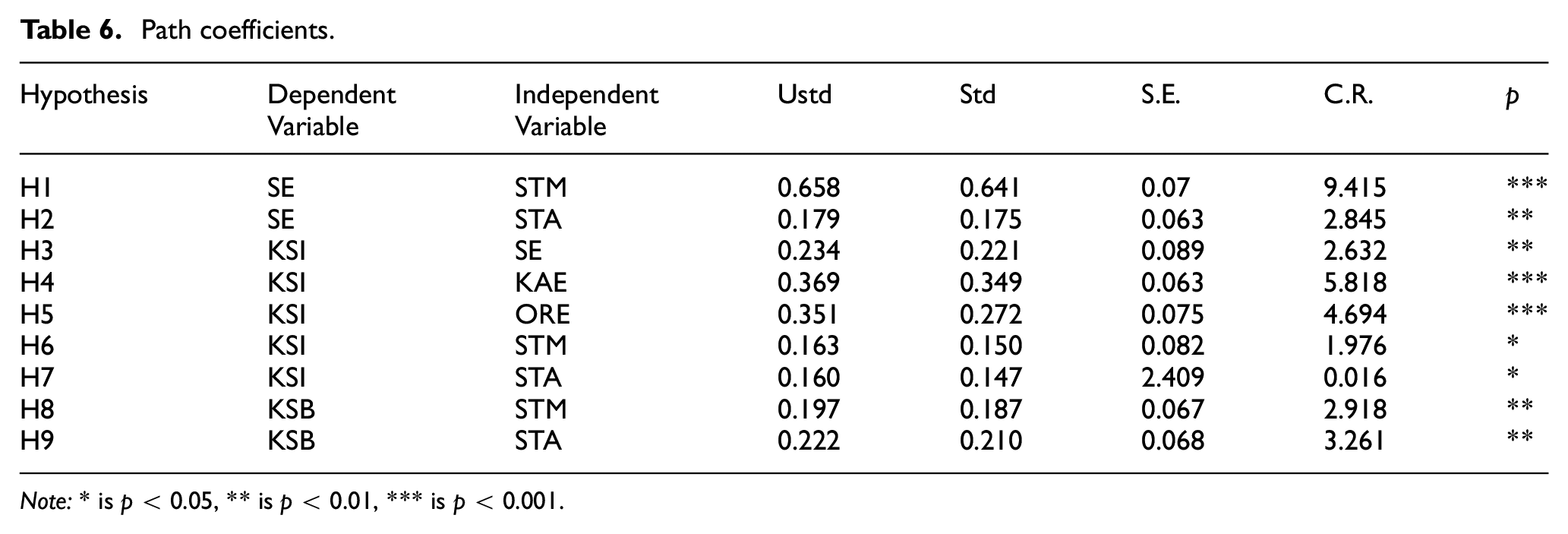
Note:* is p < 0.05, ** is p < 0.01, *** is p < 0.001.
5.2.3. Mediation test
This study used the self-help method (bootstrapping confidence interval method) and Mplus 8.3 software with 5000 resamples to construct and test a two-factor juxtaposed mediation model aiming to investigate the mediating roles of KAE and ORE between SE and KSI.
SE’s total effect on KSI is 0.524, which has a significant positive impact (Z = 4.637, p < 0.001). SE’s direct effect on the KSI is significant, with an effect size of 0.234, which indicates a significant positive impact (Z = 2.095, p < 0.05). The indirect effect can be decomposed into two parallel mediation paths: SE-KAE-KSI and SE-ORE-KSI. The confidence interval of the indirect path of SE-KAE-KSI is [0.089, 0.249], which does not include 0 and has a significant positive impact (Z = 3.907, p < 0.001), and the effect size is 0.068. Similarly, the indirect path of SE-ORE-KSI is also significant, with an effect size of 0.071. This shows that SE not only directly enhances the KSI but also indirectly enhances the KSI by enhancing the KAE and ORE. Therefore, this study supports the hypothesis of a dual-factor parallel mediation model.
The data show that KAE and ORE play partial mediating roles in the effect of SE on KSI, and the indirect effects account for 19.0% and 17.1%, respectively, of the total effects. The significance level of the difference between them is greater than 0.05, the confidence interval [−0.089, 0.119] also contains 0, and there is no significant difference in the effect size of the two.
5.3. Results analysis
This study assessed the model effects of teachers’ KSB and its predictors through structural equation modelling (SEM) analysis, as shown in Figure 2. The results showed that the explanatory power (R2) of the model for both KSB and KSI was 0.607, indicating that the present model was effective in predicting teachers’ KSB. Meanwhile, the explanatory power of SE, knowledge harvest expectation, and organisational reward expectation were 0.54, 0.15, and 0.21, respectively, which were consistent with the benchmark values of Lent et al.’s [25] study on the application of the SCCT and confirmed the robustness of the model.
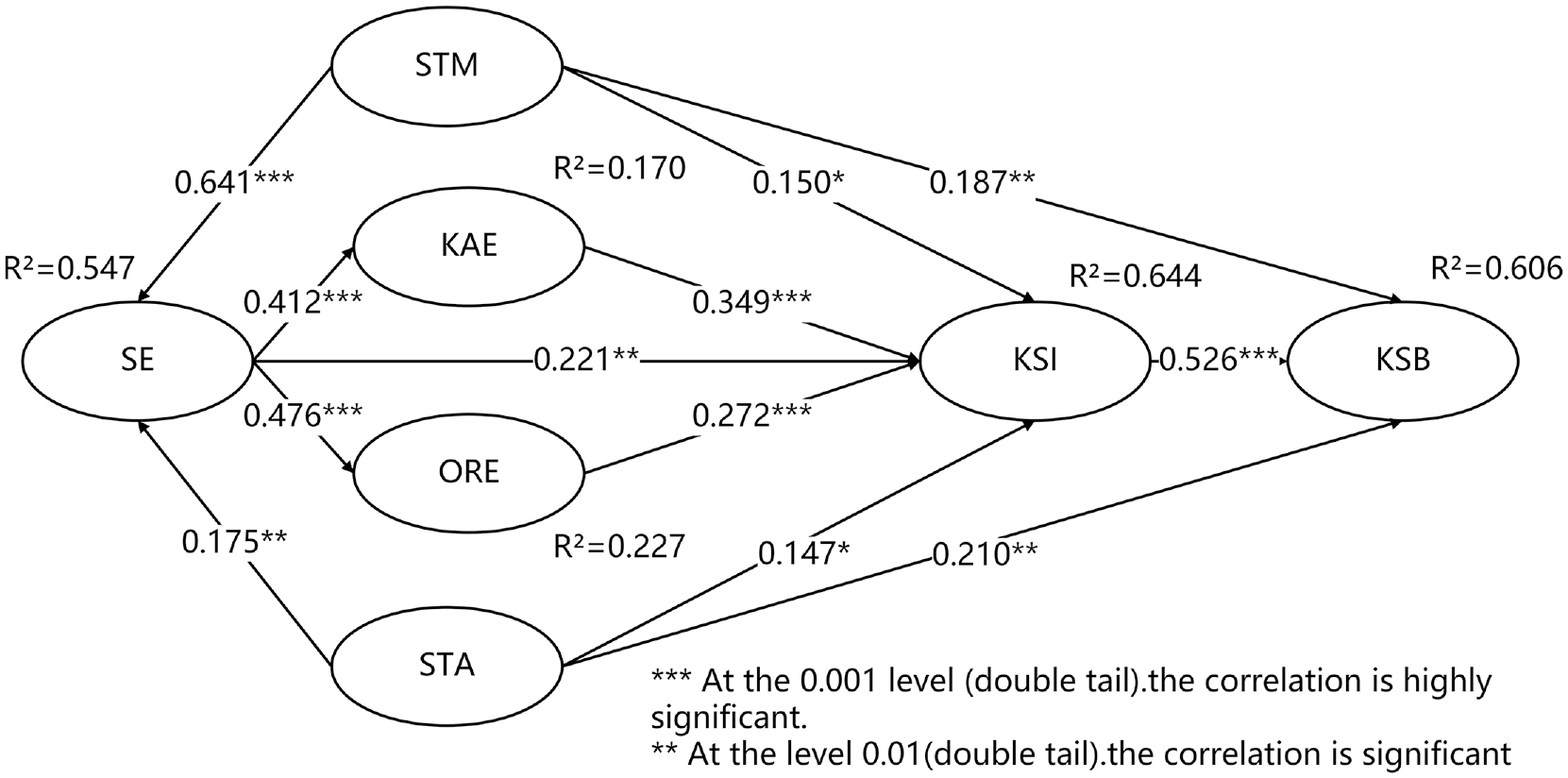
Structural model.
Based on the model analysis and hypothesis testing (see Table 7), the following key findings were derived from this study on teachers’ knowledge sharing in the mobile social media environment:
Mediating effect test.

Note:* is p < 0.05, ** is p < 0.01, *** is p < 0.001.
Knowledge harvest expectations, as well as organisational reward expectations, positively influence KSIs (H4, H5).
Trust atmosphere and technology suitability positively affect teachers’ SE (H1, H2).
Trust climate and technology suitability directly and positively affect teachers’ willingness to share knowledge as well as their behaviour (H6–H9).
Teachers’ SE, mediated through outcome expectations, affects willingness to share knowledge (H10).
These findings will be analysed in further depth in the discussion section.
6. Discussion and implications
6.1. Discussion
6.1.1. Direct and indirect effects of environmental factors on knowledge sharing
Environmental factors play crucial roles in shaping teachers’ KSIs and behaviours within mobile social media contexts. According to SCCT, these factors serve as both direct incentives and indirect facilitators through their impact on SE. For example, social trust and platform technological fitness have been identified as key determinants of effective knowledge sharing [39]. This study extends these findings by emphasising how environmental contexts influence individual behaviour, aligning with the SCCT’s assertion that such factors shape individual actions and beliefs [82].
The SCCT posits that environmental factors – such as family, social, cultural, economic, and political contexts – can either facilitate or impede individual agency [82]. These elements exert a direct influence on behavioural intentions, affecting how individuals perceive and act within their environments [23]. Furthermore, an individual’s SE beliefs are continually shaped by these environmental factors, highlighting the dynamic interplay between the individual and his or her surroundings [57]. This interaction underscores the complex process by which teachers adapt and respond to their environments, ultimately impacting their willingness and ability to share knowledge.
In the context of mobile social media, this study suggests that a climate of trust in social environments may positively influence KSIs and practices by reducing the perceived risk of sharing knowledge and enhancing psychological security and belonging. Studies by Hoseini et al. [39] and Kmieciak [83] confirm that trusting relationships within organisations mitigate the knowledge sharing process of psychological barriers and enhance knowledge sharing motivation. Furthermore, Hsu et al. [84] used a social cognitive theory model to validate how social trust can indirectly and positively promote KSBs by enhancing an individual’s SE.
Technology suitability directly and indirectly reinforces users’ SE and pleasure sharing by enhancing platform satisfaction and frequency of use, effectively promoting KSIs and practices. Wang and Xie’s [85] study of online sharing behaviours was closely linked to perceived platform ease of use and user satisfaction, with the latter directly facilitating in-platform knowledge learning and sharing activities. Stibe et al. [86] used a model of differences in knowledge behaviours to illustrate how rich, convenient, and interactive sharing experiences can enhance audience breadth and platform recognition of social networking technologies, thereby stimulating KSBs. Alshahrani and Rasmussen [87] further suggest that optimising user experiences and mimicking experiences enhance SE and indirectly promote knowledge sharing activity.
In summary, social trust and technological appropriateness have important direct and indirect effects on knowledge sharing in mobile social media, highlighting the importance of optimising this environment to promote KSIs and behaviours among the teacher community. These findings provide a theoretical and empirical basis for strategically improving the mobile social media environment to promote knowledge sharing among teachers.
6.1.2. Influence of outcome expectations on knowledge sharing intentions
The analysis indicates that SE and outcome expectations have a significant positive effect on teachers’ willingness to share knowledge via mobile social media. Teachers are motivated not only by their confidence in their ability to share knowledge but also by the potential gains and recognition they anticipate from this activity. This behaviour reflects a dual pursuit of personal empowerment and enhanced social status, thus highlighting both intrinsic and extrinsic motivations. These findings expand the theoretical understanding of knowledge sharing and provide practical insights into promoting this behaviour among teachers in digital environments.
The SCCT provides a robust framework for understanding these dynamics. According to Lent and Brown [18], there are strong correlations between outcome expectations, SE, and choice behaviours. SE enhances an individual’s ability to set clear goals and develop positive knowledge-sharing beliefs, which subsequently increases their willingness to engage in knowledge sharing. Outcome expectations – defined as the anticipated results or rewards of a behaviour – serve as key determinants in deciding whether individuals adopt specific behaviours. This aligns with SCCT’s assertion that both SE and outcome expectations are crucial in shaping individuals’ actions and choices in professional contexts.
This study aimed to explore the effect of knowledge gain expectations on teachers’ KSBs and found that teachers’ KSBs or extent matched the expected knowledge gain on a given platform. According to Bock and Kim [88], KSBs are associated with costs, and individuals are willing to share their valuable knowledge resources only when the expected knowledge rewards exceed these costs. This view is corroborated by Thi and Duong’s [63] study of KSBs on social networking sites in Vietnam, where an individual’s willingness to share knowledge is only aroused when the expected benefits exceed costs. Tseng and Kuo [89] argued that teachers’ knowledge gain expectations can enhance their positive attitudes and behavioural motivation towards knowledge sharing, thus promoting their KSIs.
This study reveals that teachers’ expectations of organisational rewards – such as recognition, praise, career advancement and material rewards – can promote sharing motivation, which in turn significantly enhances their motivation to engage in knowledge sharing. Constant et al. [90] found that beliefs in organisational encouragement and status advancement can positively promote KSIs. Similarly, Zhang W. et al.’s [91] analysis of Chinese teachers confirmed that leadership originating from school administrators, as well as trust in the organisation, leads teachers to exhibit more positive KSBs.
Taken together, outcome expectations – that is, individuals’ beliefs about the potential rewards of knowledge sharing – play an influential role at both the individual and organisational levels and are supported by both theoretical and empirical research. Heinz and Rice [92] suggested that by enhancing organisational status, increasing competence and experience, and realising social responsibility, teachers who are more likely to experience positive emotions in knowledge sharing are more likely to experience positive emotions and feel satisfied with the shared outcomes, which in turn strengthens their motivation to continue sharing knowledge in the future. This section summarises the role of outcome expectations in influencing willingness to promote knowledge sharing.
6.1.3. The partial mediating role of outcome expectations between SE and intention
The SCCT provides a valuable framework for understanding the complex relationship between SE and knowledge-sharing intentions. According to Lent and Brown [18], SE influences individuals’ expectations of their ability to perform effectively in a given domain, thereby shaping their behavioural intentions and actions. In this study, outcome expectations were found to partially mediate the relationship between SE and the intention to share knowledge. This means that while SE directly enhances individuals’ willingness to share, their expectations about the potential benefits and consequences of sharing also play a significant role in determining their intentions. These findings align with those of Safdar et al. [55], who demonstrated that outcome expectations are a crucial intermediary factor in the relationship between SE and intention. The partial mediation effect indicates that enhancing positive outcome expectations along with strengthening SE can effectively promote KSB, thus underscoring the need to integrate cognitive and motivational elements into interventions to foster collaboration among teachers.
Keren-Happuch and Moon-Ho [93] elaborated on the role of SE in shaping individual outcome expectations – the prediction or anticipation of the consequences of particular behaviours – and in setting personal goals, including goal choice and performance goals. The level of SE has an indirect effect on KSIs, a mechanism that can be explained by expectations about the effectiveness of sharing: lower SE leads individuals to be sceptical about their own ability to contribute to knowledge growth and thus show conservative sharing intentions; in contrast, higher SE prompts individuals to view knowledge sharing as a valuable contribution, which they perceive as contributing to organisational rewards and support [84,94].
6.2. Implications
6.2.1. Environmental optimisation strategy: building a good knowledge sharing network
This section explores strategies to optimise knowledge sharing in mobile social media from an environmental perspective, targeting a group of vocational schoolteachers. The findings suggest that STM and social technology appropriateness have a significant positive effect on teachers’ KSI and behaviour.
First, it is crucial to shape a positive STM. The interactive and personalised features of mobile social platforms can be used to strengthen the trust relationship between users, which in turn facilitates knowledge sharing. Practical measures include using social features (e.g. likes, comments, and retweets) to recognise knowledge contributions, deepening connections between users through private interactions (e.g. private messages and group chats), and enhancing users’ influence and credibility through personalised displays (e.g. personal homepages, hashtags, and topics). These strategies help to enhance community trust [87]. For professional teachers, it is crucial to create dedicated platforms for the exchange of pedagogical knowledge and skills, aiming to create a social environment of mutual trust and thus optimise knowledge sharing.
Second, improving the adaptability of social technologies is another key factor in optimising the knowledge sharing environment. The goal is to reduce the cost and risk of use and improve the user experience. Measures include improving the interface and functional design of social platforms and optimising search engines to reduce the cognitive burden and operational difficulty for users. At the same time, enhanced security measures (e.g. privacy protection, copyright management) are essential for safeguarding users’ intellectual property and personal information and mitigating users’ risk concerns [95,96].
6.2.2. Individual incentive strategy: cultivating teachers’ knowledge-sharing beliefs
The discussion in this section aims to develop vocational school teachers’ knowledge sharing beliefs through individual motivational strategies. The study revealed that teachers’ positive expectations of knowledge sharing outcomes significantly contribute to their willingness to share. Therefore, this study proposes strategies to consolidate teachers’ expectations of knowledge gains and organisational rewards while integrating the specific professional attributes and pedagogical needs of vocational teachers to provide customised support. This study demonstrates innovation in the field.
First, it increases teachers’ expectations of knowledge gains. Strategies include the following: a. Implementing a knowledge product trading mechanism that encourages teachers to turn their teaching results (e.g. courseware, essays, cases) into traded products, which are rewarded in the form of points and prizes, aiming to broaden the impact and scope of knowledge sharing [38]. b. Enhancing teachers’ self-directed research capacity and encouraging lifelong learning, including activities such as reading, reflecting, and writing, to continually update their professional knowledge and educational philosophy. Schools should provide learning resources and platforms, support teachers in taking appropriate professional development courses, and recognise and reward teachers’ learning outcomes. c. Dedicate a knowledge-sharing section to facilitate interaction between teachers and industry experts, focusing on the sharing of practical experience and keeping abreast of the latest industry news and technological advances, thereby stimulating pedagogical innovations and research collaborations within the field of vocational education. d. Promotion of the use of knowledge-sharing platforms to facilitate teachers’ interaction with industry experts.
Second, teachers’ expectations of organisational rewards should be increased. This study proposes two strategies to achieve this goal: a. Promote a learning organisational culture that encourages learning and knowledge sharing and provides regular training and learning opportunities to enhance teachers’ sense of belonging, pride, job satisfaction and loyalty. b. Teachers should be provided with the necessary support and guidance in the process of knowledge sharing, including the establishment of mentorships and peer-to-peer support models, to promote their professional growth and enhance their trust and interaction. c. Teachers should be provided with the necessary support and guidance in the process of knowledge sharing, including the establishment of mentorships and peer-to-peer support models, to promote their professional growth and enhance their trust and interaction.
7. Limitations and future suggestions
This study has several limitations. First, the questionnaire survey was conducted on the Internet, and there may be cases of random completion. To reduce the impact of this situation, a larger sample size should be used in future studies. Second, due to the limitations of the research subjects, the sample of this study mainly consisted of teachers at secondary vocational schools in China, and the findings may not be generalisable to other vocational education teachers. Finally, in the mobile Internet environment, there are many complex factors that affect the knowledge sharing of vocational schoolteachers, and this study did not fully consider all the influencing factors, such as the social cultural atmosphere, which needs to be verified by follow-up studies.
8. Exhibit 1. Survey questionnaire
8.1. Concept explanation
Mobile social media refers to the tools and platforms for individuals to share their opinions, insights, experiences and perspectives with each other in the mobile network environment, which mainly includes WeChat, QQ, Weibo, blogs, Baidu library, Zhihu, famous teachers’ network studios, and all kinds of social networking sites.
Knowledge sharing of secondary teachers in the mobile Internet environment refers to teachers’ sharing/sharing of knowledge information to others on mobile social media with the help of mobile devices, so as to realise the externalisation, dissemination, internalisation and innovation of teachers’ knowledge.
8.2. Part I: your basic information (Single choice, mark ‘√’ on your selected option)
1. Gender: □ Female □ Male
2. Age: □ 25 and below □ 26-35 years old □ 36-45 years old □ 46 years and above
3. Teaching experience: □ 5 years and below □ 6-10 years □ 11-15 years □ Over 16 years
4. Highest education level: □ Associate degree □ Bachelor’s degree □ Master’s degree □ Doctorate
5. Type of teacher: □ General subject teacher □ Professional subject teacher □ Internship guide teacher □ Professional subject and internship guide teacher
6. Mobile social media platforms you currently use (Multiple choices): ______________
A. WeChat B. QQ C. Weibo D. Blog E. Baidu Wenku F. Zhihu
G. Famous Teacher Network Studios H. Others_________
8.3. Part II: psychological factors in knowledge sharing
Rate each statement on a scale from 1 (Strongly Disagree) to 5 (Strongly Agree)
I can use mobile social media to share professional knowledge or teaching experiences with other teachers.
On mobile social media platforms, I can clearly express information or knowledge.
I am familiar with the operation and functions of various mobile social media platforms and can share knowledge smoothly.
The knowledge shared by teachers on mobile social media has improved my work performance.
The knowledge shared by teachers on mobile social media has provided me with new knowledge, information, skills, etc.
I think the knowledge shared by teachers on mobile social media is valuable.
My school will substantially reward knowledge-sharing behaviours
My coworkers will praise the act of sharing knowledge or experience through mobile social media.
In return for proactively sharing knowledge or experience, I will be given the opportunity to learn from others
8.4. Part III: environmental factors in knowledge sharing
Rate each statement on a scale from 1 (Strongly Disagree) to 5 (Strongly Agree)
My mobile devices and mobile network support knowledge sharing.
The mobile social media platforms I use support knowledge sharing features.
The mobile social media platforms I use are versatile, supporting various forms of knowledge sharing.
If other members on mobile social media are trustworthy and friendly, I will actively share knowledge.
If most other members on mobile social media are colleagues, friends, or acquaintances, I will actively share knowledge.
By sharing my knowledge on mobile social media, I believe that when I need help, other members will also be willing to share their knowledge.
I believe that other members will share their knowledge, so I am willing to share mine.
8.5. Part IV: behavioural factors in knowledge sharing
Rate each statement on a scale from 1 (Strongly Disagree) to 5 (Strongly Agree)
I am willing to share the knowledge, skills, or experiences I have gained in teaching or training through mobile social media.
I am willing to use mobile social media to share valuable information with colleagues.
I am willing to share my work experiences and knowledge through mobile social media in the future.
I share my teaching skills or work experiences with other members on mobile social media.
I often exchange experiences and share knowledge with colleagues through mobile social media.
I have contributed useful information to other teachers through mobile social media.
My school shares teaching skills or training experiences through mobile social media.
My school uses mobile social media for the transmission and sharing of teaching information, materials, and documents.
Footnotes
Author contributions
All authors contributed to the study conception and design. H.L. organized the entire project, while also making critical changes and reviews. J.X. conceived the initial idea and wrote the manuscript. Y.L. provide valuable advice and collate the literature. All authors read and approved the final version of the manuscript.
Declaration of conflicting interests
The author(s) declared no potential conflicts of interest with respect to the research, authorship and/or publication of this article.
Funding
The author(s) disclosed receipt of the following financial support for the research, authorship and/or publication of this article: This work was supported by the National Social Science Fund of China (Grant No. 16BTQ084) and the National College Students Innovation and Entrepreneurship Training Program (Grant No. GZ22251080006).
Ethical approval
This study was approved by Zhejiang University of Technology. The questionnaire respondents were informed about the purpose and scope of the study and gave their consent to participate.

Data availability statement
The data that support the findings of this study are available from the corresponding author upon reasonable request.