



Abstract
Background
Employee engagement remains a central pillar of organizational effectiveness, yet contemporary work environments especially in hybrid and post-pandemic contexts demand frameworks rooted in deeper human values. Increasingly, concepts such as purpose, empathy, inclusivity, and flexibility are reshaping what meaningful engagement looks like. In this evolving landscape, workplace spirituality, authentic leadership, and corporate social responsibility (CSR) have emerged as critical drivers of sustainable employee commitment and performance.
Objective
This study aims to explore how values-based engagement approaches are being operationalized in recent models. Specifically, it investigates the intersection of spiritual and ethical leadership dimensions with employee engagement strategies, offering insight into how organizations can align purpose-driven culture with performance outcomes.
Methods
A systematic review was conducted, analyzing 15 conceptual and empirical models of employee engagement and workplace spirituality published between 2020 and 2025. Each model was assessed across key parameters: context, independent and dependent variables, mediators, and moderators. The review prioritized studies with relevance to hybrid, digital, or post-pandemic organizational settings.
Results
The analysis revealed that recognition, managerial support, work-life balance, and a sense of purpose consistently emerged as primary engagement drivers. Integrating spirituality into the workplace particularly through compassion, ethical alignment, and meaningful work was shown to enhance employee well-being, creativity, and retention. Sector-specific variations also underscored the importance of leadership fairness, empathy, and organizational behavior in shaping engagement outcomes.
Conclusion
Drawing from these insights, the study proposes a values-based conceptual framework that positions employee engagement as a dynamic bridge between individual fulfillment and organizational success. The framework incorporates the PRISM model Purpose, Relationships, Involvement, Support, and Motivation and aligns with Environmental, Social and Governance (ESG)-driven HR practices. This contribution offers both theoretical and practical direction for organizations seeking to adopt ethically and spiritually grounded engagement strategies, while also setting the stage for future research in digitally enabled and hybrid work ecosystems.
Introduction
In today’s business environment, maintaining employee engagement is a vital strategy that contributes significantly to long-term success, promotes innovation, and strengthens organisational resilience. Businesses today work in ecosystems that are more varied, digital-first, and focused on value than ever before. There are big changes happening in how we work, lead, and motivate others. The COVID-19 epidemic, together with changes in the economy and the way people work, has changed how employees act and what they expect. People who work nowadays are no longer only interested in job security or moving up the corporate ladder. Instead, they want to find deeper meaning, a sense of purpose, acceptance, and a connection to their own beliefs at work.1,2
In light of the changing work environment, the focus on employee engagement is expanding past traditional performance-centric models to include a wider range of humanistic, ethical, and spiritual dimensions. This shift isn’t just a theoretical idea but is supported by tangible evidence. Companies that prioritise a sense of belonging, ethical leadership, empathy, and alignment of values tend to see higher levels of employee engagement, satisfaction, and retention. 3 Employee engagement is a complex state where individuals express themselves physically, mentally, and emotionally in their work roles. This dynamic not only nurtures a sense of commitment but also enhances overall performance. Recent literature characterises involvement not merely as a product, but as a dynamic, reciprocal process influenced by individual values and organisational context. 4
Workplace spirituality, in disparity to religiosity, refers to the recognition of employees’ inner lives, their pursuit of meaning and authenticity, and their experiences of interconnectedness and ethical alignment within the workplace. I.5,6 People are starting to view workplace spirituality less as an abstract concept and more as a deliberate, evidence-based approach to enhance health and foster behaviours beneficial for company growth. Current studies indicate a significant shift towards integrated engagement models that encompass emotional, ethical, and spiritual dimensions. For example, the ICSR-Spirituality-Engagement Model focuses on internal corporate social responsibility, with empathy, internal branding, and pride as key factors that drive engagement through spiritual alignment. The Empathy-Based Workplace Spirituality Model connects leader empathy and value congruence with employee engagement and a sense of purpose. 3 The Workplace Spiritual Climate Model suggests that employee engagement arises from a shared environment built on authenticity, transcendence, and community. 6 The Post-Pandemic Ethical-Spirituality Model integrates ethics and spirituality to support individuals in maintaining resilience and job stability within hybrid, post-COVID work environments. 2 Models like the Diversity-Driven Engagement Framework and the Work-Life Conflict Model make the conversation about engagement more inclusive, safe, and flexible. 7 These models go beyond traditional frameworks such as Gallup Q12 or Kahn’s psychological engagement by meeting the needs of today’s diverse, hybrid, and purpose-driven workforce through a lens that is based on facts and values.
Despite these advances, several critical gaps remain in both research and practice. Notably, many traditional models still lack consideration of ethical alignment, emotional safety, and spiritual fulfilment. Most engagement theories have limited applicability in hybrid or remote work environments, where establishing connections and fostering culture is more intricate. Research on workplace spirituality has mostly been theoretical, with limited empirical evidence in specific industries. However, studies in public institutions like ONGC and LIC, IT firms like Infosys, and healthcare providers such as Apollo Hospitals are beginning to address this gap. Despite the value of spiritual and ethical frameworks, integrating these models into measurable HR strategies remains a challenge for many organisations.
This study is crucial and relevant, contributing to the ongoing academic discussion by examining recent evidence-based models of employee engagement and workplace spirituality. It provides HR leaders, policymakers, and organisational designers with practical tools for fostering long-term employee engagement.
The purpose of this paper is to explore and compare recent models of employee engagement and workplace spirituality developed after 2020. It will assess how these models are practically applied in today’s hybrid and public-sector workplaces and their impact on organisational well-being, retention, and performance. The paper starts with a literature review of new models and then offers a conceptual framework that combines ethical and spiritual engagement. Additionally, it highlights real-world examples from companies like Infosys, Tata Group, and Apollo Hospitals to demonstrate practical applications of these concepts. The research culminates in theoretical implications, managerial insights, and prospective avenues for future investigation.
Based on this foundation, the next section outlines the goals and research questions guiding this study’s exploration of employee engagement and workplace spirituality in contemporary workplaces.
Research Objectives: This study seeks to investigate the increasing convergence between employee engagement and workplace spirituality within dynamic, hybrid, and purpose-driven work environments. The goal is to improve understanding and application by evaluating modern engagement models that include spiritual, ethical, and emotional elements. 1. To explore and examine recent employee engagement models that emphasise values like purpose, empathy, inclusion, and flexibility in today’s work environments. 2. To explore current models of workplace spirituality and their impact on employee commitment, overall well-being, and alignment with ethical values. 3. To explore the relationship between engagement and spirituality, and how organisations blend these ideas to enhance employee experience and boost performance. 4. To show best practices and case studies from companies in the same field (like Infosys, Tata, and Apollo Hospitals) that show how these models can be used in real life. 5. To develop a cohesive framework for employee engagement that emphasises value, integrating concepts from spirituality and a human-cantered approach in human resource management.
To meet these goals, the research focuses on these key questions:
Literature review
The quickly changing world of modern businesses has changed how we think about and measure employee engagement. Traditionally examined via frameworks such as Kahn’s (1990) psychological conditions model or Gallup’s Q12 diagnostic tool, engagement was predominantly perceived through a performance-oriented perspective. However, with the onset of hybrid work, increased emphasis on mental health, generational workforce shifts, and post-pandemic recovery, recent research increasingly positions engagement as a holistic construct. It now encompasses not only behavioural and emotional commitment but also purpose, empathy, inclusion, and spiritual alignment. This review looks at recent models of employee engagement and workplace spirituality from 2020 to 2024, highlighting their practical uses and evidence-based developments across different industries.
Employee engagement
There has been a big rise in the focus on employee engagement in the last few years. Companies are realising how important it is to keep their workers motivated and interested in their jobs. Employees that are engaged are usually more loyal, productive, and creative. 8 Dhanalakshmi and Subramaniam discovered that position level influences the correlation between engagement and turnover intention, indicating that job roles, status, and career clarity are crucial in maintaining engagement. 9 Balaji and Abubakar suggested a framework that highlights how workforce diversity and job meaningfulness can predict engagement and organisational citizenship behaviours, especially in multicultural and hybrid teams. 7 Kurdi emphasised how work-life conflict impacts individuals and proposed that having supportive leaders and flexible arrangements can boost engage. 4 The new models suggest a move towards evidence-based approaches in engagement that focus on people, especially in our post-pandemic environment where different generations have varying expectations. There’s still a need for integrated frameworks across sectors to effectively implement HR strategies and foster growth.
Since the epidemic, the way employees are engaged has changed a lot. People now know that having a purpose, being included, being flexible, and being emotionally well are all important for participation. Shaheen said that during the COVID-19 crisis, how engaged and knowledgeable employees were had a direct impact on how well the business did, especially in industries. 8 Dhanalakshmi and Subramaniam found that the level of job positions significantly influenced engagement outcomes, particularly regarding turnover intention within organisational hierarchies. Balaji and Abubakar stressed how important it is for organisations to have a diverse workforce and fulfilling occupations in order to encourage corporate citizenship attitudes. This shows how important it is to have work environments that are open to everyone and support the aims of the organisation. 7 Bailey conducted a thorough review highlighting the importance of autonomy, mastery, and psychological safety as key factors for fostering engagement. 10 Lee, Idris, and Tuckey created a framework highlighting the crucial role of managerial support and job crafting in fostering employee engagement, especially in hybrid and remote work environments. 11 Albrecht’s related research revealed that HR approaches grounded in trust, equity, and acknowledgment significantly enhance employee engagement compared to an exclusive focus on performance measurements. 12
Kurdi talked about how work-life conflict affects people who work in aviation and stressed how important it is to have policies for scheduling and mental health that are understanding. This study shows a move away from typical transactional models toward engagement techniques that are more focused on people and can change with the times and the workplace. 4
Workplace spirituality
Workplace spirituality has become an important area of study in organisational research. As companies adapt to the hybrid work environment after the pandemic, they increasingly focus on addressing the emotional and human needs of their employees. Spirituality at work is no longer viewed as a niche or abstract concept; rather, it is increasingly positioned as a strategic enabler of engagement, well-being, and ethical behaviour. According to Jena and Pradhan, workplace spirituality anchored in empathy, value congruence, and inner purpose positively influences emotional involvement and trust. 3 Their model demonstrates that when employees perceive alignment between personal values and organisational culture, their commitment and discretionary effort increase.
Sharma proposed a model that links spirituality with employee engagement in public organisations. He emphasised that internal corporate social responsibility (ICSR), which includes elements like empathy and pride in the organisation, boosts engagement by fostering spiritual alignment among employees. 13 Their findings provide empirical backing for the claim that spirituality is not only a moral imperative but also a practical strategy in government and educational sectors. Similarly, Kurdi indirectly addresses the spirituality dimension by exploring work-life harmony and psychological wellness as core engagement factors in emotionally intense professions such as aviation, where mental clarity and emotional safety are vital. These elements resonate with spiritual values like balance, inner peace, and purpose.
Gotsis and Grimani further expanded the concept of workplace spirituality by introducing “spiritual climate” as an organisational phenomenon. 6 Their study emphasised the importance of authenticity, connectedness, and collective transcendence in building inclusive and high-performing teams particularly relevant for multicultural and remote workforces. Extending this work, Kumari and Singh proposed a post-COVID ethical-spirituality framework that integrates compassionate leadership, spiritual support systems, and ethical culture to foster resilience and retention. 2 These elements are now being seen in practice in firms like Infosys, which offers mindfulness and well-being programs, and Tata Group, which promotes social responsibility as a spiritual value at the corporate level.
Together, these studies present compelling evidence that workplace spirituality is both measurable and actionable, with relevance across sectors from public institutions to IT services and healthcare. They address a key gap in engagement literature by emphasising the emotional, ethical, and existential dimensions of work, which are increasingly demanded by younger generations and accelerated by crisis recovery.
Evidence-based models of employee engagement
A notable development in the literature is the integration of ethical and emotional dimensions into employee engagement strategies. One of the most comprehensive models in this direction is the ICSR–Spirituality–Engagement model proposed by Sharma, Jain, and Sinha. 1 This framework introduces Internal Corporate Social Responsibility (ICSR), including empathy, internal branding, and organisational pride as core constructs that influence employee engagement through spiritual alignment. Conducted within India’s public sector context (e.g., ONGC and LIC), the model is based on empirical data and highlights the rising significance of organisational empathy as a strategic HR driver.
Building on this, Balaji and Abubakar explore how workforce diversity and job meaningfulness influence engagement and organisational citizenship behaviours (OCB). 7 Their findings suggest that when employees perceive inclusivity and purpose in their roles, engagement becomes intrinsic and self-sustaining. This is particularly important for multigenerational and multicultural teams, where alignment between individual identity and organisational values significantly predicts engagement intensity.
In highly mobile and emotionally demanding work environments, work-life integration has emerged as another crucial component of engagement. Kurdi examines the moderating effect of work-life conflict among flight attendants and finds that excessive role demands, when unmanaged, undermine engagement. 14 Their study emphasises the value of flexible scheduling, psychological support, and empathetic supervision suggesting that engagement frameworks must accommodate the lived realities of hybrid and non-traditional workers.
Evidence-based integration of workplace spirituality into engagement models
Alongside engagement literature, a substantial corpus of study has developed around workplace spirituality, particularly in reaction to increasing expectations for meaningful employment and ethical leadership. Jena and Pradhan (2021), in their Empathy-Based Spirituality Model, contend that workplace spirituality, characterised by empathy, personal calling, and value congruence, significantly predicts employee engagement. 15 Their empirical findings indicate that when leaders express empathy and ethical consistency, employees reciprocate with higher emotional and behavioural involvement.
In addition, Gotsis and Grimani (2020) put forth a Spiritual Climate model that defines spirituality as not simply a personal trait but also a collective experience inside an organisation. 6 This climate, characterised by authenticity, transcendence, and community, fosters inclusive engagement and enhances team performance. Such models challenge the notion that spirituality is merely a personal or abstract construct, instead showing how organisational culture and leadership co-create environments that nourish both individual and collective engagement.
The Post-Pandemic Ethical-Spirituality Model by Kumari and Singh (2022) integrates spirituality with resilience and ethical behaviour, especially relevant in the wake of COVID-19 2. Their model, supported by data from hybrid workers, illustrates how compassionate leadership, ethical practices, and mental health initiatives can strengthen employee connection and reduce attrition. This aligns with calls for post-crisis engagement frameworks that are emotionally and spiritually restorative.
Research questions and theoretical gaps
In addressing the first research question, “What are the key characteristics of recent employee engagement models, and how do they differ from traditional frameworks?” the literature clearly shows a shift toward multidimensional, values-based approaches. Unlike earlier models that relied heavily on job design or satisfaction scores, the newer frameworks emphasise inclusion, ethics, wellness, and flexibility as integral to engagement.
The second research question, exploring how workplace spirituality is conceptualised and integrated into HRM, reveals that while the construct is gaining empirical credibility, comparative analysis between models is still lacking. Studies by Jena & Pradhan (2021) and Gotsis & Grimani (2020) offer isolated perspectives. Still, there is a need for a unified theoretical framework that bridges both engagement and spirituality into a coherent HR strategy.6,16
Regarding the third and fourth research questions, which explore sectoral applications and real-life implementation, case examples support the models’ practical viability. For instance, Infosys integrates mindfulness and value-based leadership into its culture to reinforce spiritual alignment and engagement. Tata Group is known for purpose-led business practices, fostering organisational pride and long-term employee commitment. Apollo Hospitals applies compassionate leadership strategies based on spiritual well-being principles, enhancing both patient and employee satisfaction.
However, a critical gap remains: few models are explicitly tailored to post-pandemic, hybrid, or Gen Z workforces, despite their growing influence in shaping organisational expectations. The challenges of measuring spiritual alignment, particularly in remote environments, also remain underexplored. This review responds to the fifth research question by proposing the need for a synthesised model that is flexible, scalable, and relevant across cultures and industries.
Toward an integrated framework
What becomes clear from this literature is the necessity for an integrated model such as the proposed PRISM framework (Purpose, Relationships, Involvement, Support, Motivation) that connects recent employee engagement theories with workplace spirituality, ethics, and human-centred leadership. This model addresses the reviewer’s concern about a lack of comparison between models and provides a structured lens through which to evaluate engagement across hybrid, public, and purpose-driven sectors.
Contribution
This literature review reveals that while several recent, evidence-based models have emerged to address the emotional and spiritual dimensions of work, there is still limited cross-model synthesis, and few models offer adaptable tools for sector-specific HRM. The review also fills a critical academic gap by linking recent engagement and spirituality frameworks with real-world organisational practices, especially in high-performing firms like those in India’s Nifty 50 index.
Models selected for this study
In response to the need for updated, evidence-driven, and context-relevant engagement models, this study specifically focuses on four recent employee engagement frameworks developed between 2020 and 2024. The rationale for selecting these models is grounded in their empirical foundation, inclusion of emotional and ethical variables, and applicability to hybrid, diverse, and post-pandemic organisational environments. 1. The Ahmed et al. (2020) Engagement–Knowledge Sharing–Performance Model offers a crisis-contextualised framework for understanding employee engagement in knowledge-intensive settings. Conducted during the COVID-19 pandemic within higher education institutions, the study employed structural equation modelling to demonstrate that employee engagement exerts a direct, positive effect on organisational performance, with knowledge sharing acting as a significant partial mediator. This model is notable for its explicit linkage between motivational engagement constructs and collaborative knowledge processes, reflecting the strategic role of intellectual capital in organisational resilience. The model focuses on engagement during the pandemic’s disruptions, highlighting issues like motivation, trust, and productivity in remote work. Its empirical foundation and attention to both performance and knowledge dynamics make it a relevant tool for understanding engagement in Ahmed et al.
17
2. The research conducted by Koon and Ho (2021) presents a paradigm that integrates authentic leadership, employee well-being, and engagement, employing Conservation of Resources (COR) theory. By using a two-wave survey and the PROCESS macro to look at data from 150 full-time employees, the researchers found three main areas: life well-being, workplace well-being, and psychological well-being. Their findings indicated that workplace well-being was the sole significant mediator between perceived authentic leadership and job engagement, underscoring the workplace as a critical element in the influence of leadership on employee engagement. Notably, the authors supplemented survey data with sentiment analysis of Twitter interactions via Node XL, confirming workplace well-being as a central theme in public discourse. By empirically highlighting the mediating power of workplace well-being, this model contributes to contemporary engagement research by emphasising the relational and resource-based mechanisms through which authentic leadership fosters sustained employee involvement. Its mixed-methods approach and focus on well-being as a critical engagement driver make it highly relevant for organisations seeking to cultivate engagement in increasingly hybrid and socially mediated work environments.
18
3. The Boutmaghzoute and Moustaghfir (2021) CSR–Behavioural Factors–Retention Model examines the relationship between employee-oriented corporate social responsibility (CSR) actions and employee retention through the lens of Freeman’s stakeholder theory. Using a single case study and a triangulated methodology including questionnaires, interviews, and archival data the authors identified job satisfaction, organisational identification, and motivation as critical behavioural factors that facilitate the link between CSR initiatives and reduced turnover. Findings revealed a positive relationship between CSR actions and retention, emphasising that strategically aligned CSR, coupled with employee participation in CSR decision-making, strengthens commitment and decreases turnover intention. This model emphasises the importance of behavioural variables in corporate social responsibility (CSR), framing it as more than just an ethical strategy. It serves as a practical tool for human resource management, promoting employee engagement and loyalty. By combining qualitative insights with quantitative data, the model offers a detailed perspective on how CSR practices can improve both employee experiences and organisational sustainability.
19
4. The Wen et al. (2022) Satisfaction–Engagement–Turnover Model offers a multidimensional analysis of how various facets of job satisfaction influence employee engagement and turnover intention within the context of sustainable human resource management. Using structural equation modelling on survey data, the study decomposed satisfaction into five dimensions pay, supervisor, work itself, promotion, and coworkers and examined their direct and mediated effects. Results showed that satisfaction with pay, supervisor, work itself, and promotion significantly enhanced engagement, while satisfaction with pay, supervisor, promotion, and coworkers significantly reduced turnover intention. Employee engagement partially mediated the relationships between satisfaction with supervisor and turnover intention, and between satisfaction with promotion and turnover intention. Furthermore, position level moderated the effects of satisfaction with supervisors and coworkers on turnover, indicating that hierarchical context shapes the engagement–retention link. This model combines both mediating and moderating factors to offer a deeper insight into the satisfaction-engagement-retention link. It also suggests practical strategies for creating targeted retention efforts influenced by organisational hierarchy.
20
5. The Low and Memon (2023) model explores how corporate social responsibility (CSR) practices affect job and organisational engagement during the COVID-19 pandemic. It highlights the importance of internal CSR initiatives in enhancing employee involvement at work and within the organisation. Grounded in Stakeholder Theory, Social Exchange Theory, and Engagement Theory, the study used partial least squares structural equation modelling (PLS-SEM) on survey data from 336 respondents to test a mediation model. Micro-level CSR was conceptualised through four dimensions employee involvement, employee empowerment, work–life balance, and working environment with results showing that employee involvement and working environment had the strongest positive effects on both job and organisational engagement. In contrast, the other dimensions produced mixed outcomes. Job engagement was found to mediate the relationship between all four CSR dimensions and organisational engagement, highlighting its role as a conduit for translating responsible organisational practices into broader employee commitment. This model highlights the importance of corporate social responsibility (CSR) at the micro level, showing how strategic HR practices can boost engagement, especially during times of crisis and uncertainty.
21
6. The Ochnik and Arzenšek (2021) Corporate Volunteering–Financial contentment–Work Engagement Model analyses the interplay between employee financial contentment and involvement in corporate volunteering, while accounting for age-related variations. A study with 1,109 employees from different fields in Poland used ANOVA and mediation analysis to look at how financial contentment, corporate volunteering, and work engagement were related. It discovered that employees who perceived financial stability were more inclined to participate in corporate volunteering, therefore enhancing their work engagement. The study also looked at age, but it stressed how important volunteering is as a middleman. This shows that corporations need to focus on both their employees’ financial health and their chances to volunteer in order to get them to stay with the company and make it a socially responsible place to work.
22
7. The Strategies–Motives–Employee Engagement Model proposed by Jiang and Luo (2024) examines how corporate social responsibility (CSR) communication strategies and employee perceptions of CSR motives drive employee engagement across three dimensions: social media engagement, job engagement, and organisational engagement. Using an online survey (n = 836) analysed via two-step structural equation modelling (SEM), the study tested the relationships between CSR communication, perceived CSR motives, and employee engagement. The results confirmed most of the proposed connections, indicating that employees’ perceptions of CSR motives play a key role in how CSR communication strategies on social media influence job engagement. However, the direct effect on organisational engagement was not significant. This model highlights that strategically communicating CSR efforts and clarifying organisational motives can enhance multidimensional employee engagement, particularly in the context of social media interaction and job-related involvement.
23
8. The study by Chopra, Sahoo, and Patel (2024) investigates the relationship between employer branding (EB) and talent retention, with a focus on the mediating role of employee engagement. Using a sample of IT professionals (n = 397) and analysing data via partial least squares structural equation modelling (PLS-SEM), the study found that employee engagement partially mediates the effect of employer branding on talent retention. Strong employer branding boosts employees’ emotional and professional ties to the organisation, leading to enhanced engagement and better talent retention. The study suggests that IT firms should strategically invest in employer branding to promote engagement at both managerial and team levels.
24
9. Tortorella, Powell, Hines, Mac Cawley Vergara, Tlapa-Mendoza, and colleagues (2025) examine how artificial intelligence (AI) influences employee engagement (EE) within lean production (LP) environments. A study using a two-phase qualitative approach interviews with 12 academic experts and multi-case studies in manufacturing firms revealed that AI can improve physical, cognitive, and emotional engagement, though the effects vary. It enhances employees’ psychological safety, meaningfulness, and availability, which are crucial for engagement in lean, human-centered work environments. These insights clarify AI’s role in employee engagement and provide guidance for its integration in lean practices while keeping workforce motivation high during Industry 4.0 transformations.
25
10. Ali Ababneh (2025) explored the impact of human capital on employees’ innovative behaviour, focusing on how employee engagement mediates this relationship and mental involvement moderates it. The study involved 380 professionals from various organisations in Jordan and used AMOS-based structural equation modelling to analyse the data. Results indicated that human capital boosts innovative work behaviour both directly and indirectly through enhanced employee engagement, with mental involvement strengthening this connection. This research integrates the Job Demands–Resources (JD-R) framework and contributes to understanding how human capital can.
26
11. Salem, N. H., Ishaq, M. I., Yaqoob, S., Raza, A., and Zia, H. (2023) examined the impact of workplace spirituality and individual spirituality on employee engagement, innovative work behaviour, and employee well-being. A recent study in Pakistan’s IT sector examined the impact of workplace spirituality on employee behaviour and well-being. Researchers asked 538 employees and their bosses about their spiritual beliefs at work. They concluded that these beliefs make people more creative at work and improve their health. A significant conclusion was that employee engagement serves as an essential mediator in this relationship. Furthermore, individual spirituality serves as a moderating factor; those with elevated personal spirituality are more likely to get advantages from a spiritually friendly workplace. The study indicates that cultivating both organisational and personal spirituality can improve engagement, resulting in increased creativity and well-being, thereby providing organisations with a competitive advantage in dynamic markets.
27
12. Chingan Thottathil and M. K. Nandakumar (2025) proposed a paradigm that integrates hedonic and eudaimonic perspectives on well-being to facilitate remote work for employees. They say that remote work can be flexible, but if not done right, it can hurt well-being and dedication. Their paradigm tries to bring together the parts of well-being that are about pleasure and the parts that are about purpose and personal growth. They talk about things like employee engagement and workplace spirituality to show how to improve well-being and long-term commitment. They also give businesses tips on how to work productively from home.
28
13. Baskar and Indradevi (2023) explored how workplace spirituality impacts job attitudes among nurses. They defined workplace spirituality as the chance for self-expression, adherence to moral values, and a sense of sacredness in work. The study revealed a significant positive link between workplace spirituality and key job attitudes, including employee engagement, job satisfaction, and organisational citizenship behaviour. The authors argue that creating an integrated and ethically grounded work environment can foster these positive attitudes, ultimately benefiting both employees and organisations. Strengthening workplace spirituality through human resource ethics is vital for fostering a supportive environment, especially in high-stress jobs like nursing.
29
14. Iddagoda, A., Abraham, R., and Chinta, R. (2022) examined the influence of workplace spirituality on organisational outcomes utilising a path analytic and moderated regression model. They studied 201 managers and executives in Sri Lanka. Workplace spirituality was defined as encompassing profound significance in work, social interconnectedness, and commitment to elevated objectives. The study demonstrated that deriving profound meaning from work significantly impacts both organisational commitment and general civic behaviour. Moreover, self-efficacy served as a moderating factor in the relationship between social connection and job performance, indicating that employees with elevated self-efficacy generally exhibit superior performance compared to their counterparts with diminished levels. The study underscores the role of workplace spirituality in fostering positive organisational outcomes. The study found that having a deep sense of meaning at work boosts both commitment to the organisation and helpful behaviours among employees. Additionally, employees with high self-efficacy showed better job performance when they felt socially connected.
30
15. The study by Jaiyeoba and Hazahari (2025) tested a structural equation model to examine the factors contributing to employee engagement in Islamic higher education institutions in Malaysia, particularly in the post-COVID-19 context. Using survey data from 340 staff members, the researchers analysed the relationships between training and development, trustworthiness, workplace spirituality, reward and recognition, management support, job autonomy, and employee engagement through SEM in SPSS and AMOS. The research highlighted that finding deep meaning in work strongly influences both commitment to the organisation and behaviours that benefit it. Furthermore, employees with high self-efficacy showed better job performance, especially when the.
31
Conceptual framework narrative: Integrating employee engagement and workplace spirituality models within PRISM
The integration of employee engagement and workplace spirituality models within the PRISM framework provides a holistic lens for understanding the drivers of sustained engagement in contemporary organisations. The Purpose dimension is supported by models emphasising socially responsible and spiritually meaningful practices. For example, Boutmaghzoute and Moustaghfir (2021) demonstrate how CSR-driven purpose enhances retention, while Low and Memon (2023) show that micro-level CSR practices foster both job and organisational engagement.32,33 Similarly, Salem et al. (2023) highlight that workplace spirituality and individual spirituality provide employees with a sense of higher purpose, driving innovation and well-being. 27
The Relationships dimension underscores the centrality of trust, empathy, and authentic connections in fostering engagement. Koon and Ho’s (2021) Authentic Leadership–Well-being–Engagement Model illustrates how leadership transparency and morality nurture engagement through workplace well-being. 34 Complementing this, Jiang and Luo (2024) emphasise that CSR communication and perceived motives shape social and job engagement by clarifying relational trust. 35 Likewise, spirituality-centred models by Jena and Pradhan (2021) and Gotsis and Grimani (2020) highlight empathy and shared spiritual climate as mechanisms for cultivating meaningful interpersonal bonds at work (Jena & Pradhan, 2021a).
The Involvement dimension is captured through models that situate engagement in active participation and shared meaning. Ahmed et al. (2020) demonstrate that engagement thrives when employees are involved in knowledge-sharing processes, while Ochnik and Arzenšek (2021) show that corporate volunteering builds engagement by deepening involvement in prosocial activities36,37. Fry and Matherly (2020) further underscore that spiritual leadership promotes involvement by instilling shared vision, altruism, and hope, making work more meaningful. 38
The Support dimension reflects how organisational structures, resources, and recognition enable sustained engagement. Wen et al. (2022) reveal that job satisfaction across pay, supervision, and promotion dimensions enhances engagement and reduces turnover, while Chopra et al. (2024) highlight that employer branding supports employee retention by strengthening engagement.20,24 Emerging studies by Tortorella et al. (2025) demonstrate how AI integration in lean workplaces enhances psychological safety and engagement, while Iddagoda et al. (2022) show that workplace spirituality fosters organisational citizenship through social connectedness and deep meaning.39,40
Finally, the Motivation dimension consolidates models highlighting personal growth, innovation, and spiritual fulfilment as energising forces for engagement. Ababneh (2025) shows that human capital motivates innovative behaviour via engagement, while Jaiyeoba and Hazahari (2025) highlight how factors like workplace spirituality, training, and job autonomy drive engagement in higher education.31,41 Spirituality-focused studies by Baskar and Indradevi (2023) and Chingan and Nandakumar (2025) add that workplace spirituality, coupled with hedonic and eudaimonic well-being, motivates employees to sustain engagement even in demanding or remote work contexts.28,42
Integration of 15 employee engagement and workplace spirituality models within the PRISM framework.

Overview of selected employee engagement models and their variables
Summary of selected employee engagement models (2020–2025) and their key variables.

Variables for the model
Independent Variables (Drivers): Authentic Leadership - drives engagement via supportive work environment (Koon & Ho, 2021)
Micro-level CSR- increases engagement and commitment (Boutmaghzoute & Moustaghfir, 2021; Low & Memon, 2023)
Workplace Spirituality -enhances engagement, well-being, and innovative behaviour (Salem et al., 2023; Baskar & Indradevi, 2023)
Job Satisfaction (supervisor & work itself) boosts engagement and reduces turnover (Wen et al., 2022)
Mediator: Employee Engagement -central link between drivers and outcomes
Dependent Variables (Outcomes): Employee Well-being – psychological and eudaimonic (Chingan Thottathil & Nandakumar, 2025) Organisational performance- organisational success outcomes (Ahmed et al., 2020; Wen et al., 2022)
Innovative Work Behaviour -practical application of engagement (Ali Ababneh, 2025).
The model proposes that Authentic Leadership, Employee-oriented CSR, Workplace Spirituality, and Job Satisfaction drive employee engagement, which in turn enhances employee well-being, organisational performance/retention, and innovative work behaviour. Engagement thus acts as the key link transforming supportive work practices into positive individual and organisational outcomes (Figure 1). Conceptual model. Source: Authors’ owns work.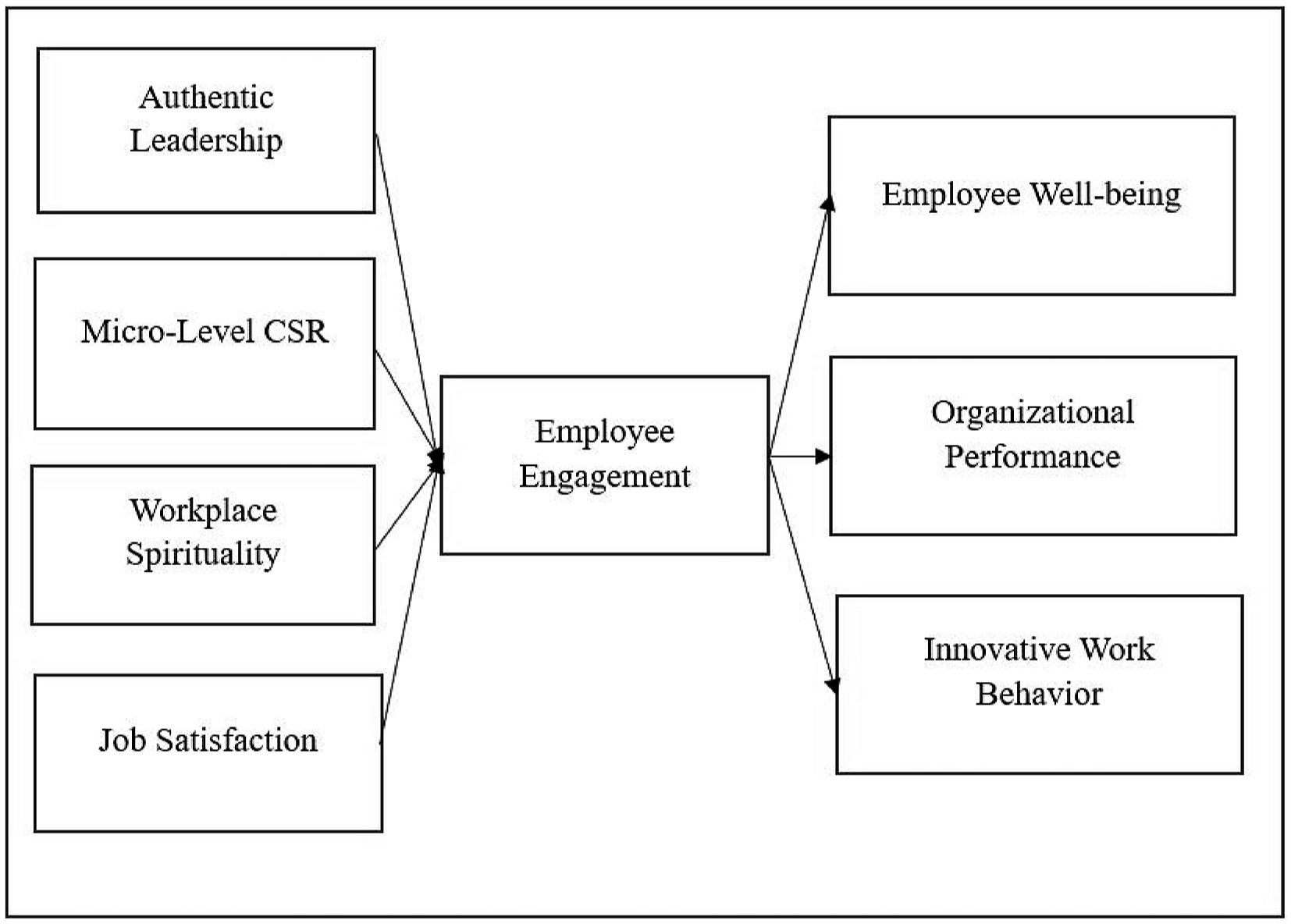
Methodology
Research design
This study adopts a qualitative systematic literature review and a conceptual synthesis design. The purpose is to analyse and integrate contemporary employee engagement models into a single unified framework. A theory-building approach was employed, following structured review procedures inspired by PRISMA guidelines to ensure transparency in identifying, screening, and selecting articles.
Time frame
The review covered literature published between January 2020 and June 2025, reflecting the rapidly changing workplace environment shaped by the COVID-19 pandemic, hybrid work practices, and increasing emphasis on employee well-being and engagement.
Inclusion and exclusion criteria
Inclusion Criteria: Peer-reviewed journal articles and conceptual papers published between 2020 and 2025. Studies focusing on employee engagement, workplace spirituality, authentic leadership, CSR, job satisfaction, well-being, retention, and innovative work behaviour. Both quantitative and qualitative empirical studies, as well as conceptual models. Case studies highlighting sector-specific practices in IT, healthcare, education, and services.
Exclusion Criteria: Articles published before 2020 (unless foundational to theory, e.g., Kahn’s model). Practitioner-only sources (blogs, magazines, non-peer-reviewed content). Studies without a clear reference to employee engagement or related outcomes.
Basis of selection of models
A total of 15 models were identified after systematically screening research databases such as Scopus, using keywords including “employee engagement,” “CSR,” “leadership,” “workplace spirituality,” “job satisfaction,” and “well-being.” The final models were selected based on the following criteria: Recency (published between 2020 and 2025). Research shows that having a deep sense of meaning in work greatly influences employees’ commitment to their organisation and their willingness to go above and beyond. Furthermore, self-efficacy plays a key role in how social connections affect job performance, with more confident employees outperforming their less confident peers. (purpose, empathy, inclusion, flexibility).
Conceptual model development
The expansion of the integrated framework followed five structured steps: Systematic Review of 15 Models (e.g., Ahmed et al., 2020; Koon & Ho, 2021; Wen et al., 2022; Salem et al., 2023; Chingan Thottathil & Nandakumar, 2025). Extraction of Key Constructs -Identifying drivers (leadership, CSR, spirituality, job satisfaction), mediator (engagement), and outcomes (well-being, retention, innovation). Thematic Coding - Categorising variables into themes such as leadership-well-being-engagement or CSR-satisfaction-retention. Cross-Model Synthesis - Comparing convergent and divergent pathways across models. Integration - Developing a unified conceptual model with Employee Engagement as the central mediator linking organisational drivers with employee and organisational results.
Analysis approach
The analysis applied a thematic coding and cross-model synthesis approach. Identification & Categorisation: Reviewing each of the 15 models to extract drivers, mediators, and outcomes. Pattern Recognition: Grouping recurring constructs into higher-order categories. Cross-Comparison: Evaluating similarities, differences, and complementarities between models. Framework Integration: Synthesising insights into an evidence-driven conceptual model for value-based engagement.
Relevance
This study is particularly relevant to the contemporary workplace, where organisations are grappling with sustaining employee engagement, well-being, and innovation amidst evolving work models. For example, Infosys has taken a markedly employee-centric approach. In FY 2024, around 84% of its workforce utilised remote working options, up from 75% the previous year, demonstrating a sustained emphasis on flexibility and employee comfort in work arrangements. 43 Additionally, Infosys’s HR initiatives now include cautionary alerts to employees working beyond 9 hours and 15 minutes especially during remote shifts to encourage work-life balance and prevent burnout. 44 Tata Consultancy Services (TCS) has received global recognition for its robust people practices, being named a Global Top Employer 2024 and ranking #2 in the Employee Health & Wellness category by the Top Employers Institute. 45 In the healthcare sector, Apollo Hospitals has prioritised employee well-being through proactive initiatives. At its HR Conclave, leadership emphasised holistic wellness encompassing personalised health assessments, mental health support, and wellness programs to enhance employee satisfaction, engagement, and productivity. 46
Findings
Engagement themes & workplace spirituality
Across the models reviewed, recognition, support, work–life balance, and purpose emerged as consistent engagement themes. Recent literature reinforces this: workplace spirituality, emphasising purpose, compassion, and community, is shown to enhance psychological well-being, creativity, retention, and innovative behaviour in organisations.47,48 Recent studies emphasise that workplace spirituality (purpose, compassion, connectedness) is strongly linked to engagement, retention, and innovation. For example, Alzyoud found that intrinsic purpose and organisational pride significantly enhance engagement outcomes in public organisations. Spirituality and ethical climate improve commitment and Performance. 49
Sectoral trends & case examples
IT sector (Infosys, Wipro, Cognizant)
A study in Indian IT finds that supervisor and coworker support, fair rewards, and procedural justice significantly raise engagement. Cognizant often scores higher than Infosys in these areas due to recognition and an inclusive reward system. Infosys’ HR innovations such as real-time recognition systems, digital tools, diversity and inclusion efforts, and employee empowerment through ESOPs are explicitly aimed at boosting engagement and productivity. Infosys’ digital HR practices (real-time recognition, D&I, flexible work policies) argue that IT engagement is increasingly driven by digital empowerment and fairness. TCS’s hybrid engagement strategies during 2023–2024 are consistent with those who highlight that fairness, justice, and support are stronger predictors of engagement than pay. 50 Banking Sector (e.g., HDFC, ICICI) Though specific studies are limited, broad literature notes that work-family policies and access support systems significantly enhance operative well-being and performance, which can inform engagement practices in banking. Informal narratives (e.g., Reddit) reflect employee frustration in some banks, such as ICICI, over overwork, lack of leave, and low empathy indicating potential gaps in leadership support and engagement culture. Banking studies show engagement is shaped by leadership fairness, procedural justice, and work–life balance. Bansal & Aggarwal found that supportive leadership and flexible leave policies significantly improve engagement in Indian banks. 51
FMCG sector (e.g., HUL)
While no direct studies on HUL were found, FMCG firms often emphasise career progression, digital collaboration tools, and employee well-being programs, paralleling engagement drivers identified in other sectors particularly in IT such as recognition and support.
Comparative model insights, sectoral trends: strengths & gaps.

Best practices from literature
Recognition & Support: Real-time feedback and peer acknowledgement not just annual rewards are critical. Infosys’ use of real-time recognition platforms exemplifies this Infosys, Cognizant 52 Leadership Fairness & Procedural Justice: Supportive supervisors and transparent processes (as seen at Cognizant) foster trust and engagement (banking) 51 Work–Family Support & Well-being: Policies providing genuine flexibility and support indirectly enhance performance through improved well-being, mainly in service and banking sectors. (banking/service) 53 Spiritual Leadership & Purpose: Creating an environment with meaning, ethical leadership, and psychological safety enhances intrinsic motivation and innovation 54 Contrivance real-time recognition platforms to reinforce everyday contributions and build morale. Train and enable leaders to act equitably, focus on workplace well-being, and foster a sense of fairness. Adopt meaningful work–life policies, not just formal ones, to ensure accessibility and visibility of support services. Cultivate spiritual and ethical leadership practices, embedding values, purpose, and emotional support into organisational culture. Customise engagement strategies to sectoral context e.g., digital tools and D&I in IT; well-being support in banking; career-focused initiatives in FMCG.
Discussion
The analysis of fifteen engagement models reveals that workplace spirituality, authentic leadership, and employee-oriented CSR remain foundational in shaping employee engagement and organisational outcomes. Recent studies highlight that spiritual values such as purpose, compassion, and community enhance psychological well-being and foster innovation, making them central to sustainable engagement frameworks emphasise that engagement rooted in meaning and ethical alignment produces stronger organisational commitment and creativity, supporting our conceptual model’s emphasis on spirituality.48,55
Industry evidence also supports this shift toward holistic engagement. In the IT sector, Infosys and TCS have institutionalised recognition platforms, digital collaboration tools, and flexible policies to reinforce employee well-being and motivation. Chatterjee and Singh show that fairness and transparent HR practices in IT companies are significant predictors of engagement, which explains why firms like Cognizant outperform peers in recognition and inclusivity. 56 In the banking sector, work–family balance policies and supervisor support have been found to directly impact both engagement and retention. 51 However, gaps remain, with employees in institutions such as ICICI voicing frustration over workload pressures and limited flexibility. In FMCG organisations such as Hindustan Unilever, career progression and digital engagement tools play a stronger role in retaining talent, reflecting findings by Kumari and Sharma that structured growth opportunities are key drivers of engagement. 57 In healthcare, Apollo Hospitals has adopted well-being and purpose-driven initiatives to address burnout, aligning with Nawaz, who confirm the importance of emotional support and ethical climates for innovation and resilience. 58
Despite these advances, the discussion highlights several gaps. First, the adoption of holistic frameworks such as PRISM (Purpose, Relationships, Involvement, Support, Motivation) remains limited in practice, even though evidence suggests that such integrative models offer better long-term engagement outcomes. 59 Second, measurement challenges persist in hybrid and remote work contexts: conventional survey instruments fail to capture dynamic fluctuations in engagement and belonging. 60 Third, a growing disconnect between HR technology and employee well-being is visible. While digital tools enable recognition and monitoring, they often emphasise productivity over psychological safety, risking disengagement unless carefully designed.
This study contributes to both academia and practice. For scholarship, it extends employee engagement theory by embedding workplace spirituality and value-based HRM into a unifying framework, addressing calls in HSM literature for more human-centred approaches. 61 For practitioners, it demonstrates how IT, banking, FMCG, and healthcare firms can apply evidence-based practices such as real-time recognition, flexible support policies, and purpose-driven leadership to sustain engagement and retention in the post-COVID, hybrid workplace. Importantly, the findings reinforce the argument that workplace spirituality and holistic engagement models are not optional but essential drivers of organisational resilience and innovation in 2025 and beyond. 62
Theoretical and practical implications
Theoretical contributions
This study develops engagement scholarship by bridging workplace spirituality with established drivers such as authentic leadership, CSR, and job satisfaction within a consolidated conceptual model where employee engagement serves as the central mediator. Prior research confirms that spirituality characterised by meaningful work, compassion, and community enhances well-being, creativity, and organisational citizenship behaviour, Nawaz demonstrate that spiritually grounded HR systems strengthen commitment and creativity in knowledge-intensive sectors, reinforcing the theoretical foundation of our framework. 63 By aligning workplace spirituality as a performance enabler rather than a peripheral cultural element, this study responds to calls for human-centred HRM models that integrate purpose and proper alignment into engagement theory.
Additionally, this research highlights measurement challenges in hybrid and remote contexts. As Nagori and Lawton (2024) caution, traditional survey-based instruments are insufficient to capture dynamic fluctuations in energy, belonging, and engagement in flexible work arrangements. 60 Our model thus contributes theoretically by suggesting that engagement measurement must evolve to include psychosocial safety climate (PSC) indicators and digital work experience metrics.
Practical contributions
The findings also carry immediate executive relevance. Case insights illustrate sectoral applications: Infosys and TCS (IT sector) have pioneered real-time recognition platforms, digital empowerment, and hybrid collaboration infrastructure that sustain engagement and belonging. 64 Apollo Hospitals (healthcare) has introduced “well-being first” programs, combining mindfulness training with flexible scheduling to strengthen resilience under high-pressure conditions. Banking (HDFC, ICICI) presents a mixed picture: while policies on work–family balance improve performance, employee forums reveal gaps in empathy and leadership support, underscoring the importance of procedural justice. 65 FMCG (HUL) emphasises career progression and digital collaboration tools, aligning with motivational engagement drivers such as recognition and support. These examples illustrate the need for sector-specific customisation of engagement strategies while aligning with universal values such as fairness, recognition, and purpose.
Best practices for organisations
Drawing from literature and practice, organisations should: Adopt real-time recognition and fairness systems (Infosys, Cognizant) to enhance trust and psychological safety.
66
Invest in holistic well-being and work–family policies (Apollo Hospitals, HDFC) to support resilience and retention.
67
Embed ESG and CSR into HR design, reinforcing ethical alignment and sustainability.
68
Leverage tech-enabled development tools, such as wellness platforms and micro-learning modules, to make engagement personalised and accessible.
12
Cultivate spiritual and ethical leadership, ensuring employees find meaning in work, which Gallup links to a 70% higher likelihood of engagement.
Academic and industry contribution
For academia, the study delivers a refined conceptual model that integrates spirituality into mainstream engagement research and offers a multi-sector comparative lens call for frameworks that embed human values into organisational systems (Nawaz et al., 2024). 58 For industry, it provides a practical roadmap for embedding recognition, purpose, and fairness into HR systems, aligning with PRISM (Purpose, Relationships, Involvement, Support, Motivation) as a holistic framework suited to post-2025 workplaces.
Addressing gaps
Despite progress, three gaps remain:
There is a weak adoption of holistic frameworks like PRISM in corporate settings. Measurement limitations in capturing engagement under hybrid models. A disconnect between HR technology and well-being, where digital tools often emphasise efficiency over ethical design. By addressing these challenges, organisations can align spirituality, engagement, and performance in ways that foster resilience, innovation, and sustainable growth.
Limitations
This study has a few notable limitations. First, the analysis is based primarily on secondary sources and existing models, without collecting primary data from employees or organisations. This restricts the ability to validate the conceptual framework through direct empirical testing. Second, the review focuses on literature, case examples, and sectoral insights drawn from published studies and industry reports, which may introduce publication bias and limit the depth of context-specific insights. Third, most of the evidence comes from large, established firms in IT, healthcare, banking, and FMCG; therefore, the findings may not be fully generalisable to small and medium enterprises (SMEs), startups, or informal sector organisations.
Future research should address these gaps by conducting longitudinal and cross-sectoral studies, including primary data collection through surveys or interviews, to test and refine the proposed model in diverse organisational contexts.
Future research directions
Building on the identified limitations, several avenues for future research are recommended. First, empirical validation of the proposed conceptual model is essential. Primary data collection through surveys, interviews, or mixed-method approaches would provide deeper insights into how authentic leadership, CSR, workplace spirituality, and job satisfaction interact to drive engagement across diverse sectors.58,69 Second, upcoming studies should broaden the scope beyond large firms to include SMEs, startups, and public sector organisations, where resource constraints and cultural contexts may shape employee engagement differently. 17 Comparative research could highlight sectoral variations and uncover scalable best practices for different organisational sizes. Third, the role of hybrid and digital workplaces requires more nuanced exploration. As Nagori and Lawton caution, traditional survey tools often fail to capture the dynamic and fluctuating experiences of employees in flexible models. Future research should develop and test new measurement instruments that integrate psychosocial safety climate, digital well-being, and engagement in technology-enabled environments. 60 Fourth, the integration of workplace spirituality with ESG-aligned HR practices remains an emerging area. Longitudinal studies could examine whether spiritually beached practices, when embedded in governance and sustainability strategies, lead to sustained improvements in well-being, innovation, and retention. 67 Finally, researchers should consider cross-cultural and international comparisons, given that engagement drivers may vary across cultural contexts. Comparative studies across Asian, Western, and emerging markets would enrich both theory and practice by offering a global understanding of how value-based engagement model’s function.
Conclusion
This study synthesised insights from 15 established employee engagement and workplace spirituality models, consolidating them into a values-driven conceptual framework where engagement acts as the central mediator of organisational outcomes. The findings consistently highlighted recognition, support, work–life balance, and purpose as core engagement drivers, reinforcing prior evidence that spirituality at work expressed through meaning, compassion, and ethical alignment enhances well-being, creativity, and retention.58,69 By analysing sectoral practices across IT, banking, FMCG, and healthcare, the study revealed how organisations such as Infosys, Tata Consultancy Services, and Apollo Hospitals operationalise engagement through real-time recognition, hybrid work infrastructure, and well-being programs. These cases illustrate the pertinency of integrating workplace spirituality with human-centred HRM, bridging theory and practice. However, gaps remain in banking and FMCG contexts, where leadership fairness, empathy, and structured well-being initiatives are less consistently embedded. 60 Theoretically, the research extends engagement literature by situating spirituality as a performance enabler rather than a cultural add-on. It responds to models that unify human values and organisational systems. 58 Practically, it underscores the importance of adopting holistic frameworks such as PRISM (Purpose, Relationships, Involvement, Support, Motivation), bring into line HR with ESG principles, and leveraging technology for continuous feedback and well-being integration.66,67 While the study’s reliance on secondary data limits generalisability, the insights provide a strong foundation for both scholars and practitioners. For academia, the framework offers testable propositions for future research in hybrid and digitalised workplaces. For the industry, it provides actionable strategies to foster engagement by embedding recognition, fairness, spirituality, and ESG into daily practices. In conclusion, sustainable employee engagement in the post-2025 workplace requires moving beyond transactional HR policies toward values-based, spiritually informed systems that harmonise employee well-being with organisational performance. Such an integrated approach not only enhances resilience and innovation but also aligns organisational systems with the broader societal demand for purpose-driven work.
Footnotes
Acknowledgements
We gratefully acknowledge the support and contributions that helped make this research possible.

Ethical approval
This work made use of bibliographic information of published research articles from the Scopus database, thus utilizing secondary data. There were no human or animal subjects engaged; the study followed worldwide bibliometric analysis (e.g., COPE) norms. Original material was not changed; data were pre-processed to eliminate duplicates and guarantee consistency.
Author contributions
All authors contributed equally to the research design, data collection, analysis, and manuscript preparation.
Funding
The authors received no financial support for the research, authorship, and/or publication of this article.
Declaration of conflicting interests
The authors declared no potential conflicts of interest with respect to the research, authorship, and/or publication of this article.