



Abstract
Background
Why and how conveying respect may foster the engagement of immigrant employees, who often occupy a vulnerable position within the workforce, in intrapreneurship—one’s search and pursuit of new venture opportunities? This question is situated within the discourse about our intrinsic drive to connect and engage with others, both socially and at work, which is essential for developing positive relationships that inspire and propel work engagement and action.
Objective
Research in this area has tended to focus on one’s experiences of respect in the interactions with others and her/his work engagement. However, little is known about why and how working immigrants who convey respect in their relationships with others may be driven to engage in specific work behaviors—intrapreneurship.
Method
We conducted both time-lagged and experimental studies to examine this question. The findings indicate that interacting respectfully with others (i.e., conveying respect) cultivates relational energy, which in turn encourages immigrant employees to engage in intrapreneurial behaviors.
Conclusion
Our findings advance the relational resourcing view by shifting the focus from experiencing respect in work relationships to the act of conveying respect, suggesting that immigrant employees who engage respectfully with others cultivate relational energy and, in turn, are better positioned to generate new venture initiatives and contribute meaningfully to their organizations.
Introduction
Intrapreneurship—the enactment of entrepreneurial behaviors within existing organizations1,2—is a vital engine of organizational innovation, growth, and competitive advantage. 3 Employees who identify new opportunities, propose novel initiatives, and solve organizational problems creatively drive the development of products, services, and processes that enhance organizational performance4,5 and reflect higher levels of innovative behavior more broadly. 6 Yet intrapreneurship does not arise in a social vacuum. It is shaped by the relational conditions in which employees are embedded—conditions that are themselves profoundly influenced by organizational dynamics, power structures, and the quality of everyday workplace interactions.7,8
While for some employees these conditions are enabling, for others they are deeply constraining. 8 This tension is perhaps nowhere more consequential than for immigrant employees, who bring diverse perspectives, broad knowledge bases, and considerable resilience to their organizations,9,10 yet who simultaneously confront language barriers, cultural differences, network exclusion, and persistent forms of workplace discrimination that undermine their sense of belonging and agency.11–15 Described as a “forgotten minority” in organizational research,16(p. 6) immigrant employees represent a substantial and growing segment of the global knowledge workforce, 17 yet remain insufficiently examined in organizational science, particularly in the context of intrapreneurship. Understanding how to foster intrapreneurial engagement among this group is therefore not only theoretically important but practically urgent, given the realities of global migration and increasing workforce diversity. 18
Scholars have increasingly argued that organizational research must be anchored in the specific contexts in which work is experienced,19,20 yet intrapreneurship theory has largely developed around a tacit assumption—that the motivational and relational conditions conducive to entrepreneurial initiative are uniformly available across employee populations. This assumption is rather problematic when delving into the context of immigrant employees, whose structural position in organizations means that such conditions cannot be presumed—they may need to be actively cultivated. The question of how immigrant employees might shape these conditions, and through what mechanisms such cultivation translates into intrapreneurial action, remains theoretically underdeveloped.
We identify three specific and interrelated issues at the intersection of intrapreneurship research, positive relationships at work, and immigrant work experiences. First, prior research has largely theorized the experience of being respected as the driver of positive work outcomes—creativity, help-seeking, resilience, and performance—while largely overlooking the act of conveying respect and its consequences for the giver.21–23 Whether and how enacting respect toward others might resource the actor, and in particular whether it might enable behaviors as demanding as intrapreneurship, has received little theoretical or empirical attention. Second, although relational energy has been recognized as a psychologically generative resource that supports broad work engagement,24–26 its specific role as a mechanism linking positive interpersonal conduct to intrapreneurial behavior remains underspecified. We thus need to develop theorizing on how everyday positive relational exchanges become motivationally significant for the initiative, persistence, and proactive problem solving that intrapreneurship requires. Third, intrapreneurship theories have rarely centered immigrant employees as a focal population despite their distinctive configuration of barriers and assets,8,9,16,27 thereby limiting our understanding of why some immigrant employees are more intrapreneurially engaged than others and what relational dynamics might explain this variation.
We address these issues by developing and testing a model grounded in the relational resourcing view21,22 in which the act of conveying respect toward co-workers—expressed through attentive, affirming, and appreciative interpersonal engagement 28 —generates relational energy, a heightened sense of psychological resourcefulness derived from interpersonal interaction,24,25 which in turn enables immigrant employees to engage in intrapreneurial behaviors. Grounded in Dutton’s 28 theorizing on how respectful interaction cultivates energizing workplace by developing positive relationships, and more broadly drawing on positive relationships at work29,30 and recent work on the power of conveying respect in workplace relationships, 31 we argue that by engaging respectfully with co-workers, immigrant employees create interactions that signal equality and affirm social worth,32,33 actively counteracting the marginalization they often face. 34 Such interactions generate relational energy that resources employees to pursue new venture initiatives despite systemic barriers,35,36 and through which the meaning of work is shaped and organizational engagement is sustained.37,38 In doing so, we advance the perspective that the immigrant employee is not a passive subject of organizational circumstances but an agentic architect of the relational conditions that make intrapreneurship possible.
We test these indirect relationships across a time-lagged field study and a controlled experiment, and offer three potential contributions to the literature. First, we extend the relational resourcing view by redirecting theoretical attention from the recipient of respect to its giver, suggesting that conveying respect is an agentic relational practice that resources the actor and enables discretionary, change-oriented behavior; this provides a more nuanced understanding of the relational underpinnings of work engagement and organizational entrepreneurship.39,40 Second, we specify relational energy as the proximal mechanism connecting respectful enactment to intrapreneurship, offering a theoretically precise and empirically grounded account of how micro-level interpersonal conduct sustains the motivational demands of organizational entrepreneurship. Third, we bring immigrant employees to the center of intrapreneurship theory as a theoretically generative focal population, advancing an agentic, inclusion-oriented perspective 41 that moves beyond deficit accounts of immigrant workplace challenges 11 and responds to calls for more contextually sensitive and relationally grounded theories of entrepreneurial behavior within organizations.42,43 The paper unfolds by first developing the theoretical background and introducing three hypotheses rooted in the relational resourcing perspective. It then describes two studies: a time-lagged field study and a controlled experiment, detailing the samples, procedures, and measures used. Following this, the results of both studies are presented. The paper concludes with a discussion of the theoretical and practical implications, acknowledges limitations, and suggests directions for future research.
Theoretical background and hypotheses
Intrapreneurship and immigrant employees
Research has conceptualized intrapreneurship as the enactment of entrepreneurial behaviors within established organizations, encompassing opportunity identification, risk-taking, and proactive initiative.1,2 Subsequent work linked such behaviors to organizational innovation and performance3,4 and catalogued the individual and structural enablers that help employees surface and advance new ideas.5,44 Yet two important aspects need further attention. First, intrapreneurship research has devoted limited attention to how micro-relational processes generate and sustain the psychological resources that entrepreneurial initiative demands—resources that are neither unlimited nor uniformly accessible.5,24,25 Second, and relatedly, intrapreneurship research has rarely centered immigrant employees as a focal population, despite their distinctive configuration of barriers and assets that renders the relational conditions of their work both particularly consequential and particularly fragile.9,16,27
Immigrant employees face a distinctive set of challenges that can erode the sense of social worth and belonging upon which intrapreneurial initiative depends. These include language difficulties, limited access to professional networks, cultural distance, and persistent experiences of workplace discrimination and exclusion.11,16,27,45 Such challenges can manifest as overt prejudice or subtler forms of marginalization, undermining job satisfaction, morale, and the psychological safety necessary to propose novel ideas and take organizational risks.14,46,47 Yet immigrant employees also bring to their organizations diverse knowledge structures, cultural adaptability, and accumulated career capital—assets that can substantially enrich intrapreneurial contributions when supported by affirming relational contexts.9,10 Positive interactions that recognize their value and foster a sense of inclusion can counteract the marginalization they often face, enabling them to engage more fully in organizational entrepreneurship. 34 This dual reality—vulnerability and potential coexisting within the same population—makes immigrant employees a theoretically generative focal group for understanding how relational dynamics shape intrapreneurial engagement.
Conveying respect toward co-workers
Our theoretical framework is grounded in the relational resourcing view,21,22 which holds that interpersonal interactions are not merely social exchanges but active sites of psychological resource generation. From this perspective, the quality of one’s relational conduct shapes the motivational, cognitive, and energetic capacities available for work engagement. Research within this tradition has thus far tended to focus predominantly on the experience of respect—documenting how being respected by supervisors and colleagues fosters creativity, 21 help-seeking and performance, 22 resilience, 39 and a sense of meaningfulness and thriving. 37 This body of work suggests that respect is a powerful relational resource but treats it almost as one’s experiencing respectful interactions, leaving us with limited understanding of the consequences of actively conveying respect toward others in the workplace.
We argue that this recipient-centered view is incomplete, and that a full account of how respectful interactions resource employees requires attending to the perspective of the giver. Respect, at its core, is about affirming the inherent worth of another person.23,33,48 When one conveys respect, one is “being present to others, affirming them, communicating and listening in a way that manifests regard and an appreciation of the other’s worth.”28(p. 22) Such enactment honors co-workers as human beings and social group members, communicating positive regard and a genuine recognition of their value.23,49,50 We suggest that this process does not merely benefit the recipient—it also transforms or at least shapes the relational context in which the giver operates. By initiating interactions in which respect is conveyed, employees actively construct higher-quality interpersonal exchanges, reduce friction and distance in their working relationships, and signal to co-workers that they are valued partners in a shared endeavor.31,51,52 This process is especially important for immigrant employees, who cannot rely on the pre-existing social capital and informal network access that their native-born counterparts may take for granted. For them, conveying respect is not only a prosocial gesture but a proactive and agentic way for cultivating the relational conditions that make organizational participation and entrepreneurial initiative possible.32,34
The theoretical lens helps in developing a better understanding of the relational underpinnings of intrapreneurship. Rather than treating entrepreneurial initiative as a product of individual disposition or organizational support structures alone,1,2 we argue that intrapreneurship is also shaped by the relational practices employees enact in their everyday interactions—practices that generate or deplete the psychological resources needed to sustain initiative, tolerate uncertainty, and persist through the demands of new venture development.5,53 The specific mechanism through which conveying respect produces these resources, we posit, is relational energy.
Conveying respect and relational energy
Relational energy is defined as “a heightened level of psychological resourcefulness generated from interpersonal interactions that enhances one’s capacity to do work.”25(p. 37) It is distinct from other forms of energy in that it is inherently interactional in origin: it is generated—or depleted—through the quality of one’s exchanges with others. 24 Building on Dutton’s 28 foundational theorizing, we argue that conveying respect is a primary interpersonal mechanism through which relational energy is cultivated. When organizational members convey respect toward one another, they develop what Carlsen and Dutton54(p. 15) term generative relationships—“strips of experience that bring a feeling of energy and aliveness to people and also have the potential to produce more enduring, expansive, and transformative consequences.” These generative connections are characterized by mutual recognition, warmth, and a shared sense of positive regard that amplifies the psychological vitality of both parties.28,35
The pathway from conveying respect to relational energy operates through several complementary processes. First, when respect is conveyed, it signals to co-workers that they are seen, valued, and appreciated—a message that creates interpersonal warmth and reciprocates positively toward the giver, inducing a cycle of positive affect and engagement.28,51,55 Second, by conveying respect, employees actively reduce the interpersonal friction, ambiguity, and guardedness that can drain energy from workplace interactions, replacing these with the openness and generativity that energizing exchanges require.24,54 Third, and importantly for the immigrant context, conveying respect creates interactions that signal equality and affirm the social worth of co-workers across group boundaries,32,33 thereby cultivating a more inclusive relational climate that energizes all participants. 34 Consistent with Flynn’s 56 research on the generative effects of prosocial acts in exchange relationships, and with Baker and Dutton’s 35 argument that acts of generosity expand the emotional resources of both parties, we reason that by conveying respect toward co-workers, immigrant employees open pathways to positive relational experiences that generate heightened psychological resourcefulness for giver and recipient alike. This energizing effect is most likely to emerge when respect is conveyed genuinely rather than instrumentally—when it reflects authentic regard for the other’s worth rather than strategic impression management.28,40 Thus,
Conveying respect toward co-workers is positively related to relational energy.
Relational energy and intrapreneurship
Intrapreneurship requires sustained and substantial psychological investment. As Gawke et al.5(p. 510) observed, “additional energy, time, and resources” are required for intrapreneurial engagement—and because intrapreneurship is a continuous rather than episodic activity, employees must be able to replenish and sustain these resources over time. Entrepreneurial behaviors are cognitively and emotionally demanding, requiring not only creative ideation but also the persistence to advocate for novel initiatives, the risk tolerance to challenge established routines, and the resilience to absorb setbacks.1,2,53 For immigrant employees, these demands are compounded by the additional psychological costs of navigating exclusion, establishing credibility, and overcoming the structural barriers that impede their organizational participation.14,16
Drawing on the relational resourcing view,21,22 we argue that relational energy, generated through interactions in which respect is conveyed, is a vital resource for meeting these demands. Relational energy supplies the psychological vitality that propels employees to engage at work 25 and transforms the experience of work into something felt as more meaningful, exciting, and worthwhile—conditions that sustain the kind of discretionary effort intrapreneurship requires.25,38 Empirically, relational energy generated through leader-follower relationships has been linked to elevated follower performance, 57 and positive subjective experiences of vitality in work relationships have been associated with greater innovative behavior. 58 Beyond these direct motivational effects, relational energy also fosters psychological availability—a readiness to invest the self in challenging work tasks—which Ramati-Navon et al. 44 identify as a key enabling condition for intrapreneurship. These mechanisms suggest that employees who experience higher relational energy are better resourced to take the initiative, sustain the effort, and absorb the risks that organizational entrepreneurship entails. The energizing consequences of generative work relationships thus expand employees’ capacity to develop and promote new ventures within the organization.37,54 Thus,
Relational energy is positively related to intrapreneurship.
Conveying respect, relational energy, and intrapreneurship
Our reasoning suggests that conveying respect and intrapreneurial engagement are connected through a coherent relational resourcing process. By conveying respect toward co-workers, immigrant employees cultivate the generative relationships through which relational energy is generated; that relational energy, in turn, supplies the psychological resources (vitality, availability, positive affect, and motivational activation) that enable and sustain intrapreneurial initiative. This mediated pathway reflects Baker and Dutton’s35(p. 326) observation that “acts of kindness and generosity between two people expand each person’s emotional resources (e.g., joy or gratefulness) and openness to new ideas and influences” (see also 29 ), and is consistent with evidence that positive relational practices generate the emotional energy underpinning creativity, innovation, and proactive organizational behavior.7,24,56 For immigrant employees specifically, this process carries particular theoretical significance: it positions conveying respect as an agentic pathway through which individuals who face structural exclusion and reduced organizational capital can nevertheless build the relational conditions that resource their own engagement and entrepreneurial contribution. The act of conveying respect thus becomes not merely an interpersonal gesture but a form of proactive self-resourcing—one that generates the relational energy necessary to transcend the barriers that constrain intrapreneurship in this population.31,34 Thus,
Conveying respect toward co-workers is indirectly related to intrapreneurship through relational energy.
Method
Research context
Prior studies on intrapreneurial engagement have explored various organizational settings, encompassing both employees and executives in contexts like small and family-owned businesses (e.g., refs. 4,5,59). However, research has yet to provide evidence regarding the context of working immigrants who may be vulnerable and face even more challenging hurdles for work engagement in general 60 and engagement in intrapreneurship in particular. 61 Although the public conversation around migration often focuses on crises and refugees, many migrant workers are primarily motivated by economic opportunities and they constituted in 2019 about 4.9% of the labor force of destination countries. 17
Despite this important context, industrial psychologists have noted that working immigrants are a “forgotten minority”16(p. 6) which deserves considerably more attention in the extant literature. However, working immigrants frequently encounter substantial labor market discrimination, which can impede their workplace integration.16,45 Research shows that, on a global scale, foreign-born workers tend to experience higher rates of workplace violence and harassment compared to their native-born counterparts. This discrimination extends to reporting these incidents, with immigrants less likely to seek help or report their experiences, particularly in high-income regions like North America. Moreover, immigrants often face challenges in integration due to language barriers, cultural differences, and discrimination. 45 Other studies have stressed that “discrimination against immigrants or neglecting their inclusion in the workplace may impede the companies’ productivity gains.”62(p. 379) This can manifest as overt prejudice through lack of respect or subtler forms of exclusion, disrespect, marginalization, and care, affecting their career advancement opportunities, job satisfaction, going the extra mile, and even their sense of belonging.46,47 Such experiences can also impact their attitudes, morale, and productivity, further complicating their integration. We delve into this context by examining a relational lens to understand the dynamics involved in the engagement of working immigrants in intrapreneurship.
Overview of studies
This research involves immigrant knowledge employees, who are vital for economic development, 9 and potentially a key source of knowledge creation processes in the organizations, in part through intrapreneurship. We designed and conducted two studies aimed at assessing the relationships between conveying respect through relational energy and intrapreneurship among immigrant employees. In Study 1, we used a time-lagged design to separate the measurement of the indirect variable (conveying respect toward co-workers), mediator (relational energy), and dependent variable (intrapreneurship). This design is instrumental in reducing potential common method bias and variance. 63 Study 2 was designed as an online experiment in which we tried to further establish the conceptual causation of the indirect influence of conveying respect on intrapreneurship.
Study 1: Method
Sample and procedure
From Prolific panel data we recruited 258 immigrants working in a variety of knowledge-intensive industries. These participants are identified under the rubrics of (1) Product development and (2) Scientific or Technical Services. Our choice was motivated by the notion that in these settings, professional immigrant employees are expected to come up with new ideas and initiatives. Participants were identified as immigrants via Prolific’s screening criteria, which classify an individual as an immigrant if they were born in a country other than their current country of residence. We further verified this criterion by including a screening question at the start of the survey, confirming that participants were born outside their current country of residence and had resided there for at least 1 year. This operational definition is consistent with that used in prior organizational research on immigrant employees (e.g., refs. 14,16). We employed a time-lagged design, collecting data on the control variables and the independent variable, conveying respect toward co-workers, at Time 1; the mediator, relational energy, at Time 2; and the dependent variable, intrapreneurship, at Time 3, with approximately 1-week intervals between waves. We received complete surveys from 243 participants. However, due to the failure of 27 participants to pass the attentive tests and five more who provided incomplete data, only 211 surveys were usable and included in the analyses.
Measures
All measurement items appear in the Appendix B. All responses were on a five-point scale (1 = not at all to 5 = to a very large extent).
Intrapreneurship
We used the scale items employed by Ramati-Navon et al. 44 of which four items manifest search intrapreneurial behaviors (search intrapreneurship) (α = .907) and four items manifest problem solving intrapreneurial behaviors (problem solving intrapreneurship) (α = .937).
Relational energy
We used the 5-item scale employed by Owens et al. 25 to assess one’s energy while interacting with co-workers at work (α = .937).
Conveying respect (toward co-workers)
We adapted this 9-item scale from Carmeli et al. 21 but slightly modified the phrases to capture one’s conveying respect towards co-workers. Thus, rather than asking about experiencing interpersonal respect at work (e.g., “Organizational members here are always available to hear out and listen to each other”) we asked participants the extent to which they engage respectfully with their co-workers (e.g., “I am always available to hear out and listen to my co-workers”) (α = .881).
Controls
We controlled for resource adequacy, which is defined as “the extent to which individuals have the means at their disposal in their immediate work situation to fully utilize their relevant abilities and motivation to accomplish work-related goals.”64,65,66(p. 324) We argue that even when people gain positive energy from their workplace relationships, they still require sufficient resources to aid in developing and advancing their ventures. Resource adequacy was assessed by the 6-item scale employed in Rousseau and Aubé 66 (α = .858).
We also controlled for one’s gender, age, and tenure in the organization. It might be challenging for women to exhibit intrapreneurial behaviors, 66 and older and tenured employees may know the social fabric in the organization better and they may also be less prone to take the risks involved in the creative facet of intrapreneurship. 25 In addition, one’s hierarchical (executive vs non-executive) role can influence intrapreneurship. 67 Education denotes knowledge breadth which is essential to come up with new venture initiatives. 67
Data analysis
We first performed CFA to assess the measurement model vis-à-vis alternative ones, followed by the latent moderated structural equations (LMS; 68 ) method in Mplus (Version 8.4; 69 ) to examine the model and hypotheses. Because standard SEM fit indices are not reported for LMS models, we assessed model fit using a two-step approach. 70
Study 1: Results
We first performed confirmatory factor analysis (CFA) using Mplus for the five-factor model and the results indicate the model fit the data well. CFA results produced Akaike (AIC) and Bayesian (BIC) values of 12,960.225 and 13,275.300, respectively. Other fit-of-indices [χ2 (340, N = 211) = 702.709, p = 0.000, CFI = 0.904; TLI = 0.893, and RMSEA = 0.071] were obtained and all standardized factor loadings in the model were above 0.60. Model constructs were evaluated for convergence validity using composite reliability (CR) and average variance extracted (AVE). CR and AVE values for conveying respect (0.883, 0.463), search intrapreneurship (0.908, 0.711), problem solving intrapreneurship (0.939, 0.793), relational energy (0.851, 0.535), and resource adequacy (0.859, 0.511) were obtained. While an AVE above 0.5 is generally recommended, an AVE below 0.5 may be deemed acceptable provided that the composite reliability is high. 71 We also performed CFA to test for alternative measurement models. Compared with a four-factor model the results indicate Akaike (AIC) and Bayesian (BIC) values of 13,299.958 and 13,601.625, respectively. Other fit-of-indices [χ2 (344, N = 211) = 1050.442, p = 0.000, CFI = 0.812; TLI = 0.794, and RMSEA = 0.099] were obtained. An alternative three-factor model in which the items of both intrapreneurship were loaded onto a single latent variable did not have an acceptable level of statistical significance (AIC = 13,628.553, BIC = 13,920.164, CFI = 0.724, TLI = 0.700, and SRMR = 0.119, χ2 (347, N = 211) = 1385.037, p = 0.000). We also tested three, two, and one-factor model structures and the results showed poorer fit with the data. Thus, our hypothesized five-factor model had a better fit with the data than the alternative models.
Study 1, mean, standard deviation, and correlations.

N = 208 to 211; p-values appear in the parentheses.
Study 1, results of structural equations modeling and indirect relationships between conveying respect, relational energy, and intrapreneurship.
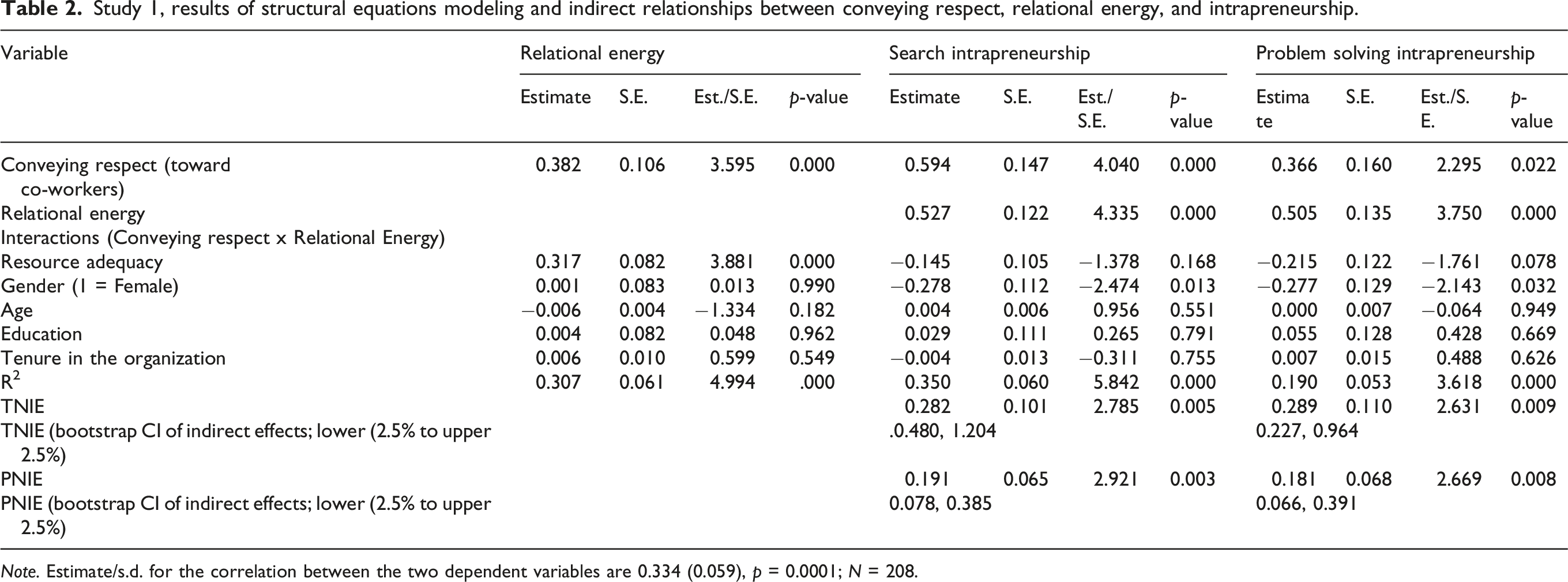
Note. Estimate/s.d. for the correlation between the two dependent variables are 0.334 (0.059), p = 0.0001; N = 208.
A similar test was conducted for problem solving intrapreneurship and the results indicate a significant link between relational energy and problem solving intrapreneurship (unstandardized estimate (for x = 0) = 0.505, SE = 0.137, Est./S.E. = 3.685; p = 0.000; unstandardized estimate (for x = 1) = 0.505, SE = 0.135, Est./S.E. = 3.750; p = 0.000), and a statistically significant link between respect and problem solving intrapreneurship (at mean M) (0.366, SE = 0.160, Est./S.E. = 2.295; p = 0.022). We also found that gender is significantly related to problem solving intrapreneurship (0.277, p = 0.032).
We followed MacKinnon et al.’s 75 guidance to estimate how much of X’s effect on Y is explained by the indirect influence of relational energy. We calculated two types of indirect effects, which are usually calculated when there is an interaction between treatment and mediator, the pure natural indirect effect (PNIE) and the total natural indirect effect (TNIE). The 95% percentile bootstrap confidence intervals (CI) of the model results indicate that the PNIE and TNIE for search intrapreneurship are positively and statistically significant (0.191 CI = 0.078, 0.385; 0.282, CI = 0.480, 1.204, respectively). For problem solving intrapreneurship the following PNIE and TNIE (also positively and statistically significant) were obtained (0.012, CI = 0.066, 0.391; 0.289, CI = 0.227, 0.964; respectively). Overall, the results support the indirect influence of respect, via relational energy, on both facets of intrapreneurship (Hypothesis 3).
Following Hayes,76(p. 148) we converted unstandardized TNIE and PNIE into partially standardized TNIE (PSTNIE) and PNIE (PSPNIE) by dividing their effects by the corresponding SD of two latent DVs (y1 and y2). We calculated partially standardized effects rather than fully standardized effects, due to the dichotomous nature of our IV. 76 We calculated the standard deviations of latent variables y1 and y2 using the tech4 option in the Mplus output command for our model (by squaring the variances in the Mplus output). Estimates, presented in Table 2, for partially standardized TNIE as regards y1 and y2 are 0.131 and 0.166, and for partially standardized PNIE they are 0.167 and 0.067, respectively.
The findings from Study 1 provide initial support for our theoretical model: conveying respect toward co-workers is positively related to relational energy (H1), relational energy is positively related to both search and problem solving intrapreneurship (H2), and the indirect effect of conveying respect on intrapreneurship via relational energy is statistically significant (H3). However, the time-lagged design of Study 1, while useful for reducing common-method variance, cannot establish causal directionality with certainty. To address this limitation and strengthen causal inference, we conducted Study 2 as a controlled online experiment in which the level of conveying respect was manipulated, allowing us to test whether experimentally induced differences in respectful conduct produce corresponding differences in relational energy and intrapreneurial behavior.
Study 2: Method
We conducted an experimental study to further establish the causal mechanism underlying the indirect effect of conveying respect on intrapreneurship by manipulating the IV (conveying respect) and subsequently assessing relational energy and intrapreneurship.
Manipulation check
We first conducted a manipulation check for conveying respect by recruiting from Prolific panel data immigrants working in a variety of industries. Overall, we attempted to recruit 100 individuals appearing under the working immigrants section at Prolific. We established two criteria in setting this research population target: the participants needed to be at least 21 years old and have a workplace tenure of at least one calendar year. Overall, 100 participants took the survey, but only 88 provided complete survey data (50% were women). We gave the high condition group a scenario to read in which we attempted to induce one’s conveying respect and asked participants to think or reflect on events in which during the day-to-day interactions with co-workers they interrelate with them in respectful ways. We gave participants in the low condition group a scenario to read in which we attempted to induce one’s showing lack of respect towards his/her co-workers by asking them to think or reflect on events in which during the day-to-day interactions with co-workers they do not interrelate with them in respectful ways (see Appendix A). We then asked participants to complete the survey items on conveying respect towards co-workers using an adaptation of the 9-item scale (1 = not at all to 5 = to a very large extent) employed in Carmeli et al. 21 (overall α = .895). All scale items are listed in Appendix B.
The results of the manipulation checks support that the conveying respect manipulation was effective. Participants in the high condition reported significantly higher respectful interactions (Mean = 4.179, s.d. = .499, SEM = .075) than those in the low condition (Mean = 3.586, s.d. = .735, SEM = .118) (F = 2.868, t = 4.428, df = 86; equal variance assumed; Mean Difference = .593; s.d. difference = .134; 95% CILower = .327; CIUpper = .860).
Sample and procedure
We recruited 289 immigrant participants from Prolific’s panel, all working in a variety of knowledge-intensive industries. These participants worked in sectors categorized as (1) Product Development and (2) Scientific/Technical Services. We were interested in professional immigrants as they work in such environments where there are higher expectations from them as well as more available opportunities to come up with new ideas and initiatives. Of the 289 participants who took the survey, 17 removed themselves before the completion of the entire survey, an additional 35 participants did not pass the attentive tests, leaving a valid N of 237 on which all subsequent analyses were performed.
Measures
Intrapreneurship
As in Study 1, we used the scale items developed by Ramati-Navon et al. 44 of which four items manifest search intrapreneurial behaviors (search intrapreneurship) (α = 0.920) and four items manifest problem solving intrapreneurial behaviors (problem solving intrapreneurship) (α = 0.926).
Relational energy
As in Study 1, we used the 5-item scale employed by Owens et al. 25 to assess one’s energy while interacting with co-workers at work (α = .906).
Controls
As in Study 1, we controlled for resource adequacy, assessed by the 6-item scale employed in Rousseau and Aubé 66 (α = .858), as well as for tenure and education. Finally, we also controlled for job scope (full- and part-time jobs) because it is likely that employees with a full-time job scope may be more comfortable to engage in intrapreneurship than those who hold part-time jobs.
Data analysis
We first performed CFA to assess the measurement model vis-a-vis alternative ones. We then used the LMS 68 method in Mplus (Version 8.4; 69 ) to test the model and hypotheses.
Study 2: Results
We first performed confirmatory factor analysis using Mplus for the four-factor model and the results indicate the model fit the data well. Results produced Akaike (AIC) and Bayesian (BIC) of 9774.985 and 9993.473, respectively. Other fit-of-indices [χ2 (146, N = 237) = 229.461, p < 0.01, CFI = 0.967; TLI = 0.961, and RMSEA = 0.049] were obtained and all the standardized factor loadings in the model were above 0.60. Model constructs were evaluated for convergence validity using composite reliability (CR) and average variance extracted (AVE). CR and AVE values for search intrapreneurship (0.920, 0.742), problem solving intrapreneurship (0.927, 0.760), relational energy (0.908, 0.667), and resource adequacy (0.850, 0.490) were obtained. An alternative three-factor model in which the items of both intrapreneurship were loaded onto a single latent variable did not have an acceptable level of statistical significance (AIC = 10,215.189, BIC = 10,423.272, CFI = 0.804, TLI = 0.775, and SRMR = 0.081, χ2 (149, N = 237) = 638.328, p < 0.01). We also tested two and one-factor model structures and the results showed poorer fit with the data. Thus, our four-factor model had a better fit with the data.
Study 2, mean, standard deviation, and correlations.
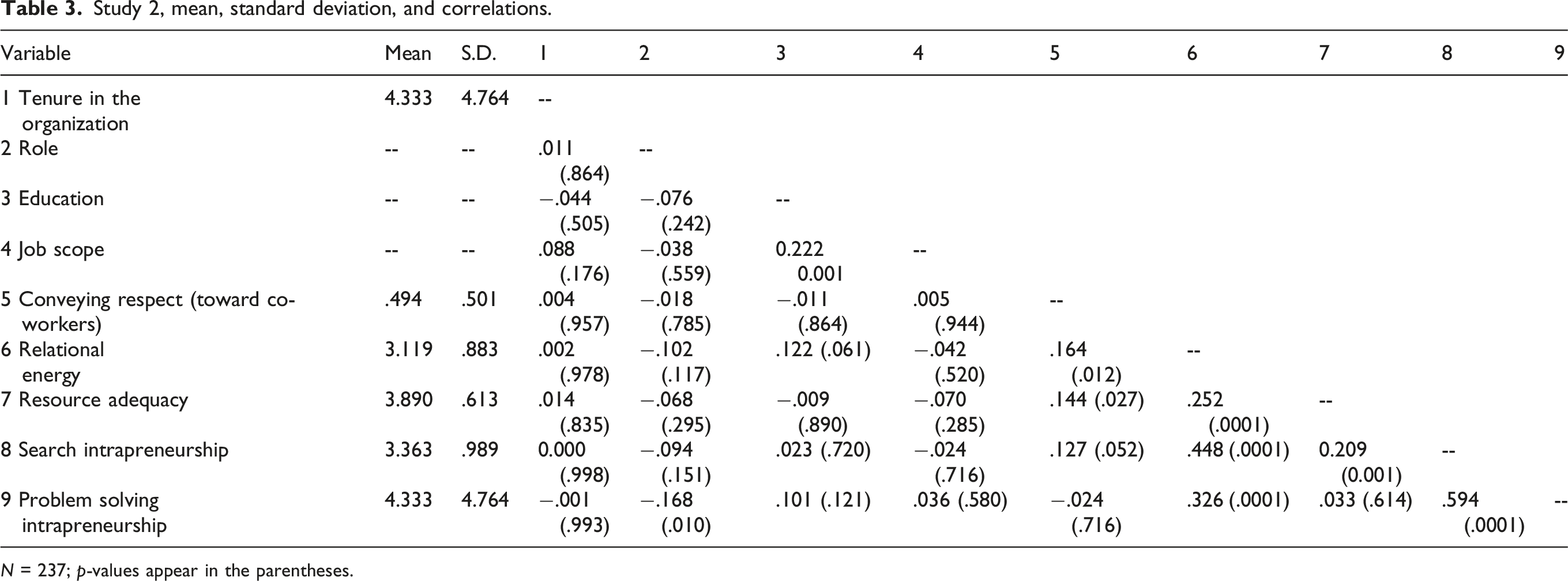
N = 237; p-values appear in the parentheses.
At the first step the structural model without the latent interaction term is estimated. Results indicate that the no interaction model fits the data well (LogLikelihood = −4812.254, AIC = 9780.509, BIC = 10,051.018, χ2 (226, N = 237) = 374.083, p < 0.01, CFI = 0.952; TLI = 0.943, and RMSEA = 0.053). At the second step the structural model with the latent interaction is estimated (LogLikelihood = −4806.507, AIC = 9773.014, BIC = 10,050.459). The log-likelihood ratio test is used to determine if the fit of the no interaction model is significantly worse than the interaction model. The result of the log-likelihood ratio test comparing the two models was significant (χ2 (2) = 11.49, p = 0.003), and AIC and BIC values are smaller for the interaction model, indicating that the interaction model fits the data better than the no interaction model.
The results indicate a positive relationship between one’s conveying respect (treatment vs control) and relational energy (unstandardized estimate = 0.300, SE = 0.088, Est./S.E. = 3.400; p = 0.001), thus in support of Hypothesis 1. We performed a test of search intrapreneurship as a function of both the mediator (relational energy) and IV (conveying respect). The results indicate a significant link between relational energy and search intrapreneurship (unstandardized estimate (for x = 0) = 0.692, SE = 0.126, Est./S.E. = 5.483; p = 0.000; unstandardized estimate (for x = 1) = 0.545, SE = 0.140, Est./S.E. = 3.894; p = 0.000), but no statistically significant link between conveying respect and search intrapreneurship (at mean M) (0.136, SE = 0.112, Est./S.E. = 1.221, p = 0.222); the XXM (interaction between IV and mediator) produced the following values (unstandardized estimate = −0.148, SE = 0.174, Est./S.E. = −0.850; p = 0.395), indicating that the relationship between relational energy and search intrapreneurship is not different for the control and treatment groups.
A comparable analysis was performed for the problem solving intrapreneurship dimension, and the results indicated a significant relationship between relational energy and intrapreneurial behavior in the search domain (unstandardized estimate (for x = 0) = 0.253, SE = 0.109, Est./S.E. = 2.319; p = 0.020; unstandardized estimate (for x = 1) = 0.628, SE = 0.136, Est./S.E. = 4.635; p = 0.000), but no statistically significant link between respect and problem solving intrapreneurship (at mean M) (−0.068, SE = 0.103, Est./S.E. = −0.659, p = 0.510); the XXM (interaction between IV and mediator) is statistically significant (unstandardized estimate = 0.375, SE = 0.163, Est./S.E. = 2.299; p = 0.021), indicating that the relationship between relational energy and problem solving intrapreneurship is not the same for the control and treatment groups. We also find that education is significantly related to relational energy (0.200, p = 0.038).
We followed MacKinnon et al.’s 75 guidance for estimating the amount of X effect on Y due to the mediation by relational energy. We calculated two types of indirect effects, which are usually calculated when there is an interaction between treatment and mediator, the pure natural indirect effect (PNIE) and the total natural indirect effect (TNIE). The 95% percentile bootstrap confidence intervals (CI) of the model results indicate that the PNIE and TNIE for search intrapreneurship are positively and statistically significant (.160, CI = .043, 0.337; .046, CI = .032, .304, respectively). For problem solving intrapreneurship the following PNIE and TNIE (also positively and statistically significant) were obtained (.012, CI = .005, .169; .049, CI = .034, .332, respectively). The index of moderation mediation (IMM) for search intrapreneurship (−.034, CI = −.174, .046) and problem solving intrapreneurship (.087, CI = .008, .242) were obtained, indicating a statistically significant difference between PNIE and TNIE only for problem solving intrapreneurship. Overall, our findings indicate that respect is related to both forms of intrapreneurship indirectly, through relational energy (Hypothesis 3).
Study 2, results of structural equations modeling and indirect relationships between conveying respect, relational energy, and intrapreneurship.
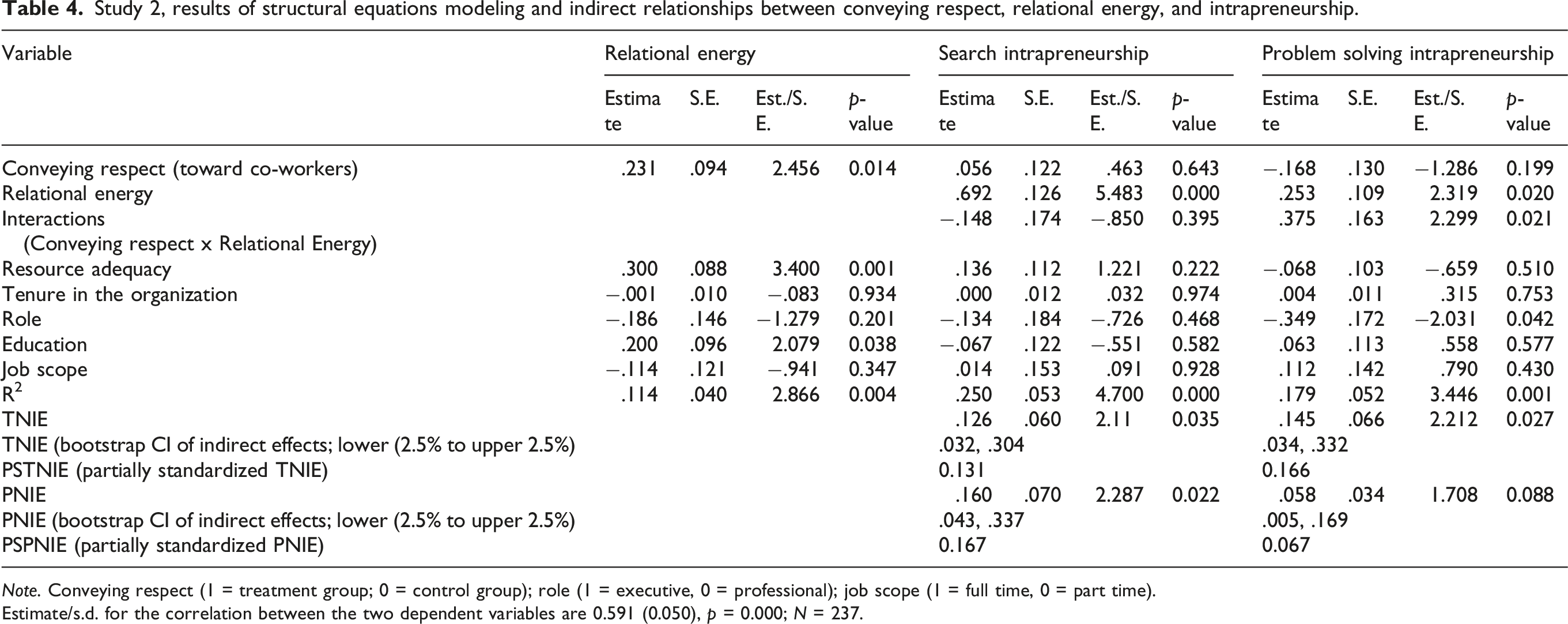
Note. Conveying respect (1 = treatment group; 0 = control group); role (1 = executive, 0 = professional); job scope (1 = full time, 0 = part time).
Estimate/s.d. for the correlation between the two dependent variables are 0.591 (0.050), p = 0.000; N = 237.
Discussion
The issue we attempted to address concerned how immigrant employees—a population that occupies a structurally vulnerable position within organizations and is routinely overlooked in intrapreneurship research—come to generate and sustain the psychological resources that entrepreneurial initiative demands. Our findings advance a relational lens to explain this issue. Across a time-lagged field study and a controlled experiment, we find that immigrant employees who convey respect toward their co-workers cultivate relational energy, which fuels their engagement in both search and problem solving intrapreneurship. These results imply that intrapreneurship is not merely a function of who employees are or what structural conditions surround them, but of what they do in the texture of their everyday relational conduct—and how those enactments generate the very resources that organizational entrepreneurship requires.
Across the two studies, the findings broadly support our hypotheses. Hypothesis 1, that conveying respect toward co-workers is positively related to relational energy, was supported in both Study 1 (β = 0.382, p < .001) and Study 2 (β = 0.300, p = .001), demonstrating replication across both correlational and experimental designs. Hypothesis 2, that relational energy is positively related to intrapreneurship, was supported for both search intrapreneurship and problem solving intrapreneurship in Study 1. In Study 2, the relationship between relational energy and search intrapreneurship was consistent across conditions, while the relationship with problem solving intrapreneurship was moderated by treatment condition, suggesting that the effect of relational energy on problem solving intrapreneurship is amplified when respect is actively conveyed. Hypothesis 3, that conveying respect has an indirect positive effect on intrapreneurship through relational energy, was supported across both studies and both dimensions of intrapreneurship, as evidenced by statistically significant TNIE and PNIE estimates with non-overlapping bootstrap confidence intervals.
Theoretical implications
We advance the view that intrapreneurship can be conceived as a relationally resourced phenomenon. A dominant tradition in intrapreneurship research has treated entrepreneurial initiative within organizations primarily as a product of individual attributes and structural enablers—personality characteristics, access to organizational slack, top management support, and similar antecedents.1–3 What this tradition has left largely under-theorized is how the micro-relational practices employees enact in their day-to-day interactions generate—or deplete—the psychological resources that sustain intrapreneurial initiative over time. Our findings suggest that conveying respect toward co-workers is positively associated with relational energy, and that relational energy drives engagement in intrapreneurship, implying that the relational conduct of employees is not merely a social backdrop to entrepreneurial activity but a constitutive force in its own right. Intrapreneurship, thus, is at least partially resourced through the quality of interpersonal interactions that precede and accompany it—a conclusion consistent with Gawke et al.'s 5 observation that intrapreneurship demands “additional energy, time, and resources,” but which advances beyond that observation by identifying a relational mechanism through which those resources are actively generated. This reframing opens a new line of inquiry into the micro-foundations of intrapreneurship: rather than asking solely what organizations must provide to enable entrepreneurial behavior, scholars can now ask what employees themselves enact relationally to cultivate the psychological conditions that make such behavior possible.
In addition, a theoretically novel contribution of our research lies in what it reveals about the direction of the relational resourcing process. The existing literature on respect at work—anchored in the relational resourcing view21,22—has documented compellingly that receiving respect generates the resources for creativity, 21 help-seeking and performance, 22 resilience, 39 and a sense of meaningfulness. 37 Yet this body of work has been largely silent on what happens to the giver. Our findings add to this recipient-centric account by suggesting that conveying respect is itself a resource-generating act for the actor who performs it. This insight is theoretically important, because it implies that the relational resourcing process is not a unidirectional transfer from an energizing other to a resourced self, but a dynamic in which the very act of initiating high-quality relational conduct expands the giver’s own psychological resources. The mechanism, we argue, operates through the construction of generative relationships28,54—interpersonal contexts characterized by mutual recognition, positive affect, and shared regard—that energize both parties (see also 35 ). Our experimental findings regarding the significant interaction between conveying respect and relational energy suggest that a complete indirect effect was not observed. These insights extend the relational resourcing view by suggesting that a fuller account of how respectful interactions resource employees must attend to both the experience and the enactment of respect, and recognize that these are not merely complementary pathways but potentially mutually reinforcing ones.
Our third contribution concerns the population at the center of our paper—the immigrant employee as a theoretically load-bearing context. The choice to study immigrant employees was not simply a matter of contextual specificity and proves to be theoretically motivated and generative. Immigrant knowledge workers occupy an analytically distinctive position; they bring significant human capital—diverse knowledge structures, adaptability, and accumulated career capital9,10—to organizations that simultaneously subject them to discrimination, exclusion, and network marginalization.14,16,27 This combination of potential and structural constraint creates the conditions under which relational conduct becomes especially visible as a resource-generating mechanism. Where native-born employees with dense informal networks and accumulated social capital may have multiple channels through which to resource their work engagement, immigrant employees operate with a thinner relational infrastructure—making the quality of the interactions they proactively initiate more consequential as a source of psychological vitality. In this sense, the immigrant context reveals with clarity that conveying respect can function as a form of proactive self-resourcing, a way in which individuals who lack the structural conditions that support intrapreneurial initiative can actively cultivate those conditions through the relational practices they enact. This advances a view of the immigrant employee not as a deficit case requiring structural accommodation but as an agentic actor who can shape the relational environment—and, through it, the psychological resources—that enable entrepreneurial contribution. Such a perspective responds to contemporary calls for more inclusive approaches to organizational entrepreneurship 42 and extends intrapreneurship theory toward populations that mainstream research has long overlooked. 43
Practical implications
The findings bear some implications for organizations that employ immigrant knowledge workers—a population that constitutes a growing share of the labor force in many economies 17 and whose intrapreneurial potential remains substantially undertapped. 61 First, our results suggest that organizations should look beyond structural interventions (i.e., training programs, resource allocation, and formal inclusion policies) as the primary levers for enabling immigrant employee engagement. While such structures matter, our data indicate that the relational climate of daily work is an equally powerful determinant of the psychological resources available for intrapreneurial initiative. Organizations that invest in cultivating cultures of genuine respectful interactions—with the expectation and modeling of respect flowing not only from leaders to subordinates but laterally across co-worker relationships—can create the conditions for relational energy to circulate and accumulate. This is practically consequential because it redistributes the burden of inclusion: rather than being the exclusive responsibility of organizational policy, it becomes a distributed relational practice that every member of an organization can enact and thereby reinforce.
Second, our findings suggest that interventions targeting immigrant employees’ own relational agency may be as valuable as those targeting the attitudes and behaviors of majority-group colleagues. If conveying respect is a pathway through which immigrant employees can actively cultivate the relational energy that resources their intrapreneurial engagement, then helping immigrant employees recognize and develop this capacity—through onboarding, mentoring, or relational skills training—represents a meaningful point of leverage. Such an approach moves organizational support for immigrant workers away from a deficit framework and toward an agentic one, recognizing that these employees are not merely the objects of inclusive management practices but active architects of their own relational environment.
Limitations and future research directions
We attempted to enhance the understanding regarding how conveying respect fuels intrapreneurial behavior through relational energy, particularly among immigrant employees. However, this endeavor also opens several conceptual, contextual, and methodological avenues for future research.
Theoretically, our work shifts the focus from experiencing respect to the act of conveying respect and its resourcing effect on the giver. Future research might employ a comparative design to explore the interaction between these two distinct pathways. For instance, scholars can examine whether and why the positive effects of giving respect offset the negative consequences of receiving low respect, particularly in contexts characterized by high power asymmetries.32,33 In addition, while we identified relational energy as a key psychological resource linking positive interpersonal conduct to intrapreneurship, 25 complementary mechanisms—such as psychological availability, vitality, or self-efficacy—deserve testing to elaborate a fuller process model that connects micro-relational acts to complex, risk-taking outcomes.24,26,44
Contextually, our findings involved immigrant employees, a group facing distinctive hurdles. 16 Although this focus provides essential theoretical precision, it necessitates research into the boundary conditions and generalizability of the findings. Future research can examine whether the same relational dynamics hold across different workforce segments facing other forms of marginalization (e.g., based on gender, age, or disability). Scholars may also clarify how organizational factors, such as resource adequacy, job scope, or the level of leader humility, 57 influence the relationship between respectful engagement and relational energy. Specifically, exploring conditions where low-status employees conveying respect for higher-status recipients can still generate relational energy may help in clarifying the power dynamics inherent in the effects of respect. 32
Regarding levels of analysis and outcomes, because respect and relational energy are inherently multilevel phenomena, 30 future research should explore how individual experiences of conveying respect accumulate into collective energy and innovation outcomes at the team or unit levels.3,4 Moreover, extending outcome variables beyond subjective reports of intrapreneurial intent to track macro-level variables—such as actual venture implementation, process improvement, patent filings, or organizational learning—would further connect micro-relational processes to macro-innovation performance. 43
Finally, from a methodological lens, despite employing both time-lagged and experimental designs, causal inference remains an interpretative challenge. Future studies should prioritize longitudinal, multi-source data collection (including peer or supervisor reports of intrapreneurial behaviors and external measures of performance) to enhance causal and construct validity. While we mitigated potential common-method bias, 63 the use of additional, independent data sources would provide stronger triangulation and robustness for this critical line of inquiry.
Footnotes
Acknowledgments
We thank the editor, the associate editor, and the anonymous reviewers for their helpful comments and suggestions. We acknowledge the financial support by The Henry Crown Institute of Business Research in Israel, Raya Strauss Center for Family Business Research, and Jeremy Coller Foundation at Tel Aviv University. We also thank Etti Doveh for her analytical suggestions and Gerda Kesler for her editorial work.

Funding
The authors disclosed receipt of the following financial support for the research, authorship, and/or publication of this article: This work was supported by the Jeremy Coller Foundation at Tel Aviv University, The Henry Crown Institute of Business Research in Israel, and Raya Strauss Center for Family Business Research.
Declaration of conflicting interests
The authors declared no potential conflicts of interest with respect to the research, authorship, and/or publication of this article.