




Abstract
Keywords
Introduction
The rapid advancement of artificial intelligence (AI) technologies is transforming various dimensions of human society, with emotion recognition emerging as one of the most notable recent developments. Emotion recognition AI refers to systems that analyze facial expressions, vocal tone, and biometric signals to infer an individual’s emotional state. These technologies are being increasingly applied across sectors such as customer service, education, healthcare, and public safety. 1 By aiming to decode not only overt expressions but also the internal emotional states of individuals, emotion recognition AI represents a technological leap that redefines the landscape of human–AI interaction. However, this development extends beyond technological innovation to generate new psychosocial contexts that may significantly impact how individuals express and regulate their emotions.
Emotion is a central component of the human experience, and emotional expression serves as a cornerstone of social interaction. 2 While emotional expression is often moderated by social norms, emerging research suggests that technologically mediated surveillance environments—particularly AI-driven affective monitoring—introduce qualitatively new regulatory pressures that extend beyond traditional social norms.3,4 As emotion recognition becomes increasingly ubiquitous in everyday settings, individuals become more aware that their emotions may be detected and interpreted by these systems. This awareness introduces a novel form of “emotional surveillance” that seeks to monitor not only visible behavior but also internal emotional states. 5
Scholars have recently pointed out that emotion recognition AI may function as a form of social surveillance. 6 The perceived readability of one’s emotions can trigger concerns about social evaluation and potential disadvantages, thereby reinforcing emotional self-censorship. Self-censorship refers to the act of deliberately limiting one’s own expressive freedom, 7 and emotional self-censorship applies this concept specifically to the domain of emotional expression. Expressive suppression, defined as the conscious inhibition of emotional expression, may be a behavioral outcome of such self-censorship. 8
The concept of emotional privacy has also gained relevance, given that emotion-related information can be construed as sensitive personal data. 9 Since emotions reflect deeply personal internal states, the capacity of AI to detect or infer these feelings raises substantial privacy concerns. Accordingly, individuals’ sensitivity to privacy—termed privacy sensitivity—may influence how they perceive and respond to emotion surveillance. 10 Those with heightened privacy sensitivity are likely to exhibit stronger negative reactions, including increased self-censorship, in response to emotion recognition technologies.
Recent studies have begun to highlight how AI-enabled emotional analytics reshape human self-regulation by transforming internal affective states into observable and evaluative data.11,12 Despite the growing body of research on emotion recognition AI, several critical theoretical gaps remain insufficiently addressed. First, the emotion regulation literature has primarily conceptualized regulatory processes—such as expressive suppression—as internally initiated cognitive strategies,2,8 while largely overlooking how external technological environments may systematically trigger or constrain these processes. As a result, existing models do not adequately explain how socio-technical conditions, such as AI-based affective surveillance, shape emotion regulation behavior.
Second, research on digital surveillance and AI ethics has predominantly focused on macro-level issues, including governance, accountability, and ethical risks.3,5,11 While these studies provide important normative insights, they offer limited explanation of the micro-level psychological mechanisms through which individuals respond behaviorally to perceived surveillance.
Third, although prior studies in behavioral information systems and consumer behavior have examined constructs such as trust, perceived risk, and privacy concerns,10,13 these frameworks have largely emphasized technology adoption and resistance rather than downstream emotional and behavioral regulation outcomes.
Taken together, these gaps suggest a lack of an integrative framework that explains how perceived AI-driven emotional surveillance translates into internal psychological processes and observable behavioral responses.
To address this limitation, the present study anchors its theoretical framework in emotion regulation theory 8 and extends it by incorporating insights from privacy calculus 10 and psychological reactance perspectives. 14 Specifically, this study conceptualizes perceived affective surveillance as a socio-technical trigger that activates emotional self-censorship, 7 which in turn leads to expressive suppression.
By focusing on emotional self-censorship as a micro-level psychological mechanism, this study responds to recent calls for examining the behavioral consequences of AI beyond adoption-focused models 11 and contributes to a more analytically grounded understanding of human behavior in AI-mediated environments. This study responds directly to recent scholarly calls urging the examination of AI’s socio-psychological impacts beyond adoption and trust models toward behavioral and emotional outcomes. 11
Integrating these domains is crucial for developing more accurate theoretical frameworks that can predict psychological and behavioral responses to new technologies. Such integration also offers practical guidance for designing AI systems that respect emotional privacy and user autonomy.
In response, the present study empirically examines how perceived social surveillance in emotion AI contexts influences emotional self-censorship and, subsequently, expressive suppression. A moderated mediation model is constructed, wherein emotional self-censorship serves as a mediator and privacy sensitivity as a moderator. Specifically, the study analyzes both the direct and indirect pathways through which perceived affective surveillance impacts expressive suppression, and whether these relationships are contingent on individual differences in privacy sensitivity.
This research advances the literature in three theoretically meaningful ways. First, it responds to recent calls in AI governance and human-centered technology research to investigate how algorithmic monitoring affects human agency and emotional autonomy. 3 By linking perceived affective surveillance with expressive suppression, this study extends emotion regulation theory into socio-technical environments. Second, building on emerging 2024 debates surrounding emotional data rights and affective privacy, 11 the study introduces emotional self-censorship as a distinct psychological mechanism through which surveillance is internalized. Third, while prior research has examined privacy concerns primarily as predictors of technology resistance, this study conceptualizes privacy sensitivity as a conditional amplifier of emotional regulation processes. In doing so, it aligns with recent interdisciplinary calls for examining how individual dispositions interact with AI-mediated environments to shape behavioral outcomes. Together, these contributions position the study at the intersection of emotion regulation theory and contemporary AI ethics discourse.
Theoretical background
The expansion of surveillance society and emotion recognition technology
Emotion recognition artificial intelligence (AI) is fundamentally transforming the landscape of digital surveillance. While traditional surveillance focused primarily on external behaviors or geolocation data, the emergence of emotion recognition technology now enables the analysis of individuals’ emotional and psychological states. This development extends the scope of surveillance from physical monitoring to the inner world of consciousness and affect. These technologies utilize facial expressions, vocal tone, language patterns, and biometric data such as heart rate to infer users’ emotional states and are rapidly being commercialized in domains such as customer service, education, recruitment, and healthcare. 1
Zuboff 5 characterizes this technological evolution as “surveillance capitalism,” a mechanism in which human experiences are transformed into data to be collected, predicted, and ultimately used to manipulate behavior. Within this framework, emotion recognition transforms the deeply sensitive realm of human emotion into a commodified data resource, serving commercial or authoritative interests. Uguz 6 argues that emotion analysis algorithms, by automatically classifying psychological states without the individual’s intent, reduce subjective emotional experiences to “objective indicators” readable by machines. In doing so, emotion recognition systems significantly expand the scope and depth of surveillance, enabling mechanical and continuous interpretation of users’ mental states.
Surveillance society theory posits that surveillance is not merely a tool for information gathering but a social mechanism that reinforces norms and internalizes self-regulation within individuals. 15 Michel Foucault’s concept of the panopticon illustrates how the mere awareness of being watched induces individuals to conform to societal norms voluntarily—an idea equally applicable in today’s digital surveillance environments. In contexts where emotion recognition AI is implemented, users may suppress or modify their emotions simply due to the awareness that their emotional states are subject to detection and evaluation. This phenomenon can be described as “emotional self-surveillance,” referring to a psychological state where individuals monitor and control even their innermost emotions in response to perceived external observation. 7
As emotion recognition technology becomes more widespread, its emotional analytics capabilities may shape cultural structures within organizations and society at large, guiding which emotional expressions are preferred or avoided. For instance, in workplace settings, positive emotions such as friendliness and optimism may be encouraged, while emotions like anger, frustration, or disappointment are discouraged or suppressed. When emotion recognition systems reward or emphasize only those emotions aligned with normative expectations, individuals are incentivized to display only “machine-approvable” emotions rather than their authentic affective states. This process can lead to the loss of emotional autonomy and authenticity, as users internalize control and express emotions in ways deemed acceptable by the technology.
This shift undermines the freedom and authenticity of emotional expression, reducing it from a voluntary act to a “datafied expression” within a surveilled environment. Emotions cease to be tools for conveying personal truth and instead become managed and interpreted objects within surveillance systems, potentially impacting individuals’ psychological autonomy and identity.
Emotion regulation theory and emotional self-censorship
Gross’s 8 emotion regulation theory categorizes regulatory strategies based on when and how they intervene in the emotional response process. This theory conceptualizes emotion regulation as a set of cognitive and behavioral strategies, emphasizing two principal types: cognitive reappraisal and expressive suppression. Cognitive reappraisal involves modifying the interpretation of a situation to reduce its emotional impact, while expressive suppression involves the conscious inhibition of outward emotional expression. 2 Expressive suppression is frequently employed in public or institutional settings, aligning emotional expressions with socially expected norms or “feeling rules”. 16
However, expressive suppression is not solely an internal choice; it is often shaped by the surrounding social and technological contexts. In digital environments where emotion recognition AI is active—such as video conferencing, customer service platforms, or learning management systems—users may suppress their emotions due to the awareness that their affect is being analyzed and recorded in real time. This creates a tendency to avoid misinterpretation or negative judgment by the system, leading users to favor immediate, rigid suppression over more flexible strategies like cognitive reappraisal. Thus, the selection and implementation of emotion regulation strategies become highly sensitive to the surveillance infrastructure. 13
To provide a more integrative theoretical explanation, this study develops a unified framework linking perceived surveillance to cognitive appraisal, emotional self-censorship, and behavioral outcomes. Drawing on emotion regulation theory,2,8 as well as recent behavioral IS perspectives such as perceived intrusiveness and autonomy threat, perceived affective surveillance is conceptualized as a socio-technical stimulus that triggers individuals’ cognitive appraisal processes. Specifically, when individuals recognize that their emotional states are being monitored by AI systems, they are likely to perceive a threat to their psychological autonomy and privacy (Brehm, 1966). 10
Recent studies on algorithm aversion and perceived intrusiveness further suggest that individuals tend to respond negatively when algorithmic systems are perceived as overly invasive or controlling.17,18 These perceptions can trigger psychological reactance and heightened self-regulatory responses.
Within this cognitive appraisal process, emotional self-censorship is conceptualized as an internal psychological mechanism. Following Bar-Tal, 7 emotional self-censorship refers to the intentional and anticipatory regulation of emotional expression in response to perceived surveillance or evaluative threat. Importantly, it represents a cognitive–motivational state rather than an observable behavior.
In contrast, expressive suppression is defined as the behavioral enactment of emotion regulation, involving the conscious inhibition of outward emotional expression. 2 Thus, emotional self-censorship and expressive suppression are conceptually distinct but sequentially related constructs: the former reflects internal cognitive regulation, whereas the latter reflects external behavioral manifestation.
Furthermore, it is important to distinguish privacy sensitivity from general privacy concern. While privacy concern typically reflects situational perceptions of risk related to data use, privacy sensitivity captures stable individual differences in the degree to which individuals perceive and react to privacy threats. 10 Therefore, privacy sensitivity is conceptualized as a dispositional moderator that amplifies the cognitive appraisal of surveillance.
Integrating these perspectives, this study proposes a unified mechanism in which perceived affective surveillance influences cognitive appraisal (e.g., perceived intrusiveness and autonomy threat), which in turn activates emotional self-censorship as an internal regulatory process, ultimately leading to expressive suppression as a behavioral outcome.
This integrative framework moves beyond descriptive accounts and provides a theoretically grounded explanation of how AI-driven surveillance shapes emotional regulation processes in human–AI interaction contexts.
Moreover, emotion recognition AI institutionalizes and systematizes self-censorship by transforming affective experience into objective, transferable data. The awareness that emotions can be analyzed and disseminated reframes emotional expression as a form of data exposure, not interpersonal communication. Consequently, expressive suppression evolves from a situational tactic into a chronic self-regulatory mechanism, with potential implications for emotional authenticity and psychological autonomy. 8
This study posits that technologically induced surveillance environments significantly influence individuals’ selection of emotion regulation strategies. Stronger perceptions of surveillance are hypothesized to reinforce emotional self-censorship, subsequently increasing expressive suppression. Emotion recognition AI, therefore, functions not merely as an analytical tool but as a socio-technical force that reshapes how emotions are regulated, expressed, and ultimately experienced. The study thus aims to reinterpret emotion regulation theory within the digital surveillance context and empirically examine the impact of emotion AI on emotional freedom and self-expression.
Consequences of expressive suppression and the moderating role of privacy sensitivity
Expressive suppression may offer short-term benefits, such as avoiding interpersonal conflict and preserving social harmony. For instance, withholding expressions of anger or frustration during a conflict may de-escalate tensions and leave room for reconciliation. 2 In organizational settings, employees frequently suppress personal emotions to maintain group cohesion—a phenomenon well-documented within emotional labor literature, especially among service workers interacting with clients (Hochschild, 1983).
However, chronic and repetitive suppression of emotional expression can lead to psychological costs. Sels et al. 19 suggest that frequent suppression restricts opportunities for authentic self-expression, increasing psychological distance, emotional disconnection, and social isolation. Over time, this can contribute to elevated stress levels, emotional exhaustion, and symptoms of depression. When suppression is driven by perceived surveillance rather than voluntary choice, it further erodes a sense of self-congruence and autonomy. Tyra et al. 4 report that a mismatch between felt and expressed emotions is associated with lower psychological well-being, reduced self-efficacy, and diminished life satisfaction.
In environments increasingly shaped by emotion recognition technologies, individuals become acutely aware that their emotions are being captured, interpreted, and potentially evaluated in real time. The stronger this perception of technological surveillance, the more likely it is that expressive suppression occurs not as a social courtesy but as a strategic act of emotional self-censorship. This behavior expands the gap between internal states and external behavior, exacerbating psychological fatigue and personal alienation.
Importantly, these effects are moderated by individuals’ privacy sensitivity. Bélanger and Crossler 10 found that privacy sensitivity significantly influences perceived risk, technology avoidance, and willingness to disclose personal information in digital environments. Individuals high in privacy sensitivity tend to harbor greater distrust toward data collection technologies and may exhibit heightened suppression responses when under emotional surveillance. Emotion data, being more intimately tied to the self than biometric or financial information, may be perceived as especially invasive when handled without consent or transparency. 9
For example, in a video conferencing context where emotion recognition is active, participants may suppress signs of fatigue or irritation to avoid being flagged by automated systems. Highly privacy-sensitive individuals are more likely to perceive this as a surveillance threat and thus engage more heavily in emotional self-censorship and expressive suppression. Conversely, individuals with lower privacy sensitivity may respond more freely, selecting emotion regulation strategies in a more flexible or autonomous manner.
In summary, this study integrates surveillance theory and emotion regulation theory to illuminate the multilayered psychological impact of emotion recognition technologies. Expressive suppression is framed not as a purely individual choice but as a consequence of structural surveillance dynamics, mediated by emotional self-censorship and moderated by privacy sensitivity. These findings underscore the necessity of user-centered and ethically sensitive design in emotion AI systems, accounting for psychological diversity in how users perceive and respond to surveillance. Such an approach contributes to a deeper understanding of the emotional dimension in human–technology interaction and offers valuable theoretical and practical insights.
Research model and hypotheses
This study conceptualizes a moderated mediation model in which perceived social surveillance in emotion recognition AI environments serves as the independent variable, expressive suppression as the dependent variable, emotional self-censorship as the mediating variable, and privacy sensitivity as the moderator. Based on this conceptual framework, six hypotheses are proposed.
The relationship between perceived social surveillance and emotional self-censorship
Emotion recognition technologies based on artificial intelligence (AI) are capable of analyzing facial expressions, vocal tones, and behavioral patterns to infer an individual’s emotional state. As a result, individuals may develop an awareness that their emotions can be “read” by external systems or observers, fostering a heightened sense of perceived social surveillance. Unlike conventional physical surveillance methods such as CCTV, this form of surveillance intrudes upon deeply personal emotional information, thereby exerting substantial psychological pressure.
Emotional self-censorship refers to the psychological mechanism through which individuals intentionally suppress or regulate their emotional expressions due to concerns about social judgment or normative expectations. Bar-Tal 7 defines self-censorship as the intentional and voluntary suppression of information despite the absence of external constraints—a concept that, when applied to the domain of emotion, encapsulates the voluntary concealment of one’s affective states.
Previous research has suggested that the perception of surveillance can increase tendencies toward self-censorship. For instance, Schneier (2018) 20 reported that American writers voluntarily censored their internet use out of fear of government surveillance. Similarly, Concord (2025) described contemporary society as one in which individuals “harbor an internal observer,” self-regulating their expressions to avoid reproach. These findings suggest that even without direct oversight, individuals may internalize surveillance mechanisms and thereby increase emotional self-censorship.
More recently, scholars have warned that technologies such as emotion recognition AI can induce a chilling effect—a psychological phenomenon in which individuals suppress their expressions out of fear of surveillance. Uguz 6 cautioned that the widespread deployment of emotion surveillance systems could induce this chilling effect at the societal level, discouraging open emotional expression.
Theoretically, the mechanism mirrors the panopticon effect: when individuals perceive a high likelihood of their emotional states being visible to others, they may self-regulate their behavior to avoid social sanctions or negative repercussions. As Uguz 6 noted, emotions serve as a mirror of one’s identity; thus, when this information is captured, it can become a means of coercion or manipulation. Consequently, perceived social surveillance can exert significant psychological pressure on individuals, leading them to conceal their emotions.
Thus, the hypothesis that higher levels of perceived social surveillance are associated with increased emotional self-censorship (H1) is grounded in theoretical frameworks concerning self-regulation and fear of social judgment. This study contributes to the growing body of research on AI-mediated emotional environments by empirically testing this association.
Moreover, understanding how emotion recognition technologies influence psychological responses is timely and important. Although expressive suppression may sometimes serve functional purposes in social settings, it is also linked to cognitive depletion and decreased psychological well-being. Franchow and Suchy (2014) 21 demonstrated that although expressive suppression aligns with social norms, it can impair executive functioning and result in psychological costs. By elucidating the mediating role of emotional self-censorship between surveillance perception and expressive suppression, the present study aims to provide critical insights into the potential mental health and organizational performance implications of AI-based surveillance technologies.
Higher levels of perceived social surveillance will be positively associated with higher levels of emotional self-censorship.
The relationship between perceived social surveillance and expressive suppression
Expressive suppression refers to the behavioral tendency of an individual to inhibit the external display of internal emotional states. For instance, refraining from frowning or raising one’s voice when experiencing anger exemplifies such suppression. Prior research indicates that expressive suppression frequently occurs in social contexts where individuals must align their emotional displays with social norms to maintain smooth interactions. As Ando (2014) noted, “Human beings, as social animals, often encounter situations where they must conceal their emotions… expressive suppression is necessary for social life” (https://dbr.donga.com). However, despite its social utility, expressive suppression consumes cognitive resources and, when prolonged, can lead to diminished executive functioning and productivity.
The hypothesis that perceived social surveillance through AI-based emotion recognition technology increases expressive suppression (H2) is theoretically supported by the concept of the chilling effect. Uguz 6 warned that the normalization of AI-driven emotional surveillance could induce widespread chilling effects, prompting individuals to suppress their emotional expressions. When people perceive that their emotions may be monitored or detected, they tend to prioritize emotional restraint over autonomy in expression. Similarly, Schneier (2018) referenced a study in which many Americans self-censored their online behavior due to concerns about government surveillance, illustrating how perceived observation can restrict expressive freedom. In a comparable vein, Concord (2025) observed that individuals “remain silent and cautious” out of fear of potential repercussions, reinforcing the notion that heightened surveillance perception leads to increased emotional suppression.
From a theoretical standpoint, the mechanism through which surveillance perception leads to expressive suppression is grounded in social control theory. When individuals become aware that their emotions may be detected by AI-based emotion recognition systems, they may suppress emotional expressions to avoid social punishment or reputational harm. For instance, fear that emotion data could be interpreted or misused by organizations or authorities (e.g., employers or agencies) may drive individuals to conceal their true feelings. As previously stated, emotions are “mirrors of personal identity,” and their visibility renders individuals susceptible to manipulation or coercion. 6 In this context, the perceived risk of emotion data exposure acts as a powerful deterrent to emotional self-expression.
Understanding expressive suppression has significant theoretical and practical implications. As Ando (2014) pointed out, suppression may impair executive functioning and lead to productivity loss within organizational settings (https://dbr.donga.com). Therefore, if perceived AI surveillance amplifies expressive suppression, this effect may not only heighten cognitive fatigue and psychological stress but also hinder organizational efficiency. By examining the psychological and behavioral consequences of emotion recognition technologies, this study aims to provide insights into how individuals and institutions can adapt emotion regulation strategies in the age of AI surveillance.
Higher levels of perceived social surveillance will be positively associated with higher levels of expressive suppression.
The relationship between emotional self-censorship and expressive suppression
Emotional self-censorship refers to an individual’s internalized intention to conceal or regulate their emotional states, whereas expressive suppression constitutes the behavioral enactment of such an intention. In essence, when a person decides to withhold their emotions, it naturally leads to a reduction in the outward expression of those emotions. From this perspective, emotional self-censorship and expressive suppression are closely interconnected and reflect sequential phases of the same regulatory process. In the framework of emotion regulation theory, expressive suppression is classified as a strategic effort to manage emotions, particularly through the deliberate inhibition of emotional expressions.
Empirical and anecdotal evidence supports this relationship. As noted by Concord (2025), individuals tend to “discipline and suppress themselves” to avoid criticism, implying that emotional self-censorship leads to a behavioral tendency to withhold emotional expression (brunch.co.kr). When emotional self-censorship becomes active, individuals are more likely to suppress emotional displays, particularly in the presence of perceived evaluative threats or social disapproval. Hence, the activation of emotional self-censorship directly corresponds to heightened expressive suppression.
This interpretation is further supported by emotion regulation literature, particularly regarding response-focused strategies. Expressive suppression, as a response-focused regulation tactic, stems from an internal decision to modulate emotional output. When individuals make a conscious decision to regulate their emotional experience via self-censorship, the behavioral manifestation typically involves minimizing expressive cues. Thus, it is theoretically expected that higher levels of emotional self-censorship will be positively associated with higher levels of expressive suppression.
This hypothesis also plays a critical role in validating the mediation pathway of the broader research model. If emotional self-censorship does not translate into expressive suppression, the proposed mediating mechanism linking perceived social surveillance to expressive suppression cannot be substantiated. Therefore, confirming the direct association between these two constructs is essential for evaluating the integrity of the hypothesized indirect effect.
From a theoretical standpoint, examining this relationship enhances our understanding of how internal psychological intentions are converted into observable behavioral responses. From a practical perspective, excessive emotional self-censorship could lead to emotional fatigue, psychological distress, or even burnout if it consistently results in suppression of emotional expression. Thus, verifying H3 contributes to a deeper understanding of the psychological pathways through which social surveillance perceptions influence emotional behavior in AI-mediated environments.
Higher levels of emotional self-censorship will be positively associated with higher levels of expressive suppression.
The mediating role of emotional self-censorship
Within the proposed research model, mediation refers to the mechanism through which perceived social surveillance (X) influences expressive suppression (Y) indirectly via emotional self-censorship (M). In other words, the effect of X on Y is transmitted through the sequential pathways X → M and M → Y. While a direct relationship may exist between perceived surveillance and expressive suppression, the present study aims to examine whether emotional self-censorship serves as a significant intermediary in this process—thus forming the basis of Hypothesis 4 (H4).
Building on emotion regulation theory 8 and cognitive appraisal theory, the mediating role of emotional self-censorship is grounded in a threat-based psychological mechanism. Specifically, perceived social surveillance functions as a socio-technical stressor that triggers threat appraisal processes, whereby individuals evaluate the potential risks associated with emotional exposure (Brehm, 1966). 10 From an identity protection perspective, emotions are closely tied to individuals’ self-concept and social identity. When individuals perceive that their emotional states are subject to external monitoring and evaluation, they may engage in anticipatory regulation to protect their identity and avoid misinterpretation or reputational harm.2,7 Furthermore, perceived surveillance increases cognitive load by requiring individuals to continuously monitor and regulate their emotional expressions in real time. This heightened cognitive burden promotes reliance on immediate and less cognitively demanding regulation strategies, such as expressive suppression. 8
Thus, emotional self-censorship represents a psychologically grounded mediating mechanism through which perceived surveillance influences expressive suppression. It reflects an internal process driven by threat appraisal, identity protection, and cognitive resource constraints, which subsequently manifests as behavioral suppression. As outlined in the logical sequence of Hypotheses 1 through 3 (H1–H3), if the pathway from surveillance perception to emotional self-censorship to expressive suppression is validated, then H4 will be substantiated. Uguz, 6 for example, warned that affective surveillance through AI technologies may undermine personal autonomy by discouraging authentic self-expression (techpolicy.press). Within this framework, emotional self-censorship functions as the core psychological mechanism transmitting the influence of perceived surveillance to behavioral inhibition.
Testing the mediating effect is crucial for elucidating the full psychological trajectory through which AI-driven surveillance may influence individuals’ expressive behavior. If emotional self-censorship is shown to mediate the relationship effectively, it would suggest that the impact of perceived surveillance on expressive suppression is not solely direct but is partially shaped by internal psychological processes. This would offer a more nuanced understanding of how surveillance technologies affect emotion regulation at both behavioral and cognitive levels.
Furthermore, this study intends to employ 22 Hayes’ (2018) PROCESS Model 8 to statistically test the moderated mediation structure. This approach will allow for an examination of how emotional self-censorship functions as a mediator, particularly under varying conditions of privacy sensitivity. Such an empirical investigation will not only clarify the layered relationship between surveillance awareness, self-censorship, and expressive suppression, but also assess the practical implications of intervening in emotional self-censorship mechanisms.
Emotional self-censorship will mediate the relationship between perceived social surveillance and expressive suppression.
The moderating role of privacy sensitivity (perceived social surveillance → emotional self-censorship)
The moderating role of privacy sensitivity is grounded in an interaction-based theoretical perspective emphasizing boundary conditions and contingent effects. Specifically, privacy sensitivity functions as a dispositional boundary condition that shapes how individuals cognitively appraise surveillance stimuli.
Drawing on privacy calculus and psychological reactance theory (Brehm, 1966), 10 individuals with high privacy sensitivity are more likely to interpret perceived surveillance as intrusive and autonomy-threatening. This heightened threat appraisal strengthens the relationship between perceived surveillance and emotional self-censorship.
In contrast, individuals with low privacy sensitivity may perceive the same surveillance conditions as less intrusive, resulting in weaker self-regulatory responses. Therefore, privacy sensitivity determines the extent to which perceived surveillance translates into emotional self-censorship, reflecting a contingent effect rather than a uniform relationship.
This interaction-based mechanism highlights that the psychological impact of AI-driven surveillance is not universal but depends on individual differences in privacy orientation. In contrast, individuals with low privacy sensitivity may perceive affective surveillance as less threatening and thus exhibit milder self-censorship responses.
Empirically testing H5 offers meaningful insights into individual differences that shape responses to AI-mediated surveillance. If privacy sensitivity is found to amplify the effect of surveillance perception on emotional self-censorship, it would highlight “for whom” affective AI technologies pose the greatest psychological impact. Such findings would inform the development of user-specific guidelines and protective strategies tailored to varying privacy orientations. At the policy level, the results may suggest the need for differentiated warnings or safeguards for populations with heightened privacy awareness.
Privacy sensitivity will moderate the relationship between perceived social surveillance and emotional self-censorship.
Moderated mediation effect: The conditional indirect effect of privacy sensitivity
Hypothesis 6 (H6) tests whether privacy sensitivity moderates the mediation effect proposed in Hypothesis 4. In other words, it examines whether the strength of the indirect pathway from perceived social surveillance (X) to expressive suppression (Y), through emotional self-censorship (M), varies depending on an individual’s level of privacy sensitivity. As previously discussed in H5, high privacy sensitivity is expected to amplify the X→M path. This amplification should, in turn, influence the magnitude of the entire indirect effect, extending to the M→Y path. Specifically, for individuals with higher levels of privacy sensitivity, the indirect effect of perceived social surveillance on expressive suppression—mediated by emotional self-censorship—is predicted to be significantly stronger.
This moderated mediation model offers a comprehensive view of how individual differences shape psychological responses to digital surveillance environments. For instance, Uguz 6 warns that without proper regulation of emotion recognition AI, individuals may feel compelled to hide or fabricate their emotions (techpolicy.press). This concern is likely to manifest more acutely in individuals with high privacy sensitivity. In such cases, heightened awareness of surveillance may lead to an intensified tendency to suppress emotional expression via self-censorship, thereby amplifying the overall indirect effect.
Verifying the presence of a moderated mediation effect is crucial for understanding the intricate interaction between situational and dispositional variables. Should H6 be supported, it would indicate that the pathway from perceived surveillance to emotional suppression, through self-censorship, is not uniformly experienced across the population. Rather, individuals with elevated privacy sensitivity are disproportionately affected, exhibiting a stronger indirect effect. This finding would underscore the necessity for differentiated psychological and policy responses to emotion AI based on user characteristics.
Ultimately, confirmation of H6 would support the argument that emotion recognition technologies may have uneven psychological consequences depending on users’ privacy orientations. Such insights would contribute to more ethically grounded, user-sensitive guidelines in the development and deployment of AI surveillance systems.
Privacy sensitivity will moderate the indirect pathway from perceived social surveillance to expressive suppression via emotional self-censorship.
Research methodology
Research design and sampling
This study employed a quantitative research design to examine the impact of emotion recognition AI technologies on individuals’ expressive suppression. Specifically, it aimed to investigate the mediating role of emotional self-censorship and the moderated mediation effect of privacy sensitivity. To collect data, a structured online survey was administered.
Demographic characteristics of the sample.

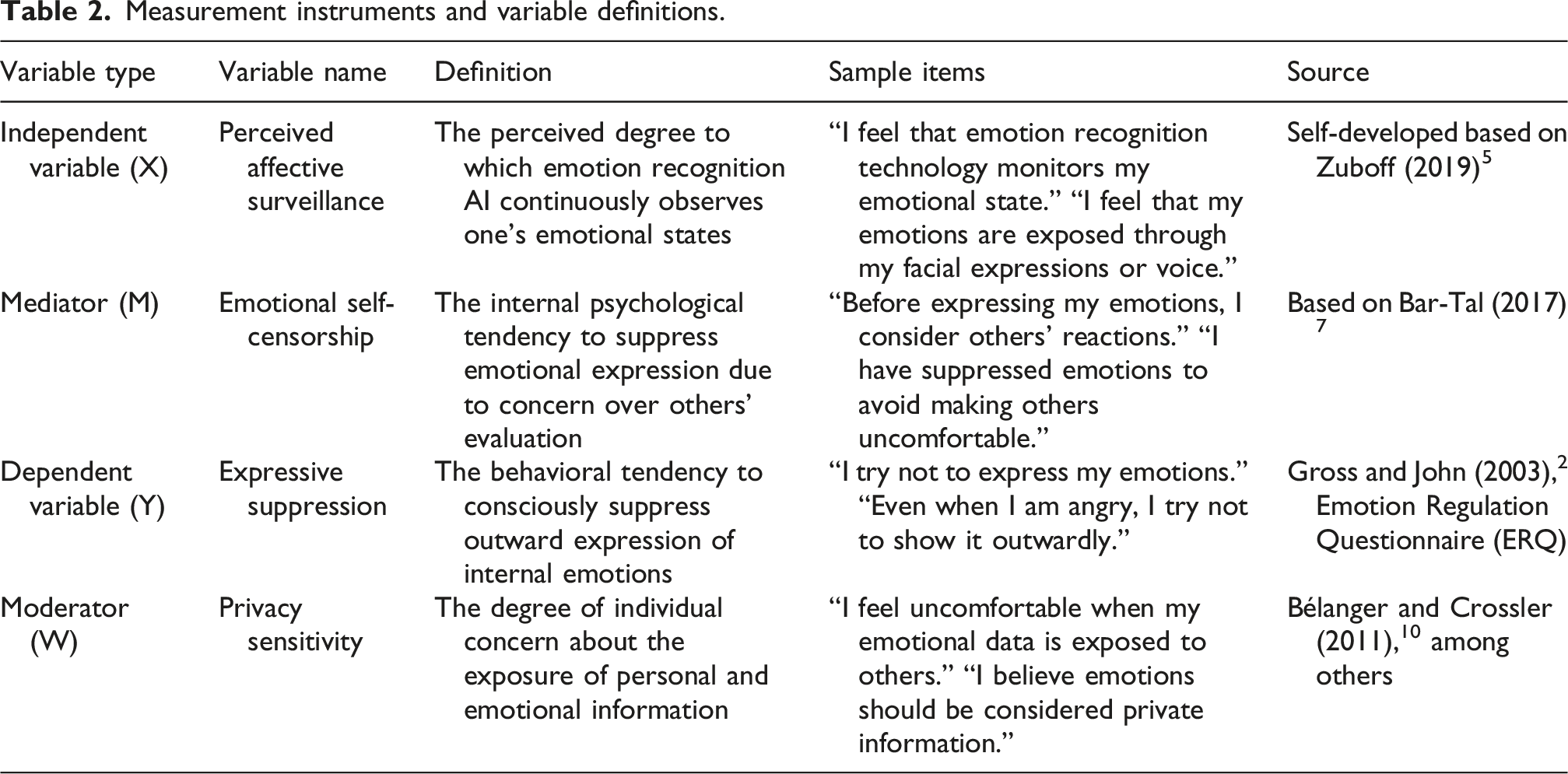
Measurement instruments and variable definitions.
Reliability assessment.
Measurement instruments and variable definitions
The survey instrument included four core constructs relevant to the proposed research model: perceived affective surveillance, emotional self-censorship, expressive suppression, and privacy sensitivity. All items were rated on a 5-point Likert scale ranging from 1 (Strongly disagree) to 5 (Strongly agree). Each construct was operationalized based on prior literature as described below.
Reliability and validity assessment
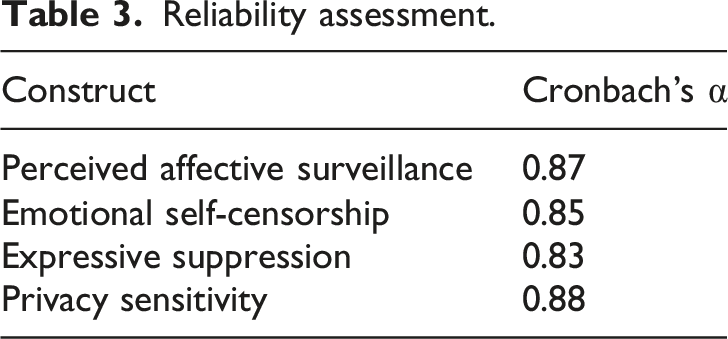
The internal consistency of all measurement items was evaluated using Cronbach’s alpha (α). As shown in Table 3, all constructs exceeded the conventional threshold of .70, indicating acceptable to high internal reliability.
To ensure the rigor and validity of the measurement model, this study conducted confirmatory factor analysis (CFA) using AMOS. The results indicated that the measurement model demonstrated an acceptable fit (χ2/df = 2.31, CFI = .93, TLI = .92, RMSEA = .065), supporting the adequacy of the factor structure. Construct reliability and convergent validity were assessed using composite reliability (CR) and average variance extracted (AVE). All CR values exceeded the recommended threshold of .70, and all AVE values were above .50, indicating satisfactory internal consistency and convergent validity (Fornell and Larcker, 1981). Discriminant validity was evaluated by comparing the square root of AVE with inter-construct correlations. The results confirmed that each construct was empirically distinct from the others.
Confirmatory factor analysis results and measurement items.
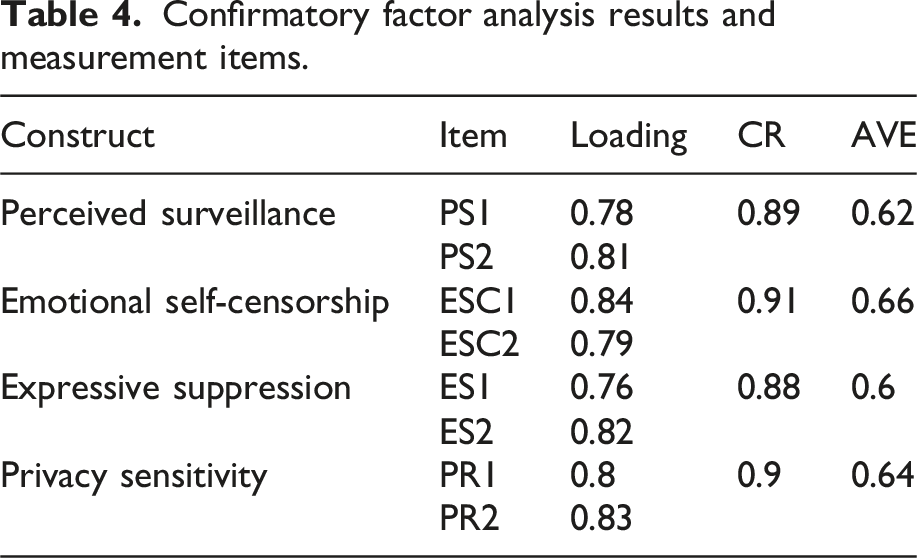
To assess the unidimensionality and construct validity, an exploratory factor analysis (EFA) was conducted using principal axis factoring with Varimax rotation. All factor loadings exceeded .60, confirming the appropriateness of the factor structure and supporting the convergent validity of the measurement scales.
Data analysis procedure and statistical techniques
Data were analyzed using SPSS 26.0 and the PROCESS Macro v4.0 developed by Hayes (2018). The analysis proceeded in the following steps: 1. Descriptive and Frequency Analysis Basic demographic characteristics and overall response trends were examined to understand the sample distribution and detect any anomalies. 2. Correlation Analysis
Pearson correlation coefficients were calculated to assess the significance and direction of relationships among the key variables. 3. Hypothesis Testing Procedures H1–H3: Direct and mediating effects were tested using multiple regression analysis. H4 (Mediation Analysis): The mediating role of emotional self-censorship between perceived affective surveillance and expressive suppression was tested using Model 4 in PROCESS. H5 (Moderation Analysis): The moderating effect of privacy sensitivity on the relationship between surveillance perception and emotional self-censorship was tested using Model 1. H6 (Moderated Mediation Analysis): To test whether the indirect effect of perceived affective surveillance on expressive suppression via emotional self-censorship varies depending on privacy sensitivity, Model 8 was employed. This model allowed the assessment of a moderated mediation structure in which privacy sensitivity serves as a moderator of the indirect pathway. 4. Bootstrapping To confirm the statistical significance of indirect effects, bootstrapping with 5000 resamples was conducted, generating 95% confidence intervals (CI). An indirect effect was considered significant if the CI did not include zero.
Through these analytical procedures, the study aimed to empirically examine the emotional regulation mechanisms shaped by AI-based emotion recognition environments, with particular attention to the mediating role of emotional self-censorship and the moderating role of privacy sensitivity.
Results
Descriptive statistics and correlation analysis
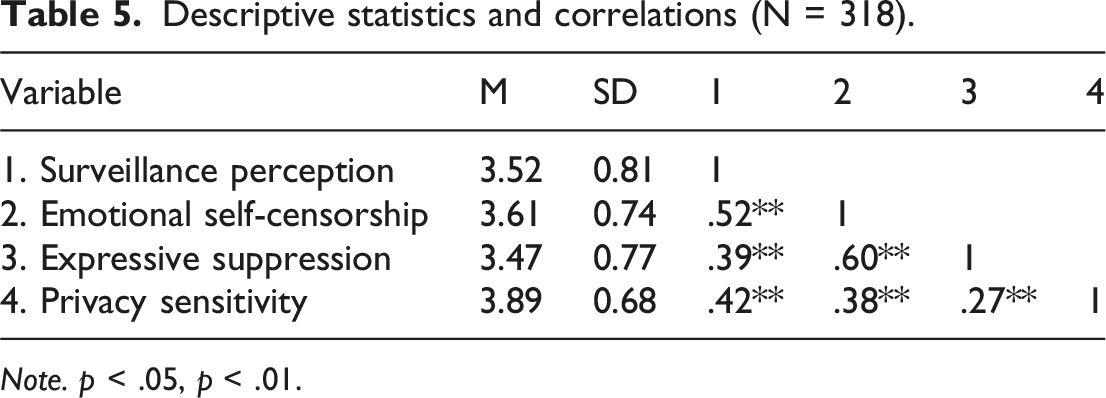
Descriptive statistics and correlations (N = 318).
Note. p < .05, p < .01.
Correlation analyses revealed significant positive associations among all variables. Specifically, the correlation between emotional self-censorship and expressive suppression was strong (r = .60, p < .01), implying a close link between internalized emotional control and behavioral suppression.
Regression analysis results
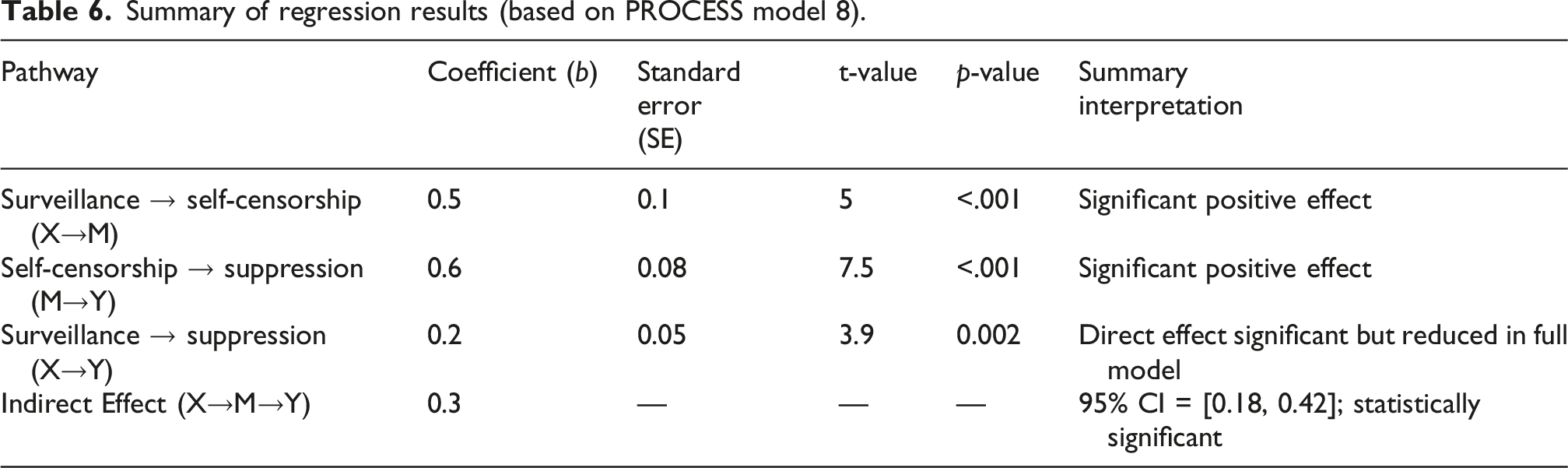
To examine whether emotional self-censorship mediates the relationship between perceived social surveillance and expressive suppression within affective AI environments, the study employed PROCESS Macro Model 8 (Hayes, 2018). Bootstrapping with 5000 resamples was used to estimate the statistical significance of indirect effects.
First, perceived social surveillance (X) exerted a significant positive effect on emotional self-censorship (M), with a regression coefficient of b = 0.50 (SE = 0.10, p < .001). This indicates that individuals with higher awareness of emotional surveillance are more likely to internally inhibit their emotional expression.
Next, emotional self-censorship significantly predicted expressive suppression (Y) (b = 0.60, SE = 0.08, p < .001), suggesting that the intention to censor one’s emotions is indeed translated into observable suppression behaviors.
Moreover, the direct effect of surveillance perception on expressive suppression remained significant (b = 0.20, SE = 0.05, p = .002), but this effect attenuated when emotional self-censorship was included in the model. This suggests a partial mediation, where part of the influence of surveillance perception on emotional suppression is channeled indirectly through self-censorship.
The bootstrapped indirect effect was estimated at 0.30, with a 95% confidence interval of [0.18, 0.42], not containing zero—thus confirming statistical significance.
These findings provide empirical support for Hypothesis 4 (H4) and demonstrate that emotional self-censorship serves as a psychological pathway linking surveillance awareness to emotion regulation behavior. Importantly, this suggests that affective surveillance technologies may reshape not only what emotions are expressed but also how individuals internally process and control those emotions. The study contributes to a more nuanced understanding of the psychological mechanisms underlying emotional regulation in AI-mediated contexts.
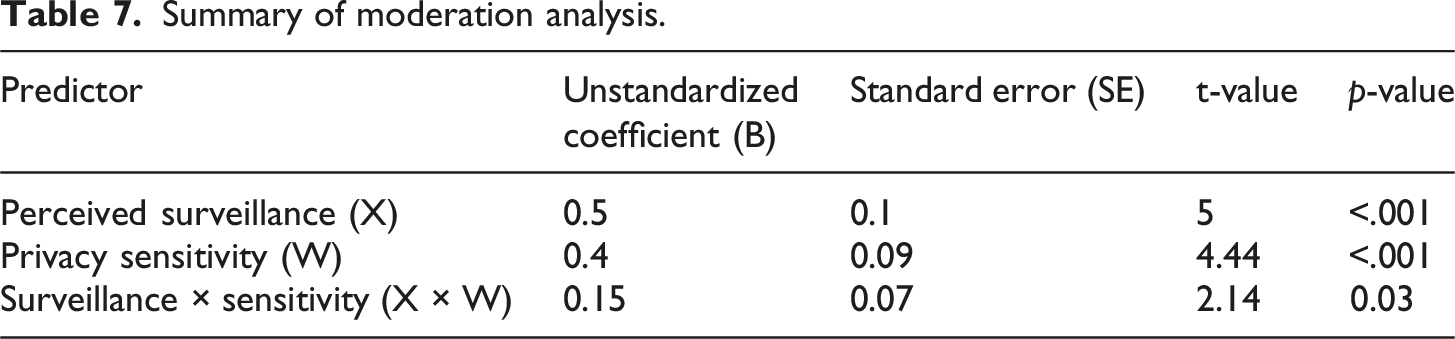
To examine whether privacy sensitivity moderates the relationship between perceived social surveillance (X) and emotional self-censorship (M), a regression analysis was conducted including the interaction term (Surveillance × Privacy Sensitivity). The results revealed a significant interaction effect, with a regression coefficient of b = 0.15 (SE = 0.07, p = .03). This indicates that the strength of the relationship between perceived surveillance and emotional self-censorship is contingent on the individual’s level of privacy sensitivity.
Specifically, individuals with higher privacy sensitivity exhibit greater susceptibility to perceived surveillance, leading to stronger emotional self-censorship. This suggests that privacy sensitivity acts as a moderating factor that amplifies the psychological response to affective surveillance.
Summary of regression results (based on PROCESS model 8).
These findings highlight that individual differences in privacy-related concerns significantly shape how people respond psychologically to emotion recognition AI systems. From a practical standpoint, the results underscore the importance of tailored policies that take into account user-specific characteristics, such as privacy sensitivity, when designing or deploying affective surveillance technologies.
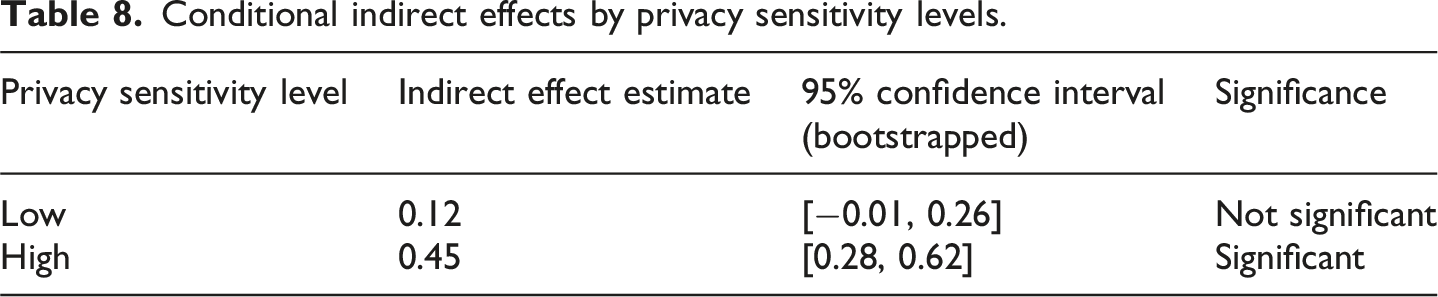
To examine the moderated mediation effect, PROCESS Macro Model 8 (Hayes, 2018) was employed. The analysis revealed that privacy sensitivity significantly moderated the indirect pathway from perceived social surveillance (X) to emotional expression suppression (Y) via emotional self-censorship (M). In other words, the strength of the indirect effect varied depending on the level of an individual’s privacy sensitivity.
Specifically, among participants with high privacy sensitivity, the indirect effect of perceived surveillance on emotional suppression through emotional self-censorship was statistically significant and substantial (Indirect Effect_high = 0.45, 95% CI [0.28, 0.62]). This implies that heightened awareness of surveillance leads to greater emotional self-censorship, which in turn intensifies emotional expression suppression.
Summary of moderation analysis.
Conditional indirect effects by privacy sensitivity levels.
These results provide empirical support for the theoretical validity of the moderated mediation model. The findings demonstrate that individual differences, particularly in sensitivity to privacy, play a pivotal role in shaping the psychological and behavioral responses to emotion recognition technologies.
Moreover, Hypotheses H4 (mediation effect), H5 (moderation effect), and H6 (moderated mediation effect) were all empirically supported, reinforcing the complexity of affective regulation under digital surveillance conditions.
This table illustrates that as privacy sensitivity increases, the indirect pathway from perceived surveillance to emotional expression suppression via emotional self-censorship becomes stronger and statistically significant. The moderated mediation mechanism suggests that privacy-aware individuals are more vulnerable to the psychological effects of AI-based emotion surveillance.
Discussion
This study aimed to elucidate the psychological mechanisms through which perceived affective surveillance influences emotional regulation in AI-mediated environments. Drawing on emotion regulation theory and related perspectives, this study examined both the mediating role of emotional self-censorship and the moderating role of privacy sensitivity. The findings provide several important theoretical implications.
First, this study contributes to emotion regulation theory by extending it into socio-technical contexts characterized by AI-driven surveillance. Traditional emotion regulation frameworks conceptualize expressive suppression as an internally initiated regulatory strategy.2,8 However, the present findings demonstrate that such regulatory behavior can also be externally triggered by perceived surveillance conditions. In particular, the significant mediating role of emotional self-censorship suggests that individuals engage in anticipatory cognitive regulation when they perceive that their emotional states are being monitored. This finding advances emotion regulation theory by showing that regulatory processes are not solely intrapsychic but are shaped by external technological environments that influence cognitive appraisal and self-regulatory intentions.
Second, this study contributes to the surveillance and AI literature by identifying micro-level psychological mechanisms underlying behavioral responses to perceived surveillance. While prior research has largely focused on macro-level issues such as governance, ethics, and societal risks associated with AI systems,3,5,11 relatively limited attention has been given to how individuals cognitively and behaviorally respond to such technologies. The present study addresses this gap by demonstrating that perceived affective surveillance operates through internal cognitive processes—specifically emotional self-censorship—to influence observable emotional regulation behavior. This finding provides empirical support for a mechanism-based understanding of human responses to AI surveillance, thereby extending existing research beyond descriptive or normative approaches.
Third, this study advances privacy research by reconceptualizing the role of privacy sensitivity as a boundary condition in emotional regulation processes. Previous studies have primarily examined privacy-related constructs, such as privacy concern, as predictors of technology adoption or resistance. 10 In contrast, this study demonstrates that privacy sensitivity plays a contingent moderating role by shaping how individuals cognitively appraise surveillance environments. Specifically, individuals with higher privacy sensitivity are more likely to interpret surveillance as intrusive and autonomy-threatening, which in turn strengthens emotional self-censorship. This finding highlights the importance of incorporating individual differences into models of human–AI interaction and provides a more nuanced understanding of privacy-related responses.
Importantly, the findings should be interpreted with appropriate caution. The moderating effect of privacy sensitivity was not uniformly observed across all relationships, indicating that its influence is context-specific rather than universal. Therefore, the conclusions of this study should be limited to the identified mechanisms and should not be generalized to all forms of emotional regulation or AI-based surveillance contexts.
Overall, by integrating emotion regulation theory, surveillance research, and privacy perspectives, this study provides a more comprehensive and theoretically grounded explanation of how perceived affective surveillance shapes emotional and behavioral responses. These findings contribute to a deeper understanding of human behavior in AI-mediated environments and offer a foundation for future research on the psychological consequences of emerging surveillance technologies.
Theoretical and practical implications
This study offers both theoretical and practical contributions by empirically clarifying the structural relationships among perceived social surveillance, emotional self-censorship, and expressive suppression within the context of AI-based emotion recognition technologies.
From a theoretical perspective, this study contributes by integrating surveillance society theories (e.g., Foucault, Lyon) with emotion regulation theory (Gross). While traditional emotion regulation frameworks have conceptualized expressive suppression as an internally initiated cognitive strategy,2,8 the present findings demonstrate that such regulatory behavior can also be externally triggered by socio-technical environments, particularly AI-driven surveillance. By identifying perceived affective surveillance as a contextual antecedent, this study extends the boundary conditions of emotion regulation theory to include technologically mediated environments.
Furthermore, this study reconceptualizes emotional self-censorship as a distinct psychological construct within AI-mediated contexts. While self-censorship has traditionally been examined in political or media domains, 7 this research extends its applicability to emotional regulation by operationalizing it as an internal cognitive–motivational mechanism that precedes behavioral suppression. This distinction contributes to a more nuanced understanding of how internal regulatory intentions translate into observable emotional behaviors.
In addition, this study advances privacy research by repositioning privacy sensitivity as a dispositional boundary condition that shapes emotional regulation processes. Unlike prior studies that primarily examined privacy-related constructs as predictors of technology adoption or resistance, 10 the present findings demonstrate that privacy sensitivity amplifies the psychological impact of perceived surveillance, thereby influencing downstream emotional and behavioral outcomes. This highlights the importance of incorporating individual differences into models of human–AI interaction.
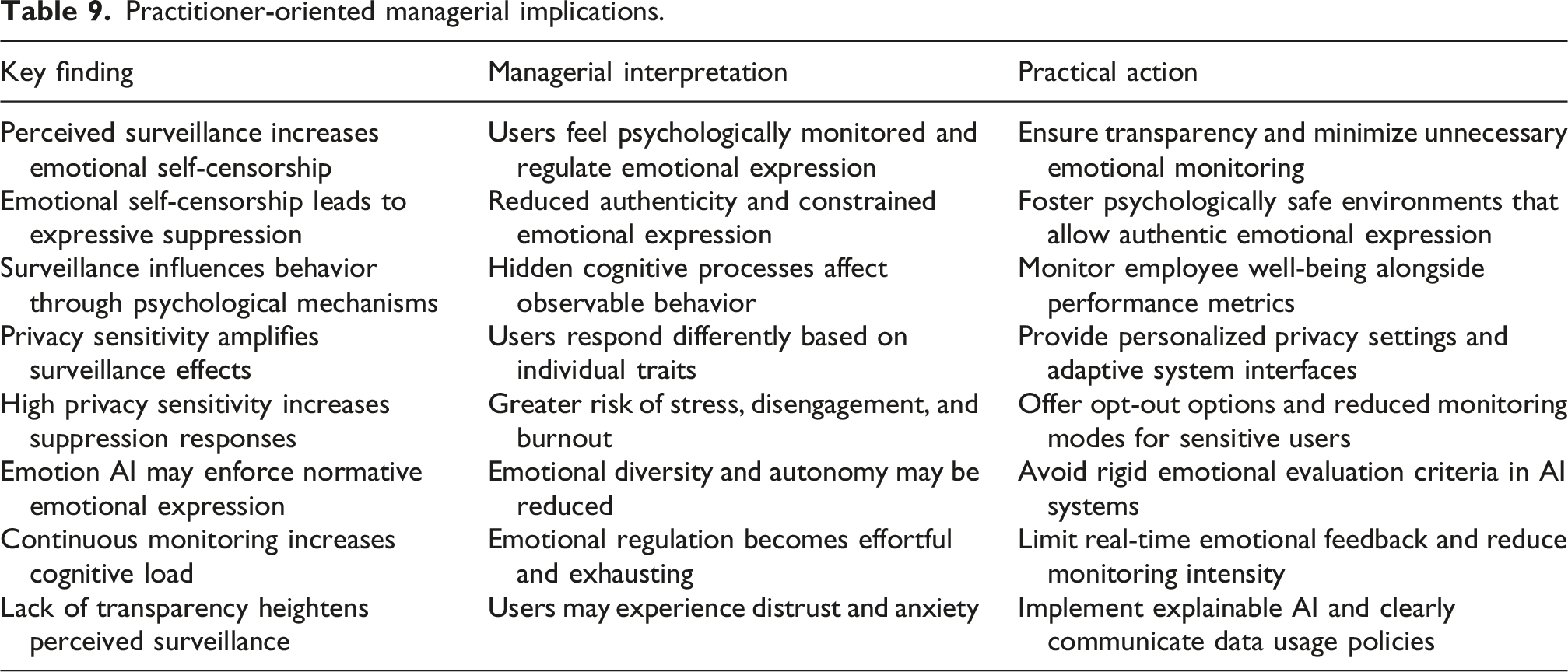
From a practical perspective, the findings provide important implications for organizations implementing emotion recognition technologies. First, the results indicate that perceived emotional surveillance can unintentionally induce emotional self-censorship and expressive suppression, potentially reducing authenticity, engagement, and psychological well-being. Therefore, organizations should carefully consider the psychological consequences of deploying such systems, beyond their functional benefits.
Second, transparency in the use of emotion recognition technologies is critical. Clearly communicating how emotional data are collected, processed, and utilized can reduce perceived intrusiveness and alleviate users’ psychological burden. Providing users with control mechanisms—such as opt-out options or adjustable monitoring settings—may further enhance trust and acceptance.
Third, the findings suggest that individual differences, particularly privacy sensitivity, play a significant role in shaping responses to emotion AI. Organizations should therefore move beyond uniform system design and adopt more user-centered approaches, such as personalized privacy settings or adaptive interfaces, to accommodate diverse user preferences and psychological needs.
Finally, prolonged exposure to emotion recognition systems may increase cognitive load and emotional fatigue due to continuous self-regulation. This is particularly relevant in emotion-intensive occupations such as customer service or education. Organizations should thus implement safeguards to protect emotional autonomy and ensure that such technologies do not inadvertently undermine employee well-being or productivity.
Practitioner-oriented managerial implications.
Limitations and suggestions for future research
While the present study contributes to both theoretical and empirical discourse, several limitations should be acknowledged, alongside directions for future inquiry.
First, the use of a cross-sectional design restricts the ability to draw causal inferences. Although significant relationships among variables were identified, the temporal sequence and causal mechanisms remain uncertain. Future studies should consider longitudinal or experimental designs to better capture how perceptions of surveillance develop over time and influence emotional regulation processes. For instance, tracking participants before and after interacting with emotion recognition systems could yield deeper insights into temporal dynamics.
Second, the sample consisted primarily of general adult participants rather than actual users of emotion recognition technologies in specific occupational contexts, such as public sector workers, airline staff, or call center employees. These groups may exhibit different emotional responses due to their daily exposure to emotionally demanding environments. Future research should diversify the participant pool to enhance ecological validity and ensure findings are applicable to real-world settings.
Third, the reliance on self-reported data introduces the possibility of response biases, such as social desirability effects or inaccuracies in self-perception. While self-report measures are valuable for assessing subjective experiences, future research would benefit from incorporating behavioral or physiological indicators—such as facial recognition data or biometric signals—to complement and validate self-report findings.
Fourth, cultural factors may influence both emotional expression and surveillance perception. As the study was conducted within the Korean context—where emotional restraint is often socially valued—the results may not generalize to cultures where emotional expressiveness is more encouraged. Future studies should employ cross-cultural designs to examine how different cultural norms moderate the psychological impacts of emotion surveillance technologies.
Lastly, while emotional self-censorship was examined as the sole mediating variable, other potential mediators or moderators—such as perceived emotional display norms, trust in technology, or organizational culture—may also play significant roles. Employing more comprehensive models, such as structural equation modeling (SEM), in future studies could help map out a more detailed network of mediating and moderating factors, thereby enhancing theoretical rigor and explanatory power.
Conclusion
This study examined how perceived affective surveillance in AI-mediated environments influences emotional regulation, focusing on the mediating role of emotional self-censorship and the moderating role of privacy sensitivity. The findings indicate that perceived surveillance significantly increases expressive suppression both directly and indirectly through emotional self-censorship.
Furthermore, privacy sensitivity strengthens this indirect relationship, highlighting the importance of individual differences in shaping responses to emotion recognition technologies. These results demonstrate that AI-driven emotional surveillance influences not only observable behavior but also internal regulatory processes.
Overall, this study emphasizes the need for human-centered and privacy-aware design of emotion recognition systems. As such technologies continue to expand, understanding their psychological impact will be critical for ensuring ethical and sustainable human–AI interaction.
Footnotes

Funding
The author received no financial support for the research, authorship, and/or publication of this article.
Declaration of conflicting interests
The author declared no potential conflicts of interest with respect to the research, authorship, and/or publication of this article.