




Abstract
Background
Managing human systems needs to build effective learning environment. The foreign business community (FBC) in Thailand initiated a pilot project a decade ago to explore the relation between external feedback and disengaged students in one urban school as part of building future workforce.
Objective
This exploratory study intends to identify specific activities of external feedback that earlier inspired strong students’ positive reactions on learning. Earlier follow-ups during the pilot phase showed higher social interactions, more positive feeling of psychological and physical safety, and greater learning interests with external feedback.
Method
Data was collected via open-ended questionnaires and analyzed using Content Analysis (CA) and Thematic Analysis (TA).
Results
The findings suggest that students react positively to interactions with outside individuals and opportunities for peer-to-peer learning. Furthermore, the results highlight the importance of second-loop feedback in shaping students’ mindset and fostering the change in their disengaged behavior. In addition to teacher-student relationship, school-business collaboration offers constructive feedback that significantly connects with students’ learning behavior.
Conclusion
External feedback constitutes a critical component in addressing school disengagement within this specific urban context. These findings offer a starting point for developing future studies of learning within complex human systems, including a workplace.
Keywords
Introduction
Developing and managing human systems, such as workplaces and classrooms, requires a deep understanding of learning.1,2 Learning is fundamental to adaptability and innovation for any living system to achieve its objectives. 3 Much like a workplace, a school functions as a complex ecosystem where learners’ behavior is shaped by the relationship of physical, social, and emotional attributes. Consequently, engagement and interaction are pivotal to continuous learning. However, the traditional viewpoint of learners as either ‘engaged’ or ‘disengaged’ can hinder a system’s capacity to function.4,5 Gaining deeper insights into learning interests and motivation to learn among individuals, particularly disengaged learners, is therefore critical for the effectiveness of human systems.
With this background, learning among upper secondary students, faced with poverty, from urban schools has gathered strong interest among business operators in Thailand.6–8 Learning is an essential skill for long-term workforce development.6,9 For instance, learning is an important trait when hiring young employees among Small and Medium Enterprises or SMEs. 10 This is due to a changing nature of work in which learning is an integral part of work. For SMEs and start-ups operating in the era of Industry 4.0 and 5.0, employees need to learn and work at the same time because of the challenge in providing formal training to all their employees by SMEs and start-ups.11,12 These enterprises tend to operate within or near urban areas so they often express strong interests in working with urban schools.13,14 Despite its importance, learning is a serious problem in Thailand’s urban context, especially schools that belong to Bangkok Metropolitan Administration or BMA.15,16 Since most BMA students cannot afford to pursue higher education, maintaining their motivation to learn and learning interests has become one of the major challenges.10,14,17
In general, learning for students in urban environment is influenced by many factors such as poor learning experiences with emphasis on assessment, poverty, inequality, inadequate career guidance, lack of opportunities for practical work experience, and inability to relate activities in a classroom to the future.15,18–20 Learning is part of a complex human phenomenon which needs to recognize previous experiences to build new mindset, interests, and understandings. In other words, learning needs physical and psychological drive to sustain attention and efforts.21–23 Many past studies on a positive change in students’ learning point to the prominent role of feedback which stems mainly from student-teacher interactions.24–28 Feedback can constructively provide guidance for improvement, nurture a positive mindset, and identify strengths and weaknesses for future development.29–31
The primary issue when exploring feedback and learning experiences in urban environment is that schools tend to operate as a closed system.6,16 This is due to mistrust with people from outside, a lack of opportunities to engage with business communities, safety and regulatory concerns, etc.15,16,32 The absence of external interactions can result in feelings of isolation and uncertainty which can affect students’ long-term development into future workforce.5,33 However, it remains unclear how external feedback from outside can address students’ mindset and motivation in an urban environment faced with a serious lack of equity and opportunity. In other words, this exploratory study focuses on the students’ reactions in one urban school to external feedback designed to improve their learning experiences. In addition to impoverished family background and school operating as a closed system, students are required to constantly take national tests to improve their learning outcomes. Hence, relying on tests alone has not had positive effects on quality of learning in Thailand.8,10
Literature review
Past and current research on school-business partnerships and work-based learning for urban education has focused on how schools can overcome disconnection—curriculum and employment, teaching subjects and future livelihood, pedagogical practices and learning interests, etc.34,35 This disconnection typically stems from a lack of localized corporate footprints, limited engagement with neighboring micro and small enterprises, and a lack of long-term commitment from municipal or local public officers. Consequently, the primary concern for students in many urban secondary schools is a deficit in social capital.34,36 Building these professional networks is fundamental for fostering social mobility and expanding employment opportunities.
As a result, many studies have sought to examine the specific roles and activities through which intermediary entities, such as non-profit organizations or chambers of commerce, can enhance the quality of basic education in urban areas.34,35 This inquiry is essential, as urban schools often struggle to independently attract and sustain effective partnerships with businesses. Ultimately, these intermediaries serve as a vital link, connecting disengaged and marginalized students and with broader professional communities. Promising interventions to improve quality of learning have prioritized student engagement and motivation, paid opportunities and learning interests, as well as mentoring and employability.34,36 Other contemporary issues for this improvement include emotional support and trust.
There are two important conceptual frameworks when examining students’ learning experiences, especially with urban environments. The Double-Loop Learning framework highlights the roles of feedback to bring a positive change in their mindset and behavior.25,37 The Self-Determination Theory underlines the importance of three needs that influence students’ motivation to learn. These needs include autonomy, competence, and relatedness. 38 For feedback, it provides students’ performance information relatively to a set of learning outcomes and improvement guidance and encouragement to reach these outcomes.39–41 Thus, feedback naturally needs to deal with students’ behavior. Unlike evaluation, feedback is formative and is not regarded as part of ranking or rating.
Feedback can be in different shapes and forms, for example, direct and indirect, internal and external, etc. 31 Active conversations on academic progress are part of direct feedback from a teacher. Fast response by a teacher when receiving an inquiry from a student is considered indirect feedback, indicating a positive gesture with care and attention. Feedback has been an integral part of learning since students interpret, internalize, and act upon this information to enhance their knowledge and skills.27,40,42 For instance, learning from a mistake and an error can be positive experiences for students with constructive feedback.39,40,43–45 This positive experience can lead to valuable non-academic activities such as willingness to help friends and others, participation in extracurriculars, and sharing problems with peers. These activities are essential for SMEs and start-ups since these organizations tend to have less rigid functional structure and expect all employees to work together.11,12
The Double-Loop Learning framework emphasizes the use of feedback to help students recognize the need to improve and address their mindset in school.4,37,45–47 Thus, both feedback loops need to be carefully designed, prepared, and applied.26,48 The first or single loop focuses primarily on the need to change decision/action while the second or double loop deals with the students’ prevailing assumption that has led to this behavior. For instance, when students develop a product from science experiment such as soap, the first-loop feedback should focus on product improvement such as eco-friendly packaging, color, and fragrance. This first-loop feedback should result in better decisions and actions of students.
When students make fertilizer from food waste, the narrative about fertilizer itself can be part of the second-loop feedback. For urban schools, poverty and sense of hopelessness are commonly cited as a reason for a lack of learning and low motivation to learn.6,15 The reason is that these students don’t see a bright future regardless of how hard they try; therefore, why should they learn and work hard at school? The story about fertilizer can challenge this prevailing mindset. Fertilizer is made from waste which nobody wants but becomes valuable after a composting process, that they learn from science subjects. This story represents the second-loop feedback that can challenge this mindset—just like fertilizer if a student continues to learn and work hard, he or she can be valuable and will be needed by others. Tackling the prevailing mindset is important for a lasting change in behavior. Thus, feedback contributes to deep reflection such as mindset and behavior of students.16,49
Based on the Self-Determination Theory, students can be motivated because of: (1) sense of control over their actions and decisions—referred to as an autonomy, (2) sense of mastery and proficiency in their ability—known as competence, and (3) sense of belonging and being connected with others—in reference to the term relatedness.44,50–52 Proper use of feedback can connect to a sense of relatedness, including students’ future—career, development, and security.43,50,53,54 With outside interactions, students may feel more connected to a new environment for their post high school. Although feedback can impact sense of autonomy and competence, this circumstance depends on guidelines and decisions made by school administrators and classroom teachers such as the level of classroom autonomy. Thus, learning experiences for urban environment tend to focus on belonging and connection for students who feel disengaged from classroom and isolated from society.15,17
Learning, disengagement feeling, feedback, and behavior represent a changing phenomenon when investigating the effectiveness and outcomes of urban schools.18,49 Furthermore, due to the problems relating to employment, poverty, and lack of school interactions with business communities, an exploratory study with the ability to repeatedly observe the relation between external feedback from business communities and students’ reaction over a long period of time is needed.55,56 In addition, an exploratory nature is essential due to the complexity of students’ reaction which is driven by classroom teaching, family background, and prevailing mindset about their future which are not often included in traditional data collection.57,58 Therefore, the need to investigate a broader social space, instead of a classroom, is critical for studying urban schools’ challenges. In addition, small data is needed to help analyze reactions to specific external feedback in a meaningful way since the interactions between schools and business enterprises are in the pilot stage.55,56 Thereby, the exploratory study adopts the framework combining small data, Double-loop Learning, and Self-Determination Theory. This study deals with whether external feedback prompts positive reactions on learning and other non-academic activities and what type of this feedback appears to encourage these reactions.
Case background
Foreign Business Communities (FBC) was approached by Bangkok Metropolitan Administration (BMA) to jointly address the challenge of students’ learning which prevents them from being more employable, especially with SMEs and start-ups in late 2013. This approach is based on the recognition that most BMA students would immediately seek to work after high school due to limited financial capability. Also, most members in FBC were SMEs and start-ups located in the vicinity of Bangkok. Also, see Appendix A for the gap in academic excellence which led to the focus on learning through better understanding of students’ psychology. Due to poverty and lack of interactions with private firms, employment opportunity was limited to Thai students from urban areas. 17 Sense of hopelessness about the future resulted in dropouts, disruptive behavior, teen pregnancy, and school bullying, especially among upper secondary schools.14,16 Most FBC members were willing to participate in the pilot project due to the need of qualified workforce and illustration of social responsibility. Note that SMEs and start-ups often need employees with high-school diploma and vocational-colleges certificate.8,59 Before the pilot project could begin, strong trust and teacher collaboration needed to be established because FBC could not be involved directly with teaching because of regulatory restrictions.
This pilot project began in the academic year 2015-16 with one BMA school, called Kaenthong Uppatham School. FBC efforts focused primarily on the upper secondary level, especially for students attending Years 10 and 11 in the science track. The reason was that FBC saw the possibility to introduce product development from science experiment. This introduction would allow FBC to become more active with external feedback without direct interference with classroom teaching. It was deemed that the development of products could reflect students’ level of understanding, instead of focusing on writing and submitting experimental reports for science experiments. It is important to point out that students’ prevailing mindset was identified early and could be described as follows: ‘Due to poverty and family background, regardless of how hard I tried at school, I would neither succeed nor have a bright future. Why did I need to learn and work hard at school?’ In addition, the use of a centralized curriculum and national tests had not been effective as most students did not plan to continue their education.8,15
Product development was also necessary due to the need for extra income from students. Students generally had to work after school until the evening, which contributed to exhaustion and inability to concentrate on the lessons of the following school days. FBC and teachers focused on products that explicitly blended science subjects, that is, Physics, Chemistry, and Biology, such as fertilizer from food waste—school lunch and snacks as well as soaps and detergents. These products were among the first significant changes in science experiments. For teachers, classroom management was easier to handle due to common need for extra income shared by students, resulting in better teamwork and social interactions as well as less bullying and disruption when making products. For FBC, teacher collaboration became stronger since external feedback such as product packaging and pricing did not interfere with lesson plan development and teaching.
Since the 2015-16 academic year, there have been many FBC-directed or sponsored activities that represent external feedback. These activities consist of first- and second-loop feedback. First-loop feedback, which is more direct, consists of school visits and workshops. The visits have included entrepreneurs and business executives as well as ambassadors from various embassies in Bangkok and delegates from international entities such as foundations and non-profit organizations. Second-loop feedback, which was more indirect and implicit, appears to be gestures and symbols to show support of students’ work and improve sense of hopefulness about their future. This has included in-kind donations, invitations to display/sell products from science experiments, and sponsorship of peer-to-peer learning, listening closely to the presentation by students, being responsive to their needs and inquiries, etc.
Past follow-ups, during FBC’s involvement with Kaenthong Uppatham School, show positive results from external feedback on social interactions and psychological and physical safety. 60 As this pilot project comes to its conclusion in early 2026, there is need to understand which and how activities of external feedback have encouraged disengaged students’ positive reactions. Thus, the open-ended survey was developed for former and Year 12 students in 2025 (prior to the completion of the academic year of 2025-2026). To take part in the survey, students needed to participate in FBC activities at school for at least 2 years. Since these activities had been consistent and continuous, there were abundant opportunities for students to express their opinions and feelings accurately, based on FBC’s feedback. Note that all students participating in the survey were 18 years old or older.
Research question
How does external feedback from FBC and its partners facilitate students’ experiences within urban environments regarding their learning, behavior, and relatedness about the future?
Objective
This research intends to analyze how sustained interactions with FBC and its partners shape and facilitate students’ learning experiences within urban environment, specifically examining the role of external feedback in fostering motivation, behavioral shifts, and a sense of relatedness towards their future.
Methodology
The open-ended survey was applied to allow current and former students to express themselves with freedom and flexibility. Open-ended questions could capture personal feelings and experiences better, based on less structured or controlled experiments. 61 These questions would allow students to reply in their own words with personal details, experiences, and insights. Students’ responses would show genuine thoughts that could likely be missed with a set of predefined questions since FBC interactions did not take place inside classroom. Thus, the open-ended questions could lead to better understanding of students’ motive behind personal description.
The questionnaire was distributed in the middle of 2025 via Google Form to ensure accessibility and voluntary participation. Within this form, the participants were provided the conditions about the purpose and confidentiality of their response which were following Thailand’s Personal Data Protection Act (PDPA). Participants understood that they could withdraw at any time without negative consequences. Their names were not required. There were four open-ended questions that allowed the participants to describe their experiences and the impacts and outcomes from external feedback, that is, questions 1.1 to 1.3 and 2. Also, see Appendix B. The next step was to identify patterns, frequencies, and relationships, given the textual and descriptive responses.
In this research, Content Analysis (CA) and Thematic Analysis (TA) were used to examine text data.62,63 CA was used to systematically classify text responses into predefined categories relating to feedback (e.g., activities and sources) and behavioral outcomes. This process enabled the quantification of repetitive patterns (e.g., impacts from constructive feedback, sharing of experiences, and recognition from outside). TA was applied to exploring deeper insights into personal reflection. 64 Themes were generated through an iterative coding process to identify the relationships among feedback, learning, motivation, behavior, and excitement. 63
In summary, the coding process followed both deductive and inductive approaches. Initial themes and analytical directions were guided by relevant frameworks (in the areas of feedback, engagement, and motivation) and actual interventions, while additional patterns and subthemes emerged directly from participants’ responses during coding. To ensure analytical consistency, portions of the coding structure and category assignments were independently reviewed by FBC members who had continuously participated in the pilot project since its inception. Disagreements were resolved through discussion and exchanges of observed behavior and experiences until a consensus was reached.
Findings
Background of the participants.
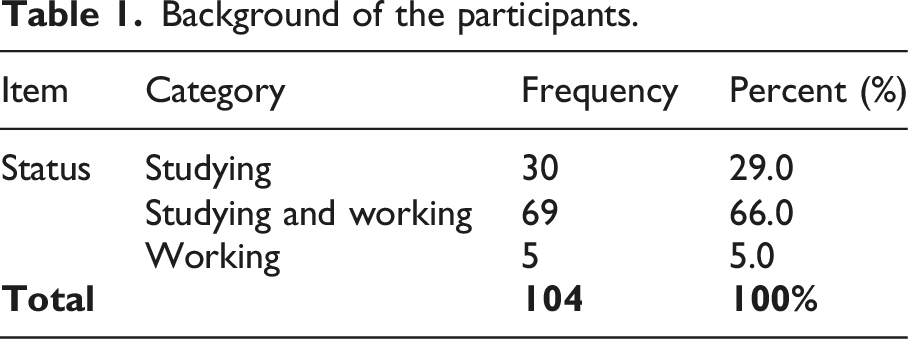
Illustration of the theme, question, and code from external feedback.

Theme 1: Learning
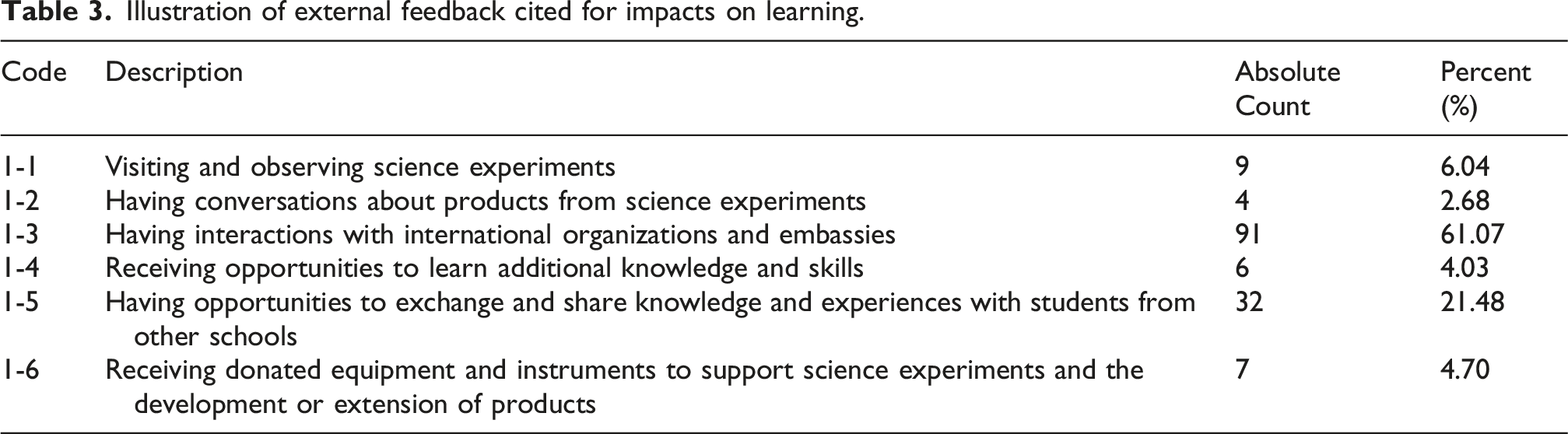
Please specify three activities by FBC and its partners that impressed you the most and had the greatest personal impact, specifically learning (in reference to Item 1.1 in Appendix B)
Area for Question 1: External feedback and its roles on learning
Illustration of external feedback cited for impacts on learning.
Theme 2: Mindset and behavior
From the activities you mentioned in Item 1.1, how did they influence your attitude/ mindset? (in reference to Item 1.2 in Appendix B)
Area for Question 2.1: External feedback and its influence on attitude/mindset
External feedback can influence attitude and mindset which change students’ behavior.31,65 Furthermore, in accordance with the second-feedback loop, addressing the attitude and mindset is essential to sustain a positive change in behavior. The two highest counts are improved behavior because of direct conversations and interactions (26.0%) and instilling new attitudes and motivation (24.0%). Because of many visitors are not Thai, another significant statement is importance of English language proficiency and communication skills (21.0%).
From the activities you mentioned in Item 1.1, how did they influence your work-related behaviors (both in the workplace and/or in the classroom)? (in reference to Item 1.3 in Appendix B)
Area for Question 2.2: Learning and contribution to behavior (relating to non-academic performance)
Illustration of influence of external feedback on attitude and behavior.

Theme 3: Excitement about or feeling related to the future
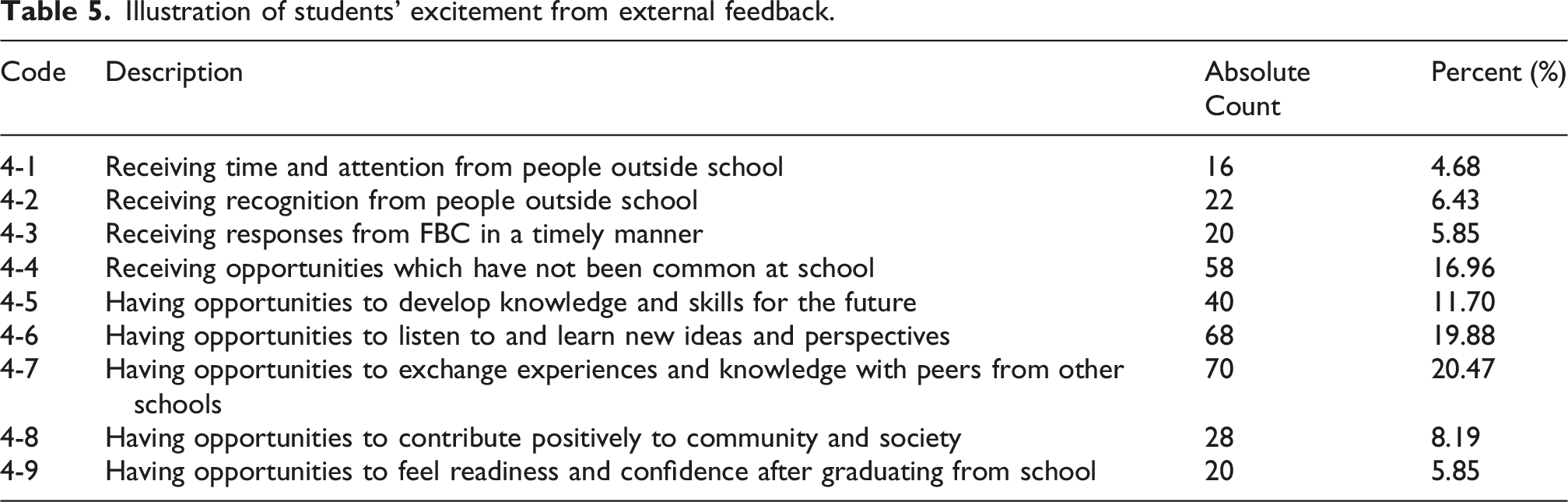
Please select three of the following activities (as part of external feedback) that, you believe, have inspired and prepared you for the future.
Area for Question 3: External feedback and relatedness to the future
Illustration of students’ excitement from external feedback.
Discussion
Two activities of external feedback have the highest counts, Code 1-3 and Code 1-5 from Table 3. During the pilot project, students are clearly keen to be provided with an opportunity to have concrete feedback from outside. By sponsoring peer-to-peer learning, FBC implicitly sends second-loop feedback to students about trust which addresses students’ sense of isolation and indicates FBC’s care and attention. Also, actual feedback from and to peers is also important for learning. Note that interactions require students to review and re-learn what they have conducted in science experiments and think about what needs to be presented.
Having visitors come and ask questions as well as having an opportunity to exchange knowledge with peers represent a meaningful symbol for disengaged students. Continuous interactions with ambassadors and international delegates who show their interests in the progress made by students in their products are critical for students’ learning. Showing interests and attention represents second-loop feedback which can address students’ prevailing assumption that nobody cares about what they do at school. See Appendix C for product development.
It appears that constructive feedback, Code 1-3 and Code 1-5 from Table 3, has resulted in students’ positive reactions relating to their behavior, attitude, and confidence, as indicated by Code 2-2, Code 2-3, and Code 2-1 from Table 4. Furthermore, the second-loop feedback has helped change students’ learning behavior and mindset, as shown by Code 3-1, Code 3-4, and Code 3-3 from Table 4. Therefore, external feedback (i.e., Codes 1-3 and 1-5), which is indirect and implicit in nature such as symbol and gesture, clearly relate to a positive change in behavior such as practicing English language and communication skills while continuing to develop other skills and attitude, including empathy and positive outlook in life.
The change in students’ behavior becomes inevitable since they cannot act in the same way in front of delegates from international organization and embassies like they do with teachers and school administrators. Furthermore, unlike typical classroom interactions, the first roles of the visitors are to listen and ask questions so that they have better understanding of the products from students. For instance, the visitors are not knowledgeable about making fertilizer from food waste so initial listening is needed. Then, they ask what they like to know more such how to make it, how to keep it, how to use it, and its benefits. The role reversal appears to be essential to drive this change.
For SMEs and start-ups, communication skills and empathy are essential since their employees are often faced with multiple tasks and are required to rotate among various projects.13,14 In addition, SMEs and start-ups often hire young workers who demonstrate their willingness to continuously learn and develop due to a need for their workers to work and learn at the same time. Because of this rapidly changing business environment, training has become reactive and cannot effectively respond to emerging business challenges.11,12,30 Thus, the change in attitude and behavior is critical for students’ future employment.
Apparently, external feedback has brought students a lot of excitement to classroom activities and their future.28,41 In other words, the interactions with FBC have seemingly revigorated a sense of relatedness among disengaged students which is important for learning.10,32,56 The purpose of Question 2, which requires a selection from a given set of statements, is to verify the description expressed earlier by students in Item 1.1. The results show that Code 4-7 and Code 4-6 from Table 5 have the highest selection among students. Comparing the two highest counts between Tables 3 and 5 shows responses’ consistency in how students react to constructive feedback. The first one is the use of peer-to-peer learning, in reference to Code 4-7 and Code 1-5. Intended feedback, when sponsoring and arranging peer-to-peer learning by FBC, is symbolic and sends a message of trust in students’ knowledge, communication and planning skills, and maturity.
Moreover, providing opportunities to interact with others challenges students’ mindset. The feedback is simple but unspoken—students are trusted and FBC believes in them. As shown in Code 4-6 and Code 1-3, having continuous opportunities to interact with people from outside such as business executives and ambassadors by exchanging ideas, asking questions, presenting products from science experiment, and listening to advice from them should not be viewed simply as an activity. It is part of second-loop feedback to address the sense of isolation and disengagement before positive behavioral change can take place.
Implications
The survey results provide two meaningful implications highlighting the relationship between external feedback and learning for disengaged students in one urban school. These implications involve both Double-loop Learning and Self-determination Theory. Firstly, for second-loop feedback design, there is a need to initially understand the nature and mindset of students, especially those who are disengaged from school and feel isolated from society.10,15 This understanding is essential since first- and second-loop feedback have different impacts when intending to correct actions or to change mindset and behavior.24,25,41 Lack of this understanding has contributed to ineffective use of constructive feedback.25,40,66
Due to the complexity of learning in urban environments, this pilot project prioritizes second-loop feedback over direct suggestions on improving products, based on the first loop. This pilot project concentrated on understanding the prevailing mindset that shaped students’ learning-interest and behavior. By utilizing the flexibility of second-loop processes which often take place through symbols and gestures, FBC decided to initially address with this mindset that was embedded in students’ daily lives. 31 It also highlights the significance of non-confrontable interactions which are essential for disengaged students. This pilot project shows that an external entity can play a constructive role in tackling negative mindset and attitude which is visible in urban environment.
Being attentive and demonstrating a willingness to listen are critical when involving disengaged students.29,65 This pilot study suggests that reversing two-way communication, where students provide an overview of their science experiments before receiving feedback from visitors, is essential. To be effective for students’ positive experiences, this reversal needs to be consistent and sustained over time. When external visitors listen to their presentations, students indicate a sense of pride in their efforts. This role reversal not only fosters attentiveness but also strengthens students’ perceived relatedness to suggestions made by FBC delegates and to outside environment. Based on the Self-Determination Theory (SDT), a sense of relatedness for disengaged students begins with visitors’ listening gesture which can be considered as a form of attention and care.
Student responses indicate that external feedback significantly supports their sense of relatedness within classroom and science experiments, fostering both a sense of belonging and stronger connections with team members.53,58,67 The positive reactions suggest that external feedback is most effective when it emphasizes students’ learning through a sense of relatedness. This includes the use of value-added, which suggests a further extension of fertilizer to cultivate fresh vegetables and produce. FBC has shown no intention to interfere with classroom management, especially autonomy of students in terms of determining the scope of science experiment or introducing assessment from different countries to demonstrate students’ competency in science knowledge.38,53 Furthermore, by challenging public perceptions of learning in urban environments, students in this pilot project have demonstrated an active inquiry mindset and a readiness to engage when supported by external feedback that prioritizes their prevailing mindset and connection to classroom and future aspirations. The evidence is how students across successive years have continuously improved from previous experiments, for example, from making fertilizers to cultivating fresh produce, and subsequently to packaged salads which can be sold in a market at a higher value.
The role of FBC in supporting student learning experiences warrants further reflection. Amidst regulatory restrictions, FBC has functioned as an external entity, serving as both a catalyst and a network integrator. As a catalyst, FBC collaborates closely with teachers to bring practical business experiences to stimulate students’ learning interests and to address the mindset that shapes their learning behavior. For instance, during school visits, providing constructive feedback to improve products from science experiments exemplifies this catalytic role. Furthermore, as a network integrator, FBC fosters engagement with disengaged students by facilitating continuous interaction with a diverse group. This network includes ambassadors, business executives, foundation managers, delegates from international agencies, and students from international schools who have played a constructive role during school visits and peer-to-peer learning.
Finally, education in urban environment needs to overcome feelings of disengagement, lack of motivation, and insufficient awareness of learning as part of employment in the labor markets.15,16,18 The pilot project shows promise through external feedback to improve learning experiences among disengaged upper secondary students. As learning has become an integral part of work, especially for SMEs and start-ups, urban schools need to operate more openly and collaborate with willing local enterprises or business associations to prepare students for future work. Consistent, continuous partnerships with business communities can improve learning behavior and experiences, representing positive educational outcomes for urban schools. As demonstrated by the longitudinal pilot project with one upper secondary school, in addition to teacher-student relationship, for urban settings, school-business collaboration offers constructive feedback that significantly enhances students’ learning behavior which ultimately prepares them for future work.
Limitations and future investigations
Despite the findings that point to the relation between external feedback and learning among disengaged students, it is important to recognize the limitations of this exploratory study. Firstly, the experiments can be characterized as field-based since FBC focused on providing disengaged students with meaningful experiences surrounding by real-world issues with the emphasis on learning as an essential skill.23,68 Due to the inability to organize and control individual interactions that students have made with FBC delegates and partners over the years, only broad implications can be made without specific consideration into variables and factors as commonly practiced in an experiment with controlled conditions.
When interpreting these findings, several additional limitations need to be considered. Participation in the study was strictly voluntary, which inherently introduces selection bias. Consequently, the sample may overrepresent highly driven or inspired students whose experiences do not accurately reflect the broader, disengaged student population. Furthermore, the findings rely entirely on retroactive data, making them susceptible to recall bias and recollection distortion as participants may subconsciously align their memories with the study’s main narrative. Finally, the lack of a comparison group prevents the establishment of causal relationships between FBC activities and students’ subsequent decisions and behaviors.
Moreover, since it is a pilot project in which familiarity and trusts did not exist between this urban school and business enterprises, only small data from upper secondary students who were part of the science track participated in and engaged with FBC activities. Future investigation can explore the relation between external feedback with younger students in the same school. The positive reactions of young students should further indicate the recognition of both teacher-student relationship in classroom and school-business collaboration in urban settings as the foundation for building learning as the future skill for disengaged students. Furthermore, these findings suggest that the benefits of constructive feedback can extend to organizational contexts, where it can ease high levels of employee disengagement. Feedback potentially acts as a mechanism for reinforcing positive behavior, encouraging active participation rather than passive behavior and withdrawals.
Conclusion
This exploratory study highlights the relationship between external feedback and students’ learning in urban environment. This relation is based on the results of the survey results from upper secondary students in one BMA school as part of the joint pilot project with FBC. The findings indicate that students, often characterized as disengaged and isolated, reacted and responded well to external feedback. This feedback challenged students’ prevailing mindset and nurtured a sense of relatedness to their studies and future. Key takeaways include the tremendous importance of double-loop feedback when addressing strong feelings of disengagement due to underprivileged family background and perceived lack of promising future. Despite some positive findings, it is not possible to generalize the use of external feedback in other learning arenas and environment due to small data and a less-structured circumstance when FBC and its partners engaged with teachers and students.
Supplemental material
Supplemental material - Exploring the connection between external feedback and disengaged learners in urban environment
Supplemental material for Exploring the connection between external feedback and disengaged learners in urban environment by Rapee Kanchana, Bordin Rassameethes, Voraya Wattanajitsiri, Panuwat Rodchom, and Kongkiti Phusavat in Human Systems Management
Footnotes

Author contributions
Conception: Rapee Kanchana, Bordin Rassameethes, and Kongkiti Phusavat.
Methodology: Rapee Kanchana and Kongkiti Phusavat.
Data collection: Panuwat Rodchom, Voraya Wattanajitsiri, and Kongkiti Phusavat.
Interpretation or analysis of data: Rapee Kanchana, Bordin Rassameethes, Panuwat Rodchom, and Kongkiti Phusavat.
Preparation of the manuscript: Bordin Rassameethes, Panuwat Rodchom, Voraya Wattanajitsiri, and Kongkiti Phusavat.
Revision for important intellectual content: Rapee Kanchana and Kongkiti Phusavat.
Supervision: Kongkiti Phusavat.
Funding
The authors disclosed receipt of the following financial support for the research, authorship, and/or publication of this article: Kongkiti Phusavat, Ph.D, National Research Council of Thailand, Grant number: N42A660996.
Declaration of conflicting interests
The authors declared no potential conflicts of interest with respect to the research, authorship, and/or publication of this article.
Supplemental material
Supplemental material for this article is available online.
References
Supplementary Material
Please find the following supplemental material available below.
For Open Access articles published under a Creative Commons License, all supplemental material carries the same license as the article it is associated with.
For non-Open Access articles published, all supplemental material carries a non-exclusive license, and permission requests for re-use of supplemental material or any part of supplemental material shall be sent directly to the copyright owner as specified in the copyright notice associated with the article.
