




Abstract
Background: Artificial intelligence (AI) has become a central driver of technological, organizational, and social change. Despite its widespread adoption, empirical evidence shows that adoption patterns vary significantly across generational cohorts. Objective: This study examines how perceived usefulness, effort expectancy, digital literacy, social influence, and trust in privacy relate to intentions to use AI technologies among Generation Z, Generation Y, and Generation X. Grounded in the Unified Theory of Acceptance and Use of Technology (UTAUT) and its extensions, the study employs a quantitative survey design (N = 206), conducting correlational and multivariate regression analyses separately for each generational group. Results: The results indicate that effort expectancy is a strong predictor across all generations, while perceived usefulness, digital literacy, and social influence have distinct effects by generation. Contrary to common assumptions, trust in privacy does not significantly predict intention to use AI across cohorts. Conclusions: The findings indicate that AI adoption is a multidimensional and age-dependent process. These generational differences highlight the need for age-sensitive AI design and implementation strategies, to promote equitable and informed use.
Introduction
Over the past decade, artificial intelligence (AI) has become a transformative technology, shaping everyday life. AI applications such as voice assistants (e.g., Siri, Alexa), recommendation systems (e.g., Netflix), and generative AI models (e.g., ChatGPT, Google Gemini, Claude, Microsoft Copilot, Perplexity AI), as well as automated solutions in healthcare and education, increasingly influence how people work, communicate, and learn. In addition to their technical contributions, these technologies raise important social and cultural questions related to data privacy, technological accessibility, and generational differences in adoption.1,2
Despite the widespread benefits of AI, its adoption varies across age groups. Younger generations, particularly Generation Z and Generation Y, tend to adopt AI technologies more readily, due to higher technological literacy and greater openness to innovation. By contrast, Generation X often faces barriers, such as increased privacy concerns and perceived system complexity. 3 Previous studies indicate that perceived usefulness, social influence, effort expectancy, digital literacy, and trust in data privacy are key factors shaping intentions to use AI technologies. 4
In this context, the present study examines how perceived usefulness, social influence, effort expectancy, digital literacy, and trust in data privacy, are associated with intentions to use AI technologies among Generation Z and Generation Y, compared with Generation X. By addressing these factors, the study contributes to a deeper understanding of how AI systems can be tailored to the needs of diverse user groups, thereby reducing adoption barriers. These findings offer practical insights for policymakers and technology developers seeking to maximize the social and technological value of AI systems, and highlight directions for future research, including cultural and gender differences in AI adoption, and the role of social media in shaping trust and social influence.
Literature review
Since the early twentieth century, scholars and practitioners have envisioned technologies capable of understanding human language and enabling natural voice-based interaction. 5 In recent years, rapid technological advances have accelerated the development of artificial intelligence (AI), establishing it as a transformative technology that enables real-time processing of complex data and conversational interfaces.6–8 Consequently, AI applications have been adopted widely across private and public sectors, including education, healthcare, engineering, and economics. 9 In healthcare contexts, AI is increasingly embedded in wearable systems, that enable real-time monitoring and behavioral prediction, particularly in clinical populations. 10
Voice-based assistants, such as Alexa and Google Assistant, illustrate the increasing integration of AI into daily life, supporting tasks such as scheduling, media consumption, and online purchasing.5,8 AI systems are often described as “machines that display aspects of human intelligence,” 11 and are widely associated with increased productivity, improved performance, and enhanced organizational competitiveness. 12 However, concerns remain regarding the potential displacement of human labor and the autonomous nature of AI-driven decision-making.11,12
To understand why individuals adopt or resist AI technologies, previous research has increasingly relied on established models of technology acceptance. Among these, the Unified Theory of Acceptance and Use of Technology (UTAUT) offers a comprehensive and widely validated framework for explaining both intentions to use and actual use of emerging technologies. 13 UTAUT integrates key constructs from eight prominent adoption models, including the Technology Acceptance Model (TAM), the Theory of Planned Behavior (TPB), and Diffusion of Innovations theory. According to UTAUT, technology adoption is primarily shaped by four core determinants: performance expectancy, effort expectancy, social influence, and facilitating conditions. Notably, UTAUT highlights that these relationships are not uniform across individuals, proposing that factors such as age, gender, experience, and voluntariness of use, moderate the strength of the associations between adoption determinants and usage intentions.13,14 This perspective is particularly relevant in the context of AI adoption, given the increasing diversity of users and the varying levels of digital exposure across generations.
To provide a comprehensive and theory-driven explanation of AI adoption, the present study builds on the UTAUT framework,13,14 and incorporates both core and extended determinants of technology adoption. Effort expectancy and social influence are derived from UTAUT, while perceived usefulness aligns conceptually with performance expectancy in TAM and UTAUT. 15 In addition, digital literacy and trust in data privacy are included as context-specific extensions relevant to AI environments. Digital literacy facilitates effective interaction with advanced technologies, and influences perceptions of ease of use and usefulness,5,16 while trust in data privacy plays a key role in the adoption of data-driven systems, particularly in AI contexts that rely on extensive personal data.8,17
Despite extensive research on technology acceptance in AI adoption13,14 important gaps remain. Existing studies have typically examined key determinants such as social influence, effort expectancy, perceived usefulness, trust in data privacy, and digital literacy, either in isolation or within limited conceptual frameworks.5,15,17 In addition, prior research has not systematically addressed how these factors operate across multiple generational cohorts within a single integrative model. To the best of our knowledge, the combined examination of these determinants across Generation X, Generation Y, and Generation Z within a unified analytical framework, has not been sufficiently explored. This gap is particularly significant, given the evolving nature of human-machine interaction, and the increasing reliance on AI systems in professional and educational contexts. Understanding intergenerational differences in AI adoption is not only of theoretical importance, but also has practical implications for the design of user-centered AI systems that accommodate diverse cognitive, social, and technological needs. The present study addresses this gap, by integrating multiple determinants of AI usage intentions, and examining their differential effects across generational cohorts.18,19
Social influence, defined as the extent to which an individual’s social environment affects their acceptance of artificial intelligence technology, is consistently identified as a key determinant of AI adoption. 9 Support from peers and the broader social environment, increases acceptance of new technologies, as individuals tend to align their behavior with group norms and expectations.5,9 Previous studies indicate that perceived social acceptance of AI use may even discourage non-adoption, due to fears of social exclusion.5,20
Another central factor, related to both acceptance and intention to use AI, is perceived usefulness. The latter is defined as the extent to which individuals believe that using AI improves performance and efficiency.5,6 Systems perceived as user-friendly and requiring minimal effort, are more likely to be adopted, while complex or cognitively demanding systems reduce perceived usefulness and discourage use. 18 Higher perceived usefulness is consistently associated with stronger intentions to adopt AI technologies. 12
Trust in data privacy is an additional and often critical factor in AI adoption. AI systems depend on extensive personal data, raising concerns about data storage, misuse, and security.8,17 Trust is therefore essential, not only for task performance, but also for confidence in responsible data management. Privacy concerns have a particularly strong influence on older users, who show heightened sensitivity to data protection risks. 3
Digital literacy has also become increasingly important in the context of AI adoption. Defined as the essential skills required for effective interaction with digital technologies, 6 digital literacy enables individuals to search for, evaluate, analyze and apply digital information to generate new knowledge. 4 Higher levels of digital literacy are associated with greater flexibility, problem-solving ability, and confidence in using advanced technologies, and are positively related to intentions to use AI systems.8,9
Effort expectancy refers to the perceived ease or difficulty of using a particular technology, especially during initial adoption. 21 The latter is considered one of the core determinants influencing users’ willingness to adopt new technologies. Individuals tend to favor technologies which they perceive as easy to understand and operate. When AI technologies are perceived as complex or difficult to use, users are more likely to resist adoption. By contrast, AI systems designed to be user-friendly, intuitive, and requiring minimal effort, are more likely to be accepted and integrated into users’ work processes. 21
Taken together, these determinants represent complementary dimensions of AI adoption. While perceived usefulness reflects the instrumental value of AI systems,5,6,12 effort expectancy captures the cognitive demands associated with their use. 21 Social influence highlights the role of normative pressures in shaping technology acceptance,5,9 whereas trust in data privacy addresses concerns related to risk, data security, and responsible data management.8,17 Digital literacy, in turn, reflects individuals’ capability to effectively engage with AI technologies and process digital information.4,6
Importantly, these factors do not operate independently, but jointly influence users’ intentions to adopt AI technologies. Prior research suggests that technology acceptance is shaped by the interaction between cognitive, social, and technological factors.13,14 For example, the perceived usefulness of AI may depend on users’ level of digital literacy, while concerns about data privacy may influence how social norms affect adoption decisions.3,8,9 Thus, integrating these determinants within a single framework, provides a more comprehensive understanding of AI adoption processes.
Generational differences in AI adoption intentions
The literature highlights that intentions to adopt AI vary significantly across populations and contexts. Studies in rural communities, national populations, and organizational settings, consistently show that perceived usefulness, social influence, effort expectancy, digital literacy, and trust-related factors influence AI adoption, although their relative importance differs.3,4,9 These differences are closely linked to generational distinctions, which stem from shared historical experiences, technological exposure, and value systems. 22 Contemporary workplaces increasingly include employees from Generations X, Y, and Z, whose varying digital skills, communication preferences, and attitudes toward technology may lead to different perceptions of AI. Older generations may see AI as a threat to job security, due to lower digital competence, while younger generations tend to prefer rapid, informal, technology-mediated communication, and show greater openness to AI adoption.7,22
Generations X, Y, and Z differ systematically in their perceptions and adoption of AI, reflecting distinct digital life experiences and developmental trajectories. 23 Generation Z (born 1997–2012), as digital natives, demonstrates high familiarity and cognitive ease when interacting with AI-driven platforms, and reports more frequent use. This pattern supports the claim that early and sustained digital exposure fosters greater adaptability, intuitive engagement, and confidence in technology use.24,25 Generation Z places great importance on ease of use, seamless interaction, and social embeddedness, which contributes to more positive affective attitudes toward AI. 24 At the same time, this cohort expresses heightened concern regarding AI’s potential impact on future employment, reflecting broader anxieties about automation and labor market uncertainty. 24
Generation Y (born 1981–1996) occupies an intermediate position between technological immersion and critical evaluation. 26 While digitally fluent and receptive to AI, Gen Y adopts AI when it clearly enhances productivity, and aligns with peer and workplace norms. 26 Their adoption decisions reflect a pragmatic balance between perceived usefulness and social validation, along with greater sensitivity to data privacy and algorithmic reliability issues, as compared to Gen Z.24,26 These concerns align with the cognitive risk-evaluation processes characteristic of adulthood, in which individuals engage in more deliberate assessments of potential costs and benefits.27,28
By contrast, Generation X (born 1965–1980), who matured before the widespread adoption of digital technologies, tends to approach AI adoption more cautiously and pragmatically. 26 Members of this cohort are more likely to adopt AI when it provides clear, tangible benefits, and is supported by adequate training and organizational resources. Empirical evidence shows that older workers report lower levels of AI integration, and perceive AI systems as more complex, thus highlighting the importance of perceived usefulness and effort expectancy in shaping their adoption intentions.26,29
Across cohorts, perceived ease of use and effort expectancy are especially influential among younger users, particularly Generation Z, for whom intuitive design and low cognitive burden are central to technology acceptance. 30 These findings highlight that AI adoption is not a uniform process, but varies by generation, shaped by differences in digital socialization, cognitive evaluation, and contextual priorities. 23
The current study
Building on the UTAUT framework,13,14 this study adopts an integrative model, to examine the determinants of intention to use AI technologies. Specifically, it investigates the associations between perceived usefulness, trust in data privacy, social influence, effort expectancy, and digital literacy, regarding individuals’ intention to use AI.
In addition, the study explores whether these relationships differ across generational cohorts: Generation X, Generation Y, and Generation Z, thereby providing a more comprehensive understanding of how cognitive, social, and technological factors jointly shape AI adoption. This design is appropriate for testing theory-driven associations among latent constructs, and for identifying age-related differences in technology adoption patterns. Generational cohort is conceptualized as a moderating variable, in line with UTAUT, which posits that age influences the strength of relationships between key determinants and technology adoption.13,14 Given the distinct technological experiences, cognitive styles, and social contexts associated with Generations X, Y, and Z, it is expected that the effects of the examined determinants on AI adoption intentions will vary across cohorts.
Research hypotheses
Direct effects of predictors on intention to use AI
The following hypotheses examine the direct relationships between the independent variables and intention to use AI.
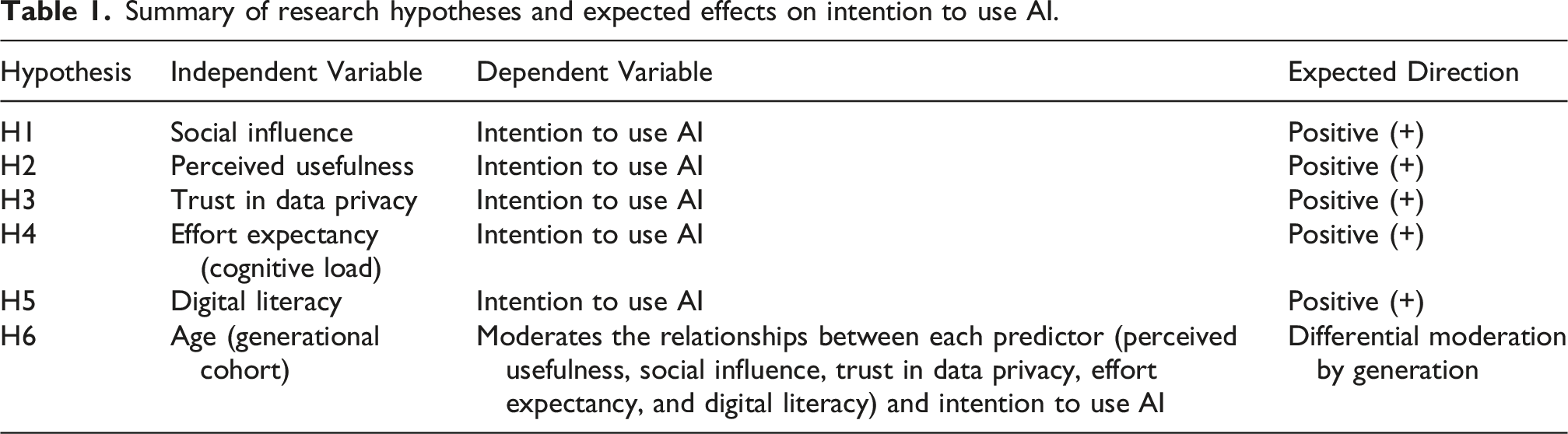
Social influence is positively associated with intention to use AI.
Perceived usefulness is positively associated with intention to use AI.
Trust in data privacy is positively associated with intention to use AI.
Effort expectancy is positively associated with intention to use AI.
Digital literacy is positively associated with intention to use AI.
Moderating effect of generational cohort
The following hypothesis examines whether generational cohort moderates the relationships between the independent variables and intention to use AI.
Generational cohort moderates the relationships between social influence, perceived usefulness, trust in data privacy, effort expectancy, and digital literacy and intention to use AI.
Summary of research hypotheses and expected effects on intention to use AI.
Method
Participants and sampling
The study sample consisted of 206 participants aged 18 to 65, representing three generational cohorts, based on established classifications 7 : Generation Z (18–26 years), Generation Y (27–42 years), and Generation X (43–65 years). Participants were recruited using a non-probabilistic snowball sampling technique, in which initial respondents were asked to distribute the questionnaire to peers and acquaintances. This approach provided access to a heterogeneous sample across age groups, although it may limit generalizability, due to potential self-selection bias.
Participation was voluntary and anonymous. Respondents provided only basic demographic information, including age, gender, and educational level. Other demographic variables, such as marital status, religion, ethnicity, and income, were not collected, and therefore could not be controlled for in the analysis.
Research instruments
Demographic variables
The questionnaire gathered information on participants’ gender, age, and years of education.
All constructs were measured using a five-point Likert scale, ranging from 1 (strongly disagree), to 5 (strongly agree). Composite scores for each construct were calculated by averaging item responses.
Procedure
The questionnaire was distributed exclusively in digital form via social media platforms, such as Facebook and WhatsApp, as well as through direct email invitations. Participants were informed of the study’s purpose, and provided informed consent before participating. The questionnaire took approximately 10 min to complete. No personally identifiable information was collected. The study was approved by the university’s ethics committee, and participation was voluntary (XX-XXX-XX-20250206).
Data analysis
Data were analyzed using IBM SPSS Statistics. The analysis included descriptive statistics to summarize participant characteristics and key variables, followed by inferential analyses to test the research hypotheses. Pearson correlation analyses examined relationships between variables. Group differences across generational cohorts were assessed using independent-samples t-tests and analysis of variance (ANOVA). Multiple linear regression analysis identified predictors of intention to use AI, and assessed the relative contribution of each independent variable. Additional analyses examined the potential effects of gender and education level, when relevant. Moderation analyses were conducted using Hayes’ PROCESS macro (Model 1). 32 Separate moderation models were estimated for each independent variable (perceived usefulness, social influence, trust in data privacy, effort expectancy, and digital literacy). In each model, the predictor was entered as the independent variable (X), intention to use AI as the dependent variable (Y), and generational cohort (Generation X, Y, Z) as a categorical moderator (W). The moderator was dummy-coded automatically (reference group: Generation X). Moderation effects were evaluated based on the significance of interaction terms (X × W), changes in explained variance (ΔR2), and corresponding F-tests. The moderation analyses indicated that the interaction terms between the independent variables and generational cohort were not statistically significant, across all models (p > .05). Additionally, the inclusion of interaction terms did not result in a meaningful increase in explained variance (ΔR2 was negligible in all cases). These findings suggest that generational cohort does not significantly moderate the relationships between perceived usefulness, social influence, trust in data privacy, effort expectancy, and digital literacy and intention to use AI. Therefore, the effects of these predictors appear to be consistent across generational groups.
Research model
This study proposes a research model in which intention to use AI technologies is explained by social influence, perceived usefulness, trust in data privacy, effort expectancy (cognitive load), and digital literacy. All constructs are hypothesized to have direct positive effects on AI usage intention. Additionally, generational cohort (Generation Z, Y, and X) is modeled as a moderating variable, influencing the strength of these relationships across age groups (Figure 1). Proposed research model of AI usage intention across generational cohorts.
Findings
Sample characteristics and descriptive profile
The study sample consisted of 206 participants, distributed across three generational cohorts: Generation Z (ages 18-26; n = 57, 27.67%), Generation Y (ages 27-42; n = 58, 28.16%), and Generation X (ages 43–65; n = 91, 44.17%). The sample provides substantial representation of both younger cohorts (55.82% aged 18–42) and older participants, with Generation X constituting the largest group.
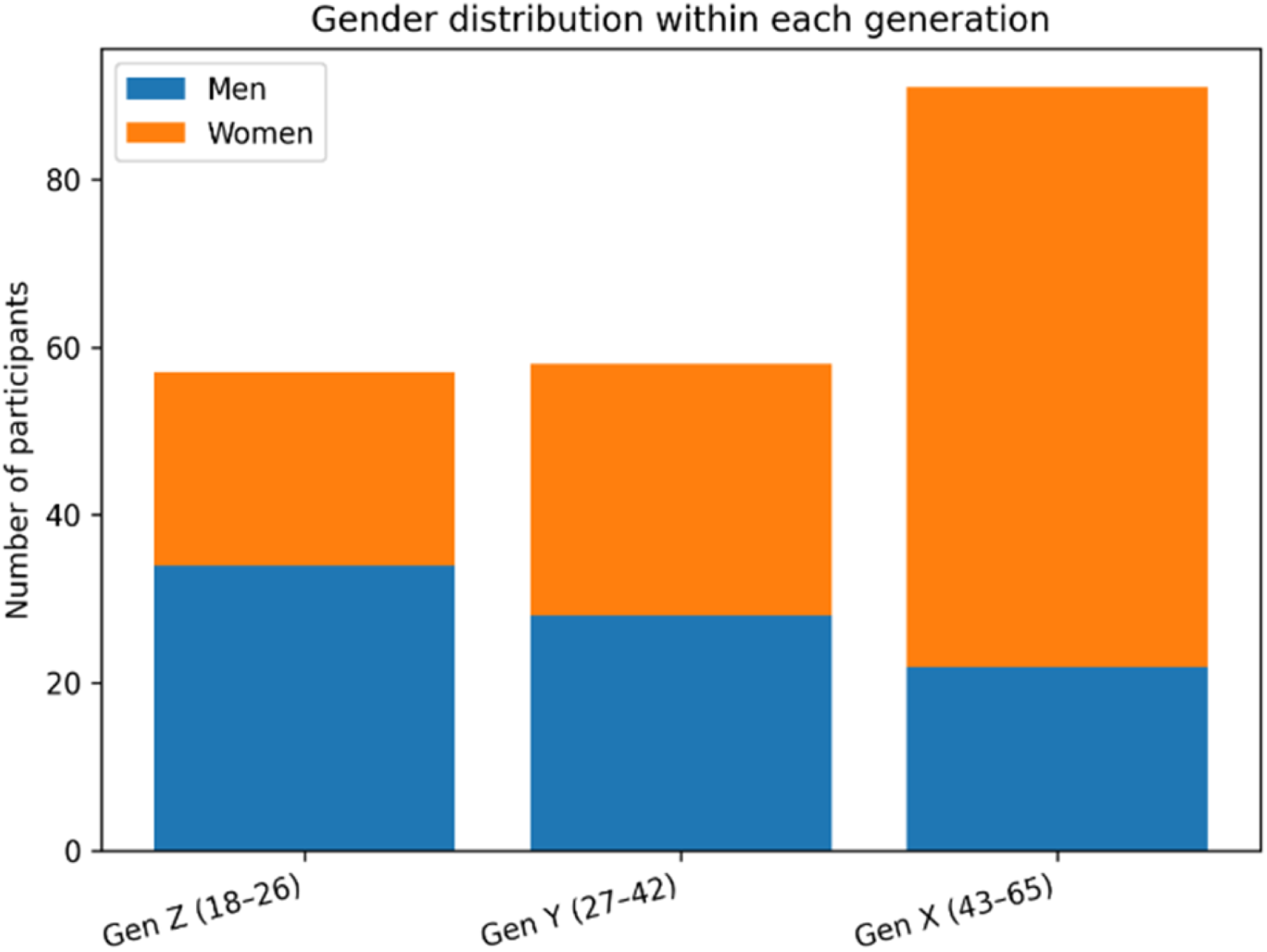
The overall gender composition of the sample was 40.78% men (n = 84) and 59.22% women (n = 122). Gender distribution varied across generational cohorts. Generation Z included a higher proportion of men (59.65%) than women (40.35%), Generation Y exhibited an approximately balanced gender distribution, and Generation X was predominantly female (75.82%). Given this uneven gender distribution across cohorts, interpretations of generational differences were approached with appropriate caution.
Figure 2 illustrates the generational distribution of the sample, while Figure 3 depicts gender composition within each generational cohort. Sample composition by generation (N = 206). Gender distribution across generational cohorts.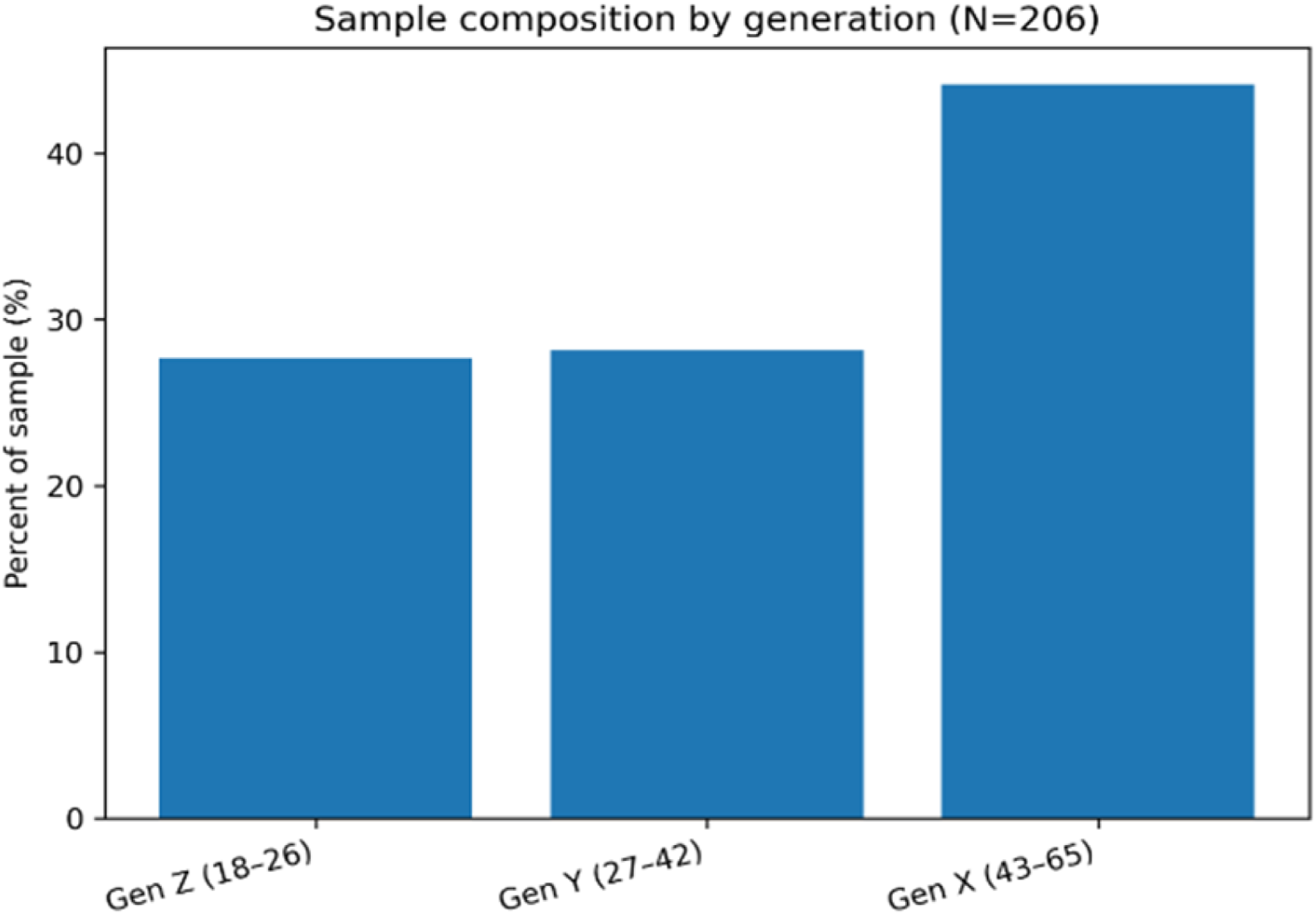
Descriptive statistics
Descriptive statistics of the study data.

Note. M = mean; SD = standard deviation.
Hypotheses testing
Hypothesis Testing Summary: Pearson Correlations Between Predictors and Intention to Use AI by Age Cohort (two-tailed Pearson correlations).

Note. Values represent Pearson correlation coefficients (r). ***p < .001.
Familiarity with AI tools
Across all cohorts, ChatGPT was the most familiar tool. Mean familiarity with ChatGPT was highest in Generation Z (M = 4.32, SD = 0.985), followed by Generation Y (M = 4.14, SD = 1.067), and Generation X (M = 3.71, SD = 1.176). Familiarity with Gemini and Claude was lower across all cohorts, and lowest among Generation X, consistent with a cohort-based gap in exposure to newer AI platforms (Figure 4). Familiarity with AI tools by generational cohort.
Means of intention to use and predictors by generation
Intention to use AI was high across all cohorts: Generation Z (M = 4.07, SD = 1.178), Generation Y (M = 4.05, SD = 1.190), and Generation X (M = 3.89, SD = 1.178). Although Generation X reported slightly lower intention, the mean remains high, indicating broad acceptance, rather than resistance (Figure 5). Predictor means showed several cohort-level patterns. Digital literacy was highest among Generation Z (M = 4.09) and lowest among Generation X (M = 3.46), whereas trust in privacy was highest among Generation X (M = 3.02). Effort expectancy was lowest among Generation Y (M = 1.72), indicating lower perceived effort in this cohort (Figure 6). Mean values of AI adoption predictors by generational cohort. Intention to use artificial intelligence by generational cohort.

Regression analyses by generation
Multicollinearity diagnostics (variance inflation factors).
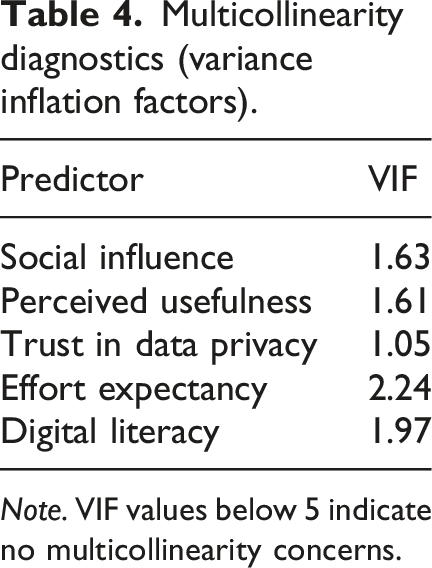
Note. VIF values below 5 indicate no multicollinearity concerns.
Separate multiple linear regression models were estimated for each generational cohort, predicting intention to use artificial intelligence (AI) from social influence, perceived usefulness, trust in data privacy, effort expectancy (cognitive load), and digital literacy. Overall, the regression models demonstrated strong explanatory power, although the relative importance of the predictors differed across cohorts. For Generation Z, the regression model was statistically significant and explained 50.4% of the variance in intention to use AI, R2 = .504, F (5, 51) = 10.37, p < .001. Effort expectancy emerged as the only significant predictor (β = .315, p = .037), suggesting that perceived ease of use plays a central role in AI adoption among younger users. None of the remaining predictors reached statistical significance (ps > .20). For Generation Y, the regression model explained 74.2% of the variance in intention to use AI, R2 = .742, F (5, 52) = 38.02, p < .001. Effort expectancy was the strongest predictor (β = .594, p < .001), followed by perceived usefulness (β = .365, p = .001) and digital literacy (β = .290, p = .005). Social influence and trust in data privacy were not significant predictors (ps > .27). For Generation X, the regression model was also statistically significant, and explained 59.2% of the variance in intention to use AI, R2 = .592, F (5, 85) = 24.71, p < .001. Perceived usefulness was the strongest predictor (β = .425, p < .001), followed by effort expectancy (β = .355, p = .001) and social influence (β = .189, p = .029). Digital literacy and trust in data privacy were not significant predictors (ps ≥ .86). Overall, the findings indicate that effort expectancy is the most consistent predictor of AI adoption across generations, whereas perceived usefulness becomes increasingly influential among older cohorts. In addition, digital literacy contributed significantly only among Generation Y, while social influence uniquely contributed to AI adoption among Generation X. By contrast, trust in data privacy did not significantly predict intention to use AI in any generational cohort.
Figures 7 and 8 visually summarize these cohort-based differences in predictor importance. Specifically, the heatmap of standardized regression coefficients highlights that effort expectancy was the strongest predictor for Generations Z and Y, whereas perceived usefulness was most influential for Generation X. Digital literacy contributed meaningfully, primarily for Generation Y, while social influence was more salient for Generation X. Trust in data privacy demonstrated minimal, and inconsistent effects, across all cohorts. Standardized regression coefficients predicting intention to use AI by generational cohort. Heatmap of standardized regression coefficients (β) by generational cohort.

Moderation analysis
Moderation analysis was conducted using Hayes’ PROCESS Model 1, with generational cohort entered as a categorical moderator, and Generation X used as the reference group. Moderation analysis examined whether generational cohort moderated the associations between the study predictors and intention to use AI. The overall model was statistically significant, F (5, 206) = 12.34, p < .001, R2 = .236, indicating that the predictors explained 23.6% of the variance in intention to use AI. However, the main effects of generational cohort were not statistically significant (W1: b = 0.406, p = .554; W2: b = 0.631, p = .271). Most importantly, the interaction between digital literacy and generational cohort was not statistically significant, ΔR 2 = .005, F (2, 206) = 0.66, p = .519. The latter indicates that generational cohort did not significantly moderate the relationship between digital literacy and intention to use AI. Therefore, H6 was not supported.
Discussion
The purpose of this study was to examine key determinants of intention to use AI technologies, focusing on perceived usefulness, trust in data privacy, social influence, effort expectancy (cognitive load), and digital literacy. In addition, the study explored whether the associations between these factors and intention to use AI, differ across generational cohorts: Generation X, Generation Y, and Generation Z.
The findings of this study show that the intention to use artificial intelligence (AI) technologies is influenced by a combination of technological, perceptual, and social factors, but not uniformly across age groups. Clear generational differences emerged, indicating that users at different life stages, rely on distinct motivations and evaluative criteria, when considering AI adoption. Among the five examined predictors: perceived usefulness, effort expectancy, digital literacy, trust in data privacy, and social influence, only effort expectancy and perceived usefulness showed consistent relevance across cohorts.
For Generation Z (ages 18–26), effort expectancy was the strongest and only significant predictor of intention to use AI, while perceived usefulness approached significance. This suggests that younger users primarily evaluate AI technologies based on ease of use and user experience, rather than functional value or social considerations. These results align with prior research, indicating that younger cohorts are more likely to adopt innovations perceived as intuitive and frictionless. 30 Extensive early exposure to digital technologies may foster familiarity and cognitive ease, as well as increased sensitivity to usability-related features.
By contrast, Generation Y (ages 27–42) demonstrated the strongest explanatory model, accounting for over 74% of the variance in intention to use AI. In this group, effort expectancy, perceived usefulness, and digital literacy were all significant predictors. This pattern suggests that Generation Y combines functional efficiency, technological confidence and personal competence, when evaluating AI. Digital literacy serves as an enabling resource that helps individuals recognize AI’s benefits, and reduces perceived barriers to use, consistent with previous research highlighting the importance of technological competence in technology adoption. 24 Positioned between digital nativity and adult responsibility, Generation Y may conduct more systematic evaluations of AI, integrating performance gains with confidence in their ability to use advanced technologies effectively.
Among Generation X (ages 43–65), intention to use AI was primarily driven by perceived usefulness and effort expectancy, with social influence also playing a significant role. This suggests that older users approach AI adoption as a rational, value-based decision, while remaining sensitive to social norms and environmental cues. The significance of social influence in this cohort concurs with research indicating that older users may rely more on external validation and trusted reference groups, when evaluating unfamiliar technologies.26,29 Contrary to common assumptions, trust in data privacy was not a significant predictor in this cohort, possibly reflecting a normalization of privacy trade-offs in the digital age, as long as perceived benefits outweigh potential risks. This pattern may be understood in light of prior work, suggesting that users often engage in an implicit trade-off between anticipated benefits and potential privacy risks, when evaluating advanced technologies. In such cases, privacy considerations may recede in importance, when the perceived practical value of the technology is sufficiently salient. 33
Across all cohorts, effort expectancy was the only universally significant predictor, highlighting the central importance of usability and intuitive design in AI systems. Simplicity, accessibility, and low cognitive burden are critical for widespread AI adoption, regardless of age, reinforcing key assumptions of UTAUT-based models. 14 Perceived usefulness was especially influential among older users, emphasizing the importance of clearly communicated, tangible value.
Overall, these findings indicate that AI adoption is a multidimensional, age-dependent process. Generation Z is primarily motivated by usability; Generation Y by a combination of usability, usefulness, and digital competence; and Generation X by practical value within a social context. These differences highlight the need for age-sensitive design, communication, and implementation strategies, to reduce digital gaps and promote informed, equitable AI use.
Theoretical implications
From a theoretical point of view, this study contributes to the literature on AI adoption by highlighting the differentiated roles of key determinants across generational cohorts. The results support the central role of effort expectancy as a core component of technology acceptance, while also suggesting that its relative importance may vary, depending on users’ developmental stage and technological background. At the same time, the findings suggest that effort expectancy may serve as an important enabling condition for adoption across the lifespan, helping to clarify the contexts in which other determinants, such as perceived usefulness or social influence, become more salient. In addition, the study contributes to existing models of technology acceptance, by demonstrating the value of incorporating AI-specific factors, such as digital literacy and trust in data privacy, particularly when considering generational variation.
Overall, the study provides a more nuanced perspective on AI adoption, by emphasizing the role of developmental, cognitive, and social factors in shaping technology use across the lifespan.
Practical implications
From a practical perspective, this study offers actionable insights for the design and implementation of AI systems across diverse user groups. These findings suggest that tailoring AI systems to the psychosocial characteristics of different age groups, may enhance user engagement and adoption. For younger users, emphasizing intuitive design and ease of use may improve interaction with AI technologies. For middle-aged users, enhancing transparency, control, and technological self-efficacy may support more informed and confident use. For older users, clearly demonstrating tangible benefits and reinforcing social legitimacy may increase acceptance. These findings highlight the importance of adopting a generationally adaptive approach to AI design and communication strategies, which may improve accessibility, foster trust, and promote more inclusive use of AI technologies in real-world settings.
Limitations and future research
Several limitations should be considered when interpreting these findings. First, the use of snowball sampling may limit representativeness and introduce selection bias toward technologically engaged participants. As a result, the findings may overestimate levels of AI adoption and positive attitudes toward AI, and may not fully generalize to populations with lower levels of technological engagement or digital literacy. This limitation should be considered when interpreting the results and their applicability to broader populations. Second, reliance on self-reported data may not fully reflect actual behavior. Third, the sample included participants with relatively high digital literacy, potentially limiting generalizability to less digitally skilled populations. Additionally, statistical constraints prevented formal between-group comparisons of effect sizes. The non-significant role of privacy trust, may also reflect measurement limitations, or insufficient sensitivity of the scale. Finally, the cross-sectional design of this study limits causal interpretation, as the observed associations reflect relationships at a single point in time. Future longitudinal or experimental research is needed to examine developmental dynamics and causal pathways in AI adoption across generations. Future research should also extend this work by including additional age cohorts, such as Generation Alpha and Baby Boomers, and by examining cross-cultural contexts where privacy norms and technology perceptions differ. Mixed methods approaches, including qualitative interviews or focus groups, could provide deeper insight into underlying motivations. Further studies should also explore occupational differences, and evaluate targeted digital literacy interventions, to assess their impact on perceived usefulness and AI adoption intentions.
Footnotes
Acknowledgments
The authors would like to thank for their valuable assistance with data collection.

Ethical considerations
The study was approved by the Ethical committee of the Ariel University.
Consent to participate
In accordance to APA ethical guidelines, all participants gave their informed consent to participate in this study.
Funding
The authors received no financial support for the research, authorship, and/or publication of this article.
Declaration of conflicting interests
The authors declared the following potential conflicts of interest with respect to the research, authorship, and/or publication of this article: The authors declare no conflict of interest. We hereby confirm: (a) All authors have participated in the design and in the write-up of the manuscript to take public responsibility for it. (b) We have reviewed this version of the paper, approve it in its present form and we have all discussed and agreed on the conclusions of the study. (c) The paper has not been published and is not considered for publication elsewhere. (d) The authors are not affiliated to any other company or organization that may be interested in its publication. (e) We hereby transfer the copyright of this paper to “HSM” in case that it is accepted for publication.
Data Availability Statement
The data that support the findings of this study are available from the corresponding author, Keren Cohen-Louck (via email), upon reasonable request.