



Abstract
Purpose
HRM research typically treats firms as facing a categorical choice between radical and incremental innovation. This article reconceptualizes the HRM-innovation relationship through a dominant innovation orientation framework, examining how HRM configurations govern the primary knowledge challenge while generating characteristic knowledge tensions for the subordinate one.
Design/methodology/approach
A qualitative, configurational case study of four mature French industrial firms; 29 semi-structured interviews analyzed through grounded theory coding, thematic content analysis, and cross-case comparison, using NVivo 14.
Findings
All four firms are ambidextrous. Radical-dominant firms deploy an enabling-bureaucratic HRM configuration configured for tacit knowledge accumulation; incremental-dominant firms deploy a flexible collaboration configuration configured for rapid knowledge recombination. Each configuration generates predictable knowledge tensions for the subordinate orientation.
Originality/value
This study reframes HRM configurations as contextually dominant institutional responses. It proposes, as a theoretically derived proposition for future empirical testing, a curvilinear U-shaped relationship between HRM formalization and radical innovation dominance, distinguishing enabling from coercive formalization.
Practical implications
Configuration-specific mechanisms boundary-spanning roles, parallel recognition streams, and protected exploratory budgets can modulate dominant-configuration costs without dismantling core logic.
Keywords
Introduction
Most innovative firms do not choose between radical and incremental innovation they pursue both simultaneously. The empirical reality of organizational ambidexterity1,2 is that firms manage exploration and exploitation concurrently, allocating institutional weight to one orientation over another at any given point in time rather than committing to either exclusively. This dynamic condition what we term a dominant innovation orientation has a structural consequence that the strategic HRM literature has not yet fully theorized the HRM architecture an organization constructs to govern its dominant orientation necessarily generates characteristic knowledge tensions for the subordinate one. Yet HRM research has persistently treated innovation as a categorical choice, prescribing flexible HR systems for explorers and more structured systems for exploiters.3–5 This either/or framing is both empirically inconsistent and practically misleading it ignores the ambidextrous reality of most innovative firms and leaves unanswered the question of how organizations manage the structural incompatibility between the knowledge governance demands of exploration and exploitation within a single HRM architecture.
This structural incompatibility is the theoretical lacuna the present article addresses. The institutional logics required to govern tacit-knowledge accumulation the primary knowledge challenge of radical innovation6,7 and those required to govern rapid explicit-knowledge recombination the primary knowledge challenge of incremental innovation are architecturally distinct. An HRM configuration cannot simultaneously serve both without generating what we term knowledge tensions predictable governance deficits that the dominant configuration imposes on the subordinate innovation orientation. These tensions are not implementation failures but structural properties of any HRM architecture configured for a dominant orientation and understanding them is essential for managing ambidextrous organizations effectively.
The institutional specificity of French mature industrial firms makes them a particularly revealing empirical site for this inquiry. As a coordinated market economy, France has developed institutional arrangements including the grandes ecoles engineering pipeline, a dense public research infrastructure (CNRS, CEA, ONERA 1 ), sector-based collective bargaining, and formalized industrial relations that strongly favor competence-enhancing HRM practices built around long-term employment, specialist career development, and institutionalized university-industry partnerships. 8 The OECD review of French innovation policy 9 identifies this duality as a structural feature of the French industrial system. Defelix, Mazzilli, and Gosselin 10 further demonstrate that alignment between HRM strategy and innovation strategy is neither automatic nor stable, but subject to contextual tensions that generic models systematically underestimate.
This framing yields a research question: How do French industrial firms configure their HRM systems to support innovation, and how do these configurations enable the management of knowledge tensions that arise from it?
We address this question through a qualitative, configurational study of four mature French industrial firms, drawing on Dhifallah, Chanal, and Defelix, 11 who demonstrated that HRM configurations cannot be evaluated in abstraction from the specific tension between exploration and exploitation that a given organizational form generates. This study makes three contributions. First, it reframes HRM-innovation configurations as contextually dominant institutional responses. Second, it advances a knowledge-tension account of ambidextrous HRM. Third, it proposes as a theoretically derived framework for future empirical testing a curvilinear, U-shaped relationship between HRM formalization and radical innovation dominance. The study also contributes to research on the intersection of HRM practices, knowledge governance, and organizational performance.12,13
Theoretical background
Organizational ambidexterity and the dominant orientation construct
The concept of organizational ambidexterity, theorized by March 1 through his foundational distinction between exploration and exploitation, captures the capacity of organizations to pursue contradictory competitive imperatives within a single institutional envelope. March 1 demonstrates that exploration and exploitation make fundamentally different and partially incompatible demands on organizational resources, routines, and managerial attention. Tushman and O'Reilly 2 operationalized this tension as the simultaneous management of incremental and discontinuous innovation, proposing structurally separated units as the primary governance mechanism. Subsequent scholarship demonstrated that this structural separation is rarely complete14,15 resources, personnel, and strategic priorities routinely cross unit boundaries. Gibson and Birkinshaw 16 proposed contextual ambidexterity as an alternative in which individual employees and teams alternate between exploratory and exploitative activities within a common organizational context.
Building on this debate, Simsek, Heavey, Veiga, and Souder 17 advance a typology that distinguishes four ambidexterity archetypes along two dimensions whether exploration and exploitation are pursued simultaneously or sequentially, and whether they are distributed across or contained within organizational units. Cyclical ambidexterity alternates between the two over time; partitional ambidexterity separates them across distinct units; symbiotic ambidexterity combines sequential timing with individual-level integration; and harmonic ambidexterity pursues both simultaneously within the same institutional boundary and over the same time horizon. 17
What both structural and contextual ambidexterity models share and what the HRM literature has not yet fully exploited is the insight that firms are not in a static state of balanced ambidexterity but in a dynamic condition of shifting dominant orientation. While early ambidexterity research predominantly adopted a static perspective, 15 more recent scholarship has reconceptualized ambidexterity as a dynamic capability requiring continuous rebalancing. 18 Lavie, Stettner, and Tushman 19 demonstrate that this rebalancing is path-dependent experience with the dominant orientation generates self-reinforcing learning cycles. Luger, Raisch, and Schimmer 18 show that effective ambidextrous firms manage this tension through continuous, dynamic rebalancing rather than by settling on a fixed balance. This rebalancing is inherently asymmetric at any given moment, institutional weight tilts towards one orientation rather than being held equally between the two.
We define the resulting construct the dominant innovation orientation, extending Prahalad and Bettis’s 20 dominant logic to the domain of innovation governance as the relative institutional weight an organization accords to one innovation type over another at a given point in time, manifested in resource allocation priorities, strategic discourses, and HRM architecture choices. Following Levinthal and March, 21 this construct describes a dynamic, temporally situated condition in which experience with the dominant orientation generates path dependence that further entrenches it, while the subordinate orientation continues to be pursued within an HRM architecture not primarily designed for it.
Knowledge tensions in ambidextrous HRM
The knowledge-based view of the firm (KBV)6,7 establishes the theoretical foundation for understanding why dominant HRM configurations generate structural deficits for subordinate innovation orientations. Grant 6 demonstrates that the organizational routines and governance structures required for tacit knowledge creation differ fundamentally from those required for explicit knowledge recombination the former demands deep specialization, long-horizon commitment, and stable institutional relationships; the latter demands generalist breadth, lateral coordination, and rapid responsiveness. Kogut and Zander 7 extend this insight to the level of combinative capabilities, showing that an organization’s capacity to recombine existing knowledge is architecturally distinct from its capacity to create new knowledge. Subramaniam and Youndt 22 provide further empirical grounding, demonstrating that human capital, social capital, and organizational capital each contribute differently to radical versus incremental innovation capabilities confirming the incompatibility that lies at the heart of ambidextrous governance.
When this foundational incompatibility is transposed to the level of HRM governance, it produces what we term a knowledge tension the structural misalignment between the governance logic embedded in a dominant HRM configuration and the knowledge requirements of the subordinate innovation orientation. Kang and Snell, 23 drawing on Nahapiet and Ghoshal’s 24 foundational model of intellectual capital, provide the analytical foundation the human capital configurations, social capital structures, and organizational capital routines that enable exploitation are structurally distinct from those enabling exploration, yet both must coexist within the same organizational boundary. Kang, Morris, and Snell 25 further show that relational archetypes configured for exploitation create governance deficits for exploration. Turner, Swart, and Maylor’s 26 systematic review extends this insight directly the intellectual capital resources required to govern exploration are categorically distinct from those required to govern exploitation, and configuring HRM for a dominant orientation therefore systematically generates governance deficits for the subordinate one.
Three properties distinguish knowledge tensions from the generic organizational tensions that Smith and Lewis 27 identify in paradox theory. First, they are structural rather than perceptual they arise from the architectural properties of the HRM configuration itself. Second, they are asymmetric rather than symmetric the dominant configuration generates a specific, directional deficit for the subordinate orientation. Third, they are predictable rather than contingent26,28 given knowledge of the dominant orientation and the configuration it has produced, the tensions it imposes on the subordinate orientation can be identified in advance. They are not implementation failures but persistent structural properties of any HRM architecture configured for a dominant orientation.
HRM configuration and the enabling bureaucracy distinction
HRM configuration, as used in this study, refers to a coherent, mutually reinforcing bundle of practices organized around a common knowledge governance logic.29–33 Boxall and Purcell 31 ground this construct in the strategic HRM literature by showing that the architecture of HR practices must be evaluated in relation to the competitive environment it is designed to serve. Delery and Doty 33 formalize this claim by distinguishing universalistic, contingency, and configurational modes of theorizing in SHRM, arguing that only the configurational mode captures the non-additive, gestalt effects that characterize high-performance HR bundles. Meyer, Tsui and Hinings 32 demonstrate that configurations are not merely descriptive aggregates but theoretically coherent institutional logics whose internal consistency is both their source of strength and the origin of the governance deficits they generate for activities outside their dominant logic. MacDuffie’s 34 foundational study of automotive assembly plants provides the empirical warrant it is the internal consistency of HR bundles not any single practice that produces performance outcomes.
The received wisdom in innovation management identifies bureaucratic structure as the natural enemy of creativity. 35 This view, grounded in Burns and Stalker’s 35 classic distinction between mechanistic and organic management systems, treats formalization as an obstacle to organizational agility. Adler and Borys’ 36 seminal distinction between enabling and coercive bureaucracy challenges this premise directly. Coercive formalization uses procedures as surveillance instruments designed to extract compliance and constrain discretion. Enabling formalization, by contrast, uses procedures as cognitive scaffolding36,37 tools that reduce ambiguity, institutionalize best practice, and free cognitive resources for non-routine and creative work. Rather than suppressing expert judgement, enabling formalization protects it. Cardinal 37 provides empirical support in the pharmaceutical industry, demonstrating that process formalization when enabling rather than coercive is positively associated with radical innovation output, a logic consistent with an enabling rather than coercive use of formalization in radical innovation settings.
These theoretical building blocks the enabling/coercive distinction, 36 the configurational logic of HRM bundles,32,33 and the knowledge governance demands that each dominant innovation orientation generates6,7 provide the analytical lens through which we read the cases. When radical innovation constitutes the dominant orientation, the primary knowledge governance challenge is tacit-knowledge accumulation and protection.6,7 Lopez-Cabrales and colleagues 38 and Barba-Aragon and Jimenez-Jimenez 39 provide empirical evidence that HRM architectures built around formalized retention mechanisms, deep specialist investment, and institutionalized external partnerships are associated with breakthrough innovation outcomes. However, these same architectures generate structural tensions for the incremental activities the organization simultaneously pursues, by privileging depth over breadth, long-horizon commitment over rapid redeployment, and individual expertise over collaborative integration.23,26 When incremental innovation constitutes the dominant orientation, the knowledge governance challenge reverses the organization must configure for explicit-knowledge recombination speed, constructing an architecture of generalist flexibility and relational porosity30,40 that accelerates market responsiveness.
This study follows a qualitative, configurational design informed by the knowledge-based view of the firm and the configurational HRM literature, which together provide the conceptual framework guiding the analysis. The following section sets out how four contrasting French industrial firms were selected and how their HRM configurations, and the knowledge tensions associated with them, were analyzed.
Methodology
Research design
To investigate the relationship between dominant innovation orientations and HRM configurations, we adopted a qualitative multiple case study design.41–43 This approach is appropriate for explanatory inquiry seeking to understand the “how” and “why” of complex organizational phenomena 44 and for building theoretical insights from empirical evidence in under-theorized domains. 45 The research positions itself within a constructivist-interpretive epistemology46,47 HRM configurations and innovation orientations are treated as socially constructed and contextually embedded phenomena, accessible through the accounts of organizational actors. The study follows the Standards for Reporting Qualitative Research (SRQR) 48 as its methodological reporting guideline. The first author conducted all fieldwork as an external academic researcher with no prior employment relationship with any of the four firms; this positioning is acknowledged as a potential source of perspective, partially mitigated by systematic member-checking and data triangulation.
Case selection
Key characteristics of sampled firms and dominant innovation orientation at the time of fieldwork.

Data collection
Informant profile by firm and hierarchical level.

When senior managers and operational engineers offered divergent accounts of the same HRM practice, we applied a systematic prioritization logic: (1) we first sought corroboration from internal documents; (2) where documents were unavailable, we treated engineers’ experiential accounts as primary evidence of how practices were lived in practice, and HR directors’ accounts as primary evidence of formal policy intent; (3) systematic divergence was itself coded as evidence of the gap between espoused and enacted HRM a substantive finding in its own right. 51 All interviews were audio-recorded with participant consent and transcribed verbatim. Primary data were triangulated with four categories of internal documents, each serving a distinct validation purpose: (1) strategic communications and R&D investment reports used to validate the dominant orientation classification; (2) employee evaluation forms and competency frameworks used to validate recruitment profiles and reward practices; (3) project archives used to validate development cycle lengths; (4) internal training catalogues used to validate learning and development practices. Documentary data were analyzed separately through Bardin’s 52 thematic content analysis (see Section 3.4). Member checking 53 was implemented by presenting preliminary findings to key informants in each organization, in accordance with Lincoln and Guba’s 53 criteria for credibility and trustworthiness in naturalistic inquiry.
Data analysis
Our analytical approach combines four complementary frameworks applied in sequence. Yin’s 41 comparative case study logic governs macro-level sequencing. Miles and Huberman’s 54 data reduction and display protocols structure the movement from raw interview material to theoretical propositions. The coding procedure for interview transcripts follows Strauss and Corbin’s 55 open-to-selective sequence, while documentary data were analyzed separately using Bardin’s 52 thematic content analysis applied specifically to the four documentary categories described in Section 3.3.
Analysis proceeded in three stages. All coding was carried out in NVivo 14, which supported the organization of first-order codes into higher-order categories and the retrieval of coded segments across cases. Analysis proceeded in three stages. The first involved open coding of all transcripts, simultaneously following Benner and Tushman’s 56 classification of innovation activities and six HRM practice domains.23,30 The second stage involved axial coding, codes were grouped into categories reflecting either a dominant-orientation HRM logic or a tension signal. Empirical linkages were retained only where reported by at least 50% of respondents within a given case. 54 This majority threshold follows Miles and Huberman’s 54 recommendation for multi-informant case research, it grounds empirical claims in convergent evidence without requiring unanimity, which would be inappropriate given that our sample deliberately includes informants at different hierarchical levels whose accounts of the same practice are expected to diverge. A higher consensus standard would have suppressed the espoused-enacted HRM discrepancies that constitute substantive findings in this study. For the purpose of cross-case analysis, the six coding domains were synthesized into three analytical dimensions resource acquisition (staffing and external partnership practices), development and retention (training, career management, and contracting logic), and social orchestration (assessment, rewards, and communication) following the intellectual capital architecture of Kang and Snell. 23 The contracting domain did not emerge as a distinct analytical dimension, its substance was absorbed into the development and retention dimension, where employment relationship logic bears directly on tacit knowledge retention. The third stage performed selective coding across cases through the constant comparative method of Glaser and Strauss. 57
Findings
Dominant HRM configurations and tensions with the subordinate innovation orientation.
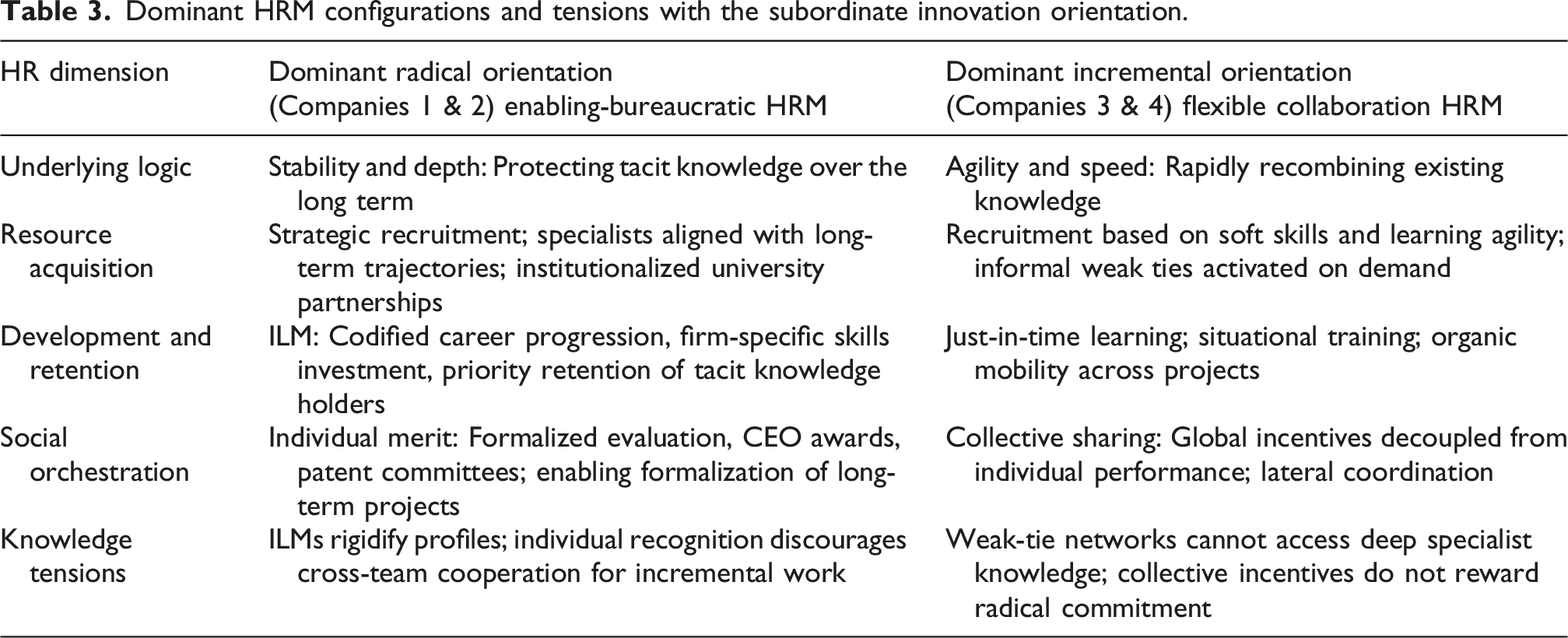
Dominant radical orientation: Firms 1 and 2
Firms 1 and 2 are engaged in the development of breakthrough technologies aircraft engine composites and novel radar architectures over development cycles spanning five to fifteen years.
The HRM configuration that emerges from their dominant radical orientation corresponds to what we term an enabling-bureaucratic HRM configuration32,33,36 a coherent bundle organized around the logic of tacit-knowledge protection, long-horizon specialist investment, and enabling formalization.36,51 Each of the three dimensions below documents how this configuration governs the dominant challenge while generating characteristic knowledge tensions for the subordinate incremental orientation.
Resource acquisition and knowledge depth
In Firms 1 and 2, recruitment is subordinated to long-term technological strategy rather than to immediate staffing needs a prior commitment to a technological domain dictates which competencies must be built, and hiring is oriented toward assembling specialist teams capable of attaining durable, field-level recognition.36,51 The R&D Director of Firm 1 articulated this logic: “For us, recruitment follows from strategy. The moment you commit to a technological field, you have no alternative, you build the competencies, hire the right people, and put together teams that the project stakeholders will, in time, recognize as real players in the domain.”
This formalized approach extends to institutionalized strong ties with universities and public research laboratories. The Head of Business Strategy at Firm 1 emphasized the deliberate formality: “We run our external partnerships by a strict protocol. Each joint project is structured around a set schedule, clearly defined deliverables, and firm deadlines nothing is left to chance or to an informal understanding.”
This account reveals formalization in its enabling register 36 the protocol does not restrict the researchers’ intellectual contribution but creates the institutional scaffolding defined deliverables, clear timelines, legitimate authority that allows deep technical work to proceed without the cognitive overhead of continuous renegotiation. The procedure is in the service of expertise, not of control.
However, this depth-oriented acquisition logic creates a characteristic tension for incremental activities. The same competency frameworks configured for long-horizon specialization make it harder to recruit the polyvalent, market-oriented profiles that incremental projects require. One R&D engineer noted: “When a client needs us to adapt an existing system to a new specification in seven months, our best fundamental researchers are not necessarily the right people for the job. But they are the ones we recruited.”
Firm 2 acknowledged a related tension; its competency review process struggles to capture the hybrid technical-commercial profiles that bridge exploratory and exploitative activities. One CEO described this as “a vocabulary problem,” the competency framework speaks the language of specialization, not of boundary-spanning.
Development and retention
Firms 1 and 2 operate according to the classic logic of an Internal Labor Market (ILM), formalized career progression pathways, substantial investments in firm-specific skill development, and strong emphasis on retention. The R&D Director of Firm 2 described this prospective orientation: “We try to map out what our people are actually doing, clarify their competences, anticipate what will be needed tomorrow, and put in place the means to get them there.”
Yet the same ILM creates recognizable tensions for incremental activities. A project engineer at Firm 1 described the friction: “On a short-cycle project, I need people who can work both sides customer and technical. In our organization, those profiles tend to move into management after five years. The people still doing hands-on technical work are our best specialists, which is great for research, but it means I have to reconstruct a translation layer from scratch on every incremental project I run.”
Social orchestration and recognition
The reward system is highly individualized; exceptional technical achievements are publicly recognized. As one engineer at Firm 1 explained: “The best ideas receive laureate prizes, handed out personally by the CEO or the HRM Director. Then there is the patent route a dedicated committee assesses whether an idea is worth filing, and that form of recognition carries real weight inside the company.”
However, this recognition architecture creates a structural tension when the same specialists are also drawn into incremental projects that depend on sustained cross-team collaboration. As one engineer at Firm 2 put it: “If advancement comes through patents and prizes, that is where I will focus my energy. When my manager asks me to spend three months supporting another team on a client refinement, the work matters but it leaves no trace in my recognition profile.”
Across the three dimensions, the tension that the enabling-bureaucratic configuration generates for the firms’ subordinate incremental activities is consistent in direction; it impedes the lateral mobility, polyvalent profiles, and collective coordination that short-cycle incremental projects require.
Dominant incremental orientation: Firms 3 and 4
Firms 3 and 4 operate in contexts where competitive advantage depends on rapidly translating market signals into product refinements over cycles of eighteen months to 3 years. Both firms maintain exploratory research activities. At the time of fieldwork, however, the dominant institutional priority was incremental exploitation.
The HRM configuration that characterizes their dominant incremental orientation corresponds to what we term a flexible collaboration configuration16,23,30 a coherent bundle organized around the logic of explicit-knowledge recombination speed, generalist flexibility, and relational porosity.7,58 Each of the three dimensions below documents how this configuration governs the dominant incremental challenge while generating characteristic knowledge tensions for the subordinate radical orientation.
Resource acquisition and network porosity
In contrast to the specialist recruitment of Firms 1 and 2, Firms 3 and 4 systematically favor candidates defined by soft skills, cultural fit, and learning agility. External knowledge acquisition relies on weak ties informal professional networks activated on an as-needed basis. The Head of Engineering at Firm 3 described this dynamic: “Over time, every project manager builds up her own network of go-to experts. I actively encourage it. Our product managers end up with very close relationships with specialists- engineer who are right at the cutting edge of the process.”
However, the same weak-tie architecture is structurally ill-adapted to the exploratory work both firms simultaneously conduct. An R&D engineer at Firm 3 described this with evident frustration: “We are currently running an exploratory project that calls for deep expertise in electrochemistry. We have been searching through our usual networks for four months without success. In an organization with a structured academic partnership in that area, this would have been resolved in a week.”
The weak-tie network architecture, calibrated for explicit knowledge recombination, cannot generate the sustained access to specialized tacit knowledge that exploratory work demands.
Firm 4 surfaces an analogous tension, the generalist recruitment logic that makes the firm agile on incremental projects means that few employees possess the deep technical specialization required for exploratory research.
Development and retention
Firms 3 and 4 operate according to a philosophy of organic mobility and market-responsive learning. Training is informal and situational. The R&D Director at Firm 3 described a learning dynamic in which the teacher is frequently an external stakeholder: “When a disruptive technology comes along, it is usually the inventor a scientist from outside who comes to explain it to us. A presentation, two or two hours, sometimes more. That is concretely how knowledge enters the organization.”
The same logic, however, systematically underserves the exploratory activities both firms pursue. One R&D engineer at Firm 4 articulated this plainly: “I spent two years on an exploratory project building a capability in underwater signal processing that exists nowhere else in the firm. At the end of it, my evaluation was identical to a colleague who had spent the same period on routine maintenance work. There is simply no mechanism to recognize what was actually built.”
This recognition gap renders deep specialist knowledge development individually illegible within an HRM architecture configured for recombination speed, leaving exploratory contributions without a mechanism that registers what was built.
Social orchestration and collective incentives
Firms 3 and 4 manage their innovation processes through social negotiation, lateral coordination, and collective alignment. The CEO of Firm 4 explained: “Our incentive system operates at the collective level. When the firm performs well, everyone receives a bonus the equivalent of one, two, sometimes three months' salary depending on results.”
Several researchers in both firms described a resulting erosion of commitment to exploratory projects: “Three years on an uncertain project, or three years improving a cable connector same bonus. But he's the one credited with contributing, because his results are visible and mine aren't yet. Nobody says it out loud, but you end up learning what really counts here.”
Discussion
HRM configurations as contextually dominant institutional responses
Our findings resist the prevailing configurational framing that treats HRM systems as stable matches to stable strategic positions. All four firms pursue both innovation types simultaneously; the difference between them is not categorical but one of degree a matter of the relative institutional weight accorded to one innovation type over another, which is the defining feature of the dominant innovation orientation construct.20,21 The HRM configurations we observe are contextually dominant institutional responses not permanent architectural commitments. The difficulties that Firms 1 and 2 experience on incremental projects, and that Firms 3 and 4 experience on exploratory ones, are not implementation gaps but predictable structural costs. 11
The enabling-bureaucratic architecture of Firms 1 and 2 constitutes what Adler and Borys 36 would recognize as enabling rather than coercive bureaucracy, its formalization is the institutional precondition for tacit knowledge deployment, not an obstacle to it.6,36 Yet this architecture imposes systematic costs on incremental activities, specialist recruitment limits polyvalent profiles; ILM pathways reduce lateral mobility; individualized meritocracy creates competitive dynamics that impede the cooperative knowledge sharing incremental projects require. These are not implementation failures but structural properties of an architecture that has correctly configured for its dominant knowledge challenge a distinction that, from a KBV perspective,6,23 is theoretically significant.
The Flexible collaboration configuration of Firms 3 and 4 generalist recruitment, weak-tie networks, just-in-time learning, collective incentives instantiates a combinative capability architecture7,58 engineered to maximize recombination speed. Our data reveal, however, the systematic knowledge tensions this configuration generates for exploratory activities, the weak-tie infrastructure is ill-equipped for sustained engagement with foundational unknowns; just-in-time learning leaves exploratory projects without accumulated knowledge depth; and collective incentives fail to provide the individual recognition that makes long-horizon exploratory commitment personally meaningful.
From a KBV perspective,6,23 the human capital bottleneck that incremental-dominant firms encounter on exploratory projects reveals a structural mismatch between a human capital base configured for explicit knowledge recombination and the tacit, embodied expertise that exploratory work demands. Individual generalist employees assigned to exploratory projects frequently experience this mismatch not as an organizational failure but as a personal deficit, 59 compounding demotivation with identity strain. 60 The collective incentive architecture reveals an analogous mechanism, calibrated to explicit knowledge recombination and its short-cycle outputs, collective incentives actively render sustained radical engagement individually irrational.6,7 Importantly, the tension profiles that emerged inductively from the data converge with the intellectual capital architecture of Kang and Snell 23 and the broader KBV account configurations calibrated for tacit knowledge creation systematically underserve explicit knowledge recombination, and vice versa. This convergence between what the cases revealed and what these frameworks would lead one to expect lends weight to the reading of knowledge tensions as structural and predictable rather than contingent.26,28
These findings also permit a more precise articulation of how the knowledge-tension construct relates to Smith and Lewis’s 27 paradox theory. Generic organizational paradoxes are perceptual and contingent: they emerge from cognitive ambivalence and are shaped by contextual factors. 27 Knowledge tensions, by contrast, are structural and predictable they arise from the architectural properties of dominant HRM configurations and can be specified in advance from knowledge of the dominant orientation.26,28 The paradox framework provides the meta-theoretical language; the knowledge-based view6,23 specifies the precise governance mechanism through which the tension is generated. Together, they constitute a complementary rather than competing account of ambidextrous organization.
Managing knowledge tensions
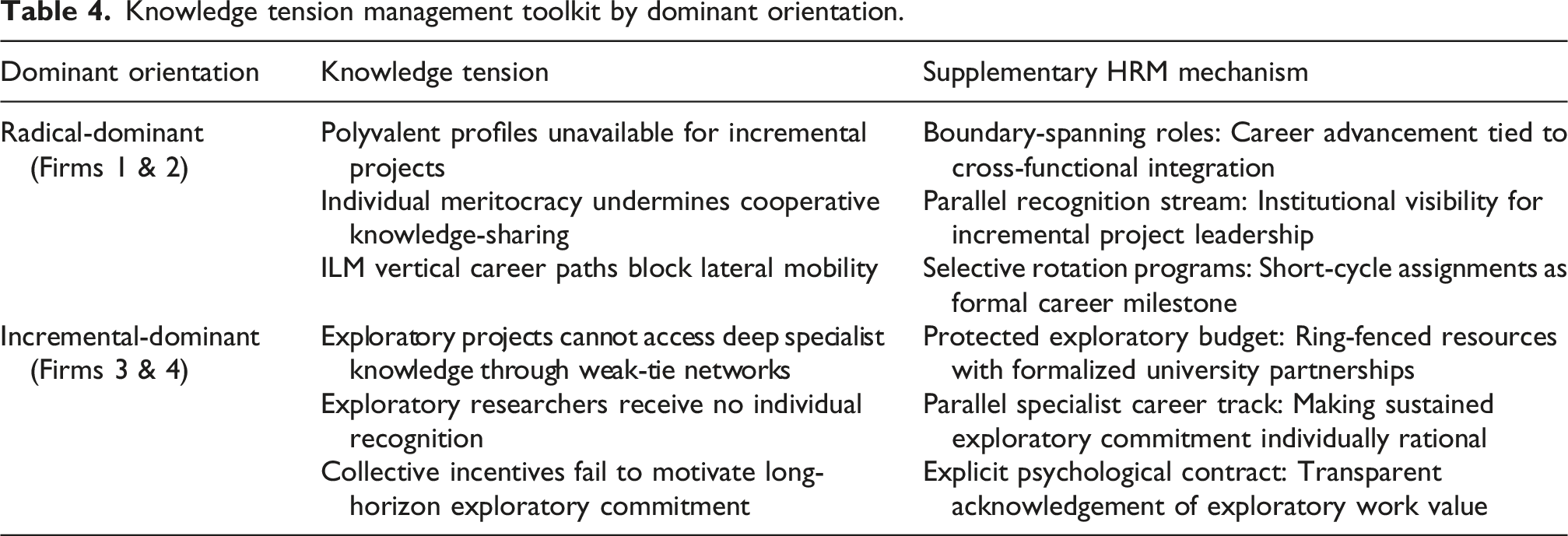
Across our four cases, the firms that navigated these knowledge tensions most effectively were those that had developed explicit institutional awareness of what their dominant configuration cost them 61 and had designed targeted, configuration-specific supplements to modulate those costs without dismantling the dominant logic. 28 It is not the elimination of knowledge tensions that distinguishes more from less ambidextrous firms, but the quality of their institutional response to those tensions. For firms with a dominant radical orientation, targeted supplementary mechanisms designated boundary-spanning roles62,63 whose career advancement is explicitly tied to cross-functional integration; a parallel recognition stream for incremental project leadership 64 ; selective lateral rotation programs can modulate the dominant configuration’s costs without disrupting its internal coherence. 28
For firms with a dominant incremental orientation, the most consequential tensions concern the radical dimension’s need for deep specialist investment, protected development time, and individualized recognition the clarification of the psychological contract with researchers assigned to exploratory projects 65 ; the development of a parallel career track for technical specialists 64 ; and the establishment of protected budgets for exploratory work insulated from the market-responsiveness logic of the dominant orientation.11,61
The U-shaped relationship: A theoretical proposition
We propose as a theoretically derived framework for future empirical testing, ideally through longitudinal designs, and not as an empirical claim established by our four-firm data that the relationship between HRM formalization and the dominance of a radical innovation orientation follows a curvilinear, U-shaped path. This proposition derives from theoretical logic the enabling/coercive distinction, 36 the knowledge-governance demands of each dominant orientation,6,7 and the configurational logic of HRM bundles32,33 rather than from any pattern observed across our cases. With our firms clustering at only two levels of formalization (high and low), the data could not, in principle, reveal a curvilinear form two points define a line, not a curve. Establishing the U-shape empirically would require tracing firms ideally ones undergoing a shift in dominant orientation across successive phases of their innovation trajectories, since the claim concerns how formalization evolves over time rather than how it varies across firms observed at a single point. The U-shape is therefore advanced as a theoretical proposition for future empirical testing.
At the left-hand, pole sit organizations whose dominant logic is cost efficiency and routine execution: high HRM formalization serves compliance and behavioral control the coercive bureaucracy of Burns and Stalker. 35 Moving rightward, as the dominant orientation shifts toward incremental innovation, formalization decreases the flexible collaboration configuration minimizes procedural constraint and maximizes the relational flexibility that rapid knowledge recombination requires. As the dominant orientation shifts further toward radical innovation as development cycles extend and the knowledge challenge shifts from recombination to creation6,7,50,66 the curve turns upward. Formalization rises again, but in its enabling register 36 not to control behavior but to protect knowledge; not to enforce compliance but to coordinate complex interdependencies 67 ; not to signal distrust but to create the institutional commitments that make deep-expertise development individually rational. 68
The theoretical significance of the U-shape lies in what it implies about the two poles, they share a surface-level resemblance both involve formal structures but differ fundamentally in their functional logic, their motivational consequences, and their relationship to the knowledge-governance processes they serve.36,67 The central implication of this study is therefore that what distinguishes more from less effective ambidextrous organizations is not the level of formalization in the abstract, but the fit between the formalization register enabling or coercive and the knowledge-governance challenge of the dominant orientation it is meant to serve.
Conclusion
Theoretical contribution
This study set out to reconceptualize the HRM-innovation relationship through a dynamic dominant-orientation account centered on knowledge governance. The reconceptualization generates three theoretical contributions.
First, we advance a framework that treats HRM configurations as contextually dominant institutional responses. This extends Lepak and Snell’s69,70 foundational work on HR architecture by showing that alignment between HRM configuration and human capital strategy is a dynamic, temporally situated process.18,19 Second, we provide a systematic, mechanism-based account of the knowledge tensions that dominant HRM configurations impose on subordinate innovation orientations. Building on and refining Smith and Lewis’s
27
paradox theory, we show that knowledge tensions differ from generic organizational paradoxes in being structural rather than perceptual, asymmetric rather than symmetric, and predictable rather than contingent extending the paradox framework into the domain of ambidextrous HRM governance.
26
These tensions are generated by the dominant configuration itself rather than by actors’ perceptions of it perception shapes how their effects are experienced, not whether the tensions arise. Third, by proposing a U-shaped curvilinear relationship between HRM formalization and the dominance of a radical innovation orientation advanced as a theoretically derived proposition for future empirical testing we provide a synthesis that explains both the empirical inconsistencies of the universalist HRM-innovation literature3,4 and the structural challenges of genuinely ambidextrous firms. The U-shape (see Figure 1) reveals that formalization is not inherently enabling or constraining for innovation; its effect depends entirely on the register enabling or coercive in which it operates.
36
This directly addresses the call by Wright and McMahan
5
for SHRM theory to account for the contingent, non-linear conditions under which HRM systems generate performance effects. Proposed U-shaped relationship between HRM formalized and innovation orientation.
Managerial implications
While our four cases are harmonically ambidextrous governing both innovation orientations within a single dominant HRM configuration the framework also speaks to firms that instead separate the two orientations structurally. For these structurally ambidextrous organizations, the boundary between distinct HRM sub-systems is a critical management domain.2,15 The two configurations cannot be averaged into a hybrid without losing the systemic coherence on which each depends; yet the boundary between them can generate employment condition mismatches, career trajectory disparities, and knowledge transfer impediments that constrain cross-boundary learning. 62 These boundary-related mismatches are best managed by explicit acknowledgement of the different knowledge-governance logics operating on either side, and by boundary-spanning mechanisms62,63 that create bridges without collapsing the distinction. Within harmonic configurations such as those we observe, by contrast, the challenge is not a boundary between sub-systems but the targeted modulation of tensions inside a single dominant configuration the focus of the toolkit set out below.
Knowledge tension management toolkit by dominant orientation.
Limitations and future research
Three limitations bound the scope of this study’s claims. The most consequential is the cross-sectional design. We observe four firms at a single moment in time and cannot track how HRM configurations evolve as dominant orientations shift. This constraint is particularly significant for the U-shaped proposition our design provides only two data points on the formalization continuum high and low sufficient to ground a theoretical argument but insufficient to establish the curvilinear pattern empirically.41,42 Future longitudinal research tracking transitions between dominant orientations would directly test the dynamic claims of our framework and allow the U-shaped proposition to be subjected to empirical test. A second limitation concerns sample size and generalizability. Four firms provide the analytical depth required for configurational theory-building42,45 but do not support statistical generalization. Survey-based research with larger samples, positioning firms at intermediate points on the dominant-orientation spectrum, would assess the external validity of the configurations and tension profiles we identify. A third limitation concerns the specificity of the French industrial context. The institutional arrangements characterizing France as a coordinated market economy the grandes ecoles pipeline, sector-based collective bargaining, and dense public research infrastructure may amplify certain knowledge tensions, particularly those arising from the enabling-bureaucratic configuration.9,26 Firms in institutional contexts with shorter innovation cycles, higher labor mobility, or weaker public research ties may exhibit different tension profiles and different configurations of boundary-spanning mechanisms. Comparative cross-national studies, particularly contrasting coordinated and liberal market economies, 8 would be especially valuable in establishing the boundary conditions of this framework and testing whether the tension profiles we identify are institutionally specific or more generalizable.
Footnotes

Ethical considerations
All interviews were conducted with the informed written consent of participants. Participants were informed of the purpose of the study, the voluntary nature of their participation, and their right to withdraw at any time. Data were anonymized prior to analysis and are stored in compliance with applicable data protection regulations.
Author contributions
Funding
The author received no financial support for the research, authorship, and/or publication of this article.
Declaration of conflicting interests
The author declared no potential conflicts of interest with respect to the research, authorship, and/or publication of this article.