



Abstract
The system for disseminating and publishing bachelor’s and master’s degree theses in Library & Information Science (LIS) at 14 Spanish universities is explored through analysis of the documents regulating open access at universities, the documents regulating thesis preparation, and thesis course syllabi. The dissemination criteria include the grade the student earns at the thesis defence and permission from several of the participants in thesis advising and grading. University repositories hold a small number of theses compared to the total number of graduates from their undergraduate and master’s degree programmes, and in some cases, the few theses that are on file are not easy to retrieve. In the light of the findings, it is recommended to establish a policy to address thesis publication and dissemination issues.
Keywords
Introduction
The first step of this investigation is to provide an overview of LIS degrees in Spain and to explore Spanish universities’ support for open access through policies on repository creation. A rough idea of the situation in Spain can thus be formed before examining the variables involved in thesis dissemination and publication, which is the main objective of this paper. A side goal is to fill a gap in the literature, since the topic of thesis availability in general, and LIS thesis availability in particular, remains largely unaddressed. Document analysis is the method used to collect, analyse, and integrate the data for a better understanding of the subject.
Brief History of LIS Degrees in Spain
Spain has offered official degrees in LIS for over 40 years. Universidad de Barcelona was the first Spanish university to do so, followed by Universidad de Granada. One by one, other universities entered the field as well, and now there are 16 Spanish universities that have at some time had bachelor’s, master’s, and doctorate programmes in LIS (De la Moneda & Arroyo Machado, 2022). Programmes have remained in a constant state of flux; however, programme contents have been thoroughly overhauled by reform after reform (Moreiro González & Fernández Marcial, 2024), each improvement plan going by a different name but all aiming to respond to society’s and universities’ demands for flexibility, so that degrees can adapt to job market needs (Muñoz Cañavate & Larios Suárez, 2018).
One of the biggest, most important changes was the adaptation of Spanish university degrees to the European Higher Education Area (EHEA). The EHEA alignment shift began in 1999 with the Bologna Process and reached bachelor’s and master’s degrees in 2008, with the introduction of compulsory bachelor’s thesis and master’s thesis courses that students must pass to earn official degrees. Bachelor’s degree programmes take four years, and master’s degree programmes (open only to holders of a bachelor’s or licentiate’s degree) last one or two years. Thesis course credit loads range between 6 and 30 credits, depending on the programme, but most universities have 6- or 12-credit thesis courses. Students are expected to spend 25 hours per credit working on their paper.
The objective of a thesis is to demonstrate that the degree candidate has mastered and can apply the knowledge, competences, and skills defined in the degree. Each university tends to lay down specific rules or regulations for bachelor’s and master’s theses. These rules are customised to suit the particular features of that university’s degrees: for example, Universidad de Granada’s School of Communication and Documentation has the Bachelor’s Degree in Information and Documentation Thesis Rules (UGR, 2024); Universidad de León has the Specific Rules for Writing and Defending Bachelor’s Theses for the Information and Documentation Degree (UNILEON, 2024); and for master’s degrees, Universidad Carlos III de Madrid has the University Rules on Theses for the University Master’s Degree in Libraries, Archives, and Digital Continuity (UC3M, 2021). A thesis advisor guides the student through the rules and their application.
For a thesis, the student must perform research that requires him or her to apply and incorporate knowledge and competences acquired while preparing for the degree. The student presents the research in the form of a report to a committee of teachers in what is known as the defence, and this committee, together with the student’s thesis advisor, evaluates and grades the student’s work. A thesis’s success and quality are indisputably linked to the amount of time the student invests in research and the advisor’s dedication to steering the student through the process. Although there are conflicting opinions on the job advisors do, some studies show that students see shortcomings in the support their advisors have provided (Tari et al., 2015). Alumni asked to look back at their thesis, and particularly their advisor’s role in it, say their advisor could have done better (Ottenheim, 2017).
Tamayo et al. (2019) review other authors’ contributions on the benefits of final projects for students and sum up the profitable takeaways as increased self-confidence, improved time management and independent working skills, skills in data collection and data analysis, improved problem-solving ability and critical thinking skills, a sense of professional competence, a better attitude towards science, and a deeper understanding of research.
The value of student research ought to be leveraged into something more than the researcher’s personal rewards, however, and, above all, something more than a box to tick on the way to earning a degree. After all, the process consumes a great deal of time and public resources. The knowledge gained or summed up in a bachelor’s or master’s thesis is sure to be of some interest to other students, researchers, and the rest of society, if the document’s quality is up to par. That knowledge should therefore be made available through open access publication in institutional repositories and other formats for sharing scientific output, like articles and conference papers. Here we will refer only to the first channel, availability in institutional repositories. We hope to address the second channel in future research.
Publication of Students’ Scholarly Papers in University Repositories
Institutional repositories of scientific and academic research findings are one of the fundamental pillars of open access policies. The number of Spanish universities that have laid down written policies on the subject is on the rise. In October 2012, 13 Spanish universities had an institutional open access policy and five had the machinery for enforcing their policy (Malo de Molina & Rasero, 2015). By 2019, the number of universities with an open access mandate had risen to 32 (Altuna Esteibar, 2019).
Spanish universities encourage open access to scholarly and scientific literature free of charge over the Internet in the belief that access, openness, and reuse of scholarly and scientific literature increase the impact of research. In Spain, the National Network of University Libraries (known by its Spanish initials as the REBIUN) states, in line 2 of its fifth strategic plan for 2024–2027 (CRUE, 2024), that libraries are strategic agents for boosting open science. The REBIUN aims at, among other things, developing framework documents to help REBIUN libraries and their parent institutions design policies on open access, data management, and related subjects. In 2012 63% of Spanish universities had their own repository or were members of some consortium that had a repository, 22 had signed the Berlin Declaration in favour of open access (which calls for a series of measures that include creating repositories), and 55 of the 75 had taken some action conducive to fostering open access to science (Abadal et al., 2013).
Today’s repositories have the solid technological infrastructure needed to provide open access to universities’ scientific output free of charge (Azorín et al., 2021). Therefore, institutional repositories are the best alternative ‒ and many universities’ chosen channel ‒ for disseminating scholarly work.
University collections include academic work (e.g. thesis, bachelor’s theses, and master’s theses). At some universities, student work can be located in the university repository under institutional policies on open access, which most Spanish universities have. When student theses that have earned a high-enough grades are published in open access, they can be shared and consulted, and respect for the authors’ intellectual property rights can be enforced more easily. Universities benefit from the publication of student theses too, because each new contribution adds to the institution’s heritage; after all, an institution’s memory resides in its repository. For these reasons, universities counsel their students to publish in open access format. Such advice can be seen in the guides put out by many university libraries, whose task it is to support students who are working on their thesis. Thus, university libraries comply with European and Spanish recommendations and legislation on access to and preservation of scientific information (e.g. the Spanish Science, Technology, and Innovation Act (España, 2011) and the 2023–2027 National Open Science Strategy).
In real life, however, a bachelor’s thesis or master’s thesis known to have been defended cannot always be looked up. There may simply be no record of it. Or, if it can be identified by an entry in a university repository, access to the paper may be restricted to the university community for which the paper was written, in which case the full paper is not available. The conclusion is that theses are still what have been traditionally termed ‘grey literature’: although university repositories exist and policies favour open access thesis publication, some theses are missing, some theses are under embargo, and some theses are accessible only to a particular university campus. This is the situation encountered in our paper, which asks the following research questions: • Q1. Do the institutional open access policies of the Spanish public universities that offer official degrees related with LIS call for the open access publication of bachelor’s theses and master’s theses? • Q2. What are the circumstances or requirements that must be met before theses written for official bachelor’s and master’s degrees related with LIS can be published? • Q3. Can theses by candidates for an undergraduate/master’s degree related with LIS be accessed and consulted in the repository of the university offering the degree?
Literature Review
Recent open science research tracking the progress of green open access to information in repositories in Spain has not yet focused on the case of bachelor’s and master’s theses (Abadal et al., 2023).
If we accept the ACRL’s definition of ‘scholarly publication’ as ‘the system through which research and other scholarly writings are created, evaluated for quality, disseminated to the scholarly community, and preserved for future use’ (ACRL, 2003), then scholarly papers such as theses qualify for scholarly publication. Therefore, they should form part of university collections. Because each thesis undergoes rigorous evaluation by a committee, one good filtering parameter would be the thesis grade.
Thesis research is validated and endorsed by an examining committee or panel armed with the expert knowledge of other researchers from the same discipline, very like a peer review, but with the difference that the writer gets no opportunity to correct mistakes or fix shortcomings.
The paper’s rigour and solidity are reflected in the student’s grade, which is decided by the committee or the thesis advisor. For the system to perform with scrupulous fidelity, it is vital to have a good grading system, a scoring rubric, that sets clear criteria for the grading authorities to apply, taking account of the seven qualities of excellence in scholarly papers according to Codina (2019): structure, substantiation, consistency, connectivity, transparency, traceability, and persuasiveness. Jonsson and Svingby (2007) boil these seven characteristics down to three: validity, reliability, and transparency.
Thesis quality is a major element that some universities consider when deciding what to keep in their institutional repository and therefore welcome into their collective heritage. Measuring students’ academic success is always a controversial concept. Even the literature cannot agree on how academic success is defined and measured (York et al., 2015). To judge the quality of a bachelor’s or master’s thesis that has been through its defence, the place to begin is the fact that the committee has already applied a series of criteria to grade the work (Hsiao et al., 2023), and the committee’s findings are embodied in the grade its members have decided to give the paper.
Despite the abundant literature on bachelor’s and master’s theses addressing points such as drafting, implementation, evaluation, defence, and quality, research on thesis dissemination and access, and particularly research on the barriers to dissemination and access, is scarce. As Schopfel and Rasuli (2018) note, any policy on theses must address the issues of thesis location, accessibility, interoperability, and reuse.
Some studies report that a high percentage of repositories contain theses, but there are no recent scientific articles that give consolidated data on the total number of even doctoral dissertations, let alone master’s and bachelor’s theses, in Spanish university repositories. A study by Casal et al. (2013) finds that 83% of a set of 65 university repositories contain master’s theses and 65%, bachelor’s theses. A later study by Cebrián Robles, Raposo Rivas, and Duarte Freitas (2018) examining the scientific contents of 62 Spanish university repositories reports that 86.7% contain articles and master’s theses and 85% contain bachelor’s theses. A search of RECOLECTA (Recolector de Ciencia Abierta), the Spanish national aggregator of open access scientific repositories that compiles the documents contained in 183 institutional repositories (at 19/06/24), returns 345,991 entries searching by ‘bachelor’s thesis’ and ‘senior project’ and 130,589 entries for ‘master’s thesis’. But when the search is restricted to a particular area or degree, things change. The numbers shrink. Bartolomé Pina et al. (2016) find that Spanish repositories are rarely used to store and share the theses of candidates for bachelor’s and master’s degrees in education. We find the same situation in LIS. Let us stipulate that, while a thesis that is not published in an institutional repository might still be published as an article, a conference paper, or some other kind of scholarly publication, publications of that sort are not included in the scope of this paper, as we have already stated.
Some authors, like Schopfel and Rasuli (2018), claim that open access academic repositories need to co-opt scholarly papers like master’s theses, if they meet quality standards. This stance rests on recent literature demonstrating that master’s theses are useful for content analysis and scientometrics and that their quality and relevance are high enough that they can be used for that purpose. However, in real life, doctoral dissertations outnumber master’s theses in repositories by a huge margin. Other research also shows evidence that master’s theses are poorly disseminated (Al-Busaidi & Alamri, 2016; Al-Busaidi & Tarr, 2018). According to data from 2023 (Saikia et al., 2023), the international directory of open access academic repositories OpenDOAR list 5,918 registered repositories containing a total of 16,559 available items, 3,462 of which are theses and dissertations. Theses and dissertations make up 20.91% of the directory’s contents and the second largest of its 11 content types, outnumbered only by journal articles. OpenDOAR’s website does not display a cumulative total of academic items. It reports that Spain contains 188 repositories. And there are no recent papers on how many Spanish theses and dissertations can be accessed through OpenDOAR.
In an attempt to pull student work out of the shadows, Martínez (2018) argues that faculty output has always received more academic and scientific recognition (in the form of classic publication), and that student work has been poorly preserved and shoddily managed. The exception to this assertion is the technical universities, which have a long tradition and consolidated practice of filing senior projects and boosting their visibility. Even before adaptation to the EHEA and the creation of institutional repositories, technical universities regarded senior projects as so important a part of their collection that they used to save the documents in a range of formats, to facilitate consultation.
Theses and senior projects have a number of benefits to offer, all of which are additional reasons in favour of open dissemination. Martínez (2018) lists the advantages of open access to student papers as follows: • It provides inspiration and a model for other students, by increasing open access education resources. In fact, some universities present theses in this light in their repositories. For instance, UOC (Universitat Oberta de Catalunya) furnishes access under the title, ‘30 examples or final projects that may inspire you’. The examples are bachelor’s and master’s theses grouped by field of knowledge, and the university notes that they are all high-quality papers that have won awards for excellence from their respective schools. • It enhances the visibility, impact, and quality of student work. • It improves document management, organisation, and preservation. • It protects student, teacher, and university copyrights. Publishing papers helps avert cases of student-student plagiarism (Ronda Pérez et al., 2016).
Plagiarism is a concern and a challenge for teachers the world over, and the literature in search of a solution continues to grow (Rahimi et al., 2024). An additional complication nowadays stems from the use of generative artificial intelligence to write theses. There are already known cases of this, and clear regulations about generative AI use must be developed.
For all of that, faculty members too have been observed to copy student work in their own publications. Cases where teachers violate student copyrights come to light every now and then (Heraldo, 2020; Hislop & Garrick, 2023; UNICHECK, 2015). This kind of misconduct has been overlooked for a long time, and the damage it does is hard to assess, although it surely deals a body blow to the integrity of the education system.
Schopfel and Rasuli (2018) defend disseminating theses and other scholarly work by students, particularly master’s theses, because of the resulting contribution to open scholarship. One of the leading advantages of disseminating advanced student work is that it enables a university to showcase the quality of its academic programmes. Another big advantage is that it provides samples for content analysis, citations, and text and data mining, as Schopfel says.
In Spain too there are authors who support open access to scholarly papers through institutional repositories. There is the feeling that open access to papers of excellence should somehow be made compulsory; so far, some universities allow bachelor’s and master’s theses to be included voluntarily in their institutional repository, provided that submissions reach the minimum grade of ‘outstanding’ (between 9 and 10 on a scale of 1–10). There are other universities that are considering setting up a parallel repository for all papers, regardless of grade (Cebrián Robles, Raposo Rivas and Duarte Freitas, 2018).
Not sharing theses cuts off access to a source of information and therefore impedes review and the production of new knowledge that might lead to new strides forward in science. These restrictions may be related with the academic ethics of open access. If we can make progress in the ways and means by which we share what we have learnt, we ought to be able to make knowledge more public and widely available as well (Willinsky & Alperin, 2011).
Method
The research objective is to report the system used to disseminate bachelor’s and master’s theses at the Spanish universities that offered bachelor’s and master’s degree programmes related with LIS in the 2023‒2024 school year. The ultimate purpose is to set guidelines for establishing a clear policy on the dissemination of scholarly papers of this type.
Sample
Universities and Their Bachelor’s and Master’s Degrees in LIS (15 June 2024)
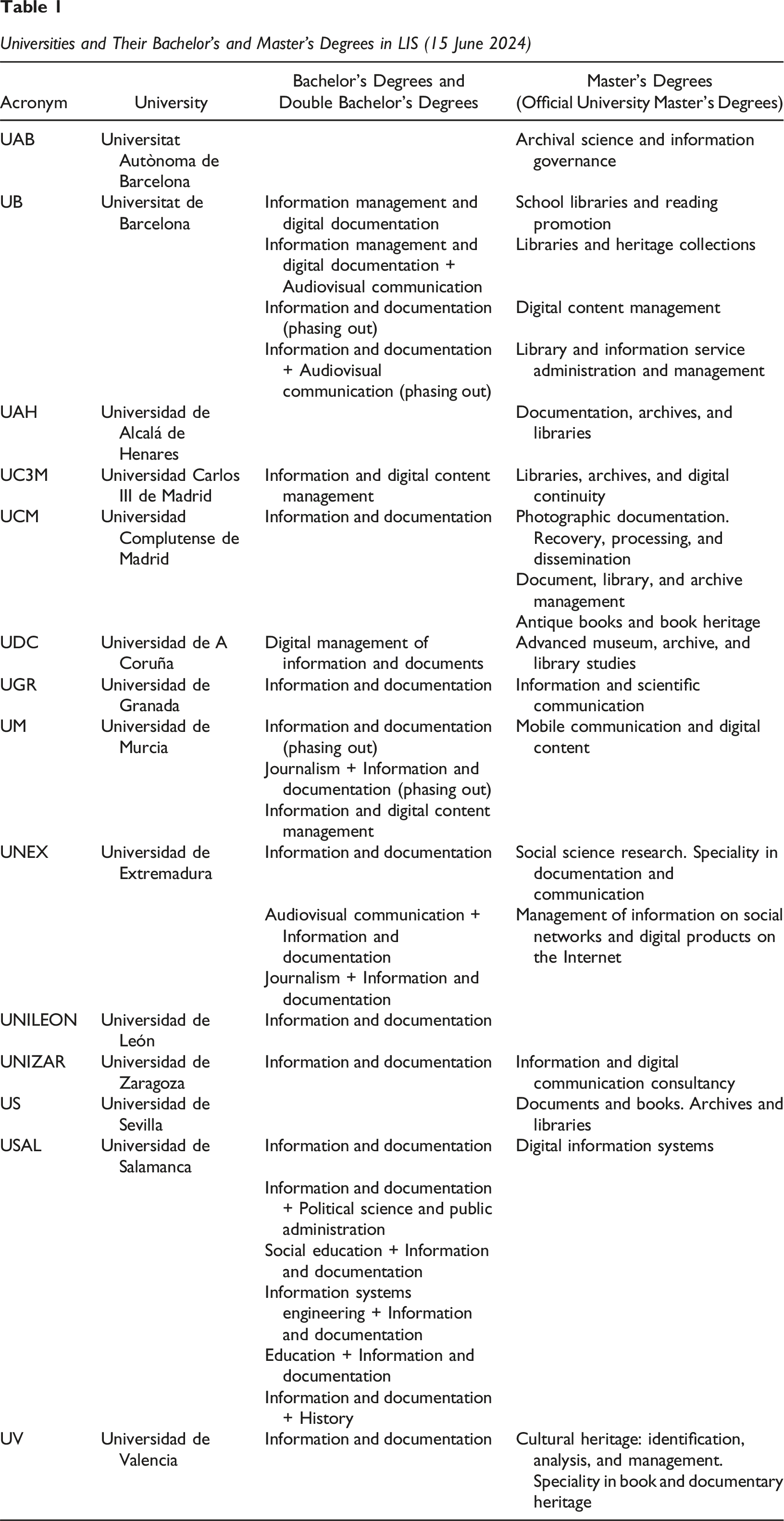
This sample of LIS-affiliated studies was chosen for our exploration of the system for the dissemination of end-of-degree theses in Spain because of these programmes’ close tie with and strong commitment to open science. Some examples can be seen in the curricula of the bachelor’s degrees that have courses on open science. For instance, at UC3M, students in the fourth year of the bachelor’s degree programme in information and digital content management may choose an elective entitled ‘Open science seminar’, and the information and digital content management programme at UM contains a compulsory third-year subject called ‘Research and open science’.
Data Collection and Analysis
To reach the objective set in this paper, a combination of methods was used involving a number of stages in which we searched for and analysed the information available from the chosen universities. Once the sample had been selected, the first step was to visit the websites of all the universities in the sample, where we searched for the following documents regulating the writing and defence of bachelor’s and master’s degree theses, in this order: • An open access policy, where we searched for express references to the dissemination of bachelor’s/master’s theses in the university repository. • A set of university-wide or school-wide regulations on scholarly papers, to see if they address the topic of publication. At each university, we looked for regulations pertaining to bachelor’s degrees in LIS, master’s degrees in LIS, or both, if the university offers both. • The syllabi of courses for LIS-related degrees, where we searched for information on the dissemination of bachelor’s theses and master’s theses. • Thesis writers’ guides offered by the libraries of the universities in the sample, to see if they furnish information about the dissemination of bachelor’s/master’s theses.
Once all the documents and related information had been located, each was searched for the words ‘dissemination’, ‘open access’, and ‘publication’. This information was inputted into an Excel spreadsheet, yielding the percentages shown in the results. These percentages were used to examine and compare thesis publication conditions and criteria, identifying common rules shared by universities and special rules unique to a single university. The authorities involved in the dissemination of scholarly work at each university were included in the spreadsheet as well, to detect similarities and differences between universities.
The final stage was to search each of the 14 repositories belonging to the chosen universities to try and locate bachelor’s theses and master’s theses, gain real access to them, and ascertain the number of papers published for each LIS degree each university offers. The point was to discover how easy access is and find the ratio between graduates and published theses. Graduate statistics were drawn from prior studies previously cited in this work, and in two particular cases (UC3M and UNILEON) the statistics were procured directly from university services, which facilitated data access for the authors as faculty members.
Results and Discussion
The information from the various websites was analysed. The results are discussed below, according to the five stages and elements of research explained above.
Institutional Policies on Open Access
Universities frequently have an institutional mandate or policy on open access. The institutional policies examined in this study date from between 2011 and 2022 (2022 being the latest update of an earlier version). Eleven universities (78.5%) have an open access policy, which is available on the university website, and three (21.4%) do not have a policy. Not all policies expressly mention bachelor’s and master’s theses, although most do; university open access policies generally include theses among the types of documents that belong to the realm of open access. One university’s policy makes no reference at all to student theses (UB), and two mention only master’s theses, not bachelor’s theses (UAH and USAL). The policies can be grouped into the following cases by their thesis access and dissemination rules: • Three universities’ policies refer to the obligation to upload theses to the repository, contingent upon the quality criteria or guidelines set for each degree or by each school (UAB, UAH, and UNILEON). • One policy states that, in order to qualify for the repository, a thesis must have received the grade of outstanding with honours (the very highest grade) and have the authorisation of the author and the thesis advisor (US). • Another three policies merely say that theses may be uploaded to the repository, without alluding to any conditions or criteria (UCM, UGR, and UM).
Thesis Regulations
Several types of documents were located containing some mandate regulating bachelor’s and master’s theses. These documents are variously named ‘regulations’, ‘rules’, or ‘guidelines’ and may apply to the university, the school, or the centre running the degree programme, or they may be designed exclusively for a particular degree. The cases at the universities in the sample vary widely, so a thesis may be subject to more than one set of rules, from the more general to the more specific or narrowly targeted: the university rules, the rules of the school offering the degree, and the rules of the degree itself, which tend to refer back to the larger framework of rules. The following regulations were located, listed in order from greater to lesser in terms of the scope they cover (university, school, degree): • Framework rules for the entire university regulating both types of theses (UB, UNIZAR, UC3M, UM, UCM, UNEX, and US). • Rules for the entire university regulating bachelor’s theses only (UB, UDC, UNILEON, UV, and USAL). • Rules for the entire university regulating master’s theses only (UAH). • Exclusive rules for the school offering the degree programme, regulating bachelor’s and master’s theses (UCM and US). • Exclusive rules for the school offering the degree programme, regulating bachelor’s theses only (UB, UC3M, UAB, UM, and UNILEON). • Exclusive rules for the degree, addressing particulars not specified in any of the above rules and tailoring the rules to bachelor’s or master’s theses in LIS (UNILEON and UGR).
Bachelor’s and Master’s Thesis Publication Conditions

The explicit conditions extracted from the various sets of rules (Table 2) address two points and may vary depending on whether the paper is a bachelor’s or a master’s thesis. The two points are as follows: • Authorisation, approval, or permission from several of the parties involved in the paper, who are repeatedly listed by the various universities as: the student (the student’s permission has to be secured at all events before the thesis can be deposited and disseminated), the department, the thesis advisor, the thesis committee, the course coordinator, the degree director or coordinator, the degree-coordinating committee, and the school council. • Subject to the above permissions, the thesis grade. The grade requirements differ, depending on whether the paper is a bachelor’s or master’s thesis. In some cases, a higher threshold is set for bachelor’s theses. The requirements are as follows: o Eight points or more out of 10, for both bachelor’s and master’s theses (UNILEON and UNEX). o ‘Outstanding’ or ‘With honours’, subject to authorisation by the author and the advisor, for both bachelor’s theses and master’s theses (US). o At least 9 points for bachelor’s theses and at least 8 points for master’s theses (UCM). If a master’s thesis scores less than 8 but more than 7.5, the thesis committee reports on the interest and advisability of publishing the paper through the repository.
Mention was also found (e.g. UAH and UGR) of the fact that a paper cannot be published if a confidentiality agreement was made prior to its defence. Theses focussing on a business environment, where some business undertaking is involved in the research, may sometimes use company data or information. In that case an agreement might be required to keep intellectual property and other matters confidential.
Bachelor’s and Master’s Degree Course Syllabi
The curricula for all of the programmes analysed, bachelor’s and master’s alike, are posted online. The courses listed in each curriculum include the bachelor’s thesis (for the bachelor’s degree) and the master’s thesis (for the master’s degree). Each curriculum contains a syllabus or teaching guide listing the course’s main characteristics (objectives, contents, learning results, teaching methods, grading system, and, less frequently, publication or dissemination). We reviewed the syllabi for the bachelor’s thesis courses in all 23 bachelor’s degree programmes examined in this analysis and located only four-degree programmes (17.3%) that allude to the thesis publication system (UCM and three UNEX degree programmes). The conditions are the same as in the university-wide rules or regulations. The bachelor’s thesis regulation at UGR alludes to storage and consultation, stating ‘bachelor’s theses shall remain in the possession of the Bachelor’s Thesis Committee to ensure the originality of later papers, and the school shall develop an information system to centralise electronic copies of the bachelor’s theses written for the university’s degrees and make it easier to consult them’ (UGR, 2024). There is no indication of the existence of any system or criteria, and we infer that the information system mentioned by UGR is a special repository of bachelor’s theses written by UGR students that can also be accessed from the university’s institutional repository.
The publication of master’s theses in the 19 master’s degree programmes is largely unaddressed at the institutional level. Only four master’s degree course syllabi (21.05%) mention thesis dissemination or publication. As in the case of the bachelor’s degrees, very few syllabi mention thesis dissemination or publication. The silence is remarkable, since the course syllabus is supposed to voice the university’s commitment to students and give them the most important (and most easily consulted) information about the course. Furthermore, the conditions located for master’s theses are the same as given in the rules discussed in point 2, and no further criteria can be added to the criteria in Table 2.
Library Guides on How to Write Scholarly Papers
On the whole, the libraries of the universities in the sample offer students guides or resources to help them write their theses. All the target universities except USAL have a portion of their website devoted to supporting and guiding thesis writers. However, not all guides refer specifically to dissemination and publication. Of the 13 universities that have a guide, eight (61.5%) discuss paper dissemination and publication, and five (38.4%) do not. According to an analysis of the resources available at Spanish public university libraries to help students prepare end-of-degree projects, in 2022 only eight of 47 libraries (36.3%) had guides or other resources that addressed the publication/dissemination process (Herrera Morillas, 2022, p. 34). Those libraries that do broach the topic refer readers to the criteria set by each school (UAB and UCM) or else reprint the particular rules that apply according to the conditions already commented on above. Some libraries (e.g. UB and UCM) place repository publishing instructions prominently, to catch the eye of website visitors. Others (e.g. UC3M) state that students must declare whether or not they have used AI in their academic work, bachelor’s thesis, or master’s thesis. This condition has been created in response to the fact that teachers do not yet have reliable tools for detecting when AI has been used. Other libraries (e.g. UCM) already post a declaration students must sign, stating whether they have used AI tools ethically in their bachelor’s thesis, master’s thesis, or doctoral dissertation. The point is fundamentally for students to use AI legally, ethically, and responsibly, and to cite correctly all sources and tools used, whatever the type, including AI.
Institutional Repositories
Lastly, all universities in the study have a community to house scholarly papers. This is the institutional repository. It is managed by the university library with the participation of other services involved in content production and management. Repositories refer to scholarly papers by one of four generic names: • Some use the label ‘student papers’, ‘scholarly papers’, ‘end-of-degree papers’, or ‘students’ papers’ (UAH, UB, UDC, UNEX, UNIZAR, and US). • Others prefer the umbrella term of ‘research’ (UAB and UNILEON). • The third group uses the general term ‘teaching’ (UC3M, UV, UM, and USAL). • There are two cases where bachelor’s theses are assigned to the ‘teaching’ community, but master’s theses are assigned to the ‘research’ community (UGR and UCM). The inference is that master’s theses are in a class above bachelor’s theses, since they are allowed to share space with publications like doctoral dissertations and patents.
Within these communities, bachelor’s theses and master’s theses are grouped into eponymous subcommunities, although they can sometimes be accessed through other routes. The usual process for accessing all theses is to go to the repository website and click on the degree the thesis was written for. In some cases, however, the access route is not through the degree, but through the school, knowledge area, or department. The route that is easiest and requires the least prior knowledge on the part of the searcher (especially students looking for papers they can use as examples) is to search by the degree the thesis was written for. Searching by subject and by keyword (the system used at UGR, UM, and UNEX) are the two most difficult strategies, though they are also the most specific when the searcher is interested in a particular topic.
At UDC, UGR, and UV, no theses for degrees related with LIS could be located. At UDC this was because neither the bachelor’s degree nor the master’s degree was listed in the subcommunity of degrees. At UGR and UV, it was because searches cannot be run by bachelor’s or master’s degrees to ascertain the total number of degrees available and access the ones related with LIS. In the case of UGR, a subject search was run among the bachelor’s theses, and three items were found, because the search showed that the bachelor’s theses in the collection covered 20 subjects, a manageable number. When the same search was attempted among the master’s theses, it was unsuccessful, because the search returned 4033 subjects, too many to review in hopes of locating all the master’s theses written for a given master’s degree. The same thing happened at UV: the keyword search found 5610 items, an impossible number to check for all the LIS-related bachelor’s theses. At all the universities where papers were located, the full versions of both bachelor’s and master’s theses can be consulted. They are published under a Creative Commons licence (Attribution-Noncommercial-No Derivatives).
Number of LIS Bachelor’s and Master’s Theses Retrieved From the Repositories of the 14 Universities Offering LIS Degrees. The Total Number of Bachelor’s and Master’s Theses (All Degrees, Not Just LIS) is Given Between Parentheses (15 June 2024)
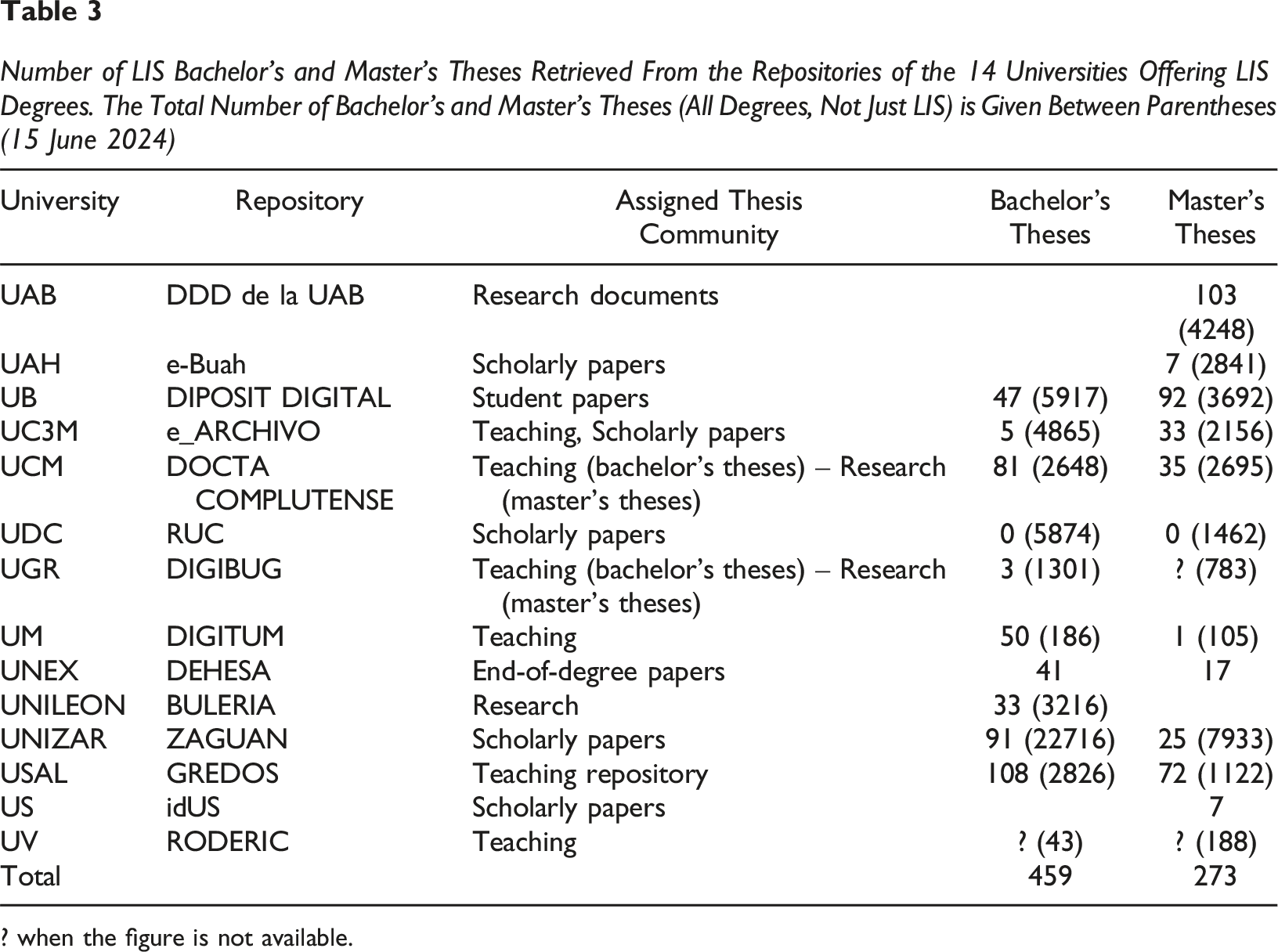
? when the figure is not available.
UNILEON and UC3M provide significant examples of repositories containing only a tiny number of theses. At UNILEON 202, bachelor’s theses have been defended as of June 2024, when data collection ended, yet its repository holds only 33 for the bachelor’s degree in LIS. At UC3M 895, bachelor’s theses have been defended, but there are only five for the bachelor’s degree in LIS. UC3M has 479 master’s theses, and its repository has only 33 LIS theses. These data demonstrate how few bachelor’s and master’s theses for LIS degrees are available at present in repositories, compared to the total number of graduates with a bachelor’s or master’s degree. If these universities are truly committed to open science, their academic authorities ought to act accordingly and either revise their publication and dissemination criteria or, if thesis quality is the problem, map out changes to their thesis-advising system. Universities should consider what ought to be done to make this happen.
Conclusions and Recommendations
The results partially reveal university repositories’ thesis publication conditions and the approximate number of theses available that were written for LIS degrees.
In answer to Q1, not all universities have an open access mandate or policy yet. Only three of the twelve policies located in the sample of 14 universities expressly mention the obligation to upload theses to the institutional repository.
To reply to Q2, under the regulations available in the sample of universities offering LIS degrees, thesis dissemination depends on compliance with criteria that differ from university to university. Furthermore, these criteria involve various combinations of the participants in the thesis-writing and evaluation process, including authorisation from the student (always), authorisation from the thesis course coordinator and the thesis advisor, authorisation from the degree programme’s director or coordinator, a resolution from the thesis committee, and, lastly, a thesis grade threshold.
The system for thesis dissemination laid out in thesis regulations exemplifies how widely experiences can differ between schools belonging to the same university. Each school, and sometimes even an individual degree programme, is entitled to set out a specific set of thesis rules to accommodate its own particular circumstances, even when a set of framework regulations already exists for the entire university.
The rules consulted for this study are updated continuously, as shown by their varying dates. Therefore, fresh updates may have already been rolled out. Predictably, one recommendable move would be to factor in the ethical perspective of using AI-generated content in scholarly papers, so as to avoid inappropriate conduct and forestall plagiarism and the use of incorrect data and flawed arguments due to failure to evaluate or verify AI-generated responses.
To answer Q3, not all theses defended by candidates for LIS degrees at the chosen universities can be accessed and consulted. It may be inferred from the tiny number of papers available that the number of defended theses eligible for uploading to the repository is culled considerably by the application of regulatory criteria. However, there are universities where no theses at all were available for consultation in the communities of the repositories holding bachelor’s and master’s theses. This indicates that none have been uploaded. At other universities, there are theses, but they are difficult to retrieve due to the search system.
The following proposal is the fruit of this research: • Universities’ open access policies ought to include mandates making it compulsory to store the research output of the entire university community and setting specific conditions for theses for the master’s degrees and bachelor’s degrees the university offers. These framework rules should be binding for schools and degree programmes, even if schools and programmes then go on to establish their own specific guidelines for implementing the overarching framework rules. • The regulations governing how bachelor’s/master’s theses are written and managed must address thesis publication and dissemination issues. • The most common form of publication for scholarly papers ought to be, by defect, publication under Creative Commons licence (Attribution-No Derivatives-Noncommercial), which does not deprive the author of any intellectual property rights. If the author wishes to use another Creative Commons licence, however, the university ought to be accommodating. • Students should be offered an embargo period in case they wish to publish in a scientific journal or elsewhere, provided that they upload the identifying particulars of their thesis and an abstract to prove the thesis’s existence. If a confidentiality agreement prevents the paper from being published in the repository, the procedure ought to be the same: the basic information on the paper should be uploaded so there is a record of its existence, but confidentiality must be respected. • Students must be able to find information about how theses are disseminated on their thesis course syllabus and in the university library’s thesis-writing guides. Attributions, citations, and references are indispensable to avoid plagiarism. Compliance with copyright legislation should be mentioned, and, just as importantly, the regulations on AI use in theses should be clearly stated, bearing in mind that AI use is increasing daily. A future can easily be imagined in which every scholarly paper explains what prompt and what AI were used to generate the paper’s theoretical framework, etc. (Codina, 2024). • The foremost condition a bachelor’s or master’s thesis must meet to qualify to enter the institutional repository must be the thesis grade, since the grade is the result of a formal assessment by experts (teachers from the degree programme) and therefore is a clear indicator of quality. In view of the cut-off grades proposed by the universities in the sample, a suitable rule might be that scholarly papers must receive an 8 or higher before they can be uploaded to the university repository. • If one goal is to avoid plagiarism while encouraging students to consult archived theses, it would be advisable to consider the pros and cons of allowing any paper that has received more than a 5 on a scale of one to 10 to be placed in the institutional repository’s scholarly paper section, where it can be accessed by anyone. In this case, the identifying particulars of the thesis should include the author’s name, the degree the author was seeking, and the grade the thesis received, so that anyone consulting it will have an idea of the reliability and value of the paper’s contents. For data protection reasons, the student’s consent would have to be secured first. • Location-wise, it is desirable for bachelor’s theses and master’s theses to have their own site or community in university repositories. The simplest way to facilitate searches would be to use the term ‘scholarly papers’, since this is the label most often used by the repositories of the universities this article examines and other public and private Spanish universities. In the specific terminology referring to the hierarchical structure of content organisation in DSpace (used in university repositories), the following levels might be used: Community (the highest level, which contains different types of academic work termed ‘scholarly papers’), Subcommunity (the middle level, which could be the degree the paper was written for), and lastly Collection (the level where items are stored in categories such as ‘master’s theses’ or ‘bachelor’s theses’). • Within each community, the easiest way to retrieve theses is by the degree programme, but that should not rule out other search systems working by subject, keyword, author, title, year, or any other parameter.
Now that there is a widespread conviction of the need to strengthen open science in all its dimensions, these recommendations could help knock down the known barriers to thesis accessibility and dissemination. Scientific work by students can be an essential component of strategies for encouraging open science practices in budding researchers right from the start of their university education.
Footnotes

Funding
The authors received no financial support for the research, authorship, and/or publication of this article.
Declaration of Conflicting Interests
The authors declared no potential conflicts of interest with respect to the research, authorship, and/or publication of this article.