




Abstract
Defining Program Learning Outcomes (PLOs) is a central requirement of outcome-based education (OBE) and quality assurance (QA) in higher education, yet it remains a persistent challenge for curriculum developers. Although national qualification frameworks and QA standards such as the Thai Higher Education Qualifications Framework and the ASEAN University Network Quality Assurance framework specify domains and descriptors for learning outcomes, they provide limited procedural guidance on how PLOs should be systematically derived from stakeholder needs, competency frameworks, and institutional missions. As a result, curriculum teams often rely on ad hoc or experience-based practices, leading to weak alignment between intended outcomes, curriculum design, and workforce expectations. This paper introduces the FISO framework, a structured four-stage process comprising Find, Identify, Select, and Obtain, designed to support the rigorous and transparent derivation of PLOs. Drawing on literature in OBE, competency-based curriculum design, global digital and professional competency frameworks, and conceptual models in Information Science, particularly the IFLA Library Reference Model, the study positions FISO as a conceptual–methodological contribution to curriculum design research. The framework is illustrated through an empirical mini case involving the redesign of undergraduate Information Science program at a Thai university, demonstrating how stakeholder evidence is systematically translated into validated learning outcomes. The paper concludes by discussing the theoretical and practical implications of FISO for curriculum developers, policymakers, and quality assurance practitioners, highlighting its potential to enhance transparency, coherence, and auditability in learning outcome formulation across higher education contexts.
Keywords
Introduction
The articulation of Program Learning Outcomes (PLOs) is widely recognized as a foundational component of outcome-based education (OBE), serving as the basis for curriculum design, teaching strategies, assessment, and quality assurance in higher education (Biggs & Tang, 2011; Harden, 2007; Mistamiruddin & Mohamad Nasri, 2024). PLOs specify what graduates are expected to know, be able to do, and value upon completion of a program, and they play a critical role in ensuring constructive alignment between educational intentions and learning experiences (Anderson et al., 2024). Within OBE systems, clearly defined and measurable PLOs are essential for demonstrating program coherence, graduate capability, and accountability to stakeholders (Keo et al., 2025; Nguyen et al., 2024).
Despite their central importance, the formulation of robust PLOs remains a persistent challenge for higher education institutions. Curriculum teams frequently struggle to translate diverse inputs such as stakeholder expectations, labor-market demands, professional competency frameworks, and institutional missions into coherent and assessable learning outcomes (Keo et al., 2025; Mistamiruddin & Mohamad Nasri, 2024; UNESCO, 2023). In practice, PLOs are often expressed at a high level of abstraction, lack explicit links to competency evidence, or are inconsistently aligned with teaching and assessment practices. These issues weaken the capacity of programs to demonstrate relevance, quality, and compliance with accreditation requirements (Keevy & Chakroun, 2015; Prøitz, 2010).
National and regional qualification frameworks, including the Thai Higher Education Qualifications Framework (HEQF) and the ASEAN University Network Quality Assurance (AUN-QA) framework, provide important reference points by defining domains of learning outcomes such as knowledge, skills, ethics, and personal attributes, and by emphasizing stakeholder engagement and continuous quality improvement (AUN, 2020; CHEs, 2022a). However, these frameworks primarily describe what learning outcomes should encompass rather than how they should be systematically derived. As a result, curriculum developers are often left without procedural guidance for converting stakeholder and competency evidence into structured, taxonomy-aligned PLOs (Anderson, 2013).
The consequences of inadequately derived PLOs extend beyond technical curriculum design issues. Weak alignment between PLOs, teaching activities, and assessment can undermine student learning, complicate program evaluation, and reduce stakeholder confidence in graduate preparedness. These challenges are particularly pronounced in dynamic and interdisciplinary fields such as Information Science (IS), where rapid digital transformation, data-intensive work practices, and evolving professional roles demand continual curriculum renewal (Chaichuay, 2023; Mihailidis, 2016). In such contexts, the absence of a transparent and systematic approach to PLO derivation risks disconnecting educational programs from both professional practice and national development priorities.
In response to these challenges, this paper proposes the FISO framework, a structured and theoretically grounded process designed to guide curriculum teams through the systematic derivation of PLOs. By integrating stakeholder analysis, competency mapping, prioritization mechanisms, and expert validation, FISO offers a replicable methodology for strengthening alignment between educational outcomes, professional competencies, and quality assurance expectations.
Research Gap
A review of literature on curriculum design, OBE, and quality assurance reveals three interrelated gaps that motivate this study. First, there is a lack of procedural guidance for deriving PLOs. While OBE and QA frameworks consistently emphasize the importance of learning outcomes and constructive alignment, they provide limited direction on the step-by-step processes through which PLOs should be generated from empirical evidence and stakeholder input (Ali & Jamin, 2025). As a result, PLO development often depends on individual expertise or institutional convention rather than systematic methodology. Second, the integration of stakeholder and labor-market evidence into PLO formulation remains weak. Although stakeholder engagement is widely recognized as a principle of effective curriculum design and quality assurance (Al-Thani, 2025), few studies offer operational models that demonstrate how diverse stakeholder inputs such as employer expectations, alumni feedback, policy priorities, and professional standards, can be synthesized and embedded into program-level learning outcomes in a transparent and auditable manner. Third, there is limited alignment between global competency frameworks and local institutional contexts. International frameworks such as the World Economic Forum (WEF) Skills Taxonomy (Ahsan et al., 2025; Mistamiruddin & Mohamad Nasri, 2024), DigComp 2.2 (Vuorikari et al., 2022), and discipline-specific models like the IFLA Library Reference Model (IFLA-LRM) (Riva et al., 2017) identify emerging competencies that are highly relevant to contemporary Information Science education. However, practical tools for mapping these global frameworks onto national qualification standards, institutional strategies, and disciplinary curricula remain underdeveloped. This gap constrains the ability of programs to prepare graduates who are both locally responsive and globally competitive. Taking together, these gaps indicate the need for a structured and transparent framework that can systematically connect stakeholder evidence, competency frameworks, and policy requirements in the derivation of measurable and coherent PLOs.
Research Purpose and Questions
The purpose of this study is to develop and examine a structured framework for deriving PLOs that integrates stakeholder needs, competency mapping, and institutional and policy requirements in a coherent and transparent manner. Specifically, the study addresses the following research questions:
How can stakeholder-derived competency requirements be systematically translated into measurable PLOs?
How can curriculum teams operationalize global competency frameworks within national and institutional contexts to support curriculum design?
What forms of value does a structured framework such as FISO provide when applied to curriculum redesign in higher education?
Literature Review
This section reviews and synthesizes educational, theoretical, and professional literature that informs the development of the FISO framework as a structured methodology for deriving PLOs. The review is organized into three interrelated strands: (1) Outcome-Based Education (OBE) and PLO development in Information Science (IS); (2) conceptual models from Information Science, particularly the IFLA-LRM and their relevance to competency-based curriculum design; and (3) contemporary approaches to skill mapping and professional competencies in IS. Together, these strands provide the conceptual basis for the FISO process proposed in this study.
Curriculum Development, OBE, and PLOs in Information Science
OBE has become a dominant paradigm in higher education, emphasizing the alignment of intended learning outcomes, teaching and learning activities, and assessment practices. Contemporary research highlights that while constructive alignment is widely accepted in principle, institutions continue to face challenges in translating outcome statements into coherent and assessable program designs, particularly at the program level (Anderson et al., 2024; Gervais, 2016; Keo et al., 2025; Nguyen et al., 2024). Recent systematic reviews further indicate that many OBE implementations prioritize compliance with quality assurance requirements over transparent and evidence-based outcome derivation processes, resulting in learning outcomes that are conceptually sound but procedurally weak (Mistamiruddin & Mohamad Nasri, 2024).
Within OBE frameworks, PLOs function as a critical mechanism for translating disciplinary expectations, institutional missions, and stakeholder needs into coherent graduate attributes. Clearly articulated PLOs support curriculum mapping, skills development, and program evaluation, while also enhancing transparency for students, employers, and accrediting bodies (Gervais, 2016; OECD, 2025). However, empirical research consistently reports challenges in developing PLOs that are sufficiently specific, measurable, and coherently aligned across curriculum levels, particularly in interdisciplinary and rapidly evolving fields (Keo et al., 2025; Mistamiruddin & Mohamad Nasri, 2024).
In the ASEAN context, the AUN-QA framework places strong emphasis on measurable Intended Learning Outcomes (ILOs), stakeholder engagement, and continuous quality improvement, positioning PLOs as the connecting mechanism between program-level intentions and course-level learning (AUN, 2020). Similarly, Thailand’s Higher Education Qualifications Framework defines outcome domains related to knowledge, skills, ethics, and personal attributes, reinforcing expectations that programs demonstrate alignment between outcomes, curriculum design, and assessment (CHEs, 2022a). Nevertheless, these frameworks primarily describe what learning outcomes should encompass, offering limited guidance on how curriculum teams should systematically derive PLOs from stakeholder evidence and competency frameworks.
Competency-based curriculum design in IS increasingly relied on formalized professional skills frameworks that translate workforce requirements into educational structures (Nguyen et al., 2025). These challenges are especially pronounced in IS, a field shaped by rapid digital transformation, data-intensive work practices, and expanding professional roles. Contemporary IS programs are therefore expected to integrate competencies in information organization, digital curation, data analytics, information governance, and socio-technical system design, alongside transversal skills such as critical thinking, ethics, and collaboration (Joseph & Aneesh, 2018; Mihailidis, 2016; Raju, 2021). National policy initiatives, including Thailand 4.0 and MHESI reforms, further shape expectations for IS curricula to align with digital-economy and workforce-development priorities (Chaichuay, 2023; MHESI, 2023). Together, these conditions highlight the need for structured approaches that can guide the systematic derivation of PLOs in complex and evolving disciplinary contexts.
Integrating the IFLA-LRM and the FISO Process for Curriculum Design
The IFLA-LRM provides a consolidated conceptual framework for understanding bibliographic information and user interaction, integrating earlier models such as FRBR, FRAD, and FRSAD into a unified structure (Riva et al., 2017). At the core of LRM are five generic user tasks: Find, Identify, Select, Obtain, and Explore which describe fundamental patterns of information interaction across systems and contexts. In this study, the IFLA-LRM is not applied as an analytical or evaluative framework. Rather, the logic of its user tasks is conceptually adapted to inform the design of a new, curriculum-oriented process, referred to as the FISO framework. While LRM was originally developed to support bibliographic control and metadata system design, its task-based logic offers a theoretically grounded way to conceptualize information-related competencies relevant to Information Science education.
From a pedagogical perspective, the LRM user tasks correspond to broad categories of cognitive and professional capability, such as information discovery, evaluation, access, and use. Building on this insight, the FISO framework selectively adapts four of these tasks: Find, Identify, Select, and Obtain as sequential stages for deriving PLOs. The fifth LRM task, Explore, which emphasizes post-retrieval navigation, discovery, and user interaction with information systems, was intentionally excluded. This exclusion reflects the distinct purpose of FISO, which focuses on learning-outcome derivation and curriculum design, rather than on information exploration behavior or system use.
The resulting FISO framework therefore represents an original methodological contribution that is inspired by, but conceptually distinct from, the IFLA-LRM. Whereas LRM provides a descriptive model of information interaction, FISO reconfigures selected elements of this logic into a procedural framework that guides curriculum developers through stakeholder analysis, competency identification, prioritization, and outcome formulation. This adaptation allows disciplinary theory to inform curriculum design without being directly imposed as an analytical structure, ensuring conceptual coherence while maintaining methodological independence.
Skill Mapping and Professional Competencies in Information Science
Curriculum mapping has increasingly been recognized as a critical mechanism for aligning learning outcomes with program content, assessment, and professional expectations. Recent quality assurance research demonstrates that systematic curriculum mapping supports program-level coherence, facilitates accreditation review, and enables institutions to document evidence-based curriculum decisions (Anderson et al., 2024). However, contemporary studies also caution that mapping exercises often remain descriptive, focusing on content coverage rather than on the logic through which competencies are prioritized and translated into learning outcomes (Xu et al., 2025; Zamecnik et al., 2024). These findings suggest that curriculum mapping must be embedded within a broader methodological framework that explicitly connects stakeholder evidence, competency selection, and outcome formulation.
In IS, professional competency research documents an expanding skill profile that encompasses digital curation, metadata management, research data management, user experience design, information analytics, and information governance (Joseph & Aneesh, 2018; Mihailidis, 2016; Raju, 2021). Emerging empirical evidence from contemporary competency studies underscores AI and data skills as essential components of modern information professional roles (Kautonen & Gasparini, 2024; Lo, 2024). Recent large-scale and data-driven studies further demonstrate the feasibility of mapping curricular content to skill profiles using computational and semantic techniques, highlighting new possibilities for evidence-based curriculum alignment (Xu et al., 2025; Zamecnik et al., 2024). Global competency frameworks such as DigComp 2.2, the OECD Skills Outlook, and the World Economic Forum Skills Taxonomy provide valuable reference points for identifying future-oriented skills in higher education. Nevertheless, recent studies emphasize that the effectiveness of these frameworks depends on their contextualization within disciplinary, national, and institutional settings (Mejías-Acosta et al., 2024). Without structured processes for prioritization and translation, competency frameworks risk remaining aspirational rather than actionable at the program level. This reinforces the importance of curriculum design approaches that systematically operationalize skills frameworks into validated PLOs.
Taken together, this body of literature indicates that IS curricula must cultivate integrated competency profiles combining disciplinary knowledge, technical and digital skills, and transversal capabilities that support adaptability and lifelong learning. However, while competency frameworks and skill taxonomies are well established, practical methodologies for embedding them systematically into PLO formulation remain limited. This gap reinforces the relevance of structured processes such as FISO, which enable curriculum teams to synthesize stakeholder evidence, map and prioritize competencies, and translate them into validated learning outcomes aligned with both global standards and local institutional contexts.
Methodology
This study adopts a conceptual–methodological research approach to develop and illustrate the FISO framework as a structured process for deriving PLOs in higher education. Rather than testing predefined hypotheses, the study focuses on synthesizing theory, policy frameworks, and professional standards into a coherent methodological model, complemented by an illustrative institutional case. This approach is appropriate for research that aims to propose, clarify, and operationalize frameworks intended to guide educational practice and curriculum design (McTaggart, 2021; Shikalepo, 2020).
Theoretical Framework
The theoretical framework of this study is constructed through the integration of three complementary bodies of literature: OBE and QA frameworks, disciplinary conceptual models from Information Science, and global competency and skills frameworks. Together, these elements inform the design logic of the FISO framework and guide its application as a structured process for deriving PLOs.
First, OBE and QA frameworks such as the AUN-QA framework and the HEQF establish the educational rationale for defining clear, measurable, and stakeholder-responsive learning outcomes (Anderson et al., 2024; AUN, 2020; Keo et al., 2025; Mistamiruddin & Mohamad Nasri, 2024). These frameworks emphasize constructive alignment, stakeholder engagement, and continuous quality improvement, thereby shaping expectations for how PLOs should function within curriculum design and accreditation processes.
Second, conceptual models from Information Science, particularly the IFLA-LRM, contribute to a disciplinary lens rather than an analytical mechanism. In this study, IFLA-LRM is drawn upon as a source of conceptual inspiration, not as a framework for data analysis or evaluation. Its user-task logic informs the structuring of the FISO stages, but the FISO framework itself constitutes an original curriculum-design methodology developed specifically for outcome derivation.
Third, global competency and skills frameworks including DigComp 2.2, the WEF Skills Taxonomy, and the OECD Skills Outlook provide reference points for identifying and classifying competencies relevant to contemporary and future professional contexts (Mattar et al., 2022; OECD, 2025; Vuorikari et al., 2022; WEF, 2025). These frameworks guide the identification and prioritization of skills during the Identify and Select stages of FISO, enabling alignment between global competency expectations, national policy priorities, and institutional missions.
Theoretical Framework Guiding for the FISO Process

Note. Integrated theoretical framework for guiding the FISO process, showing how OBE, QA standards, disciplinary conceptual models, and global competency frameworks collectively inform the systematic derivation of PLOs in IS education.
Research Design
The study employs a conceptual–methodological research design, complemented by an illustrative mini-case application. This design is appropriate for studies seeking to develop and demonstrate the utility of frameworks intended to guide professional or educational practice, rather than to generate generalizable empirical findings (McTaggart, 2021; Shikalepo, 2020). The research design comprises four interrelated stages. (1) Conceptual synthesis—Relevant literature on OBE, competency-based education, Information Science theory, global competency frameworks, and QA standards was systematically reviewed to identify key constructs, principles, and relationships relevant to PLO development. This synthesis informed the identification of design requirements for a structured outcome-derivation process. (2) Process design and logic modeling—Insights from the literature review were organized into a sequential logic model, resulting in the four-stage FISO framework: Find, Identify, Select, and Obtain. Each stage represents a distinct but connected function in translating stakeholder needs and competency evidence into validated PLOs. This step focuses on ensuring internal coherence, replicability, and alignment with OBE and QA principles. (3) Expert and practitioner validation—Draft versions of the FISO framework and supporting tools such as the skill taxonomy and Skills Matrix were reviewed by curriculum developers, quality assurance specialists, Information Science educators, and experts from policy and industry sectors. Feedback focused on conceptual clarity, feasibility within institutional curriculum processes, alignment with accreditation expectations, and perceived usefulness for curriculum redesign. This stage strengthened the framework’s practical relevance and methodological robustness. (4) Illustrative case application—The FISO process was applied in the redesign of undergraduate Information Science programs at a Thai university. This mini-case illustrates how the framework operates in practice, how stakeholder and competency evidence is synthesized, and how the process supports alignment with HEQF and AUN-QA requirements. The case is used to demonstrate feasibility and transparency rather than to evaluate learning outcomes empirically.
Although institutional data informed the case application, the primary contribution of this study remains conceptual and methodological. The case therefore functions as an explanatory example that clarifies the operational logic and outputs of the FISO framework, rather than as a standalone empirical investigation. The research conceptual framework is presented in Figure 1. Research Conceptual Framework
Empirical Mini-Case: Application in an Information Science School
The Bachelor of Information Science (BiS) Program
The BiS program, originally established as Library and Information Science, has undergone ongoing curriculum revision in response to professional developments and labor-market transformation at both national and global levels. The program subsequently evolved into Information Science, and in 2018 was incorporated into the New-Breed Graduate Program (NBP) of the Ministry of Higher Education, Science, Research and Innovation (MHESI) (KKU, 2023a). This national initiative aims to produce graduates that respond to Thailand’s twelve targeted industries (S-Curve and New S-Curve), emphasising interdisciplinary integration, advanced and specialized competencies, and future-oriented capabilities such as STEM expertise and digital skills, which are essential to support the country’s transition toward Thailand 4.0 (DGA, 2023; NESDB, 2017a). The core features of the NBP Program include industry responsiveness, interdisciplinary integration, future-ready skills, flexible delivery models, and human-capital development to enhance employability and national competitiveness (MHESI, 2020; 2023).
Aligned with these national directions, curriculum development adopts the principles of backward curriculum design (Joyce & Calhoun, 2024) and OBE, which emphasize systematic alignment between intended outcomes, instructional activities, and assessment (Harden, 2007; Spady, 1994). Furthermore, curriculum development reflects the educational philosophy of the iSchools movement, commonly referred to as the “i-Perspective,” which promotes a data-intensive, multidisciplinary, and human-centered approach to information professions in the 21st century (Oh, 2024; Wiggins & Sawyer, 2012). The revision of the program has also been driven by three key forces: data-driven insights, accelerating technological innovation, and the need to strengthen public literacies—particularly data literacy, information literacy, and AI literacy (Georgopoulou et al., 2025; Hanh et al., 2025; Oh, 2024).
The current structure of the BiS curriculum adheres to the Announcement on the National Standards for Undergraduate Study Programs B.E. 2565 (CHEs, 2022b), comprising General Education (24 credits), Professional Courses (93 credits including core courses, specialized modules, and work-integrated learning), and Electives (6 credits). The curriculum is explicitly designed according to OBE principles, which begin by defining clearly what graduates are expected to know, be able to do, and become upon completion of the program. Therefore, systematic skills mapping is required to formulate the PLOs and ensure alignment between curriculum content, instructional design, and assessment of learning outcomes (Gervais, 2016; Harden, 2007; Spady, 1994).
Results of Applying the FISO Process
Policy and Strategic Sources Informing Stakeholder Needs

Note. National, institutional, and global policy and strategic sources analyzed during the Find stage of the FISO process to identify stakeholder needs, workforce expectations, and contextual requirements relevant to the BiS program.
International Professional and Global Competency Frameworks for Information Science

Note. International professional standards and global competency frameworks consulted during the Find stage of the FISO process to capture disciplinary expectations and emerging competencies for IS education.
Skill Mapping Taxonomy Derived From Stakeholder and Professional Evidence
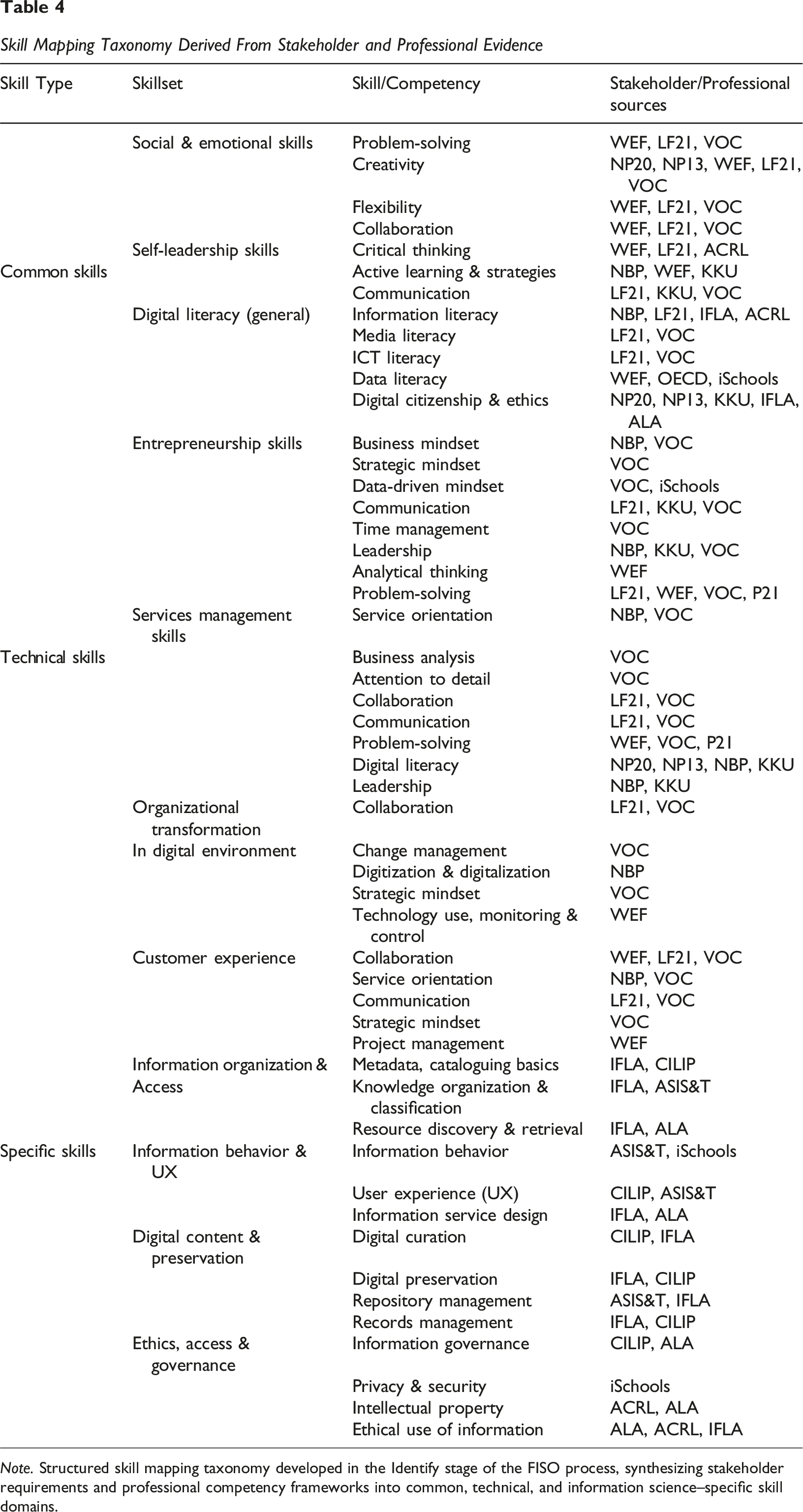
Note. Structured skill mapping taxonomy developed in the Identify stage of the FISO process, synthesizing stakeholder requirements and professional competency frameworks into common, technical, and information science–specific skill domains.
Prioritization of Core and Threshold Competencies for the BiS Program
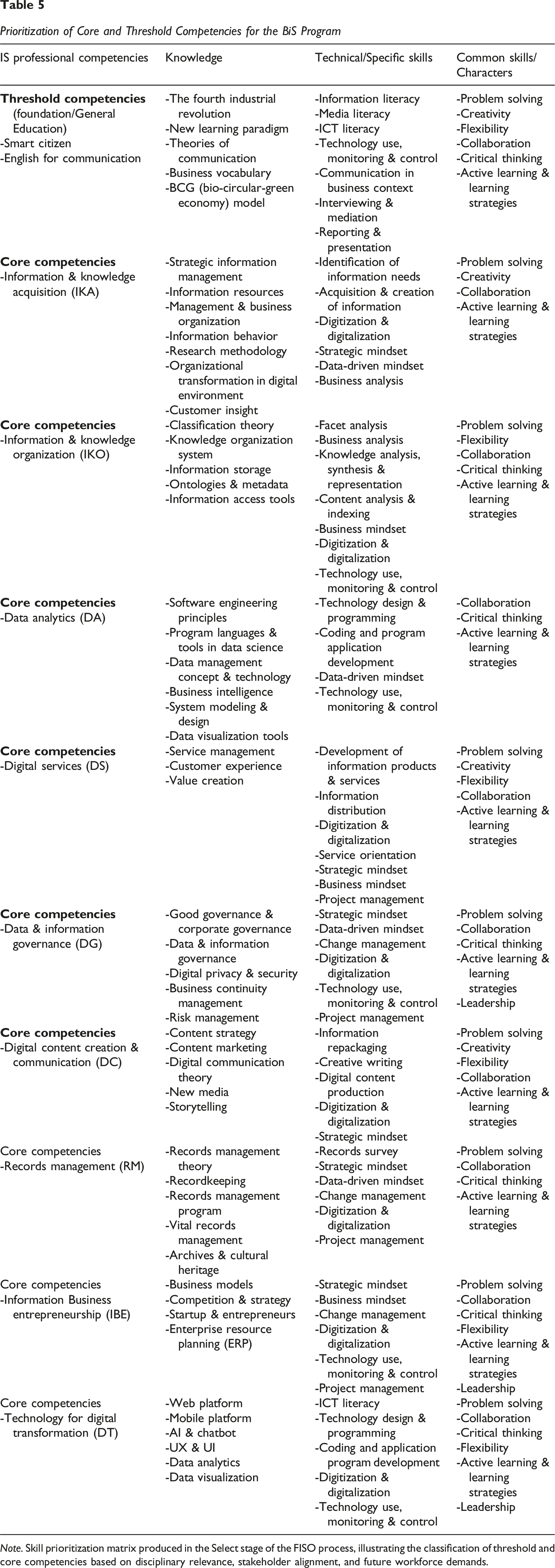
Note. Skill prioritization matrix produced in the Select stage of the FISO process, illustrating the classification of threshold and core competencies based on disciplinary relevance, stakeholder alignment, and future workforce demands.
PLOs and Their Origins in the Skill Matrix
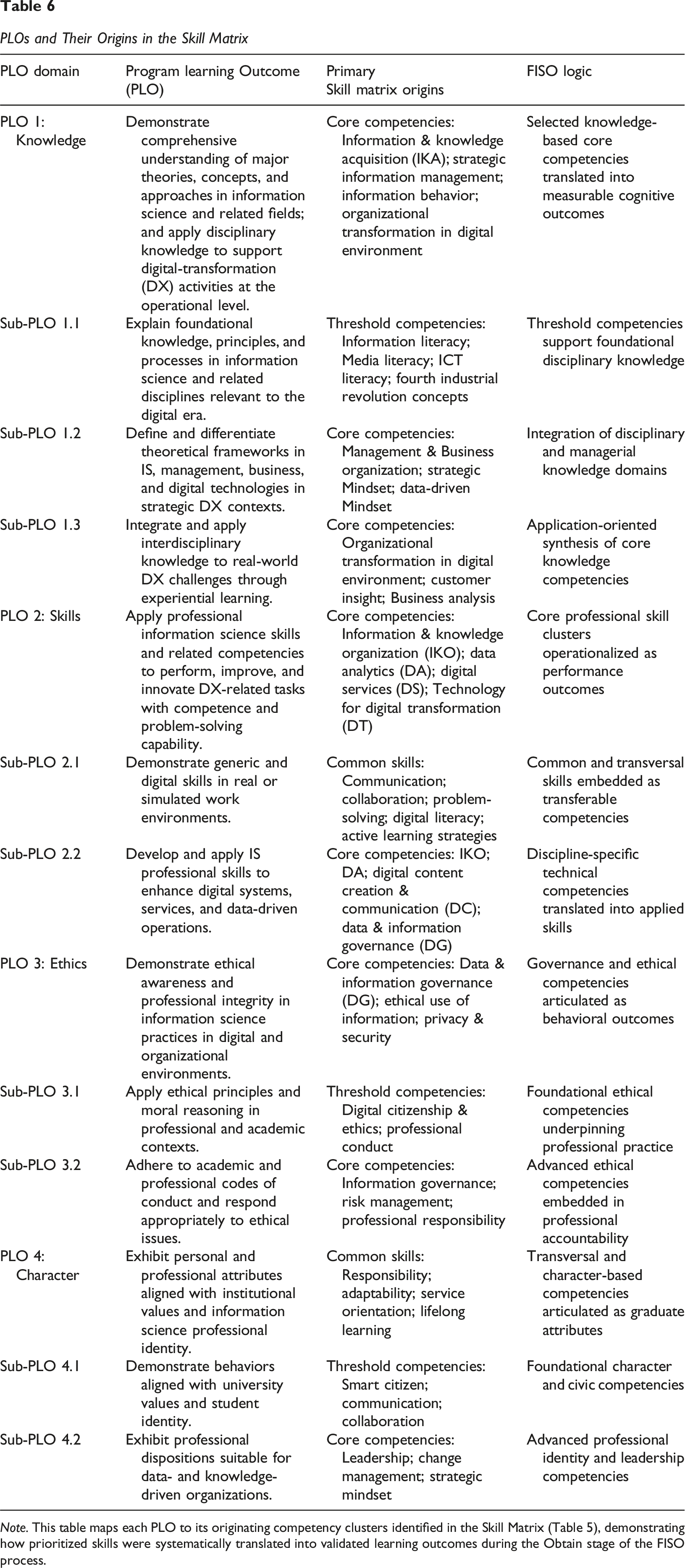
Note. This table maps each PLO to its originating competency clusters identified in the Skill Matrix (Table 5), demonstrating how prioritized skills were systematically translated into validated learning outcomes during the Obtain stage of the FISO process.
Stage 1 Find—Stakeholder Needs and Contextual Requirements
The first result of applying the FISO framework is the systematic consolidation of stakeholder needs and contextual requirements relevant to the BiS program. Instead of relying on informal consultation, the Find stage produced structured evidence base derived from authoritative policy documents, strategic plans, labor-market reports, and stakeholder feedback.
Two categories of stakeholder evidence emerged. The first comprises policy and strategic stakeholders, whose expectations are embedded in national, institutional, and international policy instruments. As summarized in Table 2, these sources include national development strategies, higher education policy initiatives, institutional transformation plans, and global labor-market analyses. Collectively, they articulate macro-level expectations related to digital transformation, future workforce readiness, interdisciplinary competence, and alignment with Industry 4.0 and Thailand 4.0 priorities.
The second category comprises discipline-specific and professional stakeholders, represented by international professional frameworks relevant to Information Science. As shown in Table 3, these frameworks such as IFLA, ALA, CILIP, ASIS&T, iSchools, and ACRL define normative expectations for IS graduates in areas including information organization, digital curation, information literacy, user experience, and professional ethics.
Result of Stage 1
The Find stage yielded a validated corpus of stakeholder requirements spanning policy, professional, institutional, and user perspectives. This corpus constitutes the empirical input for competency analysis in the subsequent stage.
Stage 2 Identify—Structured Skill Taxonomy
The second result of the FISO application is the development of a structured skill taxonomy that translates stakeholder requirements into analyzable competency components. Using the evidence identified in Stage 1, overlapping and conceptually related requirements were clustered into coherent themes, while context-specific or redundant elements were filtered to maintain a program-level perspective.
As presented in Table 4, the resulting taxonomy organizes competencies into three overarching domains: common skills, technical skills, and specific skills. Each competency is explicitly mapped to its originating policy or professional framework, enabling traceability and transparency in the derivation process. For example, digital and data literacy competencies are linked to NP20, NP13, OECD, WEF, LF21 frameworks and VOC study report, while information organization, digital curation, and information governance competencies are grounded in IFLA, ALA, CILIP, and ASIS&T standards.
Result of Stage 2
The Identify stage produced a comprehensive, source-attributed skill taxonomy that integrates transversal, technical, and disciplinary competencies. This taxonomy serves as the analytical foundation for competency prioritization in Stage 3.
Stage 3 Select—Prioritized Competency Sets
The third result of applying the FISO framework is the prioritization of competencies essential to the BiS program’s identity and future relevance. Given the breadth of competencies identified in Stage 2, not all could be translated directly into PLOs. Therefore, competencies were evaluated using four criteria: relevance to core IS domains, alignment with international standards, responsiveness to national and institutional priorities, and future workforce transferability.
The outcomes of this prioritization process are summarized in Table 5, which distinguishes between threshold competencies and core competencies across knowledge, technical skills, and personal attributes. Threshold competencies represent foundational capabilities expected of all graduates, while core competencies reflect advanced and discipline-defining skills central to professional IS practice, such as data analytics, digital services, information governance, and organizational transformation.
Result of Stage 3
The Select stage yielded a validated competency priority structure, clarifying which skills form the foundation of the curriculum and which define its advanced professional orientation. This structure directly informs PLO formulation in the final stage.
Stage 4 Obtain—Validated Program Learning Outcomes
The final result of the FISO application is the formulation and validation of PLOs derived from the prioritized competencies identified in Stage 3. Selected competencies were translated into PLO statements using outcome-based education principles and appropriate learning-taxonomy verbs to ensure clarity, measurability, and accessibility (Anderson, 2013).
The draft PLOs were subsequently reviewed through a multi-stakeholder expert validation process, involving policy-level experts, industry practitioners, and Information Science academics. Feedback focused on relevance, clarity, alignment with QA standards, disciplinary coherence, and future readiness. Revisions were made iteratively to refine outcome statements, reduce overlap, and strengthen links between knowledge, skills, ethics, and professional attributes. The final validated PLOs are presented in Table 6, including explicit mapping to their competency clusters originating from the Skill Matrix.
Result of Stage 4
The Obtain stage produced a consensus-informed set of PLOs that are evidence-based, professionally relevant, and aligned with national and international quality assurance expectations.
Summary of Results from the FISO Application
Taken together, the results of applying the FISO framework demonstrate a clear and auditable progression from stakeholder evidence (Tables 2–3), through competency structuring (Table 4) and prioritization (Table 5), to validated learning outcomes (Table 6). This sequence illustrates that FISO functions not merely as a conceptual model, but as an operational framework capable of producing transparent, quality-assured curriculum outputs in Information Science education.
Discussion
This section discusses the findings derived from the application of the FISO framework in relation to the three research questions. Rather than restating procedural steps, the discussion interprets how the results contribute to OBE, competency-based curriculum design, and QA practices, particularly within the context of Information Science education.
Contribution to Learning Outcome Derivation and OBE Practice (RQ1)
The results demonstrate that the FISO framework addresses a persistent challenge in OBE implementation: the lack of a transparent and systematic process for deriving PLOs from stakeholder and competency evidence. While OBE literature consistently emphasizes constructive alignment and outcome clarity (Biggs & Tang, 2011; Harden, 2007), recent studies continue to report difficulties in operationalizing outcome derivation beyond compliance-oriented formulations (Anderson et al., 2024; Keo et al., 2025; Mistamiruddin & Mohamad Nasri, 2024).
By structuring outcome derivation into four sequential stages: Find, Identify, Select, and Obtain, FISO transforms PLO development from an implicit academic exercise into an explicit, auditable process. The results presented in Tables 2–6 illustrate how stakeholder inputs are progressively transformed into validated learning outcomes, thereby addressing calls for greater transparency and traceability in outcome-based curriculum design (Ahsan et al., 2025; Al-Thani, 2025; Hunsapun, 2024).
Recent curriculum research highlights that outcome statements often fail not because of conceptual weakness, but because the processes used to generate them are undocumented or insufficiently grounded in evidence (Zahn et al., 2024). In this regard, FISO contributes to OBE practice by reframing PLO derivation as a design outcome, rather than a preliminary administrative step. This perspective aligns with emerging scholarship that views learning outcomes as constructed artefacts shaped by institutional, professional, and socio-economic contexts (Anderson et al., 2024; Schwarz et al., 2024).
Contribution to Competency-Based Curriculum Design and Skills Mapping (RQ2)
The findings also demonstrate how FISO provides a practical mechanism for operationalizing global competency frameworks within national and institutional contexts. While frameworks such as DigComp 2.2 (Vuorikari et al., 2022), the WEF Skills, and OECD Skills Strategy offer comprehensive descriptions of future-oriented competencies, recent studies note that institutions often struggle to translate these frameworks into program-level outcomes that are coherent and assessable (Mattar et al., 2022; Mejías-Acosta et al., 2024).
Through the Identify and Select stages, FISO addresses this challenge by converting broad competency taxonomies into a structured skill mapping and prioritization process. The results show that competencies were not adopted wholesale, but selectively contextualized according to disciplinary relevance, policy alignment, and curriculum feasibility. This approach resonates with recent research advocating context-sensitive skill mapping, rather than one-to-one adoption of global frameworks (Xu et al., 2025; Zahn et al., 2024; Zamecnik et al., 2024).
In the context of Information Science, the integration of discipline-specific competencies such as information organization, digital curation, data analytics, and information governance, alongside transversal digital and professional skills reflect current debates about the evolving identity of the field (Agrawal et al., 2021; Mihailidis, 2016). The results suggest that FISO enables curriculum teams to balance disciplinary continuity with innovation, ensuring that programs remain anchored in Information Science while responding to data-driven and digitally mediated professional environments.
Value of FISO for Curriculum Transparency and Quality Assurance (RQ3)
A key contribution emerging from the results is the value of FISO in enhancing curriculum transparency and QA readiness. Contemporary QA frameworks increasingly emphasize evidence-based reporting, stakeholder engagement, and continuous improvement, yet institutions often face challenges in demonstrating how curriculum decisions are justified (AUN, 2020; OECD, 2025).
The staged outputs produced through FISO documented in Tables 2–6, function as a curriculum audit trail, enabling institutions to demonstrate how stakeholder requirements, competency frameworks, and expert validation contribute to final learning outcomes. Recent QA-focused studies highlight the growing importance of such documentation in accreditation processes, particularly in interdisciplinary and professionally oriented programs (Anderson et al., 2024; Schwarz et al., 2024). Compared with established curriculum design approaches such as Backward Design or the Tuning methodology, FISO offers a more explicit linkage between stakeholder evidence and outcome formulation. While Backward Design focuses on alignment between outcomes, assessment, and instruction (Joyce & Calhoun, 2024), it provides limited guidance on how outcomes themselves should be derived. Similarly, Tuning emphasizes competency alignment but often leaves prioritization decisions implicit. FISO complements these approaches by making competency selection and validation visible, thereby strengthening institutional accountability and QA reporting.
Theoretical Implications for Information Science Education
Beyond its practical contributions, the results also carry important theoretical implications for Information Science education. By adapting the logic of the IFLA-LRM from a bibliographic framework into a curriculum design process, FISO demonstrates how disciplinary conceptual models can be repurposed to guide educational innovation. This cross-application responds to recent calls for stronger integration between domain theory and curriculum design in Information Science and related fields (Agrawal et al., 2021; Mihailidis, 2016). Moreover, positioning FISO as a results-producing framework highlights the role of curriculum design as a form of knowledge production rather than merely administrative planning. This perspective aligns with frameworks such as the B-Wheel model, which offer structured pathways for building sustainable competencies that support institutional transformation goals (Kautonen & Gasparini, 2024), as well as with emerging higher education research that conceptualizes curricula as socio-technical artefacts shaped by policy, labor markets, and disciplinary epistemologies (Zahn et al., 2024).
Overall, the discussion shows that FISO contributes to OBE and curriculum design literature by providing a structured, evidence-based mechanism for deriving PLOs. The framework supports systematic integration of stakeholder needs, competency frameworks, and QA requirements, while offering theoretical insights into the relationship between Information Science concepts and curriculum development practices.
Conclusion
This study has introduced the FISO framework: Find, Identify, Select, and Obtain as a structured and transparent methodology for deriving PLOs in higher education. Responding to persistent challenges in OBE and QA, the framework addresses a critical gap in existing practice by offering explicit procedural guidance for translating stakeholder needs, competency frameworks, and policy requirements into measurable and validated learning outcomes. Through an illustrative application in an Information Science program, the study demonstrates that FISO is not merely a conceptual model but an operational framework that produces traceable curriculum outputs. The results show how stakeholder evidence (policy, professional, institutional, and user perspectives) can be systematically consolidated, transformed into a structured competency taxonomy, prioritized through a skills matrix, and ultimately translated into validated PLOs. This staged process strengthens curriculum coherence and supports the creation of an auditable trail that is increasingly demanded by contemporary QA and accreditation regimes.
From a theoretical perspective, the study contributes to curriculum design research by bridging OBE, competency-based curriculum design, and disciplinary conceptual models in Information Science. By adapting the logic of the IFLA-LRM into a curriculum design process, the study illustrates how domain-specific theories can inform educational methodology, thereby strengthening the connection between disciplinary knowledge and curriculum outcomes. Conceptually, the positioning of PLO derivation as a results-producing process also reframes curriculum design as a form of structured knowledge construction rather than a purely administrative task.
Practically, the FISO framework offers curriculum developers, academic leaders, and QA practitioners a replicable and evidence-based tool for curriculum redesign. Its explicit documentation of decision points, particularly during competency identification, selection, and validation, supports institutional accountability, facilitates program review and accreditation, and enhances stakeholder confidence in graduate preparedness. While demonstrated within Information Science, the framework is sufficiently generic to be adapted to other interdisciplinary and professionally oriented fields facing rapid competency shifts.
This study has several limitations. First, the research is conceptual and methodological in nature, and the empirical application is limited to a single institutional context within Information Science. As such, the findings are illustrative rather than generalizable. Second, the study does not empirically assess the impact of FISO-derived PLOs on student learning outcomes, graduate employability, or teaching practices. Third, stakeholder engagement in the case application focused on expert validation rather than large-scale participatory consultation.
Future research could extend the application of FISO to other disciplines, institutions, and national contexts to examine its adaptability and robustness across educational systems. Empirical studies could investigate the effects of FISO-derived PLOs on curriculum coherence, assessment alignment, faculty practice, and graduate competencies. Comparative research may also explore how FISO performs relative to other curriculum design approaches, such as Backward Design or the Tuning methodology. In addition, emerging technologies such as learning analytics, curriculum mapping tools, and artificial intelligence could be explored as mechanisms to support or automate elements of the FISO process.
In an era of rapid technological change, expanding stakeholder expectations, and intensifying quality assurance demands, higher education institutions require systematic approaches to curriculum design that are both theoretically grounded and practically feasible. The FISO framework offers such an approach by providing a transparent, structured, and evidence-based pathway from stakeholder needs to validated learning outcomes. As demonstrated in this study, FISO has the potential to support curriculum innovation, strengthen QA readiness, and enhance the relevance of higher-education programs in Information Science and beyond.
Footnotes

Authors’ contributions
All authors contributed significantly to this work: Conceptual framework design (VC and KT); Research method design (VC and KT); Data source (VC and SH); Data analysis (VC and SH); Summary of the results (VC, SH, and KT); Manuscript preparation & editing (VC and KT); and Manuscript corresponding (KT). All authors have approved the final version for submission.
Funding
The authors received no financial support for the research, authorship, and/or publication of this article.
Declaration of Conflicting Interests
The authors declared no potential conflicts of interest with respect to the research, authorship, and/or publication of this article.
Data Availability Statement
No new data was created or analyzed during this study. Data sharing is not applicable.
Research Ethics
This article does not fall under the category requiring human research ethics approval according to the 2021 Guidelines for Conducting Human Research in Behavioral, Social Sciences, and Humanities issued by the Thailand Science Research and Innovation (TSRI) of Thailand. The data collection is based on secondary data.