



Abstract
Library and Information Science (LIS) education in Nigeria faces increasing pressure to adapt curricula to the demands of a rapidly evolving digital society. This study investigates the integration of emerging technologies into Library and Information Science (LIS) education in Nigeria. The study examines the extent of integration of emerging technologies in LIS curricula in Nigeria, identifies gaps between training and industry requirements, and proposes a framework for curriculum reform based on the findings. A multimethod design was adopted, beginning with a content analysis of curricula from six purposively selected universities across Nigeria’s geopolitical zones, followed by semi-structured interviews with heads of library schools to explain the patterns observed in the curriculum analysis. Findings revealed that only 18% of the curricula incorporated emerging technologies, mostly at an introductory level, with advanced areas such as AI, data science, and cloud computing largely absent. Educators highlighted challenges, including outdated infrastructure, weak industry linkages, inadequate staff capacity, and restrictive policy frameworks. The study concludes that Nigerian LIS graduates risk under-preparedness for technology-driven information environments without deliberate reform. A framework is proposed emphasizing curriculum restructuring, pedagogical innovation, staff retraining, infrastructural investment, industry collaboration, and policy realignment. The study recommends sustained integration of advanced technology courses as core requirements, alignment with global standards, and proactive engagement with regulatory bodies to ensure LIS education in Nigeria remains relevant and globally competitive.
Introduction
It is undeniable that Library and Information Science (LIS) education has undergone major global transformations driven by advances in information and communication technologies (ICTs), digital scholarship, and emerging technologies that continually redefine professional roles. Traditionally, LIS curricula in Nigeria and elsewhere were designed to train graduates for managing print-based collections and conventional services. However, the rise of artificial intelligence, the Internet of Things (IoT), data analytics, cloud computing, knowledge management systems, and information ethics has made curricular restructuring imperative to align with digital realities (Abubakar, 2021; Veeranjaneyulu, 2023). This transformation demands not only curricular redesign but also the involvement of LIS educators, who play a pivotal role in shaping programs that respond to the digital age.
Emerging technologies refer to innovative and rapidly evolving digital tools and systems that are transforming how information is created, organized, accessed, and delivered in library and information environments. These technologies include artificial intelligence, machine learning, big data analytics, cloud computing, blockchain, robotics, and other advanced information systems that enhance the efficiency and effectiveness of library services. They are typically characterized by their novelty, growing adoption, and potential to significantly reshape professional practices and user experiences. In the context of Library and Information Science, emerging technologies are increasingly influencing service delivery models, information management processes, and user engagement strategies (Bakare, 2023; Priya & Ramya, 2024). As such, their integration into LIS education has become essential for preparing graduates to function effectively in a dynamic and technology-driven information environment.
Emerging technology courses focus on tools or systems that are new or undergoing significant transformation with potential social, economic, or educational impact (Rotolo et al., 2015). Such courses typically address theoretical and applied aspects, including ethical and social implications (Education Scotland, 2016; Veletsianos, 2016). Their inclusion in LIS curricula represents a deliberate reform aimed at developing graduates equipped to thrive in technology-driven information environments. These courses encompass artificial intelligence, machine learning, cloud computing, big data management, blockchain, digital curation, digital scholarship, IoT applications, and virtual or augmented reality. Beyond traditional ICT courses, they prepare students for technologies at the forefront of digital transformation. As Awodoyin and Okiki (2023) emphasize, embedding emerging technologies in the LIS curriculum is now essential for producing globally competitive graduates.
The central role of Library and Information Science (LIS) in engaging with technological change is not new but historically grounded in the evolution of the field itself. From its early foundations in bibliographic control and classification systems to later developments in automation, digital libraries, and online information retrieval, LIS has consistently adapted to shifts in information technologies and environments (Ullah et al., 2017). The transition from card catalogues to integrated library systems, the rise of online databases, and the emergence of digital repositories illustrate how LIS education has continually incorporated new technological competencies into its curriculum and professional practice (Raju, 2020).
Historically, Nigerian LIS curricula have centered on cataloguing, classification, reference services, and collection development, with limited attention to technological innovation (Adebayo & Alex-Nmecha, 2019; Babalola et al., 2018). While these foundational areas remain relevant, the digital environment demands new competencies in digital librarianship, information ethics, sustainability literacy, and knowledge management (Ezeani et al., 2015; Roknuzzaman & Umemoto, 2013). Many African LIS programs face similar challenges of adequacy in responding to global trends (Mubofu & Mambo, 2023), raising the question of how Nigerian LIS schools can reposition their curricula to meet contemporary needs.
LIS educators, curricula, and library schools are central to this reform process because they serve as the primary sites for the production and transmission of professional knowledge, skills, and competencies within the field. In professional education, curriculum structures and pedagogical practices fundamentally shape how emerging knowledge domains are interpreted and translated into practice (Annala, 2024; Barnett & Coate, 2004). In the field of LIS, educators function not only as instructors but also as curriculum designers, mediators of technological change, and gatekeepers of professional standards. Their perceptions influence program content, pedagogical approaches, and institutional readiness for technology integration. Baker (2019) notes that faculty conceptualizations determine how students are trained, while Ariole et al. (2017) observe that educators’ expectations reflect the kind of professionals LIS schools aim to produce. In Nigeria, this is especially critical amid declining student enrollment (Adetayo et al., 2024), changing employment dynamics (Malik & Ameen, 2021; Shah et al., 2023), and concerns about graduates’ professional relevance. Furthermore, library schools operate as institutional platforms where technological innovations are selectively integrated into formal training, thereby determining the extent to which graduates are prepared for digital and data-driven information environments.
Globally, research emphasizes the need for LIS curricula to adapt to technological and professional trends (Husain & Nazim, 2015; Inskip, 2015; Jankowska et al., 2014; Malanga et al., 2024). Nigerian studies (Ajani et al., 2022; Ariole et al., 2017; Babalola et al., 2018; Ezeani et al., 2015; Oyetola et al., 2024) have repeatedly highlighted outdated curricula, emphasizing the necessity to benchmark local programs against international standards. The IFLA Guidelines for Professional LIS Education Programmes (Chu et al., 2022) provide a globally recognized framework structured around eight foundational knowledge areas (FKAs) and pedagogical standards. These guidelines stress that LIS education must remain dynamic, interdisciplinary, and responsive to technological change. It is further observed that LIS professionals bring critical expertise in areas such as information organization, metadata design, knowledge representation, information behavior, digital curation, and information ethics-domains that are essential for ensuring that technological systems are usable, accessible, inclusive, and aligned with societal needs. Therefore, investigating emerging technologies in LIS education in Nigeria is both timely and significant. This study contributes to ongoing efforts to reinvigorate LIS education, ensuring it remains relevant and capable of producing graduates who can lead innovation in contemporary information environments. Ultimately, the study seeks to bridge the gap between traditional LIS education and the competencies required in this era. This study is therefore grounded in the understanding that LIS occupies a critical interdisciplinary space between technological innovation and information practice.
Problem Statement
Library and Information Science (LIS) education in Nigeria is at a critical point. Traditional curricula focused on cataloguing, classification, and reference services no longer meet the demands of a technology-driven society. Recent advances in artificial intelligence, the Internet of Things (IoT), big data, cloud computing, blockchain, digital scholarship tools, and information ethics have transformed professional expectations (Awodoyin & Okiki, 2023; Oyetola et al., 2024). Graduates lacking exposure to these technologies risk being underprepared for modern library and information environments (Sibiya, 2023; Yadav, 2022).
Existing LIS curricula in Nigeria remain largely outdated and weak in technological integration (Adebayo & Alex-Nmecha, 2019; Babalola et al., 2018). Studies show that African LIS programs lag behind global trends due to inadequate infrastructure, limited skilled faculty, and resistance to change (Abubakar, 2021; Mubofu & Mambo, 2023). This is often reflected in limited access to digital infrastructure, insufficient integration of emerging technology courses into curricula, and constrained opportunities for faculty upskilling, which collectively hinder the development of relevant digital competencies among graduates (Bouaamri et al., 2022; Ocholla & Bothma, 2007; Ogunjimi et al., 2026; Raju, 2015, 2020; Sibiya & Ngulube, 2024). Although some schools have begun introducing digital courses, integration remains inconsistent and superficial. These shortcomings contribute to persistent challenges such as declining student enrollment (Adetayo et al., 2024), limited employability in technology-driven sectors (Malik & Ameen, 2021; Shah et al., 2023), and a widening gap between LIS education and professional realities.
Unlike most previous studies that have focused primarily on student perceptions, curriculum content reviews, or employer expectations, this study is distinctive in centering on the perspectives of LIS educators, who are the key drivers of curriculum design and reform in Nigeria. While this study combines content analysis of curricula with empirical evidence from educators’ experiences, the study bridges the gap between theoretical curriculum frameworks and the realities of implementation in Nigerian universities. Furthermore, by benchmarking these findings against the IFLA Guidelines for Professional LIS Education Programmes, the study contributes a context-specific and internationally aligned framework for reforming LIS curricula. Against this backdrop, this study investigates the integration of emerging technologies into LIS education in Nigeria, with the aim of identifying existing gaps and providing a basis for proposing a framework for curriculum reform.
Objectives of the Study
The study was guided by the following specific objectives: (1) To examine the extent of integration of emerging technologies in LIS education in Nigeria. (2) To analyze how LIS programs prepare students for the digital information environment. (3) To identify gaps between LIS education and industry as well as international standards (IFLA Guidelines). (4) To propose a framework for improving the integration of emerging technologies in LIS education based on the identified gaps.
Literature Review
Emerging Technologies and LIS Education
Scholarly attention on LIS education has consistently indicated the need for education reform in response to technological change. In Nigeria, Abubakar (2021) highlights challenges such as inadequate funding, poor infrastructure, and limited qualified faculty that hinder the adoption of digital innovations. Similarly, Adebayo and Alex-Nmecha (2019) report that LIS students receive insufficient practical training in areas like digitization and information literacy, while Adetayo et al. (2024) link declining enrollment to poor awareness of technological opportunities. Ezeani et al. (2015) further note the limited adoption of digital archiving and data mining skills among academic librarians, and Ariole et al. (2017) stress the need to restructure LIS curricula and provide better-equipped laboratories. Babalola et al. (2018) also argue for embedding entrepreneurship into LIS education to prepare graduates for self-employment in areas such as indexing, publishing, and knowledge management.
Recent scholarship has explored specific emerging technologies in LIS education. Oyetola et al. (2024) observe that although LIS educators in Nigeria recognize the relevance of artificial intelligence, adoption remains constrained by low competency, weak connectivity, and faculty resistance. Awodoyin and Okiki (2023) similarly report positive perceptions of the Internet of Things (IoT) but note underutilization caused by poor funding and inadequate infrastructure. Ocholla (2021) reflects on the disruption of LIS education in Africa during the COVID-19 pandemic, emphasizing the urgency of technology-driven learning. In South Africa, Sibiya (2023) finds that LIS graduates require additional education in digital scholarship, while Mubofu and Mambo (2023) argue that Tanzanian LIS curricula insufficiently address global digital trends, particularly in literacy and inclusion. Kwanya (2024) projects that the Fourth Industrial Revolution (4IR) will transform LIS education, asserting that the convergence of digital, physical, and biological systems, alongside technologies such as AI, IoT, big data, and cloud computing, demands a radical transformation of both curriculum and skill sets.
In India, Husain and Nazim (2015) advocate integrating knowledge management into LIS curricula, while Kumar (2023) reports strong student support for the adoption of IoT in libraries. Yadav (2022) identifies computing, data management, and soft skills as critical competencies in the digital age. In Pakistan, Malik and Ameen (2021) and Shah et al. (2023) observe that employment opportunities remain largely traditional despite new digital roles, and Shah et al. (2024) highlight the urgent need to build technological competencies among professionals. Similarly, Krtalić and Mandl (2019) and Inskip (2015) emphasize emerging didactic trends and the integration of information literacy into LIS education, while Roknuzzaman and Umemoto (2013) recommend incorporating knowledge management into curricula as a form of innovation. Jankowska et al. (2014) extend this discourse to sustainability, demonstrating how LIS schools can embed global issues into their programs. Across the reviewed literature, studies show that while Nigeria shares challenges with other African nations, it significantly lags behind its global counterparts in aligning LIS education with rapidly changing technological and professional landscapes. These disparities reinforce the necessity of benchmarking against international guidelines such as IFLA to guide reform. Although some Nigerian LIS schools are beginning to embrace elements such as AI, IoT, and digital information systems, yet, gaps remain in practice, infrastructure, and policy alignment.
Benchmarking LIS Education With IFLA Guidelines
The global Library and Information Science (LIS) community has long recognized the need for education that balance traditional library values with evolving technological developments. To address this, the International Federation of Library Associations and Institutions (IFLA) developed the Guidelines for Professional Library and Information Science (LIS) Education Programmes (Chu et al., 2022), which provide a global framework for LIS curriculum design and evaluation. The guidelines serve as a benchmark for LIS schools worldwide, outlining foundational knowledge areas (FKAs) that reflect the core competencies required of contemporary information professionals. A central feature of the guidelines is the identification of eight Foundational Knowledge Areas (FKAs) that form the backbone of professional LIS education. These FKAs are: (1) (2) (3) (4) (5) (6) (7) (8)
Benchmarking Nigerian LIS education against the IFLA Guidelines is essential because it enables a systematic evaluation of how well local programs align with international best practices. The guidelines provide a globally endorsed framework for identifying strengths, weaknesses, and gaps that may not be apparent through internal assessments alone. In particular, the IFLA framework emphasizes the integration of ICTs, digital literacies, and innovation-oriented competencies, which are areas often underrepresented in Nigerian LIS curricula. As documented in several studies (Abubakar, 2021; Mubofu & Mambo, 2023; Oyetola et al., 2024), most LIS programs in Nigeria retain a strong focus on traditional library operations while giving limited attention to advanced technologies such as artificial intelligence, data science, and cloud computing. By using the IFLA framework as a benchmark, educators and policymakers can evaluate the extent to which LIS schools are meeting international expectations for professional readiness.
Moreover, aligning LIS education with IFLA’s guidelines provides an evidence-based foundation for curriculum reform and policy dialogue in Nigeria. The benchmarking process does not merely compare curricular content; it also provides a justification for reform that aligns with global standards. It ensures that curriculum redesign efforts are not ad hoc but grounded in an internationally validated framework that values adaptability, innovation, and professional competence. Thus, this study’s adoption of the IFLA Guidelines as a reference point allows for a comprehensive assessment of Nigerian LIS education while ensuring that the proposed framework for integrating emerging technologies remains both globally informed and locally relevant. In addition, the centrality of LIS education in preparing professionals for technological change is well established in the literature. Studies have consistently shown that curriculum design, faculty expertise, and institutional capacity determine how effectively emerging technologies are integrated into professional training (Husain & Nazim, 2015; Inskip, 2015). As such, examining LIS educators’ perspectives provides critical data on the opportunities and constraints shaping curriculum reform.
Methodology
This study adopted a multimethod research approach, combining quantitative and qualitative methods to address different dimensions of the research problem (Farinosi & Melchior, 2025; Howard & Tummon, 2025). Specifically, the study employed a sequential design involving curriculum content analysis and semi-structured interviews. In this design, quantitative data were first collected and analyzed through systematic content analysis of Library and Information Science (LIS) curricula in selected Nigerian universities. The results of this phase provided an empirical overview of the extent to which emerging technologies are represented within LIS programs. The second phase involved qualitative data collection through semi-structured interviews with heads of library schools. The interviews were conducted after the curriculum analysis to gain deeper perspectives into the patterns and gaps identified in the first phase. This sequential approach allowed the qualitative findings to explain, contextualize, and elaborate on the results of the curriculum analysis, thereby providing a richer understanding of how LIS educators perceive the integration of emerging technologies into LIS education in Nigeria. Content analysis was used to systematically examine documentary evidence to determine the extent of technological inclusion (Krtalić & Mandl, 2019), while interviews captured the perspectives of heads of library schools directly involved in curriculum development.
The population comprised Library and Information Science (LIS) programs offered in Nigerian universities, whose official curricula served as the documentary sources for the content analysis. From the population of LIS programs in Nigerian universities, six universities were purposively selected to ensure representation across Nigeria’s six geopolitical zones. The selection was guided by three operational criteria. First, program longevity was considered to ensure that the selected institutions had well-established LIS departments with documented curricular structures and experience in program development. Second, institutional visibility and academic standing were considered. Universities with nationally recognized LIS programs and a track record of academic publications, postgraduate training, and professional contributions to the LIS field were prioritized. Third, evidence of digital and technological infrastructure was examined. Universities that demonstrate some level of technological capacity, such as computer laboratories, institutional repositories, digital library initiatives, or courses related to information and communication technologies, were selected to ensure that the study examined programs with at least some exposure to technology integration. The selected universities were the University of Ibadan (South West), University of Nigeria, Nsukka (South East), Ahmadu Bello University, Zaria (North West), University of Maiduguri (North East), University of Ilorin (North Central), and University of Port Harcourt (South-South).
The study also consisted of Heads of Library and Information Science schools in Nigerian universities. The Heads of Library Schools in the selected universities were purposively chosen as interview participants because of their direct involvement in curriculum design, academic leadership, program administration, and engagement with regulatory bodies such as the National Universities Commission (NUC) and the Librarians’ Registration Council of Nigeria (LRCN). Because of these responsibilities, they possess institutional knowledge regarding curriculum development processes, constraints imposed by national regulatory frameworks, staff capacity, and infrastructural challenges affecting the integration of emerging technologies into LIS education. This study focused specifically on heads of library schools because they serve as primary decision-makers and coordinators of curriculum reform within universities. Their viewpoints were therefore considered particularly relevant for understanding the institutional and policy dimensions of integrating emerging technologies into LIS education. In total, six Heads of Library Schools participated in the interviews.
Two instruments were employed for data collection. The first was document analysis, which examined LIS curricula from the selected universities to identify courses and themes related to emerging technologies (Appendix A). The analysis also included the IFLA Guidelines for Professional Library and Information Science (LIS) Education Programmes, which served as an international benchmark for evaluating how Nigerian LIS curricula align with global standards. The second instrument comprised semi-structured interviews conducted with the six heads of library schools to obtain deeper insights into their perceptions of emerging technology integration (Appendix B). The interview guide was reviewed by two senior experts in Library and Information Science education with extensive experience in curriculum design and LIS research (Oladokun et al., 2026). Their review focused on the clarity, relevance, and alignment of the questions with the study objectives. Their feedback led to minor refinements to improve the clarity and focus of the interview questions.
Data for the study were collected over three months between May and July 2025. During this period, official curriculum documents were obtained from the selected universities and analyzed. Semi-structured interviews were subsequently conducted with the Heads of Library Schools. Each interview lasted between 32 and 48 minutes. The interviews were conducted via WhatsApp voice calls and audio recorded with participants’ consent. The recordings were subsequently transcribed verbatim to ensure that participants’ responses were accurately captured. To enhance transcription accuracy, the recordings were reviewed multiple times during transcription, and the transcripts were cross-checked against the original audio files to correct omissions or inconsistencies. In addition, member checking was employed, whereby the interview transcripts were shared with the participants to verify the accuracy of their responses and to allow them to clarify or refine any statements where necessary.
Data were analyzed using both quantitative and qualitative approaches. In the first stage, curriculum documents from the selected universities were analyzed through content analysis using descriptive quantitative techniques such as tables and frequency counts. The analysis involved a systematic examination of course titles, course descriptions, and program structures within each LIS curriculum. To quantify the representation of emerging technologies, each course in the reviewed curricula was identified and classified as either emerging technology-related or not. The proportion was then calculated by dividing the number of emerging technology courses by the total number of courses and multiplying by 100. In addition to this internal comparison, the identified courses were mapped against relevant components of the National Universities Commission’s Common Core Minimum Academic Standards (CCMAS) and the IFLA Guidelines for Professional LIS Education Programmes. This benchmarking approach enabled the study to determine the extent to which the curricula align with national regulatory expectations and internationally recognized competency frameworks. In addition, particular attention was given to the institutional curriculum component permitted under the National Universities Commission’s Common Core Minimum Academic Standards (CCMAS). Under the CCMAS framework, approximately 70% of the curriculum is centrally prescribed, while the remaining 30% constitutes discretionary institutional content that universities can use to introduce locally relevant or innovative courses. To examine how this space was utilized, courses identified in each curriculum were further categorized according to whether they appeared within the core CCMAS-prescribed structure or within the institutional discretionary component. Ethical principles were strictly observed; informed consent was obtained from participants, confidentiality was maintained, and participation was voluntary. Audio recordings and transcripts were securely stored and used solely for research purposes, and institutional identities were anonymized to protect respondents and their universities.
Results
In this section, the study’s results are presented in line with the research questions that guided it.
Research Question 1: To What Extent Are Emerging Technologies Integrated Into LIS Education in Nigeria?
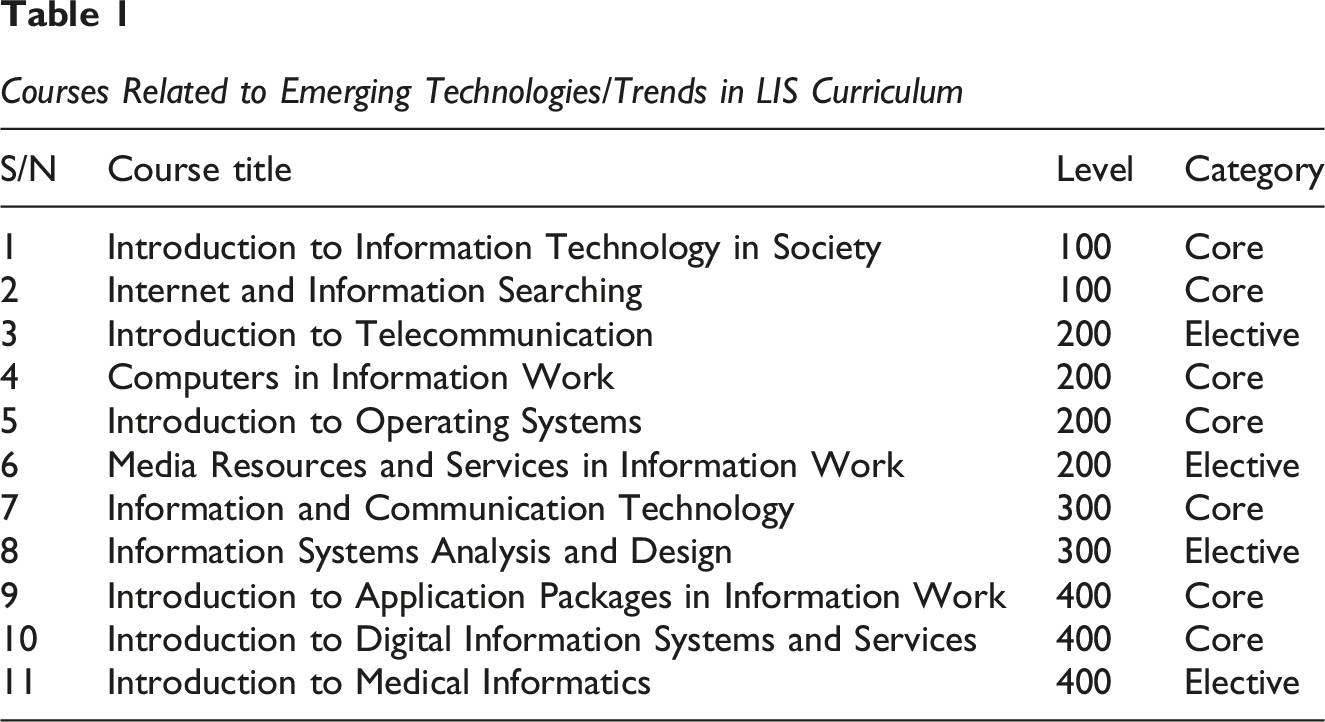
Courses Related to Emerging Technologies/Trends in LIS Curriculum
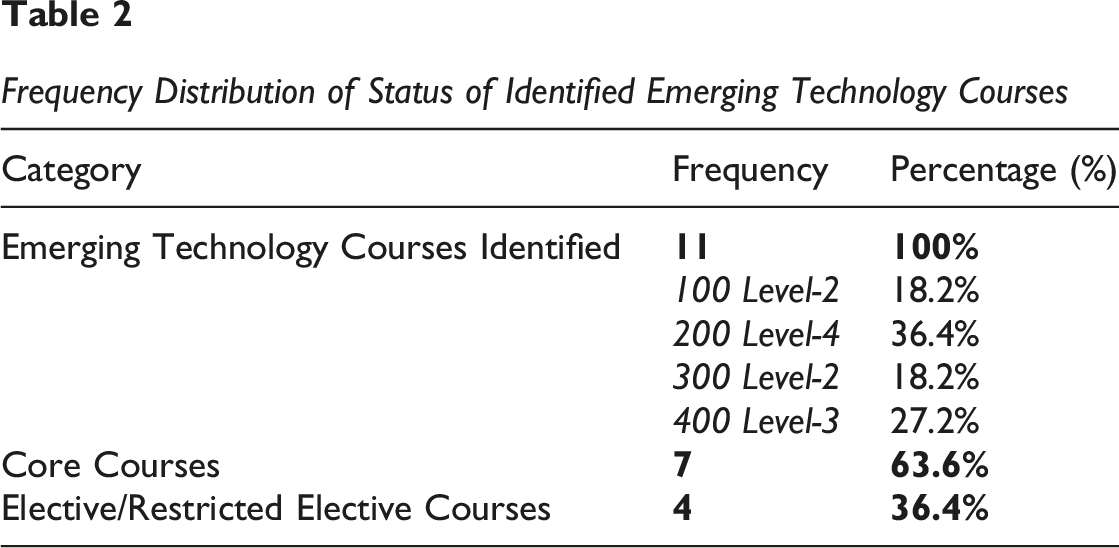
Frequency Distribution of Status of Identified Emerging Technology Courses
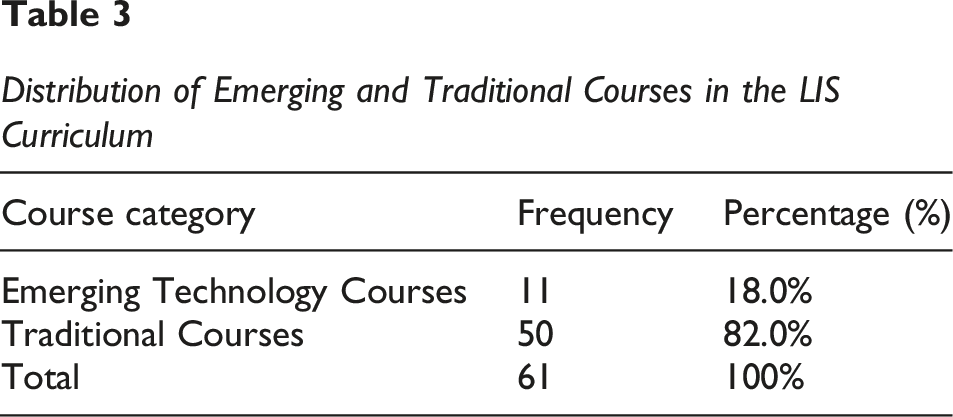
Distribution of Emerging and Traditional Courses in the LIS Curriculum
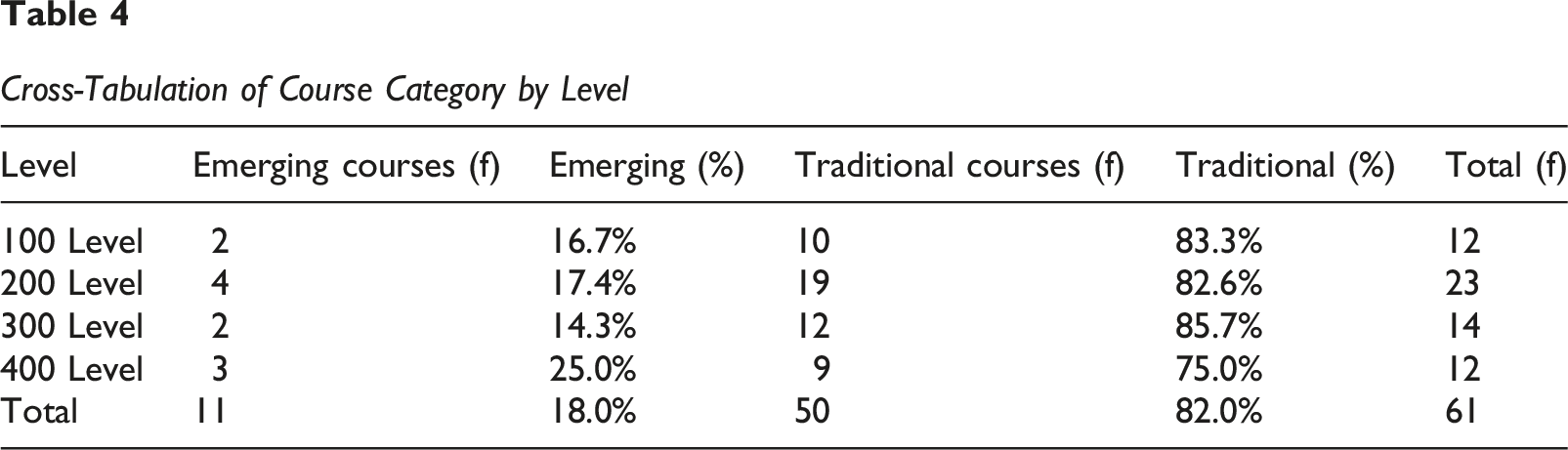
Cross-Tabulation of Course Category by Level
Cross-Tabulation of Course Category by Status
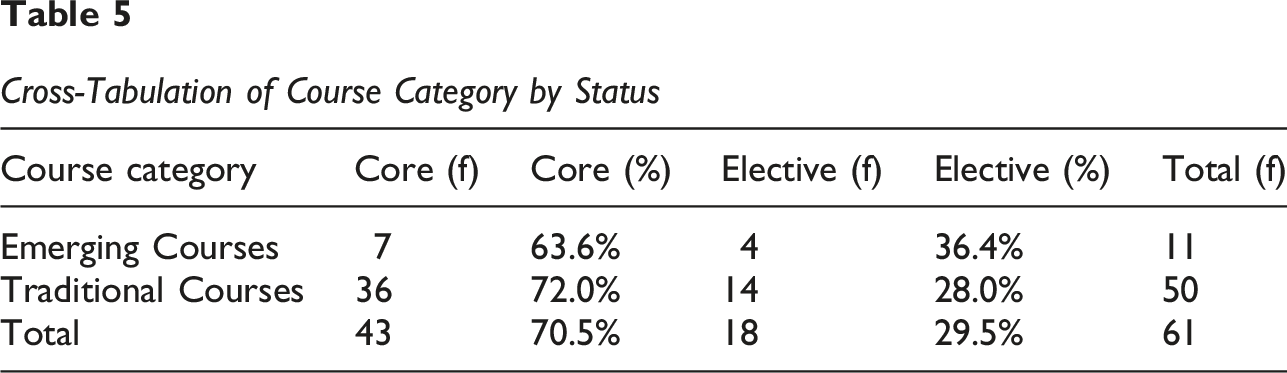
Table 1 presents the distribution of these courses across the four levels of study. Eleven courses were identified as technology-related, representing about 18% of the total curriculum. This indicates that Nigerian LIS programs still emphasize traditional library areas over technology-driven competencies. Most identified courses are introductory, such as Introduction to Information Technology in Society and Computers in Information Work, offered at the 100 and 200 levels. Advanced or specialized areas such as artificial intelligence, big data analytics, cloud computing, blockchain, and virtual reality are absent. A significant proportion of these courses are electives, implying that some students may graduate without exposure to crucial technological skills. For instance, Information Systems Analysis and Design and Medical Informatics are elective courses, meaning students who avoid them may lack relevant professional competencies. As a result, Table 1 demonstrates that while Nigerian LIS schools have made some progress in introducing digital content into their curricula, the coverage is shallow, unevenly distributed, and largely introductory in nature. The absence of advanced technology courses reflects a curricular gap between what is taught in LIS schools and the competencies required in today’s digital information environment.
Table 2 shows that 63.6% of the courses identified are core while 36.4% are electives. The highest concentration (36.4%) occurs at the 200 level, with courses such as Telecommunication, Computers in Information Work, and Operating Systems. At the 100 level, introductory courses dominate, while at the 300 and 400 levels, students encounter slightly more advanced courses such as Information and Communication Technology, Application Packages, and Digital Information Systems. Despite this progression, the absence of courses in artificial intelligence, big data, blockchain, and cloud computing indicates a shallow technological base. In sum, the findings reveal that while Nigerian LIS curricula reflect some integration of technology-related content, the coverage is minimal and uneven. Most courses focus on basic ICT literacy, leaving advanced technologies underrepresented. This limited exposure creates a gap between the skills LIS graduates acquire and the competencies required in modern, technology-driven information environments.
Table 3 shows that emerging technology courses constitute only 18.0% (f = 11) of the total LIS curriculum, whereas traditional courses account for a dominant 82.0% (f = 50). This distribution indicates a clear imbalance in the overall curriculum structure, with a significantly greater emphasis placed on non-emerging courses. The relatively low proportion of emerging technology courses suggests that they occupy a limited position within the program when compared to the total number of courses offered.
Table 4 further reveals that this imbalance is consistent across all levels of study. At the 100 level, emerging courses account for 16.7% (f = 2) compared to 83.3% (f = 10) for traditional courses. A similar pattern is observed at the 200 and 300 levels, where emerging courses remain below 20% of total offerings. Although the 400 level shows a slight increase to 25.0% (f = 3), traditional courses still predominate. This indicates that the integration of emerging technology courses does not substantially improve as students progress through the program.
Table 5 presents the distribution by course status and shows that 63.6% (f = 7) of emerging courses are core, while 36.4% (f = 4) are elective. In comparison, traditional courses have a higher proportion of core offerings at 72.0% (f = 36), with only 28.0% (f = 14) as electives. This suggests that traditional courses are more firmly embedded as compulsory components of the curriculum, whereas a notable proportion of emerging courses remain optional, potentially limiting students’ exposure to them.
Research Question 2: How Do LIS Programs in Nigeria Prepare Students for Participation in the Digital Information Environment?
Findings from the interviews reveal that Nigerian LIS programs attempt to prepare students for the digital information environment, but their effectiveness is constrained by several factors, including a persistent theory–practice gap, inadequate infrastructure, weak industry collaboration, and limited educator capacity. As a result, students often complete their studies with conceptual understanding of digital technologies but lack the hands-on competence demanded in professional settings.
On the theory–practice gap, participants consistently noted that although ICT-related courses exist, instruction remains largely theoretical. As Participant 1 explained, “We have courses like Introduction to ICT and Digital Information Systems, but most times they are handled with slides and lectures. Students rarely work with the applications or systems discussed. They understand the concepts but lack practical confidence when they graduate.” Other participants also expressed this concern. Participant 3 noted that “Even when practical components are included in the course outline, the implementation is weak, and students are not sufficiently exposed to real systems.” Similarly, Participant 6 stated that “Our graduates often understand the theory, but when they enter the workplace, they struggle to apply what they have learned in practical settings.”
Infrastructural inadequacy further limits effective preparation. Participant 2 observed that even where curricula include relevant digital content, outdated equipment and limited access to modern software hinder practical engagement. According to the participant, “Sometimes a class of 100 students shares fewer than 20 functional computers. The labs are obsolete, and software licenses have expired. So, students rely on theory and struggle to cope in real digital library environments.” Other participants noted similar challenges. Participant 4 explained that “Even when digital courses are introduced, there are no adequate facilities or reliable internet access to support practical training.” In the same vein, Participant 5 noted that “The available infrastructure does not reflect current industry standards, making it difficult for students to gain relevant experience.”
Weak collaboration between LIS schools and the information industry also emerged as a challenge. Participant 3 noted that “…We don’t have strong partnerships with digital libraries, archives, or tech companies. Internships are not well structured, so many students graduate without ever working on a real digital platform…” Other participants reinforced this view. Participant 1 indicated that “Many students are attached to traditional library settings during internships, where exposure to modern technologies is limited.” Similarly, Participant 6 observed that “There is minimal engagement with industry professionals who could provide practical insights into current digital practices.” As a result, students graduate without the necessary workplace experience that could make them more competitive in the labor market.
While some institutions organize workshops on digital tools, Participant 4 explained that these are inconsistent and infrequent, making it difficult for students to build sustained digital competencies. As stated, “Sometimes, external bodies or NGOs organize workshops for our students on things like digitization or the use of library software, but these are not consistent. It could happen once in two years, and that is all. They learn a bit today, then wait months or even years before the next opportunity comes. That kind of irregular exposure is not enough to develop real digital skills.” Participant 2 supported this by noting that “Such training opportunities are not embedded within the curriculum, so students do not experience continuous skill development.”
The issue of educator preparedness was also emphasized. Participant 5 admitted that many lecturers require retraining to effectively teach modern technology courses, noting that “To be honest, many of us who teach in library schools also need retraining. Some of the emerging technologies are new even to us. For example, when students ask practical questions about AI or cloud computing, not every lecturer can demonstrate how it works. We need professional development to update our skills.” Other participants also shared this concern. Participant 2 stated that “Some lecturers are not sufficiently equipped to teach emerging technologies beyond theoretical explanations,” while Participant 6 added that “Without continuous training, it is difficult for educators to keep pace with rapid technological changes.”
Research Question 3: What Gaps Exist Between LIS Education in Nigeria and the Competencies Required by the Information Industry?
Findings From Benchmarking With IFLA Guidelines
The benchmarking of LIS curricula in Nigerian universities against the IFLA Guidelines for Professional LIS Education Programmes (Chu et al., 2022) revealed several areas of alignment and divergence. Across the six analyzed curricula, most of the programs reflected strong coverage of traditional knowledge areas such as Information Resources and Knowledge (FKA 2), Information Services (FKA 5), and Professionalism (FKA 8). However, the Information and Communication Technologies (FKA 3) component was largely limited to basic ICT literacy, with minimal representation of advanced digital competencies such as artificial intelligence, big data analytics, blockchain, and cloud computing.
Similarly, Research, Innovation, and Evaluation (FKA 4) was underrepresented, as most curricula contained few research or innovation-oriented courses linked to technological change. The Literacies and Learning (FKA 7) domain, particularly data and digital literacies, was also weakly addressed. While some courses promoted information literacy and general ICT awareness, they did not extend to the pedagogical and applied dimensions emphasized by IFLA. In contrast, Nigerian LIS curricula retained strong emphasis on Management and Leadership (FKA 6), although leadership in digital environments was rarely featured. Generally, the benchmarking exercise shows that Nigerian LIS education curricula content remains strong in traditional library foundations but lags behind global standards in technologically driven and innovation-oriented competencies. This misalignment indicates the need for comprehensive curriculum reform to align with international expectations, especially within the ICTs, research, and digital literacy knowledge areas that are central to IFLA’s framework.
Findings From Interviews
Interview findings supported these results and presented an extensive understanding of the misalignment between LIS curricula and industry expectations. All participants acknowledged that courses on emerging technologies are largely absent, creating a disconnect between classroom learning and workplace realities. Participant 1 attributed this to the rigidity of the National Universities Commission’s Common Core Minimum Academic Standards (CCMAS), which allows departments to modify only 30% of curricular content: “…even if we want to introduce courses like AI, blockchain, or big data analytics, we can’t go far because 70% of the curriculum is fixed by NUC. This rigidity has made the curriculum outdated and disconnected from the realities of the digital information economy.”
Participants also noted that feedback from employers and alumni reflects dissatisfaction with graduates’ technological competencies. Participant 2 stated, “We constantly receive feedback from employers and even our alumni that the digital skills of our graduates are not strong enough. They do well in cataloguing, classification, and reference services, which are primarily in the traditional areas, but when it comes to things like database management, digital curation, or advanced information retrieval, they are very weak. Employers expect them to hit the ground running with modern technologies, but most of them require retraining before they can fit into today’s work environment.”
Participants further emphasized that the LIS curriculum remains heavily biased toward traditional librarianship. Participant 3 submitted that “The LIS curriculum is still heavily biased towards traditional librarianship. We continue to spend a lot of time on cataloguing, classification, and bibliography, while very little space is given to emerging technologies. This overemphasis on the old ways makes our graduates less competitive in a digital economy where employers are looking for people with skills in AI, data analytics, or cloud computing.” Participant 4 noted that “Even when we succeed in introducing some of these modern courses, funding and infrastructure become major obstacles. For instance, we have included digital scholarship in our curriculum, but there are no digital labs, no modern servers, and no reliable internet for students to practice what they are taught. So, the students only hear the theory in class without the facilities to apply it. It is like teaching someone how to drive a car by just drawing the steering wheel on the board; as such, it doesn’t translate into real competence.”
Participant 5 added that policy misalignment also impedes progress. “The NUC and LRCN have not updated their benchmarks to reflect emerging technologies. If regulators still emphasize traditional competencies, universities have little incentive to revise their curricula. Without that policy push, LIS schools will continue to lag, and our graduates will remain underprepared for the demands of the modern information society.”
Research Question 4: What Framework Can Be Proposed to Improve the Integration of Emerging Technologies Into LIS Education in Nigeria Based on the Identified Gaps?
Based on the findings from the benchmarking using IFLA guidelines and the perspectives of LIS educators, the six main gaps that emerged from the results are: shallow coverage of emerging technologies, a theory–practice gap, inadequate infrastructure, weak industry linkages, limitations in educator capacity, and weak policy alignment. On the basis of these gaps, we propose a framework for effective integration of emerging technologies into LIS curricula in Nigeria. The framework, as presented in Figure 1, is represented as a multi-pillar model. Each pillar addresses a key component necessary for effective reform: Conceptual Framework for Integrating Emerging Technologies Into LIS Curricula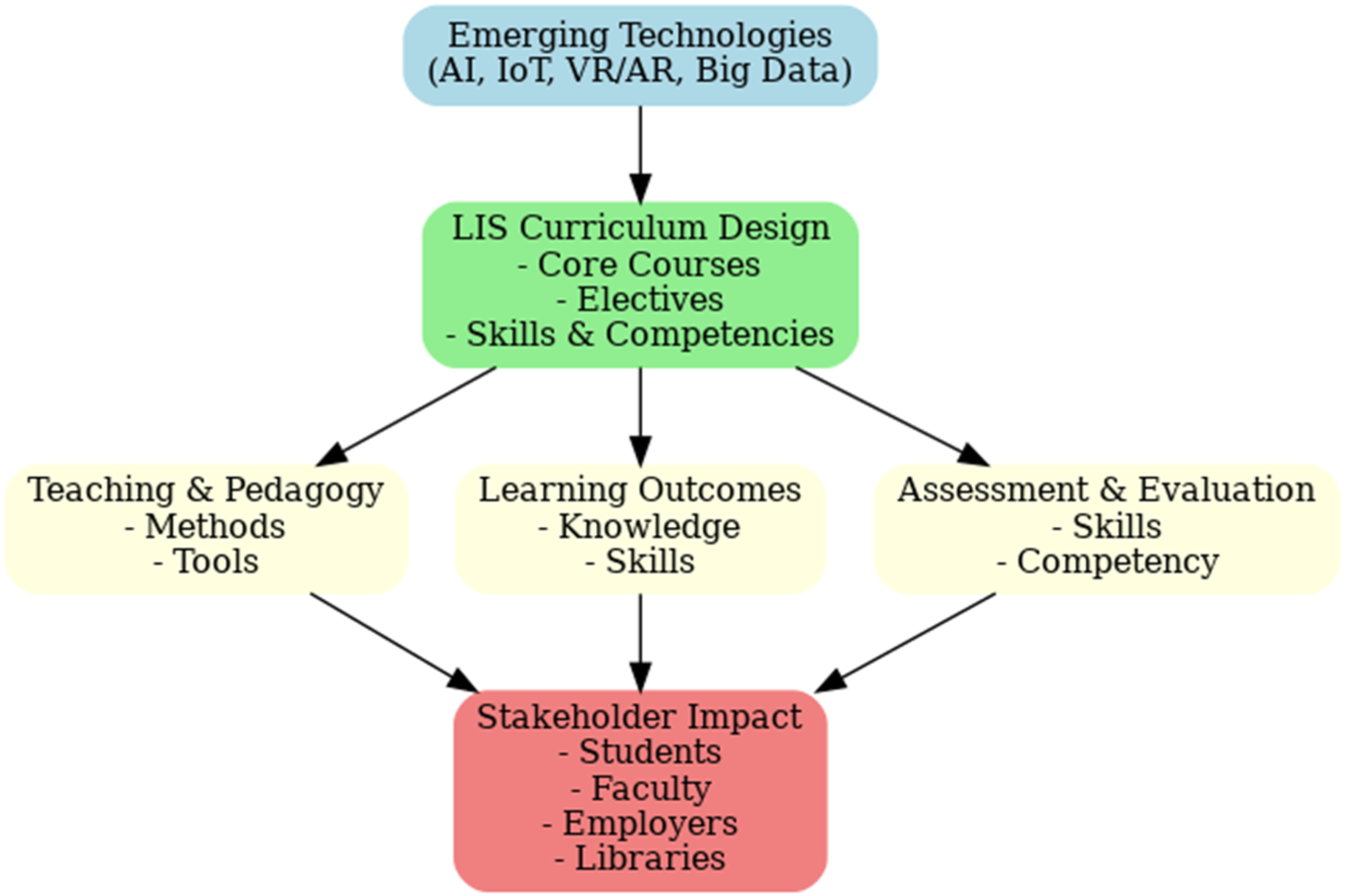
Figure 1 illustrates the dynamic interplay between emerging technologies and LIS curriculum design, emphasizing how innovations such as artificial intelligence, the Internet of Things, virtual/augmented reality, and big data inform the structuring of core courses, electives, and competency development. It highlights the cascading effects of curriculum design on teaching and pedagogy, learning outcomes, and assessment practices, ultimately shaping the experiences and capabilities of key stakeholders, including students, faculty, employers, and libraries. Through the mapping of these interconnections, the framework offers a structured guide for embedding technological advancements into LIS education, ensuring professional relevance, practical proficiency, and the cultivation of adaptive, technology-literate graduates.
At the heart of the framework is curriculum design, which mediates the influence of technological innovations on learning processes and outcomes. Curriculum design encompasses the structuring of core courses, the selection of elective modules, and the development of skills and competencies aligned with professional standards. When technological content, practical exercises, and experiential learning opportunities are strategically embedded, LIS programs cultivate both theoretical understanding and applied proficiency among students.
Curriculum design directly shapes three interrelated domains such as teaching and pedagogy, learning outcomes, and assessment and evaluation. In the teaching and pedagogy domain, instructors employ innovative methods and technological tools to foster interactive, adaptive, and collaborative learning environments. This approach enhances student engagement and facilitates experiential learning, allowing students to apply emerging technologies in authentic library contexts. Learning outcomes reflect the curriculum’s focus on knowledge acquisition, skill development, and critical thinking, equipping graduates with the capacity to navigate complex information ecosystems. Assessment and evaluation strategies are calibrated to measure not only knowledge retention but also technological literacy, professional competencies, and readiness for practice.
The framework positions stakeholders, including students, faculty, employers, and libraries, at the terminus of this interdependent process. For students, integration of emerging technologies enhances employability, adaptability, and lifelong learning potential. Faculty benefit from opportunities to refine pedagogical strategies and engage in research-led teaching. Employers and the LIS profession gain a workforce capable of delivering advanced information services and responding to technological change. Libraries, as primary sites of practice, experience improved operational effectiveness, user engagement, and adoption of smart services aligned with contemporary information management trends.
Discussion and Implications
The study revealed that emerging technology courses are present within Nigerian LIS education but remain limited in scope and depth. Although introductory courses such as Information Technology, Internet and Information Searching, and Digital Information Systems are offered, advanced areas such as artificial intelligence, big data, blockchain, and cloud computing are missing. This finding corroborates earlier studies by Adebayo and Alex-Nmecha (2019) and Babalola et al. (2018), who reported that LIS education in Nigeria continues to emphasize traditional courses such as cataloguing and classification, while only marginally incorporating ICT. Similarly, Mubofu and Mambo (2023) observed that Tanzanian LIS curricula inadequately respond to global digital trends, demonstrating that the challenge extends across African LIS education. However, international perspectives show stronger integration of advanced technologies; for example, Husain and Nazim (2015) argued for embedding knowledge management in Indian LIS curricula, while Kumar (2023) found positive student support for IoT applications in academic libraries. Beyond the general presence of technology-related courses, the structural distribution of these courses within the curriculum further reinforces their marginal position. The findings show that emerging technology courses constitute only 18% of the total curriculum, compared to 82% for traditional courses, indicating a significant imbalance in curricular emphasis. In addition, the distribution across levels reveals that emerging courses remain consistently below 25% at all stages of the program, suggesting that technological competencies are not progressively developed as students advance. Furthermore, although a majority of emerging courses are classified as core, a substantial proportion (36.4%) remain elective, implying that some students may complete their programs without sufficient exposure to critical technological skills. These patterns suggest that emerging technologies are not yet systematically embedded within LIS curricula but are instead treated as peripheral components. This finding aligns with earlier studies (Adebayo & Alex-Nmecha, 2019; Babalola et al., 2018), which report that LIS education in Nigeria continues to prioritize traditional library functions over technological innovation. It also reinforces observations by Mubofu and Mambo (2023) that African LIS curricula often lag in aligning with global digital competencies.
The benchmarking exercise, discussed earlier, further supports these findings by showing that Nigerian LIS curricula are strong in traditional domains such as Information Resources and Knowledge and Information Services but weak in technologically oriented areas emphasized by the IFLA Guidelines, notably Information and Communication Technologies (FKA 3) and Research, Innovation, and Evaluation (FKA 4). In other words, while Nigerian programs meet foundational expectations, they underperform in areas crucial for preparing graduates for the digital information economy.
The findings indicated that Nigerian LIS schools attempt to prepare students for the digital information environment but face challenges such as outdated infrastructure, a persistent theory–practice gap, weak industry linkages, and inadequate staff capacity. This resonates with the observations of Abubakar (2021), who highlighted infrastructural challenges and inadequate qualified faculty as barriers to digital adoption in LIS schools. Similarly, Ocholla (2021) described how African LIS education was disrupted during the COVID-19 pandemic due to weak technological foundations, indicating systemic limitations. In contrast, developed contexts report stronger alignment between LIS education and professional digital demands. For instance, Inskip (2015) emphasized the embedding of information literacy into LIS education in the United Kingdom as a central element of preparing students for practice. The comparison shows that while Nigerian LIS programs provide theoretical awareness of digital tools, they lag in equipping students with practical, workplace-ready competencies, a gap that weakens their competitiveness in the information industry. In addition, these findings resonate strongly with international models of LIS education. For instance, the gaps identified such as weak integration of advanced ICTs, poor industry linkages, and insufficient staff capacity directly correspond to areas emphasized in the IFLA FKAs, particularly FKA 3 (ICTs), FKA 4 (Research and Innovation), and FKA 7 (Literacies and Learning). This alignment suggests that Nigerian LIS education is not only lagging in relation to local industry demands but also falling short of globally accepted competency frameworks. As a result, the study demonstrates that curriculum reform is both a national necessity and an international imperative.
In addition, a key finding of this study is the clear misalignment between LIS education and industry expectations in Nigeria. The absence of courses in critical emerging technologies, coupled with overemphasis on traditional librarianship, has created graduates who are often ill-prepared for technologically driven roles. This is consistent with findings by Malik and Ameen (2021) in Pakistan, who reported that LIS graduates were largely trained for conventional roles, leaving them unprepared for new opportunities in digital industries. Similarly, Sibiya (2023) found that South African LIS graduates lacked competencies in digital scholarship, which employers increasingly demand. Within Nigeria, Oyetola et al. (2024) documented that although LIS educators recognize the relevance of artificial intelligence, adoption remains limited due to poor competency and resistance among faculty. These parallels reinforce that the mismatch between LIS training and labor market expectations is a recurring theme in developing contexts. However, in contrast, Jankowska et al. (2014) showed that in the United States, LIS schools increasingly embed sustainability and digital innovation into curricula, reflecting stronger alignment with societal and industry trends.
As part of the outcomes of the study, a framework is proposed for integrating emerging technologies into curricula, based on the identified gaps, including shallow coverage of emerging technologies, theory–practice gap, inadequate infrastructure, weak industry linkages, educator capacity limitations, and weak policy alignment. Thus, the proposed framework proposed the following strategies: curriculum restructuring, strengthening industry-academic collaboration, capacity-building for educators, enhancing infrastructure, reforming accreditation benchmarks, and sustainability. These strategies are consistent with the recommendations of Awodoyin and Okiki (2023), who argued that integrating IoT into LIS curricula in Nigeria requires policy support, infrastructure, and faculty retraining. Similarly, Roknuzzaman and Umemoto (2013) emphasized that knowledge management integration into LIS education demands collaborative frameworks and institutional readiness. On a broader level, Malanga et al. (2024) showed that embedding information ethics into LIS curricula in Malawi required both curricular innovation and policy guidance. Comparatively, Baker (2019) stressed that faculty conceptualizations of curriculum strongly shape its effectiveness, indicating the centrality of educators’ role in sustaining reforms.
Policy Implications of the Proposed Framework
The framework developed in this study carries several important policy implications for different stakeholders in LIS education in Nigeria: (1) National Universities Commission (NUC) should initiate a review of the Common Core Minimum Academic Standards (CCMAS) to grant greater flexibility to LIS schools in introducing advanced technology courses as core rather than elective components. Beyond flexibility, the NUC should mandate a minimum threshold of technology-oriented credits in LIS programs, reflecting the competencies outlined in global frameworks such as the IFLA Guidelines for Professional LIS Education Programmes and the ALA Core Competencies. (2) Librarians’ Registration Council of Nigeria (LRCN) should complement NUC efforts by updating its accreditation and licensing benchmarks to include emerging technology competencies, particularly in artificial intelligence, big data analytics, cloud computing, blockchain, and digital scholarship. The Council should also create a national competency framework for LIS professionals in the digital era and promote continuous professional development (CPD) initiatives in collaboration with LIS schools and professional associations. (3) Universities and library schools are central to implementing curriculum and pedagogical reforms. They should engage in curriculum restructuring and content innovation by embedding advanced and practice-oriented courses such as AI, data science, blockchain, and virtual/augmented reality as core courses at higher levels (300–400). Pedagogically, library schools should shift toward project-based and experiential learning, emphasizing capstone projects, internships, industry residencies, simulations, and service-learning opportunities that solve real-world information problems. (4) Professional Associations such as the Nigerian Library Association, and National Association of Library and Information Science Educators should serve as capacity-building and advocacy platforms for LIS educators. They should coordinate national CPD programs, organize short courses, hackathons, and certification workshops, and facilitate educator exchange programs in collaboration with ICT industry partners. (5) The government and Tertiary Education Trust Fund (TETfund) should prioritize funding for digital infrastructure and faculty development within LIS schools. Special intervention funds and grants should support educator certification, laboratory setup, and technology acquisition. Government policies should encourage cross-institutional resource sharing and regional collaboration among African LIS schools to develop open educational resources (OERs) and digital repositories for shared use.
Conclusion
This study investigates the integration of emerging technologies into LIS education in Nigeria, with the aim of identifying existing gaps and providing a basis for proposing a framework for curriculum reform. The findings reveal that while LIS schools in Nigeria have made efforts to incorporate technology-related courses, these remain basic in scope and largely limited to introductory ICT concepts. Advanced areas such as artificial intelligence, big data analytics, blockchain, cloud computing, and digital scholarship are notably absent, highlighting the inadequacy of the current curricula in addressing global trends in the information profession. Furthermore, the structural composition of the curriculum reveals that emerging technology courses account for only 18% of total offerings, remain limited across all levels of study, and are partly designated as electives, thereby restricting systematic and progressive development of technological competencies among students.
The results also showed that although LIS programs provide a foundational understanding of digital systems, their ability to prepare students for the digital information environment is constrained by outdated infrastructure, weak industry linkages, and a persistent theory–practice gap. Consequently, graduates often lack the practical skills and competencies demanded by employers in today’s technologically driven information landscape. Furthermore, a clear misalignment between curriculum content and industry expectations was identified, with employers increasingly calling for skills in data management, digital curation, and advanced ICT applications that LIS schools have yet to fully integrate. To address these challenges, the study proposed a framework for the systematic integration of emerging technologies into LIS curricula in Nigeria. The framework emphasizes the restructuring of curricula to embed advanced technology courses as core requirements, continuous professional development for educators, the provision of modern infrastructure and digital tools, stronger partnerships between LIS schools and the information industry, and the reform of accreditation benchmarks by regulatory bodies.
As a result, the study establishes that while Nigerian LIS education has recognized the importance of emerging technologies, current curricula and institutional practices remain insufficient for producing globally competitive graduates. For LIS education in Nigeria to remain relevant and impactful in the 21st-century knowledge economy, a deliberate and coordinated reform is required to ensure that LIS graduates are adequately equipped with the knowledge, skills, and competencies necessary for navigating the digital information environment.
Limitations of the Study
This study has some limitations. First, the study focused on only six purposively selected library schools across Nigeria, representing each of the six geopolitical zones. While these institutions were chosen based on their ranking, facilities, and pioneering status, the findings may not fully capture the realities of all LIS schools in the country, particularly newer or less-resourced institutions. Second, the study relied on content analysis of curricula documents and interviews with heads of library schools. Although these methods provided rich insights into the integration of emerging technologies, the perspectives of other stakeholders, such as students, recent graduates, and employers in the information industry, were not directly included. Their experiences could have offered a more holistic understanding of the alignment between curriculum content, graduate competencies, and industry expectations. Third, the study’s qualitative interviews were limited to six participants due to time and resource constraints. Although the participants were senior academics, the small sample size restricts the generalizability of the findings. Finally, the use of scheduled WhatsApp calls for interviews may have affected the depth of engagement compared to face-to-face discussions.
Suggestions for Further Studies
Following the limitations in this study, future research should adopt a broader scope by including a larger number of LIS schools across Nigeria and possibly extending to other African countries for comparative analysis. Further studies should also incorporate the perspectives of students, alumni, and employers to provide a comprehensive assessment of how LIS curricula prepare graduates for the demands of the digital information landscape. Future studies may therefore adopt additional methods such as classroom observation, course syllabi analysis, or student feedback to examine the actual implementation of emerging technology courses in LIS programs. Additionally, longitudinal studies could be conducted to track how curriculum reforms in LIS schools impact graduate employability and professional relevance over time.
Future research may also explore the integration of specific emerging technologies, such as artificial intelligence, big data, blockchain, and virtual/augmented reality, into LIS education, assessing both pedagogical approaches and practical outcomes. Finally, experimental or pilot interventions in curriculum reform could be undertaken to test models for embedding emerging technologies into LIS programs, offering evidence-based frameworks for national and regional adoption.
Footnotes
Acknowledgements
The authors sincerely appreciate the efforts of the Editor for coordinating the review process and the reviewers for their painstaking and constructive contributions. This manuscript has been significantly improved following their valuable suggestions and comments. The authors also express their gratitude to the Heads of Library Schools who participated in this study for their time, cooperation, and the confidence they reposed in the research by providing the necessary information and documents that supported this study.

Funding
The authors received no financial support for the research, authorship, and/or publication of this article.
Declaration of conflicting interests
The authors declared no potential conflicts of interest with respect to the research, authorship, and/or publication of this article.
Declaration of AI Use
The authors used GPT-5 from OpenAI to improve language and readability. After employing the use of this tool, the authors reviewed and edited the content as needed. The authors take full responsibility for the content of the publication.
Appendix
Courses in the LIS Curriculum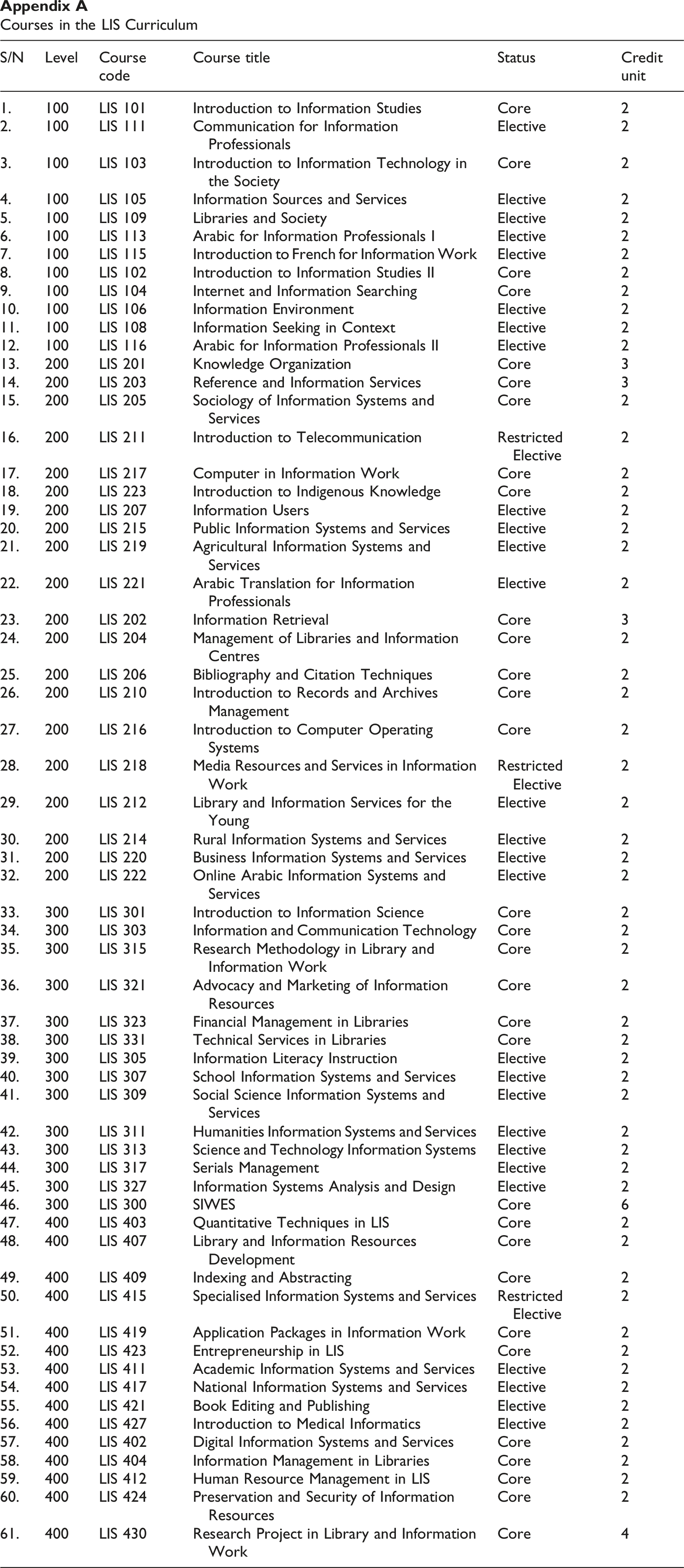
S/N
Level
Course code
Course title
Status
Credit unit
1.
100
LIS 101
Introduction to Information Studies
Core
2
2.
100
LIS 111
Communication for Information Professionals
Elective
2
3.
100
LIS 103
Introduction to Information Technology in the Society
Core
2
4.
100
LIS 105
Information Sources and Services
Elective
2
5.
100
LIS 109
Libraries and Society
Elective
2
6.
100
LIS 113
Arabic for Information Professionals I
Elective
2
7.
100
LIS 115
Introduction to French for Information Work
Elective
2
8.
100
LIS 102
Introduction to Information Studies II
Core
2
9.
100
LIS 104
Internet and Information Searching
Core
2
10.
100
LIS 106
Information Environment
Elective
2
11.
100
LIS 108
Information Seeking in Context
Elective
2
12.
100
LIS 116
Arabic for Information Professionals II
Elective
2
13.
200
LIS 201
Knowledge Organization
Core
3
14.
200
LIS 203
Reference and Information Services
Core
3
15.
200
LIS 205
Sociology of Information Systems and Services
Core
2
16.
200
LIS 211
Introduction to Telecommunication
Restricted Elective
2
17.
200
LIS 217
Computer in Information Work
Core
2
18.
200
LIS 223
Introduction to Indigenous Knowledge
Core
2
19.
200
LIS 207
Information Users
Elective
2
20.
200
LIS 215
Public Information Systems and Services
Elective
2
21.
200
LIS 219
Agricultural Information Systems and Services
Elective
2
22.
200
LIS 221
Arabic Translation for Information Professionals
Elective
2
23.
200
LIS 202
Information Retrieval
Core
3
24.
200
LIS 204
Management of Libraries and Information Centres
Core
2
25.
200
LIS 206
Bibliography and Citation Techniques
Core
2
26.
200
LIS 210
Introduction to Records and Archives Management
Core
2
27.
200
LIS 216
Introduction to Computer Operating Systems
Core
2
28.
200
LIS 218
Media Resources and Services in Information Work
Restricted Elective
2
29.
200
LIS 212
Library and Information Services for the Young
Elective
2
30.
200
LIS 214
Rural Information Systems and Services
Elective
2
31.
200
LIS 220
Business Information Systems and Services
Elective
2
32.
200
LIS 222
Online Arabic Information Systems and Services
Elective
2
33.
300
LIS 301
Introduction to Information Science
Core
2
34.
300
LIS 303
Information and Communication Technology
Core
2
35.
300
LIS 315
Research Methodology in Library and Information Work
Core
2
36.
300
LIS 321
Advocacy and Marketing of Information Resources
Core
2
37.
300
LIS 323
Financial Management in Libraries
Core
2
38.
300
LIS 331
Technical Services in Libraries
Core
2
39.
300
LIS 305
Information Literacy Instruction
Elective
2
40.
300
LIS 307
School Information Systems and Services
Elective
2
41.
300
LIS 309
Social Science Information Systems and Services
Elective
2
42.
300
LIS 311
Humanities Information Systems and Services
Elective
2
43.
300
LIS 313
Science and Technology Information Systems
Elective
2
44.
300
LIS 317
Serials Management
Elective
2
45.
300
LIS 327
Information Systems Analysis and Design
Elective
2
46.
300
LIS 300
SIWES
Core
6
47.
400
LIS 403
Quantitative Techniques in LIS
Core
2
48.
400
LIS 407
Library and Information Resources Development
Core
2
49.
400
LIS 409
Indexing and Abstracting
Core
2
50.
400
LIS 415
Specialised Information Systems and Services
Restricted Elective
2
51.
400
LIS 419
Application Packages in Information Work
Core
2
52.
400
LIS 423
Entrepreneurship in LIS
Core
2
53.
400
LIS 411
Academic Information Systems and Services
Elective
2
54.
400
LIS 417
National Information Systems and Services
Elective
2
55.
400
LIS 421
Book Editing and Publishing
Elective
2
56.
400
LIS 427
Introduction to Medical Informatics
Elective
2
57.
400
LIS 402
Digital Information Systems and Services
Core
2
58.
400
LIS 404
Information Management in Libraries
Core
2
59.
400
LIS 412
Human Resource Management in LIS
Core
2
60.
400
LIS 424
Preservation and Security of Information Resources
Core
2
61.
400
LIS 430
Research Project in Library and Information Work
Core
4