



Abstract
This article argues that investment in social inclusion policies is an economically efficient option for developing countries. It analyzes different social inclusion policies, particularly those practiced in Brazil and Colombia, as they demonstrate, among other things, the racial dimension of exclusion and the corresponding economic contribution of race-based social inclusion policies to sustained economic growth and development. These cases also demonstrate that educational policies are central to social inclusion programs, because they render the highest economic medium and long-term return. Evidence supporting this argument comes from Conditional Cash Transfers (CCTs), a Brazilian social policy that has become a landmark in social policy, as well as from Brazil’s Affirmative Action (AA) policies.
Keywords
Introduction
This article argues that social inclusion policies are economically efficient because social exclusion is costly in terms of economic growth and social cohesion. In Joseph Stiglitz’s words, “Widely unequal societies do not function efficiently, and their economies are neither stable nor sustainable” (Stiglitz, 2012, p. 83). To make this point, we analyze different social inclusion policies, particularly those practiced in Brazil and in Colombia. These case studies are especially relevant because they highlight the racial dimension of exclusion and the corresponding economic contribution of Affirmative Action to sustained economic growth and development. Central to all social policies aiming at inclusion are educational policies because they render the highest economic medium and long-term return. To demonstrate this effect, we analyze Conditional Cash Transfers (CCTs), a Brazilian social policy that has already been disseminated abroad and has become a landmark in social policy across national borders.
We will first discuss the causal paths that link poverty reduction and human capital accumulation to economic growth and “development,” followed by an analysis of some of the empirical processes and outcomes related to CCTs that made this policy scheme stand out among other social policies safeguarding the poorest of the poor. Subsequently, we analyze Affirmative Action policies (AAs) for their positive impact on inequality reduction and development. In the conclusion, the article highlights some key lessons learned from Brazil about combining CCTs with Affirmative Action. These lessons are highly relevant for countries like Colombia that also counts on a significant Afro-descendant population with a similar history of marginalization and exclusion.
Modernization is Dead
Modernization theory has an important place in the discussions about economic growth, political stability, and development. Particularly the early work of Samuel Huntington (1968) still holds some insight for contemporary students of development, especially those from rich countries, because of his insistence on the importance of the degree, not the kind, of government. As Huntington puts it, “The primary problem is not liberty but the creation of a legitimate public order. Men may, of course, have order without liberty, but they cannot have liberty without order” (Huntington, 1968, p. 7f). While this has proven to be true, much of the other assumptions held by modernization theorists have not withstood the proof of time. There is no king’s road to development. The middle class is not the only driving force for democracy, and most of all: Democracy will not automatically follow economic development, as Przeworski and Limongi (1997) have demonstrated, and as the experiences of South Africa during Apartheid, China, and most of Latin America during the late 1970s and early 1990s have amply shown. Democracy must be achieved, fought for, and actively constructed and defended or it will not emerge and survive. The direction of the causal link, if anything, goes the other way: It is not that economic development breeds democracy, but rather democracy has some important spillover effects on economic growth (Sen, 1999). More precisely, the rule of law, a functioning judicial system, and the freedom, enforced and protected by government, of people to act as they want will also contribute to economic growth – if the government provides for the necessary opportunities (such as infrastructure and effective law enforcement).
Sen’s whole “capability approach” hinges on the idea that if given the opportunity, people will act in their own best interest, and if guided by effective government, this pursuit of self-interest will produce agglomerated economic output. Sen is thus very close to Adam Smith’s original (1776) understanding of markets. With Smith, he also shares the understanding that markets can easily be distorted and become dysfunctional – something that most contemporary free marketeers conveniently overlook. Sen’s approach to development as freedom firmly supports demand-side driven economics, that is, he follows the work of Maynard Keynes, believing that investments in people’s abilities and resources will impact the whole economy positively. However, he goes beyond Keynes and argues that “free agency is itself a constitutive part of development; it also contributes to the strengthening of free agencies of other kinds” (Sen, 1999, p. 4). The core insight of Sen is clear: It is not the amount of money you have that decides how happy or fulfilled you are, but what that money can buy you; in other words, what kind of life you are able to live. Many of us have fallen prey to what Karl Marx has called “fetishism,” namely, the obsession with money for its own sake. Sen reminds us that money is a means to an end and that it is the end that matters. The freedom to choose what kind of life one wants to live, the very freedom to life, health, education, being a respected member of the community, being able to shape the institutions under which one lives, being able to breathe clean air, being and feeling safe, being able to move about – all of these are ends in themselves and not all of them can be bought with money. Money is a poor (yet easy) way to measure one’s capabilities.
Education
The most cost-effective investment a government in Africa, Latin America, and Asia can make is in education. This is consistent with both Amartya Sen’s multidimensional approach to development and with the traditional economic growth theoretical model that places human capital at the center stage.
Going beyond the instrumental connection between human capital accumulation and economic growth, Sen (1999) argues that human capital indeed adds to economic growth by increases in efficiency of the production factors. However, education per se does not guarantee increasing levels of individual income, yet even at the same level of income, an individual’s gain from education can be far reaching in terms of life possibilities. According to Sen, “a person may benefit from education – in reading, communicating, arguing, in being able to choose in a more informed way, in being taken more seriously by others and so on” (1999, p. 294). Hence, human capital formation beyond its instrumental value to economic growth represents an expansion of human agency, which in itself must be a central goal of any development or growth strategy.
From a traditional Human Capital accumulation perspective, the relation between schooling and income can be traced back to the early work done by Mincer (1958), Becker (1962), and Schultz (1961) for the US case. Former World Bank Senior Adviser George Psacharoupulos (1993) has a lifetime career built on demonstrating and measuring the economic impact of education. Psacharopoulos (2007), based on research by the New York–based Center for Benefit-Cost Studies of Education, argues that in the US, one extra high school graduate is expected to pay $139,100 more in taxes over a lifetime (Psacharopoulos, 2007, p. 20). The same research indicates that $26,600 could be saved in terms of policing, arresting, sentencing, and incarceration costs with every extra high school graduate. According to Levin (2007), the 2007 rate of high school dropouts
entails a loss of $260,000 less lifetime earnings of a high school dropout versus a high school graduate, $60,000 less in taxes paid and $58 billion in total annual health bills. The country loses $192 billion (1.6% of GDP) in income and tax revenue with each cohort of 18-year-olds who never complete high school. (Psacharopoulos, 2007, p. 23)
In the United States, one year of additional schooling would lead to 30 percent reduction of murder and assaults rates, a 20 percent reduction of car thefts, 13 percent less arson, and 13 percent less burglaries (Levin, 2007, quoted in Psacharopoulos, 2007). The same authors find that “the benefit-cost ratio of preschool programs in terms of reduced costs of crime, drug use and teen parenting is 7:1 (Levin, 2005)” (Psacharopoulos, 2007, p. 23).
The success story of such quick developers as South Korea can hardly be told without noting the tremendous impact that its educational policy has had. Cuba, despite all its unfreedoms and problems, provides yet another empirical example of the importance of making education a government priority. It might also indicate some of the pitfalls of doing so: Once people are learned, they will not readily accept unfreedom.
Regarding the impact of human capital accumulation on growth, economists Joseph Stiglitz and Shahid Yusuf (2001) have demonstrated that what matters most for achieving sustained growth is what economists call “Total Factor Productivity” (TFP), which measures the increase of worker efficiency. Together with the value of how much input an economy receives (in terms of resources), TFP determines the overall output of an economy, where investment in education is computed as an input. Different from other inputs, however, educational input also impacts TFP, as higher levels of learning lead to more efficient behavior among workers and entrepreneurs. Hence, according to Stiglitz, “the key policy issue facing all developing countries remains: How to close the knowledge gap” (Stiglitz & Yusuf, 2001, p. 512). Stiglitz summarizes his explanation for the “East Asian Miracle” with this general statement: “The most successful governments have realized the importance of these social policies (including egalitarian income distribution and education policies), not only as ends in themselves but as necessary for long-term economic growth” (ibid., p. 525). Also, Barro and Lee (2010), using an updated panel data set of world educational attainments, confirm that indeed the schooling of workers has a positive effect on economic output. Furthermore, supporting Stiglitz and Yusuf’s arguments, Barro and Lee found that “The gap between developing and advanced countries in average years of schooling among the overall population over age 15 remains high (3.94 years in 2010) as it has narrowed by only less than 1 year in the past 40 years” (2010, p. 12).
The argument for sustained economic growth, based on increases in human capital and factor productivity, is clearly supported by empirical data for the case of Latin America and the Caribbean as well. The 2002 ECLAC report, “Education and the Labor Market in Latin America: Why Measurement Is Important and What It Tells Us About Policies, Reforms and Performance,” provides some interesting insights. In this report, the authors demonstrate that in the region, secondary, post-secondary, and tertiary education are very important in relation to labor market returns. As such, they are also related to the likelihood of leaving poverty behind. The report concludes that the problems of educational quality and equity in access should be central in the design of development policies in the region.
Moreover, a previous report by ECLAC (1997) analyzes the income levels of the newcomers to the labor market in Latin America and found that in 80 percent of the cases, having a minimum of 12 years of schooling is the threshold for earning enough income to leave poverty. If we take these arguments into account and consider additional empirical results cited in ECLAC (2002), which argued that inequality in employment opportunities and the wage differential between skilled and unskilled workers explains much of the inequality in the region, then it becomes clear that education and human capital formation beyond elementary education are requirements to generate productive and competitive economies in a global context. Furthermore, it is safe to argue that having well-educated citizens will have a positive impact on democratic governance and social cohesion, increasing both and thus, raising individual and societal utility functions.
However, Latin American countries are at a great disadvantage in terms of human capital accumulation.
In the OECD countries almost everyone now goes on to upper secondary education and the great majority, nearly 80%, completes it with Japan at 95% heading the list. In Latin America and the Caribbean only half go on to upper secondary education and, on average, less than a third completes it. Even in the NIAE (Newly Industrialized Asian Economies) countries nearly 75% go on to upper secondary education. (ECLAC, 2002, p. 14)
It also becomes clear that despite gains, countries in the region have been unable to provide their economies with the highly skilled workforce needed to improve their international competitiveness and ensure sustained economic growth, perpetuating pervasive social inequalities instead. As a result of these and many other related findings, social policies focused on education, health, and infrastructure have moved to the center stage of the development discussion. This time it is not advocated by social scientists and humanists, but by mainstream economists, whose main concern is not social justice per se, but sustained economic growth and prosperity.
The Cost of Exclusion and Discrimination
Mayra Buvinic (Buvinic, Mazza, & Deutsch, 2004), in her introduction to the Inter-American Development Bank (IDB) report, “Social Inclusion and Economic Development in Latin America,” which she coedited, writes that several Latin American countries have started to focus on strategies aimed at including historically excluded segments of their societies. She mentions the 1991 Colombian Constitution, affirmative action in Brazil, anti-discrimination legislation in Mexico, the 1997 Peruvian law which criminalizes discrimination, as well as several policies and projects for Garifunas in Honduras, indigenous people in Chile, Afro-descendants in Colombia, and for people with disabilities in Mexico and Nicaragua. Buvinic then argues that “Reflecting this new interest, international development agencies have embraced the goal of social inclusion and supported research on the causes of poverty and inequality and the remedies” (Buvinic et al., 2004, p. 4). While it is not easy to define and measure what exactly inclusion is, Buvinic and her coeditors and coauthors all agree that poverty, access to quality services, access to physical infrastructure, access to participation in labor markets, social participation and social capital, justice and political participation, as well as violence and victimization constitute exclusion, so the policies aimed at inclusion must target these factors.
To these authors, excluded groups and individuals tend to be invisible, poor, stigmatized, discriminated against, and suffering from an accumulation of these factors. In “Global Synthesis: Consultation with the Poor” (known as “Voices of the Poor”), one of the background reports on a participatory assessment done with the poor by the World Bank (Narayan, Chambers, Shah, & Petesch, 1999), the authors argue that
The stigma of poverty was a recurring theme. Many participants spoke of how their poverty prevented them from participating fully in society. Being unable to follow the traditions and customs of their respective cultures was a humiliation for many...The poor also spoke about discrimination – that is, being denied opportunities – and humiliating treatment by officials. There was a widespread experience of being treated badly, whether by guards at supermarkets or by uncaring doctors, nurses, school teachers, and traders. (Buvinic et al., 2004, p. 13)
Hence, not surprisingly, all authors contributing to Buvinic’s publication agree that “Policies for inclusion call of public investments to correct imbalances in access to quality services and to productive and political resources. They strive to ‘level the playing field’ and create an enabling environment for the excluded to exercise their agency” (Buvinic et al., 2004, p. 10). These assertions are all very much in tune with the “Voices of the Poor” and Sen’s multidimensional approach.
Several Latin American countries now provide statistical information on the situation of their minorities, which is deemed by many as an important first step in the struggle to overcome exclusion, as it provides the necessary information on the excluded, their numbers, location, and characteristics, without which public policies cannot be designed. According to Buvinic, “Twelve countries in the region included questions on ethnicity and race in the 2000 round of population censuses, some for the first time (Honduras, Peru)” (Buvinic et al., 2004, p. 11).
On the basis of their assessment of several countries of the region, these authors assert that what needs to be done in order to break the vicious cycle of exclusion is to break the intergenerational transmission of disadvantage; to expand access to labor, land, and capital markets; to implement integrated local development projects; to actively combat stigma and discrimination with laws and preferential policies; and to empower socially excluded groups. The policy recommendations these authors suggest in order to achieve these goals include “establishing national civil and social rights frameworks to address and remedy discrimination, and…addressing the multiple causes and consequences of exclusion through inclusionary social and economic policy” (ibid., p. 25).
Why is fighting exclusion of such importance? Our own answer is very much in tune with Buvinic’s: Beyond issues of justice, which by themselves represent a major incentive, “Discrimination and exclusion are costly to the economy and society” (ibid., p. 26). Inequality imposes high economic and social costs through lower accumulation of human capital, which in turn correlates negatively with economic growth and societal cohesion. The adverse impact of inequality is difficult to gauge with accuracy, but some economists have attempted to measure the economics of exclusion and discrimination. Jonas Zoninstein, in his contribution to the same IDB publication mentioned above, asserts that without discrimination, “Bolivia’s economy grows by 36.7 percent, Brazil’s by 12.8 percent, Guatemala’s by 13.6 percent, and Peru’s by 4.2 percent” (Zoninstein in Buvinic et al., 2004, p. 45). Zoninstein also locates the most important cause responsible for reproducing exclusion: Education. He writes: “In a comparative study of schooling and earnings in South Africa and Brazil, Lam (1999) found that differences in schooling explain much of the earning inequalities in both countries” (ibid., p. 48). And he concludes, that
[a] social inclusion strategy could start by promoting more and better investment in human capital of Afrodescendents and indigenous peoples and by ending occupational discrimination. These changes would increase the productivity and reduce unemployment among these excluded groups, leading to increases in the productivity of labor and capital, the incentives to invest in new plant and equipment, and the competitive strength of the economy as a whole, including activities oriented to external markets. (Lam, 1999, p. 49)
Indeed, Ocampo and Vallejo (2012, p. 128) argue that even though access to primary and secondary education in Latin America is gradually improving, gaps in terms of quality of education at all levels and gaps in access to tertiary education continue to be a major issue, leading to a more educated workforce in average years of schooling, but a less productive one. According to these authors, investment in educational quality, in higher education, as well as in measures that provide more access for historically excluded groups is paramount to guaranteeing a more sustainable economic growth prospect. Access to education in Latin American countries, given their historically high income inequality, has always been a problem. According to Klein and Porta (2001), the major factors affecting secondary school attendance in Latin American countries are income and location inequalities (urban–rural) (p. 46). The effect of income inequality increases when looking at tertiary education attendance rates (Klein & Porta, 2001).
Going back to the ECLAC (2002) report on Latin America and Caribbean countries (LACs), it is possible to observe in Table 1 how LACs were already falling behind the newly industrialized economies, NIAE countries, not only in terms of enrollment ratios for both secondary and tertiary education, but also in terms of ratio increases between the mid-1980s and late 1990s (p. 16).
Enrolment in Secondary and Higher Education: 1985 to 1997
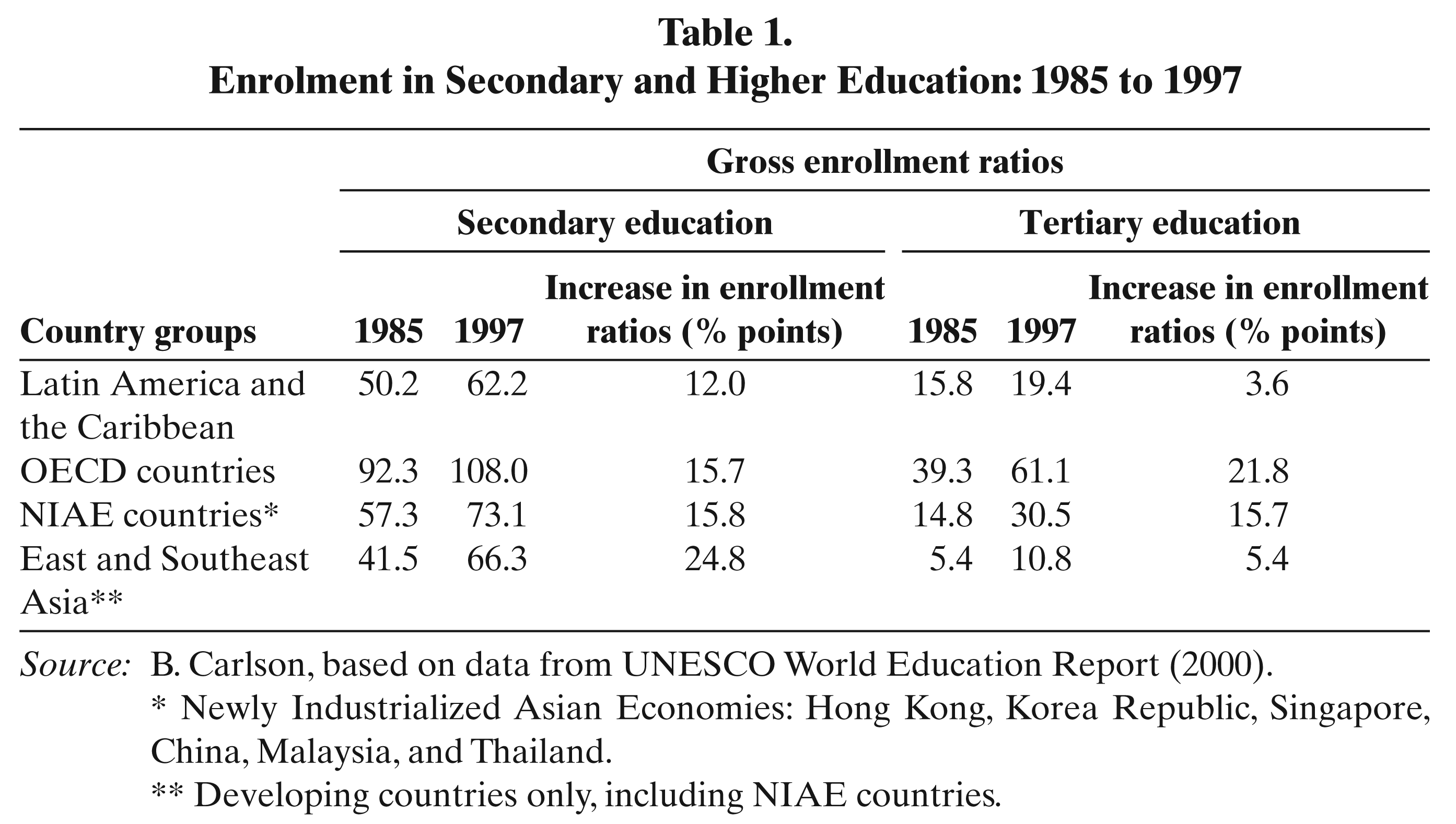
Source: B. Carlson, based on data from UNESCO World Education Report (2000).
* Newly Industrialized Asian Economies: Hong Kong, Korea Republic, Singapore, China, Malaysia, and Thailand.
** Developing countries only, including NIAE countries.
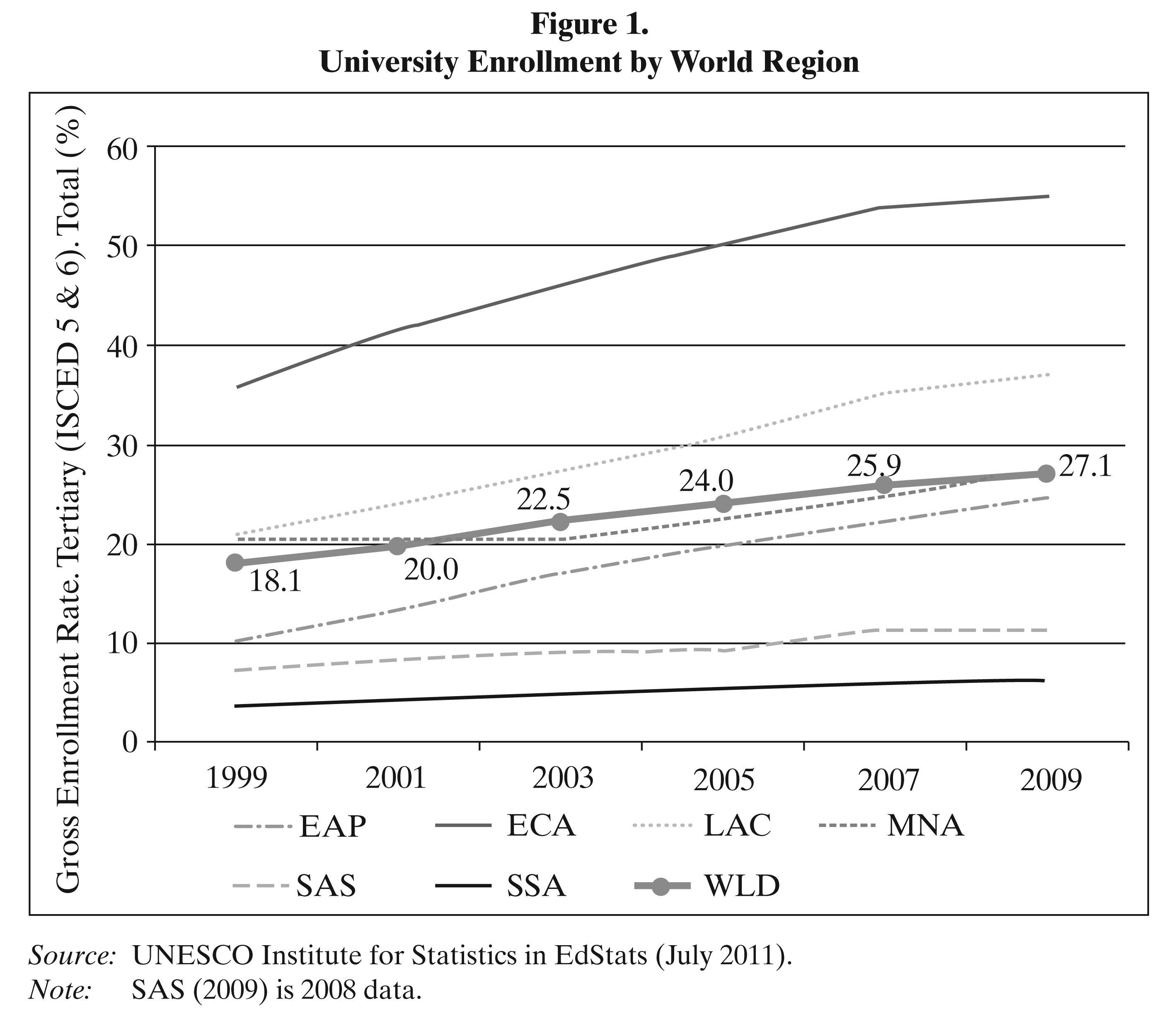
It is important to highlight that although secondary enrollment in LACs has increased steadily, from 59 percent in 1999 to 73 percent in 2009, tertiary enrollment is still low in comparison to developed economies (Klein & Porta, 2001). Also, there are some important overtime changes. Hong Kong, Singapore, and Taiwan are considered nowadays as developed economies by the International Monetary Fund (IMF). The Korean Republic is now classified by the IMF under “other advanced economies.” Only Malaysia and Thailand are still classified as developing economies within Asia – and so are Brazil and Colombia. 1
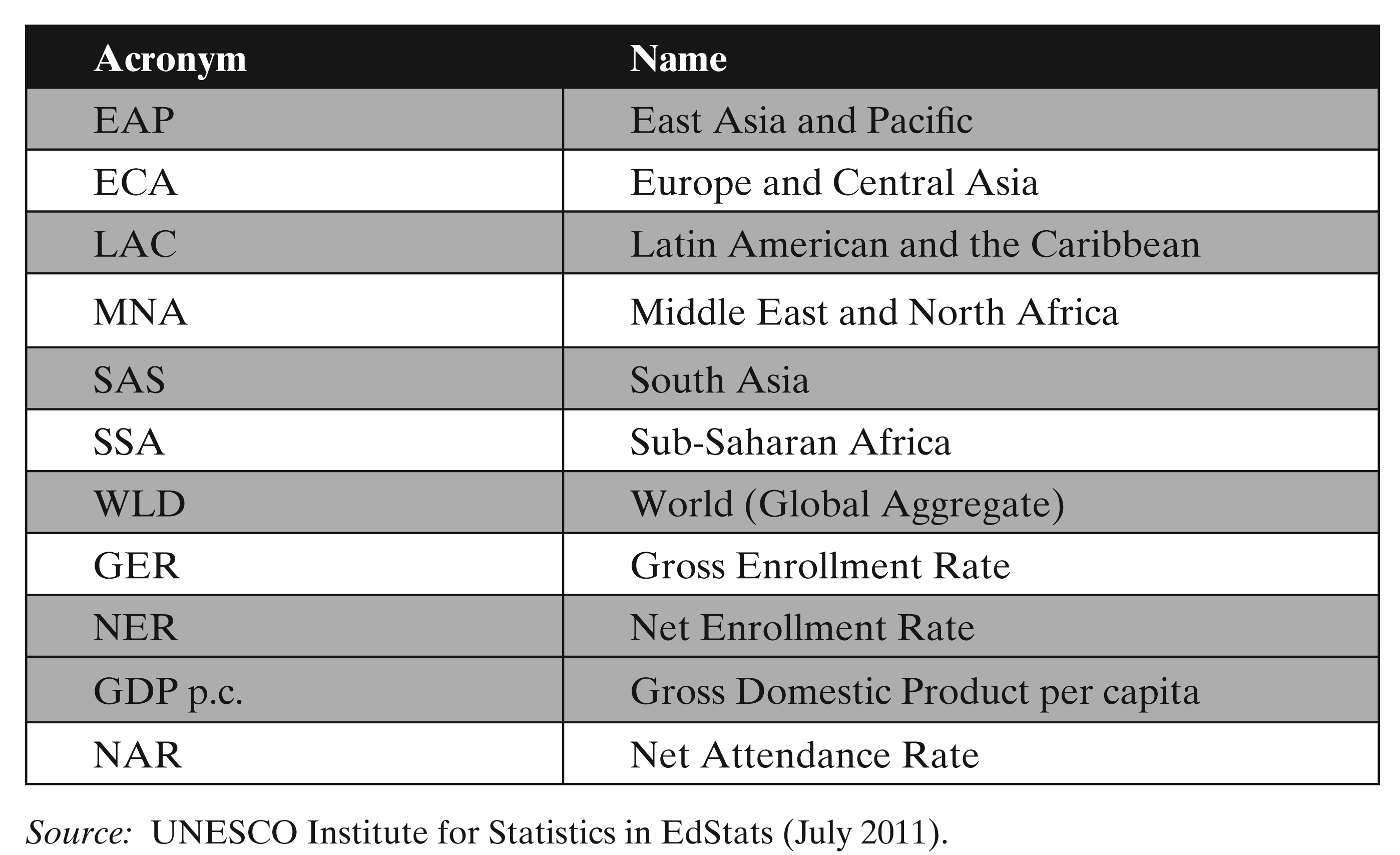
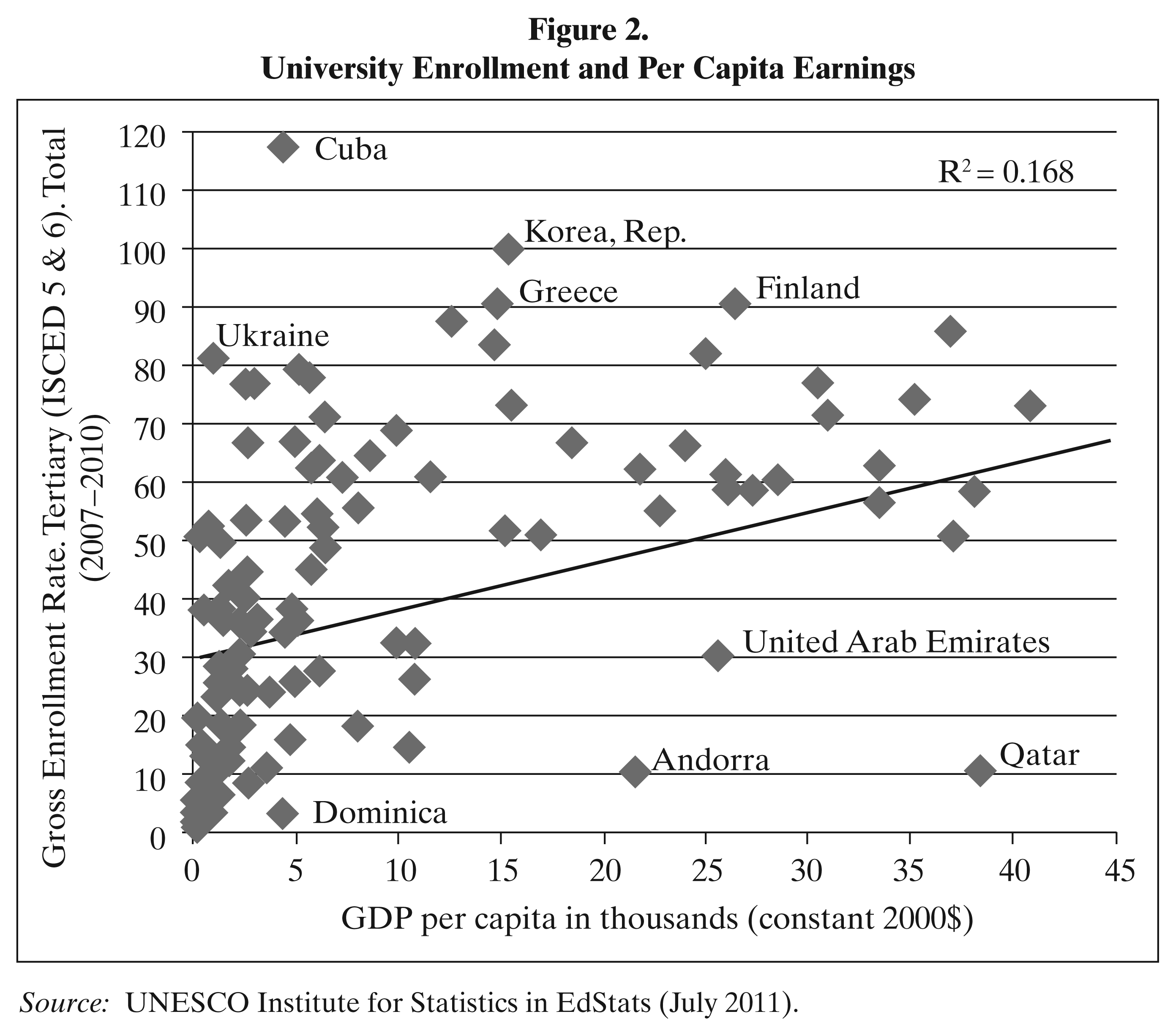
Therefore, it is possible to observe how the LACs are still lagging behind in both human capital accumulation and economic growth rates. In fact, the data in Figure 1 from “The State of Education Analysis Series” by the World Bank (ibid., pp. 48 & 52), corroborates those statements. The authors found a high correlation between tertiary education enrollment and a gross domestic product (GDP) per capita. They also found a significant gap in tertiary enrollment rates between LACs and developed economies (see Figures 1 and 2, and also see acronym guide to better understand graphics).
Source: UNESCO Institute for Statistics in EdStats (July 2011).
Source: UNESCO Institute for Statistics in EdStats (July 2011).
Source: UNESCO Institute for Statistics in EdStats (July 2011).
With this information in mind, the case for social policies, particularly investment in education, could not be any clearer, stated more pervasively, or supported with more evidence. Anybody who opposes it opposes sound empirical evidence and research. Social investment is investment into a country’s economic growth and development, with investment in education standing out as by far the most effective. The case for social and educational policies thus is no longer a case for justice alone; it is a case for collective economic growth. 2
Conditional Cash Transfers
According to Ariel Fiszbein and Norbert Schady (2009, p. 1),
Countries have been adopting or considering adoption of CCT programs at a prodigious rate. Virtually every country in Latin America has such a program. Elsewhere, there are large-scale programs in Bangladesh, Indonesia, and Turkey, and pilot programs in Cambodia, Malawi, Morocco, Pakistan, and South Africa, among others. Interest in programs that seek to use cash to incentivize household investments in child schooling has spread from developing to developed countries – most recently to programs in New York City and Washington, DC.
These authors speak of a “CCT Wave” which, in 2009, benefited 5 million households in Mexico and 11 million families in Brazil, that is, some 46 million people in Brazil alone.
The idea behind CCT programs is simple. Families need savings to make investments. Given that the poorest are unable to save, they cannot invest and thus remain outside of markets, or, in the case of the very poor, they do not have enough money for their own consumption. By giving them small amounts of money, they will be able to feed their families and gain the opportunity to invest – and thus be able to work their way out of poverty. This is not a new idea, but classical demand-side Keynesian economics. What gave this old idea its revolutionary character was the insight that most poor children are out of school not because they want to, but because their parents make them work. In 1995, under the governorship of Cristovam Buarque, the Brazilian capital of Brasilia started a social program called Bolsa Escola that sought to give parents incentives to keep their children in school, namely, by providing them with the money they could otherwise earn begging in the streets or working. From the beginning, this program was conditional: Parents could get the money only as long as their children remained in school. By paying parents if they kept their children in school, this program was able to address several problems at once: To provide money to poor families so that they could invest and participate in markets and to find a way to keep children in schools, which not only positively impacts them but also promises to contribute to the gross national product (GNP) by actively fighting exclusion (Castro & Bursztyn, 2008). In 2003, when Luis Inacio Lula first took office in Brazil, this program was merged with others into the well-known Bolsa Familia Program and applied on a national level. In its current form, Bolsa Familia demands that children under 17 stay in school; that children aged 0–7 receive all required vaccinations and grow according to established targets; that pregnant women participate in prenatal care; and that lactating women participate in a monitoring program. In 2007, this program cost the Brazilian Federal government US$4.7 billion, which equaled 0.3 percent of its GDP (Brazilian Ministry for Social Development and Hunger Eradication).
The impacts of Bolsa Familia and similar programs have been impressive. Not surprisingly, according to Fiszbein and Schady (2009, p. 15),
…the largest consumption impacts are found when the transfer amount is generous (as with the Red de Protección Social [RPS] program in Nicaragua). Moreover, because transfers generally are well targeted to the poor, the effects on consumption have translated into impacts on poverty…Some of the reductions in poverty are quite large. In Nicaragua, for example, poverty fell by 5–9 points (using the 2002 data).
The successful targeting of the poor is one of the reasons of the program’s success, not only because CCTs allow for a high degree of accountability of public resources but also because the benefits are very visible. By 2007, the Brazilian program showed exceptional results in the targeting of beneficiaries with 73 percent of resources reaching the lowest income quintile and 94 percent going to the two lowest income quintiles (Lindert, Linder, Hobbs, & Brière, 2007, p. 6).
Between 2003 and 2009, the income of poor Brazilians has grown seven times as much as the income of rich Brazilians and poverty has fallen during that time from 22 percent of the population to 7 percent (World Bank, n.d.). According to Lustig, Lopez-Calva, and Ortiz-Juarez (2011), Brazil’s Gini coefficient declined by 5.4 points between 1998 and 2009. Over half of the reduction in extreme poverty (2/3) can be attributed to the reduction in inequality. To these direct benefits, one should add the money the Brazilian government is saving by preemptively avoiding all those costs that a population without education and good health is likely to accrue.
In this respect, the example from Colombia is particularly telling. The Colombian Familias en Acción program provides direct monetary support to mothers of the beneficiaries (children), subject to family compliance with conditionalities. Families have to ensure school attendance of children and must adhere to regular health checkup appointments that monitor, and seek to ensure, children’s biological growth and development. The verification of compliance with the set of commitments is aimed at fostering household responsibility, which complements the investment in human capital of children. Thus, the program increases the income of families in extreme poverty, allowing them to be linked to market transactions. This and the human capital formation associated with the conditionality, in turn, allow them to improve their living conditions.
According to the Colombian National Department of Planning (2008) and based on a three-year panel survey (2002, 2003, 2006), this program showed positive results in several dimensions of well-being. In education, the program showed a positive impact on the school attendance rate of 4.48 percent. In rural areas, school attendance increased even more, by 7.84 percent, while school attendance in urban areas increased by 2.9 percent from 2002 to 2006. In addition, child labor was successfully reduced, especially in rural areas, which is directly related to higher school attendance rates. The program is associated with a decrease in labor market participation rates of girls (10–17 years) in both rural and urban areas, while for boys the decrease was significant only in urban areas. In the three years of the study, the rural girls’ labor market participation rate dropped from 35.6 to 29.2 percent, while for boys the reduction was 5.5 percent. There was also a reduction in the hours worked per day, for girls and boys aged 10–13 years old and 14–17, of 4.6 percent and 9.2 percent, respectively.
The Colombian program also had a significant positive impact on nutritional patterns. Significant positive effects were obtained in total consumption in rural areas, while total consumption also increased in urban areas, even if not significantly. On an average, consumption increased by 9 percent in rural areas and by 6 percent in urban areas, with food consumption being the main item to explain these increases. This finding is closely related to nutrition improvements, as variety of food intake is also a positive result of the program. Families reported a consumption increase of higher quality foods.
While vaccinations did not show a relevant change, the rate of attendance for regular infant health checkups increased by 44 percent in urban areas and by 20 percent in rural areas. As a result, participating infants (0–2 years of age) were on an average 0.78 cm taller than non-beneficiaries of the same age bracket. Similarly, a significant reduction of the percentage of children affected by diarrhea was achieved in rural areas (more than 10 percent for children aged 0 to 4 years). Overall, the impact of Familias en Acción has been so positive that it has been made a national law in 2012 so that over 2.3 million families are expected to be covered by its benefits.
In sum, it is possible to observe why CCTs have spread beyond Brazilian national borders. The implementation of this policy has rendered positive short-term effects such as the reduction in poverty and inequality, higher rates of school attendance, and improved children’s health. In the long run, these policies are very likely to impact human capital accumulation, which, in turn, will impact economic growth rates and democratic governance.
The Convergence of Social Policy and the Achievement of Racial Equality
The topic of racial equality in LACs has gained increased attention since the early 1990s. Though a contested arena, the social inclusion of racial and ethnic minorities is of utter importance for the sustainability of democratic governance and the achievement of development in the region. The cost of racialized exclusion and inequality, in terms of justice, peace, and economic development, is too high for political regimes to ignore them. In this sense, it is imperative to determine which policies and interventions work and how they can be implemented in local contexts.
Similar to CCTs that started in one country and traveled abroad, Affirmative Action policies started in India and have traveled to countries such as the United States, South Africa, and Brazil. AA policies were put in place to correct pervasive racial and ethnic disparities, which are the product of historical conditions, and are defined by the United Nations as “…a coherent packet of measures, of a temporary character, aimed specifically at correcting the position of members of a target group in one or more aspects of their social life, in order to obtain effective equality” (UN, 2002, p. 3). Despite meeting with strong opposition, these policies have brought positive results in terms of inclusion of minorities and reduction of race- and ethnicity-based inequalities in all dimensions of development, from education to geographical segregation and health access.
Affirmative Action was introduced over 50 years ago in India, where the post-independence government had a strong commitment in the fight against caste-based exclusion. The first policies were undertaken under the leadership of Dr Bhimrao R. Ambedkar, Chairman of the Drafting Committee of the 1950 Indian Constitution. Piron and Curran (2005) argue that electoral quotas in India have guaranteed political power beyond mere representation to excluded castes. Quota access to education, especially higher education, has allowed for upward social mobility patterns, creating a more inclusive middle class. According to the authors, a study from 1996 showed that a sizeable proportion of the Indian middle class were second- and third-generation beneficiaries of these policies.
In the case of South Africa, the same authors argue that AA policies were implemented since 1994 with the post-apartheid elected government. The political willingness of the government to tackle racial injustices can be appreciated in a steady decline of inequality, which, measured by the Gini index, went from 0.67 in 1991 to 0.57 in 2000.
Similar results can be observed in the US, where AA policies were implemented in the late 1960s as a result of the 1964 Civil Rights Act that ended legal segregation, signed by President Johnson. AA in the US had a strong emphasis on access to higher education from the beginning, given the strong correlation of educational achievement with employment and income. In the US, these policies were the main reason why the percentage of black college graduates (aged 25–29) rose from 5.4 to 15.4 percent between 1960 and 1995 (Bowen & Bok, 1998). Bowen and Bok (1998) explain that due to AA, African Americans gained access to formerly exclusive academic disciplines. For instance, the percentage of black law students in 1960 was close to 1 percent, but in 1995 it had reached 7.5 percent. Equally important was the rise of the percentage of African Americans with medical degrees, which went from 2.2 percent in 1964 to 8.5 percent in 1995. As a result of the strong emphasis on higher education, by 1996 African Americans made up 8.6 percent of all male professionals and 13.1 percent of female professionals in the United States. Even political representation showed a dramatic increase during the heydays of affirmative action, with elected black officials increasing to 7,984 in 1993 compared to 280 in 1965.
In Brazil, AA policies emerged officially in 2002. Their implementation was the result of a variety of reasons, amongst which was a 1950 UNESCO report that denounced Brazilian racism. Since then, other authors questioned the validity of the traditional tropes of racial democracy upon which Brazilian national identity was based (Reiter, 2009c; Skidmore, 1998). After years of social mobilization and political struggle, with the re-democratization and the arrival of Fernando Henrique Cardoso to the presidency in 1995, AA policies finally gained political momentum. So far, these policies have mainly focused on guarantying access to higher education and to guarantee public employment opportunities.
According to Marques da Silva and Dias da Silva (2009), between the years 2002 and 2009, 90,287 young blacks entered higher education through these types of initiatives. Nowadays, there are more than 80 higher education institutions with affirmative action quotas. Also, in addition to individual institutions of higher education adopting these types of policies to promote race-based access, the federal program Universidade para Todos – The University for All Program (ProUni) – grants full and partial scholarships to poor undergraduate students and supports vocational training in private institutions of higher education to all those unable to afford them. It was created by the Federal Government in 2004 and institutionalized by Law No. 11,096 on January 13, 2005. The program provides tax exemptions to those educational institutions that adhere to the program. Though it is not directed to black students but to all graduating high school students that prove a per capita income lower than three minimum wages, the authors show that between 2005 and 2009, some 247,000 black students have benefited from the program. By 2011, this number had increased to an estimated 350,000 black students.
In Brazil, race-based affirmative action policies of access to higher education have been managed in a decentralized manner, thus giving higher education institutions ample discretion as to the implementation of them. As a result, it is difficult to have national data regarding the socioeconomic impact of these policies, but individual universities have invested a great deal of effort into guaranteeing the transparency and efficiency of these policies. In this effort, many universities have managed to collect and analyze data on their AA programs. Roberto de Mattos (2003) describes the experience of the State University of Bahia (Universidade do Estado do Bahia, UNEB), which implemented AA in 2003. In the 2003 vestibular, 3 of the 60,955 applicants 30.6 percent applied seeking entry through the University quota system, which reserved 40 percent of vacancies to Afro-descendants. After the selection processes, a total of 28,214 students were admitted, 40.54 percent of whom were Afro-descendants. The author finds that the majority of admitted Afro-descendants came from public schools and from lower-income families.
The same author argues that labor market inequalities persist despite the relative success of AA, which, to him, points to the necessity to seek complementary policies to cover different aspects of racialized inequality. Dos Santos and Queiroz (2010), also analyzing the state of Bahia, focus on the experience of the Federal University of Bahia (UFBA), where quotas were introduced in 2004. They show that before 2004, the percentage of students coming from public schools was around 38 percent. After the implementation of quotas, it reached 50 percent. Critics of AA policies argued that “quotistas” would perform badly, thus lowering general standards and thus, jeopardize the broadly accepted merit principle. However, these authors showed that the data refutes these arguments. To the contrary, in 11 of the 18 preferred careers “quotistas” showed a better or equal performance in relation to “non-quotistas.”
Despite the lack of systematic data and the lack of specific race-based AA policies at the National Level, the authors were able to conclude that the AA initiatives in place have created new spaces for black social mobility and racial equality in the country. Furthermore, numerous studies about the issue of inequality in Brazil found a strong correlation between access to higher education and labor market insertion (Beccaria, Maurizio, Fernandez, Monsalvo, & Alvarez, 2011; Buvinic et al., 2004, pp. 179–247). These positive impacts may not fully compensate the negative impacts of racial discrimination as wage disparities between racial and ethnic groups are very high and pervasive, but they have a significant impact in improving equality and achieving sustainable economic growth.
Finally, it is worth noticing that it is reasonable to expect the new Affirmative Action Law enacted by the Brazilian President Dilma Rousseff in August 2012 to have a significant impact on Brazil’s poor minorities. Bolsa Familia benefits black families significantly more than white families. In 2007, 24 percent of black (preto and pardo) households benefited from the program – almost three times the percentage of white households (9.8%). The new federal Affirmative Action framework, which aims mostly to promote public high school graduates, will disproportionally affect Afro-Brazilians. The Special Secretary for the Promotion of Racial Equality, Luiza Barrios, stated that her office expected the number of black students admitted to public universities to rise from 8,700 to 57,000 (Romero, 2012).However, universalist policies, though with good intentions and in most cases good results as well, have proven insufficient to deal with institutionalized discriminatory practices that affect certain groups disproportionally. India provides a good example for this being the case. Therefore, not only a greater range of affirmative action policies are needed but also for longer terms to really impact structural race-based barriers (Bowen & Bok, 1998).
Conclusion
Recent research on the impact of social investment, especially on education, all point to the path that countries need to follow if they seek to achieve sustained economic growth. They need to find ways to fight back the extremely entrenched exclusion of parts of their populations, so that these historically excluded segments can become active members in their democracies and in their national markets. The cost of neglecting this task is extremely high.
The experiences of CCTs and AA policies are blueprints for social policy design and innovation. Access to higher education is the sine qua non precondition for formal labor market insertion, guaranteeing income generation of those families in need.
In this context, the need for an efficient assignment of scarce public resources and the imperative of inequality reduction call for exploring possible multidimensional objectives of CCTs. In Brazil, a starting point could be to extend the subsidies for black families sending their kids to higher education institutions, including those that prepare youth to take the vestibular. This would allow for a fine graining of families receiving federal benefits, and allow the particularly needy to have their children inserted in the formal job market and thus enhance their chances to secure family income levels above the poverty line.
In Colombia, on the other hand, the discussions around overlapping of public policy objectives are still recent, despite some advances made since the passing of the new national constitution in 1991. In Colombia, laws and regulations dealing with racial disparities advanced at a much greater pace than its empirical implementation, thus, making real life impacts invisible or minuscule at best. Still, if recent dynamism in academic and political debate around the issue of racial equality is indicative of a trend, then the discussion around affirmative action policies could gain momentum (Mosquera & León Diaz, 2009). It could be expected then that in order to maximize fiscal expenditure, instruments already in place could be a good starting point, as they could serve dual purposes. Specifically, looking at the targeting schemes 4 and conditionality compliance of the CCT could serve also to identify possible beneficiaries of affirmative action policies. In Colombia, this will also call for a regional redistribution of public resources as the Afro-descendant population is still highly segregated, located in the most deprived areas of the country. Finally, it is important to highlight that in the case of Colombia, the efficient usage of resources for these types of programs is of utmost importance, given that Familias en Accion has been mainly financed with funds from international lenders. Bundling different programs allows for a more efficient allocation of scarce resources, which is essential to their continuity.