




Abstract
This article presents evidence on the divergent development experiences of Ghana and Malaysia. Various demographic, social, and development indicators are carefully analyzed. Factors that explain Malaysia’s development miracle are discussed. The state’s capacity to engineer economic transformation is discussed using literature on the developmental state paradigm. Malaysia’s industrial and agricultural transformation is presented as examples of the developmental state in action. It is argued that for sub-Saharan African countries such as Ghana to develop, they must carefully study the experiences of countries like Malaysia. Instead of demonizing the state’s activities, they must reassess the role of the state, its capacity to reclaim policy space, and the extent to which the state can embed itself in society to achieve developmental goals. The relevance of the Malaysian experience for Ghana is discussed.
Introduction
In recent years there has been renewed interest in comparative studies of development between sub-Saharan Africa (SSA) and East Asia (EA). International organizations, academic journals, scholars of development, and the popular media have all shown great interest in the analyses of development between these two regions (for example, articles in the Cambridge Journal of Economics, vol. 25, issue 3 in 2001; Ansah, 2006; Asare & Wong, 2004; BBC, 2005; Brautigam, 1996; Chang, 2003, 2006, & 2007; Ghana National Development Planning Commission, 2008; Khan, 2009; Ocampo, Jomo, & Vos, 2007; Stein, 1996 & 2003; UNCTAD, 2007; UNECA, 2011; Van Donge, Henley, & Lewis, 2012). Emerging from the literature has been the importance of the role of the state in economic change and the need to continue country-specific analyses in search of lessons for the development.
The development experiences of Ghana and Malaysia since their independence present a unique opportunity to conduct such country-specific analysis. In this article, I take a deeper look at the development experiences of these two countries to not only answer the call for country-specific analyses but also re-emphasize two important but often overlooked facts. First, state-building through the creation and maintenance of embedded autonomy and social legitimacy are central to solving the development puzzle (Evans, 1995; Trezzini, 2001; Wade, 1990; Woo-Cumings, 1999). Second, lessons for Ghana’s development can be found in the Malaysian experience even in the face of historically specific experiences. This article will examine various development indicators from 1960 to 2010. This approach plus discussions of important historical events will allow us to identify the main factors that explain the divergent development of Ghana and Malaysia.
These two countries are compared because of their unique historical, geographical, and sociocultural similarities. It is important to note that this article does not assume that Malaysia is without problems and that Ghana has not made any progress towards development. In fact, relative to many countries in SSA, Ghana has made tremendous progress in recent years, but relative to Malaysia and in particular considering when the two nations were declared independent, Ghana has underperformed. The main task here is to identify the areas in which the successful experiences of Malaysia can provide lessons for Ghana. The main contribution of this article lies in its analysis of data and its emphasis on the need to reassess the role of the state in economic change. This article accepts the premise that development in Ghana and SSA requires a developmental state (Mkandawire, 2001; UNECA, 2011).
The article is structured as follows. The first section provides a brief introduction to Ghana and Malaysia. The second discusses the divergent development since independence. The third examines the developmental state paradigm and Malaysia’s economic development. The fourth examines the shaping of agricultural development in Malaysia through the country’s federal and state initiatives. I follow this with a discussion of the importance of the Malaysian experience for Ghana in the fifth section. The sixth section concludes the article.
Ghana and Malaysia: An Introduction
Ghana and Malaya (now peninsular Malaysia) gained their independence from Britain on March 6, 1957, and August 31, 1957, respectively. Before independence, the two nations were agricultural and commodity-based economies largely serving British colonial interests. Ghana’s economy was defined by cocoa cultivation and gold mining, and Malaysia’s economy was largely dependent on rubber production and tin mining. More than half of the labor force in both nations was engaged in the production of primary products, with a significant portion of their outputs going to Britain.
Ghana’s estimated population in 2012 was 25 million and Malaysia’s was 29 million. In addition to their historical commonalities, Ghana and Malaysia are similar by way of their ethnic, linguistic, and religious diversity. Ethnically, there are over 20 groups in both nations. In Ghana, the major groups are the Akan (45 percent), Mole-Dagbon (15 percent), Ewe (12 percent), and Ga Adangme (7 percent). In Malaysia, the major groups are the Melayu or Malay (51 percent), Chinese (24 percent), Indians (mostly Tamil; 8 percent). Minor ethnic groups in Ghana include the Guan, Gurma, Grusi, and Nzema. In Malaysia minor ethnic groups include the Kelabits, Bidayuhs, Kayans, Penans, and Lun Bawungs. Linguistically, various languages are spoken in both nations, and most citizens speak one or more of the native languages plus some English (Bodomo, 1996; Department of Statistics-Malaysia, 2008; Ghana Statistical Service, 2002; Reece, 2004). Ethnic diversity is a significant similarity because it shows that fractionalization is not a precondition for poor economic performance as suggested by Sachs and Warner (1997) and Bloom and Sachs (1998). Trezzini (2001) argued, using the example of Malaysia, that rapid economic growth and development can be achieved in spite of significant ethnic diversity.
Like ethnicity, religious diversity characterizes both nations. In Ghana there is no official state religion. Christianity accounts for over 60 percent of the religious population and there is a significant Muslim population. Other religions including animism are freely practiced. In Malaysia, Islam is the official state religion but constitutional provisions protect the practice of other religions. Relative to Ghana, there is a strong correlation between ethnicity and religion in Malaysia (Noland, 2002). The existence of a state religion in Malaysia is an important difference. Some economists interested in impact of religion and culture on economic outcomes have shown that religious beliefs can have an impact on behavior outcomes and can thus affect economic outcomes not only at the individual but also at the national level (Anderson, 1988; Iannaccone, 1998). Given this reality, it could be inferred that societies brought together, by strong religious and cultural bonds will have a strong likelihood to succeed economically, but there is no empirical evidence to corroborate this claim since there are many close-knit societies that have failed to prosper (McClelland, 1961). According to a study using India, Malaysia and Ghana as examples, Noland (2002, p. 26) found that “religious affiliation does not appear to have a robust impact on economic performance.” In other words, religion, ethnicity, and cultural diversity while important are not necessarily an advantageous factor for economic growth and development and can therefore not be the only factor explaining Malaysia’s excellent economic performance.
Divergence since Independence
Demographic divergence can be observed by studying the population dynamics between the two nations. Population dynamics reveal changes in important demographic indicators such as the size of the population, age-compositions, and the nature of rural–urban populations. In absolute terms, the Ghanaian and Malaysian populations have grown at similar rates. Average population growth rates have followed similar trends (Figure 1). Growth rates for both nations were 3 percent in the 1960s and 1970s but have since declined to 2.4 percent in Ghana and 2.3 percent in Malaysia.

Sources: Calculations based on World Development Report (2000/2001) and World Development Indicators (2010).
Population age-compositions since independence also show divergence. This divergence has implications for dependency ratios in both nations (Figure 2). For Ghana, it implies that in the short run, a smaller (working-age) portion of the population is supporting a comparatively larger (youth and elderly) population. In the long run, Ghana has the potential to add more of its citizens to its active population and labor force (ages 15–64). The reverse is true for Malaysia. This indicator highlights the rates at which individuals become economically engaged in the production of goods and services and also the rate at which they depend on others to provide for them. In the recent period, Malaysians are economically more active than Ghanaians.

Sources: Calculations based on various editions of World Development Indicators, World Tables, and Yearbook of Statistics – Malaysia (2008).
Further inquiry into the population dynamics shows the transition of both nations from rural to urban societies. In the 1960s, both nations had less than 30 percent of their population living in urban areas. In 2008 the estimated urban population of Ghana and Malaysia were 50.2 percent and 70.4 percent, respectively (Figure 3). Increased urbanization is an important sign of development. “The positive association between urbanization and per capita income is one of the most obvious and striking stylized facts of the development process…generally, the more developed country, measured by per capita income, the greater the share of population living in urban areas” (Todaro & Smith, 2012, p. 312).

Sources: Calculations following Todaro and Smith, 2012, Chapter 7, and based on data retrieved from various editions of World Development Indicators and World Development Reports. Ghana’s population can be referenced on the primary axis.
A careful look at the dynamics of rural–urban population with respect to changes in average incomes shows further divergence and an interesting fact that runs counter to the notion that increased urbanization implies higher average incomes. Figure 4 shows that as Ghana became more urban, average incomes stagnated. Urban poverty has been on the rise, and the presence of squatter communities is prevalent in large cities like Accra and Kumasi. The evidence from Malaysia supports the assertion of higher urbanization and higher average incomes since urban growth has been consistent with per capita income growth.

Sources: Calculations followed Todaro and Smith, 2009, Chapter 7 and data retrieved from various editions of World Development Indicators, World Development Reports, and Alan Heston, Robert Summers and Bettina Aten, Penn World Table Version 6.3, Center for International Comparisons of Production, Income and Prices at the University of Pennsylvania, August 2009.
Economic divergence in these economies can be observed by carefully analyzing development and social indicators since their independence. At independence, Ghana and Malaysia were archetypal single crop economies. Ghana was (and is still) well known for its cocoa. Malaysia was famous for its natural rubber. These two crops along with mining activities accounted for more than half of the foreign exchange earnings for both nations (Clark, 1998).
Figure 5 shows that the Gross Domestic Product (GDP) of Malaysia was double that of Ghana in absolute terms, from 1960 through the 1970s. Since that period, Ghana’s GDP relative to Malaysia’s has stagnated. Malaysia’s GDP relative to Ghana has increased to a maximum of 19 times. It is important to note that in spite of the dismal relative performance of Ghana to Malaysia, recent trends (since the early 2000s) in the economic growth data show a robust average growth rate in GDP of about 5.7 percent for Ghana. Gross savings as a percentage of GDP has been higher in Malaysia since the 1980s. The maximum level of gross savings was in 2008. In that year, the rate in Malaysia was more than five times that of Ghana. Gross capital formation in Ghana has been inconsistent. Ghana added fixed capital to its economy faster than Malaysia in the early years after independence. However, in the period 1970–2000, Malaysia has added fixed capital at a faster rate than Ghana. For example, Malaysia added about four times more than Ghana in the 1980s. Ghana’s gross fixed capital formation as a percent of GDP rose relative to Malaysia’s by the end of the 2000s with the greatest investments going into agriculture, mining, and financial services (Ghana National Development Planning Commission, 2008).The rise in investment in the recent period in Ghana can be attributed to the catch-up process where developing countries accumulate on an average newer assets at a faster rate than developed economies. In other words, in the recent period, Ghana has added more new fixed assets than Malaysia, because Ghana had none or very few fixed assets to begin with and thus relative to its GDP, these additions accounted for larger shares.

Sources: Calculations based on World Development Indicators.
Figure 6 shows per capita GDP for Ghana and Malaysia from 1960 to 2010. The data reveals an astonishing divergence. Average incomes in 1960 were $179 in Ghana and $300 in Malaysia. In 2010, they were $1,283 and $8,372 for Ghana and Malaysia, respectively. The growing gap in average incomes cannot be explained by population growth since both countries have experienced similar growth rates in population since 1960.
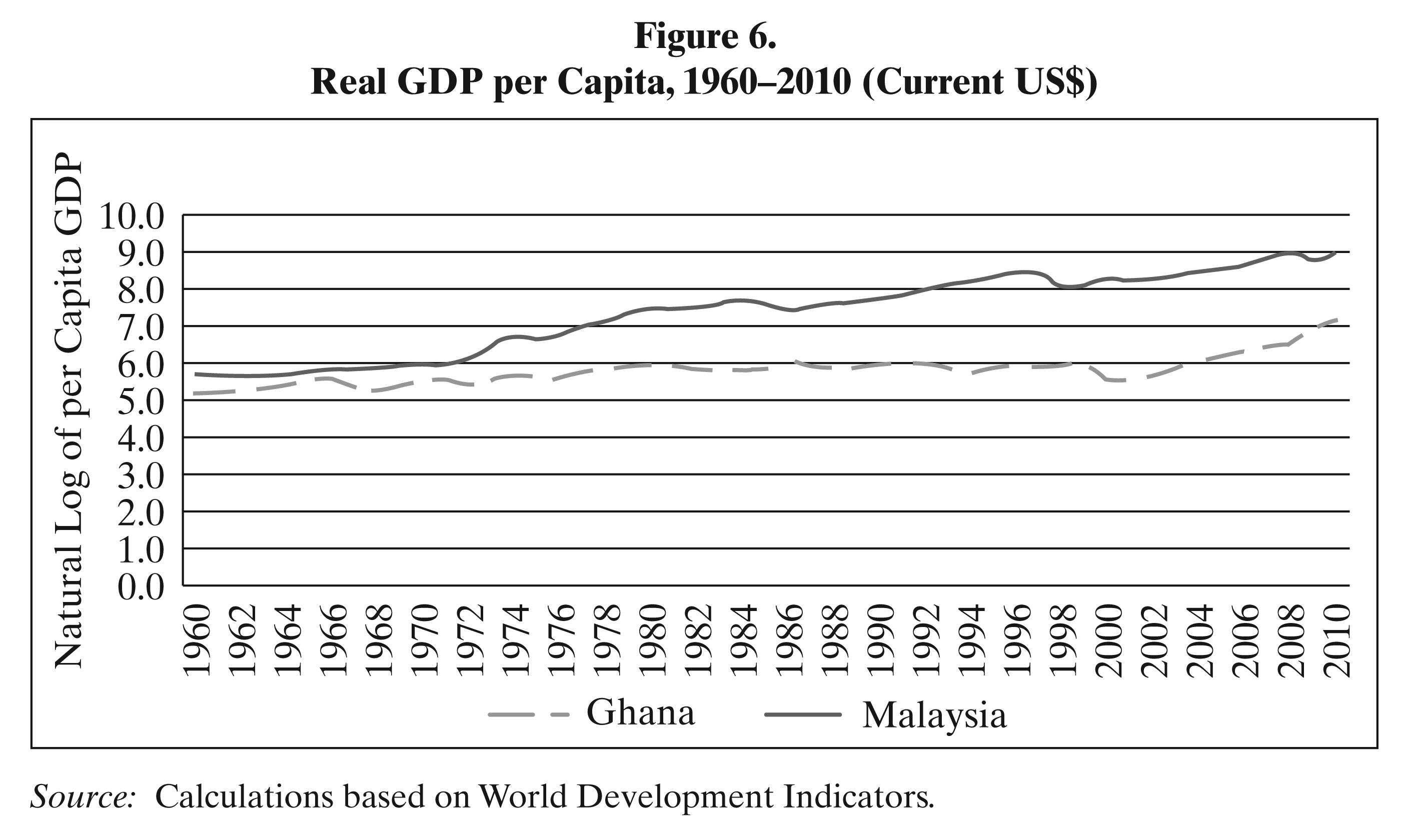
Source: Calculations based on World Development Indicators.
Improvements in the quality of life are an important indicator of economic development. Table 1 presents data on selected social indicators of development. These indicators provide insights into the levels of education, health, and infrastructure. Life expectancy, literacy rates, and percentage of roads paved in Ghana are well below the levels in Malaysia. Infant mortality is about eight times higher in Ghana and malnutrition affects 28 percent of children under five. In general, these indicators suggest that the quality of life is higher in Malaysia.
Selected Social Indicators of Development
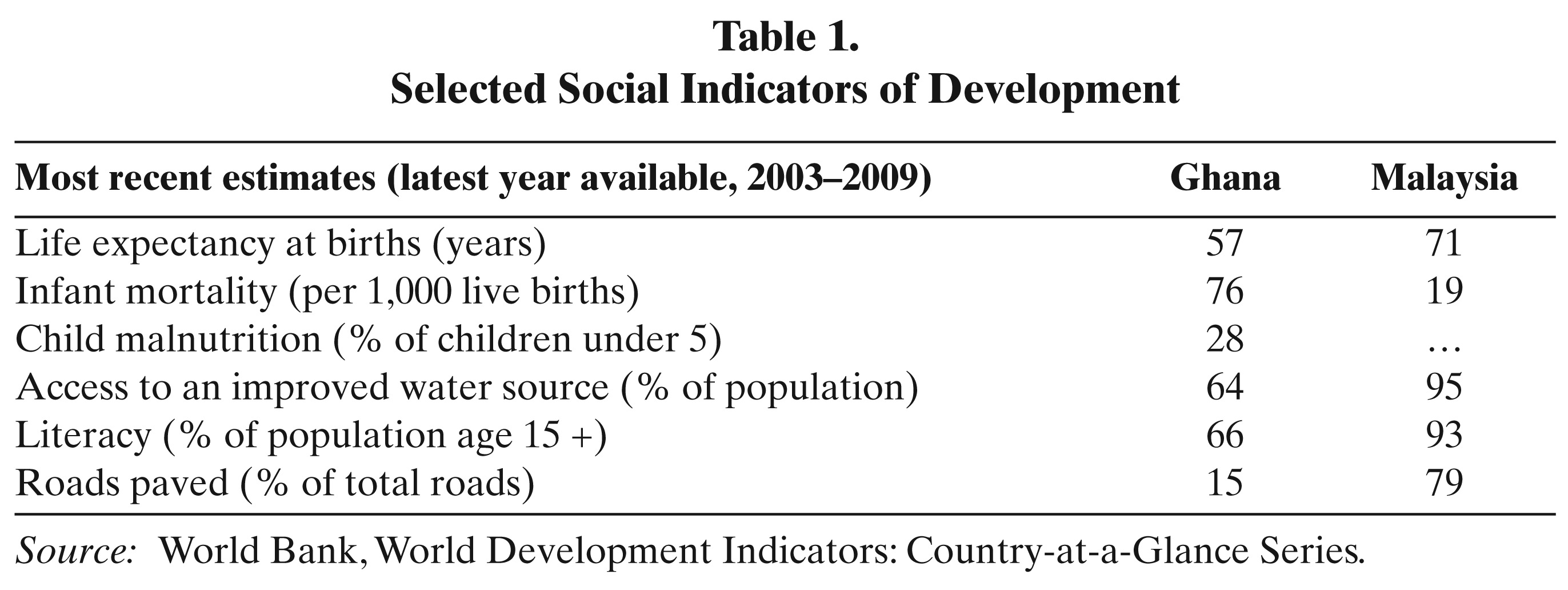
Source: World Bank, World Development Indicators: Country-at-a-Glance Series.
Structural change is another important indicator of development and evidence of it is best shown by looking at the value added to GDP and the share of the labor force engaged in the agricultural, industrial, and service sectors of an economy. The movement of an economy from agriculture to industry and service-oriented activities reflects structural change. Tables 2 and 3 show the value added to GDP by sector and Tables 4 and 5 show the share of the labor force employed by each sector. In 1960, the value added per sector as a percent of GDP was similar for the two countries. Five decades later, however, the structure of the Ghanaian economy has remained the same and that of Malaysia has become more industrial and service oriented.
Ghana – Structure of the Economy (Value Added as % of GDP)
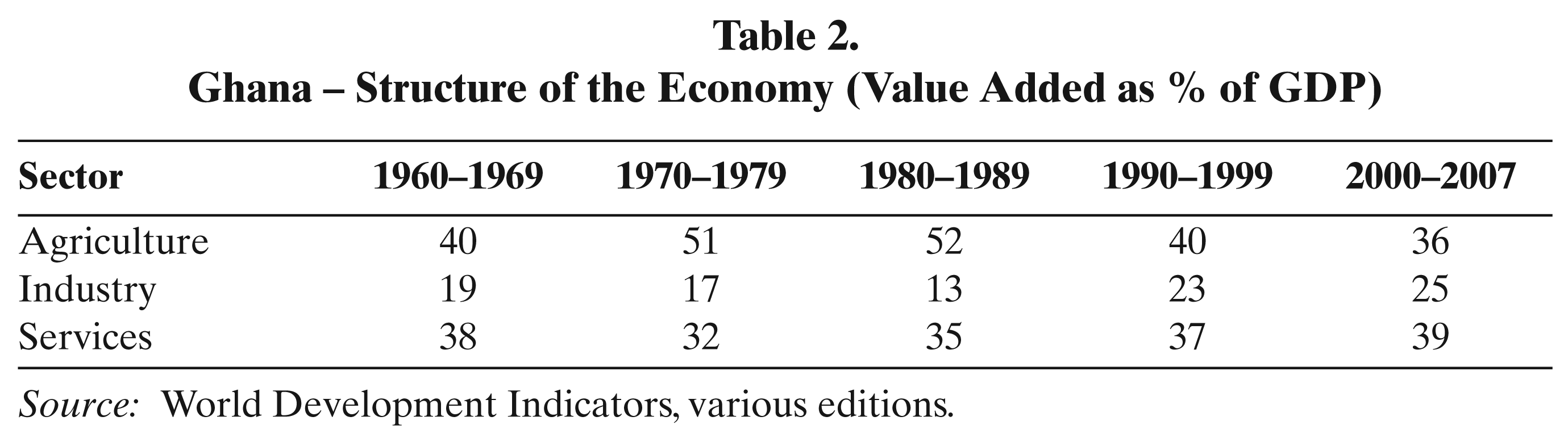
Source: World Development Indicators, various editions.
Malaysia – Structure of the Economy (Value Added as % of GDP)
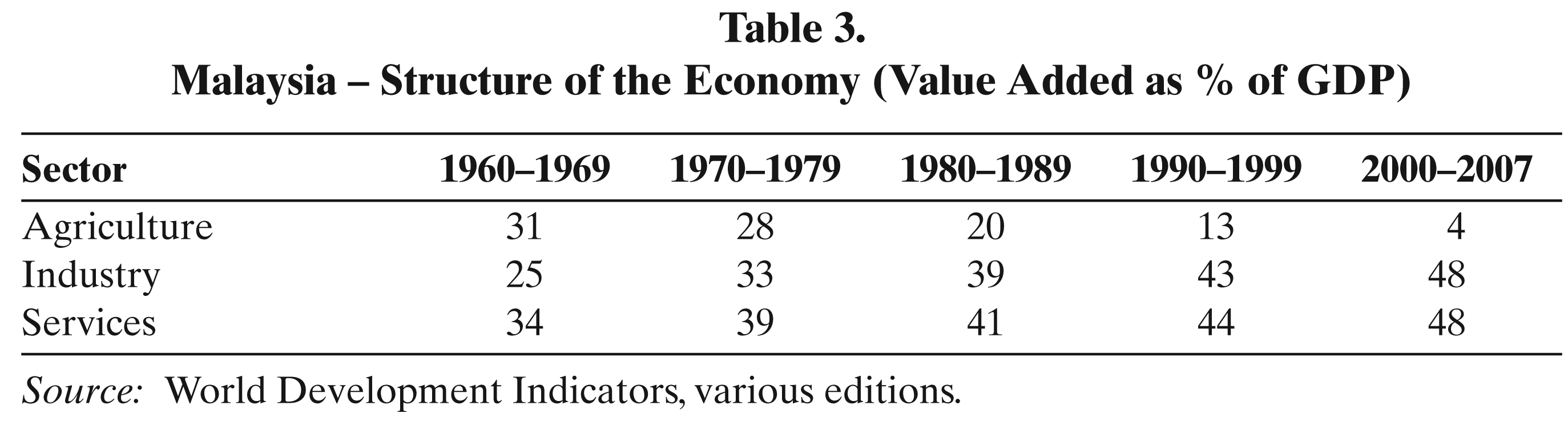
Source: World Development Indicators, various editions.
Ghana – Share of Labor Force in Agriculture, Industry, and Services (%)
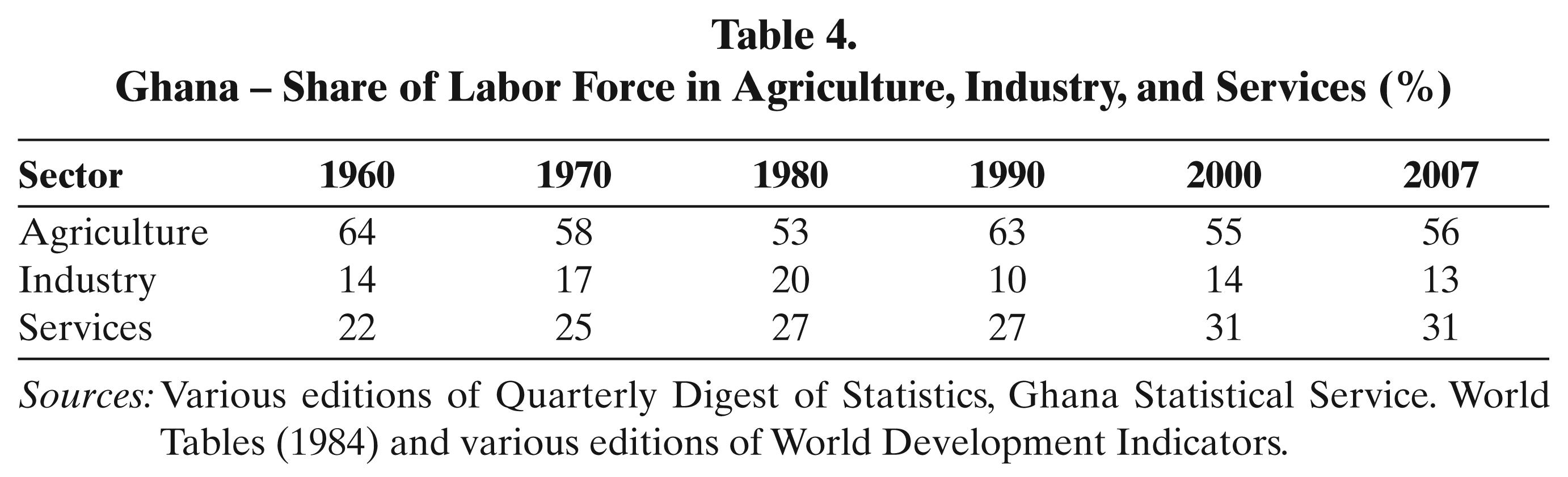
Sources: Various editions of Quarterly Digest of Statistics, Ghana Statistical Service. World Tables (1984) and various editions of World Development Indicators.
Malaysia – Share of Labor Force in Agriculture, Industry, and Services (%)

Sources: World Tables (1984), World Development Indicators, and Yearbook of Statistics – Malaysia (2008).
In the 1960s, the share of the labor force in both nations was similar. Over 60 percent of the labor force was engaged in agricultural activities. Fifty years later, over 50 percent of Ghana’s labor force is still employed in agricultural activities compared to about 14 percent in Malaysia.
Structural change in Malaysia relative to Ghana has been accompanied by an improvement in the distribution of income. Figure 7 presents Lorenz curves to show the distribution of income across population quintiles in the two countries over a 10-year period. Gini indices are also provided to show the changes in the distribution of income. The Gini index ranges from zero to one. Zero implies that incomes are equally distributed and one indicates that incomes are unequally distributed. For most nations, the Gini index is between these two extremes. In Ghana in 1997, the Gini was 0.33 and in 2006, it was 0.43. This increase suggests a worsening distribution of income. In Malaysia, the Gini was 0.49 in 1995 and 0.38 in 2004 suggesting an improvement in income equality.
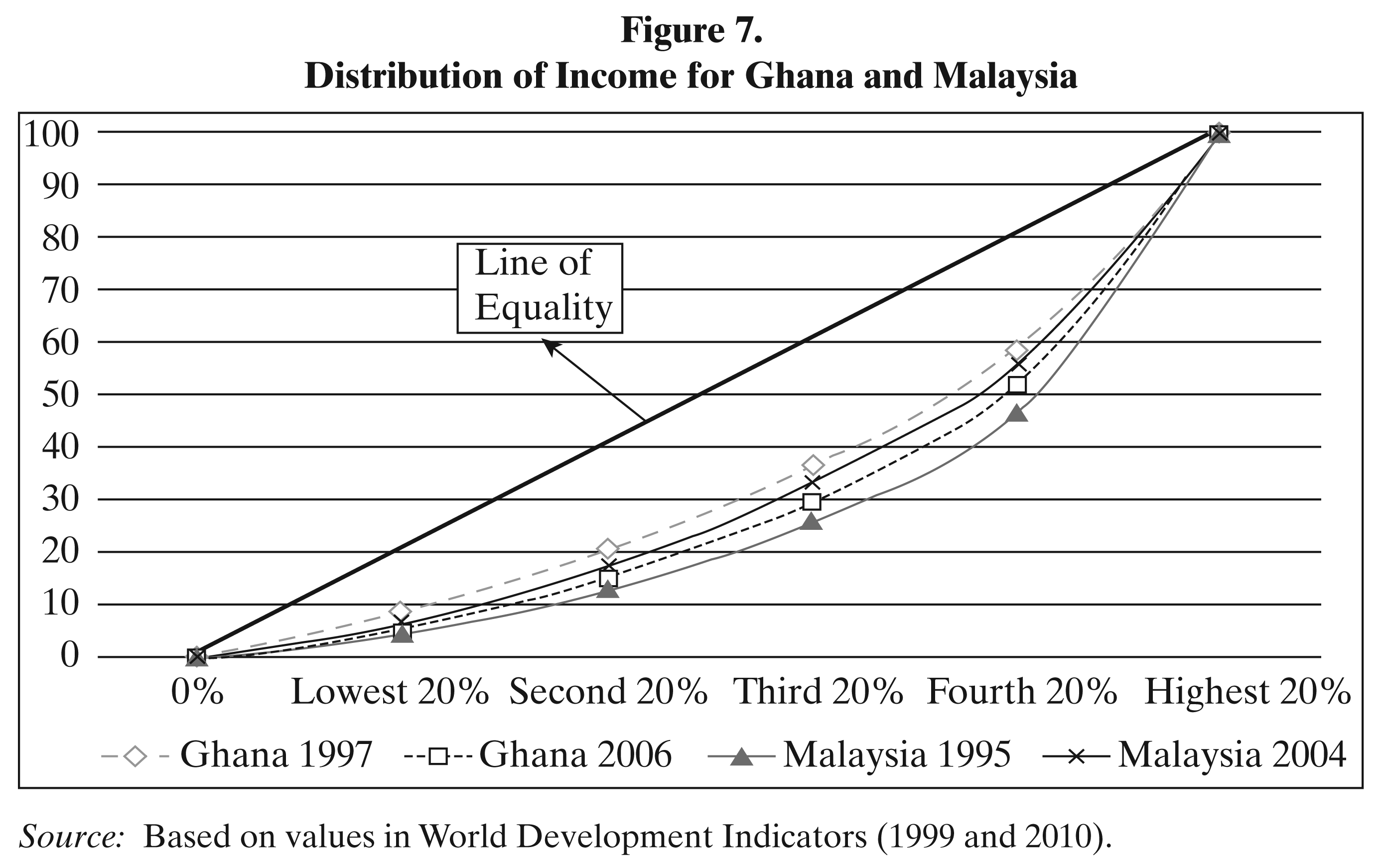
Source: Based on values in World Development Indicators (1999 and 2010).
The evidence presented clearly shows divergence. Asare and Wong (2004) and J. Khan (2009) stressed the importance of political instabilities in their explanation for this divergence. Political instability in Ghana started with a coup d’état against the government of Dr Kwame Nkrumah in 1966. Subsequent coup d’états in 1972, 1978, and 1981 interrupted efforts to build a stable atmosphere for the pursuit of development goals. These coup d’états were followed by reductions in real GDP. For example, real GDP declined by 2.5 percent following the 1972 and 1978 coups and in 1982, a 6.9 percent decline in real GDP was experienced after the 1981 coup. In Malaysia, a blemish on political stability occurred on May 13, 1969. Ethnic violence between Chinese and Malay groups in Kuala Lumpur threatened political stability. In the aftermath of those events, the ruling Alliance Party (now Barisan Nasional) tightened its grip on security and ethnic relations particularly between the Chinese and Malays. They enacted several policies including the New Economic Policy to strengthen role of Malay majority. It is important to note that various incarnations of the same party, now Barisan Nasional, has since won every election (BBC, 2005).
According to Akyuz and Gore (2001), the poor connection between savings, investment, and exports in SSA including Ghana explains the divergence. Political instability and corruption have interrupted efforts to create and sustain this nexus. Recent advances by the Ghana Export Promotion Council are a step in the right direction and aggressive efforts to build such a links are needed and the state’s role in such efforts cannot be underestimated. In their study of the export of agricultural products, Abor, Adjasi, and Hayford (2008) showed that from 1991–2002 changes in policy towards crops like pineapples helped boost their export performance and increased investment in the crop.
The commitment to education, health, and infrastructural development has been poor in Ghana as shown. For example, with regard to education, Ghana has struggled to maintain its human capital. Ghana is among the leading countries affected by brain drain in health workers (Dovlo, 2004). Many young and skilled Ghanaians have either left or are leaving the country in search of greener pastures. Malaysia’s commitment to improving education, health, and infrastructure is evidenced in the data. For example, data on total public spending on education as percent of GDP show that both countries spent an average of 5 percent of GDP on education in the 1970s; in the 1980s, Ghana spent 2 percent and Malaysia spent 6 percent; and in the 2000s, Ghana has spent 5 percent and Malaysia has spent 6 percent. Investment in education is recognized as an important ingredient in the development process and according to Schatz (2007), the provision of primary and secondary education played an instrumental role in the economic development of Malaysia because education provided opportunities for advancement for rural communities, such as Lawas, Sarawak.
The Ghanaian economy needs more diversification if structural change is to be achieved. Creating value in agriculture has been missing because of the failure to link the sector with industry (Ghana National Development Planning Commission, 2008, p. 98). In Malaysia, government action towards diversification in and between agriculture and industry improved productivity. Industrial capacity was built up in the oil palm industry through the careful use of tariffs and the establishment of agro-processing plants by the state and private sector (Gopal, 1999). Fold and Whitfield (2012) have argued that Malaysia’s experience with rubber production, the active role of the state especially with regard to the development of appropriate infrastructure and regulation, and the availability of large parcels of land facilitated plantation agriculture and large-scale oil palm production. On the contrary, they argued that in Ghana, the dominance of smallholder cultivation, the absence of state capacity to support plantation agriculture plus the influence of few vertically integrated companies contributed to stagnation in oil palm production and limited agro-processing. Furthermore, in Malaysia the Federal Land Development Authority (FELDA) and Federal Land Consolidation and Rehabilitation Authority (FELCRA) schemes were actively involved in improving agro-processing capacities.
Another factor explaining the divergence is domestic entrepreneurial activity. Unlike Ghana, domestic entrepreneurship in Malaysia is unique because it is overwhelmingly dominated by Chinese–Malaysian entrepreneurs. 1 While there is no reason to believe that a particular group of people is inherently endowed with certain entrepreneurial proclivities, the dominance of the Chinese–Malaysian’s is noteworthy. Their entrepreneurship is perhaps because of the “non-bumiputera” (non-sons of the soil), or non-preferred status which places significant barriers with regard to access to government contracts, purchases of land and education scholarships. This status has incentivized many Chinese–Malaysians to become more entrepreneurial as government support for their initiatives continues to be very limited in the post New Economic Policy era. 2 Chinese–Malaysians have relied on family networks in and out of Malaysia to fund their entrepreneurial activities. Where necessary, they have partnered with Malay businessmen to get access to government contracts (Gomez & Jomo, 1999).
The Association of Southeast Asian Nations (ASEAN) has been an important regional economic organization for Malaysia and its influence is an important explanatory factor for the divergence observed. Many of the countries in the organization have shown tremendous progress in recent years. ASEAN has provided Malaysia and its members with a relatively stable regional economic environment in which to trade and invest. Other EA economies such as Japan, South Korea, Taiwan, and China have also provided excellent examples of growth and development for Malaysia to follow. As an example, Dr Mahathir Mohammed’s “Look East” initiative drew inspiration from the progress made by other nations in EA. “Mahathir laid out the foundations of the Look East in 1982 as an effort to emulate Japanese industrialization, work attitude, ethics and skills and, also directly seek the cooperation of the Japanese government and companies in various areas of technical training and industrial management” (Dhillon, 2009, p. 176). Furthermore, according to Jomo (2007), selective interventions implemented in Japan, South Korea, and Singapore played a role in enhancing Malaysia’s export growth since those policies favored Malaysia because of its low input and production costs and a favorable investment climate. In contrast, the Economic Community of West African States (ECOWAS) is famous for its military interventions in previously war-torn member nations such as Liberia and Sierra Leone. The fact that ECOWAS is composed of some of the world’s poorest countries has not provided a favorable regional economic environment for Ghana. Role models for development are non-existent and in many respects, Ghana is the benchmark nation in the region.
The role of foreign direct investment (FDI) in Malaysia’s economic development is well documented (Ismail & Yussof, 2003; Jomo, Felker, & Rasiah, 1999; Yean, Siang, & Mokhtar, 2011). For example, Tsen (2005, pp. 92–94) states that “generally, FDI has played an important role in the development of the manufacturing sector in Malaysia [and] Malaysia received substantial amounts of FDI […] higher than other ASEAN-4 countries namely Thailand, Indonesia and the Philippines.” FDI inflows particularly into industries, such as food manufacturing, chemicals, and chemical products, helped Malaysia to build up necessary capacities in the agricultural sector as well as improve its export performance in those sectors. On the contrary, FDI flows to Ghana have been limited for various reasons including the political risk, low-skilled labor force, and a poor investment climate. FDI flows to Ghana over the last few decades have been in areas such as telecommunications and energy. Such inflows have come from nations such as Malaysia (Ansah, 2006). Flows into the industrial sector have been limited, and Ghana must encourage more FDI to establish cooperation between agriculture and manufacturing in order to exploit important backward and forward linkages in enterprises such as agro-processing.
Developmental State Paradigm and Malaysia’s Economic Development
An important factor that drives economic development is the role of the state, and in this article, I employ the developmental state paradigm following Joshi (2012) to highlight the role of the Malaysian state in its economic growth and development. According to Chang (2003, p. 41), “defining the appropriate roles of the market and the state has been a central concern of policymakers since the beginning of capitalism” and the rise of development economics after WWII made this aspect of economics even more important. After WWII, most scholars and practitioners of development focused on ways through which government-engineered growth could be achieved, given the superiority of Keynesian economics, 3 but the declining importance of Keynesianism and the rise of neoliberalism in the 1970s shifted the focus of scholarly work in economic development towards market (in the neoclassical sense) inspired growth (Chang, 2003; Fine & Jomo, 2006; Jomo & Reinert, 2005; Toye, 2003). This shift has meant that development policy has been based on so-called free market economics. In SSA, it has led to the demonization of the state even though empirical evidence suggests that in many nations including Ghana, the fastest rates of growth were achieved during periods of strong state involvement in the economy (Akyuz & Gore, 2001). The demonization of the state has led many countries in SSA to ignore the important examples of state-led development in EA over the last five decades.
Chalmers Johnson is credited with formalizing the concept of the developmental state (Cumings, 1999, p. 63; Joshi, 2012, p. 356). Johnson
4
(1982) argued that credit for the exceptional development of Japan after WWII should go to the insightful government policies dating back at least to the 1920s. Johnson (1999, p. 36) credited the work of Onis (1991) and Castells (1992) as advancing and refining the concept of the developmental state. Onis (1991) summarized the works of Johnson (1982), Deyo (1987), Amsden (1989), and Wade (1990) and added to our understanding of the “institutional and sociopolitical bases underlying the capacity of the East Asian states to implement effective and coherent development strategies” (Onis, 1991, p. 110). Onis (1991, p. 115) concluded that “the logic of developmental state rests precisely on the combination of bureaucratic autonomy with an unusual degree of public-private cooperation.” Castells (1992, p. 56) defined the developmental state as follows:
A state is developmental when it establishes as its principle of legitimacy, its ability to promote and sustain development, understanding by development the combination of steady high rates of economic growth and structural change in the productive system, both domestically and its relationship to the international economy.
Evans (1995) highlighted the importance of the bureaucratic autonomy in his “embedded autonomy.” Embedded “implies a concrete set of connections that link the state intimately and aggressively to particular social groups to whom the state shares a joint project of transformation” (ibid., p. 59) and autonomy refers to the state’s ability to “provide institutionalized channels for the continual negotiation and renegotiation of goals and policies” (ibid., p. 59). The ability to negotiate and renegotiate is based on the ability of the state to “discipline firms which break the rules, and also prevent people with money from hijacking the political process” (Gainsborough, 2009, p. 1319). In essence, the state’s ability to control and discipline domestic and foreign capital is the crucial element that allows it to act as a developmental state (Haggard, 1990; Krieckhaus, 2002; Migdal, 1988).
Joshi (2012) added to the argument for development states with his “Varieties of Development States.” In his work, he broadens the concept to include various types of states that have been successful in meeting the Millennium Development Goals and proposes three varieties of developmental states: human developmental state, resource developmental state, and social development state. Joshi (2012) contends, as did Leftwich (1995, p. 421), that “few societies in the modern world will make speedy transitions from poverty without…a developmental state.”
Scholars of the developmental state have identified important attributes that help the state to achieve its main goal of industrial and economic development while expanding and exploiting the synergies between industry and other sectors such as agriculture. The first attribute is that the developmental state is consistent in its pursuit of developmental objectives. Failure in developmental objectives does not mean an abandoning of those objectives altogether. Secondly, the developmental state is an activist state. The state is not relegated to the role of an overseer, because it actively participates in the development process and even serves as an entrepreneur of last resort where necessary in the absence of private capital (Amsden, 1989). The state goes beyond the minimalist state in neoclassical economic theory and development policy formation is not separate from the social structures and relationships that exist among citizens, and between citizens and their state. The developmental state evolves as the needs of the society change. Thirdly, the state uses trade and FDI policies to promote domestic productive capacity and technological learning (Jomo, Felker, & Rasiah, 1999; Khan, 2007). As the developmental state pursues industrial development and promotes synergic relationships, objectives such as poverty reduction and income distribution are considered to be important goals.
Malaysia’s New Economic Policy enacted in 1971 is a good example of the development state in action in spite of its contentiousness. Recognizing the growing inequality between Malays, other ethnic groups and the Chinese, this policy sought to promote the economic well-being of economically disadvantaged ethnic groups. By all accounts, these efforts were successful in reducing income inequality across ethnic groups (Gomez & Jomo, 1999). According to Jomo (2007, p. xvii), “Malaysia’s industrialization efforts since Merdeka [independence] have changed significantly over time.” Industrial upgrading has been a systematic project deeply woven into the national development agenda. After independence and prior to the mid-1980s, Malaysia experimented with Import-substituting Industrialization (ISI) (1950s until late 1960s) and Export-oriented Industrialization (EOI) (1970s until mid-1980s). During this period, resource and non-resource-based export-oriented industries were promoted and supported. Processing capacities increased and were important to economic growth and employment generation (Gopal, 1999; Jomo, 2007, p. 11).
Since the mid-1980s industrial master plans were put in place to provide a coherent framework for industrial upgrading. The First Industrial Master Plan (IMP-1) was proposed in 1985 and implemented from 1986 to 1995. IMP-1 identified 12 priority sectors which included many resource-based sectors such as rubber products, palm oil products, and food processing. Industrial upgrading embraced the agricultural capabilities of the country and attempted to improve them by incorporating industry to enhance production, processing, and value addition. Various incentives including pioneer status, investment tax credits, export allowances, and tax relief for research and development were important components of the industrialization process as it related to agriculture and many other sectors. IMP-1 also embraced non-resource–based sectors such as electrical, electronics, and transportation equipment and laid the foundation for further industrial development (Gopal, 1999; Li & Imm, 2007).
The Second Industrial Master Plan (IMP-2) was introduced in 1996 and implemented from 1996 to 2005. The focus of IMP-2 was on creating manufacturing clusters and encouraging locally integrated industrial activity. These clusters focused on packaging, distribution, and other value adding activities. In the current period, the Third Industrial Master Plan (IMP-3) is in its implementation stage (2006–2020). IMP-3 is designed to continue with the clusters approach put forth in IMP-2. The main objective of IMP-3 is to achieve long-term global competitiveness through the transformation and innovation of the manufacturing and services sectors. The focus on these two sectors is evidence of the structural change that has been achieved in the Malaysian economy. IMP-1 improved the synergy between agriculture and industry, IMP-2 focused on building industrial capacity through manufacturing clusters, and IMP-3 is focusing on building global competitiveness through manufacturing.
The IMPs have contributed significantly to Malaysia’s economic transformation as many of the targets have either been achieved or exceeded (Jomo et al., 1999; Li & Imm, 2007). In addition to the IMPs, several important pieces of legislation such as the Promotion of Investments Act (1986) and Capital Investment per Employee (CIPE) ratio (1995) were introduced to promote domestic industrial activity and enhance the export potential of Malaysia. As many East Asian developmental states have shown, the main task of the developmental state is the pursuit of industrial development to support various sectors of the national economy in ways that allow for successful growth and structural transformation. Malaysia’s industrial policy since independence is a testament to the developmental state in action.
The evolution of Malaysia’s agriculture from low technology labor-intensive methods to specialized capital-intensive methods is another testament to the success of state-led development. It is also evident that timely and judicious state intervention can in fact provide a dynamic perspective on comparative advantage wherein the state is an active participant in the building and generation of comparative and competitive advantages. Dynamic comparative advantage involves altering the production choices of a country to reflect changes in global economic indicators such as world commodities prices. These changes are necessary to ensure the profitability of an economic activity such as agriculture.
Malaysia’s history with tree crop cultivation is an example of dynamic comparative advantage. Through government action and a recognition of changing international trends, Malaysia transitioned from natural rubber (colonial period and around independence) to cocoa (1980 through 1990s) and oil palm (since early 1960s but rapidly over the last two decades) production. Natural rubber started declining in the mid-1970s; cocoa production started in the mid-1970s and peaked with an estimated area harvested of 414,236 hectares in 1989. Oil Palm has grown rapidly to an estimated 5 million hectares (as of 2011) under cultivation (Department of Statistics – Malaysia, 2008; Fold & Whitfield, 2012; Gopal, 1999; Jomo et al., 2004; Jomo & Rock, 1998). According to Reinert and Reinert (2005), dynamic comparative advantage is more sophisticated and aligns well with the historical evidence on development.
In the march towards development, agricultural transformation which is the process by which the structure of production shifts from subsistence-based small-holder production towards specialized commercial-based production has been achieved (Jayne, Minde, & Argwings-Kodhek, 2002; Timmer, 1997). The movement away from the cultivation of small plots (less than 10 hectares) to industrial size plots supported by processing and storage facilities is evident in Malaysia. As an important part of the process of structural transformation, agricultural development in Malaysia exposed backward and forward linkages that enhanced the synergies between the agricultural, industrial, and service sectors. A backward linkage is one in which a firm buys goods from another firm and uses these as inputs. This is seen when farmers buy agricultural inputs like fertilizers and heavy equipment from industry. A forward linkage is one in which a firm sells its output to another firm, and this is observed when farmers sell their agricultural output to industrial interests such as processing plants. According to Todaro and Smith (2012, p. 779), “such linkages are especially significant for industrialization strategy when one or more of the industries (product areas) involved have increasing returns to scale that a larger market takes advantage of.”
Shaping Agricultural Development in Malaysia: Federal and State Level Initiatives
Agricultural development has been shaped by federal and state initiatives. State initiatives have been tailored to the unique conditions of each state and federal initiatives have provided an overarching framework within which sector-specific development plans have been designed and kept in line with national development objectives. Five-year development plans involving the marriage of the state (local and federal) and private actors have been instrumental to agricultural development since independence. State policies have provided generous opportunities and incentives for the private sector to lead the development process (Morrison, 1997).
Federal initiatives have included five-year national development plans and three national agricultural policies (NAP). NAP-1 was introduced in 1984 and focused on increasing the planted area of export crops such as oil palm and cocoa. Increasing yields through the modernization of agriculture and infrastructure development were important cornerstones of this policy. NAP-2 was introduced in 1992 and focused on identifying, deepening, and maximizing the benefits from inter-sector linkages. Agro-industry was heavily promoted to add value to unprocessed agricultural output. For example, export controls of various forms were used to discourage the export of crude timber and oil palm. High duties on the export of crude palm oil and the outright ban on log exports encouraged the creation and exploitation of inter-sector linkages between agriculture and industry. These controls increased investment in refining operations, resulting in the tremendous technical progress that propelled Malaysia to become the world’s leader in oil palm refining (Gopal, 1999; Jomo & Rock, 1998). NAP-3 was introduced in 1998 following the Asian financial crisis to re-evaluate the role of agriculture in national development. The goal of this policy was to bring agricultural policy in line with emerging trends in Malaysia in the aftermath of the crisis. Enhancing food security, creating new sources of growth within the sector, and further deepening inter-sector linkages were an important focus of NAP-3.
High impact projects, such as the “Permanent Food Park” initiative, were launched to encourage more private sector participation in high technology agriculture. Under the Permanent Food Park initiative, state government identifies available lands and the federal government provides the basic infrastructure. Malaysian citizens can rent land through the program and must engage in the production of fruits and vegetables. The goal of this initiative is to help participants reach an annual income of at least 36,000 ringgits (US$11,300). The program is focused mostly in Peninsular Malaysia (Boughton, Kajisa, & Maredia, 1997; >Department of Agriculture, Malaysia:
Federal initiatives for agricultural development have also included land development schemes under the administration of FELDA. The goal of FELDA, established in 1956, was to open up agricultural land mostly in Peninsular Malaysia to landless settlers. FELDA experimented with various modes of land development and the cultivation of three major tree crops (rubber, cocoa, and oil palm). According to Jomo and Rock (1998, p. 8), “FELDA has successfully used public resources (land, capital) to significantly expand agricultural production to the advantage of the settlers with some degree of public accountability.” Another important initiative was FELCRA which was established in 1966 to help rural communities participate in national development objectives. In helping rural communities, FELCRA has been involved in the oil palm and paddy rice business as well as in agro-industry.
State level initiatives are very diverse in Malaysia but have similar goals of improving rural livelihoods. We will draw on examples from the eastern Malaysian state of Sarawak. The Sarawak Land Development Board (SLDB), established in 1972, and the Sarawak Land Consolidation and Rehabilitation Authority (SALCRA), established in 1976, have been influential in the process of agricultural transformation in this state. The actions of SLDB and SALCRA have contributed to the rapid expansion of oil palm cultivation in Sarawak. In 1963, there were no oil palm plantations or a significant area under cultivation in Sarawak. By 2005 about 543,398 hectares was estimated to be under cultivation and in a matter of four years in 2009, that estimate grew by 300,000 plus hectares. The increase has been in tandem with increases in processing capacity to allow for value addition (Schatz, 2007). In addition to SLDB and SALCRA, the Sarawak Land Custody and Development Authority (SLCDA) has served as a matchmaker for land-based initiatives by the private sector. Our final example is the Sarawak Economic Development Corporation (SEDC), which has established a poultry farmer’s scheme that combines stable market demand with hands-on experience and the necessary credit and subsidies to ensure the success of the program (Morrison, 1997; Morrison, Murray, & Ngidang, 2006).
The Importance of the Malaysian Experience for Ghana
The divergence of Ghana and Malaysia, as discussed in this article, prompts an important question: How can the Malaysian developmental state experience inform development strategy formation in Ghana? In answering this question, it is important to be cognizant of the path to development of not only Malaysia but all now developed countries. Recognizing this path must include an acceptance of the following facts. First, the state can be a catalyst for growth and development. Second, strong-state society relationships are necessary to embed the autonomy of the state in the society (Evans, 1995; Migdal, 1988; Wade, 1990). Third, effective bureaucracies that are responsive to the needs of society are necessary for development 5 (Amsden, 1989, 2001). Fourth, agricultural development must go hand in hand with industrial development since industrial development remains one of the most important goals of the developmental state. Finally, Ghana and other countries in SSA must carefully study current global rules on trade and issues of development to identify ways in which new ladders of development can be built since old ones have been kicked away 6 (Chang, 2003; Chang & Grabel, 2004).
Prior to identifying important developmental goals for Ghana based on the Malaysian experience, it is important to note the failure of policy formation in Ghana since independence. The post-independence government of President Kwame Nkrumah pursued a policy of heavy industrialization under various development plans including a seven-year development plan from 1963/1964 to 1969/1970. 7 This plan included several provisions aimed at modernizing the Ghanaian economy through industrial upgrading (Aryeetey & Fosu, 2008). Prior to this plan (1961–1965), the Nkrumah government had already laid the foundation for development with the construction of the Akosombo Dam under the Volta River Hydroelectric Project. Since the power generated by the dam was beyond the demand in Ghana at the time, the Volta Aluminum Company (VALCO, now Alcoa in Ghana) became, and continues to be, the largest user of the power generated by the dam with its smelter in the port city of Tema.
After the 1966 coup d’état, the drive towards industrialization stalled. While Nkrumah’s big push agenda was successful in providing important infrastructure such as the dam, subsequent policies have been incoherent and have thus failed to sustain the necessary improvements in physical and human capital. Under the Nkrumah government, Ghana started to establish the foundations of a developmental state but subsequent governments failed to sustain such efforts. Military and civilian governments that followed Nkrumah introduced ineffective development policies that included strong adherence to Washington Consensus principles of liberalization which embodied structural adjustment policies (SAP) that sought to minimize government in all instances (Birdsall & Fukuyama, 2011; Botchway & Moudud, 2007). In general, the first two and a half decades after independence were characterized by erratic growth rates in real GDP as shown in Figure 8. Negative growth rates coincided with policy changes, reversals, and/or changes in government (Aryeetey & Fosu, 2008).
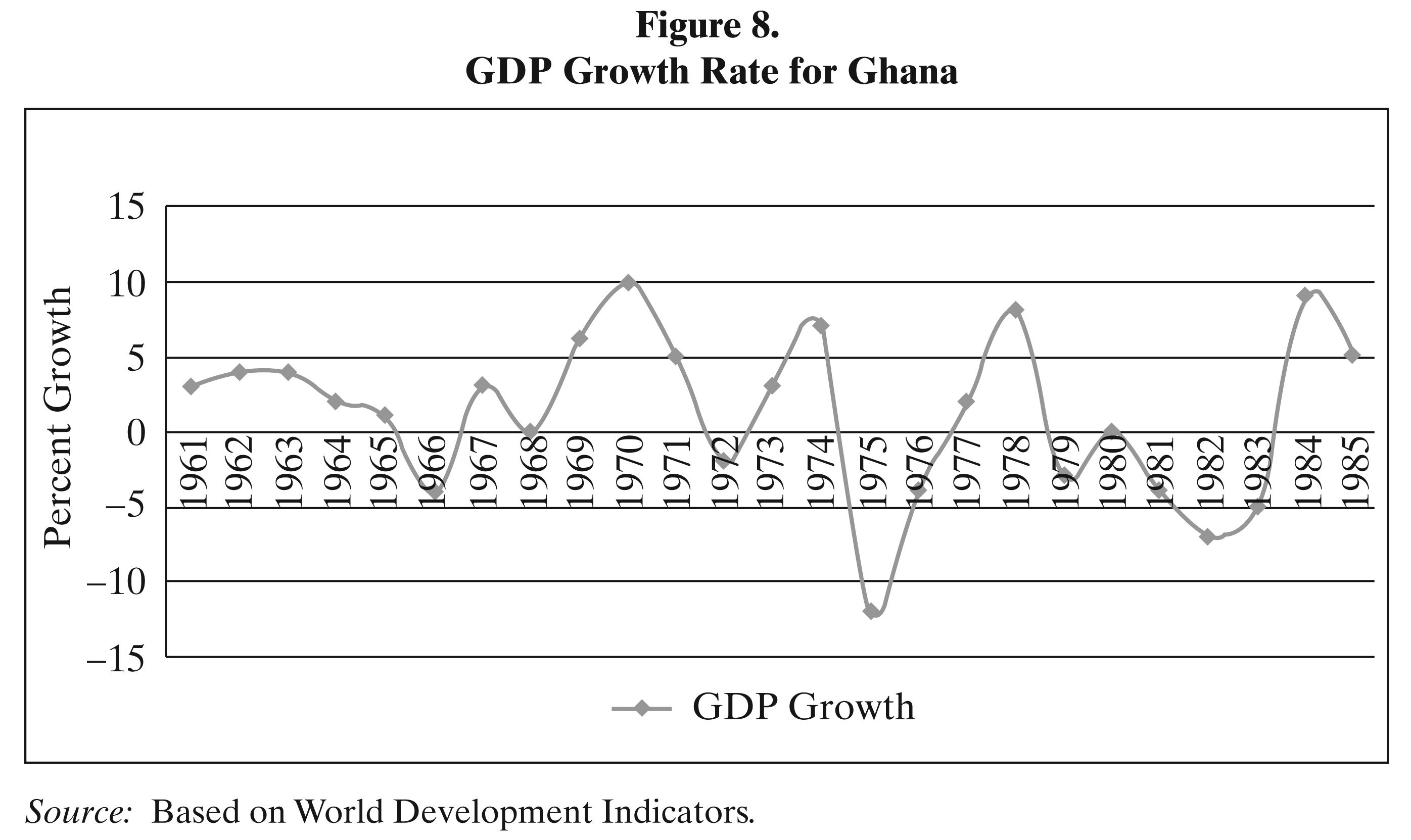
Source: Based on World Development Indicators.
An important difference between Ghana and Malaysia has been the frequent regime changes, political instability, and the consequent lack of consistent and effective development plans in Ghana. Beginning with the Consolidation Development Plan (1957–1959), Ghana has had several plans with different durations and implementation times. The Second Development Plan (1959–1964), the Seven-year Plan for National Reconstruction and Development (1963/1964–1969/1970), the Two-year Development Plan (1968/1969–1969/1970), the One-year Development Plan (July 1970–June 1971), the Five-year Development Plan (1975/1976–1979/1980), the Economic Recovery Programme or SAP (1983–1989), Ghana Vision 2020 (1995–2020), and Ghana Poverty Reduction Strategy I and II (2003–2005 and 2006–2009) have all been implemented to varying degrees. It is important to note the absence of a plan during 1972–1974, 1981–1983, and 1990–1994. Currently, there is the Seven-year Development Plan (2008–2015). Many of these plans have not been actionable because they have lacked the financial backing necessary to ensure their successful implementation (Ghana National Development Planning Commission, 2008, p. 11). Policy formulation, adherence, and evaluation since the Nkrumah period have been poor. Ghana has experimented with import substitution industrialization and export-oriented industrialization. In the early 1980s, Ghana fully embraced SAP. The neoliberal nature of SAP ensured that government involvement in the economy was minimized. The state was demonized and the excesses and transgressions of prior military governments were used to entrench the notion of government failure. SAP is contrary to the developmental state as well as the successful period of industrialization under Nkrumah. The failure of the SAP to provide sustained economic growth and development is well documented (SAPRIN, 2004; Stein, 1996).
In the period post-1992, political stability has been restored and the state has been slowly allowed back in areas such as youth employment policy. The reluctant acknowledgement of the World Bank (1993) that the state does in fact has a role to play in development coupled with the forgiveness of debts under the Heavily Indebted Poor Countries initiative have all influenced recent policies in Ghana. The President’s Special Initiative in Agriculture under the Kufuor government and the National Youth Employment Programme represent new ways in which the state has been able to re-enter certain areas of the Ghanaian economy. Under special initiative programs, the government-led investment in the production of crops such as cassava and oil palm. The employment program has allowed the government to take the lead in addressing the problem of high youth unemployment (Baah, Achakoma, & Ampratwum, 2009; Tonah, 2006).
Using the policy directions and roles of the state in Ghana since independence as a contrasting point of comparison, the Malaysian developmental state experience can inform strategies and policies in Ghana in the following ways: first, political stability must be pursued at all cost; second, government intervention is necessary to create and sustain industrial targeting policies; and third, effective development planning, execution, and evaluation are absolutely necessary for establishing clear objectives, tracking progress, reassessing goals, and identifying future paths of development. The Malaysian experience with political stability, whether democratic or not (by Western standards), offers an important lesson for Ghana. Apart from the riots of 1969 on the peninsula, Malaysia has enjoyed political stability. Since 1992, Ghana has adopted this lesson and enjoyed now 20 years of political stability in a region of great political uncertainty and instability.
Secondly, and perhaps the most important insight from the Malaysian experience, is the role of the government, particularly in the area of industrial upgrading, targeting, and agenda setting. Malaysia’s industrial policy since independence, particularly IMP-1 through IMP-3, is an important insight for Ghana. Ghana must develop an actionable and coherent industrial master plan that has at its core the development of manufacturing potential and explores ways agriculture and industry can be linked to enhance production and add value to the output generated. As an example, the existing industrial policy framework for Ghana has no targets for the various sectors. On the contrary, Malaysia’s has specific achievement targets for manufacturing, pharmaceuticals, agriculture, exports, and other sectors. Targets should include projections and expectations of worker productivity (see Ghana Industrial Policy 8 and Malaysia – Third Industrial Master Plan). Government planning for industrial development in Ghana must be coherent, well-articulated, and actionable and the IMP model of Malaysia can be utilized.
The third area where the Malaysian developmental state experience can be utilized in Ghana is in the area of consistent development planning. Development planning in Malaysia has been consistent. Since the First Malaysia Plan (1966–1970), all subsequent plans have been five years in length with mid-term reviews to assess progress. Such a model will be particularly useful in Ghana as it will set the tone and clarify the direction and objectives of the country for specific periods into the future.
Conclusion
This article has analyzed and presented evidence on the divergence that has occurred between two nations with similar initial conditions: Ghana and Malaysia. Since independence, Malaysia has been successful in transforming its economy by effectively developing its industrial capabilities and exploiting its agricultural potential through government action at various levels. In addition to discussing the specific ways in which industrial development has been achieved in Malaysia, this article has also identified the relevance of the development experience of Malaysia for Ghana. The hope is that this article has revealed the continued need for country-specific, comparative analyses as well as the need for a developmental state in developing countries such as Ghana and Malaysia.