



Abstract
Nigeria like most other African countries has responded to the growing challenge of poverty by introducing social protection strategies. Despite the rising popularity of social protection as an anti-poverty intervention throughout Africa, social protection is still inadequate in Nigeria. This article examines major social protection arrangements in Nigeria and challenges associated with them. The article begins by providing a general perspective on poverty and social protection in Nigeria. The article brings into view major reasons for the inadequacy of social protection arrangements in Nigeria.
Introduction
Nigeria is the most populous country in Africa, with over 150 million people accounting for about 47 percent of West Africa’s population and nearly a fifth of sub-Saharan Africa’s population. Nigeria’s population is diverse, made up of around 350 ethnic groups speaking 500 indigenous languages (World Bank, 2007). Nigeria is Africa’s largest oil producing country, and it is the eleventh largest producer and the eighth largest exporter of crude oil in the world (Fadiora, 2010). This has made oil the dominant factor in Nigeria’s economy for the past 50 years. In 2007, over 87 percent of government revenues, 90 percent of foreign exchange earnings, 96 percent of export revenues, and almost half of the GDP was accounted for by oil (Watts, 2008, p. 43).
Despite its abundant natural resources, poverty is a major problem in the country. Approximately 70 million people live on less than US$1/day, 54 percent of Nigerians live below the poverty line and over one-third live in extreme poverty (defined as those who cannot afford 2,900 calories per day) (UNDP, 2006). Poverty has increased in recent decades: between 1970 and 2000, those living on less than US$1/day increased from around 36 percent to around 70 percent, translating into an increase in the number of people living in poverty from 19 million in 1970 to 90 million in 2000 (Sala-i-Martin & Subramanian, 2003, p. 4).
The country’s human development indicators are also poor: Nigeria’s Human Development Index (HDI) is quite low (0.448), giving the country a ranking of 159 out of 177 countries (Fadiora, 2010; UNDP, 2006). Nigeria also has one of the highest income inequalities in the world (Human Development Report, 2005, p. 272). In addition to these broad indications of the extreme poverty and vulnerability challenge in Nigeria, the health and education Millennium Development Goals (MDGs) indicators, specifically, are very poor (MDGs Nigeria, 2010). These indicate that Nigeria needs a social policy focus that can address the root causes of this situation and not just the symptoms. Sadly social protection interventions in Nigeria have been associated with many challenges. This article examines some of these interventions and problems associated with them.
Overview of Poverty and the Need for Social Protection in Nigeria
Poverty is a pervasive problem in Nigeria. Several reports indicate that the problem has been persistent despite economic growth in the country. For example, the 2012 report of the National Bureau of Statistics (NBS) in Nigeria indicates that the incidence of poverty in Nigeria worsened between 2004 and 2010. The report indicates that the number of Nigerians living below poverty line rose from 68.7m to 112.5m (63.7 percent rise in poverty incidence) during the period, while the population rose from 139.2m to 158.6m (13.9 percent rise in population) over the same period. Earlier figures on unemployment in Nigeria corroborated this situation as the number of unemployed members of the labor force continued to grow from 12.3 percent in 2006 to 23.9 percent in 2011.
However, during the same period, Nigerian economy grew strongly at an average annual growth rate in excess of 6.6 percent, making the country the fifth fastest growing economy in the World in 2010 at 7.87 percent real growth rate. The above represents the paradox of growth in the face of poverty and inequality. 1 The 2010 Global Monitoring Report (GMR) of the United Nations Education, Scientific and Cultural Organization (UNESCO), also revealed that about 92 percent of the Nigerian population survives on less than $2 daily, while 71 percent survives on less than $1 daily. Despite being a middle-income country, Nigeria has the highest level of stunting in sub-Saharan Africa, and the third highest in the world, with 41 percent of all children under five classified as stunted and 23 percent as severely stunted (Holmes, Akinrimisi, with Morgan, & Buck, 2012).
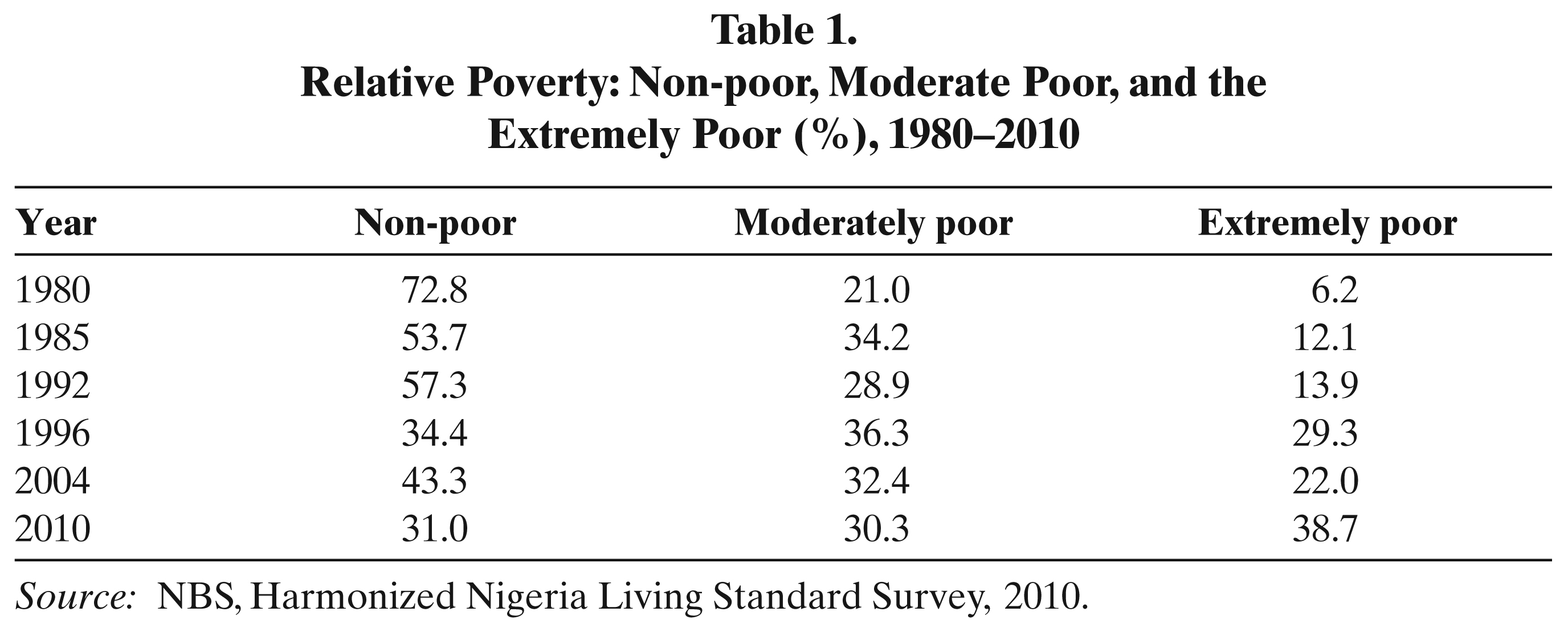
The Nigeria Poverty Profile Report, 2010, a report, which emerged from the Harmonised Nigeria Living Standard Survey (HNLSS) conducted by the NBS with support from the World Bank, DFID (UK), and UNICEF, indicates that Nigeria’s relative poverty measurement stood at 54.4 percent, but increased to 69 percent (or 112,518,507 Nigerians) in 2010. The North-west and North-east geopolitical zones recorded the highest poverty rates in the country with 77.7 percent and 76.3 percent, respectively, in 2010, while the South-west geopolitical zone recorded the lowest at 59.1 percent. Among States, Sokoto had the highest poverty rate at 86.4 percent, while Niger had the lowest at 43.6 percent in the year under review. With regard to absolute poverty defined in terms of the minimal requirements necessary to afford minimal standards of food, clothing, health care, and shelter, 54.7 percent of Nigerians were living in poverty in 2004 but this increased to 60.9 percent (or 99,284,512 Nigerians) in 2010. Among the geopolitical zones, the North-west and North-east recorded the highest rates at 70 percent and 69 percent, respectively, while the South-west had the least at 49.8 percent. At the State level, Sokoto had the highest at 81.2 percent, while Nigeria had the least at 33.8 percent during the review period. Statistics on poverty are shown in Table 1.
Relative Poverty: Non-poor, Moderate Poor, and the Extremely Poor (%), 1980–2010
Source: NBS, Harmonized Nigeria Living Standard Survey, 2010.
Table 1 is a distribution of the Nigerian population into extremely poor, moderately poor, and non-poor. Distributing the population into extremely poor, moderately poor, and non-poor, the proportion of the extremely poor increased from 6.2 percent in 1980 to 29.3 percent in 1996 and then came down to 22.0 percent in 2004 before reaching 38.7 percent in 2010. For the moderately poor, the picture was quite different as the proportion rose between 1980 and 1985 from 21.0 percent to 34.2 percent. It went down between 1996 and 2004, from 36.3 percent to 32.4 percent, and even further in 2010 to 30.3 percent. On the other hand, the proportion of non-poor was much higher in the country in 1980 (72.8 percent) compared to 1992 (57.3 percent). It dropped significantly in 1996 to 34.4 percent, falling further in 2010 to 31 percent. These indicators emphasize the need for a comprehensive social protection strategy to safeguard the poor and vulnerable against risks of destitution.
Conceptual Framework
In sub-Saharan Africa, the effects of economic recession and structural adjustment since the 1980s have made a number of international agencies and some African States to emphasize social protection as a useful strategy for positive change. Currently, cash transfer scheme (conditional and non-conditional) has been the focus of policy attention. This strategy for managing poverty and “vulnerability” has been celebrated in countries such as South Africa (Case, Hosegood, & Lund, 2005; Samson et al., 2004). The success of cash transfer programs also made Nancy Birdsall, President of the Centre for Global Development as quoted in the New York Times of January 3, 2004, to assert that these programs “are as close as one can come to a magic bullet in development” (cited in Adesina, 2012, p. 1).
Social protection has been defined in different ways. According to Norton, Conway, and Foster (2001, p. 7), “social protection refers to the public actions taken in response to levels of vulnerability, risk and deprivation which are deemed socially unacceptable within a given polity or society.” The World Bank (2004, p. 3) also defined social protection as “a collection of measures to improve or protect human capital, ranging from labor market interventions, publicly mandated unemployment or old-age insurance to targeted income support.” Social protection interventions assist individuals, households, and communities to better manage the income risks that leave people vulnerable. Social protection can also be viewed as “the set of policies and programs designed to reduce poverty and vulnerability by promoting efficient labor markets, diminishing people’s exposure to risks, and enhancing their capacity to protect themselves against hazards and interruption/loss of income” (Ortiz, 2001, p. 4).
Devereux and Sabates-Wheeler (2004, p. 2) offered a more comprehensive definition of social protection when they asserted that
social protection is the set of all initiatives, both formal and informal, that provide: social assistance to extremely poor individuals and households; social services to groups who need special care or would otherwise be denied access to basic services; social insurance to protect people against the risks and consequences of livelihood shocks; and social equity to protect people against social risks such as discrimination or abuse.
Social protection emerged as a critical response to the “safety nets” discourse of the late 1980s and early 1990s. In the World Development Report, 1990, for instance, safety nets were very much the third prong of the World Bank’s three-pronged approach to “attacking poverty” (World Bank, 1990), and were conceptualized as minimalist social assistance in countries too poor and administratively weak to introduce comprehensive social welfare programs. During the 1990s, as new thinking emerged in areas such as “rights-based approaches,” “sustainable livelihoods,” and the multidimensional nature of poverty and vulnerability, safety nets began to be criticized as residualist and paternalistic, and more sophisticated alternatives began to be proposed. As this agenda has evolved, the broader potential of social protection began to be recognized, and bigger claims are now being made for what social protection can and should strive to achieve (Adesina, 2012).
This article views social protection from both an economic and social perspective. This is based on Devereux and Sabates-Wheeler’s (2004) transformative social protection framework, which takes into consideration both economic and social sources of risk and is based on a framework whereby social protection promotes social equity as well as economic growth. It includes four levels of social protection provision:
Protective: protecting households’ income and consumption, which includes social assistance programs such as cash transfers, in-kind transfers, fee waivers to support access to basic and social services. Preventative: preventing households from falling into or further into poverty, including, for instance, health insurance programs, subsidized risk pooling mechanisms. Promotive: promoting household’s ability to engage in productive activities and increase incomes, for example through public works employment schemes, agricultural inputs transfers, or subsidies. Transformative: addressing social inequalities and discrimination, which includes, for example, core social protection programs which tackle gender inequality and promote child rights and linkages to awareness-raising programs or tackling discrimination.
Overview of Social Protection Policies in Nigeria
Over the years, government and nongovernmental institutions have tried designing and implementing programs aimed at providing the citizens with assistance in the areas of job creation, housing, social security, and health insurance (Morgan & Yablonski, 2011). The emphasis on social protection by scholars and international agencies has influenced the Nigerian government to include social protection in the Vision 20: 2020 program. The objective of this program for social protection is to increase productivity and income, reduce poverty and vulnerability by diminishing people’s exposure to risk and enhancing their capacity to protect themselves against hazards and loss of income. Specifically, it calls on social protection to contribute to reducing the poverty rate from 65 percent to 50 percent by 2013. An estimated N186 billion (about $1.16 million) of social protection expenditure is proposed over the plan period (2010–2013), although it is not clear how this will be allocated within social protection or how these resources will be generated. The plan suggests that process issues will be addressed (harmonizing provision, improving coordination and data management, etc.) alongside expansion of social protection provision to the informal sector, particularly through the National Health Insurance Scheme (NHIS) and social transfers to the most vulnerable groups (Hagen-Zanker & Holmes, 2012).
The major objectives of social protection policies in Nigeria include assisting people who are poor to get out of poverty, providing income support to the poorest, especially the sick, and retirees; increase enrollment and attendance rates of students in public schools; address short-term employment needs by developing skills and competencies; and reduction of damages to properties arising from natural and man-made disasters. Major social protection schemes pursued by the Nigerian government over the years include the National Health Insurance Scheme and the National Pension Scheme.
The Federal Government introduced the National Health Insurance Scheme (NHIS) as a strategy for ameliorating the effects of socio-economic inequality on the health seeking behavior of Nigerians. Health insurance is a social security system that guarantees the provision of needed health services to persons on the payment of token contributions at regular intervals. NHIS which was established under Decree 35 of 1999 (now Act 35 of 1999) by the Federal Government of Nigeria is aimed at providing easy access to health care for all Nigerians at an affordable cost through various prepayment systems. The rationale for introducing National Health Insurance is therefore to eliminate the current situation where patients pay directly for health care and those who cannot pay are denied medical attention. National Health Insurance is expected to improve access to quality health care services and provide financial risk protection against health-related catastrophic expenditures for the whole population (Panafrican Capital Report, 2012). Contributions into the scheme are earnings-related. The employer pays 10 percent while the employee pays 5 percent, representing 15 percent of the employee’s basic salary. However, the employer may decide to pay the entire contribution. In accordance with the existing contractual agreement between employers and employees, especially in the organized private sector, an employer may undertake extra contributions for additional cover to the benefit package. There is usually a processing (waiting) period of 60 days before a participant can access services. The contributions paid cover health care benefits for the employee, a spouse and four biological children below the age of 18 years. More dependants or a child above the age of 18 would be covered on the payment of additional contributions from the principal beneficiary. However, children above 18 years who are in tertiary institution will be covered under Tertiary Insurance Scheme (NHIS, 2012). Health care providers under the Scheme are expected to provide the following benefit package to the contributors:
Out-patient care, including necessary consumables. Prescribed drugs, pharmaceutical care, and diagnostic tests as contained in the National Essential Drugs List and Diagnostic Test Lists. Maternity care for up to four live births for every insured contributor/couple in the Formal Sector Program. Preventive care, including immunization, as it applies in the National Program on immunization, health education, family planning, antenatal and post-natal care. Consultation with specialists, such as physicians, pediatricians, obstetricians, gynecologists, general surgeons, orthopedic surgeons, ENT surgeons, dental surgeons, radiologists, psychiatrists, ophthalmologists, physiotherapists, etc. Eye examination and care, excluding the provision of spectacles and contact lenses. A range of prostheses (limited to artificial limbs produced in Nigeria). Preventive dental care and pain relief (including consultation, dental health education, amalgam filling, and simple extraction).
The National Pension Scheme is an arrangement put in place to enable retired public servants to take care of themselves during old age, that is, after retirement. Prior to the enactment of the Pension Reform Act, 2004, pension schemes in Nigeria had been bedeviled by many problems. The Public Service operated an unfunded Defined Benefits Scheme and the payment of retirement benefits were budgeted annually. The annual budgetary allocation for pension was often one of the most vulnerable items in budget implementation in the light of resource constraints. In many cases, even where budgetary provisions were made, inadequate and untimely release of funds resulted in delays and accumulation of arrears of payment of pension rights. This scenario necessitated a re-think of pension administration in Nigeria and the enactment into law of the Pension Reform Act, 2004 (National Pension Commission, 2012). The 2004 Pension Act introduced the Contributory Pension Scheme. The key objectives of the new scheme are to
ensure that every person who has worked in either the public or private sector receives his retirement benefits as and when due; assist improvident individuals by ensuring that they save to cater for their livelihood during old age; establish a uniform set of rules and regulations for the administration and payment of retirement benefits in both the public and private sectors; and stem the growth of outstanding pension liabilities.
The new pension scheme is contributory, fully funded, based on individual accounts that are privately managed by Pension Fund Administrators (PFAs) with the pension funds assets held by Pension Fund Custodians. Under this system, the employees contribute a minimum of 7.5 percent of their Basic Salary, Housing and Transport Allowances and 2.5 percent for the Military. Employers are expected to contribute 7.5 percent in the case of the Public Sector and 12.5 percent in the case of the Military. Employers and employees in the private sector are required to contribute a minimum of 7.5 percent each. An Employer may elect to contribute on behalf of the employees such that the total contribution shall not be less than 15 percent of the Basic Salary, Housing and Transport allowances of the employees. An Employer is obliged to deduct and remit contributions to a Custodian within seven days from the day the employee is paid his Salary while the Custodian shall notify the PFA within 24 hours of the receipt of contribution.
Contribution and retirement benefits are tax exempt. The contributions are deducted immediately from the salary of the employee and transferred to the relevant retirement savings account. By so doing, the pension funds exist from the onset and payments made when due. The new scheme requires pension funds to be privately managed by PFAs and Pension Fund Custodians (PACs). PFAs have been duly licensed to open retirement savings accounts for employees, invest and manage the pension funds in fixed income securities listed and other instruments as the Commission may from time to time prescribe, maintain books of accounts on all transactions relating to the pension funds managed by it, provide regular information on investment strategy to the employees or beneficiaries and pay retirement benefits to employees in accordance with the provisions of the Act.
Pension Fund Custodians are responsible for the warehousing of the pension fund assets. It is envisaged that at no time will the PFAs hold the pension funds assets. The employer sends the contributions directly to the Custodian, who notifies the PFA of the receipt of the contribution and the PFA subsequently credits the retirement savings account of the employee. The Custodian will execute transactions and undertake activities relating to the administration of pension fund investments upon instructions by the PFA. The Pension Reform Act, 2004, established the National Pension Commission (PenCom) as the body to regulate, supervise, and ensure the effective administration of pension matters in Nigeria (National Pensions Commission, 2009).
The Universal Basic Education Program was introduced by the Nigerian government because of the inability of many parents to send their children to school as a result of poverty. The Program is a nine-year basic educational program, which was launched and executed by the government and people of the Federal Republic of Nigeria to eradicate illiteracy, ignorance, and poverty as well as stimulate and accelerate national development, political consciousness, and national integration. Former President Olusegun Obasanjo flagged off UBE on September 30, 1999, in Sokoto, Sokoto State.
The UBE Program is Nigeria’s strategy for the achievement of Education for All (EFA) and the education-related MDGs. The implementation of the program has been in effect since 1999, but progress was initially hampered by lack of an enabling law to execute certain aspects of the program. The President signed the UBE Bill into law on May 26, 2004, following its passage by the National Assembly. The UBE Act, 2004, makes provision for basic education comprising of ECCE, Primary and Junior Secondary Education. The financing of basic education is the responsibility of the State and Local Governments. However, the Federal Government has decided to intervene in the provision of basic education with 2 percent of its Consolidated Revenue Fund. For states to fully benefit from this Fund, criteria were established which states have to meet.
The Act also provides for the establishment of the Universal Basic Education Commission (UBEC) to co-ordinate the implementation of the program at the states and local government through the State Universal Basic Education Board (SUBEB) of each state and the Local Government Education Authorities. 2 Nigeria has made improvements in net enrollment in primary school: 9 out of 10 eligible children are now in school as a result of Universal Basic Education (UBE) interventions and enrollment in private schools (NPC, 2010). However, this figure masks the fact that disadvantaged groups are still excluded and education quality remains poor: the country still has more than seven million children out of primary school, of whom girls constitute about 62 percent (ibid.). It also masks attendance: the 2008 Demographic Health Survey (DHS) shows that net attendance at primary is 62.1 percent (NPC and ICF Macro, 2009). Approximately 15 million children under 14 are working to support their family and pay their school fees (UNICEF Nigeria, 2006).
The government’s 2005 target of gender parity in education was not achieved, although enrollment of girls in school rose from 78 percent to 85 percent between 2000 and 2008 (NPC, 2010). The gross enrollment ratio has been consistently over 10 percent higher for boys than for girls. At secondary level, although enrollment of both boys and girls has risen, it has been higher for boys than girls. Dropout rates for girls tend to be significantly higher in schools that do not have separate toilet facilities for boys and girls (ibid.). Unsurprisingly, this also means that literacy rates are higher for males than for females, at 82.5 percent and 64.3 percent, respectively, for 15- to 24-year olds. Meanwhile, there is still a significant gender gap in certain regions. The North-west and North-east have the highest proportion of persons with no education – roughly 7 in 10 women and half of men – whereas the South-south has the lowest percentage of those who have never been to school (15 percent among females and 8 percent among males) (Hagen-Zanker & Holmes, 2012, p. 16).
Conditional Cash Transfer programs provide cash payments to poor households that meet certain behavioral requirements, generally related to children’s health care and education. The reason for conditional cash transfer programs can be inferred from the assertion of the United States Department for International Development (USAID) that viable social safety nets can reduce transitory poverty, prevent poor people from falling into deeper poverty, and provide a foundation for them to escape poverty. One of the major conditional cash transfer programs in Nigeria is called “In Care of the People” (COPE). It was launched in 2007 to provide payment of monthly cash transfers to extremely poor households on the condition that they keep their children of basic school age in school and make use of all free health care facilities, including immunization.
The objective is to break the intergenerational transfer of poverty and reduce the vulnerability of the core poor in society to existing socioeconomic risks, and to improve the capacity for human contribution to economic development in the community, state, and nation. The program’s design draws on a Latin American model. Beneficiary households receive a monthly Basic Income Guarantee (BIG) for one year and then a lumpsum Poverty Reduction Accelerator Investment (PRAI). The BIG ranges from $10 to $33, depending on the number of children in the household; a further $50 per month is withheld as compulsory savings, which is provided as the PRAI (up to $560) to the head of the household. Entrepreneurship and life skills training are provided to beneficiaries to maximize the PRAI. Payments are based on households meeting two key conditions: the enrollment and retention of children of basic school age in basic education (Primary 1 to junior secondary education), where a child must maintain at least 80 percent school attendance, and participation in all free health care programs.
COPE is targeted at households with children of basic school age with the following characteristics: headed by poor females; aged; physically challenged; HIV and AIDS patients. A community development committee (CDC) coordinates the identification of beneficiaries; this usually includes a district head, a social welfare officer, a health assistant, a headmaster of a primary school, a women’s leader, a councilor representing the ward and religious leaders (one imam and one pastor).
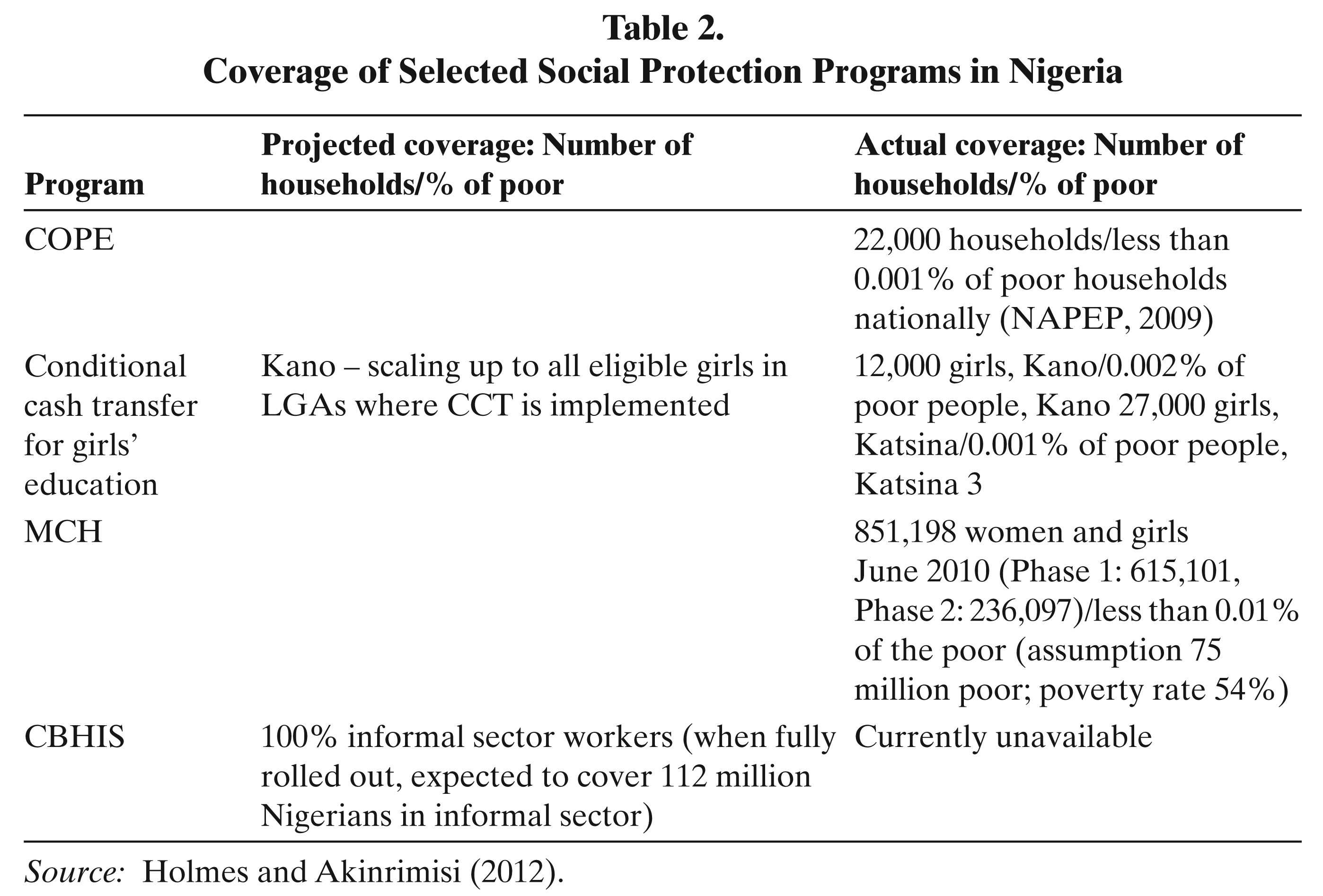
The program started as a pilot in 12 states and became compulsory across all states in the second phase. It is currently in its third phase, with state governments required to match funding. In this third phase, the program is subject to state commitment to its implementation. A total of 12 states have committed funding: Katsina and Kebbi (North-west); Bauchi and Adamawa (North-east); Kogi and Niger (North-central); Bayelsa and Cross River (South-south); Anambra and Abia (South-east); and Osun and Lagos (South-west). Program coverage is extremely small. NAPEP’s own estimates suggest that COPE has now reached approximately 22,000 households. Dijkstra, Akanji, Hiddink, Sangarabalan, and de Mevius (2011) find that 18,750 households have been trained by COPE. This results in coverage of less than 0.001 percent of the poor.
The Ambassador’s Girls’ Scholarship Program (AGSP) is one component of the US Government’s African Education Initiative (AEI) administered on behalf of the US Government and people of America by the United States Agency for International Development (USAID). This education program increases access to quality basic education in Africa by providing scholarships and textbooks, improving teacher training, and strengthening community participation in education. Since the inception of the program in Nigeria in 2004, a total of 9,149 children attending 411 schools in 13 states have benefited from the program. There are currently 255 AGSP beneficiaries in 26 schools in Niger State and 235 AGSP beneficiaries in 55 schools in Nassarawa State. Over the past four years, the US Government has provided over $1.2 million in scholarships to underprivileged Nigerian boys and girls. Scholarship recipients are selected by community leaders, school principals, and the facilitating NGO (World Education, 2007).
The Edo Girl’s Power Initiative (GPI) is a Nigerian non-governmental, not-for-profit youth development organization founded in 1993 by Bene Madunagu and Grace Osakue to address the challenges facing girls in the Nigerian society and equip them with information, skills, and opportunities for action to grow into self-actualized young women. The mission of GPI as a national organization is to educate girls between the ages of 10–18 years concerning their health, rights, self-reliance skills, and needs from a gender perspective through information, communication, counseling, and community intervention.
Fuel Subsidy Reform Palliative Measures of the Federal Government of Nigeria have recently been affected by the removal of the fuel subsidy, thus increasing the pump price of fuel. The position of analysts on the effect of this policy on poverty reduction has been divergent. Some believe that the subsidy’s removal will help to curb the problem of poverty in the country, while others argue that the policy is likely to make most Nigerians poorer by reducing their purchasing power as well as their level of demand. In order to reduce the effects of this policy on the masses, the government recently procured diesel powered public buses under the Urban Mass Transit Program.
The National Poverty Eradication Program (NAPEP) was established in 2001 and involved all stakeholders in poverty eradication in Nigeria, namely the federal, state and local governments, civil society organizations, research institutions, the organized private sector, women groups, and concerned individuals (Okoye & Onyukwu, 2007). The primary aim of NAPEP is to address the problem of absolute poverty in Nigeria. The stakeholders recognized that certain fundamental reasons were responsible for the inadequacy of antipoverty measures over the years and they include the absence of a policy framework, inadequate involvement of stakeholders, poor implementation arrangements, and lack of proper co-ordination. All of these seem to have received attention in designing NAPEP and to make it different from all past efforts. The mandate is to monitor and coordinate all poverty eradication efforts in order to harmonize and ensure better delivery, maximum impact, and effective utilization of available resources. NAPEP is organized into four schemes. These are Youth Empowerment Scheme (YES), Rural Infrastructure Development Scheme (RIDS), Social Welfare Schemes (SOWESS), and the National Resource Development and Conservation Scheme (NRDCS).
The Community-based Health Insurance Scheme (CBHIS) aims to protect the informal sector and marginalized groups against the burden of high out-of-pocket health expenditures by pooling risks within a community. Such programs have been implemented before in Nigeria but with little success, owing to the mismanagement of funds by community members. To respond to these problems, a new pilot scheme is currently underway, with a new model based on learning from previous pilots and health schemes in Uganda and Mexico. The pilot will be implemented in 12 states and is envisaged to provide a safety net for a minimum of over 60,000 people in the informal sector. When fully rolled out, it is expected to cover 112,000,000 Nigerians in the informal sector (Hagen-Zanker & Holmes, 2012).
Major Challenges Associated with Social Protection Interventions in Nigeria
The scale of most social protection programs in Nigeria is extremely small when compared with the number of people who require such policy interventions. This is reflected in the small scale of programs run by government and development partners (international agencies and NGOs) which cover between a few hundred households and a few thousand. In other words, social protection programs reach only a small fraction of the poor. For example, the cash transfer program COPE has reached just 0.001 percent of poor households (Dijkstra et al., 2011). In Jigawa State, for example, a state with 4 million people and a poverty rate of 90 percent, only 850 households are beneficiaries of the program (Holmes et al., 2012). The coverage of some social protection programs in Nigeria is illustrated in Table 1.
Despite being relatively rich compared with other countries in sub-Saharan Africa in terms of per capita GDP, Nigeria spends a significantly lower share on social protection. In 2006–2007, Nigeria spent 0.9 percent of GDP on social protection, while countries such as Ethiopia, Kenya, Malawi, Mozambique, and Uganda spent an average of 1.4 percent in the same year (Hagen-Zanker & Tavakoli, 2011, p. 1).
Coverage of Selected Social Protection Programs in Nigeria
The transformative social protection approach indicates that “social protection” should address distinct problems of “social vulnerability” not necessarily through resource transfers, but “through delivery of social services, and through measures to modify and regulate behavior towards socially vulnerable groups” (Devereux & Sabates-Wheeler, 2004, p. 9; 2007, p. 23). In Nigeria the poor performance of the social services sector especially electricity supply contributes to the persistence of poverty in the country.
Strong political will has been identified as a requirement for the success of social policies (Giovannetti et al., 2011). In Nigeria frequent policy changes and inconsistent implementation turn out to prevent continuous progress. Severe budgetary and governance problems have also contributed to the full implementation of the programs. This has often resulted in partial implementation or abandonment of social programs.
A crucial aspect of transformative social policy is state–community partnership in setting the social policy agenda (Adesina, 2012). In Nigeria lack of involvement of beneficiaries in the formulation and implementation of social programs had resulted in the failure of policies that would have transformed the lives of people from quantity to quality.
The manifestations and problems associated with corruption in Nigeria have various dimensions. Among these are project substitution, misrepresentation of project finances, diversion of resources, conversion of public funds to private uses, etc. (Okoye & Onyukwu, 2007). In some cases, lack of accountability and transparency made social programs to serve as conduit for draining national resources.
Conclusion and Policy Implications
The level of poverty in Nigeria requires effective social protection strategies. Sadly, the social protection arrangements in Nigeria are grossly inadequate. The major challenges associated with social protection arrangements in Nigeria are the inadequate coverage of the existing programs, insufficient expenditure on social protection, poor social services delivery, lack of political commitment, and the non-involvement of the beneficiaries in program design and corruption. It is therefore very pertinent that efforts be directed towards scaling up the social protection arrangements in Nigeria and ameliorating the structural problems associated with social protection services delivery in Nigeria.