




Abstract
In the last few years a participatory watershed program is being implemented in the state of Andhra Pradesh. At present, the Andhra Pradesh Rural Livelihoods Project (APRLP) seeks to scale up the ongoing watershed program activities in the state by providing support in the areas of capacity building, livelihood support, and the provision of other schemes and services to the persons and organizations involved. This article is the outcome of the writer’s field work in Andhra Pradesh. Using a livelihoods approach, the author reveals that the lives of marginal communities have radically changed as a result of the introduction of watershed programs in the drought-prone areas of this region.
Keywords
Introduction
Policy initiatives are being initiated by different state agencies to improve the living conditions of the marginal sectors of Indian society. There has been a sizable body of research produced on the conditions which have marginalized these people as well as the development programs directed at them. These sectors are swelling in number and are in a deplorable condition of destitution. It is apt in this regard to quote the observation of Jhabvala and Standing (2010) “although India has a very impressive economic growth record over the past two decades, it does not have the same achievements in implementing social policies that could reduce poverty, income insecurity and income inequality.”
Traditionally, the discipline of anthropology has been geared to studying marginalized communities. 1 The primary means of understanding their situation has been through the rubric of deprivation. While this approach continues to be useful, it also runs the danger of reducing the subjects of its study to mere victims of larger processes (Kasi, 2007). In other words, there is a tendency to see the marginalized as totally lacking in agency or to focus on the supporting mechanisms that address their issues. An important corrective to this tendency is the livelihoods approach taken up by scholars like Diana Carney (1998), Scoons (1998), Farrington et al. (1999), Ellis (2000), Reddy (2001), Reddy et al. (2001), Mariella (2002), Rakodi (2002), Reddy et al. (2004), Deshingkar (2004), Siva Prasad and Pandey (2007), and Prowse (2008). One of the important features of the livelihood approach is that it focuses upon people’s assets (physical, natural, financial, human, social, and political capital). It also looks at how people utilize these assets and negotiate their problems.
The sustainable livelihoods (SL) approach goes back to the mid-1980s, when Robert Chambers (1988) first initiated thinking about this approach. The early theoretical formulations were developed further in the early 1990s by Chambers, Conway, and others (1992; Bebbington, 1999). Since then, a number of development agencies, governmental, and non-governmental, such as, the Department for International Development (DFID), United Nations Development Programme (UNDP), CARE, and OXFAM, have made efforts to implement it. There have been many attempts to define livelihoods. Chambers and Conway defined livelihoods as “the ways in which people satisfy their needs, or gain a living” (1992, p. 5).
Later, Carney (1998) and Ahmed and Lipton (1997) offered an elaborate definition of SL. According to Carney (1998, p. 2)
A livelihood comprises the capabilities, assets (including both material and social resources) and activities required for a means of living. A livelihood is sustainable when it can cope up with and recover from stresses and shocks and maintain or enhance its capabilities and assets both now and in the future, while not undermining the natural resource base.
A “Livelihood” is a set of flows of income, from hired employment, self-employment, remittances or (usually in developing rural areas) from a seasonality and annually variable combination of all these. Livelihood implies systems of how people make a living and whether their livelihoods are secure or vulnerable over time (Ahmed & Lipton, 1997).
A SL approach aims to provide a wider view of poverty than conventional income-based approaches. Scoons (1998), Rakodi (2002), Siva Prasad and Pandey (2007), and Kasi (2007) rightly viewed that the SL approach recognizes the importance of the ability to access resources and entitlements, reduce risk and vulnerability, and exercise voice. It, therefore, emphasizes that the poor do have assets, options, and strategies, and that they are decision takers. Its concern with “getting below the surface” to informal institutions and processes is particularly important; and offers the prospect of identifying entry points for pro-poor change, and of sequencing activities in such a way as to minimize the danger of appropriation of benefits by local elites.
The SL approach highlights access to assets as key to enhancing capabilities. Pretty (1999) emphasizes that assets, under the five headings of natural, social, human, physical, and financial capital, are vital for sustainable development (Pretty, 1999). In addition to identifying assets, the nature of access is critical to determining “entitlement,” defined by Williams as the “full range of resources that persons have at their disposal for the realisation of capabilities” (Williams, 1999, p. 194).
Pretty and Ward identify social capital as an important part of SL. It consists of formal and informal rules, norms and sanctions, connections through networks and between groups – all of which facilitate relations of trust, reciprocity, and exchange (Pretty, 1999, cited in Marzano, 2002, p. 823; Pretty & Ward, 2001, p. 211).
Further, Marzano (2002, p. 824) explains that SL approach helps to identify people who may be vulnerable by examining people’s access to available assets and the livelihoods choices they subsequently make. In this study, social or political capital influences access to most other resources, and is, therefore, a key factor determining vulnerability. Those with insufficient access to land will, if they have the available labor within the household, rent or borrow plots of land from other landowners in the villages (cited in Kasi, 2007).
According to Appendini (2001, p. 24), the central objective of the livelihoods approach was “to search for more effective methods to support people and communities in ways that are more meaningful to their daily lives and needs, as opposed to ready-made, interventionist instruments.” Robert Chambers (at IDS) and Gordon Conway (at IIED), themselves, who drew upon insights from previous research on food security and agro-ecological sustainability, are widely acknowledged for having put livelihoods, then usually called “sustainable livelihoods,” at centre stage (Chambers & Conway, 1992).
This is not to say that livelihood is not a matter of material well-being. Rather, it also includes non-material aspects of well-being. Livelihood should be seen as a dynamic and holistic concept. In the words of Bebbington (1999, p. 2002):
A person’s assets, such as land, are not merely means with which he or she makes a living: they also give meaning to that person’s world. Assets are not simply resources that people use in building livelihoods: they are assets that give them the capability to be and to act. Assets should be understood only as things that allow survival, adaptation and poverty alleviation: they are also the basis of agents’ power to act and reproduce, challenge or change the rules that govern the control, use and transformation of resources.
Further, Haan and Zoomers (2005, p. 33) posit that the improved understanding of the holistic meaning of livelihood is an important achievement of the livelihoods approach. It reveals itself not only in its view on livelihood outcomes, but also in its attention to a variety of capitals upon which the poor draw to shape their livelihoods. Besides conventional assets like land, livestock, or equipment, these include various elements of human and social capital. The emphasis is on the flexible combinations of, and trade-offs between, different capitals.
A valuable step forward has been made by Scoones and Wolmer (2002) in their study of pathways to crop livestock integration in Africa. Pathways show that people do make their own livelihoods, but not necessarily under conditions of their own choosing: “Livelihoods emerge out of past actions and decisions are made within specific historical and agro-ecological conditions, and are constantly shaped by institutions and social arrangements” (ibid., p. 183).
The livelihoods approach allows for both the intentional, strategic behavior of actors and the historical, socio-cultural repertoire. It represents a dynamic standpoint on livelihoods, which take into account successes and failures, as well as social and geographical mobility, rather than making rigid and static assumptions about class, gender and so on. Livelihoods are usually analyzed in relation to a single location, seeking to understand the geographical, socio-economic, and cultural micro situations (Haan & Zoomers, 2005, cited in Kasi, 2007).
The Question of Vulnerability
The SL approach takes into account the vulnerability context in order to understand the way people cope up with those contexts. There have been many attempts to define “Vulnerability.” According to Alwang et al. (2001): “Vulnerability is best defined relative to some benchmark of ill-being.” Vulnerability is related to factors, such as, educational opportunities, mortality, nutrition, and health, which can be measured (Dercon, 2001). In brief, “vulnerability” is understood as the trends, shocks, and seasonality over which people have limited or no control. These conditions critically affect their livelihood status and possibilities.
Prowse (2003, p. 12) views vulnerability as “what poor people are concerned about” and it is not so much that their level of income, consumption, or capabilities are low, but that they are likely to experience highly stressful declines in these levels, to the point of premature death. This approach suggests that poverty can be seen as the probability (actual or perceived) that a household will suddenly (but perhaps also gradually) reach a position with which it is unable to cope, leading to catastrophe.
Further, there are studies which argue that the SL approach has been widely identified as an instrument to eradicate poverty (Bebbington, 1999; Kasi & Siva Prasad, 2005; Mariella, 2002; Williams, 1999). However, our article seeks to use this approach as a means to understand not only poverty, but all the other forms of deprivations and vulnerability contexts—keeping in view the marginalization debate. The rationale for the promotion of a “livelihoods approach” in the watershed program in states, such as, Andhra Pradesh, lies in the desire to take a more inclusive approach to community development and directly address some of the criticism that the watershed program, which is essentially land-based, does not benefit the poor, many of whom are landless. Such an approach focuses on people’s livelihood assets and strategies. People’s own human capital—comprising the skills, knowledge, ability to labor, and good health—is one asset on which they can draw. Hitherto, there has been insufficient differentiation in considering human capital within the livelihoods frameworks. DFID’s sustainable rural livelihoods approach puts “people at the centre of development.” The DFID-supported Andhra Pradesh Rural Livelihoods Project (APRLP) covers five districts in Andhra Pradesh, with a total population of over 15 million. The target groups for the project are the rural poor in those districts, estimated to be up to 40 percent of the population (Seeley, 2001).
The Andhra Pradesh Rural Livelihoods Project
For the last few years, in Andhra Pradesh, the participatory watershed program, hitherto termed the APRLP project, is being implemented in the State. This program aims to scale up ongoing watershed program activities in the State by providing support to persons and agencies involved in the areas of capacity building, livelihood support and convergence of other schemes and services, collectively called “watershed plus.” The project is expected to assist in macro policy evolution in areas relating to evolving effective and sustainable approaches to reduce poverty in the five drought-prone districts of the state. The project adopts a participatory sustainable rural livelihoods strategy, which is based on an analysis of the capital assets (physical, social, human, natural, financial, and political) from which the rural poor make up their livelihoods (APRLP, 1999).
The term “marginal” is used here to represent the tribal communities of Andhra Pradesh and more so in respect of the Sugali Tribe in Ananthapur District. The Macmillan Dictionary of Anthropology defines the term “Marginal” or “Marginality” as “in its economic, political and socio-cultural dimensions is an important element in most contexts of anthropological research, and has varying dimensions, which have been explored in ethnography and anthropological theory to varying extents.” Thus “the vast majority of the populations studied by anthropologist’s are to a certain extent marginal ones, often doubly marginal, as in the case of ethnic minority groups existing within Third World nations which are themselves marginal to the world capitalist system.” It is further mentioned that “anthropological research within Western nations also tends to focus on groups which are in some way marginal to the dominant national society, whether they are ethnic minorities or groups that are in some other way set apart from the mainstream” (Seymour-Smith, 1986, pp. 177–178).
The World Bank (2005) uses the term “Indigenous Peoples” to refer to the same category of people. It uses the term “Indigenous Peoples,” in a generic sense, to refer to a distinct, vulnerable, social and cultural group. A group that has lost “collective attachment to geographically distinct habitats or ancestral territories in the project area,” because of forced severance, remains eligible for coverage under this policy. Further, Anjana Chaudhary (2000: 234) has defined the term “marginal group” as “a culture group that has relinquished some of its traditions and separate identity and partially accepted the values and ways of life of a culture it is in the process of adopting.”
Keeping in view the aforementioned definitions and also looking at possible limitations, an attempt is made in the article to portray the watershed program vis-à-vis the life context of the Sugali people. The tribal communities in India, to a large extent, are overwhelmingly marginalized not only economically but also spatially, culturally, and otherwise. Andhra Pradesh has a significant proportion of tribal population and is ranked fifth in the country. Numerous laws promulgated in the pre- and post-British India have affected the tribal’s adversely. These laws have threatened their livelihoods and existence. These groups, who were forest dwellers and forest dependent communities (La Rovere et al., 2009; Larson et al., 2007; Saravanan, 2009), have been denied usufruct rights over forest produce. Recent incidents, for instance, which got attention because of the vibrant media and other sources at Nandigram, Singur (West Bengal), parts of Orissa, and Sompet (Andhra Pradesh) reflects the severity of the existed situations which portray the destitute conditions of the tribal/adivasis people. Land reforms have not benefited them in any significant way. Hence, they remain landless and, to some extent, even homeless. The lack of education has resulted in their exploitation by the non-tribals. Government officials have often colluded or remained apathetic to this situation (Kasi, 2007).
As Bokil (2002) rightly pointed out, the first and foremost problem before the tribal communities in India is to earn and sustain livelihoods. This problem is assumed alarming proportions because the traditional means of obtaining livelihoods are increasingly threatened. In the past 50 years, the access to and control over the resources has undergone radical changes. Thus, it is in this context demonstration of the tribal communities which can make use of the available natural resources and obtain SL (2002, pp. 163–165).
Though majority of tribal/adivasis lives in forest areas, many of them also live in the plain areas of India, which are not included under the list of Scheduled areas. Hence, in order to develop these groups, the government initiated the Integrated Rural Development Programme (IRDP). The Government of Andhra Pradesh has implemented the IRDP, in order to change the livelihoods of the people through agricultural development. This program aims to bring about an integrated development involving various agencies like forest, agriculture, education, and health. The main thrust of the program is toward an all round development of the people. An integrated approach would help to bring about effective administrative control, monitoring and evaluation of the entire program. Besides these efforts of the government, non-governmental organizations (NGOs) have also been involved in the development of tribal livelihoods. Given these efforts of both the government and NGOs, it would be important to study the impact of these efforts on both the livelihoods, as well as the cultures of the tribals. Mere adoption of a livelihoods approach would not lead to a sustainable development. It has to be seen in the context of the lives and aspirations of the tribal people. In fact, the analysis has to be integrated into traditional anthropological concerns for a better understanding of the tribal development (Kasi, 2007).
As mentioned earlier, the role of development agencies in implementing the developmental efforts among tribes/adivasis and other marginal sections of the rural India and elsewhere in south Asia (Ur-rehman, 2008) is also very essential to put-forward the nexus existing between the state and development agencies. The following section highlights some of the studies in this context. Baviskar (2001) mentioned that the decline of the state is accompanied by increasing attention toward civil society institutions. Among the social groups and associations of various kinds that are considered to make up civil society, NGOs have become especially prominent in the last two decades. NGOs have emerged around the world – notably in the developing world – as major players in the developmental action (Meyer, 1996, p. 453). Given the profound implications of NGO involvement in development, there is a great need to critically examine the changing relations between NGOs, state agencies, multilateral and bilateral funding institutions, and other social groups. The NGO sector in India is characterized by tremendous diversity and heterogeneity. Ignoring this diversity, unfounded generalizations are often put forward and unfair comments and criticisms are offered. NGOs differ from one another in size, in funding, in functions; in the levels at which they operate; and in organizational structures, goals, and membership (Baviskar, 2001, cited in Kasi, 2009, p. 116).
In India, there are 14,000 NGOs registered under the Foreign Contributions Regulation Act. In all, there may be over 30,000 NGOs in India. The close collaboration between academics and the NGOs’ practical work is one of the reasons for the absence of rigorous studies in this area. Social scientists have close links with NGOs, and since many NGOs operate in the cross-disciplinary space between academic research and activist intervention, they offer to academics many opportunities to pursue their work into the domain of non-academic practice.
There are many definitions of NGOs. The voluntary sector includes non-governmental, non-profit organizations. They may be engaged in a variety of activities: implementing grassroots/sustainable development, promoting human rights and social justice, protesting against environmental degradation, and many other similar tasks. According to Baviskar (2001), some activists resent and reject the term NGO. Instead, they designate themselves as social action groups, political action groups or social movements. Anna Hazare’s village development group at Ralegan Siddhi in Maharashtra and Ela R. Bhatt’s Self-Employed Women’s Association (SEWA) in Gujarat are both identified as NGOs, but are very different from each other, in terms of size, membership, funding, approaches, strategies, and outcomes.
I quote from Baviskar (2001) who also said that while there are many definitions of NGOs, there are several classifications too. Shah and Chaturvedi (1983) divide NGOs into three main categories: technomanagerial, reformist, and radical. Hirway (1995) classified NGOs in Gujarat into: welfare-oriented, developmental organizations, and empowering NGOs. Iyengar (1998) classified NGOs in Gujarat into four categories: Gandhian, service delivery organizations, professional organizations, and mobilizational organizations.
There are studies which explain that the link between NGO, CBO, Civil Society and DWCRA is cordial and these are making good progress all over India and, most importantly, in Andhra Pradesh. The role of SHGs and NGOs in Andhra Pradesh is the highest in the country. These are acting as good agents of the development. For instance, Nametra (1995) has rightly said that the NGOs could only facilitate the undertaking of subsistence activities, and that the income from such activities was either equal to or less than the existing wage income. These activities made a difference to the people in so far as they could be undertaken during the lean season and that the problem of seasonal unemployment could be, to some extent, solved (Radhakrishna & Ray, 2005).
In Andhra Pradesh, in all the districts, different NGOs and CBOs are conducting their activities among the marginal groups. In Anantapuram, for instance, some NGOs are working for the development of the marginal sections. Rural development Trust (RDT), an NGO, is active in all the Mandals (block) of the district. There are two Mandals, that is, Penukonda and Hindupur, where RDT is not in operation. In these two Mandals, two different NGOs are working with the marginal groups. Likewise, we have Social Education and Development Society (SEDS) running its activities in the Penukonda Mandal of Anantapuram District of Andhra Pradesh.
Methodology
This article is based on the data collected from Anantapuram district in Andhra Pradesh. The present study is basically a qualitative study aimed at understanding the livelihood systems of the marginal communities and shocks, stresses and trends involved in their livelihood processes. In order to fulfill the objective of the study, qualitative anthropological tools and techniques have been employed. These are: mainly Observation (participant and non-participant type), Interviews (formal and informal) using detailed checklist, Key-informant interviews, Case Studies, Focus Group Discussions, etc. The study also sought to understanding the native’s concepts and people’s views regarding the livelihood systems of the people, existing systems of utilization, local knowledge of the different capitals involved and also, most importantly, the role of vulnerability context in their daily life systems.
Data from secondary sources were gathered from books, articles, published reports, census reports, and government documents from the respective departments. Quantitative data with regard to demographic and economic aspects, and accessibility and availability of different assets, services, and also other information regarding the study was collected from primary sources through detailed census schedules.
Watershed Development Programs in Andhra Pradesh
With a total geographical area of 274,400 km, Andhra Pradesh is the fifth-largest state of India. The state consists of 23 districts comprising 1,104 revenue mandals. The economy of Andhra Pradesh is predominantly agrarian. According to the population census of 2001, the population of the state is 75.7 million. The population density being 213 persons per km. Almost 75 percent of the population lives in rural areas, with 70 percent depending on agriculture as the main source of livelihood. The importance of agriculture sector is further underlined by the fact that almost 70 percent of the state’s work force is engaged in agriculture and allied activities. Due to the high population growth, the share of agricultural laborers shows an increasing trend, indicating that increasing man-land relation lead to severe problems of productively absorbing the growing rural population in the agriculture sector. Andhra Pradesh has one of the highest shares of agricultural laborers in the total work force of all Indian states. Landless families constitute up to 60 percent of total households in certain districts of the state.
Although productivity has increased in the last 25 years, the standard of living of large sections of the population has not improved to a noticeable degree. About 54.2 percent of the land holdings are classified as marginal. Recent demographic interpolation estimate that 18 and 4 percent of Andhra Pradesh population belong to Scheduled Castes and Scheduled Tribes, respectively. According to the latest estimates, almost one quarter of the total population of Andhra Pradesh comes in the below poverty line category.
The Drought Prone Area Programme (DPAP) is a centrally sponsored program funded by Central and State governments on a 50:50 basis. The DPAP aims at developing the drought-prone areas with an objective of drought proofing by taking up soil and land moisture conservation, water harvesting structures, afforestation and horticulture programs on a comprehensive micro watershed basis. During 1994–1995, the program was implemented in 69 blocks of eight Districts. From 1995–1996, this program was further extended in 11 Districts, with 94 blocks, under the scheme and in Anantapuram District, to 16 blocks under Desert Development Programme (DDP).
While DPAP is targeted toward the semi-arid and dry sub-humid areas, DDP was designed specifically for improved natural resource management and environmental protection measures in the arid areas of Andhra Pradesh state. Besides this delineation of geographical target areas, there are virtually no difference between DPAP and DDP as regard to operational guidelines, eligibility for erosion control and SWC measures, etc., except that under the DDP, the cost norms are higher (₹ 4,500 to 5,000 per ha.) than for DPAP projects (₹ 4,000 per ha.). The main criterion for inclusion into DPAP is the share of irrigated land at the block level, the current ceiling being 20 percent. The total number of blocks covered under DPAP is 94, while 16 blocks have been identified for DDP. These 110 blocks represent one third of the total number of 330 blocks in Andhra Pradesh.
Watershed Development in Anantapur District
Anantapuram is a hot arid district and falls in the rain shadow zone with a very low estimated annual rainfall of 520 mm, which is second lowest in the country—after Jaisalmar in Rajasthan. In the district, the area is fully undulating—with ridges and valleys with black cotton soils in certain areas. Out of the total rainfall received, only 10–15 percent is utilizable for agriculture. The rest is going waste through streams into the sea and evaporation. Due to large number of water conservation and water harvesting structures taken up in the district during 1993–1994 and 1994–1995, recharge of 1000 M.cub of additional ground water was made possible.
The entire district is declared as hot arid due to severity of soil erosion, high temperatures, and low and erratic and uneven distribution of rainfall (resulting in “soil and moisture stress”), excessive evaporational losses and crop losses as the ultimate effect of drought and high aridity index. Trends of desertification are also seen in parts of district. Unfortunately, the status of the district has not been changed from drought prone to hot arid. Ground water levels are alarmingly receding. Further degeneration of existing marginal and degraded forests had occurred in the last four decades and acute scarcity of drinking water, fodder and fuel is taking place in every alternative year. All these factors are creating tremendous concern and awareness regarding the danger that is looming large among the masses of the district. Anantapuram district mainly depends on South–West and North–East monsoons. Normally South–West monsoon rains are useful for rain-fed dry crops. But failure of two monsoon hits the district drastically—leading to drought. The following physical symptoms are indicative of the origin of desertification trends:
Hardly 10 percent of land mass available in the district is covered with forests. Most of the hillocks and hill ranges are barren without any sort of vegetation. The top soils having been washed away due to the very strong erosion factor. About 30 percent of hills are declared to be dead hills where nothing can grow because there is no top soil on the hills, except granites boulders and weathered rocks. Levels of ground water are going down year after year owing to low rainfall and over-exploitation and improper use and wastage of water. A remarkable and unique feature of the district is the high intensity of winds after experiencing the maximum temperature during summer and, at the time, of onset of monsoons.
To combat the recurring drought and to bring comprehensive development, the DPAP program was introduced in the year 1975—covering all the blocks in the district. This program is now being implemented on area approach basis with the watershed development concept. Accordingly, several developmental strategies were implemented with a view to conserve soil, harvest and conserve rain water bringing out change in cropping pattern, organizing people in Self-Help Groups (SHGs), development of dryland horticulture, sericulture, and promotion of social forestry, and integrated rural development.
However, with all the developmental strategies carried out under DPAP up to 1994–1995, nearly 2.62 lakh hectares, out of 19.5 lakh hectares of geographical area, could be covered and about 2.07 lakh individual beneficiaries could be assisted. At this stage, the trends of desertification were noticed in various parts of the district. It was declared as a hot arid district and program of DDP was introduced in the year 1995. In this program a concerted integrated micro watershed development approach was envisaged by Dr. Hanumantha Rao under the new guidelines of Government of India. According to this, area of watershed would be approximately 500 ha, and programmed to spend ₹ 22.50 lakhs in each watershed area. Out of this, ₹ 18.00 lakhs will go for works component and ₹ 4.50 lakhs for covering the community organization and administrative costs. It is contemplated to execute the works and to implement the program through NGOs and Government officials serving as the Project Implementation Agency (PIA).
Integrated Action Plan for Watershed Program in Anantapur District
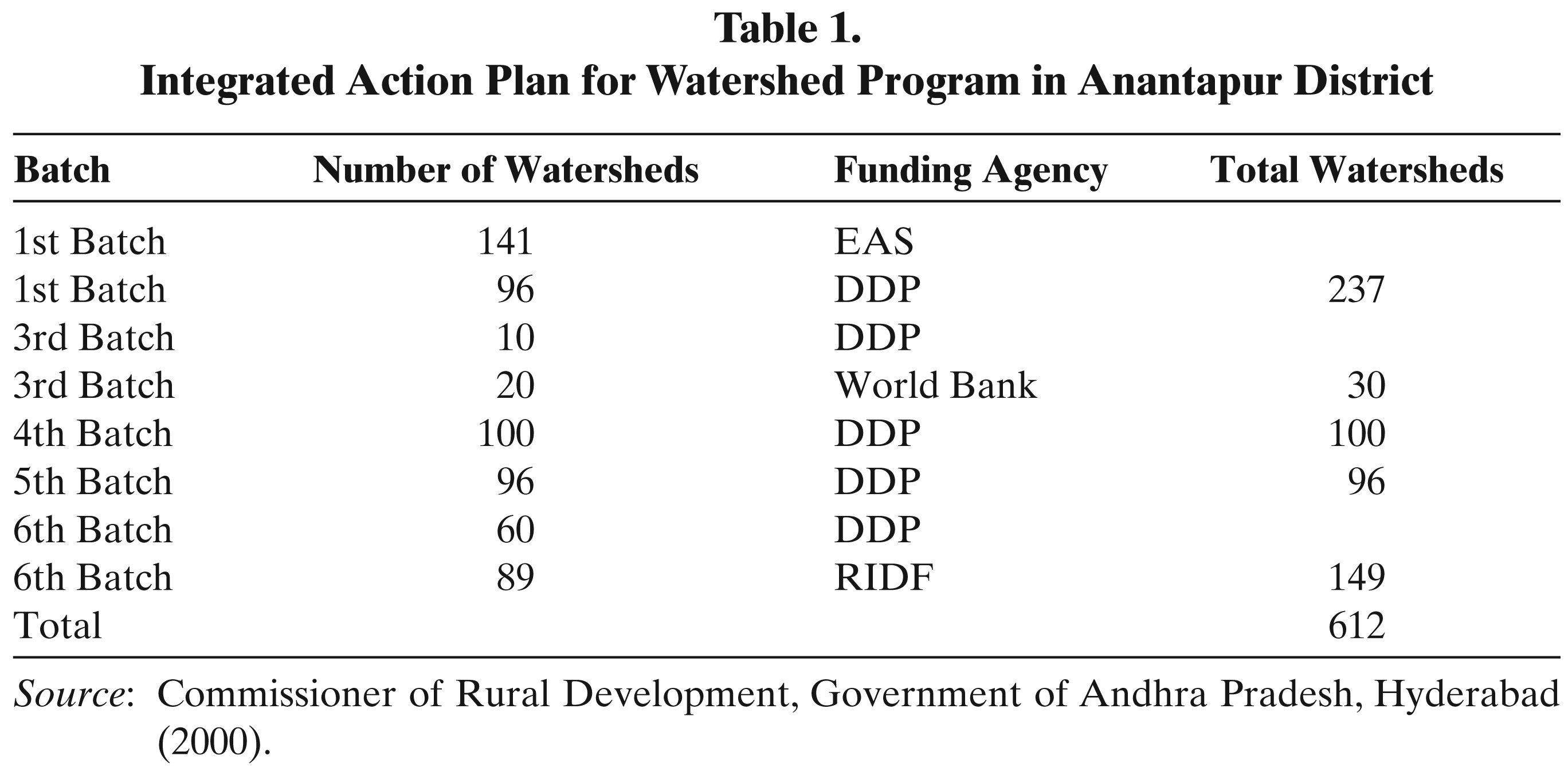
Source: Commissioner of Rural Development, Government of Andhra Pradesh, Hyderabad (2000).
An integrated action plan for a project period has been prepared for the watersheds programs for the district, as detailed next. In micro watersheds, the developmental works is being taken up by the watershed committees with the help of SHGs and user groups under the supervision of the watershed development team, PIA’s and Multi Disciplinary Teams.
Taken into the priority ranking given by the Andhra Pradesh State Remote Sensing Application Centre (APSRAC), were the variables of SC, ST, population percentage of literacy, percentage of agricultural labor, scarcity of drinking water, quality of drinking water, availability of DWCRA, status of ground water, contiguity with an existing watershed, livestock population, and community mobilization, etc., 3600 watersheds were prioritized into very high, high, medium, low, and very low categories. The aforementioned program is being implemented in the Mallapuram village, which is described next, along with the related development programs such as DWCRA and the role of watershed programs in the empowerment of women in the area.
Role of NGOs in the Development of Marginal Communities
NGOs have been playing for some time an important role in the developmental cycles of marginal and vulnerable communities. Holmen and Jirstrom (2009) have observed that:
NGOs are major players of development aid today. It is widely believed they represent civil society and that, for example, the UN and the World Bank would be strengthened if NGOs were given a larger influence over policy formulation and development.
Ghosh (2009) has stated that “NGOs promote democracy when they redefine participation in terms of their relationship with state and society; and contribute to improve the quality of participation, although with much less success in promoting internal democracy.” Taking these views further in the following section an attempt is made with two cases from the Rayalaseema area, one of the more backward and frequent drought affected regions of Andhra Pradesh, to analyze and probe the links the NGOs maintain in order to implement their schemes and programs for the development of marginal and vulnerable communities.
Case-1 Rural Development Trust
Father Vincent Ferrer and Mrs. Anne Ferrer founded Rural Development Trust, popularly called RDT, in the year 1969 with Anantapur as its central headquarters. It is primarily working for the integrated development of over 250,000 rural poor families with special focus on Dalits, Tribes, Weaker Sections, Disabled, and Women spread across 1,874 villages in the chronic drought-prone Anantapuram district of Andhra Pradesh, South India. It has a total of 1,764 full time staff members who are specialists in their respective fields and about 5,500 trained village volunteers covering health, education, ecology, women, and disability sectors. The aim of RDT includes a set of guiding principles (DHARMA) namely, “Concern for others especially poor and needy,” “Work beyond duty,” “Pursuit of Excellence in Work,” and “reaching as many poor as possible.”
The Vicente Ferrer Foundation in India
The Vicente Ferrer Foundation is an NGDO (non-governmental development organization) committed to the process of transforming the poorest and most needy areas of Andhra Pradesh in southeast India. The Vicente Ferrer Foundation was founded in India in 1969 with the aim of finding solutions to the multiple problems of the rural community of Anantapuram in Andhra Pradesh state. Since then, it has been working as an organization with a deep social commitment, respectful of the environment and is a promoter of the process of development which the area is experiencing. A team of more than 2,200 people (of which 99 percent are natives of Anantapuram) is responsible for implementing the development program that the organization carries out – the most innovative in the history of India—covering 3,152 villages and benefiting more than two and a half million people.
Activities of RDT
RDT has constructed retaining walls and terraces that have slowed the erosion caused by torrential monsoon rains. With this, better yields are being achieved and fertile topsoil and moisture are conserved. To combat climate imbalance in the area, a plan has been set in motion to reforest Anantapuram (Andhra Pradesh) which includes the planting of fruit trees and medicinal plants.
Through the introduction of drip irrigation and spraying, RDT has managed to save, multiply, and share water resources in the area.
For decades, the main crop in Anantapur has been peanuts, a delicate fruit which is severely affected when the rains fail, or are delayed. To alleviate this problem, the Foundation promotes the planting of other species that need less water and are more resistant to drought. Mango, sapodilla, jujube, Indian redcurrant, jamun, custard apple, and pomegranate are some examples. In this way, the diet is enriched and the family income increases.
The Drought Reserve Fund encourages job creation during the critical months of drought. In addition to preventing migration, the Fund serves to improve the condition of the soil by means of a small salary which the Foundation pays to laborers to clean up the wastelands.
To avoid total dependence on crops, the Foundation has promoted livestock farming. Thus, dairy cows that have been given out become a source of safe and regular income for families. In the same vein, the organization has also begun to promote fish farming, pig farming, and poultry farming.
RDT Activities in Anantapuram

Source: Rural Development Trust (RDT) office Anantapur (2010).
It has been observed from the field that RDTs action oriented work has resulted in significant distribution of resources to the poor and vulnerable sections of the Rayalaseema Region, with specific reference to Anantapur district. This has paved the way for establishing a number of other NGOs in the area and spreading their interventions in other segments of rural life.
Case-2 Social Education and Development Society (SEDS)
In 1980, with six years of nonprofit work in Andhra Pradesh already under his belt, Rajen Joshua set out to register his own NGO and the SEDS was born. With the help of his wife and eight friends, he established a central campus on a farm in the village of Anandapuram and began working with the local population toward improved community organization. After 21 years, it has blossomed to employ 35 full-time staff, organize 60 village health workers (soon to be more than 100) and often day labor for up to 500 people. Its programs have expanded from simple community organization to include large-scale watershed, child sponsorship, village health, and community and women’s empowerment programs serving 120 villages with more than 100,000 people.
Although SEDS’s initial work focused on community organization, this soon evolved into efforts to deal with issues that were perceived to lie at the heart of the area’s problems. Anantapuram district of Andhra Pradesh is still the second most drought-prone Indian region. When SEDS started its operation, there was massive deforestation and intense population pressure on the land and its natural resources had significantly contributed to the widespread hunger and general poverty experienced by the local population (Kasi, 2007, 2011).
In response, SEDS began an environmental campaign in 1984 that would soon be transformed into its principal program. The degradation of soil and depletion of surface water in the open wells used by the villagers made it clear that something had to be done. SEDS’s initial efforts, therefore, included homestead plantations, revival of Tamarind orchards and community wood lots. By increasing the overall number of trees, SEDS was able to check erosion and begin recharging the water table that had fallen dramatically. In conjunction with kitchen gardens and individual plantations that provided means for subsistence and income generation, community awareness slowly began to increase and the first signs of acceptance by the local population emerged.
Through its efforts, SEDS has made a significant impact, which is generally all that can be truly desired in development work. The problems of poverty and drought that plague the region will never be solved entirely, but through its work, and the work of other like-minded NGOs, both the local environment and population have seen improvements that make the situation for today’s community far better than what SEDS found when it arrived more than 20 year ago. In that respect, SEDS has been, and will hopefully continue to be, a huge success.
Watershed Program of SEDS
SEDS’s watershed program provides the backbone of the organization. Working in the second most drought-prone region in India, SEDS has created a system of rainwater harvesting ponds, irrigation tanks and check dams and gullies—contributing to a dramatic rise in the water table. It has also implemented programs of education and awareness for the local population and introduced, or aided in, the regeneration of a wide array of vegetation with over 10 million trees planted in the process. Through SEDS’s work, the water table in this semi-arid region has risen from a depth of 42 feet to 4 feet, the landscape is noticeably greener and healthier and the area’s ecology and economy are moving toward a more balanced coexistence.
Afforestation and Soil Conservation
In over 20 years, SEDS has planted nearly 10 million trees as part of a vast effort (in conjunction with its water conservation and collection program) to bring life to the dry earth of Anantapuram District. When the group first arrived, the surrounding landscape was practically barren—as deforestation continued to exact a heavy toll due in large part to the population pressure on natural resources that is still growing (213 per sq. km in 2011 as against 190 in 2001). Used as construction material and fuel, the trees had all but disappeared from the hillsides—leaving them unprotected and diminishing both their water retention capacity and natural beauty.
Tree and grass introduction, initiated on the hills using local species, such as, neem, tamarind and Pogamia glabva, has since expanded to roadsides, homesteads, schools, bunds, and other SEDS landscaping projects. The 17 km road leading from Penukonda to Anandapuram and the SEDS farm has blossomed amazingly. Large green canopies now hang over previously brown expanses, providing shade and shelter to passing workers and travelers. Possibly the most impressive however, is the farm itself, which has grown into a virtual oasis—with its towering palm trees, nurseries, gardens, and paddy fields.
Natural forest regeneration has also begun to emerge, spurred by the increasing success of SEDS’s efforts. Those trees now present act as bio fertilizers (providing essential nutrients to the soil) and wind buffers (arranged in “shelter belts” to further the prevention of soil erosion), while still providing traditional sources of fuel and housing materials (though on a much smaller and sustainable scale). Other benefits of vegetation introduction include examples like that of the thousands of Agave cacti planted by the organization. These act as natural (and consequently much cheaper) fencing for cattle and land demarcation but can also be utilized for their fiber by local rope makers.
In the same manner as hillside trees, grass planted along contour bunds, dams, and gully checks has proven essential to their maintenance and durability. The root structures of the vegetation give strength and cohesion to the soil by trapping water, and allow low-cost production that utilize natural elements, instead of relying on artificial materials such as concrete.
Homestead and individual plantations, along with kitchen gardens, form another large aspect of SEDS’s afforestation/soil management program. The former has introduced fruit trees (mango, sapota, guava, pomegranate, etc.) to provide food and an additional source of income to farmers and their families while the latter, who generally produce vegetables, serve the same purpose. Individual plantations have placed trees around land borders to facilitate land demarcation in addition to providing for fuel needs and income generation (in bad crop years, the farmers can sell the wood). Schools have benefited from this all as well, when in conjunction with the awareness/education program, trees have been planted on their grounds by students.
Wood lots have been established for meeting basic fuel needs in order to ease the pressure on land due to deforestation. Three or four acres of common property are set aside by each village for community-managed growth and distribution of firewood, with focus placed on trees, such as, Eucalyptus and Acacia nilotica, which have rapid regeneration periods (generally five years), In addition, community orchards of Tamarind trees now exist and the production of the spice, traditionally used in Indian cooking, is a further source of income generation.
Compost heaps of collected leaves are used as fertilizers (thereby promoting organic materials) and also provide an example of fire prevention techniques. To combat what is obviously a significant concern in such a dry area, routine fire-tracing clears the land of some of the more dangerous elements by burning grass and the miscellaneous natural fuel sources that lay around hills and farmlands.
The SEDS afforestation/soil conservation program is essential to its environmental mission. These extensive projects, which work in conjunction with its water management and conservation efforts under the general heading of “watershed,” have begun the correction of years of environmental damage. However, a massive amount of work still remains to be done and with the future maintenance and expansion planned, SEDS will continue to direct and improve the region’s endangered landscape.
Water Conservation and Management
Fundamental to life on our planet, water is a valuable resource everywhere. It is especially precious in the drought-prone Anantapur District of Andhra Pradesh. When SEDS arrived in 1980, the water table (or underground level required to reach before arriving at water) lay at 42 feet. With a lack of trees and other natural elements to trap monsoon rains and allow for greater soil saturation, the region was quickly depleting its already low reserves. Erosion had destroyed nature’s own checks and balances and even areas utilizing man-made irrigation tanks had seen their production levels drop.
Combined with reforestation efforts, SEDS has created a system of gully checks, check dams, rainwater harvesting ponds, contour bunding, and percolation and irrigation tanks to rejuvenate the soil and maximize the benefits provided by the rains that fall only in the months of June, July, and August.
A total of 30 rainwater harvesting ponds, ranging from 10’x10’x10’ to 10’x25’x10’, have been constructed. Full by the end of the season, the water that they collect is used for purposes ranging from human and animal consumption to irrigation and percolation. Made available to over 1,500 separate farmers, they have helped increase crop production providing both subsistence and increased commerce to local villagers. At the same time, fish introduced by SEDS in such reserves provide many of the same benefits.
Gully checks and check dams are the primary methods by which the flow of water over natural terrain is controlled. The water’s course is slowed and directed by dirt and concrete barriers constructed by SEDS with the assistance of the beneficiary farmers and villagers. The barriers are placed in ravines and natural waterways, where erosion and deforestation have greatly diminished the ability of the terrain to retain moisture and the crucial topsoil is continually washed away. When heavy rains do fall, they run off almost immediately, providing nothing to the vegetation in the higher regions. With this system of checks, both water and the eroding topsoil are trapped, preventing loss and benefiting the previously water depleted areas.
Contour bunding, the building of embankments along ridges and the natural contours of the land, performs much the same purpose. By controlling and decreasing the flow of water, it slows the erosion of topsoil and helps provide irrigation to farmed fields and previously barren hillsides, leading to increased crop production and natural or introduced vegetation.
Irrigation tanks existing prior to the construction of SEDS’s collection ponds have since been de-silted by the group. Prior to SEDS’s involvement, the build-up of soil and other materials behind irrigation dams had prevented the effective management of the flow of water. Areas that had previously produced two or three crops a year were down to one, and the danger of flash floods had increased. (In 1977, the town of Mekalapalli was wiped out by one such flood. It was later reconstructed on higher ground and is now known as Anandapuram, the town where the SEDS farm is today.) Currently, due to SEDS’s efforts, crop production has recuperated and flood dangers are minimal.
Additionally, at least ten percolation tanks have been constructed to help recharge the area’s water table. The rainwater collected in these tanks seeps into the ground, providing much-needed moisture to the soil while refilling open and bore wells of the surrounding villages.
Through all of these efforts, SEDS has managed to drastically improve the situation in which the area finds itself with respect to its water supply. With the extensive construction realized under its water management program, the water table has risen 38 feet and crop production has doubled. Furthermore, the health and growth benefits to the economy, the residents and the region itself have been immense.
Synergy of the Development Interventions in the Region
As Fisher (1998) rightly pointed out, NGOs are: “organisations involved in the development and they are officially established participatory organisations, serving communities and constituted by middle or lower middle class professionals.” Further, Holmen and Jirstrom (2009) viewed, in their study, that NGOs represent a humanitarian alternative, and that they can, and do, represent the poor and the marginalized. Taking cues from the earlier studies and studies in India and South Asia, it has been viewed by many scholars in India and elsewhere that despite many initiatives by the different agencies in the marginal and backward regions, for instance Rayalaseema of south India, there is lack of synergy between the NGOs, on one hand, and the state and its functionaries, on the other, while initiating development interventions. This is further deteriorating the conditions of the marginal people of the region and thus forcing them to migration to nearby towns and cities in search of livelihoods.
RDT and SEDS are carrying their activities in one of the backward regions of south India for the past 25 years. As the area is also influenced by factional politics, and group differences, both the NGOs are also carrying their works in accordance with the local factional leaders. This is in a way not helping the poor and the marginalized in the area, and leading to further animosities between the communities and NGOs.
Positive Impact through Watersheds Programs—Concluding Remarks
The cases discussed earlier portray the prevailing scenario in the region. As Ghosh (2009) puts it, NGOs are directly involved in promoting various aspects of development, NGO activists and their immediate beneficiaries may be viewed as actors. Hence, people, in the study area, felt that before watershed program their lands were not in good condition. Everywhere they could found stones, rocks, etc. Farmers felt that their yields also reduced drastically. Laborers were unable to get the wage works, so they used to migrate to other areas for work. Irrigated area acreage was less before the introduction of the watershed program in Mallapuram. Dairying people have felt that their milk yield were also very less before the watershed program was introduced in Mallapuram. Farmers used to go to distant places for grazing purposes. People felt that after launching of the watershed program, bunding works have been done in the lands. As a result, both farmers and laborers have been since laborers are now earning more wages and soil rejuvenation has increased, which has resulted in more crop yield for the farmers. Horticultural crops have been given to the farmers, through which changes have come in the cropping pattern. Due to the watershed program, ground water table has increased to 110 feet from 80 feet, according to the sarpanch.
According to Venkatesu, who is practicing dairying, milk yield has improved significantly from 60 to 300 liters over a period of three years. People have also felt that area under forest cover has increased. According to a farmer, Ramanjaneyulu, crop yield has gone up from 5 to 6 bags per acre to 8 to 10 bags after the watershed program was launched. Now, there is also an increase in the non-farm activity in the village. There are three hotels, three petty business shops in the village which were not there earlier. Some of the people have started maintaining autos and running these between Mallapuram and Kalyanadurg. According to them, due to the watershed program, self-employment has improved. “Wage rates have increased, compared to other areas,” said Sakranna Goud, Ex. Watershed chairman. Due to the equal wage rates system followed in the watershed program, women laborers felt happy and agricultural labor rates have also increased, according to Hanumappa, a farmer from the village. Due to watershed program, women’s position has improved and savings has increased drastically. Lingamma, the chairman of the watershed committee, said that watershed program has brought changes in their livelihoods systems. Thus, it is seen from the study that watershed development program has immensely changed the lives of the marginal communities in one of the drought-prone regions of Andhra Pradesh. It would be more than worthwhile to replicate this initiative in similar regions – both in the state and other parts of the country. The rural landscape there is surely bound to change for the better.
Footnotes
Acknowledgements
The author is grateful to Professor R. Siva Prasad, his Guruji, mentor and advisor, for his consistent help in the different stages of this article and also wishes to thank the anonymous peer reviewers, for useful comments on the earlier drafts of the article.