



Abstract
The rise of economic liberalism in Sri Lanka in the latter half of the twentieth century has generated a continuous, powerful, and controversial debate about women in the workforce. Local politicians and powerful societal forces have used discourse to display power in the media and wider society. Gender issues were used as a platform to engage in unrelated political agendas and criticize export processing zones (EPZs), female workers, and female sexuality. Our research in Sri Lanka sampled more than 4,000 women over 14 years. The article uses data from two research studies from 2008–2011 (Study 1) and from 2013–2014 (Study 2) in Sri Lanka. The studies are interrelated. Each analyse the levels of empowerment and disempowerment experienced by women, due specifically to the negative discourse they faced on a daily basis – both as part of their life as EPZ workers (study 1) and after returning to their villages (Study 2). Serious pieces of negative discourse stand out as examples of misleading speech and attempt to subjugate women through power. Our interviews with Sri Lankan EPZ workers show that young women are described as Juki girls, a pejorative term used with a negative connotation. Moreover, EPZs are often referred to as whore zones or love zones due to the stigma created by society and pushed by a political agenda in national political discourse, such as: “Our innocent girls are sewing underwear for white women” (Lynch, 2002, p. 82). The questions in both studies were designed to assess the respondents’ experiences of power (or powerlessness) and empowerment. Study 1 shows that nearly all of the women surveyed (95.3 percent) reported feeling empowered as a result of their work in EPZs. The respondents also indicated empowerment across their home as well. However, societal level disempowerment was significant, much of it emanating in the public arena and in societal and political resistance to EPZ workers. Concurrently, results of Study 2 demonstrated lower but significant negative experiences as a result of work in formal manufacturing. Less than 10 percent (7.2 percent) experienced humiliation in public, their community or society while working in the manufacturing industry, and only 12 percent reported experiencing negative societal attitudes upon first returning home from their work in EPZs.
Keywords
Introduction
This article focuses on the impacts of public discourse on two groups of women studied in Sri Lanka between 2008 and 2014. Study 1 sampled 2304 women in Export Processing Zones (EPZs) and focused on issues of empowerment and disempowerment. At the time of writing, data collection and analysis for Study 2 was still on-going and only completed in 2016. However, as we had already sampled 953 women and trends were clearly evident among this sample, the data was included in this article. Study 2 sought to explore what happened to women when they left formal employment and returned to their villages and communities. Overall, the data from both studies showed positive signs of empowerment around incomes, a regular wage, and women’s contributions to family incomes, but alarmingly we found that the most significant source of disempowerment was around negative public opinions of women, negative political discourse, and public humiliation as well as societal level resistance to women who work in formal employment. What we have discovered in the data is that it is from within Sri Lanka itself that women in our research faced the most oppressive forms of disempowerment. Our research was not designed to focus on such issues per se. Yet, given that they emerged in the data and this analysis is compelling, we urge other researchers to explore them more fully.
Background
Sri Lanka has embraced export-oriented economic development through the establishment of Export Processing Zones (EPZs) in 1997, formerly free trade zones (FTZs), leading women from around the country to migrate to those regions in attempts to free themselves from poverty (Engman, Onodera, & Pinali, 2007; Lynch, 2007). It is from this cohort of women that Australian Aid and the Centre for Social Research at Edith Cowan University sought to inquire into what it means to these women to earn their own money and to decide how they spend it, what formal employment offers them in terms of independence and decision-making, and how these translate to empowerment and independence (Hancock, 2005, 2009; Hancock & Edirisinghe, 2012; Hancock, Middleton, & Moore, 2012; Hancock, Middleton, Moore, & Edirisinghe, 2011a, 2011b; Hancock, Moore, & Middleton, 2011). 1
In 1992, a debate prompted by local politicians about invasive economic liberalism was focused against the insertion of women into the formal Sri Lankan economy. It has instigated thought provoking themes in gender and sexuality by criticizing the addition of women in the workplace that started in 1977 with the creation of the first exporting processing zone (EPZ) and the sudden interest in female workers to dominate this industry (Abeywardene et al., 1994; Hancock & Edirisinghe, 2012; Hewamanne, 2011; Lynch, 2002), generating an unstable cultural and sociological dilemma. In the nationalist contemporary Sri Lankan society, women form the core of family structure and are regarded as a solid pillar of culture, nationalism, and tradition. A gendered shift of power takes place when women enter the workforce and restructure the family environment being away from home and contributing to the family income (Hancock et al., 2012; Lynch, 2002), which has been generating the debate and harsh criticism disguised in misleading language coming from a figure of authority (e.g., politicians and media).
In fact, according to Lynch (2002, 2007), the debate about women’s issues and rights is arguably just a platform to discuss and promote different political views. The two main political parties in Sri Lanka (United National Party—UNP and Sri Lanka Freedom Party—SLFP) fundamentally disagree about the influence of foreign policies, their economic liberalism agenda, and the preservation of Sinhala traditions. By creating policies that are morally and sexually controlling women’s behavior, it was believed that the future of the country would be preserved and its traditions not likely to be ethnically mixed with the sexually free feminist Western culture (Lynch, 2002; Moloney & Pelehach, 2013; Rao, 1995). These values are even stronger in rural Sri Lanka, given that “villages are generally associated with discipline, tradition, and morality and cities with the opposite because of the foreign influences in urban areas” (Lynch, 2002, p. 92). According to De Alwis (1996, p. 107), “Sri Lankan women epitomised submission, chastity and restraint.” While the UNP is considered more materialistic, Westernized, and oriented by capitalist development, the SLFP has been associated with the preservation of Sinhala traditions. This simple difference creates the context in which the criticism made by the SLFP is inserted: “Our innocent girls are sewing underwear for white women” (Lynch, 2002, p. 82). By being the compass of morality and sexuality in the country, the SLFP criticism is intended to raise fear about Westernization and the loss of Sinhala traditions in order to be back in power. The language used in the discourse shows a concern about Westernization and capitalism overriding the traditional moral and religious values of the country for monetary gains in the EPZs (Descarries, 2014; Lynch, 2007). This type of subjective-defining language is universal and leads to gender stereotyping and subordination (Talbot, 2010).
By means of discourse to instigate change, local politicians used women’s issues on labor and sexuality merely as a platform for engaging unrelated political agendas (Rao, 1995; Simpson & Mayr, 2013). Analysis of political arguments and speeches about the topic published by Mani (1989) surprisingly revealed that women were neither the subject of the discourse nor its object, being marginalized in the debate and therefore preserving relations of power by the use of language, nonetheless misguiding observers to reflect otherwise. Moreover, Mani argues that these debates ultimately affected women negatively because although not being directly about them, the issues debated had little chance of being changed, corrected, or improved. Female urban garment factory workers recruited (referred to as Juki girls) were usually unmarried, Sinhala and migrants from villages, raising a particular concern about their sexual behavior and causing moral panic in their traditionalist society. Their work location is usually considered sexually loose, corrupt, and morally degrading (Hancock, 2005; Hancock, Middleton, et al. 2011a; Lynch, 2007).
It is widely acknowledged in the current literature that “powerful groups can influence the way language is used and how these groups can exercise control over access to language” (Simpson & Mayr, 2013, p. 2); therefore, it is no surprise that in the political context power is exercised routinely rather than coercively, as it is commonly assumed. As language is accepted by anthropologists and linguistics not to be a passive or neutral medium, the command of language can eventually manipulate individuals and institutions, and generate subordination by shaping thoughts of individuals using hegemony by way of power operated through language as a mechanism to persuade groups to subordination (Castania, 2003; Descarries, 2014; Duranti, 2011). Shaw (2007) argued that women workers in Sri Lanka are acculturated to be compliant and not to “cause trouble.” The analysis of data from EPZ female workers’ interviews in Study 1, for example, shows the way local politicians take advantage of their power to instigate subordination and moral disapproval of EPZ factory workers in Sri Lanka due to a political disagreement, or for political gain.
International Comparisons
Globally, economic liberalization policies in postcolonial Third World countries, such as Mexico, Malaysia, Philippines, and Sri Lanka, feature strategies such as removing state controls on imports and attracting foreign investment (mainly by recruiting predominantly female employees for EPZs’ industrial production) (Lynch, 2002). Although lingering, the issues in this article are not a novelty in the region. According to Ball (2008), this has led to feminized labor markets and exposed large cohorts to job segregation and Jahan (2014) argued that in Bangladesh globalization has had significant and problematic consequences on the female workforce. Metcalfe and Rees (2010) argued employment of women working on EPZs suffered exploitation and poor health. In 1986, Heyzer published a book pointing out the fact that women in poverty groups located in Southeast Asia were being exploited and subordinated by local, regional, national, and international forces. These structural forces aimed to insert women in the development process, yet the rapid social changes resulted in economic problems in the sector while excluding the context and ideology of the region. The same author claims that emancipation of women in the modernization process was urgent and necessary (Heyzer, 1986).
Engman and Farole (2012) report that EPZs normally offer an advantage to investors compared to the domestic market by creating fiscal incentives, “allowing for a combination of duty-free imports of raw materials, intermediate goods, and capital goods as well as streamlined and onsite customs services” (p. 1). The same authors state the goals of EPZs in a competitive market is to “create new jobs, boost growth in exports and foreign exchange earnings, facilitate economic diversification and industrialization, and provide access to foreign technology and management expertise” (p. 1). The pressure to maintain a certain level of competitiveness in the emerging industry, led employers to cut costs and improve productivity by “resizing workforces and lowering fixed costs to better adjust to the changing demand patterns in the global market” (Arunatilake, 2012, p. 489).
In the late 1990s, for example, a group of over 6000 women in Bangalore took action against their employer. It was argued that the multinational electronics organization intentionally prevented career mobility in an attempt to keep costs low. Moreover, it was revealed that young women were subjected to poor environmental conditions and exploited to work longer hours without remuneration (Ferus-Comelo, 2009). The author also suggested that these negative conditions are comparable to those experienced in the clothes manufacturing industry; however, they are likely unreported (Morris, 2013). Usually, these companies share a pyramidal structure which favours subcontracting; with such structures also typified by poor working conditions and (or) a lack of worker rights. They are often at the core of national development and operate within export processing zones (EPZs) and FTZs. Outsourcing practices in foreign countries seem effective in reducing costs by instituting precarious working conditions and exploiting local workers with long hours and lower wages, increasing the company’s profitability but reducing employment and worsening labor relations. Loose working regulations in those locations contribute to allow this situation to continue (Fernandez & Sotelo Valencia, 2013). There appears to be recurring themes in the literature where female workers that are already disadvantaged by their gender are further entrenched by exploitative employers and poor economic standing (Arunatilake, 2012; Lynch, 2007). As Shaw (2007) argues many women are actually acquiesced to move into formal employment and face society alone to help their families through remittances.
Methodology
Our research in Sri Lanka presented in this article sampled more than 4,000 women over 8 years. The article uses data from two research studies: (a) from 2008–2011 (Study 1) and (b) from 2013–2014 (Study 2) in Sri Lanka. Study 1 analyzed experiences of empowerment and disempowerment as part of their life as EPZ workers and Study 2 focused on women after returning to their villages (Study 2). Study 2 is a follow-up study (from Study 1) which seeks to look at the other side of formal employment, specifically what happens to those women once they leave their working environments and return to their villages and communities. Serious pieces of negative discourse stand out as examples of misleading speech and power and attempts to disempower women in both studies. The methodology will be presented separately.
Study 1
Participants
There were 2,304 female workers who responded to the survey. Respondents were aged between 17 and 58 years old, with an average age of 24.02 years (SD = 5.20). The majority of the sample had never married (79.5 percent), while approximately 19 percent reported being married. Most of the women completed their General Certificate of Education (GCE) to at least an Ordinary level (60.2 percent), with 37 percent having achieved an Advanced-level education, while only 1 percent reported a tertiary education.
Most of these women worked in urban areas (61 percent) rather than rural (39 percent). The majority reported working in export processing zones (EPZs) located in Katunayake (39.1 percent), followed by Biyagama (21.7 percent), and Seethawaka Industrial Park (17.4 percent). The rest worked in Koggala (8.6 percent), Wathupitiwala (8.9 percent), and Kandy (Pallekele) Industrial Park (4.3 percent).
Garment and textile factories were the most common types of factories the sample worked in (81.5 percent), while the rest (18.5 percent) worked in a range of factories such as shoes, machinery, fishing, toys, and jewelry. Time spent working ranged from less than one year to 31 years. The average years worked was 3.08 years (SD = 2.46). Most of the sample reported working in a low to medium level (78.8 percent), followed by trainee starter level (14.6 percent), management level (5.6 percent), and few reported working as a skilled worker (1 percent).
Materials
The first study explored how Sri Lankan women become agents of change by improving their social standing—exploring the relationship between economic wealth and social capital. Materials of Study 1 included survey questionnaires and focus groups, with data collection exploring young women’s experiences of work and any feelings of empowerment or disempowerment attributed to their employment. Also of importance was the facilitation of self-expression among women by limiting the influence of erroneous—albeit long-standing—instruments of gender inequality and empowerment on Sri Lankan policy development. Findings provided new insights into the efficacy of these macro-measures—including the Global Gender Gap Index (GGI), 2 Gender Development Index (GDI), 3 Gender Empowerment Measure (GEM), 4 and Gender Inequality Index (GII) 5 —while also allowing the researchers to critique the appropriateness of the Millennium Development Goals 6 (MDGs) and continued use of gender mainstreaming 7 (GM).
As cited above, a total of 2,304 surveys were conducted with women across various regions of Sri Lanka. Part one of the surveys was quantitative in nature, collecting demographic information pertaining to age, marital status, and education level. Other survey items identified work-related data which encompassed factory type, work rates, respondents’ current positions, and career pathways— including their capacity to earn and save. Respondents also nominated whether they have been exposed to verbal, physical, or sexual harassment while working, or faced public humiliation as a result of their employment in EPZs. Part two of the survey was qualitative in nature and required women to provide responses to open-ended items.
Eight focus groups were conducted with a cross section of 72 women. Focus group question guides were similar in content to the surveys; however, they allowed for in-depth exploration of women’s empowerment, skills development, and financial literacy—for instance, whether young women used formal institutions. These sessions provided a wealth of insight and added contextual understanding to the close-ended questionnaire responses, also allowing for the triangulation of data between the quantitative and qualitative parts of the survey, thereby adding validity to the overall findings. In addition to these sources of primary data, interviews were conducted with 22 key informants representing factory management, (non)government officials, policy makers, union officials, and other stakeholders working with women. These experts were able to provide information pertaining to the empowered socioeconomic and political status of women as a result of their formal employment in EPZs.
Procedure
The Sri Lanka-based research assistants that collated data were trained in research methods, were able to converse in both English and Sinhalese, and received formal support and development from the principal investigator, Centre for Women’s Research (CENWOR), research director, and project manager. The recruitment process was randomized and largely encompassed women living in (or around) various boarding houses close in proximity to the EPZs—including some nongovernment agencies. Focus group respondents included women from various rural villages aged between 20 and 38 years (see “Participants” section for a demographic outline of survey respondents). Eligibility was restricted to women that had been employed in an EPZ for at least one year prior to participating in the surveys or focus groups.
Ethics approval for surveys, focus groups, and interviews was received in late 2007 vis–à–vis Edith Cowan University’s Ethics Committee. Respondents were required to complete a two-page survey or participate in focus groups. Both forms of data collection were conducted in secure community-based locations, with research assistants cognizant not to interfere with these women’s work or familial responsibilities. In particular, the nature of focus groups encouraged women to freely express their concerns or discuss issues of sensitivity relating to their experiences as EPZ workers. Key informant interviews were less than an hour in length and conducted in private at informants’ places of work by the CENWOR project manager. It was understood that any findings would remain anonymous and confidential, with no published data linking individuals to their place of work or village of residence. Most primary data was translated to Sinhalese and then retranslated to English using the process of back translation.
Quantitative survey data was analyzed using Statistical Package for Social Sciences (SPSS) Statistics 17.0 and encompassed all 2,304 responses. In comparison, only 40 percent of the qualitative open-ended questions were analyzed (N = 1,062) due to the wealth of data collected; however, this represented the overall sample. Responses were transcribed into word documents, thematically coded, and analyzed in-depth using NVivo data management software; this data was initially categorized based on the five open-ended items (see “Materials” section) and further divided into distinct subthemes. Similar transcription and thematic analysis techniques were used for the focus group data and together with the statistical analysis, formed part of the mixed-method research design of study!
Study 2
Method
The method used in Study 2 is the same as Study 1; however, the locations are changed to focus on sampling women from 10 districts in Sri Lanka, representing urban, rural, and remote rural locales. 2,500 participants will be sampled by 2016 and the six districts chosen to represent a cross section of Sri Lanka, demographically, geographically, and socioeconomically. The targeted districts are—urban: (a) Colombo, (b) Kandy; rural: (c) Gampaha, (d) Kalutara, (e) Awissawella, (f) Galle, (g) Ratnapura; and remote rural: (h) Embilipitiya, (i) Monaragala, (j) Kurunegala.
Participants
Study 2 aimed to answer questions from participants such as: Does their improved financial position and gains in feelings of empowerment remain? Does their increased knowledge and skills translate into enhanced social capital? Do they engage socially and politically once they settle back into village life? At the time of writing, Study 2 had analyzed surveys from 953 women who no longer worked in formal manufacturing and had returned to their villages to live. By the end of 2016, 2,500 women will have been sampled. In essence, Study 2 was a follow-up to Study 1; however, it contained a different sample. The women in Study 2 were aged between 20 and 87 years old, with an average age of 40.02 years (SD = 11.50). Most of these women were from rural areas of Sri Lanka (91 percent) or were located from the large cities: Colombo (17.9 percent), Ambilipitya (17.2 percent), and Galle (13.5 percent). The others lived in Kandy (10.5 percent), Ratnapura (10.5 percent), Kalutara (10.4 percent), Gampaha (9.7 percent), Monaragala (0.8 percent), and Kurunegala (9.4 percent). The majority were married (85.8 percent), while a minority reported being unmarried (8.4 percent), widowed (3.5 percent), and separated or divorced (1.0 percent). Most of the sample also reported having children (83.7 percent), with the majority advising they had two (31.7 percent), one (24.9 percent), or three (17.1 percent) children. Over half of the sample (54.1 percent) completed their GCE to at least an Ordinary level of education, and of those, 13.8 percent achieved an Advanced level and 0.8 percent completed a tertiary or diploma level of education.
The number of years these women worked in formal manufacturing employment ranged from 2.5 to 40 years, with an average being 7.01 (SD = 4.94). The length of time since these women left formal manufacturing employment ranged from less than 1 year to 40 years. The average time since working in an EPZ was approximately 9 years (M = 8.99, SD = 7.32). Garments was the most common (73.8 percent) industry these women worked in, followed by tea production (11.5 percent), and a range of other industries (14.8 percent) such as cosmetics, plastics, rubber, and tobacco. Most were mid-level skilled workers (49.2 percent), while over a third were basic-level skilled workers (34.3 percent). Some respondents were in supervisory positions (15.4 percent), while less than 1 percent (n = 5) were managerial level.
Materials
While Study 1 explored the degree to which women were empowered by the beliefs and practices evident in their respective workplaces—as well as their treatment by families and Sri Lankan society. Study 2 investigated what local, societal, cultural, and political structures exist to maintain the empowerment of women postemployment—with many having returned to their home villages. Although not dealing exclusively with former EPZ workers, the researchers measured the magnitude that women working in Sri Lanka’s manufacturing sector have been successful in turning incomes into social capital upon exiting the workforce. The findings will be used to inform service delivery, social policy development, and implementation targeted at female employment, microfinance, and empowerment—of particular concern is the interplay evident between power and language.
As with Study 1, the survey collected quantitative data relating to respondents’ prior workplace, length of employment, and reasons for exit. Other questions related to educational background, current familial and employment status, as well as access to work pensions. The survey also gathered qualitative information, initially exploring barriers to receiving such benefits, use of savings, and queried respondents’ ability to procure (and pay) loans; with other open-ended questions encompassing several broad avenues of inquiry around these issues and themes and research assistant observations.
A total of 300 survey respondents will be asked to participate in in-depth interviews, with a further 75 taking part in focus groups—forming part of a representative sample that reflects 10 districts of Sri Lanka (see “Participants” section). Both question guides were similar in content to the open-ended survey items; however interviews explored individual cases in greater detail within the context of respondents’ experiences prior to, during, and postemployment; whilst the focus groups examined others’ perceptions of these women and whether they had “changed” since their return.
Procedure
As in Study 1, the research assistants that collected primary data had been trained in research methods and ethical conduct, and were also bilingual (in both English and Sinhalese)—overseen by the principle investigator and research officer. Prospective participants were identified via a snowball sampling frame that utilized the (local) knowledge of field researchers and key individuals, representing women from various urban, rural, and remote regions. The demographic break down of in-depth interview and focus group respondents has not yet been finalized, although eligibility for participation was restricted to women that had been employed in EPZs (including industrial sites), industrial parks and any factory established under the garment factory scheme for a minimum of three years.
Ethics clearance was obtained from Edith Cowan University’s Ethics Committee in March of 2013. Survey respondents were required to complete a nine page questionnaire and cross sections identified for (further) participation in in-depth interviews or focus groups—with most data collection (and analysis) ongoing. Respondents were initially approached in safe areas and each form of data collection (was) conducted in a similarly secure environment. Details pertaining to key stakeholder interviews and data resulting from meetings have not been disseminated to the research team. Most instruments (and data collected) will be translated to Sinhalese and then using back translation, retranslated to English for data analyses.
Quantitative data was analyzed using SPSS Statistics 19.0 and as stated previously, encompasses 953 responses of the expected total 2,500. The collation, transcription, and analysis of survey responses are still ongoing; of the returned and transcribed (scanned) surveys, 80 questionnaires have been formatted into (typed) word documents, making the raw data compatible for transfer into NVivo 10 for qualitative review, 8 with two in-depth interviews and three focus group transcripts also prepared for placement into the data management software. Preliminary qualitative analysis has involved coding based on the open-ended survey items, research assistant observations, and avenues of inquiry described above—further shaped by emerging trends and subthemes as more data becomes available. Preliminary analysis of the individual and group interviews has also identified areas of interest and already expands upon survey findings, justifying the triangulation of data to capture the meaning employment has for Sri Lankan women. While data collection and analysis of Study 2 are ongoing, they have been included in this article because we found clear links between negative discourse and disempowerment in both studies, despite the fact that this was not the aim of either. While the results of Study 2 are not complete, the large sample size of participant data analyzed allows us to produce valid results. Furthermore, some of the discourse revealed in the qualitative analysis is also provided as it again is very disturbing as it comes from stakeholders and leaders and points to the use of language to disempower women.
Results
Study 1
Our survey contained several questions related to themes of power and powerlessness among Sri Lankan women, with items also exploring the subordination of these female (former) factory workers. It was found that most of the women did not report negative experiences as a result of working in EPZs. However, of those who did report negative experiences, just over one quarter (26.2 percent) reported been verbally abused, and nearly one-fifth (19.3 percent) reported public humiliation either in their village (20.7 percent), society at large (62.7 percent), and while using public transport (12.6 percent). It is these data that point to public humiliation and the issue of public discourse. We found that comments in the media such as EPZs being “love zones” or “whore zones” or political comments about “white women’s underwear” are catalysts to negative public attitudes to women in formal employment. Despite this, the respondents of the survey also reported experiences of empowerment as a result of their time working in an EPZ.
Indeed, nearly all of the women surveyed (95.3 percent) reported feeling empowered as a result of their work in EPZs. The respondents also indicated empowerment across the home. Just over half of the sample (55.8 percent) indicated greater engagement in decision making within the home. This largely took the form of collective decision making (34.7 percent), making household decisions (11.8 percent), and making decisions regarding child rearing and education (10.7 percent). Again, over half (56 percent) of the women surveyed reported increased social inclusion. This comprised of increased respect within the family (31.9 percent), within villages (17.7 percent), and society at large (7.8 percent).
Although not overwhelming, many women also reported increased decision making outside of the home (37.8 percent) such as being involved in workplace/boarding house decisions (26.1 percent) and social welfare activities in villages (17.1 percent). Some women (21.7 percent) also reported greater participation in community and political activities which mostly occurred among village committees (21.8 percent), general contribution to their communities (21.4 percent), contributing to factory committees (19.3 percent), and also contributing to temple (15.5 percent). Clearly economic capital allowed women to maintain employment and reach goals that were empowering. However, analysis of the qualitative data revealed a serious problem around public humiliation and negative attitudes toward women who work in EPZs.
Table 1 clearly shows that women in Study 1 faced serious issues of disempowerment and negative public opinion about EPZ workers. Humiliating comments and remarks were dominant as were negative opinions. However, also of importance were lack of societal inclusion as a result of formal employment and issues around traveling in public. These taken together with the quantitative analysis provide very strong links to wider public and negative discourse in Sri Lanka.
Public Humiliation and Social Inclusion
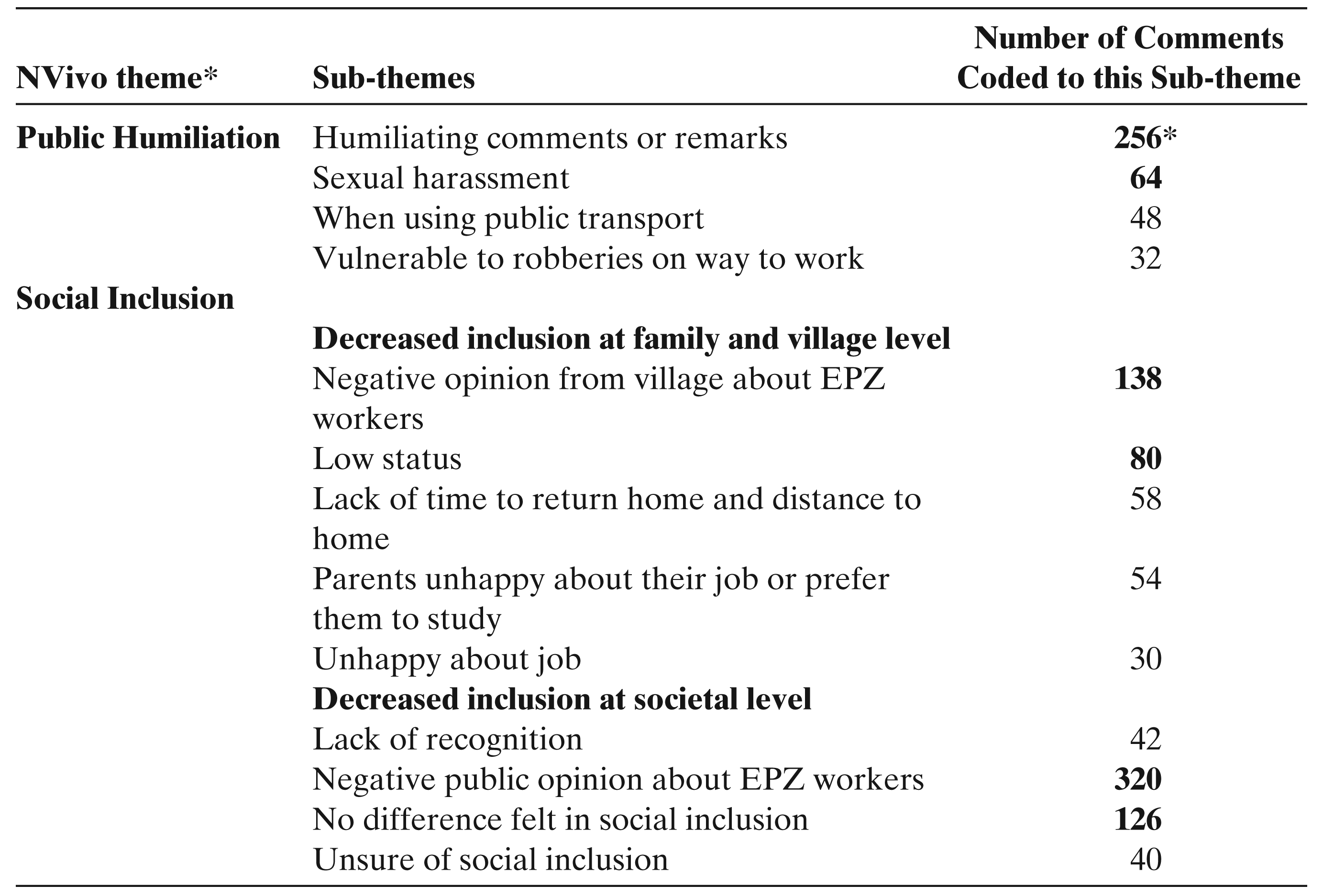
ii) numbers expanded by factor of 40/60.*
From Table 1 we also draw the following conclusions. The majority of women reported they did not participate more in decision-making processes outside of their home as a result of their employment—citing a lack of time due to work commitments or an inability to gain parental permission. However, several restrictions appeared to be self-imposed—some elected not to engage in community work out of choice— while others feared negative societal reprisal or marginalization due to their employment in EPZs.
Respondents also described their level of participation in community and political activities. Qualitative data revealed that not only had some women’s workplaces prohibited their participation, time constrains resulting from work-related duties were largely attributable to respondents’ lack of involvement in community and political activities. Union activities were further truncated due to their fear of being marginalized by employers. Given the cultural importance of societal engagement to respondents, as well as the potential sociopolitical and economic benefits of Unionization, an inability to participate in community or civic roles was identified as deleterious to women empowerment and served to further entrench these EPZ workers (see Hancock et al., 2011a).
This cohort of EPZ workers also reported their experiences of public humiliation. Some women described being exposed to verbal humiliation, theft, and sexual harassment (by ‘zipper men’) outside of the work environment; with many also verbally abused by co-workers and sometimes exploited by male family members. Women faced constant disapproval for their occupation, appearance, and attire or union activities. However, many female EPZ workers learned to passively ignore and actively overcome such negative behavior—congregating in groups, gaining access to private transport, limiting interactions with perpetrators, or modifying their own behavior so as to dissuade harassment.
Women verbally abused in their workplace agreed their ill-treatment was largely attributed to a “failure” to meet targets, being maligned for requesting parental leave, or cases of physical abuse by management. Some had been encouraged to engage in intraoffice politics—where informing management of poor workers improved their career prospects. The mistreatment of female EPZ workers resulted from prevailing societal perceptions that such individuals do not conform with traditional expectations of what constitutes “acceptable” work or living arrangements and behavior for (young) Sri Lankan women. This led to feelings of negative affect amongst some respondents.
Hancock et al. (2011) also identified cases of social inclusion and exclusion whilst employed in EPZs. Qualitative findings illustrated the treatment of women was highly dependent on their chosen field of employment, with many industries considered more respectable than EPZ work and thus a better indication of these women’s relatively high education levels. Moreover, and in relation to this, Hancock et al. (2011) found that unfair generalizations were made about EPZ workers, where individual cases of “misbehavior” had been attached to the entire workforce by the media.
Highly cognizant of the cultural expectations placed on women not to dishonor their family and care for others’ well-being, an absence of “respect” from family (village) members was particularly deleterious to the well-being of respondents. This led many to actively portray “acceptable” self-images in the presence of others and use earnings to improve their family’s lifestyle or pay debts. However, men who changed their behavior or appearance as a result of their exposure to (modern) work were not marginalized, while women received disapproval. Consequently, some respondents concealed their employment history in order to improve future prospects for marriage and being accepted within communities.
Findings strongly correlated positive interactions with family and village members as enhancing these women’s sense of objective well-being (ability to earn, skills learnt, and confidence). In comparison, exposure to negativity diminished feelings of self-efficacy (as also reported in Hancock et al., 2011). Once EPZ workers felt a greater sense of self-efficacy as a result of their employment and when their achievements were viewed as beneficial by family members, this positively impacted on their feelings of acceptance in villages.
Ostensibly, formal employment either had no impact or had not improved most women’s feelings of inclusion at the societal level—regardless of individual and communal-level inclusion, or acceptance as EPZ workers. Responses indicated experiences of societal marginalization and subjugation may have been a consequence of long-standing sociopolitical class and caste systems that remain pervasive in Sri Lankan culture. This was potentially deleterious to women from the “low” socioeconomic groups that enter EPZ work and thereby further entrenching already disadvantaged individuals.
Study 2
As with Study 1, several questions were asked of the women to assess their experiences of power (or powerlessness) and subordination. The results demonstrated few negative experiences as a result of their work in formal manufacturing. Less than 10 percent (8.4 percent) experienced humiliation in public, their community, or society whilst working in the manufacturing industry, and only 13.1 percent reported experiencing negative societal attitudes upon first returning home from their work in an EPZ. These women, therefore, experienced little overt/blatant forms of harassment, and indeed, many of the women reported gaining some form of power as a result of their working in EPZs.
14.7 percent of the women reported they do not feel more accepted in their family.
29.3 percent reported not experiencing greater decision-making power in their family.
34.6 percent did not feel more accepted in their community.
56.4 percent did not participate in activities in the community, any more than what they did prior to working.
89.3 percent reported not participating more in political activities.
17.8 percent did not report better social status than women of their own generation who were never employed in the manufacturing industry.
Tellingly, quantitative data from Study 2 reveals that women who leave formal employment are not interested in political engagement and struggle with social and cultural acceptance. While Study 2 is still incomplete, the results from an analysis of qualitative data (n = 80) and one of the focus group discussions held with key stakeholders provides discursive insights into the types of attitudes and language that are used in public to subordinate women who have worked in formal “Westernized” manufacturing in Sri Lanka. While the stakeholders are protected by anonymity, we can reveal that the focus group was made up of high-level political, religious, cultural, and economic leaders at a district level. Their comments went as follows, one leader stated that women and women’s employment organizations are “vulgar” and a threat to the national tradition. Yet another stakeholder stated that women who work in garment factories are “encouraged to drink and get drunk” and again the word “vulgar” was used. Another stated that women who worked “became useless” after leaving employment and that “they had adopted Western ways.” One religious leader stated that
The women who are women’s rights activists are vulgar women. There is a good mannered way of behavior among married couples of Sri Lanka. It has been formed under us. The objective of the most researches is to destroy the culture of this country. If a child commits a wrong thing mother or grandmother cannot punish, because it is considered as a breach of child rights. Therefore there’s no mechanism to rectify the children’s behavior. In our country, earlier days, if a child does something wrong, parents used to beat them by throwing cupules of red ants on them. We controlled our children but did not kill them. The western patterns are not good. The western education system has changed the society by giving freedom to the child. The influences from the west are destroying our culture by building an undisciplined culture. Women are exploited by the garment factories.
In contrast to the narrative above, from analysis of the quantitative and qualitative data the following themes emerged. The majority of women felt more accepted (70 percent) and took part in more decision-making within the family (62 percent), describing their earning power and ability to (save) budget, pay debts, make purchases, and (or) renovate. Most felt more self-confident (79 percent), mainly thanks to their formal work experiences, capacity to learn, and due to an ability to deal with problems, clients, or the public; and most believed the skills they learned whilst in formal employment were still useful (78 percent)—transferring these skills to life or (new) work contexts. Most believed they were socially (62 percent) and economically (68 percent) stronger than women of their generation without formal work experience. Higher social (economic) status was linked to not being an economic burden; or where others valued their skills (training) or field of work. However, the sustained status and well-being of women post-return was strongly linked to access to economic capital. Women unable to continue financially supporting families (communities) experienced marginalization.
Many remained engaged upon their return by becoming self-employed using money earned and loans to purchase land, buildings, and equipment—some, applying their knowledge to identify “niche” markets. Many adopted the role of “bread winner” within families (being the eldest sibling or becoming widowed). Many able to bridge cultural expectations and emerging responsibilities. However, levels of decision-making power were often dependent on their ability to contribute or financially support others. This indicated a reciprocal relationship, where money “bought” respondents a “place” in Sri Lanka and allowed them to have a voice; with some women implementing local awareness programs—educating communities about traditional women’s concerns (such as housekeeping) and on modern issues, including health prevention or work opportunities. These women are emerging as “role models” for their communities and other women.
Conclusion
This article has presented findings from two studies that focused on gender and empowerment in Sri Lanka. Specifically, among export processing zone workers (Study 1, n = 2,304) and women who have left formal employment and returned to their villages (Study 2, n = 935). The underpinning aim of both studies was that gender inequality has been identified as arguably the most significant contributor to the maintenance of poverty in developing nations and in recent times, gender equality has had the most significant positive effect on development, the alleviation of poverty, and economic growth. The modernization process is generally typified by movement of the workforce away from rural areas and a national economic focus on primary industry, to more urban-based employment and the manufacturing industry (Cali & Menon, 2012). From Study 1, we argued that since the establishment of the export processing zones (EPZs), Sri Lankan women have migrated in unprecedented numbers from their rural villages and communities to work in factories in urban areas, so they might improve their economic circumstances. They have experienced significant improvements in their lives through income generation and improved knowledge and skills, they feel more self-confident and have more control over their lives where they can make decisions concerning their futures. This suggests they are experiencing empowerment. However, as we have demonstrated in this article, societal and political level discourse and humiliation has caused many to experience disempowerment, in effect destroying positive avenues to empowerment through employment.
The continued societal marginalization and subjugation of female EPZ workers were linked to long-standing cultural–patriarchal–political systems pervasive in Sri Lanka. Negative attitudes diminished empowerment among EPZ workers; however, many of them learned to adapt. Modified behavior to dissuade mistreatment—some portrayed an “acceptable” public self-image or used earnings to improve the lifestyles of their families or community; others ignored harassment, used private transport, traveled as a group, or avoided “unsafe” areas. After having accumulated enough capital or funds for their families, the majority returned to their communities feeling economically empowered. Despite a lack of societal recognition, they were aware that Sri Lanka’s future sustainability depended on women’s formal labor force participation.
Data from Study 2 also indicated contradictory findings. On the one hand, most women were using economic capital to create social capital for themselves and their families. Formal employment had been empowering in an economic sense and from their experiences in Western manufacturing, many women were able to turn experience into positive outcomes for their families and community, with many women forming small businesses and self-help groups to expand their gained wisdom and experience. On the other hand, we also found significant negative discourse and attitudes toward women in Study 2, and given that this came from religious, political, and economic leaders, it is very disturbing and the source of potential and significant disempowerment. While Study 2 is still in process, its findings complement those in Study 1 and hence have been presented in this article.
The research from both studies found women experienced and understood empowerment in diverse and complex ways. Interestingly, they also experienced disempowerment concurrently. Many had secured themselves financially, having accumulated enough capital, or remitted enough money back to their families, to look forward to a brighter economic future. However, there were many who discontinued their employment due to harassment in their workplace or the harsh working conditions, or some reported experiencing social isolation and humiliation. Not only has the move to export-oriented industrialization in Sri Lanka been recent, it has had severe implications for women, simultaneously providing opportunities for employment while also creating significantly improved socioeconomic conditions in the country. However, there remains a real risk that economic gains will be lost to social exclusion and gender-based disempowerment.
If one of the goals of governments and aid agencies is sustainable gender equity and empowerment for women, especially those at the most disadvantaged societal levels, then further analyses are required to explore and expand what it means to be empowered. More specifically, we argue in this article that focus should be on what threats language and negative public discourse and humiliation pose to positive trends in economic empowerment and ultimately to women’s ability to engage with development and economic progress. This is an underdeveloped area of study that will enhance social policy development by governments with respect to gender equality, as well as inform policy and funding decisions made by global and national aid agencies.