



Abstract
This article examines the viability of mainstream neo-realist international relations scholarship for understanding regional power dynamics within Africa by offering a critical evaluation of the categorization of South Africa as a hegemonic power on the continent. Using the theoretical framework of hegemonic stability theory, it argues that there is a somewhat weak link between South Africa’s foreign policy character and its hegemonic disposition in Africa. The South African state, which is the driving force for political, economic and foreign policy processes, is itself subordinate in relation to international capital and lacks the influence expected of a regional hegemon. Despite South Africa’s development, the article demonstrates that its dependency provides the theoretical construct for understanding the country’s ambiguous hegemonic projection. This analytical framework captures the crux of the “hegemonic debate” as well as other conversations in relation to the adaptation of the concept of hegemony to Africa. Therefore, any application of the hegemonic discourse to South Africa necessarily requires a deeper understanding that takes cognizance of the fact that country’s regional hegemony operates within the orbit of a dependent-development paradigm in the global economic order, a neo-liberal order that continues to deepen Africa’s dependency syndrome. Dependency, as well as other complexities, impedes the reality of South Africa’s hegemonic ambitions in Africa.
Introduction
In the decades following the end of the Cold War, the international political system witnessed an unanticipated shift from a United States (US)-led unipolar global order to a new world order marked by waves of multiple regional competing powers (Prys, 2010). In the contemporary era, the global dominance of the US inspired the emergence of regional and middle powers such as Japan, Australia, Brazil, Canada, China, India, and Saudi Arabia, to name but a few. It was expected that these regional powers would provide leadership capable of promoting stability and paving the way for development in their proximate regions.
This led to increased research on regional (middle) power leadership (Flemes, 2009; Habib, 2009; Prys, 2010). Many of these studies focused on Europe, Asia, and the Americas and few theorized regional power dynamics within Africa (Smith, 2013; Taylor, 2000). This continent has been engaged in on-going robust debate on how best to conceive the rising political prowess and economic influence of South Africa in Africa. While the literature is replete with the categorization of South Africa as Africa’s hegemonic power (Alden & Soko, 2005; The Economist, 2006); this article explores the intricacies of South Africa’s capacity to assume the responsibility of a regional hegemonic power.
A fundamental and sacrosanct principle of international relations theory and practice is the need to establish how theoretical constructs find empirical resonance in the contemporary global order and across regions. It is thus important to investigate how the leadership or capabilities of key regional players like South Africa translate to a regional hegemonic order. For instance, Taylor affirms that “certainly, at the level of theory-building, there has been little progress within the South African academy beyond neo-realist ontologies and objectivist epistemologies” (Taylor, 2000, p. 207). Understanding what theoretical nuance captures this peculiar regional power dynamics is crucial in determining the placement of hegemonic order within the region.
Prys (2010) observes that the theoretical and empirical literature lacks a conceptual and theoretical framework of analysis that adequately reflects hierarchical power relations at the (African) regional level. This suggests reliance on grand theories prescribed for a global context to analyze regional phenomena (Ogunnubi, 2014; Shaw, 2015). Hegemony stability theory is commonly employed at the global level; however, Yilmaz (2010) recognizes its applicability to regional power configurations. Therefore, in the case of Africa in particular, there is a need to thoroughly explore how regional leadership factors demonstrate hegemonic characteristics, particularly in ensuring regional stability, security and promoting public goods. This understanding is necessary in order to support the discourse that regards South Africa as a regional hegemon.
Many previous studies have been deliberately unmindful of the African situation in what Brown (2006) regards as an “Africanist critique.” For example, Taylor (2000) bemoans the manner in which the Western world has applied Western-centric international relations concepts to Africa and the Third World in general (Smith, 2013, p. 534) also posits that as a result of peculiarly self-enforced historical characteristics, South Africa’s international relations scholarship has suffered from a “lack of critical theoretical reflection.” Most of the ideas touted in global discourse are predominantly Eurocentric and consequently irrelevant to Africa. Illustrating this point more vividly, Adeniji (2005) criticizes the dominance of the United Nations by developed countries which use these ideas to strengthen their domination of not just Africa, but the entire Third World. He argues:
A few powerful states which designed (the United Nations) ab initio have shown a determination to preserve the status quo, which historically has been in their favour, the vast majority of member-states, largely concentrated in the southern hemisphere, poor, underdeveloped and at the periphery of high global politics, would prefer the UN to metamorphose into an instrument of change; an instrument for bridging the economic and technological gap between the rich North and the poor South. (Adeniji, 2005, p. 1)
In such a scenario, South Africa—as an acclaimed regional leader in Africa—is expected to play a seminal role in ending the “pseudo absence” of Africa from mainstream international relations (Brown, 2006). Understandably, South Africa remains a beacon of hope for a continent which, despite its formal political detachment from the centers of colonialism several decades ago, has continued to clamor for economic independence and regrettably lags behind other regions of the world. As noted by Amoako (2005), Africa remains the only continent with a dismal record in terms of meeting the 2015 Millennium Development Goals (MDGs). Poverty levels have soared to alarming levels, with half of the continent’s citizens living on a dollar or less a day since the inception of the MDGs (48 percent in 2000 and 50 percent by 2005) (Amoako, 2005, p. 2). This is in stark contrast with East Asia which reached the targets for poverty and education by 2005, with South Asia also making considerable progress (Amoako, 2005, p. 2). These realities lend credibility to the view that by the end of the current decade, the ever-expanding development gaps between Africa and the rest of the world will have widened considerably.
This article aims to address this situation by examining regional leadership in Africa generally and how South Africa has positioned itself as Africa’s hegemon. It critically evaluates the various motivations that inform South Africa’s putative claim to hegemony. By interrogating the literature that contends South Africa is a “subimperial power” (Alden & Schoeman, 2015; Bond, n.d., p. 4; Carmody, 2012), we argue that this claim South Africa is a “middleman” for international (global and local) capital on the continent (Marthoz, 2012, p. 1). However, South African strong industrial base and other economic variables has transformed the country into a new imperial power, which wields immense political and economic clout in Africa (Bond, n.d.). Its attainment of such power has not elevated the country to the position of hegemon due to the multipolar nature of African power arrangements and other considerations.
Hegemonic Stability Theory
Hegemonic stability theory captures the intricacies of the international political economy at the point of high level aggregation, and argues that international economic liberalization and stability are most likely when a single country displays a predominance of power (Webb & Krasner, 1989). Hegemonic allocation of power operates when a country has the military, political, and economic power to act unilaterally and this influences its openness of trade, market, and other economic activities within the system. According to the realist tradition, a hegemon does not only acquire dominant power, but must be keen to assert its influence and demonstrate its power when required.
Realists conceive international relations as the “battle-field” of a power struggle among nations for interest maximization. Nye (2002) holds that a superior power becomes a hegemonic power by persuading others to cooperate. The term hegemony originates from ancient Greek “hegemonia,” which “literally expresses the dominant and oppressive status of one element in the system over the others” (Yilmaz, 2010, p. 194). According to Volgy (cited in Yilmaz, 2010, p. 195) hegemony is the position of having the capability, capacity, and power to influence the rules, values and norms of international systems based on one’s own motivation and interest.
The literature categorizes hegemons into three types: benevolent, mixed-motives (strategic), and exploitative (Destradi, 2010). A benevolent hegemon promotes the general welfare of states rather than self-interest. Benevolent hegemons thus use rewards rather than force to earn the allegiance of other states. The mixed-motives or strategic hegemon displays a fair measure of general as well as self-centered interest. When necessary, mixed motives hegemons use coercion to achieve their objectives. Finally, the exploitative hegemon is concerned with relative gains and uses coercion to win compliance and achieve its ends. Destradi (2010, pp. 909–910) calls this type of leadership “imperial” and notes that it has a realist inclination or bent. An exploitative hegemon is the type of hegemon that has provoked an anti-hegemonic struggle against “super powers.” In the international political economy, this results in undue influence and the adoption of ideas akin to the Marxist understanding of oppressive power, which is exemplified by the coercive activities of the advanced capitalist countries against many of the countries in the Third World. Some scholars have restricted the meaning of the term hegemony to this coercive type of power. However, this conception does not entertain the possibility of benevolent hegemons (Destradi, 2010, p. 910).
South Africa has invested in the promotion of an “Africa Agenda” by supporting continental peace, security, and development projects (Landsberg, 2014) but the status of hegemony still does not fit the country. Explaining the place of South Africa in the hegemony debates, Habib notes:
Every hegemon has to be a pivotal state. But it has to be more. Hegemons not only aspire to leadership, are not only endowed with military, economic and other resources. They necessarily have to have political and socio-economic visions about their trans-national environments, and a political willingness to implement those visions. If that vision is one of security, stability and development, as is often the case, then the hegemon undertakes to underwrite the implementation of these goals. (Habib, 2003, p. 3)
Those who continue to liken the role of South Africa on the continent to that of a regional hegemon also agree that the country has been extremely “uninterested” in the implementation of its lofty hegemonic ambition, despite its rhetoric of super-power capacities (Marthoz, 2012). It thus seems that South Africa does not occupy the same hegemonic position as Britain in the nineteenth century and the USA following World War II (Webb & Krasner, 1989). South Africa does not have the will power and strength to defy the directives of the United Nations, unlike the USA, which invaded Iraq under the guise of maintaining global security. It is highly unlikely that the South African state will do such in Africa. However, despite its “obstructed” power within global political calculations, South Africa has considerable regional leverage to influence decisions on the continent (Kotch, 2013).
Although Landsberg (2014) believes that South Africa is one of the pillars of the African Union, he however argues that the absence of a hegemon in the region has been the primary determining factor in the limitations of the African Union to perform effectively as a regional integrated body. South Africa seems to have used its influence solely to expand international trade for itself rather than genuinely seeking trade openness in Africa. Its membership of BRICS, IBSA, and the G-20 is evidence of its economic imperatives. Furthermore, South Africa is able to play a significant role in the political economy of Africa through South African companies (like MTN, Vodacom, Multi Choice, and Game) but this falls short of demonstrating hegemonic power or becoming the sole super power in the region.
The relentless march of globalization, the proliferation of powers within the international system and the dependent nature of South Africa’s position within the global system as well as the subordinate position of the Africa in the global economy has made it extremely difficult for the country to assume hegemonic power. This is not to underestimate the economic and political strength of South Africa but to demonstrate that economic wealth and power within a region does not automatically qualify a country for hegemony (see Cox, 1996). While this could be seen to echo the arguments posited by the dependency school of thought, the dependent-development theory has challenged the notion that no state in the periphery of the world economy can achieve a great deal of development within the capitalist international economic order.
South Africa and other hitherto underdeveloped countries in the Third World’s noble efforts to shed their underdeveloped status and join the developed economies, and their gradual success, has further undermined the dependency argument of the impossibility of the development of Third World countries except through “delinking” (Frank, 2004). This strengthens the position of dependent-development theorists like Amin (1990) who cite the examples of the Asian Tigers, Brazil, Taiwan, and Singapore to buttress their argument that states like South Africa that were hitherto colonized and absolutely dependent could adopt a dependent-development approach. While we strongly doubt that a dependent economy could become a hegemon within the current international system, such an economy could assert its influence as a hegemon within the periphery or a region like Africa. Given the reality of Nigeria as a “sleeping giant” (Akinterinwa, 2008) and the democratization tsunami that has hit contending regional powers like Egypt and Libya, South Africa could perhaps assert itself as Africa’s hegemonic power in the future given the will to do so.
Regional Hegemony and the Paradox of Power
Nigeria, Egypt, and Libya seemed to have hitherto tried to strategically position themselves as the leading powers in Africa. However, South Africa’s entry onto the African political and economic stage after 1994 undermined the influence of other powers and paved the way for its ascendancy into a hegemon. Therefore, it is important to examine the motivations for conceiving South Africa as Africa’s hegemonic power. In brief, South Africa made a huge investment in ending the civil war in Burundi, was involved in the complex engagement that led to a successful referendum on a new Constitution in Democratic Republic of Congo, and spearheaded the popular campaign, “African Solutions to African Problems” through its efforts in institutionalizing the New Partnership for Africa’s Development (NEPAD). It was regarded as Africa’s largest economy (until recent resurgence of Nigeria’s economy), and has hosted numerous Mega Sporting Events (MSEs) (including successive hosting of the African Nations Cup and the 2010 World Cup) (Black, 2007; The Economist, 2006). Furthermore, “a South Africa personified by Mr Mandela” holds a strong claim to moral and emotional regional leadership (The Economist, 2006). While South African has thus displayed many traits of a hegemonic power, the country is confronted by other strong dynamics and opposition to its consolidation of the title.
South Africa’s celebrated entry into the African democratic arena in 1994 resulted in changes in the power, leadership, and economic equations on the continent (Ogunnubi, 2015). South Africa has become one of Africa’s largest economies, accounting for 25 percent of the African economic market (Alden & Schoeman, 2015). Nigeria is Africa’s largest economy, with South Africa second, and Angola in third place (International Monetary Fund, 2015, p. 7). Furthermore, the country’s membership of major multinational institutions including the G20, BRICS 1 and IBSA 2 as Africa’s sole member, has resulted in its being internationally regarded as a major African leader (Marthoz, 2012). This is premised not only on its assumed capacity to “truly” represent the voice of the continent but on its extensive and robust foreign policy involvement in Africa coupled with its desire to find African solutions to African problems (Alden & Schoeman, 2015; Marthoz, 2012; Obi, 2015).
South Africa is undoubtedly the most industrialized African country and has the more recent appellation of the continent’s most advanced economy. According to the World Development Indicator, the country has the highest Gross Domestic Product (GDP) in Africa, at US$6,482.2 (between 2011 and 2015), while Nigeria recorded US$3,203.3 during the same period, and Angola’s GDP was estimated at US$5,900.5 between 2006 and 2010 (International Monetary Fund, 2016). Similarly, South Africa has rich mineral and material resources (including chrome, diamonds, gold, iron ore, manganese, platinum, etc.). Although Nigeria also has immense natural resources, it has been unable to live up to international expectations. Prior to the end of apartheid, South Africa was also the only African country to possess nuclear warheads (Fischer, 1994; Mazrui, 2006). Finally, South Africa has the largest concentration of diaspora Whites outside Europe and America (Mazrui, 2006). It is for these reasons that Mazrui (2006) notes that South Africa represents a truly exceptional society in the postcolonial era.
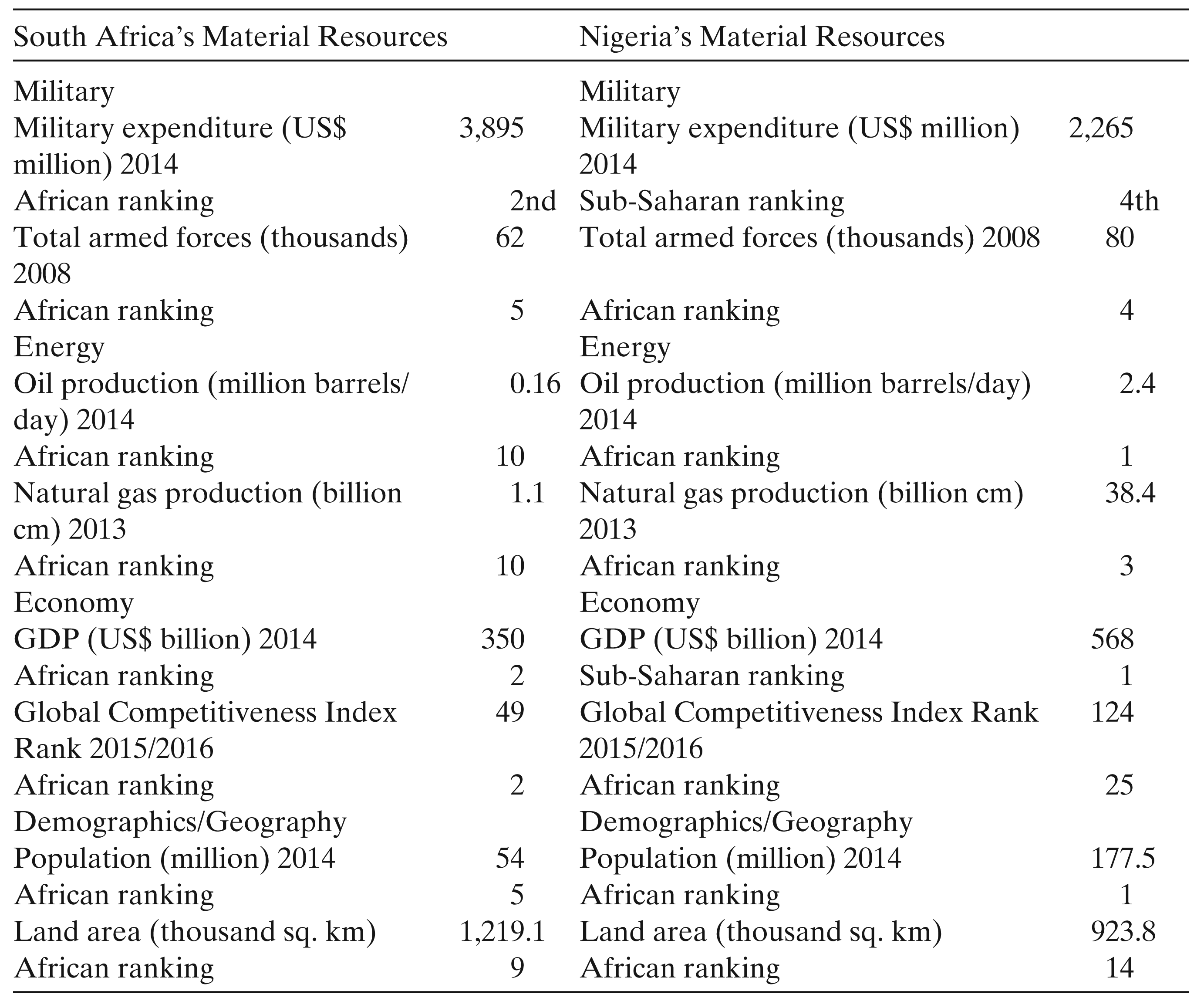
South Africa thus remains Africa’s economic giant (Adedeji, 1999, p. 5), and as remarked by Kissinger (2001, pp. 208–209), “no state except Nigeria or South Africa is in a position to play a major role outside its immediate region…” In terms of material resources, 2007 military, energy, economic, and demographic indicators classify Nigeria as a secondary power in comparison to South Africa (Flemes & Wojczewski, 2010, pp. 20–21). Despite considerable changes since then, South Africa is still considered to have the capability to propel the continent toward the path of economic development and security.
South Africa’s re-emergence on the African political stage in 1994 was perceived as a threat to Nigeria’s erstwhile dominance and hegemonic ambition on the continent. With a superior and industrial economy, South Africa has reconfigured the power equilibrium in Africa aided by Nigeria’s faltering economy and long years of despotic military rule. The hegemonic/leadership ambition of these two countries has continued to shape and configure their interaction, particularly in the post-apartheid era. Although, Nigeria is foremost in peacekeeping and peacemaking interventions in the region, its internal contradictions, especially militancy in the Niger Delta and Boko Haram terrorism has limited its ability to utilize its natural resources and impeded its capacity to function effectively as Africa’s “peacemaker” (Akinola & Uzodike, 2014; Ogunnubi & Isike, 2015). Table 1 compares South Africa and Nigeria’s material resources.
Other Africa states look to South Africa and Nigeria as possible leaders. However, both have a troubled history that causes suspicion among other African countries. Theories of regional leadership posit that an aspiring leader has to proclaim its leadership intent and has to receive acknowledgment from other states within its region. Different theories and criteria have also been formulated for political leadership in the international system. While the USA remains the undisputed—albeit insufficient—global leader, recognizing regional or middle powers has become a challenge. Thus, South Africa’s historical reality impedes its legitimacy as a hegemon on the continent.
The apartheid legacy may continue to obstruct South Africa’s ability to effectively function as a super-power in Africa for many years to come. This raises fundamental questions about bestowing the title of hegemonic power on the country as well as applying international relations theories at universal level to the complex intricacies of a regional system. African states are also reluctant to accept the legitimacy of South Africa’s self-proclaimed hegemonic power due to their contributions to the fall of apartheid and subsequent acceptance of the country into the African state system: many perceive the country as the brainchild of a collective African struggle and are thus reluctant to accept it as the hegemon. Furthermore, South Africa’s small population as compared to many African states, its “romance” with “lefties” like Iran, Belarus and Cuba, its “whiteness,” the incessant violent manifestation of xenophobia, and other variables remain impediments to its attainment of a unipolar position in Africa.
Comparison of South Africa and Nigeria’s Material Resources (2013–2014)
Hegemony or Leadership: The Dilemma of Theory and Practice
How do mainstream theoretical approaches to hegemony help us to understand regional power dynamics in Africa? Do neo-realist theoretical constructs such as the hegemonic stability theory apply to this continent? Does it make any theoretical and empirical sense to subscribe to a South African regional hegemony in Africa? Understanding these important questions is crucial in evaluating the extent to which the foreign policy strategies of dependent regional powers like South Africa show a hegemonic disposition in the region.
An examination of the underlying assertions of South Africa’s reputed hegemonic influence reveals a somewhat weak linkage between its foreign policy and its hegemonic disposition on the continent. This is because the state, which is the major driver of socio-economic and political processes, is subjected to the manipulations of the interests of global powers in Africa. Due to its dependent economy, it is very difficult for an African country to assume the position of a hegemon. There is no doubt that (until recently) South Africa’s economic prowess has surged and its industrial, economic and political influence transcends the Southern African region’s and Africa’s at large; however, its subservient role in the international political economy has restricted its hegemonic ability on the continent. As a result of the strong linkages between South Africa’s economy and international capital, the current downturn of its economy has been linked to the 2008 global recession experienced by the west, including the USA. In recent years, Western intervention in Libya and Egypt further exposed the inability of any African power to be a rallying point on the continent. South Africa could not mobilize for the resolution of the Libyan crisis at regional level, but instead, “voted affirmatively in the UN Security Council” in support of the US-led invasion of Libya (Bond, n.d., p. 7).
The lack of a hegemon in the Southern African sub-region could also explain why the Southern African Development Community (SADC) has failed to resolve the Zimbabwean economic and political crisis, despite South Africa being a member of SADC. South Africa has been unable to extend its constitutional democracy to its immediate neighbor, Zimbabwe, which is contrary to the tenets of hegemony. Instead, South Africa continues to support President Mugabe of Zimbabwe, to the disdain of some African states and world powers (Bond, n.d., p. 3). According to Yilmaz, “Hegemony enabled the dominant state to spread its moral, political, and cultural values around the society and sub-communities” (Yilmaz, 2010, p. 194). However, South Africa’s quandary in resolving the political logjam in Zimbabwe is understandable. Those who use South Africa’s stance on Zimbabwe as a yardstick to dismiss her leadership credentials do not appreciate the complexities of the situation. “Silent diplomacy” on Zimbabwe is widely cited as a “blemish” on South Africa’s foreign policy (Flemes & Wojczewski, 2010). However, the Zimbabwean crisis remains a complex dilemma that has defied global and regional interventions. Hence, South Africa’s inability to provide political solutions is a concern, but it should not be taken out of the context.
South Africa adopted a much firmer stand against human rights abuses and the highhandedness of Nigerian military regimes in the mid-1990s. In 1995, it called for aggressive sanctions to be imposed on Nigeria after the General Abacha regime executed nine Ogoni activists, who had held Shell and the Nigerian government to ransom due to environmental crimes against the Ogoni community (Akinola, 2011). Cyril Ramaphosa, then Secretary General of the African National Congress (ANC), issued a scathing verbal attack on the Nigerian junta and Shell, a major oil company operating in Nigeria. Even President Nelson Mandela, who prior to the hangings advocated a silent approach to the Nigerian crisis, called for Nigeria’s suspension from the Commonwealth (Black, 2007, p. 41), which was put into effect.
South Africa was accused of using “non-African” means of discipline (Vale & Maseko, 1998). Given this historical background, South African could be soft peddling its role in Zimbabwe due to President Mugabe’s iron grip on power, and in order to avert the opprobrium it attracted in 1995. The country is concerned that it will be labeled an aggressor if it takes any radical action in Zimbabwe. To justify this stance, one only needs to recall the dire consequences of US military and political intervention in Iraq and the recurrent crises and violence that have riddled the country till date (Gervisser, 2007).
South Africa has the major—but not all—requirements to assume the position of a regional super-power. Its mineral wealth which bests many countries worldwide will continue to lure investors from across the world. Its industrial and manufacturing economy is ahead of that of its African counterparts, but this is not as well balanced as that of Brazil. However, South Africa has been able to expand its economic might across Africa. Although, Ghana provides a political base for Pan-Africanism due to the intellectual foundation laid by Kwame Nkrumah (Bolaji, 2015), South Africa has strategically occupied the leadership position of the regional supranational body: Africa Union. The possibility of deeper integration, led by the African Union headed by a South African, Nkosazana Dlamini-Zuma, would serve the interests of the rainbow nation. Indeed, South Africa would grow in strength, disproportionate to other African countries, in line with her hegemonic ambition. The possibility of her becoming the next President of South Africa would also enhance the country’s bid as the regional hegemon (The Economist, 2016). Expectedly, her experience and influence across the globe becomes a veritable instrument for South Africa’s hegemonic projection.
The ANC’s moral credentials were as important as political ones in promoting South Africa’s reputation in the immediate post-apartheid era. However, with the passage of time, the country has taken a more realist or pragmatist stance in its international agenda. The need for economic advancement within its state borders and the promotion of democracy have become more important. The country’s wealth and its overall economic vibrancy on the international stage do not percolate to ordinary South Africans who continue to live in abject penury (Akinola, Tella, & Adeogun, 2015). The yawning fissures between the rich and the poor have provoked and sustained crises like crime and xenophobia. Added to this is corruption and cronyism (Hunter & Letsoalo, 2015). Black Economic Empowerment has tended to benefit a few strategically placed black individuals, while the majority remain in poverty. Many ANC members have used the ties forged among “comrades” during the struggle to gain unfair advantage in terms of government contracts (DA, 2015).
Declining political morality and the subsequent scandals that have rocked the leadership of the ANC have engendered doubt in the international community that hitherto held Mandela and the ANC in high moral regard (Van der Westhuizen, 1998). If South Africa is to be regarded as the foremost regional leader, it will certainly not be because of its moral appeal, human rights activism and democratic development. Instead, it will be due to its imperial might and economic prowess within Africa and its economic engagement with other countries and trade blocs (Carmody, 2012). We doubt if African countries will accept South Africa’s hegemonic claim based only on this. Furthermore, the question of whether aspirant or displaced leaders like Nigeria, Libya, Egypt and—recently—Angola will cede allegiance to another power remains open for debate.
From a conceptual position, any effort to apply the hegemonic theory to Africa would inevitably require fine-tuning to fit the peculiarity and nuances of the African context: a subservient economy. Such a conceptualization of (regional) hegemony in Africa should be one that acknowledges the distinctive socio-economic and political characteristics of the post-colonial African state, which is dependent in nature. Structural dependency, which undeniably subjected post-colonial African states to the whims and caprices of international interests, has limited the hegemonic projections of African regional powers (Alden & Schoeman, 2015). In South Africa the state, which is the engine room for the assertion of its political and economic might, is constrained by other exogenous factors that subordinate its tendency toward regional unipolarity. The hegemonic lens therefore needs to be refocused in order to understand how South Africa’s foreign policy behavior intersects with some of the distinctive and contradictory realities that may be applied to the hegemonic theory.
Therefore, to a large extent, any application of the hegemonic discourse to South Africa must capture the reality of these limitations. For instance, application of the hegemonic theory to the scenario of food security (that addresses critical issues of food production, marketing, distribution, availability, and affordability) as an essential component of national sustainability and power paints a dismal picture for Africa, and South Africa in particular. Of an estimated population of 53 million people, about 13 million, or one in four South Africans experience hunger (OXFAM, 2014). Africa has been the only continent to suffer per capita food and agricultural decline over the past four decades and remains the only continent that significantly depends on the international market for its food security. This in itself is indicative of a very vulnerable power position for any state in Africa that aspires to hegemony. A country that lacks the capacity to feed its population is unlikely to achieve any kind of hegemonic influence. Given that South Africa’s food security is threatened and that the food sector is dominated by global actors, the elementary and fundamental index of power which every hegemon should effectively possess becomes flawed.
This suggests that in its application to South Africa, the hegemony theory must be applied with significant caution and adjustments. We propose a modification that recognizes the dependent system within which Africa’s economy operates. When the influence of international capital and the role and character of the subservient state and its politics are taken into consideration, the trajectory of development itself is manipulated by other centers of power which the so-called hegemon must effectively contend with. For instance, South Africa does not have the economic clout to influence the Bretton Woods institutions to its advantage in Africa in the same way that the USA can condition these to act in its favor.
In similar vein, Alden and Schoeman (2015, p. 251) concede that “the implications of South Africa’s symbolic representivity rather than substantive hegemony over Africa is that it is always conditioned by a need to work in partnership with external powers to achieve its foreign policy aims.” Thus, the South African state does not adequately fit the realist prescription of the hegemonic theory because post-apartheid South Africa still contends with massive domestic issues that reduce its capacity to project hegemonic influence in Africa, and even beyond. Given these realities, it is impracticable to speak of a regional hegemonic order in an African context, which aligns with the tenets of the hegemonic theory. This is not to say that the South African state or any other state on the African continent does not exhibit appreciable political and economic sovereignty. We maintain that there are limitations to South Africa’s capacity to project power to the extent that the hegemonic theory tends to suggest when understood from a realist perspective.
The South African example of regional hegemony is thus a clear reminder that “the distribution of power across the international system is more than a function of material capability but rather reflects contingencies derived from the perceived requirements for the maintenance of order in line with leading states” (Alden & Schoeman, 2015, p. 251). Hence, by limiting our understanding to the realist conception of the credentials for hegemony, we can effectively debate the extent to which South Africa can truly be regarded as a regional hegemony, not least its capacity to project it. Nevertheless, a hegemonic tag has often been ascribed to South Africa, mainly by local scholars and sometimes by international foreign policy commentators based on the aggregate strength of its preponderant material and significant ideational capabilities (Ogunnubi & Isike, 2015).
It is therefore important to identify and appraise the roles of diverse social forces that interact with one another at the domestic and regional levels. Clearly, these forces throw up an overall system that operates in subordination to the international system. When hegemony is discussed in the African context, such reference is often completely oblivious of the fact that there are palpable domestic and international forces operating within a neo-liberal global order where the frontiers of states have been thrown wide open in a very competitive manner. International capital’s penetration of the Third World—through imperialism—has deepened contestation for influence and power. The South African state’s capacity to limit this penetration and project its hegemonic power in Africa remains contested.
Due to the power configurations in Africa, we hold that South Africa is one of the major powers in Africa, one of the leaders of the African cause, but not a hegemon. According to Nye (2002), there are three categorizations of power: the first deals with military power, the second deals with the economic powers by multiple actors, while the third focuses on different international engagements on broad range of activities. Power configuration in Africa could be said to represent what Nye (2012, p. 215) refers to as “middle chessboard,” in his “complex three-dimensional chess game,” where economic power is manifested by multiple factors. It will be erroneous to identify a single power in Africa as dominant. The power relations in Africa is founded on divergent major powers operating within a multilateral framework. For instance, South Africa “pays an annual due of 15% together with Libya, Egypt, Algeria and Nigeria who also pay 15% of the AU’s annual budget” (Landsberg, 2014, p. 5). This represents one of the indications for multi-polar nature of Africa power distribution.
Conclusion
This article examined the implications of using the hegemonic stability theory to understand power dynamics within Africa. We also raised serious concerns about categorizing South Africa as a regional hegemon. We claim that South Africa’s capacity to effectively act as a regional hegemon is impeded as a result of the highly dependent nature of its economy and position within the international system and the country’s relation to international capital. Hence, a strict application of the hegemonic stability theory to Africa could be said to be too ambitious. Furthermore, the attribution of hegemonic power to South Africa is misplaced due to the many factors (internal and external) highlighted in this article.
It is difficult to ascribe the conceptual characteristics of (regional) hegemony to South Africa or any other African state. In grappling with the hegemonic discourse from an African perspective, it is important to refocus the hegemonic lens in order to understand how South Africa’s foreign policy behavior interfaces with some of the distinctive characteristics of hegemonic theory. Therefore, realistically and viewed from the perspective of the internationalization of capital, and the character and geo-political configuration of the South African state, the country’s trajectory of economic openness and stability itself reacts to the dictates of other centers of superior power within the global system.
Although South Africa, with its dependent capitalist conditions, exercises a meaningful degree of autonomy in its domestic economic policies as well as wielding considerable influence in Africa, we recognize the limitations of its capacity to project power to the extent that neorealist hegemonic theory would suggest. By focusing our analysis of hegemony on the country’s trajectory of power acquisition and assertiveness, it is clear that references to South African hegemony are not appropriate.