




Abstract
Many thinkers in affluent countries consider the idea of the Third Way (TW) an outdated concept. This article argues that the concept of the TW still dominates the development discourse and as a consequence also influences policy prescriptions. Through a systematic examination of Human Development Reports (HDRs), the text shows that in the pre-2015 development agenda, the human development (HD) approach had significant similarities to the currents of thought that informed the TW. Second, the article analyzes the post-2015 development agenda and the HDR 2016, and shows that the Agenda 2030 flourishes on similar theoretical and practical premises as the TW and the pre-2015 agenda. Finally, the article discusses the shortcomings of this continuity.
Introduction
The Third Way (TW) has been used as a generalizing term to refer to the prevailing social-democratic standpoints and policies in Western Europe and the US in the second half of the 1990s. Against the background of the end of the Cold War and the new pace of globalization, the TW represented the search for a middle ground between socialism and the Washington Consensus’ neoliberal guidelines. Today, the TW is widely seen as an outdated concept. Even more than that, it is the target of critics in many industrialized countries that suffer from a number of social and economic crises. In the words of Barber (2016) from the Financial Times, the TW offered “policies for sunny weather, not for the storms of today.”
However, the TW was not just a purely policy-related concept, it also had sociological foundations. The TW was the political application of new modernization theories that are generally grouped under the term reflexive modernization (Mouzelis, 2001, pp. 439–440), which from the second half of the 1980s became the dominant theoretical access to understand industrial societies. The theory of reflexive modernization rests on the assumption that affluent societies face risks that have been created by their own modernization processes (Beck, 1986, 1994).
For the developing countries, too, the 1990s and the end of the Cold War meant a new approach in international development policy. The human development (HD) approach was introduced as a reaction to the neoliberalism of the 1980s. The HD is referred to as “the analytical bedrock of the Millennium Declaration and the Millennium Development Goals—the timebound development objectives and targets agreed on in 2000 by 189 heads of states and governments to reduce basic human poverty by 2015” (UNDP, 2016, p. 3).
Given the dominant influence of Western ideas and, especially, modernization theories on mainstream development thinking and development policy as represented by international actors such as the United Nations and its agencies such as the United Nations Development Programme (UNDP) as well as World Bank and International Monetary Fund, it would be no surprise to find imprints of the TW and reflexive modernization in the HD approach that shaped the international development agenda since the 1990s.
For the developing countries, the HD approach was a reaction to the Washington Consensus, whereas the TW was a reaction to neoliberal policies in the industrialized countries. There are some analyses that deal with the relationship between reflexive modernization or the TW and the HD approach, and they point to the similar ideological premises both approaches are based on. These works point to some of the similarities of these two approaches in aspects such as institutional changes, socioeconomic strategies, responses to climate change, and environmental risks (e.g., Borne, 2010; Craig & Porter, 2005; Goetze, 2002, p. 33; Kiely, 2005; Pieterse, 1998; Ziai, 2006). Yet this relationship between the two approaches has not held a significant place in debates on international development, and there is, to the best of my knowledge, no systematic comparison of the theoretical pillars of the two programs.
However, such a comparison ought to have been a vital precursor to current debates about international development. Today, the international development agenda has a new label: the Agenda 2030. The 8 Millennium Development Goals (MDG) have been succeeded by the 17 Sustainable Development Goals (SDGs). The debate on the Agenda 2030 is, on the other hand, fairly limited in its scope. Whereas some scholars identify a potential for a new turn in development policy into a more positive direction (Fukuda-Parr, 2016; Stuart & Woodroffe, 2016), others point to the inconsistencies in the Agenda 2030 and criticize the continuity and compatibility of the new agenda with neoliberal principles (Carant, 2017; Scheyvens, Banks, & Hughes, 2016; Weber, 2017). Yet, even the more optimistic views on the SDGs claim that the Agenda 2030’s success is dependent on many factors. An important risk, for instance, is related to the clause “as nationally appropriate”, which refers to the individual countries’ specific manner of pursuing the Agenda (Pogge & Sengupta, 2015, pp. 6–7). The SDGs’ success depends among other things on the individual countries’ national strategies (Biermann, Kanie, & Kim, 2017, p. 27; Fukuda-Parr, 2016, p. 50). Hence, “[t]here is a risk that the most transformative goals and targets would be neglected in implementation through selectivity, simplification, and national adaptation” (Fukuda-Parr, 2016, p. 50).
The academic work on the Agenda 2030 to date focuses on the SDGs. An aim of this text is to dig deeper into the debate on the Agenda 2030 and analyze the roots of the thinking behind it. This article shows that the HD approach has been driven by a social democratic stance, but that this stance is informed by the social democracy of the 1990s which has had very critical outcomes that lie behind today’s global challenges. In the following, this article first demonstrates that the pre-2015 international development agenda exhibited significant similarities to the TW. It provides a systematic comparison of the two programs’ main pillars which should serve as a framework of analysis for understanding today’s development agenda. Second, based on this framework, the article analyzes the Agenda 2030, searches for the imprints of the TW and highlights the critical aspects of both approaches, TW and HD.
Human Development in the Pre-2015 and Post-2015 Period: Development on the third Way
The UNDP defines HD as “about expanding the richness of human life, rather than simply the richness of the economy in which human beings live. It is an approach that is focused on people and their opportunities and choices” (UNDP, 2017). Since the first Human Development Report (HDR) in 1990, this definition of HD has remained more or less the same (Alkire, 2010, p. 7). The HD takes important insights from Amartya Sen’s ideas on “development as freedom” (Sen, 2001) and his capability approach (Sen, 1985, 1992, 2001). However, it would be wrong to conclude that the reports fully represent the capability approach. The capability approach serves as a philosophical basis and, by design, leaves certain theoretical and practical aspects open such as how to define or evaluate the necessary changes in the development process (Comim, Qizilbash, & Alkire, 2010; Robeyns, 2003, 2005), whereas the HDR have a practical dimension and offer their own interpretation of Sen’s ideas.
Thus, in this analysis, I rely principally on the concept of the HD approach as espoused by the UNDP. My understanding of the TW concept is primarily based on Anthony Giddens’ work, as he is often regarded as the main theorist behind the TW politics. Source material in this part are, therefore, mainly Giddens’ work on the TW and UNDP’s publications on HD, primarily the HDRs. Special attention is devoted to HDR 1999, which is on “globalization with a human face”, and to HDR 2010, which was published at the 20th anniversary of the first HDR, and aimed to set the guidelines for the future as well as to HDR 2016, which is the first HDR after the SDGs were introduced.
There are four pillars that show the affinity between the TW and HD in the pre-2015 development agenda: (a) the centrality of globalization to understand the contemporary world; (b) the concept of governance as the main framework of politics; (c) the centrality of the individual who has rights and responsibilities and is the main target of public policy; and (d) the socioeconomic strategies. These four pillars also represent, respectively, the two programs’ sociological, political, ethical–philosophical, and practical foundations. In order to trace the imprints of the TW in the current development policy, the article scrutinizes the HDR 2016 with respect to the sociological-, political-, ethical-, and policy-related roots. In the following sections, I first demonstrate the affinity between the TW and HD with respect to these four pillars in the pre-2015 agenda. Then at the end of each section, I analyze the post-2015 agenda by looking at the imprints of these pillars in the HDR 2016.
Sociological Foundations: Globalization as the Main Theoretical Point of Departure
The first similarity between the TW and HD stems from both approaches’ view on globalization. In Driver and Martell’s (2000, p. 150) words, globalization is “the central theme” in the TW, the entire thinking behind it deals with the search for adequate responses to globalization. The same point applies to the HD approach. Like the TW, the HD identifies a new moment in globalization since the end of the Cold War and the end of the old ideologies (Beck, 1994, pp. 41–44; Giddens, 2000, pp. 1–2; UNDP, 2010, p. 11). Both programs identify changing relations of time and space. In words very similar to Giddens’ (1995 [1990], p. 64) “time–space distanciation”, HD rests on the idea of “shrinking space, shrinking time and disappearing borders” (UNDP, 1999, p. 1). Both approaches see a rise of individualism and a new nature of social relations against the background of emerging new opportunities due to globalization (Beck, 1994, pp. 13–16; UNDP, 1999, pp. 34, 82). In addition, both the TW and HD identify similar risks in the process of globalization, such as environmental problems (Giddens, 2000, pp. 132–142; UNDP, 2010, pp. 81–83) and the rise of fundamentalism parallel to the increased importance of local culture and to the lost boundaries of time and space which drive some individuals to look for traditional answers (e.g., Giddens, 1994, p. 100; UNDP, 1999, p. 34).
In the HDR 2016, the sociological theoretical pillar of the pre-2015 agenda seems to remain intact. The HDR 2016, too, puts globalization at the center of its analytical perspective and the perspective on globalization is elaborated with respect to the change in time–space relations, in social relations, and to increased risks and opportunities for individuals. An example of the changing time–space relations in the report is the nature of global activism: “Although petitions, protests, fundraising and political publications have always existed, the Internet has allowed them to reach an unprecedented level and bring together people across the world. Mobile phones have multiplied the impact of popular movements” (UNDP, 2016, p. 40). Like before, changing social relations and the rise of individualism form part of the report, as it mentions a new, younger middle class which “may also be more insular and be more intimately linked to a Twitter community or a Facebook community than to a physical community or neighborhood. It may have many digital connections but few human connections” (UNDP, 2016, p. 34).
Moreover, the HDR 2016 has the same view on globalization as not only associated with opportunities but also with risks. For example, the report calls globalization “a double edged sword” (UNDP, 2016, p. 34). Many of the problems listed call attention to environmental risks as the report argues that “[p]rogress in human development can stagnate or even be reversed if threatened by shocks from environmental degradation, climate change” (UNDP, 2016, pp. 122–123). Furthermore, similar to the pre-2015 agenda, the report points to the rise of local culture, identity politics, conflicts, and fundamentalism as risks arising from globalization. Cunningham Kain (2016, p. 121), former chairperson of the United Nations Permanent Forum on Indigenous Issues, writes for the HDR 2016 and describes the contemporary period as “an era where xenophobia, fundamentalism, populism and racism are on the rise in many parts of the world”. In addition, the report counts violent extremism as one of the biggest problems (UNDP, 2016, p. 36). Another risk that the report mentions is migration as “[a]t the end of 2015 more than 65 million people worldwide had been forcibly displaced (internally displaced persons, refugees and asylum seekers)—the most since the Second World War” (UNDP, 2016, p. 35).
Hence, although the HDR 2016 states that “the current global landscape is very different from what the world faced in 1990” (UNDP, 2016, p. 137), the risks it enumerates such as “[i]nequality and exclusion, violence and extremism, refugees and migration, pollution and environmental degradation” (UNDP, 2016, p. 137) are neither new problems nor are they mentioned as global problems for the first time. However, the main differences to the pre-2015 agenda lie first in the fact that the report emphasizes the “new nature” of these problems, that is, their severity has increased since the 1990s, and second, that these problems are now highly relevant for developed countries as well (Willis, 2016). The following excerpts illustrate the way these challenges are deemed to affect developed countries:
At a time when global action and collaboration are imperative, self-identities are narrowing. Social and political movements linked to identity, whether nationalist or ethnopolitical, seem to be getting stronger. Brexit is one of the most recent examples of a retreat to nationalism when individuals feel alienated in a changing world. (UNDP, 2016, p. 7)
and
Poverty is no longer a problem of developing regions only; it is also on the rise in developed countries (UNDP, 2016, p. 30).
Another new risk that the HDR 2016 mentions is the anti-globalization movement as a new risk. “Even many academics and policymakers who welcomed globalization are revising their opinion. It was always thought that globalization would not benefit everyone but that the benefits would eventually outweigh the losses [footnote omitted]” (UNDP, 2016, p. 35). Still, the HDR states that globalization “cannot be rolled back, so the challenge is to ensure that globalization leaves no one behind” (UNDP, 2016, p. 35).
Political Framework of Orientation: Governance
The second commonality between the TW and HD is that they name governance as the main framework for politics. Both approaches, HD and TW, rest on the assumption that due to globalization nation-states’ room for maneuver has been increasingly restricted by the wider international political and economic framework as well as by the stronger expression of local identities (Giddens, 1998, pp. 31–32; UNDP, 1999, pp. 30–34). Politics takes place within a broader context determined by international relations among states as well as by the engagement of different stakeholders such as local, national, supranational, and transnational actors (Giddens, 1998, pp. 46–54; UNDP, 1999). These changes give rise to the concept of “governance.”
For both TW and HD, governance means a political orientation toward a pluralistic democratic system which consists of three sectors: the state or public sector, the private sector and the voluntary sector or civil society. In that sense, both approaches also attempt to move beyond the idea of the national government as the only political actor (Giddens, 1998, p. 71; UNDP, 1999, pp. 7–13, 2010, p. 2). Governments are mainly responsible for the regulation of social life, whereas the private sector is the main engine of economic activity (Giddens, 1998; UNDP, 2010, pp. 60–64). In both programs, civil society is expected to monitor the activities in the two other sectors (Giddens, 2001, p. 7) and is viewed as a more flexible and pragmatic actor (Giddens, 2001, p. 7; UNDP, 2010, p. 63).
Furthermore, both TW and HD regard governance as a concept that can be applied at a global level which is captured by the term global governance (Giddens, 2001, p. 17; UNDP, 2010, p. 9). Both approaches identify the same points which require global engagement and are identical to the points listed as global challenges: ecological risks, international migration, international law and human rights, conflict management and democracy promotion (Giddens, 2001, p. 17; UNDP, 2010, p. 9), and the international economic framework, that is, regulation of financial markets (Giddens, 2001, p. 17; UNDP, 2010, p. 81).
The post-2015 agenda continues with this line of thinking on the political pillars of (global) policymaking. In HDR 2016, as before, governance is a guiding concept that can be applied at the national and global levels with three main groups of actors: states and multilateral organizations, civil society, and private sector. Cooperation among the state, civil society, and the private sector is advocated at the national and global levels. The private sector is again considered the main engine of economic activity. Civil society is once again assigned the role of monitoring the activities in the two other sectors; “[a] free press, a vibrant civil society and the political freedoms guaranteed by a constitution underpin inclusive institutions and human development” (UNDP, 2016, p. 87). The state is expected to provide the necessary regulatory framework for the society; an emphasis lies on the rule of law and protection of human rights by the state. “A central feature of the rule of law is the equality of all before the law—all people have the right to the protection of their rights by the state, particularly the judiciary” (UNDP, 2016, p. 130).
Moreover, the HDR 2016 represents the same line of thinking on global governance as the pre-2015 agenda or the TW. “Human development for everyone requires identifying relevant barriers to practical universalism at the level of the main global institutions: markets, multilateral organizations and global civil society” (UNDP, 2016, p. 138). The report states that “[w]e live in a globalized world where HD outcomes are determined not only by actions at the national level, but also by the structures, events and work at the global level” (UNDP, 2016, p. 17). Consequently, the report argues that global problems can only be confronted with “the construction of global collective capabilities to achieve results that no country can on its own” (UNDP, 2016, p. 137). The issues that effective global governance should deal with also remain intact as the problems associated with globalization are more or less the same. “[R]egulating currency transactions and capital flows and coordinating macroeconomic policies and regulations” (UNDP, 2016, p. 17), supporting global civil society networks, combating climate change, global injustice, and security threats are counted as the main fields which require action (UNDP, 2016).
Ethical Considerations: Politics for the Individual
The third overlapping aspect between the TW and HD is that both programs’ ethical considerations put the individual at the center of policymaking. TW politics claims to focus on expanding the choices and opportunities for individuals (Giddens, 2000, pp. 80–85) since individualization has become “a compulsion, but a compulsion for the manufacture, self–design and self–staging of not just one’s own biography but also its commitments and networks as preferences and life phases change” (Beck, 1994, p. 14). Inspired by Amartya Sen’s work on individual freedom and development and his capability approach (e.g., Sen 1985), HD is also about expanding choices and puts the individual’s quality of life at the center of social policies (Alkire, 2010; Fukuda-Parr, 2003; UNDP, 1990, p. 10, 2010, p. 2).
Although the individual himself or herself is the main target of policymaking, both approaches view the individual as belonging to a community. In TW, this idea can be found in the concept of “stakeholder society.” TW rests on the assumption that due to globalization, a new form of individualization emerges which enables the formation of alliances that are based on concerns with identities and lifestyles rather than with class differences (Giddens, 2000, p. 78; Mouzelis, 2001, pp. 439–440). These alliances in the stakeholder society provide the social capital, the “trust networks that individuals can draw upon for social support, just as financial capital can be drawn upon to be used for investment” (Giddens, 2000, p. 78).
A very similar position can be observed in several HDRs. Concerns about belonging to a community feature, for example, in HDR 2004 (UNDP, 2004, pp. 16–18) or in the national HDR for Bosnia Herzegovina (UNDP Bosnia and Herzogovina, 2009, p. 9), which associates lack of social capital and of ties to the community with “the potential for fostering social exclusion, nepotism, clientelism and cronyism”. In addition, civil society’s mobilization around “shared values, norms and interests” (UNDP Kosovo, 2008, p. 18) which is viewed as an ideal situation is reminiscent of the concept of stakeholder society. And again, like in the TW, this kind of civil society is regarded as “the foundation on which social capital is built” (UNDP Kosovo, 2008, p. 19).
Furthermore, both TW and HD presume that the individual’s choices and decisions cannot be regarded as free of his or her responsibilities and duties for the community he or she belongs to. Echoing Giddens’ work, TW politics rests on the argument that in the new phase of modernity, individuals are not only facing greater risks but also have more influence on their environment (Giddens, 1998, p. 31). Consequently, the processes in reflexive modernity give rise to the need for a new relationship between the “individual” and the “collective” (Giddens, 1998, p. 37). This relationship is then to be determined by the motto no rights without responsibilities (Giddens, 1998, p. 65, original emphasis).
HD, too, emphasizes that people have to be aware of their responsibilities. In the HDR from 2004, it says that “[f]reedom to choose is important not only for the individuals who would make the choice, but it can also be important for others, when the responsibility that goes with choice is adequately seized” (UNDP, 2004, p. 18, my emphasis). And in the HDR for UNDP Latin America and the Caribbean (2010, p. 18), it is stated that “[e]very person is entitled to demand his or her rights but must also fulfill the responsibilities associated with those rights.” As another example, the UNDP’s definition of governance says “that governance comprises the mechanisms, processes and institutions through which citizens and groups articulate their interests, exercise their legal rights, meet their obligations and mediate their differences” (UNDP, 1997, p. 55, my emphasis). Reading between the lines demonstrates that HD is compatible with the TW’s motto of “no rights without responsibilities.”
Noteworthy is, however, that HDRs in the pre-2015 agenda use a more nuanced language about individuals’ rights. The HDR 2010, for example, defines human rights as the “absolute safeguards” for the systematically disadvantaged members of societies (UNDP, 2010, p. 18). That is, of course, not to say that TW theorists would not agree on the importance of human rights. There is, however, a difference in emphasis, which can be explained by the fact that the main focus of reflexive modernization theory is on affluent countries which by and large have been successful in providing a good framework for the implementation of human rights. HD, on the other hand, is also concerned with establishing this framework in developing countries.
The HDR 2016 reveals continuity with respect to development policy’s philosophical perspective on the individual. The individual himself or herself remains the main target of policymaking and social policy ought to be “enlarging freedoms so that all human beings can pursue choices that they value” (UNDP, 2016, p. 1). Furthermore, the report continues with the same understanding of the community’s significance for the individual as evidenced by the following excerpt:
Membership in a group fulfils a basic desire to belong to a family, a community, a religion or a race. Individuals have multiple group affiliations at any one time and belong to different groups throughout life. Groups allow individuals to identify with others based on a shared characteristic or interest, but they also permit exclusion. (UNDP, 2016, p. 76)
These sentences not only show that ideally the individual should belong to a community but also presume that this community is established not only due to supposedly immutable ties such as race or religion but also by common interests which is reminiscent of the concept of the stakeholder society in the pre-2015 agenda.
Additionally, and again in line with the pre-2015 thinking, the HDR 2016 highlights the individual’s responsibility for society. It also refers to “personal and social responsibility” (UNDP, 2016, p. 13) as one of the necessary skills for living in the world of the twenty-first century. However, there is a difference with respect to the emphasis on the relationship between rights and responsibilities. The HDR 2016 does not use the word “rights” in a manner that reminds the reader immediately of the individual’s responsibilities, and there seems to be a discursive departure from the principle of “no rights without responsibilities.” Instead, the emphasis is on the intrinsic value of human rights for global development as well as on critical issues such as inequality and the structural discrimination against groups such as ethnic minorities, women, or LGBTI (see also Fukuda-Parr, 2016; Stuart & Woodroffe, 2016).
Treating the full expansion of choices and freedoms associated with human development as human rights is a practical way of shifting highly unequal power balances. Human rights provide principles, vocabularies and tools for defending the rights, help reshape political dynamics and open space for social change. (UNDP, 2016, p. 130)
Furthermore, the HDR 2016 views HD, that is, “leaving no one behind” and human rights as closely interrelated. Human rights are called “the bedrock of the human development approach” (UNDP, 2016, p. 85). The report acknowledges that “[h]uman development for all entails a full commitment to human rights” (UNDP, 2016, p. 130).
Socioeconomic Strategies
A further commonality between the two approaches TW and HD is their socioeconomic program. The TW advocates the term “social investment state” and argues against both the welfare state and the neoliberal framework. In the TW, instead of giving out welfare, the state should support technological progress (Giddens, 2000, pp. 79–80) and invest in human capital (Giddens, 1998, p. 117). TW aims at establishing a “synergy between public and private sectors, utilizing the dynamism of markets but with the public interest in mind” (Giddens, 1998, p. 100). Policies should consist of social investment strategies that do not provide direct economic support such as establishing a climate for entrepreneurial initiatives, cultivating social capital, life-long education, and family-friendly workplaces (Giddens, 1998, pp. 124–126). TW also views its social investment strategies as compatible with macroeconomic objectives such as low inflation rates, limited government borrowing, and high levels of growth and employment (Giddens, 2000, p. 73), which are considered essential for a country to be competitive in the global economy. Labor markets also have to be compatible with economic globalization, and flexibility in “working patterns, wages and working time” are, therefore, mentioned as adequate strategies (Ferrera, Hemerijck, & Rhodes, 2001, p. 120). In particular, promoting entrepreneurship is deemed a good strategy to establish flexible working arrangements and to foster economic growth (Giddens, 2000, p. 75).
Similarities to the TW’s “social investment state” and its socioeconomic guidelines can be found in several documents related to HD as also shown by Kiely (2005) and Ziai (2006). TW’s economic policy framework based on recommendations for low inflation, low public debt, and supply-side measures for employment can, for example, be identified in the HDR for Kosovo from 2012 titled “Private Sector and Employment” (UNDP Kosovo, 2012). The global HDR 2010 also emphasizes the competitiveness in the global market for developing countries with the example of India where “policy moves were consistent with a long-term shift toward a more open and dynamic capitalism” (UNDP, 2010, p. 109). Like in the TW, HD, too, considers flexible labor markets essential for a globally competitive economy. For instance, the 2015 report singles out “flexicurity in Denmark” as a good example, both for flexibility in the labor market and for decent work (UNDP, 2015, pp. 23, 180). As in the TW, HD also emphasizes entrepreneurship, especially of women and poor rural population groups, as a desirable socioeconomic strategy (UNDP, 1993, pp. 39–41).
In the HDR 2016, this socioeconomic program remains in place. Social investments in human capital through education, health, and infrastructure are listed as important measures:
Investing in human priorities is intended to reach those who lack basic social services such as education and health care that are essential for enhancing human capital so that these people can not only be part of inclusive growth, but also enhance their capabilities, which are intrinsically valuable. (UNDP, 2016, p. 108)
Following the SDG framework automatically requires a certain type of economic thinking that centers on low public debt, supply side economics, and flexible labor markets (Carant, 2017; Weber, 2017)—as was the case in the pre-2015 agenda and the TW. Furthermore, in the Agenda 2030, economic growth via employment-led measures and entrepreneurial activities are also a preferred strategy (UNDP, 2016, pp. 11–14, 106–107) and a remedy to enable the socioeconomic inclusion of vulnerable individuals in the labor market and social life.
Implications of a Global Development Agenda Still on the third Way
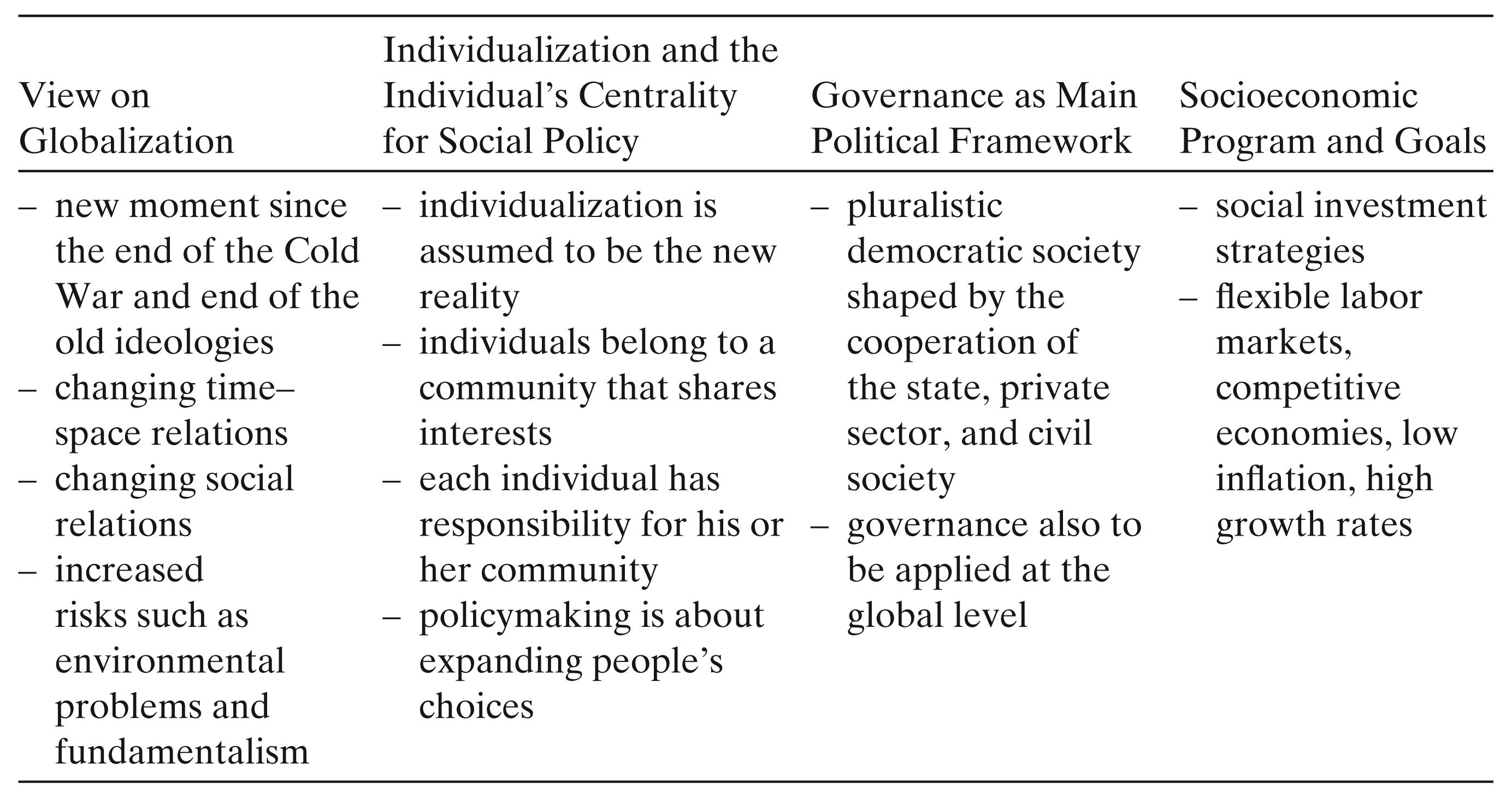
The comparison shows that the sociological, ethical, political, and practical pillars of both approaches, TW and HD, have a large number of overlapping aspects that represent a very similar line of thinking. HD shows a significant theoretical kinship to various Western modernist approaches. The introduction of a new global development agenda has not brought about a significant change in this reliance on a modernist stance. Even more, HD, at least the way it is understood in HDRs, can be defined as the TW of international development thinking and policy. Table 1 summarizes their similarities.
Each pillar in these two programs, TW and HD, however carries certain interrelated risks. An essential shortcoming in the TW’s and global development policy’s analysis, and consequently in their prescriptions is the centrality of globalization and in particular the treatment of globalization as an exogenous phenomenon that does not need to be engaged with any further. The problem is that taking globalization as granted evades the issue of causality in terms of globalization (Kiely, 2005, p. 908, original emphasis). In this way, there is no room for alternative thinking on globalization.
Similarities between TW and HD
Consequently, the socioeconomic framework suggested in both approaches does not challenge the neoliberal guidelines that underlie economic globalization. Instead, these strategies seek to accommodate and adjust to these neoliberal guidelines (Kiely, 2005: Sandner, 2000). The measures suggested in these programs cannot be separated from the liberalization of markets, a focus on economic growth and the neoliberal edifice of the Washington Consensus (see also Weber, 2017).
However, it was the very same Washington Consensus that overlooked human rights abuses in many countries while promoting foreign direct investment and trade liberalization. Globalization has not automatically and universally resulted in a global acceptance of human rights and of liberal democracy. In contrast, in some countries like Turkey, economic globalization was possible due to pressure exerted on democratic forces such as social democratic parties and trade unions, when the opening of the economy went hand in hand with a military regime. Moreover, child labor or women’s bad working conditions at international corporations in developing countries, in particular in the textile industry and in sweatshops, are a direct result of economic globalization (Wichterich, 2003).
In HDR 2016, one can read many positive references to female entrepreneurship through microcredits. However, the vast amount of negative empirical findings on microcredits’ effects does not make it into the report (see also Weber, 2017). Similarly, the opportunities that mobile phone technology offers are part of the HDR 2016, whereas the working conditions of the workers producing those phones are not elaborated. Additionally, the search for the term “decent work,” which is also incorporated in the SDGs, yields only six results in the HDR 2016, while the word “factory” is only in one sentence (UNDP, 2016, p. 43)—and this sentence is not about workers’ working conditions but about pollution. The words “sweatshop” or “textile” do not appear at all. In other words, the Agenda 2030 lacks a critical perspective on its own guidelines and, against this background, its emphasis on human rights becomes unrealistic.
Furthermore, caution is in order when one looks at the central place of the individual in policy design. Measures within the governance framework are an attempt at self-regulation through semantical instruments which are based on neoliberal assumptions of individuals’ increased responsibility for the success in their own lives, and success is equated with successful participation in the market economy (Goetze, 2002, p. 247; Ziai, 2006). Employing the term governance without asking critical questions means that one assumes automatically that states’ autonomy has been increasingly weakened and that states cannot be the main guarantors of the social contract. The term “governance” reveals the neoliberal roots behind the idea of the handover of the state’s responsibilities to civil society and the private sector (Mohan & Stokke, 2000; Ziai, 2006). The state is not expected to take up any significant role in distributing welfare. In Hutton’s (1999, p. 98) words on the TW, “[s]ocial democratic concerns to redistribute income, to manage and regulate capitalism and to sustain a universal welfare state are regarded as ‘old Labor’ …. Education and training become the new touchstones of policy, but within a greatly constrained growth of public spending”.
It is, therefore, the individuals’ own responsibility to participate in the economic opportunities which the global or national private sector or the international or national nongovernmental organizations may provide, including training to increase individuals’ opportunities in the labor market. However, this view ignores the fact that there are population groups who do not have the power to take the first step to take part in the labor market such as discouraged workers or those who are so marginalized that they do not have access to information about the training or income-generating opportunities. A good example is given by Malhotra, Schuler, and Boender (2002, p. 10) who mention that even contacting a microcredit institution may be an expression of a woman’s power to challenge the existing structures. Caution is, thus, also required in thinking about entrepreneurship, as it is necessary to question if individuals freely choose to be entrepreneurs or are forced to choose this path since there are no other alternatives left in the labor market (Güney-Frahm, 2016; Heilman & Chen, 2003).
Hence, the widely employed term “governance” in both pre- and post-2015 agenda is not a neutral term, and neither is “global governance” (Ziai, 2006). The use of global governance in both programs ignores the unequal power relations between the developing and developed countries (Abrahamsen, 2004). Moreover, international organizations like the UN, which are assumed to be one of the main actors of global governance, are points of knowledge creation and dissemination regarding international development (Stiglitz, 1999, p. 319). The United Nations, for example, is an institution where individuals from diverse backgrounds and with different values come together. On the other hand, the bureaucratic forces behind international development policy usually come from the industrialized countries (see also Carant, 2017). The UNDP’s Junior Professional Officer Programme, for example, is primarily only open to citizens of donor countries.
The comparison so far shows that both in the pre- and post-2015 development agendas, a theoretical kinship with the TW exists. The affinity and continuity in the sociological, political, philosophical, and practical pillars mean first—as critics of international development policy have argued for decades—that global policymakers have not ceased to try to find solutions for developing countries with prescriptions derived from industrialized countries. Second, and even more important, sticking to an agenda that is very close to the TW means that global policymakers try to cure current problems with remedies that were implemented in the last decades and actually worsened existing problems. Perhaps if a systematic comparison of these two approaches had held a significant place in the debates on international development policy, this blind spot could have been avoided.
Conclusion and Outlook
The sociological-, political-, philosophical-, and policy-related foundations of the HDRs and the TW rest on similar premises. The UNDP itself states that the HD approach “informed and influenced the 2030 Agenda and the Sustainable Development Goals” (UNDP, 2016, p. 3), but it seems to be more than just an influence. For the Agenda 2030, the continuity with the TW means that some aspects like human rights receive a stronger emphasis in the development policy (Fukuda-Parr, 2016), but the theoretical foundations, in particular the neoliberal tenets, have remained the same (Carant, 2017; Weber, 2017).
However, in both programs, there is a lack of digging deeper into the causes of existing problems and an equal lack of profound critical engagement. Certainly, HD and the TW attempt to find adequate responses to contemporary problems. Problematic, however, is that these considerations are met with superficial solutions as the main theoretical framework in both approaches does not challenge the current global capitalist system. Neither the role of financial markets nor the backlash in democratization and human rights in many countries, as a result of globalization are explained or addressed in a satisfactory manner by either of the two approaches.
The mainstream global social policy of the last decades has focused on “promot[ing] individual opportunity while leaving the structure of capitalism to develop largely as it chooses” (Hutton, 1999, p. 98). There has been a lack of a foundational critique at capitalism and at its neoliberal interpretation. The global Agenda 2030 is hardly able to offer a transformative solution as the actors still prefer to operate within the existing political and economic structures of capitalism. Sticking to the line of thinking that dominated policymaking in the pre-2015 agenda means that today’s policymakers in the field of international development have not learnt from past mistakes.