



Abstract
This article identifies the dilution of key aspects of labor standards and establishes their systematic links with the global integration of the Malaysian economy through capital and labor inflows. The approach taken in this article is that investors and migrants, may, serve as channels of (lower) labor rights. For this purpose, the study consolidates information through interviews conducted with trade unions, activist groups and non-governmental organizations. The findings suggest that migrants have influenced and lowered the labor rights for the unskilled group. Since migrants have little information about their rights, they are directed into the secondary labor market with insecure and exploitative jobs. They have therefore become a preferred source of employment, “naturally” relegating the unskilled locals into contractual jobs with minimal to no work entitlements.
Introduction
The two major forces that have impacted extensively the labor markets in Southeast Asia are industrialization and globalization (see Rasiah et al., 2015). The former refers to the emergence and expansion of manufacturing and service activities, while the latter relates to the integration of the economy with the global market. To date, there is no consensus on the underlying causes of the undesirable outcomes in labor markets due to globalization. The impact of global integration of labor markets on labor standards, more specifically, varies across countries, and invariably depends on state policies regulating those markets.
The Malaysian labor market, which is highly integrated through labor and capital (foreign direct investment [FDI]) inflows, is indeed riddled with many problems (large presence of unskilled migrant workers [hereafter migrant workers will be used to refer to the unskilled segment]; low labor absorption; wage stagnation; low quality of labor; and low labor standards). Policy instruments in Malaysia have been partially effective in regulating and managing labor (Devadason & Chan, 2014; ILO, 2016; Kanapathy, 2001; Pillai, 1995; World Bank, 1995) and capital inflows. A wide range of labor market policies, coupled with frequent policy reversals, and a lack of continuity in the policy direction have been cited as reasons for the policy misalignment. Further, the overwhelming presence and mistreatment of foreign labor in the economy (Mullen et al., 2019), in turn, has consequently raised concerns on labor rights’ and the ability of the labor market to integrate these workers. At the heart of the current policy debate, therefore, is the failure of internal factors, namely the national labor laws in the protection of the rights of workers.
The problems related to labor standards are not fully understood. Following which, no comprehensive policy has been outlined to address the problems in the labor market in Malaysia (Nambiar, 2017). Recognizably, the discussion of labor standards is not complete without understanding the extent to which foreign labor policies, and integration through industrial and investment policies, have influenced the former. As such, the related literature has largely focused on the standards of the host labor market in attracting multinational corporations (MNCs) (Cooke, 1997; Javorcik & Spatareanu, 2005; Kucera, 2002). Departing from previous research, the approach taken in this article is that migrants and investors (external factors/actors), may, serve as “channels” of (lower) labor standards given the structural (development) dependence of Malaysia on the twin flows of labor and capital. The key question the article seeks to address is: Has integration through labor and capital inflows affected labor practices and regulations in Malaysia? Framing the question in a specific manner yields the following: Are unskilled migrants and investors “channels” of lower labor standards?
The article, through a survey of various related stakeholders (trade unions, activist groups, and non-governmental organizations [NGOs]), therefore aims to advance the debate regarding labor standards and economic openness and subsequently derive some policy lessons from the unique experience of a highly integrated labor market like Malaysia. The findings of the study are then used to forward some implications for labor-and investment-related policies in dealing with labor standards. The article is organized as follows. The second section reviews the literature to establish the links between economic openness and labor standards. Then follows a profile of labor market policies, and state promotional policies (industrial/investment policies) that have encouraged capital and labor inflows through the export-industrialization phase in Malaysia since the mid-1980s in third section, to set the background of the study. The fourth section details the qualitative approach adopted for the study and discusses the findings from the interviews. The fifth section concludes.
Theoretical Considerations
Definition of Labor Standards
Labor standards, as defined by the International Labour Organization (ILO, 1998, 2003; Brown, 2000), refer to core labor standards and economic standards. Core labor standards refer to fundamental human rights and can be classified into freedom of association and the right to collectively bargain; elimination of forced and compulsory labor; elimination of employment discrimination; and abolition of child labor. Conversely, economic standards include elements such as minimum wage laws and levels of benefits and working conditions (see also the 2006 Ministerial Declaration of the United Nations Economic and Social Council on Full Employment and Decent Work).
This article adopts the core labor standards, focusing specifically on workers’ rights (or collective labor rights that include right to join unions, bargain collectively, right to strike) instead of human rights, 1 and the economic standards that focus on individual labor rights (compensation and working conditions).
Migrations of Labor-cum-Capital and Labor Standards
Historically, there are close linkages between labor and capital for high labor immigration economies. One argument linking the inflows of labor and capital is business-driven migration, whereby the by-product of FDI is the international mobility of workers. Namely, efficient seeking FDI that tends to be vertically integrated results in the relocation of labor-intensive activities to countries with lower labor costs. Evidently, Malaysia, with its open immigration and open investment policies, supports that argument of “capital chasing labor” (Hatton & Williamson, 1998), as unskilled migrants continue to induce FDI inflows (Devadason & Subramaniam, 2016).
Globalization, fostered by pro-immigration and investment policies, is also expected to undermine national efforts to impose stringent labor standards, the so-called race-to-the-bottom 2 thesis, particularly when penalties for noncompliance are low in the host country. This applies and relates to migration decisions of the unskilled and location decisions of MNCs (Rodrik, 1996). Exponents of the “race-to-the-bottom” thesis predict that poor people migrate in search of better welfare benefits, causing policymakers in host countries with relatively higher benefits to reduce payments to avoid a further influx of migrants. Their presence in the host economy can also create new forms of labor segmentation and discrimination. Similarly, MNCs are found to utilize temporary (Frobel, Heinrichs, Kreye, & Burgess, 1980; Henderson, 1989; Wallerstein, 1979), nonunionized exploitative work arrangements (Cardoso & Faletto, 1971; Evans, 1979; Maskus, 1997; Smith, Bolyard, & Ippolito, 1999), immigrant, and unskilled labor to reduce production costs.
Optimistic accounts of the presence of MNCs, however, suggest a “çlimb-to-the-top,” with positive labor market outcomes in the host economy in the form of higher wages (Myint et al., 2015), better compensation packages, and higher job security than comparable domestic firms. Foreign direct investors are said to bring best practices for workers’ rights to host countries (Aggarwal, 1995; Busse, 2003; Finnemore, 1996; Garcia-Johnson, 2000; Kucera, 2002; Mosley & Uno, 2017; Organization for Economic Co-operation and Development [OECD], 2000, 2002). FDI inflows are also considered to be greater in countries with stronger workers’ rights, as MNCs with their strong corporate culture strive to avoid bad publicity and product boycotts by investing in countries with low labor standards.
The persistent labor and FDI inflows to Asia, more specifically, has been dealt with broadly in terms of their impacts on employment and wages (including job creation/displacement, labor productivity and inequality, poverty, and spillovers). Studies that relate factor mobility and labor standards in Asia remain limited. Harrison, Scorse, Collins, and Elliott (2003) find a positive relationship between compliance with labor standards, particularly minimum wage laws, and outward orientation, and foreign ownership, in the case of Indonesia. Alternatively, Raman (2008) argues that MNCs in Malaysia restricted growth and the influence of trade unions, removed well-established minimum standards, blocked minimum wage legislations (in the past), weakened collective bargaining, and flooded the labor market with foreign workers.
Clearly, the various elements of the “race-to-the-bottom” thesis enjoy different degrees of support from previous research. Less attention has, however, been paid to the interactions between the mobility of labor and capital and their joint influence on labor standards in the host economy. Though the twin flows of labor and capital have left enduring legacies on the labor market outcomes in Asia, there is a paucity of research examining the impacts on labor standards due the less available/quantifiable measures of labor rights. This justifies the importance of exploring further, in a qualitative context, the interactions between external drivers, and between the internal (domestic policies) and external drivers of labor rights outcomes.
Labor-and Industrial-related Policies in Malaysia
Malaysia embarked on an aggressive export industrialization drive since the mid-1980s. Following which, she courted inflows of labor and capital to drive the industry (see Figure 1). The employment of foreign workers grew from a mere 136,000 in 1982 to 2.2 million in 2017, while FDI inflows, though volatile, increased from USD 1.4 million to USD 9.5 million. The State therefore became reliant on both migrant labor and FDI, which are now entrenched features of the local economy. To avoid the threat of capital exit from the “footloose” 3 MNCs, more so when the capital relies on unskilled labor, the rigor of the country’s labor standards has been compromised (Raman, 2008). Table 1 summarizes the key aspects and changes of foreign labor policies, industrial/investment policies and ratifications of core labor standards that have a direct bearing on labor standards and workers’ rights in Malaysia.

Foreign workers (FW) is on the primary (left) axis and foreign direct investment (FDI) is on the secondary (right) axis.
Malaysia—Key-related Policies Affecting Labor Standards, 1985–2019 (April)

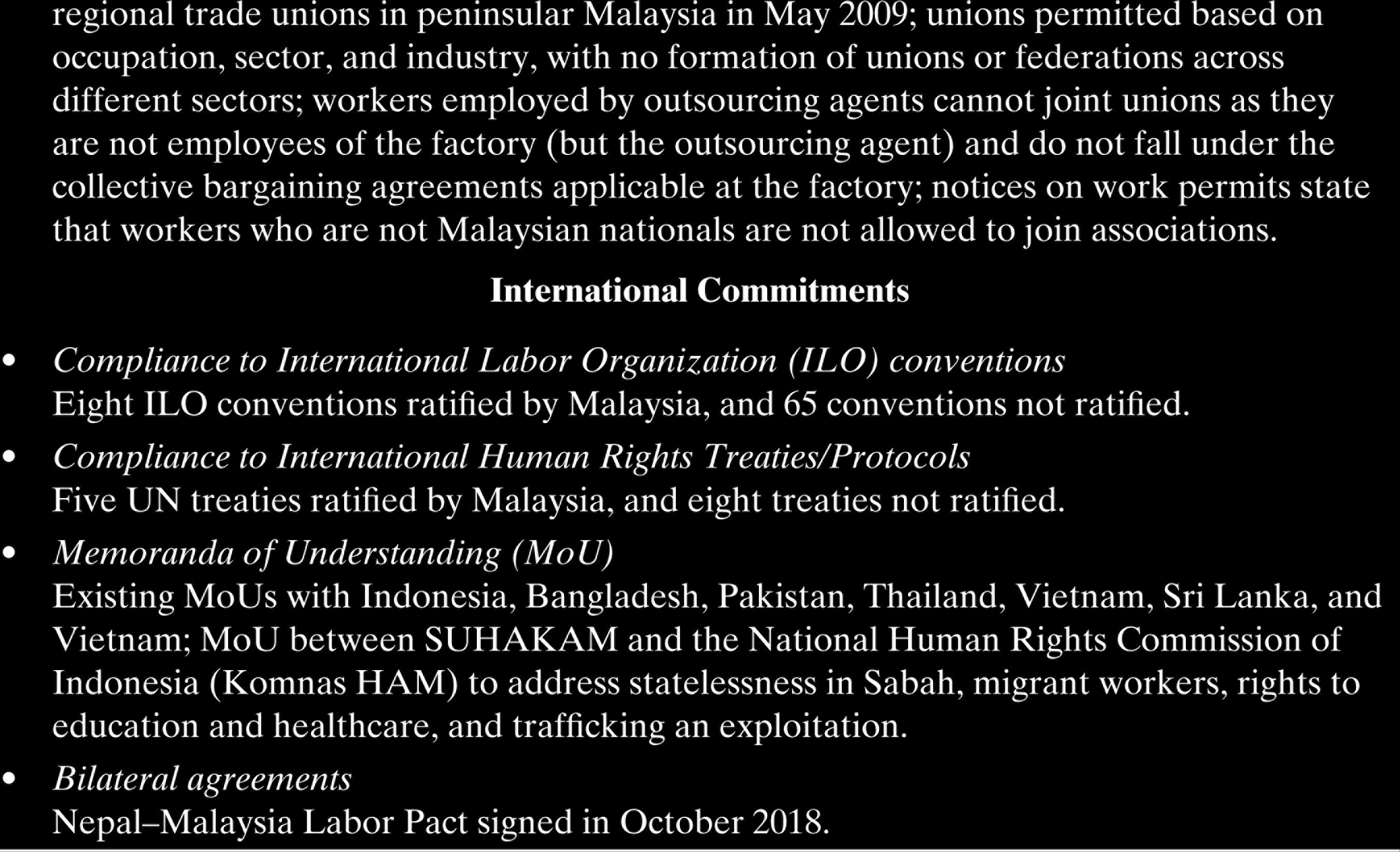
For example, the government responded to the preferences of mobile capital in the flagship electronics industry by restricting trade unions in factories, and the formation of a national union for this industry until 2009. Due to the lack of an organized workforce that can defend its rights, the workers in the electronics industry were subject to harsh working conditions (long working hours). The labor laws, especially on trade unions, are therefore said to fall short of minimum international standards. The electronics industry is also the largest employer of unskilled migrants, and therefore it is not surprising to note that Malaysia has not ratified several conventions and treaties directly related to migrant workers, such as Migration for Employment Convention (Revised), 1949 (No. 97), Migrant Workers (Supplementary Provisions) Convention, 1975 (No. 143), concerning migrations in abusive conditions and the promotion of equality of opportunity and treatment of migrant workers, and the International Convention for the Protection of the Rights of All Migrant Workers and Members of Their Families.
Other related conventions that have not been ratified apply to forced labor (Protocol of 2014 to the Forced Labour Convention, 1930), freedom of association, collective bargaining and industrial relations (Freedom of Association and Protection of the Right to Organize Convention, 1948 [No. 87]; Workers’ Representatives Convention, 1971 [No. 135]); occupational safety and health (OSH; Occupational Safety and Health Convention, 1981 [No. 155]) and social security (Equality of Treatment [Social Security] Convention, 1962 [No. 118]).
Worth mentioning here is that there is horizontal segmentation 4 in the labor laws by region (Peninsular, Sabah, and Sarawak). As of 2015, foreign workers in Sabah may be granted family visas as they come under the Sabah Labor Ordinance (CAP 67), and not the Children and Young Persons (Employment) Act 1966. The children of the migrant workers (mostly Indonesians and Filipinos), engaged in plantation work, have given rise to the issue of child labor among palm oil growers’ in Sabah.
At this juncture, the country is amending their labor laws, namely the Trade Unions Act 1959, the OSH Act 1994, the Industrial Relations Act 1967 and the Employment Act 1955, to provide more comprehensive protection to workers. The amendments to the OSH will include increased penalties for employers who fail to ensure safety, health, and welfare at the workplace (The Sun Daily, 2019).
Data and Findings
Data Sources
A series of in-depth face-to-face interviews were conducted with trade unions, activist groups, and NGOs. To ensure the reliability and the competence of informants, interviews were held with key persons who are directly involved in foreign worker matters. Interviews were conducted with the Malaysian Trade Union Congress (MTUC) 5 , and its affiliates, namely the Metal Industries Employees Union (MIEU), Electrical Industry Workers Union (EIWU), Non-Metallic Mineral Products Manufacturing Employees Union (NMMPMEU), Food Industry Employees Union, and National Union of Plantation Workers (NUPW). Other stakeholders interviewed include the Human Rights Commission of Malaysia (SUHAKAM), Tenaganita (a civil society organization), and The Forest Trust (TFT, renamed as Earthworm Foundation). The nine interviews were conducted in November 2018 and in May 2019.
Information gathered through face-to-face interviews included the following: (a) state of labor standards (including the adoption of ILO conventions and the International Human Rights Treaties) in Malaysia; (b) the role of capital and labor inflows in impacting decent work and labor practices; and (c) the extent of reforms in labor governance, and alignment of labor standards with international requirements. Specifically, the information from the experts was used to explain some of the observations and validate the qualitative findings from secondary sources. Therefore, interviews were based on a predefined structured questionnaire. The structure of the interview was in a discussion form, typically 90 minutes per session, to solicit much information (cross-sectional information). In brief, the sample was purposive. The use of both secondary and primary methods to gather data for this study served as a triangulation approach to enrich the findings.
Causal Connections
The causal channels through which foreign labor and (vertical) FDI, driven by the foreign labor policies and industrial policies, are hypothesized to affect forced labor, employment discrimination, levels of benefits and working conditions (working time, wage and nonwage remuneration, and health and safety in the workplace), freedom of association/collective bargaining, and ratification of international conventions/human rights treaties, are illustrated in Figure 2.
Expansive foreign labor policies coupled with generous investment incentives directly increased the inflow of migrant workers and inward FDI (same direction of factor flows), respectively. Existing evidence supports patterns of interdependence between unskilled migrants and foreign capital to Malaysia before 2000, and thereafter unskilled migrant workers have induced capital inflows to Malaysia (Devadason & Subramaniam, 2016). That evidence suggests that the market for unskilled labor is relevant for MNCs and for FDI location decision. This research extends on the arguments on the interdependence between capital and labor, and the “capital chases labor” in terms of international factor mobility to establish the relationship between factor flows with labor rights. (The last column in Figure 2 summarizes the outcomes on the different segments of labor rights based on the interviews conducted with the various stakeholders.)

An argument is made, first, for a broader view of labor costs. The reasoning here is that labor costs embody labor standards, and lower labor standards (e.g., violations of basic freedom of association and collective bargaining rights, and work discrimination) lead to lower labor costs and vice versa. By restricting collective labor rights, firms can reduce the demands for wages and nonwage benefits (Aidt & Tzannatos, 2002; Gallagher, 2005; Graham, 2000; Kucera, 2002; Murillo & Schrank, 2005). Second, to extend the one-sided view that the conditions of the domestic labor market dictate the migration decision and FDI location to a two-sided approach of the relationship. That is, the state of labor rights may be transmitted through the vulnerable (unskilled) migrants and the exploitative nature of capitalists/investors.
State of Labor Standards
Historically, there has been a big divide in the protection between the locals and migrant workers in the unskilled category. With effect from January 2011, it was made compulsory for all foreign workers to be covered by medical insurance, and with effect from January 2019, all foreign workers to be provided equal protection as the locals under the Social Security Organization (SOCSO). Yet, employers’ noncompliance to health and safety conditions are considered the most critical issue for migrants by the unions. They have minimal healthcare coverage, apart from other issues such as unpaid medical leave, and encounter harassments within the workers’ hostels. Given a general lack of protection at the workplace, a total of 3,773 workplace accidents were recorded for 2018, with the largest incidence of accidents reported for the construction sector (Bernama, 2019).
Based on the interview with SUHAKAM, it is gathered there could be some underreporting, as only 63 labor-related complaints were filed with the Commission from January 2015 to December 2017. The Commission, however, does recognize that the numbers have increased from 12 to 18 and subsequently 33 complaints between 2015 and 2017. The 63 cases filed during that period relate to human rights and violence.
Another group vulnerable to exploitation in the form of wages, working, living, and health conditions are the undocumented migrant workers and the refugee community 6 . Tenaganita flagged the problem of not addressing why undocumented migrants have been on the rise in Malaysia, particularly the parties that are responsible for the illegal status of these workers. Engaged in helping the undocumented migrants through the PATI (pendatang asing tanpa izin) rehiring program 7 , the rights group raised three key points: first, there is still no clarity on PATI; migrants (refugees, asylum seekers, and stateless persons) without permits or migrant workers without permits as not all migrants are classified as “workers.” Second, the group argues that the incidence of documented workers shifting to the undocumented status is somewhat high among the domestic helpers, plantation, and construction sectors due to exploitation by recruitment agents and employers. Third, employers are keen on employing the undocumented migrants because of less accountability. Additionally, there are about 154,000 refugees in Malaysia, of which 93,000 are employable, and they are working 8 in the informal economy. They are also cited to be abused by many actors, whereby there are now calls not to deny them jobs for security instead of just survival (Aris, 2019a). According to them, rights to work, as argued, will reduce the dependency on migrants.
Given the above state, Tenaganita SUHAKAM and the Malaysia Bar assert that the undocumented migrants should not be discriminated against, and their rights recognized (see also Zahiid, 2018). The Malaysian Bar has recently called for the scope of the provision of legal aid be expanded to migrant workers and refugees (Lim, 2019).
Impact of Labor and Capital Inflows
To begin with, most unions do not blame the MNCs for the exploitation of unskilled workers (including migrant workers). According to them, the unskilled employed at local corporations (The Daily Star, 2018) and small-and medium-sized enterprises (SMEs) are also found to be exploited in some form or the other (forced labor, see Verite, 2014, forced overtime, debt bondage, withheld wages, and passport confiscation).
The bigger issue cited by the unions is the problem that follows from the large numbers (stock) of foreign workers that occupy the unskilled segments of the manufacturing workplace relative to their local counterparts. At this juncture, it is worth noting that the unions remain divided on the need for unskilled migrants in the manufacturing sector. Those that argue based on employer preferences for migrants relative to locals also point out that there has been a compromise by enforcement agencies in the recruitment practices of migrant workers. Some established electrical companies are found to have a ratio of one local to four migrant workers, when the eligibility is only 1:3 for an export-oriented manufacturer. The additional migrants were found to be recruited directly by the companies concerned. This suggests that the abusive practices in recruitment did not surface merely with the proliferation of outsourcing companies. As such, the recent termination of outsourcing companies, though lauded, may not see the end of such abuse in giving work permits liberally.
What follows is that the surplus of migrant workers has downgraded the nature of employment for the unskilled locals, according to the union in the food industry. The locals, who compete with the migrant workers for jobs, are literally hired “permanently” on contract by some employers, with their contracts being renewed multiple times for long periods of 10–15 years. The union cited a case of company that hired 800 local workers on a contract basis, with no entitlements such as wage increment and work benefits. Rightfully, those with fixed-term contracts should get the same benefits as normal employees, as stipulated in the Employment Act 1955. The local contract workers are also left with a poor deal as they are further denied other benefits accorded to migrant workers, such as accommodation and transportation to work.
From the interviews with the union from the electrical industry, it is also learnt that though employers do not favor (and in some cases even deter or threaten) migrant workers from joining the union, the local workers also resent migrants from being represented by the company union. Alternatively, many migrant workers choose not to join their company union given their temporary status and the subscription fees to be paid for union membership. The migrants, for example the Nepalese, choose to continue their union membership with the General Federation of Nepalese Trade Unions (GEFONT) in their home country. The union cited a case where an established electrical MNC in Malaysia with approximately 1,600 foreign employees agreed to the creation of a union in its organization, but there were no voters for the union representation.
Some unions, therefore, reckon that shifting the blame for the lack of workers’ rights to MNCs alone is not justified. Instead, they advocate that unions should change their approach in dealing with these large corporations. Unions, they stressed should work with corporations to ensure job security for the unskilled as some industries such as electrical and electronics, are already seeing massive slowdown, and many MNCs in those industries are relocating to low-cost sites like Vietnam and Myanmar. Their argument is that further capital flight through company closures is going to generate job losses to the unskilled (foreign and local) and skilled.
The MTUC, however, states that the code of conduct for MNCs in electronics is not that clear. This industry is subject to fragmented production involving many suppliers and sub-suppliers along the supply chains that produce according to standards set out by the “lead firm.” According to the union, it is difficult to monitor labor standards along those supply chains to ensure responsible sourcing as the large corporations are not willing to reveal information on their suppliers (see also Ramchandani, 2018). Apart from the labor standards along the supply chain, the union in the food industry observed not all MNCs in Malaysia adhere to their global labor practices.
The TFT argues otherwise in the case of palm oil in Sabah, stating that larger corporations instill better labor practices than smaller companies, and that bad labor practices are prevalent largely in the milling and the plantation work. The TFT also adds that child labor of migrant families in the plantation sector in Sabah is prevalent among smallholders. Though these children deserve protection and education, the restrictions on these children’s participation in the labor market 9 may not be appropriate since these children’s earnings are a crucial family resource, and schooling may be unavailable for migrant children. The TFT argues for the prohibition of children participating in “hazardous” work, and for that purpose, an identification of “light work” in the plantation sector (see also The Forest Trust [TFT], 2018) is needed. In fact, MNCs engaged in the plantation sector have displayed their responsibility by providing alternative education (learning centers) for migrant children (including the stateless and Malaysian children).
Noncompliance with award or collective agreement is cited to be a major issue by the metal and nonmetallic mineral industries union. From the interviews, it is noted that large corporations (both local players and MNCs) use the judicial review to cause protracted delay in settlement of industrial disputes. It has also been recently expressed by the Timber Employees Union of Peninsular Malaysia that compensation has not been paid for migrants who have suffered injuries at their workplace or to family members in the country of origin in the case of deaths of migrants (Aris, 2019b).
Based on the discussion with the unions, it was posited that there is no clear connection between MNCs per se and the decline in labor rights. However, there appears to be a close link between the presence of unskilled foreign workers and the dilution of workers’ rights, following from the discussion with the unions and the activist group.
Reforms in Labor Laws and Practices
Migrant workers are vulnerable as they do not know their rights (see Pillai, 2019), according to the union in the food industry. Employers, therefore, disregard their welfare, forcing them to work long hours (12 hours per day) and multitask. MTUC has therefore embarked on projects to educate migrant workers on their rights. However, this initiative is only partially effective; in that, it only reaches the documented migrants, and not the larger group of undocumented segments that continue to remain ignorant of their rights.
MTUC has also sent a memorandum asking the government for a Royal Commission Inquiry to the plight of foreign workers as there is abusive practices and corruption from the recruitment and sourcing to the employment stages of these workers. The recruitment of migrants through outsourcing companies since 2004 resulted in some workers working with permits, while others do not have permits. The use of third parties to bring in workers to facilitate working programs in Malaysia was also cited as a problem in Malaysia, as the migrants paid exorbitant fees to recruiters and end up as entrenched “slaves” to the recruiting agents. A case was cited by an NGO where some school-leavers from Central Java, Indonesia, were solicited to work with electronic companies in Malaysia, but upon arrival, they were sent to food production factories. This system also led to some foreign workers being cheated of their status to enter the country as legal workers, leaving them as undocumented, while others became subjects of the human trafficking racquet. The unions and the NGOs, therefore, voiced their opinion to the government to abolish this system that functioned as a “syndicate.” The union noted that the MNCs favored this system as it facilitated the recruitment of workers to their company while absolving their responsibility over these workers. An NGO added that some MNCs benefited from this system as they used these companies to supply them with undocumented workers. Though the government has finally resorted to ban the outsourcing companies in March 2019, the implementation of this ban raises serious concerns. The policy provides for the outsourced migrants to be absorbed as direct employees by their respective companies, repatriated by the outsourcing entities if they do not get direct employment, and for those that remain after March 2019, they will be declared as “illegal”. This is considered a serious injustice to foreign workers who must pay for the policy mistake of the country (Maliamauv, 2019).
The protection offered to migrants under the Workmen’s Compensation Act (WCA) 1952 was grossly inadequate relative to the SOCSO that applies to the local workers (see also Chan & Devadason, 2007). Upon death, the maximum coverage for a migrant worker is RM 25,000 under the Act. With effect from January 2019, the Act was abolished, following which social security protection for migrant workers is covered by SOCSO. Despite giving equal protection to migrants and locals, the MTUC argues that the payout to the migrant worker in the case of an injury involves time-consuming paperwork, beginning with filing the claim with the Labor Department, followed by a request for a report on the nature of the injury from the government clinic where the foreign worker was attended to, submission of report of the injury to the Labor Department for further assessment and recommendation to the insurance company. The Union also feels that the government is not ready for addressing the safety and health convention, Convention 102. The MTUC also forwards the lack of political will of the Malaysian government to ratify Convention 087 on freedom of association and protection of the right to organize for both local and foreign workers.
The levy system, according to the union, is a failure as the yearly amount charged per worker is low relative to the profits raked by the companies that exploit these workers. The unions explained that despite employers having to provide accommodation and transportation for foreign workers relative to their local counterparts and having to face with the discipline issues among foreign workers, employers continue to show preference toward foreign workers. This reflects the gains that companies derive from utilizing foreign workers. As for the minimum wage, there is no issue of noncompliance among employers. However, the unions are looking forward to an upward revision in the wages from the current RM 1,100 and disagree with the way in which wage fixing is done, which is restrictive and not in line with international standard. The unions are against the motion to set the minimum wage based on sectors (Aris, 2019c). Another issue cited by one union is the productivity-linked wage system (PLWS), and it has allowed employers to deny decent and acceptable wage for workers. The nonmetallic mineral union cited an isolated but peculiar case whereby an MNC in the industry had renegotiated the wages based on the minimum wage, but at the same time lowered the maximum wage from the previous limit in the collective agreement of RM 2,500–1,800.
There also calls for legally binding bilateral agreements on manpower recruitment to promote fair and ethical recruitment, labor rights, and decent work of migrant workers (Bhuyan, 2019). Unlike the preferred nonbinding and less formal memorandum of understanding (MoU), bilateral agreements will ensure that both the countries of origin and destination are responsible for migrant workers. For example, under the recently signed Nepal–Malaysia Labor Agreement in October 2018, migrants will pay less as their airfare, visa, and medical fees will be borne by the Malaysian employer.
Concluding Remarks
While acknowledging that the influences on labor rights may be internal and not just external, the focus of this article is on the latter. Generally, there is little evidence based on the interviews with the unions and the NGOs to support the allegation that migrants and investors are solely to be blamed for the current state of labor rights in Malaysia.
One common take among the unions is that some (but not all) MNCs tend to adapt to inferior local practices than impose their own, concerning workers’ rights. It should be recognized that how MNCs apply best labor practices do not depend on the corporate culture of the firm per se, but also on domestic policies (labor laws and practices) that shape and monitor their behavior. Policies that compromise on labor standards are not the panacea for attracting FDI.
If anything, the findings suggest that migrants have contributed to the state of low labor rights among the unskilled. Migrants lack the awareness of their rights as pointed out by the unions and the rights group, and this again is compounded with internal factors that further downplay their rights, such as no union representation. Consequently, the surplus of migrants (documented and undocumented), in turn, erodes the position of the local skilled, who also get exploited by employers, as they have no choice but to accept contractual jobs that offer no work benefits. The local workers also become underrepresented as the union membership declines with the large number of migrant workers that are nonunionized in the industry.
For improving labor standards, the government needs to work with the NGOs and unions to raise awareness of labor rights and promote more responsible behavior of employers. Importantly, the government needs to address corruption and collusive behavior between agencies and employers and enforce internationally accepted labor standards. The unions, that appear divided and fragmented in terms of their perspectives on the role of migrants and their rights, need to consolidate their effort to fight a common cause of improving workers’ rights for all.
Footnotes
Acknowledgements
The research for this article was supported by the European Union H2020 Framework Programme CP-2016 under grant agreement no. 770562 (Grant No: IF002AB-2018) and the Ungku Aziz Centre for Development Studies, University of Malaya (Grant No: PD003-2017).
Declaration of conflicting interests
The author declared no potential conflicts of interest with respect to the research, authorship, and/or publication of this article.
Funding
The author received no financial support for the research, authorship, and/or publication of this article.